Business Negotiation Core Skills
Begin
14 pages · ~28 min
Business Negotiation Core Skills
Learn essential negotiation strategies and techniques to achieve better outcomes in business dealings. Ideal for professionals seeking practical skills in preparing, conducting, and closing successful negotiations.
What you’ll learn
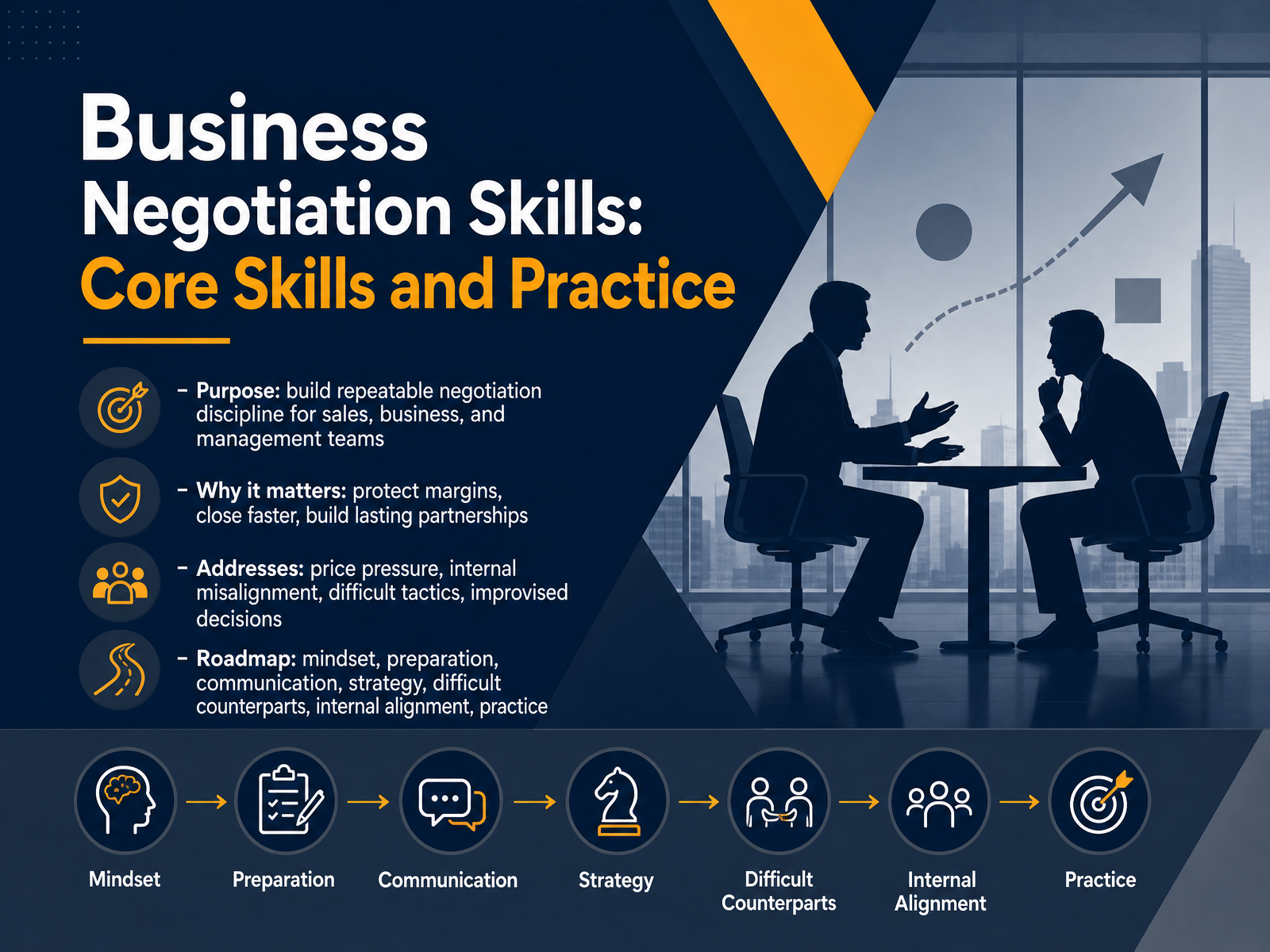
- 01Business Negotiation Skills: Core Skills and PracticeWelcome. If you're in sales, business development, or you lead a team that has to defend its numbers, you already know this truth: every conversation about price, scope, or timeline is a negotiation. The problem is, most of us wing it. We improvise under pressure, give away margin we didn't need to lose, and then wonder why the deal felt like a battle. This course changes that. Our goal is to build a repeatable negotiation discipline, one that protects your margins, closes deals faster, and actually strengthens partnerships. We'll address the real pressures you face: price pushback, internal misalignment, difficult tactics from the other side, and those decisions made on the fly that you regret later. Over the next sessions, we'll cover mindset, preparation, communication, strategy, handling difficult counterparts, getting your own team aligned, and plenty of practice. You'll leave with a structured approach you can use tomorrow. Let's start by making the business case for why discipline matters so much. spjimr.orgpdtraining.com.auunichrone.com+21 min
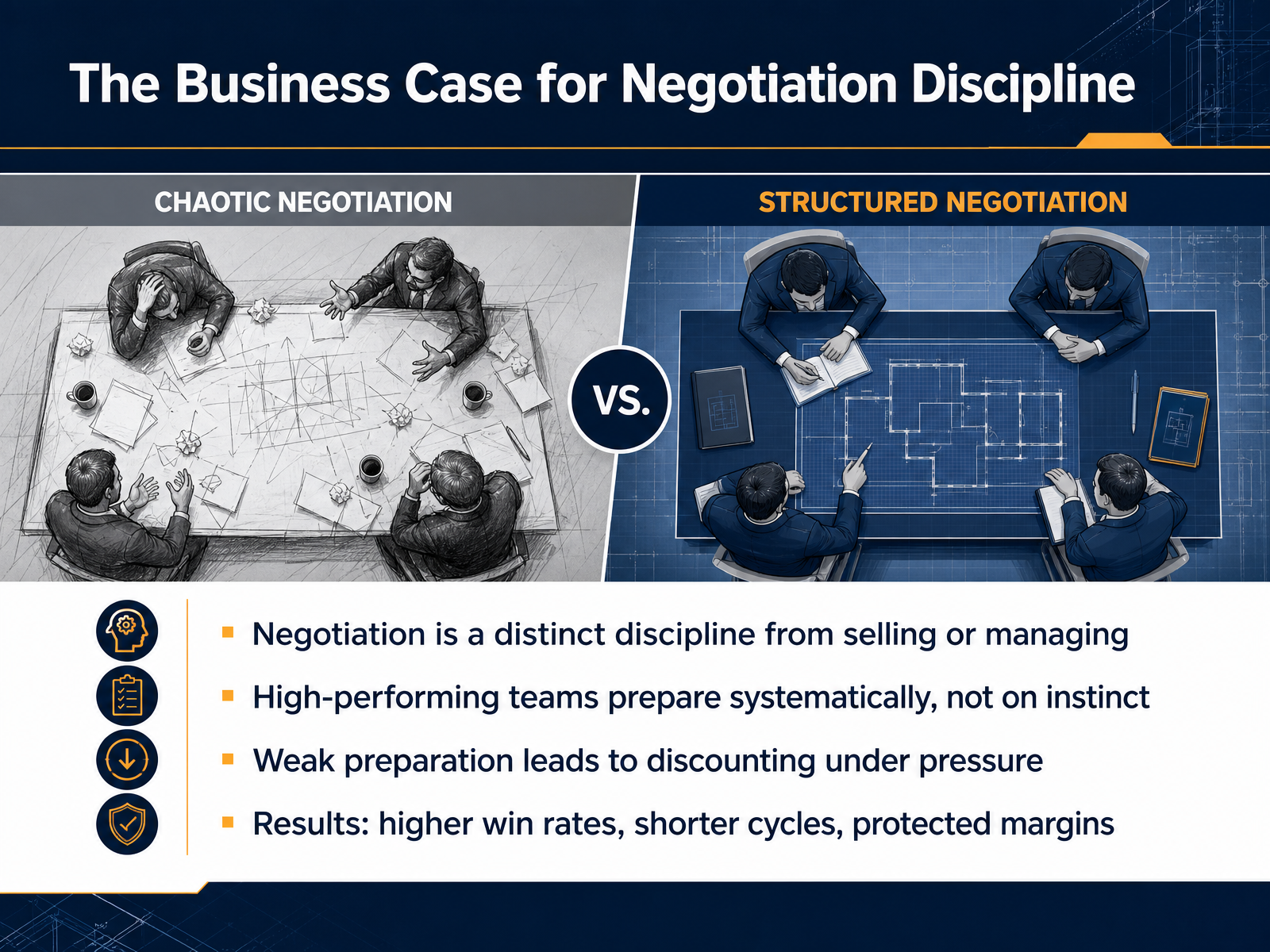
- 02The Business Case for Negotiation DisciplineLet's talk about why negotiation deserves its own discipline. You'll likely already know that being great at discovery or demos doesn't automatically make you great at negotiation. They're different skill sets, requiring different preparation and different frameworks. High-performing teams don't rely on instinct. They prepare systematically, with a clear walk-away point, defined tradeables, and a map of who really decides. When preparation is weak, you discount under pressure. It's that simple. The numbers back this up. Teams that invest in structured negotiation see higher win rates, shorter sales cycles, and protected margins. In fact, one study found organizations with rigorous negotiation training experience up to thirty percent higher win rates. So this isn't about personality or natural talent. It's about building a repeatable system. That system starts with your mindset, which is exactly what we'll explore next.
 alignednegotiation.comredbearnegotiation.cominddist.com+21 min
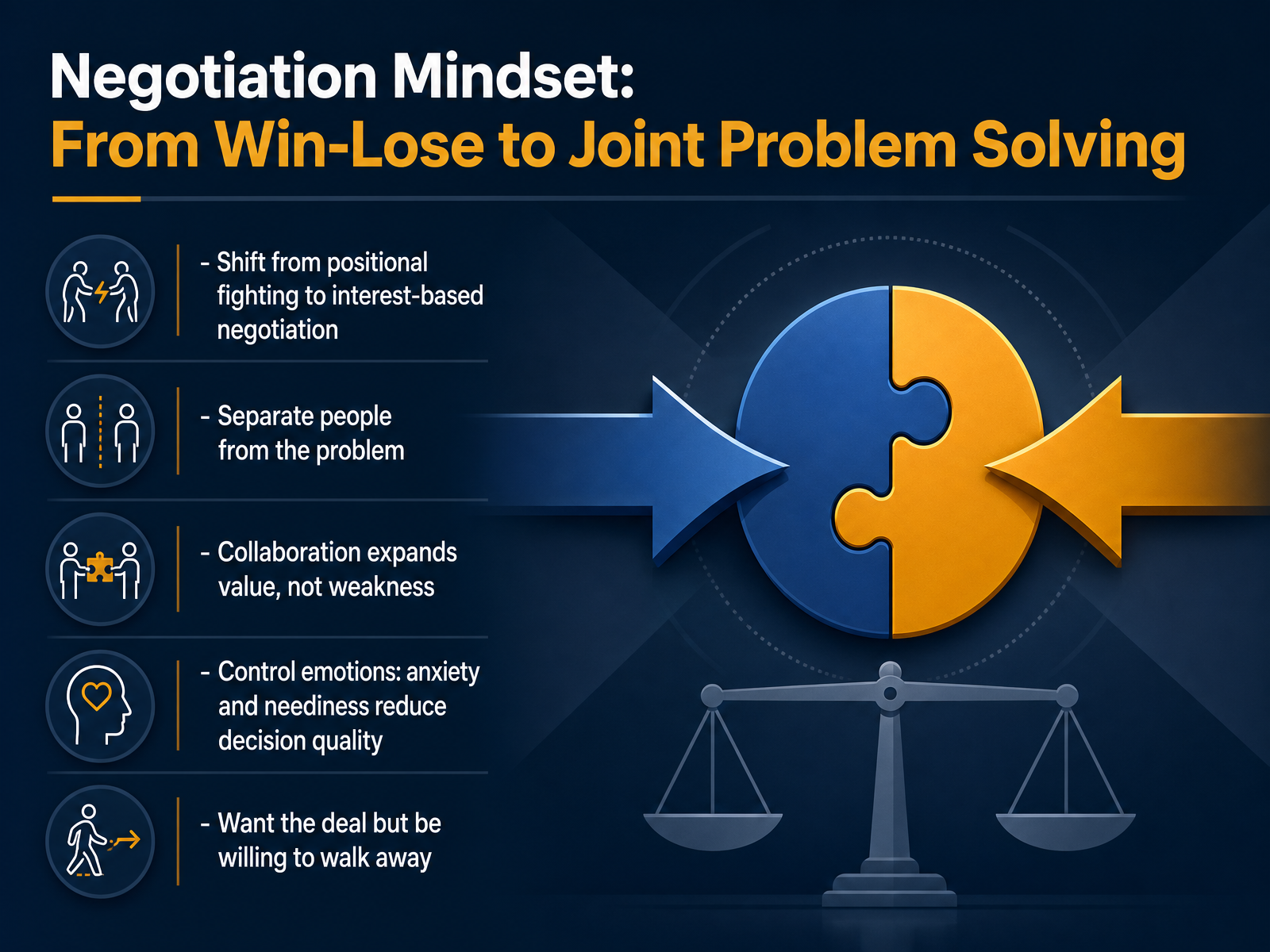
 - 03Negotiation Mindset: From Win-Lose to Joint Problem SolvingLet's talk about mindset, because it determines everything that follows. The biggest shift you'll make is moving from positional fighting to interest-based negotiation. Don't argue over stated positions like a specific price. Instead, dig into the interests underneath: the budget constraints, the timeline pressure, the internal politics. That's where solutions live. This also means separating people from the problem. You can push hard on the terms while still respecting the person across the table. Collaboration isn't weakness; it's how you expand the value available to both sides. Now, the emotional piece. Anxiety and neediness will cloud your judgment and lead to bad decisions. The antidote is simple in theory: want the deal, but be willing to walk away. When you know your walk-away point, you project calm, and that calm is a source of power. We'll get into how to define that point next, with the preparation tools you'll need.
 pon.harvard.edurainsalestraining.comsalesprep.ai+21 min
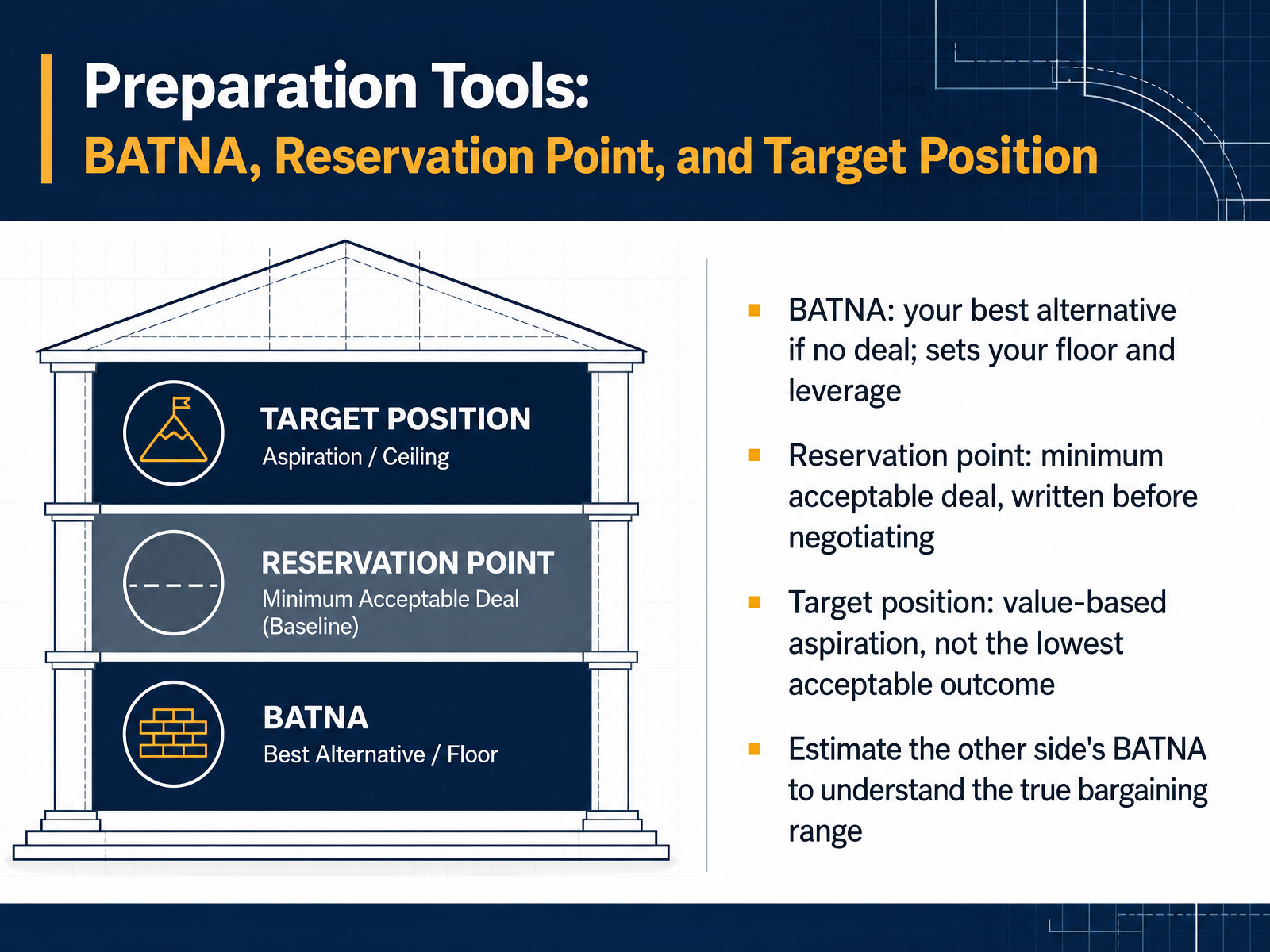
 - 04Preparation Tools: BATNA, Reservation Point, and Target PositionNow let's get into the tools that turn preparation into leverage: BATNA, reservation point, and target position. You'll likely already know BATNA as your best alternative to a negotiated agreement. It is, quite simply, your walkaway option, the path you take if this deal falls through. That alternative sets your floor. It is the source of your power, because your strength at the table doesn't come from your offer, it comes from your alternatives. Next is your reservation point. Write this number down before you even sit down. It's the absolute minimum deal you will accept, the point below which you walk away. Decide it in advance, and do not negotiate it with yourself in the room. Your target position is different. That is the value-based aspiration, the number you want based on the value you deliver, not the lowest you are willing to accept. And finally, don't stop at your own analysis. Estimate the other side's BATNA. What will they do if they don't buy from you? Go to a competitor, build internally, or do nothing? Understanding their alternatives reveals the true bargaining range and tells you how much pressure you can apply. So as a takeaway, one strong BATNA, one written floor, one clear target, and an educated guess at their side will put you ahead of most negotiators before a single word is exchanged. Next, let's turn this into a concrete pre-negotiation checklist you can use before your next deal.
 pon.harvard.edurainsalestraining.comsalesprep.ai+22 min
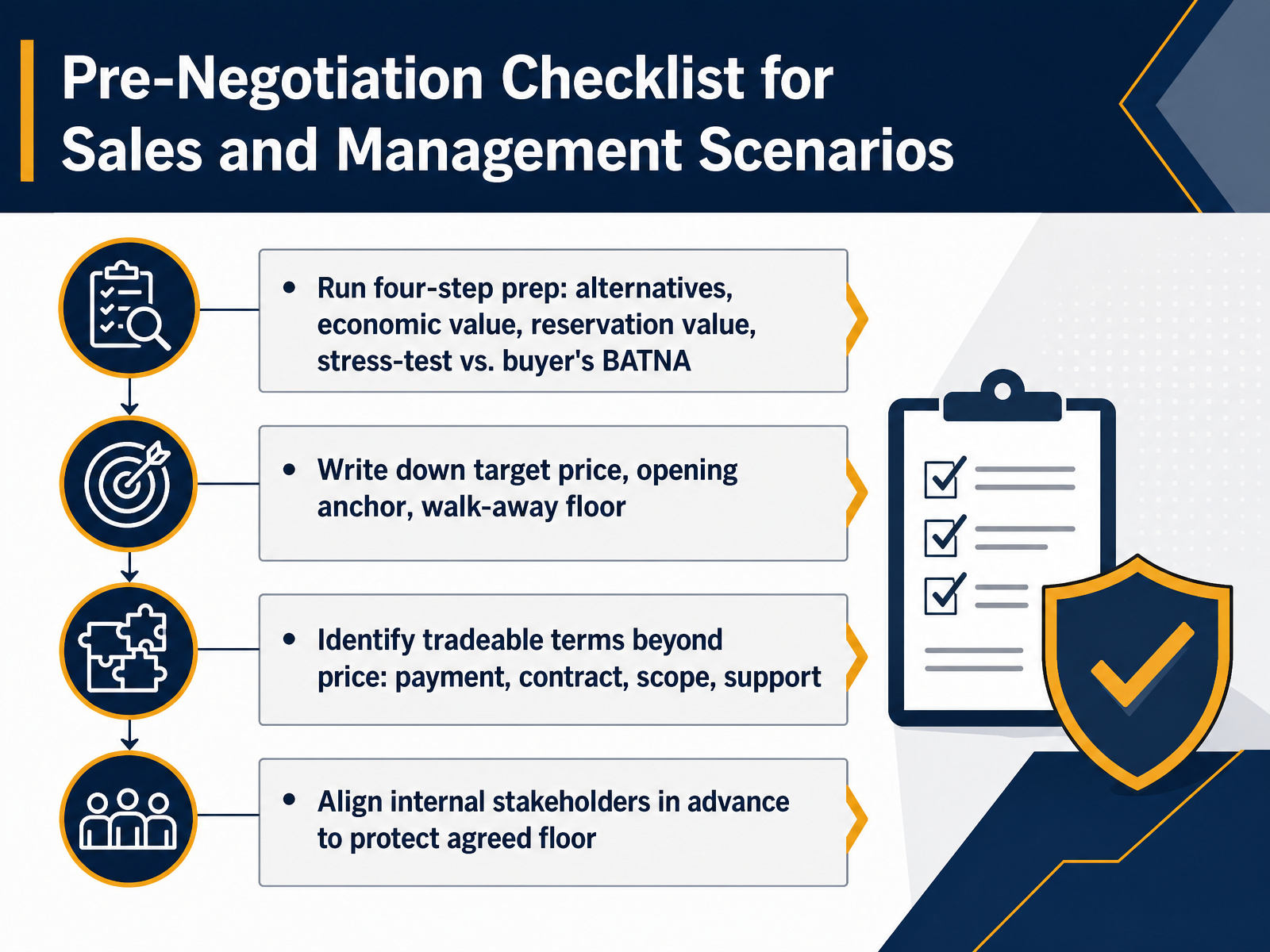
 - 05Pre-Negotiation Checklist for Sales and Management ScenariosLet’s shift to what happens before you ever sit down at the table. Preparation is where deals are won or lost. First, run a four-step prep: identify your alternatives, put an economic value on each, set your reservation value—the absolute floor you won’t go below—and stress-test it against the buyer’s BATNA, their best alternative to a negotiated agreement. Second, write down three numbers: your target price, your opening anchor, and your walk-away floor. Having them in writing keeps you from improvising under pressure. Third, identify tradeable terms beyond price—payment schedules, contract length, scope, support levels. These are your levers to create value without discounting. Finally, align internal stakeholders before the meeting. Make sure finance, legal, and delivery know and respect your floor. If your own VP is willing to go lower, procurement will find it. Internal alignment is what protects your walk-away point. Get this done, and you negotiate from strength. Next, let’s get into active listening and strategic questioning.
 pon.harvard.edurainsalestraining.comsalesprep.ai+21 min
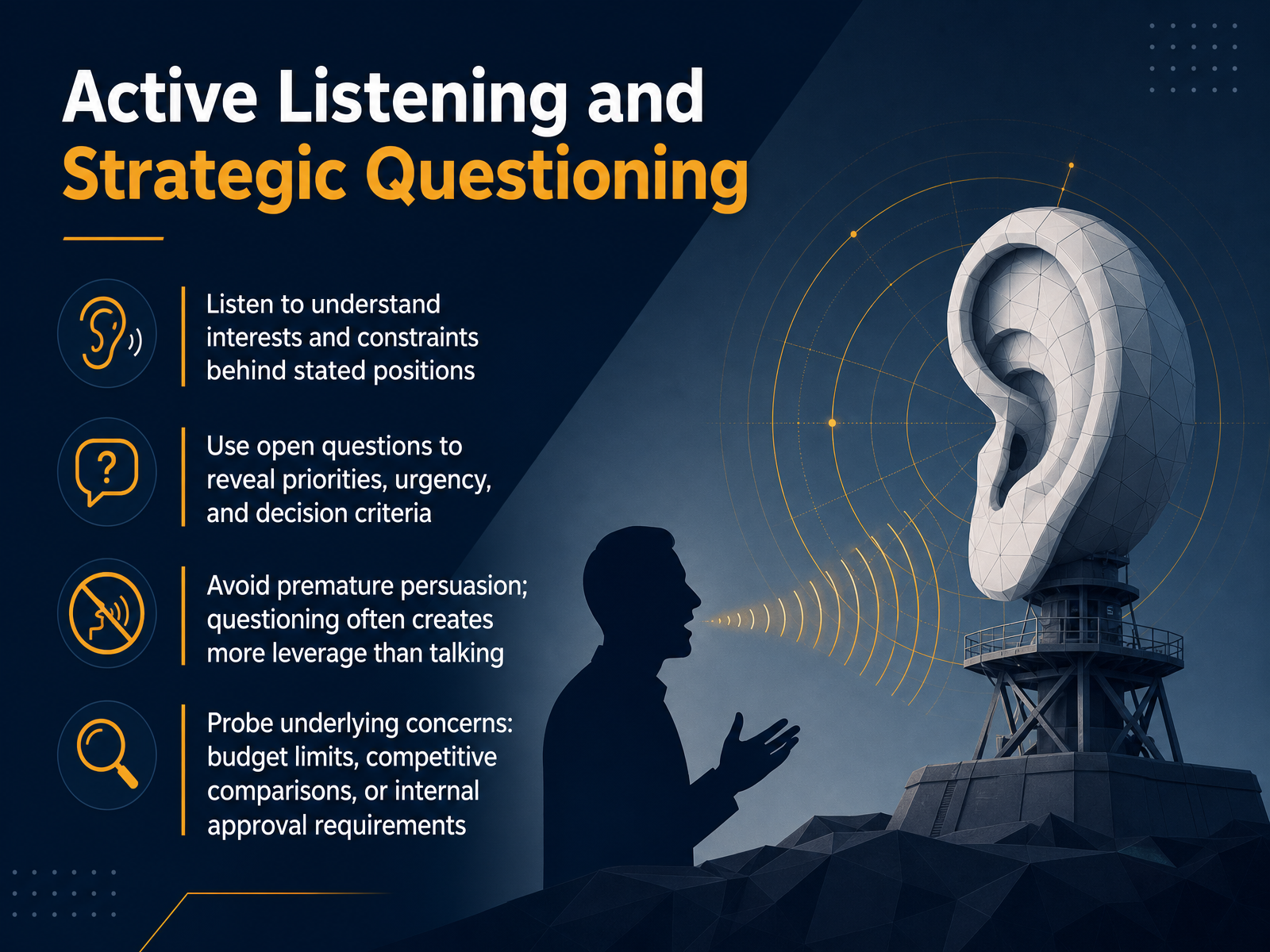
 - 06Active Listening and Strategic QuestioningLet's talk about the two skills that give you the most control at the table: active listening and strategic questioning. You'll likely already know that listening matters, but here's the key shift: you're not listening to respond. You're listening to understand the interests and constraints behind the stated position. When a buyer says 'your price is too high,' that's a position. The interest underneath could be a hard budget cap, a competitive quote, or an internal approval threshold they can't exceed. Your job is to uncover which one. This is where strategic questioning creates leverage. Open questions — not yes or no — reveal priorities, urgency, and decision criteria. Ask 'what's driving that number for you?' or 'how does this fit into your current budget cycle?' Resist the urge to persuade early. Silence after a question is powerful; let them fill it. In high-performing negotiations, questioning often builds more leverage than talking ever will. So probe for the real constraints: budget limits, competitive comparisons, approval requirements. Every answer sharpens your next move. Remember: in a negotiation, the person asking the questions usually holds the control. Now, let's look at how to use that information to frame the conversation and anchor your position.
 alignednegotiation.comredbearnegotiation.cominddist.com+22 min
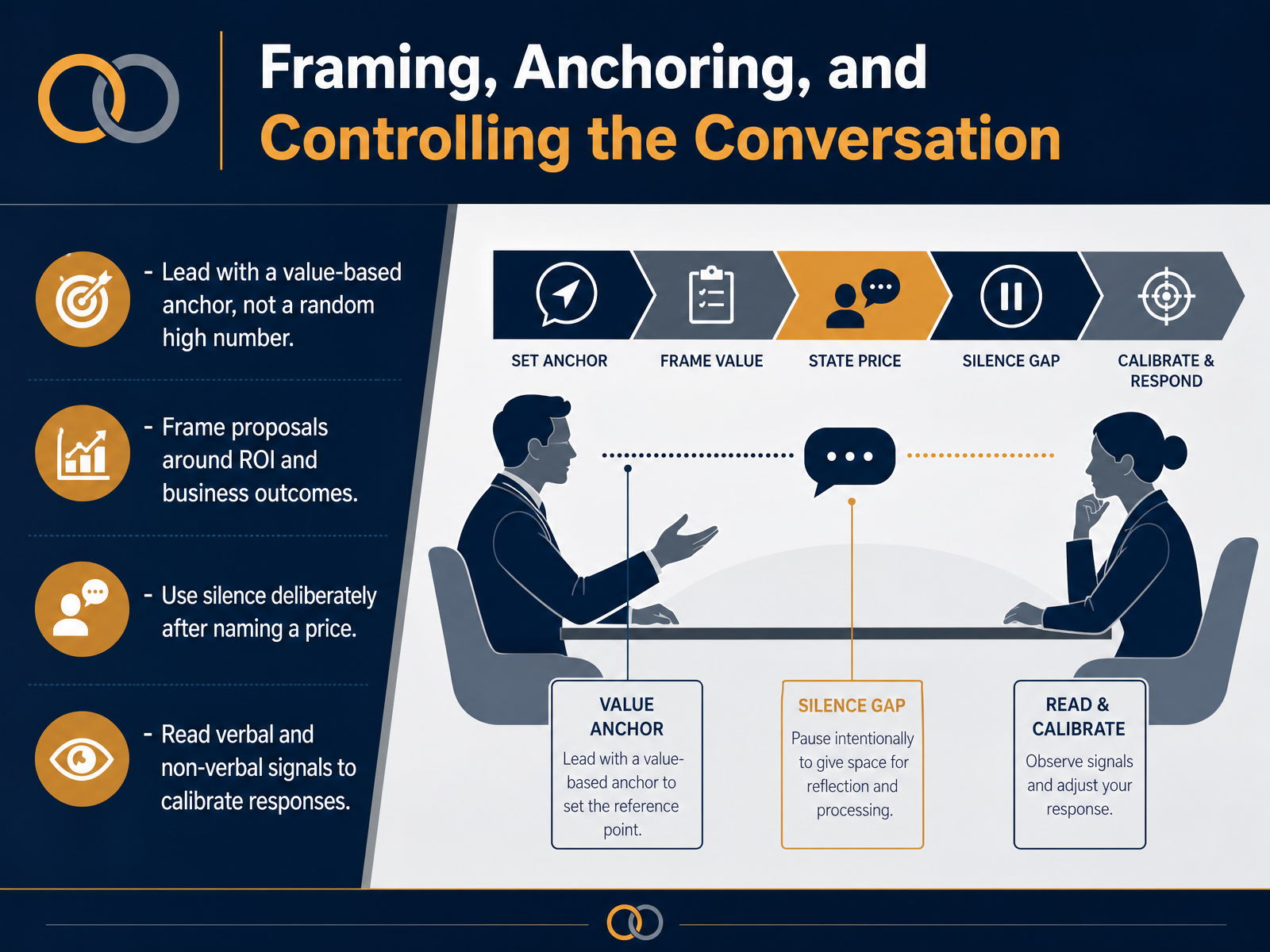
 - 07Framing, Anchoring, and Controlling the ConversationNow let's talk about framing, anchoring, and controlling the conversation. This is where preparation meets execution. Lead with a value-based anchor, not a random high number. You've built the value case since discovery, so use it. Say something like, 'Based on what you shared about your current cost per deal, the annual value here is roughly two hundred thousand. Our investment starts at eighty-five.' That anchors the discussion in ROI, not in a price fight. Frame every proposal around business outcomes. Talk about what they gain in velocity, margin, or risk reduction, not about features or discounts. And here's the critical part: use silence deliberately after naming your price. Do not fill the gap. The next person to speak usually concedes something, so let it be them. Finally, read the verbal and non-verbal signals. If they lean in and ask about terms, you're in a good zone. If they go quiet and check their watch, you may need to recalibrate. These moves don't just steer the deal; they set the rhythm for everything that follows. Next, we'll look at competitive and collaborative strategy choices, and how to know which one you're actually in.
 alignednegotiation.comredbearnegotiation.cominddist.com+22 min
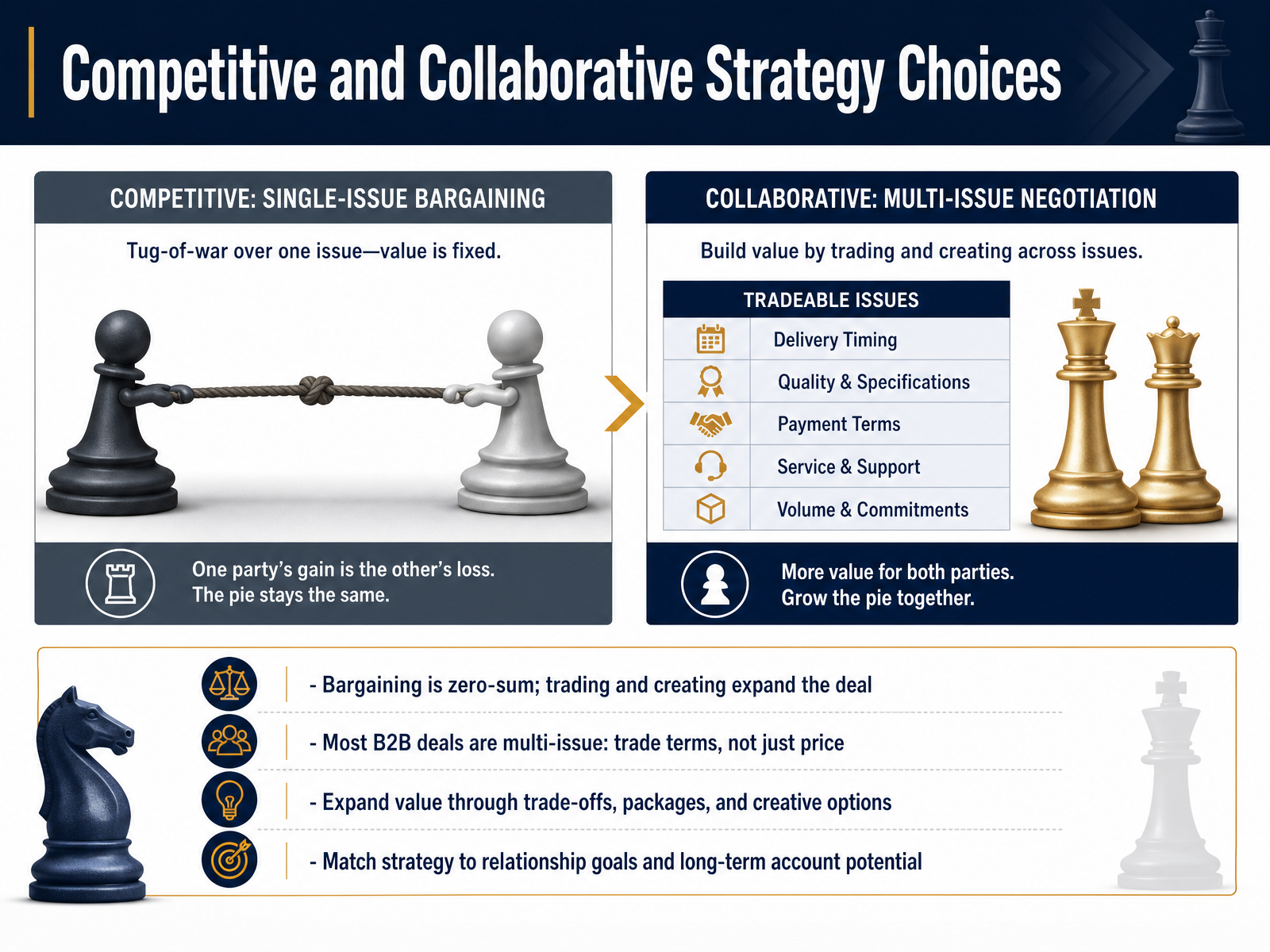
 - 08Competitive and Collaborative Strategy ChoicesLet's shift from preparation to the choices you make at the table. Too many deals are treated as a pure fight over price. That's bargaining. It's zero-sum. Every dollar they get, you give up. But most B2B deals are multi-issue. You have payment terms, delivery timelines, scope, support levels, contract length. That means you can trade, not just concede. You give them a longer payment cycle, they give you a higher unit price. You include extra training, they commit to a two-year term. This is how you expand the deal and create value beyond the price line. The key is to match your approach to the relationship. Is this a one-time transaction? Drive a hard bargain. Is this a strategic account with long-term potential? Then collaboration protected today's margin is worth more than squeezing the last point. You'll likely already know this, but the discipline is in planning your trade-offs before you're in the room. Know what you can flex and what you can't. That preparation lets you package creative options without giving away your position. Ready to look at how to structure those concessions?
 pon.harvard.edurainsalestraining.comsalesprep.ai+21 min
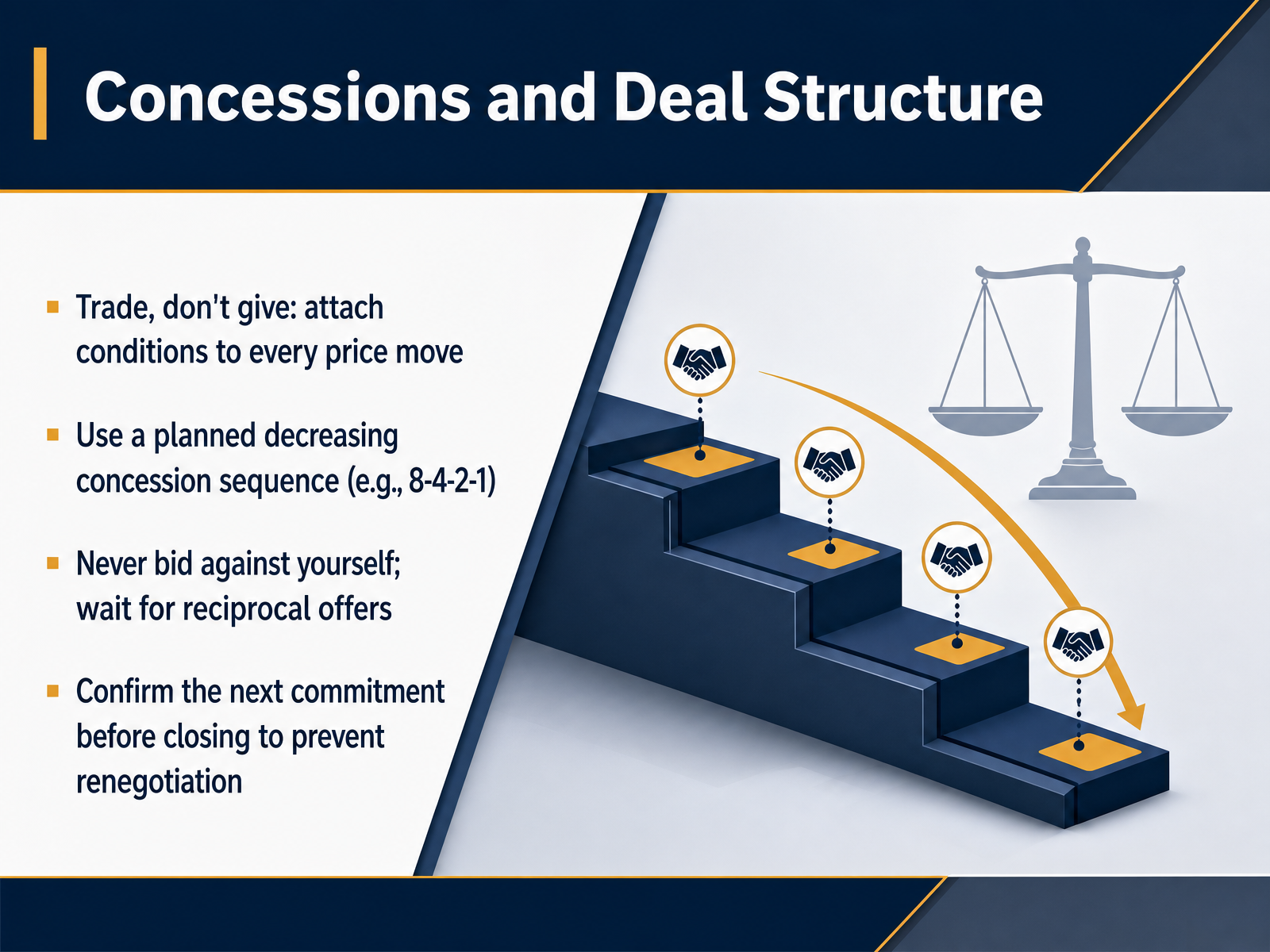
 - 09Concessions and Deal StructureNow let's talk about concessions and deal structure. The core principle is simple: trade, don't give. Every price move you make should come with a condition attached. For example, 'I can move on price if we shift to an annual prepay.' This preserves your margin and tests the buyer's real constraints. Next, plan a decreasing concession sequence—eight, four, two, one percent. Start meaningful, then shrink each move. This signals you're approaching your floor without saying it aloud. Never bid against yourself. If you reduce price before the buyer asks, they'll assume your opening was inflated. Wait for a reciprocal offer or a commitment before you move. Finally, confirm the next commitment before closing. Agree on the next step: the revised order form, the follow-up call, the signature date. If you don't, the deal isn't closed—it's paused—and paused deals get renegotiated. That's the discipline. Now let's look at how to handle objections and price pressure.
 pon.harvard.edurainsalestraining.comsalesprep.ai+22 min
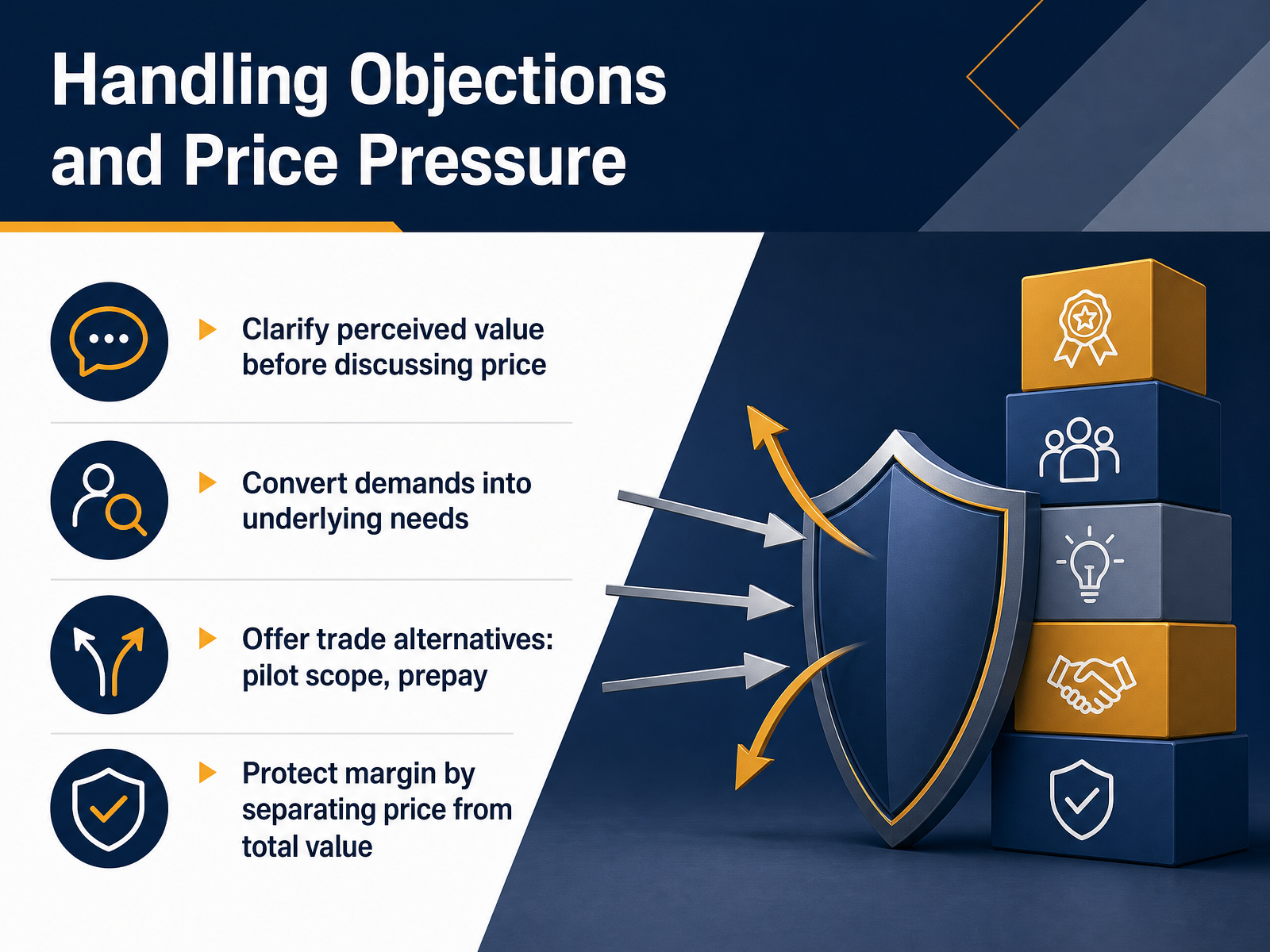
 - 10Handling Objections and Price PressureLet's talk about the moment where most deals either get saved or get given away — the price objection. Before you say a single number, work to clarify what the client actually perceives as valuable. If they think they're buying a commodity, they'll push on price. If they see the operational impact, the conversation shifts. Ask about the cost of the problem they're solving. That anchors the value before price ever enters the discussion. Next, convert demands into underlying needs. When they say 'we need twenty percent off,' that's a position. The need might be budget approval, or a competitive bid they're trying to beat. Probe with questions like 'help me understand what's driving that number.' Their answer tells you what to solve. Then, if you need to move, offer trade alternatives, not pure discounts. Suggest a pilot scope instead of a full rollout, or an annual prepay in exchange for a lower rate. Every price movement should come with a return. Finally, protect your margin by separating price from total value. Break down implementation, training, and support as distinct components, so a concession on one line doesn't erode the whole deal's economics. Remember: the goal isn't to avoid concessions, it's to make each one a deliberate, structured exchange that preserves the deal's integrity. Now, let's look at how to stay grounded when the other side plays hardball.
 alignednegotiation.comredbearnegotiation.cominddist.com+22 min
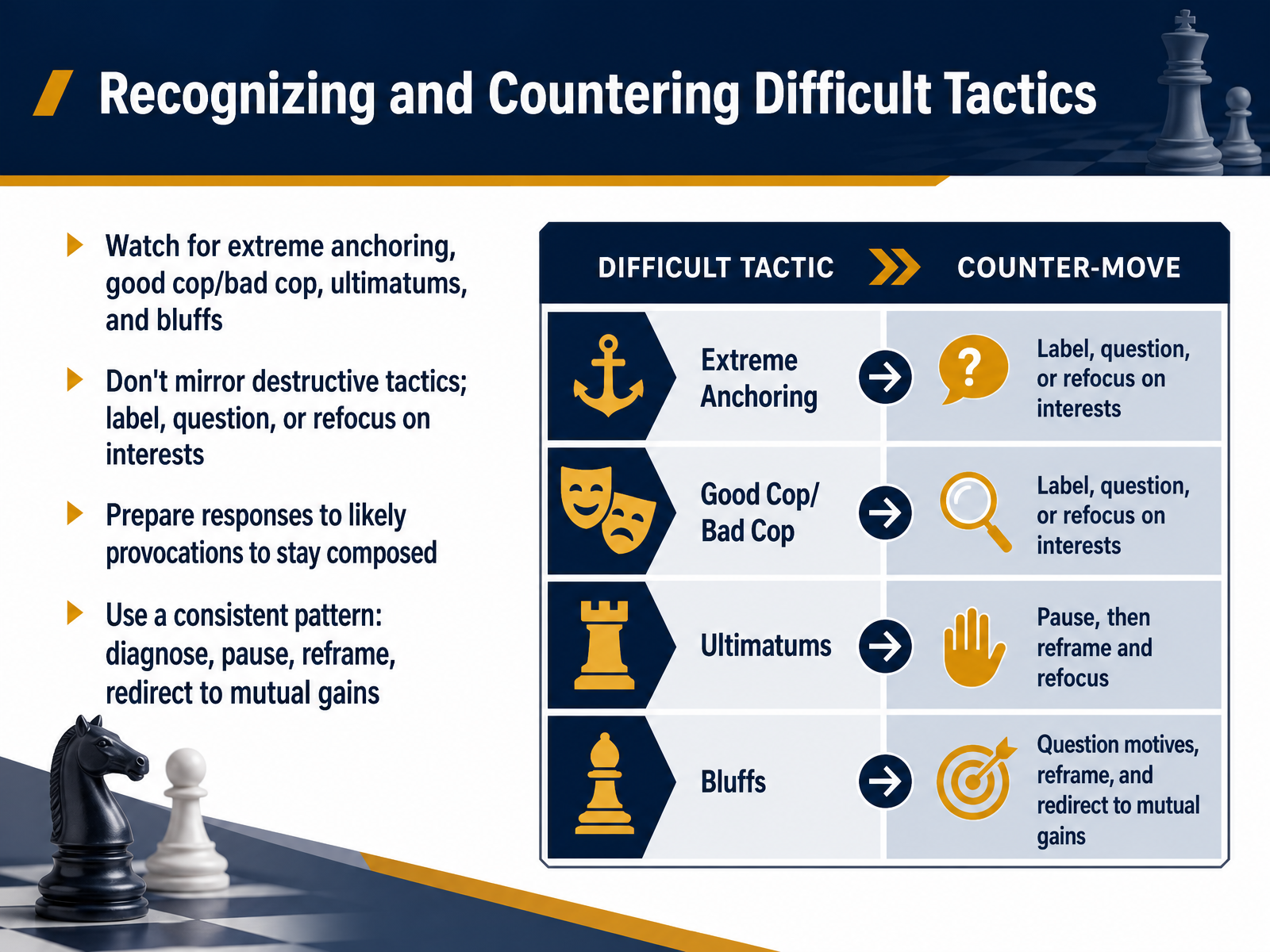
 - 11Recognizing and Countering Difficult TacticsLet’s talk about the tactics that can throw you off balance: extreme anchoring, good cop bad cop, ultimatums, and outright bluffs. You’ll likely recognize these from the field. The key is not to mirror them. Escalation is a trap. Instead, you want to diagnose, pause, reframe, and redirect. When you see an extreme opening anchor, don’t bid against yourself. Pause. Ask them to walk you through how they arrived at that number. It forces them to justify, not dictate. With good cop bad cop, remember they’re on the same team. Don’t let the performance split you. If an ultimatum lands, treat it as data, not a deadline. Ask what they need to move. A bluff will usually fade under calm scrutiny. The most powerful tool is preparation. Before you walk in, list what they might say to knock you off balance and your response. When it happens, you diagnose it, take a beat, reframe the issue around mutual interests, and redirect to the real problem. This keeps you composed and in control. Next, we’ll look at how to align your own team before you ever walk into the room.
 pon.harvard.eduhbr.orgpon.harvard.edu+22 min
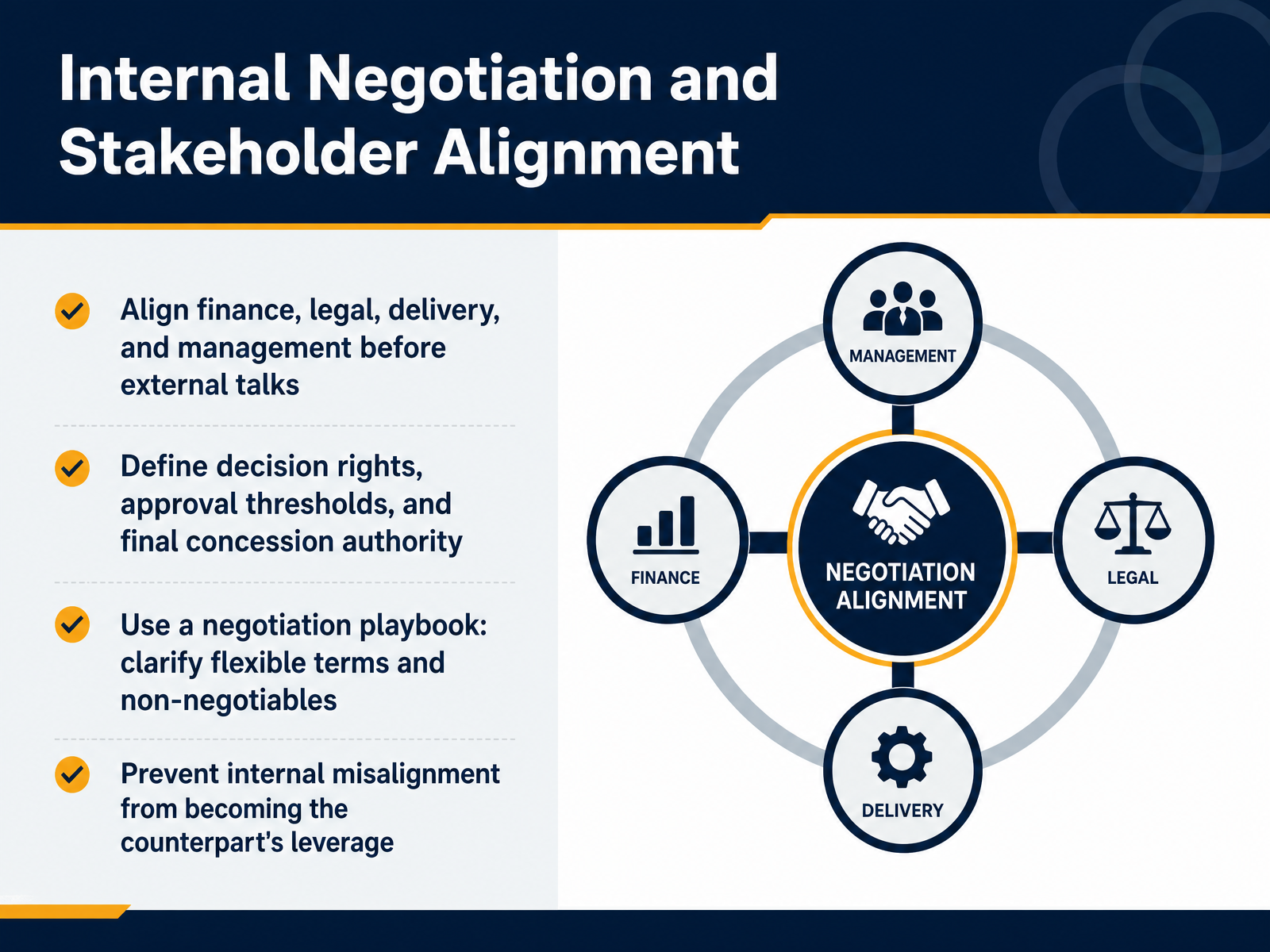
 - 12Internal Negotiation and Stakeholder AlignmentLet's turn to a place where many deals actually get won or lost: inside your own organization. Before you ever sit across from the counterpart, you need to align finance, legal, delivery, and management. You'll likely already know the pain of a deal stalling because legal flagged a liability clause at the last minute, or finance rejected the payment terms you'd already agreed on. That internal misalignment doesn't just slow things down—it becomes leverage for the other side. So, your first move is to define decision rights clearly. Who can approve what, up to what threshold, and who has the final authority to concede? Without that, your negotiator is negotiating with one hand tied behind their back. Next, build a simple negotiation playbook. Document what's flexible—like delivery timelines or contract length—and what's non-negotiable, such as core pricing or liability terms. This gives your team clarity so they don't have to escalate every small decision. The payoff is speed and confidence. When everyone internally knows the lines, you present a unified front. The counterpart can't exploit gaps between what your sales rep says and what legal will actually accept. Do this alignment work early, and you close deals faster and protect your margin. Coming up next, we'll put these skills into practice with scenarios, role-plays, and structured debriefs.
 alignednegotiation.comredbearnegotiation.cominddist.com+22 min
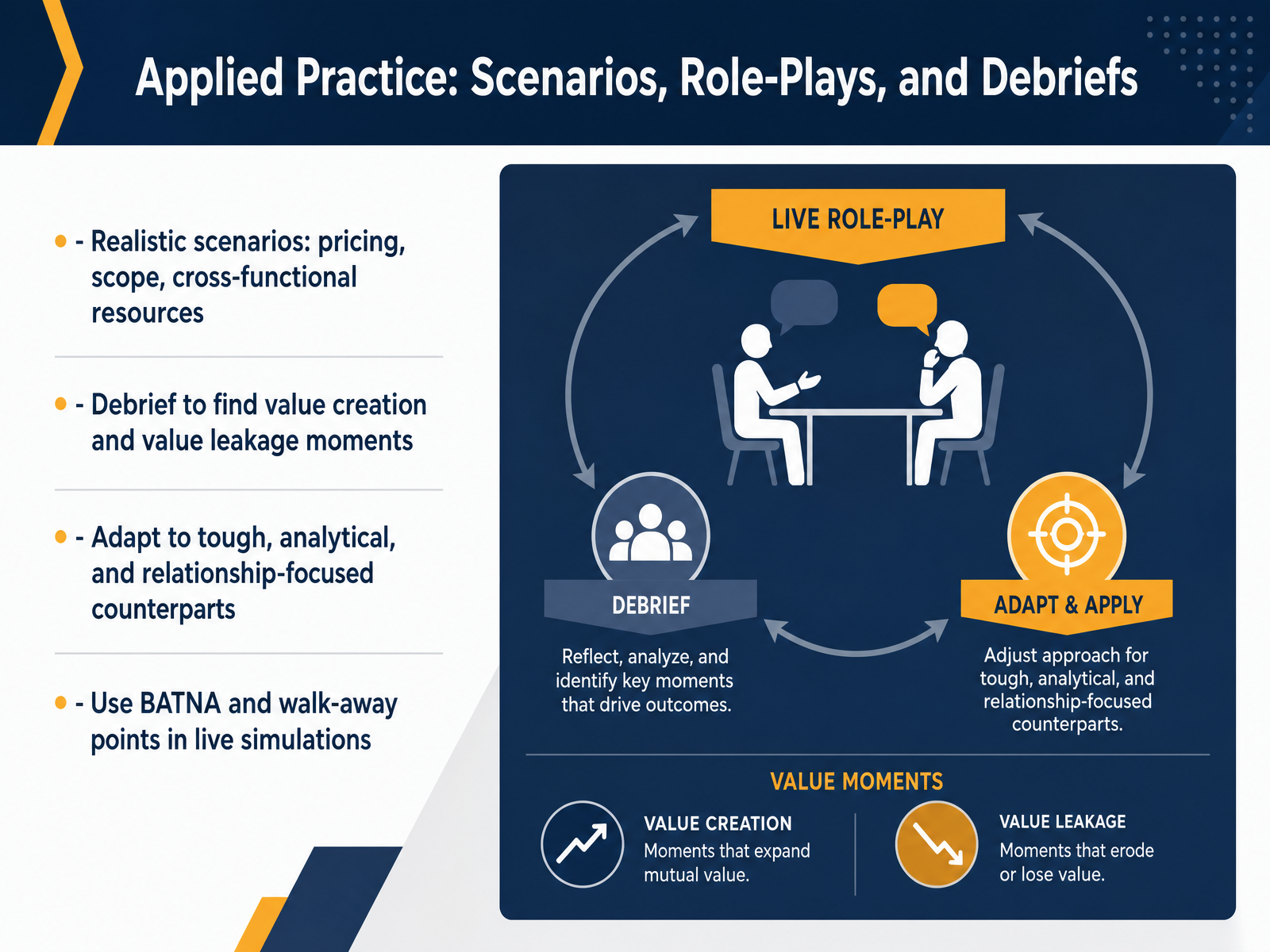
 - 13Applied Practice: Scenarios, Role-Plays, and DebriefsThis is where the framework becomes instinct. We move into applied practice, using realistic scenarios that hit pricing, scope, and cross-functional resources. You'll recognize these deals from your own pipeline. Now, the debrief matters just as much as the negotiation itself. We'll deconstruct where you created value and where value leaked out, because that's how you build repeatable skill. Then we adapt. Some counterparts are tough and analytical, others are relationship-focused. Each requires a different approach, and the simulations mirror that pressure. Keep your B A T N A front and center, and know your walk-away point before you enter. Being indifferent to the outcome, not the effort, gives you control. When you can walk away, you never negotiate from fear. Now, let's talk about how to turn this into a disciplined action plan for your team.
 pon.harvard.edurainsalestraining.comsalesprep.ai+21 min
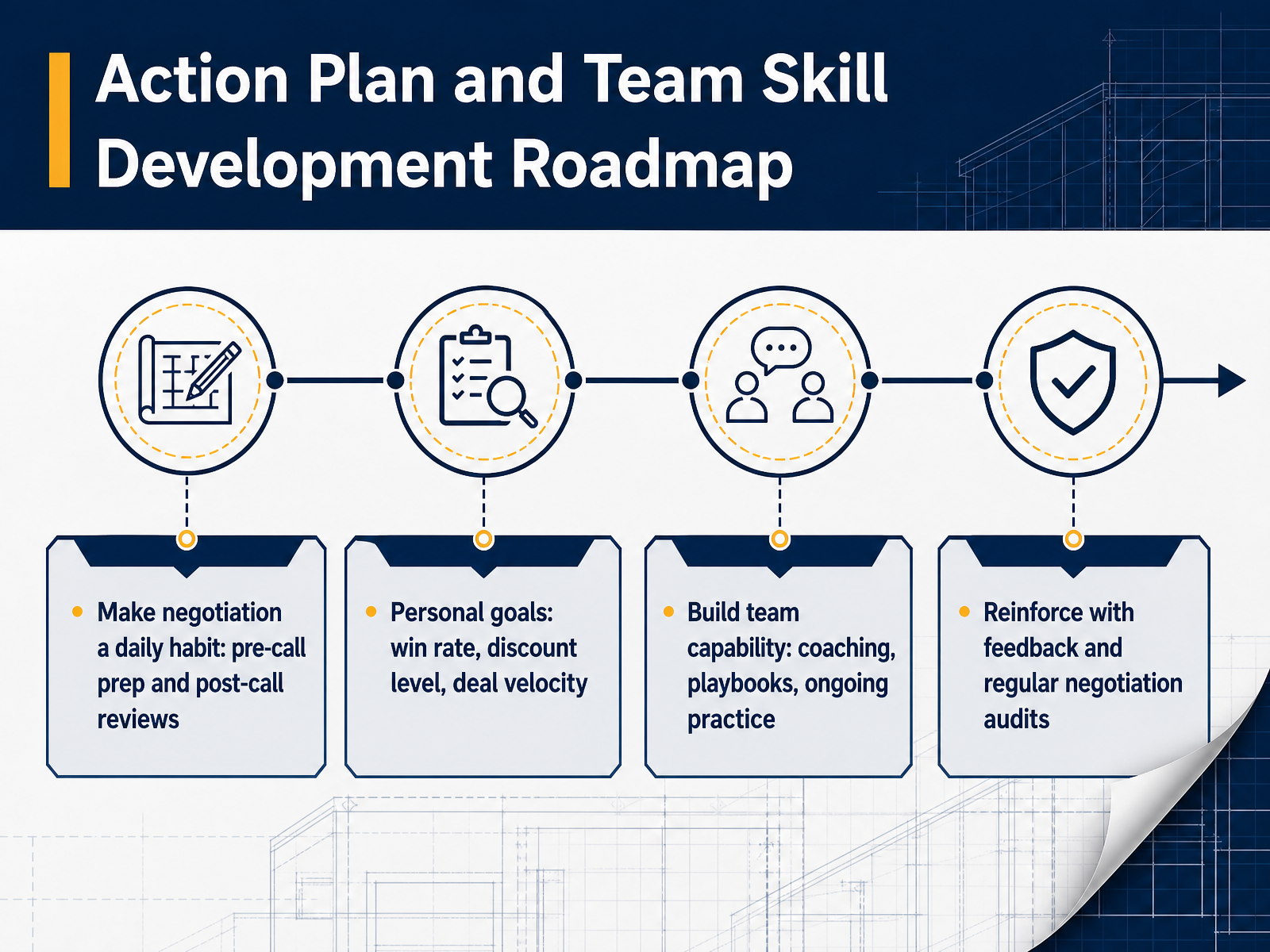
 - 14Action Plan and Team Skill Development RoadmapLet’s bring everything together into a roadmap you can start using this week. First, make negotiation a daily habit. That means fifteen minutes of prep before a call and a quick review after. What was your walk-away point? What did you learn about the buyer’s alternatives? Write it down.
Second, set personal goals. Track your win rate, your average discount level, and deal velocity. You can’t improve what you don’t measure, and these three numbers tell you exactly where you stand.
Third, build team capability. This isn’t a one-time workshop. Use coaching sessions, create a negotiation playbook that documents what’s flexible and what isn’t, and practice with realistic role-plays. Teams that rehearse price pressure close better deals.
Finally, reinforce with feedback and regular negotiation audits. Review your last ten deals. How many involved discounts, and what did you get in return? That audit will show you where the leaks are.
Negotiation is a structured skill. Prep before, review after, and practice as a team. Thank you for joining, and go protect your margin in the next deal.
 pon.harvard.edurainsalestraining.comsalesprep.ai+22 min
Take the deck with you
Download this course as a file — free, no sign-up needed.
- PDF handoutEvery slide page, ready to print or share.15 pages · 3.6 MBDownload
- Narrated PowerPointThe deck that presents itself — every slide carries the digital human's narration video.15 pages · 16.9 MBDownload
- PowerPoint slidesThe full deck as a .pptx — open it in PowerPoint, Keynote, or Google Slides.15 pages · 3.5 MBDownload
Free to use in your own training — please keep the PersonWise credit page at the end.
Have your own deck? Turn it into a course
Sources consulted
Web sources consulted while building this course.
- Effective Negotiation Skills for Business Performance — spjimr.org
- Negotiation Training — pdtraining.com.au
- SN-Course-Outline — unichrone.com
- Negotiation Skills Training Course Program | Uphilos Training and Consultancy — uphilos.com
- Sales Negotiation Training Courses | Negotiation Experts — negotiations.com
- How To Give Your Sales Team a Negotiation Edge in Q1 2026 | Aligned — alignednegotiation.com
- The Ultimate Guide to Sales Negotiation Training — redbearnegotiation.com
- How to Develop Your Sales Team's Negotiation Skills — inddist.com
- What Are Sales Negotiation Skills? Strategies, Tips & Tools | Apollo — apollo.io
- Essential Negotiation Skills Every Sales Rep Must Know - Allego — allego.com
- Negotiation Tactics, BATNA and Examples for Creating Value in Business Negotiations - PON - Program on Negotiation at Harvard Law School — pon.harvard.edu
- How to Manage a Sales Negotiation to Your BATNA — rainsalestraining.com
- BATNA in sales negotiation: how to build your best alternative in four steps | Salesprep — salesprep.ai
- Negotiation BATNA: The B2B Guide That Goes Beyond Basics — b2bsalestraining.org
- What Is BATNA in Negotiation? — online.hbs.edu
- Dealing with Hardball Tactics in Negotiation - PON - Program on Negotiation at Harvard Law School — pon.harvard.edu
- How to See Through These 3 Hardball Negotiation Tactics — hbr.org
- 10 Hard-Bargaining Tactics to Watch Out for in a Negotiation — pon.harvard.edu
- 8 Ways to Protect Yourself Against Hardball Tactics — psychologytoday.com
- How to Deal with a Hardball Strategy When You Have a Weak BATNA - PON - Program on Negotiation at Harvard Law School — pon.harvard.edu