Begin
16 pages · ~32 min
Introduction to Optics
An introductory course on optics exploring the properties of light and color for beginners.
A digital instructor presents all 16 pages. Hold “Ask” at any point and ask out loud — the answer comes from this course. No sign-up needed.
What you’ll learn
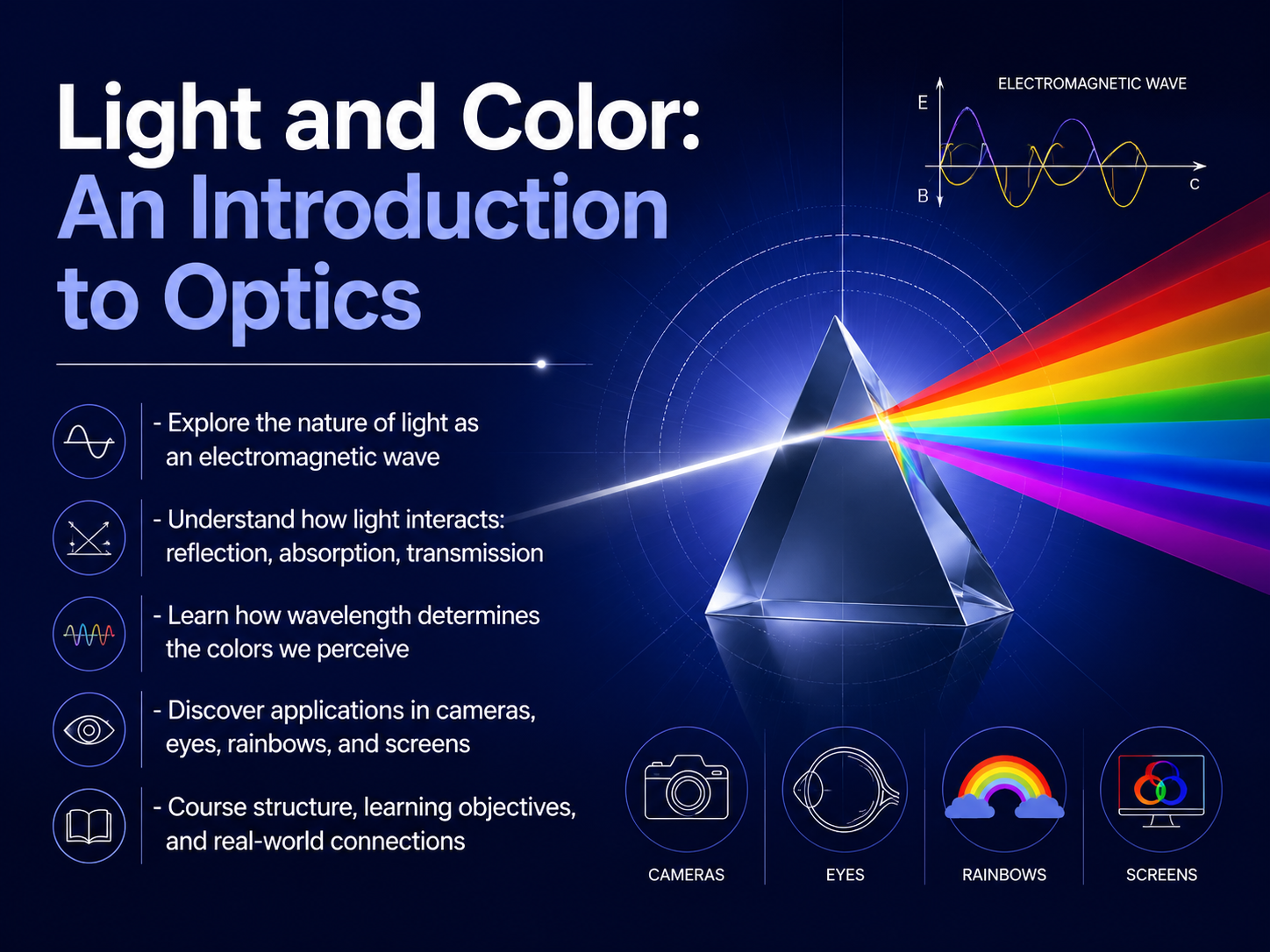
- 01Light and Color: An Introduction to OpticsWelcome to Light and Color: An Introduction to Optics. I'm glad you're here. In this course, we'll explore something you experience every single moment—light. We'll start with the nature of light itself, as an electromagnetic wave. Then we'll uncover how light interacts with the world around you through reflection, absorption, and transmission. You'll learn how a simple property called wavelength determines every color you see, from the deep red of a rose to the violet in a rainbow. We'll connect these ideas to things you use daily, like cameras, screens, and even your own eyes. By the end, you'll have a clear picture of the course structure and the real-world connections that make optics so fascinating. Let's get started by asking a fundamental question: What is light, exactly?en.wikipedia.orgscience.nasa.govnist.gov+21 min
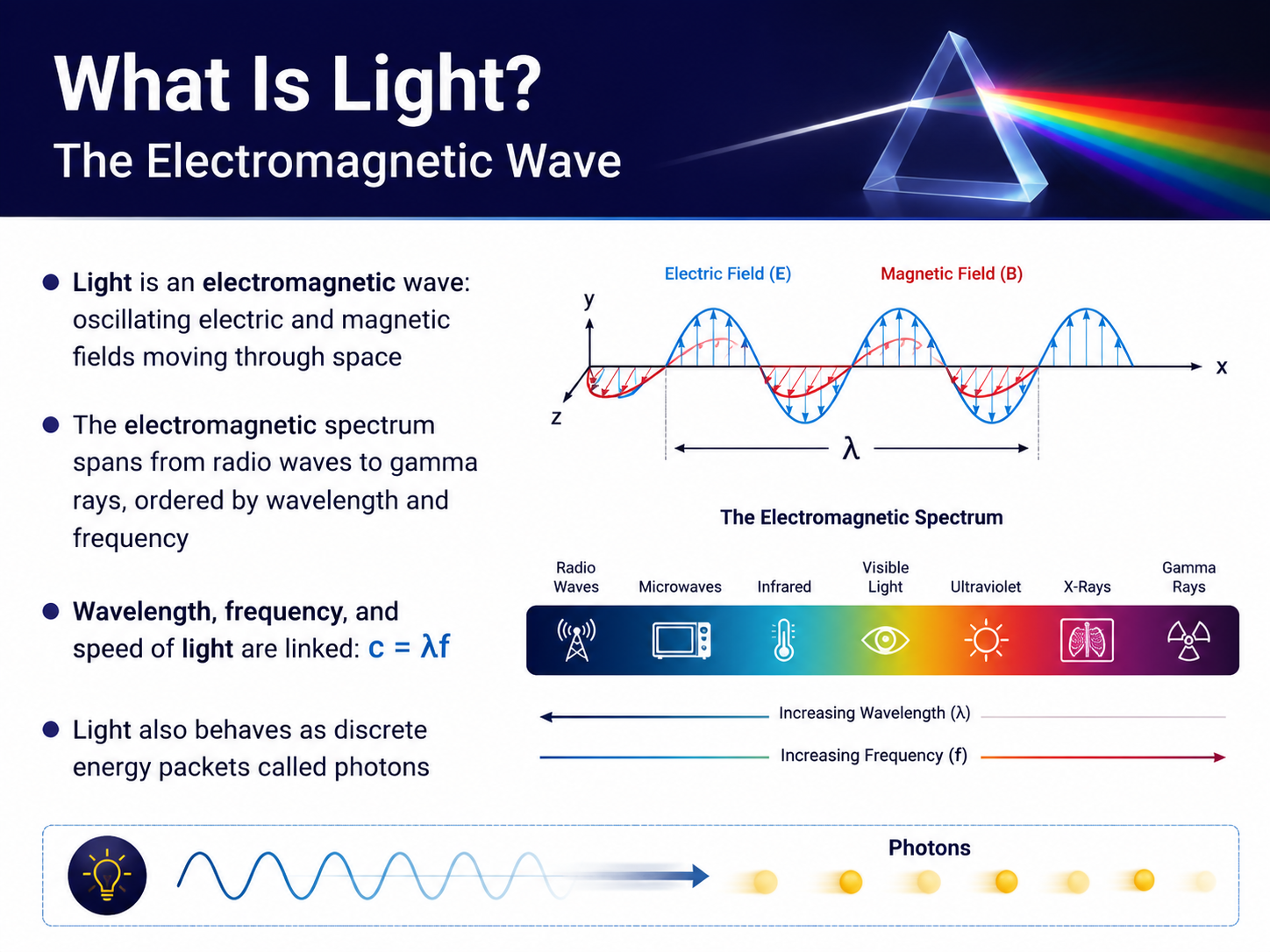
- 02What Is Light? The Electromagnetic WaveNow, let's get to the heart of it: what is light? Simply put, light is an electromagnetic wave. Picture a tiny, invisible ripple of electric and magnetic fields oscillating together as they travel through space. This family of waves, called the electromagnetic spectrum, is huge. It stretches from long, lazy radio waves to incredibly short, high-energy gamma rays. To sort them, we use two key measurements. The first is wavelength, which is the distance between two wave peaks. The second is frequency, which is how many peaks pass a point each second. These two are bound together by a simple, elegant equation: c equals lambda times f. The speed of light, c, is constant, so a shorter wavelength always means a higher frequency. There's one more fascinating piece to the puzzle. Light also acts like a stream of tiny energy packets called photons. You can think of a photon as a single, discrete chunk of light energy. Now, let's bring this down to what you can actually see. On the next slide, we'll explore the tiny slice of this spectrum called the visible spectrum.
 en.wikipedia.orgscience.nasa.govnist.gov+22 min
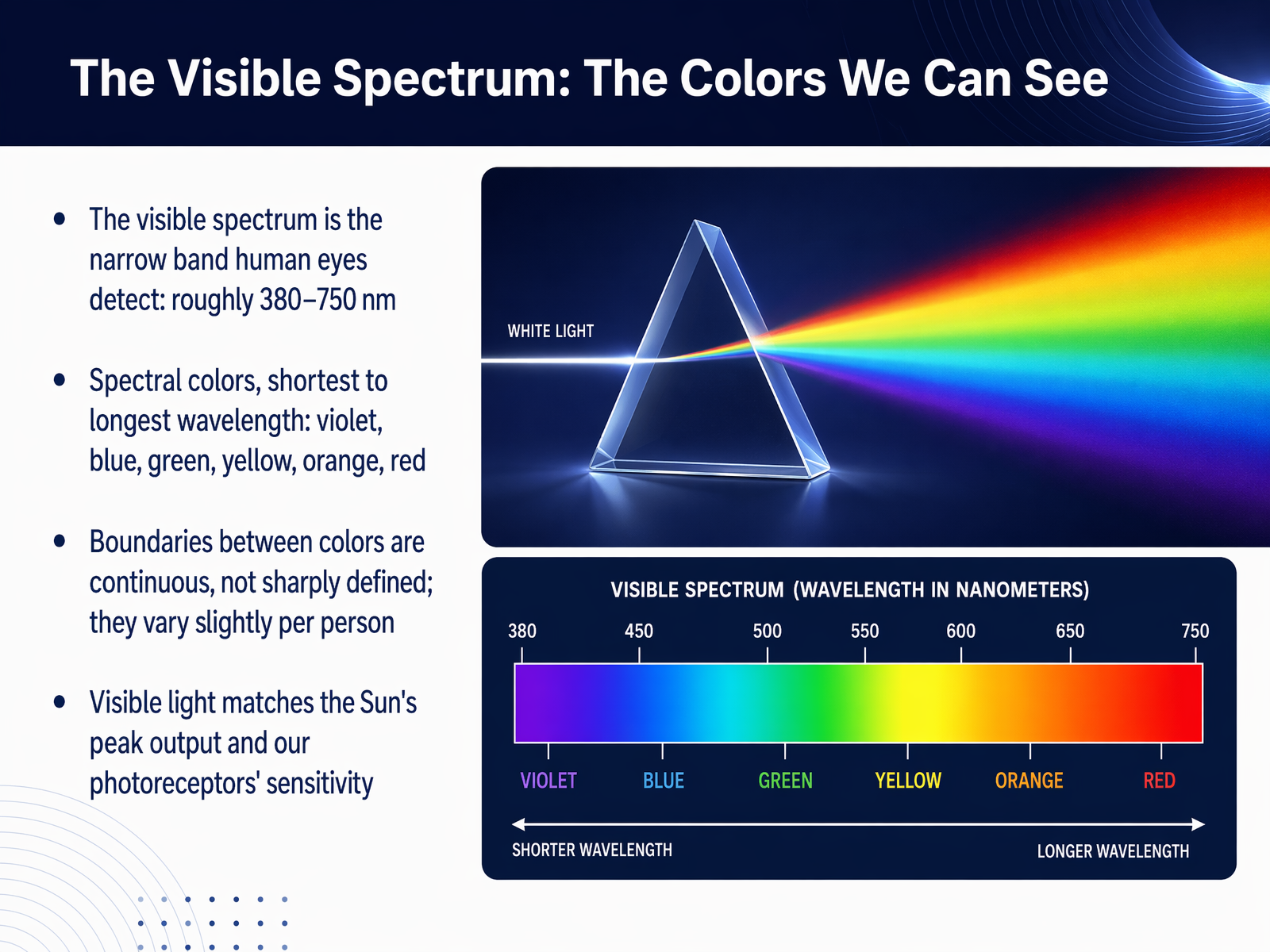
 - 03The Visible Spectrum: The Colors We Can SeeNow let's zoom in on the part of the rainbow our eyes can actually detect: the visible spectrum. This is a very narrow band of light, spanning roughly 380 to 750 nanometers. To put that in perspective, a nanometer is one billionth of a meter, so we are talking about incredibly tiny waves. Within this band, we see the familiar spectral colors. Starting from the shortest wavelength, we move from violet, then blue, then green, through yellow and orange, and finally to red at the longest wavelength. But here's a key point: these colors don't have hard, sharp borders. They blend into one another continuously, like a smooth gradient. And the exact point where you see blue turn to green might be slightly different from what the person next to you sees. This entire range just happens to match the peak energy output of our sun, and it's perfectly tuned to the sensitivity of the photoreceptor cells in our eyes. So, the light we see is no accident; it's a direct link between our biology and our star. Next, let's explore the fundamental property that defines each of these colors: wavelength.
 en.wikipedia.orgscience.nasa.govnist.gov+21 min
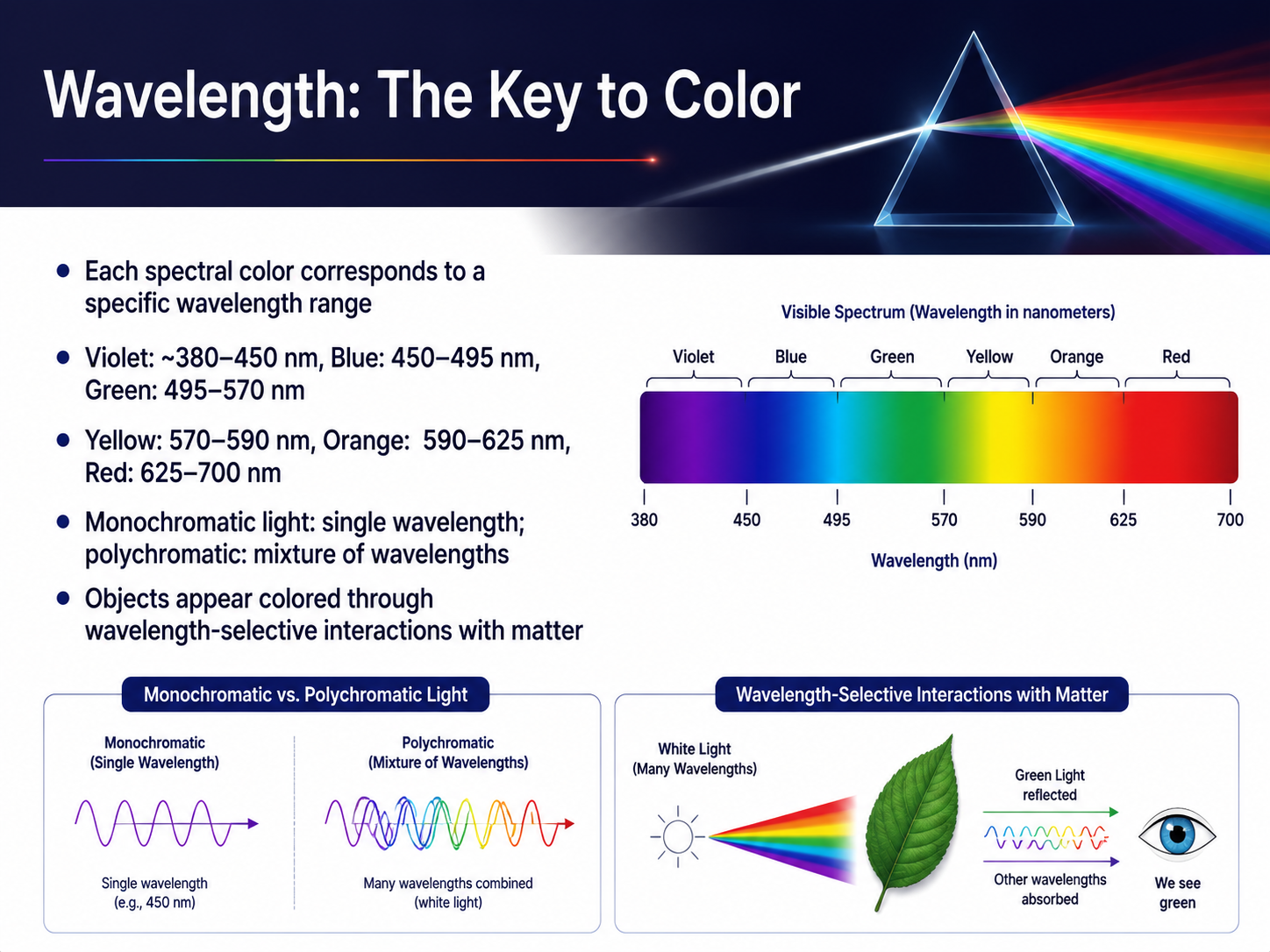
 - 04Wavelength: The Key to ColorNow let's zoom in on the key to color itself: wavelength. Simply put, wavelength is the distance between two peaks of a light wave, and we measure it in nanometers. Each spectral color you can observe corresponds to a specific range of these wavelengths. Violet has the shortest range we can see, from about 380 to 450 nanometers. Blue follows, from 450 to 495. Green occupies 495 to 570. Yellow sits between 570 and 590. Orange spans 590 to 625. And red has the longest visible range, from 625 to 700 nanometers. Light made of just one wavelength is called monochromatic. A laser is a great example of this. Most light, like sunshine, is polychromatic, meaning it's a mixture of many wavelengths. This is why objects can appear colored. A leaf looks green because it interacts with light in a wavelength-selective way. It absorbs most other wavelengths, like red and blue, and reflects the green wavelengths back to your eyes. Next, we'll explore this process in detail with reflection: how light bounces.
 en.wikipedia.orgscience.nasa.govnist.gov+22 min
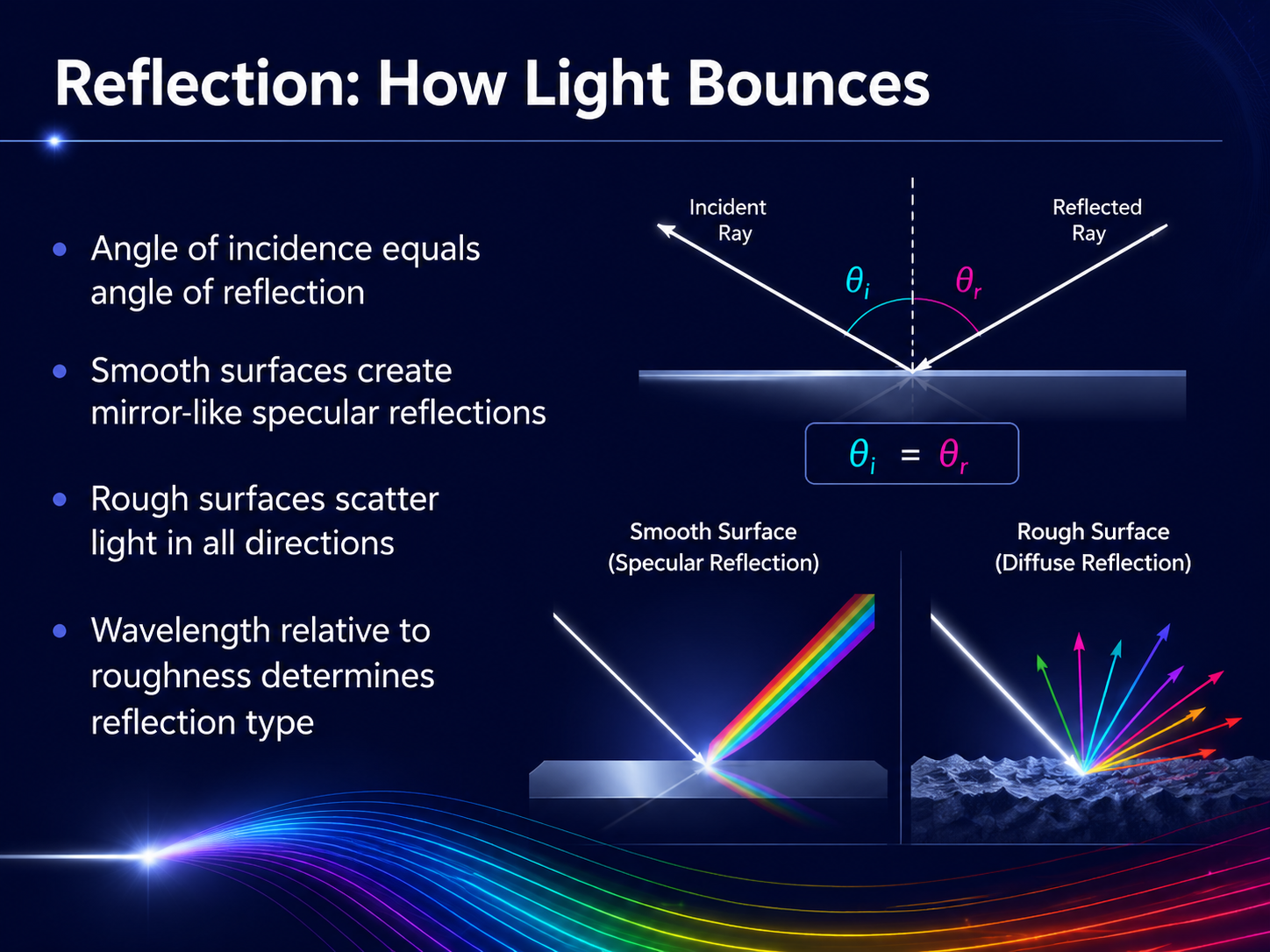
 - 05Reflection: How Light BouncesNow, let's look at the actual rule for how light bounces, called reflection. The key principle is simple: the angle of incidence equals the angle of reflection. Think of a ball bouncing straight back from a wall, or a billiard ball hitting a cushion. The incoming angle matches the outgoing angle, every time. But the surface makes a big difference in what you actually see. A smooth surface, like a polished mirror, creates a specular reflection. That's the clear, sharp image you recognize. A rough surface, like a piece of paper, scatters the light in all directions. This is called diffuse reflection, and it's why you can see the paper from any angle without a blinding glare. The real deciding factor is the relationship between the light's wavelength and the size of the surface bumps. If the bumps are smaller than the wavelength, you get a mirror-like reflection. If they are larger, the light scatters. Up next, we’ll explore what happens when light doesn’t bounce—in the slide on absorption, where light goes.
 1 min
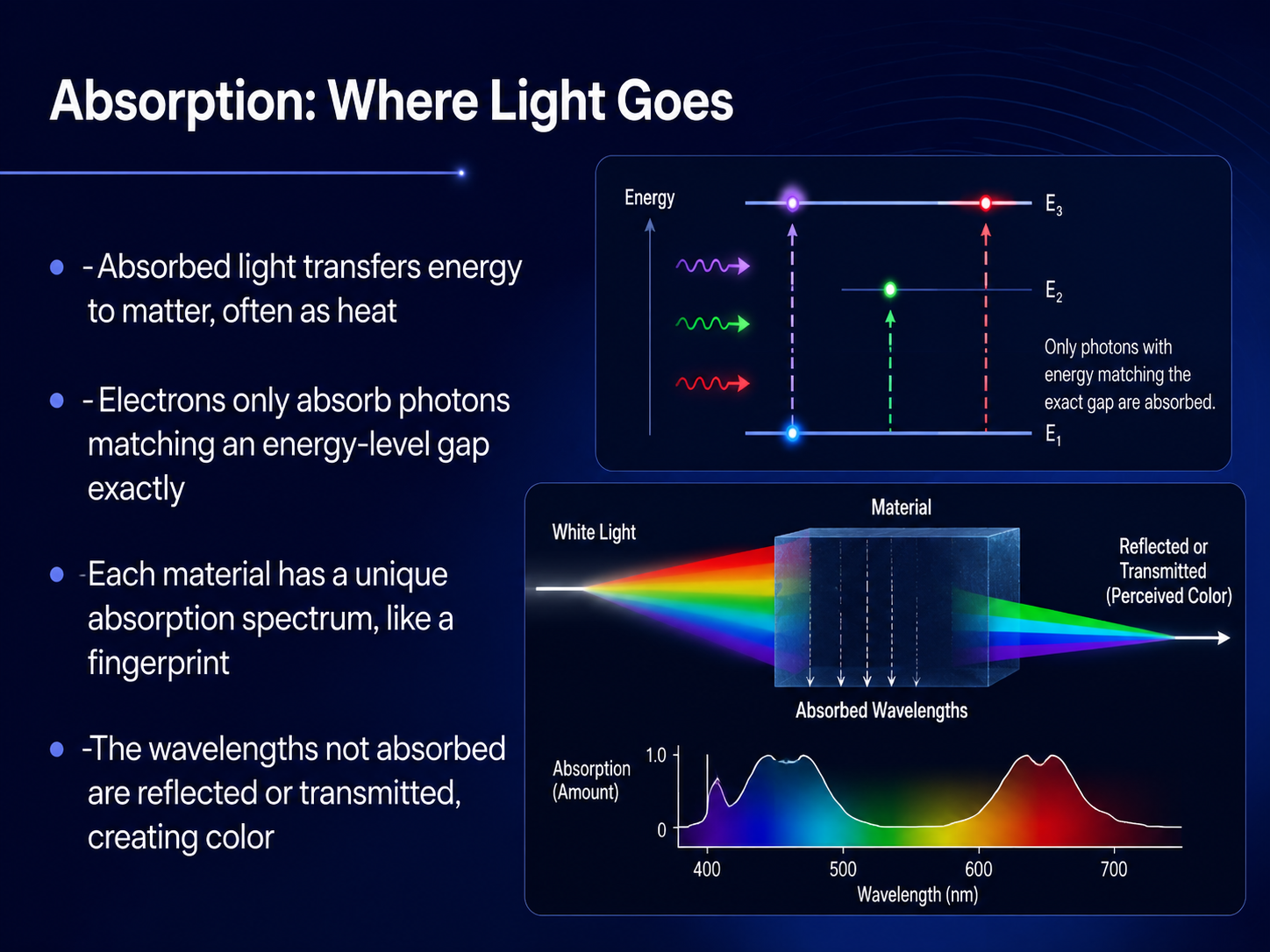
1 min - 06Absorption: Where Light GoesNow let's talk about where light goes when it disappears. You can observe this directly. On a sunny day, a dark shirt feels much warmer than a white one. That's absorption at work. The absorbed light doesn't vanish. It transfers its energy to the material, often as heat. At the atomic level, this process is very precise. An electron can only absorb a photon if the photon's energy matches the exact gap the electron needs to jump to a higher energy level. It's an all-or-nothing match. If the energy doesn't fit, the photon passes right by. Because every element has a unique arrangement of electrons, each material absorbs a unique set of wavelengths. This creates an absorption spectrum, which acts like a fingerprint for that substance. The wavelengths that are not absorbed are either reflected or transmitted. Those are the wavelengths that reach your eyes, creating the color you see. So a leaf looks green because it absorbs red and blue light, but reflects the green. Next, we will explore these specific energy jumps in more detail, with 'Electrons and Energy Levels: The Quantum Picture'.
 science.nasa.govimagine.gsfc.nasa.govvce.studypulse.au+22 min
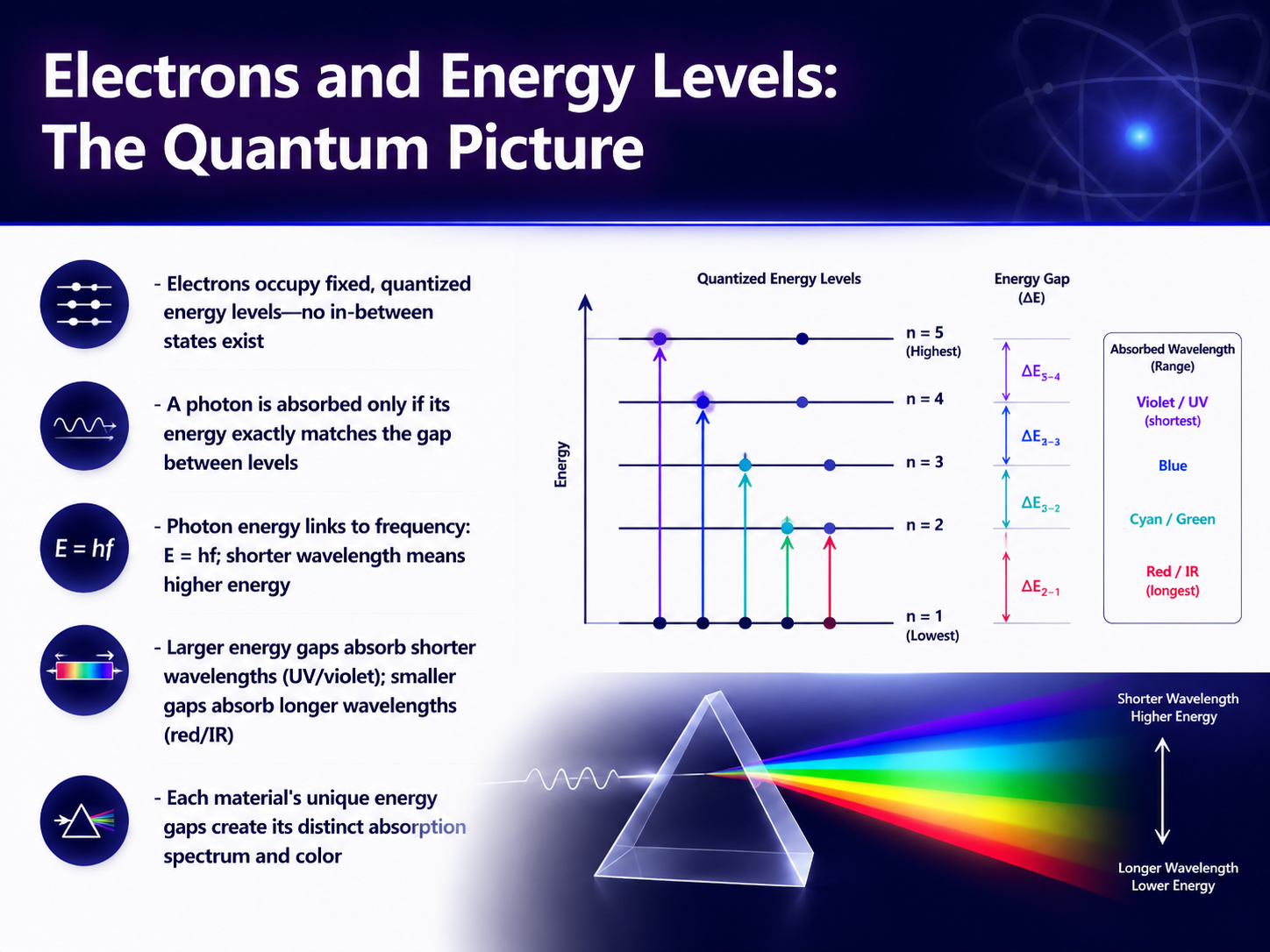
 - 07Electrons and Energy Levels: The Quantum PictureLet's zoom in even closer now, to the electrons inside the atom. This is where light and color get really precise. Think of electrons as sitting on a ladder, but it's a very special ladder. They can only stand on the rungs. They cannot hover in between. These rungs are fixed, quantized energy levels. For a photon to be absorbed, its energy must exactly match the gap between two rungs—no more, no less. This energy is described by the equation E equals h f. The h is Planck's constant, a tiny fixed number, and f is the frequency of the light. A shorter wavelength means a higher frequency, and therefore higher energy. So, a larger energy gap between electron rungs absorbs shorter wavelengths, like ultraviolet or violet light. A smaller energy gap absorbs longer wavelengths, like red or infrared. Every material has its own unique arrangement of energy gaps. This is why each substance absorbs a distinct set of colors, creating its own unique absorption spectrum. That unique spectrum is the fundamental reason a leaf looks green, while a flower looks red. It's all about the specific energy rungs inside. Now, let's see what happens when light isn't absorbed, but passes through the object. We'll explore that in the next slide on Transmission and Refraction.
 science.nasa.govimagine.gsfc.nasa.govvce.studypulse.au+22 min
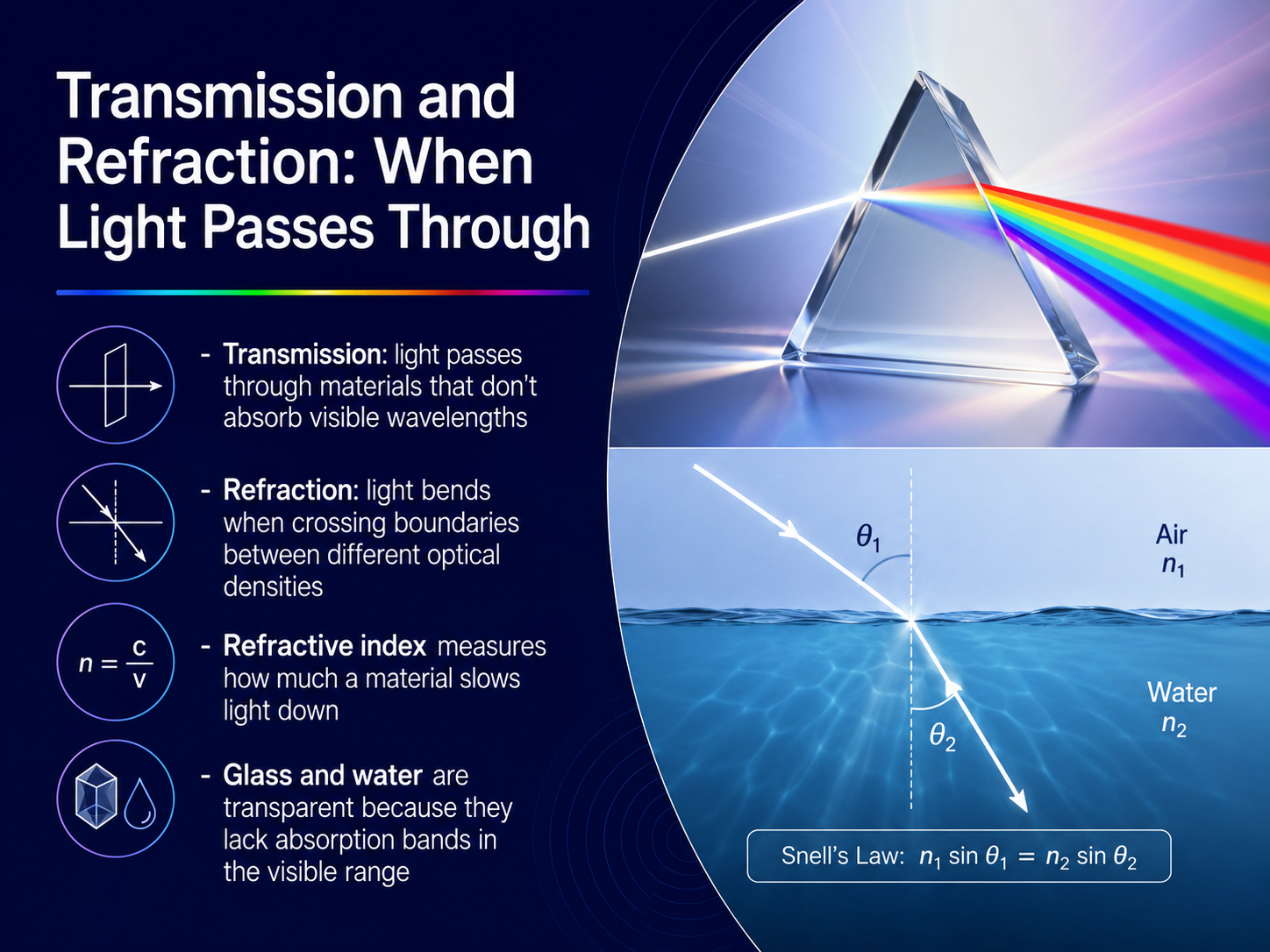
 - 08Transmission and Refraction: When Light Passes ThroughNow, let's consider what happens when light goes through a material, like a window. This is called transmission. A material transmits light when it does not absorb the visible wavelengths. Think of clear glass. You can see right through it because the glass has no absorption bands in the visible range. The same is true for water. When light crosses from one transparent material into another, like from air into water, it often bends. This bending is called refraction. Refraction happens because light changes speed. The refractive index is a number that measures exactly how much a material slows light down. You can observe this yourself. Place a pencil in a glass of water. The pencil looks bent at the water line. That is refraction in action. Next, let's bring this all together and see how our own eyes detect these colors, in the human eye, our color detector.
 1 min
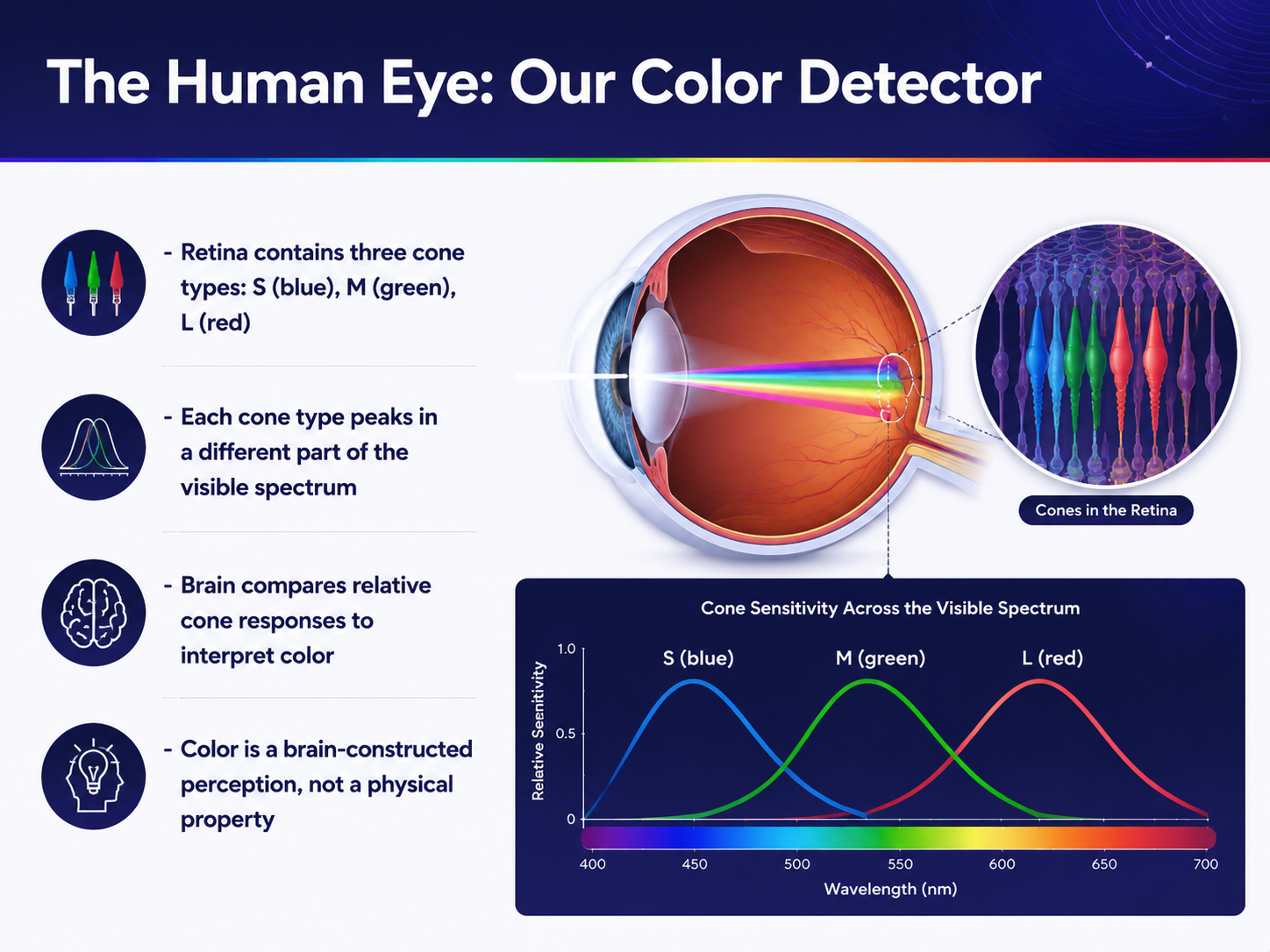
1 min - 09The Human Eye: Our Color DetectorNow, let's bring the light inside the remarkable detector you already own: your eyes. On the retina at the back of the eye, you have three types of cone cells. We call them S, M, and L cones, which are sensitive to short, medium, and long wavelengths of light. You can remember that roughly as blue, green, and red. Each cone type peaks in a different part of the visible spectrum. But here is the key insight. When light enters your eye, your brain does not just read out a wavelength. It compares the relative response from all three cone types. It is like a mixing board, balancing the signals to interpret the color. So, color is not a physical property of the light itself. It is a perception constructed entirely by your brain. Next, we will trace this fascinating process from the raw physics all the way to that constructed perception.
 1 min
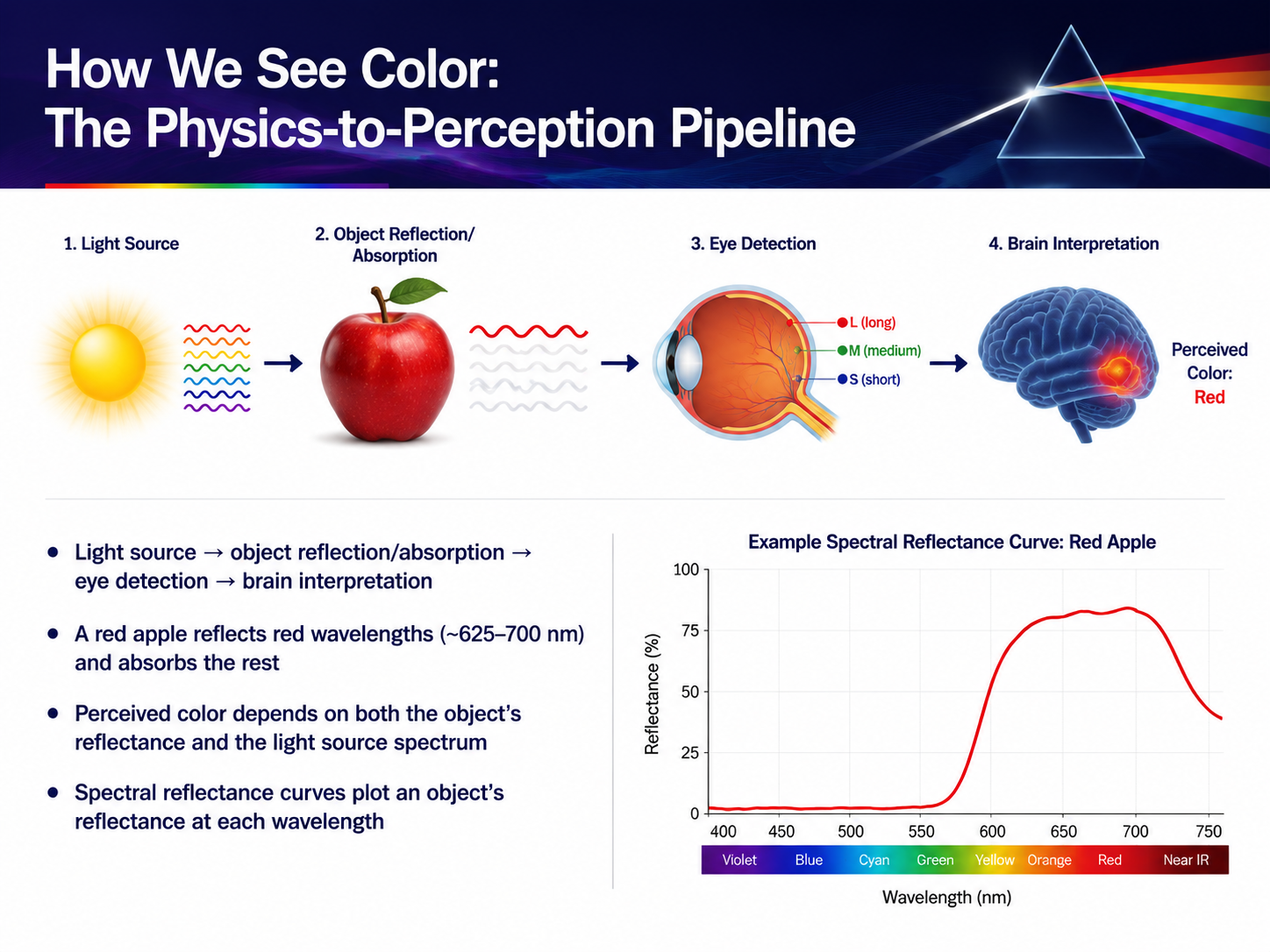
1 min - 10How We See Color: The Physics-to-Perception PipelineNow let's connect the physics to what you actually see. This is the pipeline from light to perception. First, a light source shines on an object. Next, the object reflects some wavelengths and absorbs the rest. Those reflected wavelengths enter your eye, where they're detected, and then your brain interprets the signal as a specific color. For example, a red apple reflects red wavelengths, roughly 625 to 700 nanometers, and absorbs most of the others. But here's a key point: the color you perceive depends on two things. One is the object's reflectance, the wavelengths it bounces back. The other is the light source itself. If you look at that apple under a pure blue light, it won't look red at all, because there are no red wavelengths to reflect. Scientists capture this reflective fingerprint with a spectral reflectance curve. It's a simple graph that plots how much light an object reflects at each wavelength. You can think of it as a signature that defines its color. Next, we'll ground this in something you can relate to: a real-world comparison of a banana peel and a green leaf.
 mdpi.commdpi.comdoi.org+22 min
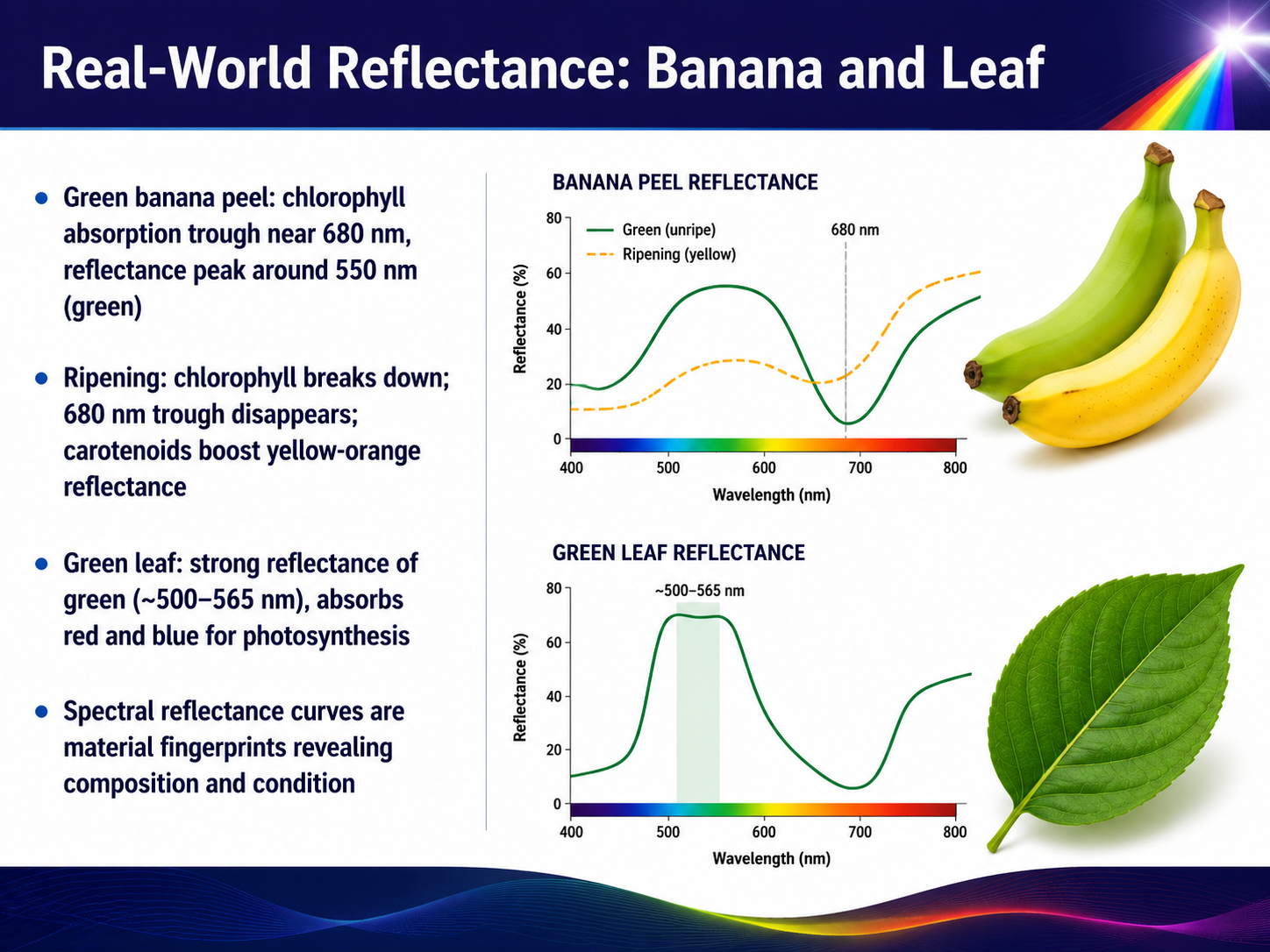
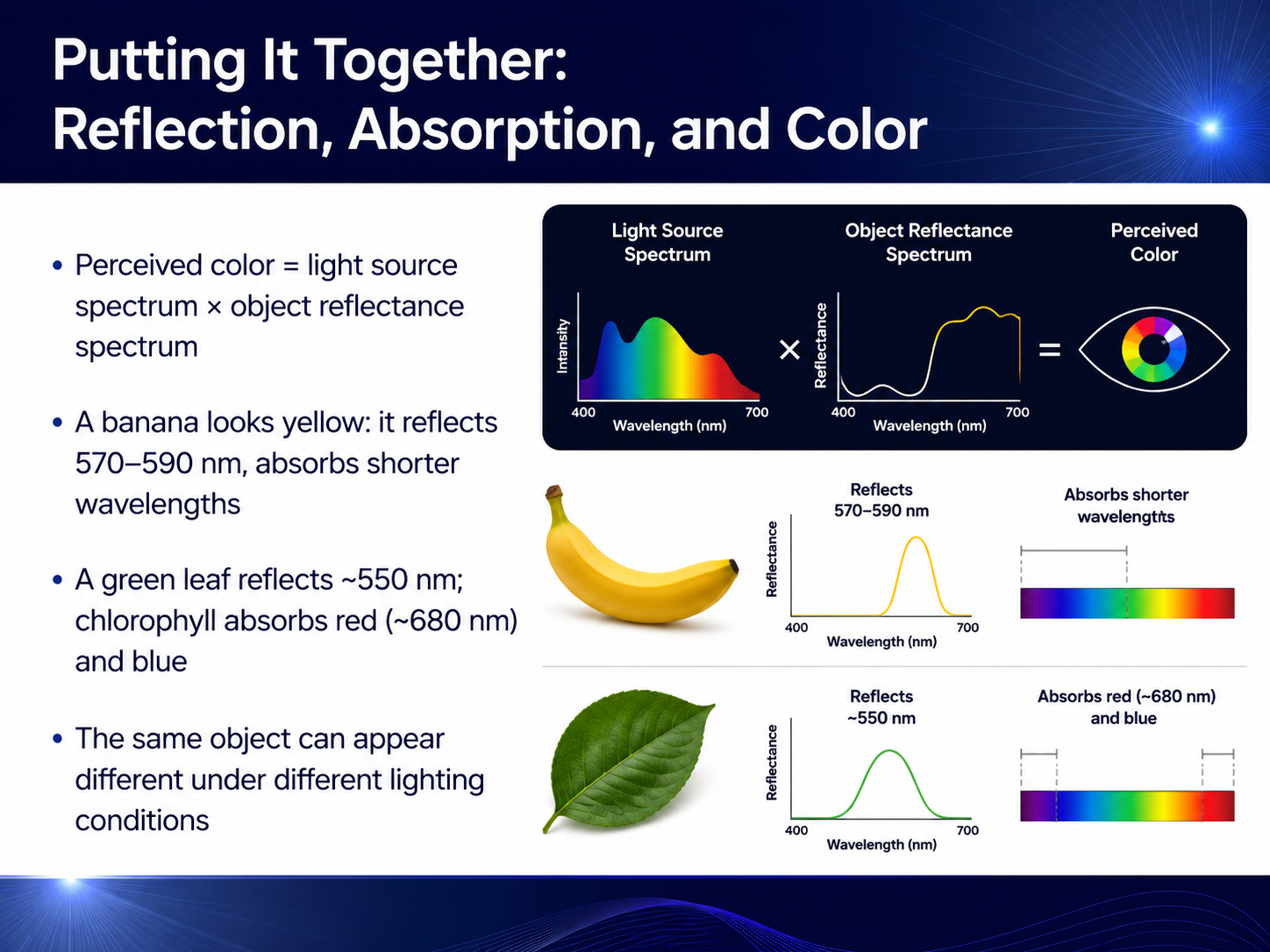
 - 11Real-World Reflectance: Banana and LeafNow let's look at two real-world examples that show how spectral reflectance curves act like material fingerprints. First, a green banana peel. Chlorophyll in the peel strongly absorbs light near 680 nanometers. That creates a clear trough in the curve. Meanwhile, you see a reflectance peak around 550 nanometers, which is the green part of the spectrum. That is why the banana looks green to your eyes. As the banana ripens, chlorophyll breaks down. The absorption trough at 680 nanometers gradually disappears. At the same time, carotenoids increase reflectance in the yellow and orange range. The peel shifts from green to yellow, and the spectral curve becomes flatter and smoother. Now consider a green leaf. It also reflects strongly in the green band, roughly 500 to 565 nanometers. But it absorbs red and blue light very efficiently to power photosynthesis. The takeaway here is that every material has a unique spectral signature. These curves don't just tell us color. They reveal composition, ripeness, and even plant health. Next, we will explore subtractive color mixing with pigments and filters.
 mdpi.commdpi.comdoi.org+22 min
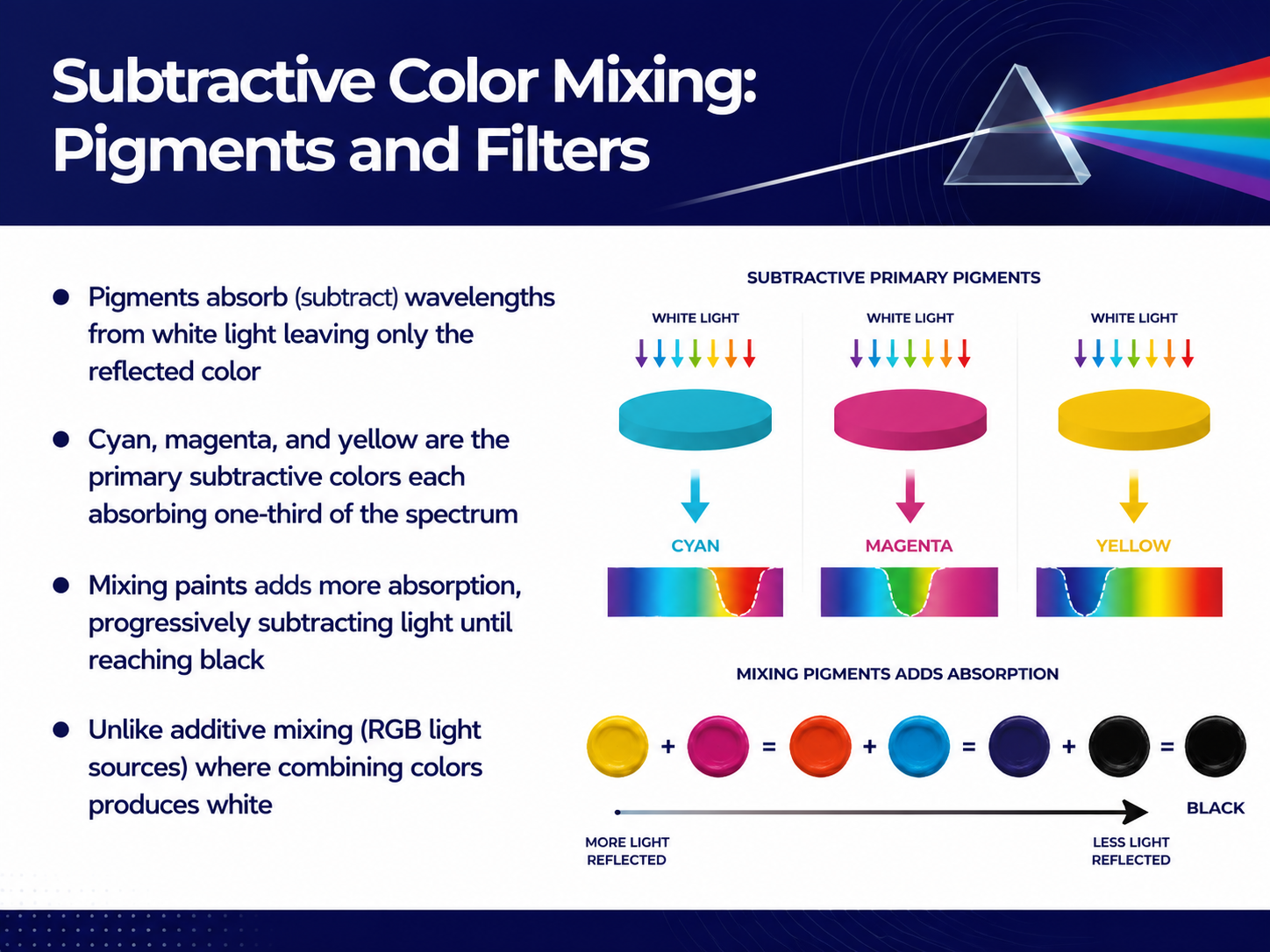
 - 12Subtractive Color Mixing: Pigments and FiltersNow let's shift from mixing light to mixing paint. This is called subtractive color mixing, and it works the opposite way. A pigment, like the paint on this page, absorbs—or subtracts—certain wavelengths from white light. The color you actually see is the light that’s left over, the wavelengths that bounce back to your eye. The primary subtractive colors are cyan, magenta, and yellow. Each one absorbs about one-third of the visible spectrum. When you mix two paints, you add their absorption abilities together. More wavelengths get subtracted, and the mixture looks darker. Keep mixing, and you progressively subtract more light until, in theory, you reach black. This is very different from the additive RGB mixing we saw with light sources, where combining red, green, and blue gives you white. With pigments, you start with white light and chip away at it. You can observe this any time you blend watercolors or mix paints. Up next, we’ll see how this principle can play tricks on our eyes in a slide called The Same Object, Different Light: Metamerism.
 2 min
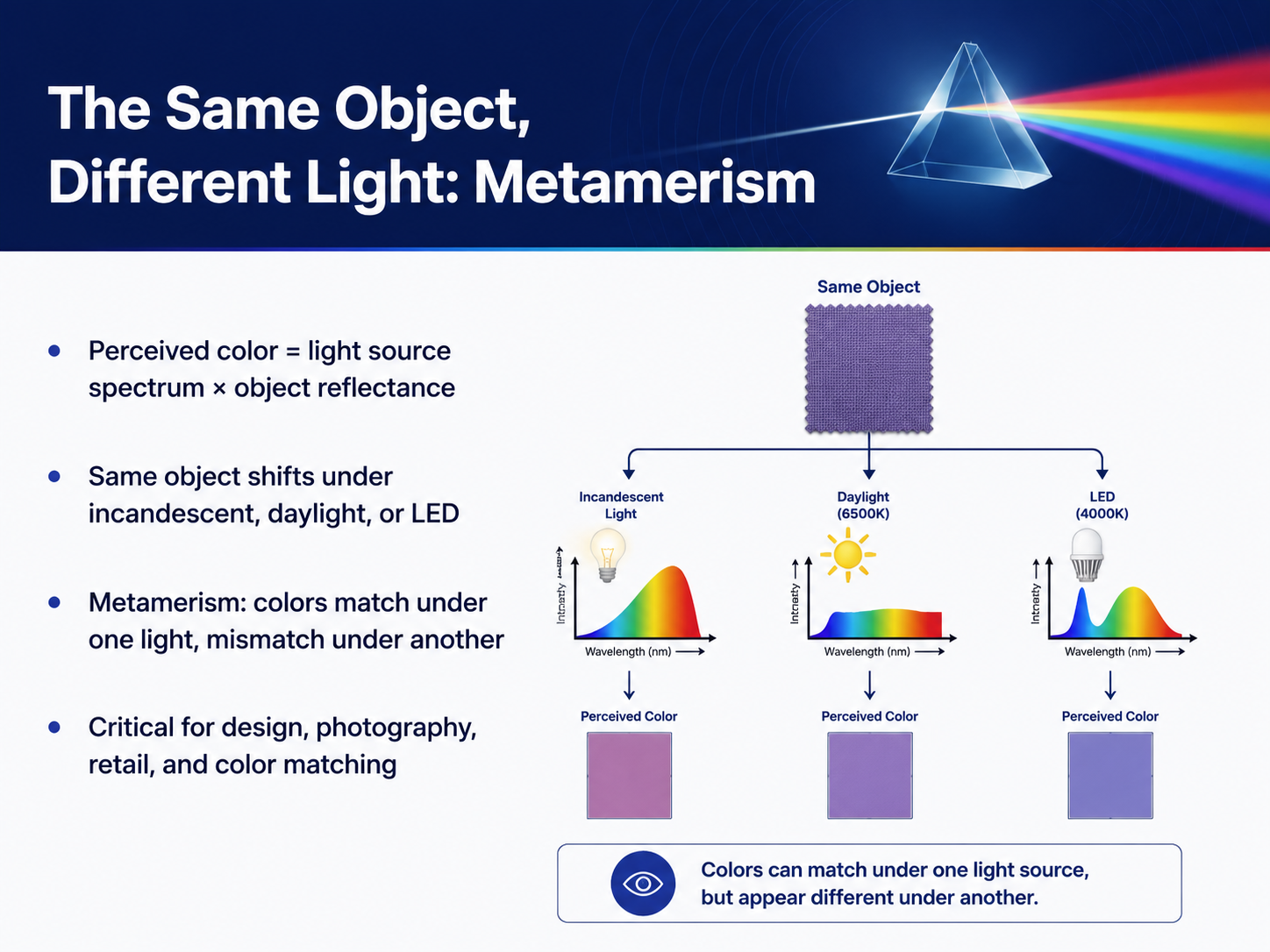
2 min - 13The Same Object, Different Light: MetamerismNow, here's a fascinating twist. The color we see isn't just about the object—it's also about the light shining on it. Think of it as a simple equation: perceived color equals the light source's spectrum multiplied by the object's reflectance. That means a red apple can look different under a warm incandescent bulb, cool daylight, or a bright LED. This effect is called metamerism. It's when two colors appear identical under one light source, but look completely different under another. You might see this with a pair of socks that match perfectly indoors, but not outside. This is critical for anyone in design, photography, or retail, where accurate color matching is a must. Up next, let's put all these pieces together in our final concept: 'Putting It Together: Reflection, Absorption, and Color.'
 1 min
1 min - 14Putting It Together: Reflection, Absorption, and ColorNow we can connect the dots. What you perceive as color is really a combination of two things: the spectrum of the light source, multiplied by the reflectance spectrum of the object. Let’s make that concrete. A ripe banana looks yellow because its peel reflects light in the yellow range, roughly 570 to 590 nanometers. It absorbs the shorter, bluer wavelengths. A green leaf, on the other hand, reflects strongly around 550 nanometers, which we see as green. Its chlorophyll absorbs red light near 680 nanometers and blue light, using that energy for photosynthesis. Here’s a crucial observation you can test yourself: the same object can look completely different under different lighting. A banana under a cool blue LED versus a warm kitchen bulb will not appear the same yellow. The object’s physical surface hasn’t changed, but the light feeding it has. That’s why understanding both reflection and the light source is essential. Next, we’ll explore these principles in action with some everyday applications.
 mdpi.commdpi.comdoi.org+21 min
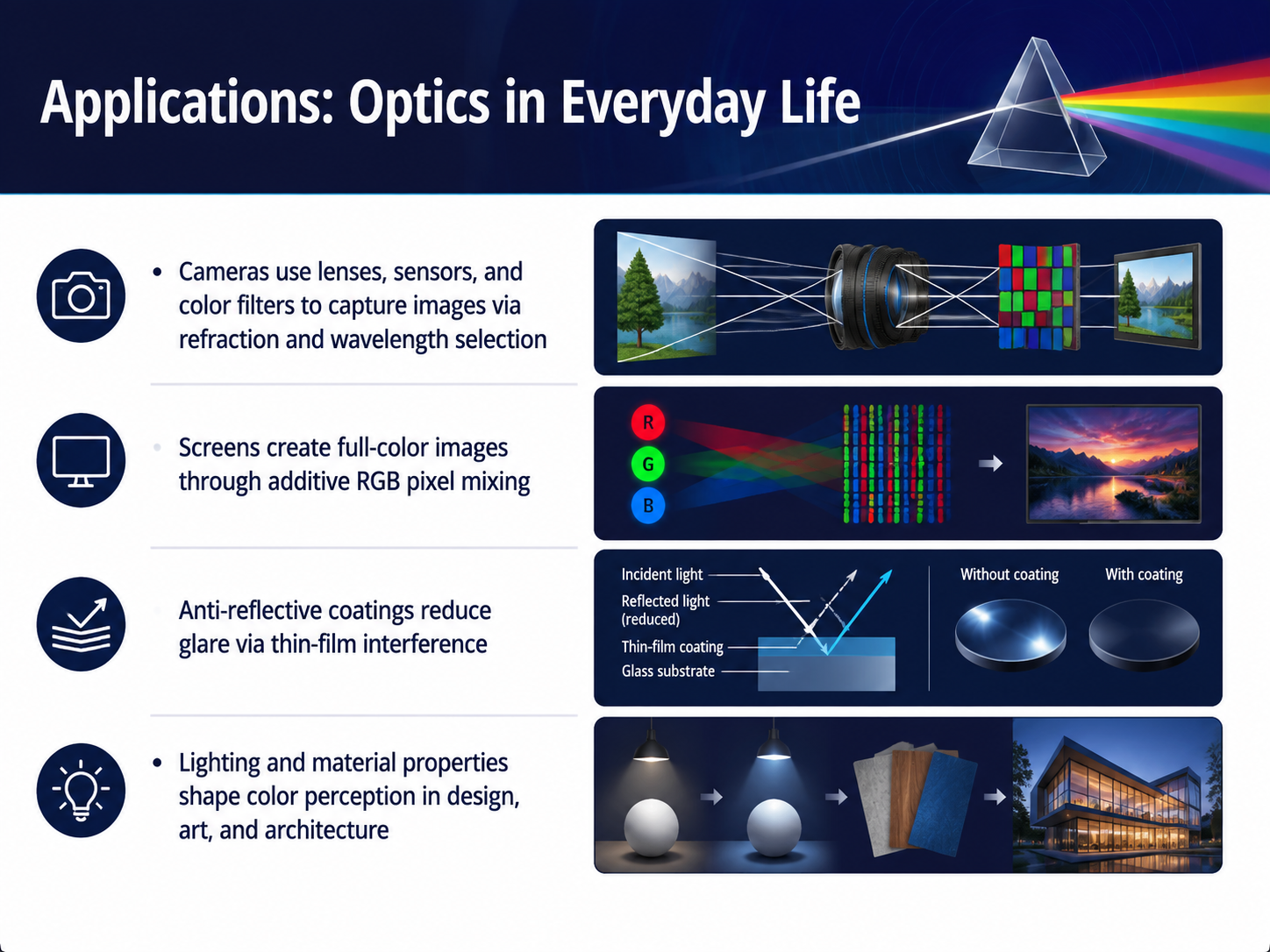
 - 15Applications: Optics in Everyday LifeSo how do these ideas show up in the tools you use every day? Let’s look at a few clear examples. A camera lens uses refraction to bend light onto a sensor, and tiny color filters select specific wavelengths, red, green, and blue, to record a full color image. Your phone screen does something similar in reverse. It mixes tiny red, green, and blue pixels additively, and your eye blends them into the colors you see. Have you ever noticed a bluish or purplish tint on eyeglasses or a camera lens? That is an anti-reflective coating. It uses thin-film interference to cancel out reflections and reduce glare. Even the paint on a wall or the lighting in a room shapes your perception. A warm light bulb can make a blue fabric look dull, while a cool light makes reds pop. Designers and architects use these material and light interactions to create specific moods and visual effects. Next, let’s pull everything together with our summary and key takeaways.
 2 min
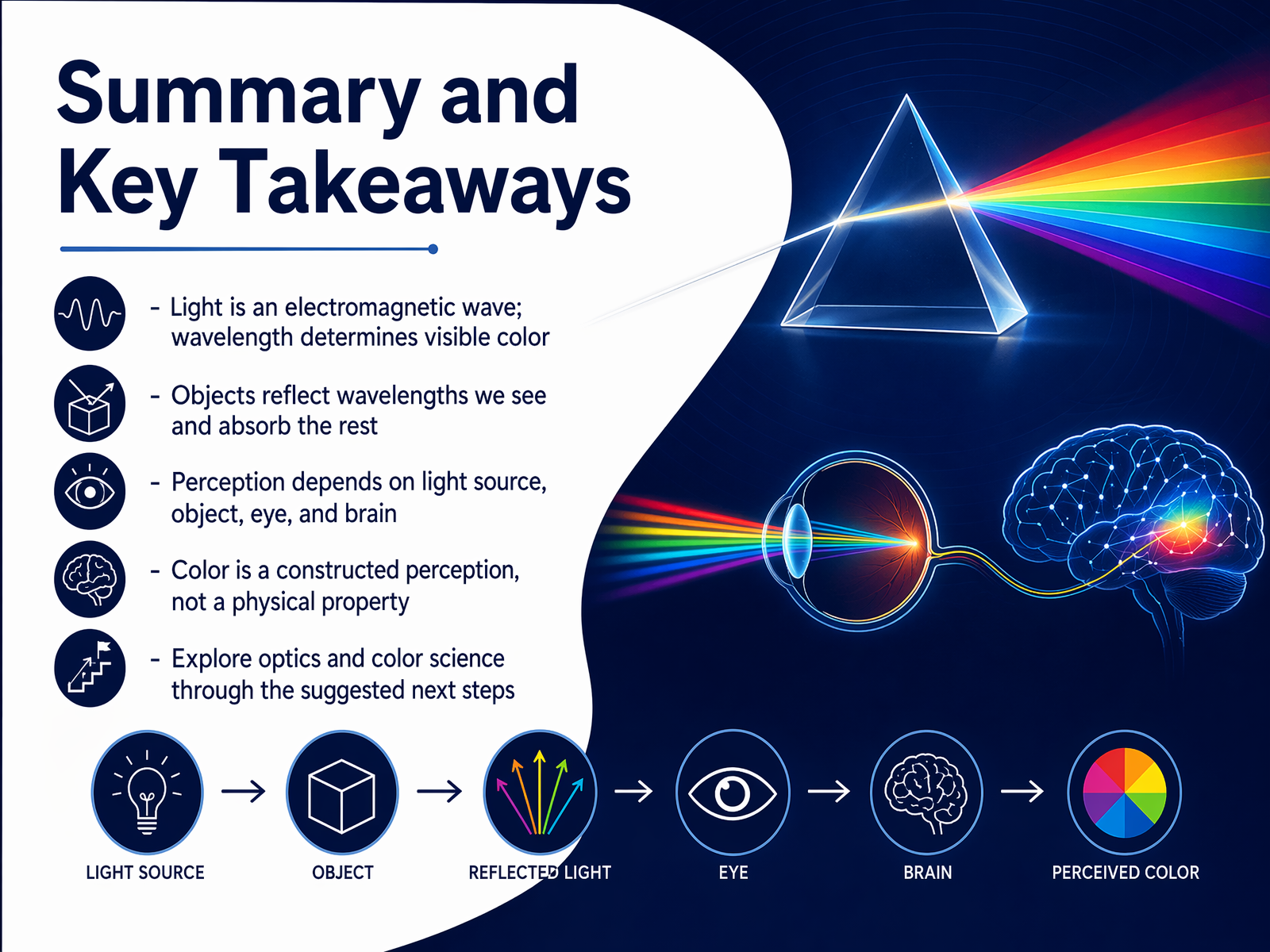
2 min - 16Summary and Key TakeawaysLet's pull together the key ideas from our journey through light and color. First, light behaves like a wave. Its wavelength is simply the distance between wave peaks, and that distance determines what color you see. Second, when light hits an object, the object reflects certain wavelengths back to your eye and absorbs the rest. You see the reflected wavelengths as the object's color. Third, your perception of color involves four players: the light source, the object, your eye, and your brain. All four work together. Finally, here's the big takeaway. Color is not a physical property of objects. It is a perception your brain constructs from light. Thank you for exploring these ideas with me. I encourage you to keep observing the world around you, and take the next steps to deepen your understanding of optics. You have built a great foundation today.
 1 min
1 min
Take the deck with you
Download this course as a file — free, no sign-up needed.
- PDF handoutEvery slide page, ready to print or share.17 pages · 3.8 MBDownload
- Narrated PowerPointThe deck that presents itself — every slide carries the digital human's narration video.17 pages · 14.8 MBDownload
- PowerPoint slidesThe full deck as a .pptx — open it in PowerPoint, Keynote, or Google Slides.17 pages · 3.7 MBDownload
Free to use in your own training — please keep the PersonWise credit page at the end.
Have your own deck? Turn it into a course
Sources consulted
Web sources consulted while building this course.
- Visible spectrum - Wikipedia — en.wikipedia.org
- Visible Light - NASA Science — science.nasa.gov
- Atomic Spectroscopy - Spectral Wavelength Ranges, Dispersion of Air | NIST — nist.gov
- The Visible Spectrum: Wavelengths and Colors - ThoughtCo — thoughtco.com
- Visible Light Definition and Wavelengths — thoughtco.com
- Spectroscopy 101 – How Absorption and Emission Spectra Work - NASA Science — science.nasa.gov
- Background: Atoms and Light Energy - Imagine the Universe! — imagine.gsfc.nasa.gov
- Photon Emission and Absorption by Atoms - StudyPulse — vce.studypulse.au
- Atomic spectra | Elucidate Education — elucidate.org.au
- 6.1: What Causes Molecules to Absorb UV and Visible Light - Chemistry LibreTexts — chem.libretexts.org
- Green Banana Maturity Classification and Quality Evaluation Using Hyperspectral Imaging — mdpi.com
- Study on the Relations between Hyperspectral Images of Bananas (Musa spp.) from Different Countries, Their Compositional Traits and Growing Conditions — mdpi.com
- Non-invasive, real time in-situ techniques to determine the ripening stage of banana — doi.org
- Using VIS – NIR imaging for non-intrusive Musa Acuminata banana color changes assessment over a maturity period — doi.org
- Detecting temporal changes in skin surrogate model using hyperspectral imaging | MRS Communications | Springer Nature Link — link.springer.com