English Study Routine Development
Begin
14 pages · ~28 min
English Study Routine Development
A course for English learners on creating a personalized, sustainable study routine. You will learn how to set realistic goals and build an effective daily practice.
What you’ll learn
- 01Building an English Study RoutineWelcome. If you are learning English, or helping others learn, you are in the right place. Here is the truth about making progress. Motivation is great, but it fades. What really works is having a simple system. A routine you can rely on, even on busy days. In this training, we will build that system together. We will cover setting clear goals, practicing the right skills, and finding time in your schedule. We will explore how to build habits that stick, and how to check your progress along the way. And we will keep it realistic for busy adults. Small steps count. You can build this. Imagine starting your day with a coffee and just five minutes of English. That is a system you can rely on. So let us begin. First, we will look at why building a system works so much better than waiting for motivation to strike.link.springer.combrightmindpublishing.comjournals.kmanpub.com+21 min
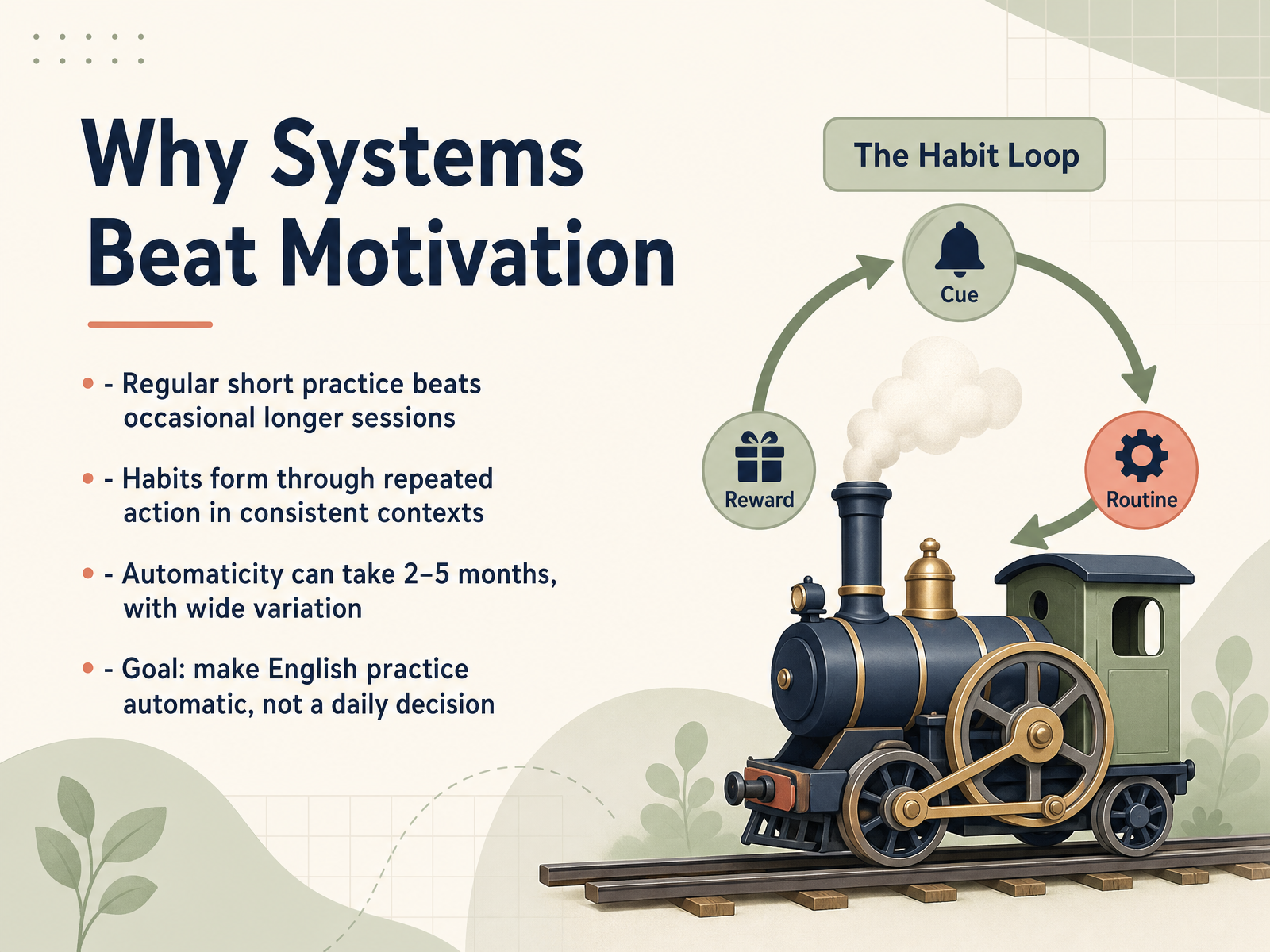
- 02Why Systems Beat MotivationLet's talk about why systems beat motivation. Many learners wait until they feel inspired to study, but that is a trap. Motivation fades. A system keeps you moving even on low-energy days. Research on adult habit formation shows that regular, short practice wins over occasional long sessions. In fact, frequency matters more than duration. Think of it this way: ten focused minutes every day beats two hours once a week. That consistent context—same time, same chair, same cup of tea—signals your brain it is time to learn. And here is the encouraging part: habits become automatic in two to five months, sometimes faster, sometimes slower. That is completely normal. The goal is not to make a daily decision about studying. The goal is to make English practice simply what you do. This works for your own study or for your students. Try pairing English with an existing routine, like your morning coffee. Small steps count. Next, let's look at understanding your starting point with CEFR.
 link.springer.combrightmindpublishing.comjournals.kmanpub.com+21 min
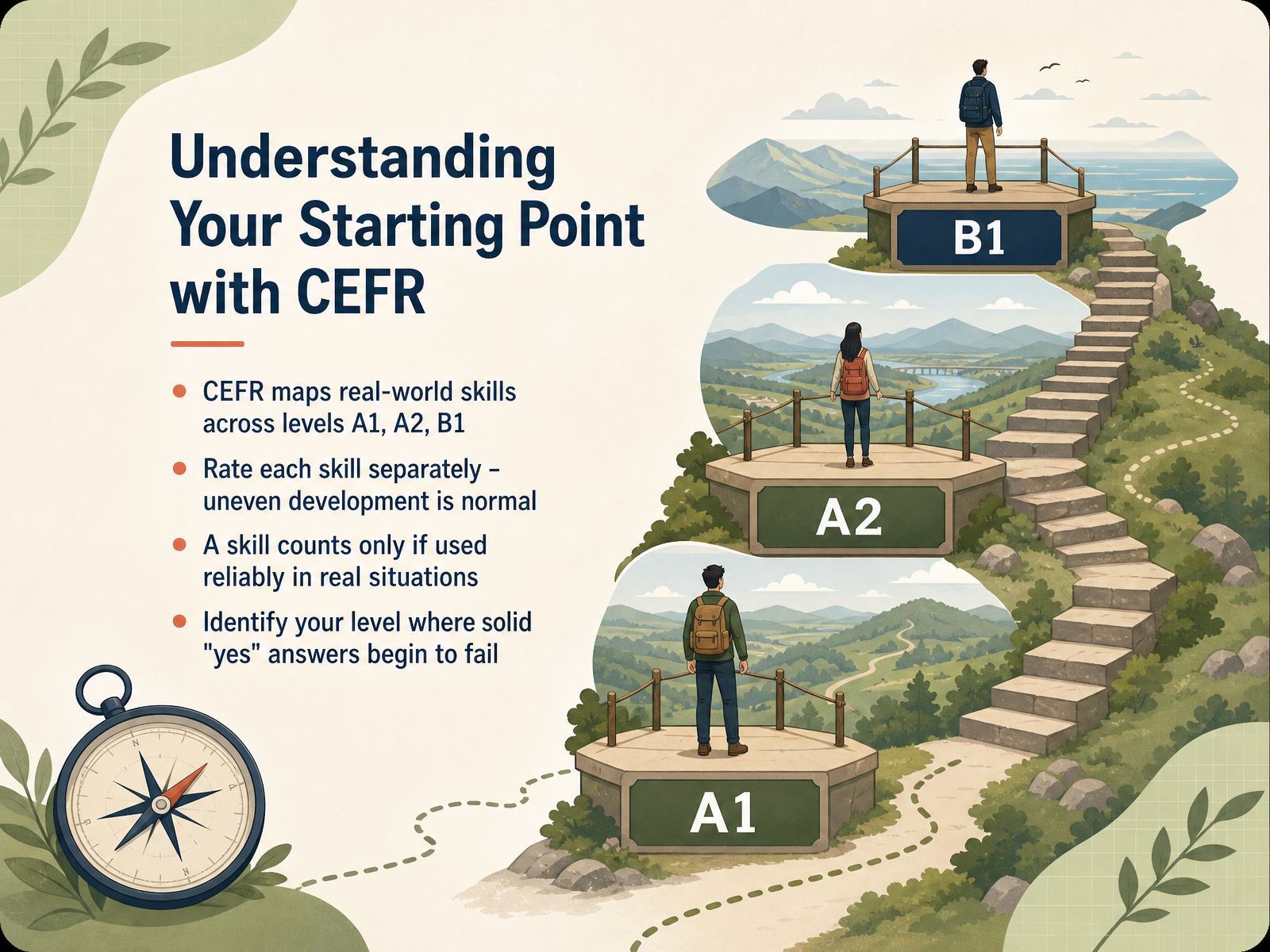
 - 03Understanding Your Starting Point with CEFRNow that you are ready to begin, let us talk about that crucial first step, knowing where you are right now. The CEFR framework can help you do this honestly. It is a map of real-world skills, from A1 for basic users, up to B1 for independent users. But here is the key point. Do not rate your English as one single level. Rate each skill separately. Reading, writing, listening, and speaking. Uneven development is completely normal. Many people can read well but struggle to speak. That is fine. This framework is about what you can do reliably, in real situations. It does not count if you did it once with lots of help. It counts when you can do it on a normal day. So, as you look at the descriptions, find the level where your solid yes answers begin to turn into maybe. That is your honest starting point. This works for you or for your students. Small steps count, but they must start on solid ground.
 cedefop.europa.eurm.coe.intcoe.int+21 min
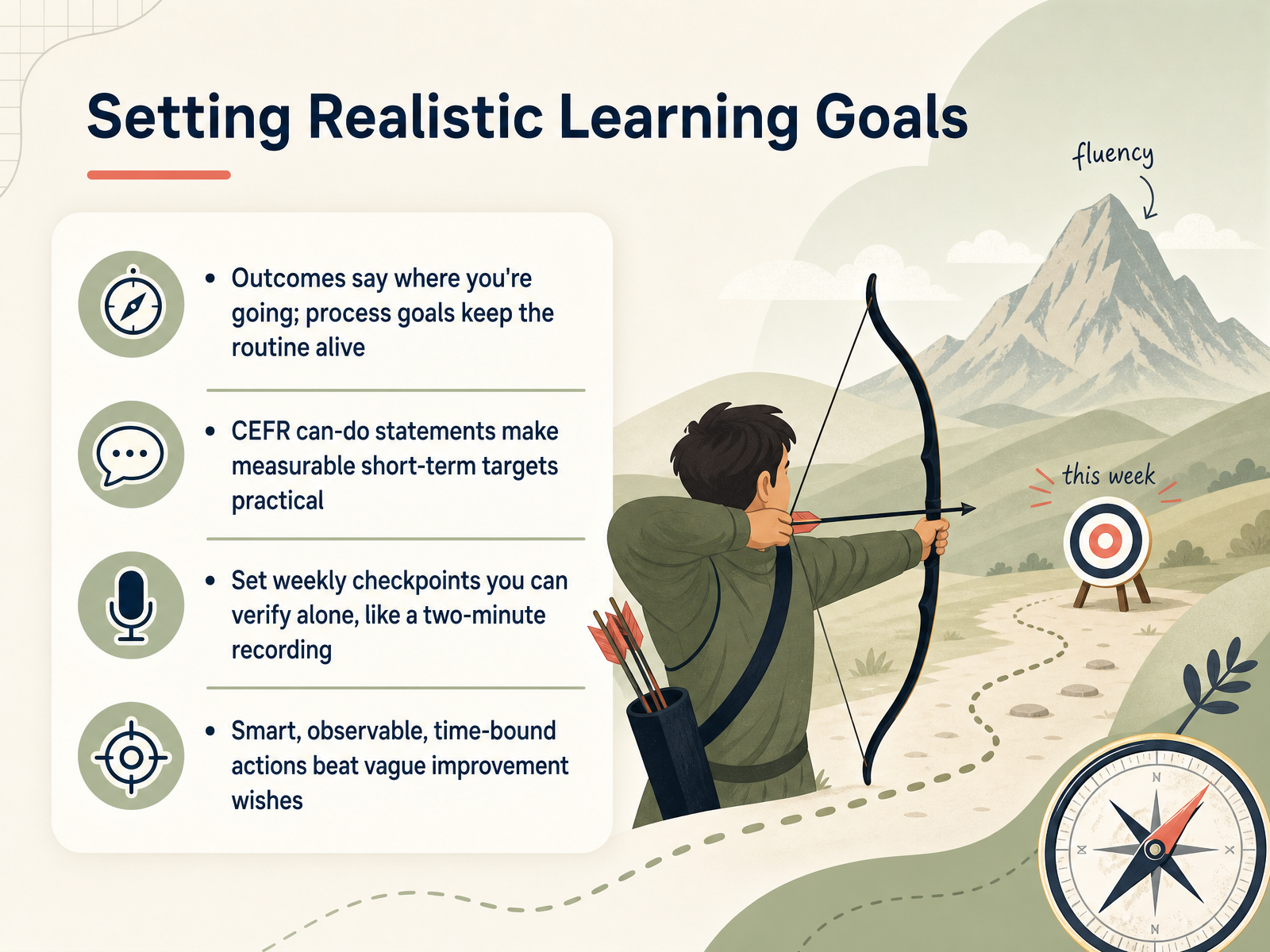
 - 04Setting Realistic Learning GoalsNow let's think about setting goals that actually work for you. There's a difference between an outcome, like 'I want to reach B1,' and a process, like 'I will practice speaking for ten minutes each day.' Outcomes tell you where you're going, but process goals keep your routine alive. A great way to make process goals practical is to use CEFR can-do statements. These are simple 'I can' sentences that describe real tasks. For example, at A2, you might say, 'I can describe my family in simple sentences.' That's measurable. So set a weekly checkpoint you can verify on your own. Maybe record yourself for two minutes describing your weekend. Listen back. Did you use the words you planned? That's evidence of progress. Smart, observable, time-bound actions beat vague wishes like 'improve my English.' Try it: pick one can-do statement for this week, and give yourself a simple task around it. This works for your own study or for guiding your students. Small steps really do count. Next, let's look at balancing the four core skills.
 cedefop.europa.eurm.coe.intcoe.int+21 min
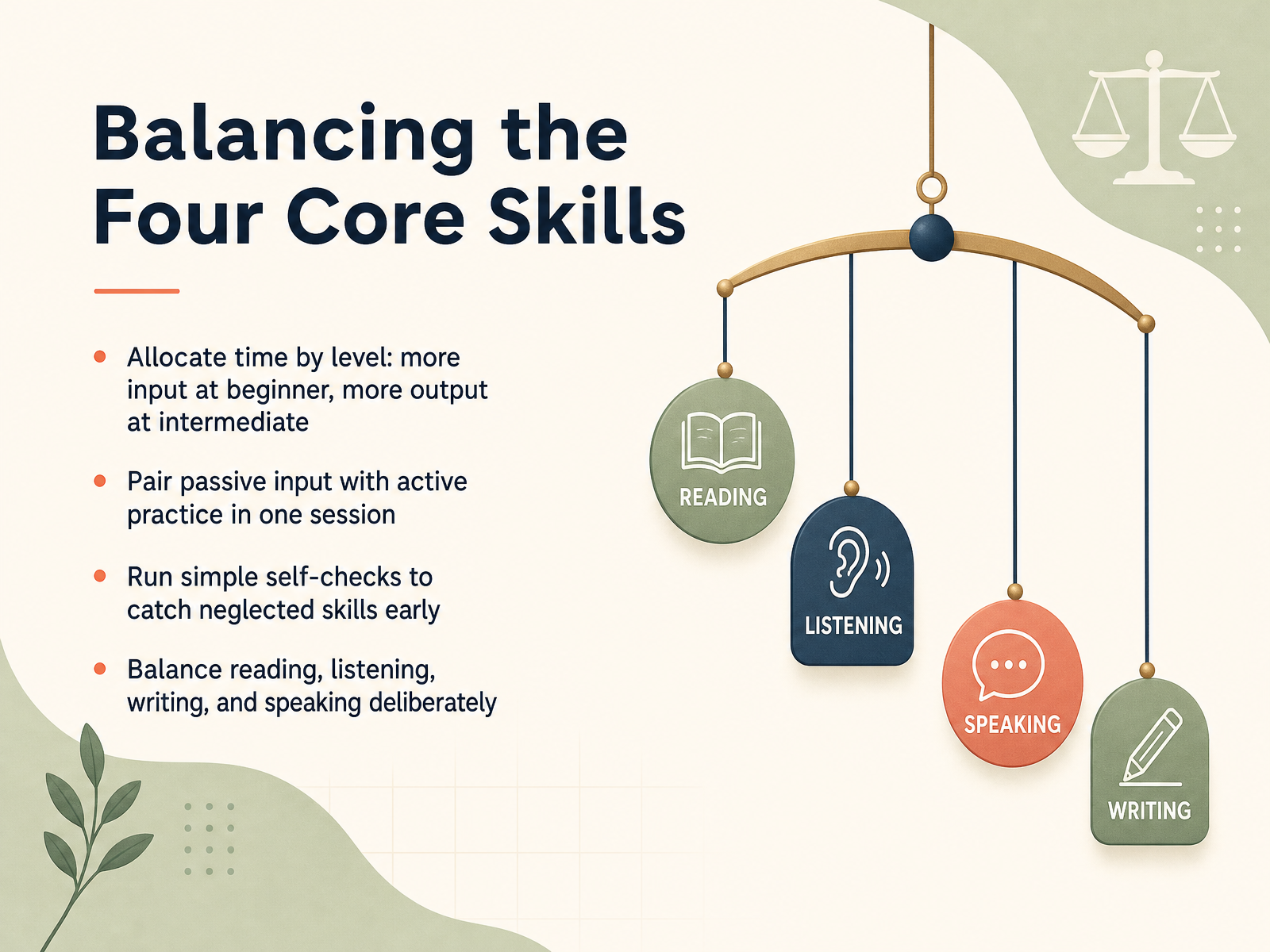
 - 05Balancing the Four Core SkillsNow let's talk about balancing the four core skills. The key is to match your time to your level. If you're a beginner, focus more on input—reading and listening. They build your foundation. As you move to intermediate, shift toward output—speaking and writing. That's where you start using what you've learned. Also, try pairing passive input with active practice in one session. For example, listen to a short podcast, then summarize it out loud or write a few sentences. This turns passive understanding into active ability. Check in with yourself regularly to catch neglected skills early. Ask simple questions like, 'When did I last write in English?' or 'Have I spoken out loud this week?' Small checks like these keep your routine honest. And remember, all four skills matter. Reading helps your writing. Listening helps your speaking. Balance them deliberately, not by accident. Next, let's look at choosing materials that fit your level and interests.
 cedefop.europa.eurm.coe.intcoe.int+22 min
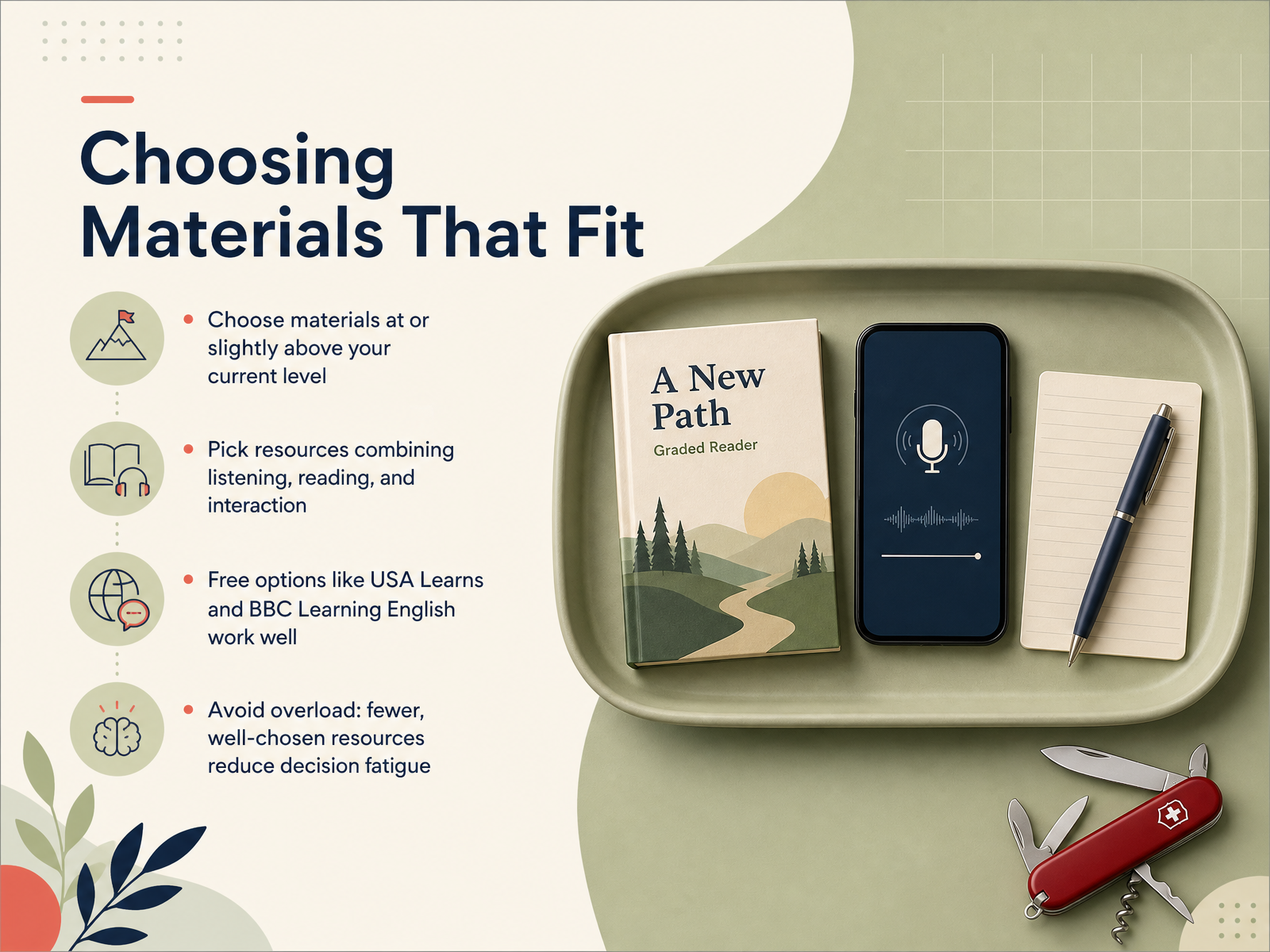
 - 06Choosing Materials That FitNow let’s talk about choosing materials that fit you. The key is to pick resources that are at or slightly above your current level. If it’s too easy, you won’t grow. If it’s too hard, you may feel frustrated. So aim for that sweet spot where you understand most of it but still learn something new. Also look for materials that blend listening, reading, and interaction. That keeps your practice balanced. Good news: free options like USA Learns and BBC Learning English work really well for adult learners. USA Learns offers video-based courses with listening, reading, writing, and speaking activities. BBC Learning English gives you short, current lessons with audio and transcripts. You can start today without spending money. And remember, avoid overload. Pick just two or three resources you like and stick with them. Fewer well-chosen tools reduce decision fatigue. For example, choose one main course and one source for daily listening. That’s enough. Think about what will fit your schedule and your goals. This works for your own study or your students’ learning journey. Next, we’ll look at designing a weekly schedule so your materials are put to good use.
 usalearns.orglexinglo.commyenglishpages.com+22 min
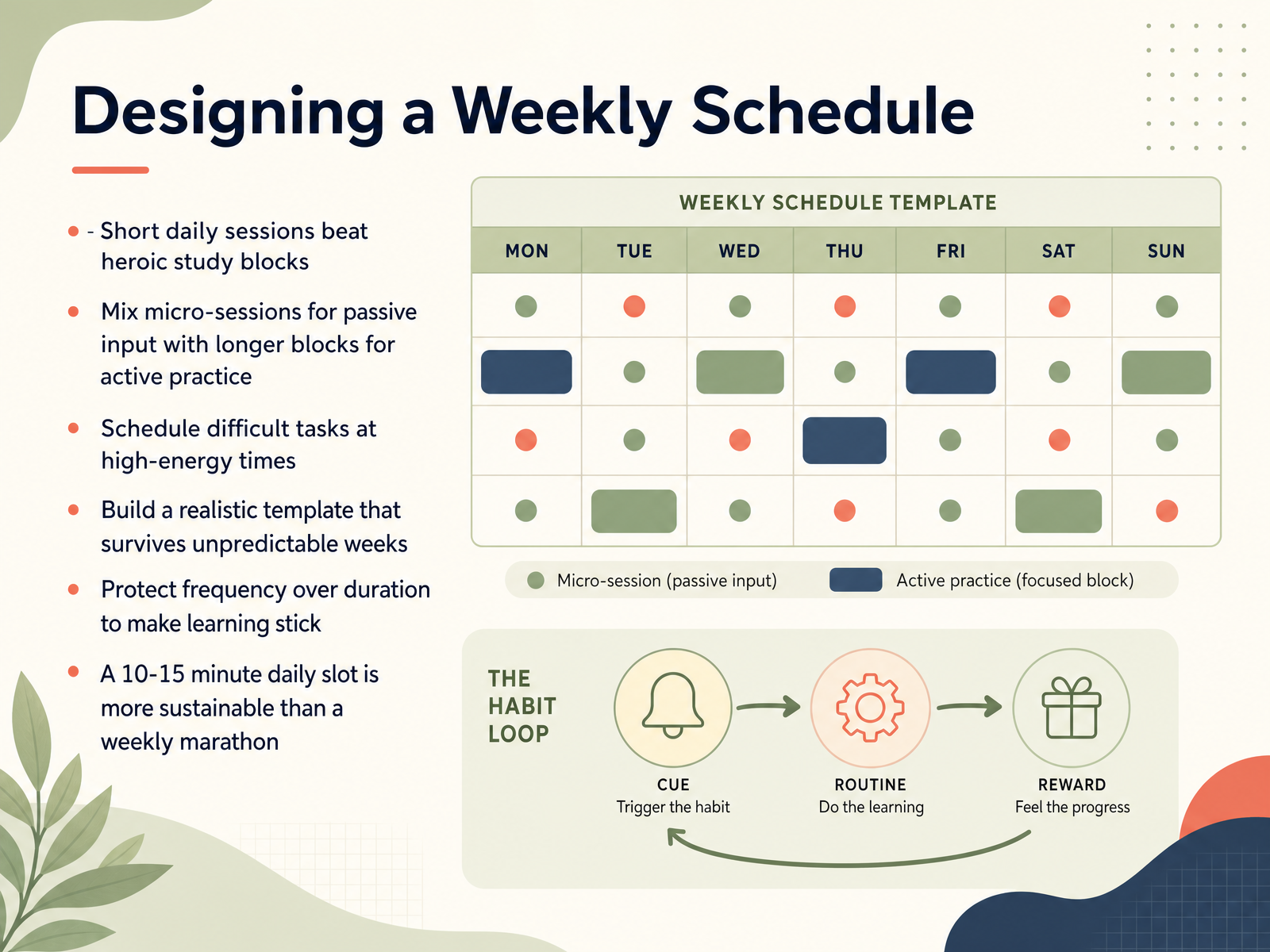
 - 07Designing a Weekly ScheduleLet’s turn that daily moment into a full weekly schedule. And the key idea here is simple: short daily sessions beat heroic study blocks. You can build this. Research shows that how often you practice matters far more than how long each session lasts. A ten to fifteen minute daily slot is more sustainable than a weekly marathon. So, think about mixing micro-sessions for passive input, like listening to a podcast on your commute, with longer blocks for active practice, like speaking drills or writing. You can also schedule difficult tasks at your high-energy times. For example, if you’re sharpest in the morning, put grammar work there. And build a realistic template that survives unpredictable weeks. If you miss a day, don’t worry. Just protect frequency over duration to make learning stick. It’s better to study five days for ten minutes than to cram once for two hours. This works for your own study or for guiding your students. Small steps count, and they add up faster than you think. Now, let’s look at habit stacking and implementation intentions, which will make this schedule almost automatic.
 link.springer.combrightmindpublishing.comjournals.kmanpub.com+22 min
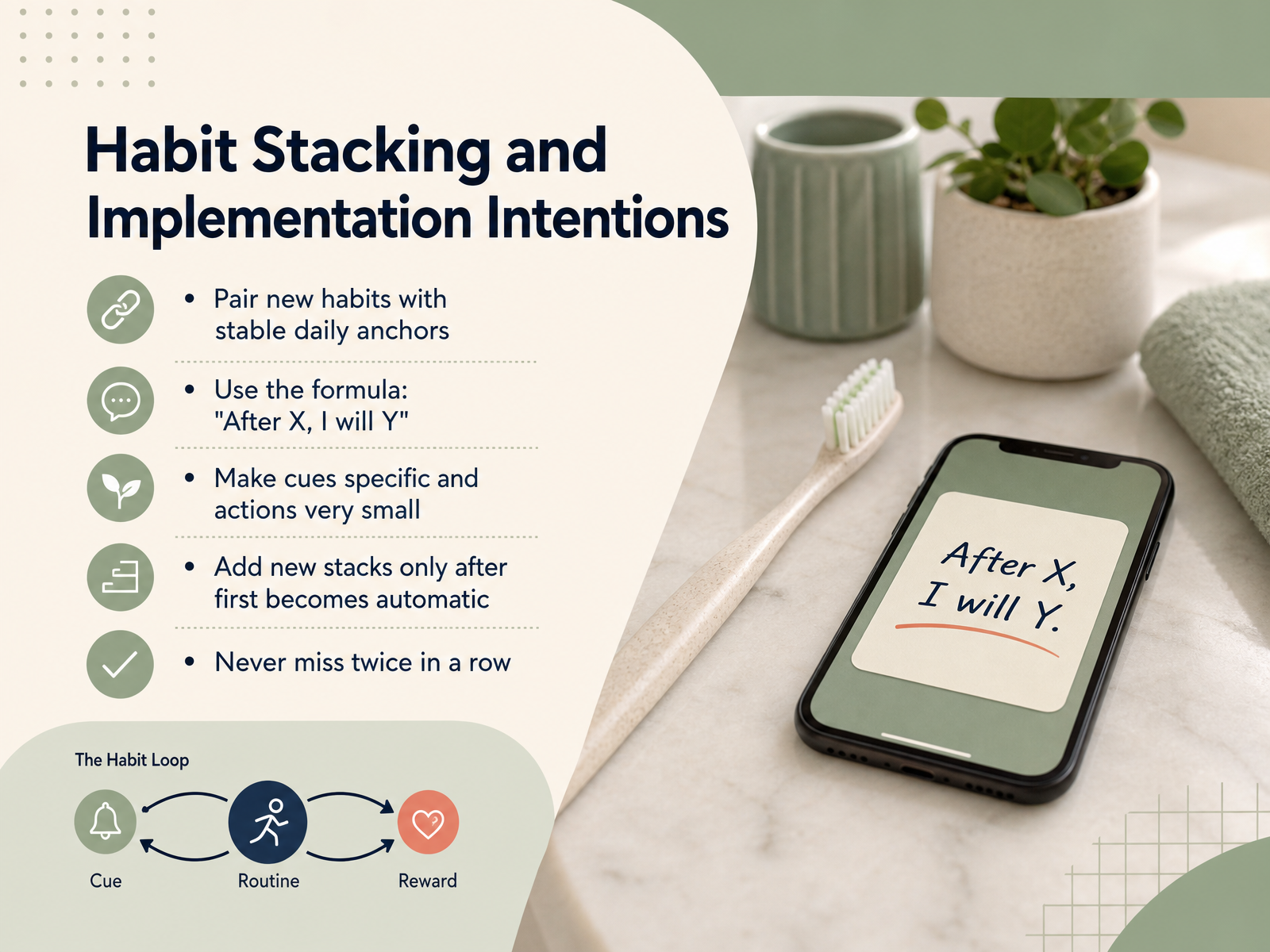
 - 08Habit Stacking and Implementation IntentionsNow let's talk about two powerful tools that make consistency almost automatic: habit stacking and implementation intentions. The idea is simple. Don't create a new slot in your day; piggyback on one that already exists. Use the formula "After X, I will Y." For example, "After I pour my morning coffee, I will review ten flashcards." Make the cue specific and the action very small. Not "after breakfast, I will study" but "after I clear my plate, I will open my language app for five minutes." Specific beats vague every time. Also, this works for your own study or your students'. Pick an anchor that happens every day without fail. And please add new stacks only after the first one becomes automatic. Most people can run two or three small stacks daily, but don't install them all at once. Finally, a golden rule: never miss twice in a row. One missed day is an accident. Two is the start of a new, less helpful pattern. So if you slip, just pick it back up tomorrow. Now let's look at how to track your progress without adding overhead to your routine.
 blog.langtrack.appjamesclear.comling-app.com+21 min
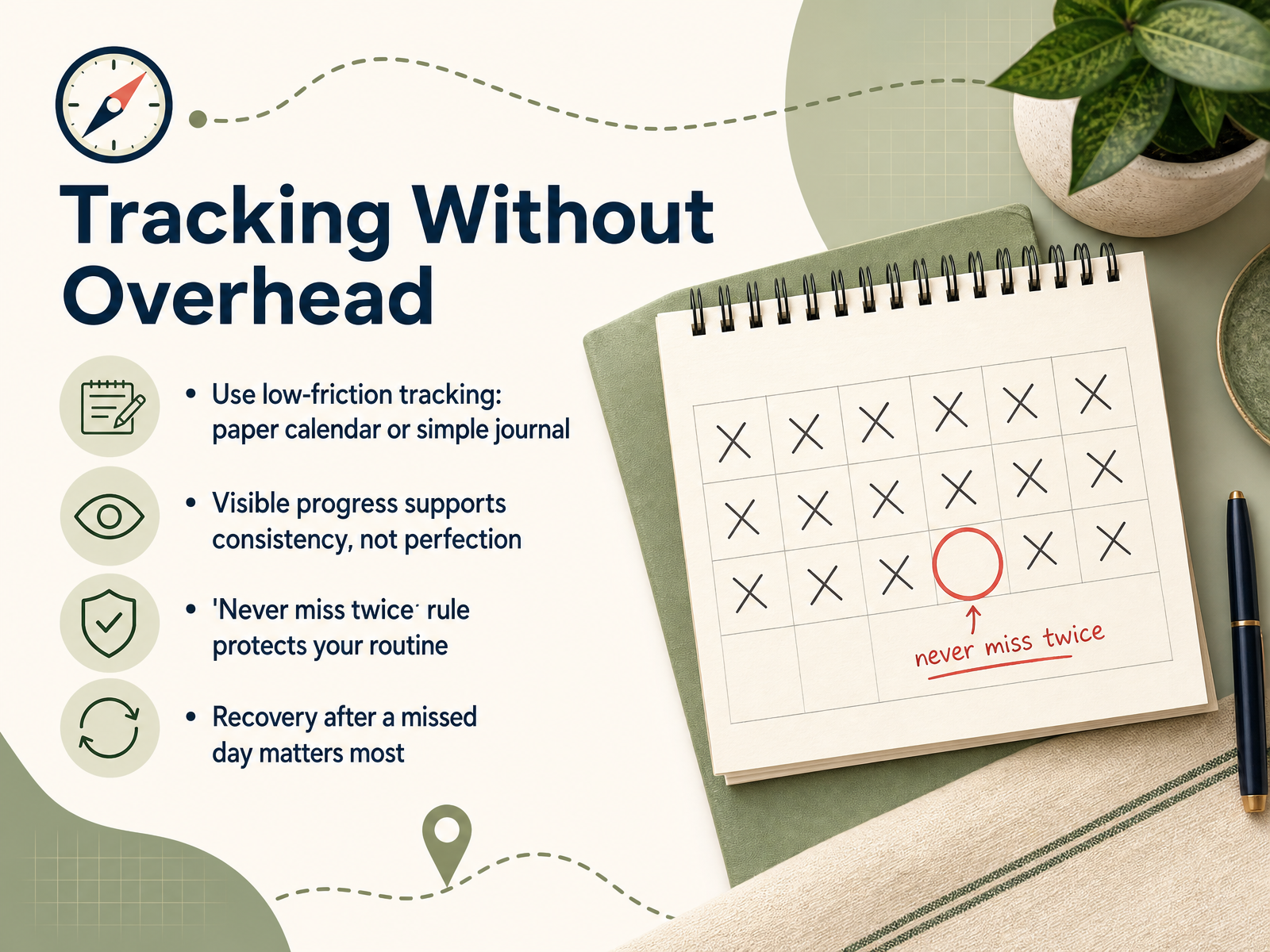
 - 09Tracking Without OverheadNow let's talk about tracking your progress without adding extra work. The secret is to keep it simple with low-friction tools, like a paper calendar or a small journal. You do not need a complex system. Just a place where you can see your effort at a glance. And that visible progress is what keeps you going. It is not about being perfect. It is about being consistent. If you miss a day, remember the 'never miss twice' rule. One missed day is just an accident. Two days in a row starts a new pattern you do not want. So what matters most is how you recover after a missed day. Just pick up where you left off with a small session. For your own study or your students', this works beautifully with habit stacking. For example, after you pour your morning coffee, mark that day on the calendar. Or after you brush your teeth at night, jot down one sentence in your journal. The tracking becomes part of the routine itself. Keep it visual, keep it simple, and let the chain of days be its own reward. Coming up next, we will look at self-assessment and progress checks to see how far you have come. Let's dive in.
 blog.langtrack.appjamesclear.comling-app.com+22 min
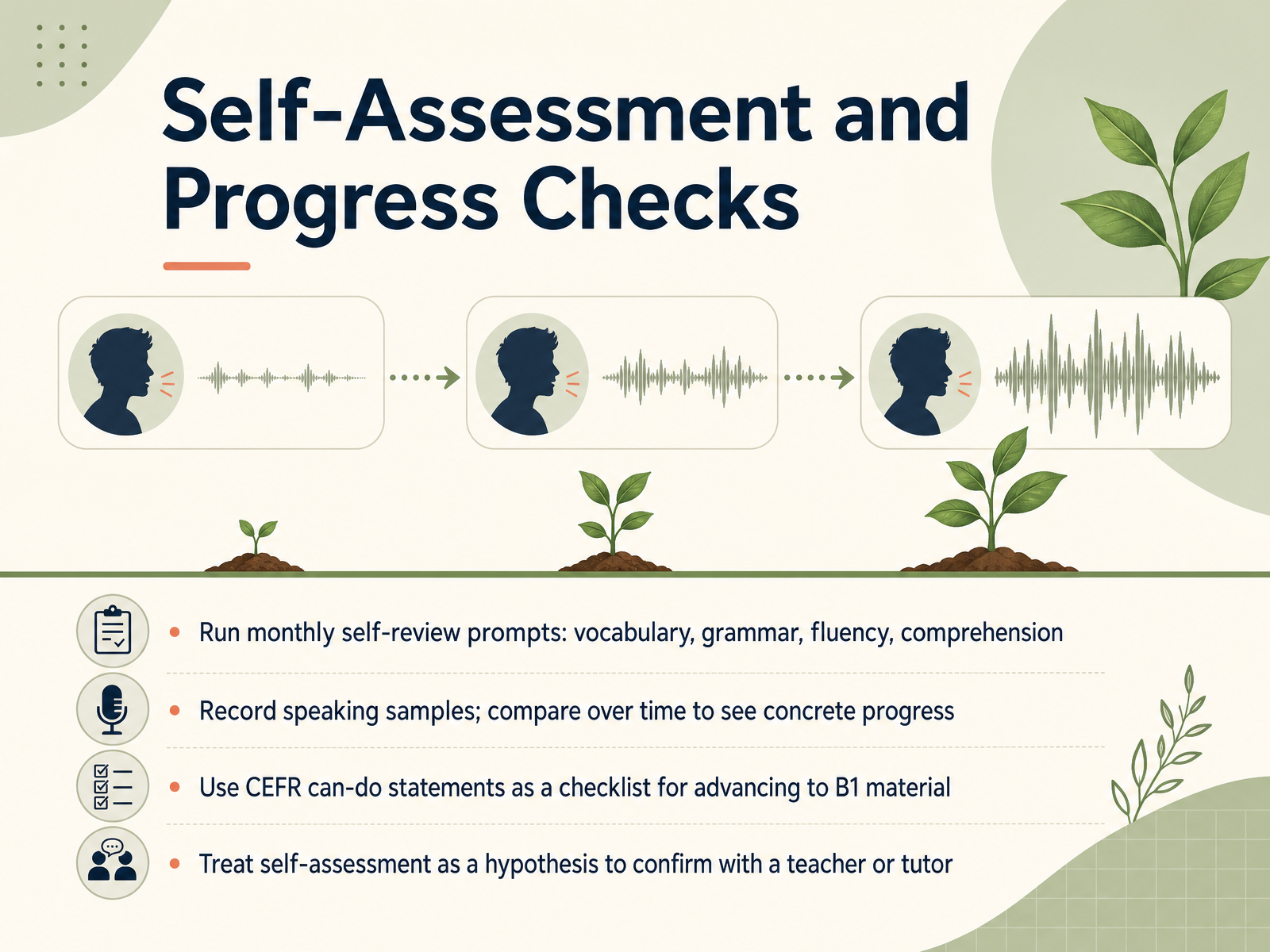
 - 10Self-Assessment and Progress ChecksLet's talk about how you can check your own progress. Every month, take a few minutes for a self-review. Ask yourself simple questions about your vocabulary, your grammar, your fluency, and how well you understand others. You can record yourself speaking, just for a minute or two. Then, a few weeks later, record again. When you listen back, you will hear the progress you've made. That is a very satisfying feeling. Another helpful tool is the CEFR can-do checklist. These are simple statements like, "I can describe my family in simple terms." Start at the A1 level and work your way up. When you can honestly say yes to most statements at A2, you're ready to explore B1 material. One important tip: treat your self-assessment as a hypothesis, not a final verdict. You might think you are at one level, but it's always smart to confirm that with a teacher or a tutor. This approach works well for your own study, or you can use it with your students. A monthly self-check is a small step, and small steps count. Keep this habit, and your routine will stay on track. Next, we'll look at how to adjust your routine over time.
 cedefop.europa.eurm.coe.intcoe.int+22 min
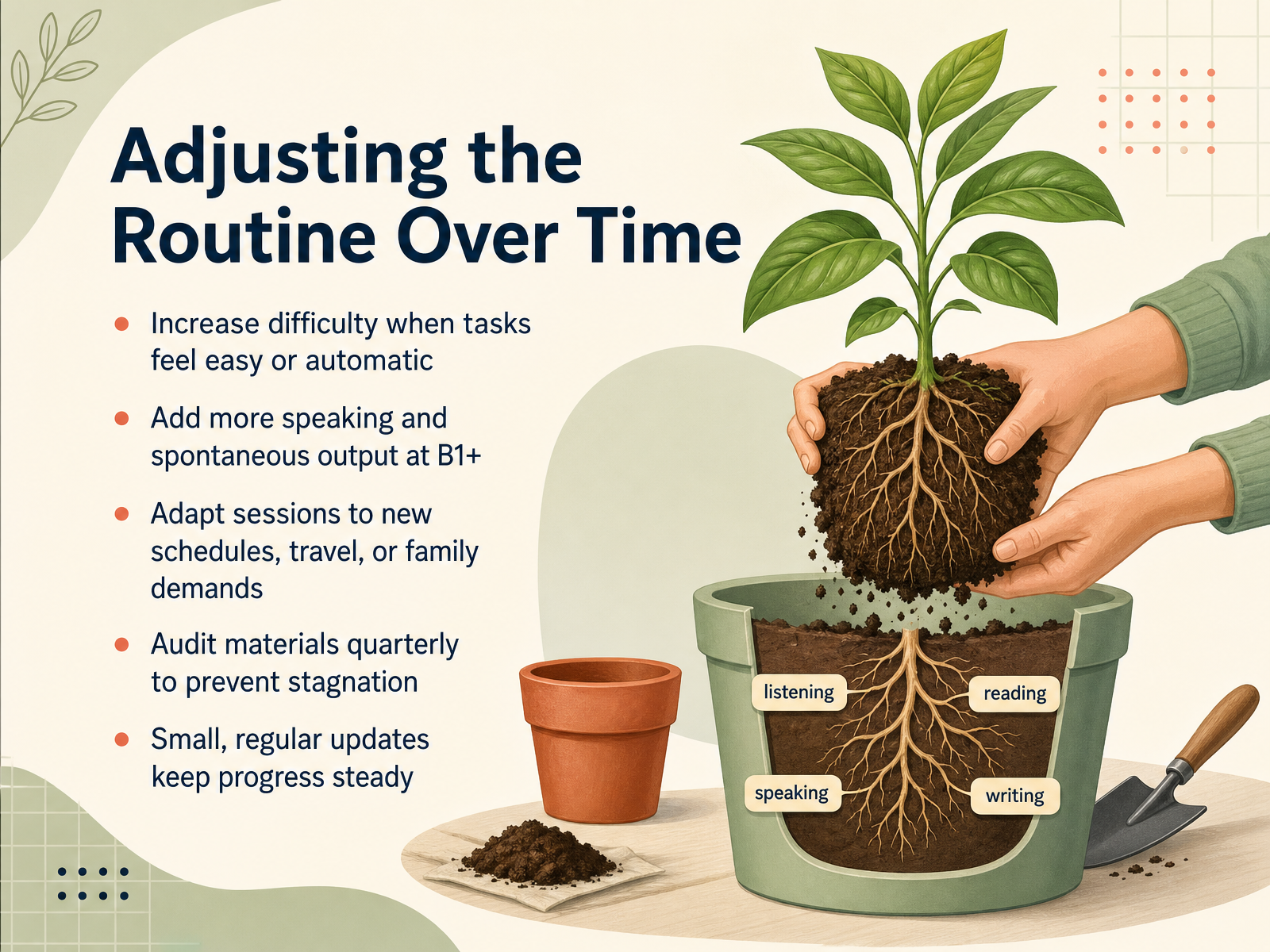
 - 11Adjusting the Routine Over TimeNow let's talk about keeping your routine fresh over time. A routine that never changes can start to feel stale, and that's when motivation tends to dip. So here's the good news: you can adjust as you go, and small, regular updates keep progress steady. When tasks start to feel easy or automatic, that's your signal to increase the difficulty. Maybe you move from simple listening clips to a full podcast episode, or from writing short sentences to a paragraph. At the B1 level and beyond, try adding more speaking and spontaneous output. That means talking about everyday topics without preparing every word first—like describing your weekend to a friend or giving your opinion on a film. Your schedule will also shift, with travel, family, or new work demands. That's fine. You can adapt your sessions to fit real life, even if it means shorter practice on busy days. And about every three months, take a quick look at your materials. If something feels repetitive or no longer challenges you, swap it out. These small updates—a new podcast, a different writing prompt, a conversation partner—can make all the difference. This works for your own study or your students' routines. Remember, you don't need a perfect plan, just one that grows with you. Next, we'll look at how teachers and coaches can apply these ideas even more directly.
 cedefop.europa.eurm.coe.intcoe.int+22 min
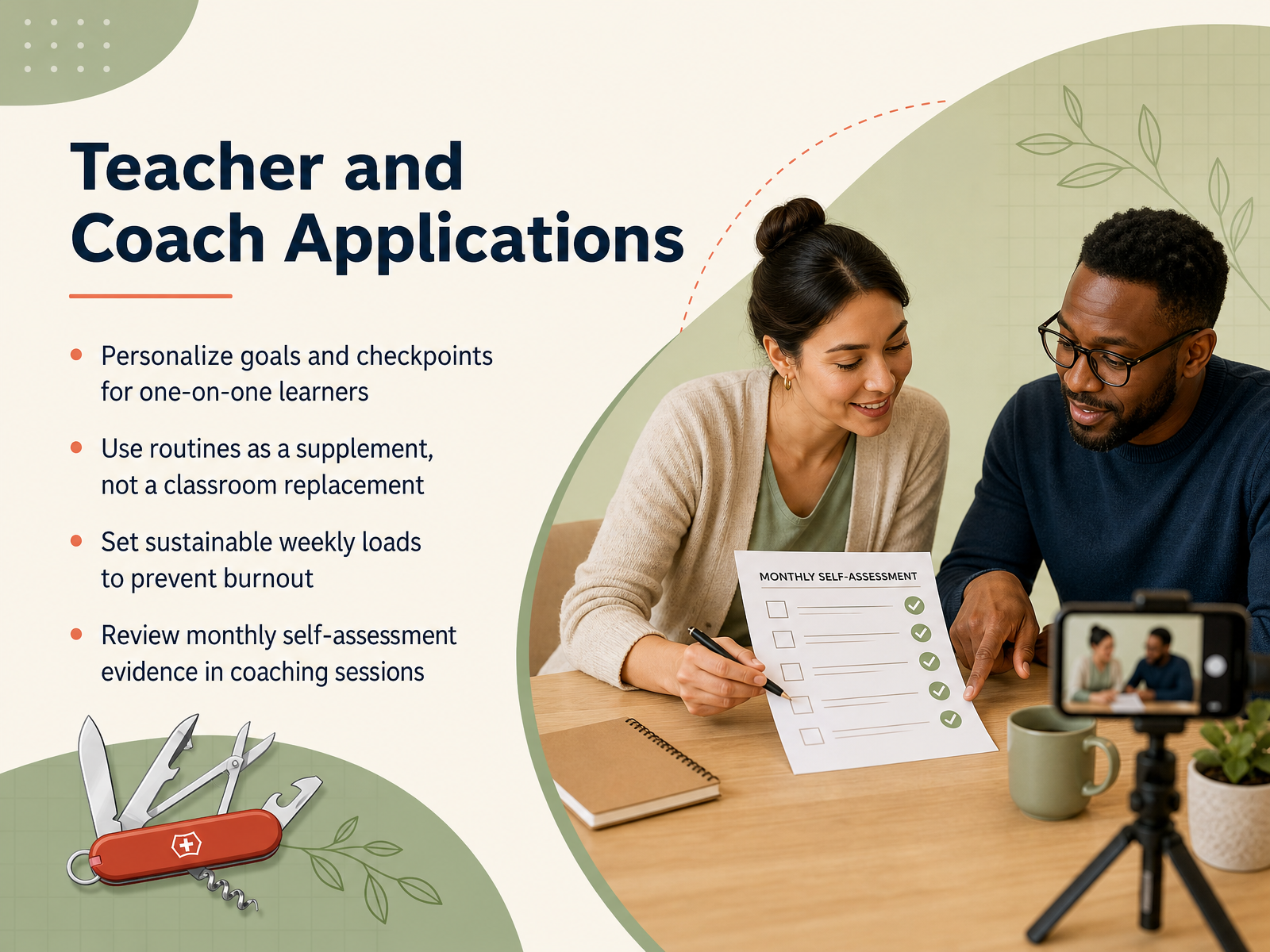
 - 12Teacher and Coach ApplicationsNow let's look at how you can apply this as a teacher or coach. Start by personalizing goals and checkpoints for your one-on-one learners. Their routine should fit their life and their level. For example, if a learner is at A1, a goal might be to master simple introductions by the end of the month. Use the routine as a supplement, not a replacement for your sessions. It builds consistency between lessons, but it doesn't replace the feedback and guidance you provide. Set a sustainable weekly load. Small steps count, so if a learner can only manage ten minutes a day, that's a fantastic start. It's better than a one-hour session that feels overwhelming and leads to burnout. Finally, review their monthly self-assessment evidence during coaching. Look at what they have recorded, what they marked as easy, and what was difficult. This gives you a clear picture of their progress and where to focus next. This approach works for your own study as well. A realistic routine that you can actually follow will always beat an ambitious one you abandon. Now, let's move on to building a seven-day starter plan to put all of this into practice.
 cedefop.europa.eurm.coe.intcoe.int+22 min
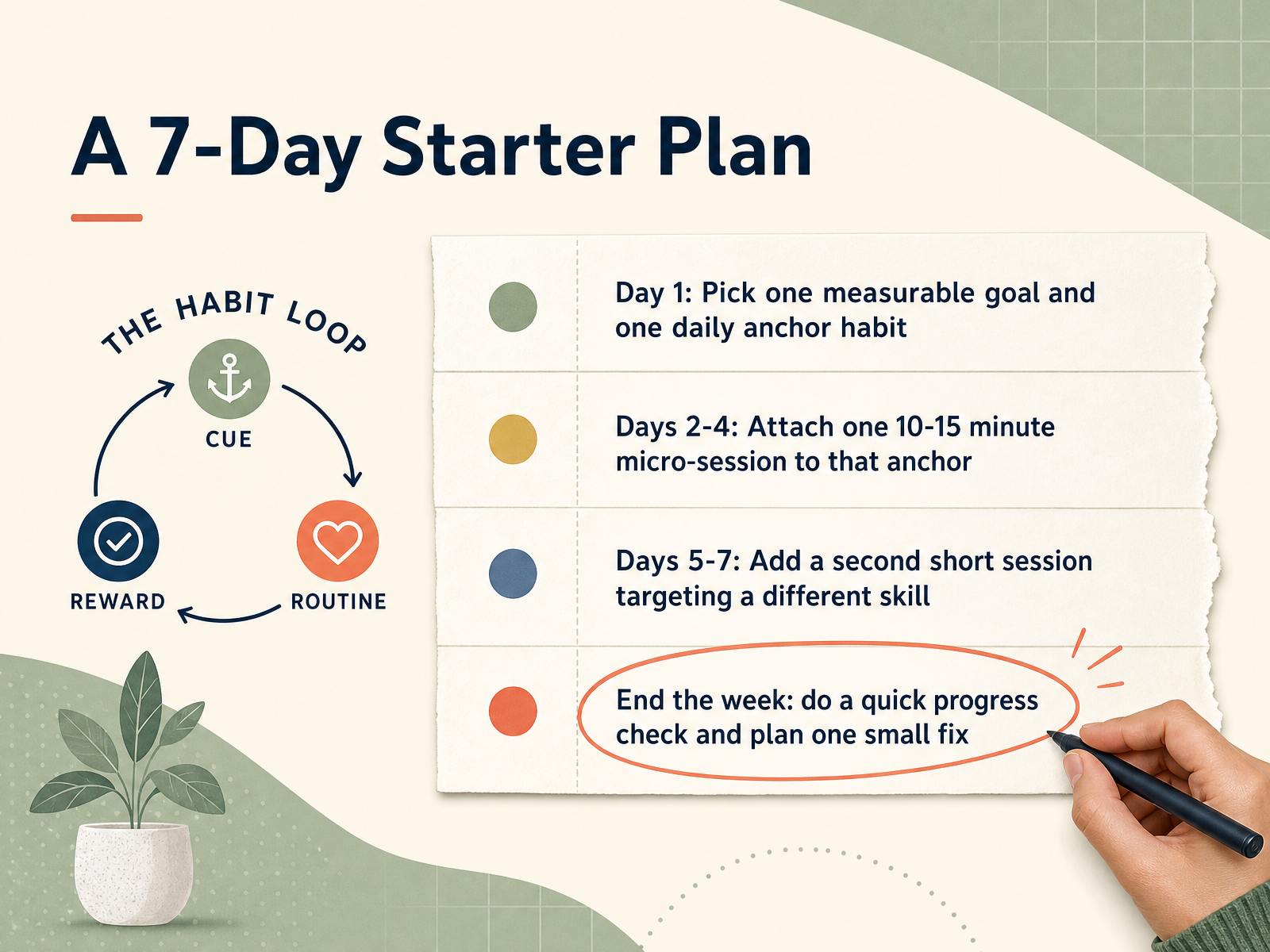
 - 13A 7-Day Starter PlanLet's turn all of this into a simple plan you can start using tomorrow. Here is a seven-day starter plan. Day one, pick one measurable goal and one daily anchor habit. For example, your goal might be to learn ten new words, and your anchor might be your morning coffee. Days two through four, attach one ten to fifteen minute micro-session to that anchor. As soon as you pour your coffee, you open your app or your flashcards. Days five through seven, add a second short session targeting a different skill. Maybe you listen to a short podcast during your commute, while your morning session stays focused on vocabulary. At the end of the week, do a quick progress check. Ask yourself what felt easy and what felt like a struggle. Then, plan one small fix for the next week. The goal here is to start small, stay consistent, and build momentum. You can use this same structure for your own study or with your students. One small fix each week leads to real progress over time. Next, let's bring everything together with some key takeaways and clear next steps.
 blog.langtrack.appjamesclear.comling-app.com+22 min
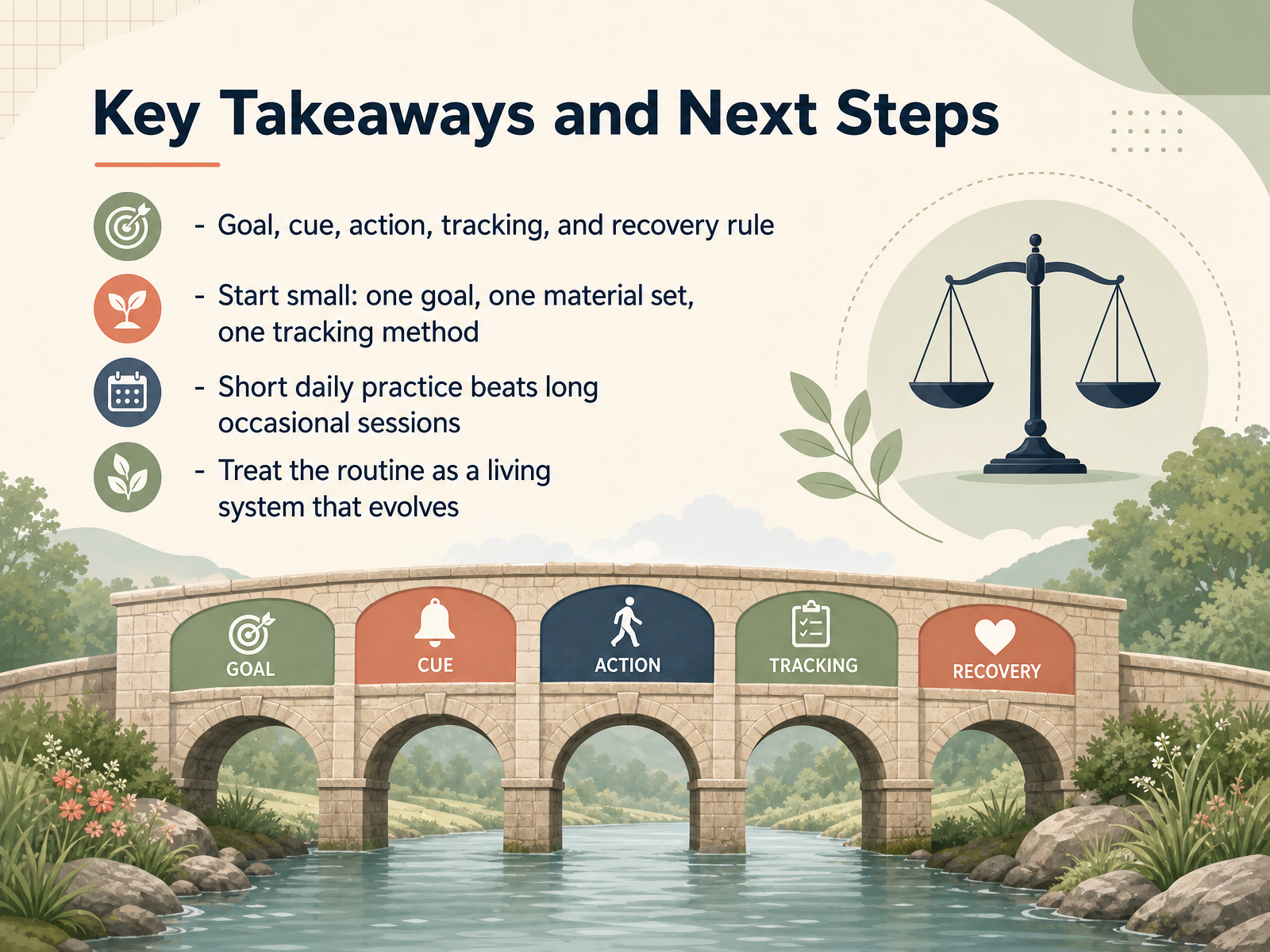
 - 14Key Takeaways and Next StepsLet’s quickly review the key points we covered today. You’ve learned the five essential pieces: set a clear goal, choose a daily cue, decide on a simple action, track it consistently, and follow the recovery rule—never miss twice in a row. Start small. Pick just one goal, one material set, and one way to track. That’s all you need. Remember, short daily practice always beats long occasional sessions. Ten minutes every day will take you further than two hours once a week, and it’s easier to keep going. Finally, treat your routine as a living system. It will change as your life changes, and that’s okay. You can adjust, refine, and start again anytime. Thank you for joining. You have everything you need to build a routine that works for you. Now take that first small step. You can do this.
 link.springer.combrightmindpublishing.comjournals.kmanpub.com+21 min
Take the deck with you
Download this course as a file — free, no sign-up needed.
- PDF handoutEvery slide page, ready to print or share.15 pages · 3.6 MBDownload
- Narrated PowerPointThe deck that presents itself — every slide carries the digital human's narration video.15 pages · 13.4 MBDownload
- PowerPoint slidesThe full deck as a .pptx — open it in PowerPoint, Keynote, or Google Slides.15 pages · 3.5 MBDownload
Free to use in your own training — please keep the PersonWise credit page at the end.
Have your own deck? Turn it into a course
Sources consulted
Web sources consulted while building this course.
- The impact of Duolingo usage patterns on motivation and self-perceived speaking proficiency: a quantitative study of Chinese bachelor-level EFL students | Asian-Pacific Journal of Second and Foreign Language Education | Springer Nature Link — link.springer.com
- THE THEORY OF HABITS IN LANGUAGE LEARNING | EduVision: Journal of Innovations in Pedagogy and Educational Advancements — brightmindpublishing.com
- [PDF] Push Notifications and Habit Formation: Behavioral Impact on Daily ... — journals.kmanpub.com
- A Multi-Year Study of Chunking Trajectories in Later-Life Additional Language Learning | Journal of the European Second Language Association — euroslajournal.org
- Push Notifications and Habit Formation: Behavioral Impact on Daily ... — researchgate.net
- Common European Framework of Reference for Languages - Self-assessment grid — cedefop.europa.eu
- Assessment grid - English — rm.coe.int
- The CEFR Levels - Common European Framework of ... — coe.int
- CEFR Can-Do Statements: How to Use Them for Self- ... — iworldlearning.com
- CEFR Language Proficiency Self Assessment — theglobalseal.com
- USA Learns 1st Free Online English Courses — usalearns.org
- Free English Lessons & Dictation Practice A1-C2 — lexinglo.com
- English For Absolute Beginners — A0 - My English Pages — myenglishpages.com
- ▷ The best English course for beginners | Free — loecsen.com
- 12 Free English Learning Resources That Actually Work ... — thekingdomofenglish.com
- Habit Stacking for Language Learners - LangTrack Blog — blog.langtrack.app
- How to Build New Habits by Taking Advantage of Old Ones — jamesclear.com
- How To Build A Daily Language Habit (Even When Motivation Runs Out) - ling-app.com — ling-app.com
- The Psychology of Habit-Stacking: Building Effortless Language Immersion - How the Brain Learns Languages — thelanguagebrain.com
- Using Habit Stacking in Your Language Learning Journey — gofluent.com