Managing Stakeholder Expectations
Begin
14 pages · ~28 min
Managing Stakeholder Expectations
A training for project managers on effectively identifying, prioritizing, and managing stakeholder expectations to ensure project success.
What you’ll learn
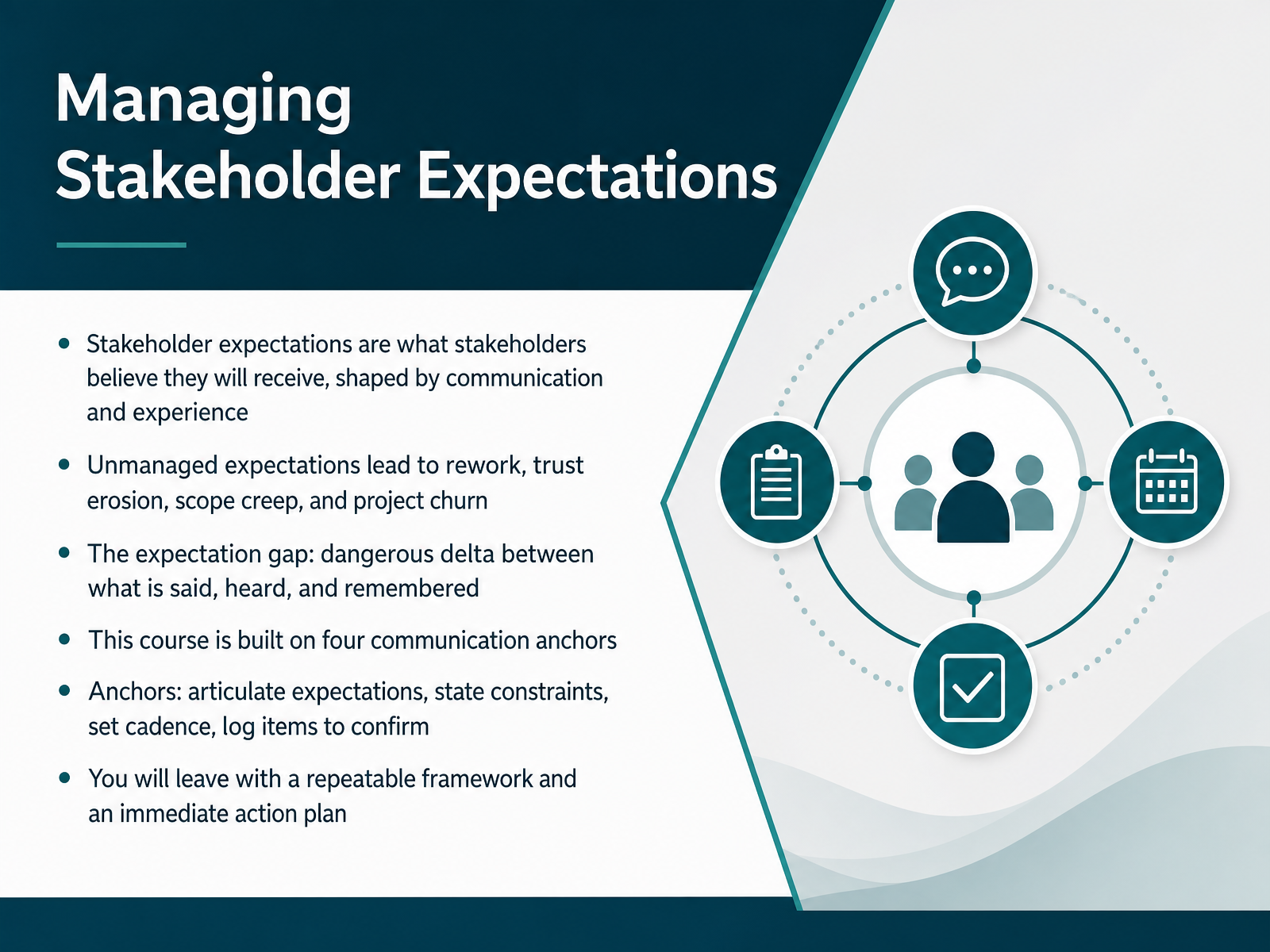
- 01Managing Stakeholder ExpectationsWelcome to Managing Stakeholder Expectations. Think about the last time you delivered exactly what was asked for, yet the stakeholder was still disappointed. That disconnect is what this course is all about. Stakeholder expectations are what people believe they will receive, shaped by your communication and their previous experiences. When those expectations go unmanaged, you get rework, eroding trust, scope creep, and constant project churn. We call this dangerous delta between what is said, heard, and remembered the expectation gap. To close that gap, this course is built on four communication anchors. You will learn to articulate expectations clearly, state your known constraints upfront, set a regular communication cadence, and log items that need confirmation. By the end, you will leave with a repeatable framework and an immediate action plan you can use today. Let's begin by exploring the real cost of letting expectations drift.edurev.inmanagementconcepts.comlsfglobal.com+22 min
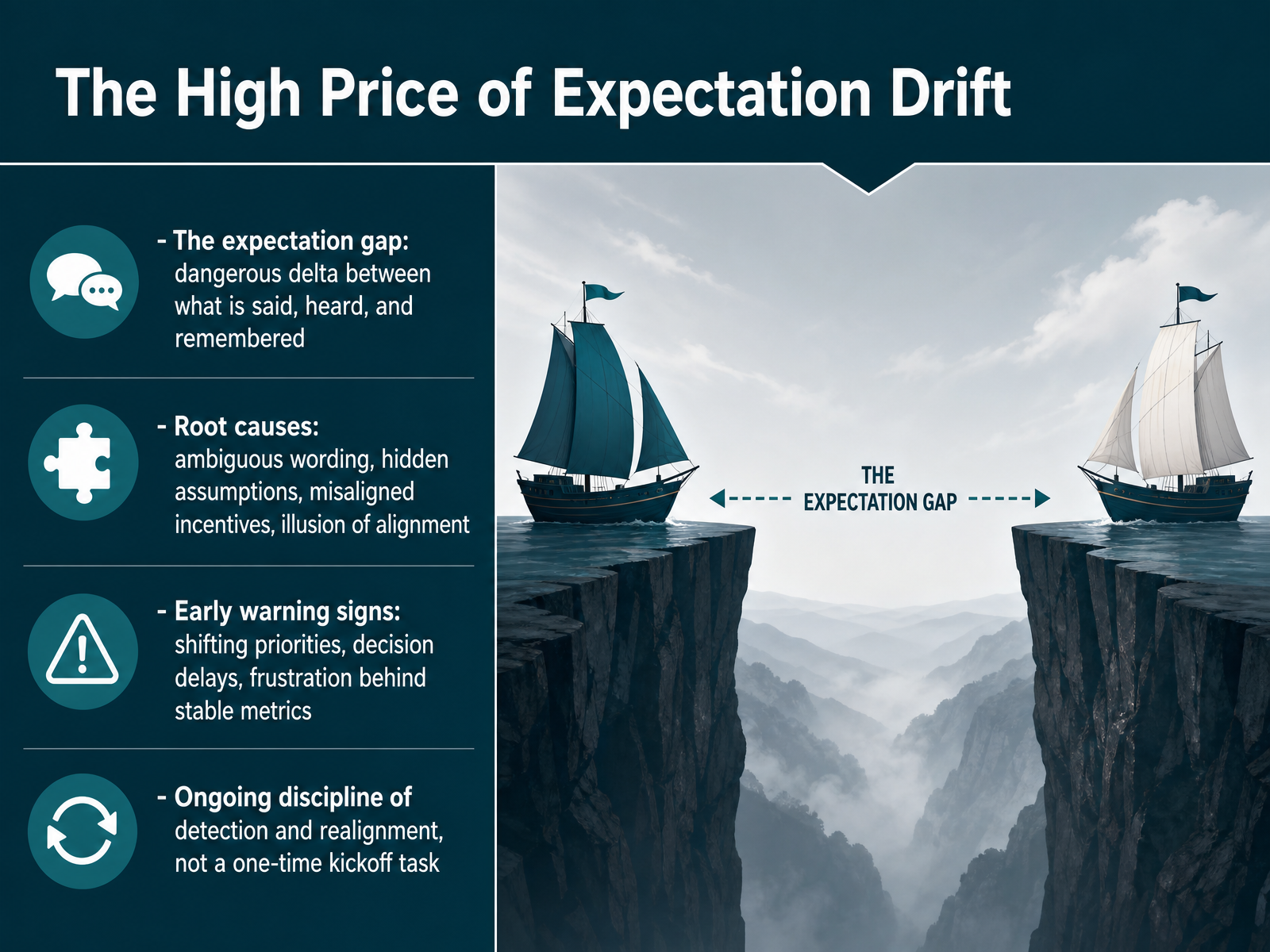
- 02The High Price of Expectation DriftLet's take a closer look at what happens when alignment starts to break down. We call it expectation drift, and the cost is surprisingly high. The core problem is the expectation gap. That's the dangerous distance between what you say, what a stakeholder hears, and what they remember later. Root causes aren't always obvious. They often include ambiguous wording, hidden assumptions no one voiced, or misaligned incentives. Sometimes it's an illusion of alignment where everyone nods in the meeting but walks away with a different picture. Warning signs appear early if you watch for them. Shifting priorities, delayed decisions, or growing frustration behind stable metrics all tell a story. The key takeaway is this: managing expectations is an ongoing discipline. It's not a one-time kickoff task. You need to detect drift and realign continuously. With that mindset, let's move into our core framework and explore the four communication anchors.
 pmexams.comdesignthinkingblog.compmworldjournal.com+21 min
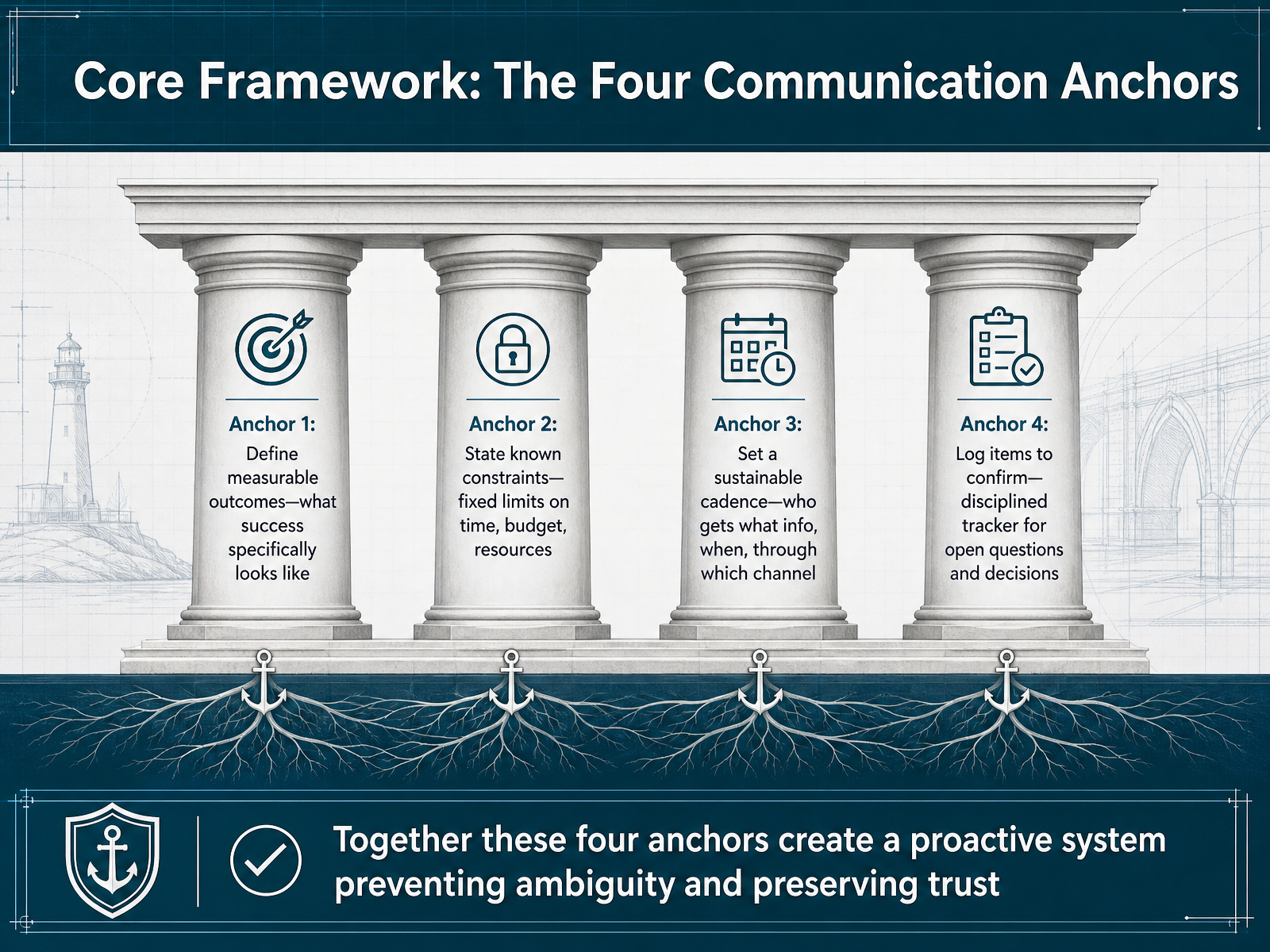
 - 03Core Framework: The Four Communication AnchorsLet's look at the core framework that makes expectation management work. It's built on four communication anchors. Anchor one: define measurable outcomes. You want to specify what success actually looks like, so no one is guessing. Anchor two: state known constraints. Be upfront about fixed limits on time, budget, or resources. Anchor three: set a sustainable cadence. Decide who gets what information, when, and through which channel. Anchor four: log items to confirm. Keep a disciplined tracker for open questions and pending decisions. Together, these four anchors create a proactive system. They prevent ambiguity and preserve trust. Now let's go deeper into that first anchor. In the next slide, we'll practice turning vague wishes into measurable outcomes.
 restruggle.comknowledge.insead.edumural.co+21 min
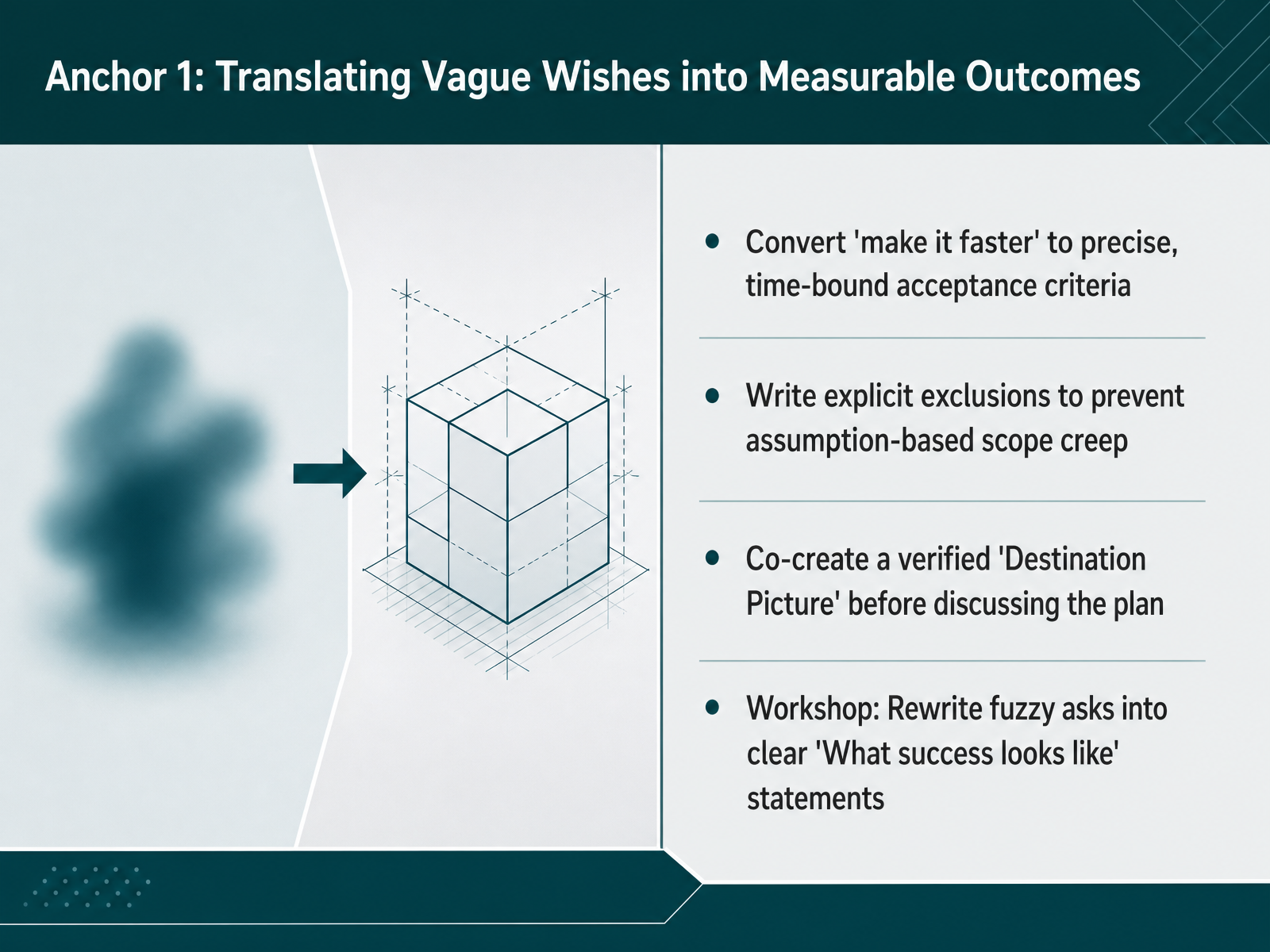
 - 04Anchor 1: Translating Vague Wishes into Measurable OutcomesNow let's talk about translating vague wishes into measurable outcomes. This is your first anchor for managing expectations. You will often hear a stakeholder say, 'Make it faster.' Your job is to turn that into precise, time-bound acceptance criteria. For example, 'The homepage loads in under two point five seconds on a 4G connection.' You also need to write explicit exclusions right from the start. If you don't state that copywriting or SEO auditing is out of scope, stakeholders will assume it's included. Think of exclusions as a list of what you are definitely not doing. This prevents assumption-based scope creep. Before you even discuss the plan, co-create a verified destination picture. Agree on exactly what success looks like. We will now run a short workshop. You'll practice rewriting fuzzy asks into clear statements of what success looks like. Next, we will anchor our work in reality by surfacing constraints as strategic guardrails.
 resources.rework.combusiness.adobe.comprojectmanagementformula.com+22 min
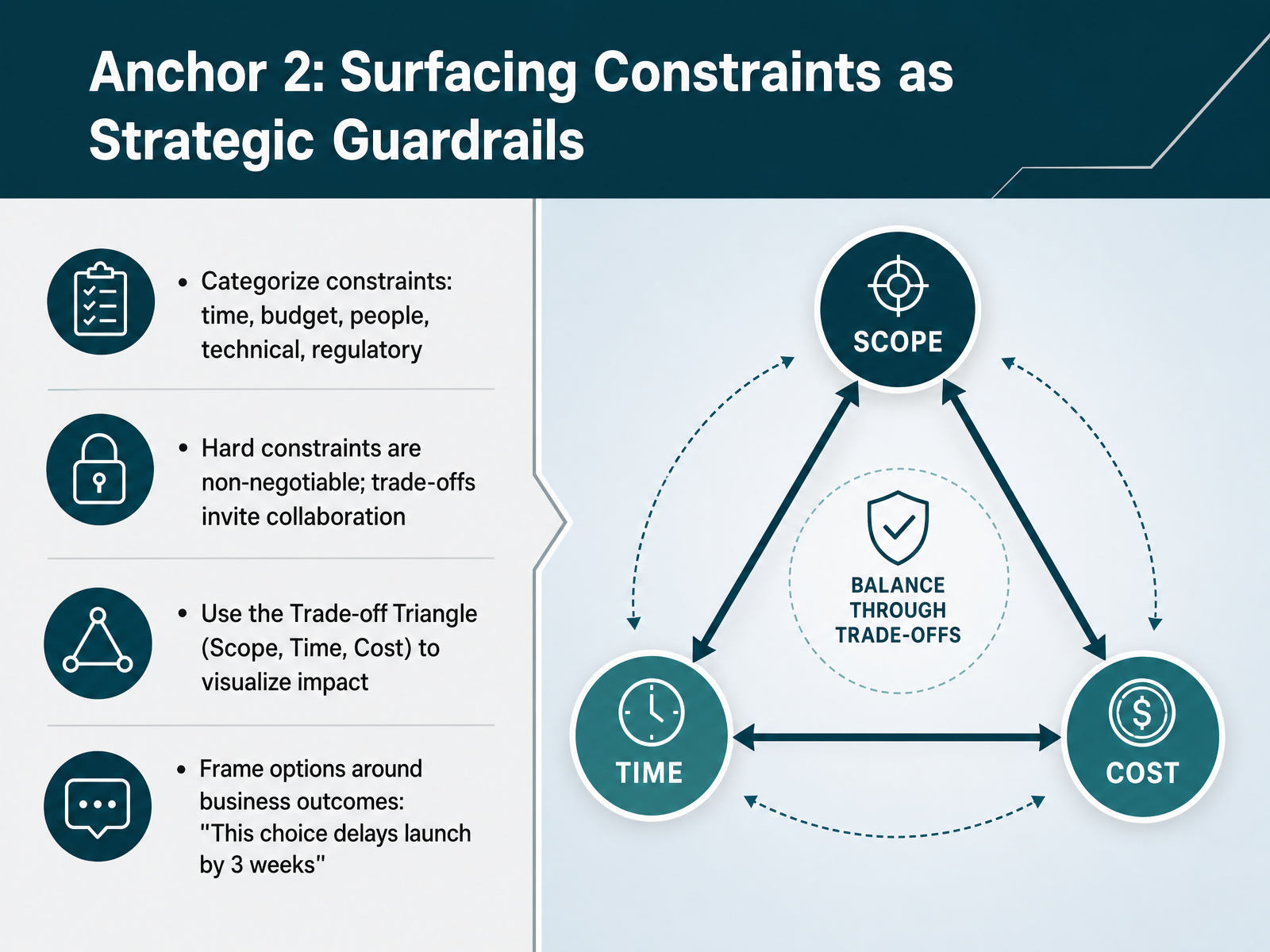
 - 05Anchor 2: Surfacing Constraints as Strategic GuardrailsNow let's talk about surfacing constraints. Think of constraints not as roadblocks, but as strategic guardrails that guide decision-making. When you categorize constraints clearly, you help everyone understand the boundaries of the project. Common categories include time, budget, people, technical limitations, and regulatory requirements. Next, distinguish between hard constraints and trade-offs. A hard constraint is non-negotiable, like a regulatory deadline. A trade-off invites collaboration. To make this concrete, use the trade-off triangle, which connects scope, time, and cost. When one side changes, at least one other side must adjust. For example, you might say, 'This choice delays launch by three weeks,' to frame the impact directly around business outcomes. This approach moves the conversation from a simple 'no' to a strategic discussion about priorities. Over to you: practice framing constraints so stakeholders see the full picture and can make informed decisions together. Next, we will move to Anchor 3, Designing a Sustainable Communication Cadence.
 monday.compmpwithray.commural.co2 min
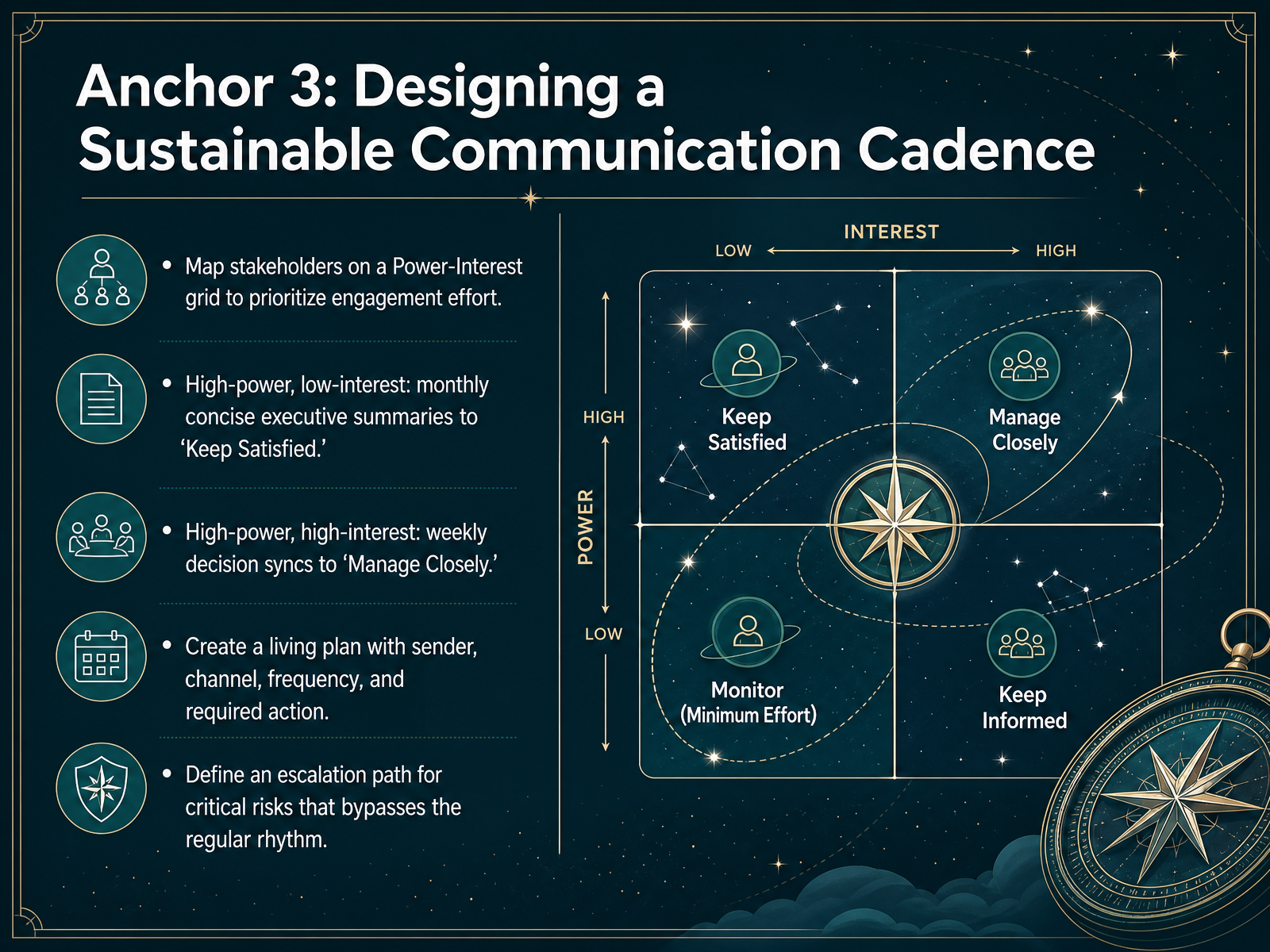
 - 06Anchor 3: Designing a Sustainable Communication CadenceNow let’s make that strategy sustainable by designing a clear communication cadence. Start by mapping your stakeholders on a power interest grid. Focus your energy where it counts. For high power but low interest stakeholders, your goal is to keep them satisfied. A monthly concise executive summary works well. For high power and high interest stakeholders, they need closer management, so plan weekly decision syncs. Once mapped, create a living plan. For each group, define the sender, the channel, the frequency, and the required action. Finally, define an escalation path for critical risks that bypasses the regular rhythm. This prevents delays when something urgent comes up. With a disciplined cadence and clear escalation rules, everyone knows when to expect updates and how emergencies get handled, building trust across the board. Next, we’ll look at Anchor 4 and how to turn known unknowns from risk into reliability.
 2 min
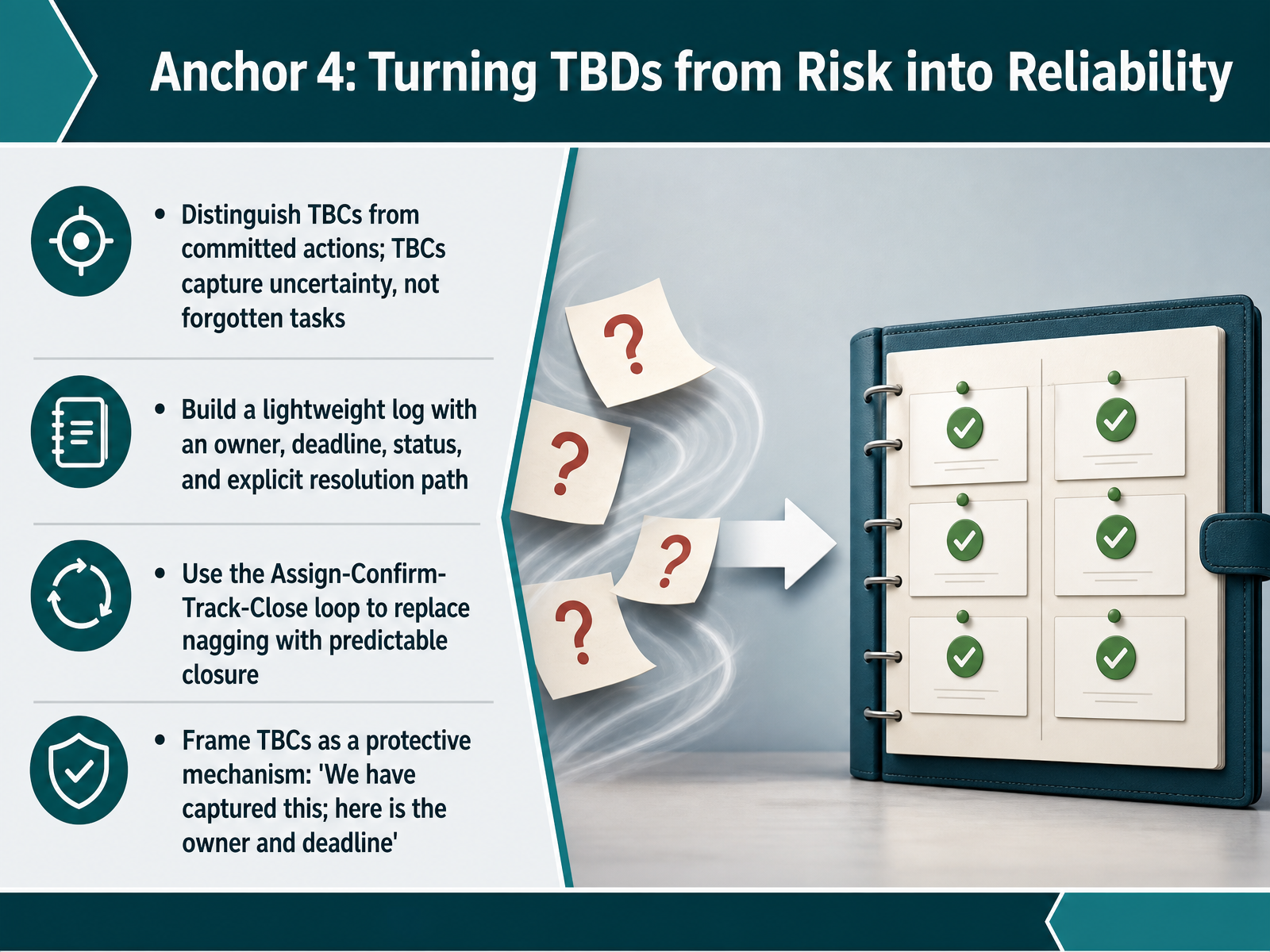
2 min - 07Anchor 4: Turning TBDs from Risk into ReliabilityLet’s move into our fourth anchor: turning TBDs from risk into reliability. When you say “to be confirmed,” you’re not describing a forgotten task—you’re capturing real uncertainty. The goal is to make that uncertainty manageable. Start by separating tentative confirmations from committed actions. Build a lightweight log that includes a single owner, a deadline, a current status, and a clear resolution path. Keep it simple. Then use a four-step loop: assign the item to one named person, confirm they’ve accepted it, track progress visibly, and formally close it. This replaces nagging with predictable closure. Frame every TBC as a protective mechanism. For example, say “We’ve captured this open point; here is the owner and the deadline.” That language shows control, not delay. By owning your unknowns, you maintain trust and keep conversations moving forward. Next, we’ll put all four anchors together by running a Four-Anchor Stakeholder Alignment Conversation.
 2 min
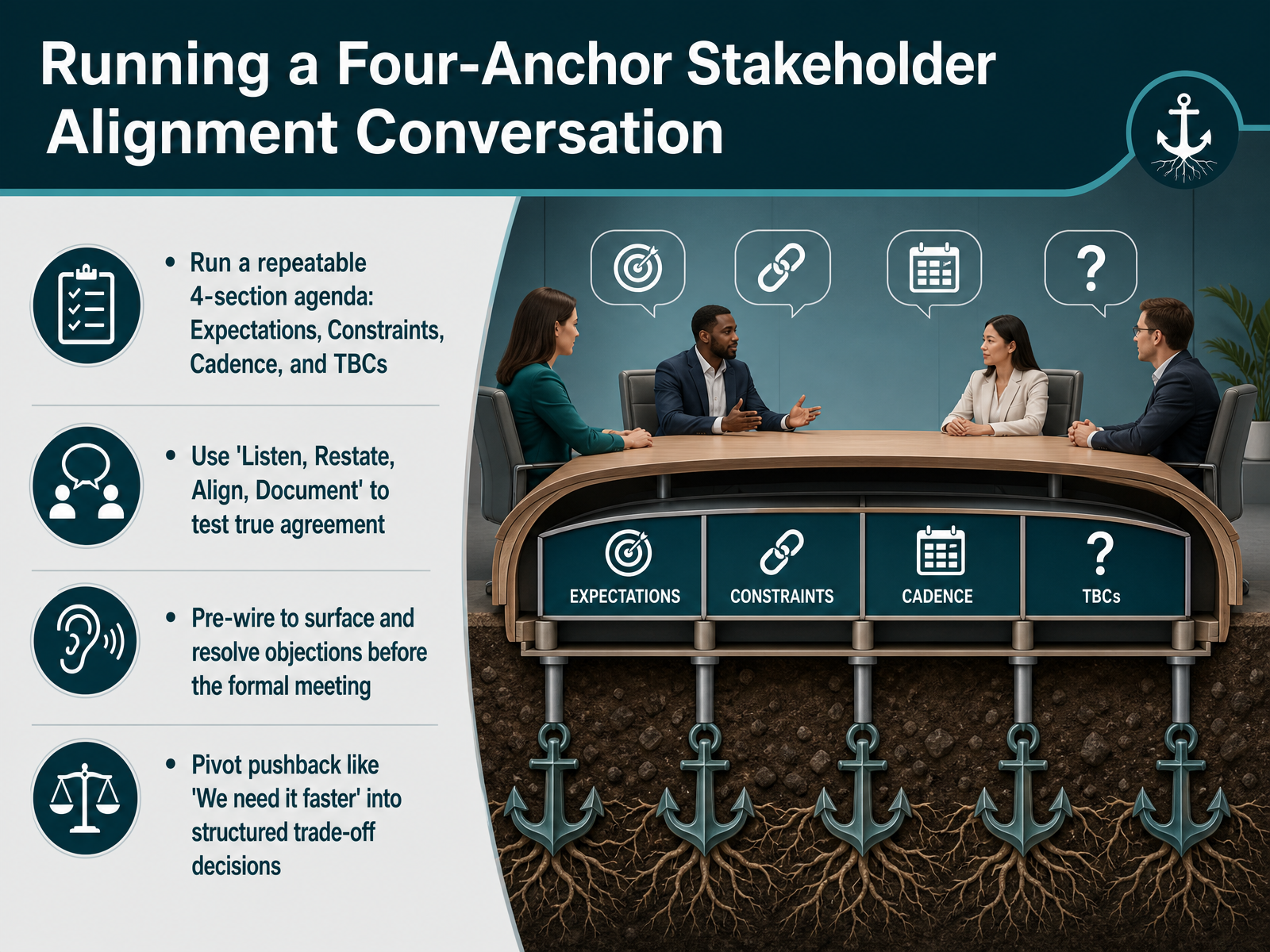
2 min - 08Running a Four-Anchor Stakeholder Alignment ConversationLet's move into the core of the conversation: running a repeatable four-anchor agenda. You will consistently cover four sections: Expectations, Constraints, Cadence, and TBCs—your To Be Confirmed items. This structure turns vague discussions into clear decisions. During the meeting, use a simple loop: Listen first, Restate what you heard, Align on the resolution, and Document the outcome. This tests for true agreement, not just polite silence. Before you even enter that room, pre-wire the decision. Have one-on-one conversations to surface objections early. This turns the formal meeting from a discovery session into a confirmation session. When you face pushback, like 'We need it faster,' don't just say no. Pivot it into a structured trade-off. Ask what they are willing to deprioritize to get that speed back. Now, let's see how to secure that alignment before the room fills up. The next section is: The Pre-Wire Protocol: Securing Alignment Before the Room.
 2 min
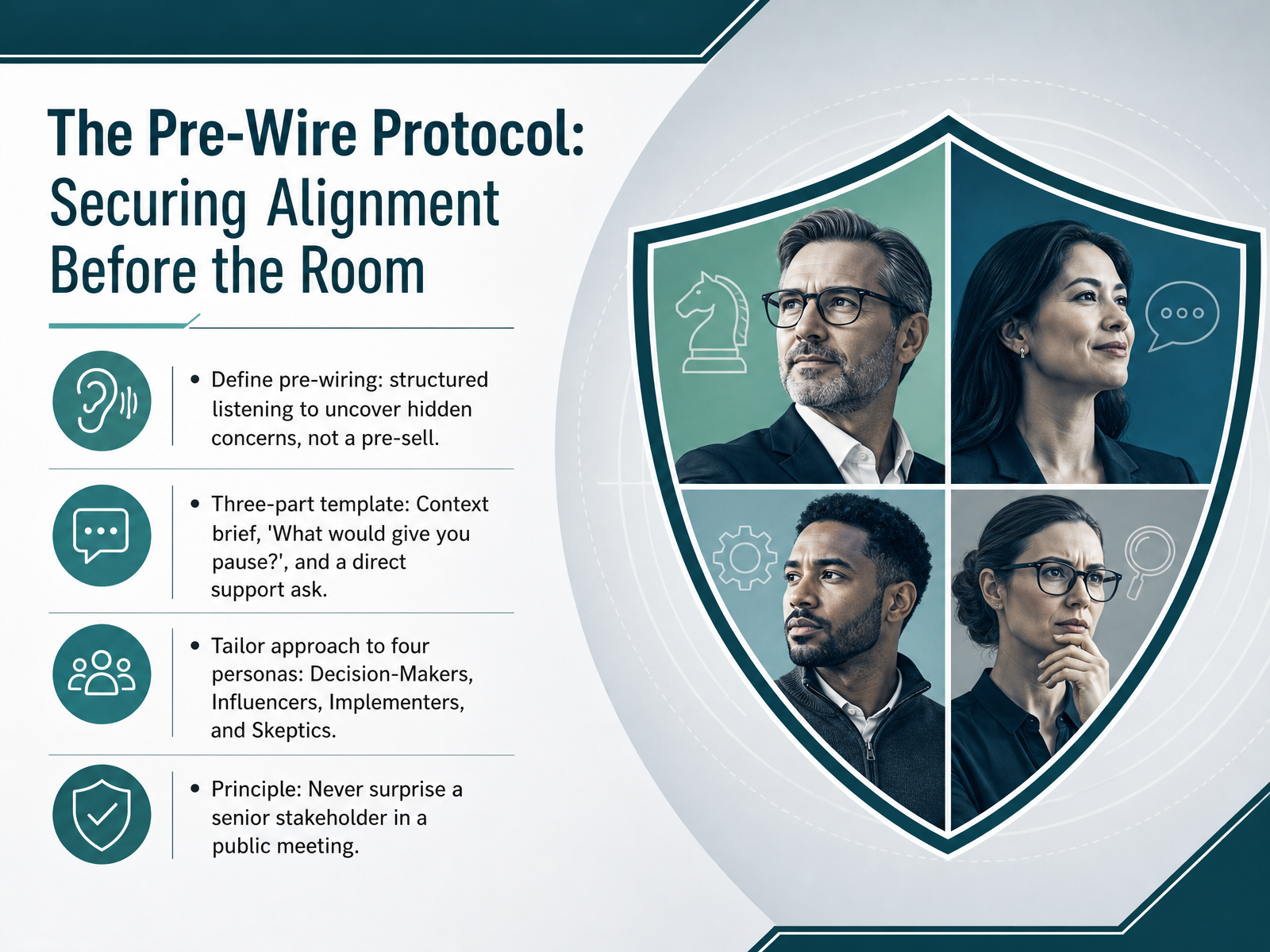
2 min - 09The Pre-Wire Protocol: Securing Alignment Before the RoomNow, let's talk about the work that happens before the room—specifically, the pre-wire protocol. First, define what pre-wiring actually is. It is not a pre-sell where you try to convince someone of your answer. Instead, it's a structured listening exercise to uncover hidden concerns. You want to test the decision, not just endorse a finished deck. To do this well, use a simple three-part template. Start with a brief context overview—keep this to about two minutes. Then, ask a targeted invitation, like, 'What would give you pause?' This surfaces the real friction. Finally, end with a direct support ask to confirm their stance. You also need to tailor your approach to different personas. Decision-makers need to know the outcome and trade-offs. Influencers care about the credibility of the evidence. Implementers focus on operational constraints, while Skeptics respect a clear, data-backed risk assessment. The core principle anchoring all of this? Never surprise a senior stakeholder in a public meeting. Bring objections into the light early. Next, we'll build on this foundation by moving into Conducting Alignment Checkpoints Across the Lifecycle.
 2 min
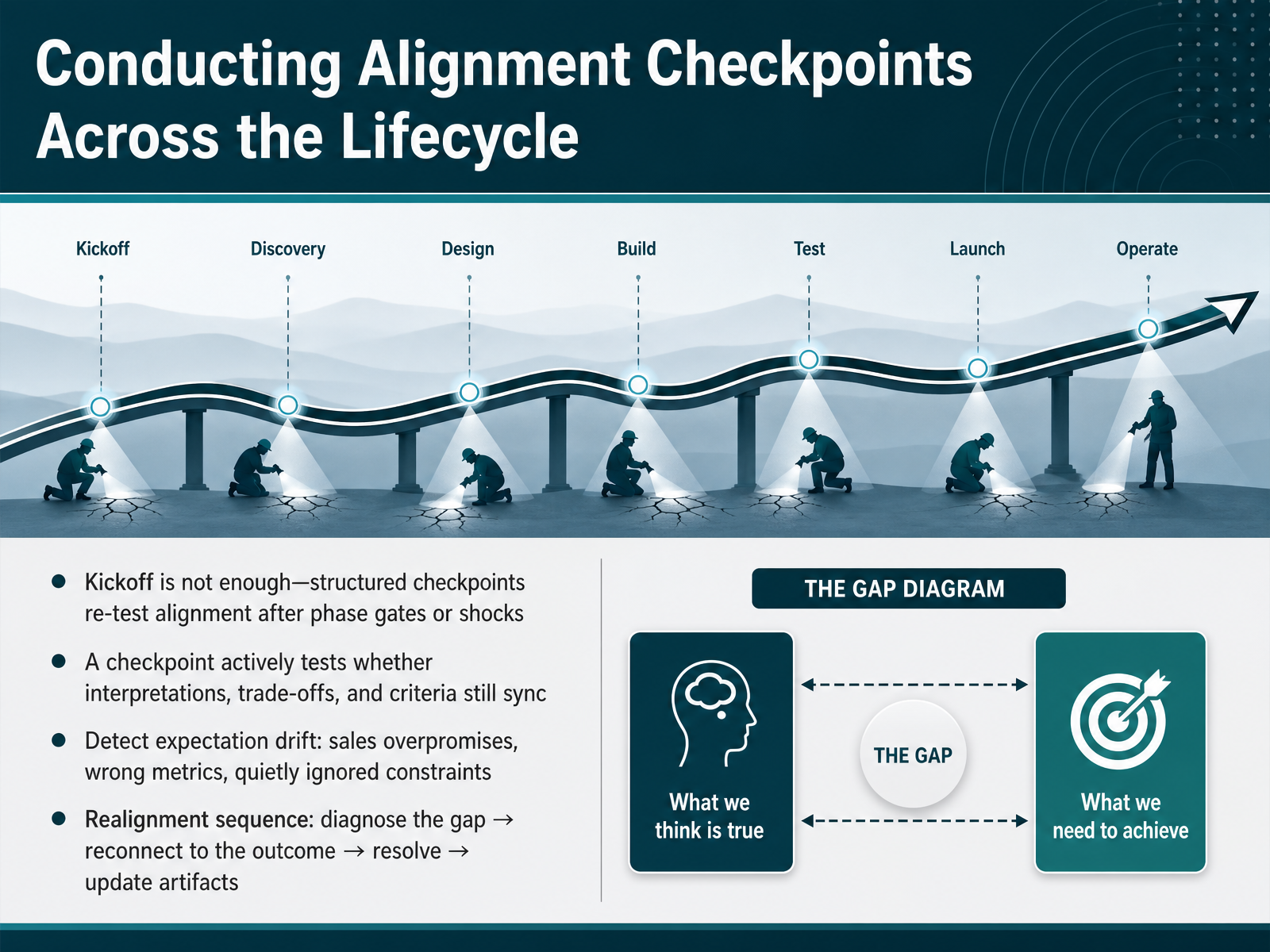
2 min - 10Conducting Alignment Checkpoints Across the LifecycleLet's talk about conducting alignment checkpoints across the project lifecycle. Think of it this way: the kickoff meeting is just the starting line. It's not enough to keep everyone on track, because project context changes over time. You need structured checkpoints—moments after a phase gate or a major shock—where you deliberately re-test alignment. A strong checkpoint actively asks whether everyone’s interpretations, trade-off decisions, and acceptance criteria are still in sync. Without this, you risk expectation drift. That's where sales overpromises, teams track the wrong metrics, or constraints get quietly ignored. When you detect drift, follow a clear realignment sequence. First, diagnose the gap. Then, reconnect the discussion to the intended outcome. Next, resolve the decision conflicts. Finally, update the artifacts so the new alignment sticks. This turns a checkpoint from a status ritual into a real protective habit. Next, we'll explore how to handle those hard conversations when you need to deliver difficult news without destroying trust.
 pmexams.comcopextraining.comtechademy.com2 min
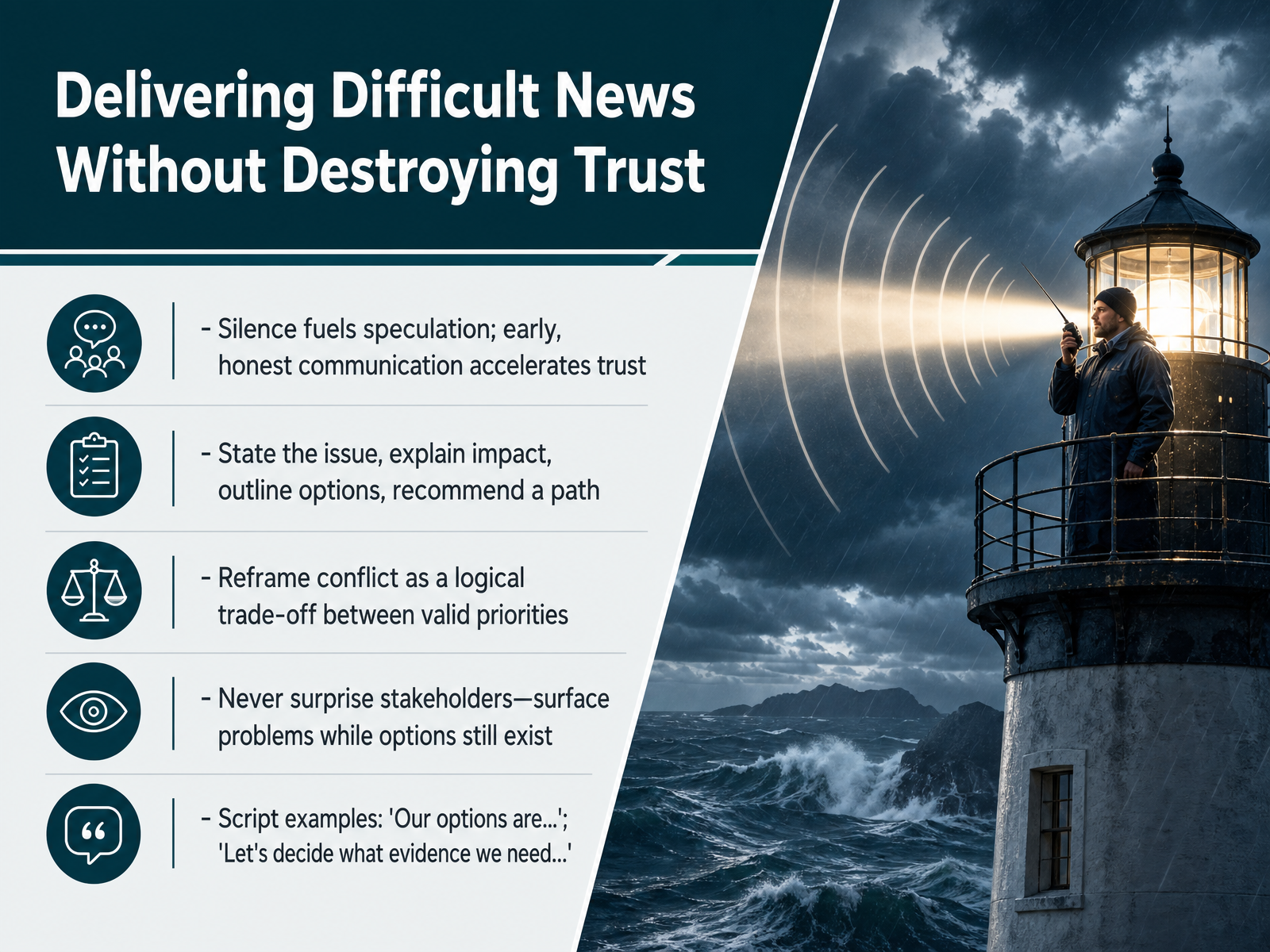
 - 11Delivering Difficult News Without Destroying TrustLet’s talk about delivering difficult news without destroying trust. Silence fuels speculation, and speculation erodes confidence fast. Early, honest communication is what actually accelerates trust. When you need to share a tough update, start by stating the issue clearly. Then explain the real impact, outline a few viable options, and recommend a path forward. When people push back, try reframing the conflict. Position it as a logical trade-off between two valid priorities, not as a personal disagreement. And remember the golden rule: never surprise your stakeholders. Surface problems while options still exist, so they can help shape the solution. Use direct, collaborative language like ‘Our options are...’ or ‘Let’s decide what evidence we need before we commit.’ This keeps the conversation forward-looking. In short, honesty early preserves the relationship, and framing hard choices as shared decisions keeps trust intact. Next, we’ll apply these principles to de-escalation and conflict resolution in live settings.
 pmexams.comcopextraining.comtechademy.com2 min
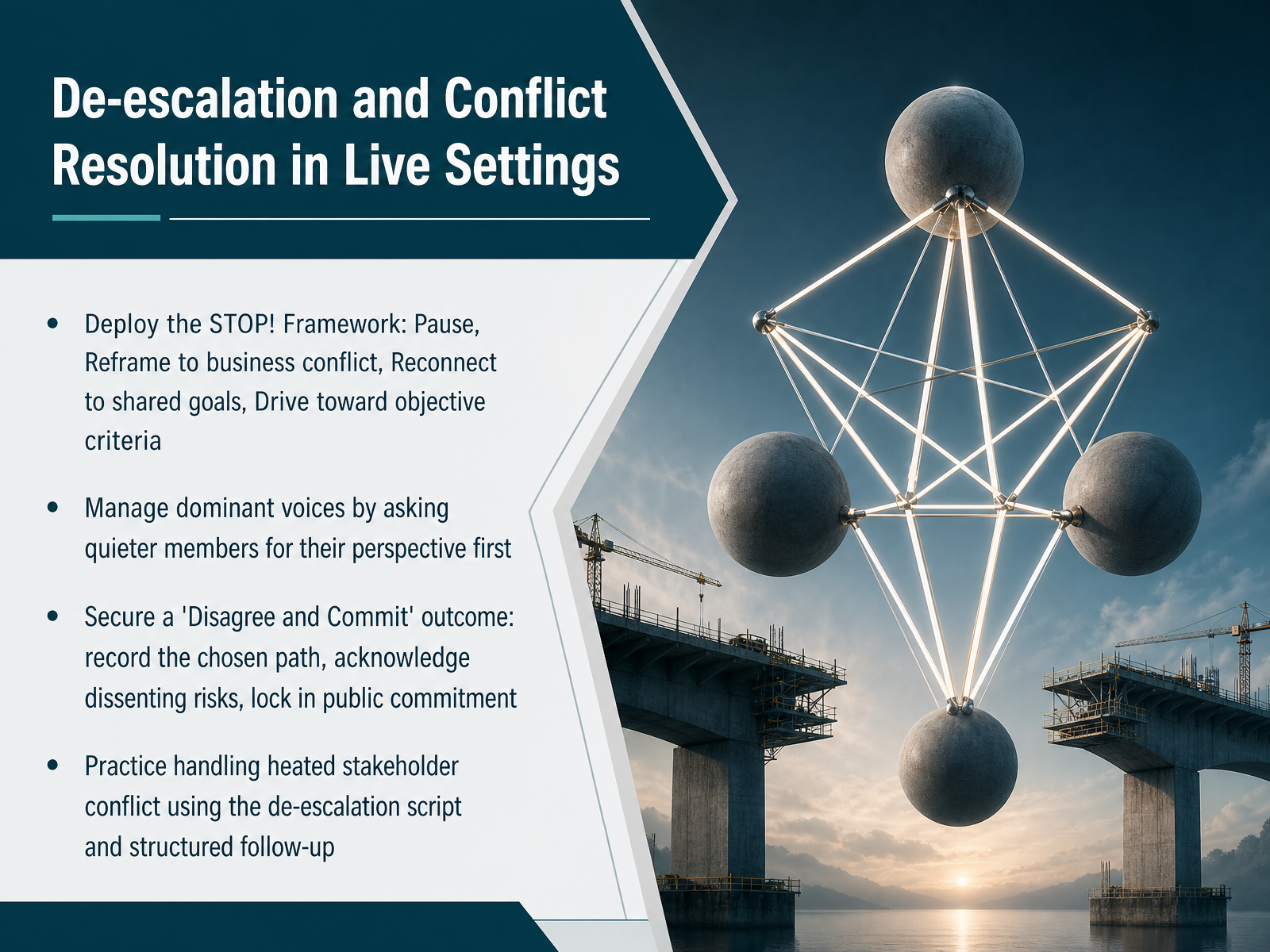
 - 12De-escalation and Conflict Resolution in Live SettingsLet's shift to what happens when tensions rise during a live meeting. When a heated debate breaks out, remember the STOP framework. First, pause. Intervene calmly before personal attacks stick. Second, reframe the conflict. Strip away the emotional language and state the underlying business trade-off clearly. Third, reconnect both parties to your shared project goals. Finally, drive toward objective criteria. Ask which data or metrics you can use to settle the argument, rather than relying on opinions. To manage dominant voices, actively call on quieter members first. A simple 'I'd like to hear from the team members who haven't spoken yet' can change the entire dynamic. When alignment is hard to reach, aim for a 'Disagree and Commit' outcome. Record the chosen path, explicitly acknowledge the dissenting risks, and lock in a public commitment to move forward. Document this clearly so the team can execute as one. Practice this before you need it. Use a de-escalation script and always schedule a structured follow-up to review the decision. Now, let's build on these live facilitation skills to create your broader expectation management system.
 2 min
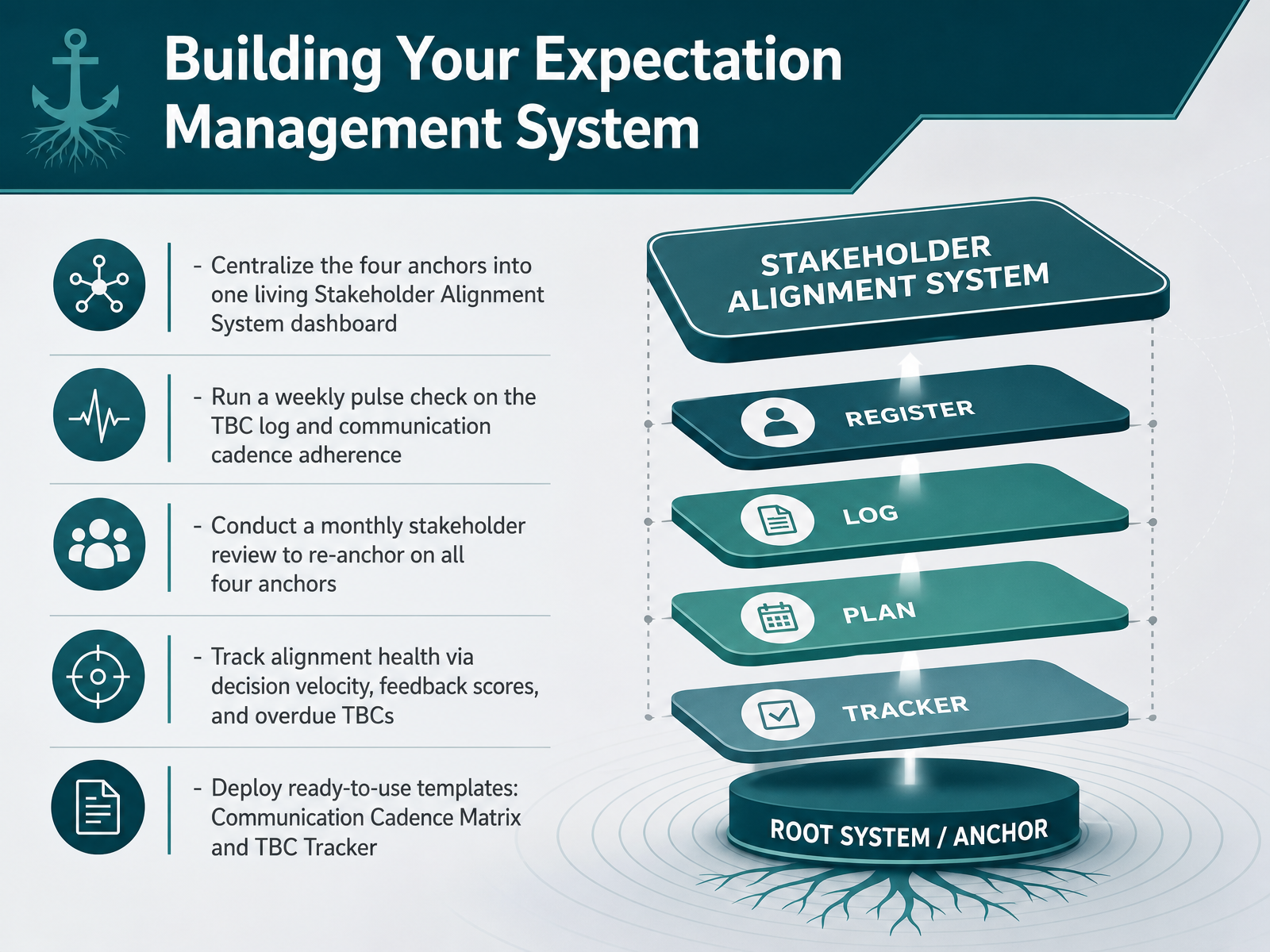
2 min - 13Building Your Expectation Management SystemNow let's bring everything together into a single operating system. You have four anchors: outcome, evidence, constraints, and confidence. Centralize them into one living Stakeholder Alignment System dashboard. This becomes your single source of truth. Run a weekly pulse check on your To Be Confirmed log and communication cadence adherence. Short, frequent checks catch drift early. Then conduct a monthly stakeholder review to re-anchor on all four anchors. People forget, priorities shift, and new evidence emerges, so this monthly reset is essential. Track alignment health using simple leading indicators: decision velocity, feedback scores, and overdue To Be Confirmed items. These metrics tell you if your system is actually working. Finally, deploy ready-to-use templates like the Communication Cadence Matrix and the T B C Tracker. Templates reduce friction and make consistency easy. Up next, we'll translate this into your personal action plan and key takeaways.
 restruggle.comknowledge.insead.edumural.co+22 min
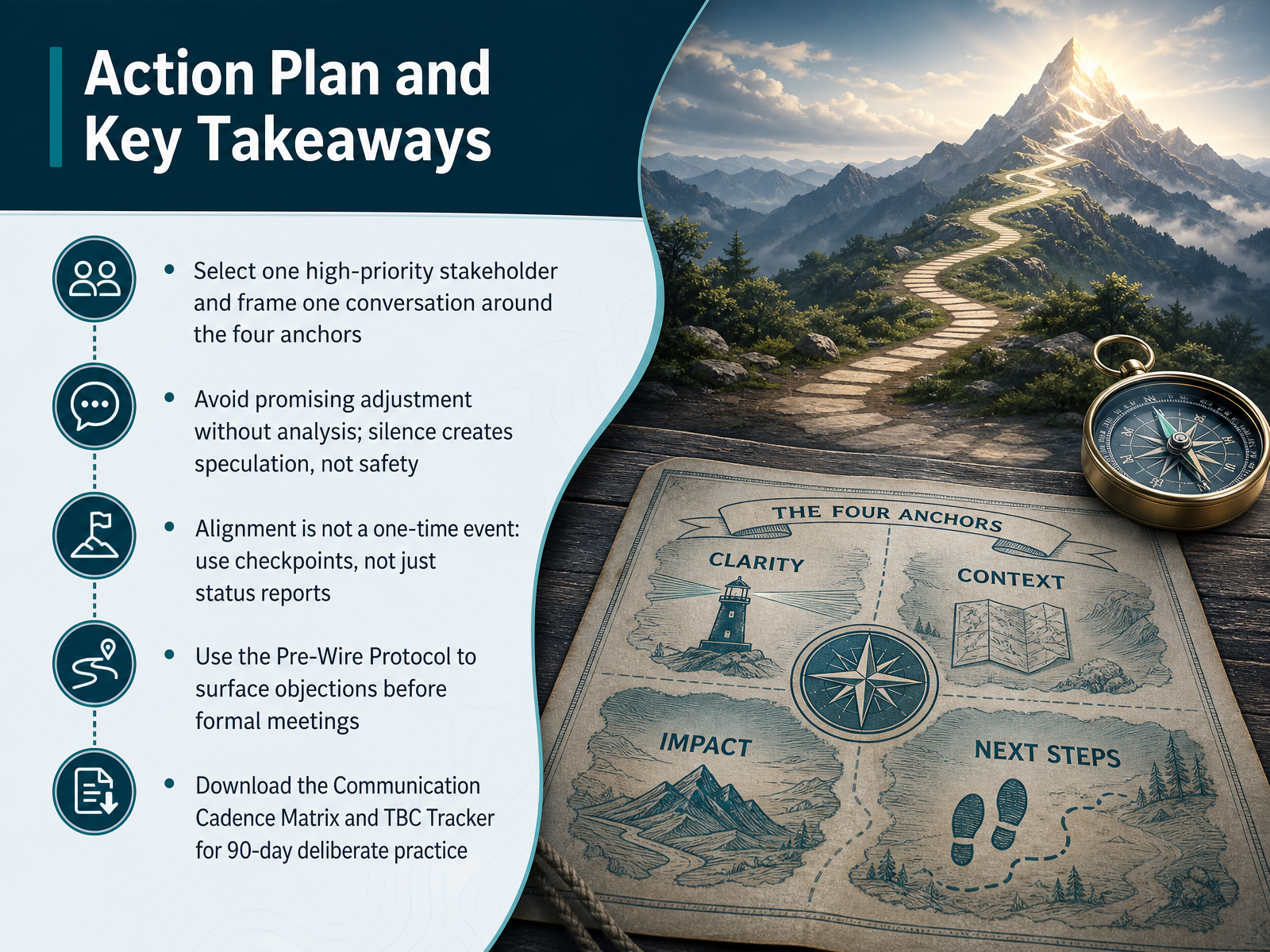
 - 14Action Plan and Key TakeawaysLet's bring this all together with an action plan you can start this week. First, select one high-priority stakeholder and frame your next conversation around the four anchors: the outcome, the evidence, the unmovable constraints, and your confidence level in what’s known versus assumed. Second, resist the urge to promise adjustments without analysis. Remember, silence creates speculation, not safety. Third, treat alignment as an ongoing practice, not a one-time event. Use regular checkpoints, not just status reports, to catch drift early. Fourth, adopt the Pre-Wire Protocol to surface objections before formal meetings, making difficult conversations easier. Finally, download the Communication Cadence Matrix and the T B C Tracker. These tools will guide your deliberate practice over the next ninety days. Thank you for your commitment to clearer, more trustworthy communication. You now have the framework and the tools. The next step is to use them.
 restruggle.comknowledge.insead.edumural.co+22 min
Take the deck with you
Download this course as a file — free, no sign-up needed.
- PDF handoutEvery slide page, ready to print or share.15 pages · 4.0 MBDownload
- Narrated PowerPointThe deck that presents itself — every slide carries the digital human's narration video.15 pages · 13.9 MBDownload
- PowerPoint slidesThe full deck as a .pptx — open it in PowerPoint, Keynote, or Google Slides.15 pages · 4.0 MBDownload
Free to use in your own training — please keep the PersonWise credit page at the end.
Have your own deck? Turn it into a course
Sources consulted
Web sources consulted while building this course.
- Stakeholder Expectation Management - Traditional Project Management - PMP — edurev.in
- Managing Stakeholder Expectations and Relationships — managementconcepts.com
- Expectations Management - LSF Global - Best Learning and Development Courses and Coaching for Professionals — lsfglobal.com
- PMP 2026 Manage Stakeholder Expectations | PM Exams — pmexams.com
- How to Manage Stakeholder Expectations: PM Guide — techademy.com
- PMP 2026 Finding the Root Causes of Misunderstandings About the Vision | PM Exams — pmexams.com
- What Stakeholder Drift Looks Like Before a Project Goes Off Course - Design Thinking Blog — designthinkingblog.com
- Why Projects Misalign, and the One Shift that Fixes It — pmworldjournal.com
- How to Manage Changing Stakeholder Expectations — copextraining.com
- Managing Stakeholder Expectations | reStruggle — restruggle.com
- Four Elements of Successful Stakeholder Communication — knowledge.insead.edu
- Manage Stakeholder Expectations with 10 Tips — mural.co
- PMP 2026 Stakeholder Communication Tailoring | PM Exams — pmexams.com
- "Project Scope Statement: Definition, Examples, and Template" — resources.rework.com
- Writing a Project Scope Statement – Steps and Examples — business.adobe.com
- Scope Document Example – Project Management Formula — projectmanagementformula.com
- Scope of Work Template Explained: Sections, Example and How to Write One | Aviy — aviy.ai
- Sample Scope of Work – Project Management Formula — projectmanagementformula.com
- Project Constraints: Types, Examples, and How to Manage Them — monday.com
- Triple Constraints in Project Management: The Ultimate Guide to Balancing Time, Cost, and Scope in 2025 — pmpwithray.com