PMO Project Management
Begin
14 pages · ~28 min
PMO Project Management
PMO Project Management training provides professionals with core skills to establish and operate a Project Management Office, covering governance, standards, and portfolio alignment.
What you’ll learn
- 01PMO Project ManagementWelcome. If you lead projects, programs, or a PMO, this course is built for the realities you face. We are not here to talk about reporting for its own sake. We are here to connect portfolio investment to delivery standards and, most importantly, to benefits. The days of the PMO as a pure administrative function are over. The mandate now is strategic value. Over the next few modules, we will cover the full scope: value definition, governance, prioritization, delivery excellence, meaningful reporting, risk, capability building, managing change, and maturity. Expect practical frameworks you can apply immediately, not abstract theory. Whether you are a PMO professional, a program manager, or a department leader, your goal is the same: to make every dollar of investment count. Let's begin by grounding ourselves in the current operating context for 2026.pmi.orgplanisware.comprojectmanagementformula.com+21 min
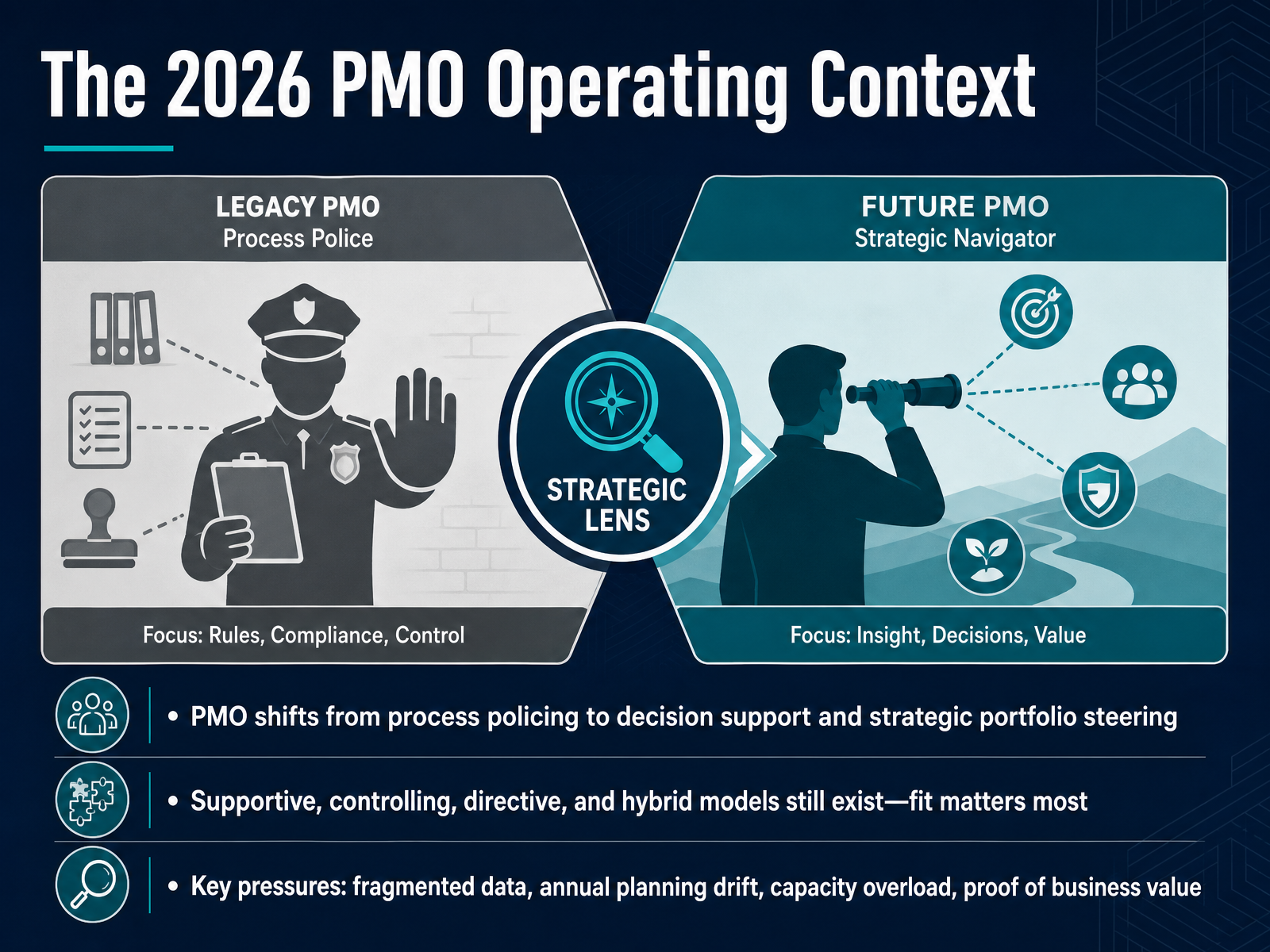
- 02The 2026 PMO Operating ContextLet's step back and look at the operating context we are all dealing with heading into 2026. The PMO has fundamentally shifted. Its role is no longer about policing processes. We now need to be decision support and strategic portfolio steering—helping the business choose the right work and then actually delivering those outcomes. That said, governance models still matter. Whether your office is supportive, controlling, directive, or a hybrid, the critical success factor is fit. If the mandate doesn't match the culture, you will create friction or get ignored. Now, the pressures forcing this evolution are real. Fragmented data scattered across systems makes it hard to see the true portfolio picture. Annual planning cycles decay within weeks or months. You face constant capacity overload where scarce people get over-allocated and tired. And you must fight to prove tangible business value beyond 'on time, on budget'. Understanding this context is what turns a PMO from a cost center into a strategic asset. We'll cover how to prove that value next.
 pmi.orgplanisware.comprojectmanagementformula.com+21 min
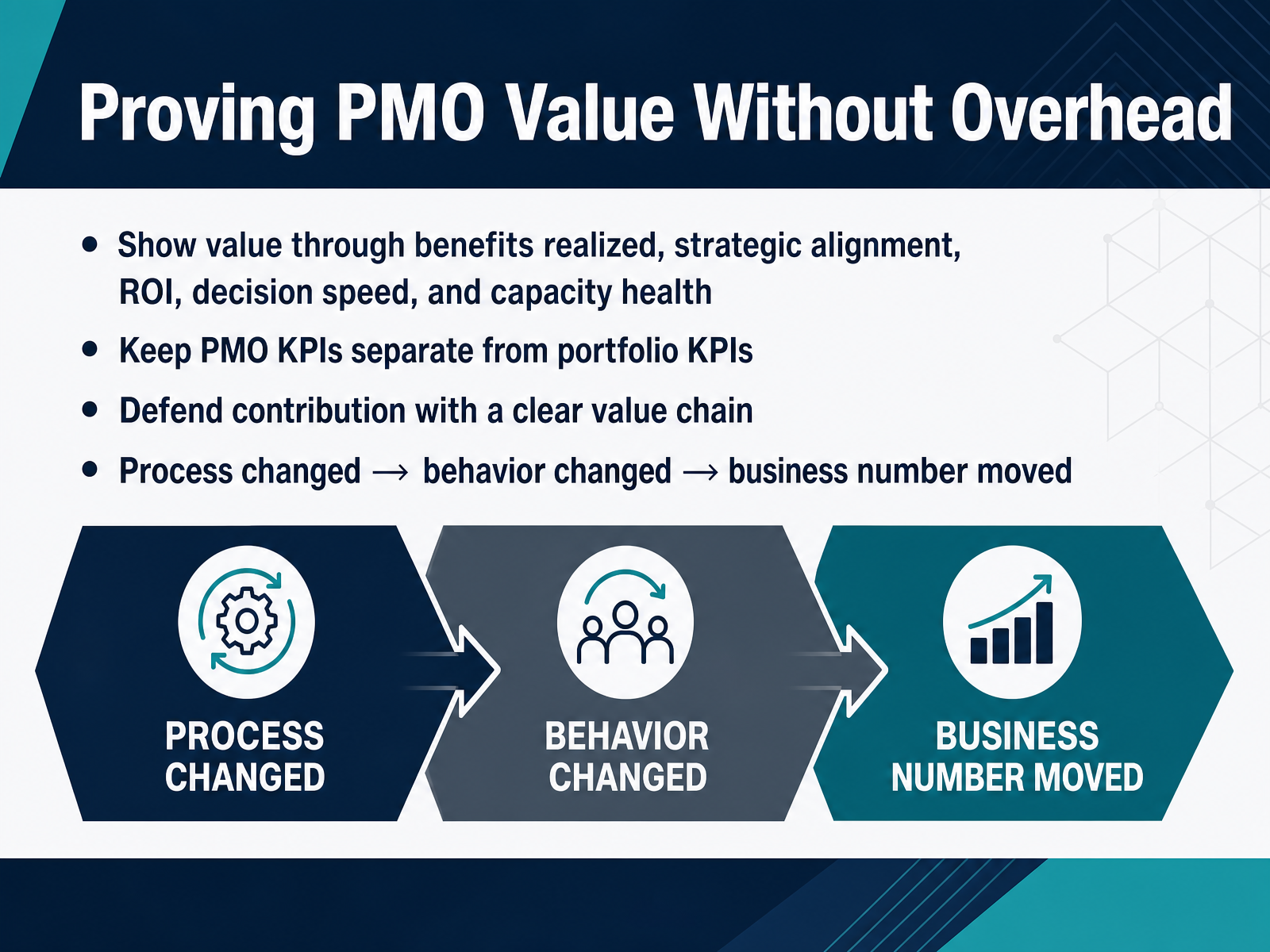
 - 03Proving PMO Value Without OverheadProving value without becoming overhead. That's the balancing act every PMO faces. Leadership won't fund you just because your processes are tidy. They fund you when they can see a direct line from your work to business outcomes. So lead with what executives actually care about: benefits realized, strategic alignment, ROI, decision speed, and capacity health. Those measures show whether your portfolio is paying off, not just whether it's busy. Keep your PMO's own KPIs separate from your portfolio KPIs. Portfolio health is about delivery performance across projects. Your KPI is whether your processes made that performance possible. Mix the two, and you lose the story. And when you defend your contribution, build a value chain you can defend. Process changed, behavior changed, business number moved. For example, you cut intake turnaround from thirty days to nine. That's a process change. Leaders then started three initiatives earlier. That's a behavior change. Revenue landed a quarter sooner. That's the business number. That's a claim you can defend. Lead with that chain, and you're a partner, not a cost center.
 planisware.complanisware.comnimblework.com+22 min
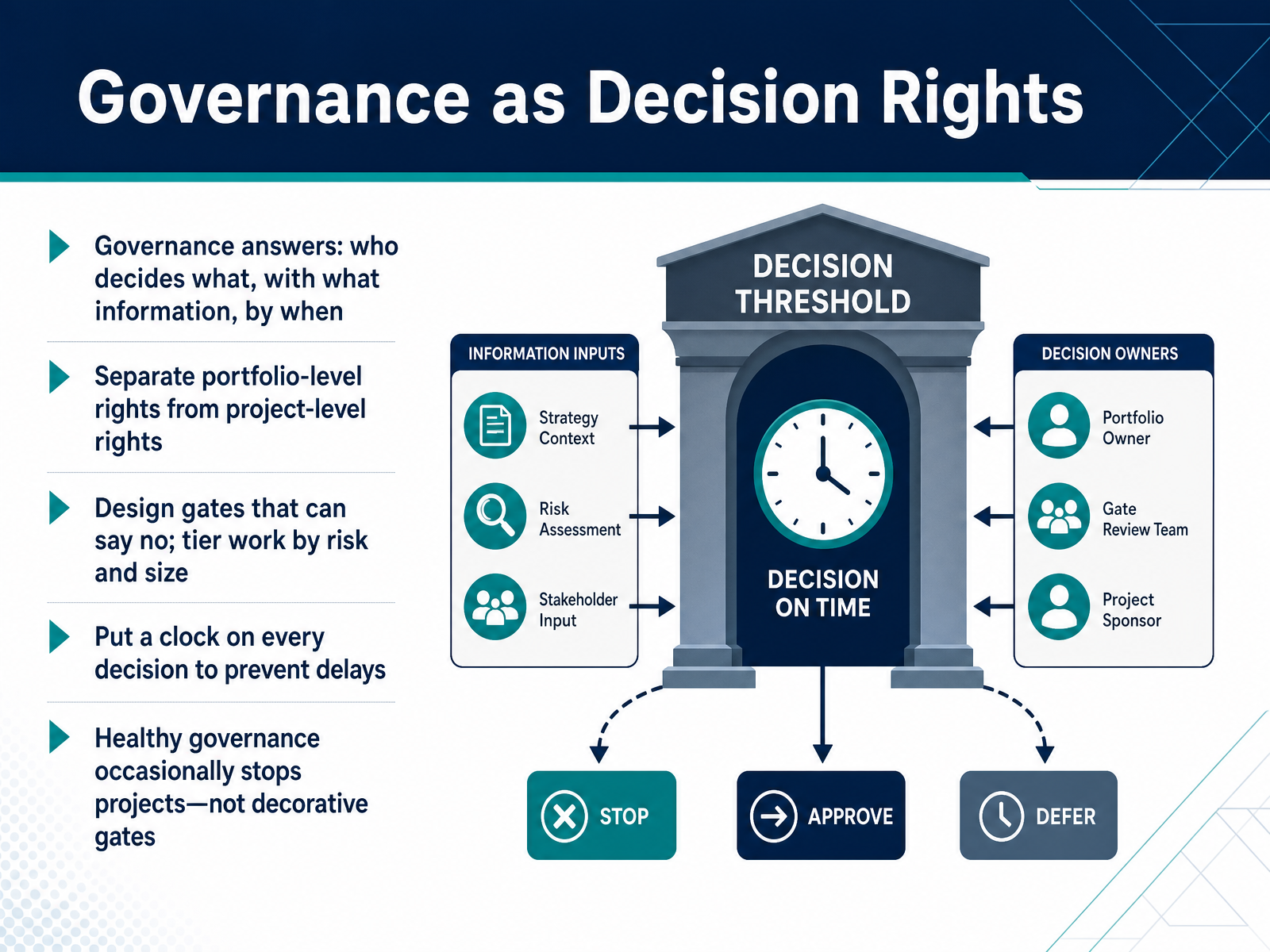
 - 04Governance as Decision RightsLet’s talk about governance as decision rights, because that is what it actually is. Governance answers one question: who decides what, with what information, and by when. If you cannot answer that in one sentence, you have process, not governance. Start by separating portfolio-level rights from project-level rights. The portfolio board decides which projects exist. The steering committee decides how a funded project is run. Keep those forums apart, or you will steer the portfolio one project at a time. Next, design gates that can actually say no. Tier your work by risk and size so a small process tweak does not go through the same gate as a major platform replacement. The heavy committee should only see the heavy work. And put a clock on every decision. A decision right without a deadline is just a suggestion. If a funding change takes five business days, say so. If an escalation takes forty-eight hours, say so. When decisions blow their clock, they escalate automatically. Here is the honest test of whether your governance is working: has a gate ever stopped a project? If nothing ever gets killed, your gates are decorative. A healthy governance model occasionally kills work. That is not failure, that is the system working. So check your own forums. Can each one name a decision it made in the last two months? If not, you are holding status meetings, not governance. Now, once your decision rights are clear, we need to look at how work gets in the door in the first place—intake, prioritization, and where the capacity line actually sits.
 pmoevolution.comportfoliohub.ioplanisware.com+22 min
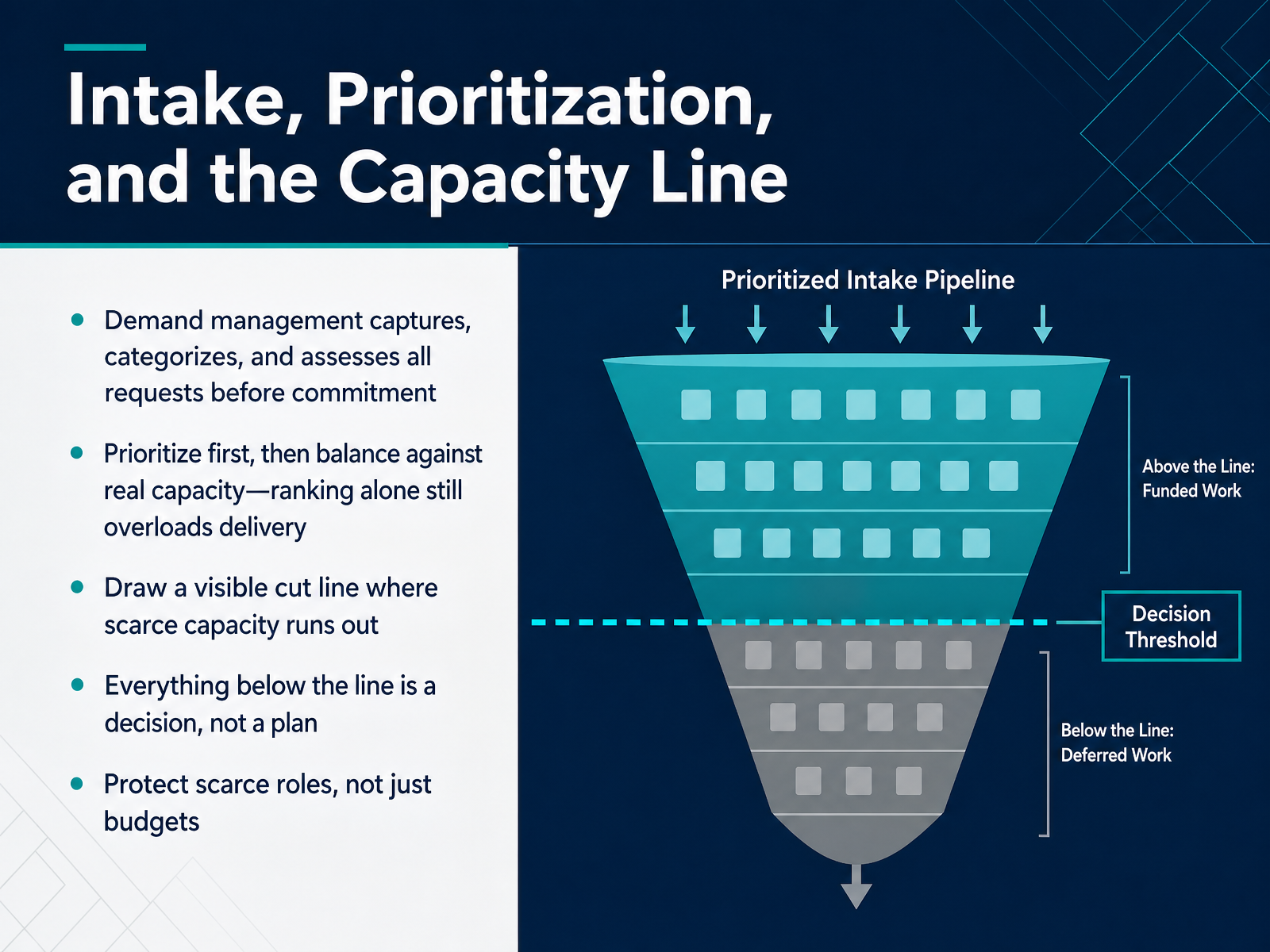
 - 05Intake, Prioritization, and the Capacity LineLet’s talk about the moment where strategy meets reality: intake, prioritization, and the capacity line. Demand management is your first control point. It captures every request, categorizes it, and assesses it before anyone commits resources. The goal is a single, honest pipeline. Now, a common mistake is to build a ranked list and call it a portfolio. Ranking alone does not prevent overload. You must balance that ranking against real, available capacity by role, not just by headcount. That’s where you draw the visible cut line. Everything above it gets properly funded and staffed. Everything below it is not a backlog; it is a decision waiting to be made. Frame it that way for your executives, and the conversation changes from effort to trade-offs. Also, protect your scarce roles, not just your budget. Your bottleneck is usually two or three specialist roles. When you protect them and draw that line on the screen, your sponsors see exactly what a new request costs. If we add this, three higher-priority projects drop below the line. That visibility builds credibility and makes the portfolio governable. Next, we’ll look at how to make stopping projects a deliberate, repeatable discipline, not a last resort.
 planisware.compmoevolution.comportfoliohub.io+22 min
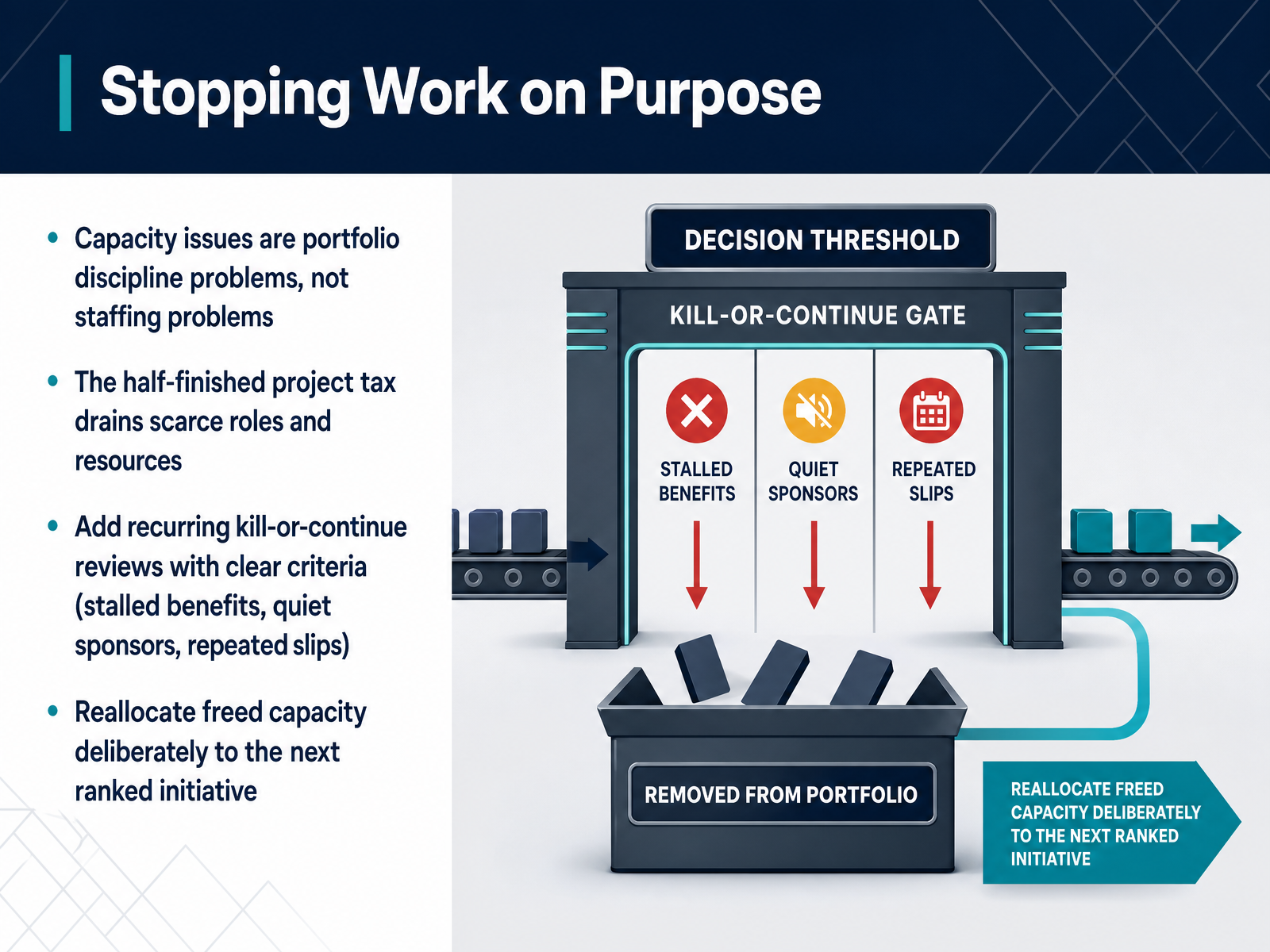
 - 06Stopping Work on PurposeLet's talk about the discipline most portfolios avoid: stopping work on purpose. When capacity is tight, we call it a staffing problem, but it's really a portfolio discipline problem. Every half-finished project still consumes meetings, reporting, and your scarcest specialists. That's the half-finished project tax, and it quietly drains the initiatives that matter. The fix isn't hiring. It's adding a recurring kill-or-continue review to your governance cadence. Give it clear, objective criteria: stalled benefits, a sponsor who has gone quiet, or a delivery date that has slipped three times. Naming a project for review is not an accusation. It's hygiene. And when you do stop something, the real win is the architect, analyst, or change lead you just freed. Reassign those people deliberately to the next ranked initiative above the capacity line. If that capacity just drifts, it gets reabsorbed by the same noise within weeks. Put it in writing. Tie it to a specific priority. That is how you turn a painful decision into real portfolio throughput. Now, let's look at the delivery framework that makes this level of control practical.
 planisware.compmoevolution.comportfoliohub.io+21 min
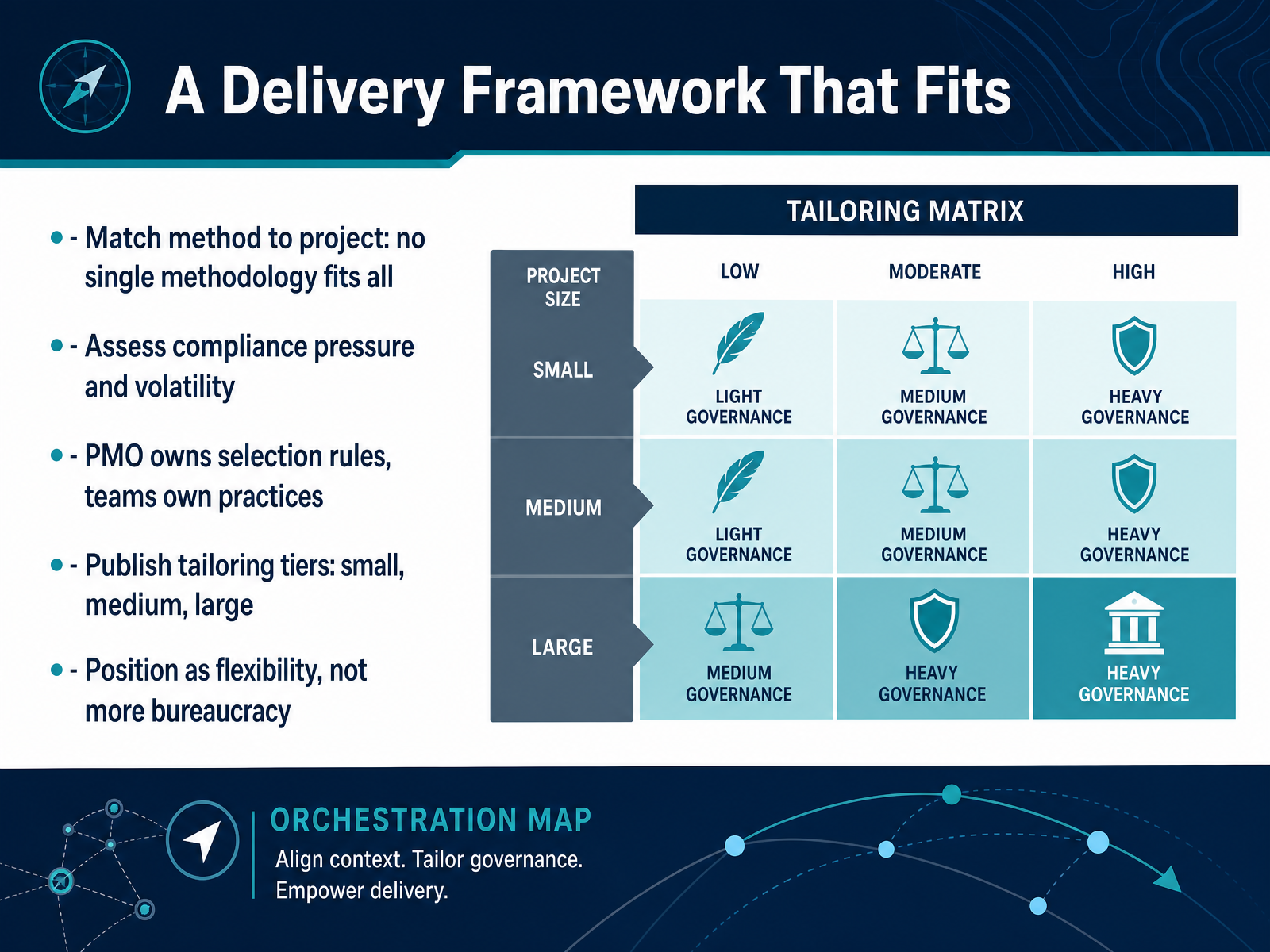
 - 07A Delivery Framework That FitsNow let's talk about fitting the delivery framework to the work at hand. No single methodology works for everything. The old waterfall versus agile debate is over. What matters is matching the approach to the project's realities, and that means assessing two things: compliance pressure and volatility. How fixed are the requirements? How fast is the environment changing? Map your projects against those dimensions, and the right approach becomes clear. The PMO owns the selection rules, not the day-to-day practices. Teams own how they execute. Your job is to define which projects use which framework, and then get out of the way. Publish clear tailoring tiers, small, medium, large, so a two-week initiative doesn't carry the same paperwork as a two-year program. Be explicit about what changes at each tier. And position this as flexibility, not more bureaucracy. Frame it as giving teams the right tools for the job. One client called it the pick-and-use framework, and adoption jumped because people felt supported, not restricted. Do this well and your PMO becomes a strategic partner, not the process police. Next, let's look at reporting that drives decisions.
 portfoliohub.io2 min
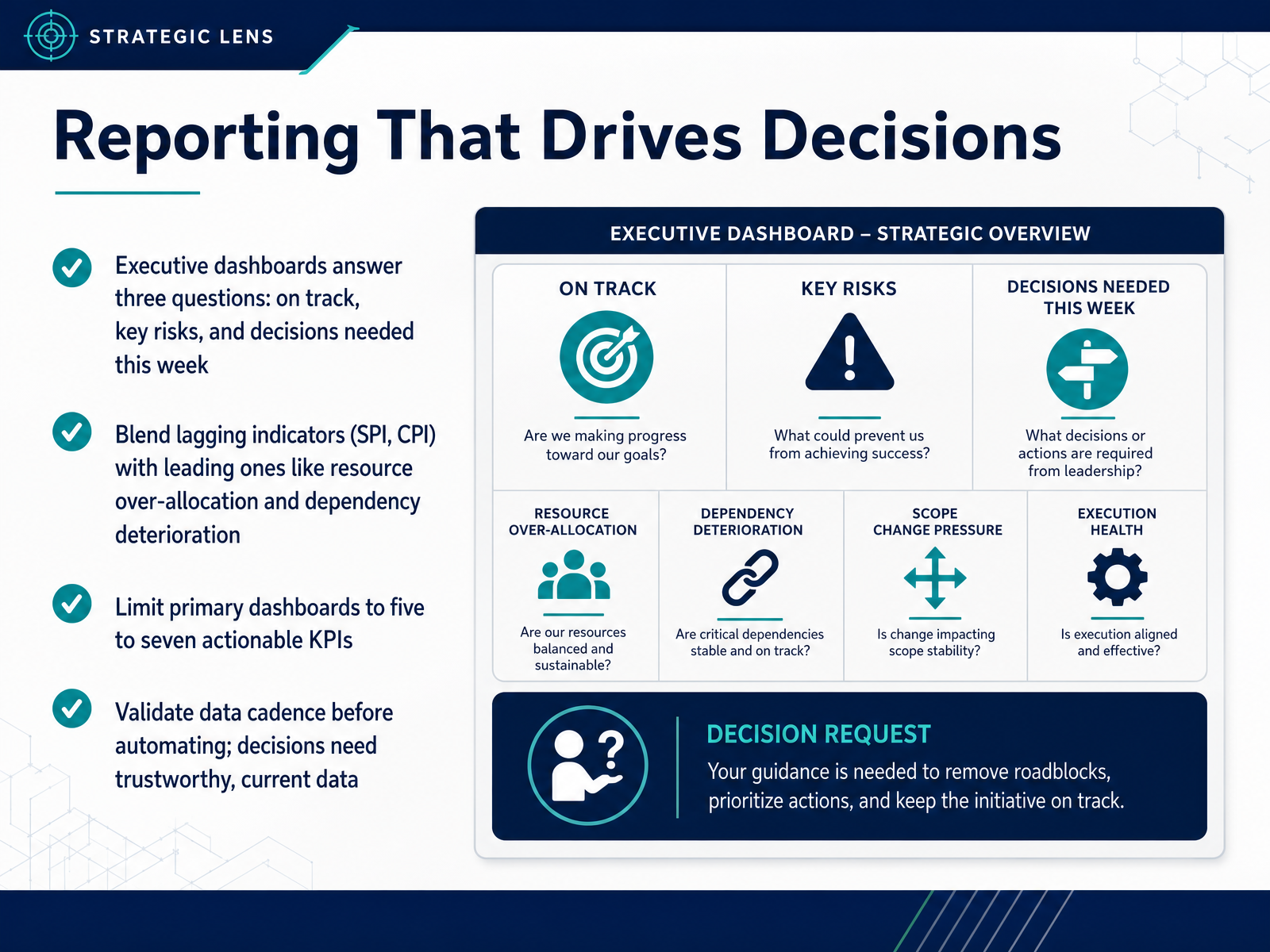
 - 08Reporting That Drives DecisionsNow let’s talk about the reporting that actually drives decisions. An executive dashboard should answer three questions: are we on track, what are the key risks, and what decisions are needed this week. If it doesn’t do that, it’s just decoration. There are two types of indicators you need to blend here. Lagging ones like schedule performance index or cost performance index show where you are today. Leading ones like resource over-allocation or dependency deterioration show where you’re heading. You need both. Keep your primary dashboard disciplined. Five to seven actionable KPIs is the maximum. Anything else goes into drill-down views. And before you automate anything, validate your data cadence. A beautiful dashboard with stale numbers destroys trust faster than no dashboard at all. Every refresh cycle must match the decisions it supports. Remember, clarity beats volume and timeliness beats polish. Now let’s shift to how you handle risk and dependency management across the portfolio.
 1 min
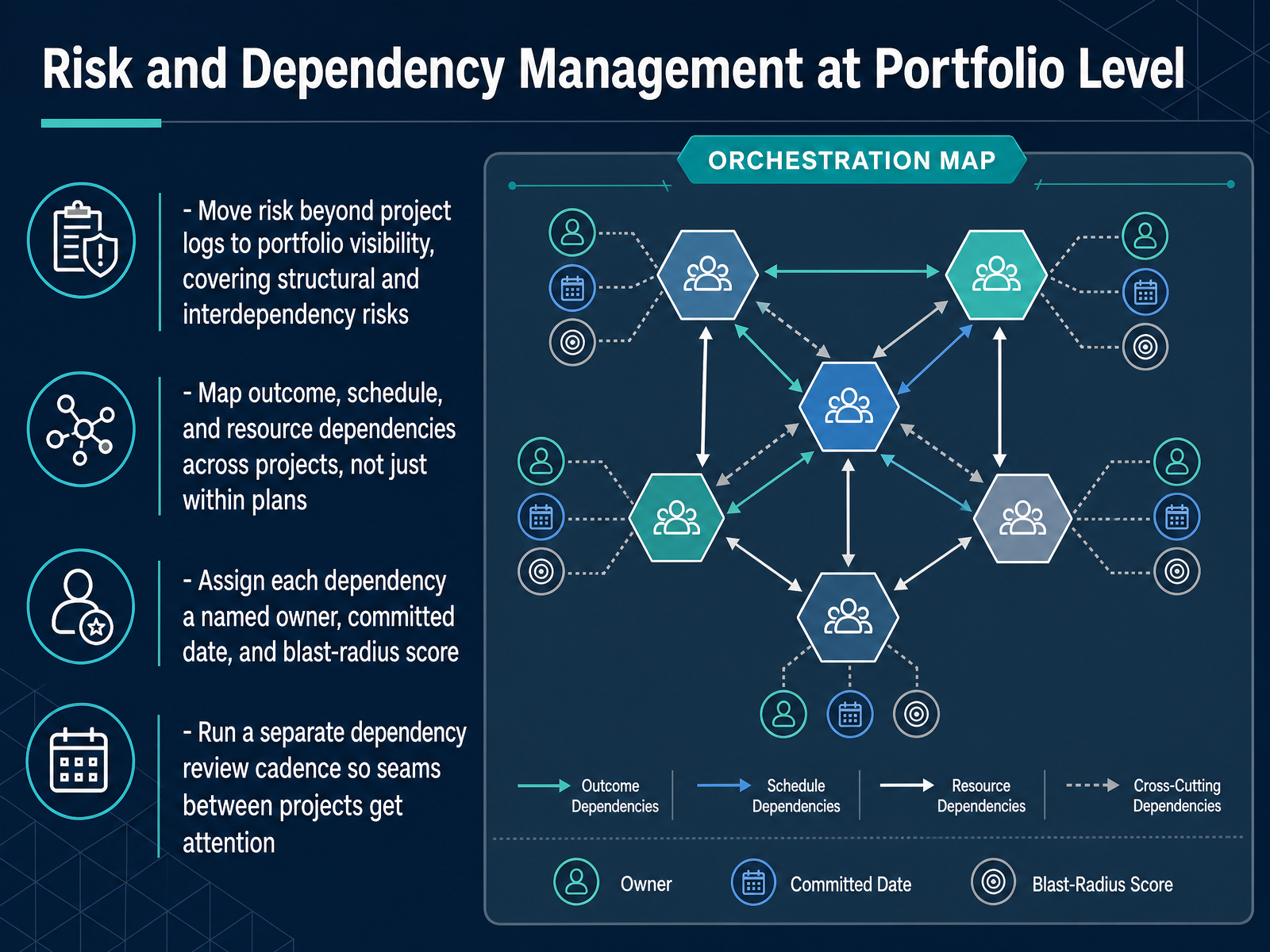
1 min - 09Risk and Dependency Management at Portfolio LevelNow let’s zoom out to the portfolio level, where risk and dependency management really earn their keep. Project-level logs catch single-project issues, but they miss the seams between projects. That’s where the costly surprises live. So, move risk visibility beyond the project logs. Track structural risks and interdependency risks, not just individual component risks. Map three types of dependencies across your project portfolio: outcome dependencies, where one project’s success depends on another’s deliverable; schedule dependencies, where timing is linked, often visible in cross-project Gantt views; and resource dependencies, where multiple projects draw on the same limited talent or platform team. For every dependency, assign a single named owner, a committed date, and a blast-radius score. A blast-radius score tells you how many programs or how much budget sits downstream if that dependency slips. Rank your attention by that score, not by noise. Then, run a separate dependency review cadence, every two weeks, distinct from status meetings. Keep one agenda item: what changed, what’s at risk, what decisions are needed today. That dedicated rhythm is what keeps the seams between projects from turning into the reason your portfolio misses its date. Next, we’ll look at the PMO capability and career paths that underpin all of this discipline.
 1 min
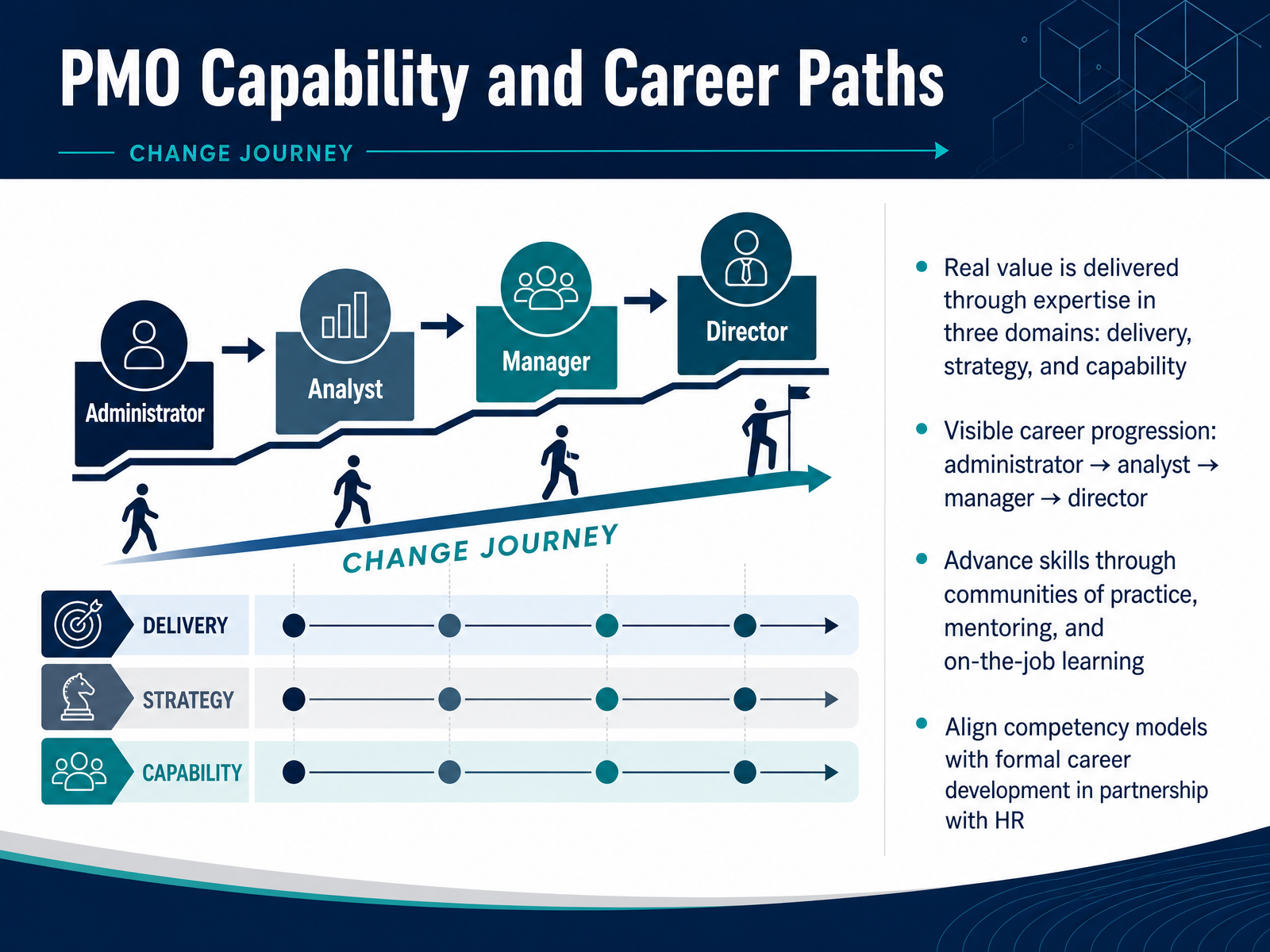
1 min - 10PMO Capability and Career PathsHere’s where we think about the people side of the PMO. Real value is delivered through expertise in three domains: delivery, strategy, and capability. Delivery is doing the work well. Strategy is aligning with business goals. Capability is building the skills that make your team resilient. If a team is strong in delivery but weak on strategy, they produce reports that no one uses. That’s competence without impact.
Now, those who want to grow need a visible career path. It typically runs from administrator to analyst to manager to director. Each step shifts weight from doing tasks to shaping outcomes and leading others. Instead of hoping people develop, we advance skills through communities of practice, mentoring, and on-the-job learning. For example, having an analyst lead a retrofit on governance not only builds experience but also strengthens the service itself.
Finally, align competency models with formal career development in partnership with HR. That alignment turns individual growth into organizational capability.
As we move on to stakeholder engagement and change leadership, keep in mind that building your people is what makes every other PMO improvement possible.
 2 min
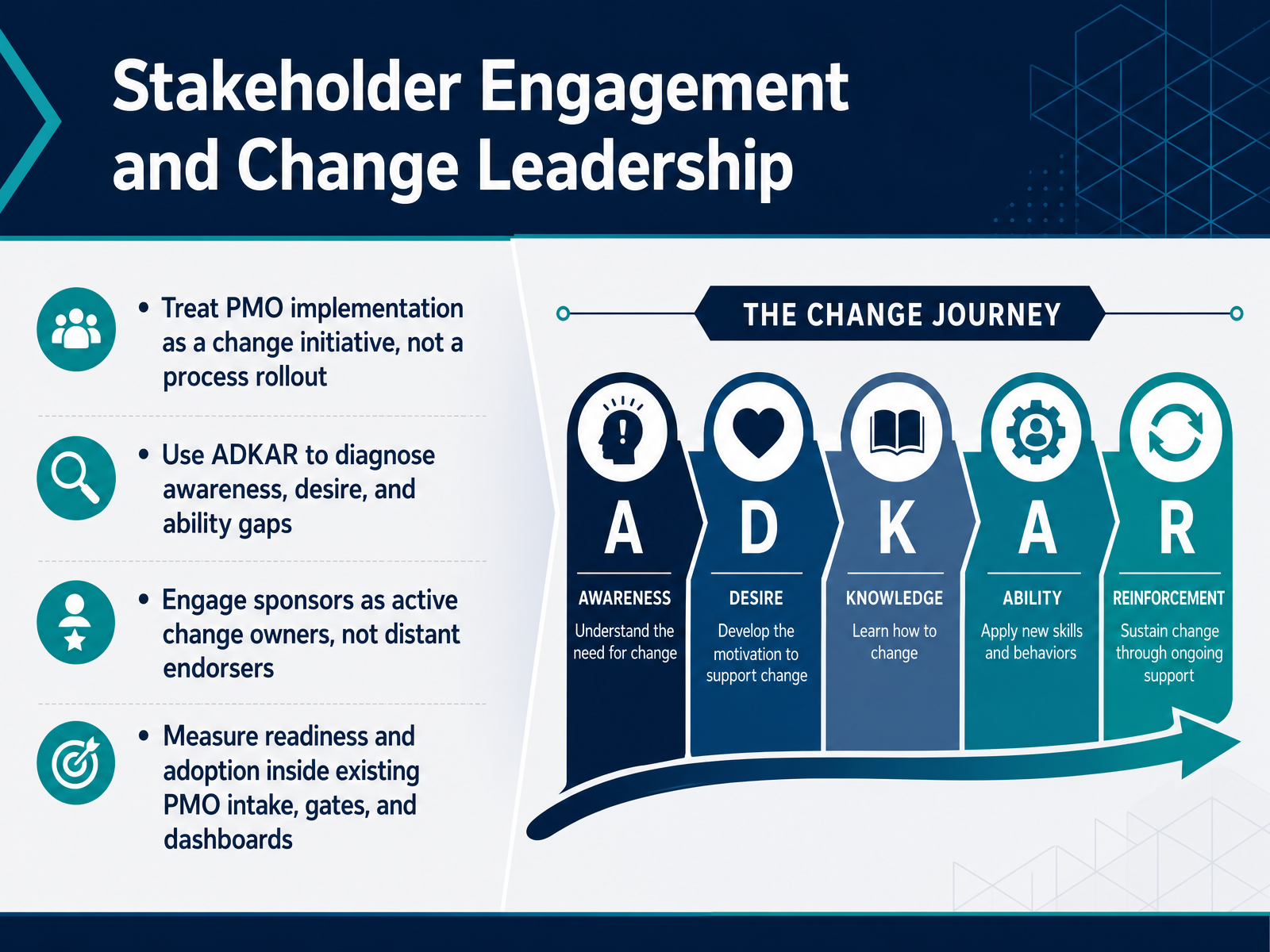
2 min - 11Stakeholder Engagement and Change LeadershipNow, let’s tackle the part that often determines success or failure: the people side of the PMO. Treat implementation as a change initiative, not just a process rollout. A governance framework on paper means nothing if teams won’t use it. Use the ADKAR model to diagnose gaps across your stakeholder groups. Are they aware of why the PMO exists? Do they have the desire to support it? Do they have the ability to work within it? You can’t fix resistance until you know which element is missing. And remember, sponsorship must be active, not ceremonial. Your executive sponsor needs to make decisions, clear blockers, and visibly use the new processes. If leadership won’t follow the governance standards, neither will anyone else. Finally, build readiness and adoption metrics into what you already use. Add adoption risks to the RAID log at stage gates, and put stakeholder confidence on the project dashboard. If adoption is only measured after go-live, it’s already too late to act. Keep it simple; pick one pilot, measure it, and expand. Now, let’s look at how PMO maturity can guide that planning effort.
 2 min
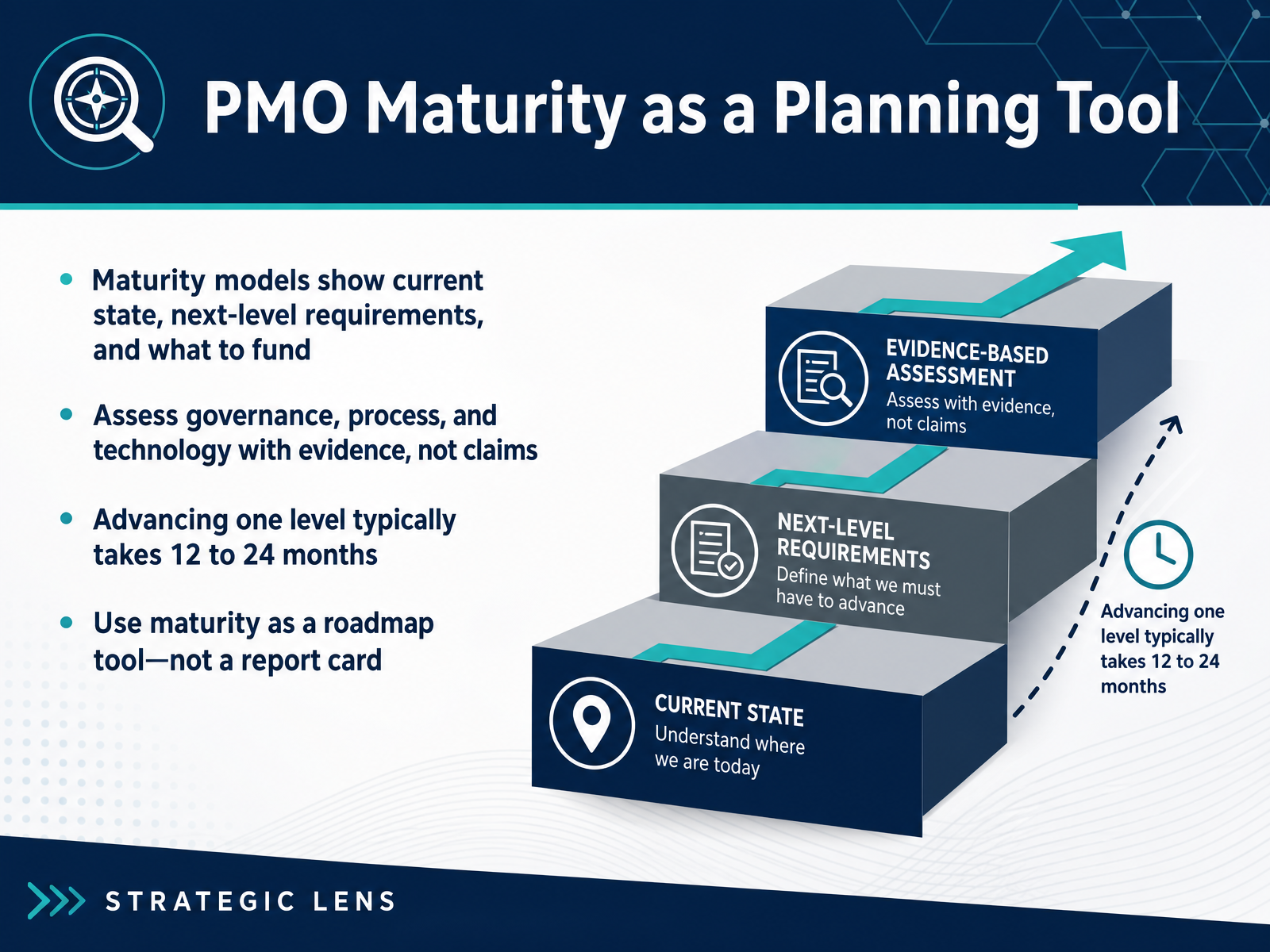
2 min - 12PMO Maturity as a Planning ToolLet's talk about using maturity as a planning tool, not just a label. A maturity model does three things well. It shows you where you are today, it defines what the next level actually requires, and it gives you a clear case for what to fund. But the value depends on the evidence. Assess your governance, your processes, and your technology with proof, not perception. If you claim you have a prioritization process, you need to show the records of decisions it produced. Without that, you are likely overstating your real level. Now, keep expectations realistic. Advancing one level typically takes twelve to twenty-four months. That is not because the documents are hard to write. It is because new habits have to embed across project managers, sponsors, and delivery teams. So, treat maturity as a roadmap tool, not a report card. Don't try to fix six domains at once. Pick the one or two that are holding your score down and invest there for a full year. That focused progress is what earns the next budget cycle. Next, we will translate this into a concrete twelve-month improvement roadmap.
 2 min
2 min - 13A 12-Month Improvement RoadmapLet's turn that roadmap into a working plan. The most effective route is the opposite of launching parallel workstreams. Instead, prioritize two to three high-impact changes and commit to them over the next twelve to eighteen months. Resist the urge to fix everything at once. Start with an evidence-based maturity assessment. This grounds your decisions in facts, not assumptions, and reveals where the real gaps are. Then, convert each gap into a specific, owned action with a clear owner and a deliverable. Don't just list themes like improve risk management. Define precisely what good looks like. Before you scale anything, run a focused pilot. Select one process or portfolio segment, implement the change, measure the outcome against your success criteria, and then decide. This evidence-based approach de-risks the rollout and builds the case for wider adoption. Finally, embed a review rhythm. Revisit the roadmap quarterly to stay responsive to shifts in strategy or priorities. And reassess your maturity every twelve to eighteen months to measure genuine progress. That cadence keeps leadership confident the investment is compounding, not stalling. Now, let's wrap up with a concrete action plan for your PMO.
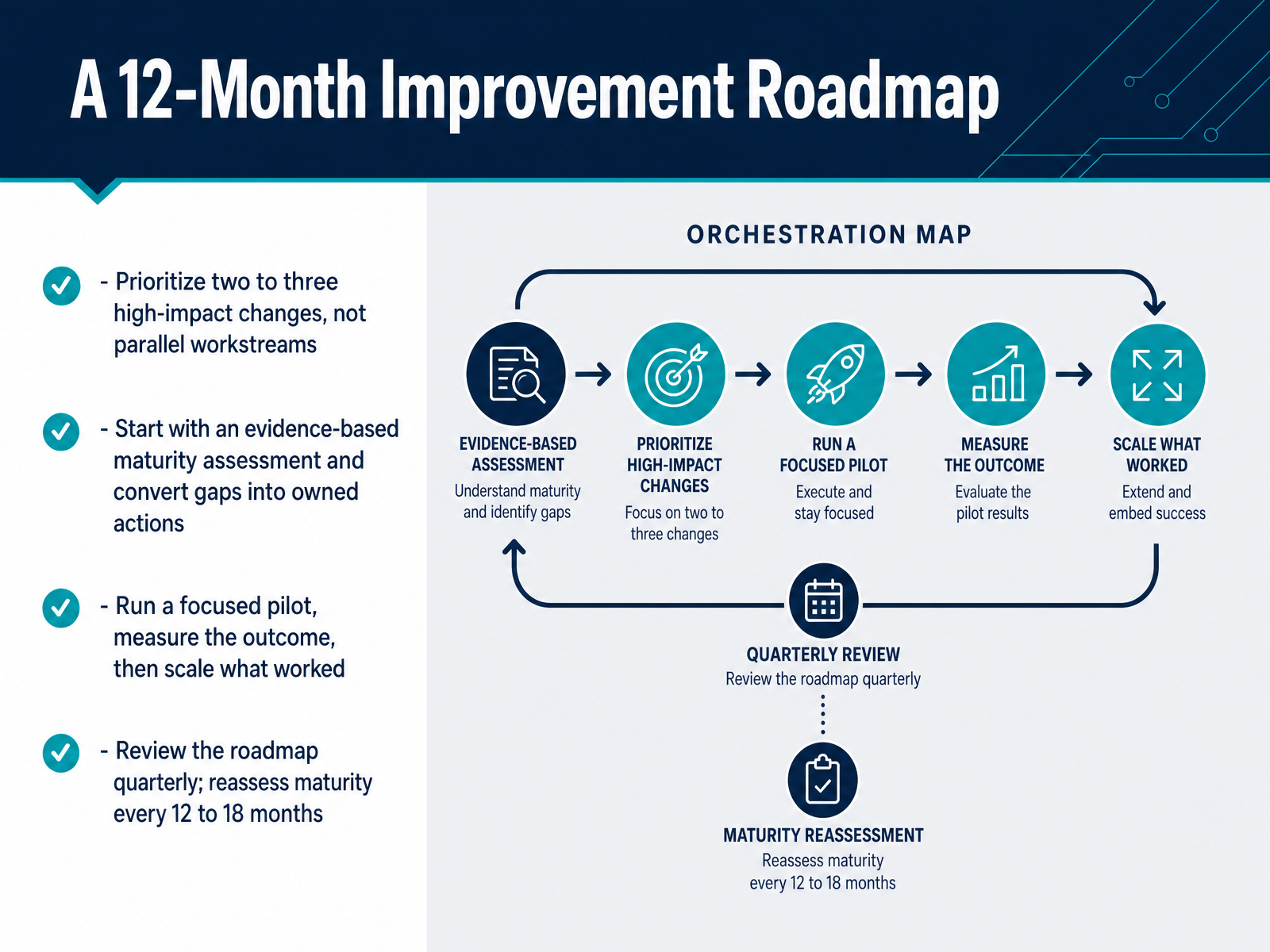 pmi.orgplanisware.comprojectmanagementformula.com+22 min
 - 14Action Plan for Your PMOSo here's where we turn insight into action. Start with the decision that hurts most right now. It's usually funding or capacity. Pick that one and make it faster with better, connected data. Next, define your five most critical portfolio decisions. Give each one a clear owner and a deadline. That's governance that actually decides. Then map your capacity by role, not headcount. Find the bottleneck. And pick one project to pause or stop next month. It will sting, but it will free your best people for work that matters. Finally, build your plan. Write down the owner, the timeline, and what success looks like. Measurable and specific. No passive intentions. You now have the framework: prioritize by value, govern by decision rights, and balance against real capacity. None of this requires a bigger team or a new tool this quarter. It requires discipline and starting with one honest move. Go make it. Thank you for your time, and good luck building a PMO that leads with confidence.
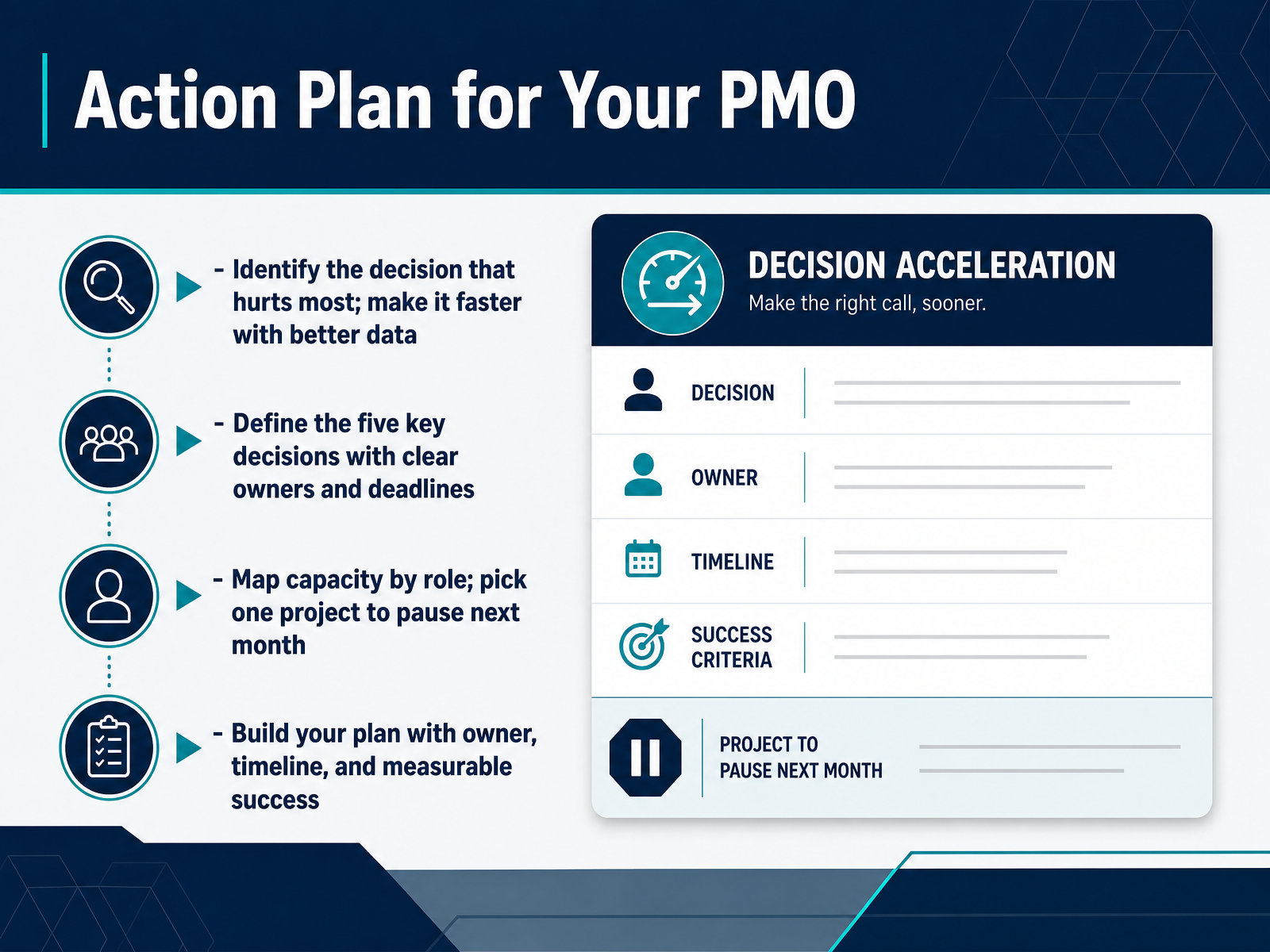 planisware.compmoevolution.comportfoliohub.io+22 min
Take the deck with you
Download this course as a file — free, no sign-up needed.
- PDF handoutEvery slide page, ready to print or share.15 pages · 3.5 MBDownload
- Narrated PowerPointThe deck that presents itself — every slide carries the digital human's narration video.15 pages · 14.4 MBDownload
- PowerPoint slidesThe full deck as a .pptx — open it in PowerPoint, Keynote, or Google Slides.15 pages · 3.4 MBDownload
Free to use in your own training — please keep the PersonWise credit page at the end.
Have your own deck? Turn it into a course
Sources consulted
Web sources consulted while building this course.
- Project Management Offices: A Practice Guide - PMI — pmi.org
- 10 Proven PMO Best Practices to Boost Project Success - Planisware — planisware.com
- PMO Modern Best Practices – Project Management Formula — projectmanagementformula.com
- Project Management Office (PMO) – A 2026 Guide - Celoxis® — celoxis.com
- 2026 PMO Playbook: Strategic PPM with AI Foresight & Value Creation - Celoxis® — celoxis.com
- The 8 PMO KPIs that really matter in 2026 — planisware.com
- How to Demonstrate PMO Value to Leadership Effectively | Planisware — planisware.com
- PMO Metrics In 2026: The 12 That Predict Delivery Outcomes — nimblework.com
- PMO KPIs and Metrics: How to Measure PMO Performance | Portfolio Hub — portfoliohub.io
- Benefits Realization KPIs: The Missing Link in PMO Performance Reporting | Empowering Leaders in Project & Portfolio Management — blog.metagyre.com
- PMO Governance: Decision Rights Over Gatekeeping — pmoevolution.com
- Project Portfolio Governance: Gates and Decision Rights | Portfolio Hub — portfoliohub.io
- Establishing PMO Governance Models for Strategic Portfolio Management — planisware.com
- PMO Framework: Components, Models, and How to Build One | Portfolio Hub — portfoliohub.io
- PMO Governance Framework Design: Control Execution & Capital | Handle — handle.ae
- Streamlining PMO Processes and Improving Project Prioritization — planisware.com
- PMO Capacity Planning: The Trap That Starves Your Priorities — pmoevolution.com
- Project Portfolio Management Process: 7 Steps and Flow | Portfolio Hub — portfoliohub.io
- Resource Capacity Planning for IT PMOs: The S.M.A.R.T. Planning Framework | ProSymmetry — prosymmetry.com
- Demand Management in Project Portfolio Management | Portfolio Hub — portfoliohub.io