Pattern Recognition and Machine Learning
Begin
14 pages · ~28 min
Pattern Recognition and Machine Learning
This training introduces pattern recognition and machine learning, covering core concepts and methods for learners to build and apply models to real-world data.
What you’ll learn
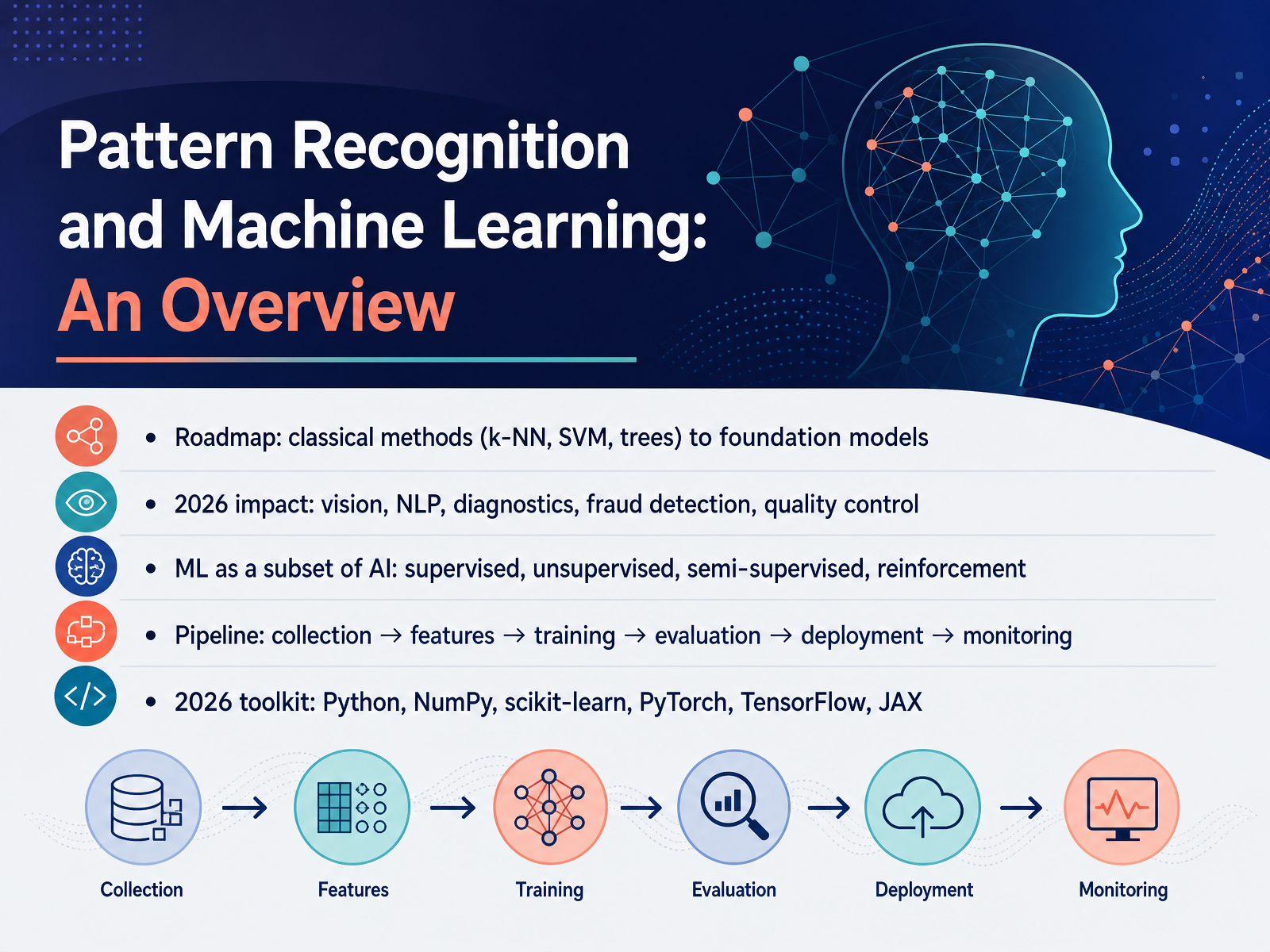
- 01Pattern Recognition and Machine Learning: An OverviewWelcome, everyone. I'm glad you're here. Over the next fourteen slides, we'll build a clear, practical map of pattern recognition and machine learning, and I promise you don't need advanced math to follow along. So, what are we actually doing here? Pattern recognition is how a system spots regularities in data, and machine learning is how it learns those patterns from examples instead of hard-coded rules. Think of a fraud team flagging an unusual transaction in milliseconds, or a quality-control camera catching a scratch on a phone screen. That is pattern recognition at work. Here's our roadmap. We'll start with classical methods like k nearest neighbors, support vector machines, and decision trees, then move toward today's foundation models. We'll see machine learning as a subset of artificial intelligence, covering supervised, unsupervised, semi-supervised, and reinforcement learning. We'll walk the full pipeline, from data collection to features, training, evaluation, deployment, and monitoring. And we'll get hands-on with the modern toolkit: Python, NumPy, scikit-learn, PyTorch, TensorFlow, and JAX. Let's start with the foundations that everything else builds on.mlflow.orgrahulkolekar.commyundoai.com+22 min
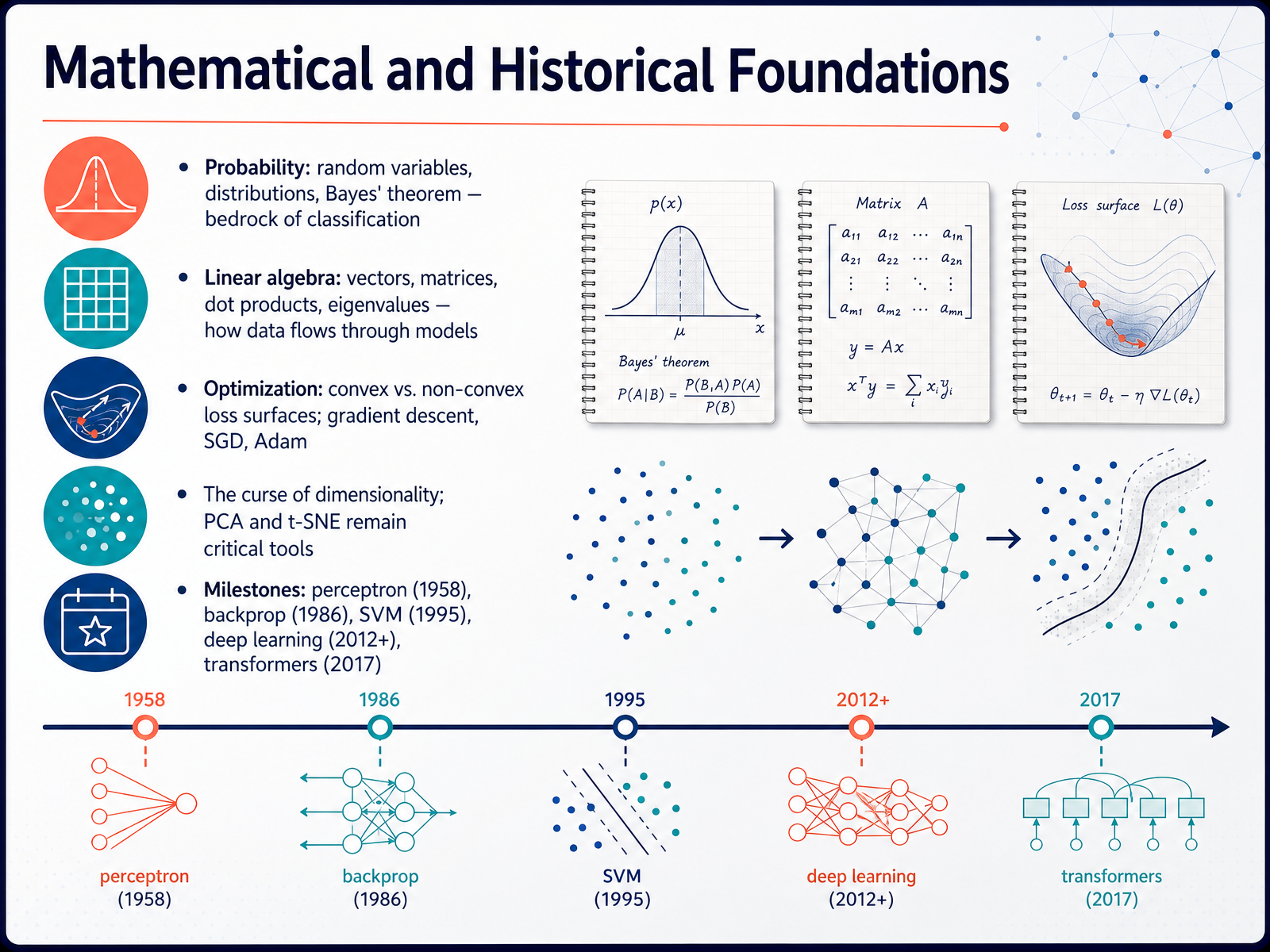
- 02Mathematical and Historical FoundationsLet's move on to where machine learning actually comes from, the mathematical and historical foundations. Three math pillars carry the field. First, probability. A random variable is just a number whose value depends on chance, like the outcome of a coin flip. A distribution describes how likely each value is. And Bayes' theorem lets us update our beliefs when new evidence arrives, which is the bedrock of classification. Second, linear algebra. Vectors and matrices are how we store data, the dot product measures similarity, and eigenvalues reveal important directions in that data, showing how information flows through a model. Third, optimization. Convex loss surfaces have one clear bottom, while non-convex ones have many, which is why we rely on gradient descent and its variants, stochastic gradient descent and Adam. We also meet the curse of dimensionality, where data gets sparse fast as dimensions grow. Principal component analysis and t-SNE remain critical tools for fighting it. Historically, the perceptron arrived in nineteen fifty-eight, backpropagation in nineteen eighty-six, support vector machines in nineteen ninety-five, deep learning took off after two thousand twelve, and transformers landed in two thousand seventeen. So here's the takeaway. These foundations, probability, linear algebra, and optimization, still explain almost everything we build today. Next, let's look at core learning paradigms and concepts.
 assemblyai.comanalyticsvidhya.comgithub.com+22 min
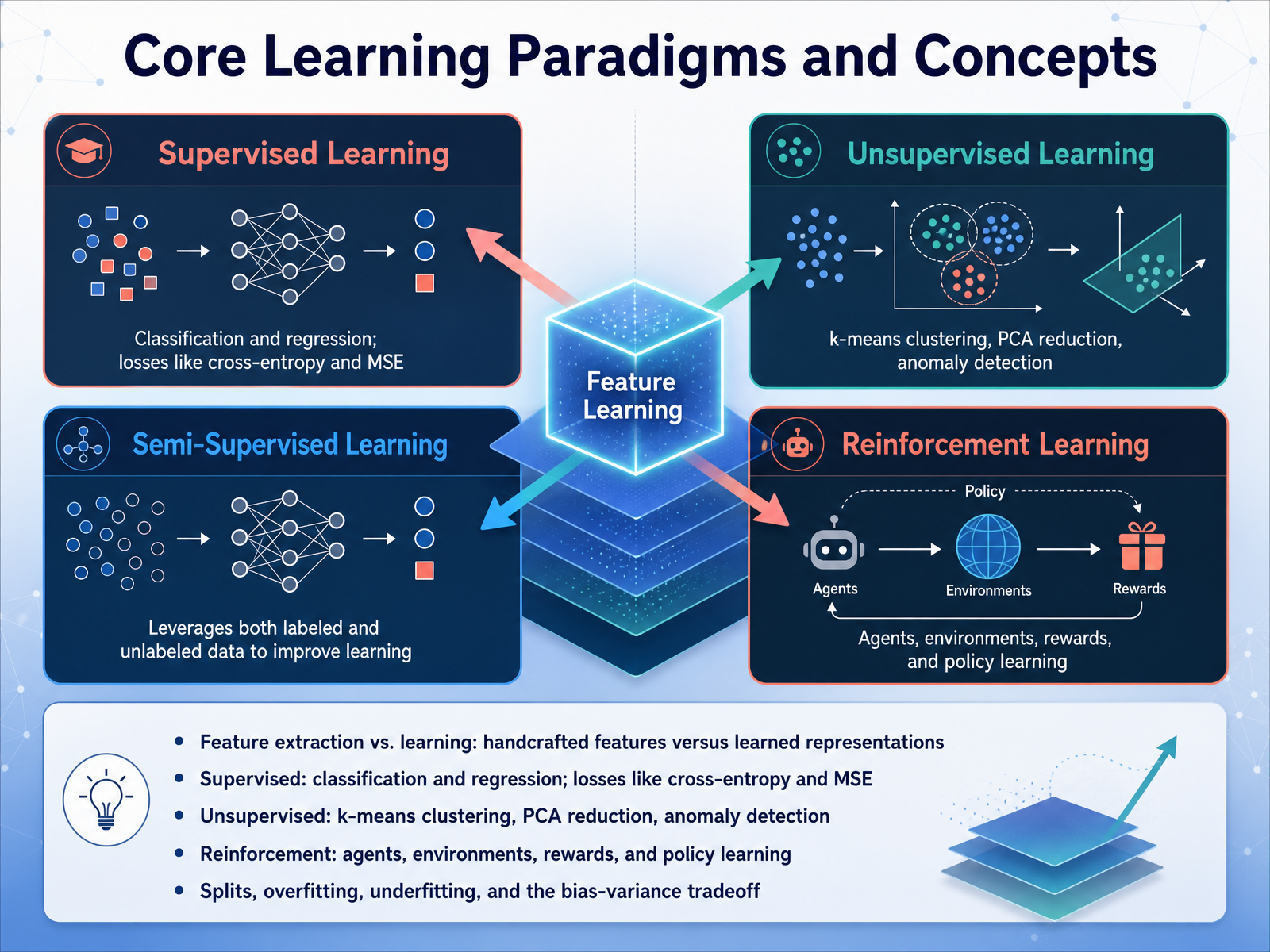
 - 03Core Learning Paradigms and ConceptsLet's walk through the core learning paradigms that organize everything in machine learning. First, feature extraction versus learning. Handcrafted features are what we design ourselves, while learned representations let the model discover useful patterns directly from data. Next, supervised learning, where we train on labeled examples. Classification predicts categories, like spam or not spam, and regression predicts numbers, like house prices. The loss measures error, with cross-entropy for classification and mean squared error for regression. Unsupervised learning works without labels. K-means groups similar points, P C A reduces dimensions, and anomaly detection flags unusual behavior, like a strange transaction on your card. Reinforcement learning trains an agent that acts in an environment and learns from rewards, refining its policy over time. Finally, data splits, overfitting, underfitting, and the bias-variance tradeoff. Overfitting memorizes noise; underfitting misses the pattern. The tradeoff is the balance between them. Keep that balance in mind. Now let's move on to Classical Pattern Recognition Algorithms.
 assemblyai.comanalyticsvidhya.comgithub.com+22 min
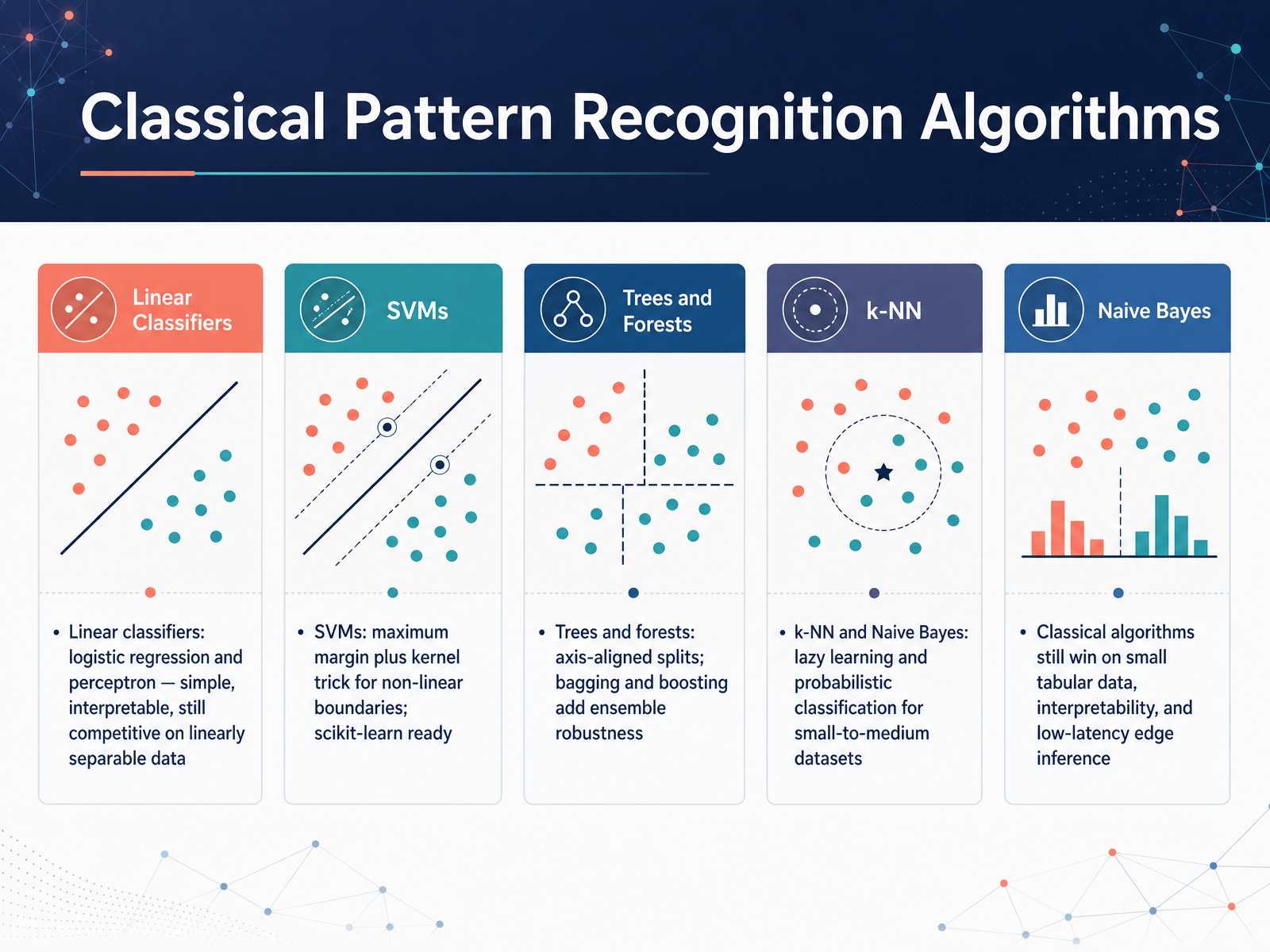
 - 04Classical Pattern Recognition AlgorithmsLet's walk through the classical pattern recognition algorithms, because these are still the workhorses you'll reach for again and again. First, linear classifiers. Logistic regression and the perceptron draw a straight line, or a flat boundary, through your data. Simple, interpretable, and still competitive when your classes are linearly separable. Next, support vector machines, or S V Ms. They find the maximum margin boundary, the widest street between classes, and the kernel trick lets them bend that boundary for non-linear data. Scikit-learn ready, out of the box. Then trees and forests. Decision trees split on axis-aligned cuts, easy to read and explain. Bagging and boosting combine many trees into an ensemble, which adds robustness and usually lifts accuracy. Finally, k-nearest neighbors and Naive Bayes. k-N N is lazy learning: it stores the data and votes among the closest neighbors at prediction time. Naive Bayes is probabilistic classification, fast and surprisingly strong for small to medium datasets. Here's the takeaway: classical algorithms often win on small tabular data, when you need interpretability, and for low-latency edge inference. Let's build on this with neural networks and deep learning foundations.
 ailoitte.comlabelyourdata.com6wresearch.com+22 min
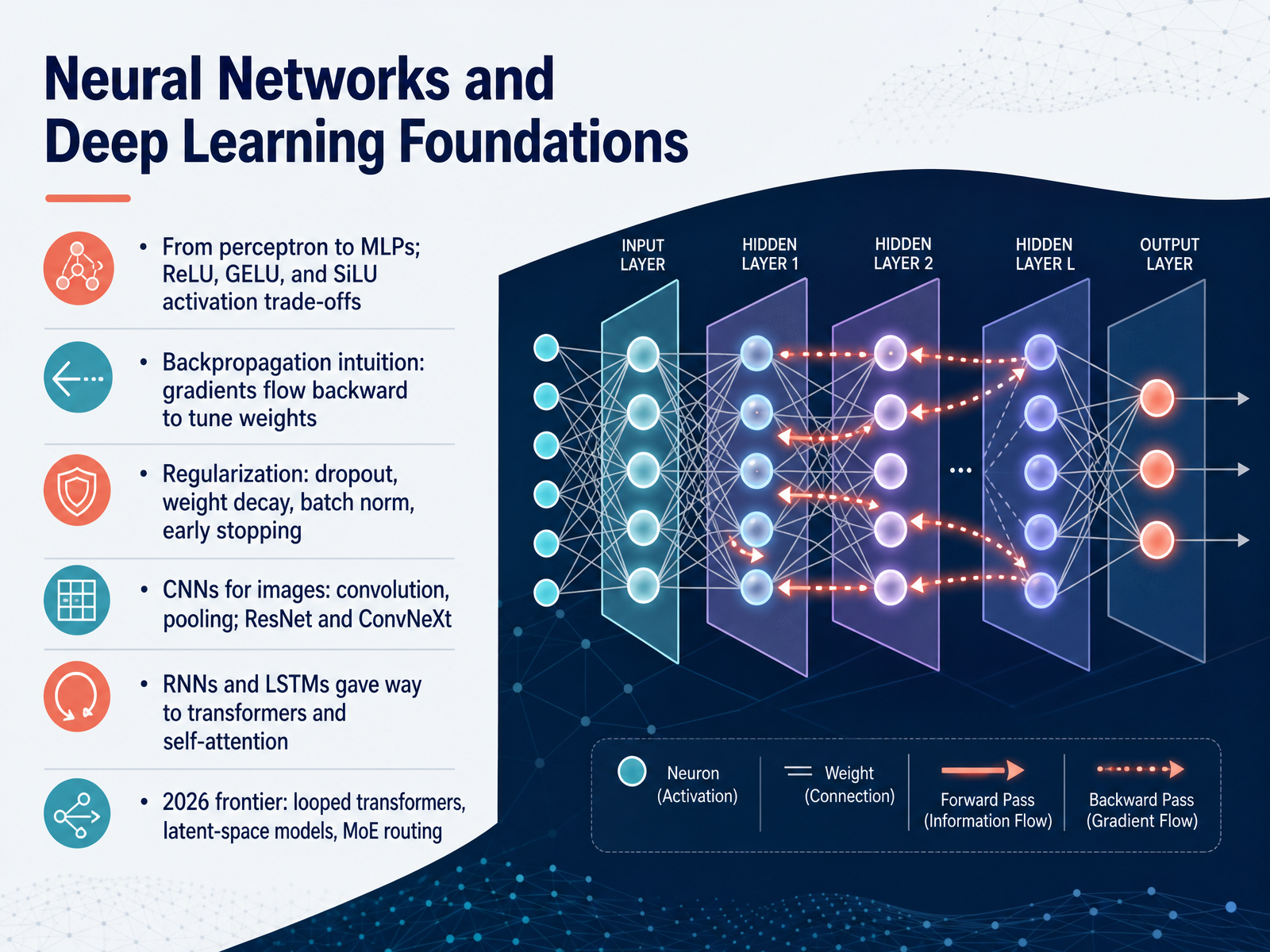
 - 05Neural Networks and Deep Learning FoundationsSo far we've covered the building blocks of learning from data. Now let's see what happens when we stack those blocks into deep neural networks. It starts with the perceptron, a single neuron, and grows into multi-layer networks. Along the way, we choose activation functions like ReLU, GELU, and SiLU. Each one controls how a neuron responds, and each trades off speed and smoothness. Training happens through backpropagation. Think of it as feedback flowing backward: the network measures its error and nudges every weight to reduce it. To keep models from memorizing, we add regularization, such as dropout, weight decay, batch normalization, and early stopping. For images, convolutional networks like ResNet and ConvNeXt learn spatial patterns. For sequences, recurrent networks and LSTMs gave way to transformers and self-attention. And by 2026, the frontier includes looped transformers, latent-space models, and mixture-of-experts routing. The takeaway is simple: deep learning is layers plus feedback plus guardrails. Next, we'll look at how to measure whether any of this is actually working, in Model Evaluation and Validation.
 arxiv.orgarxiv.orgarxiv.org+22 min
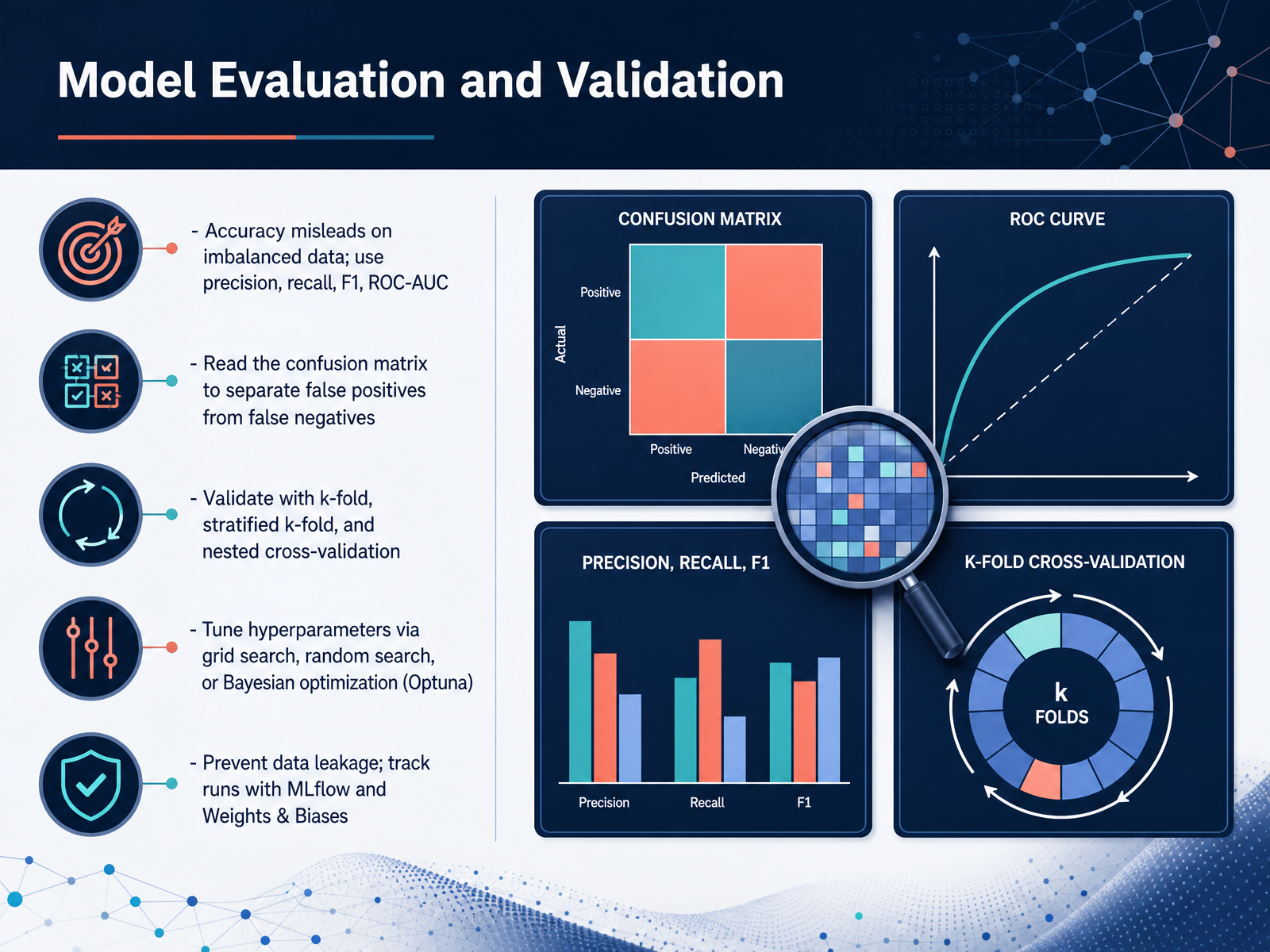
 - 06Model Evaluation and ValidationNow let's turn to how we actually judge a model, because a model that scores well on paper can still fail in practice. Accuracy is the first trap. On imbalanced data, like fraud detection where only one percent of transactions are fraudulent, predicting everything as normal gives you ninety-nine percent accuracy and catches zero fraud. So we reach for precision, recall, F one score, and R O C A U C instead. Precision asks how many flagged items were truly positive. Recall asks how many true positives we caught. The confusion matrix makes this concrete by separating false positives from false negatives, so we can see exactly which mistakes the model is making. Next, validation. We use k-fold cross-validation, and when classes are skewed, stratified k-fold keeps each fold representative. For serious tuning, nested cross-validation separates model selection from final evaluation. Then hyperparameter tuning, where grid search tries every combination, random search samples a few, and Bayesian optimization tools like Optuna learn from previous trials to find good settings faster. One critical rule: prevent data leakage, where information from your test set sneaks into training and inflates your scores. Track every experiment with MLflow or Weights and Biases so results stay reproducible. Here is your takeaway: choose metrics that match your data, validate honestly, and log everything. Next, let's look at the practical workflow for data preparation and feature engineering.
 mlflow.orgrahulkolekar.commyundoai.com+22 min
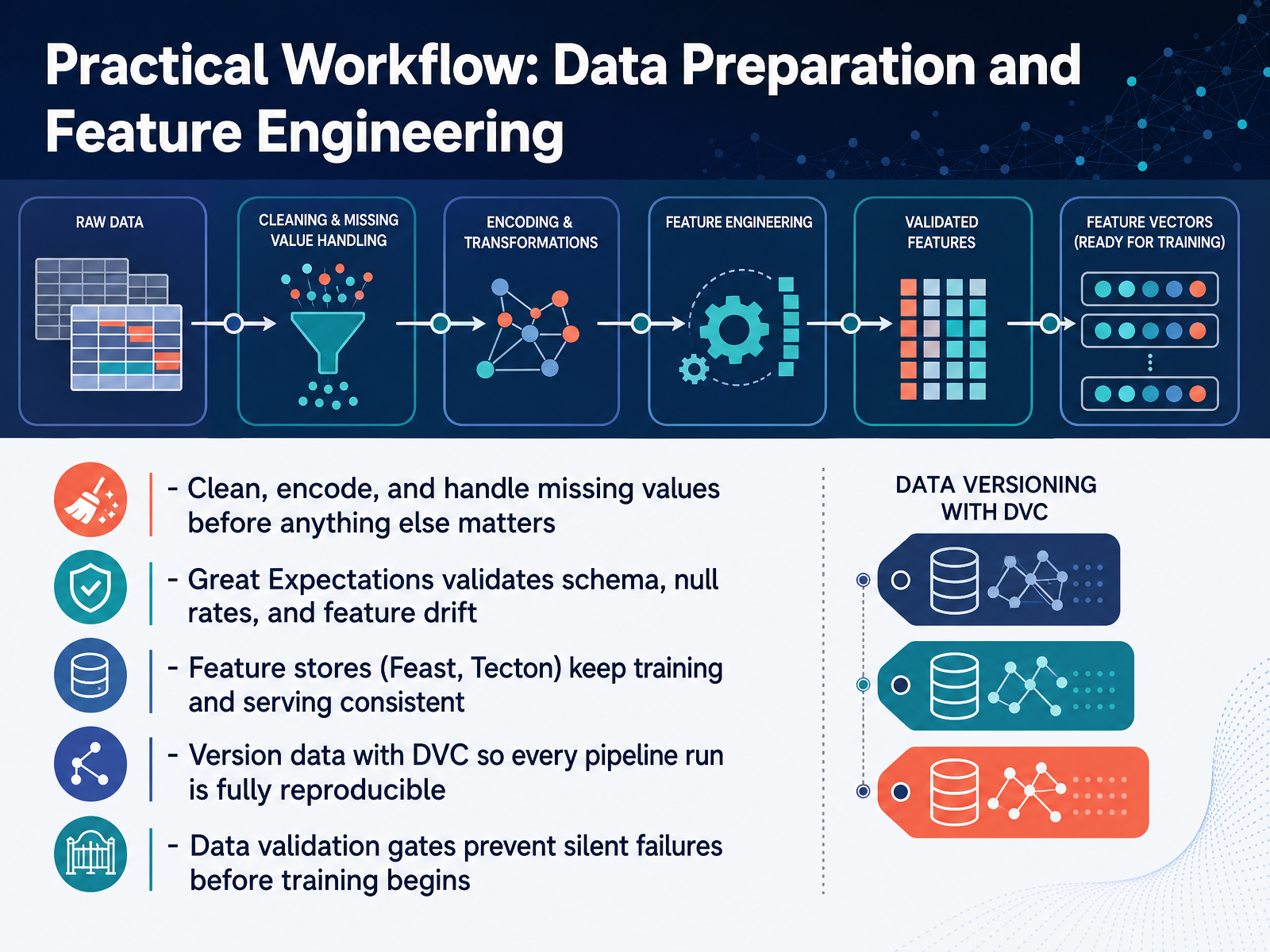
 - 07Practical Workflow: Data Preparation and Feature EngineeringLet's talk about the practical workflow before modeling, because in real projects, data preparation is where most of the value is created, and most silent failures begin. First, clean your data, encode categorical values, and handle missing values before anything else matters. Great Expectations is a tool that validates your data by checking schema, null rates, and feature drift, so problems surface early. Feature stores like Feast or Tecton keep training and serving consistent, which prevents a common issue called training-serving skew. Version your data with DVC, short for Data Version Control, so every pipeline run is fully reproducible. And finally, use data validation gates to stop silent failures before training begins. That way, your workflow stays reliable and debuggable.
 mlflow.orgrahulkolekar.commyundoai.com+21 min
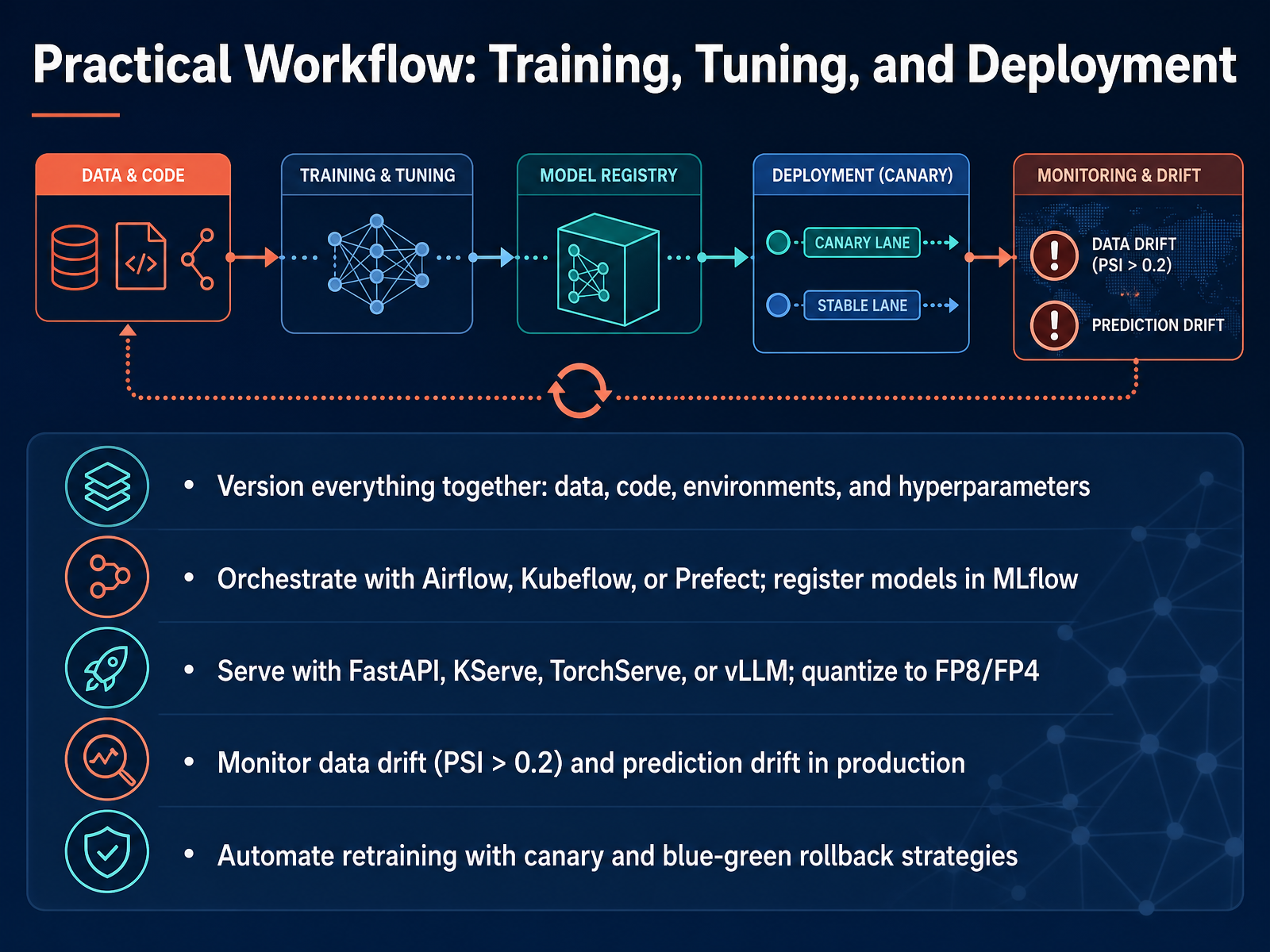
 - 08Practical Workflow: Training, Tuning, and DeploymentNow let's walk through the practical workflow that carries a model from training into production. First, version everything together: your data, your code, your environment, and your hyperparameters. This gives you true reproducibility, so you can recreate any past run exactly. Next, orchestrate the pipeline with a tool like Airflow, Kubeflow, or Prefect, and register each model in a registry such as MLflow so every version is traceable. For serving, options include FastAPI, KServe, TorchServe, or vLLM, and you can quantize to FP8 or FP4 to cut latency and cost. Once live, monitor for data drift, where a Population Stability Index above zero point two signals moderate drift, and watch prediction drift too. Finally, automate retraining, and protect yourself with canary and blue-green rollback strategies. The takeaway is simple: version, orchestrate, serve, monitor, and retrain as one continuous loop. Up next, we look at the ethical side of this work in Ethical AI, Fairness, and Explainability.
 mlflow.orgrahulkolekar.commyundoai.com+21 min
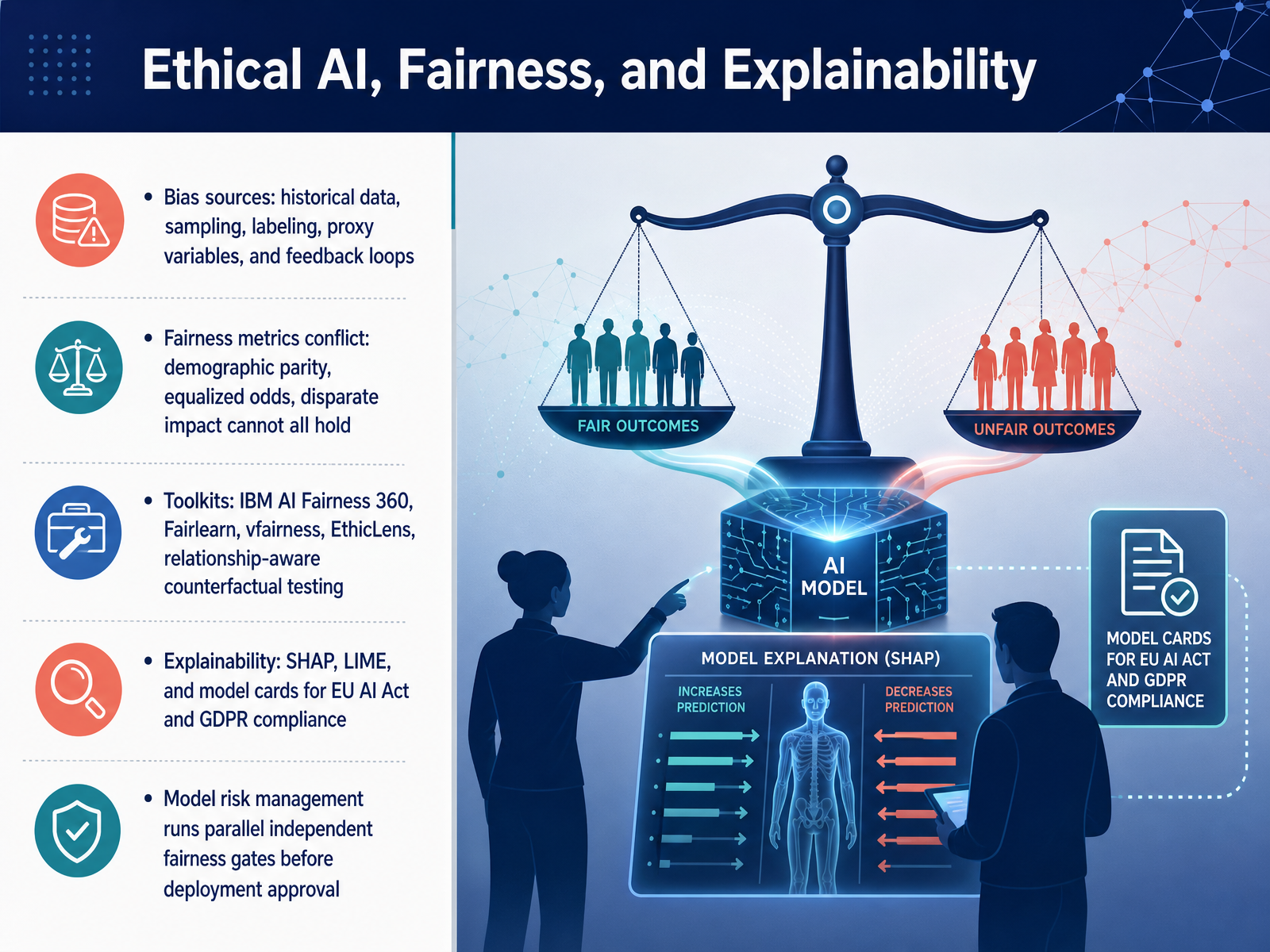
 - 09Ethical AI, Fairness, and ExplainabilityNow let's talk about the part of machine learning that keeps people up at night: ethics, fairness, and explainability. Bias can creep in from historical data, from how we sample, from labeling choices, from proxy variables that secretly stand in for protected traits, and from feedback loops that amplify past decisions. Here's the hard truth. Fairness metrics conflict. Demographic parity, equalized odds, and disparate impact cannot all hold at the same time. So you must pick the metric that fits your use case before you analyze, not after. We have solid toolkits for this. IBM's AI Fairness 360, Fairlearn, vfairness, EthicLens, and relationship-aware counterfactual testing help detect and mitigate bias across the lifecycle. For explainability, SHAP and LIME surface feature attributions, and model cards document intended use, limitations, and bias assessments for compliance with regulations like the EU AI Act and GDPR. In production, model risk management runs as a parallel, independent fairness gate before deployment. Performance approval and risk approval are separate sign-offs. Either can block the release. That separation is the control. Next, we'll make this concrete with case studies and hands-on examples.
 mlflow.orgrahulkolekar.commyundoai.com+22 min
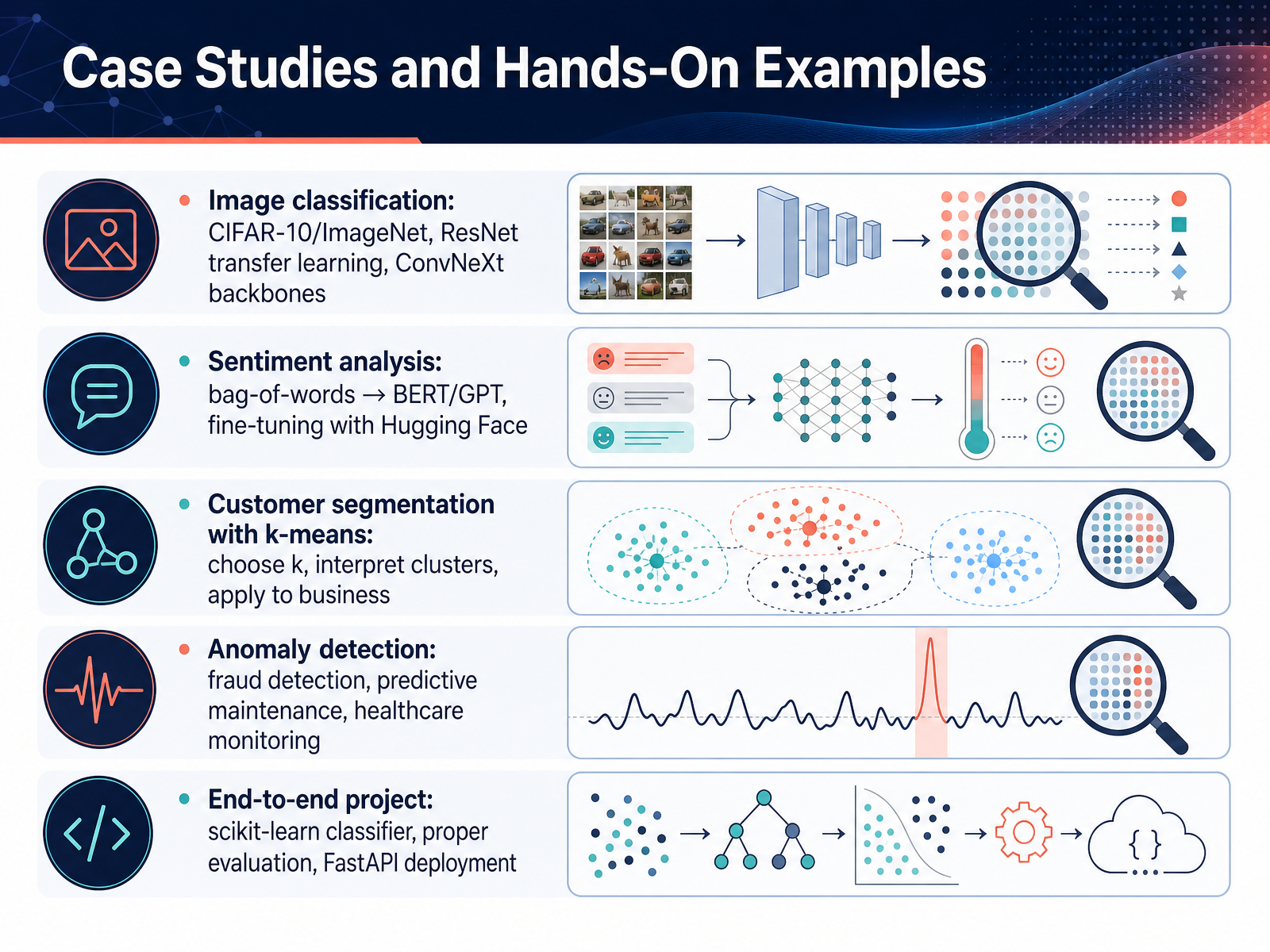
 - 10Case Studies and Hands-On ExamplesNow let's walk through some concrete case studies, so you can see these ideas in action. We'll start with image classification. Datasets like CIFAR-10 and ImageNet give us labeled images to train on. In practice, we rarely train from scratch. Instead, we use transfer learning with a ResNet backbone, meaning we take a model already trained on millions of images and fine-tune it on our own data. ConvNeXt backbones work the same way and often prove very efficient. Next, sentiment analysis. Here we move from a bag-of-words approach, which simply counts word occurrences, to transformer models like BERT or GPT that capture context. Tools like Hugging Face make fine-tuning these models quite approachable. Then customer segmentation with k-means. A key decision is choosing k, the number of clusters. We interpret each cluster in business terms, such as high-value or price-sensitive buyers, and use that to guide marketing. Anomaly detection is another powerful pattern, flagging rare events like fraud, equipment failures, or unusual patient vital signs. Finally, an end-to-end project brings it together: train a scikit-learn classifier, evaluate it properly with a held-out test set, and deploy it with FastAPI so others can actually use it. The takeaway is simple. Pattern recognition becomes valuable when it moves from model to real decision. Next, we'll look at current trends and advanced topics.
 ailoitte.comlabelyourdata.com6wresearch.com+22 min
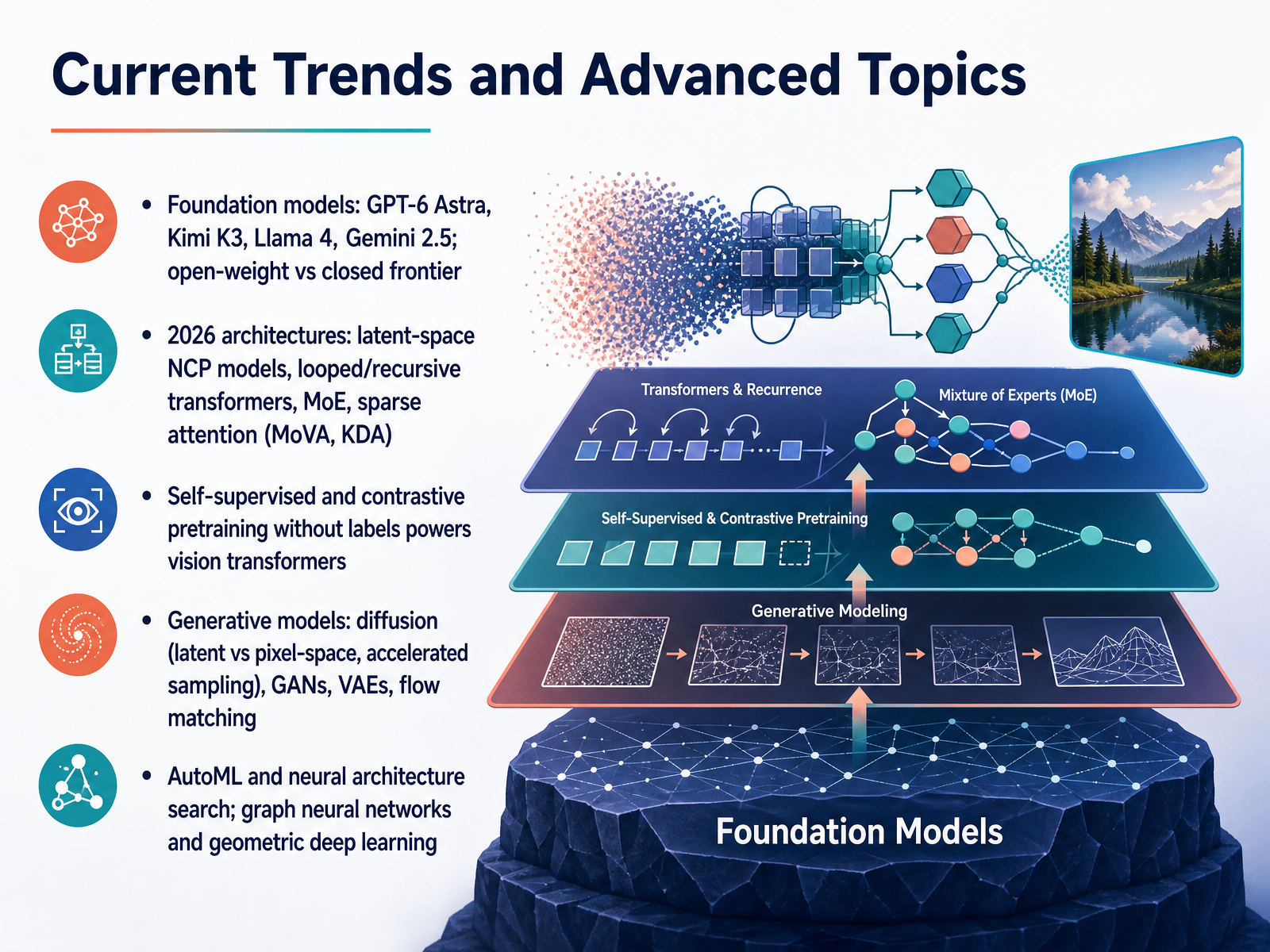
 - 11Current Trends and Advanced TopicsNow let's look at where the field is heading. Foundation models are large, pretrained systems you adapt to many tasks, and in 2026 the frontier keeps moving. We have models like GPT-6 Astra, Kimi K3, Llama 4, and Gemini 2.5. The key split is open-weight versus closed: closed models still lead on the hardest reasoning, while open-weight models like Kimi K3 and Llama 4 are within roughly one generation and are much cheaper to self-host. Architectures are changing too. Latent-space models like next concept prediction learn at the concept level rather than just predicting the next word. Looped or recursive transformers reuse the same layers to think longer, and mixture-of-experts plus sparse attention, such as MoVA and Kimi Delta Attention, cut compute dramatically. Then there is self-supervised pretraining, which learns from unlabeled data. That is what powers modern vision transformers and contrastive systems. Generative modeling spans diffusion, including latent versus pixel space and accelerated sampling, along with GANs, VAEs, and flow matching. Finally, AutoML and neural architecture search automate model design, while graph neural networks and geometric deep learning handle relational and structured data. The big takeaway: the core ideas of pattern recognition still anchor every one of these advances. Next, we move into MLOps and Production Systems in 2026.
 arxiv.orgarxiv.orgarxiv.org+22 min
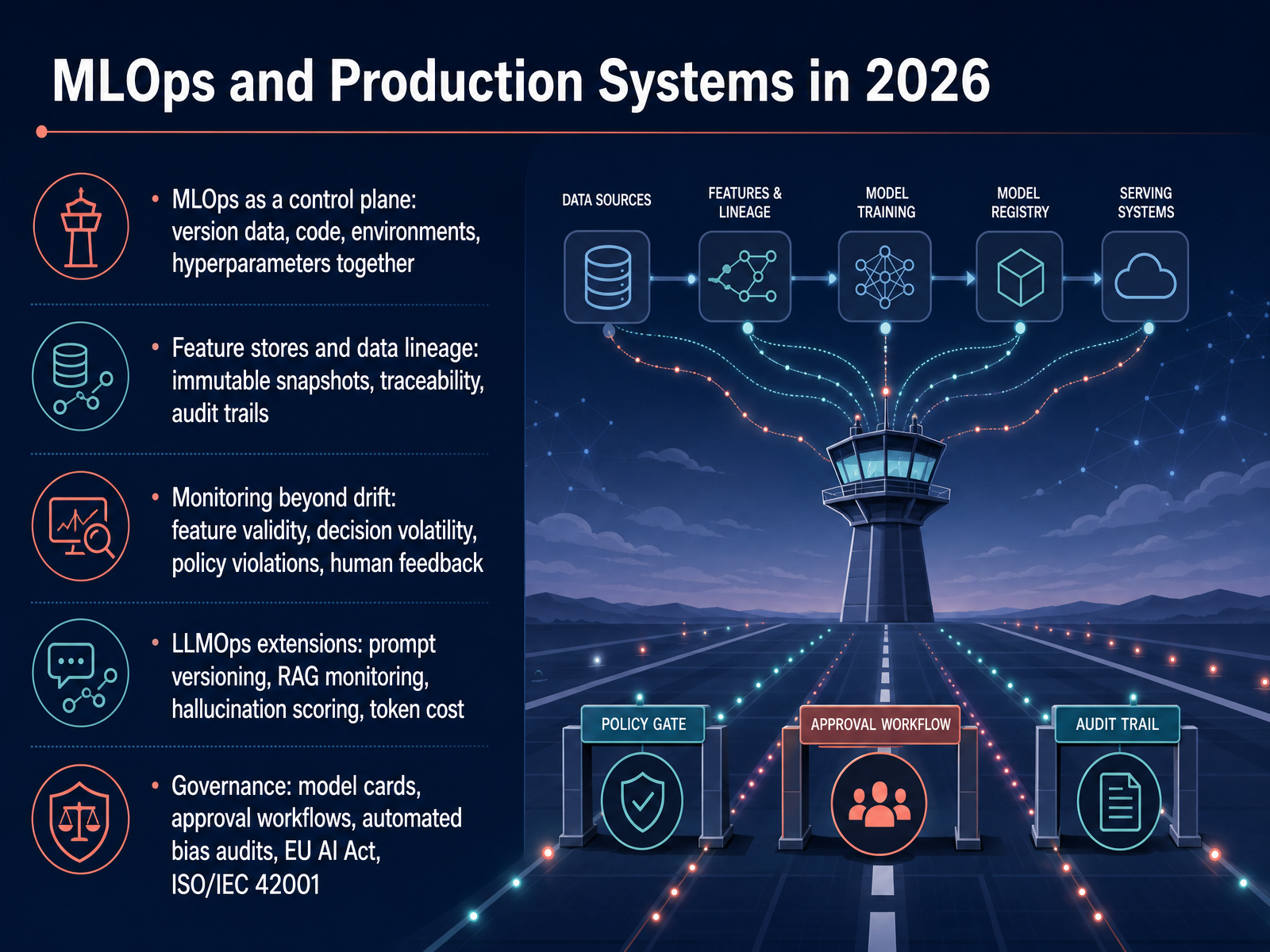
 - 12MLOps and Production Systems in 2026Let's bring machine learning into production now. The key shift in 2026 is treating MLOps as a control plane, not just a pipeline. That means versioning data, code, environments, and hyperparameters together, so any training run can be recreated exactly. Feature stores and data lineage help too. An immutable snapshot freezes a dataset in time, and lineage lets you trace any prediction back to its source. Monitoring also goes beyond drift. We check feature validity, decision volatility, policy violations, and human feedback. For large language models, LLMOps adds prompt versioning, retrieval-augmented generation monitoring, hallucination scoring, and token cost tracking. And governance ties it together with model cards, approval workflows, automated bias audits, plus frameworks like the EU AI Act and ISO/IEC 42001. Did you catch that? The takeaway is simple: mature MLOps makes every model explainable, auditable, and reversible. Next, we'll look at learning resources, tools, and career paths.
 mlflow.orgrahulkolekar.commyundoai.com+22 min
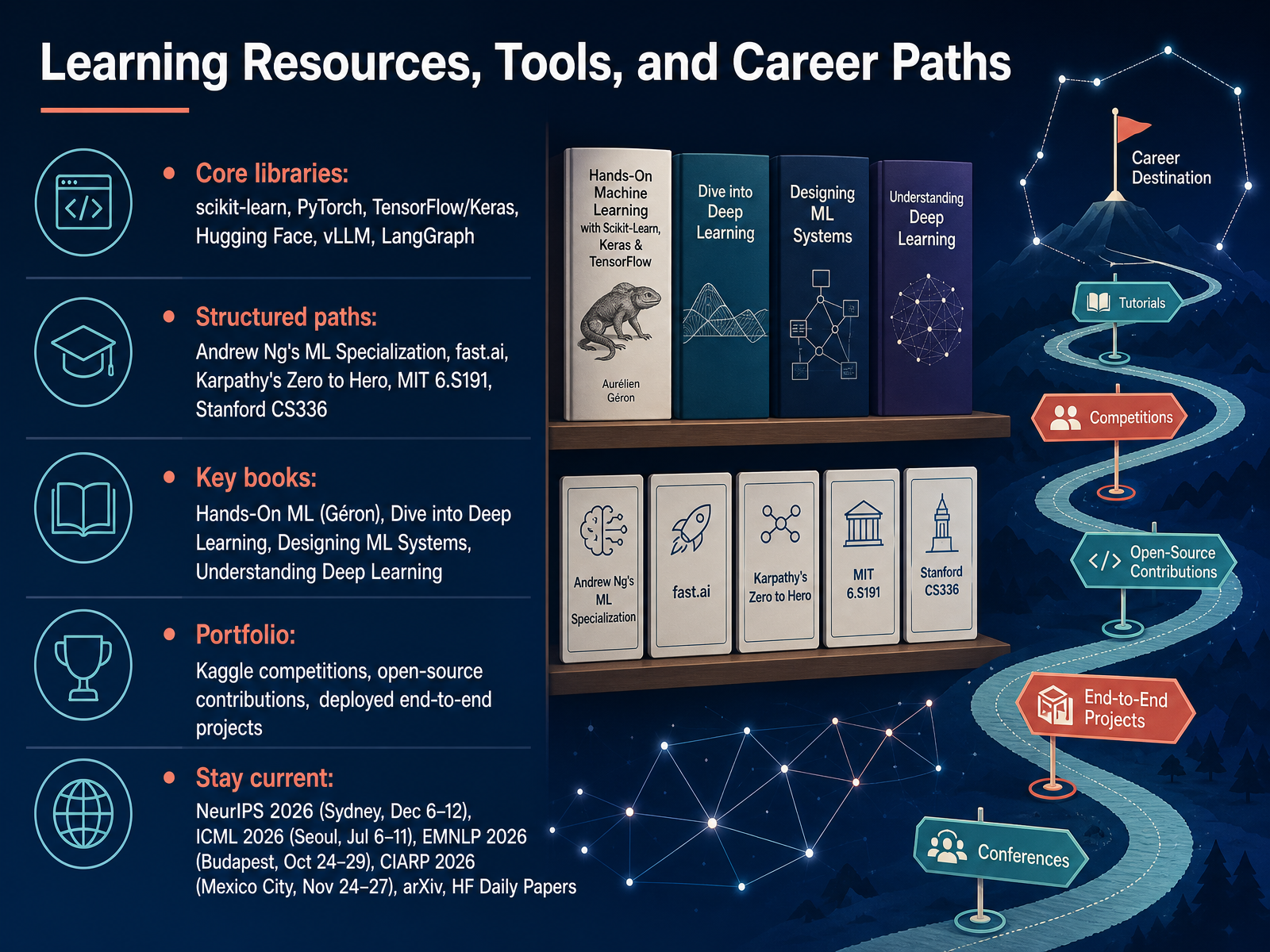
 - 13Learning Resources, Tools, and Career PathsBefore we wrap up, let's talk about where to go next. For libraries, start with scikit-learn for classical models, then PyTorch for deep learning. TensorFlow and Keras are still strong for deployment, Hugging Face gives you pretrained models, vLLM handles fast inference, and LangGraph helps you build agent workflows. For structured learning, Andrew Ng's Machine Learning Specialization is the gold standard beginner path, fast.ai gets you building quickly, Karpathy's Zero to Hero explains model internals better than anything, and MIT 6.S191 plus Stanford CS336 take you deeper. Four books are worth your shelf space: Hands-On Machine Learning by Géron, Dive into Deep Learning, Designing ML Systems, and Understanding Deep Learning. For your portfolio, Kaggle competitions, open-source contributions, and one deployed end-to-end project beat certificates every time. And stay current through NeurIPS 2026 in Sydney, ICML 2026 in Seoul, EMNLP 2026 in Budapest, CIARP 2026 in Mexico City, plus arXiv and Hugging Face Daily Papers. Pick one course, one book, and one project this month. Next, let's look at Next Steps: Building Your Capstone and Continuing to Grow.
 assemblyai.comanalyticsvidhya.comgithub.com+22 min
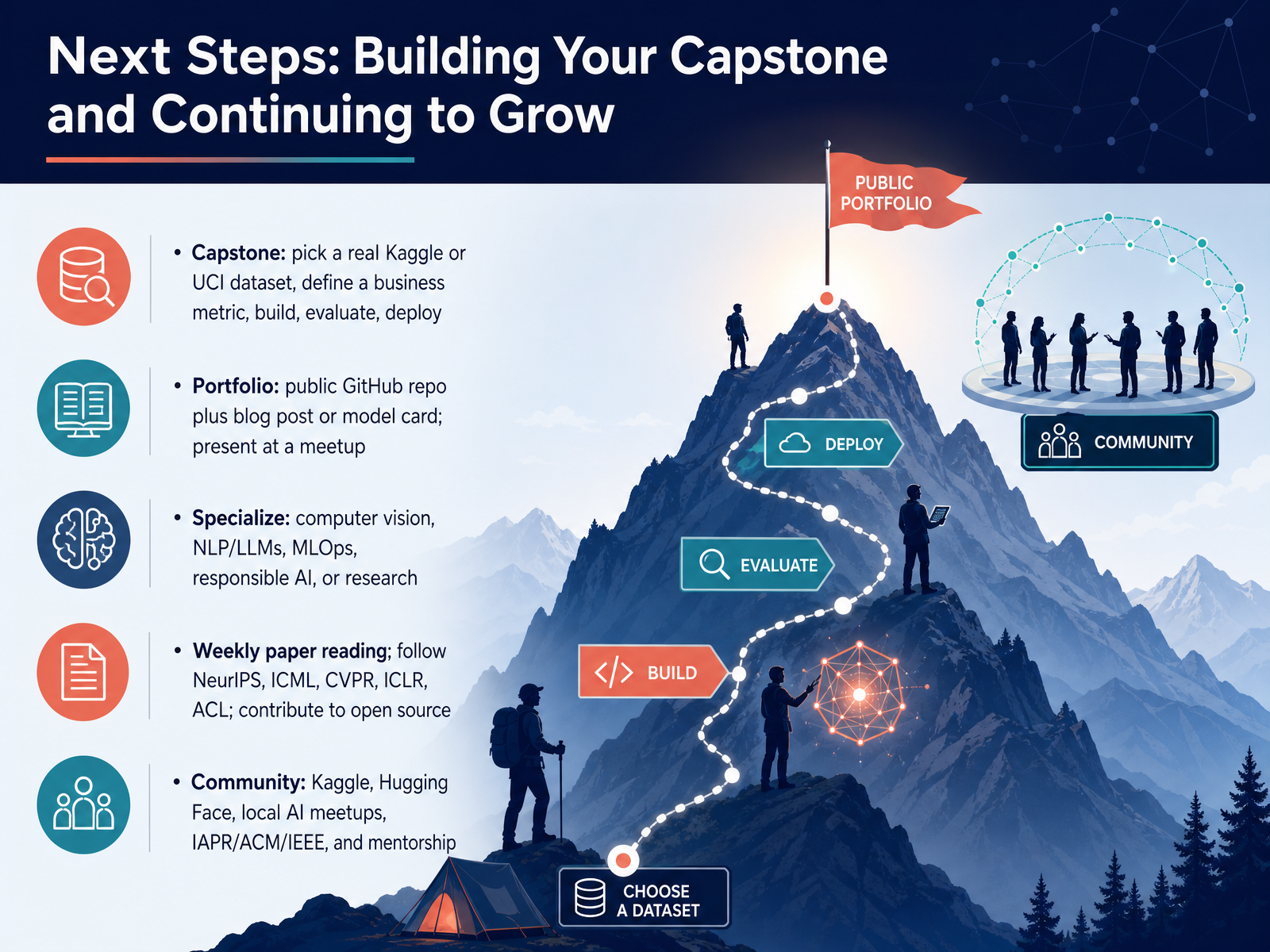
 - 14Next Steps: Building Your Capstone and Continuing to GrowSo, let's close the loop. What does your next step actually look like? Start with a capstone. Pick one real dataset from Kaggle or the UCI repository, define a business metric that matters, then build, evaluate, and deploy it. Next, make your work visible. A public GitHub repository, plus a blog post or a model card, and present it at a local meetup. Then specialize. You could go deep into computer vision, natural language processing and large language models, machine learning operations, responsible AI, or research. Keep growing by reading one paper a week, and follow conferences like NeurIPS, ICML, CVPR, ICLR, and ACL. Find your community on Kaggle, Hugging Face, and local AI meetups, or through IAPR, ACM, and IEEE. And remember, consistency beats intensity. You have the foundation now. Pick one step this week and start building. Thank you for learning with me, and I will see you out there.
 assemblyai.comanalyticsvidhya.comgithub.com+22 min
Take the deck with you
Download this course as a file — free, no sign-up needed.
- PDF handoutEvery slide page, ready to print or share.15 pages · 4.2 MBDownload
- Narrated PowerPointThe deck that presents itself — every slide carries the digital human's narration video.15 pages · 16.6 MBDownload
- PowerPoint slidesThe full deck as a .pptx — open it in PowerPoint, Keynote, or Google Slides.15 pages · 4.2 MBDownload
Free to use in your own training — please keep the PersonWise credit page at the end.
Have your own deck? Turn it into a course
Sources consulted
Web sources consulted while building this course.
- MLOps Pipeline Automation Best Practices in 2026 — mlflow.org
- MLOps in 2026 — The Definitive Guide: tools, cloud platforms, architectures, and a practical playbook — rahulkolekar.com
- MLOps Best Practices for Production AI in 2026 - MYUNDOAI — myundoai.com
- MLOps [2026]: Complete Guide to Machine Learning Operations — precisionaiacademy.com
- MLOps Best Practices Checklist and Maturity Framework – Complete Guide 2026 – PyInns — pyinns.com
- How to Learn Machine Learning in 2026: Updated Roadmap — assemblyai.com
- 50+ Machine Learning Resources for Self Study in 2026 — analyticsvidhya.com
- h9-tec/Awesome_ai_learning — github.com
- Machine Learning Roadmap: What to Learn First (2026) — dataquest.io
- AI Learning Roadmap · Venkata Pagadala — venkatapagadala.com
- Role of Pattern Recognition in AI Agents across Industries — ailoitte.com
- Pattern Recognition: Latest Techniques and Applications in 2026 | Label Your Data — labelyourdata.com
- Global Pattern Recognition Market Challenges 2026 — 6wresearch.com
- Pattern Recognition Market Outlook | Soocian — soocian.com
- What Is the Best AI for Pattern Recognition in 2026? - Style3D AI — style3d.ai
- [2609.10715] NCP-ArchPreview Technical Report: Moving towards Latent Space Language Models through Next Concept Prediction — arxiv.org
- [2609.11801] Thinking with Looped Flows — arxiv.org
- [2609.01343] SMELT: Scaling Laws for Compute-Matched MoE Looped Transformers — arxiv.org
- Graph Machine: Towards Better Pretraining via Edges — arxiv.org
- [2609.10441] ConvMem: Convolutional Memory for Long-Context Reasoning — arxiv.org