Begin
15 pages · ~30 min
Cosmic Dimensions and Scale
Explore the vast scale of the universe, from subatomic particles to cosmic structures, in this engaging presentation for curious learners.
A digital instructor presents all 15 pages. Hold “Ask” at any point and ask out loud — the answer comes from this course. No sign-up needed.
What you’ll learn
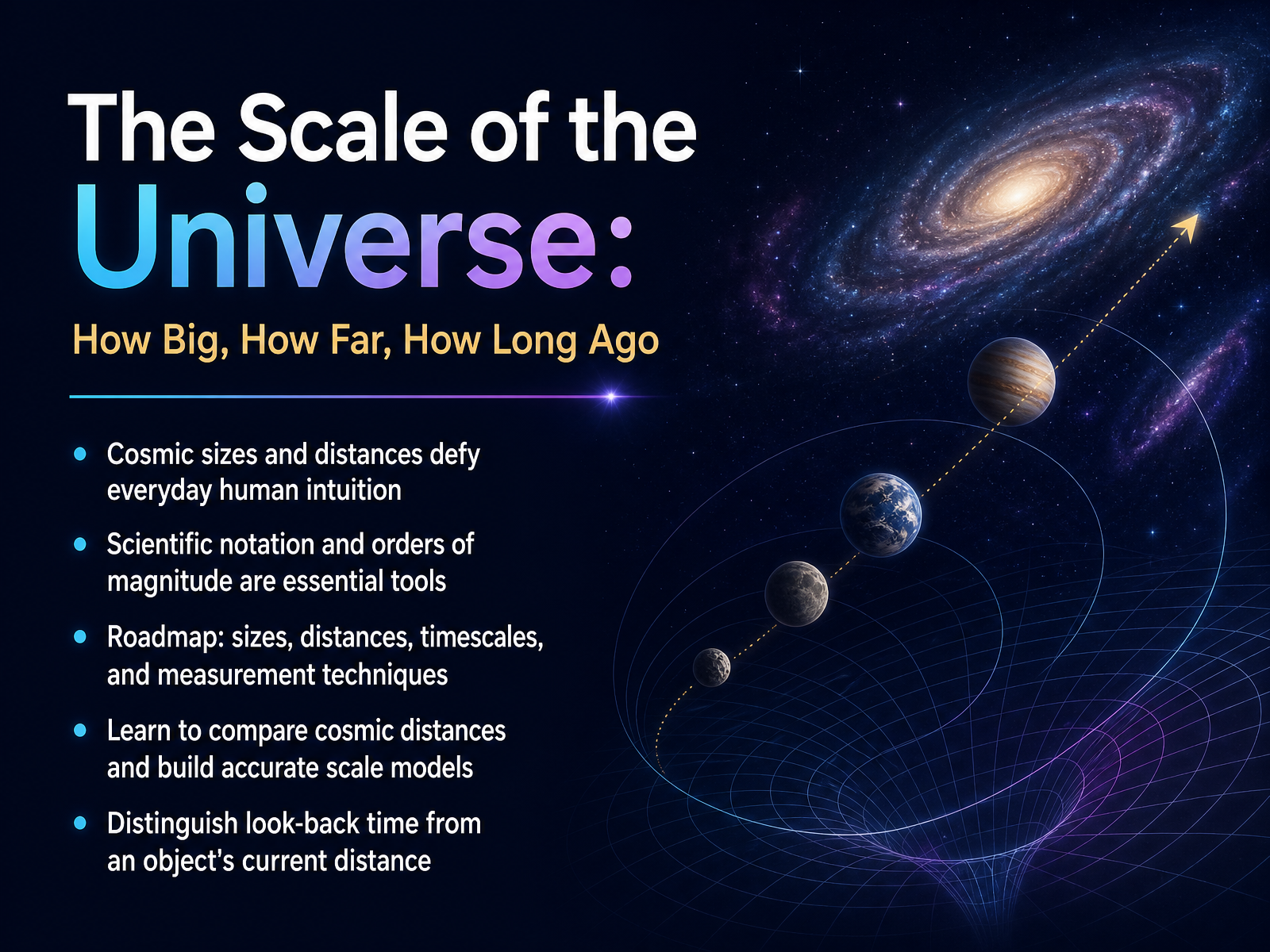
- 01The Scale of the Universe: How Big, How Far, How Long AgoWelcome to The Scale of the Universe: How Big, How Far, How Long Ago. I am glad you are here. Over the next few lessons, we are going to take a journey through the true size, distance, and age of the cosmos. Now, I should warn you. Our everyday intuition is built for human sized things. Rooms. Cities. Maybe a long road trip. But cosmic scales shatter that intuition completely. So we need better tools. We will use scientific notation and orders of magnitude to keep enormous numbers manageable. Along the way, we will compare sizes, build scale models, and explore how astronomers measure distances across space and time. We will also untangle a tricky but beautiful idea. Looking far into space means looking back in time. The light we see is ancient. And because the universe has been expanding for about 13.8 billion years, a galaxy whose light traveled for 13 billion years is now much farther away than 13 billion light years. By the end, you will be able to compare these distances clearly and tell the difference between look-back time and an object's current distance. Next, we will start with the language scientists use to handle such gigantic numbers: orders of magnitude.pdg.lbl.goven.wikipedia.orgpdg.lbl.gov+22 min
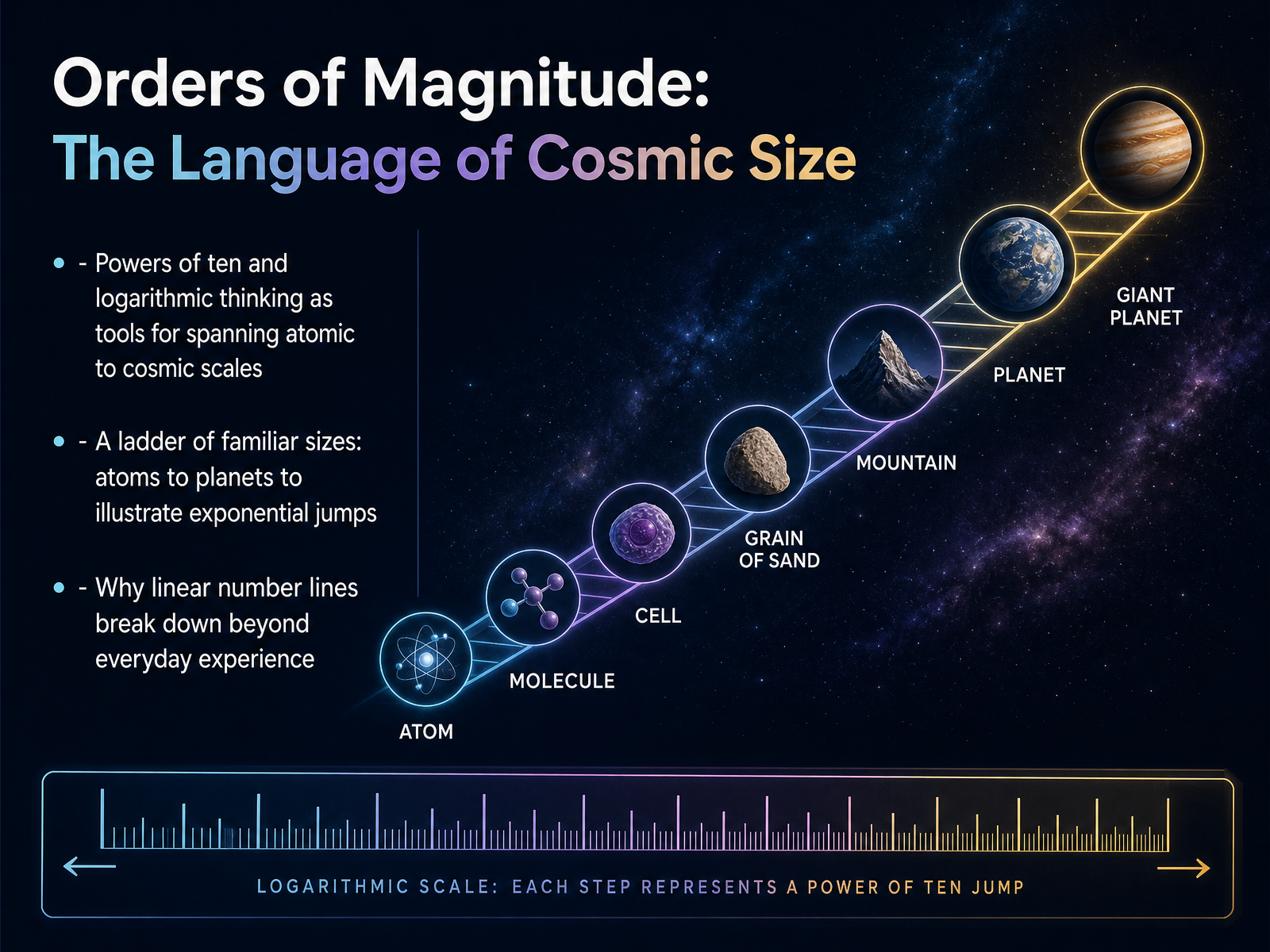
- 02Orders of Magnitude: The Language of Cosmic SizeNow, to grasp the sheer scale of the cosmos, we need a new kind of measuring tool. Think of it as a cosmic ladder. The first rung might be something familiar, like a person. Climb to the next rung, and we have a city. Another rung takes us to planet Earth. But here's the problem: jumping from a person to a planet isn't a simple step. These jumps are colossal and uneven. Our everyday number line, where one, two, three just keep adding up, simply breaks down when we try to fit a planet on it. So instead, we use powers of ten. Each rung on our ladder multiplies the size by ten. It is a way of thinking in leaps, not steps. This language of exponential jumps is what lets us climb from the realm of atoms all the way to the edge of the observable universe. With this new tool in hand, let's take our first big leap and look inside a place that really shows these principles in action: our own solar system.
 ssd.jpl.nasa.govscience.nasa.govscience.nasa.gov+21 min
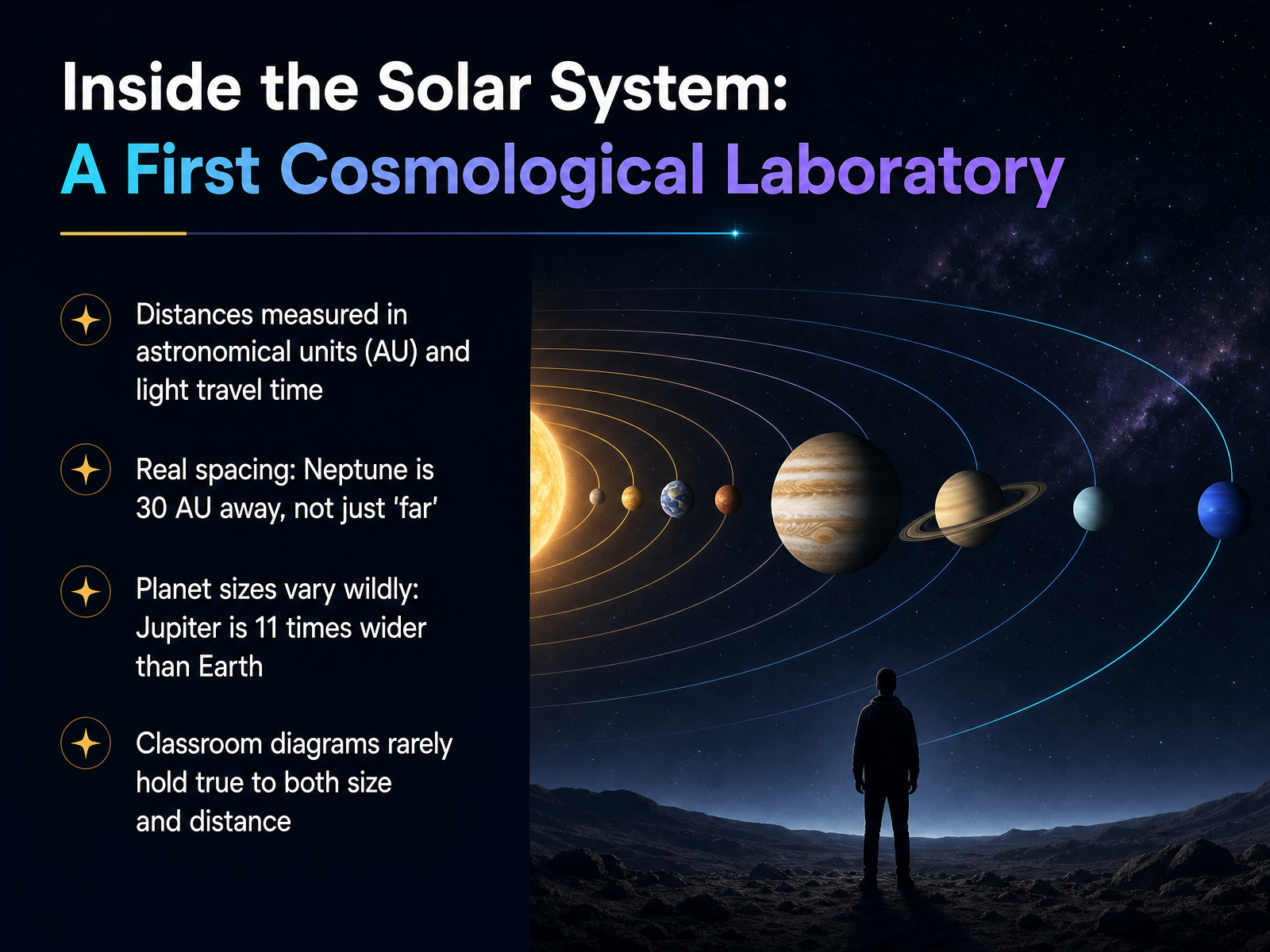
 - 03Inside the Solar System: A First Cosmological LaboratoryNow, step inside our solar system, and think of it as a first cosmological laboratory. Here, astronomers use the astronomical unit, or AU, to measure distance. One AU is the span from the Sun to Earth. But don't let that single unit fool you into thinking the planets are close. Neptune isn't just far away. It orbits at thirty AU, meaning it's thirty times farther from the Sun than we are. And the planets themselves vary wildly in size. Jupiter is a giant, about eleven times wider than Earth. You could line up eleven Earths across its equator. This is why the classroom diagrams you've seen rarely show both size and distance accurately. If they did, most planets would be tiny dots scattered across a page. The vastness between worlds is simply too great to capture in a single picture. This challenge of distance brings us to a profound idea: because space is so vast, light itself takes time to cross it.
 ssd.jpl.nasa.govscience.nasa.govscience.nasa.gov+21 min
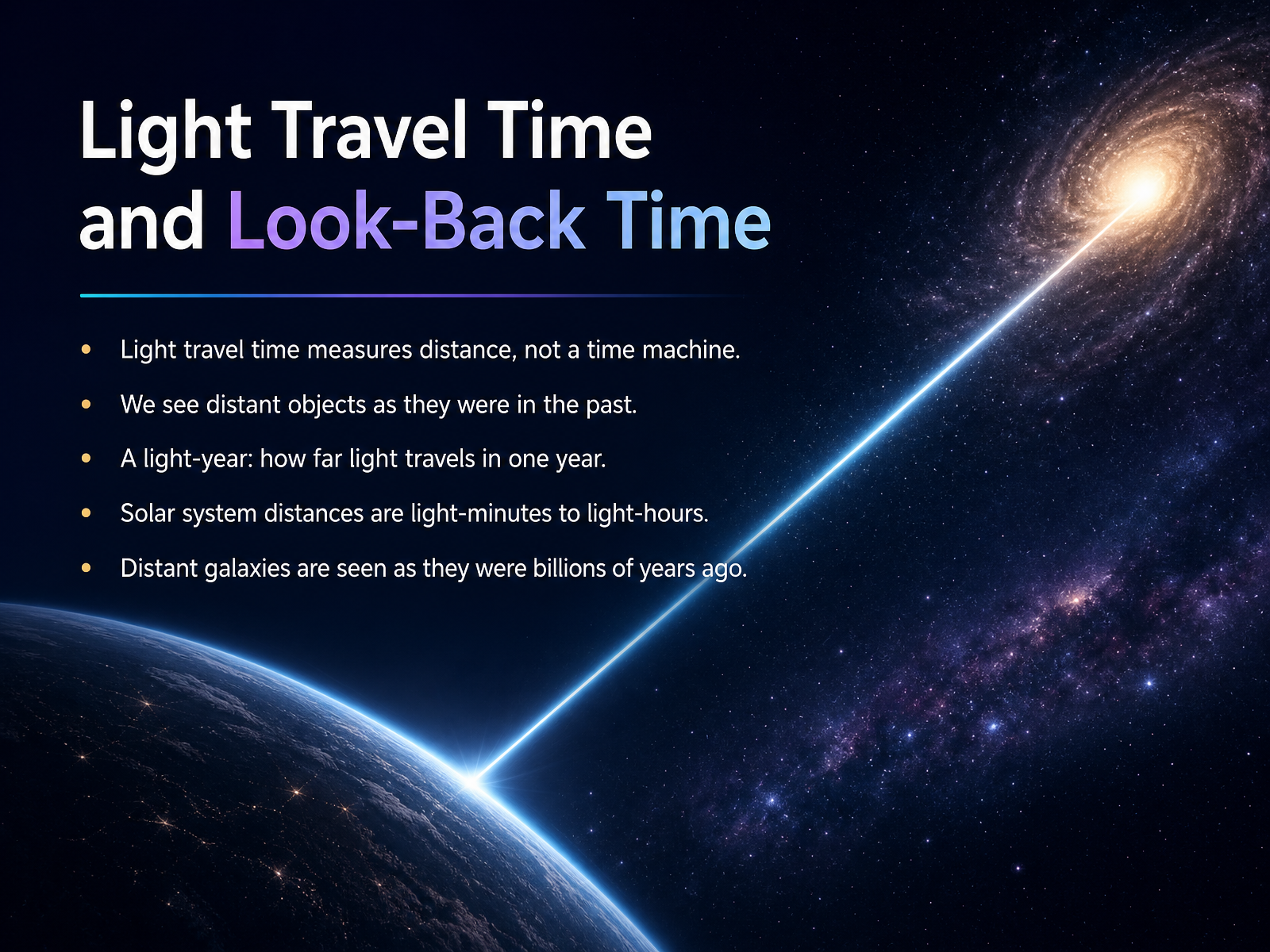
 - 04Light Travel Time and Look-Back TimeNow let's talk about something that sounds like science fiction, but is actually how we read the universe. When we look at a distant star, we are not seeing it as it is right now. We are seeing it as it was when the light left it. Light is fast, incredibly fast, but the universe is so huge that even light takes time to travel. A light-year is how far light travels in one year, about six trillion miles. Within our solar system, distances are measured in light-minutes or light-hours. Sunlight takes about eight minutes to reach your eyes, so you are always seeing the sun eight minutes in the past. Now step back, way back. The light from distant galaxies has been traveling for billions of years. When we capture that light, we are looking back in time, seeing those galaxies as they were long before Earth existed. It is not a time machine, but it is a kind of deep history, written in light. And that history has a structure. Next, we zoom in from this immense scale to our own island of stars in the Milky Way.
 pdg.lbl.goven.wikipedia.orgpdg.lbl.gov+22 min
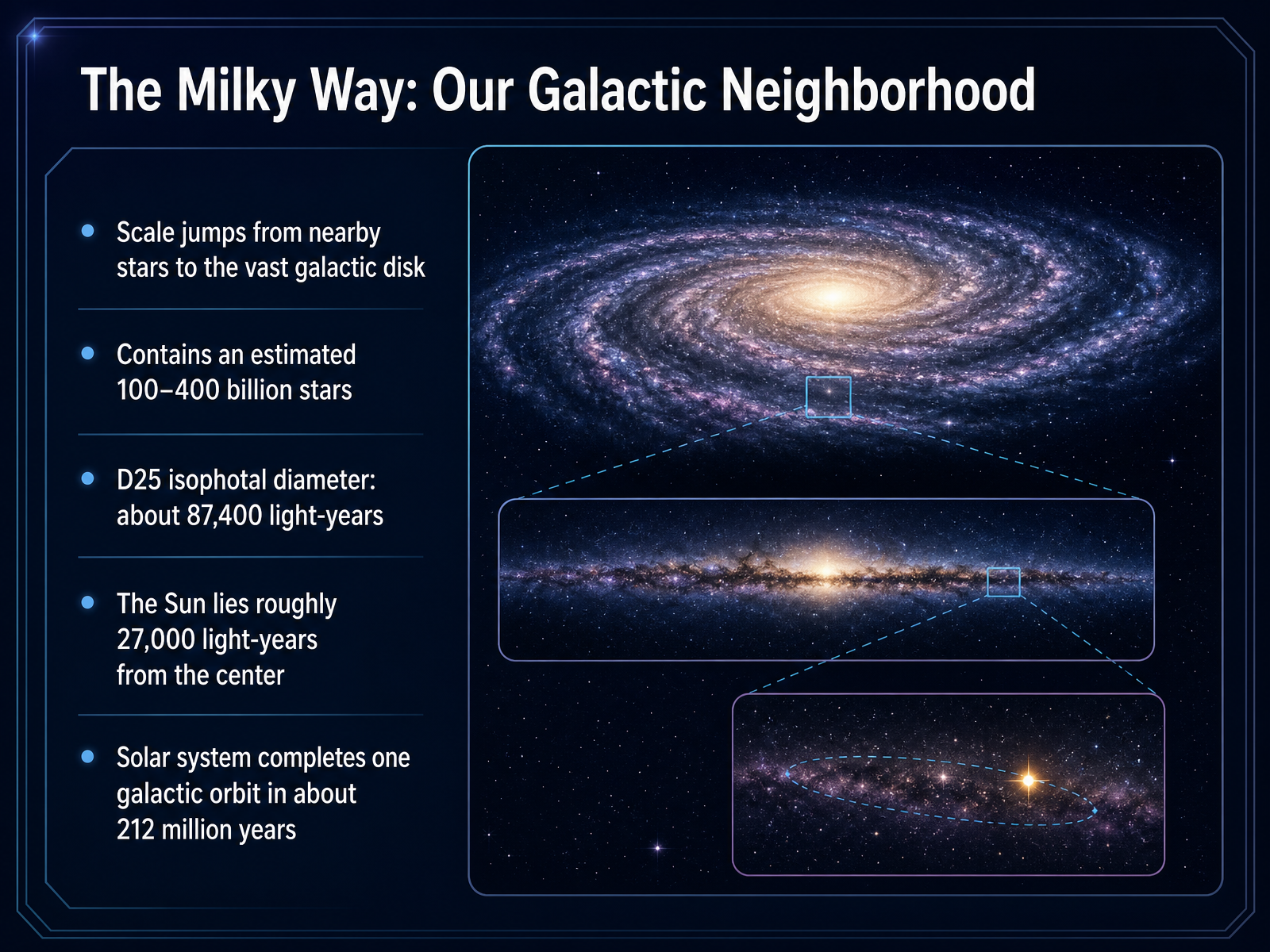
 - 05The Milky Way: Our Galactic NeighborhoodAnd now we arrive at our own cosmic address, the Milky Way galaxy. When you look up at that faint band of light stretching across a dark sky, you are seeing our galactic neighborhood from the inside. This is a vast, rotating disk containing anywhere from one hundred to four hundred billion stars, each one a sun, with many likely hosting planets of their own. Think about that number for a moment. Light itself takes about eighty-seven thousand four hundred years to cross from one edge of the galaxy to the other. And our Sun is not at the center. We are out in the galactic suburbs, roughly twenty-seven thousand light-years from the heart of the Milky Way. Our entire solar system is riding a slow, majestic carousel, completing just one full orbit around the galactic center about every two hundred twelve million years. The dinosaurs were beginning to roam the Earth the last time we were on this side of the galaxy. Keep that sense of scale with you as we zoom out even further to meet our nearest large neighbor in the Local Group, the Andromeda galaxy.
 nature.comimagine.gsfc.nasa.goven.wikipedia.org+22 min
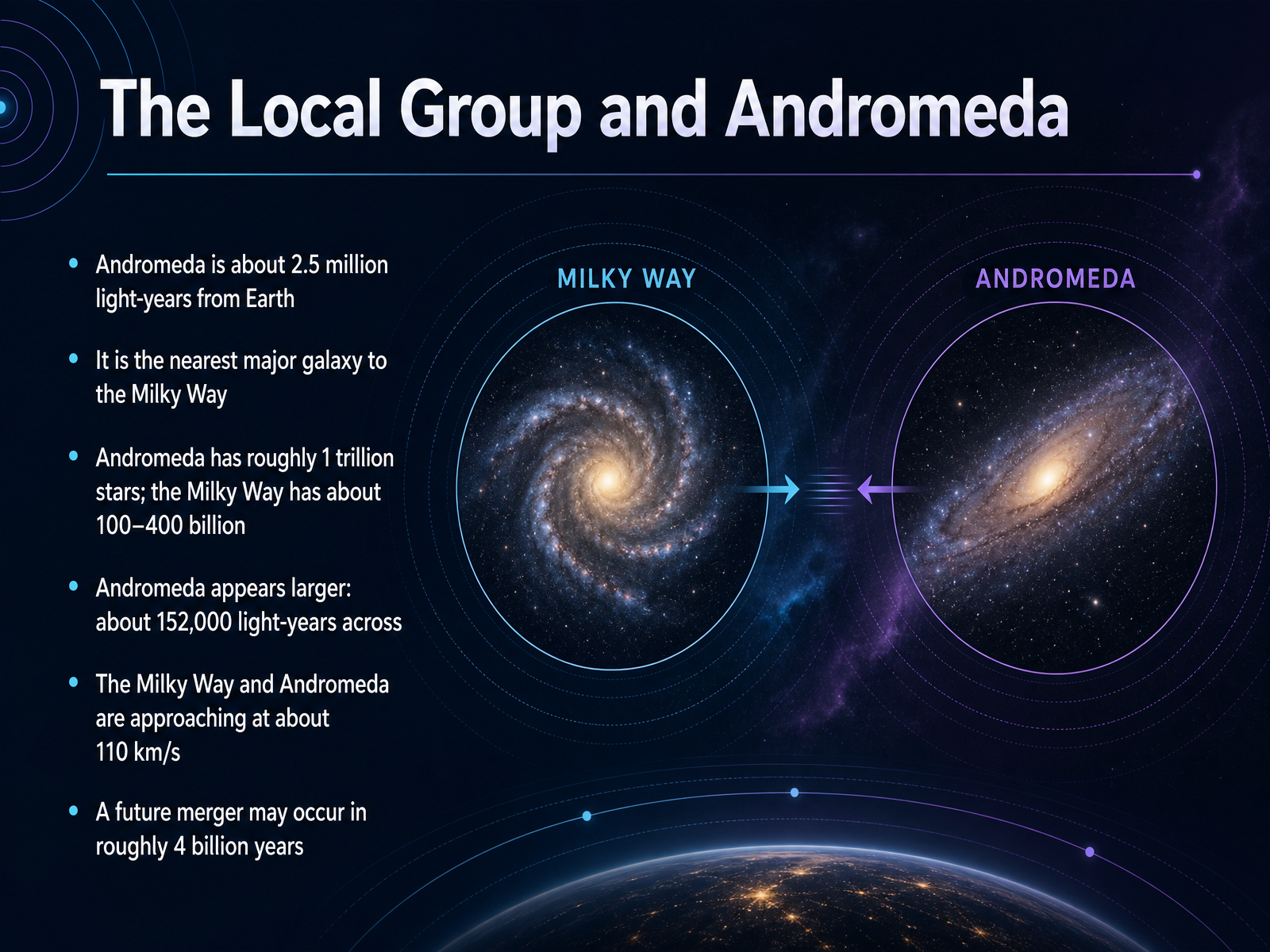
 - 06The Local Group and AndromedaNow, let's step into our local neighborhood and meet our nearest major galactic neighbor: Andromeda. Take a moment with this number. Andromeda is about two and a half million light-years away. That means the light entering your eyes when you see it tonight started its journey before humans walked the Earth. It's a truly enormous city of stars, holding roughly a trillion suns. To feel that scale, our Milky Way might contain between one hundred and four hundred billion. Andromeda is also wider, stretching about one hundred fifty-two thousand light-years across. But here's the twist in our story. Andromeda isn't just sitting there; it's approaching us at about one hundred ten kilometers every second. The distance is closing. In roughly four billion years, our two galaxies may merge, brushing past each other in a slow cosmic dance to build something entirely new. Now that we've met our neighbor, let's zoom out even farther to explore galaxies, clusters, and the cosmic web.
 nature.comimagine.gsfc.nasa.goven.wikipedia.org+21 min
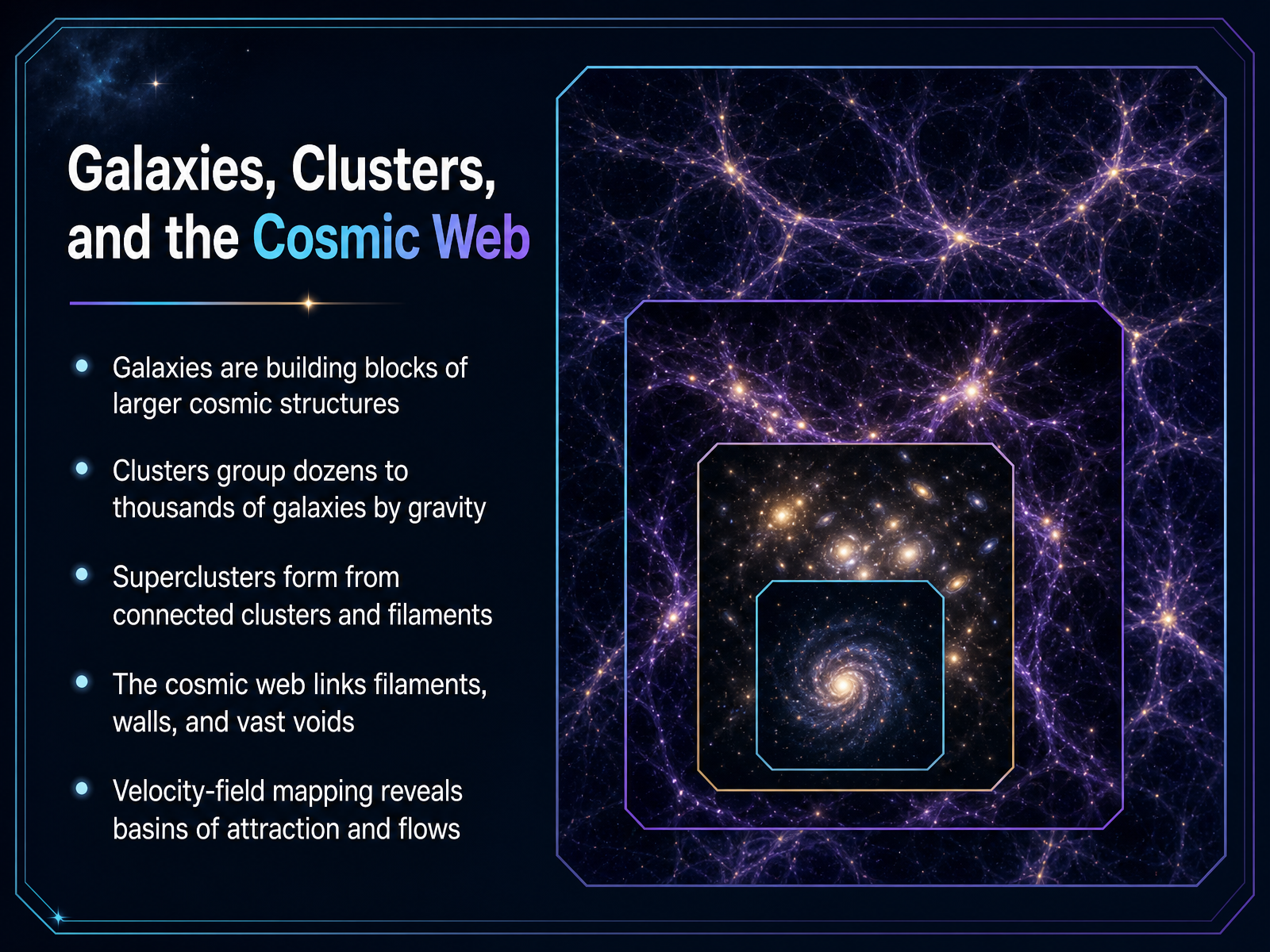
 - 07Galaxies, Clusters, and the Cosmic WebNow let's zoom out even further. Galaxies are not scattered randomly. They are the building blocks of something much grander. Picture a single galaxy as a glowing city of stars. Dozens to thousands of these cities gather together through gravity to form a cluster. Our own Milky Way belongs to a small cluster called the Local Group. But clusters do not stop there. They connect with other clusters and form vast superclusters, structures so large they stretch across hundreds of millions of light years. Together these superclusters weave a pattern known as the cosmic web. Imagine a spider's web stretched across the sky, with glowing filaments and walls of galaxies, and between them enormous, nearly empty regions we call voids. To map this web, astronomers study how galaxies flow. By tracing the velocity field of galaxies, they find basins of attraction, valleys in space where matter is being pulled inward. These flows reveal hidden boundaries between structures, boundaries that are invisible when we only look at where galaxies sit. Next we will meet our own supercluster, Laniakea, and see where we fit in this cosmic web.
 aanda.orgarxiv.orgaanda.org+22 min
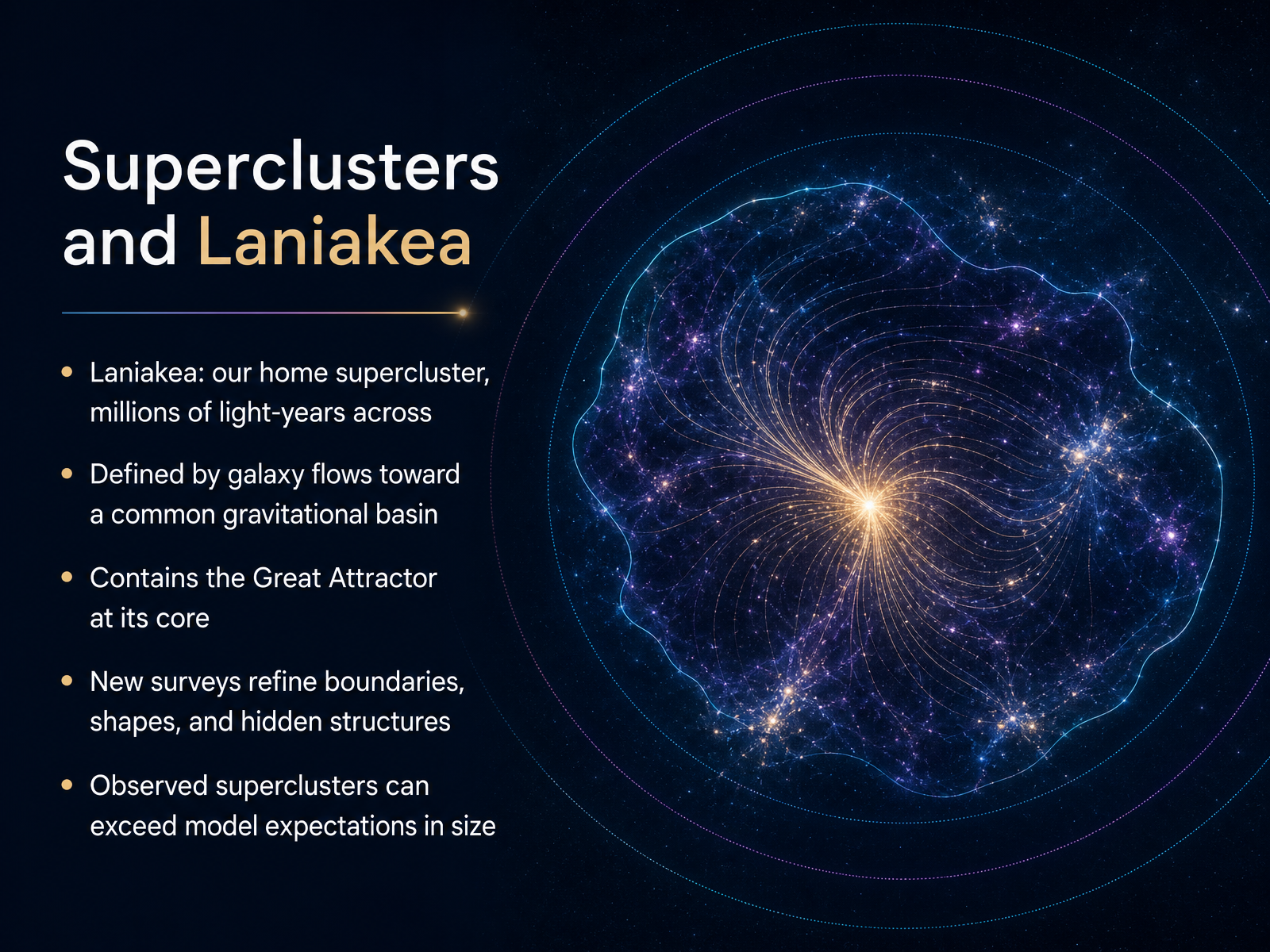
 - 08Superclusters and LaniakeaNow we zoom out to a scale where even galaxy clusters become tiny beads in a much larger web. This is Laniakea, our home supercluster. The name comes from Hawaiian, meaning immense heaven. And it truly is. Laniakea stretches across millions of light years. Imagine drawing a map not of stars, but of how galaxies drift. Galaxies inside Laniakea all flow, slowly, toward a shared gravitational basin. At its heart lies the Great Attractor, a dense region pulling everything toward it. New surveys keep refining our view of this enormous structure. They reveal sharper boundaries, unexpected shapes, and hidden structures that were invisible before. One surprising finding is that observed superclusters can be larger than our best models predict. The cosmic web, it seems, still holds secrets. Next, we step back even farther, to the observable universe and its horizon.
 aanda.orgarxiv.orgaanda.org+21 min
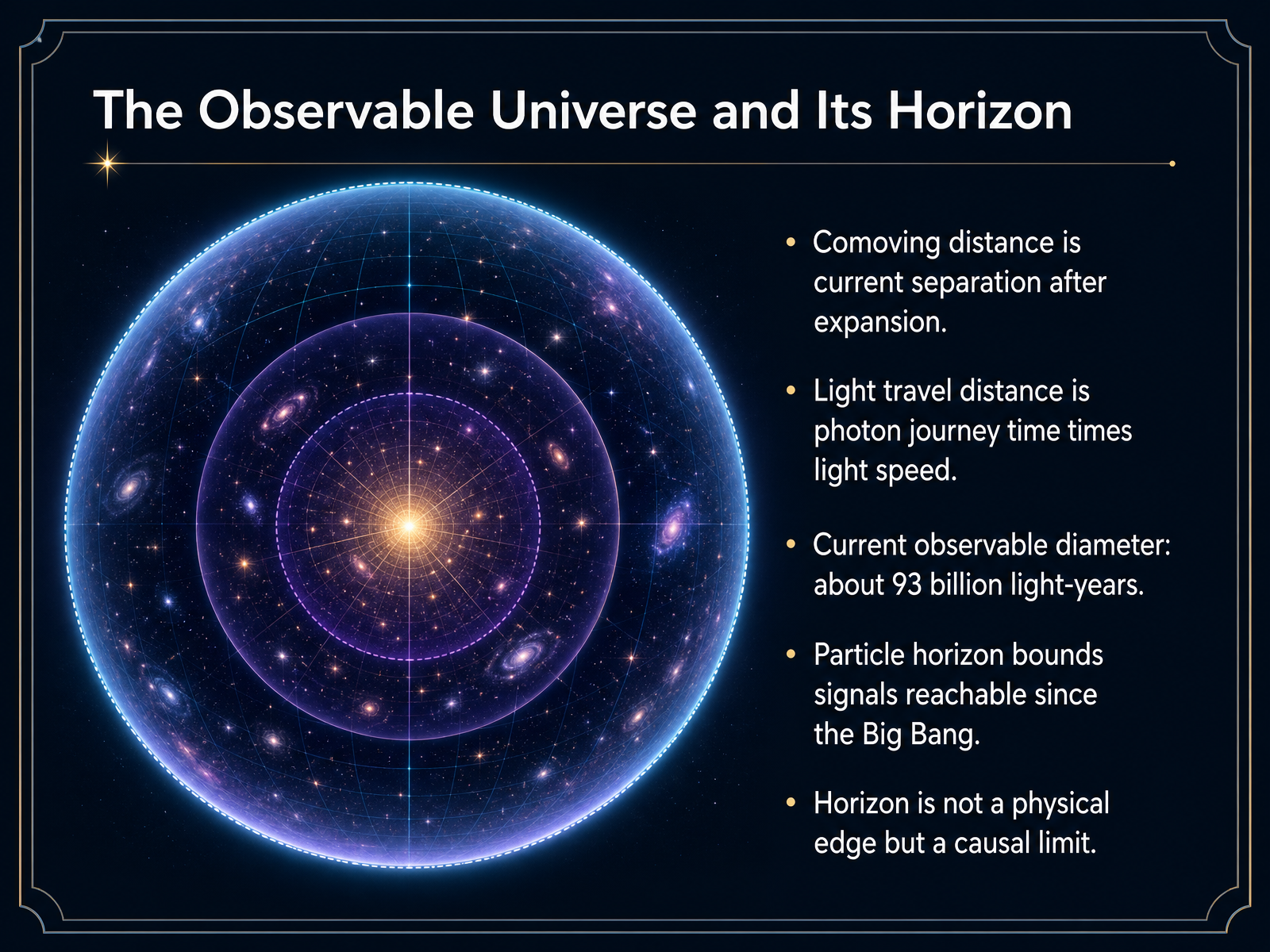
 - 09The Observable Universe and Its HorizonNow we arrive at one of the most mind-bending ideas in all of science, the observable universe and its horizon. To understand the vastness here, we need to be careful about what we mean by distance. Light travel distance tells us how long a photon has been journeying across space. Since the universe is about 13.8 billion years old, you might expect the edge to be 13.8 billion light years away. But space itself has been stretching this whole time. So the comoving distance, which is the separation between us and a distant object right now after accounting for that expansion, is much larger. In fact, the observable universe is about 93 billion light years across. That is the diameter, not the radius. Think of it this way. The light began its trip when the source was much closer, and while that light traveled, the space behind it and ahead of it expanded enormously. This bubble is bounded by what we call the particle horizon. It is not a physical wall. It is a causal limit, a boundary in time. Beyond it, signals simply have not had enough time since the Big Bang to reach us. Coming up next, we will trace that journey through cosmic time, from the Big Bang to today.
 pdg.lbl.goven.wikipedia.orgpdg.lbl.gov+22 min
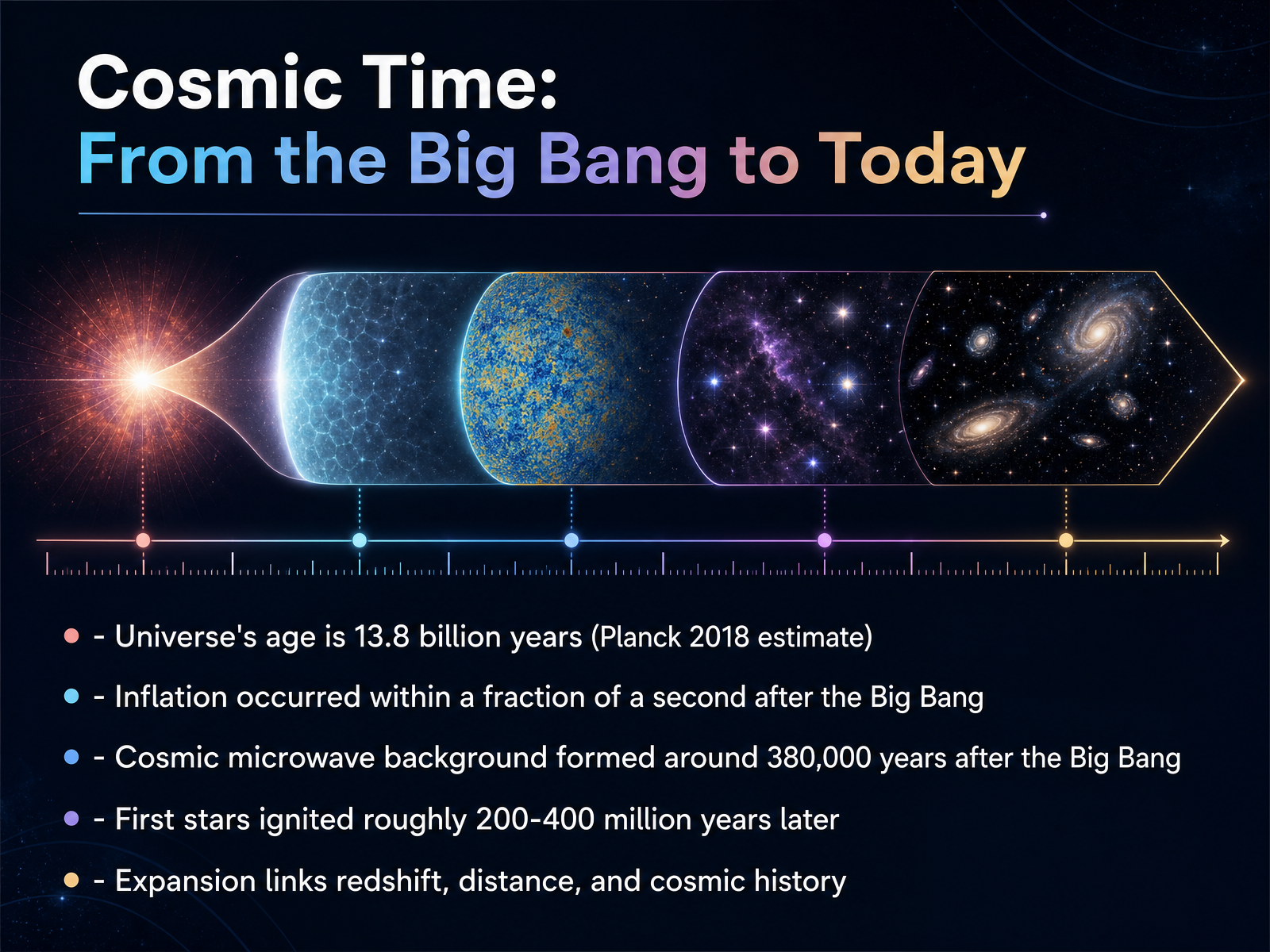
 - 10Cosmic Time: From the Big Bang to TodayNow, let's step back and think about time itself. The universe isn't just vast in space, it's vast in history. Our best estimate puts its age at 13.8 billion years. Let that sink in. That's a timeframe so immense it's almost impossible to truly feel. The very first moments were astonishingly fast. In a fraction of a second, a period called inflation stretched the infant universe at a speed beyond our everyday intuition. Then, around three hundred eighty thousand years later, the universe had cooled enough for light to travel freely. That ancient light is the cosmic microwave background, a faint glow we can still detect today. But the universe was dark then. It took another two hundred to four hundred million years for the first stars to ignite, sending their light across the cosmos. When we study distant galaxies, their light is stretched to redder wavelengths by expansion. This redshift is a powerful tool, linking how far away something is, how long its light has traveled, and how cosmic history unfolds. Next, let's look at how we actually measure these unthinkable scales.
 pdg.lbl.goven.wikipedia.orgpdg.lbl.gov+22 min
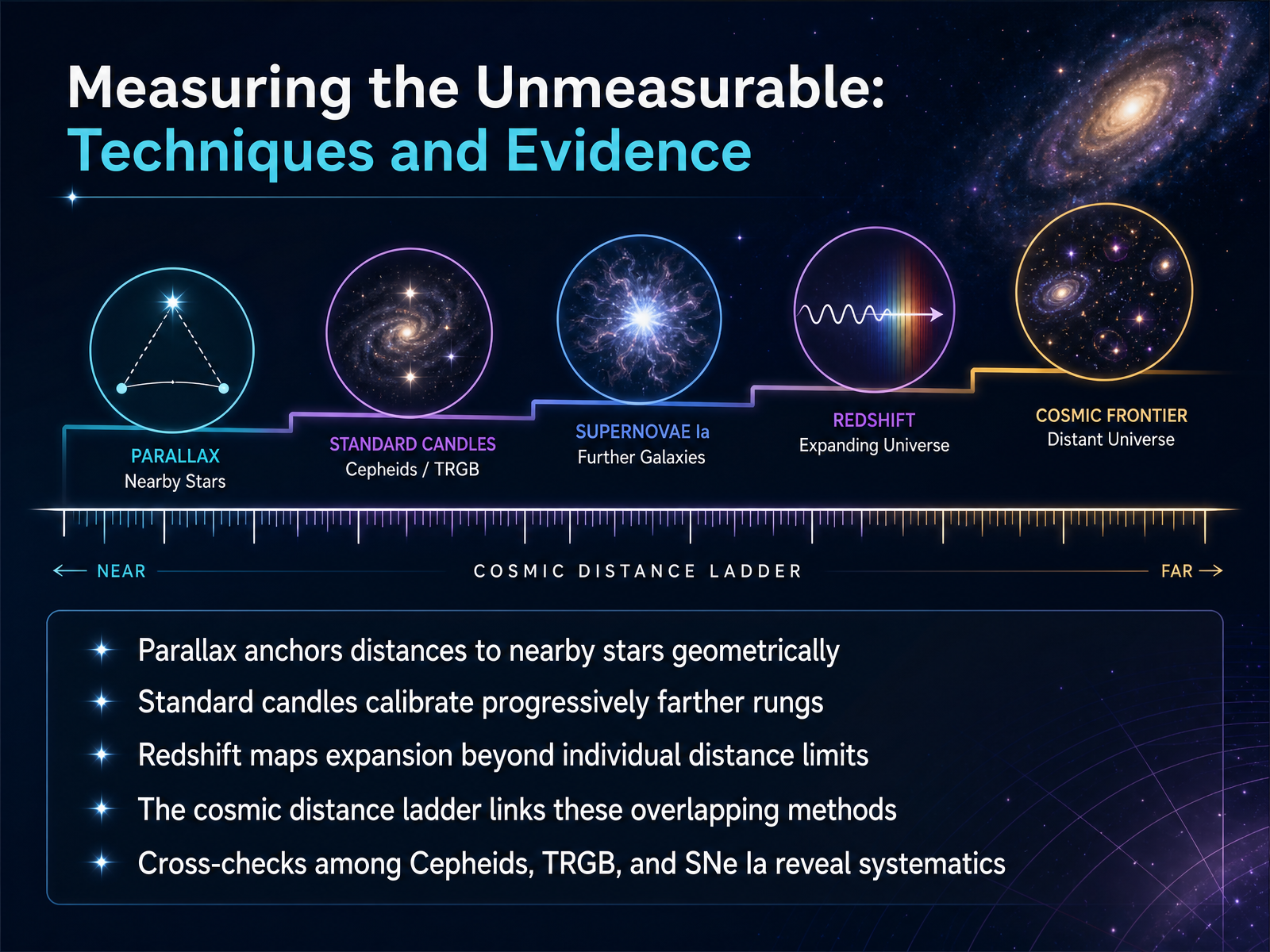
 - 11Measuring the Unmeasurable: Techniques and EvidenceSo how do we actually measure something as unmeasurable as the universe? We build a cosmic distance ladder. For the closest stars, we use simple geometry. As Earth orbits the Sun, nearby stars seem to shift against the distant background. This is called parallax, and it anchors our first rung. For greater distances, we rely on standard candles. These are objects with a known true brightness, like Cepheid variable stars and certain exploding stars called Type Ia supernovae. By comparing how bright they look from Earth to how bright we know they really are, we can calculate their distance. To reach the farthest galaxies, we use redshift. The expansion of the universe stretches light, making it redder. The more it is stretched, the farther away the source is. These overlapping methods, from parallax to supernovae to redshift, work together like the rungs of a ladder. By cross-checking these different techniques, we ensure our cosmic measurements are accurate. And this incredible precision leads us directly to a surprising discovery, the Hubble tension.
 1 min
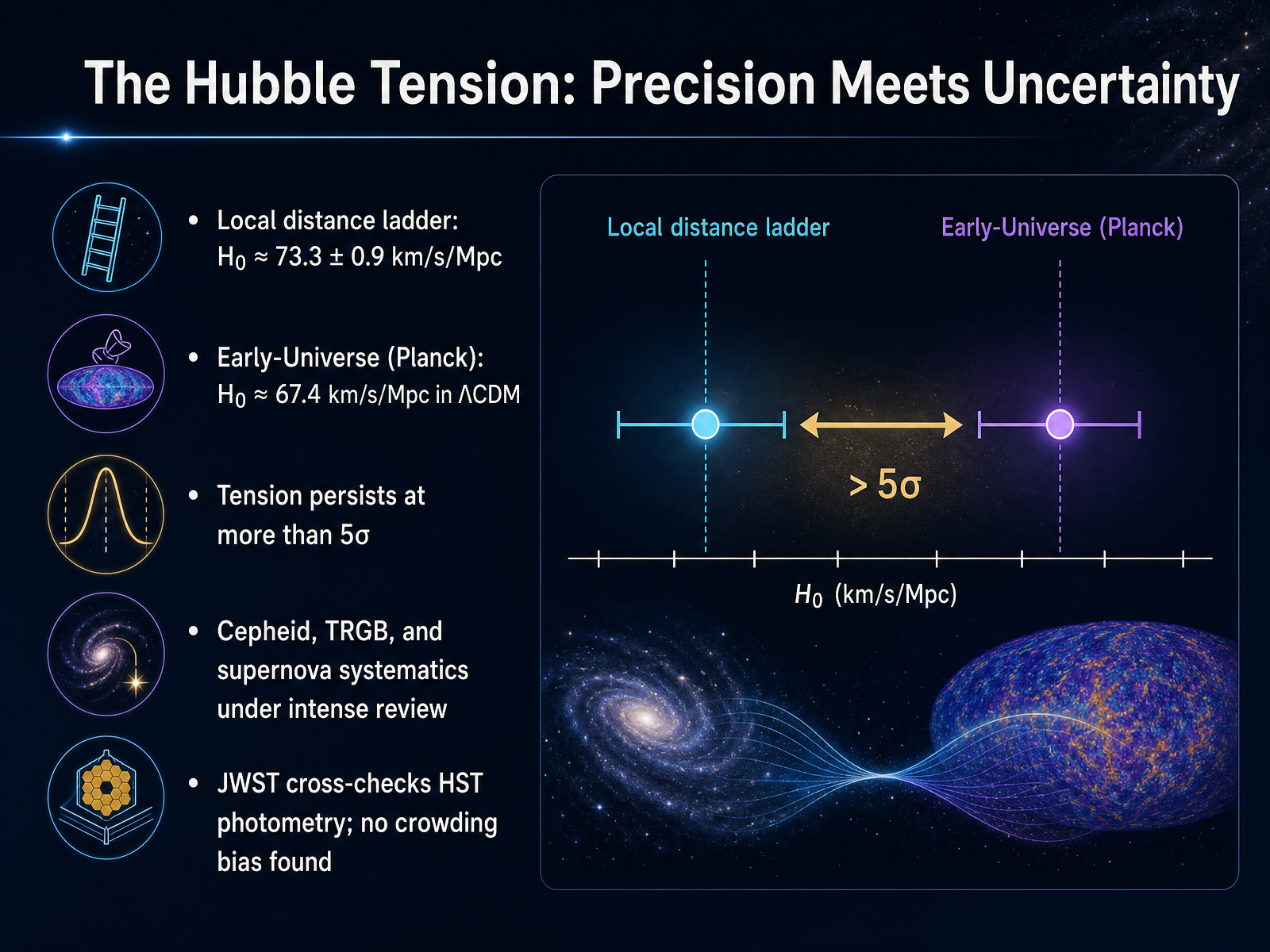
1 min - 12The Hubble Tension: Precision Meets UncertaintyNow we come to a fascinating problem: the Hubble tension. It is a place where our incredible precision meets a deep uncertainty. On one side, we have the local distance ladder. It measures the expansion rate, the Hubble constant, at roughly seventy three point three kilometers per second per megaparsec. The uncertainty there is tiny, less than one. On the other side, we have the early universe, captured by the Planck satellite. It gives us a different number, about sixty seven point four. These two measurements are both incredibly precise, but they do not agree. Scientists say the tension persists at more than five sigma. That means there is less than a one in a million chance this is a random fluke. So, is one of our measurements wrong, or is the universe telling us something new? Researchers are intensely reviewing every step of the distance ladder, from Cepheid stars to the tip of the red giant branch, and supernovae. The James Webb Space Telescope has even double checked the Hubble photometry and found no errors from stellar crowding. It is a genuine cosmic mystery. As we ponder this, let's move on to see how we can ground this immense scale with activities and tools for learners.
 2 min
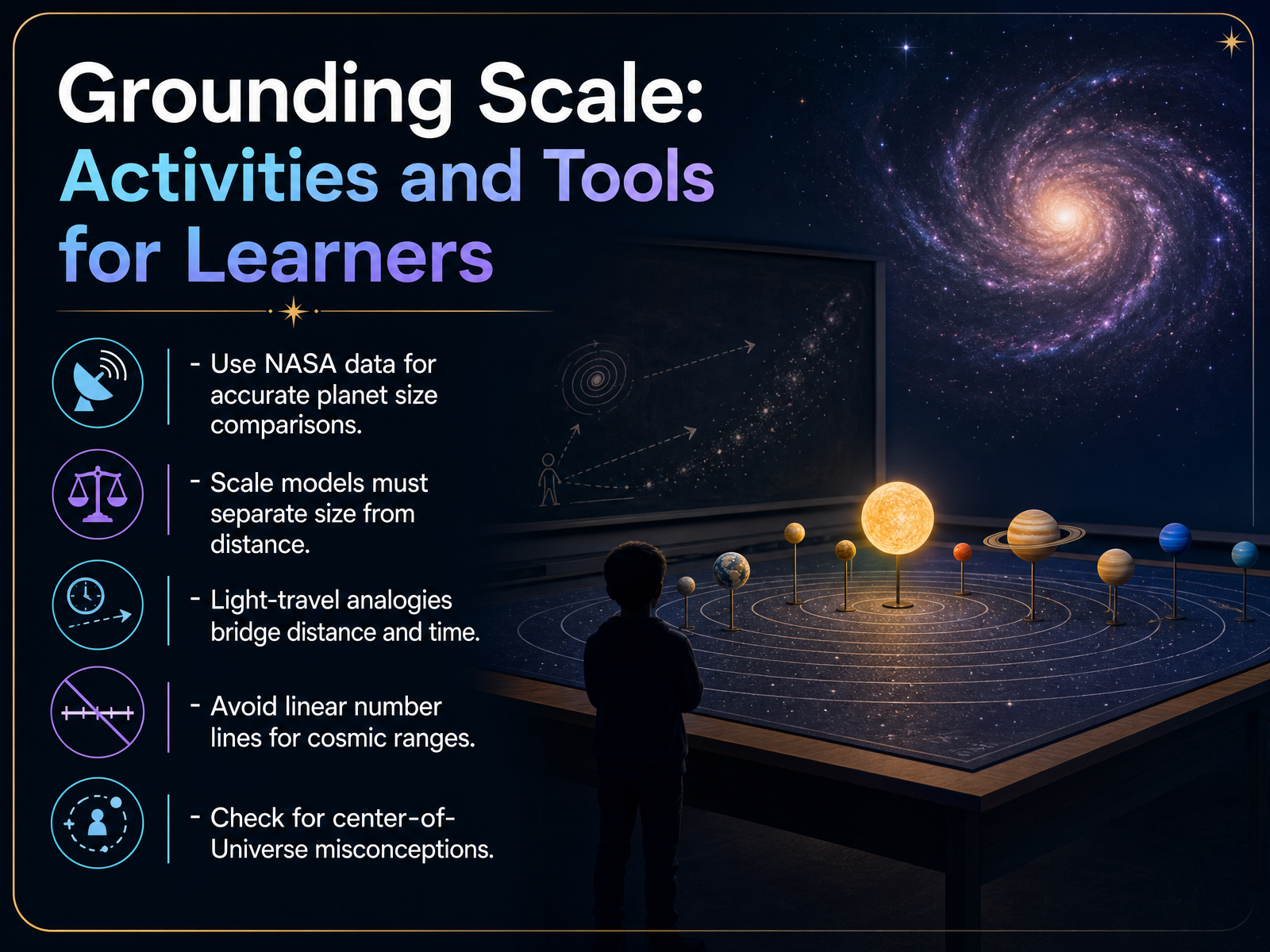
2 min - 13Grounding Scale: Activities and Tools for LearnersNow that we have felt the scale of the cosmos, a good question arises: how do we teach this without losing the wonder? The first tool is real data. NASA and JPL publish precise planetary sizes and distances, so you never have to guess. Just remember, a model that correctly shows planet size cannot show true distance on the same page. If Earth were a marble, Neptune would be across a football field. So separate size from distance, or the model breaks. Light travel time helps here. Saying Neptune is four light hours away connects distance to time in a way our minds can grasp. Avoid linear number lines for cosmic ranges. They compress everything and quietly suggest the Sun and planets sit on a neat line, which they do not. Also watch for a hidden assumption: the idea that we are at the center of the Universe. Scale activities are a perfect chance to notice and correct that trap. Keep these tools in hand, because next we will turn to the misconceptions and cognitive traps that commonly follow.
 ssd.jpl.nasa.govscience.nasa.govscience.nasa.gov+21 min
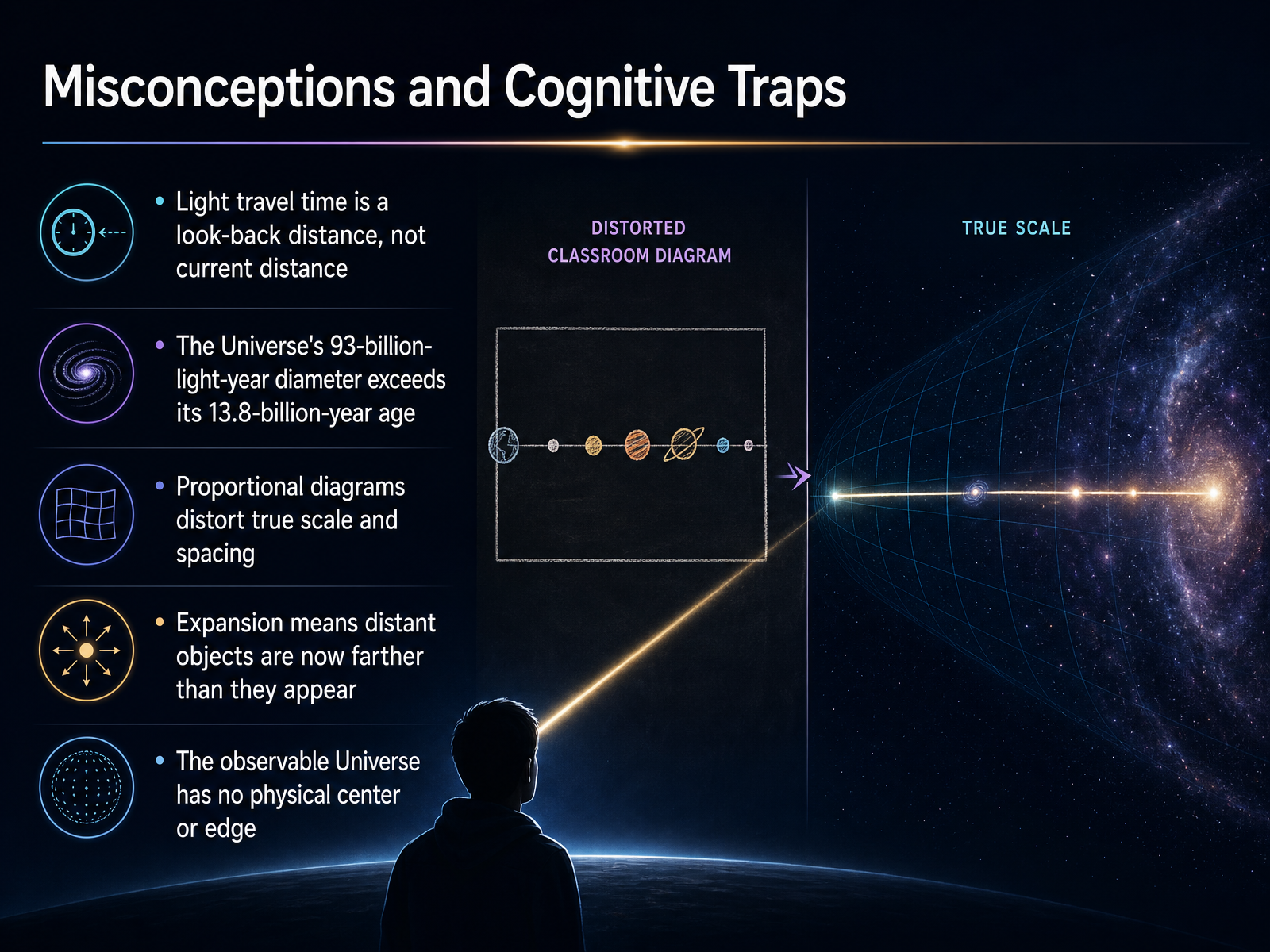
 - 14Misconceptions and Cognitive TrapsNow, let's clear up some misconceptions that often trip people up. Think about light travel time. When we say a galaxy is thirteen billion light years away, that's how long its light traveled to reach us. It is not where the galaxy is right now. Expansion has carried it much farther. That's why the observable universe can be ninety three billion light years across, even though it is only thirteen point eight billion years old. The space itself has been stretching the whole time. And remember those diagrams in textbooks? They are almost never to true scale. If they were, the planets would be invisible specks. Finally, try not to picture an edge or a center. The observable universe is just the bubble of space that has had time to send light our way. It is a horizon, not a wall. Let's connect these ideas and see the whole picture.
 pdg.lbl.goven.wikipedia.orgpdg.lbl.gov+21 min
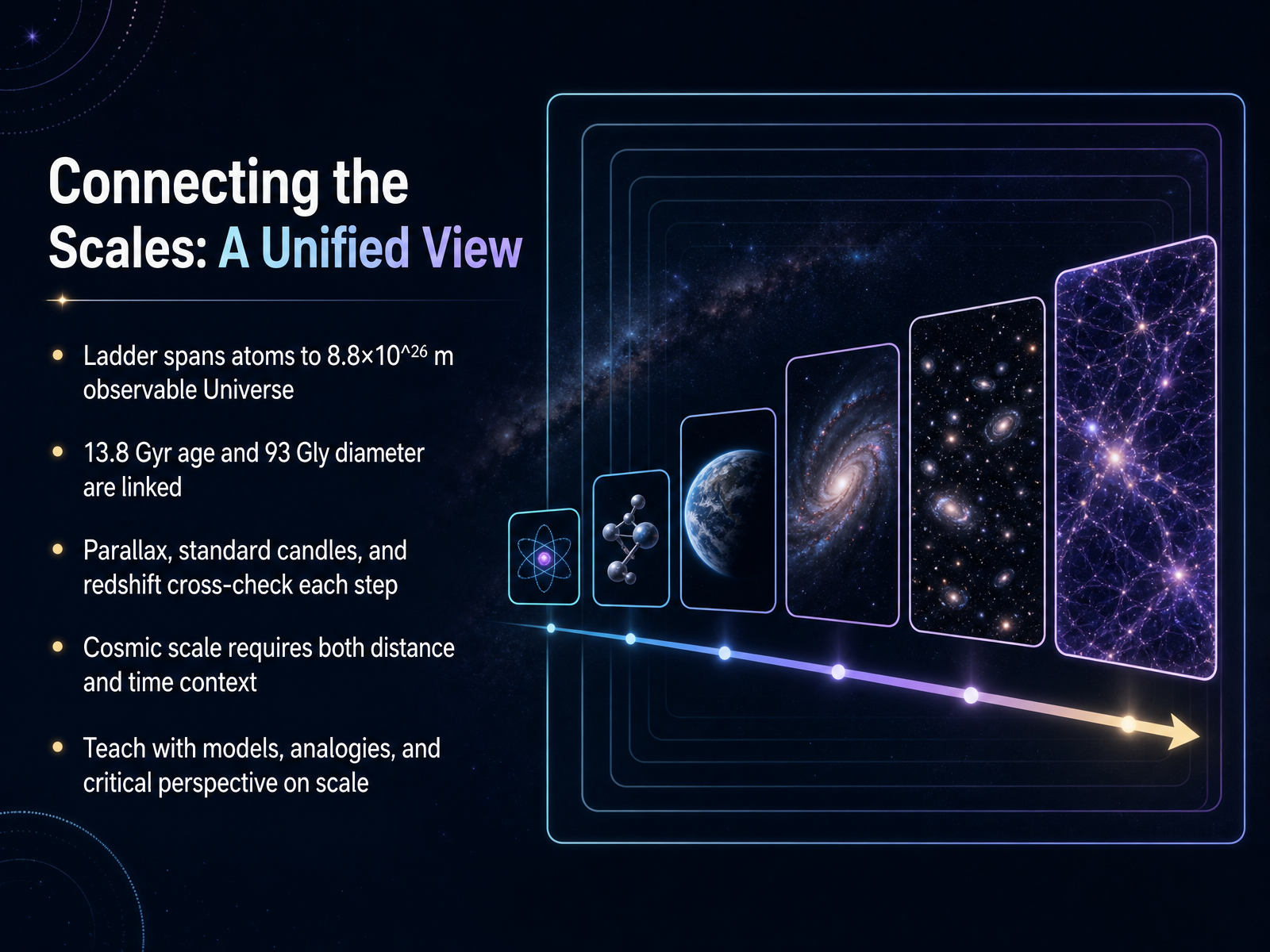
 - 15Connecting the Scales: A Unified ViewLet us bring everything together. We began with atoms and climbed all the way to the observable Universe, a sphere about ninety three billion light years across. But that size only makes sense when we remember the other half of the story: time. The Universe is thirteen point eight billion years old. Space has been stretching the whole time, so the light we see from the most distant galaxies has travelled much farther than the original distance would suggest. That is why the observable diameter can be larger than the age might imply. Every step of our cosmic ladder, from parallax to standard candles to redshift, is a different ruler. They overlap and cross check each other, and that is exactly what makes the answer trustworthy. When you teach this, use models and analogies, but also pause to ask what the numbers really mean. A map of the cosmos is not just size. It is a map through time. Thank you for taking this journey with me. Keep looking up, and keep asking how we know.
 pdg.lbl.goven.wikipedia.orgpdg.lbl.gov+21 min
Take the deck with you
Download this course as a file — free, no sign-up needed.
- PDF handoutEvery slide page, ready to print or share.16 pages · 4.4 MBDownload
- Narrated PowerPointThe deck that presents itself — every slide carries the digital human's narration video.16 pages · 15.0 MBDownload
- PowerPoint slidesThe full deck as a .pptx — open it in PowerPoint, Keynote, or Google Slides.16 pages · 4.4 MBDownload
Free to use in your own training — please keep the PersonWise credit page at the end.
Have your own deck? Turn it into a course
Sources consulted
Web sources consulted while building this course.
- 2. Astrophysical Constants and Parameters — pdg.lbl.gov
- Observable universe — en.wikipedia.org
- 2. Astrophysical Constants and Parameters — pdg.lbl.gov
- Inconsistency Between the Age and Diameter of the Universe — public.nrao.edu
- Age of the universe — en.wikipedia.org
- Planetary Physical Parameters - JPL Solar System Dynamics — ssd.jpl.nasa.gov
- Planet Sizes and Locations in Our Solar System - NASA Science — science.nasa.gov
- Solar System Sizes - NASA Science — science.nasa.gov
- Planets — ssd.jpl.nasa.gov
- Horizons System — ssd.jpl.nasa.gov
- The broken-exponential radial structure and larger size of the Milky Way galaxy | Nature Astronomy — nature.com
- Milky Way Galaxy - Imagine the Universe! - NASA — imagine.gsfc.nasa.gov
- Andromeda Galaxy — en.wikipedia.org
- The Fate of the Milky Way–Andromeda System: To Merge or Not? - IOPscience — google.iopscience.iop.org
- A Galactic Self-portrait: Density Structure and Integrated Properties of the Milky Way Disk - IOPscience — iopscience.iop.org
- Dynamic cosmography of the local Universe: Laniakea and five more watershed superclusters | Astronomy & Astrophysics (A&A) — aanda.org
- Reconstructing the kinematics of Laniakea using Type Ia Supernovae — arxiv.org
- In search of the Local Universe dynamical homogeneity scale with CF4++ peculiar velocities | Astronomy & Astrophysics (A&A) — aanda.org
- An effective description of Laniakea: impact on cosmology and the local determination of the Hubble constant — arxiv.org
- Identification of basins of attraction in the local Universe | Nature Astronomy — nature.com