Environmental Change in World History
Begin
15 pages · ~30 min
Environmental Change in World History
Explore how environmental shifts have shaped human history, from ancient civilizations to modern climate challenges, in this course for history students and general learners.
What you’ll learn
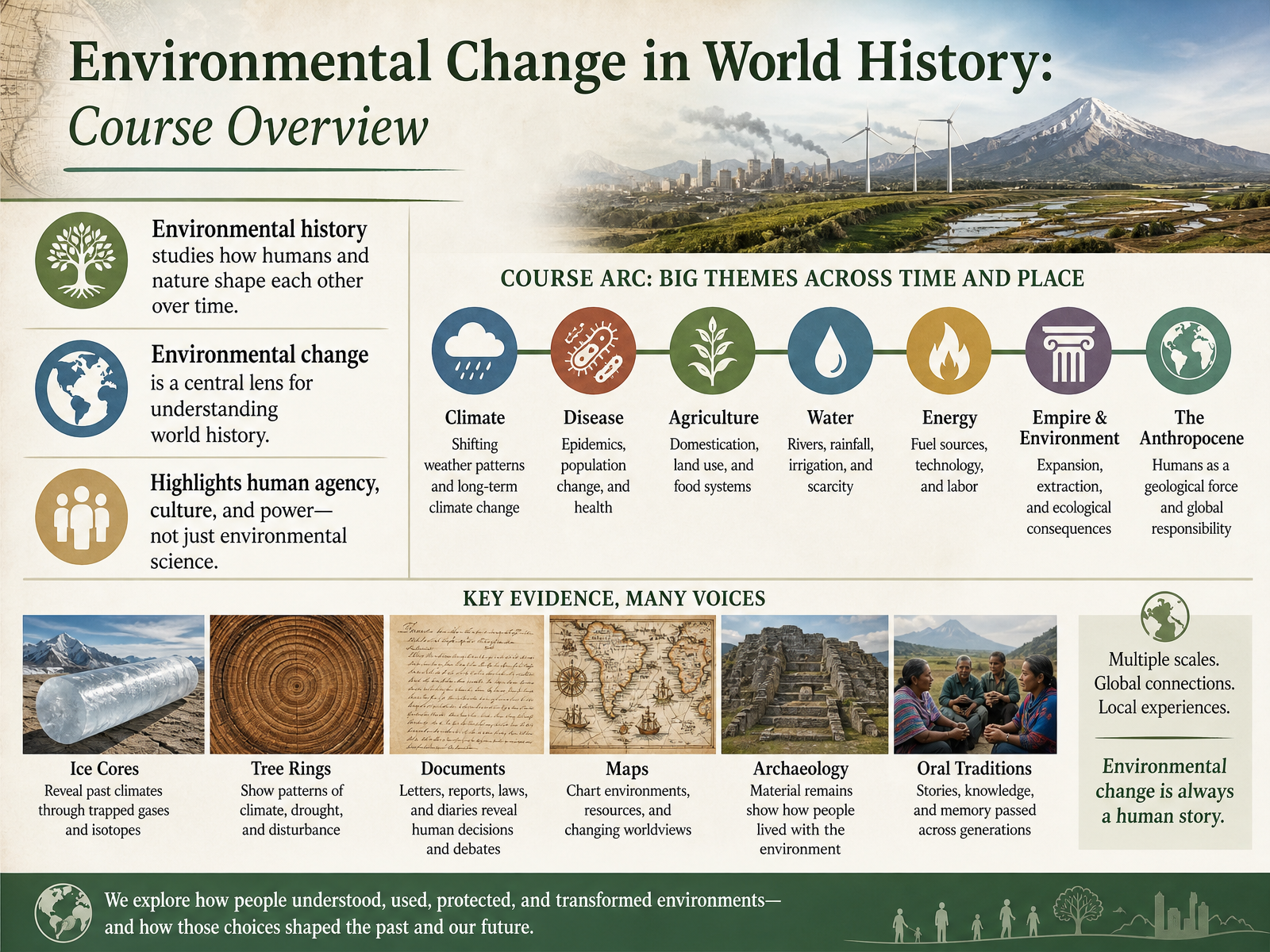
- 01Environmental Change in World History: Course OverviewWelcome to Environmental Change in World History. In this course, we will explore a simple but powerful idea: human societies and the natural world do not just happen to share a timeline. They actively shape each other. Environmental history studies that two-way relationship over time. Think of it as reading world history through forests, rivers, climates, and diseases, not only through kings and treaties. Over the next several sessions, we will move from core concepts to climate, disease, agriculture, water, energy, empire, and finally the Anthropocene, the age shaped by human power on a planetary scale. To build this story, we will use ice cores, tree rings, documents, maps, archaeology, and oral traditions. Each of these is an archive, but some of them exist in the natural world. Along the way, we will pay close attention to human agency, culture, and power. This is not only a science story. It is a story about choices, beliefs, and unequal consequences. As we begin, I want you to hold one question in mind: when did the environment stop being a backdrop and start becoming a character in history? That question will guide us into Core Concepts and Sources.worldhistorycommons.orgcnr.berkeley.edufiveable.me+22 min
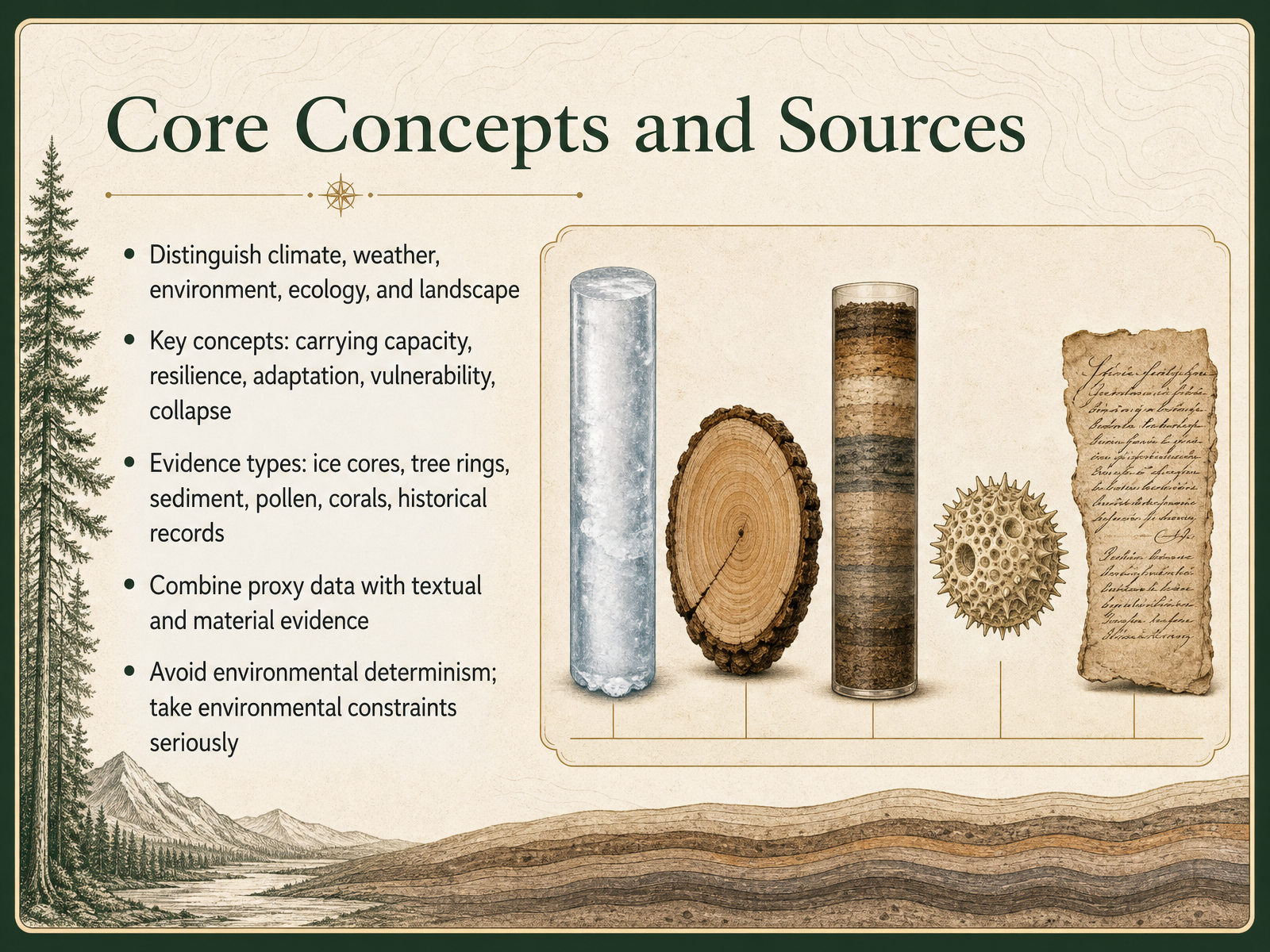
- 02Core Concepts and SourcesBefore we turn to any particular society, we need a shared vocabulary. Climate is the long-term pattern of weather over decades and centuries, while weather is what happens day to day. Environment is the broader stage, including soil and water, and ecology describes how living organisms relate to one another within that stage. Landscape is the physical face of a place that people perceive and shape. Once we have those terms, we can work with key concepts like carrying capacity, the number of people a given environment can support, and resilience, the ability to recover from disruption. Adaptation means adjusting to new conditions, vulnerability measures exposure to harm, and collapse marks a loss of social complexity. But how do we know any of this? We combine proxy data, such as ice cores, tree rings, sediment, pollen, and corals, with textual and material evidence from human archives. Each type of evidence has limits, so we avoid environmental determinism while still taking environmental constraints seriously. With that toolkit in hand, let us turn to climate shifts and early civilizations.
 eh-resources.orgjournals.sagepub.comncei.noaa.gov+22 min
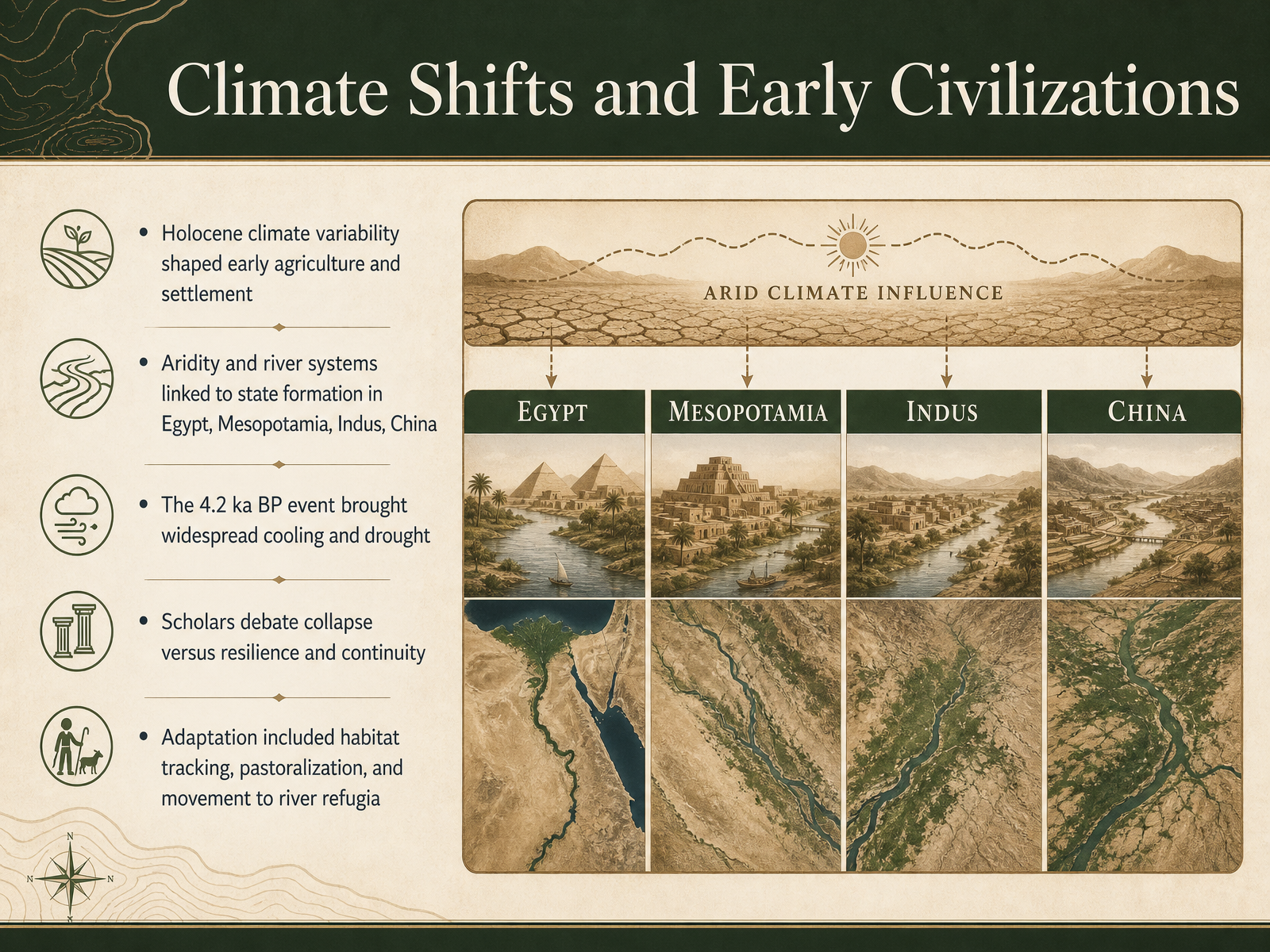
 - 03Climate Shifts and Early CivilizationsLet's turn to the deep background of early civilizations and their climate. Around four thousand two hundred years ago, many parts of the world experienced an abrupt shift toward drier and cooler conditions. Scientists call this the four point two thousand year event, or four point two ka BP. In Egypt, Mesopotamia, the Indus Valley, and northern China, this shift coincided with major social disruption. But the story is not simply one of collapse. Some regions saw widespread abandonment, while others show remarkable continuity. In the Mediterranean and west Asia, rainfed farming became unreliable, and people moved toward rivers and springs. We call this habitat tracking. Pastoral groups adjusted their seasonal movements, and some communities shifted toward more drought resistant crops. In the Indus region, the urban phase gave way to smaller settlements and migration toward the east and south. Scholars still debate how much we should attribute these changes to climate alone. A recent isotope study in northern Mesopotamia found no dramatic break in local diets, which reminds us that resilience and adaptation were just as important as crisis. So rather than one narrative of environmental collapse, we see many experiments in survival. Next, we will examine how disease and ecology reshaped populations and demographic patterns across world history.
 sciencedirect.comnature.compastglobalchanges.org+22 min
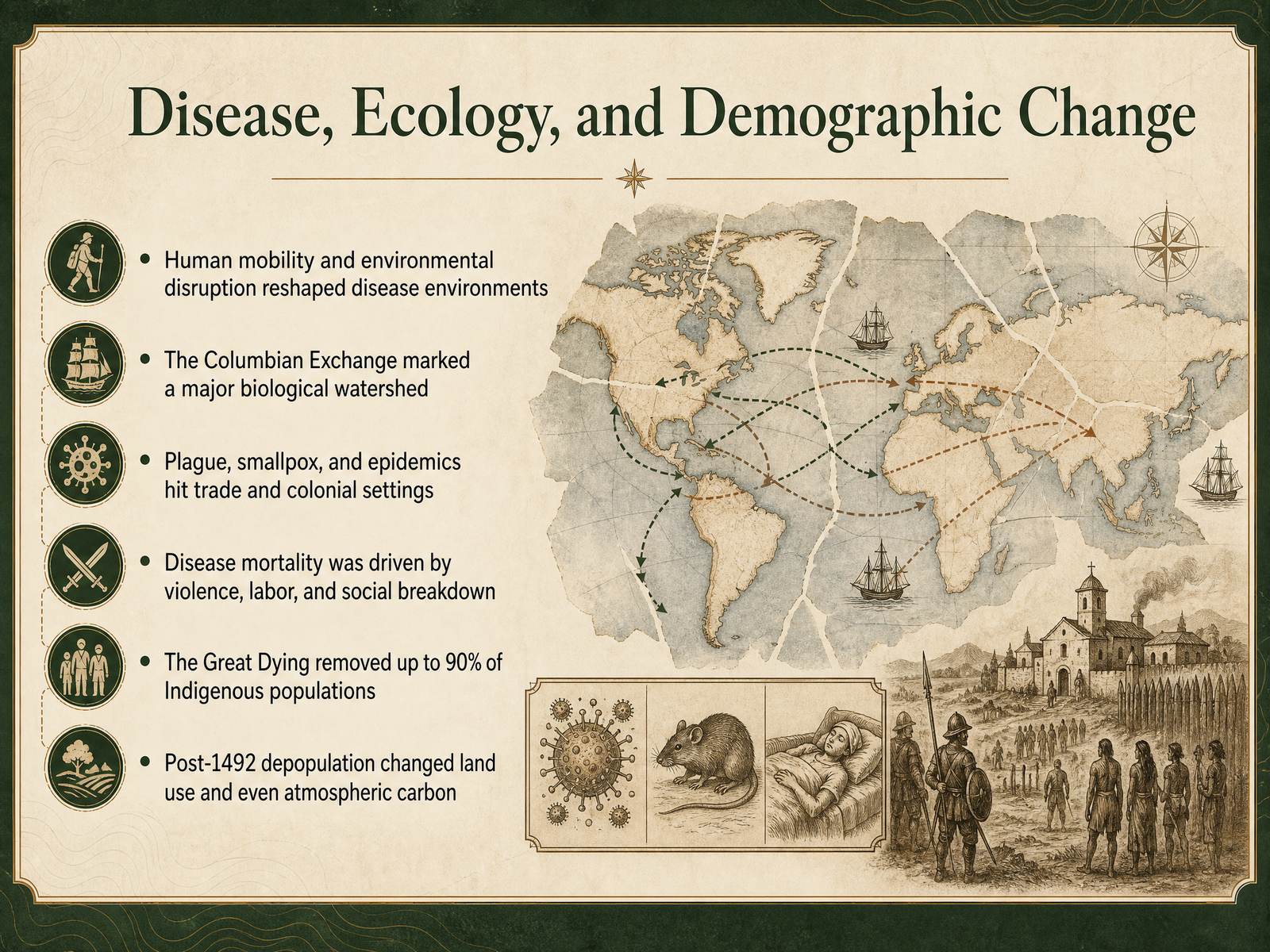
 - 04Disease, Ecology, and Demographic ChangeConsider what happens when human mobility meets environmental disruption. Disease environments change. And perhaps no event illustrates this more starkly than the Columbian Exchange. Beginning in fourteen ninety-two, the Atlantic world became a biological corridor. Pathogens like smallpox and plague moved into populations with no prior exposure, no inherited immunity, and no social infrastructure ready for them. But this was not purely a viral story. Mortality spiked where violence, forced labor, and social breakdown already frayed the fabric of daily life. The result was the Great Dying. In the century after contact, up to ninety percent of Indigenous peoples in the Americas perished. That is a demographic rupture almost impossible to visualize. And here is the ecological twist. With fields abandoned, forests regrew on tens of millions of hectares. That regrowth pulled so much carbon from the air that it likely contributed to a measurable dip in atmospheric carbon dioxide in the late fifteen hundreds and early sixteen hundreds. Disease, in other words, reached into the Earth system. Next, we turn to another engine of change, agriculture, soil, and landscape transformation.
 sciencedirect.comideas.repec.orgsage.cnpereading.com+22 min
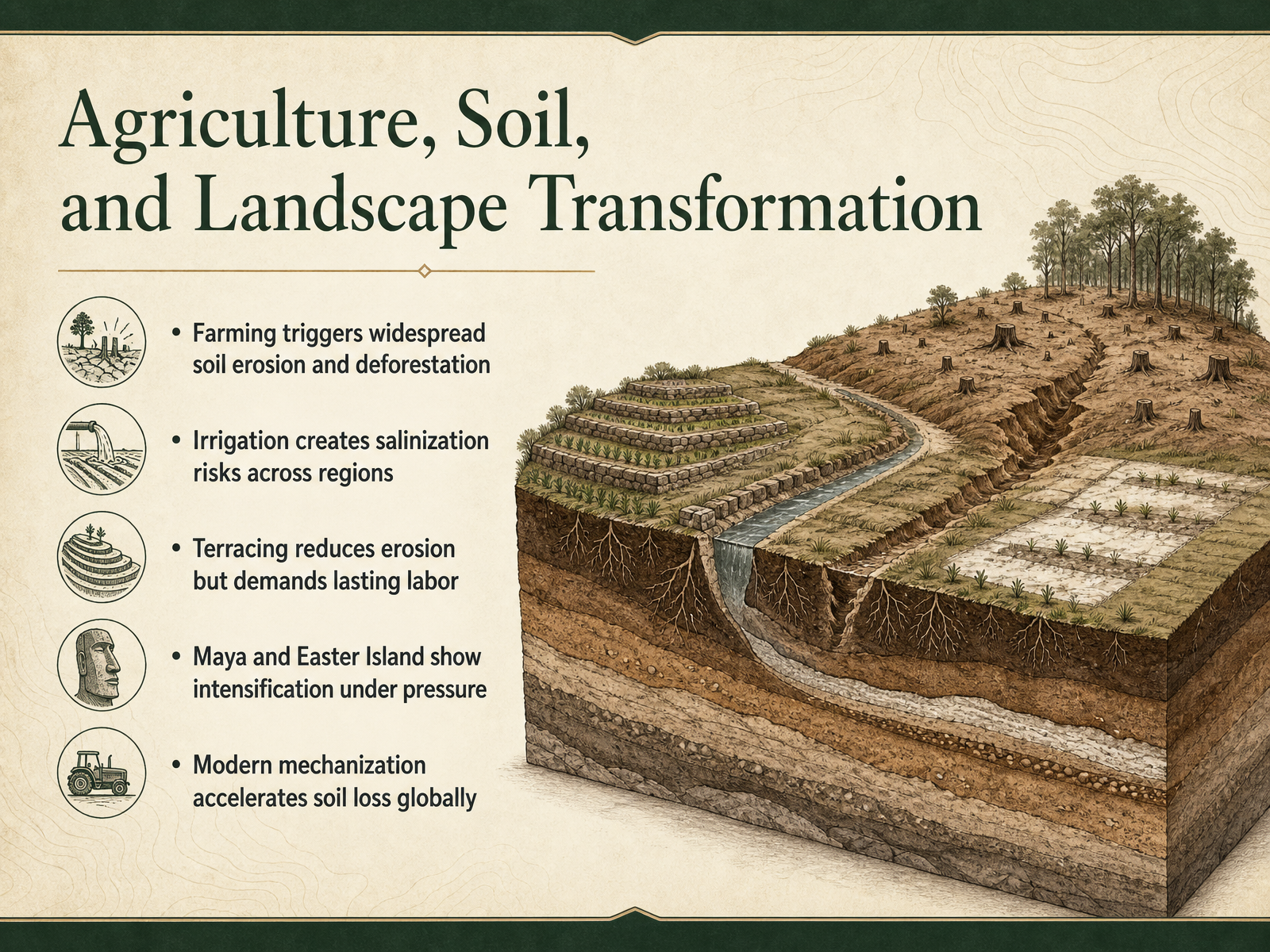
 - 05Agriculture, Soil, and Landscape TransformationLet’s think about what happens when a society shifts from gathering to plowing. Farming defined new rhythms of life, but it also transformed the ground itself. Clearing forests for fields exposed soil to wind and rain, and once that protective cover was gone, erosion could accelerate dramatically. Irrigation brought its own quiet risk: in dry regions, repeated watering can leave salts behind in the upper soil, a process called salinization that gradually lowers fertility. Not every agricultural system treated the land the same way. Terraces carved into hillsides could slow erosion and hold soil in place, but they required continuous labor across generations, which tells us something about how a community valued its landscape. The Maya and the people of Easter Island show intensification under pressure, where dense populations and changing conditions pushed farming strategies to their limits. In the modern era, large machines and expanded fields have quickened the pace of soil loss in many parts of the world. This slide reminds us that agriculture is never simply about crops; it is a long negotiation between human needs and the durability of soil itself. Next, we shift from land to another vital medium, as we turn to water, rivers, and maritime environments.
 2 min
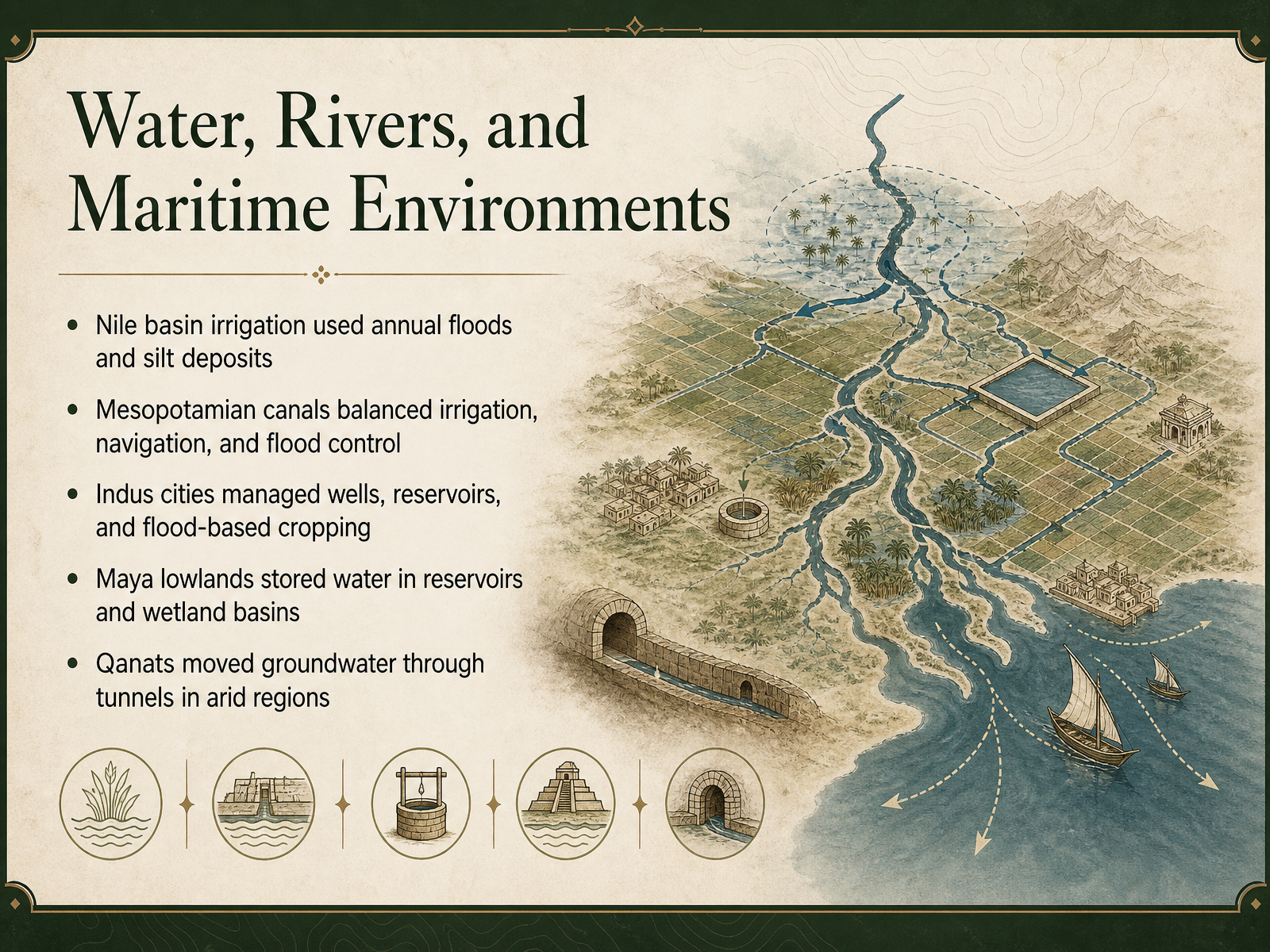
2 min - 06Water, Rivers, and Maritime EnvironmentsLet’s turn now from land to water. Rivers and coastlines were not just natural features; they were living platforms for agriculture, trade, and political power. In the Nile basin, annual floods spread silt across the fields, and farmers worked with that rhythm, planting after the waters receded. Mesopotamia offers a different picture. There, canals had to serve irrigation, navigation, and flood control at the same time, which required careful coordination. In the Indus cities, wells, reservoirs, and flood-based cropping supported dense urban life. The Maya lowlands used reservoirs and wetland basins to store water through long dry seasons. And in arid regions, qanats carried groundwater through underground tunnels, reducing evaporation and making settlement possible far from rivers. Each of these systems shows a society reading its environment closely and shaping it without pretending to fully control it. In the next slide, we shift from water to something even more powerful, the rise of energy regimes and industrial transformation.
 2 min
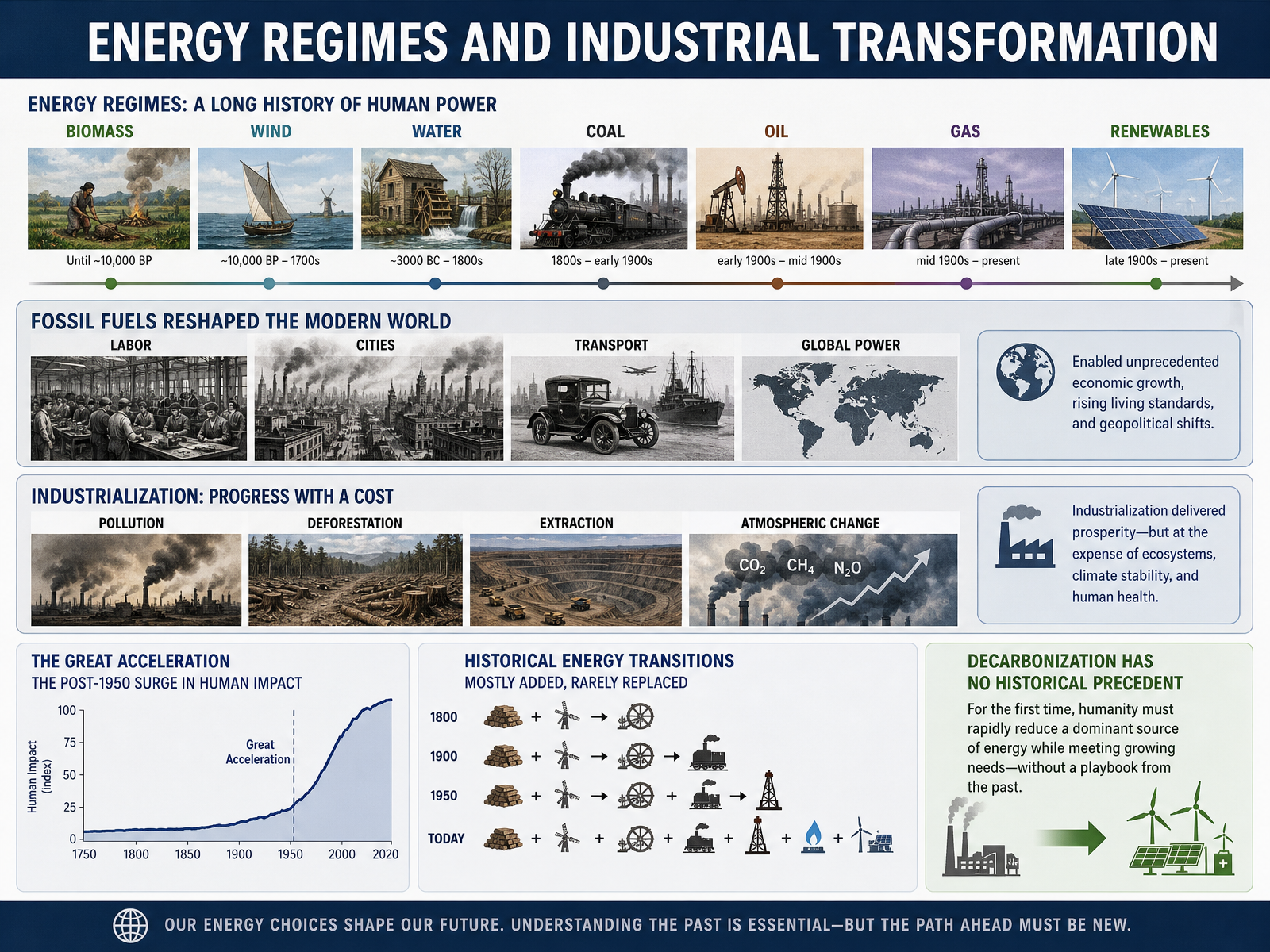
2 min - 07Energy Regimes and Industrial TransformationLet's turn now to energy, because the modern world was built on a dramatic shift in how humans power their lives. Before industrialization, most societies drew on what we call the organic energy regime. Think of biomass like wood and charcoal, combined with wind for sailing ships, water for mills, and muscle power from animals and people. That was the pattern for most of world history. Then, from roughly the eighteenth century onward, coal entered the picture more forcefully, followed later by oil, natural gas, and eventually nuclear and renewable sources. The crucial point is not that one source simply vanished and another appeared. Historically, energy transitions mostly added new sources to the existing mix. Wood did not disappear when coal arrived, and coal did not disappear when oil rose. What did change was the scale and the consequences. Fossil fuels gave societies access to energy stored deep underground, energy that was dense, transportable, and seemingly abundant. This reshaped labor, cities, trade, and global power. It also brought new forms of damage, visible in urban smoke, deforestation, mining landscapes, and what scientists now recognize as atmospheric change. After the Second World War, these trends accelerated so sharply that researchers call the period after nineteen fifty the Great Acceleration. This is not simply a gradual story of progress. It is a threshold moment when human activity became a planetary force. And it raises a hard question. If earlier transitions added energy sources, what would it mean to deliberately subtract fossil fuels? Decarbonization would be something new in history. No society has yet achieved a transition that removes dominant energy sources at planetary scale. That challenge is exactly what connects this discussion to our next theme, because industrialization was never just about factories. It was also about empires, raw materials, and the unequal map of extraction.
 2 min
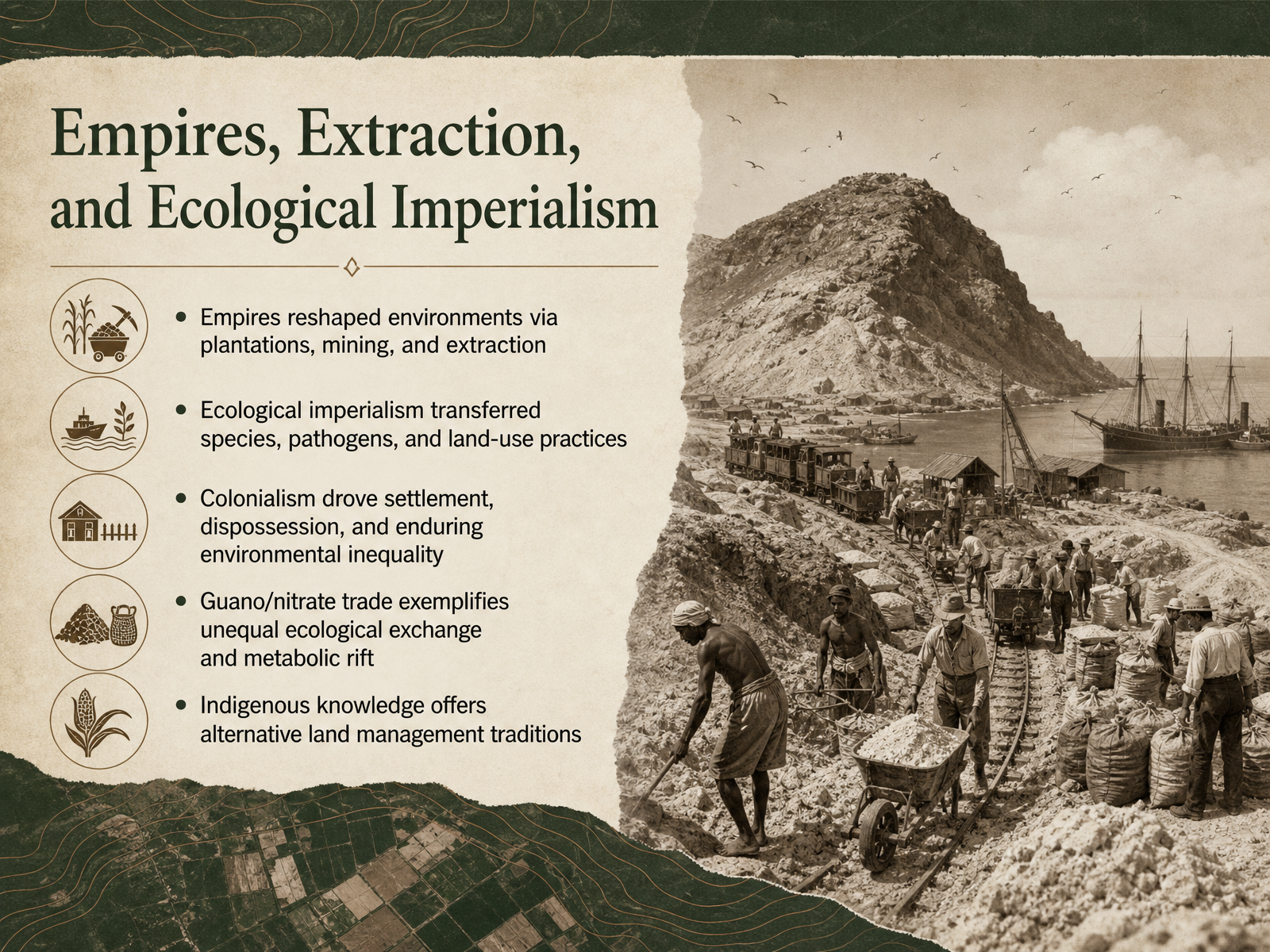
2 min - 08Empires, Extraction, and Ecological ImperialismEmpires did not simply redraw borders. They reorganized landscapes, often turning them into engines of extraction. Picture vast plantations replacing mixed woodlands, or deep mine shafts cutting through hills. This was not only a political project, but an ecological one. Historians use the term ecological imperialism to describe how empires transferred species, pathogens, and land use practices along with armies and administrators. Sometimes these transfers succeeded brilliantly, as in temperate settler colonies. In other places, like the Canadian North, introduced species gained only a limited foothold, reminding us that colonial ecologies were uneven and contested. Consider the nineteenth century guano and nitrate trade. Britain drew soil nutrients from Peru and Chile to restore exhausted fields at home, creating what some scholars call a metabolic rift. Wealth flowed to the imperial core, while debt, degraded landscapes, and imported labor remained on the periphery. Colonial rule also drove settlement and dispossession, producing environmental inequalities that persist in land access and exposure to harm today. Yet this is not the only story. At Ollantaytambo in Peru, Andean farmers maintained Inka field systems for decades after invasion. Indigenous land management traditions offer alternative models attentive to water, soil, and long term resilience. Next, we turn to the Anthropocene and contemporary crises.
 2 min
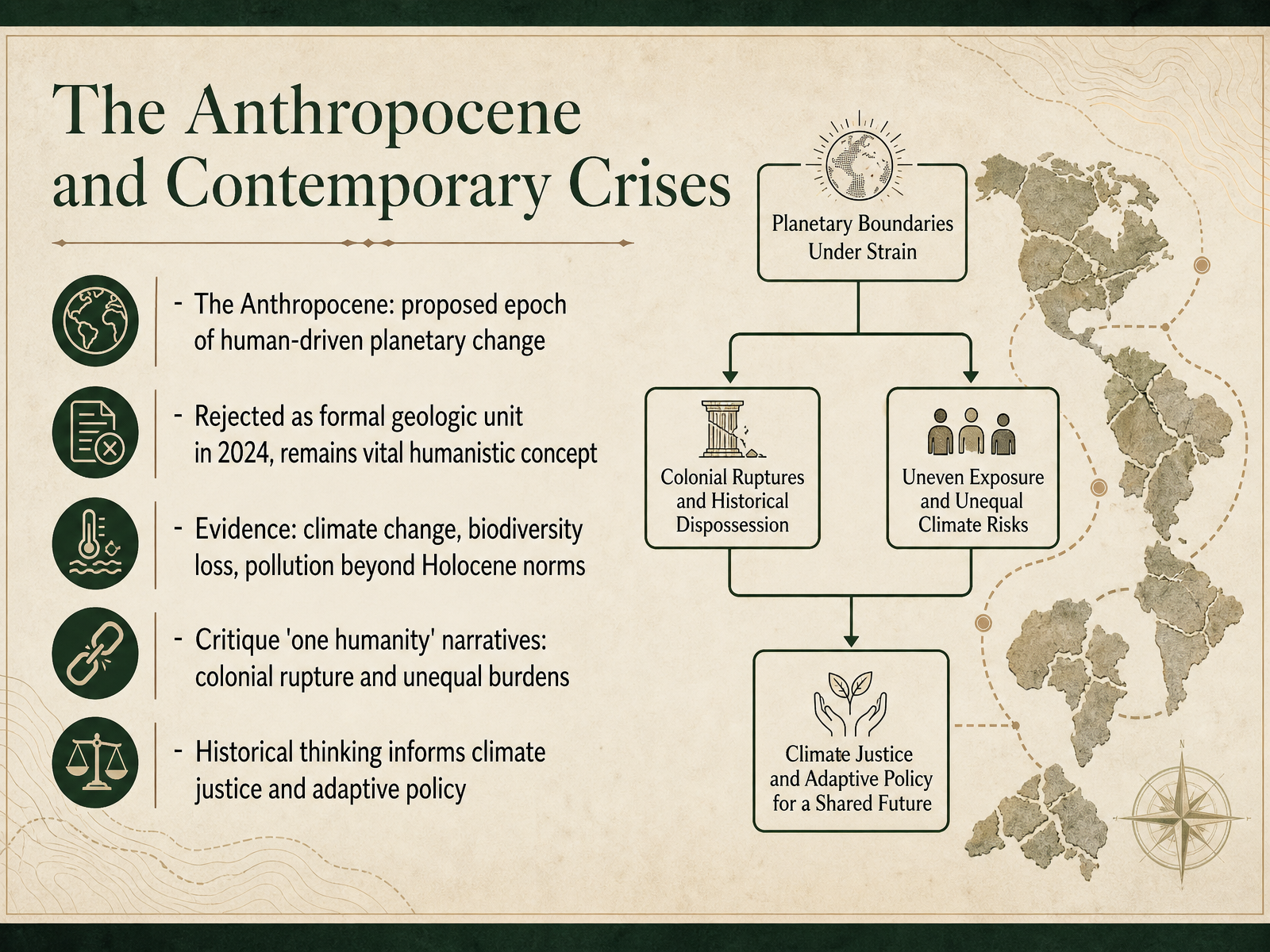
2 min - 09The Anthropocene and Contemporary CrisesNow, we arrive at the concept that frames our present moment: the Anthropocene. This is a proposed epoch defined by human-driven planetary change. In March of twenty twenty-four, geologists formally rejected it as a unit of the geologic time scale, judging the rock record too thin. Yet, as a humanistic concept, it remains vital. The evidence is all around us: accelerating climate change, sharp biodiversity loss, and pollution that pushes far beyond Holocene norms. But we must think critically here. The phrase 'one humanity' hides a difficult history. The changes we measure are not equally caused, and their burdens fall unequally. The markers of this new age are rooted in colonial rupture and extraction. So, historical thinking is not an abstract exercise. It directly informs climate justice and adaptive policy, helping us ask who is responsible and who must adapt first. This is exactly the challenge we turn to next: teaching environmental change in the humanities classroom.
 2 min
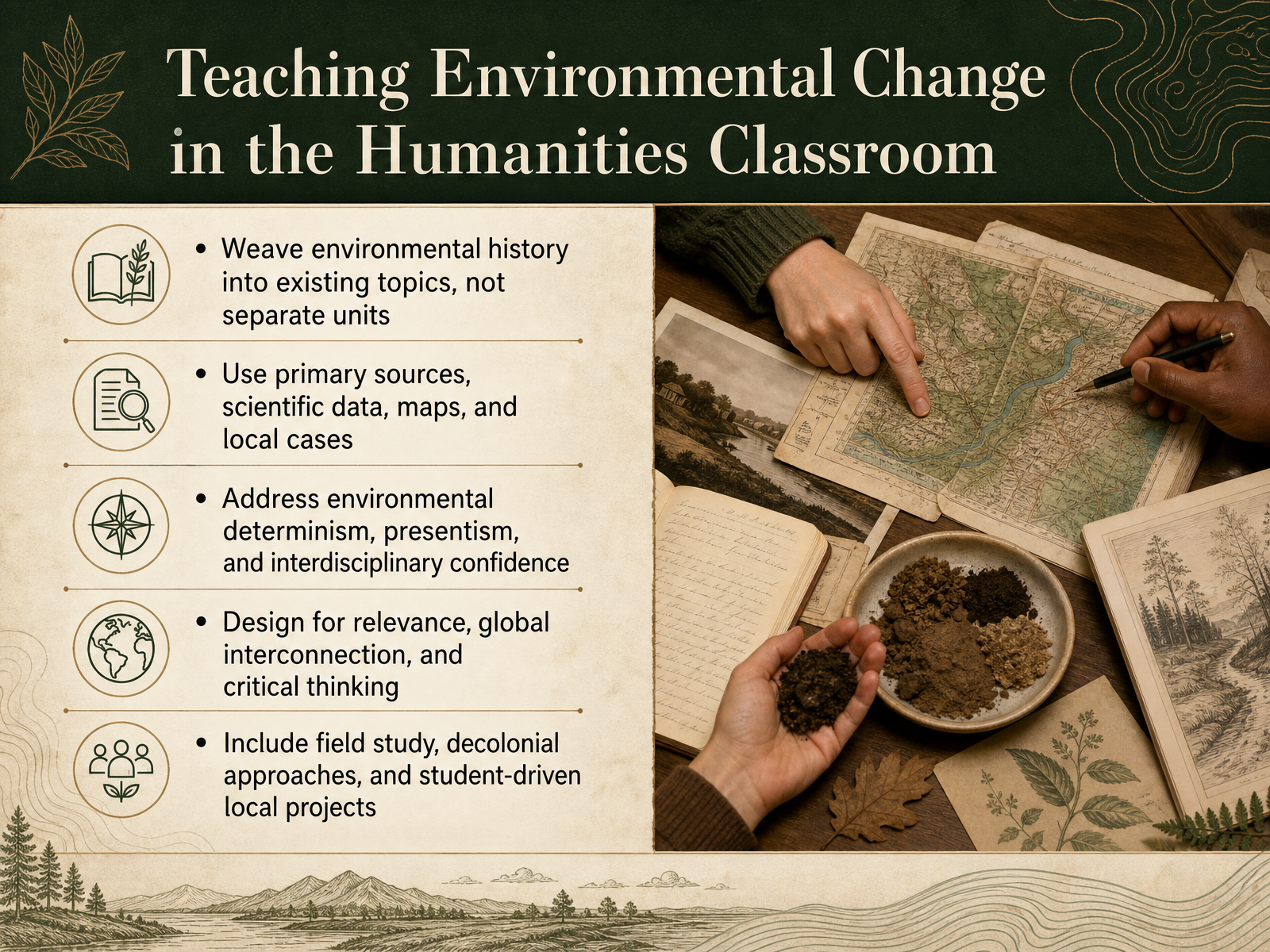
2 min - 10Teaching Environmental Change in the Humanities ClassroomNow let us think about what it actually looks like to bring environmental change into a humanities classroom. The strongest approach is not to add a separate unit on the environment, but to weave it into topics you already teach. The Black Death, the rise of empires, industrialization, and modern warfare all look different when you ask where water, soil, disease, and energy fit into the story.
Use a mix of materials. A primary source document can sit beside a temperature graph. A historical map can be read against a local case study. That combination helps students see environmental history as interpretive work, not just a set of facts.
You will also need to name three common challenges. Environmental determinism assumes climate or geography simply causes human outcomes. Presentism judges past people by today's standards. Interdisciplinary confidence asks historians to discuss scientific data without pretending to be scientists. Name each one openly, so students can recognize and question them.
Finally, ground the work in relevance and critical thinking. Local field study, decolonial perspectives, and student-driven projects can turn abstract global systems into questions students investigate themselves. This brings us naturally to one of the most teachable examples: the little ice age and the crises it set in motion across the globe.
 2 min
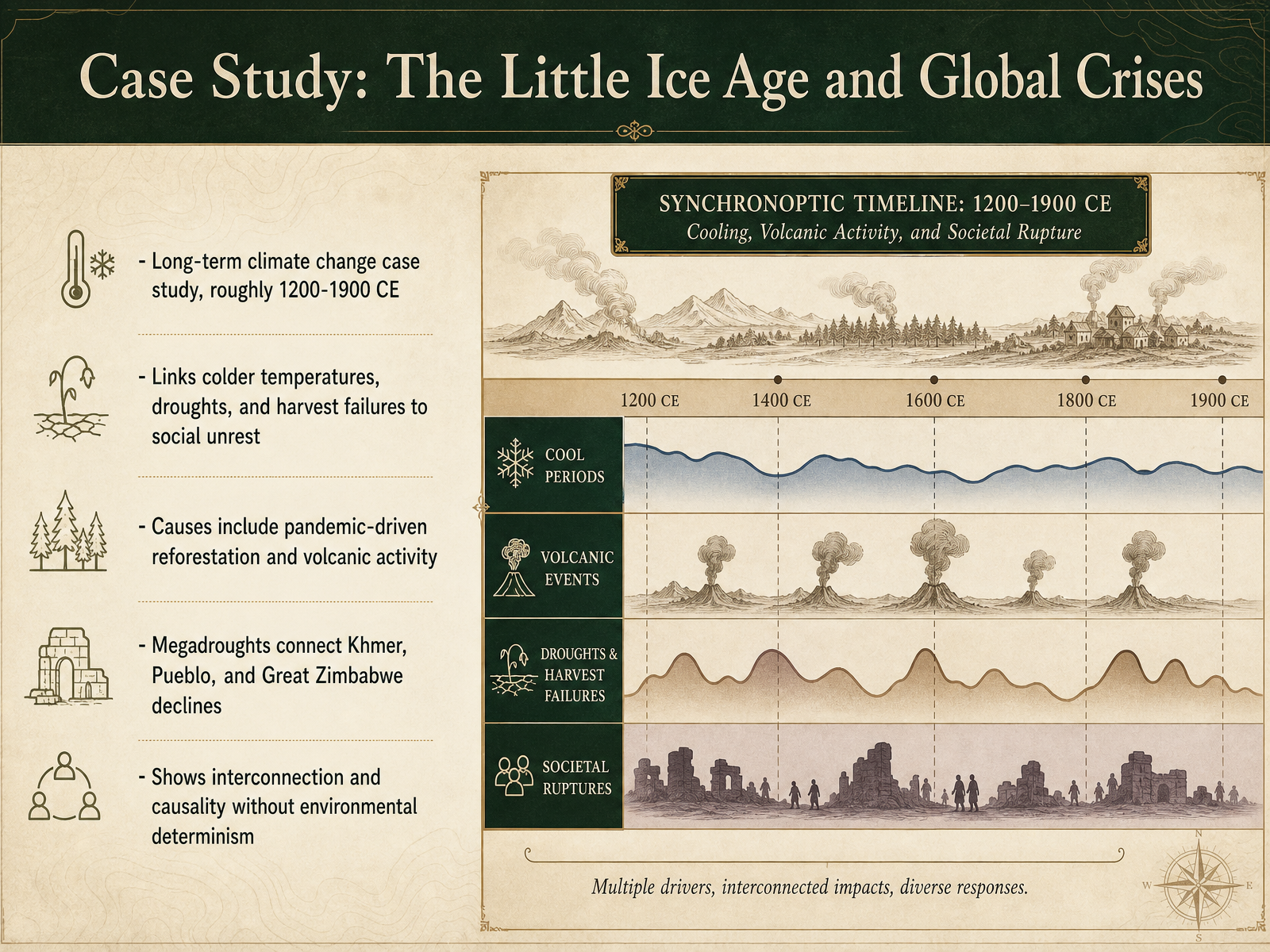
2 min - 11Case Study: The Little Ice Age and Global CrisesLet’s turn now to a case that shows how long-term climate change could shape human affairs across many regions at once. The Little Ice Age, roughly from twelve hundred to nineteen hundred CE, was not a single event. It was a period of colder temperatures, punctuated by droughts and harvest failures that often fueled social unrest. But what caused it? One striking possibility connects pandemic-driven depopulation to climate. When major outbreaks killed large numbers of people, fields were abandoned, forests regrew, and more carbon was pulled from the atmosphere. Volcanic activity likely added another cooling push. The result was a cooler, more unstable climate. In places like Southeast Asia, the American Southwest, and southern Africa, megadroughts coincided with the decline of major societies such as the Khmer, the Pueblo peoples, and Great Zimbabwe. The key point is not that climate determined their fates. Instead, environmental pressure interacted with political, economic, and social choices. That distinction matters. When we move to the next slide, we’ll examine one of the most direct examples of this interconnection: the Columbian Exchange as biological globalization.
 sciencedirect.comideas.repec.orgsage.cnpereading.com+21 min
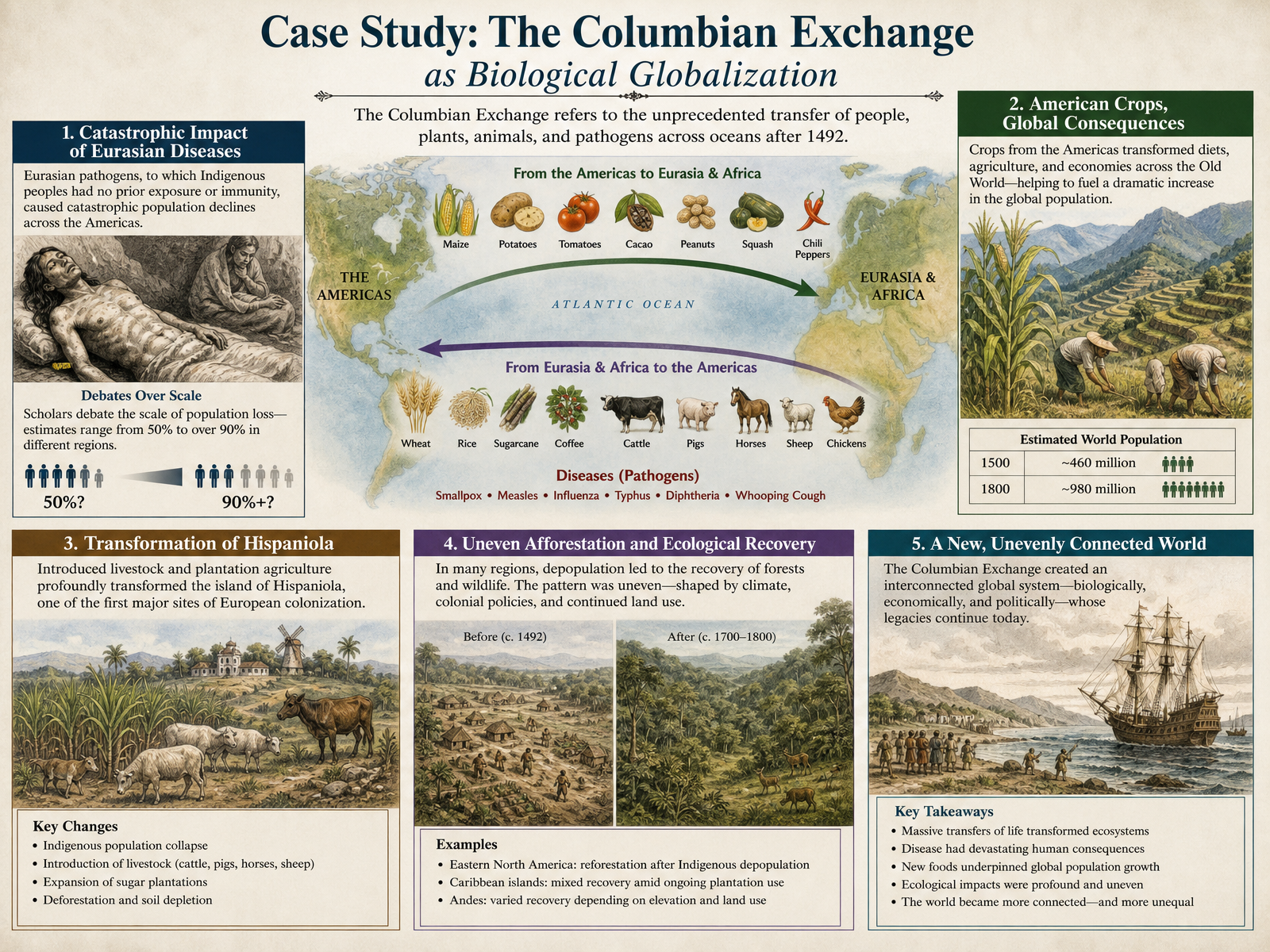
 - 12Case Study: The Columbian Exchange as Biological GlobalizationNow let's move from global patterns to a single pivotal case: the Columbian Exchange as biological globalization. After 1492, previously separated continents began exchanging people, plants, animals, and pathogens across the oceans. The most devastating transfer was disease. Eurasian illnesses like smallpox and influenza reached Indigenous populations with no prior immunity, causing catastrophic decline. Historical estimates vary widely, and scholars continue to debate the exact scale, but many regional studies suggest losses reaching ninety percent or more. At the same time, American crops transformed the rest of the world. Maize and potatoes became global staples, fueling population growth far beyond the Americas. Consider Hispaniola, where introduced livestock and plantation agriculture reshaped the landscape almost immediately. Over time, regional depopulation also led to uneven afforestation. As fields were abandoned, forests returned in some areas, but not uniformly. This case reminds us that biological exchange is never just about species moving; it is about power, vulnerability, and lasting environmental change. Next, we shift to another water-based case: the rise and fall of Angkor.
 sciencedirect.comideas.repec.orgsage.cnpereading.com+21 min
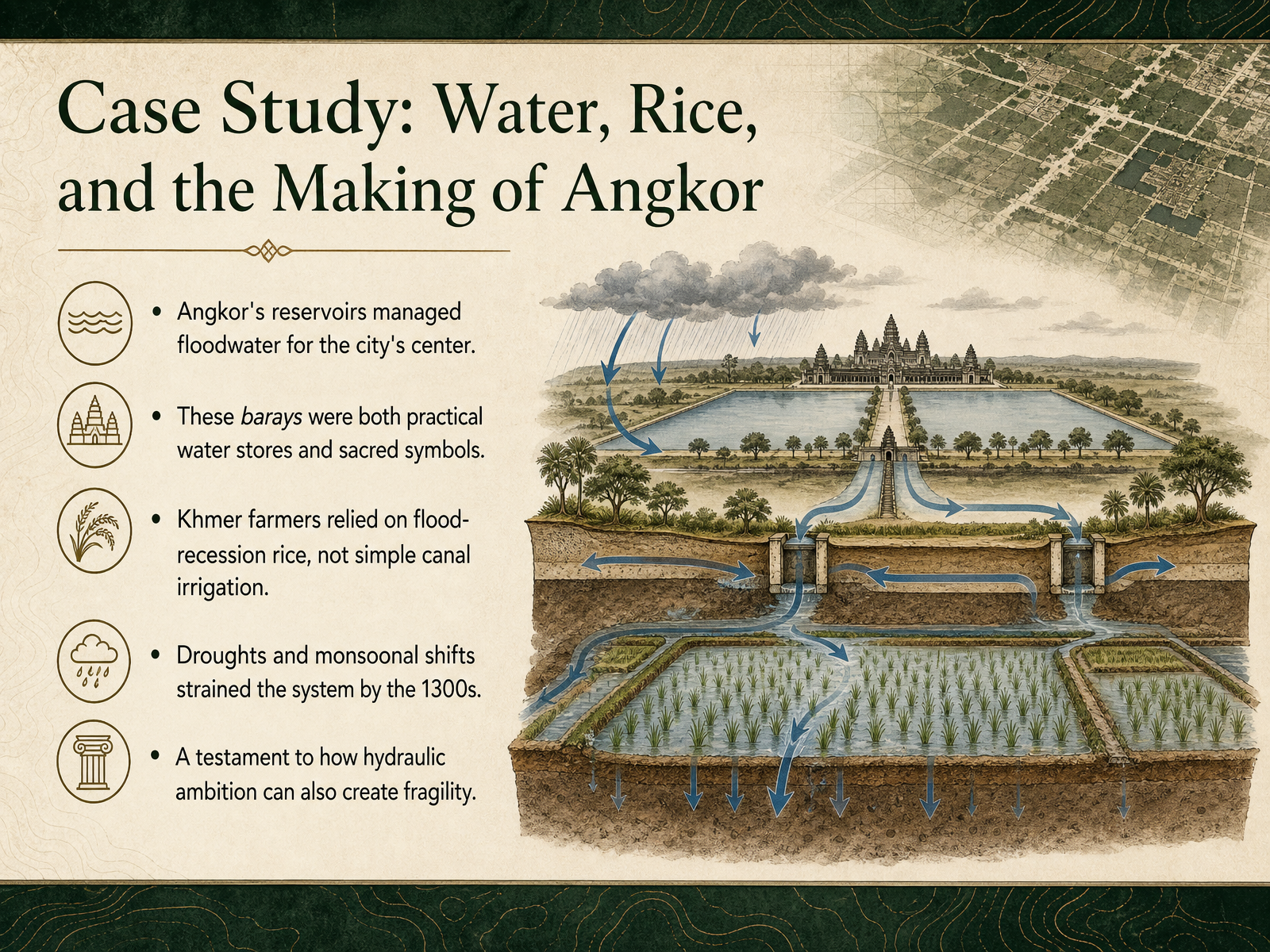
 - 13Case Study: Water, Rice, and the Making of AngkorLet's turn now to a city that turned water into both power and belief: Angkor. Imagine a sprawling urban center, and at its heart, enormous rectangular reservoirs called barays. They were practical, certainly. They captured and managed floodwater that might otherwise have overwhelmed the city. But they were also sacred symbols, earthly representations of the cosmic ocean in Hindu and Buddhist thought. The real agricultural story, though, lies beyond those grand structures. Khmer farmers did not rely on a simple network of canals flowing from the reservoirs. Instead, they read the landscape and harnessed the natural rhythm of the monsoon. They practiced what is called flood recession rice cultivation. As the seasonal floodwaters pulled back, they left behind moist, fertile soil, and farmers planted directly into that retreating water's edge. It was an elegant adaptation to nature's pulse. But this system had a critical weakness. By the thirteen hundreds, shifting monsoon patterns and prolonged droughts began to strain the entire agricultural foundation. The very hydraulic ambition that built Angkor also created deep fragility. The city's dependence on a predictable water cycle became its point of vulnerability. In our next case study, we will see how the appetite for another natural resource, fertilizer, created an entirely different kind of global fragility.
 1 min
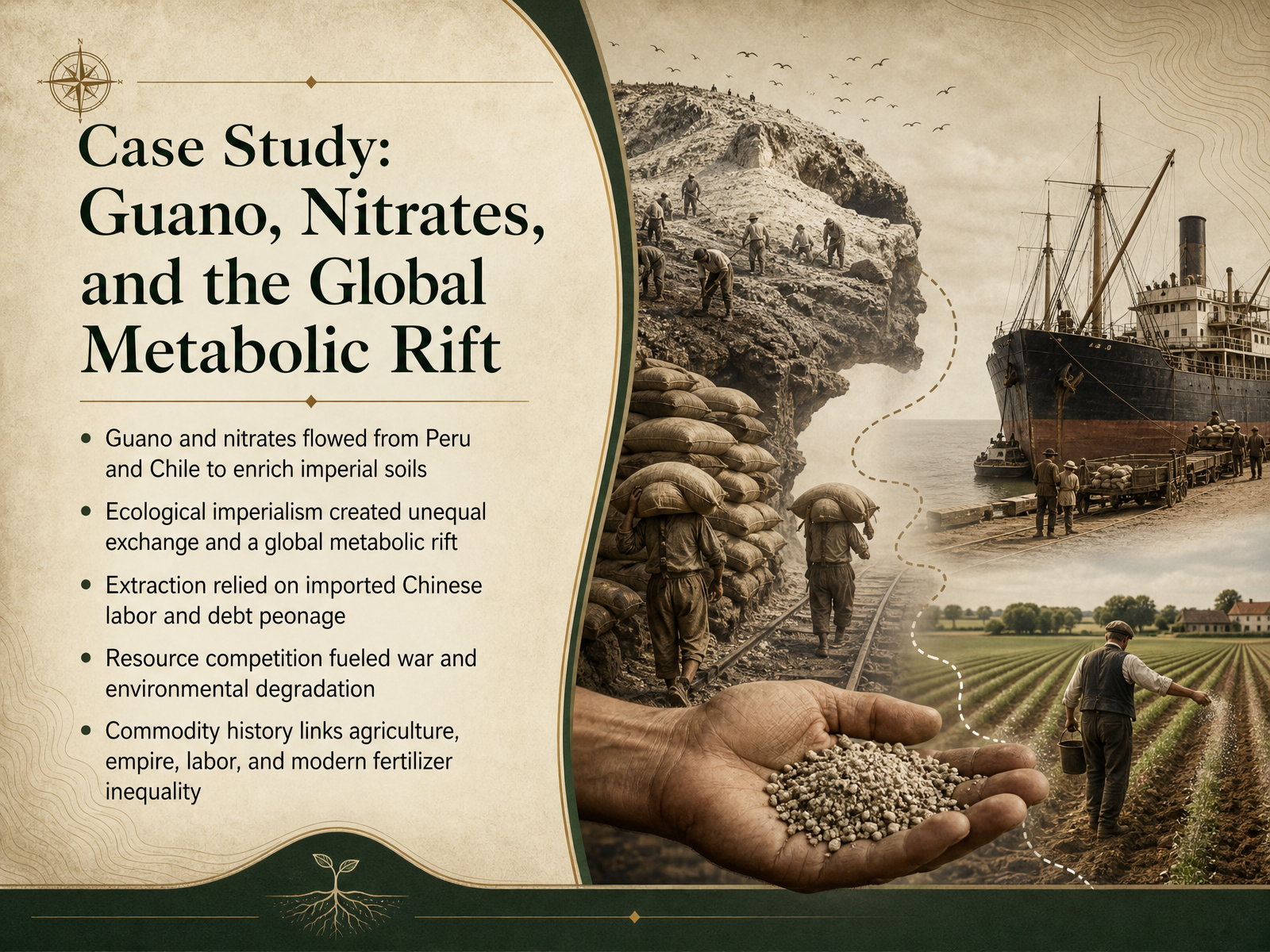
1 min - 14Case Study: Guano, Nitrates, and the Global Metabolic RiftNow let’s look at a concrete case that ties these threads together: guano, nitrates, and what scholars call the global metabolic rift. In the nineteenth century, bird droppings from Peru and nitrates from Chile flowed across the ocean to enrich soils in Britain and other imperial centers. Here, a metabolic rift means a break in the natural nutrient cycle. Instead of returning waste to the land where food was grown, the system shipped fertility itself across the globe. That created an unequal exchange. Peru and Chile exported their ecological wealth while imperial soils stayed productive. It was an environmental overdraft. But this trade also rested on imported Chinese laborers and debt peonage, showing how soil fertility was entangled with empire, forced labor, and debt. Resource competition over these deposits even fueled war, as in the War of the Pacific. So commodity history lets us see agriculture, empire, labor, and fertilizer inequality as one connected story. As we move to our final slide, we will step back and ask what synthesis and action might look like.
 2 min
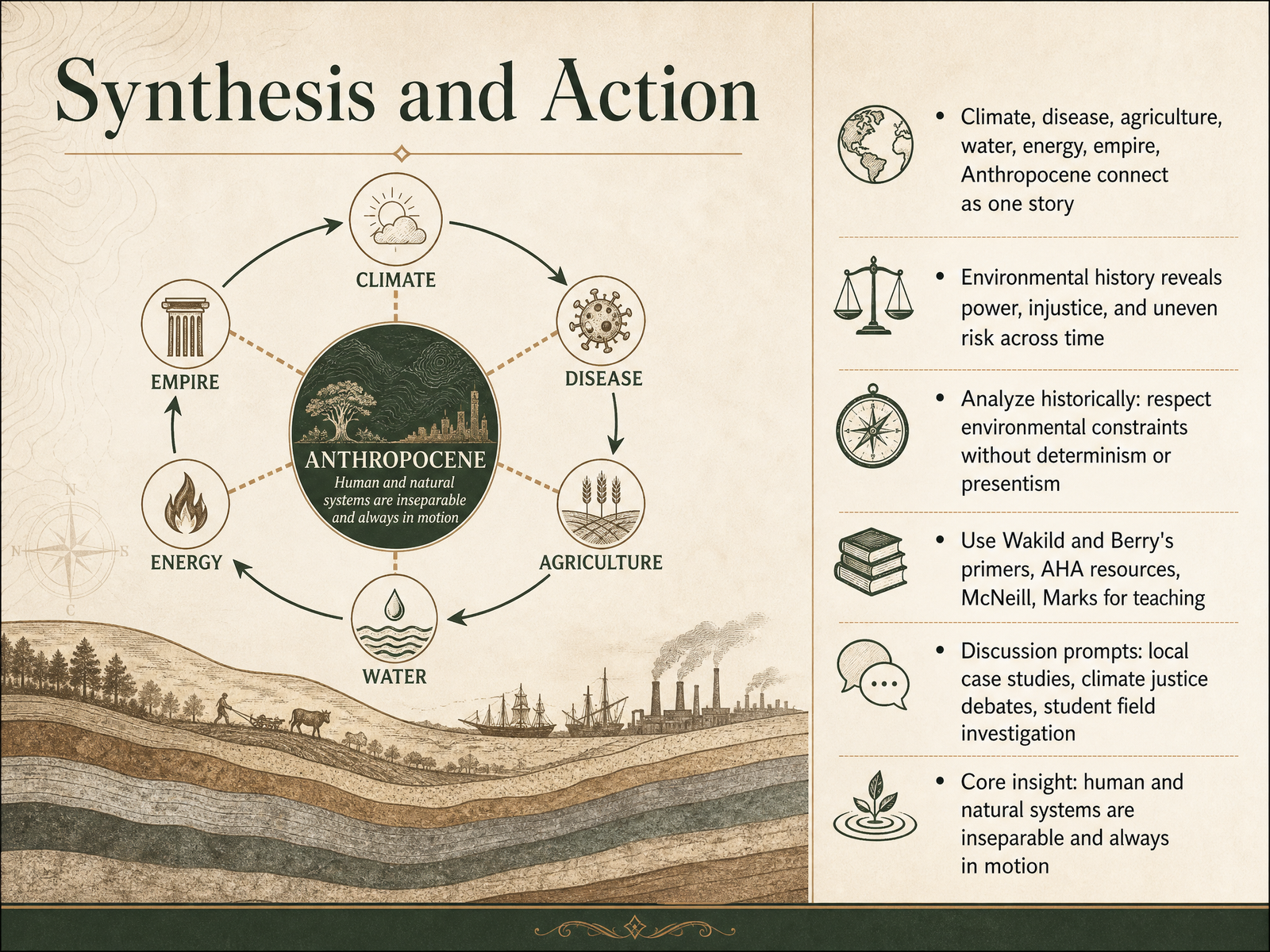
2 min - 15Synthesis and ActionSo here we are, at the place where all these threads come together. Climate, disease, agriculture, water, energy, and empire are not separate chapters. They form a single, interconnected story. And the Anthropocene, this idea that human activity has become a geological force, is the latest chapter in that unfolding narrative. But environmental history is not just a story of change. It is also a story of power. It reveals who has benefited from using nature, and who has shouldered the greatest risks. When we study the past this way, we must avoid two common mistakes. We should reject determinism, the idea that the environment simply dictates what humans do. And we should avoid presentism, judging the past only by today's values. Instead, we ask careful questions. We follow the evidence. For those of you who teach, resources from the American Historical Association, along with works by J. R. McNeill, Robert Marks, and Emily Wakild and Michelle Berry, offer excellent starting points. Consider framing discussions around local case studies or debates about climate justice. Better yet, invite students to investigate their own communities, their own watersheds, their own histories. Because the core insight of this entire course is simple and profound. Human and natural systems are inseparable, and they have always been in motion. Thank you for joining me. Now, go and look at the world around you with new eyes.
 worldhistorycommons.orgcnr.berkeley.edufiveable.me+22 min
Take the deck with you
Download this course as a file — free, no sign-up needed.
- PDF handoutEvery slide page, ready to print or share.16 pages · 6.9 MBDownload
- Narrated PowerPointThe deck that presents itself — every slide carries the digital human's narration video.16 pages · 22.0 MBDownload
- PowerPoint slidesThe full deck as a .pptx — open it in PowerPoint, Keynote, or Google Slides.16 pages · 6.9 MBDownload
Free to use in your own training — please keep the PersonWise credit page at the end.
Have your own deck? Turn it into a course
Sources consulted
Web sources consulted while building this course.
- Primer: Environmental History | World History Commons — worldhistorycommons.org
- WHAT IS ENVIRONMENTAL HISTORY — cnr.berkeley.edu
- Key Themes and Debates in Environmental History |... | Fiveable — fiveable.me
- History and Sustainability — histecon.magd.cam.ac.uk
- What is Environmental History? — environmentandsociety.org
- Reconstructing past climates | - Environmental History Resources — eh-resources.org
- High-resolution multiproxy climatic records from ice cores, tree-rings, corals and documentary sources using eigenvector techniques and maps: assessment of recovered signal and errors — journals.sagepub.com
- What Are Proxy Data? - National Centers for Environmental Information — ncei.noaa.gov
- Documentary evidence as climate proxies — st-andrews.ac.uk
- CP - A global inventory of quantitative documentary evidence related to climate since the 15th century — cp.copernicus.org
- The 4.2 ka BP climatic event and its cultural responses — sciencedirect.com
- Did a mega drought topple empires 4200 years ago? - Nature — nature.com
- Global megadrought, societal collapse and resilience at 4.2-3.9 ka BP across the Mediterranean and west Asia | PAGES — pastglobalchanges.org
- Much ado about nothing: assessing the impact of the 4.2 kya event on human subsistence patterns in northern Mesopotamia using stable isotope analysis | Antiquity | Cambridge Core — cambridge.org
- Climate change at the 4.2 ka BP termination of the Indus valley ... — agupubs.onlinelibrary.wiley.com
- Earth system impacts of the European arrival and Great Dying in the Americas after 1492 — sciencedirect.com
- The Depopulation of Hispanic America after the Conquest — ideas.repec.org
- Neotropical human–landscape interactions,fire,and atmospheric CO 2 during European conquest — sage.cnpereading.com
- The Columbian Exchange: A History of Disease, Food, and Ideas - American Economic Association — aeaweb.org
- Non-uniform tropical forest responses to the ‘Columbian Exchange’ in the Neotropics and Asia-Pacific | Nature Ecology & Evolution — nature.com