Local SEO Concepts and Applications
Begin
14 pages · ~28 min
Local SEO Concepts and Applications
Learn how local SEO boosts visibility for location-based searches, covering core concepts, strategic purposes, and real-world examples to attract nearby customers.
What you’ll learn
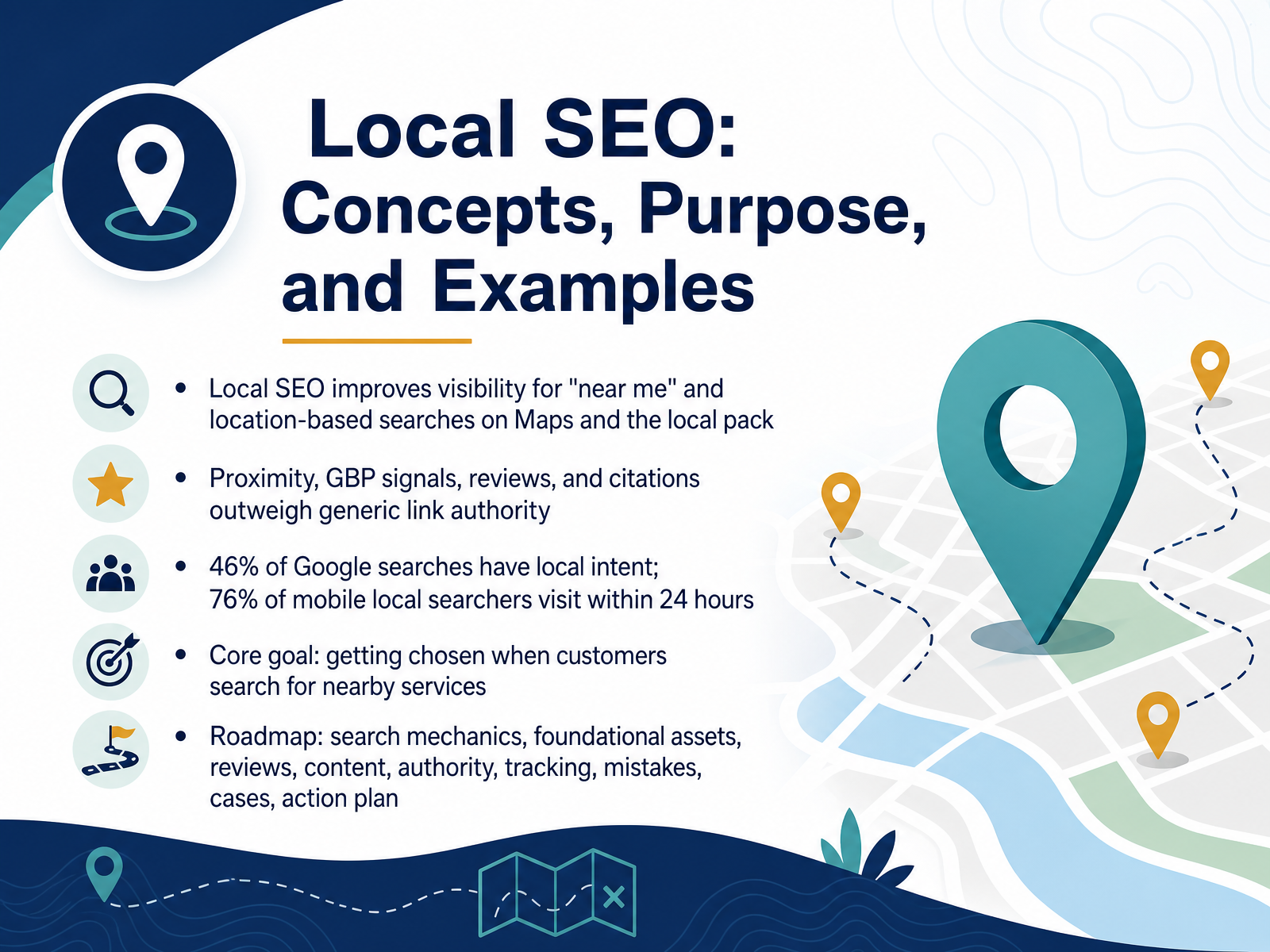
- 01Local SEO: Concepts, Purpose, and ExamplesWelcome to Local SEO: Concepts, Purpose, and Examples. If you already understand traditional SEO, the shift here is simple. We are not chasing global rankings. We are optimizing for the search that happens when a customer is ready to act in their own neighborhood. That means showing up in Google Maps and the local map pack, the set of three business listings that appears at the top of location-based searches. The signals that matter most here are proximity, your Google Business Profile, reviews, and consistent business information across the web, not just generic link authority. The data tells the story. Forty six percent of Google searches have local intent, and seventy six percent of people who run a local search on mobile visit a business within twenty four hours. The core goal is simple: get chosen when customers search for nearby services. In this course, we will cover search mechanics, foundational assets, reviews, content, authority, tracking, common mistakes, and real-world cases. By the end, you will have a practical action plan for improving local visibility. Up next, we look at how local search actually works.brightlocal.comsearchlab.nlbiziq.com+22 min
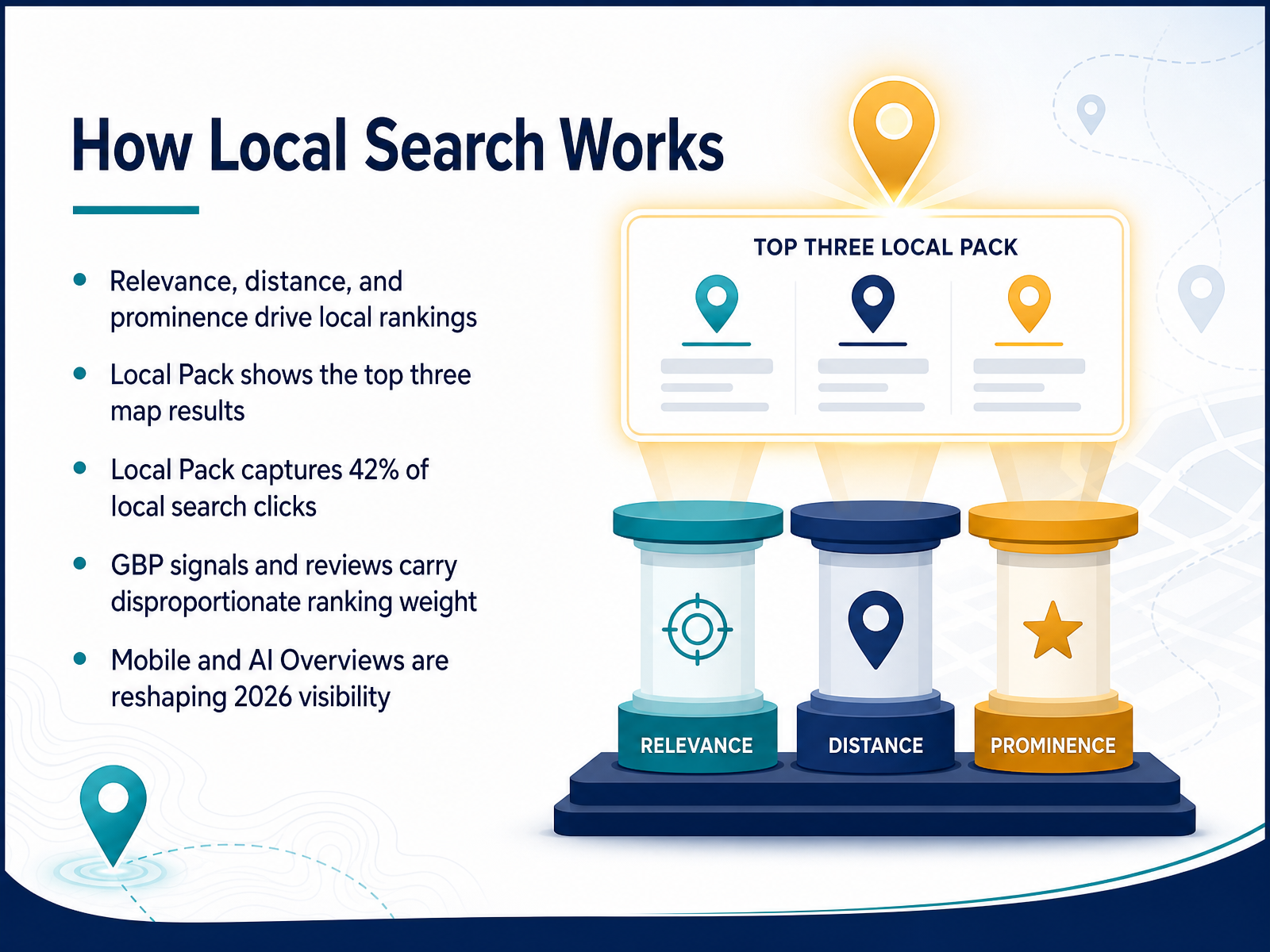
- 02How Local Search WorksNow let's get practical about how local search actually works. It is not just the same SEO algorithm with a city name added. Local rankings are driven by three core signals: relevance, distance, and prominence. Relevance is about how well your profile matches the searcher's intent. Distance is simply how close you are to the person searching. And prominence refers to how well-known and trusted your business appears online. When a query has local intent, Google surfaces what is called the Local Pack, which is the top three map results shown above the standard links. And those three spots matter. The Local Pack captures forty-two percent of all clicks on local search results. If you are outside of it, you are fighting for the remaining attention. So, which signals move you into those spots? Your Google Business Profile signals and your reviews carry a disproportionate amount of weight. In fact, these two areas combine to influence roughly half of what drives Map Pack rankings. This means having a precise primary category and a steady flow of recent reviews often outperforms simply being physically closer. Finally, the surface itself is shifting. Mobile searches and AI Overviews are increasingly shaping visibility in 2026, so your information must be structured and accurate. Up next, we will look at how customers actually move through the decision process in Mapping the Customer Journey.
 support.google.combrightlocal.combirdeye.com+21 min
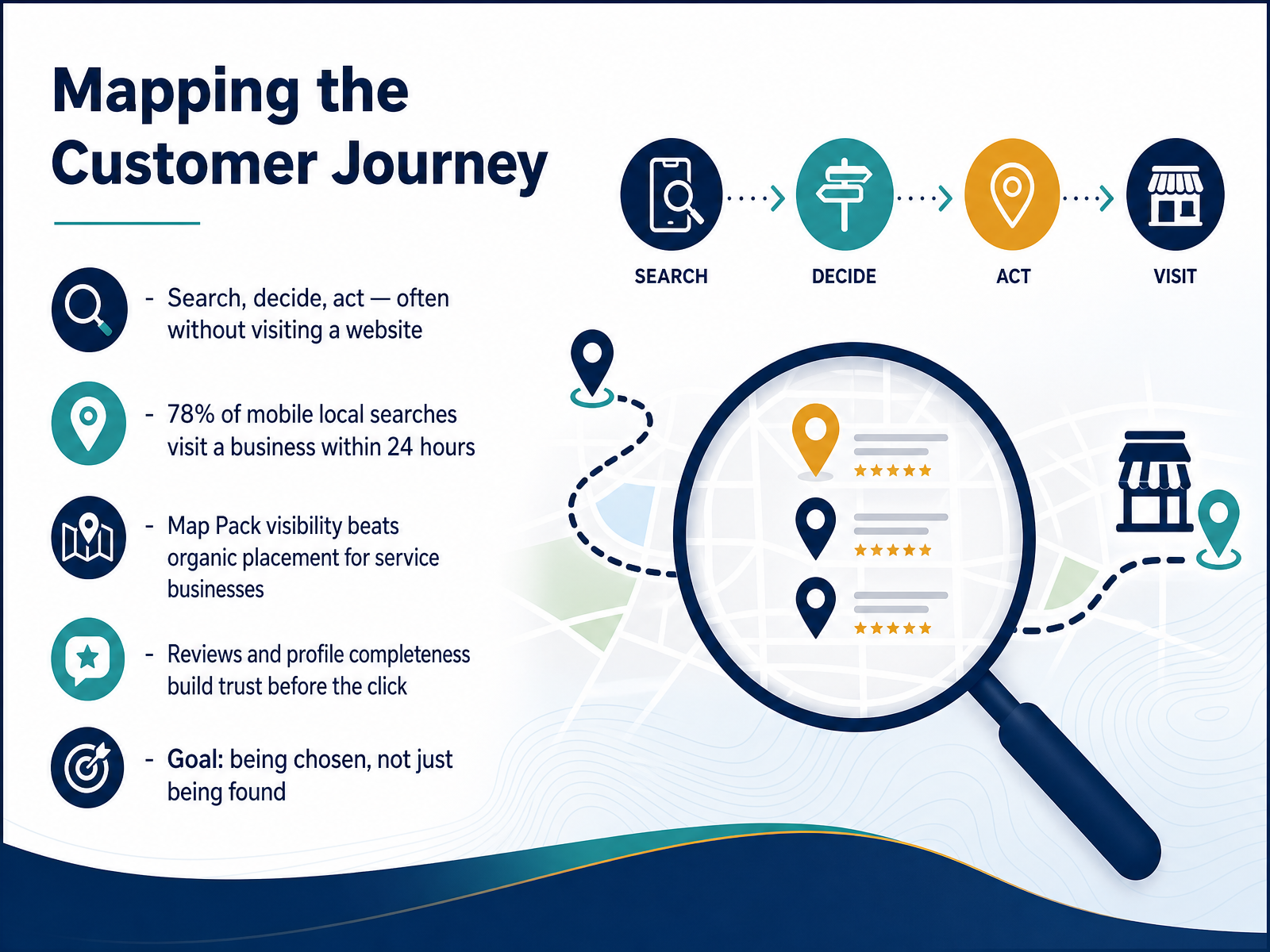
 - 03Mapping the Customer JourneyNow, let's map the actual customer journey, because the path from search to sale is shorter than ever. A potential customer searches, decides, and acts, often without ever visiting your website. The data backs this up. Roughly seventy-eight percent of people who do a local search on their phone visit a related business within twenty-four hours. For service businesses, being visible in the Map Pack, that block of three results under the map, usually beats ranking in the regular blue links below it. But visibility is only the first step. Reviews and a complete profile build trust before a customer even clicks, and trust is what turns a search into a choice. So the goal is not just being found. The goal is being chosen. Next, we'll look at the tool that makes that possible: your Google Business Profile as the local storefront.
 brightlocal.comsearchlab.nlbiziq.com+22 min
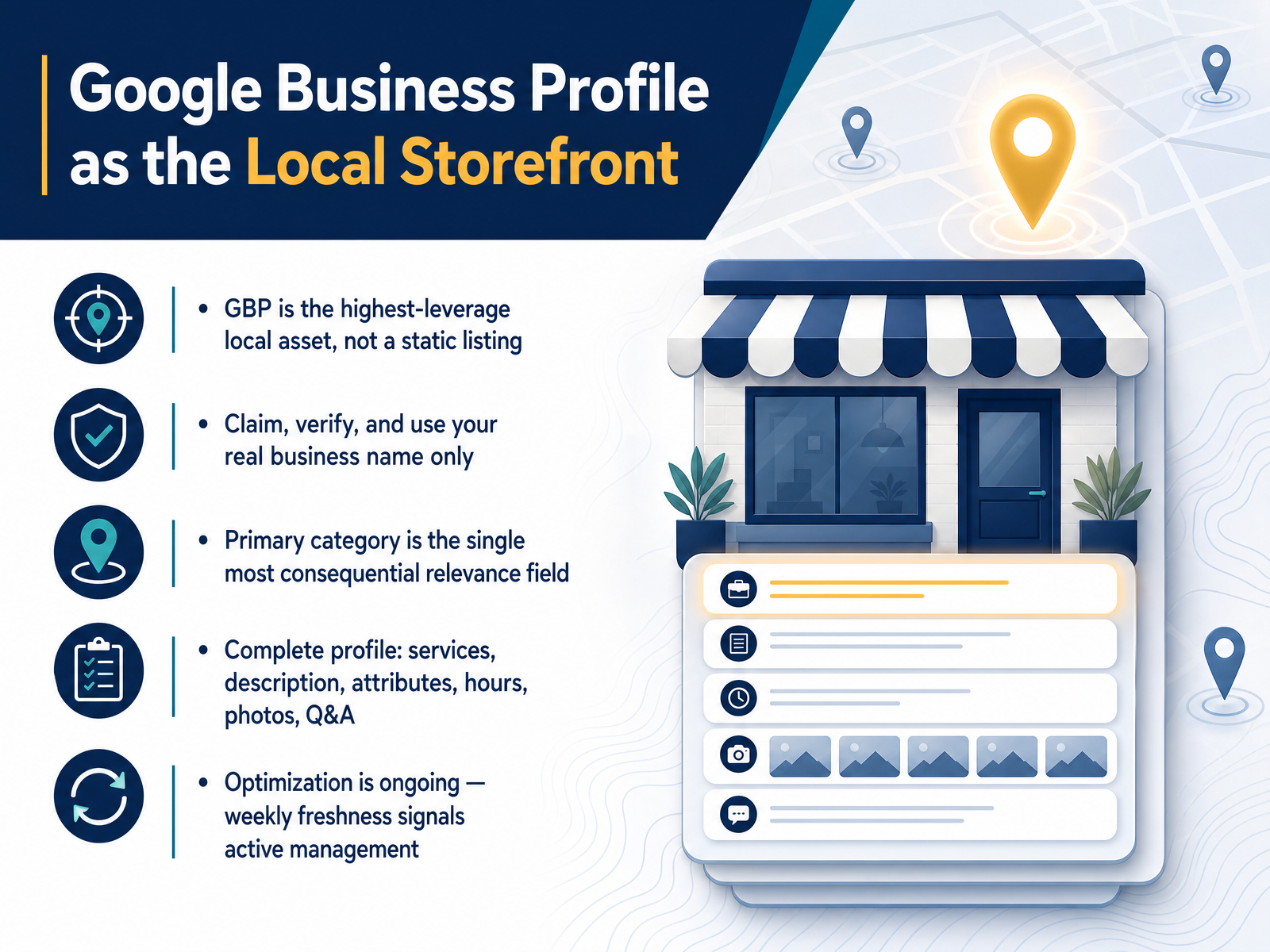
 - 04Google Business Profile as the Local StorefrontNow let's focus on your Google Business Profile, which functions as your local storefront. Think of this as the highest-leverage asset you control. It is not simply a static listing that sits there. It is a live profile that can directly influence whether you show up in the local map pack. First, you must claim and verify the profile. If you do not own it, you cannot manage or optimize it. Use your real business name only. Do not add keywords or city names to the title, because Google flags this and it can lead to a suspension. Next, pay very close attention to the primary category. This is the single most consequential relevance field you have. It tells Google exactly what kind of business you are, and that determines the search queries where you are eligible to rank. Choosing the most specific category, like Emergency Plumber instead of just Plumber, can dramatically improve your visibility. After that, complete the rest of the profile. Fill out services, descriptions, attributes, hours, photos, and the Q&A section. A dense, complete profile signals authority and gives customers the information they need to convert. Finally, keep the profile fresh. Regular updates show Google that the business is actively managed, which supports stronger local performance. Up next, we will talk about NAP Consistency and Local Schema.
 thesearchsherpa.comflento.iodollyseo.com+22 min
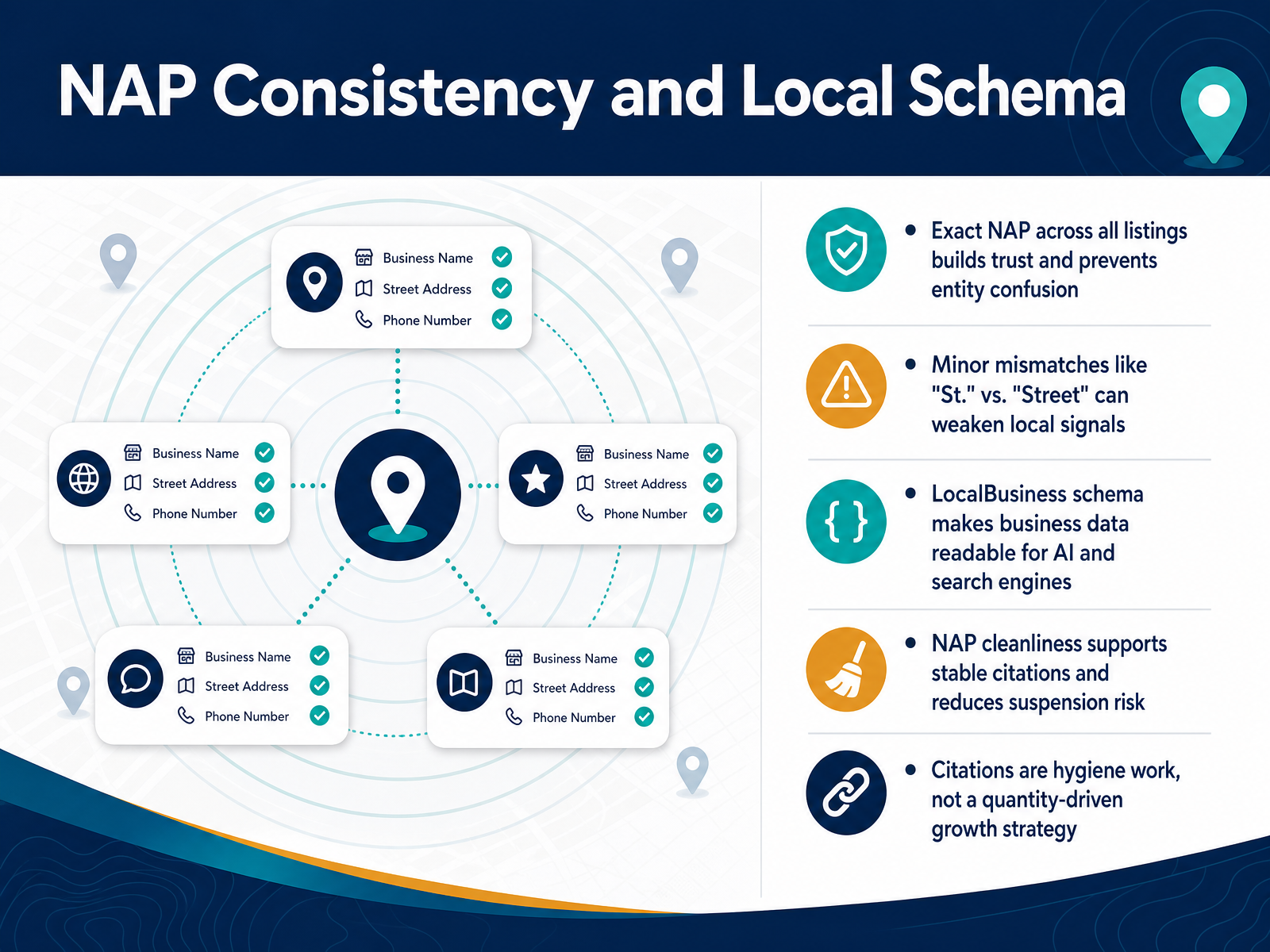
 - 05NAP Consistency and Local SchemaNext, let's talk about the data layer of local SEO: NAP consistency and local schema. NAP stands for Name, Address, and Phone number. Exact NAP across your website, Google Business Profile, and every directory listing builds trust. It prevents Google from confusing your business with another entity. Even minor mismatches matter. A profile that says Street and a directory that says the abbreviation can weaken your local signals. Clean, consistent NAP also supports stable citations. It reduces the risk of suspension from data conflicts. Now, think of citations as hygiene work, not a growth hack. More citations are not always better. A smaller set of accurate, verified listings is what actually helps. On the website side, LocalBusiness schema makes your structured data readable for search engines and artificial intelligence. It confirms key facts like hours and location in a format machines can parse directly. This supports richer results and clearer entity matching. So the takeaway is simple: keep your data exact, keep citations clean, and use schema to remove ambiguity. That foundation leads us directly into our next topic: reviews as a ranking and trust lever.
 thesearchsherpa.comflento.iodollyseo.com+22 min
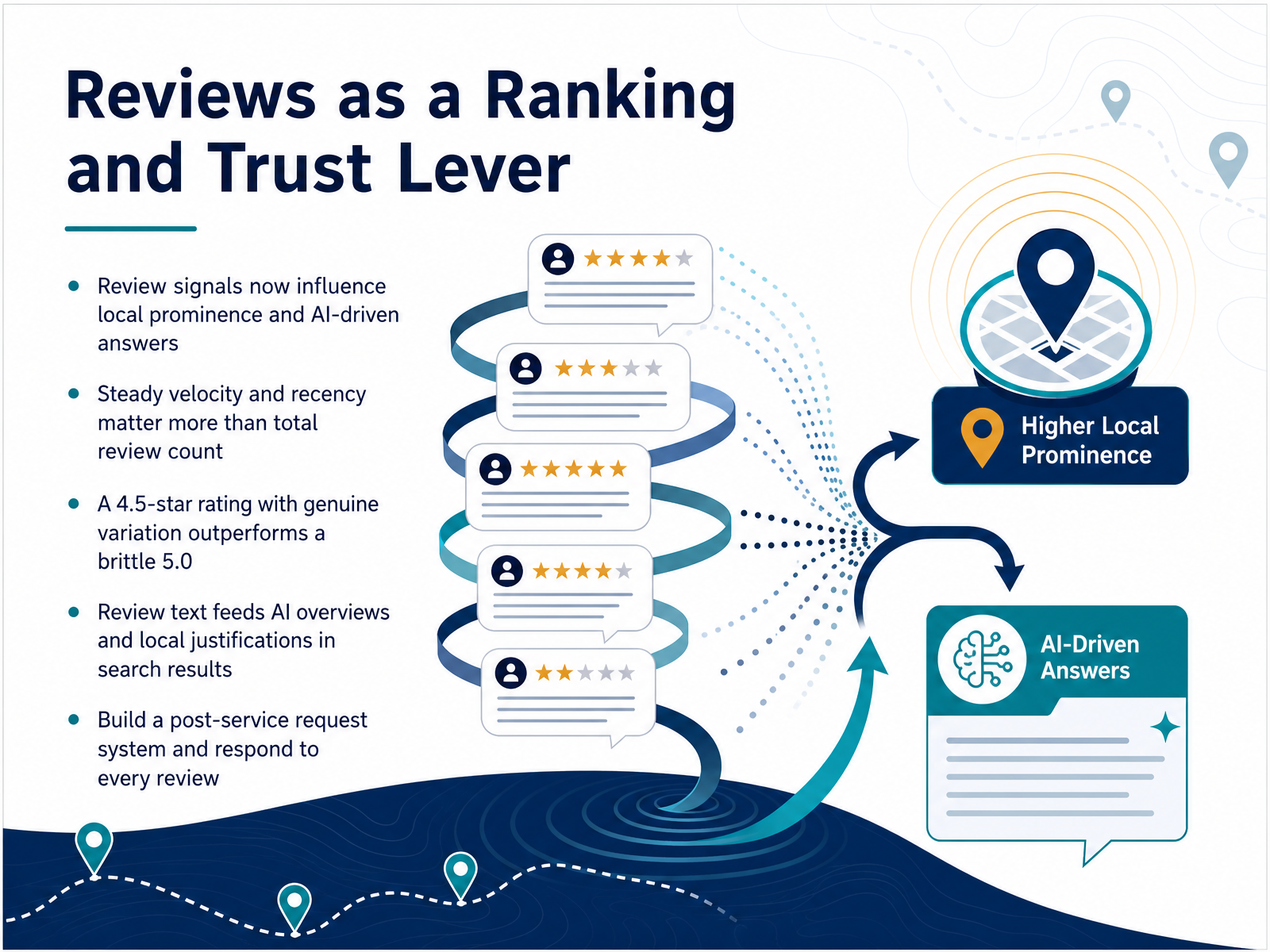
 - 06Reviews as a Ranking and Trust LeverNow let's talk about where reviews do the heaviest lifting. Reviews are no longer just a trust signal for shoppers. They have become a direct ranking input and a source of content for AI answers. When Google decides who belongs in the map pack, it weighs review signals heavily. Specifically, it looks at velocity and recency. A steady flow of a few new reviews each month usually outperforms a large batch from two years ago. Fresh activity tells Google you are still in business and serving customers. We also see a shift away from chasing a perfect five point zero. A four point five rating with some natural variation looks more credible to both searchers and Google's filters than a brittle five stars with zero complaints. The text inside reviews matters too. When a customer mentions a specific service or your city, that language feeds the local justifications in search results and helps AI engines understand what you actually do. So, how do you operationalize this? You need a system. Ask for a review shortly after the job is done, send a direct link, and commit to responding to every single review, good or bad. Next, we will look at how to turn these individual reviews into a long-term reputation system.
 rankite.comfokal.comrevioreputation.com+21 min
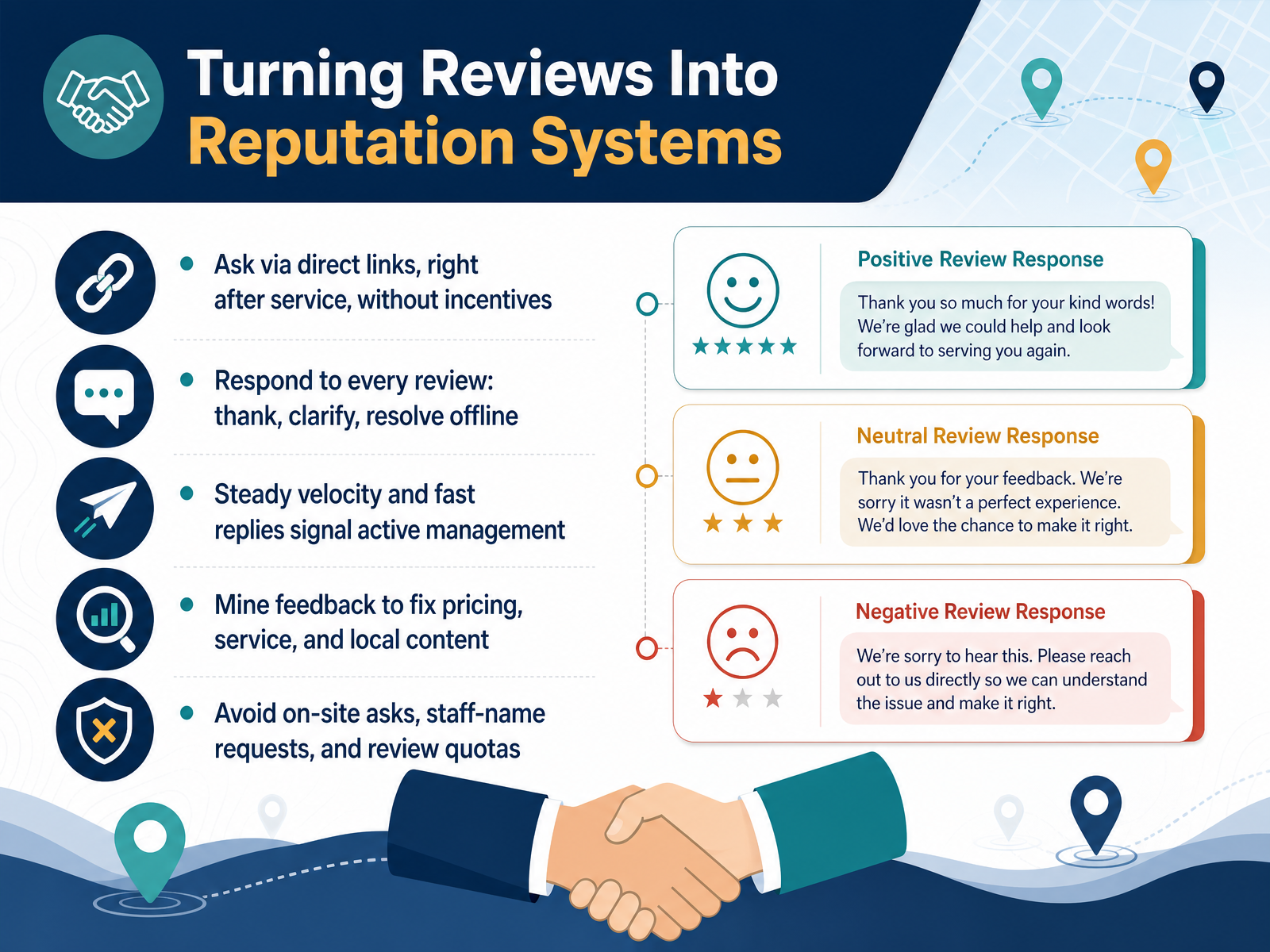
 - 07Turning Reviews Into Reputation SystemsNow, let's turn reviews from scattered feedback into a reputation system you actually control. The most durable approach is to ask for reviews through direct links immediately after service, without offering incentives. That keeps the ask simple and compliant. Then respond to every review, both positive and negative. Thank the customer, clarify any misunderstanding, and move difficult conversations offline to resolve them privately. A steady flow of new reviews plus fast replies signals to Google that the business is actively managed. Beyond ranking, mine that feedback. If customers repeatedly mention pricing confusion or a specific service issue, fix it in your operations and reflect the change in your local content. Equally important is what to avoid. Do not ask customers to leave reviews while they are still on site, do not ask them to name specific staff members, and do not set internal review quotas for employees. These practices now risk review removal or profile penalties. The point is to build a review process that looks natural, feels genuine, and compounds trust over time. Up next, we will cover local link building and citation strategy.
 rankite.comfokal.comrevioreputation.com+22 min
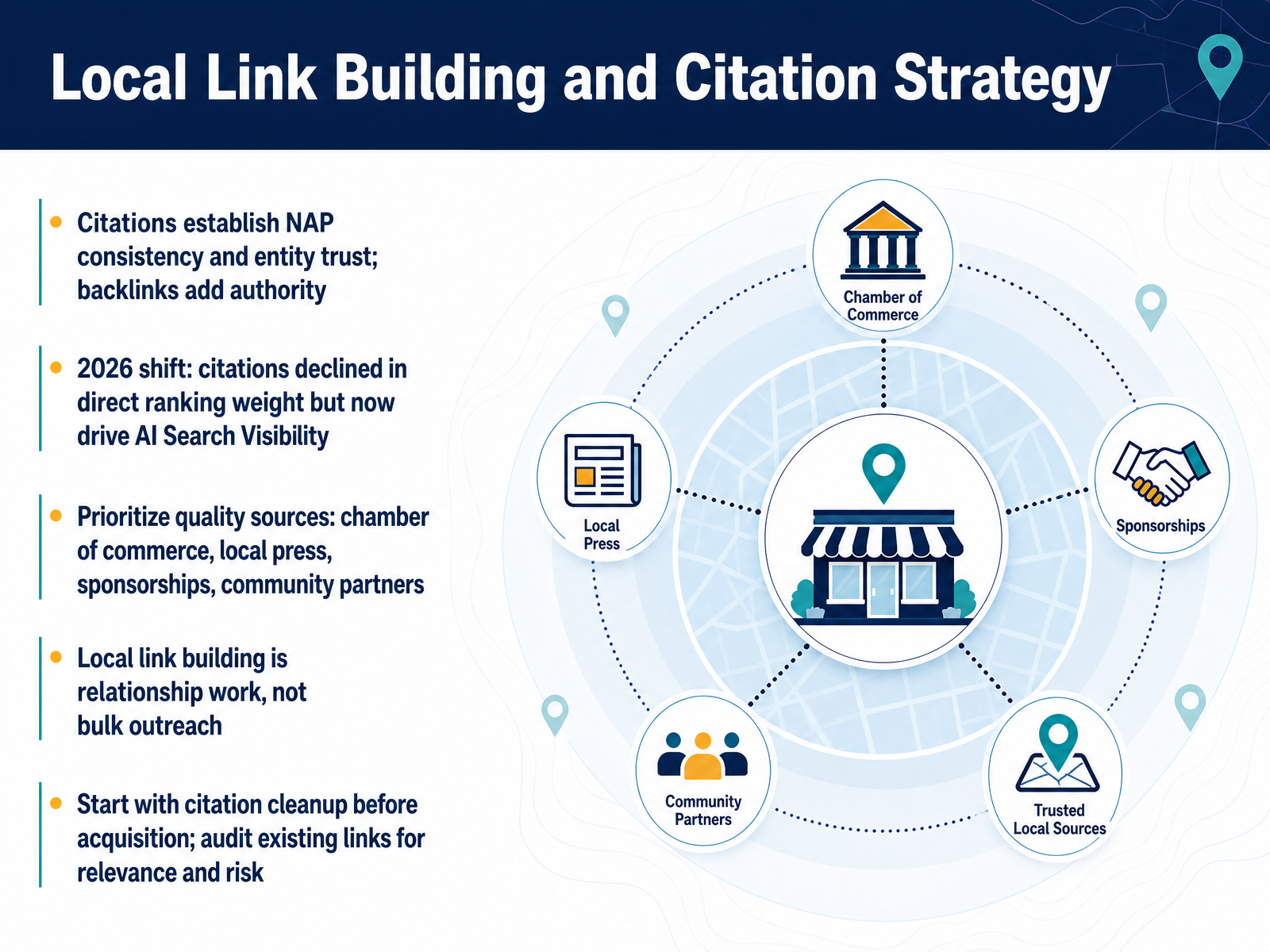
 - 08Local Link Building and Citation StrategyNow let's talk about the relationship side of local search: link building and citations. Citations are simply consistent mentions of your business name, address, and phone number across directories. They establish trust that Google uses to verify your business. Backlinks from local websites add authority and prominence. In 2026, citations carry less direct ranking weight than they once did. But they now play a major role in AI search visibility. When ChatGPT or Google's AI Overviews decide which local business to recommend, they look at citation consistency and quality sources. Prioritize the places that matter in your community: your chamber of commerce, local press, event sponsorships, and community partners. Think of this as relationship work, not bulk outreach. A single mention in your city's newspaper outperforms dozens of generic directory links. Before chasing new links, start with a cleanup. Audit your existing citations for accuracy and relevance. Fix inconsistencies first. That prevents bad data from canceling out your good work. Next, we'll turn to the content and on-site signals that reinforce everything we've covered.
 support.google.combrightlocal.combirdeye.com+21 min
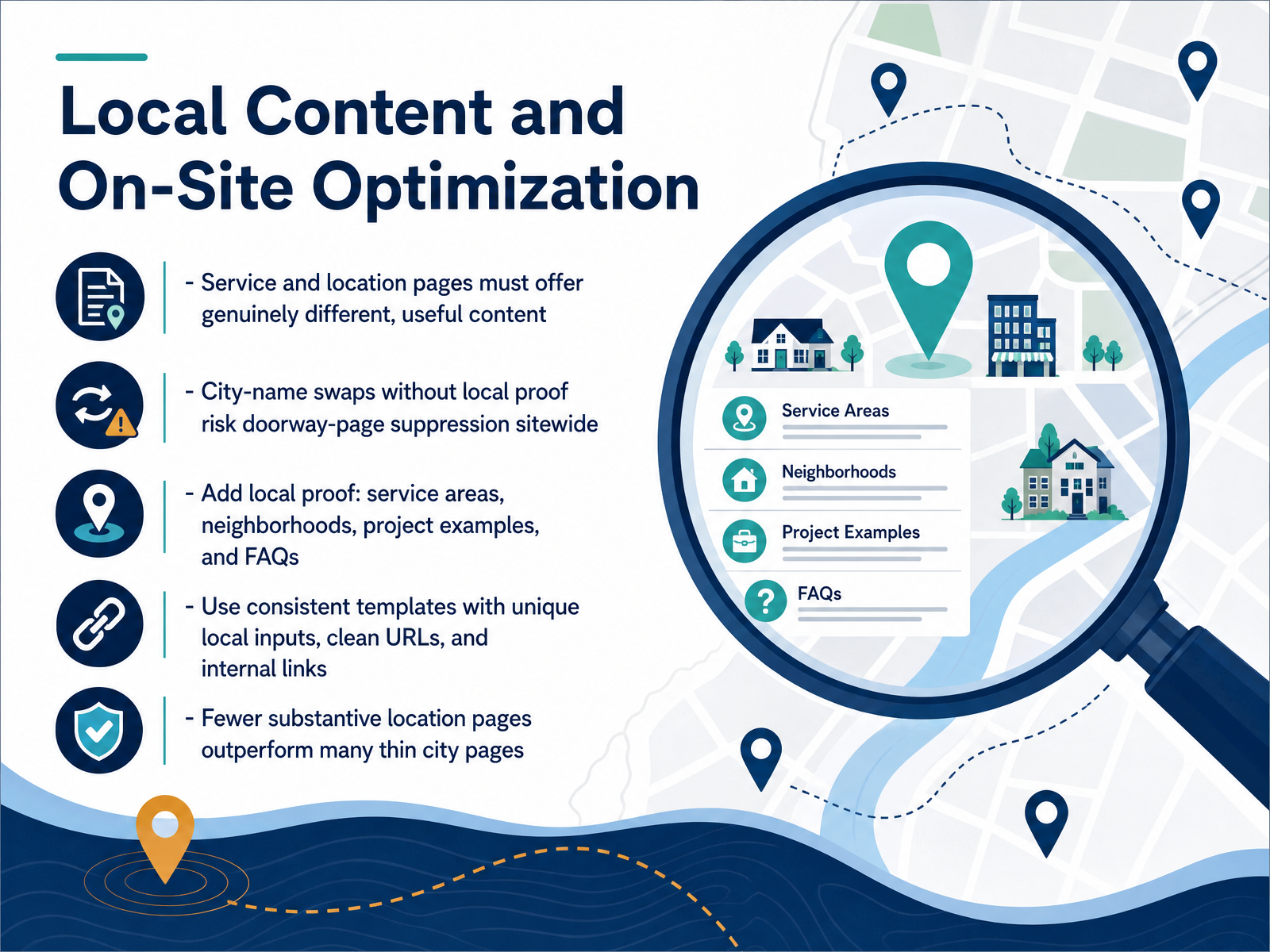
 - 09Local Content and On-Site OptimizationNow, the local content on your own site. This is where a lot of local SEO efforts quietly fail. The rule is simple. If you have a page for Denver and a page for Boulder, and the only thing that changes is the city name, Google will likely treat those pages as doorway pages, and that risk can pull down the whole site. Instead, make each page genuinely different. Add local proof: the neighborhoods you actually serve, real project examples from that area, and FAQs that answer questions people in that market actually ask, like response times or permit rules. Use a consistent template, that is fine. But fill each page with unique local inputs, keep URLs clean, and link related pages together naturally. And remember, fewer substantive location pages will almost always outperform a long list of thin city pages. A clear seven hundred word page with real local detail beats five near-identical pages every time. Next, let's move from pages to measurement, and talk about tracking what actually happens.
 1 min
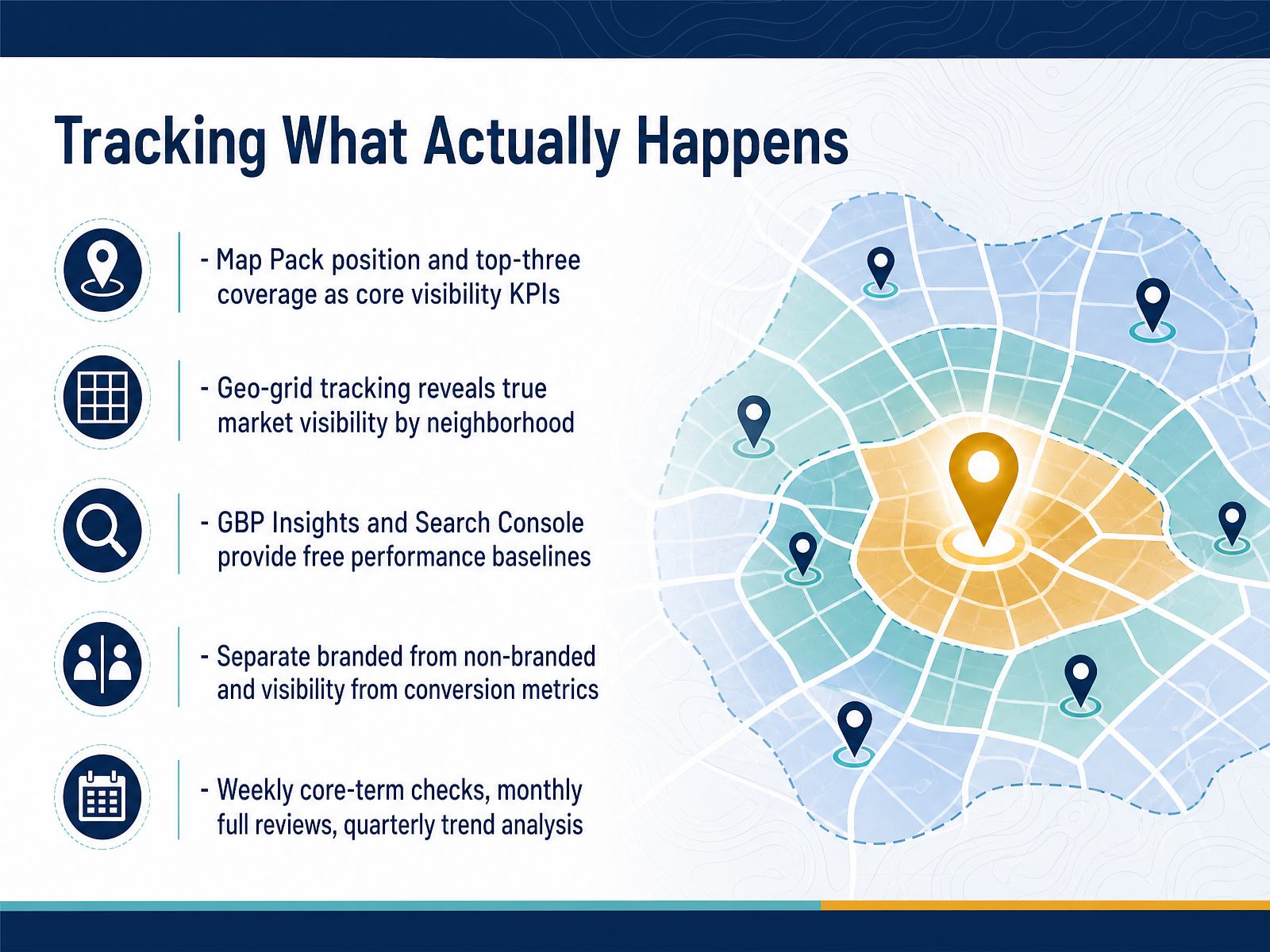
1 min - 10Tracking What Actually HappensTracking what actually happens means moving beyond a single number. Start with Map Pack position and top-three coverage. The Map Pack is that block of three local results at the top of a search, and showing up there is where most local clicks live. Track it for your top five to ten keywords. Then use geo-grid tracking to see real market visibility by neighborhood. A single average rank hides the fact that you may rank first near your office and twelfth across town. Geo-grid scans reveal exactly where you win and where competitors beat you. For free performance baselines, use Google Business Profile Insights and Search Console. They show profile views, calls, direction requests, and the queries triggering your listing. Keep your metrics clean by separating branded searches from non-branded ones, and visibility from conversion. Showing up is not the same as a customer calling. Finally, set a realistic cadence. Check core terms weekly, run a full review monthly, and analyze trends quarterly. That rhythm catches real shifts without chasing daily noise. Next, we will look at common mistakes that restrict local visibility.
 2 min
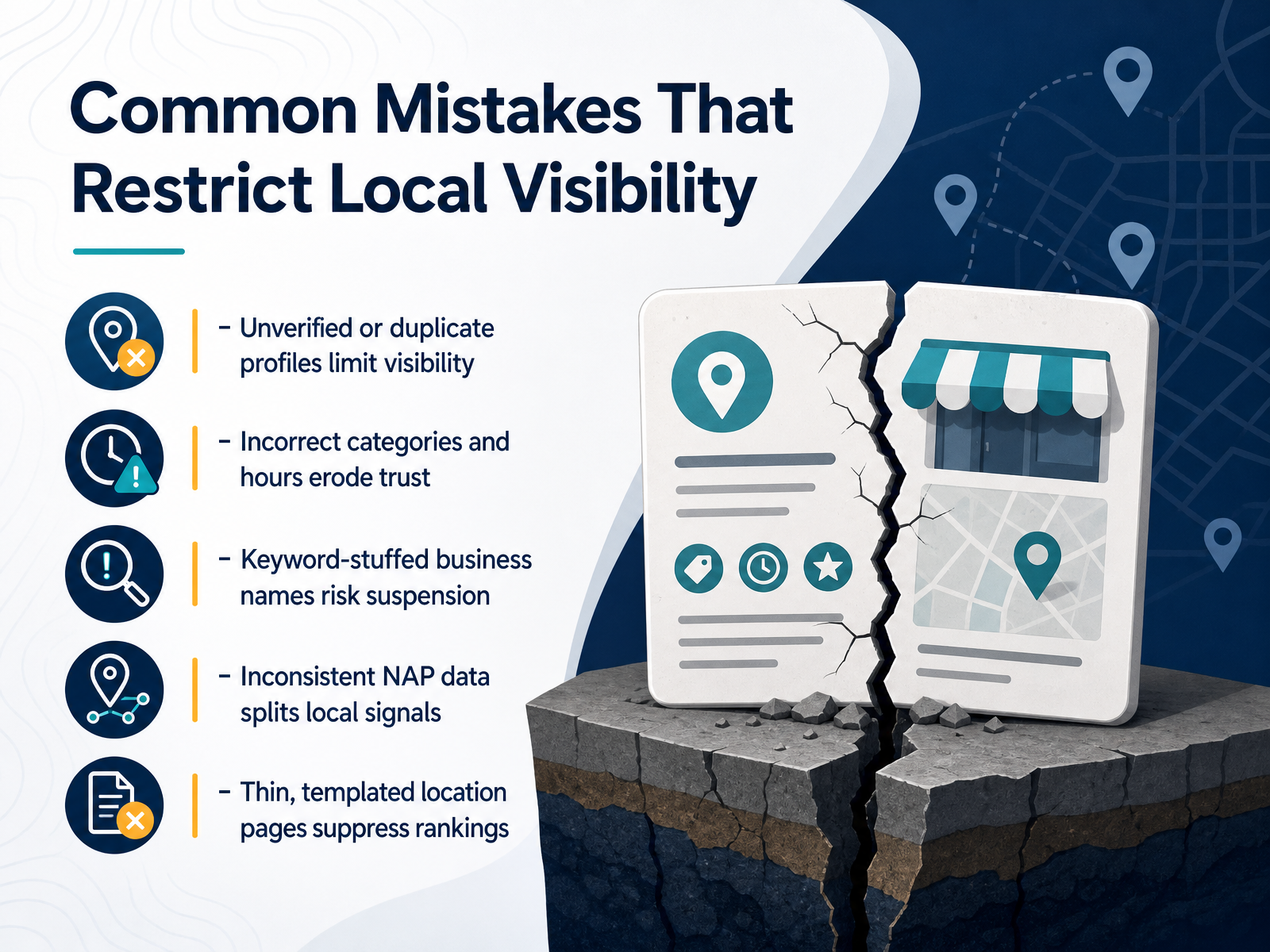
2 min - 11Common Mistakes That Restrict Local VisibilityNow, let's look at the mistakes that quietly cap your visibility. The first is unverified or duplicate profiles. Google treats these as low-trust signals, and they can limit whether you show up at all. Next, incorrect categories and hours. A customer who finds you closed when they arrive stops trusting you, and Google picks up similar reliability signals. Keyword stuffing in your business name is riskier now. Adding city or service keywords that aren't part of your real brand can lead to suspension, taking you out of search entirely. Inconsistent NAP data is another common problem. If your name, address, and phone number vary across directories, Google cannot confidently merge those signals, so your local authority gets split. Finally, thin location pages. If every service area page says the same thing with a different city name, they can suppress your rankings as doorway content. The fix, for each, is operational: verify, correct, align your details, and give each page real local proof. Up next, we'll walk through case examples that show what strong local visibility actually looks like.
 1 min
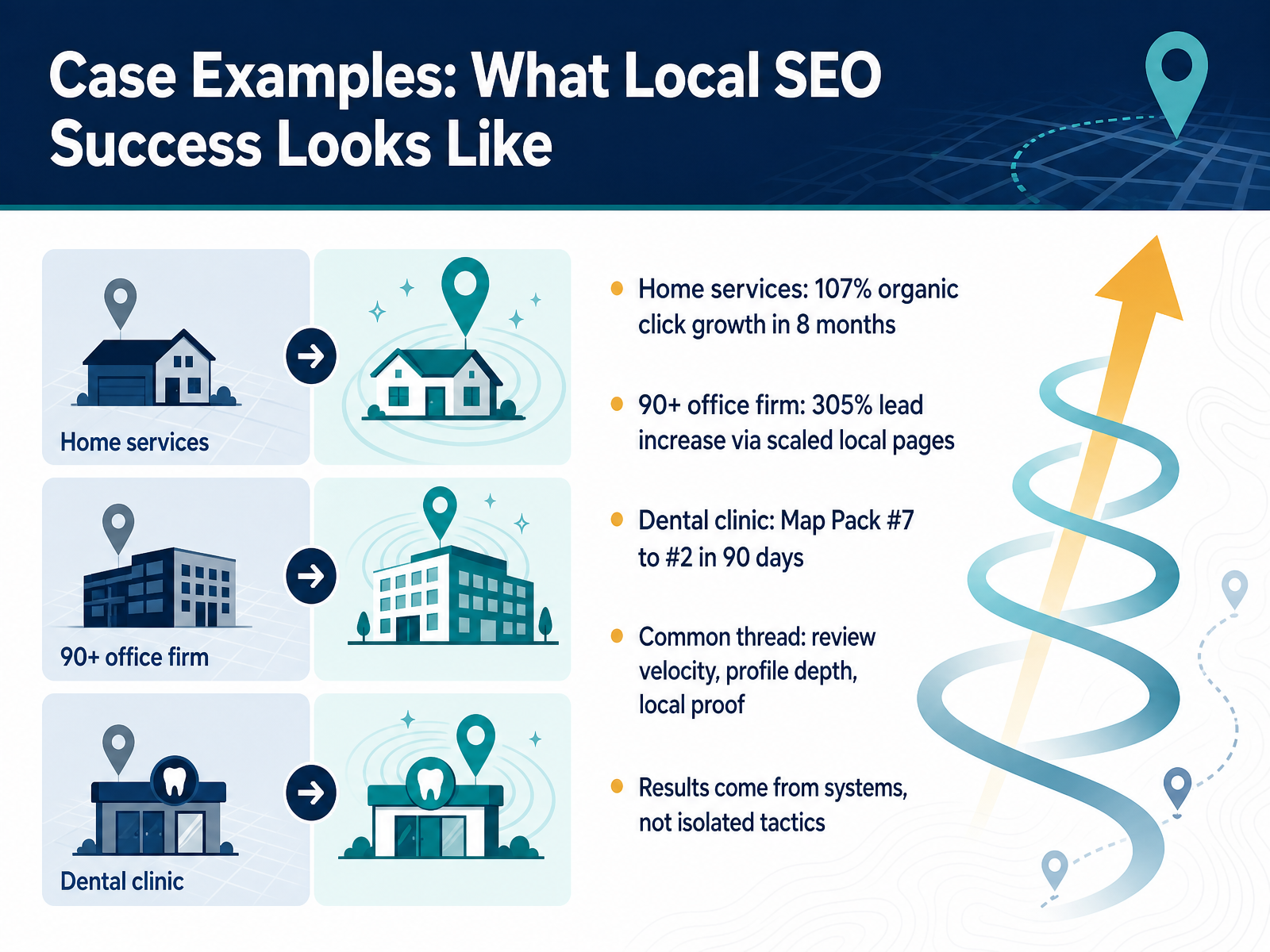
1 min - 12Case Examples: What Local SEO Success Looks LikeLet’s look at what these systems actually produce in the real world. A home services company in California ran an eight month local SEO program and saw organic clicks grow one hundred seven percent, with their hometown clicks up even more. A financial firm with over ninety offices restructured its local pages around how people search, and organic leads increased three hundred five percent. A dental clinic moved from position seven to position two in the map pack in ninety days, and calls from their Google Business Profile rose eighty nine percent. The thread connecting all three is the same. Review velocity, meaning a steady flow of fresh reviews, profile depth, and local proof from real customers. None of these wins came from a single clever tactic. They came from consistent, connected work. Next, we’ll map out an actionable local SEO workflow so you can apply the same discipline to your own business.
 rankite.comfokal.comrevioreputation.com+21 min
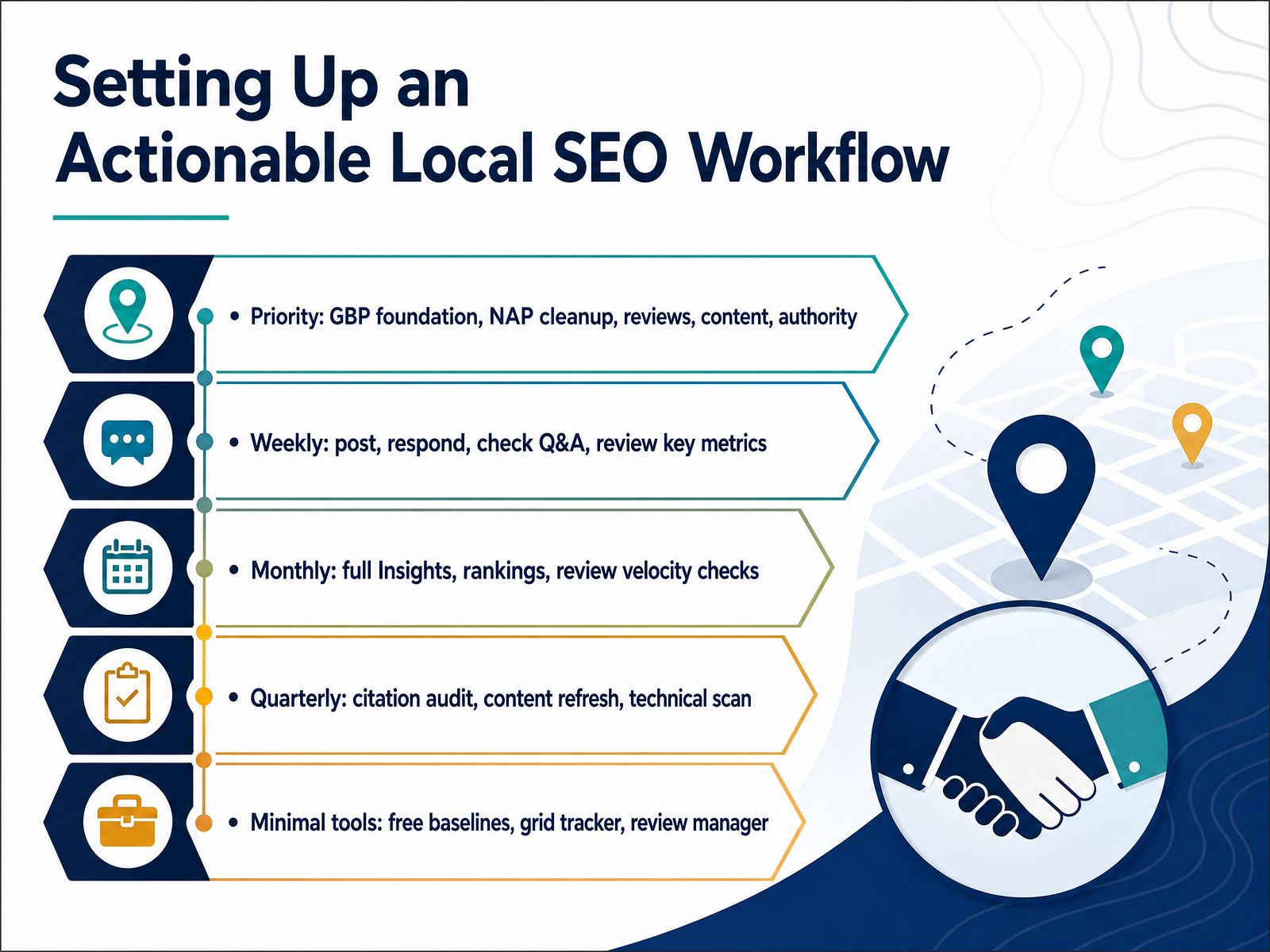
 - 13Setting Up an Actionable Local SEO WorkflowNow let's turn this strategy into a repeatable workflow. Think of local SEO as a maintenance game, not a one-time setup. Your top priority should be your Google Business Profile, or G B P. Keep it complete and active. Then clean up your NAP data, which is your name, address, and phone number. Make sure they're identical everywhere. Next, focus on review velocity, fresh content, and building local authority. For weekly tasks, publish a post, respond to all new reviews, and check your Q&A section. Keep a close eye on key metrics like calls and direction requests. Every month, do a full review of your G B P Insights, check your rankings, and track how many new reviews you're getting. Then every quarter, run a citation audit, refresh your top service pages, and scan for technical issues. The good news is you don't need a massive tool stack to start. Use free baselines from G B P Insights and Search Console. You'll also want a grid tracker to understand where you rank across your service area, and a review manager. Next, let's look at the key takeaways and the immediate steps you should take.
 2 min
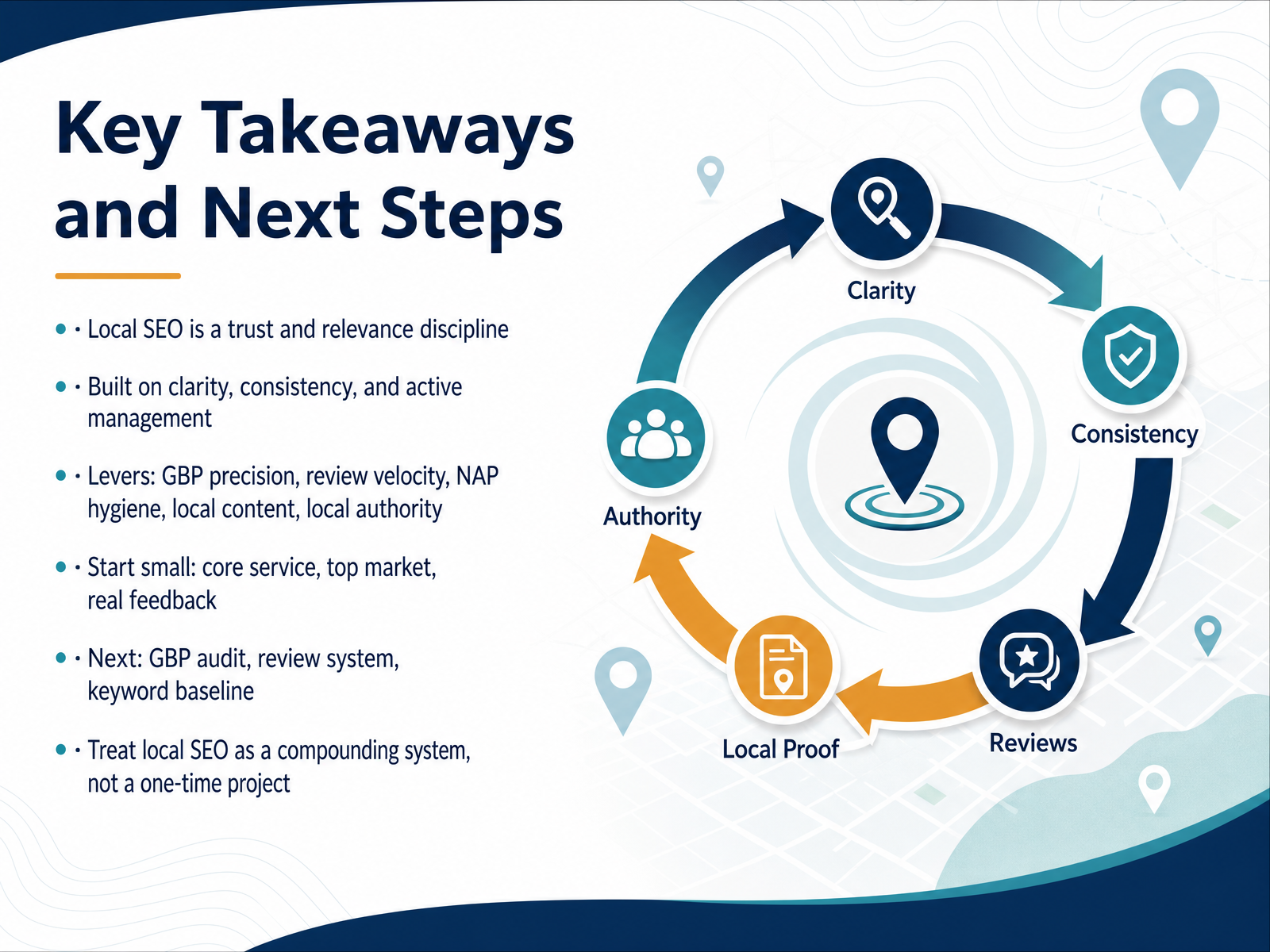
2 min - 14Key Takeaways and Next StepsLocal SEO isn't a project with a finish line. It's a business discipline built on trust and relevance. The foundations are simple. Keep your business information clear and consistent. Actively manage your Google Business Profile, your reviews, and your local content. If you're feeling overwhelmed, don't try to fix everything at once. Start small. Pick your core service and your top market. Get real feedback from real customers. Your immediate next steps are a quick audit of your Google Business Profile, a simple system for asking for reviews, and a baseline snapshot of your current keyword rankings. From there, treat this work as a compounding system. Small, consistent effort adds up over time. Clarity gets you found. Consistency builds trust. Active management keeps you visible. Thanks for joining, and go put this into practice.
 brightlocal.comsearchlab.nlbiziq.com+21 min
Take the deck with you
Download this course as a file — free, no sign-up needed.
- PDF handoutEvery slide page, ready to print or share.15 pages · 3.7 MBDownload
- Narrated PowerPointThe deck that presents itself — every slide carries the digital human's narration video.15 pages · 14.4 MBDownload
- PowerPoint slidesThe full deck as a .pptx — open it in PowerPoint, Keynote, or Google Slides.15 pages · 3.6 MBDownload
Free to use in your own training — please keep the PersonWise credit page at the end.
Have your own deck? Turn it into a course
Sources consulted
Web sources consulted while building this course.
- 35+ Local SEO Statistics You Need for 2026 — brightlocal.com
- Local SEO Statistics 2026 | 50+ Data Points on Local Pack, Reviews & GBP — searchlab.nl
- Local SEO Statistics 2026: 85 Data Points That Change Everything — biziq.com
- Local SEO in 2026: A Complete Guide to the Map Pack — seobeni.com
- Local SEO Statistics 2026: 16 Data Points — shopify.com
- Tips to improve your local ranking on Google — support.google.com
- Google's Local Algorithm and Local Ranking Factors — brightlocal.com
- What Is the Google Local Pack? 2026 Ranking Guide | Birdeye — birdeye.com
- Local SEO 2026: what moves the Google Local Pack | Traficum — traficum.com
- Local SEO Ranking Factors: What Actually Moves the Needle in 2026 | Chris Brannan — cwbrannan.com
- Google Business Profile Optimization Checklist: 42 Items for 2026 | The Search Sherpa — thesearchsherpa.com
- Google Business Profile Optimization: The Complete 2026 Checklist | Flento — flento.io
- Google Business Profile Checklist (2026): 39 Fixes for More Calls — dollyseo.com
- Google Business Profile Optimization: 2026 Checklist — sbnmktg.com
- The Complete Google Business Profile Optimization Checklist | AdIQ Learning Center — front.adiq.com
- Do Google Reviews Help SEO? Local Ranking Guide (2026) — rankite.com
- Google Reviews and Local SEO: How to Rank and Convert | Fokal Guides — fokal.com
- Local SEO 2026: Do Reviews Beat Backlinks? [Data] — revioreputation.com
- Why Google Reviews Matter for Local SEO in 2026 — needmoxie.com
- How Google Reviews Impact Local Rankings in 2026 | Local SEO Guide — yogrowsolutions.com