Digital Marketing Fundamentals
Begin
14 pages · ~28 min
Digital Marketing Fundamentals
Digital marketing fundamentals training covering why it matters for business success; learners will understand key concepts, channels, and strategies to reach and engage target audiences effectively.
What you’ll learn
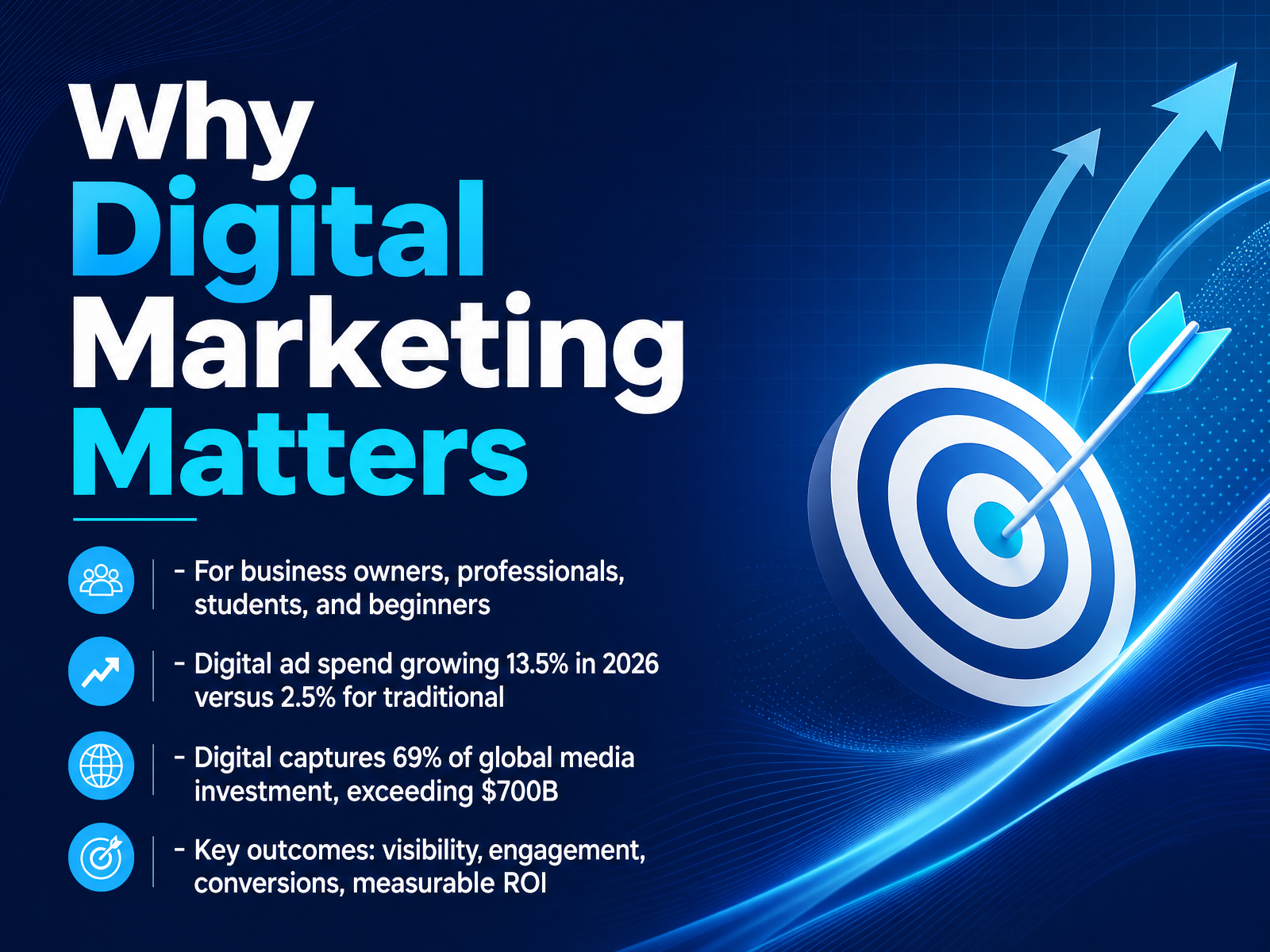
- 01Why Digital Marketing MattersHello and welcome. Today, we're talking about why digital marketing matters, and who it's for. Whether you're a business owner, a working professional, or a student just starting out, this is your space. Think of digital marketing as today's most essential business tool. Not a tech mystery, but a practical way to grow. Here's why. By twenty twenty-six, digital ad spending worldwide is set to grow thirteen point five percent. Traditional media? Just two point five percent. That's a huge gap. Digital now captures sixty-nine percent of all global media investment. We're talking over seven hundred billion dollars. Money is flowing where the people are, and people are online. What does this mean for you? It means real, measurable outcomes. Better visibility for your brand, deeper engagement with your audience, more conversions, and a clear, measurable return on investment you can actually track. Digital marketing puts you in control. It's the direct path to reaching the right people, at the right time, and proving your efforts are working. Next, let's step into the customer's shoes and explore 'The Digital-First Consumer: A New Reality'.emarketer.comemarketer.comemarketer.com+22 min
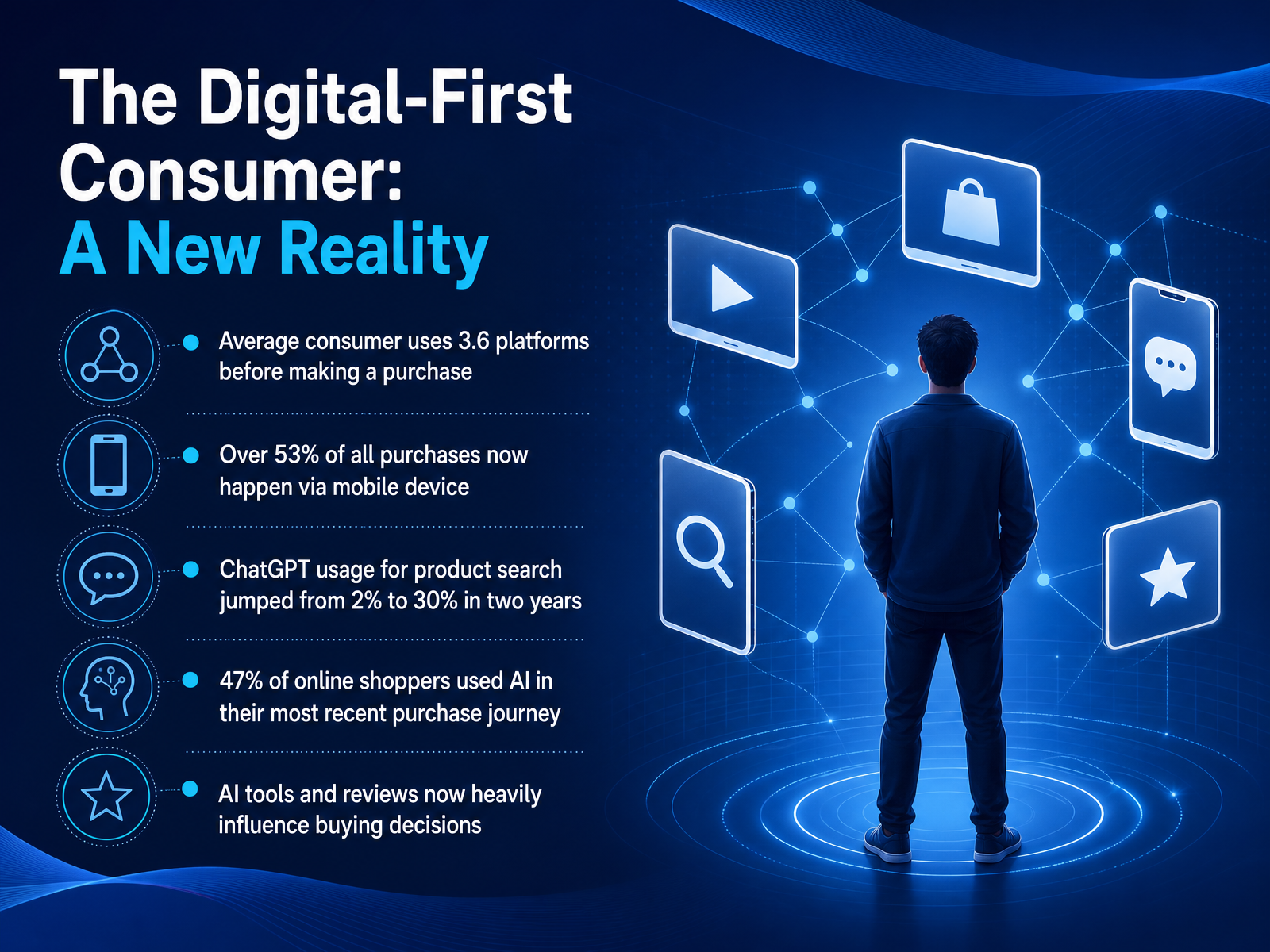
- 02The Digital-First Consumer: A New RealityAlright, let’s look at what’s really happening with consumers today. The way people discover and buy products has fundamentally shifted, creating what we call the digital-first consumer. Think about your own habits for a moment. The average consumer now uses three point six different platforms before making a purchase decision. They might start on Instagram, check a review on YouTube, ask a question on an AI tool like ChatGPT, and only then visit a store. It’s not a straight line anymore. And that journey is overwhelmingly mobile. For the first time ever, over fifty-three percent of all purchases now happen via a mobile device. But here’s the most dramatic change. Just two years ago, barely anyone used AI for shopping. Now, usage of tools like ChatGPT for product search has jumped from two percent to thirty percent. Nearly half of all online shoppers used AI somewhere in their most recent purchase journey. AI tools and online reviews are no longer the future; they are the present and they heavily influence buying decisions before a customer ever speaks to a salesperson. So, how do you show up across all these moments? Let’s get practical and walk through the core digital marketing channels that make this possible.
 pymnts.comiabaustralia.com.auriseatseven.com+22 min
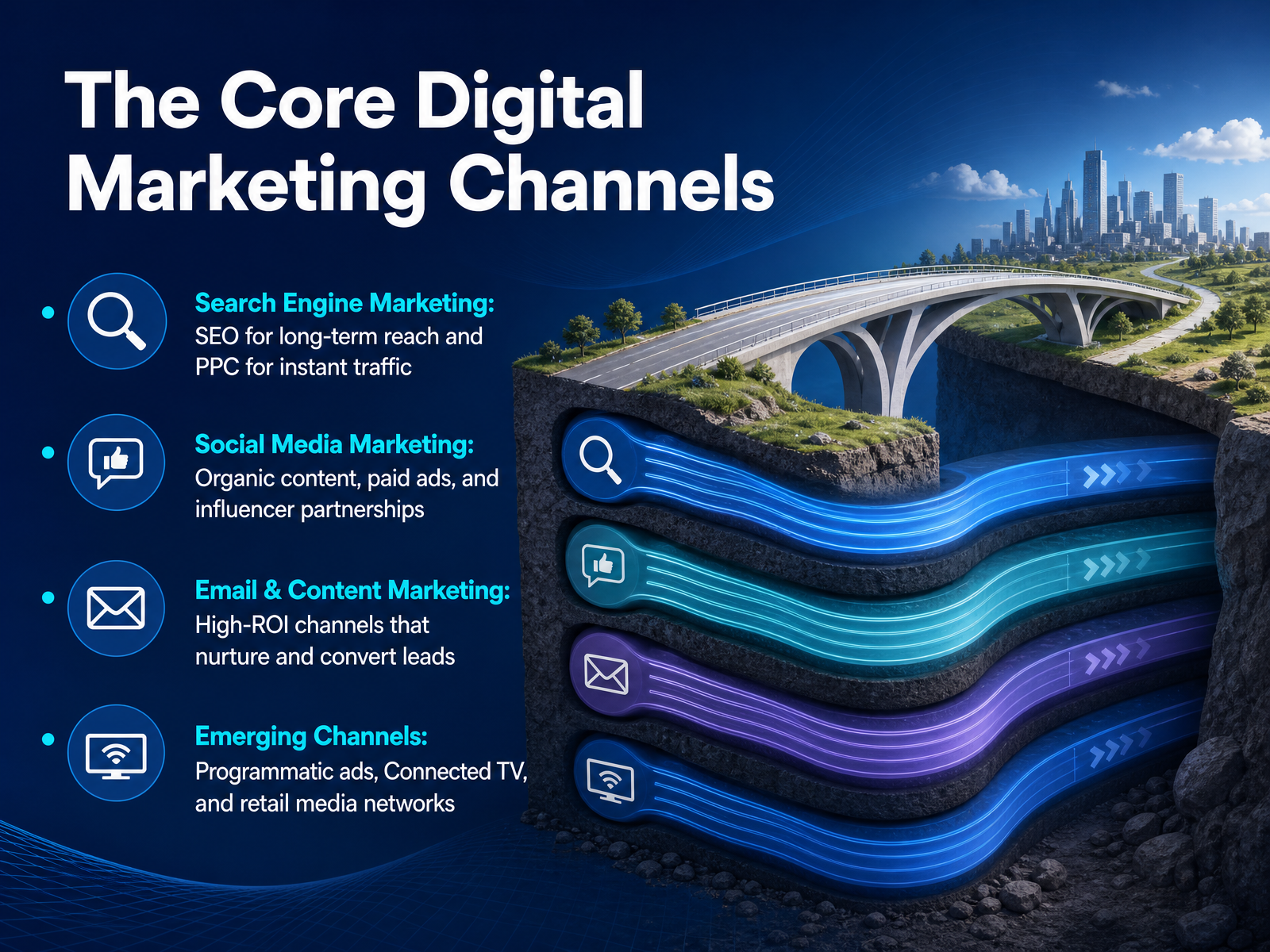
 - 03The Core Digital Marketing ChannelsNow, let's look at the main channels you can use to reach your customers. Think of these as the key tools in your daily toolkit. First, we have search engine marketing. This includes SEO, which is a long-term strategy to show up in organic results, and PPC, or pay-per-click ads, for driving traffic right away. Next is social media. This isn't just about posting updates. It covers organic content, targeted paid ads, and collaborations with influencers to build trust. Then, there's the powerhouse of email and content marketing. These channels give you a remarkably high return on investment by nurturing relationships and converting interested leads into loyal customers. Finally, we have emerging channels like programmatic ads, Connected TV, and retail media networks. They offer new, precise ways to meet your audience where they are. In our next part, we'll connect these tools to your business outcomes as we discuss defining success through goals and KPIs.
 2 min
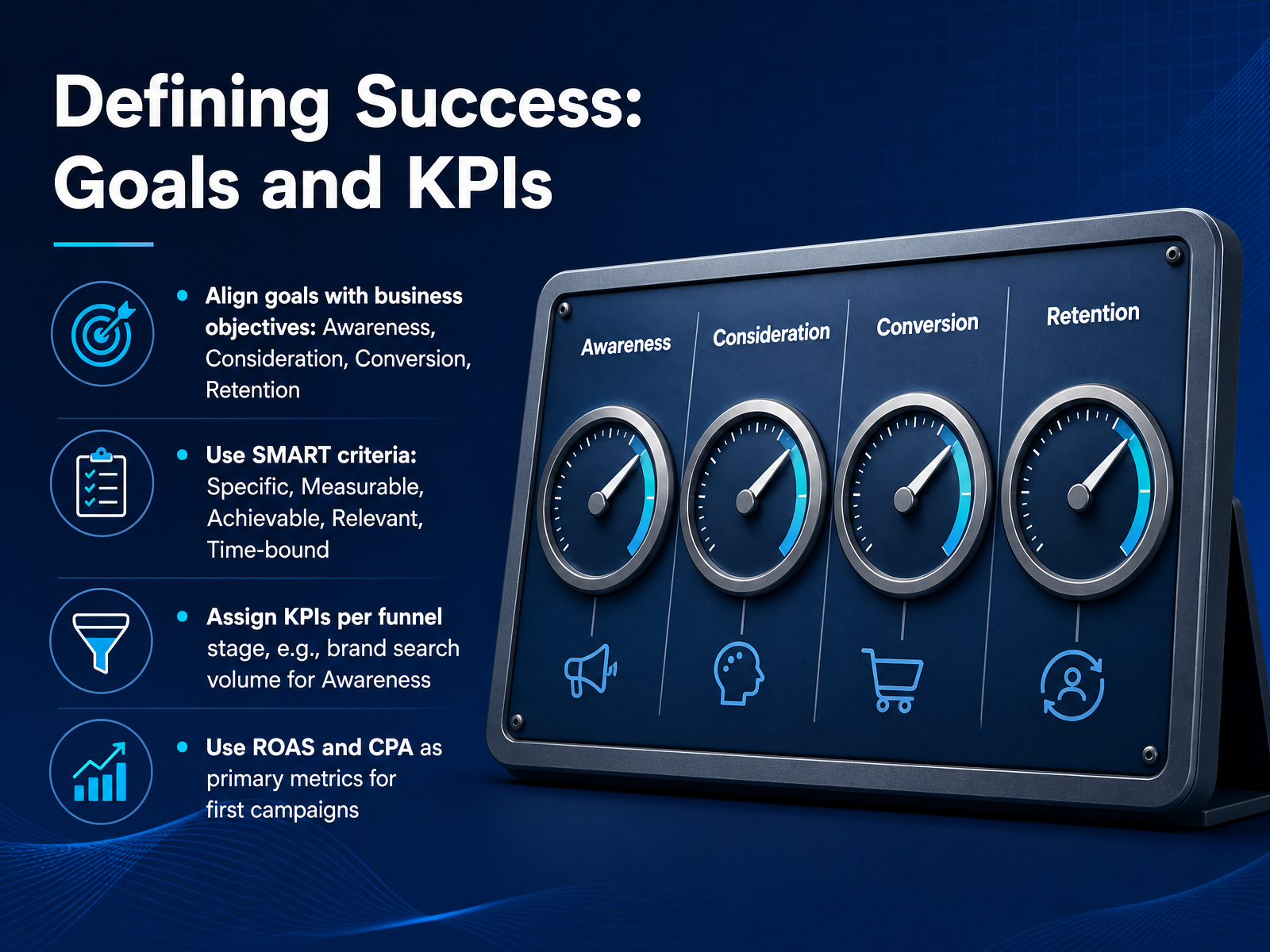
2 min - 04Defining Success: Goals and KPIsSo, how do we actually know if our digital marketing is working? That comes down to setting clear goals and tracking the right numbers. First, make sure every goal ties back to a business objective. Think in terms of the customer journey. Are you trying to build awareness, get people to consider your product, drive a conversion like a sale, or keep customers coming back for retention? Once you have that clear, shape your goals using the SMART criteria. That means being Specific, Measurable, Achievable, Relevant, and Time-bound. For example, instead of saying 'get more website visits,' a SMART goal would be 'increase website traffic from social media by fifteen percent in the next quarter.' Then, you assign key performance indicators, or KPIs, to each stage of that customer journey. For the awareness stage, a good KPI might be brand search volume, which is how many people are searching for your company's name. When you're launching your very first campaigns, keep your primary metrics simple and focused on cost and return. The two big ones to watch are Return on Ad Spend, or ROAS, and Cost Per Acquisition, or CPA. ROAS tells you how much revenue you earned for every dollar you spent. CPA tells you how much it cost to get one new customer. These are your financial guideposts. Knowing what to measure is powerful, but measuring the right thing starts with knowing who you're measuring. So next, let's talk about why knowing your audience is the starting point.
 2 min
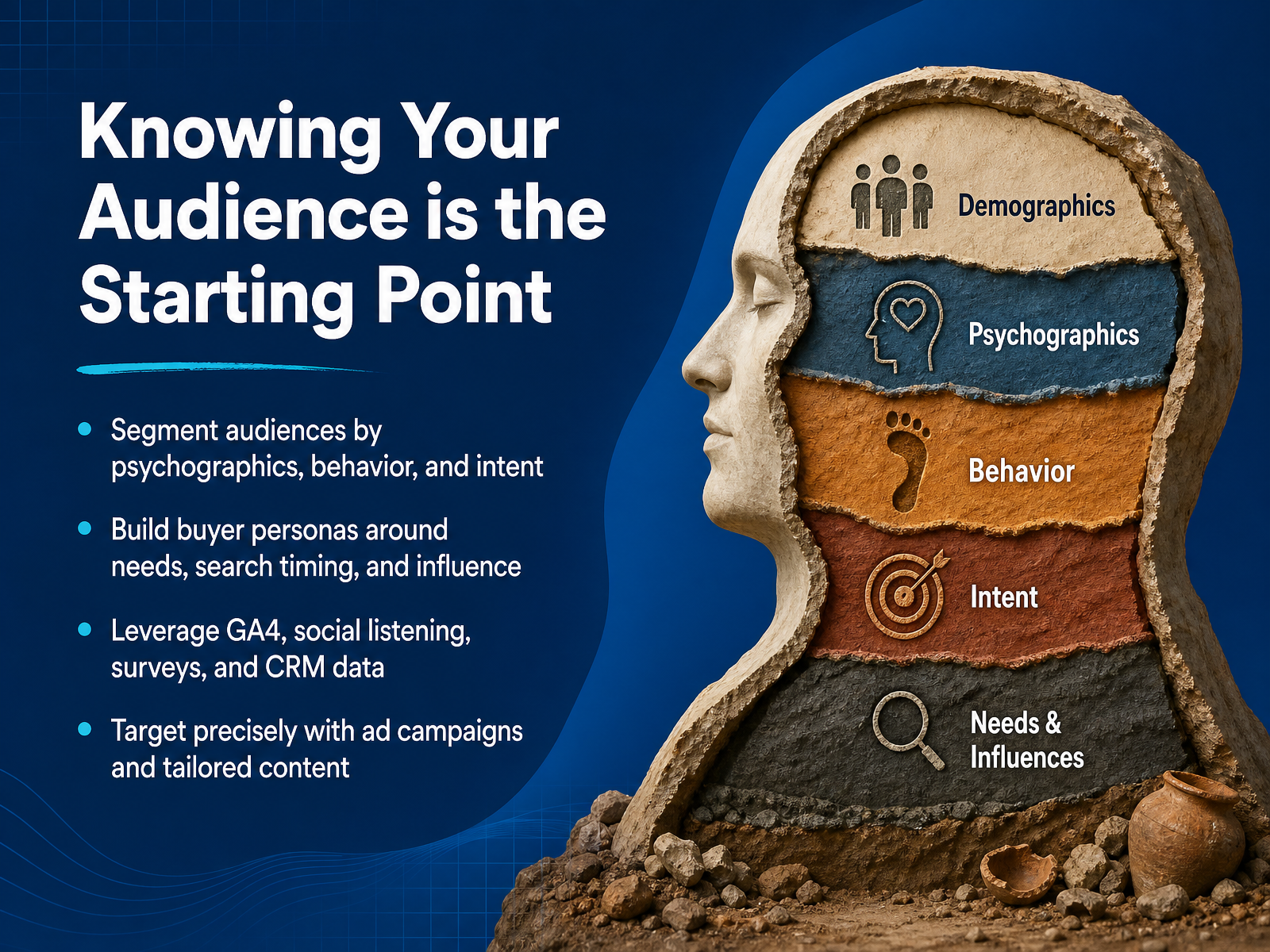
2 min - 05Knowing Your Audience is the Starting PointAlright, let's talk about the starting point for any smart marketing: really knowing your audience. We don't just mean their job title. We dig deeper, into what we call psychographics. What are their values, their interests? What's actually driving their daily choices? We also look at their online behavior and their intent. Are they just browsing for information, or are they ready to buy something right now? From this, we build buyer personas. Think of these as detailed profiles of our ideal customers, built around their real needs, the best times to reach them during a search, and who influences their decisions. You can build these profiles using real data, not just guesses. Tools you likely already have are perfect for this. We can pull insights from Google Analytics 4, social listening tools, customer surveys, and your own CRM data. This isn't just an academic exercise. When you know your audience this well, you can target your ad campaigns with impressive precision and create content that feels like it was written specifically for one person. Next, we’re going to take all this audience understanding and put it to work by crafting your actual digital marketing strategy.
 2 min
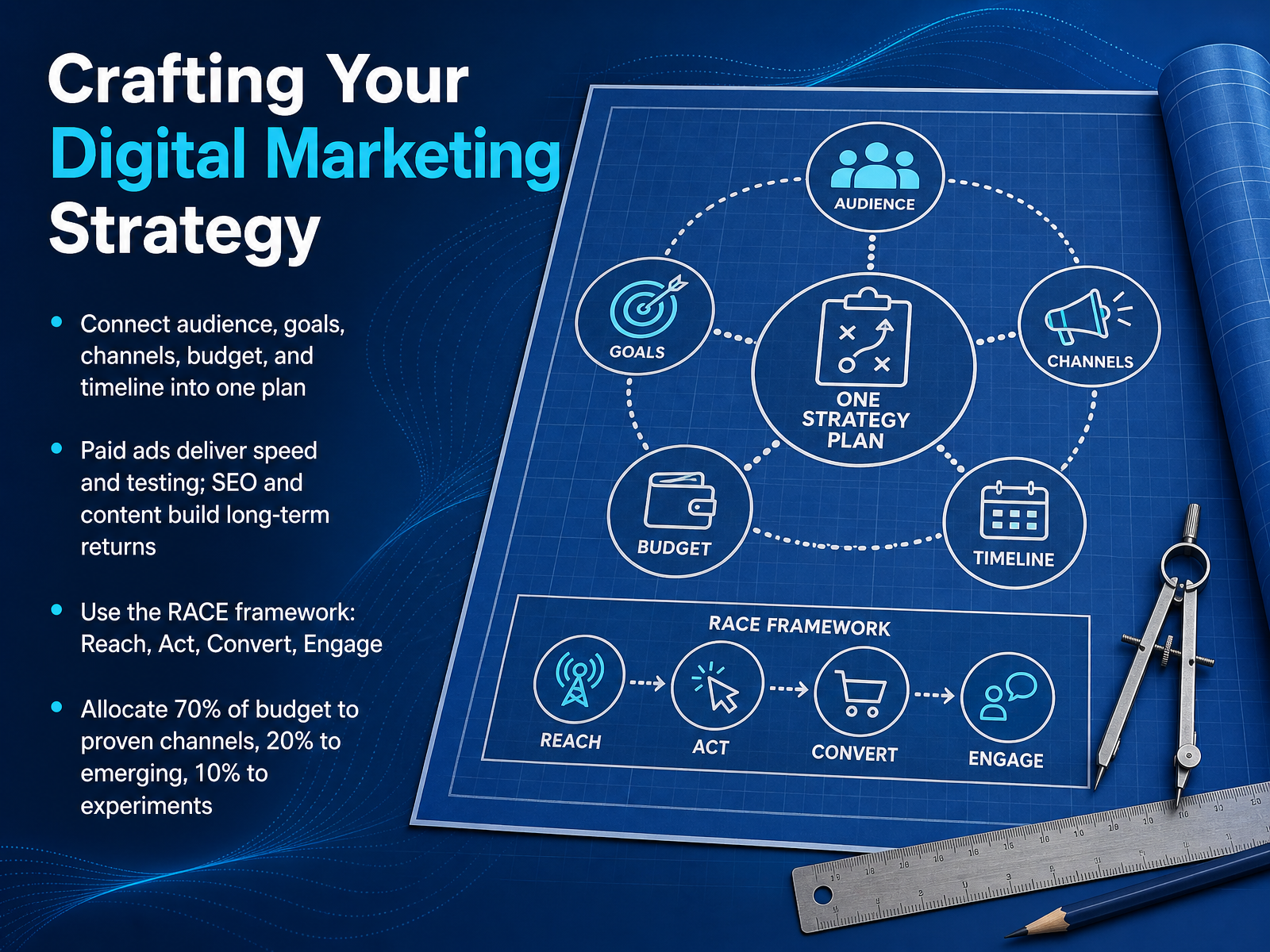
2 min - 06Crafting Your Digital Marketing StrategySo how do we pull all of this together into one clear plan? It's about connecting five simple pieces: your audience, your goals, the channels you'll use, your budget, and your timeline. Think of it as a roadmap, not a riddle. Now, a smart strategy balances two speeds. Paid ads are your quick wins. They deliver instant traffic and let you test ideas fast. But for lasting value, you need the slow and steady power of search engine optimization and valuable content, which build your foundation over time. A helpful way to organize all this is the RACE framework: Reach, Act, Convert, Engage. Reach new people, get them to Act on your site, Convert them into customers, and then keep them Engaged for the long haul. Finally, let's talk budget. A simple rule of thumb is seventy percent on what you already know works, twenty percent on promising new channels, and just ten percent on small, smart experiments. This keeps your business stable while you grow. Next, let's look at how you'll know it's all paying off, as we explore measuring success and proving ROI.
 2 min
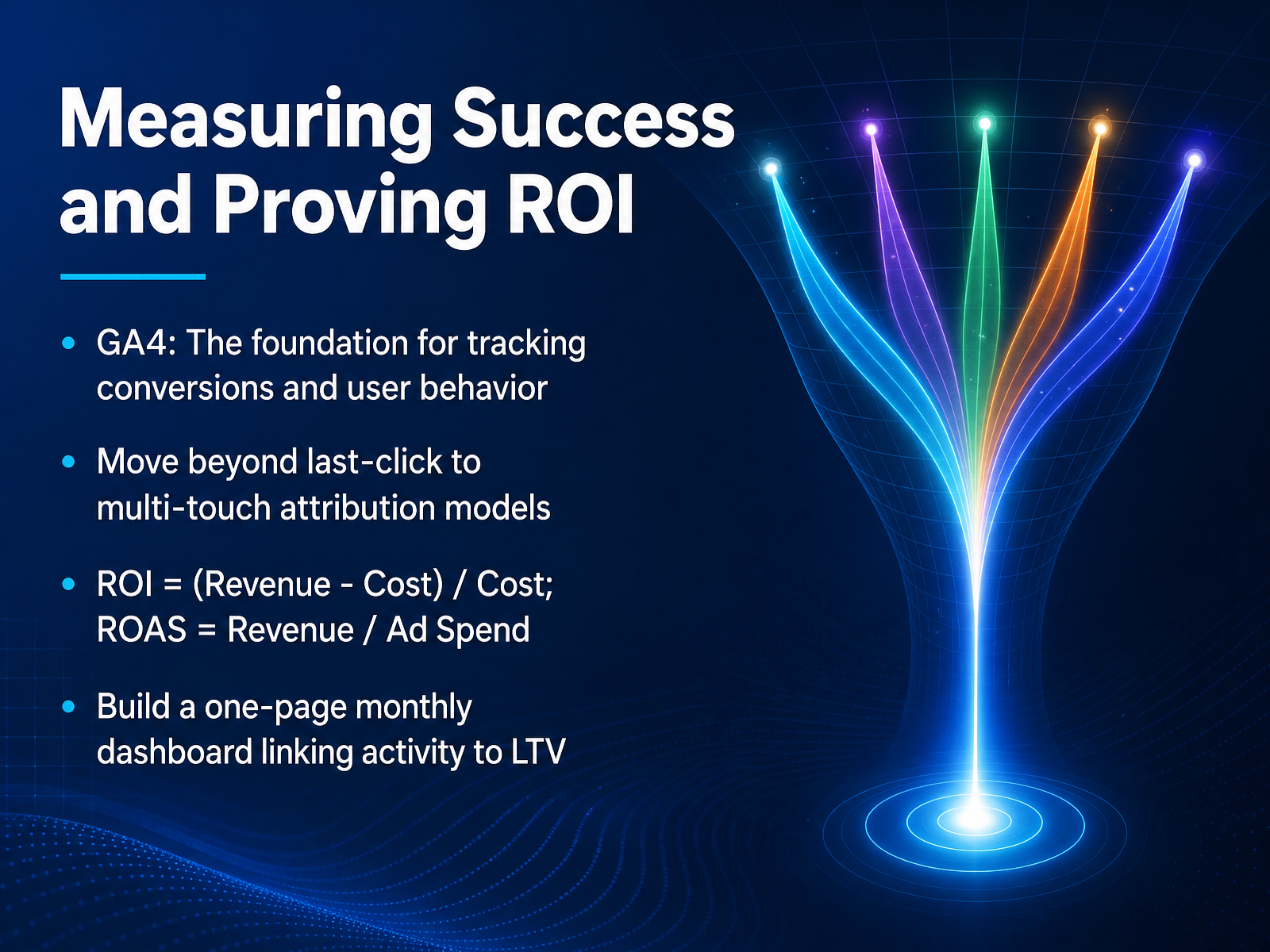
2 min - 07Measuring Success and Proving ROINow that we can reach people, how do we know it's actually working? This is where we prove the value of our marketing. And the foundation of all of that tracking is a tool you've probably heard of: Google Analytics 4, or G A four. Think of it as your website's dashboard. It shows you exactly how people find you, what they click on, and whether they become a customer. But we need to look at the data the right way. Many people just give credit to the very last click before a sale, like a search ad. We need to move toward what's called multi-touch attribution. This just means recognizing that the helpful blog post someone read last week, or the email they opened yesterday, also played a huge role. To keep us focused on real results, let's memorize two simple calculations. First is R O I, or Return on Investment. It's your revenue minus your cost, divided by your cost. This tells you the profit you made for every dollar you spent. Second is R O A S, or Return on Ad Spend. That's simply your revenue divided by your ad spend. If you spent one dollar and made four dollars, your R O A S is four. These numbers keep us honest. Finally, don't get lost in a hundred different reports. Build a simple, one-page monthly dashboard. It should clearly link your activities, like a social media campaign, to what really matters: the long-term value of a customer. A clear, one-page view is how you lead conversations about growth. Speaking of clear views, next we'll talk about a framework for measuring R O I across your different channels.
 2 min
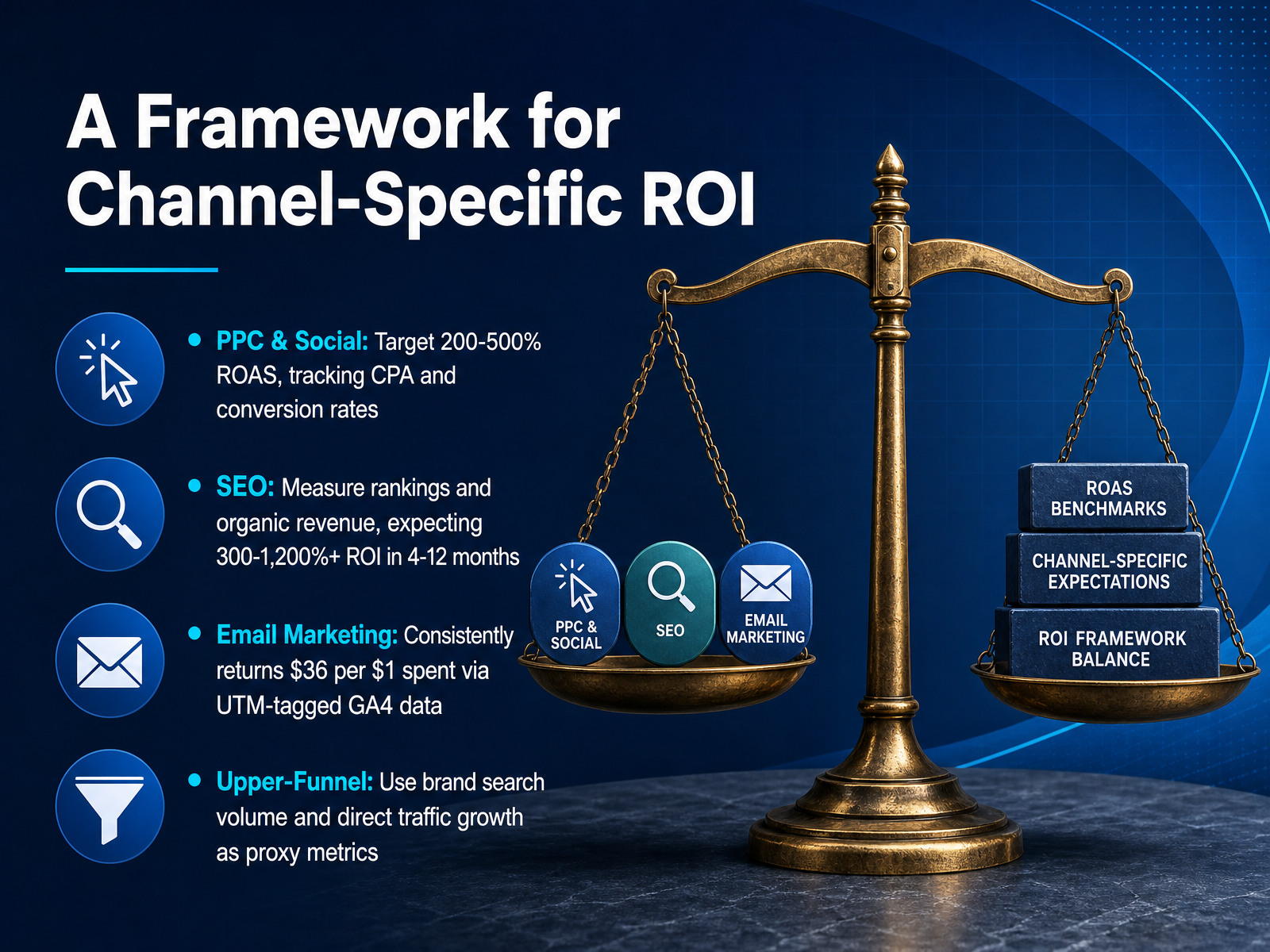
2 min - 08A Framework for Channel-Specific ROINow, let's turn that strategy into a practical framework for measuring success, channel by channel. For paid search and social media ads, a healthy target is often a return of two hundred to five hundred percent on ad spend. Keep a close eye on your cost per acquisition and conversion rates. For search engine optimization, it's a longer game. Measure your keyword rankings and organic revenue growth. You can realistically expect a return of three hundred to over twelve hundred percent, but results typically build over a window of four to twelve months. Email marketing is the consistent powerhouse. It famously returns around thirty six dollars for every single dollar spent. Track this reliably by using UTM-tagged links that feed into your Google Analytics 4 data. And for those upper-funnel activities like brand videos or awareness campaigns, direct return isn't the immediate metric. Instead, watch for growth in brand search volume and direct website traffic as your key indicators of success. Coming up next, we'll navigate the important legal and ethical landscape you need to know in 2026.
 2 min
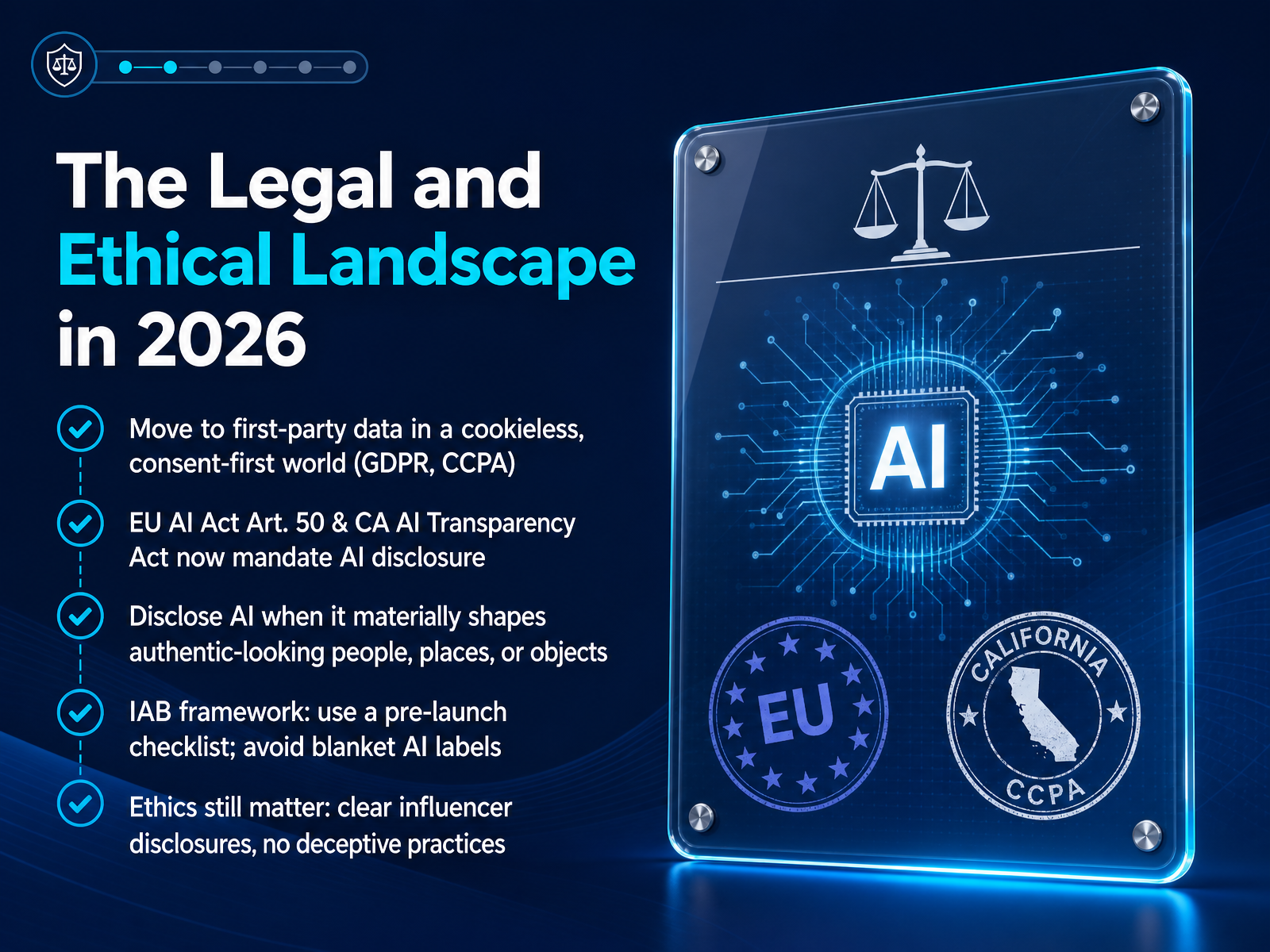
2 min - 09The Legal and Ethical Landscape in 2026Now, let's talk about the legal and ethical landscape that's taking shape right now. By 2026, marketing has firmly moved into a cookieless, consent-first world defined by regulations like GDPR and the CCPA. This means relying on first-party data isn't just smart, it's essential. At the same time, new AI laws like the EU AI Act and the California AI Transparency Act now require us to disclose when we're using artificial intelligence in a way that materially shapes authentic-looking people, places, or objects. But this doesn't mean sticking a blanket AI label on everything. In fact, the industry framework from the IAB specifically advises against that, warning it can lead to disclosure fatigue. Instead, the best practice is a practical, pre-launch checklist. Before a campaign goes live, you simply ask: Was AI used, and does it risk misleading a reasonable consumer about what is real? If the answer is yes, you apply a clear, specific label. And remember, these new rules layer on top of our existing ethical foundations. We must still have clear influencer disclosures and always avoid deceptive practices, no matter what tools we use. Ultimately, meaningful transparency builds the trust that protects your brand's reputation. Next, we'll tackle how to avoid the most common snags by discussing overcoming common pitfalls in measurement.
 iab.comthedrum.commorganlewis.com+22 min
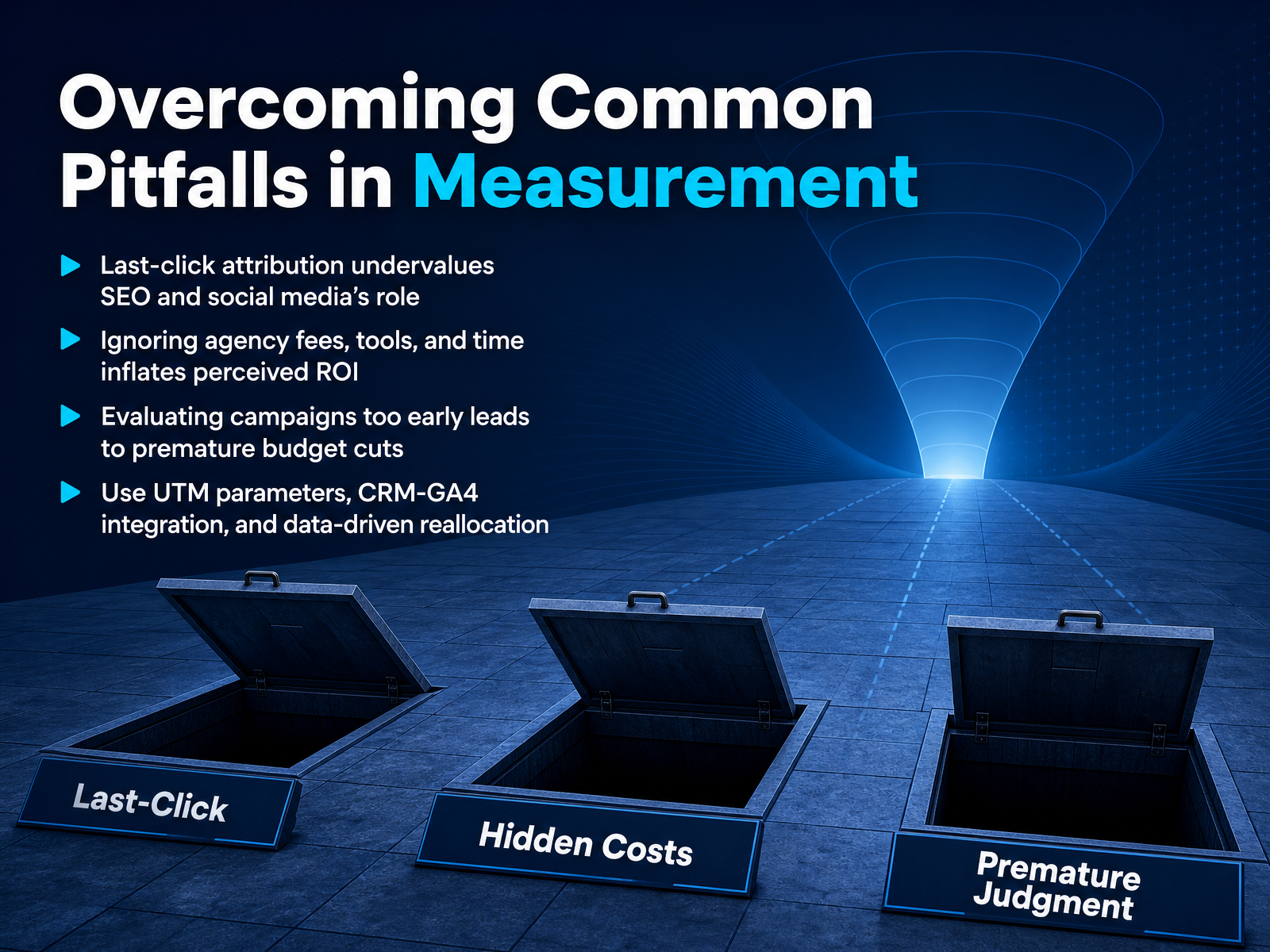
 - 10Overcoming Common Pitfalls in MeasurementBut even with the right metrics, it is easy to run into a few common traps that can throw your numbers off. First, if you only look at the last click before a sale, you give all the credit to things like paid search or email, and you completely undervalue the work your SEO and social media did to spark that interest in the first place. Another trap is forgetting to factor in the true cost. If you look at a campaign's sales but ignore the agency fees, software tools, and your team's time, your return looks bigger than it really is. Also, be patient. Evaluating a campaign too early, before it has enough data, can lead to cutting the budget right when it was about to deliver. To get past these, simple steps make a huge difference. Use UTM parameters on your links to track exactly where traffic comes from. Connect your CRM to Google Analytics 4 so you can see the whole customer journey. Then let the data guide you. Instead of guessing, reallocate your budget to what is actually working. Let's shift from what to avoid and look at putting this into motion with a realistic first 90-day plan.
 2 min
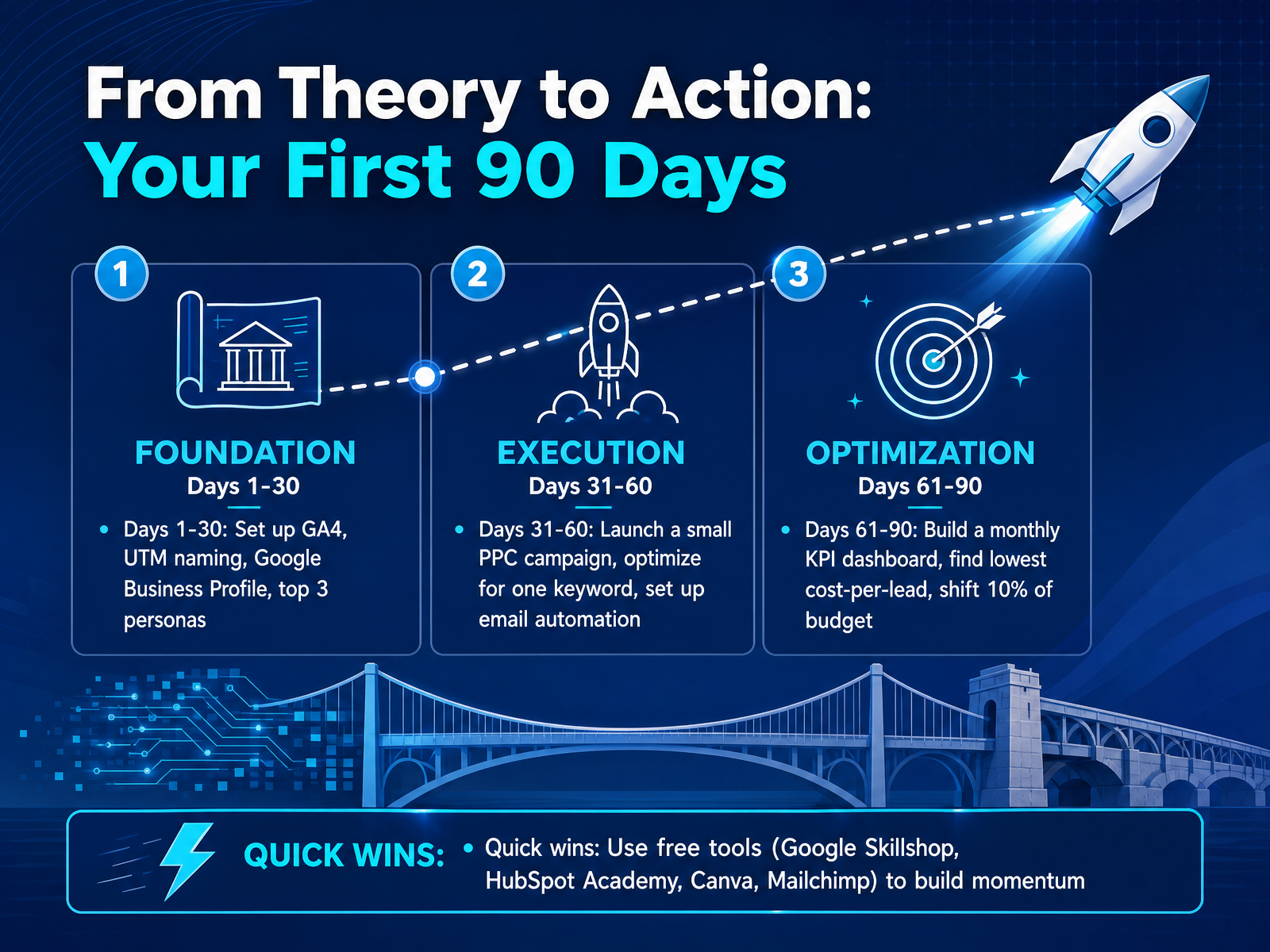
2 min - 11From Theory to Action: Your First 90 DaysNow let's turn that big-picture thinking into a concrete plan. Here’s a realistic road map for your first ninety days. During the first month, focus on getting the plumbing right. Set up Google Analytics 4 so you can actually see what’s happening on your site. Create a clean UTM naming system to track your links, claim your Google Business Profile, and define your top three customer personas. In days thirty-one to sixty, it’s time to test the waters. Launch a very small pay-per-click campaign, just enough to learn. Optimize it around one specific keyword, and set up a simple email welcome sequence that runs on autopilot. For the final stretch, days sixty-one to ninety, build a monthly key-performance-indicator dashboard to keep score. Find out which channel is giving you the lowest cost per lead, and then do something bold: shift ten percent of your budget into that winning tactic. Remember, you don’t need a giant budget to build momentum. Lean on free tools like Google Skillshop, HubSpot Academy, Canva, and Mailchimp to sharpen your skills without touching your wallet. Small, consistent actions here will build the foundation for everything else. Next up, let’s talk specifically about building your beginner’s toolkit with certifications and free resources.
 classcentral.comcoursera.orggrow.google+22 min
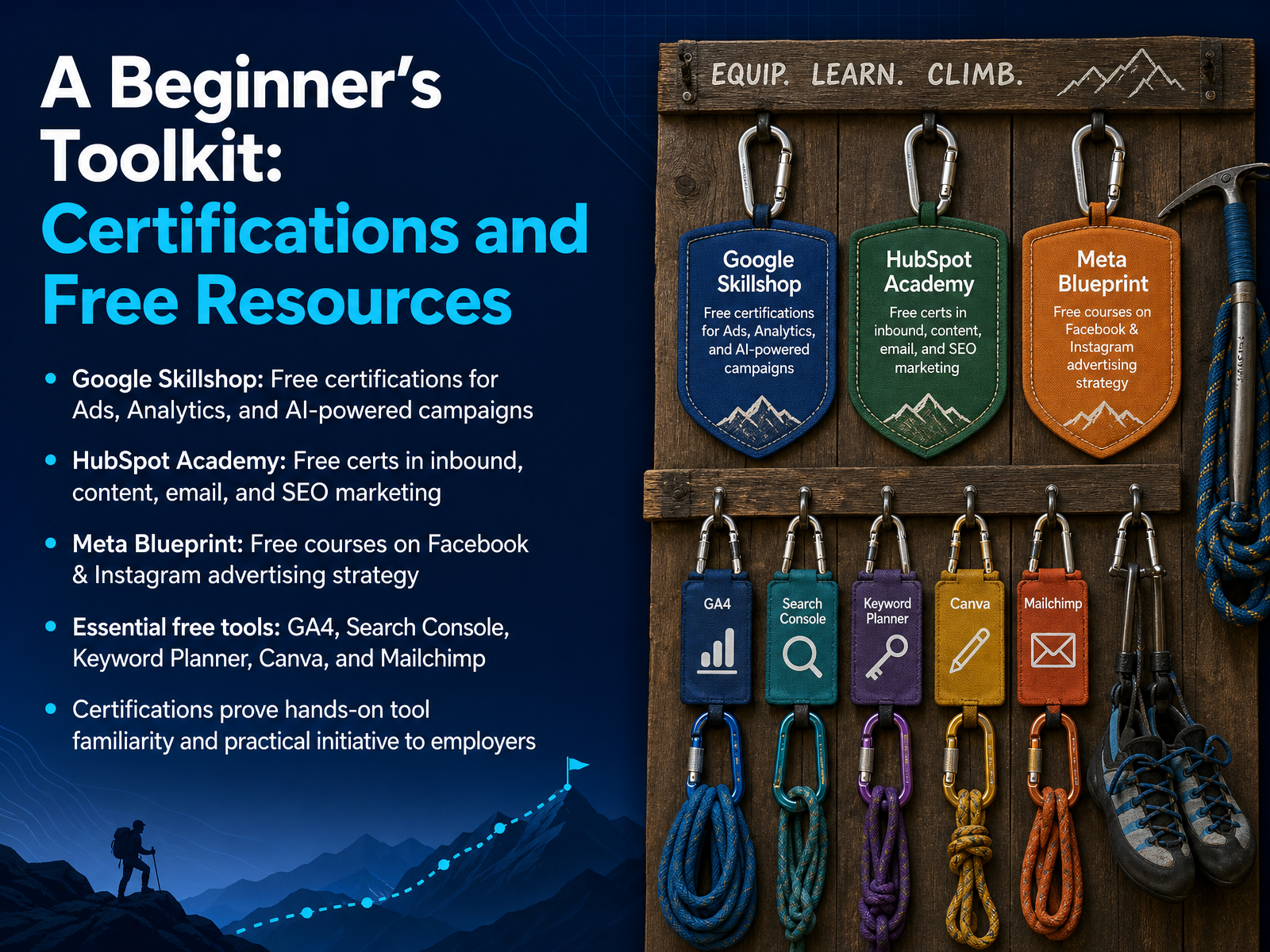
 - 12A Beginner's Toolkit: Certifications and Free ResourcesNow that you see the value, you might be wondering where to actually start. The good news is you don't need to spend a dime to build a solid foundation. There are incredible free resources that can take you from curious beginner to confident practitioner. Let's look at a few you can tap into right now. Google Skillshop gives you official certifications in Google Ads, Analytics, and even AI-powered campaigns, all at no cost. HubSpot Academy is another goldmine, with free certifications in inbound marketing, content strategy, email marketing, and SEO. If social media is your focus, Meta Blueprint offers fantastic free courses on Facebook and Instagram advertising strategy. Beyond certifications, you'll want to get hands-on with the tools themselves. Essential free tools like Google Analytics 4, Search Console, and Keyword Planner help you understand data. Canva lets you create professional visuals, and Mailchimp is perfect for starting with email. These certifications do more than just fill a line on your resume; they prove to an employer that you have practical initiative and real hands-on familiarity with the tools they use every day. Next, we'll look at how all these pieces come together as the future becomes integrated with AI, trust, and genuine human connection.
 classcentral.comcoursera.orggrow.google+22 min
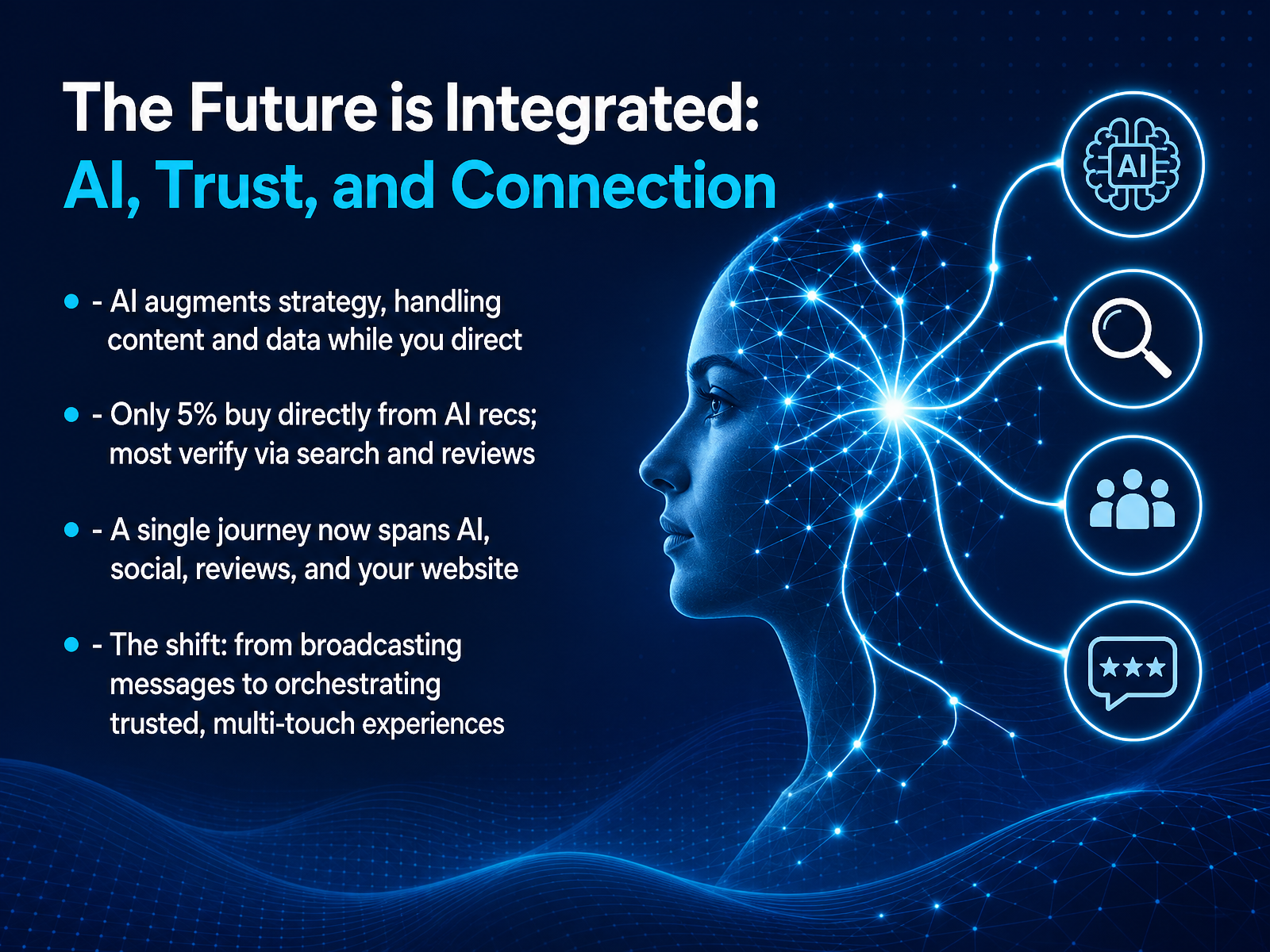
 - 13The Future is Integrated: AI, Trust, and ConnectionSo what does all this mean for the big picture? The future isn't about picking one channel—it's about orchestrating them all. Think of AI as your strategic assistant. It can handle heavy lifting like analyzing data and generating content, but you're still the director, guiding the story. Now, here's a fascinating reality check. Only five percent of consumers buy directly from an AI recommendation. The other ninety-five percent immediately go to search engines, review sites, and social media to verify what the AI told them. This means a single customer journey now flows seamlessly across AI, social media, reviews, and your website. People aren't just receiving your message anymore; they're assembling their own picture from every touchpoint. The big shift is moving from simply broadcasting a message to orchestrating a trusted, multi-touch experience. It's about being present and consistent everywhere your customer looks, so that when they verify, they find a story they can believe in. Next, let's bring all of this together with our key takeaways and your next steps.
 pymnts.comiabaustralia.com.auriseatseven.com+22 min
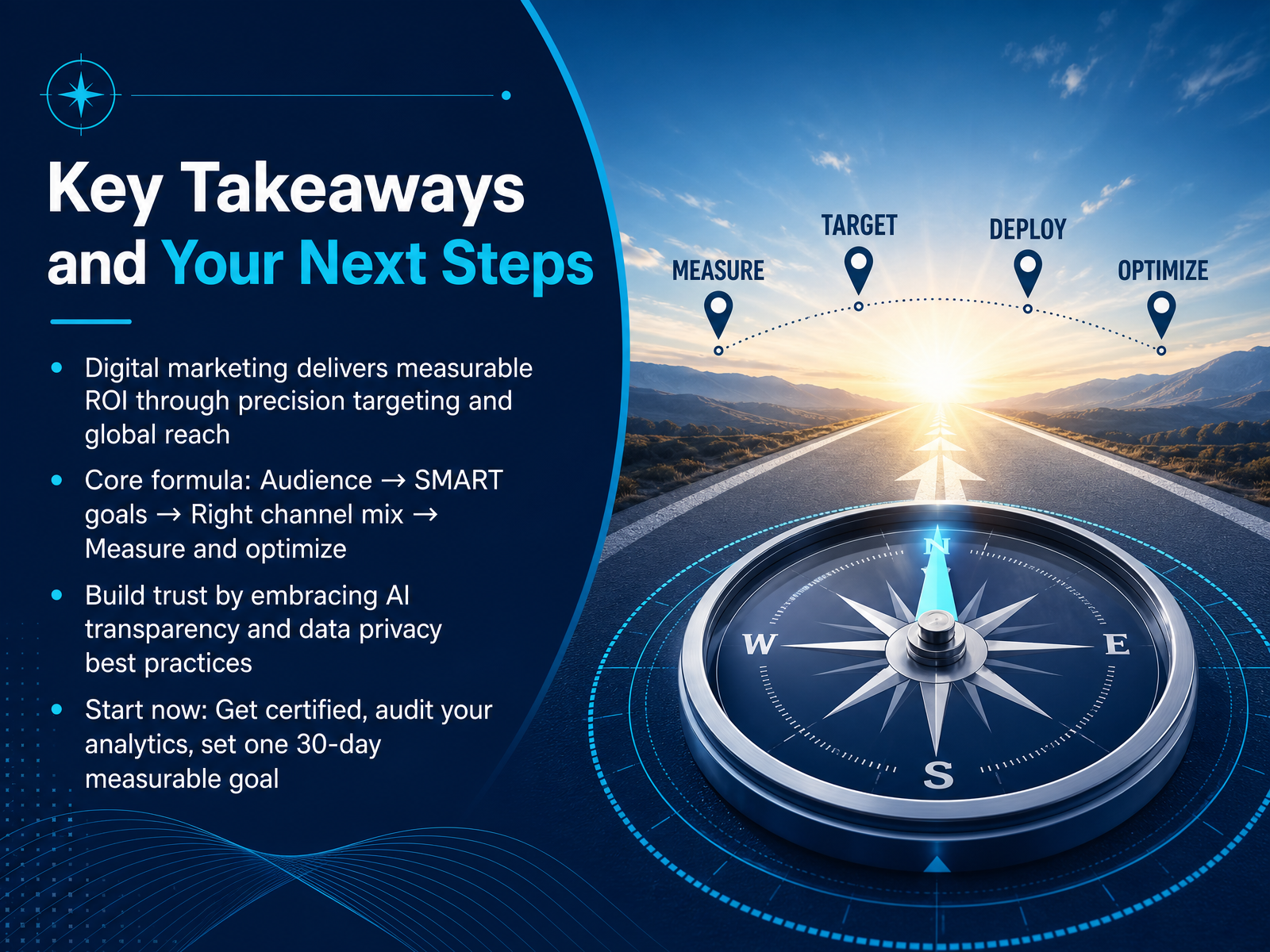
 - 14Key Takeaways and Your Next StepsWe covered a lot of ground together, so let's bring it all home. First, remember that digital marketing delivers measurable return on investment through precision targeting and global reach. It's not just throwing money at ads. It's a system. The core formula we keep returning to is simple: know your audience, set S M A R T goals, choose the right channel mix, and then measure and optimize constantly. Second, building trust is non-negotiable. Be transparent about how you use AI and always follow data privacy best practices. That's what turns a one-time buyer into a loyal fan. So where do you go from here? Start today. Pick one thing. Get a free certification from Google or HubSpot to build your confidence. Audit your website analytics to see what's actually happening. And set one thirty-day measurable goal. Just one. You've got this, and a great future starts with that single step. Thank you for learning with me.
 classcentral.comcoursera.orggrow.google+22 min
Take the deck with you
Download this course as a file — free, no sign-up needed.
- PDF handoutEvery slide page, ready to print or share.15 pages · 4.5 MBDownload
- Narrated PowerPointThe deck that presents itself — every slide carries the digital human's narration video.15 pages · 15.8 MBDownload
- PowerPoint slidesThe full deck as a .pptx — open it in PowerPoint, Keynote, or Google Slides.15 pages · 4.4 MBDownload
Free to use in your own training — please keep the PersonWise credit page at the end.
Have your own deck? Turn it into a course
Sources consulted
Web sources consulted while building this course.
- Worldwide Ad Spending Forecast 2026 — emarketer.com
- Digital Ad Spending Will Increase 13.5% Worldwide in 2026, and Traditional Will Tick Up 2.5% | EMARKETER — emarketer.com
- Worldwide Ad Spending H1 2026 — emarketer.com
- Ad Spend May 2026 - dentsu Global Ad Spend Forecasts May 2026 — insight.dentsu.com
- Advertising - Worldwide | Statista Market Forecast — statista.com
- The AI-Powered Shopper Has Arrived — pymnts.com
- Commerce and Discovery Report 2026: Online Shopping Trends — iabaustralia.com.au
- The Multi-Channel Search Report 2025/26 | Rise at Seven — riseatseven.com
- State of Search Q1 2026: Behaviors, Trends, and Clicks Across the US & Europe | Datos — datos.live
- The State of Commerce: Online & Retail Shopping Trends in 2026 - Numerator — numerator.com
- IAB - AI Transparency and Disclosure Framework — iab.com
- AI disclosure laws arrive in the EU and California. What do they mean for marketers? | The Drum — thedrum.com
- New California AI Disclosure Rules Become Operative — morganlewis.com
- Updates to AI labeling requirements (July 2026) - Advertising Policies Help — support.google.com
- Guidelines on transparency obligations for providers and deployers of certain AI systems | Shaping Europe’s digital future — digital-strategy.ec.europa.eu
- [2026] 280+ Free Digital Marketing Certificates & Badges - Class Central — classcentral.com
- Google Digital Marketing & E-commerce Professional Certificate | Coursera — coursera.org
- Certificate in Digital Marketing & E-commerce - Grow with Google APAC — grow.google
- Free Digital Marketing Courses & Certificates [2026] - Coursera — coursera.org
- Meta Social Media Marketing Professional Certificate | Coursera — coursera.org