Effective Meeting Agendas
Begin
13 pages · ~26 min
Effective Meeting Agendas
Learn to create clear, purposeful meeting agendas that drive productive discussions and achieve desired outcomes.
What you’ll learn
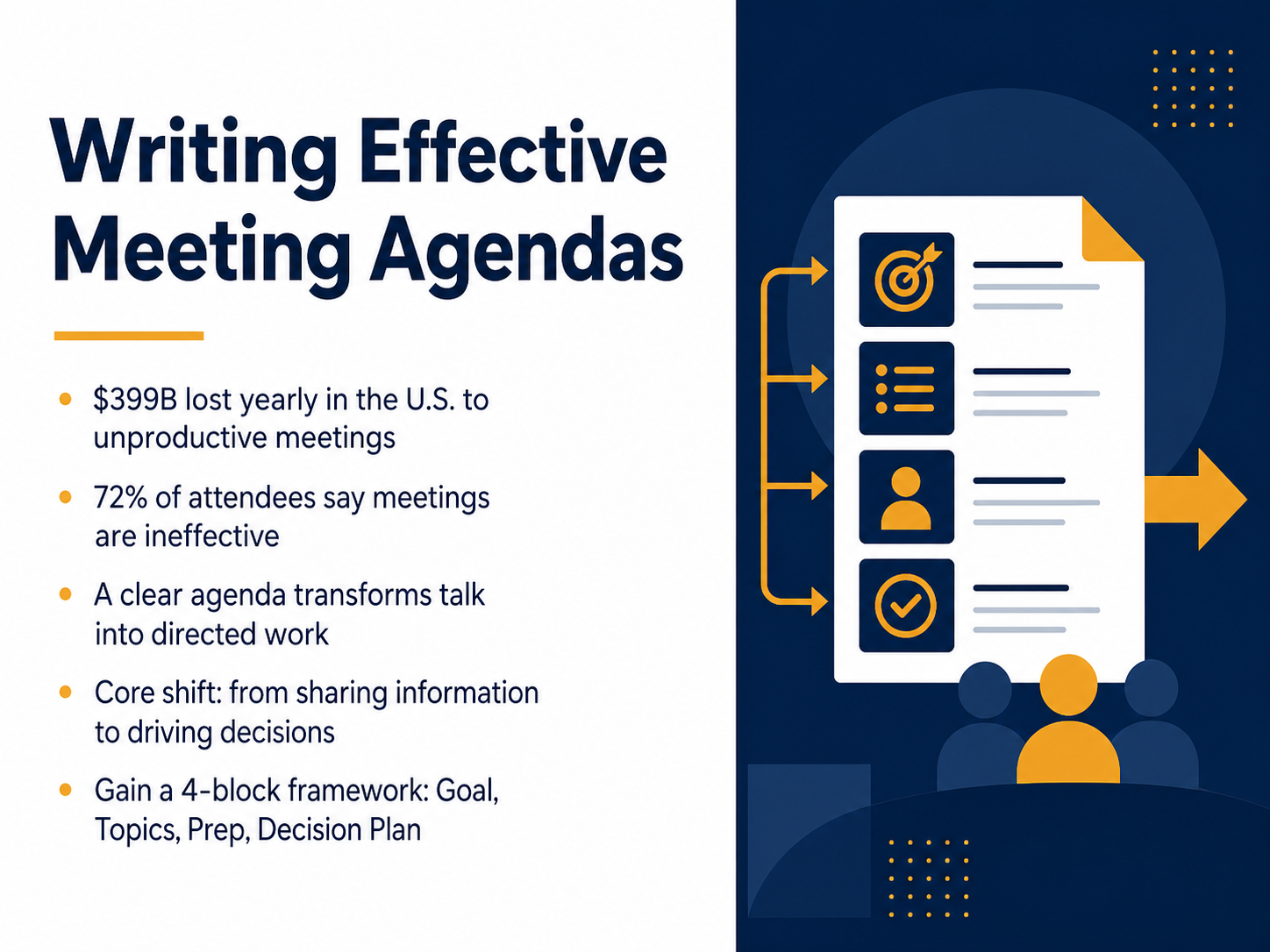
- 01Writing Effective Meeting AgendasWelcome. In this course, we focus on writing effective meeting agendas. The goal is simple: turn unfocused meeting time into directed, decision-driven work. Consider the current reality. Research shows that unproductive meetings cost the U.S. economy an estimated three hundred ninety-nine billion dollars every year. And seventy-two percent of attendees report that the meetings they attend are ineffective. These numbers point to a clear problem: too many meetings are built for sharing information, not for making decisions. The core shift we will practice is moving from information dump to decision forum. To make this shift repeatable, you will gain a four-block framework. The four blocks are Goal, Topics, Prep, and Decision Plan. By the end of this course, you will be able to craft a concise agenda that tells people exactly why they are meeting, what to prepare, and how they will leave with clear decisions. Let's begin by examining the real cost of meetings without agendas.1 min
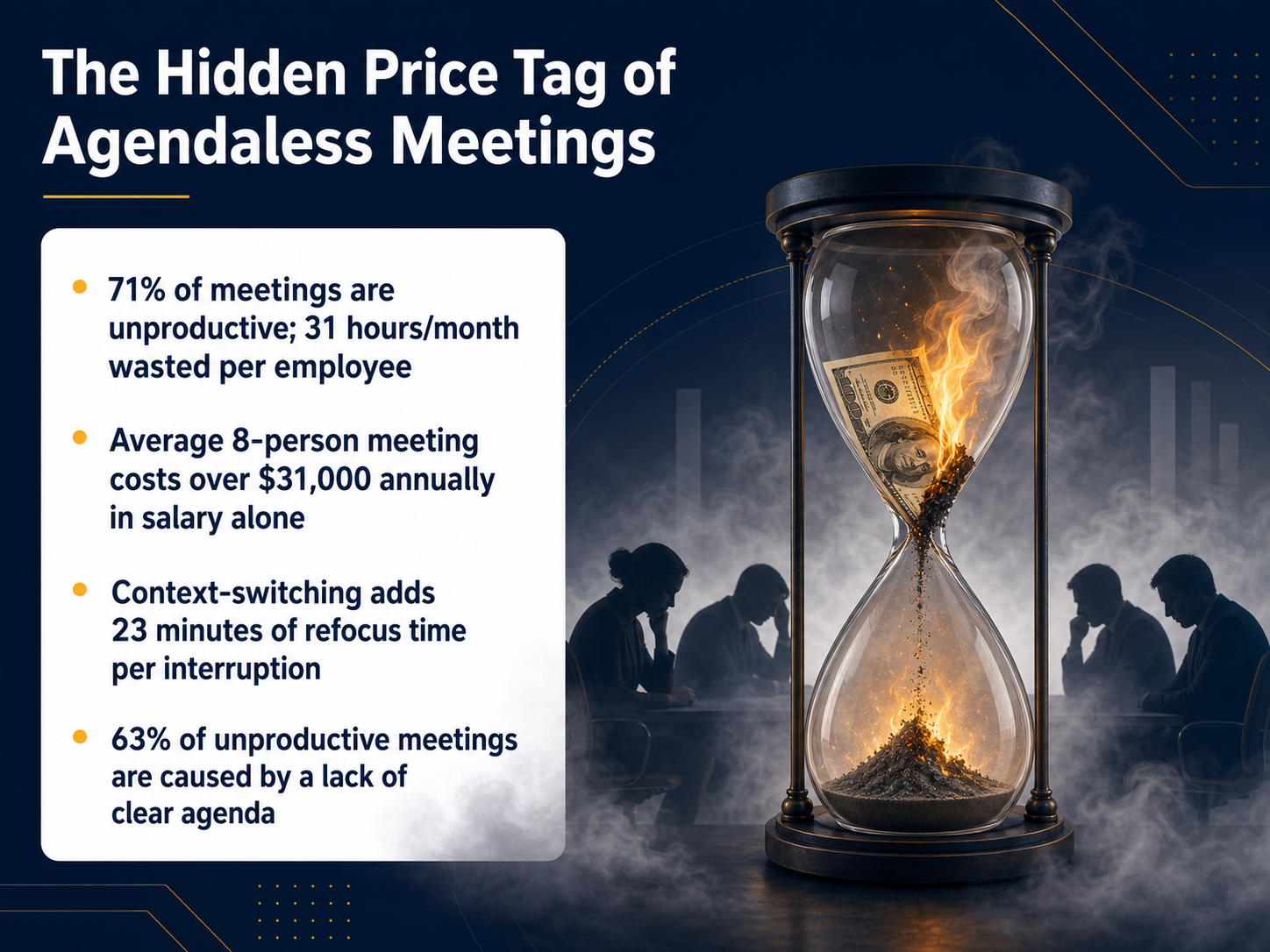
- 02The Hidden Price Tag of Agendaless MeetingsNow let's look at what happens when we skip this step. The cost is larger than most people realize. Research shows that seventy-one percent of meetings are considered unproductive, and the average employee wastes a staggering thirty-one hours every month in them. If you take a standard eight-person meeting, the annual salary cost alone can exceed thirty-one thousand dollars. Beyond the direct cost, every unplanned interruption forces people into context-switching. It takes about twenty-three minutes to fully refocus after each disruption. And what is the primary culprit? Sixty-three percent of unproductive meetings trace directly back to the absence of a clear agenda. This is a problem you can solve before anyone even walks into the room. Next, we will walk through the four building blocks of a complete agenda.
 1 min
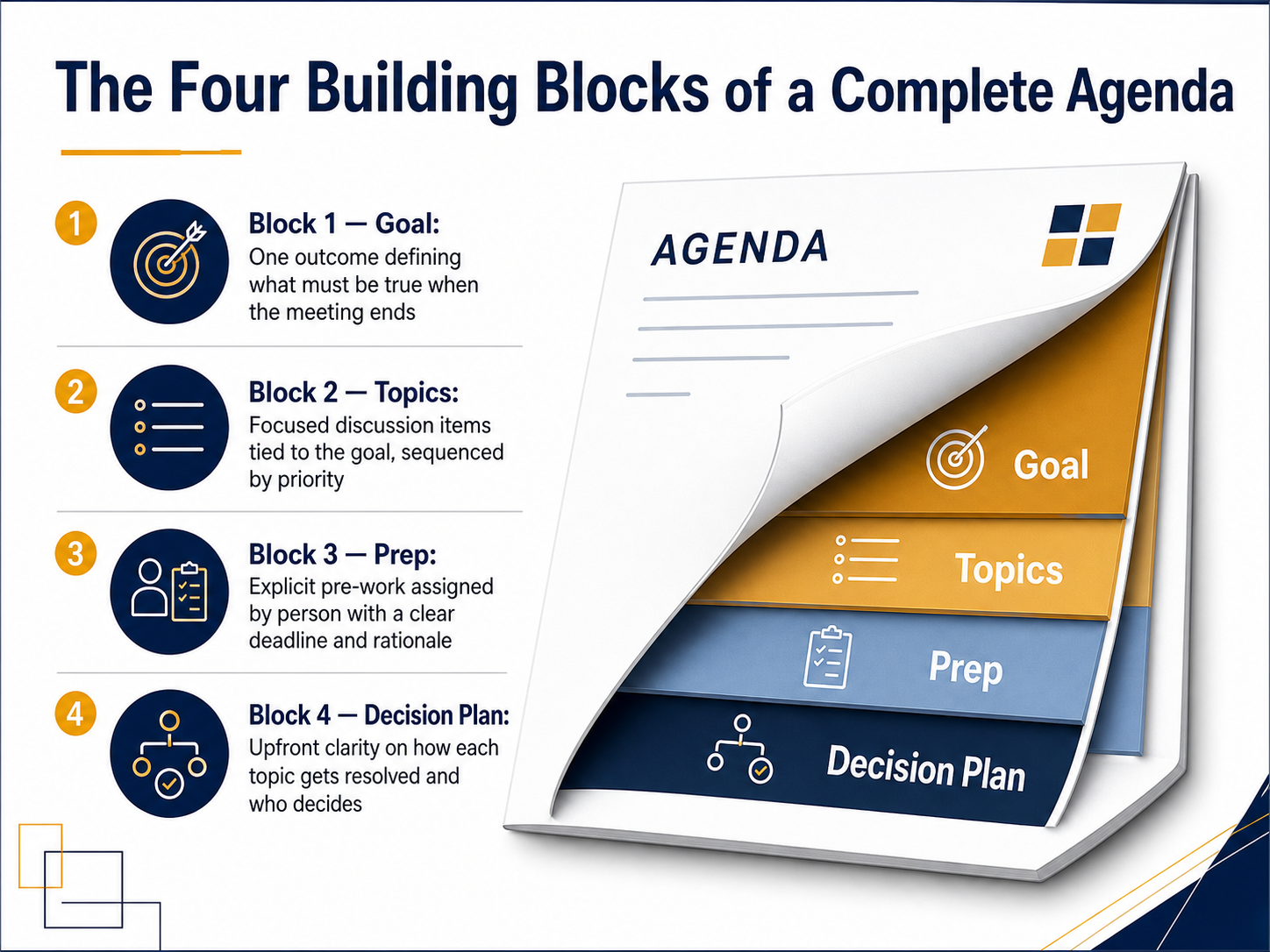
1 min - 03The Four Building Blocks of a Complete AgendaLet's break down the four building blocks that turn a vague list of topics into a complete, actionable agenda. First is the Goal. This is a single outcome statement that defines what must be true when the meeting ends. Instead of 'discuss project X', a real goal is 'reach a funding decision for project X'. Second, Topics. These are your focused discussion items, directly tied to the goal, and sequenced by priority so you address the most critical items first. Third, Prep. This is explicit pre-work assigned to a specific person with a clear deadline and a short rationale explaining why the task matters. Finally, the Decision Plan. Here you provide upfront clarity on how each topic will be resolved and who has the final authority to decide. These four blocks keep your agenda sharply focused on outcomes. Next, we will start building from the top with the first block: defining the meeting's true goal.
 1 min
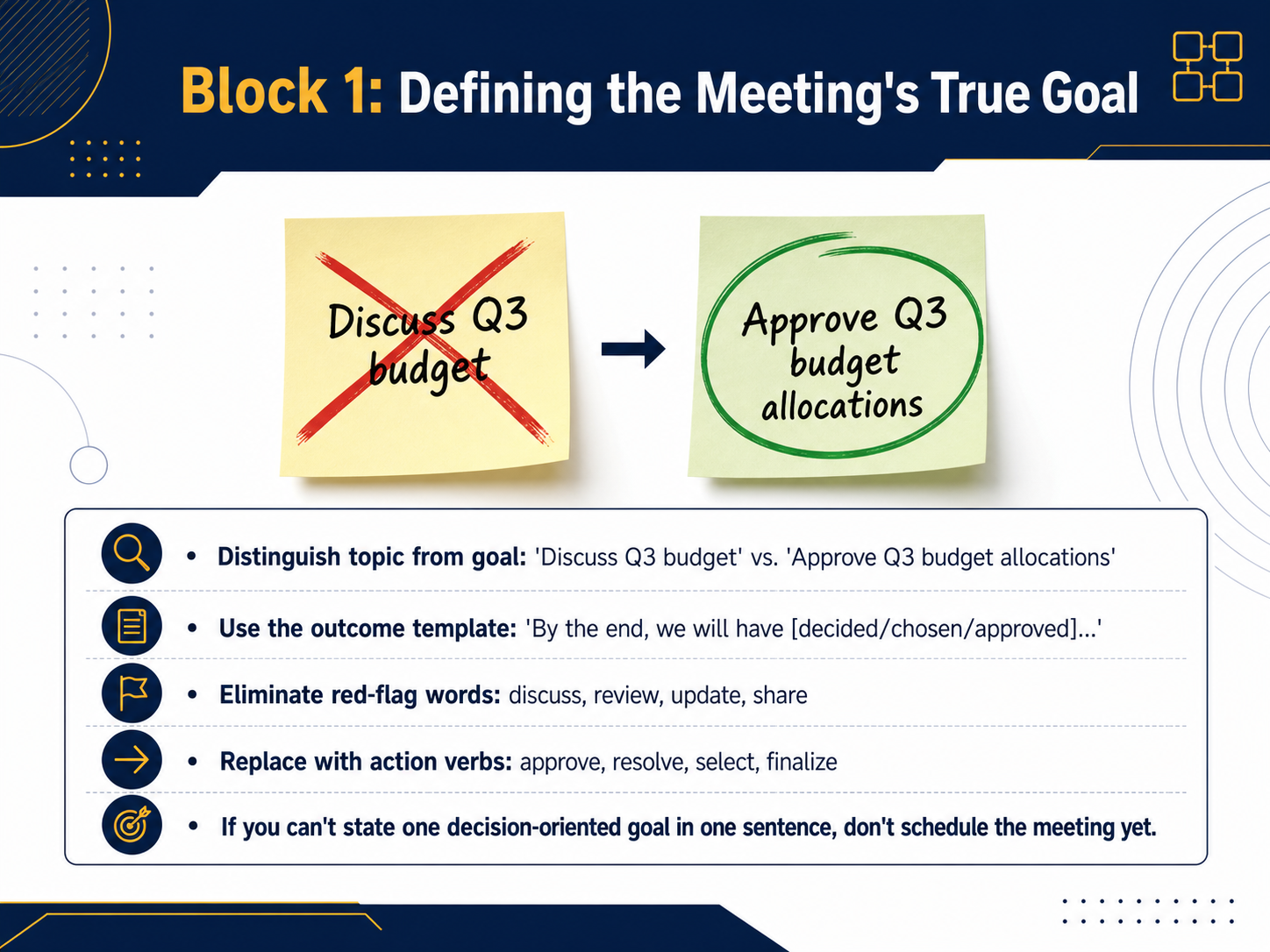
1 min - 04Block 1: Defining the Meeting's True GoalNow let's get into the first building block of your agenda: defining the meeting's true goal. This is where most agendas lose their edge. A topic is not a goal. 'Discuss Q3 budget' is a topic. 'Approve Q3 budget allocations' is a goal. See the difference? One describes an activity, the other demands a decision. To sharpen your goal, use a simple outcome template. Start with the phrase 'By the end, we will have' and then insert a strong action verb like decided, chosen, or approved. This forces clarity before anyone walks into the room. You also need to eliminate what I call red-flag words. Watch out for discuss, review, update, and share. These words signal information exchange, not progress. Replace them with decisive verbs like approve, resolve, select, or finalize. Here is a hard rule for you: if you cannot state one single, decision-oriented goal in one clear sentence, do not schedule the meeting yet. That discipline alone will transform your workday. Next, we'll build on that goal by selecting and sequencing the right discussion topics.
 2 min
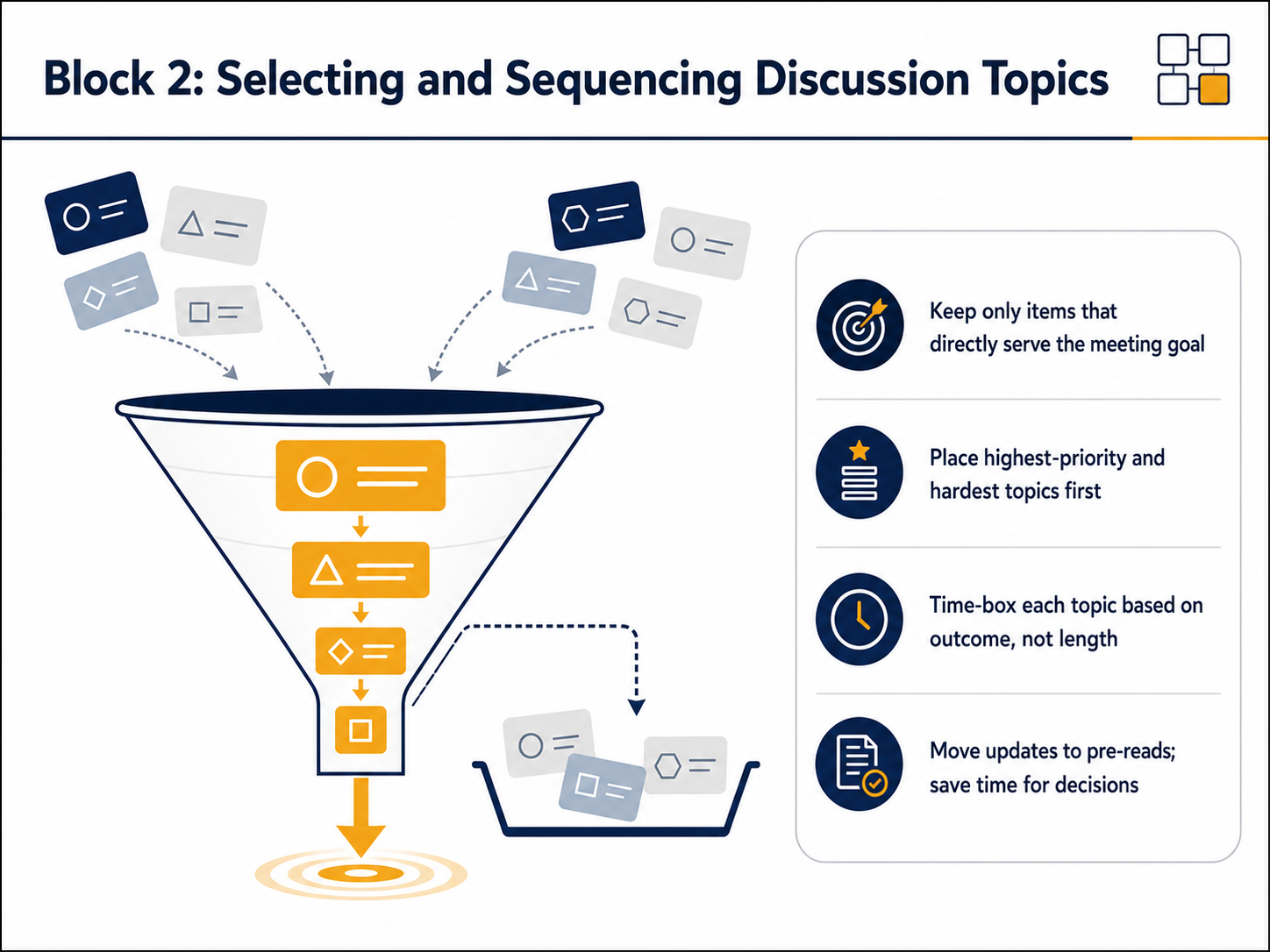
2 min - 05Block 2: Selecting and Sequencing Discussion TopicsNow, let's talk about selecting and sequencing your discussion topics. This is where you turn your goal into a focused agenda. First, filter ruthlessly. Keep only the items that directly serve the meeting's objective. If a topic doesn't help reach your stated goal, remove it or move it to a pre-read. Second, order strategically. Always place the highest-priority and most difficult topics at the start, while everyone's energy and attention are fresh. Third, time-box each topic based on the decision you need to make, not the topic's general importance. For example, allocate fifteen minutes to approve a vendor, instead of a loose thirty minutes for 'vendor discussion.' Finally, make 'updates' a pre-read document. This frees up live meeting time for real discussion and decisions. In the next block, we will cover how to assign clear pre-work that actually gets done.
 1 min
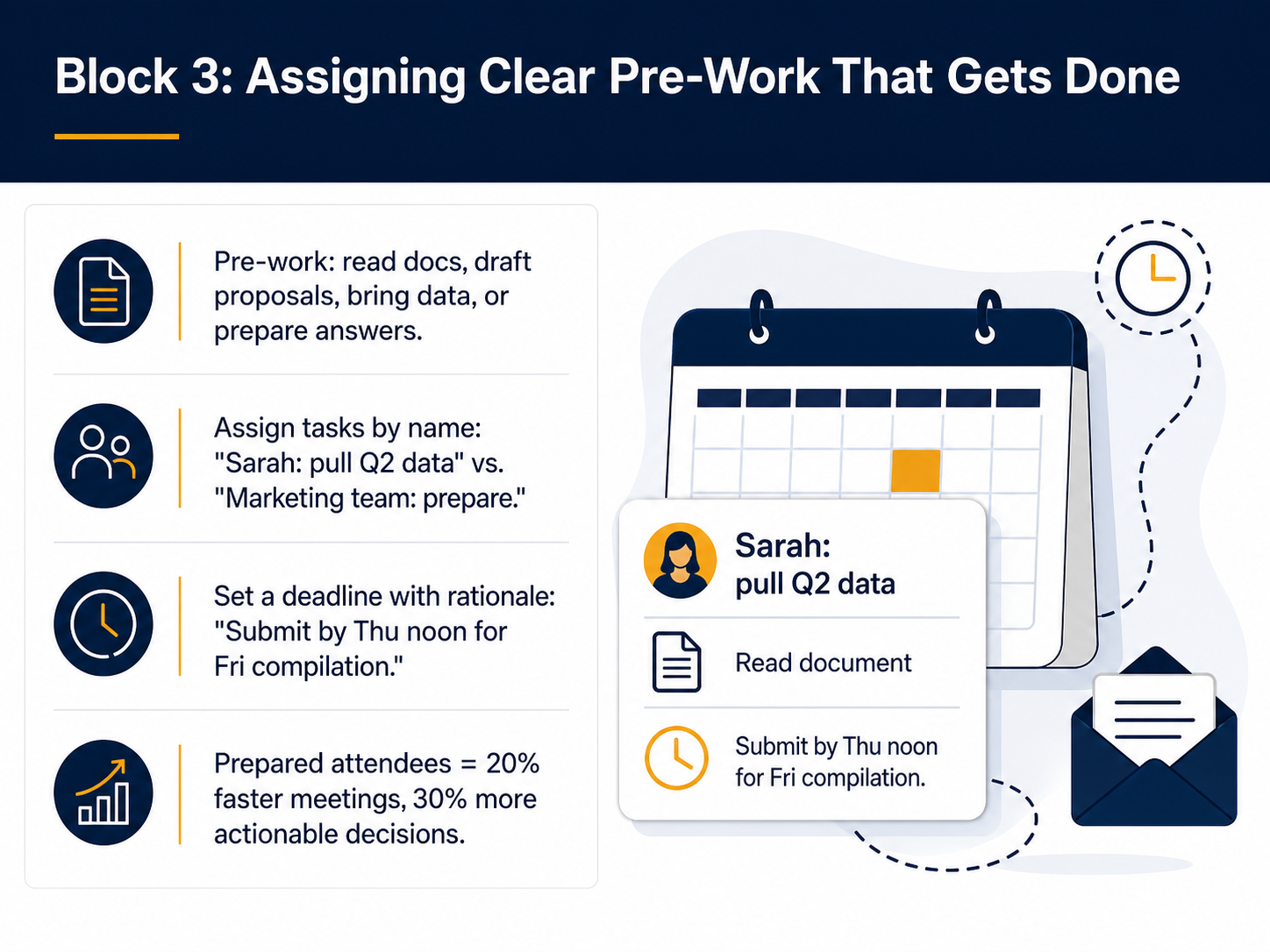
1 min - 06Block 3: Assigning Clear Pre-Work That Gets DoneNow, the third building block of your agenda is assigning clear pre-work that actually gets done. Pre-work isn't just a suggestion. It can be reading a document, drafting a proposal, bringing specific data, or preparing answers to key questions. The key is to make it precise. Assign tasks to a specific person by name, not a department. For example, write "Sarah: pull Q two data," not "Marketing team: prepare." Then, set a deadline with a clear rationale so people understand why it matters. Say "Submit by Thursday noon for Friday compilation." This simple shift creates accountability. When attendees arrive prepared, meetings run about twenty percent faster and produce thirty percent more actionable decisions. Next, we'll cover the final block: clarifying decision authority before the discussion even begins.
 1 min
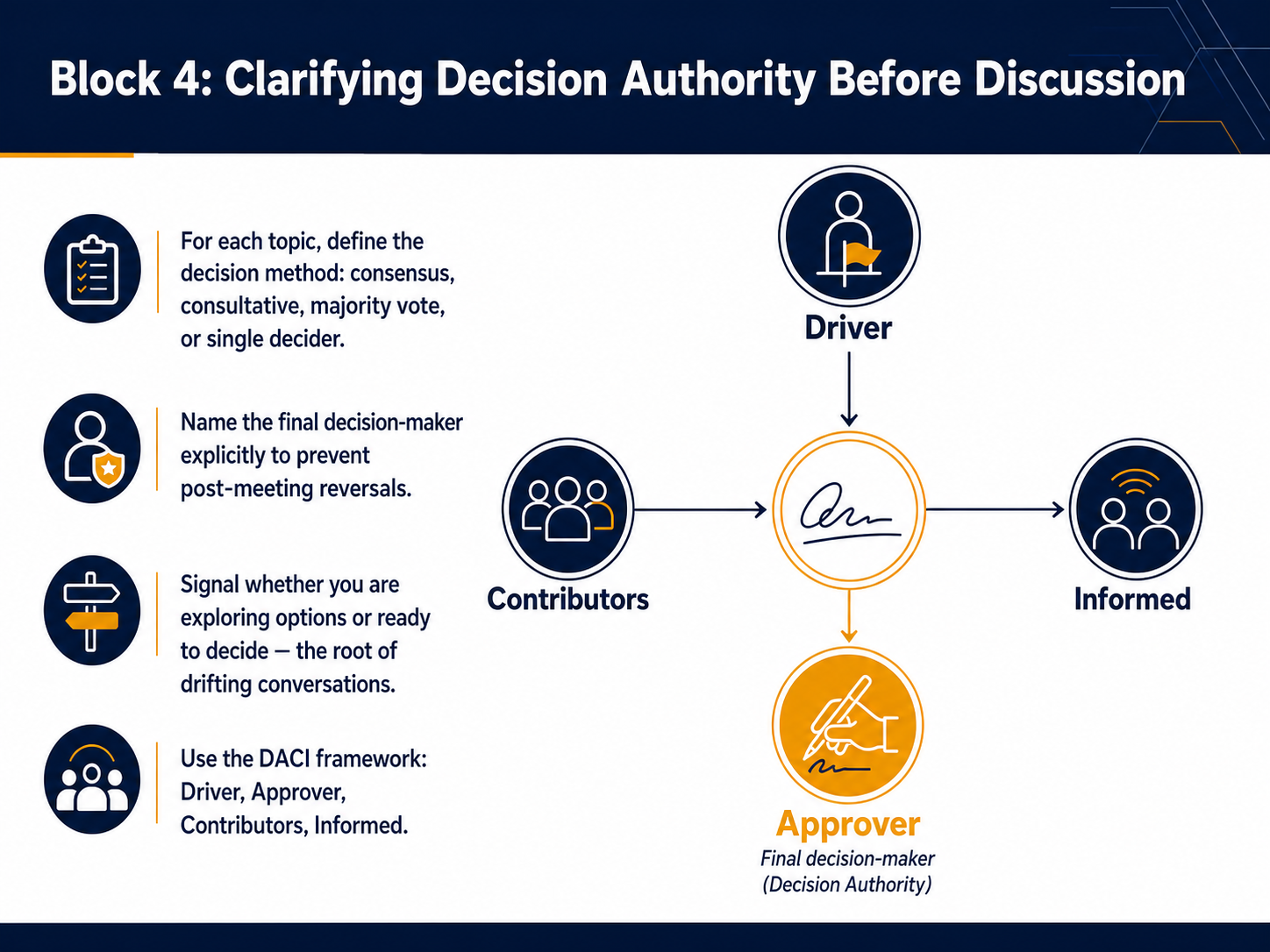
1 min - 07Block 4: Clarifying Decision Authority Before DiscussionNow that you have your topics listed, let's clarify how each decision will actually get made. This block is about assigning authority before the discussion starts. For each agenda topic, define the decision method. Will you use consensus, a consultative approach, a majority vote, or a single decider? Name the final decision-maker explicitly. This simple step prevents post-meeting reversals and confusion. Equally important, signal whether you are exploring options or ready to decide. This distinction is the root cause of most drifting conversations. To make roles crystal clear, I recommend the DACI framework. DACI stands for Driver, Approver, Contributors, and Informed. The Driver coordinates the discussion. The Approver has the final say. Contributors provide input, and Informed parties receive updates. Putting this in writing transforms your agenda into a decision-making tool. Up next, we will turn this structure into clear language as we cover writing the agenda with the right tone and clarity.
 2 min
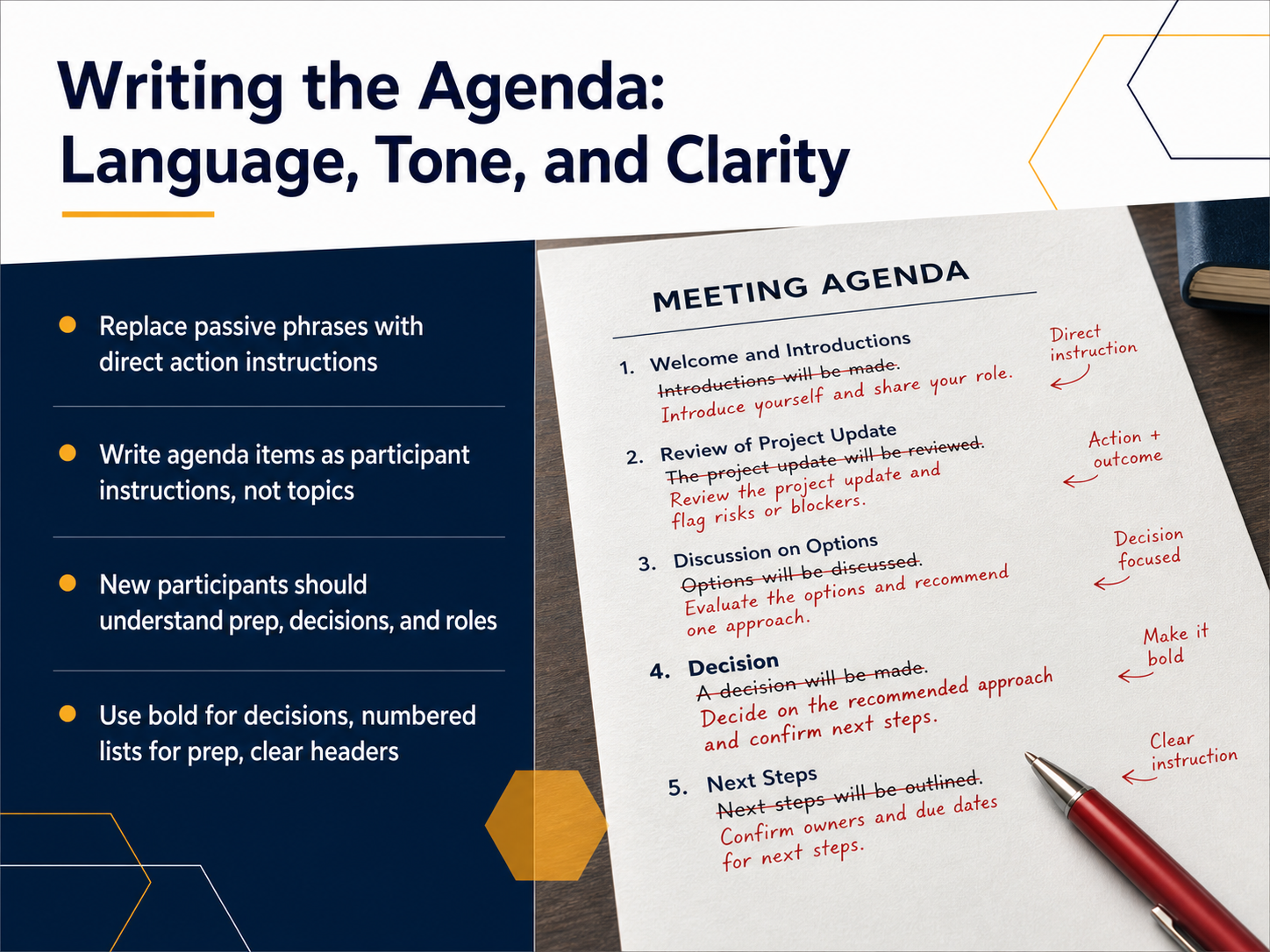
2 min - 08Writing the Agenda: Language, Tone, and ClarityLet's move from structure to the language that brings your agenda to life. The words you choose directly affect how prepared your participants feel and how productive your meeting becomes. First, replace passive phrases with direct action instructions. Instead of writing "Project status will be reviewed," write "Review project status and identify two critical blockers." This tells people exactly what to do. Second, write agenda items as participant instructions, not as topics. A vague topic like "Budget" becomes a clear instruction: "Decide on the Q3 marketing budget allocation." This immediately signals the purpose of the conversation. Third, make sure any new participant can understand their preparation, the decisions required, and their role just by reading the agenda. Never assume prior context. Finally, use formatting to guide attention. Use bold for decisions that must be made, numbered lists for pre-work steps, and clear, consistent headers to organize sections. These small acts of clarity turn a static list into a reliable map that every participant can follow.
 2 min
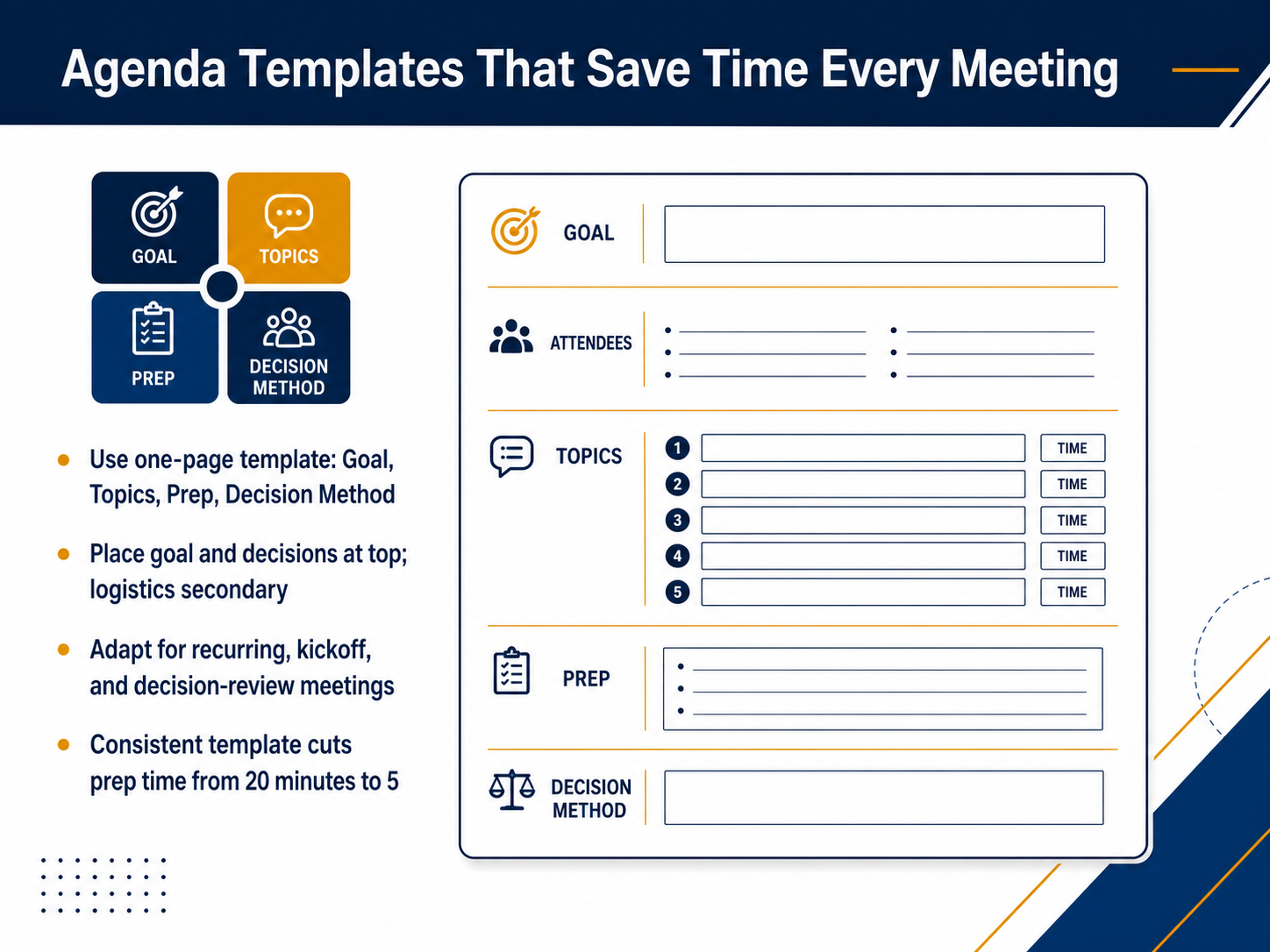
2 min - 09Agenda Templates That Save Time Every MeetingLet's shift from principles to a practical tool that saves time. Using a one-page template turns agenda writing from a chore into a quick, repeatable process. Your template should have four clear sections: Goal, Topics, Prep, and Decision Method. Place the goal and the decision method right at the top. This keeps the meeting's purpose visible from the start. Logistics, like the time and location, go below these core elements. You can then adapt the same template for different meeting types. A recurring check-in focuses on progress against a known goal. A project kickoff expands the prep section to set context. A decision-review meeting highlights the options and the decision method even more prominently. The real benefit is speed. With a consistent template, you stop staring at a blank page. Teams we work with typically cut agenda prep time from around twenty minutes down to five. That is time you can invest in the meeting itself. Next, we'll look at how to distribute the agenda so everyone arrives ready to contribute.
 1 min
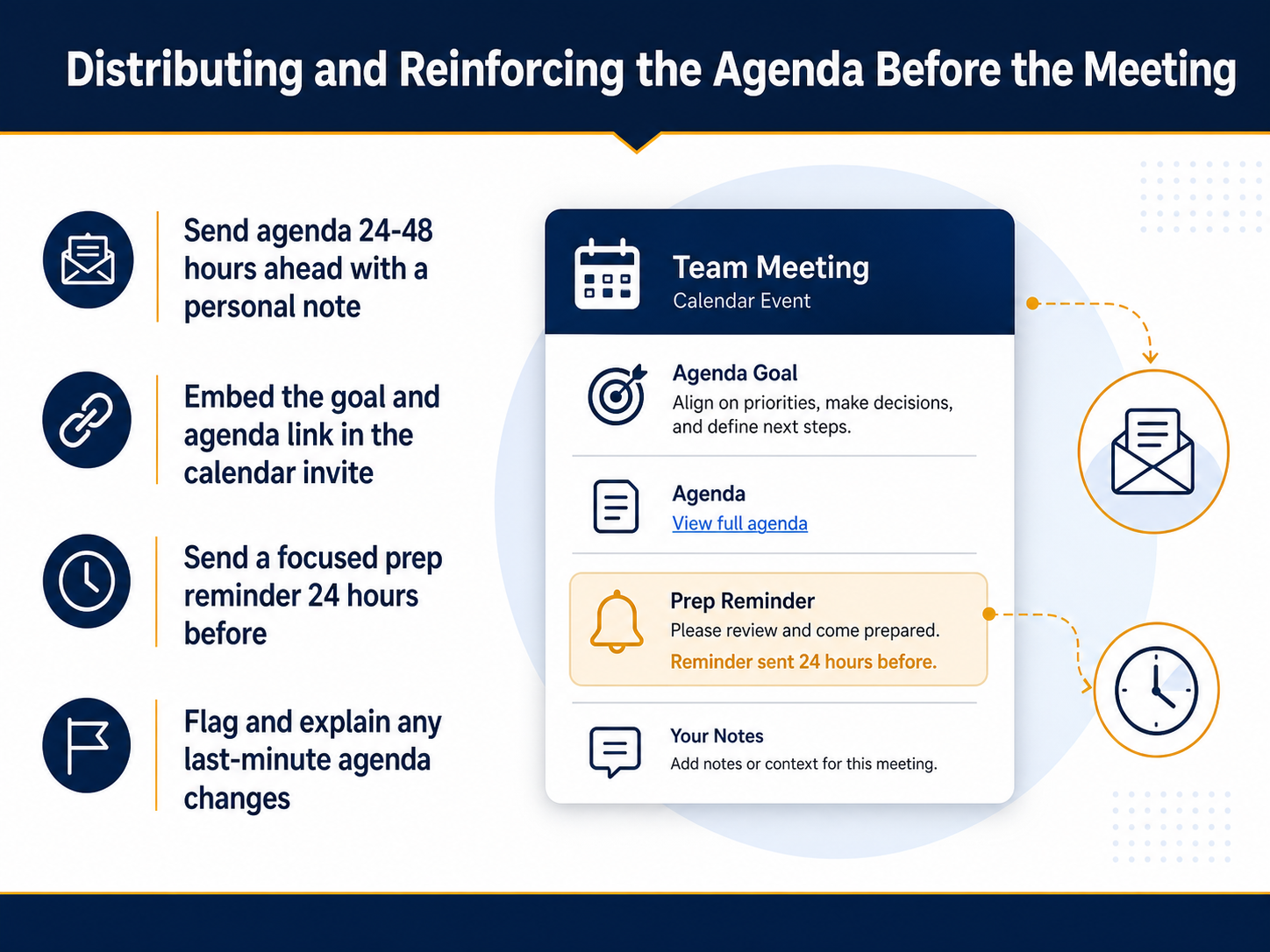
1 min - 10Distributing and Reinforcing the Agenda Before the MeetingNow let's put that agenda to work by distributing it effectively. Send the document twenty-four to forty-eight hours before the meeting, attached to a brief personal note that highlights the main goal. Next, embed that same goal and a link to the agenda directly inside the calendar invitation, so the purpose is visible the moment someone opens the event. About twenty-four hours out, send a focused prep reminder. Keep it short, and point to the two or three decisions the group needs to make. If anything changes last minute, flag the update explicitly. Rather than quietly swapping the file, write a one-line summary of what changed and why right at the top of the agenda. This small step preserves trust and keeps preparation on track. Coming up next, we will rebuild a vague request into a clear agenda, step by step.
 1 min
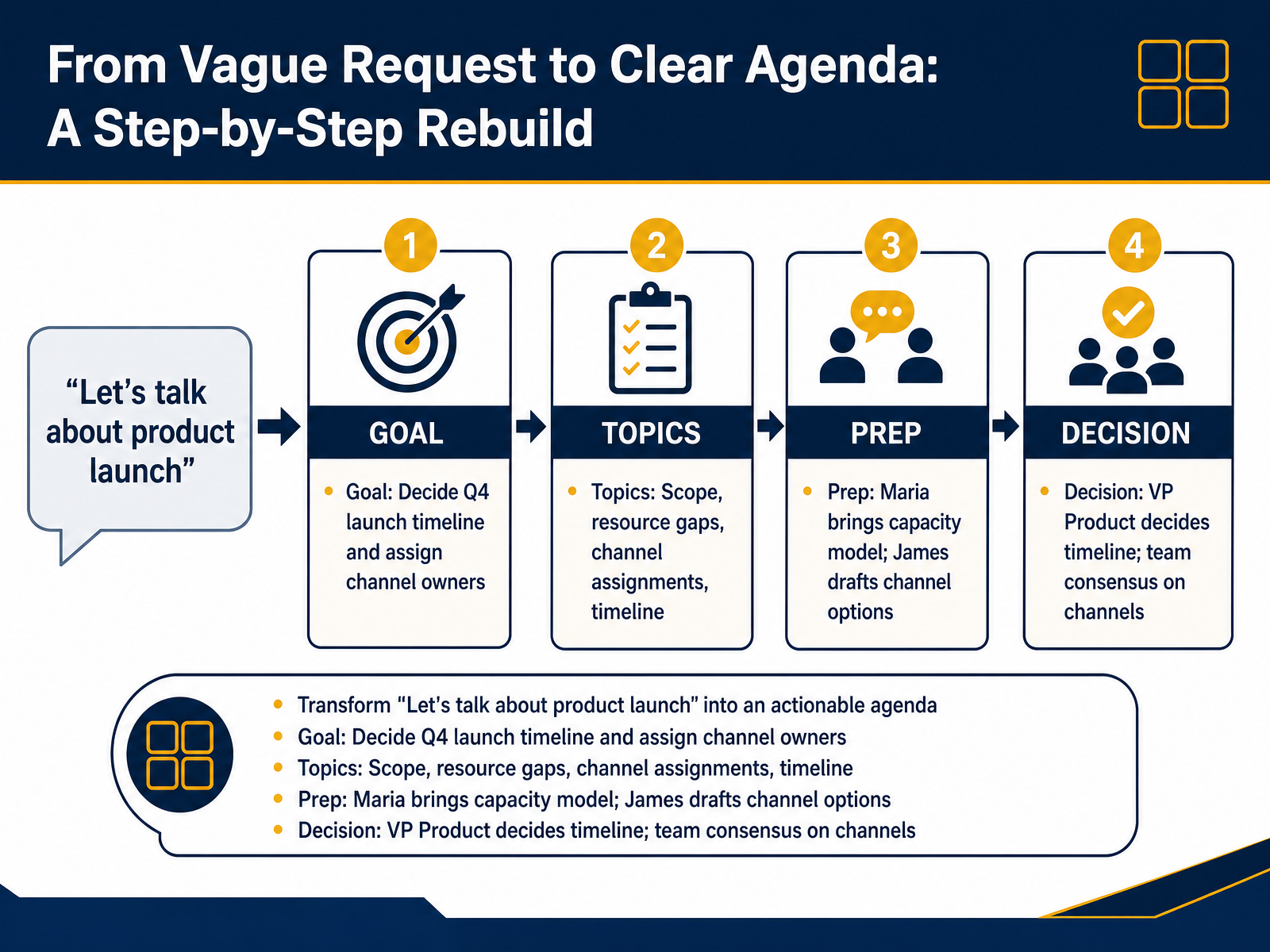
1 min - 11From Vague Request to Clear Agenda: A Step-by-Step RebuildNow let's see how to rebuild a vague request into a clear, actionable agenda. Take the open-ended ask, "Let's talk about product launch." Instead, we define a sharp goal: Decide the Q4 launch timeline and assign channel owners. From there, we break the meeting into four specific topics: scope, resource gaps, channel assignments, and timeline. Then we tie each topic to preparation. Maria brings the capacity model, and James drafts channel options. Finally, we name the decisions upfront. The VP of Product decides the timeline, and the team reaches consensus on channels. This one-page rebuild turns ambiguity into alignment before anyone enters the room. Next, you'll apply this method in a practice exercise where you rebuild a flawed meeting request yourself.
 1 min
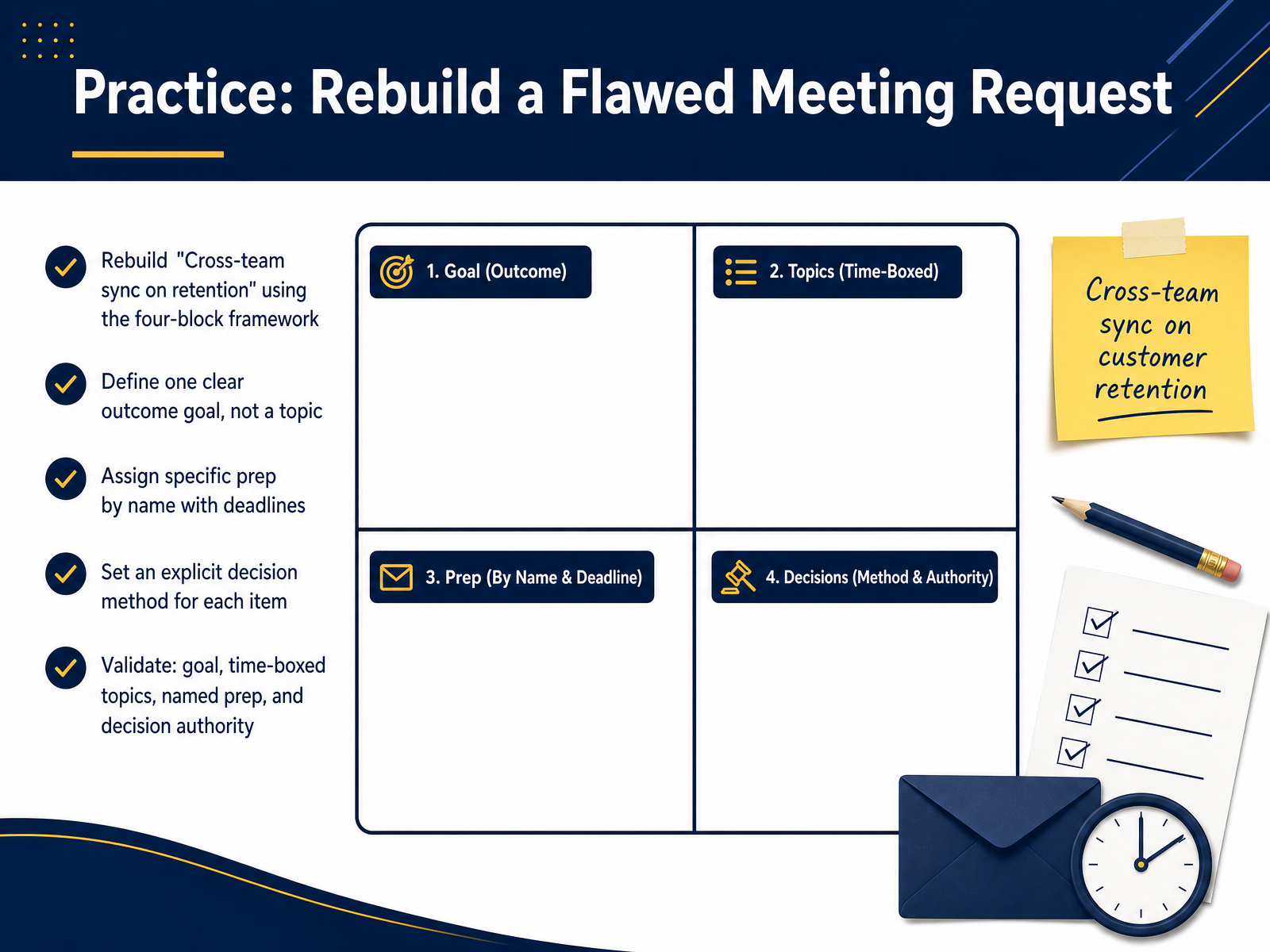
1 min - 12Practice: Rebuild a Flawed Meeting RequestLet's put the framework into practice. Take a vague meeting request like "Cross-team sync on retention" and rebuild it. First, define one clear outcome goal, not just a topic. For example, the goal might be to agree on the top two causes of early churn, not simply to "discuss retention." Next, assign specific prep by name, with a deadline. Ask Jordan to compile exit-survey data by Monday, and ask Priya to draft a summary of support-ticket trends. Then, for each agenda item, set an explicit decision method. State whether the team will vote, or whether the Head of Product has final authority. Finally, validate your work. Check that you have a measurable goal, time-boxed topics, named preparation owners, and a clear decision authority for every item. Use this four-block test before you publish any agenda.
 2 min
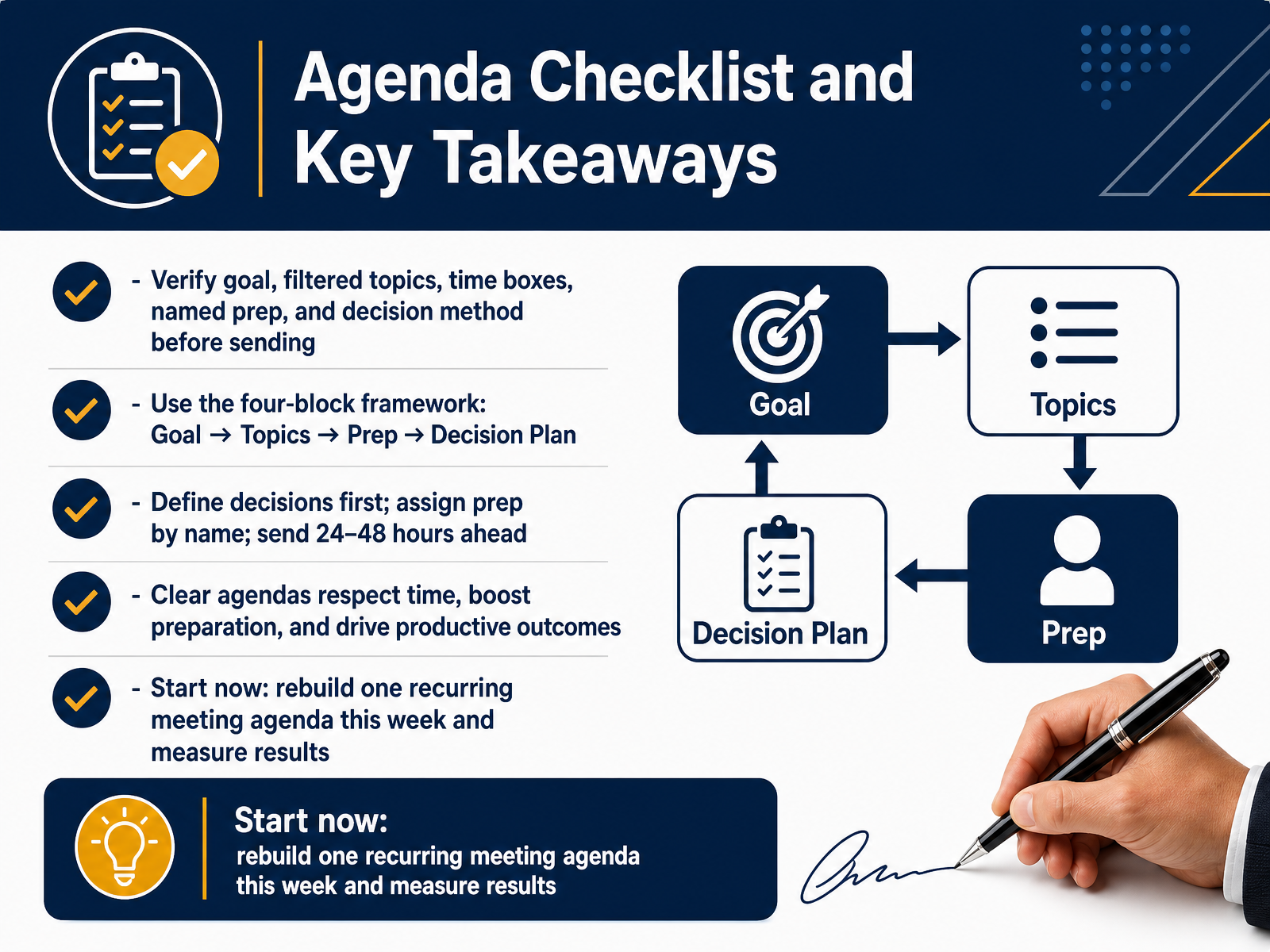
2 min - 13Agenda Checklist and Key TakeawaysLet's quickly recap the key steps before you send your next agenda. First, run through your checklist. Confirm the meeting goal, verify that only filtered, truly necessary topics are included, and check that every topic has a clear time box. Make sure each preparation task is assigned to a specific person by name, and finally, confirm the decision method is stated upfront. Remember the four-block framework that makes this repeatable: Goal, then Topics, then Prep, and then the Decision Plan. The most important shift is to define how decisions will be made before you list the discussion items. Assign preparation by name so nothing falls through the cracks, and aim to send your agenda twenty-four to forty-eight hours ahead of the meeting. Clear agendas respect everyone's time, they dramatically improve preparation, and they drive productive outcomes. Now, here is your one concrete action. This week, pick one recurring meeting and rebuild its agenda using everything you've learned. Then measure the results. You will see the difference immediately. Thank you for your time and focus. I'm confident you'll write agendas that make every meeting better.
 2 min
2 min
Take the deck with you
Download this course as a file — free, no sign-up needed.
- PDF handoutEvery slide page, ready to print or share.14 pages · 3.1 MBDownload
- Narrated PowerPointThe deck that presents itself — every slide carries the digital human's narration video.14 pages · 11.9 MBDownload
- PowerPoint slidesThe full deck as a .pptx — open it in PowerPoint, Keynote, or Google Slides.14 pages · 3.0 MBDownload
Free to use in your own training — please keep the PersonWise credit page at the end.
Have your own deck? Turn it into a course