Rhetoric: Audience, Purpose, and Choice
Begin
14 pages · ~28 min
Rhetoric: Audience, Purpose, and Choice
This training introduces learners to the foundational principles of rhetoric—audience, purpose, and choice—equipping them to analyze and craft effective communication in diverse contexts.
What you’ll learn
- 01Understanding Rhetoric: Audience, Purpose, and ChoiceWelcome. Over this course, we will step into the role of the rhetorical analyst. Our goal is not simply to label techniques, but to understand why a speaker or writer makes a specific choice in a specific moment. Think of rhetoric as the art of strategic decision-making. It involves the deliberate selection of language, structure, and evidence. These choices are never random. They are always driven by three core concerns: who the audience is, what the purpose demands, and what the situation—the kairos—makes possible. As we build our framework, we start seeing how an op-ed concedes a point to build trust, or how an activist shifts tone when speaking to allies versus skeptics. This practice sharpens our critical reading and builds our own persuasive range. Our journey together moves through three stages: first, building analytical frameworks; then, applying them to dissect real-world texts; and finally, considering how we translate analysis into ethical action. We begin by laying that foundation with the most essential visual model for these relationships. Let's turn now to The Rhetorical Triangle: A Foundational Model.2 min
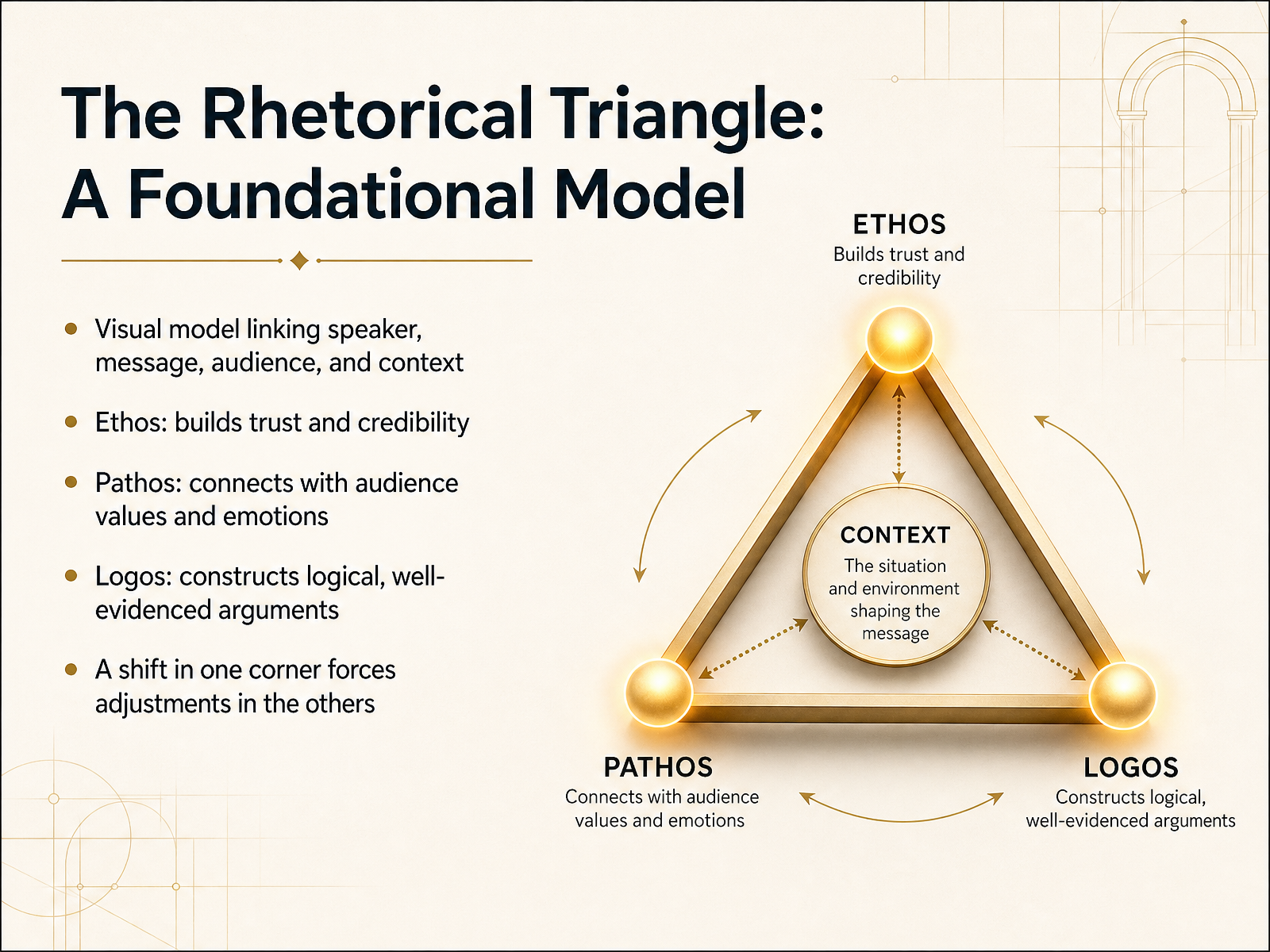
- 02The Rhetorical Triangle: A Foundational ModelSo here we have it—the rhetorical triangle. It’s our foundational model for mapping any persuasive moment. Picture four interconnected points: the speaker, the message, the audience, and the enveloping context. When you’re analyzing a speech or an ad, you’re essentially watching how a speaker strategically navigates this space. We’ll unpack their primary moves through three classical appeals. Ethos: that’s the credibility play. Think of a doctor in a white coat citing her own clinical trials—she’s saying, “Trust me.” Pathos: this is the vital emotional connection. An environmental group showing a lone polar bear on shrinking ice is appealing directly to your values and shared concern. Logos: the architecture of a reasoned case, built with data, structure, and precise evidence. Now, here’s the crucial dynamic—the triangle isn’t static. A strategic shift in one corner forces a recalibration everywhere else. If a speaker suddenly faces a hostile audience, her ethos-building might need to surge, and her logical structure might need to accommodate a strategic concession. Every choice ripples through the entire system. Understanding this interdependence is what transforms a simple description into true rhetorical analysis. Now, let’s trace where this complex calculus actually begins. Our next step is “The Root of Every Choice: Audience Awareness.”
 2 min
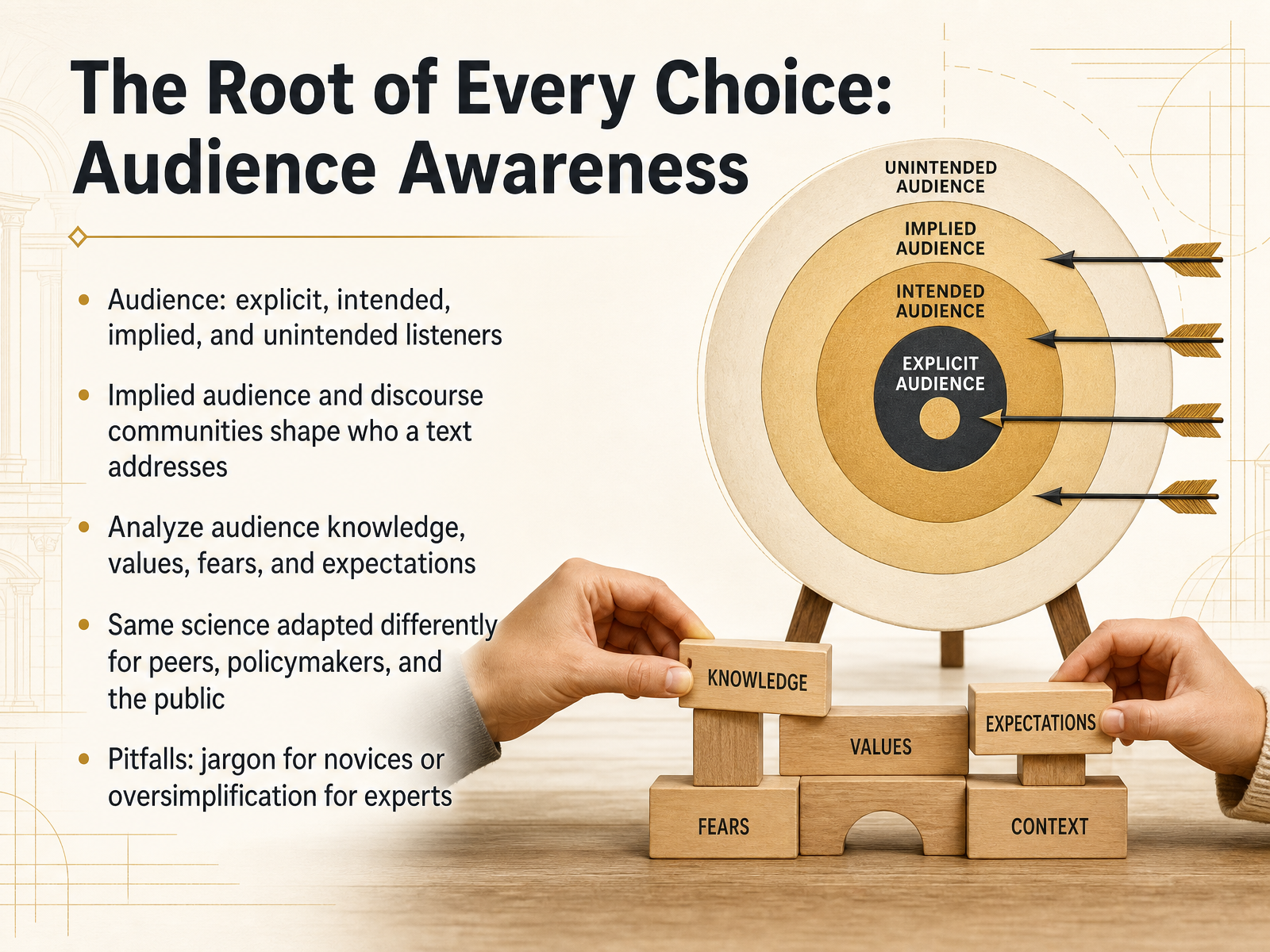
2 min - 03The Root of Every Choice: Audience AwarenessSo let's start with the foundational question in any rhetorical analysis: who is the speaker actually trying to reach? We often think of the audience as a single, visible group, but it’s rarely that simple. A speaker is simultaneously addressing an explicit audience—the people physically in the room—and an intended audience—those they most want to persuade. There's also an implied audience, which is the ideal reader or listener the text itself constructs, and often unintended listeners who overhear the message. Take a climate scientist. When they write for a scholarly journal, they assume an implied audience that shares a deep vocabulary and values empirical rigor. But when that same scientist speaks at a town hall, the implied audience shifts to a community worried about local flooding and property values. Both are real, but the speaker’s awareness of each group’s knowledge, values, and, yes, even their fears, fundamentally dictates every word choice. The pitfall, of course, is misalignment. You see it when a technical brief drowns a public audience in jargon, alienating the very people it needs to persuade. Or conversely, when an oversimplified message makes an expert audience feel patronized. Effective rhetoric begins here, with the strategic act of tailoring the message to a specific discourse community. Let's carry this idea of strategic fit forward as we examine the engine driving those choices: purpose.
 2 min
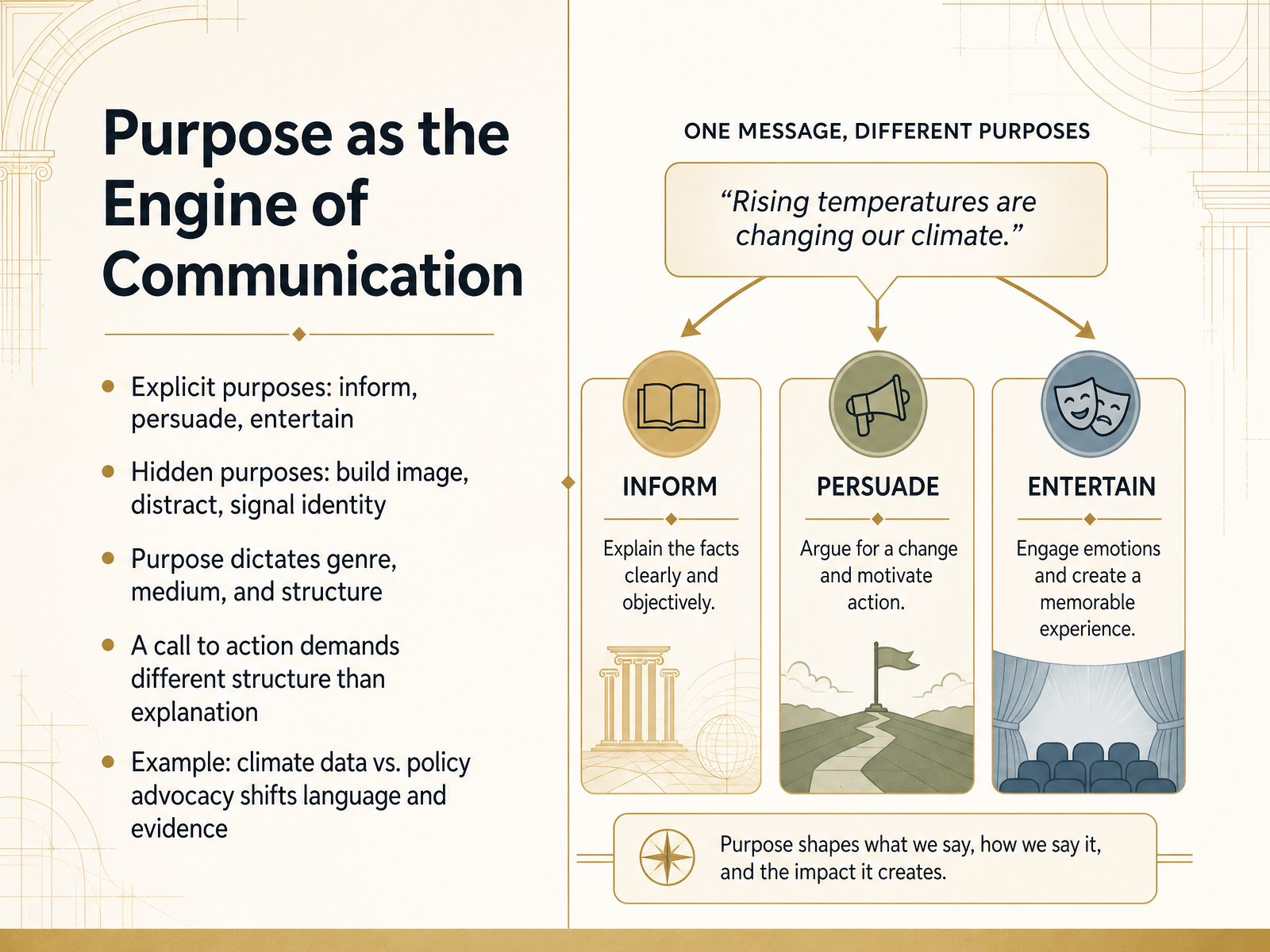
2 min - 04Purpose as the Engine of CommunicationSo if audience is the destination, purpose is the engine that gets us there. It seems straightforward at first: we speak to inform, to persuade, to entertain. But beneath those explicit goals, there are often hidden purposes at work. A speaker might be building a particular image, or subtly distracting from a weak point, or signaling membership in a community. Think of a corporate apology that doesn't just inform you of a mistake, but actively rebuilds the CEO's ethos. That image-building is the true engine. And here's where the analysis gets precise: purpose dictates genre, medium, and structure. A call to action demands a very different architecture than a pure explanation. Consider climate data. A scientific report presents findings with cautious, hedged language to inform peers. But turn that same data into policy advocacy, and suddenly the evidence is framed as a moral imperative, the language becomes urgent, and the structure funnels you toward a specific demand. That shift isn't random. It's a direct, traceable consequence of a changed purpose. Now let's consider how that purpose is shaped by the immediate moment, as we look at situational context, including kairos, exigence, and constraints.
 2 min
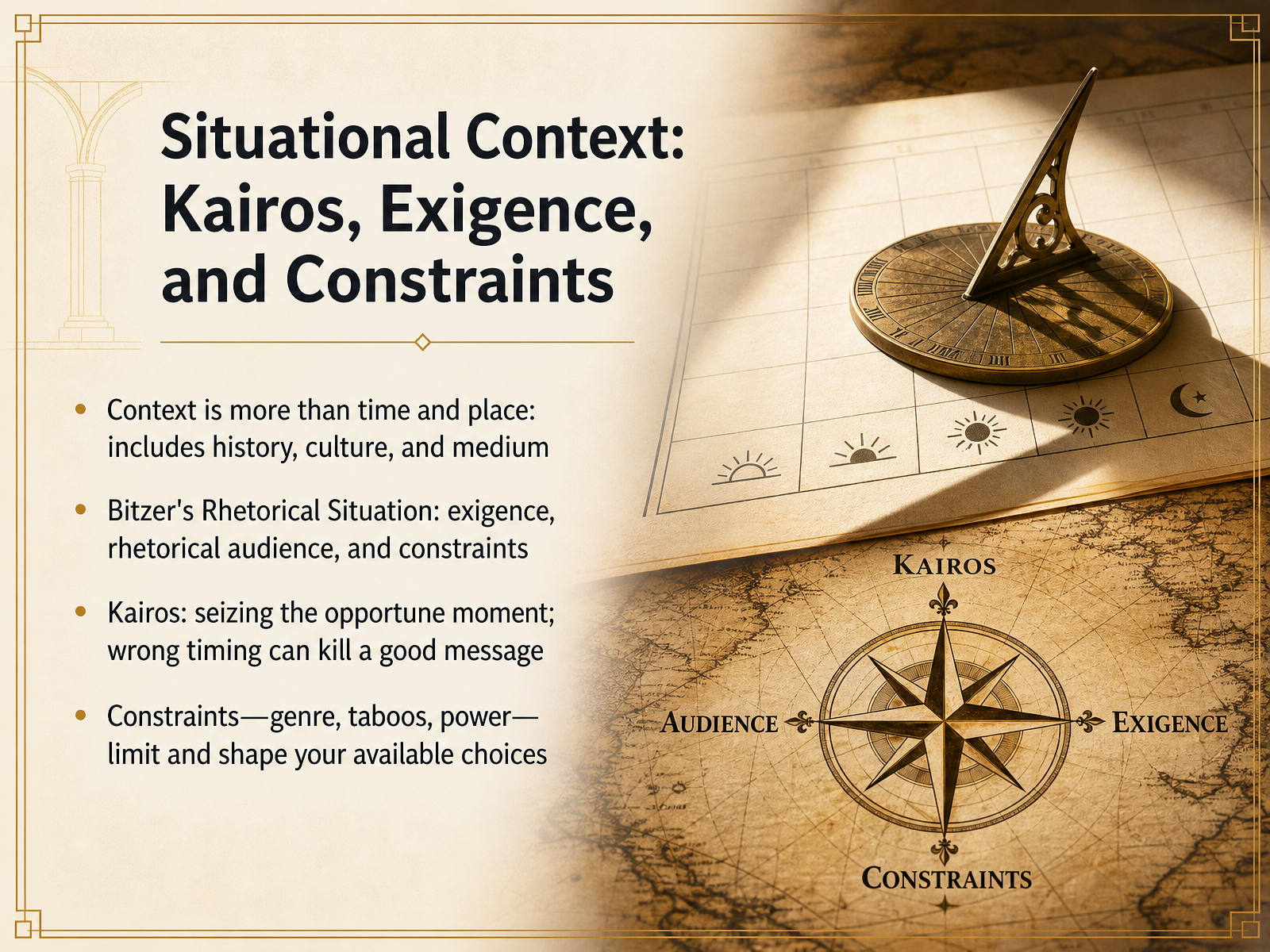
2 min - 05Situational Context: Kairos, Exigence, and ConstraintsNow let's complicate the idea of context a bit. We're not just talking about a calendar date and a physical place. Context includes history, culture, and even the medium itself—a televised address is a different situation than a printed op-ed, even on the same topic. Lloyd Bitzer gave us a powerful framework for this: the rhetorical situation. He argues that rhetoric is a response to an *exigence*—an urgent imperfection that can be modified by speech. It's not just any problem; it's a problem that calls for words. And that response is shaped by a specific rhetorical audience, people who can actually act on the issue, and by constraints. This is where *kairos* becomes critical. Kairos isn't just chronological time; it's the opportune moment. The same argument made a week too late, or even a moment too soon, can completely fail. A eulogy offers the right words at the right time; a preemptive political victory speech does not. Finally, let's get specific about those constraints. They include genre—you don't start a research paper with a personal anecdote, usually. They include cultural taboos and unspoken power dynamics. These constraints don't just block you; they shape your available choices. A diplomat, for example, speaks through a narrow corridor of constraints, where a single word can be an explosive choice. So, how do these constraints actually manifest in the words on the page? That's exactly where we're going next, by deconstructing language choices like diction, tone, and framing.
 2 min
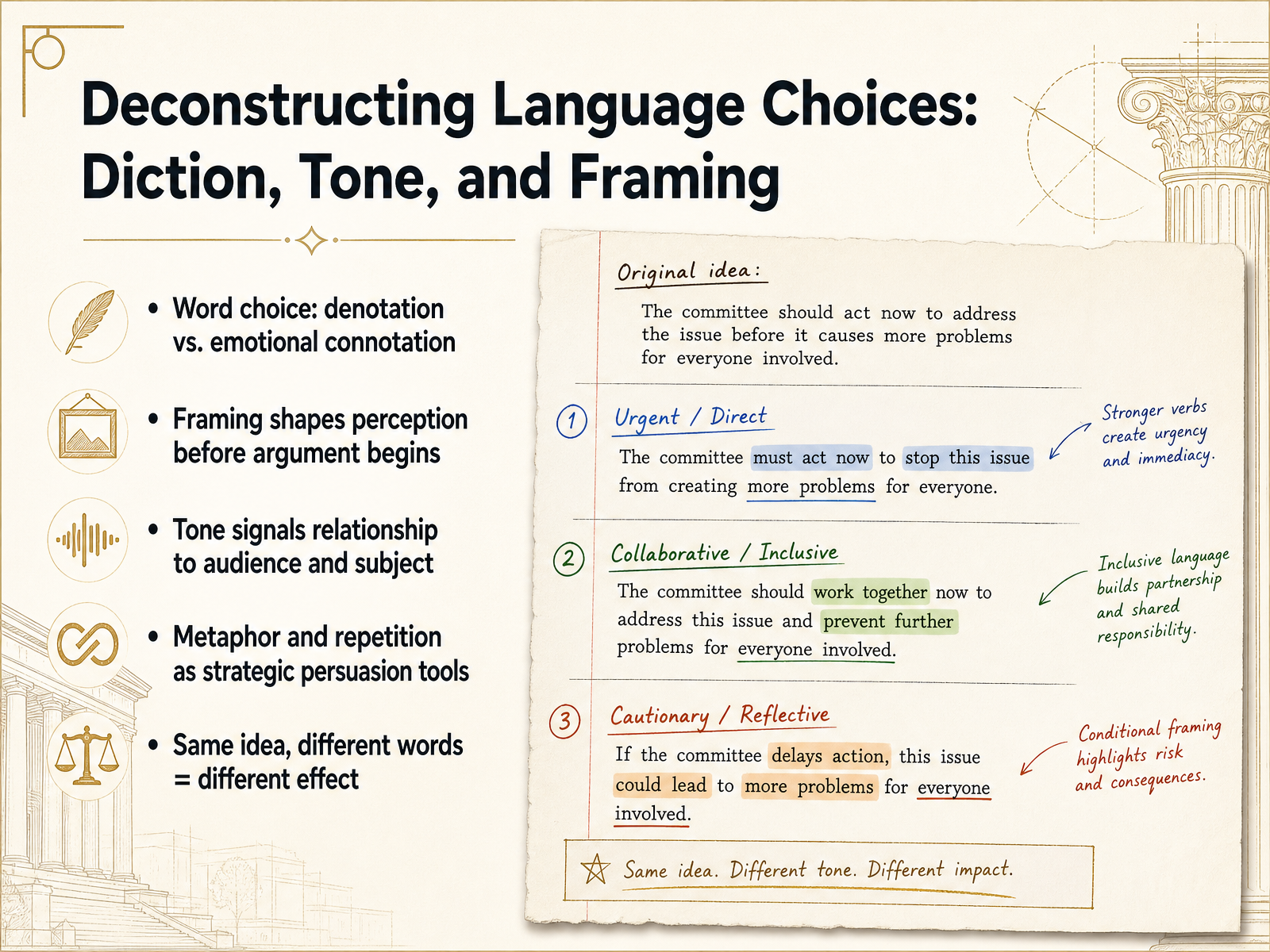
2 min - 06Deconstructing Language Choices: Diction, Tone, and FramingSo let's look closely at the writer's raw material: language itself. When we analyze diction, we're not just asking what a word means in the dictionary—its denotation. We're asking about its emotional charge, its connotation. Think about the difference between describing a crowd as a 'gathering' versus a 'mob.' Same basic referent, but the connotation primes a completely different feeling before an argument even begins. That priming is framing. Framing is the lens the speaker sets up—it shapes perception before logic even arrives. It might cast a policy as a 'safety net' or a 'hammock,' and that single choice sets the stage for all the evidence that follows. Tone, meanwhile, signals the speaker's relationship to you and to the subject. Is it urgent, ironic, elegiac? An urgent tone tells the audience this is a crisis demanding immediate action, which can be a powerful appeal to kairos. Now, two more tools: metaphor and repetition. Metaphor smuggles in an entire system of understanding; saying 'argument is war' makes us think in terms of winning and losing, not exploration. And repetition—think of anaphora—creates rhythm and inevitability, making a claim feel more true simply through its return. A skilled rhetorician knows that saying the same idea with different words isn't just restating; it's creating a different effect entirely. In a moment, we'll push past individual words to see how these choices work together structurally, deconstructing the architecture of evidence itself.
 2 min
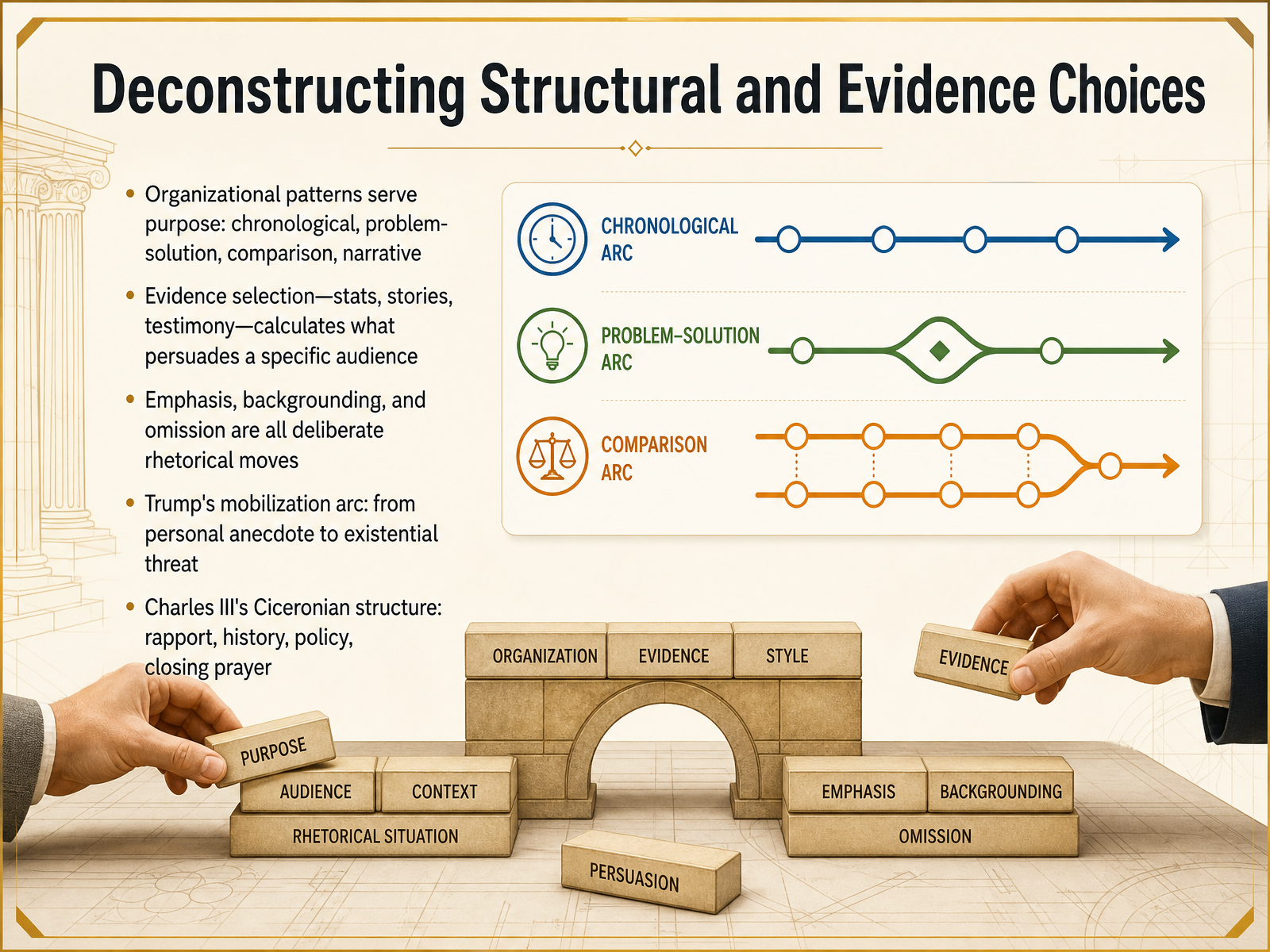
2 min - 07Deconstructing Structural and Evidence ChoicesHow a speaker arranges a message is itself a rhetorical choice. Organizational patterns are not neutral containers—they serve purpose. A problem-solution structure, for instance, immediately frames the speaker as a diagnostician and potential savior. A narrative arc, on the other hand, builds identification and emotional stakes before any policy detail appears. Think about evidence selection through the same lens. Why does a speaker choose a single vivid story over a page of statistics? Because they’ve calculated what persuades their specific audience. A personal testimony may build ethos and empathy far faster than data. And what about what’s left out? Emphasis, backgrounding, and omission are always deliberate moves. When Trump opens a speech with a personal anecdote of being targeted and then widens it to an existential threat against his supporters, that structural arc fuses his fate with theirs. Compare this to Charles the Third’s address to Parliament, which followed a Ciceronian sequence: first establishing rapport, then honoring history, outlining policy, and closing with a prayer. Each part positions the audience differently—from grieving family member to constitutional sovereign. Structure, evidence, and silence are all arguments. Let’s turn now to how these choices manifest visually on the page or screen, in layout, typography, and imagery.
 2 min
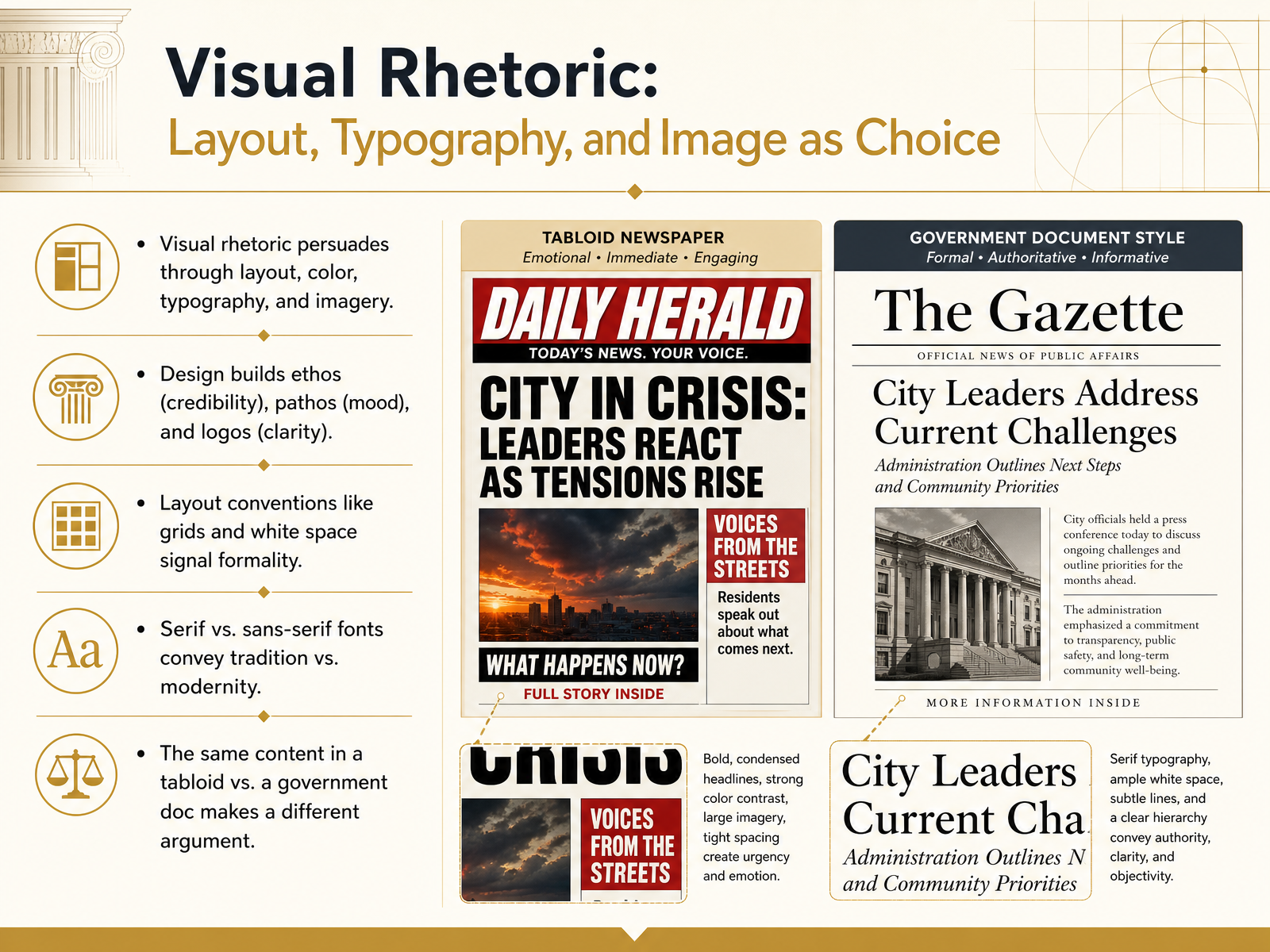
2 min - 08Visual Rhetoric: Layout, Typography, and Image as ChoiceNow let’s turn to a dimension of rhetoric that often operates below our conscious awareness—visual rhetoric. When we talk about layout, typography, and imagery, we’re really talking about choices that shape ethos, pathos, and logos before a single word is read. Think about a government report set in a clean, two-column grid with generous white space. That layout signals formality and institutional credibility; it’s a visual appeal to ethos. Now imagine the same text crammed into a tabloid with bold, high-contrast headlines and grainy photographs. The argument hasn’t changed, but the design suddenly evokes urgency, sensation—a very different pathos. Typography alone carries argumentative weight. A serif typeface, with its small decorative strokes, often conveys tradition, stability, and scholarly authority. A sans-serif font reads as modern, streamlined, and direct. The choice between them is rarely neutral; it orients the audience toward a certain relationship with the content. So as we analyze a text, we should ask: how does the visual frame prime our trust, our mood, or our comprehension? That same question will sharpen our focus in the next slide, where we’ll apply these ideas in a case study in depth—Trump’s 2026 primetime address.
 2 min
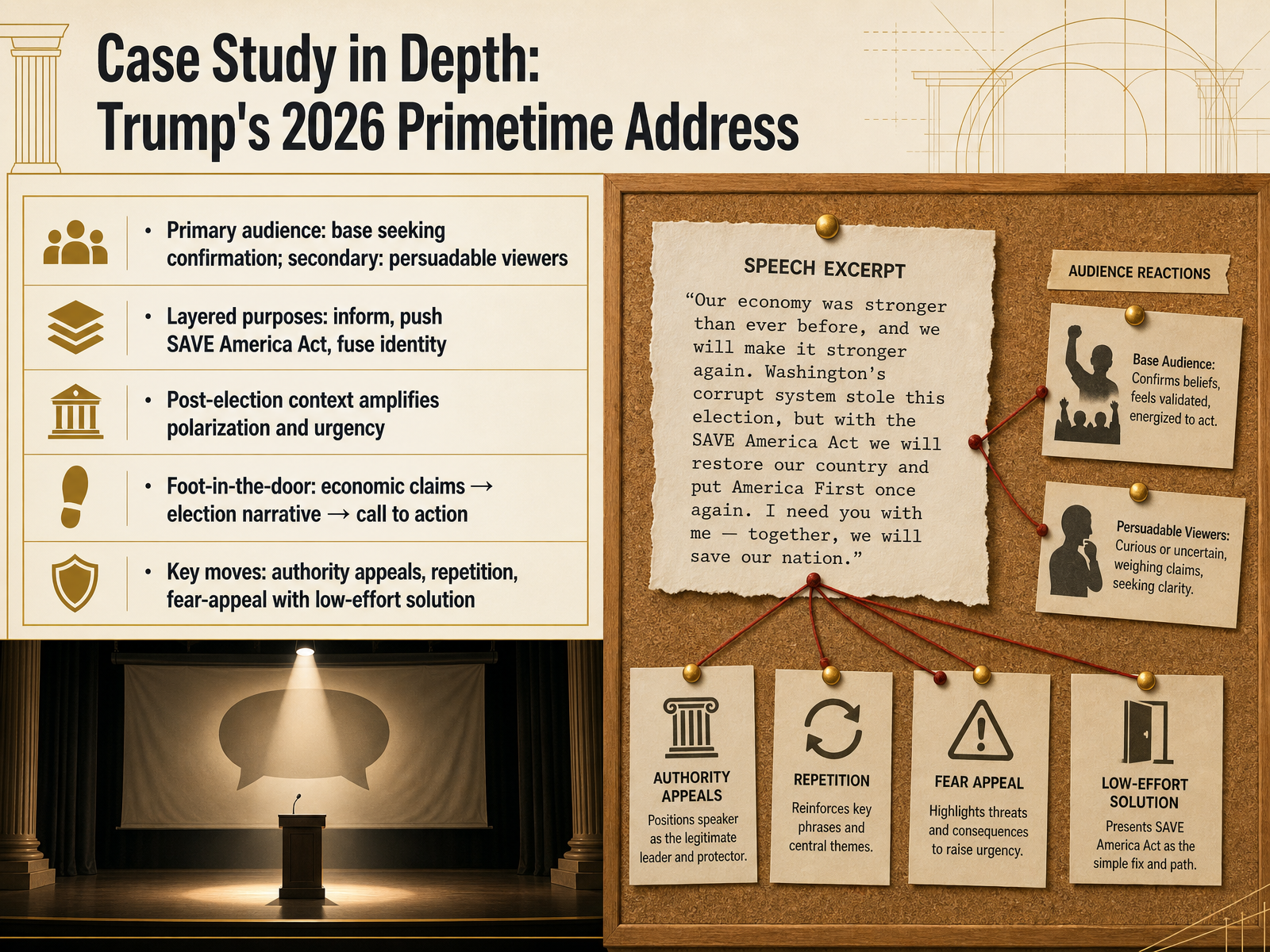
2 min - 09Case Study in Depth: Trump's 2026 Primetime AddressLet's turn now to a specific live case: Donald Trump's 2026 primetime address. This speech arrived in a charged post-election moment, where polarization wasn't just a backdrop—it was the very condition of reception. His primary audience was a base seeking confirmation of its worldview. But a secondary audience, persuadable viewers who may be watching out of civic habit, was also present in the room. The purposes are layered. On the surface, the speech informs and pushes for the SAVE America Act. Dig deeper, and you see identity fusion at work—weaving audience self-conception into the policy ask. This context amplifies urgency. And the structure itself is a rhetorical lesson. Notice the foot-in-the-door technique: he opens with a shared economic claim, builds into an election narrative, and only then moves to the call to action. Key moves include repeated authority appeals, rhythmically patterned repetition, and a classic fear-appeal that offers a low-effort solution. How does that combination shape the persuadable listener's sense that action is both necessary and easy? We'll hold that question as we pivot to a very different rhetorical situation—a contrasting case study: King Charles the Third's 2026 address to Congress.
 2 min
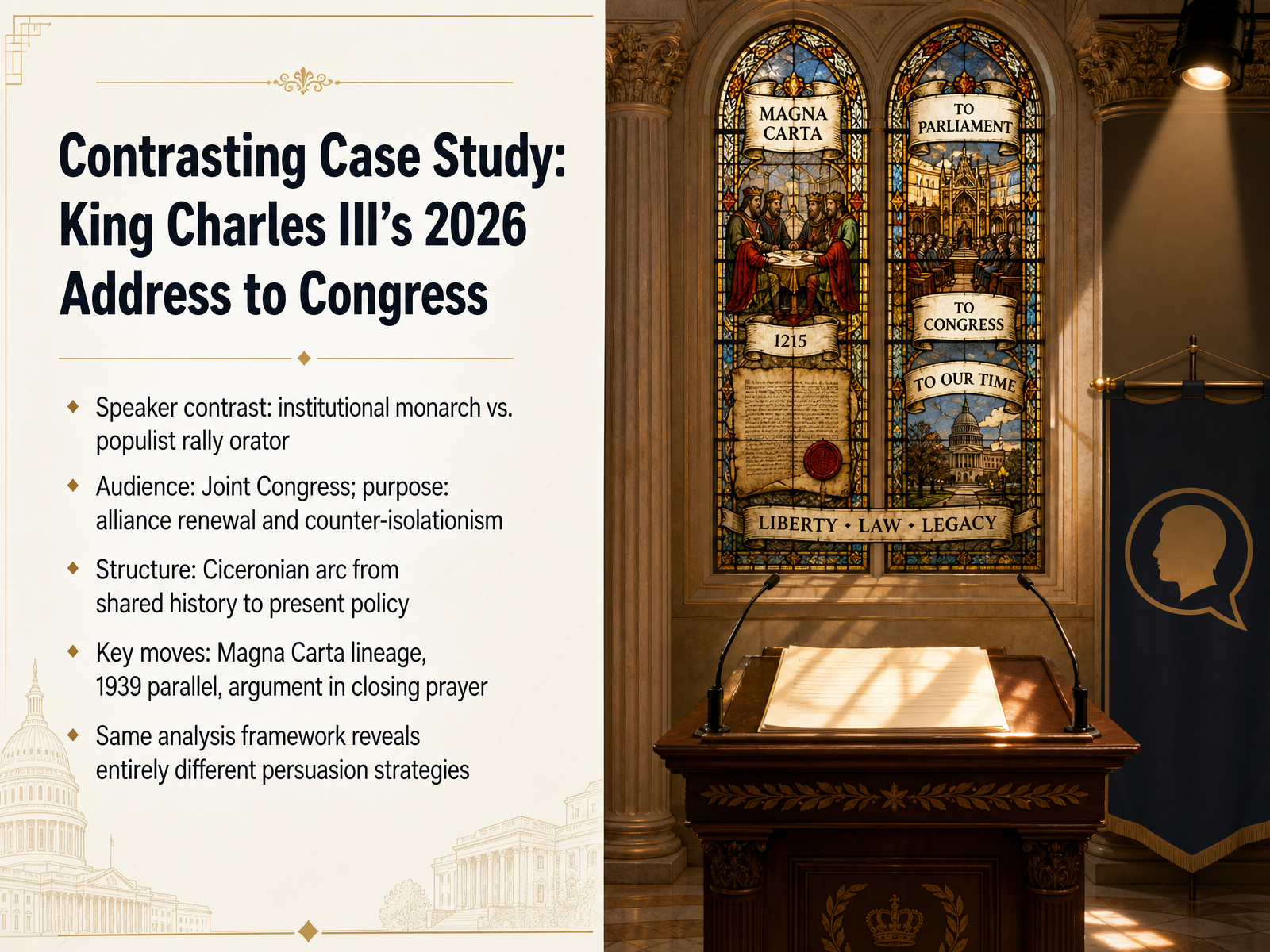
2 min - 10Contrasting Case Study: King Charles III's 2026 Address to CongressLet’s turn now to a contrasting case, King Charles the Third’s address to a joint session of the U.S. Congress. The speaker here is an institutional monarch, not a populist orator whipping up a rally. That identity shapes everything. His immediate audience is the assembled Congress, but the wider public is listening, and his purpose is delicate: renewing an alliance while quietly countering isolationist sentiment. Structurally, he leans on a Ciceronian arc, moving from a shared constitutional history to a present-day policy vision. Notice key moves. He traces a lineage back to Magna Carta, grounding the special relationship in deep legal soil. He evokes the nineteen thirty-nine royal visit as a parallel moment of democratic resolve. And perhaps most striking, he embeds his policy argument inside a closing prayer, layering ethos and *kairos* into a single rhetorical gesture. Same analysis framework, entirely different persuasion strategies. We will push this idea further, tracing a thread: how purpose can radically reshape the same message.
 2 min
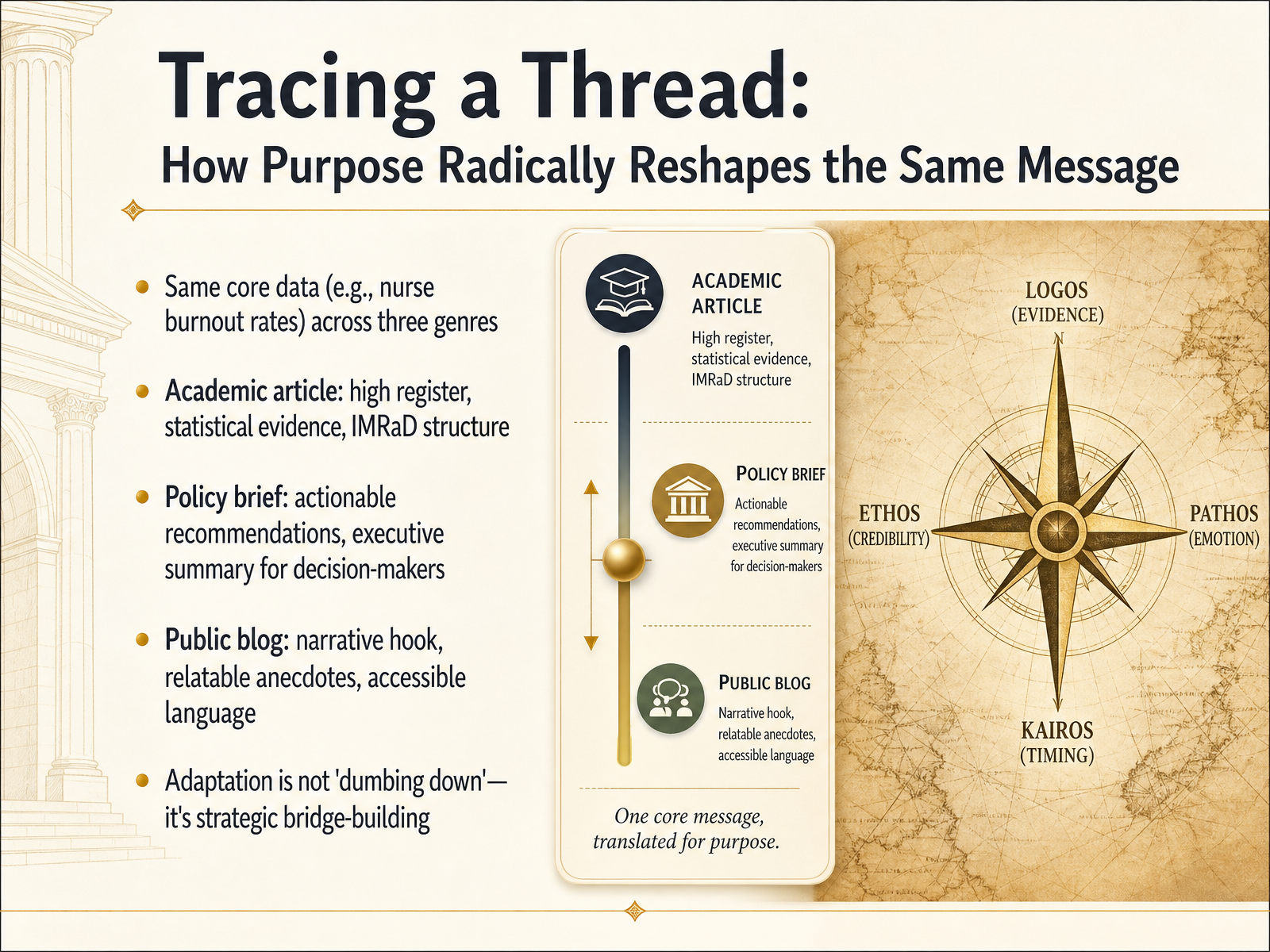
2 min - 11Tracing a Thread: How Purpose Radically Reshapes the Same MessageConsider this: a researcher, a policy advisor, and a nurse advocate all receive the same alarming data—a thirty-five percent burnout rate among critical care nurses. Now watch how a single purpose reshapes that raw number into three distinct rhetorical performances. The academic article deploys a high-register, IMRaD structure, foregrounding statistical significance and methodological rigor for an audience primed to interrogate evidence. The policy brief condenses that same evidence into an executive summary and three actionable recommendations, strategically framed for a decision-maker who needs levers to pull, not literature reviews. And the public blog? It opens with a narrative hook—a nurse describing the hollowed-out stare at the end of a sixteen-hour shift. The language becomes accessible, the statistics secondary to shared feeling. But notice what this adaptation is not. It is not 'dumbing down.' Each version practices what we might call a principled translation, building an epistemic bridge between specialized knowledge and a specific audience's context. The integrity of the data holds; only the architecture of access changes. Soon, you will apply this lens yourself in a guided analysis exercise.
 2 min
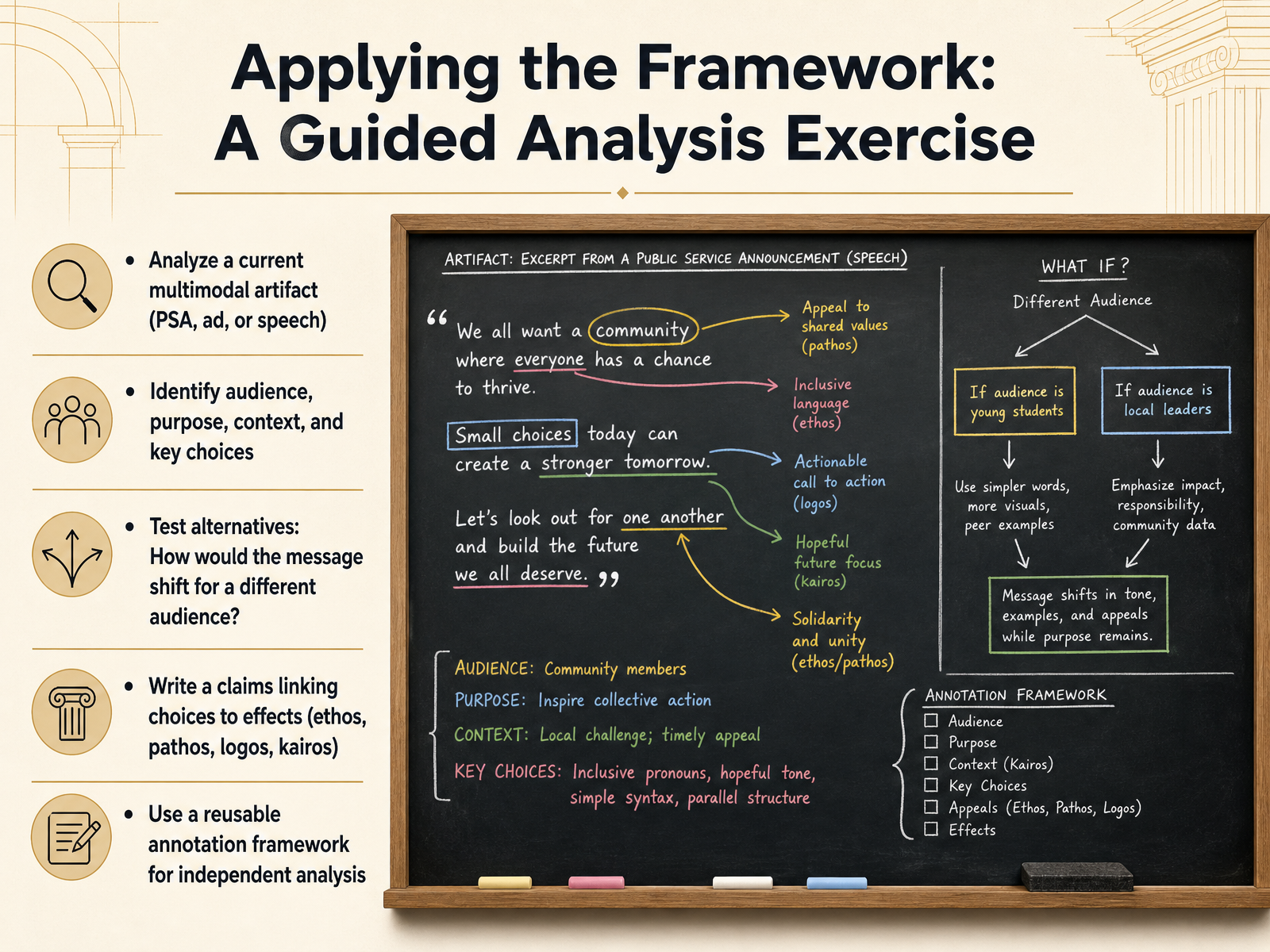
2 min - 12Applying the Framework: A Guided Analysis ExerciseLet's put our analytical toolkit to work. We're going to walk through a guided exercise using a current multimodal artifact—perhaps a public service announcement, a short speech, or even an advertisement. The first step is to identify the fundamental rhetorical situation: Who is the specific audience, what is the core purpose, and what is the contextual moment, the *kairos*, that gives it urgency? Once we've mapped that terrain, we identify the key compositional choices—visual framing, word choice, narrative structure. Then comes a powerful test: imagine a different audience. If the message were for a skeptical insider instead of a sympathetic newcomer, how would the design shift? Would a logical appeal replace a narrative one? After you've played out those alternatives, distill your findings into a crisp claim, directly linking a specific choice to its effect, whether that's building *ethos*, evoking *pathos*, structuring a *logos* argument, or leveraging a timely opening. To make this process durable, we'll organize our notes using a reusable annotation framework—one you can apply to any text you encounter independently, turning every artifact you see into a live case study for rhetorical reasoning. Now, let's see how this analytical muscle translates directly into your own strategic communication in our next segment, 'From Analysis to Action'.
 2 min
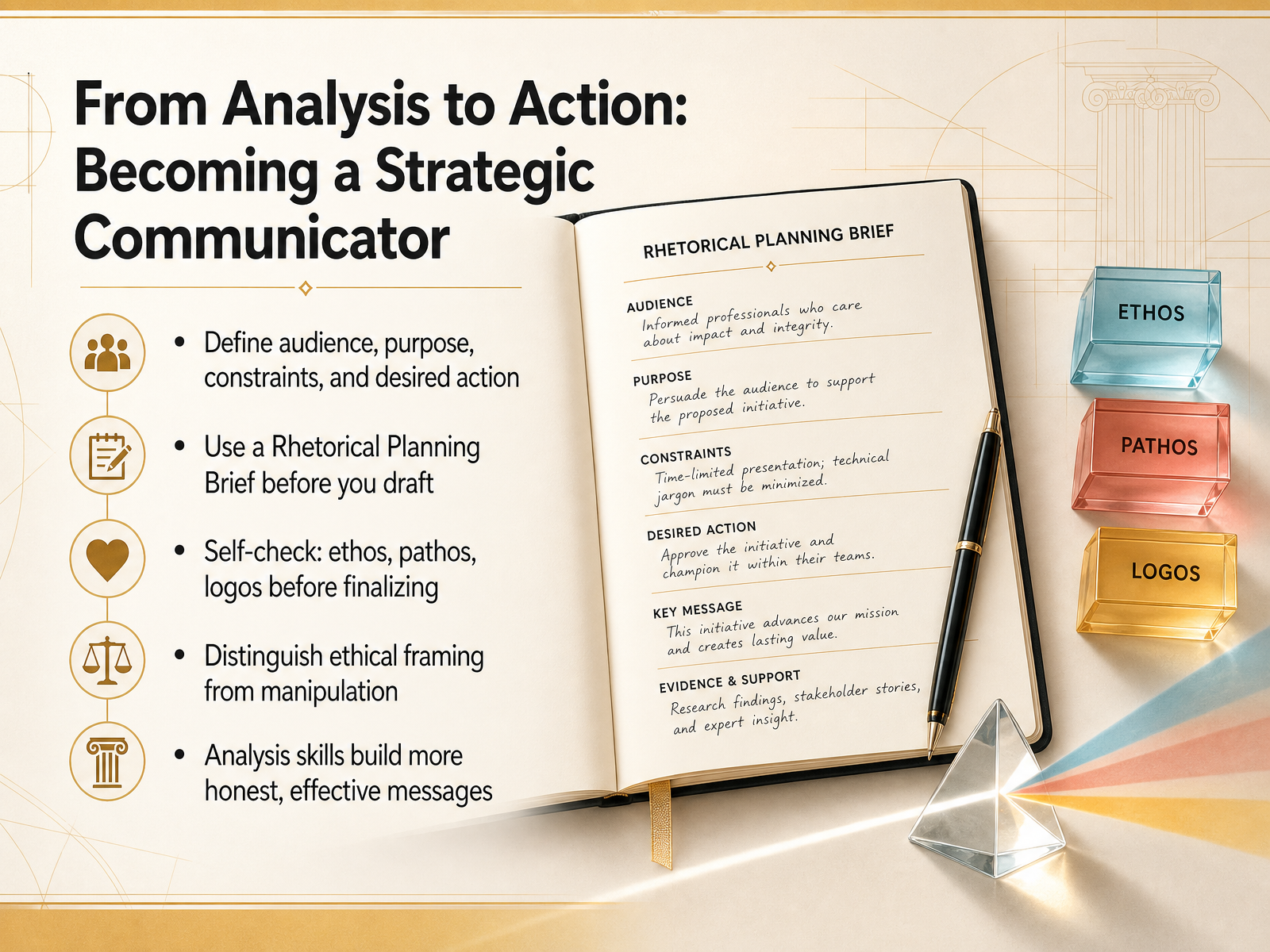
2 min - 13From Analysis to Action: Becoming a Strategic CommunicatorSo how do we take these analytical skills and turn them into action? Becoming a strategic communicator means making the same deliberate choices we have been studying, but this time for our own messages. It starts with clarity about four elements: who your audience is, what your purpose demands, what constraints you face, and what specific action you want the audience to take. Before you draft anything, try using a Rhetorical Planning Brief. It is a simple tool that forces you to answer those four questions on paper. Then, after you have a draft, run a self-check on ethos, pathos, and logos. Ask yourself, have I built credibility? Have I connected with the values and emotions of this specific audience? Is my reasoning sound and well supported? One more distinction matters deeply here: the line between ethical framing and manipulation. Framing honestly acknowledges your perspective while respecting the audience's ability to reason. Manipulation deceives or pressures. When you navigate that line with integrity, you are not just making a message more effective. You are making it more honest. And here is the real payoff. The same analysis skills that unpack a speech are the skills that help you build a message worth hearing.
 2 min
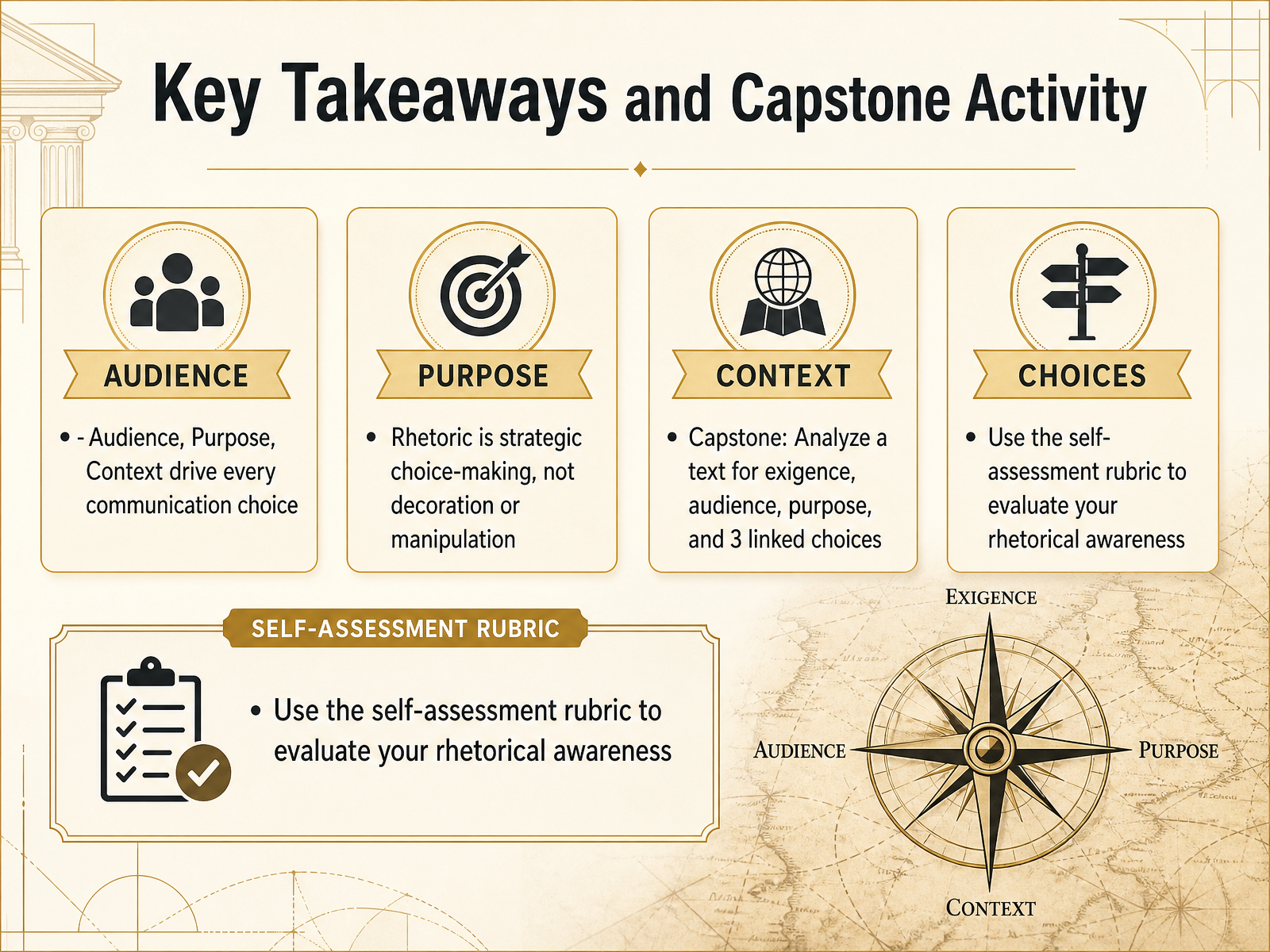
2 min - 14Key Takeaways and Capstone ActivityWe began by naming the three forces that shape every message: audience, purpose, and context. What I hope you take from this course is that rhetoric is not decoration. It is not manipulation. It is strategic choice-making in real moments—what the Greeks called kairos. Your capstone activity asks you to step fully into that analyst's role. Choose a text—a speech, an op-ed, an ad—and map its exigence, audience, and purpose. Then identify three linked rhetorical choices and explain how they work together. Use the self-assessment rubric not as a checklist, but as a mirror for your own growing rhetorical awareness. Thank you for the precision, the curiosity, and the questions you brought to this inquiry. Now go and read the world with sharper eyes.
 2 min
2 min
Take the deck with you
Download this course as a file — free, no sign-up needed.
- PDF handoutEvery slide page, ready to print or share.15 pages · 4.8 MBDownload
- Narrated PowerPointThe deck that presents itself — every slide carries the digital human's narration video.15 pages · 18.7 MBDownload
- PowerPoint slidesThe full deck as a .pptx — open it in PowerPoint, Keynote, or Google Slides.15 pages · 4.7 MBDownload
Free to use in your own training — please keep the PersonWise credit page at the end.
Have your own deck? Turn it into a course