Begin
14 pages · ~28 min
Technical Writing Roles and Handoffs
This training clarifies technical writing roles, responsibilities, and handoffs, helping writers and cross-functional partners understand ownership and collaborate effectively across the documentation lifecycle.
A digital instructor presents all 14 pages. Hold “Ask” at any point and ask out loud — the answer comes from this course. No sign-up needed.
What you’ll learn
- 01Technical Writing Roles, Responsibilities, and HandoffsWelcome. This course is about roles, responsibilities, and handoffs in technical writing. The goal is shared vocabulary, so writers, engineers, product managers, editors, and subject-matter experts can agree on who owns what.
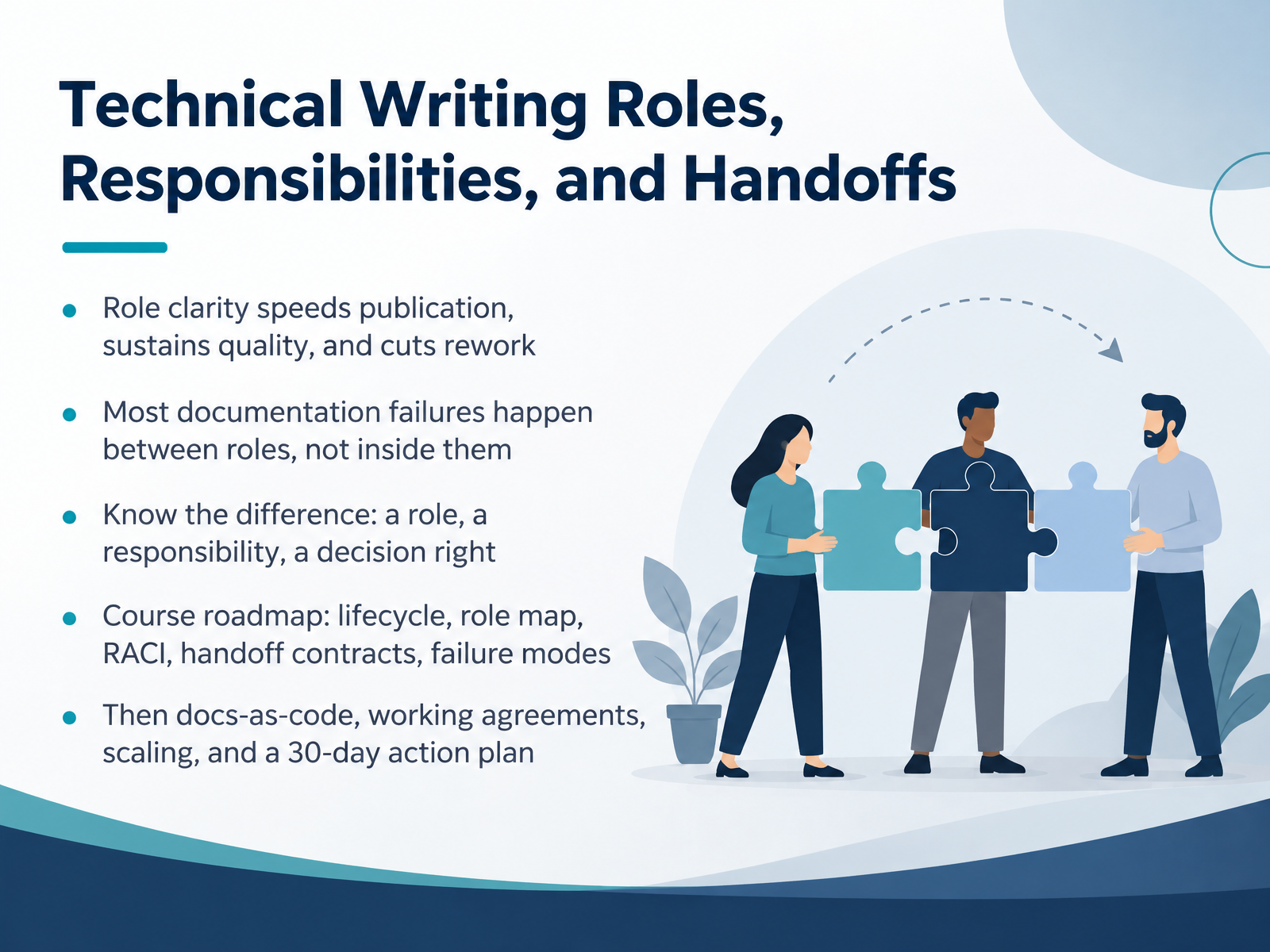
Here is the core idea. Role clarity speeds publication, sustains quality, and cuts rework. And most documentation failures happen between roles, not inside them. A writer waits on a spec that never arrives. A reviewer gets pulled in after the release notes are already live. Nobody inside the role did poor work. The gap sat between them.
So we will separate three things. A role is a position you hold, such as technical writer or subject-matter expert. A responsibility is a task that role performs, like drafting, verifying accuracy, or editing. A decision right is the authority to say yes, and the authority to say no. Keep those distinct, because they are not interchangeable.
Here is the roadmap. We start with the documentation lifecycle and its quality gates. Then a role map, so you can see who does what. From there, a RACI view of decision ownership, and handoff contracts that make inputs explicit. After that, common failure modes, docs-as-code, working agreements, and scaling. We close with a thirty-day action plan.
Your takeaway for this slide. Before your next handoff, name the role, the responsibility, and who holds the decision right.
Next, we look at the Documentation Lifecycle and Its Quality Gates.mtfinstitute.comekline.ioones.com+22 min
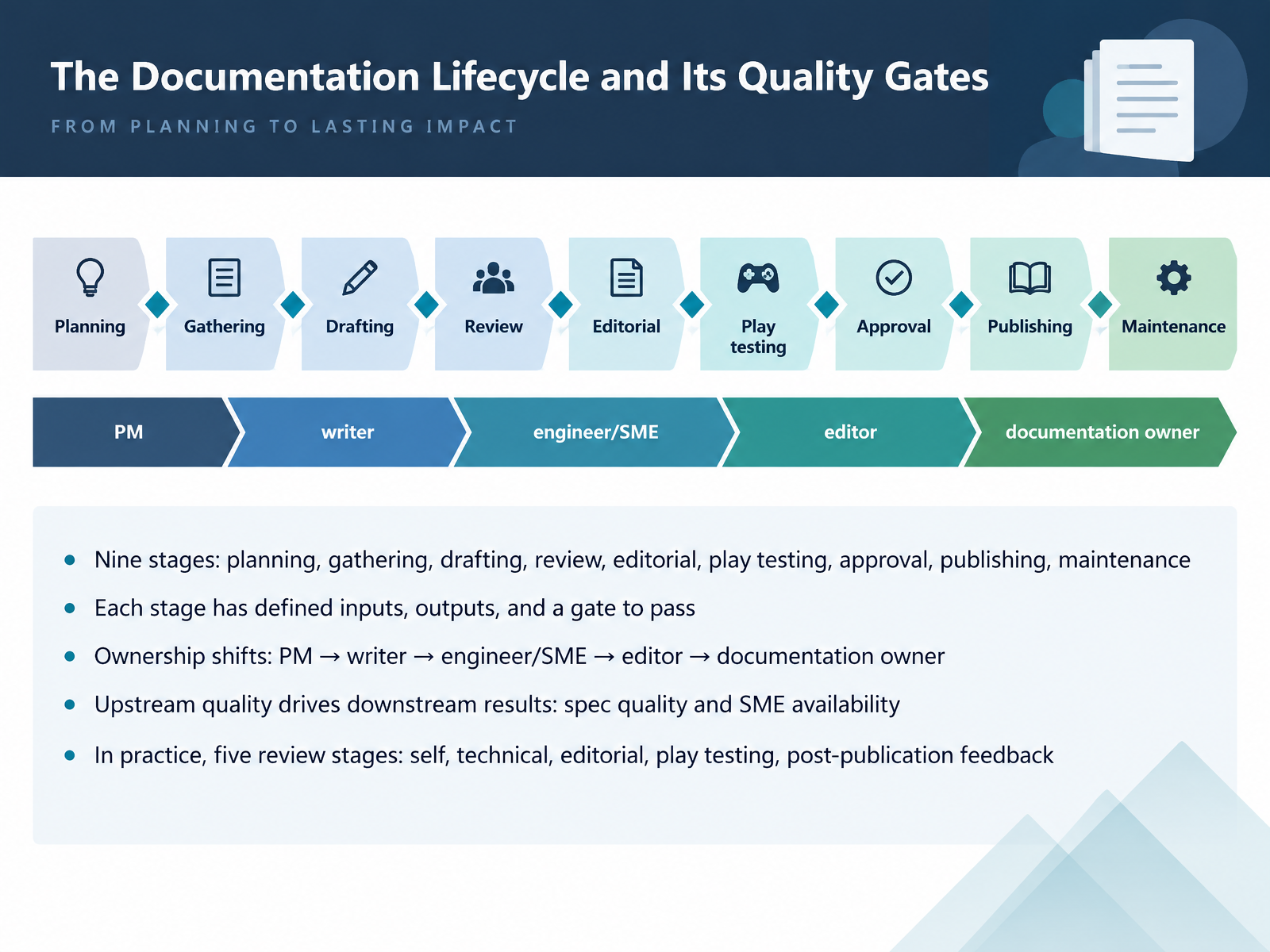
- 02The Documentation Lifecycle and Its Quality GatesLet's look at the lifecycle your documentation moves through, and the gates it has to pass. There are nine stages, from planning and gathering through drafting, review, editorial, play testing, approval, publishing, and finally maintenance. Each stage has defined inputs, outputs, and a gate. That gate is simply the checkpoint that says this stage is done well enough to move on.
Ownership shifts as the work moves. The product manager frames the need. The writer drafts. An engineer or subject matter expert verifies accuracy. An editor polishes presentation. The documentation owner signs off and keeps it current. Upstream quality drives downstream results, so a vague spec or an unavailable expert shows up later as weak content.
In practice, most teams run five review stages: self review, technical review, editorial review, play testing, and post-publication feedback. Here's your takeaway. Before your next handoff, name the stage, the owner, and the gate in one sentence. Next, we'll map roles: who does what.
 arxiv.orgtrepo.tuni.fibeyond.minimumcd.org+22 min
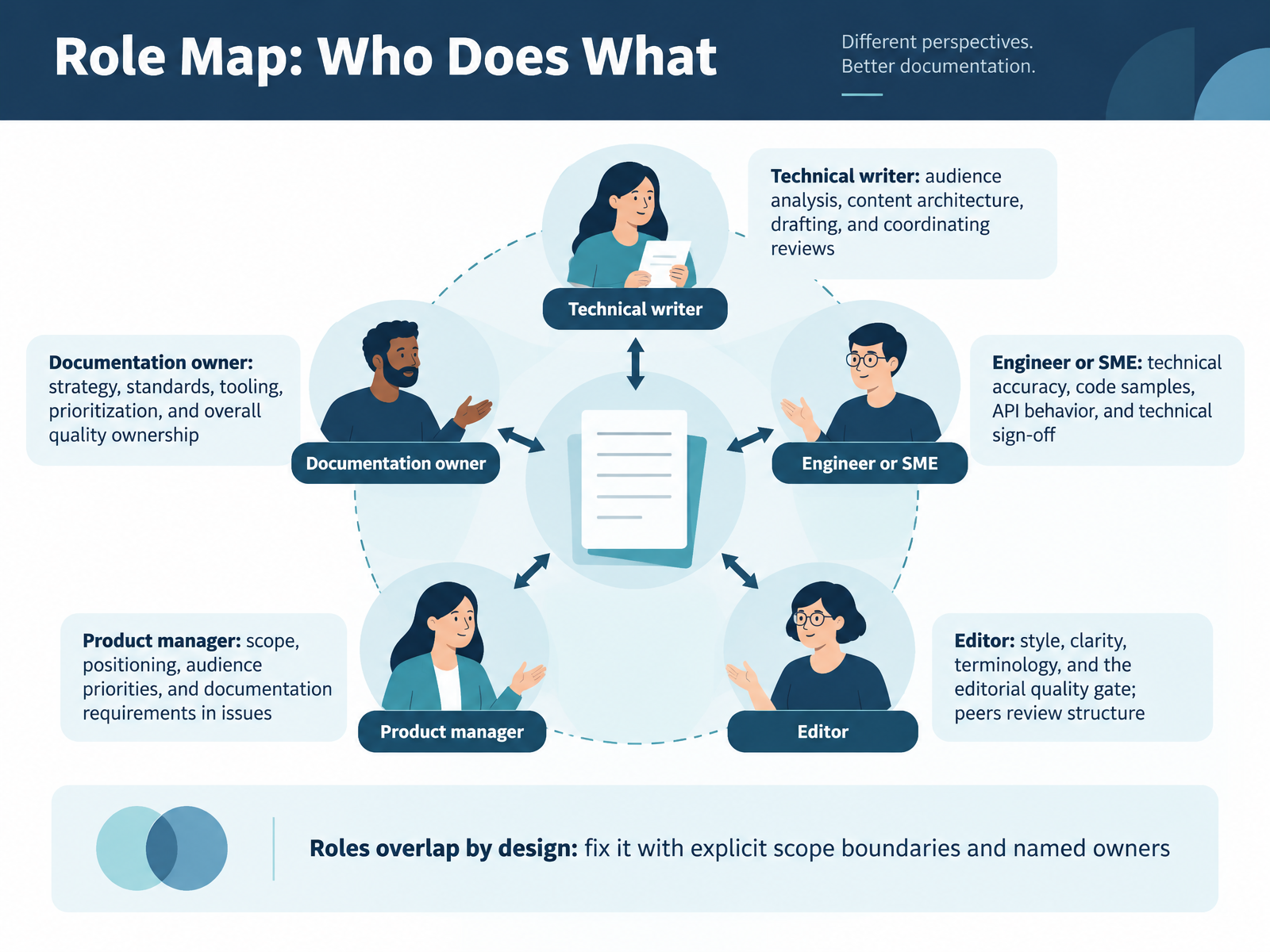
- 03Role Map: Who Does WhatLet's map the roles clearly, because shared vocabulary prevents most handoff friction. The technical writer runs audience analysis, content architecture, and drafting, and coordinates reviews. The documentation owner sets strategy, standards, tooling, prioritization, and owns overall quality. The engineer or subject matter expert owns technical accuracy, code samples, API behavior, and technical sign-off. The product manager defines scope, positioning, audience priorities, and documentation requirements in issues. The editor owns style, clarity, terminology, and the editorial quality gate, while peers review structure. These roles overlap by design. That overlap only becomes a problem when ownership is unnamed. So your takeaway is this. Before your next handoff, write down explicit scope boundaries and one named owner per deliverable. Now let's look at how decision rights formalize that with a RACI model, in RACI and Decision Rights for Documentation.
 docs.gitlab.comvaishvanara.github.iodraftview.app+22 min
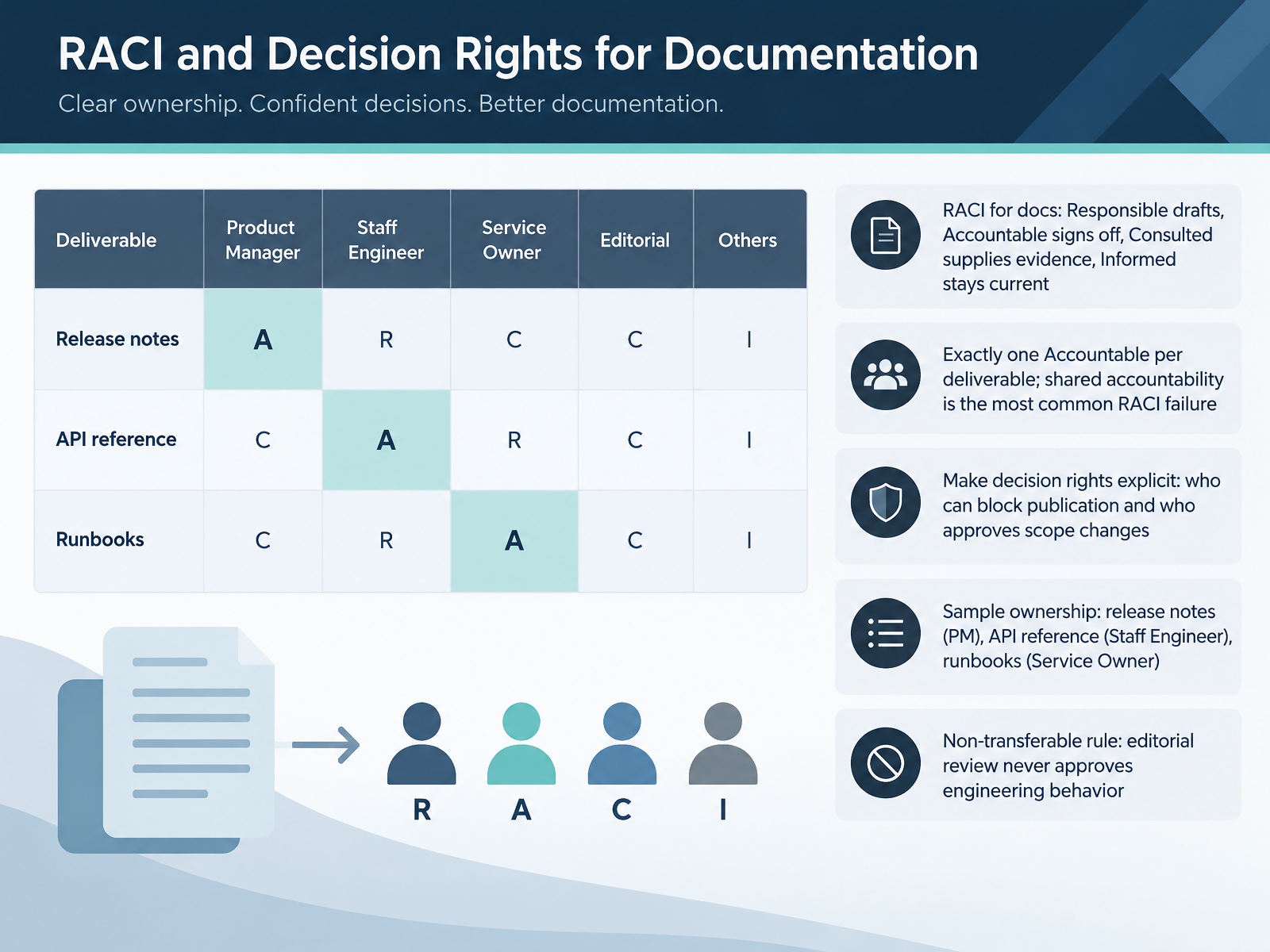
- 04RACI and Decision Rights for DocumentationNow let's make ownership and decision rights explicit, using a RACI frame. Responsible drafts. Accountable signs off. Consulted supplies evidence. Informed stays current. Name exactly one Accountable person per deliverable. Shared accountability is the most common RACI failure, because it quickly becomes nobody's decision. Say who can block publication, and who approves scope changes. For example, the start of a release notes or API reference update is a single Accountable owner. Sample ownership looks like this: release notes belong to the product manager. API reference belongs to the staff engineer. Runbooks belong to the service owner. Keep this rule non-transferable. Editorial review never approves engineering behavior. Your takeaway: before the next handoff, write down the one Accountable owner and the two decision rights, blocking publication and scope change. Next, Handoff Contracts: Artifacts, Criteria, and Deadlines.
 mtfinstitute.comekline.ioones.com+22 min
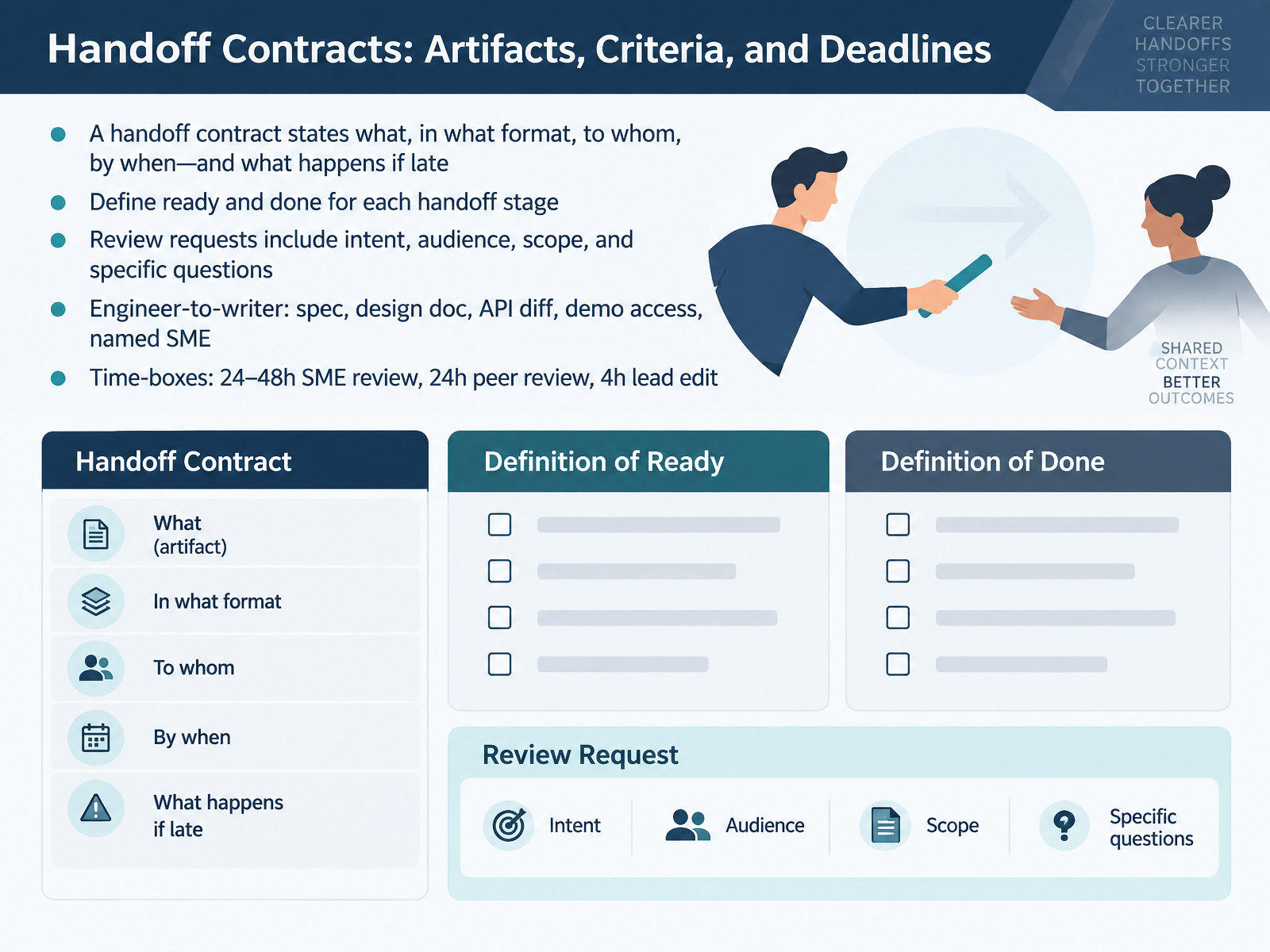
- 05Handoff Contracts: Artifacts, Criteria, and DeadlinesLet's turn that coordination into something concrete. A handoff contract states what is being handed off, in what format, to whom, and by when. And it says what happens if it's late. Here's the key idea. Define ready and done for each stage. Ready means the writer has what they need to start. Done means the reviewer can sign off. Engineer to writer, that package includes the spec, the design doc, the API diff, demo access, and a named subject matter expert. When a reviewer asks for review, include intent, audience, scope, and specific questions. Vague requests get vague, last-minute feedback. Now the time boxes. SME review runs twenty-four to forty-eight hours. Peer review, twenty-four hours. Lead edit, four hours. Those numbers protect everyone's calendar. Your takeaway: before your next handoff, write the contract in one line. Who delivers what, in what format, by when, and who reviews it. For example, an engineer names the API diff and an SME name in the ticket before the writer starts. Next, we'll look at failure modes at role boundaries.
 arxiv.orgtrepo.tuni.fibeyond.minimumcd.org+22 min
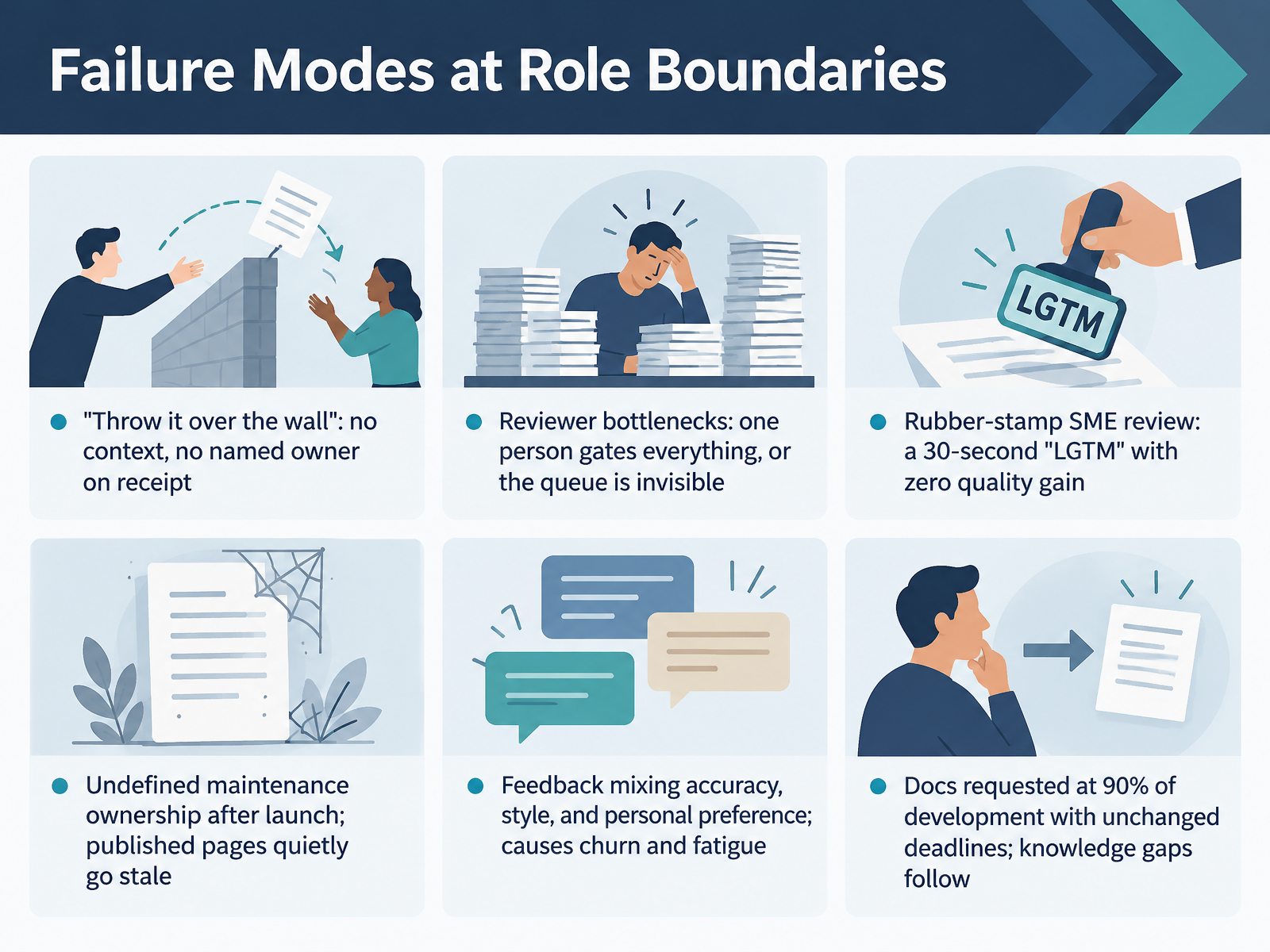
- 06Failure Modes at Role BoundariesNow let's talk about where handoffs actually break down. Failure modes at role boundaries.
First, throwing it over the wall. No context, and no named owner when it lands. If a developer drops a feature spec into your channel with no note and no recipient, that work stalls until someone guesses.
Second, reviewer bottlenecks. One person gates everything, or the queue is invisible. A review sitting in someone's inbox is not tracked anywhere, so nobody can see it is blocked.
Third, the rubber-stamp review. A thirty-second looks good to me from a busy engineer adds zero quality. It just delays the doc behind their calendar.
Fourth, undefined maintenance ownership after launch. Published pages quietly go stale because no one owns them.
Fifth, feedback that mixes accuracy, style, and personal preference. That causes churn and fatigue.
And sixth, docs requested at ninety percent of development with unchanged deadlines. Knowledge gaps follow.
One takeaway: in your next handoff, name the receiving owner, the review scope, and the maintenance owner in writing. That single habit closes most of these gaps.
Next, we look at Docs-as-Code and Modern Collaboration Tooling.
 arxiv.orgtrepo.tuni.fibeyond.minimumcd.org+22 min
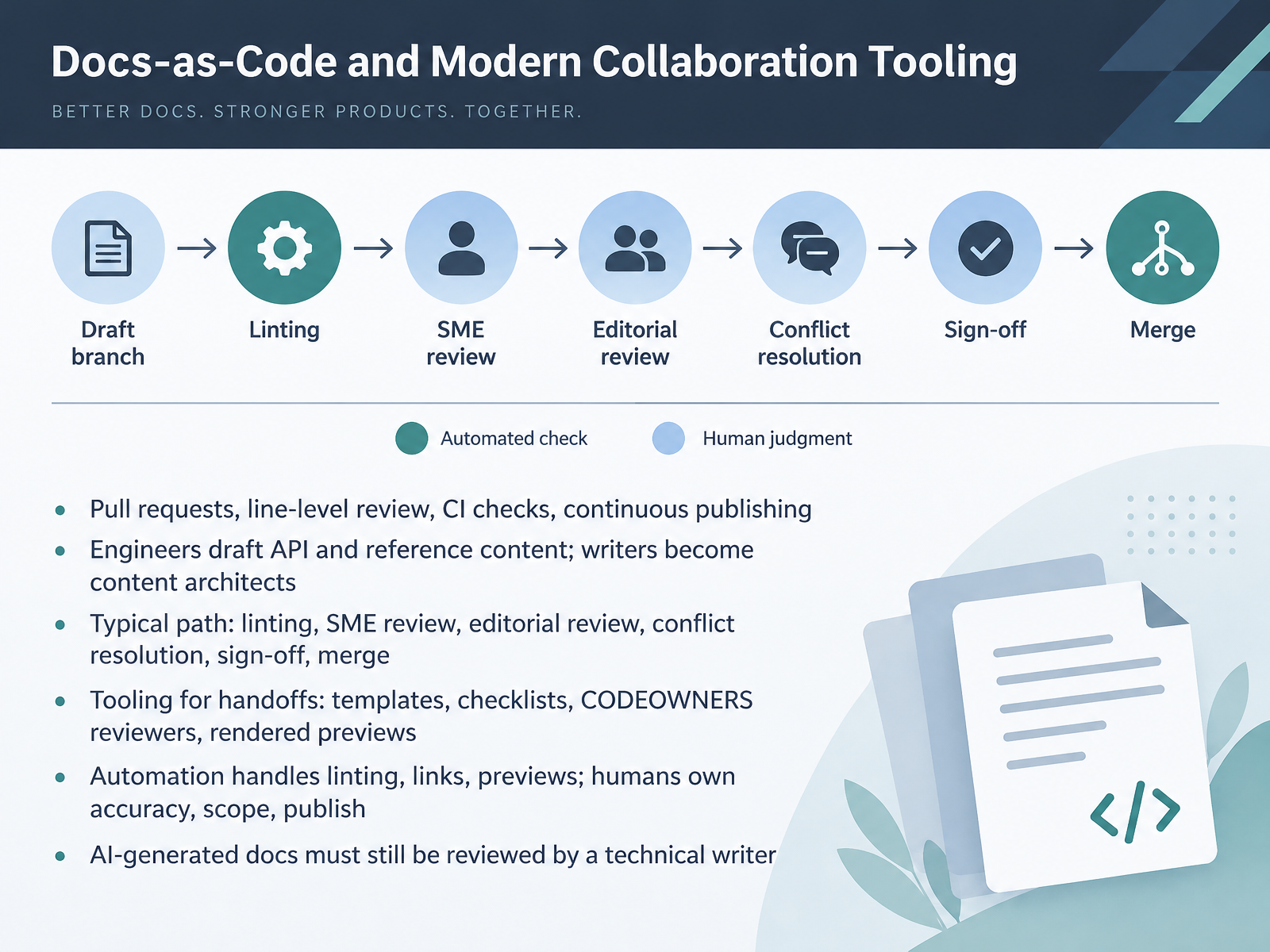
- 07Docs-as-Code and Modern Collaboration ToolingNext, let's look at docs-as-code and the tooling behind modern collaboration. In docs-as-code, documentation lives in the same repository as the code, and pull requests become your review surface. Line-level review, automated CI checks, and continuous publishing replace shared documents and email threads.
A role shift follows. Engineers often draft API reference content, while writers become content architects who shape structure, standards, and consistency. The typical path looks like this. Linting runs first, then SME review, then editorial review. If stakeholders disagree, conflict resolution comes next, followed by sign-off and merge.
Tooling makes handoffs explicit. Templates capture what a good draft needs. Checklists define completion. CODEOWNERS assigns the right reviewers automatically. Rendered previews let non-technical reviewers see the finished page without touching Git.
Keep the division clear. Automation handles linting, link checks, and previews. Humans own accuracy, scope, and the decision to publish. And AI-generated docs still require review by a technical writer, because the tool is not a substitute for subject-matter expertise.
Here is your takeaway. Before your next docs pull request, confirm that CODEOWNERS routes it to a subject-matter expert and to a writer, and that the checklist covers accuracy, style, and preview.
Working Agreements for Writers, Reviewers, and SMEs comes next.
 docs.gitlab.comvaishvanara.github.iodraftview.app+22 min
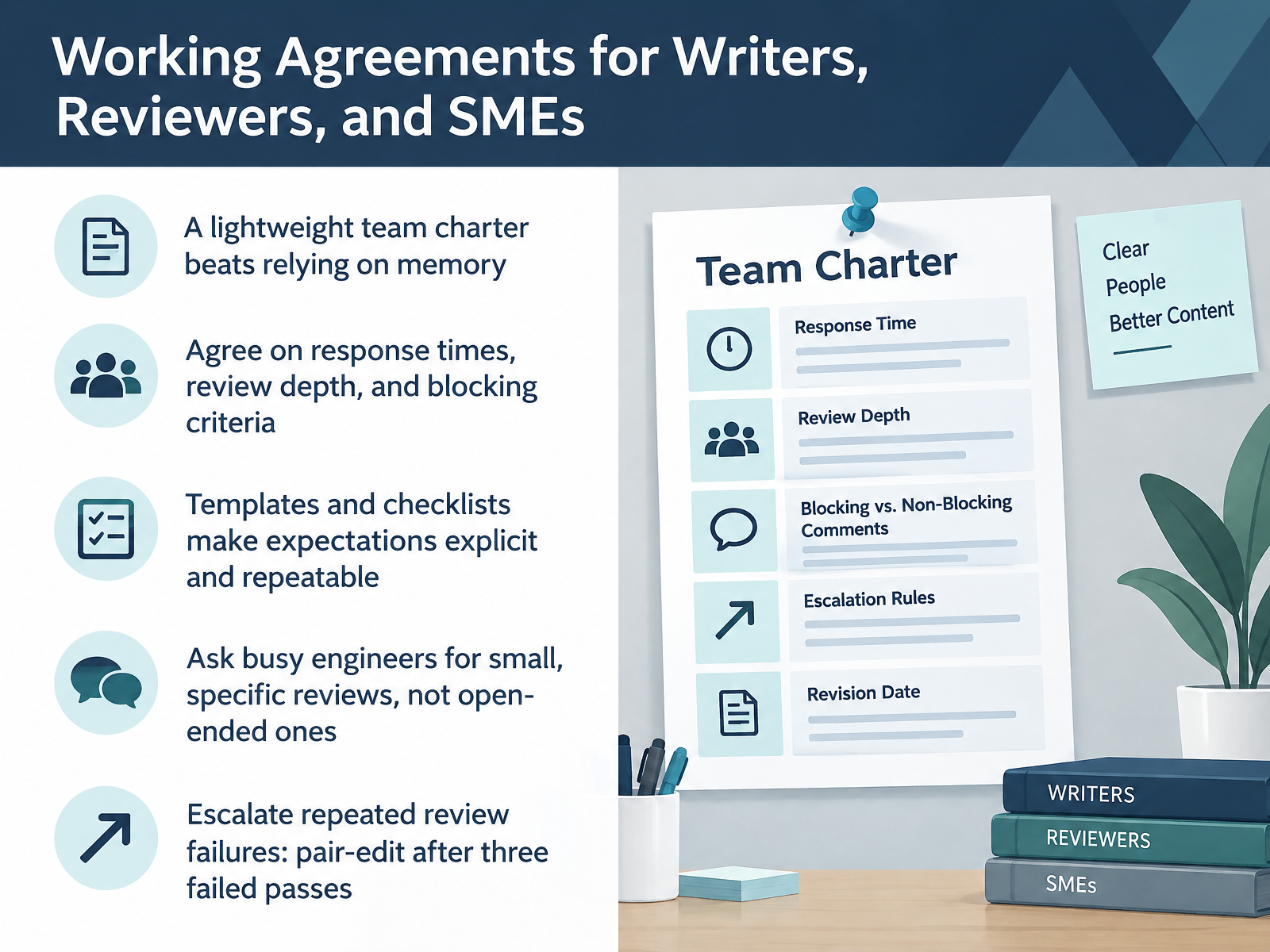
- 08Working Agreements for Writers, Reviewers, and SMEsNow that we've mapped roles and handoffs, let's talk about how to make them hold up in practice. The answer is a lightweight working agreement, not memory. A short team charter that everyone can read in two minutes beats relying on habits nobody wrote down. Define three things together: response times, how deep each review should go, and what counts as blocking. For example: subject matter expert review within two business days, technical accuracy only, and anything that would break a code sample blocks the release. Templates and checklists make those expectations explicit and repeatable, so nobody has to renegotiate them every sprint. And when you ask a busy engineer for a review, keep it small and specific. Say, please check the permissions table on this page, rather than, please review the whole guide. Open-ended requests are how you get a thirty-second looks good to me. Finally, decide what happens when review keeps failing. One concrete rule: after three failed passes, the writer and the subject matter expert pair-edit for thirty minutes and finish it together. So here is your takeaway for the next handoff: agree on one response time, one review scope, and one escalation rule, write them into your charter, and share it with the reviewers before the next document starts. Next, we'll look at scaling roles across teams, regions, and vendors.
 arxiv.orgtrepo.tuni.fibeyond.minimumcd.org+22 min
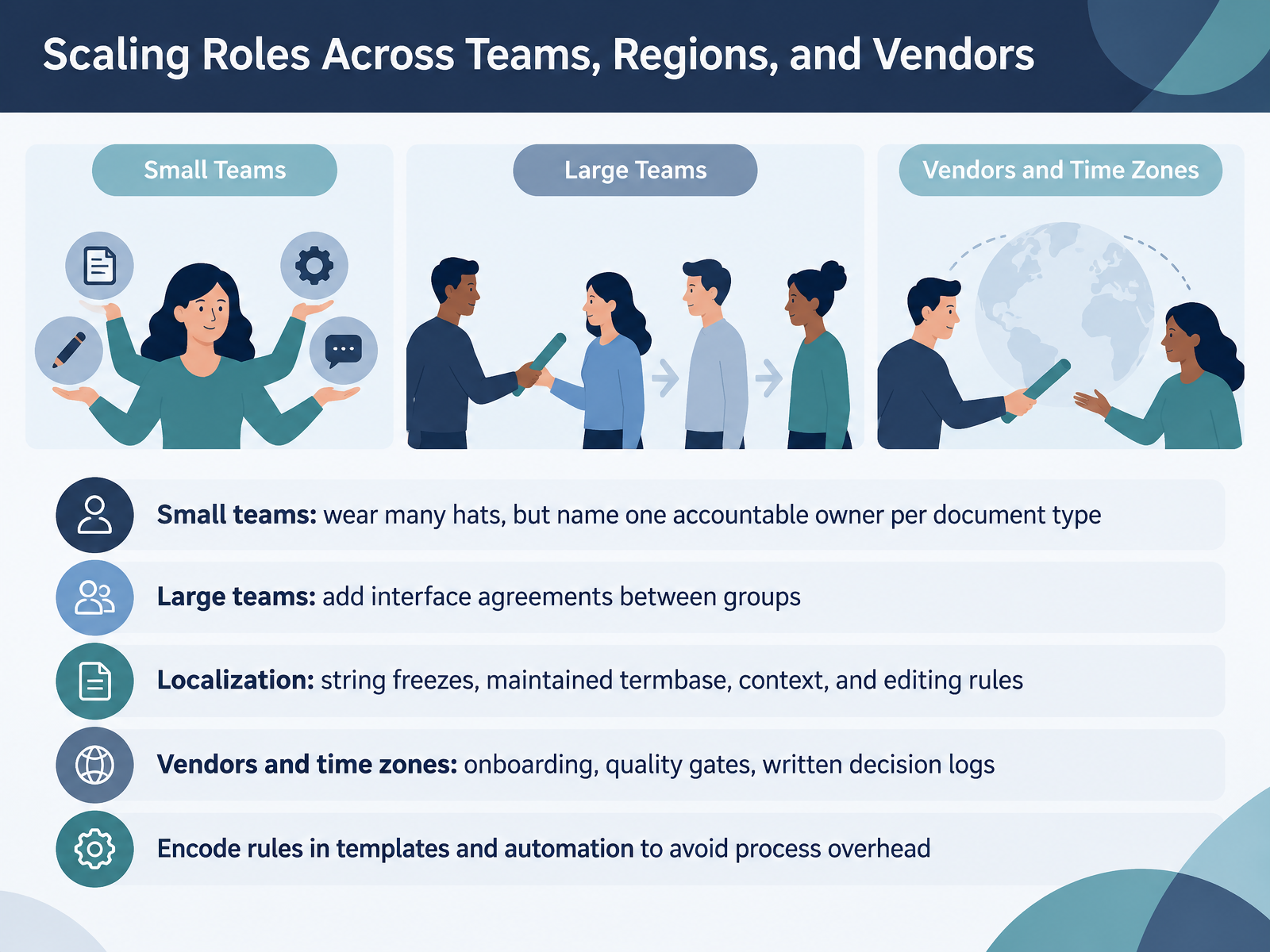
- 09Scaling Roles Across Teams, Regions, and VendorsNow let's talk about scaling roles across teams, regions, and vendors. On a small team, people wear many hats, and that's fine. What isn't fine is shared ownership. So name one accountable owner for each document type, even if that person also writes, reviews, and publishes it. When teams get larger, add interface agreements between groups, so each side knows what it hands over and what it receives. For localization, you need string freezes, a maintained termbase, usage context, and clear editing rules. Give translators a short brief, a glossary, and screenshots, and they can work without guessing. With vendors and time zones, invest in onboarding, quality gates, and written decision logs. Fold these rules into templates and automation so the process doesn't become overhead. Your takeaway: put a one-page responsibility map in your template today. Next, we look at RACI and Role Clarity in Regulated and High-Risk Content.
 mtfinstitute.comekline.ioones.com+22 min
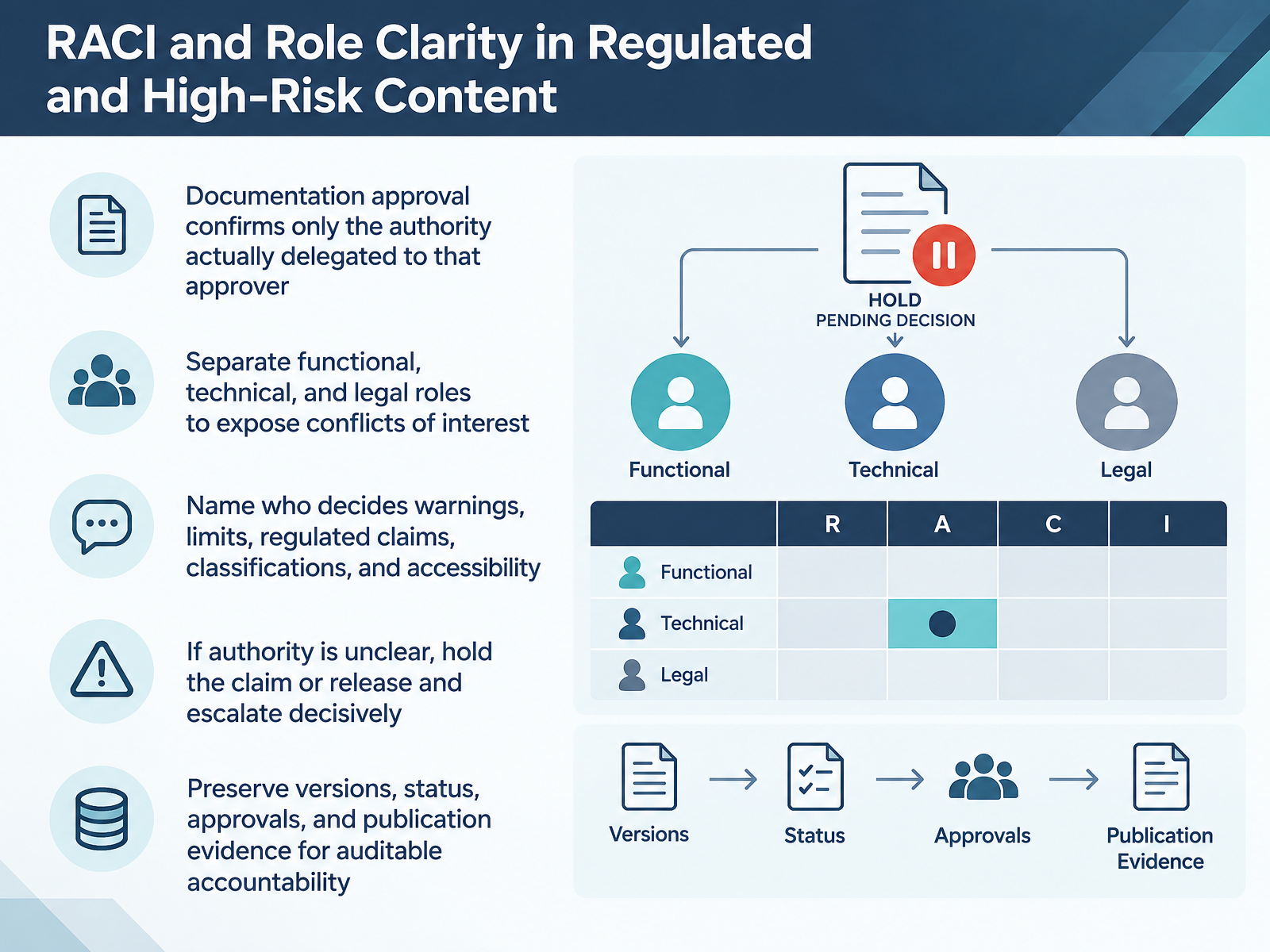
- 10RACI and Role Clarity in Regulated and High-Risk ContentNext, let's talk about RACI and role clarity in regulated and high-risk content. Start with this principle. Documentation approval confirms only the authority actually delegated to that approver. A clean editorial review does not approve engineering behavior. One practical step is to separate functional, technical, and legal roles. That separation exposes conflicts of interest before they reach a release. Then name who decides warnings, limits, regulated claims, classifications, and accessibility. If authority is unclear, hold the claim or the release, and escalate decisively with a decision-ready request. For example, if no one can confirm who owns a safety warning, pause publication rather than guessing. Also preserve versions, status, approvals, and publication evidence. That gives you auditable accountability. Your takeaway for the next handoff is simple. Confirm the named decision owner in writing before you publish. That leads us into Measuring Process Health.
 mtfinstitute.comekline.ioones.com+22 min
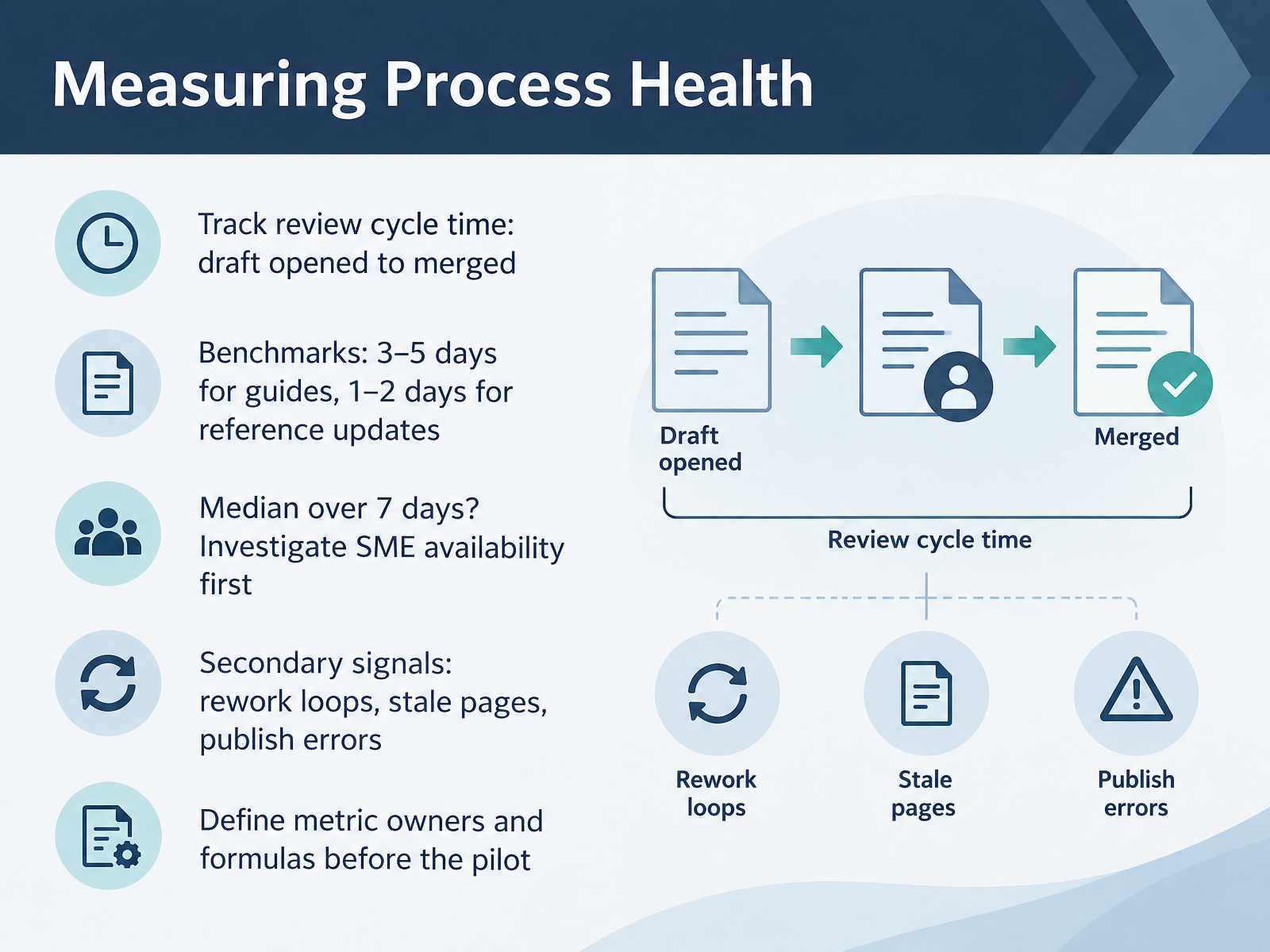
- 11Measuring Process HealthLet's turn to measuring process health. The core metric is review cycle time. That means the time from when a draft is opened to when it is merged. As a benchmark, aim for three to five days on a guide, and one to two days on a reference update. If your median creeps past seven days, look at subject matter expert availability first. That is usually the bottleneck, not writing speed. For example, a runbook stuck at nine days is often waiting on one engineer's calendar, not on the writer. Secondary signals tell you where the process bends. Watch rework loops, stale pages, and publish errors. One practical takeaway: before any process pilot, name the metric owners and write down the formulas. Decide who calculates cycle time, what counts as opened, and what counts as merged. Then everyone is measuring the same thing. Next, we will look at designing your own role map and RACI.
 arxiv.orgtrepo.tuni.fibeyond.minimumcd.org+21 min
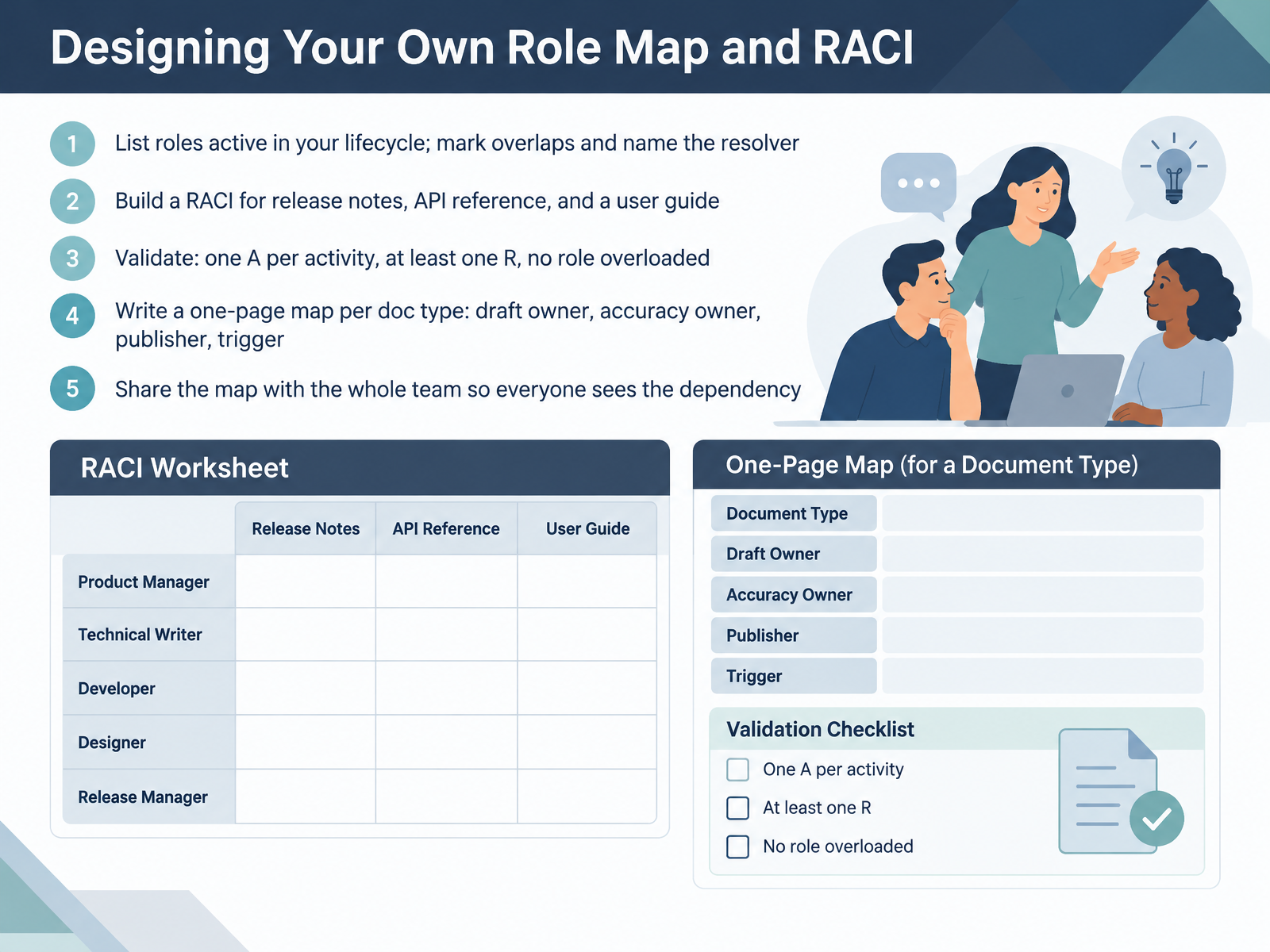
- 12Designing Your Own Role Map and RACILet's put it all together and build your own role map. Start by listing every role active in your documentation lifecycle. Mark where responsibilities overlap, and name one resolver for each overlap. For example, if both the product manager and the staff engineer claim accuracy on API reference, name a single resolver now, before the next release.
Next, build a RACI for three common docs: release notes, API reference, and a user guide. R means responsible, A means accountable, C means consulted, and I means informed. Then validate it. Exactly one A per activity. At least one R per activity. And no role overloaded with too many R's.
Turn each doc type into a one-page map. Name the draft owner, the accuracy owner, the publisher, and the review trigger. Add those four fields, and the ambiguity disappears. Finally, share the map with the whole team, so everyone sees the dependency, not just their own box.
Your takeaway: pick your three highest-risk doc types this week and write one page for each. Then, when your weakest handoff still fails, you will know exactly where to write a handoff contract. That is where we go next, in Drafting a Handoff Contract for Your Weakest Link.
 mtfinstitute.comekline.ioones.com+22 min
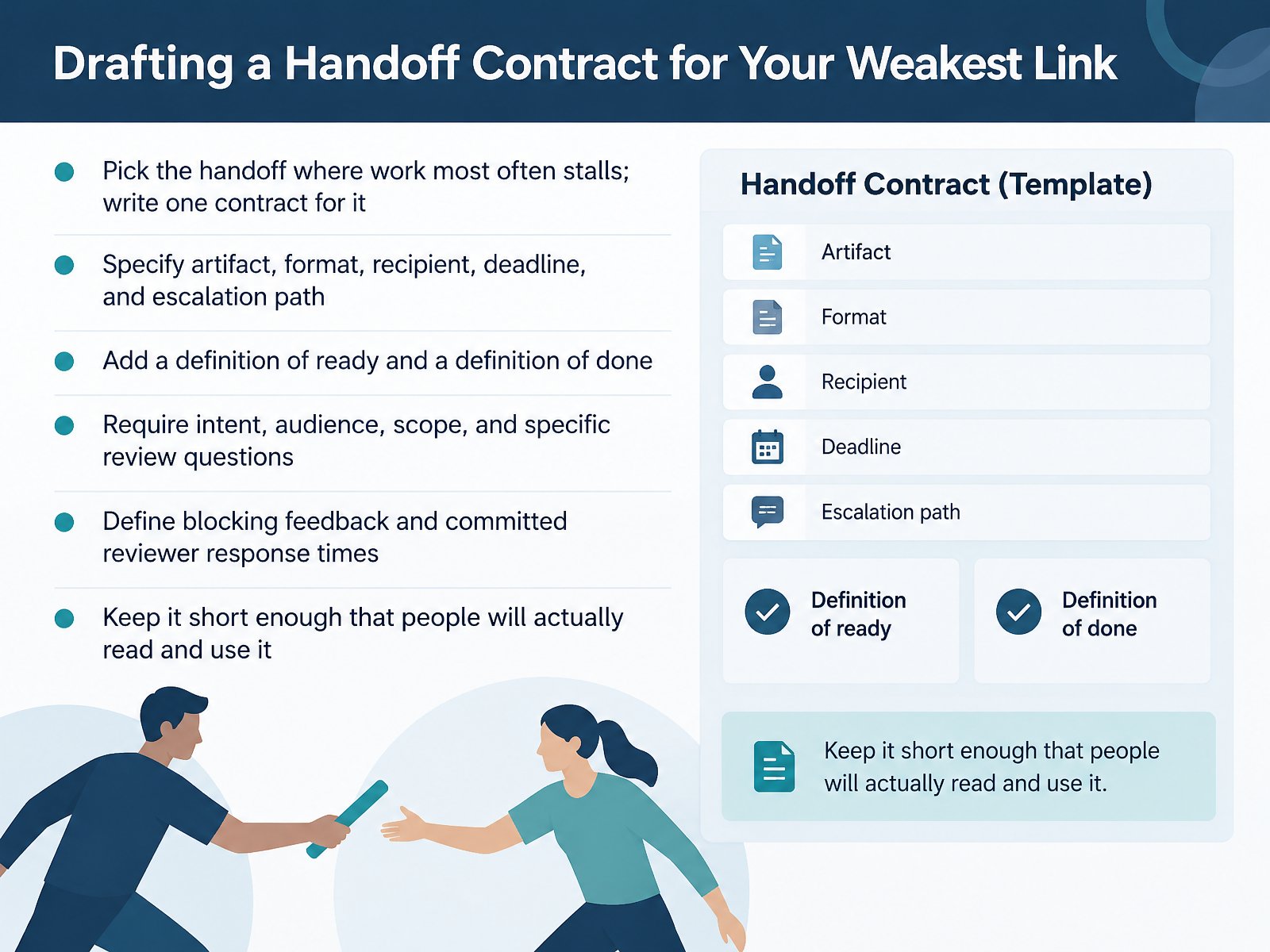
- 13Drafting a Handoff Contract for Your Weakest LinkSo let's put this into practice. Pick the handoff where work most often stalls, and write one contract for it. For example, the developer to technical writer kickoff, or the writer to subject matter expert review. Then specify five things: the artifact, the format, the recipient, the deadline, and the escalation path. Add a definition of ready and a definition of done. Require intent, audience, scope, and specific review questions, so a reviewer isn't left guessing what you need. Define what counts as blocking feedback, and set committed reviewer response times, like two business days. And keep the whole thing short, one page, so people actually read and use it. Your takeaway: draft the contract this week for your one weakest handoff. Next, we'll look at how to run a thirty day pilot and adjust.
 arxiv.orgtrepo.tuni.fibeyond.minimumcd.org+21 min
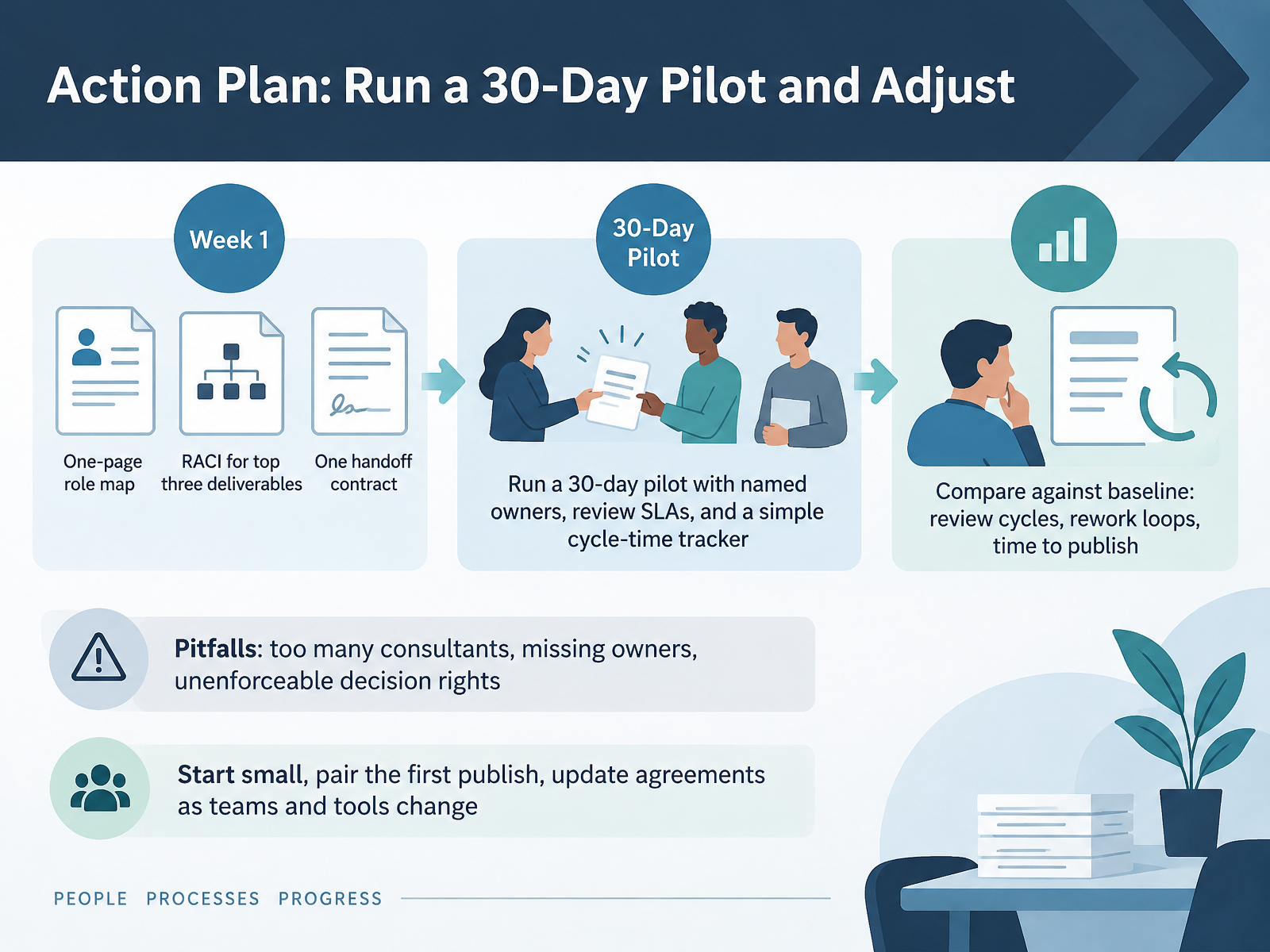
- 14Action Plan: Run a 30-Day Pilot and AdjustLet's close with a plan you can actually run. In week one, keep it small. Write a one-page role map, build a RACI for your top three deliverables, and draft one handoff contract. Make sure each deliverable has one accountable owner.
Then run a 30-day pilot with named owners, agreed review time limits, and a simple cycle-time tracker. Compare results against your baseline: review cycles, rework loops, and time to publish.
Watch for three pitfalls. Too many consultants muddy decisions. Missing owners leave work stranded. And decision rights nobody can enforce become suggestions.
Start small. Pair the first publish so a new owner has support. Then update your agreements as teams and tools change.
Thank you for working through this with me. The roles picture only gets clearer when you put it into practice, so take that one handoff contract into your next meeting. You've got this.
 arxiv.orgtrepo.tuni.fibeyond.minimumcd.org+22 min
Take the deck with you
Download this course as a file — free, no sign-up needed.
- PDF handoutEvery slide page, ready to print or share.15 pages · 3.1 MBDownload
- Narrated PowerPointThe deck that presents itself — every slide carries the digital human's narration video.15 pages · 12.6 MBDownload
- PowerPoint slidesThe full deck as a .pptx — open it in PowerPoint, Keynote, or Google Slides.15 pages · 3.0 MBDownload
Free to use in your own training — please keep the PersonWise credit page at the end.
Have your own deck? Turn it into a course
Sources consulted
Web sources consulted while building this course.
- Technical Writing SOP and Playbook | MTF Institute — mtfinstitute.com
- Documentation Governance Model: Roles, Review Gates, Metrics, and Workflows for Product Teams — ekline.io
- How to Collaborate on and Review Technical Documentation — ones.com
- How Startups Can Build a Documentation Strategy Before Hiring a Technical Writer - Doc Holiday — doc.holiday
- Senior Technical Writer Job Description Examples that ACTUALLY Work — technicalwriterhq.com
- “A Second Set of Eyes”: The Process and Challenges of Software Documentation Review — arxiv.org
- Producing technical documentation in Scaled Agile software development : A case study — trepo.tuni.fi
- Integration and Feedback Problems | MinimumCD Practice Guide — beyond.minimumcd.org
- Documentation Review Process: A Step-by-Step Guide | Docsio — docsio.co
- Review Without the Bottleneck: Getting Docs Checked Without Begging — clickhelp.com
- Workflows | GitLab Docs — docs.gitlab.com
- Review and approval workflows - Technical Writing KB — vaishvanara.github.io
- The Complete Guide to Docs-as-Code Reviews — draftview.app
- Markdown for Technical Writers: The Docs-as-Code Workflow Guide | MarkdownTools Blog — blog.markdowntools.com
- What to expect when you're expecting docs-as-code — blog.jillshaheen.com