Begin
14 pages · ~28 min
Employee Onboarding Fundamentals
A comprehensive onboarding course designed to equip new employees with essential organizational knowledge, policies, and tools for a successful start.
A digital instructor presents all 14 pages. Hold “Ask” at any point and ask out loud — the answer comes from this course. No sign-up needed.
What you’ll learn
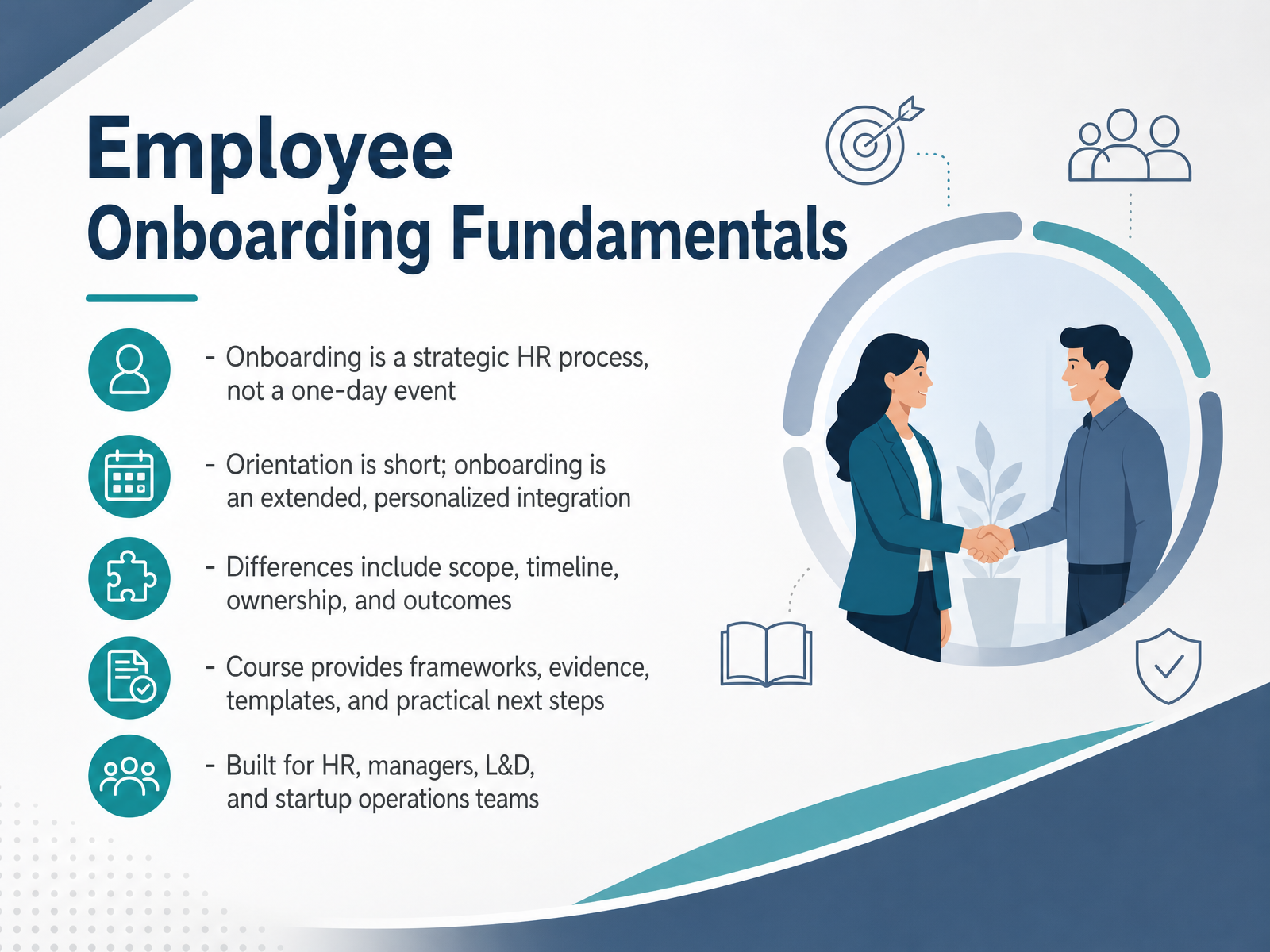
- 01Employee Onboarding FundamentalsWelcome. Over the next few sessions, we will look at employee onboarding as a strategic HR process, not just a one day event. You already know the fundamentals, so our focus is on practical frameworks and evidence you can adapt to your own teams. The key distinction to hold on to is this. Orientation is the short, structured introduction to policies, paperwork, and logistics. Onboarding is the larger journey of integrating a new hire into their role, their team, and the company culture. The two differ in scope, timeline, ownership, and the outcomes they produce. In this course, we will work through frameworks, research, and templates that help you move beyond first day logistics. The goal is to give you actionable next steps you can shape to your own context, whether you are in HR, managing people, leading learning and development, or running startup operations. Let us begin with the business case for better onboarding.indeed.comaihr.compaycor.com+21 min
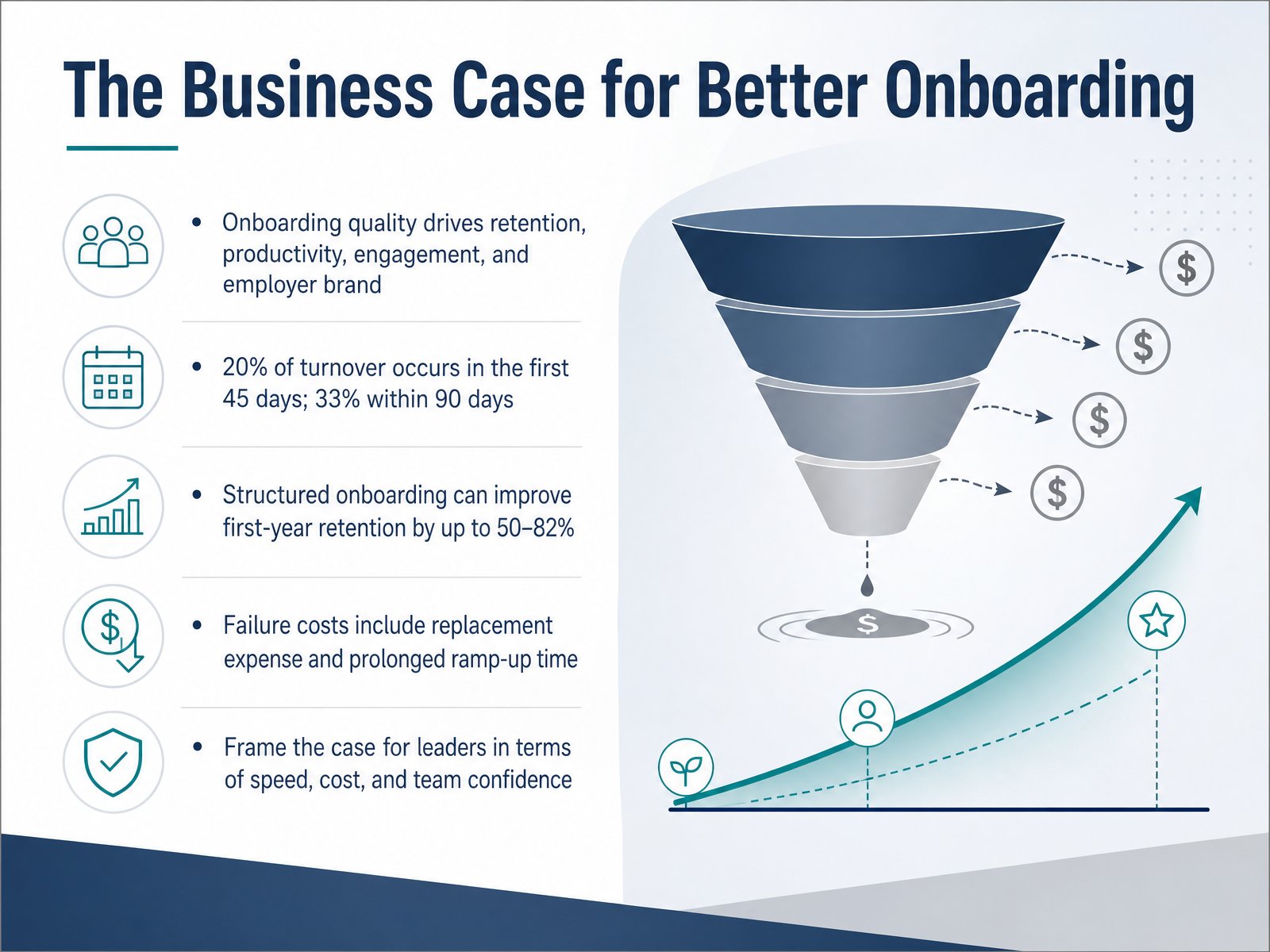
- 02The Business Case for Better OnboardingLet us look at why onboarding deserves real investment. The numbers are hard to ignore. One fifth of all turnover happens in the first forty five days, and a third of new hires leave within ninety days. That is a very expensive problem, because replacing someone means both direct recruiting costs and a longer ramp up period. The upside is just as clear. Organizations with structured onboarding can improve first year retention by fifty to eighty two percent, and they often see productivity gains of over seventy percent. When you make the case to leadership, frame it in the language they care about. Talk about speed to contribution, the cost of early attrition, and the confidence your managers gain when new hires arrive prepared. Retention is not just an HR metric here. It is a direct line to team stability and operational momentum. Let's move next to what current data tells us about new hires.
 bamboohr.comhibob.comapqc.org+21 min
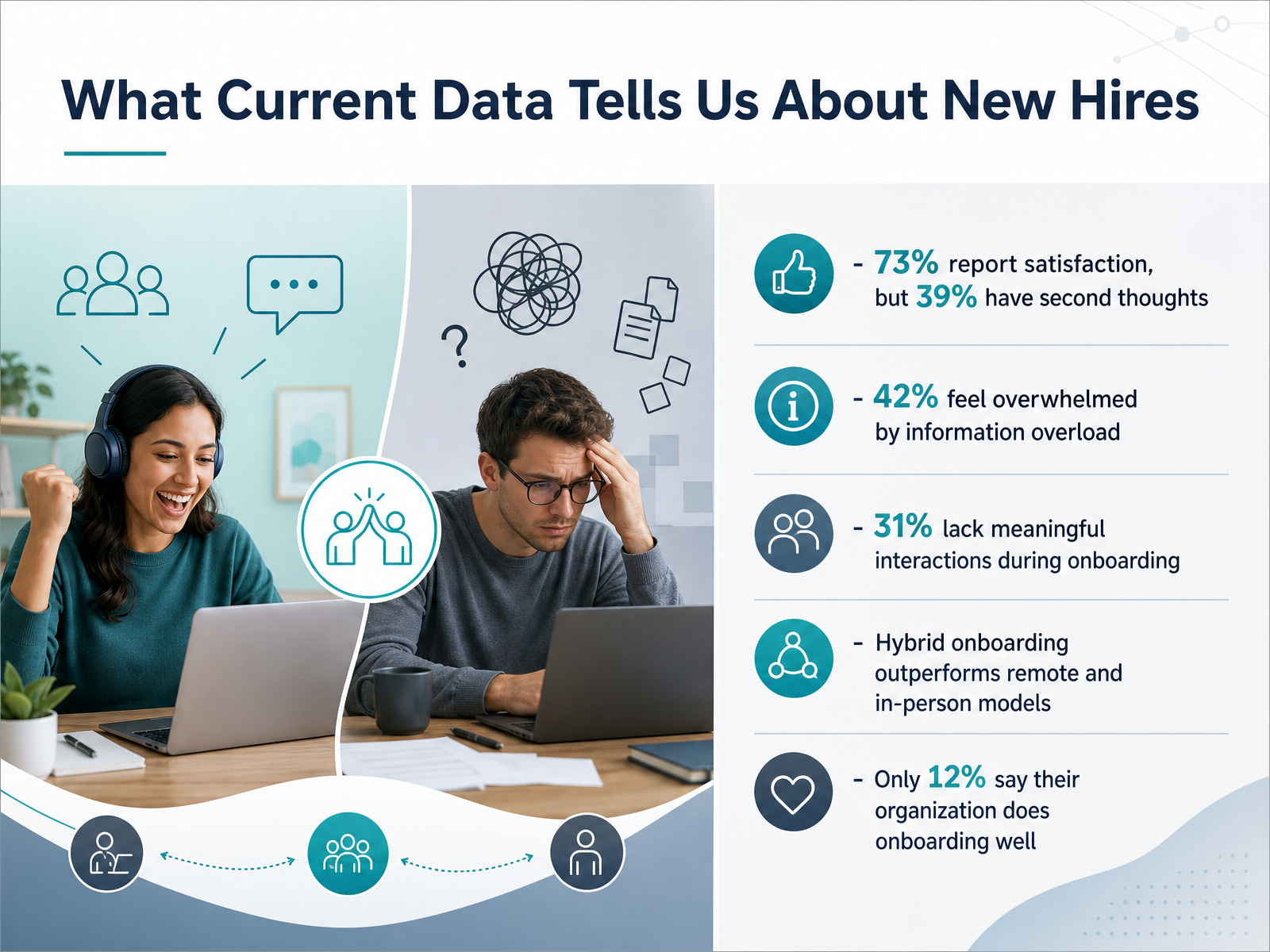
 - 03What Current Data Tells Us About New HiresLet's look at what the data is telling us about the new hire experience. On the surface, it sounds positive. Seventy-three percent of new hires report satisfaction with their onboarding. But dig a little deeper, and a more complex picture emerges. Thirty-nine percent still have second thoughts about their new role during those early weeks. That gap between feeling generally fine and feeling truly committed is exactly where we have room to improve. We also see two common friction points. Forty-two percent of new hires feel overwhelmed by information overload. And thirty-one percent report a lack of meaningful interactions. In other words, we are often giving people too much content and not enough connection. The format you choose matters too. Hybrid onboarding is currently outperforming both fully remote and fully in-person models. Yet here is the reality check. Only twelve percent of employees say their organization does onboarding well. So what is the difference between checking boxes and actually doing this well? Let's clarify that next, as we look at onboarding versus orientation.
 bamboohr.comhibob.comapqc.org+22 min
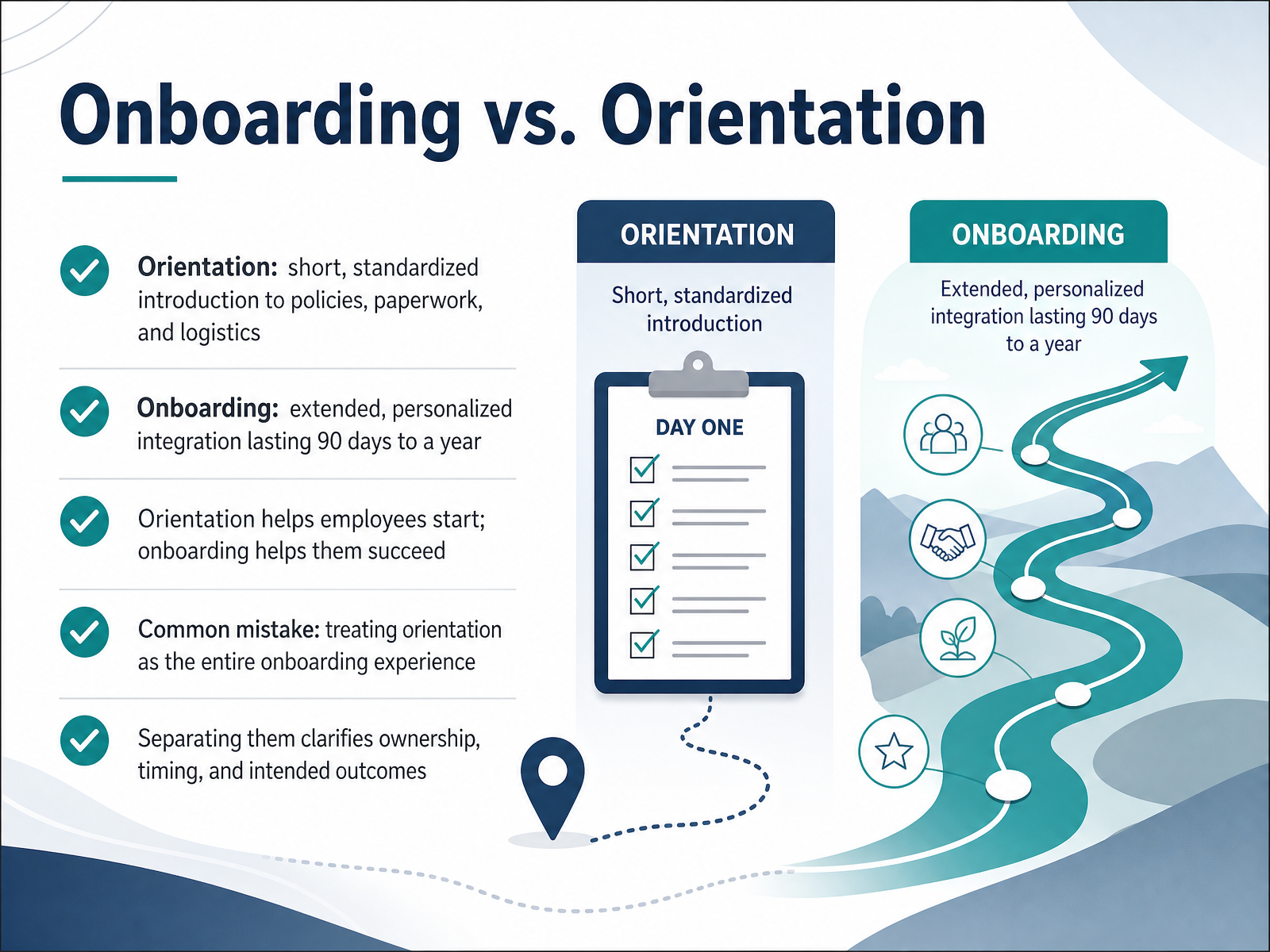
 - 04Onboarding vs. OrientationNow let's clarify a distinction that shapes how you design the entire new hire experience: onboarding versus orientation. Orientation is the short, standardized introduction. It covers policies, paperwork, and logistics, and it typically happens in the first few days. Onboarding is the extended, personalized integration that can last anywhere from ninety days to a full year. Think of it this way. Orientation helps employees start. Onboarding helps them succeed. The most common mistake is treating orientation as the entire onboarding experience. When those two blur together, support often stops too early, before the employee has really settled into the role. Separating them clarifies ownership, timing, and intended outcomes. Orientation is one part of onboarding, not a replacement for it. With that foundation in place, let's look at the core components of effective onboarding.
 indeed.comaihr.compaycor.com+21 min
 - 05Core Components of Effective OnboardingLet's look at the core components that actually drive effective onboarding. You likely recognize most of these, but the real work is in how they connect. First, preboarding, which is the readiness work between offer acceptance and day one. It sets the tone before your new hire logs in. Next, role clarity. This goes beyond a job description. It means concrete expectations, early goals, and how their work contributes to the team. Then there's operational readiness: compliance, tools, access, and equipment. This is non-negotiable, but it shouldn't consume the whole first week. Social integration is where belonging and psychological safety begin to form. Think beyond a welcome lunch. It's about meaningful interactions early on. Learning and enablement covers role skills, systems training, and feedback loops, so new hires can course-correct quickly. And a common gap you'll recognize: too many programs nail day-one logistics, but then neglect long-term integration. That's where retention risk hides. Next, let's extend this into the onboarding timeline.
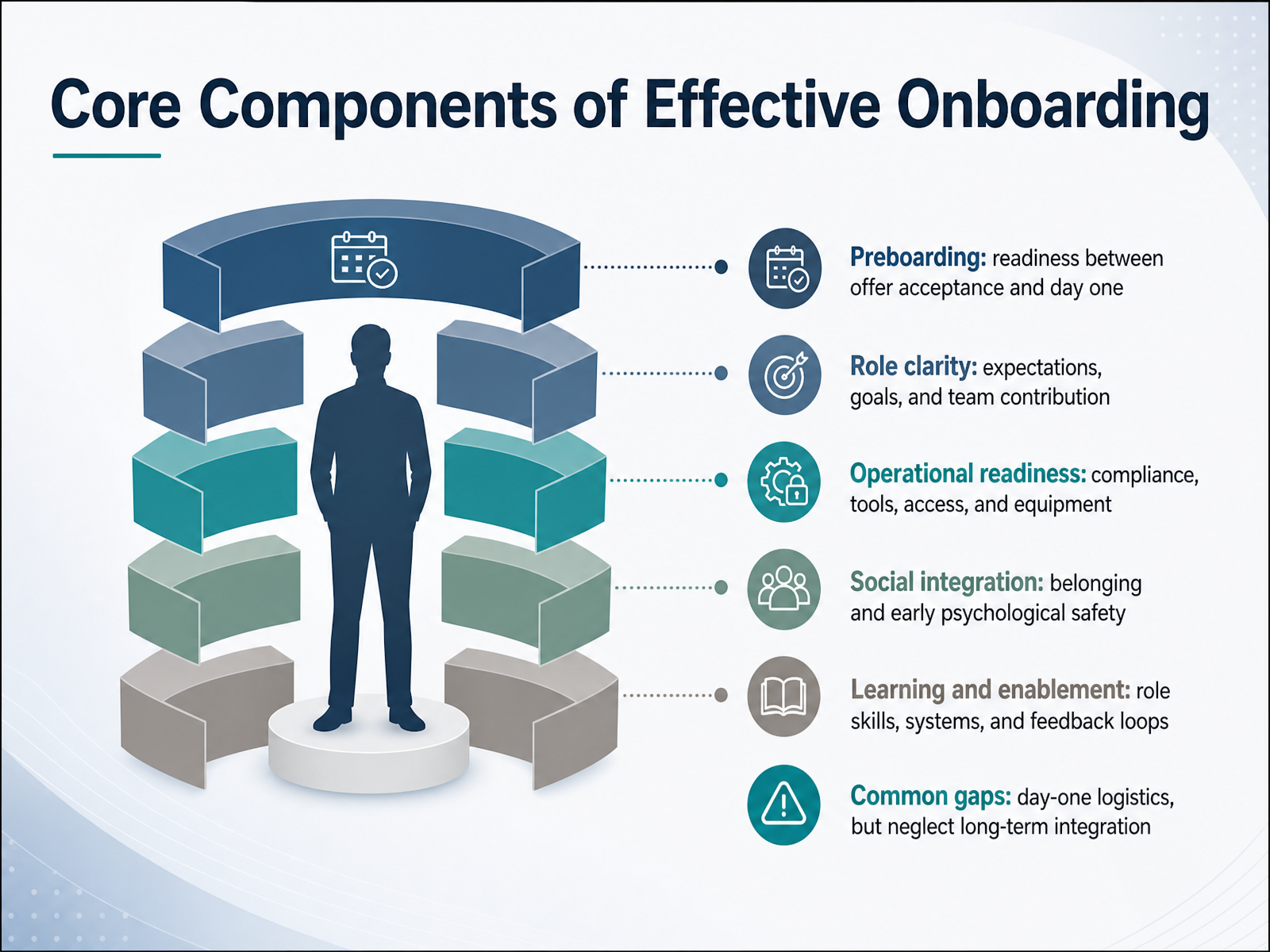 bamboohr.comhibob.comapqc.org+22 min
 - 06The Onboarding TimelineNow, let’s map the employee journey against a timeline that supports retention rather than just completion. Start with preboarding. This is where you set the pace, ensuring access and expectations are clear before day one. Then, in the first week, focus heavily on connection. The data shows that significant turnover risks emerge in the first forty-five days, so early human interaction is your best defense against isolation. As you move into the first thirty days, shift the focus to role clarity and foundational learning. This is where you prevent information overload by spacing out context. By the sixty-day mark, you should be actively seeking feedback and correcting course. This is the moment to gauge whether your new hire feels supported by their manager, which is the strongest predictor of long-term retention. Finally, at ninety days and beyond, you transition ownership from HR to performance management and development. Throughout all of this, keep your eye on early warning signs. If a new hire is disengaged or falling behind, intervene immediately. A well-paced timeline turns onboarding from an administrative chore into a strategic driver of productivity. Let’s look next at how to assign roles and responsibilities to make this timeline actually work.
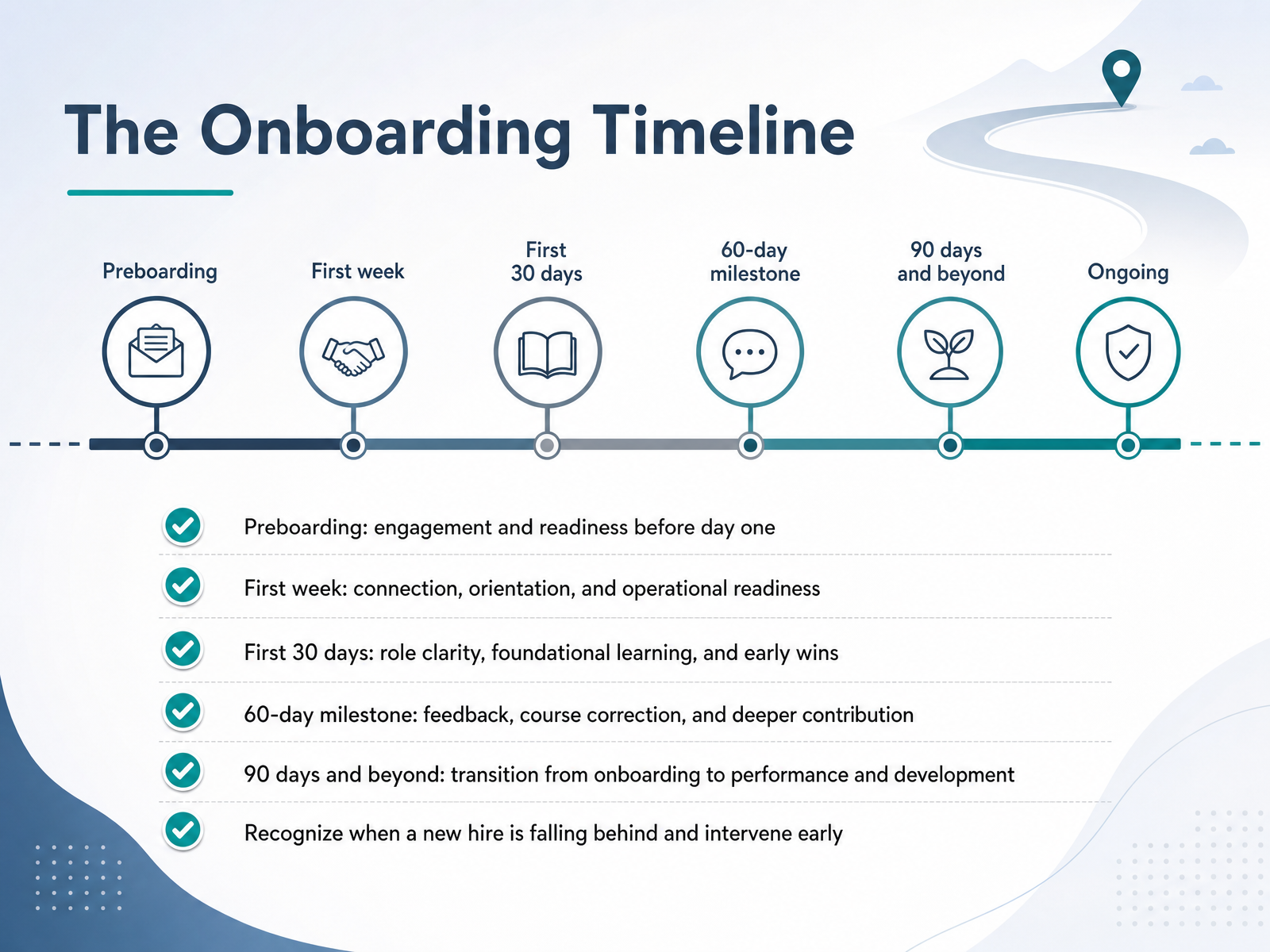 bamboohr.comhibob.comapqc.org+22 min
 - 07Roles and ResponsibilitiesLet's get specific about who owns what during onboarding, because without clear roles, things slip. HR carries the logistics and compliance backbone: system access, paperwork, and overall program coordination. People managers own the human core: setting expectations, giving feedback, coaching, and holding regular check-ins. L&D designs role-specific training paths and skill development, so learning is relevant from day one. A buddy or mentor provides daily support, helps with social integration, and creates a safe space for questions that might feel too small to ask a manager. And here's where many programs break down: the handoffs. Only about a third of HR leaders describe the transition between recruiting, HR, IT, and managers as seamless. So design those handoff points deliberately. Decide who triggers system access, who schedules the first check-in, and who confirms equipment is ready before day one. When ownership is explicit, new hires feel supported instead of passed around. Next, we'll look at designing a structured onboarding program that turns these roles into a repeatable experience.
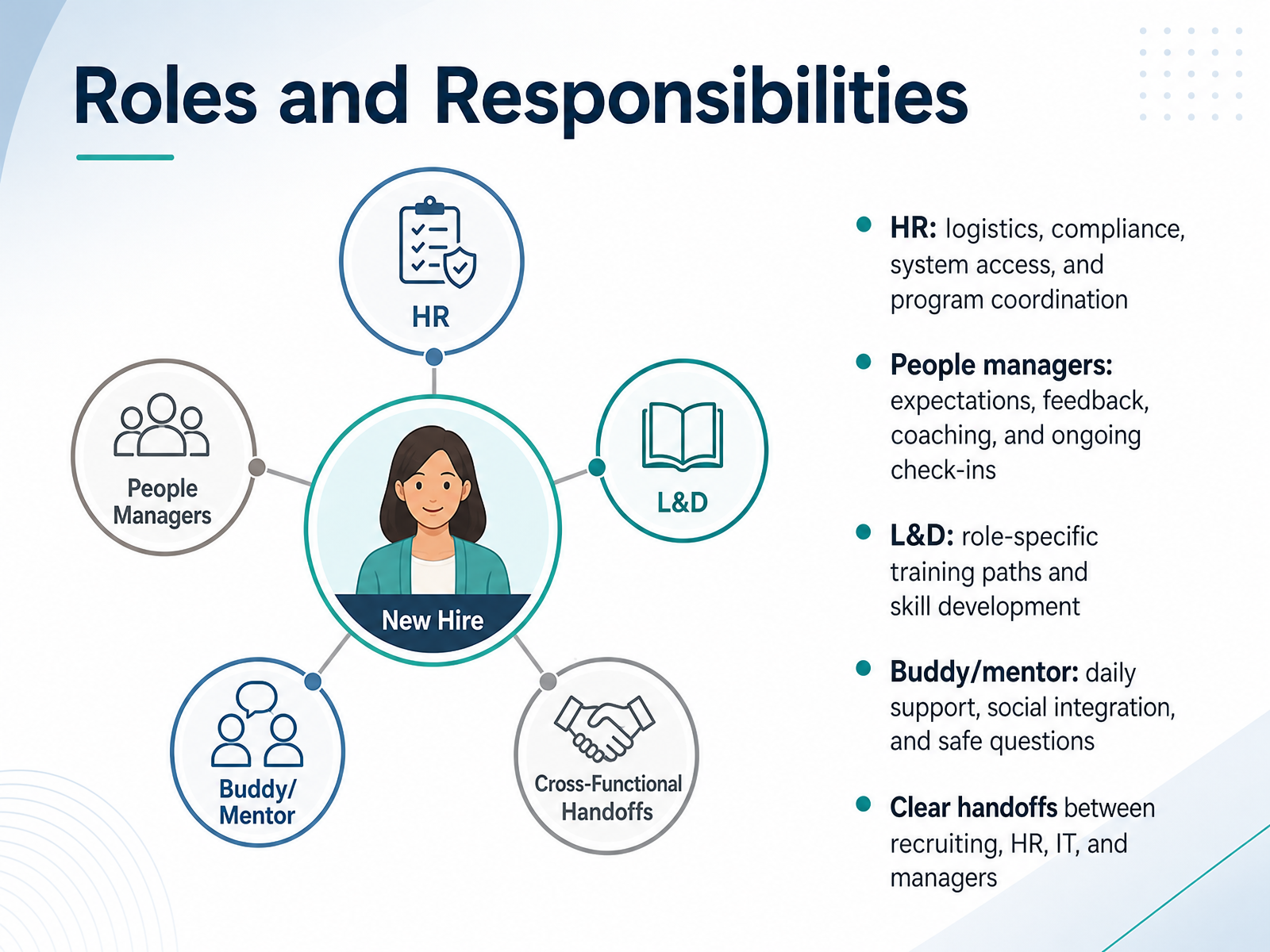 bamboohr.comhibob.comapqc.org+22 min
 - 08Designing a Structured Onboarding ProgramLet's move into the structure that holds onboarding together. A strong program gives you a repeatable framework. That consistency is what drives retention gains we see in the research, with structured onboarding improving first year retention by around fifty percent. But repeatable does not mean rigid. Leave room for personalization so new hires feel seen as individuals, not processed as cases. Phase your content across preboarding, then thirty, sixty, and ninety day milestones. That pacing prevents the information overload that about two in five new hires report. Use templates, checklists, and automation to cut down on administrative task volume, especially the routine questions that eat up HR time. Then balance the standardized layer with role specific training and manager led conversations. Manager involvement is one of the strongest predictors of onboarding success, so make those touchpoints intentional rather than optional. Think of the program as a spine that supports the process, while managers and teams add the muscle around it. That combination keeps the experience consistent, connected, and relevant. Next, we will look at creating connection in hybrid and remote teams.
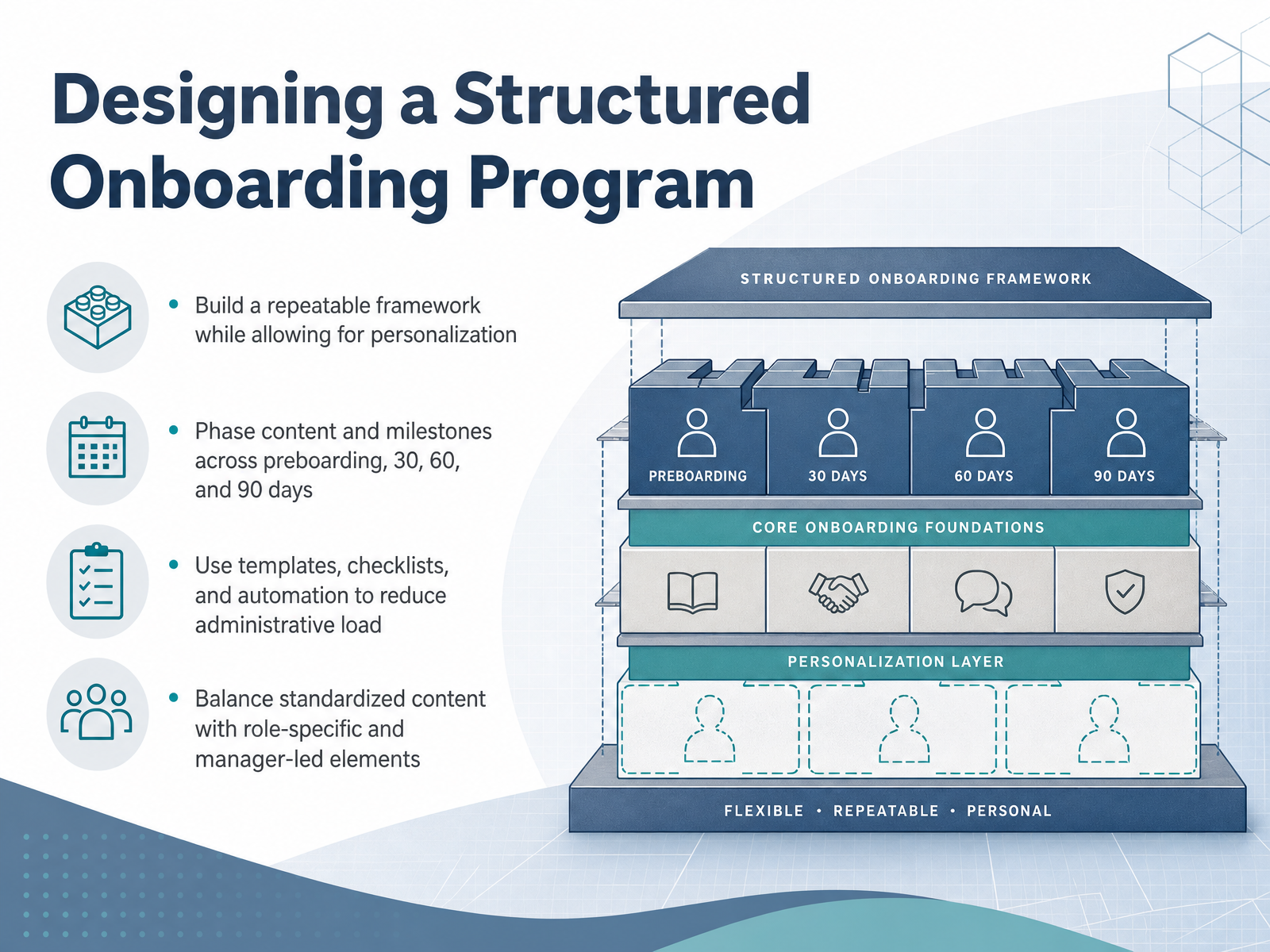 bamboohr.comhibob.comapqc.org+22 min
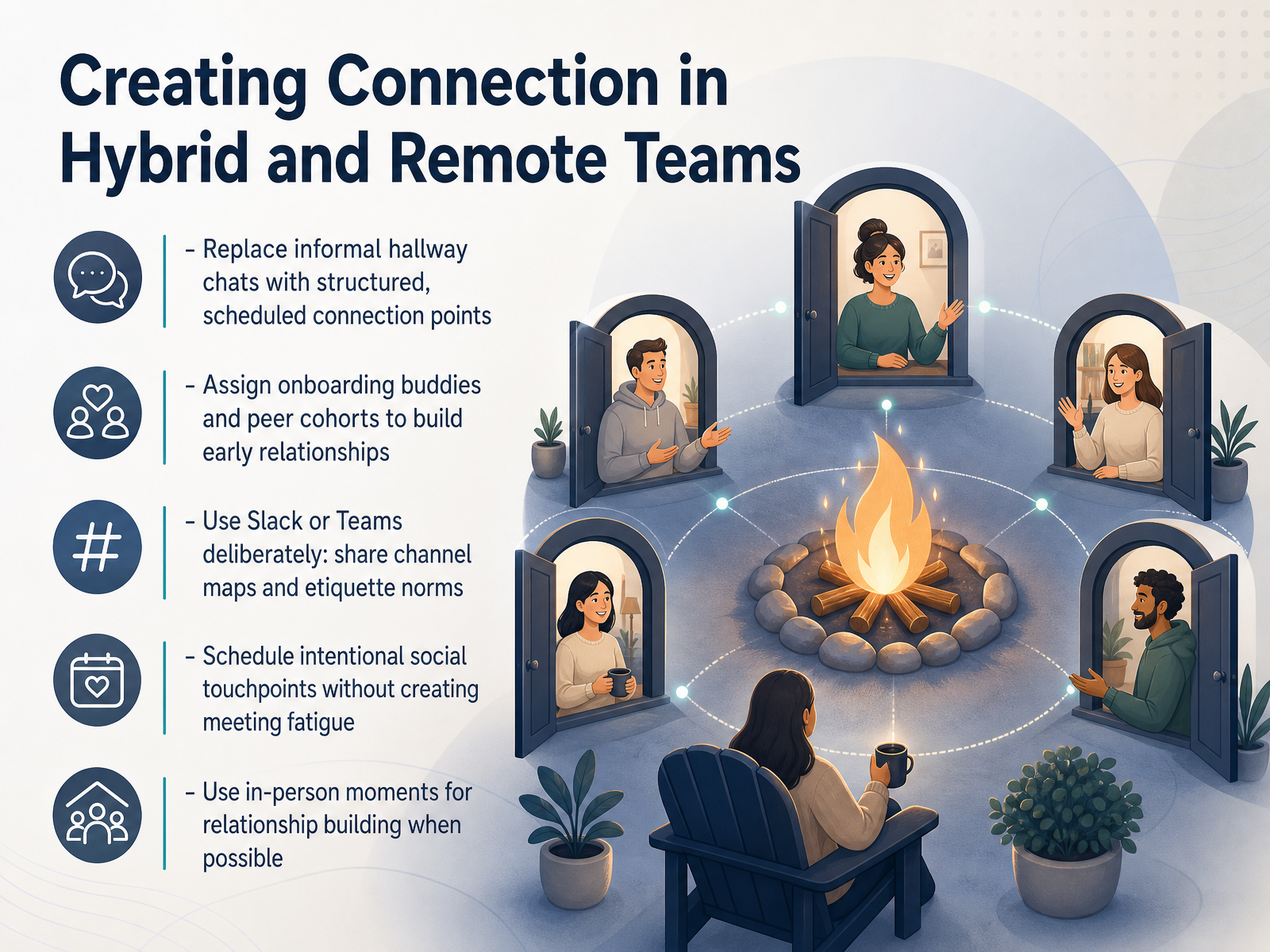
 - 09Creating Connection in Hybrid and Remote TeamsNow, let's talk about creating genuine connection when your team isn't in the same room. Hybrid onboarding is actually outperforming both fully remote and fully in-person models in twenty twenty-five. But connection doesn't happen by accident. It needs structure. Think about replacing those informal hallway chats with scheduled touchpoints. A fifteen minute virtual coffee, or a standing thirty minute team huddle, gives people the casual interaction they're missing. Onboarding buddies and peer cohorts are also critical. Pairing a new hire with someone who excels at digital communication gives them a safe person to ask the awkward questions. And don't overlook your collaboration tools. A simple channel map for Slack or Teams removes a huge amount of early confusion. Just be intentional about how many events you schedule. You're aiming for meaningful connection, not meeting fatigue. When you do have in-person opportunities, use them for relationship building, not information dumps. Save those moments for team lunches or mentorship pairings. With that foundation in place, let's look at how to deliver all this connection without overwhelming your new hires.
 bamboohr.comforbes.comgetculturebot.com+22 min
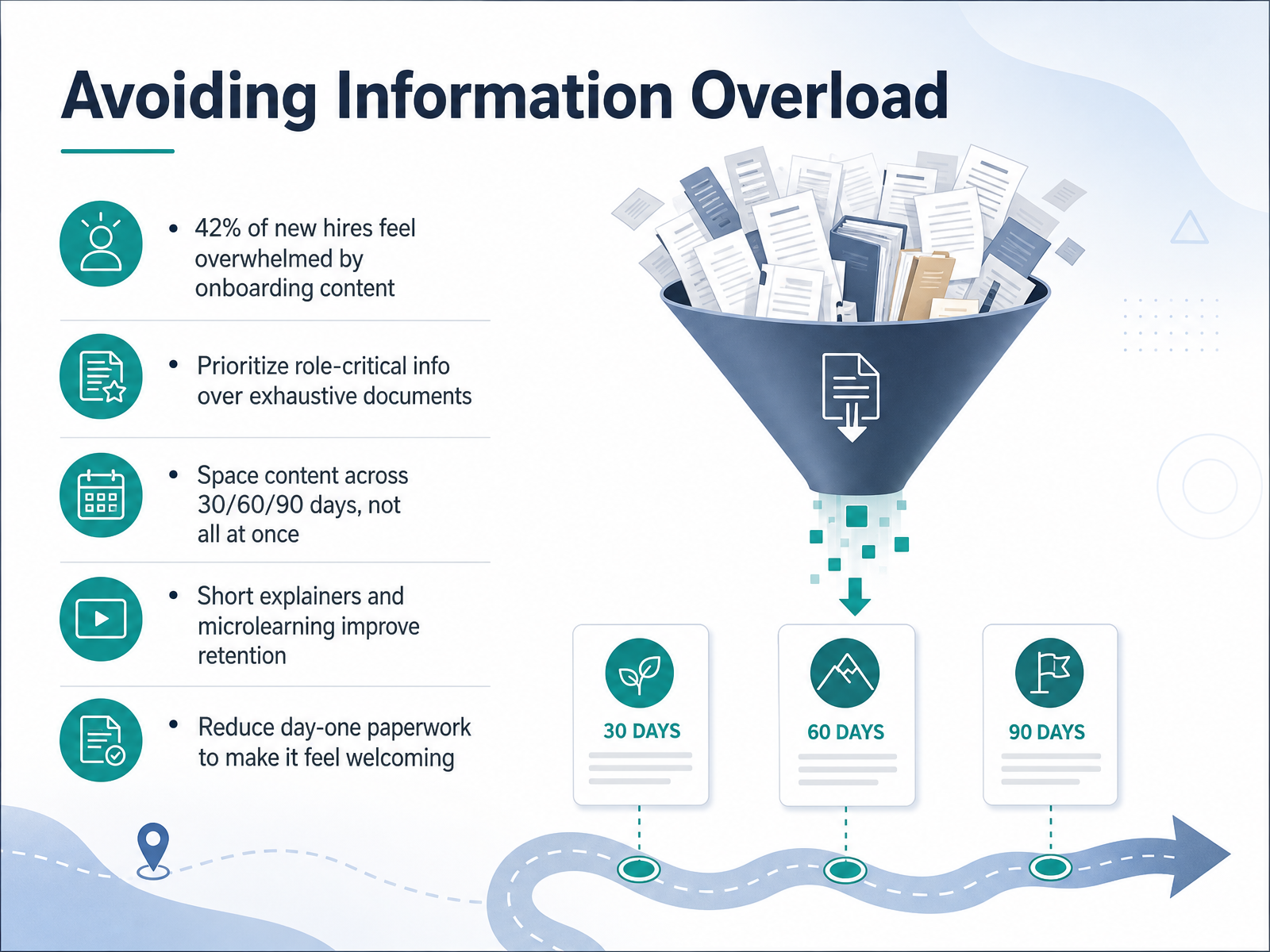
 - 10Avoiding Information OverloadLet's shift to a common onboarding failure: information overload. The data is clear on this one. Forty two percent of new hires feel overwhelmed by the volume of content thrown at them in their first weeks. When that happens, the information doesn't get absorbed. It gets ignored. So the fix isn't adding more documents; it's being more intentional. Start by prioritizing role critical knowledge. Your new hire needs to understand their core workflow and key tools before they need a deep dive into every company policy. A useful approach is to space content across the first thirty, sixty, and ninety days. This gives people time to apply what they learn before moving on to the next layer. You can also lean into short explainers and microlearning. Breaking down a complex process into a quick video or a one page guide is far more effective than a fifty page manual. And on day one specifically, reduce the paperwork. Protect that first day for connection, not administrative burden. It sets a completely different tone. With that in mind, let's look at how we can measure the effectiveness of these strategies in our next section: Measurement and Feedback.
 bamboohr.comhibob.comapqc.org+22 min
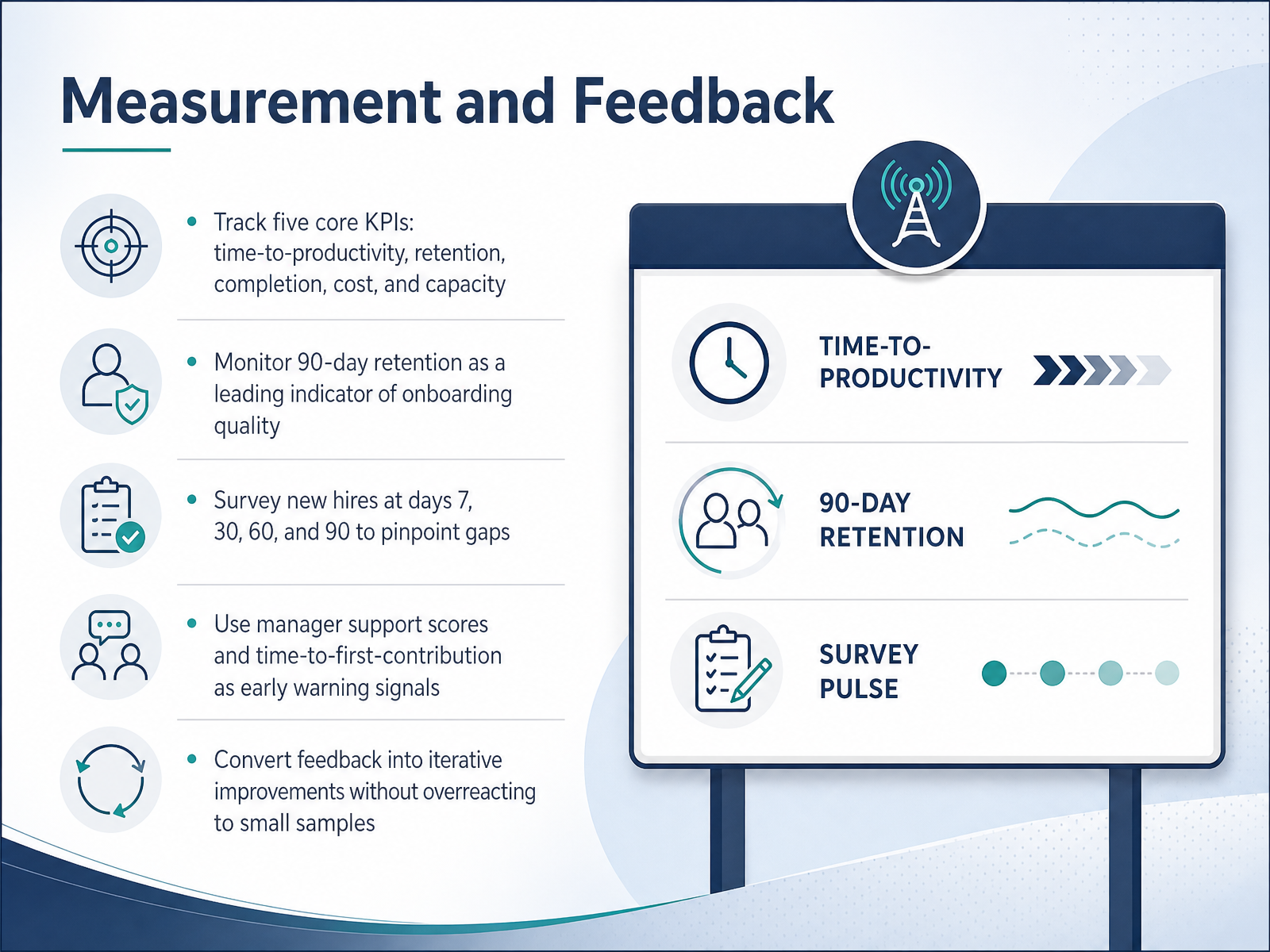
 - 11Measurement and FeedbackNow let's talk about measuring what matters. You want five core KPIs on your dashboard: time-to-productivity, retention, completion, cost, and capacity. Think of them as a group. A fast time-to-productivity is great, but only if retention stays strong and the cost doesn't spike in the process. One of the most telling leading indicators is ninety-day retention. If new hires are still engaged at day ninety, the first weeks did their job. To catch gaps early, survey new hires at days seven, thirty, sixty, and ninety. A short survey works fine. Pay special attention to manager support scores and time-to-first-contribution. Together, these are your early warning signals. If a manager support score dips below six out of ten around day thirty, treat that as a prompt to intervene. You have a narrow window. Finally, use the feedback you collect to make iterative improvements. Don't overhaul the entire program based on three responses. Look for patterns across cohorts. That measured approach keeps your onboarding sharp without overreacting to noise. Next, let's examine common mistakes and how to avoid them.
 bamboohr.comhibob.comapqc.org+22 min
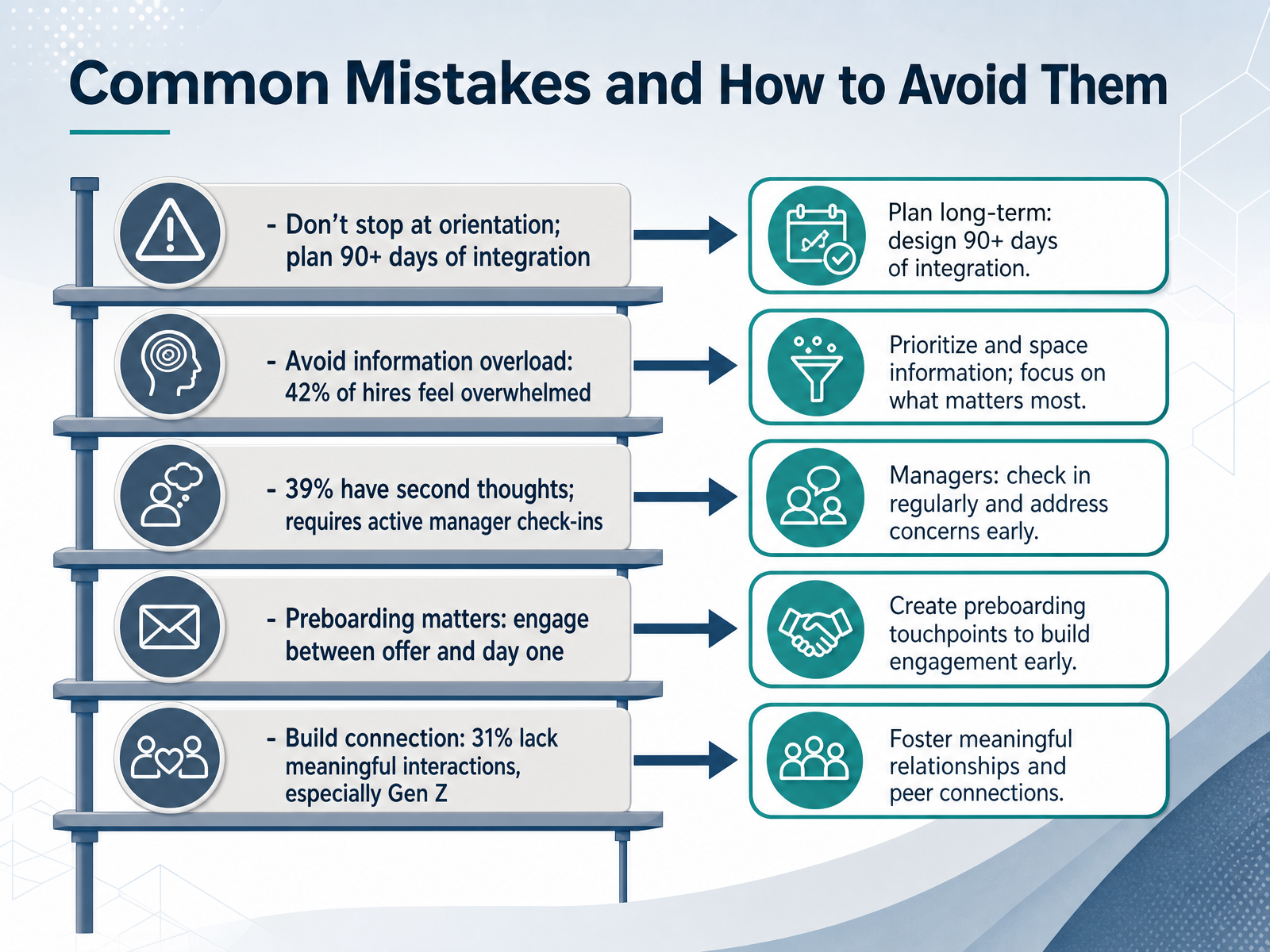
 - 12Common Mistakes and How to Avoid ThemLet's look at the most common onboarding mistakes, and more importantly, how to avoid them. First, don't confuse orientation with onboarding. A one-day event is not a plan. Structure a journey that extends at least ninety days, with clear milestones for integration and early contribution. Second, watch for information overload. Forty-two percent of new hires feel overwhelmed. Pace the learning, and favor self-paced, hands-on resources over a massive content dump. Third, remember that thirty-nine percent of hires experience second thoughts. That uncertainty is normal, but it requires active manager check-ins. A brief weekly conversation can stabilize confidence faster than any portal. Fourth, don't ignore preboarding. The window between offer acceptance and day one is prime time to build anticipation and reduce first-day anxiety. Finally, be intentional about connection. Thirty-one percent of new hires report a lack of meaningful interactions, and this is especially pronounced for Gen Z. Scheduled introductions and buddy programs solve that. Next, we'll explore how to adapt onboarding for different contexts.
 bamboohr.comhibob.comapqc.org+22 min
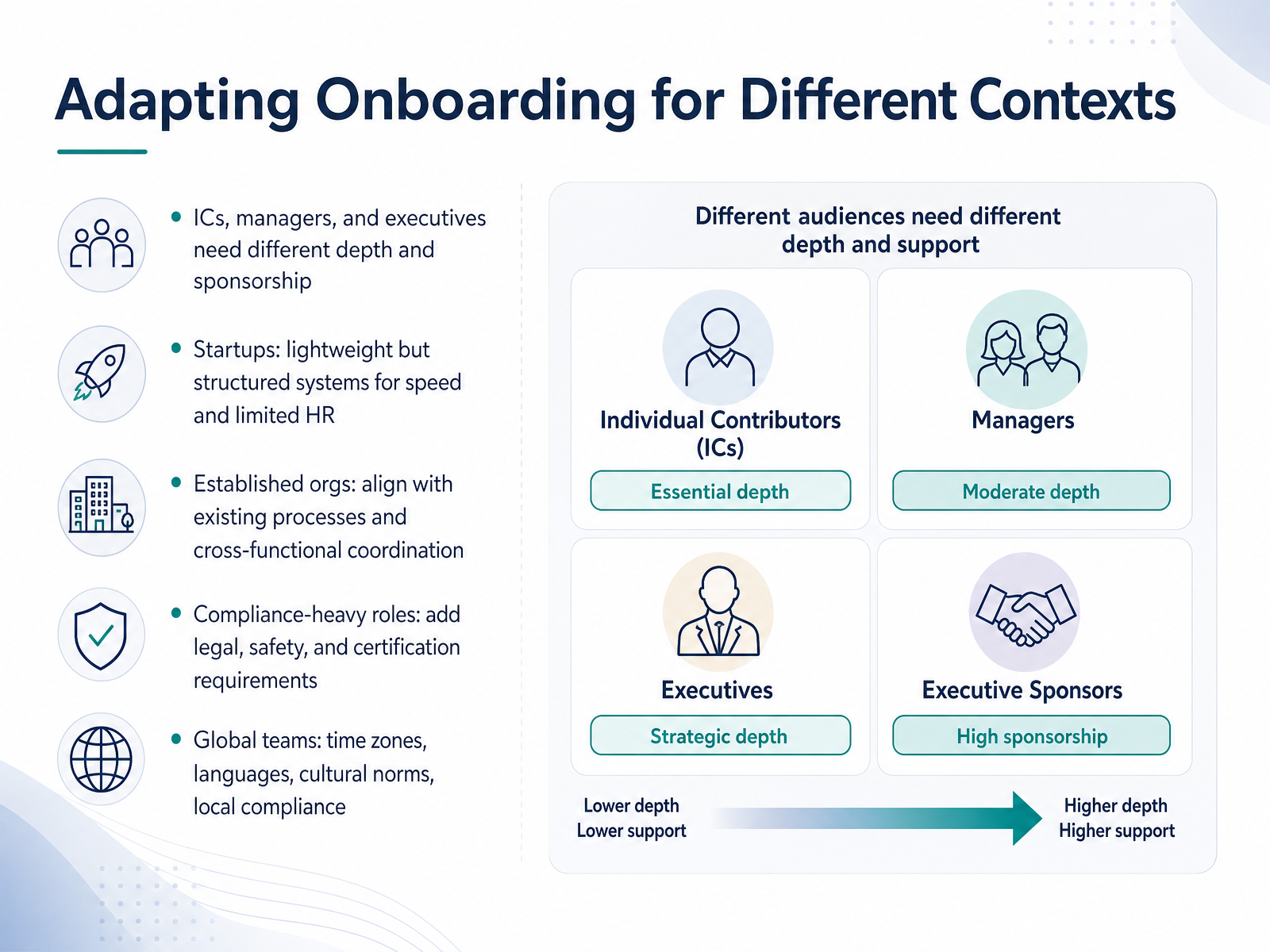
 - 13Adapting Onboarding for Different ContextsOnboarding works best when you adapt it to the situation, and that starts with role level. Individual contributors need fast clarity on tools and daily tasks. Managers need stronger context around team dynamics and leadership expectations. Executives often benefit from a tailored plan with senior-level sponsorship and early stakeholder mapping. Your company stage matters too. A startup may not have a large HR team, but a lightweight, repeatable system keeps speed without losing structure. In an established organization, you are usually aligning with existing processes and coordinating across functions. For compliance-heavy roles, you will add legal, safety, and certification steps on top of the standard journey. And for global teams, plan around time zones, languages, cultural norms, and local compliance. The takeaway is simple. Keep your core onboarding outcomes consistent, but adjust depth, sponsorship, and sequencing based on context. That flexibility is what helps new hires feel supported instead of processed. Next, we will turn these ideas into an action plan and next steps.
 indeed.comaihr.compaycor.com+21 min
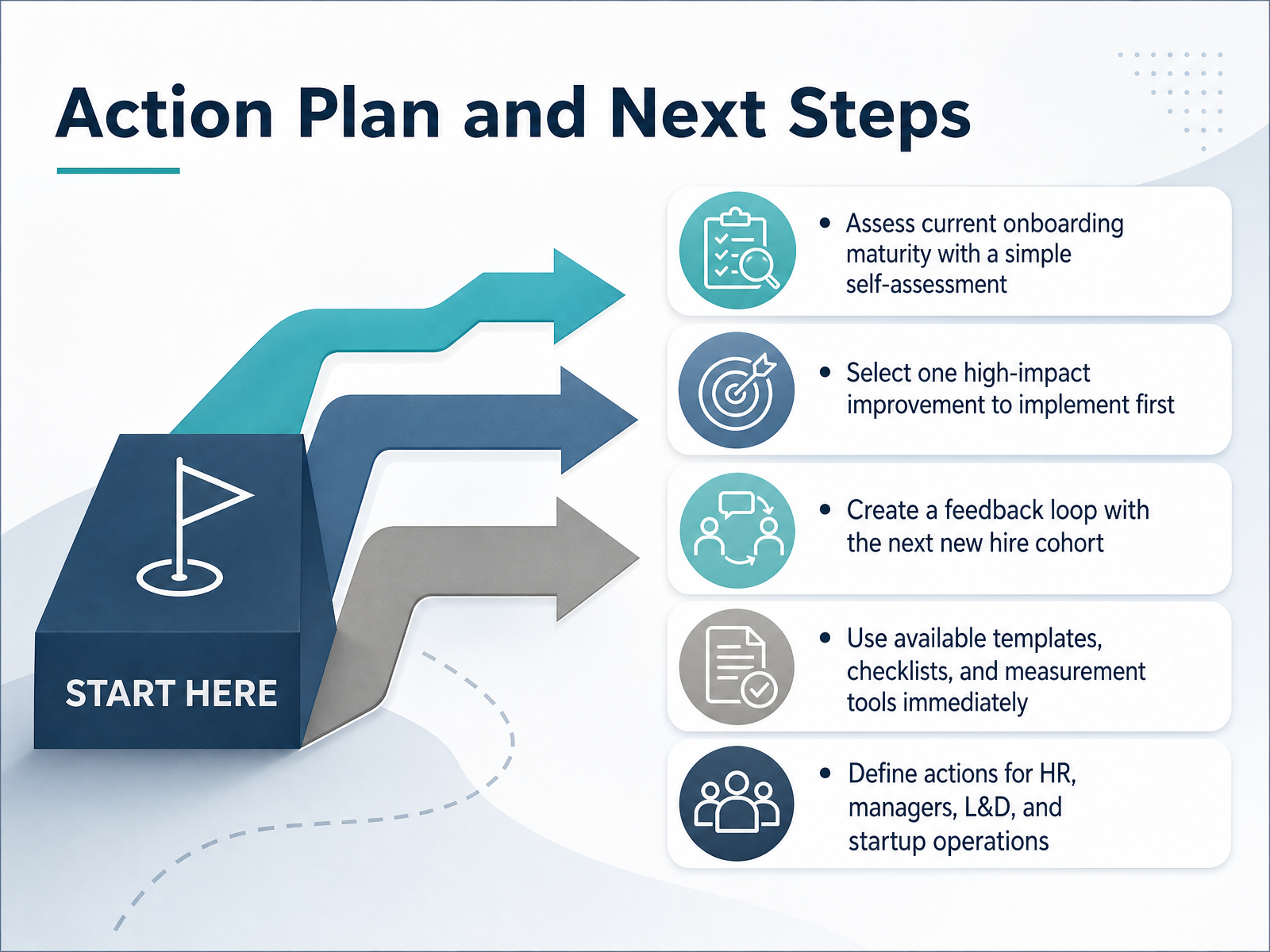
 - 14Action Plan and Next StepsSo where do you go from here? Start by running a quick self-assessment of your current onboarding maturity. Be honest about where the gaps are; that baseline tells you what one high-impact improvement to tackle first. Don't try to fix everything at once. Choose one change, roll it out, and measure the result. Then build a feedback loop with your next new hire cohort. Ask them what worked and what added unnecessary noise. Use the templates, checklists, and measurement tools right away, so you're not designing from scratch. Finally, make ownership explicit. Define what HR owns, what managers own, and what learning and operations teams contribute. The fundamentals we've covered are meant to adapt to your context, not replace it. Move forward with one concrete action, keep listening to new hires, and let each cohort inform the next. Thanks for joining, and good luck putting your plan into motion.
 bamboohr.comhibob.comapqc.org+21 min
Take the deck with you
Download this course as a file — free, no sign-up needed.
- PDF handoutEvery slide page, ready to print or share.15 pages · 3.4 MBDownload
- Narrated PowerPointThe deck that presents itself — every slide carries the digital human's narration video.15 pages · 15.0 MBDownload
- PowerPoint slidesThe full deck as a .pptx — open it in PowerPoint, Keynote, or Google Slides.15 pages · 3.3 MBDownload
Free to use in your own training — please keep the PersonWise credit page at the end.
Have your own deck? Turn it into a course
Sources consulted
Web sources consulted while building this course.
- Employee Orientation vs. Employee Onboarding — indeed.com
- Onboarding vs Orientation: What's the Difference? [+ Free PDF] - AIHR — aihr.com
- Onboarding vs Orientation: The Differences & Similarities — paycor.com
- Complete Employee Onboarding Guide — shrm.org
- Employee Orientation vs. Employee Onboarding: Why You ... — insperity.com
- First Day Fog: Onboarding Benchmarking Report for 2025 | BambooHR — bamboohr.com
- The state of employee onboarding research - HiBob — hibob.com
- Onboarding Excellence: HR's Report Card for New Employee Success | APQC — apqc.org
- Employee Onboarding Statistics 2025: Key Data & Trends — libertify.com
- Enboarder 2025 HR Leader Survey: Winning the First 90 Days — enboarder.com
- How Remote Onboarding Can Help Your New Hires — forbes.com
- Onboarding Best Practices for Remote & Hybrid Teams - CultureBot — getculturebot.com
- Remote, In-Person, or Both? Designing an Onboarding Process That Works in a Hybrid World — Category One Consulting — category1consulting.com
- 8 Best Practices for Hybrid Onboarding — greatplacetowork.com