Labor Systems Across Civilizations
Begin
15 pages · ~30 min
Labor Systems Across Civilizations
Explore how diverse civilizations structured labor systems, examining historical contexts and their societal impacts for history students and enthusiasts.
What you’ll learn
- 01Labor Systems Across CivilizationsWelcome to this exploration of labor systems across civilizations. Today we will ask a deceptively simple question: how have different societies organized, controlled, and valued human work? Labor is never just about producing goods or surviving from day to day. It reveals how power is distributed, how laws are written and enforced, and how ordinary people build their lives within larger economic realities. Throughout this course, we will use a comparative perspective, looking across regions and tracing the entanglements between them. We will move from foundational concepts to concrete cases, from plantations and industrial transformation to the legacies that still shape work today. By the end, you will have a clearer framework for understanding why labor takes such different forms, and why those differences matter. In the next slide, we begin with that comparative framework.pure.uva.nldegruyterbrill.comdigitalcommons.library.uab.edu+22 min
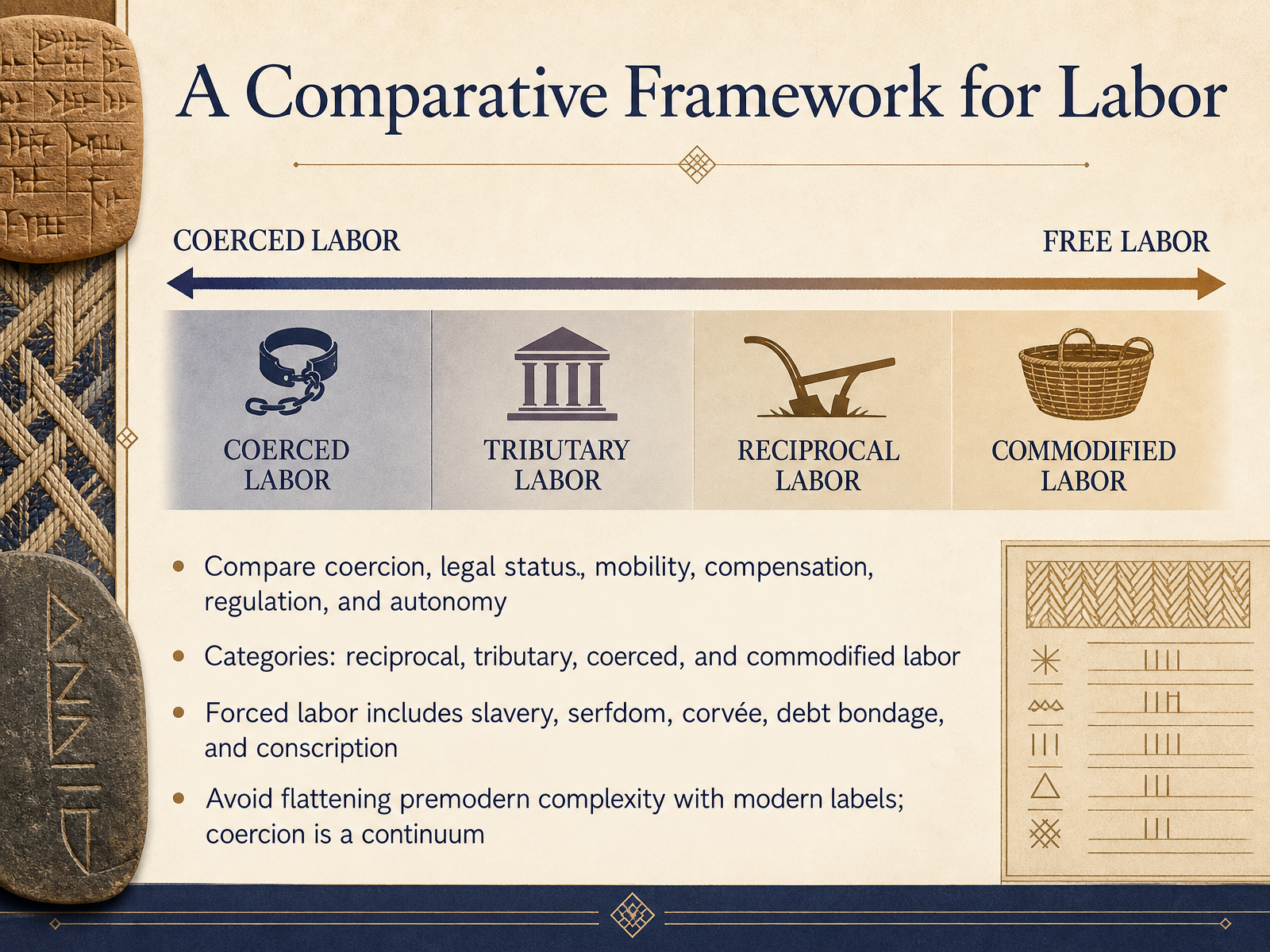
- 02A Comparative Framework for LaborLet's begin by building a shared lens for comparing how different societies mobilized work. Instead of dividing labor simply into free and unfree, historians now look at several overlapping dimensions. These include legal status, mobility, compensation, and the degree of regulation or autonomy a worker held. When we compare labor across civilizations, we can group the arrangements into four broad categories. Reciprocal labor covers work done for family or community. Tributary labor is owed to a state or a ruling authority. Coerced labor is extracted through force or legal compulsion, and commodified labor is exchanged in markets for wages. Within the category of forced labor we find several distinct forms. Slavery, serfdom, corvée, debt bondage, and military conscription all constrain choice, but they do so through different legal, economic, and political mechanisms. A central point is this. Coercion is not a single yes or no condition. It exists along a continuum. Premodern systems often mixed incentives, obligations, and direct compulsion. Applying a modern label like free or unfree too quickly can flatten that complexity. As we move to the next slide, we will look more closely at slavery, serfdom, and other coerced systems, so those distinctions become concrete.
 digitalcommons.law.buffalo.edueconomics.mit.edusciencedirect.com+21 min
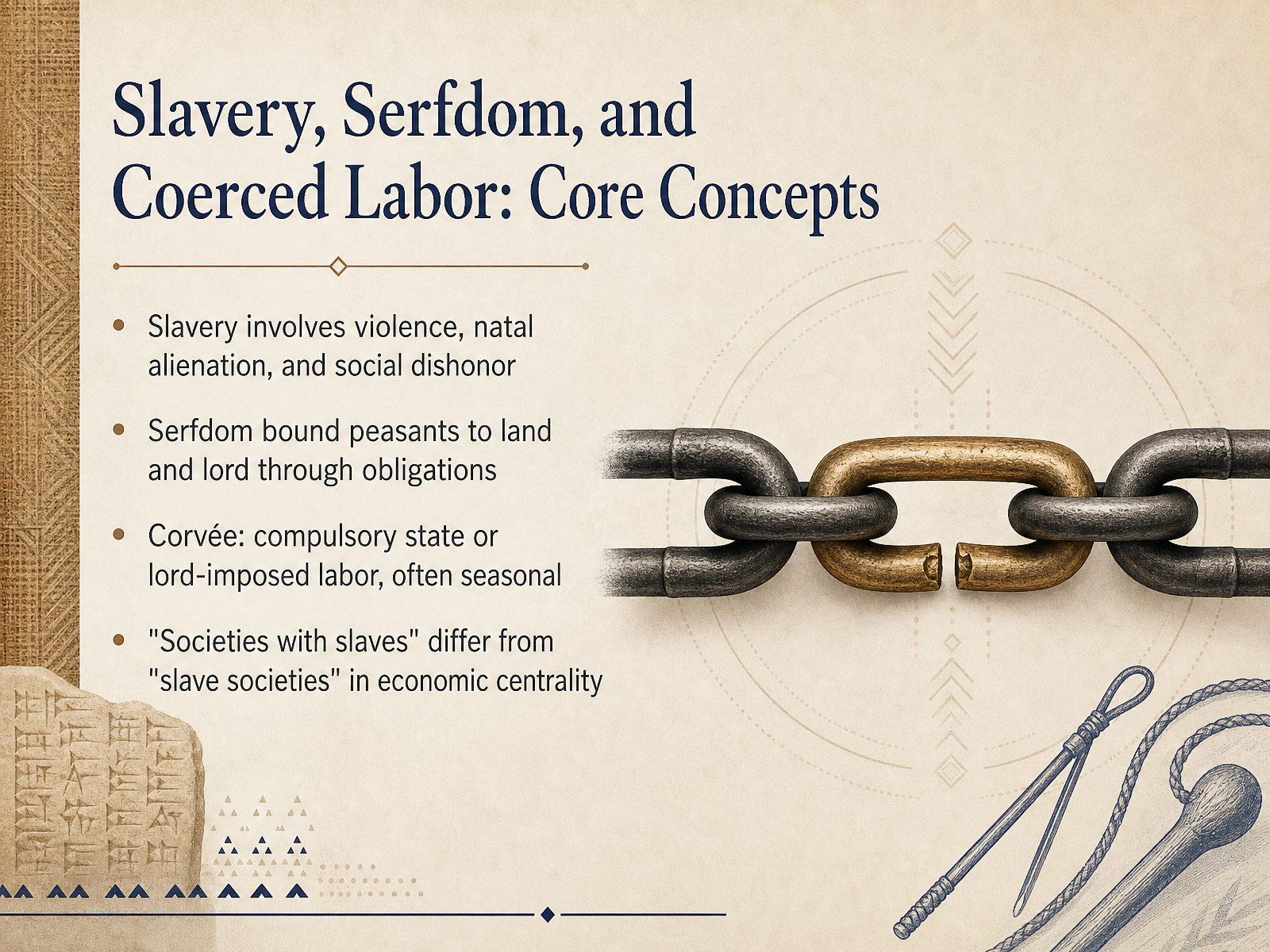
 - 03Slavery, Serfdom, and Coerced Labor: Core ConceptsNow let’s define the core concepts we need before comparing labor across civilizations. At the most extreme end is slavery, which the sociologist Orlando Patterson described not simply as forced work, but as a relationship built on three elements: violence or the threat of violence, natal alienation, meaning the enslaved person is cut off from their kinship and ancestry, and social dishonor, a status of permanent degradation. By contrast, serfdom bound peasants to the land. Serfs were not property in the same sense, but they owed obligations to a lord, such as labor service, payments, or a share of their harvest, and they generally could not leave the estate. We also encounter corvée, a French term for compulsory labor imposed by a state or a lord. Corvée was often seasonal, like requiring peasants to maintain roads, build monuments, or harvest state fields for a set number of days each year. Finally, it is useful to distinguish between societies with slaves, where enslaved people existed but the economy did not depend on them, and slave societies, where enslaved labor was central to producing the main source of wealth. This distinction helps us avoid treating all historical slavery as if it were identical to the plantation complex of the early modern Atlantic. With these terms in mind, let’s turn to labor in early agrarian states.
 digitalcommons.law.buffalo.edueconomics.mit.edusciencedirect.com+22 min
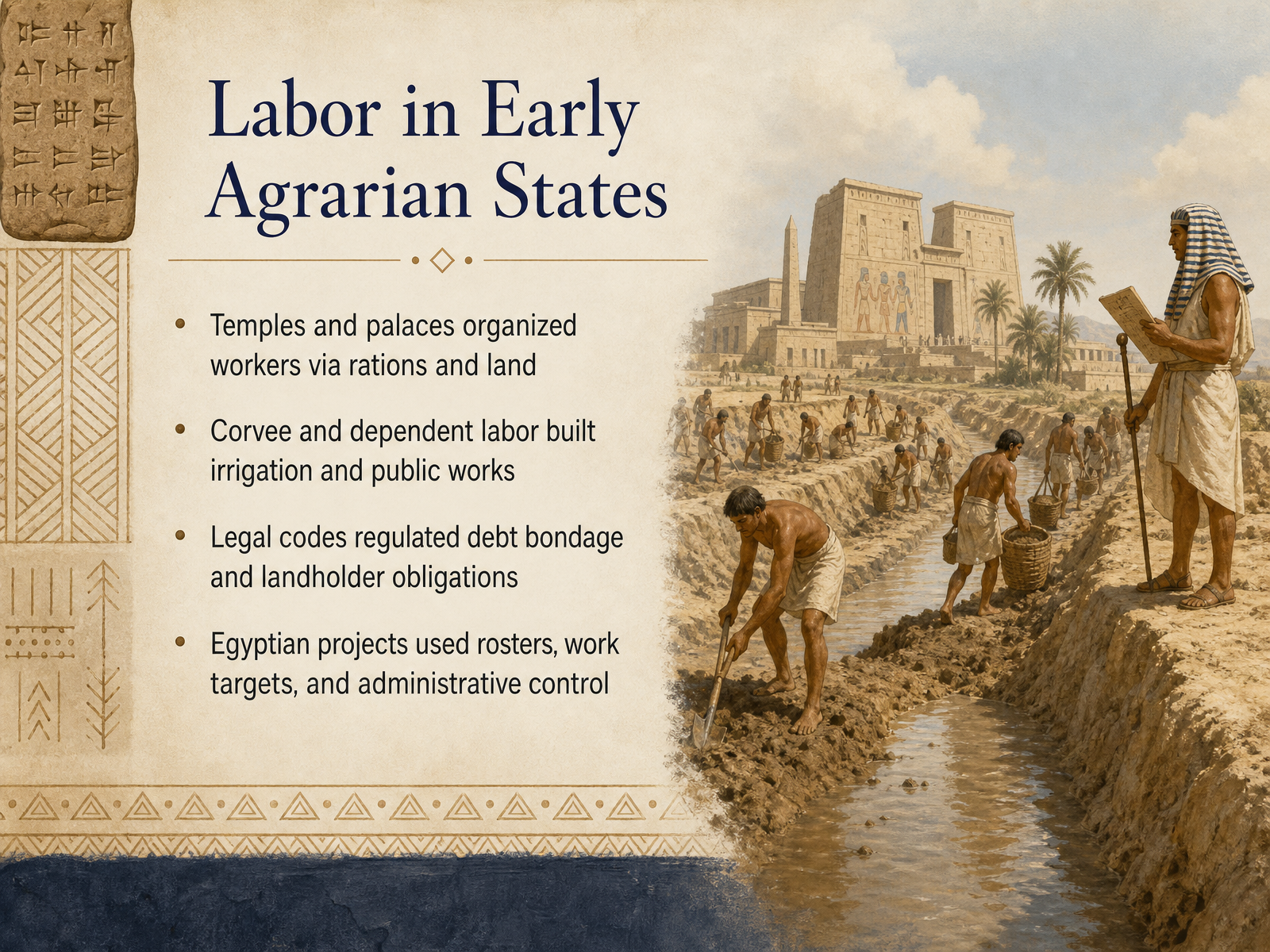
 - 04Labor in Early Agrarian StatesNow let's look at how early agrarian states organized human effort. In Mesopotamia, temples and palaces functioned almost like vast households. They issued monthly grain allotments to workers, from field laborers and weavers to administrators. This system supported entire communities, including the young, the old, and the sick, while also serving as a form of payment. Alongside these institutional workers, states relied on corvee labor. This was a compulsory work duty, typically required from male citizens for a set period each year, often around one month. Workers could sometimes send a substitute or pay a fee to avoid service. This labor force was essential for large public works, such as digging canals, building roads, and constructing public buildings. Legal codes also played a role. Laws from this period regulated landholder obligations and set rules around debt bondage, attempting to manage how people could be bound to service for unpaid debts. In Egypt, we see a different but equally systematic approach. Records from the Middle Kingdom reveal a strong administrative hand. Scribes used rosters, set work targets, and filed regular reports to monitor attendance and performance on state projects. This combination of rations, legal obligation, and meticulous administration formed the backbone of labor in the earliest states. Next, we will transition to the Classical Mediterranean, where labor regimes took on new forms.
 journals.sagepub.comjstage.jst.go.jpacademia.edu+22 min
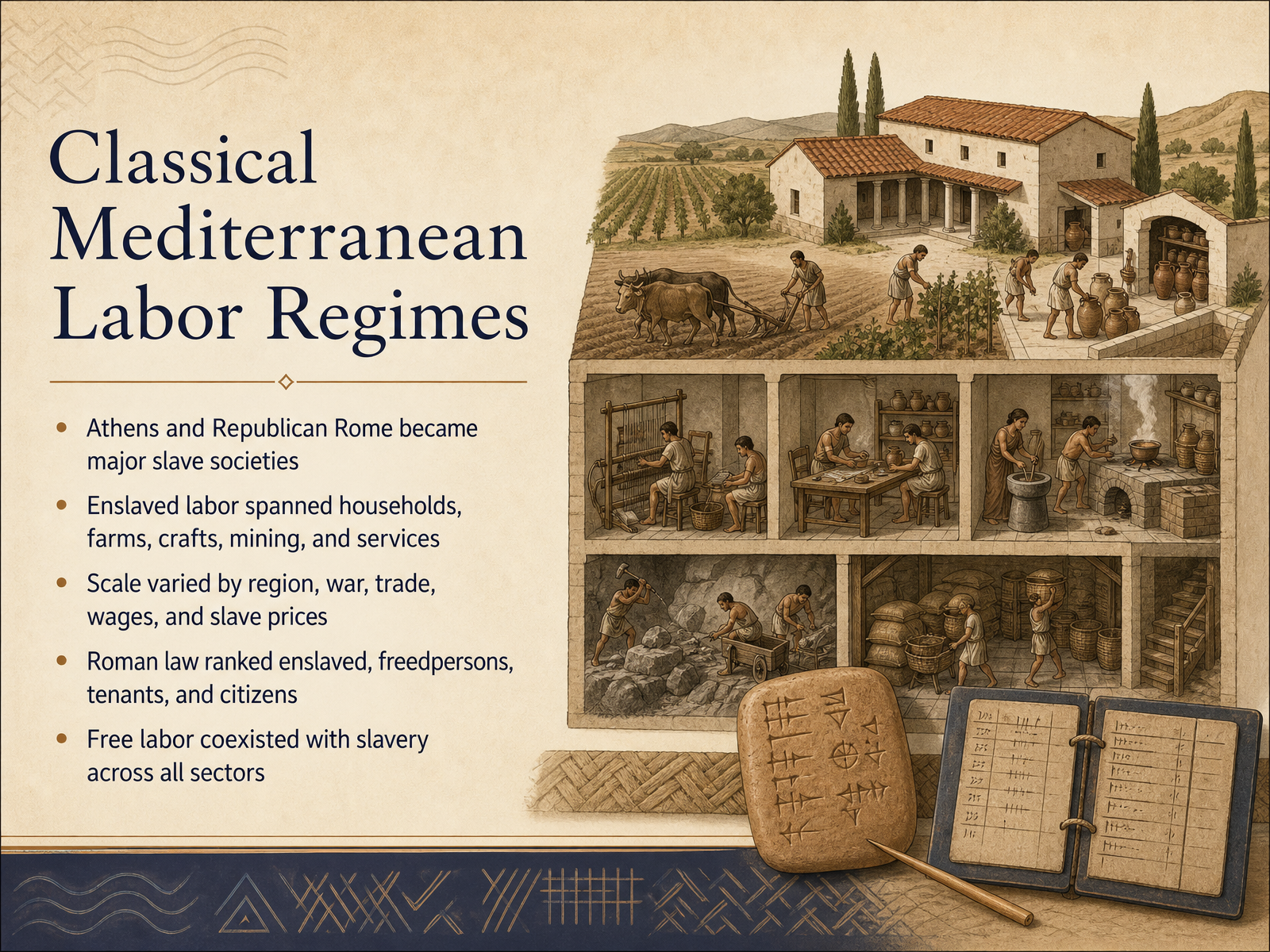
 - 05Classical Mediterranean Labor RegimesNow let's turn to the Classical Mediterranean, where Athens and Republican Rome developed into what historians call major slave societies. Enslaved labor was not confined to a single industry. It spanned households, farms, craft workshops, mining, and urban services. But the scale of slavery was never uniform. It varied by region, by war, by trade, by wage rates, and by the price of enslaved people. In fourth century BCE Athens, for example, a typical enslaved person might cost the equivalent of one hundred fifty days of unskilled wages. In Roman Egypt, that same relative price could rise above one thousand days of wages. Roman law formalized these hierarchies by ranking the enslaved, freedpersons, tenants, and citizens as distinct legal categories. Still, free labor did not disappear. Free workers and enslaved workers often operated side by side, in the same workshops, on the same farms, and in the same city streets. This coexistence shaped everything from daily bargaining to long term social mobility. Our next slide turns eastward to examine labor under Asian empires.
 sciencedirect.compapers.ssrn.comideas.repec.org+21 min
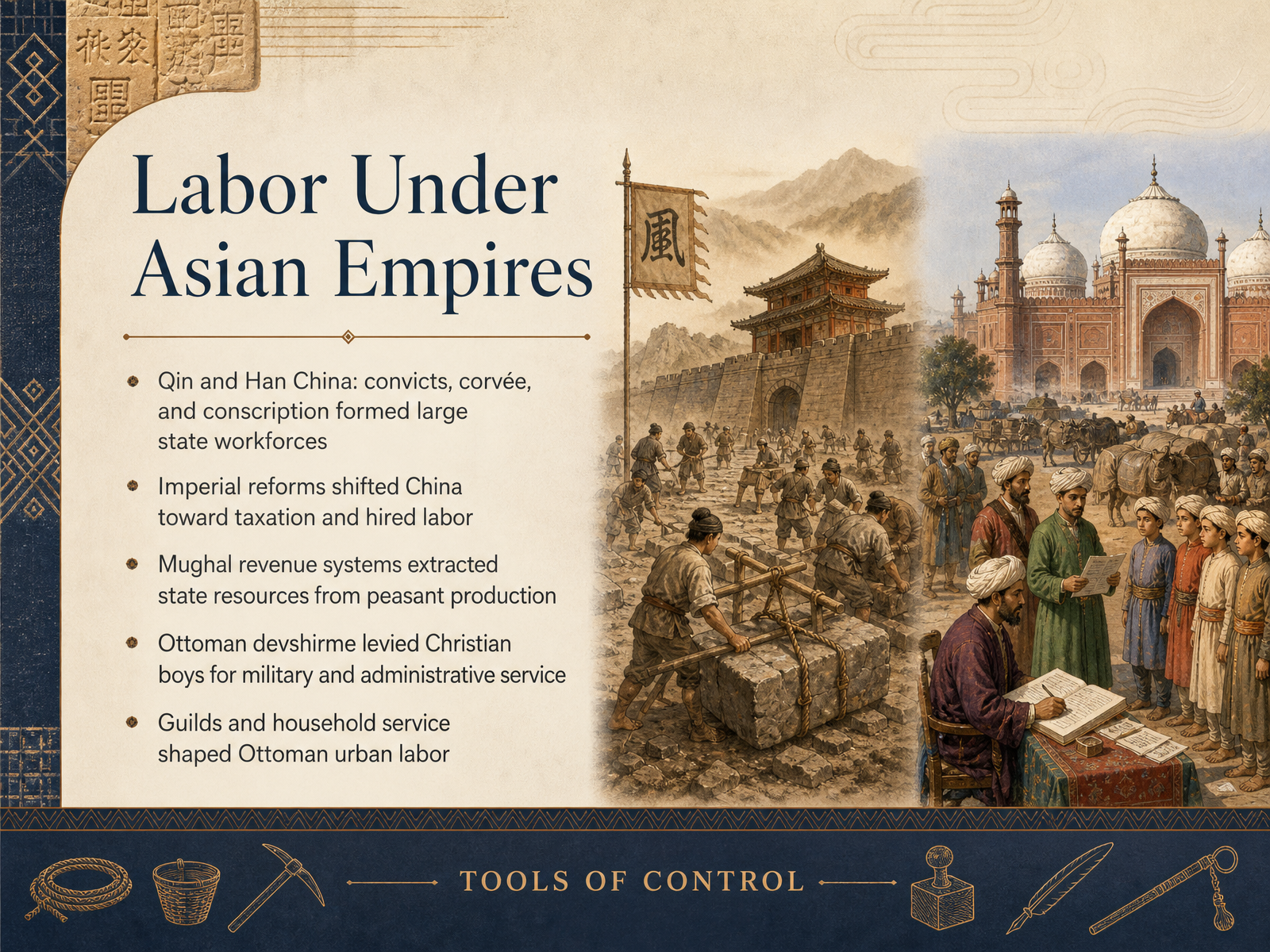
 - 06Labor Under Asian EmpiresLabor under Asian empires reveals how states turned people into resources, though the methods varied widely. In Qin and Han China, convict labor, corvée, which was compulsory unpaid work, and conscription formed enormous state workforces. These systems supported roads, walls, and granaries. Over time, imperial reforms gradually shifted China toward taxation and hired labor, reducing direct coercion. In Mughal India, revenue systems extracted resources from peasant production, tying agricultural labor to the fiscal demands of the state. The Ottoman Empire developed its own distinctive practices. The devshirme levied Christian boys from subject communities for military and administrative service. Many became janissaries or palace officials, while others labored in urban workshops or on farms. In Ottoman cities, guilds regulated skilled trades, and household service absorbed domestic workers. In each case, labor was not simply forced or free. It existed along a spectrum shaped by state needs, social status, and local economies.
 2 min
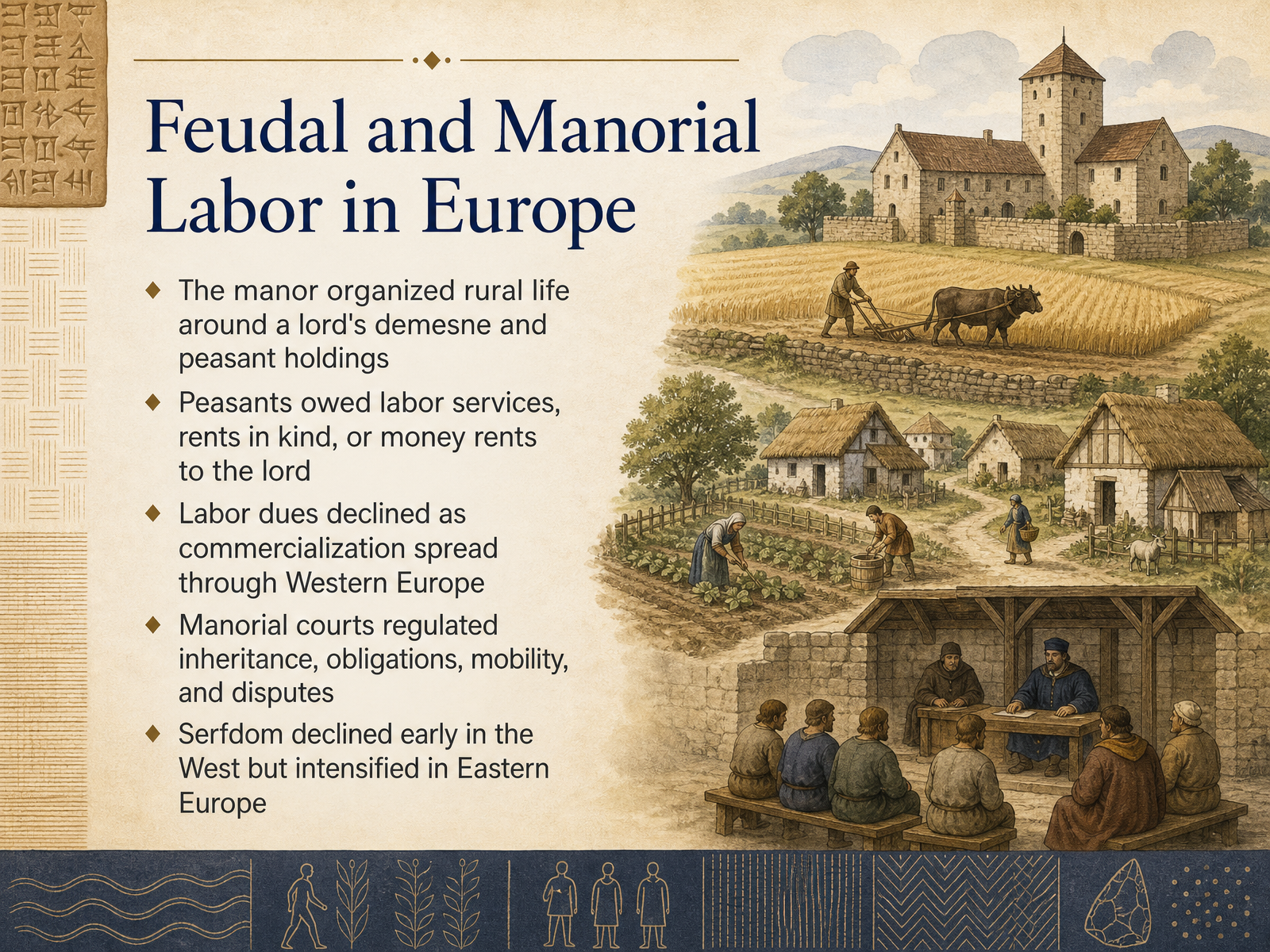
2 min - 07Feudal and Manorial Labor in EuropeContinuing our exploration of preindustrial labor, we now turn to feudal and manorial labor in Europe. Here, the manor served as the organizing framework of rural life. Picture a landscape centered on the lord's demesne, that is, the portion of land reserved directly for the lord's own use and benefit, surrounded by the smaller holdings of peasant families. Peasants met their obligations through labor services on the demesne, through rents in kind such as grain, chickens, or eggs, or increasingly through money rents. As commerce spread across Western Europe, many lords found it more efficient to convert labor dues into cash payments, allowing peasants greater flexibility. Manorial courts played a crucial role in this world, regulating inheritance, recording obligations, resolving disputes, and even controlling movement. While serfdom gradually declined in the West, it moved in the opposite direction in Eastern Europe, where it intensified from the later fifteenth century onward. In our next slide, we will examine Atlantic slavery and plantation economies.
 1 min
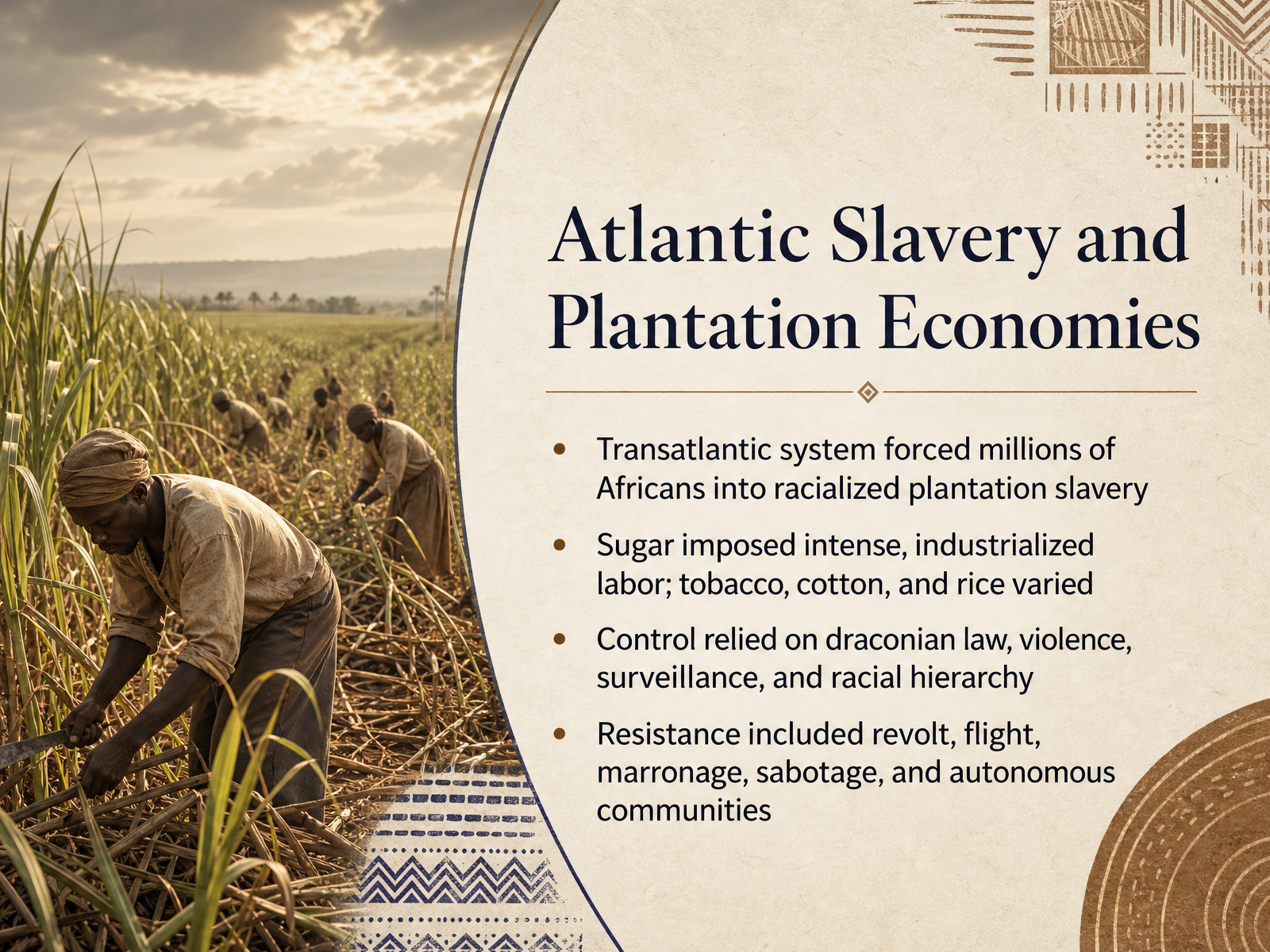
1 min - 08Atlantic Slavery and Plantation EconomiesMoving to the Atlantic system, we encounter one of the most extreme labor regimes in history. The transatlantic slave trade forced millions of Africans into a form of bondage defined by race. Unlike earlier systems, this slavery was hereditary, meaning children could inherit unfree status. On Caribbean plantations, sugar production demanded relentless, industrialized labor. Enslaved people faced tightly coordinated shifts, dangerous processing work, and brutal discipline. Tobacco, cotton, and rice plantations created their own rhythms, but violence and surveillance remained central everywhere. Control depended on draconian law, public punishment, patrols, and a rigid racial hierarchy that cast African-descended people as property. Yet resistance was constant. Enslaved people escaped to form maroon communities, slowed work, broke tools, or plotted revolt. Some negotiated small freedoms through skilled positions or spiritual and medical knowledge. These acts did not simply react to oppression. They reshaped plantation life and, over time, helped undermine the system itself. Next, we turn to indentured and colonial labor after abolition.
 2 min
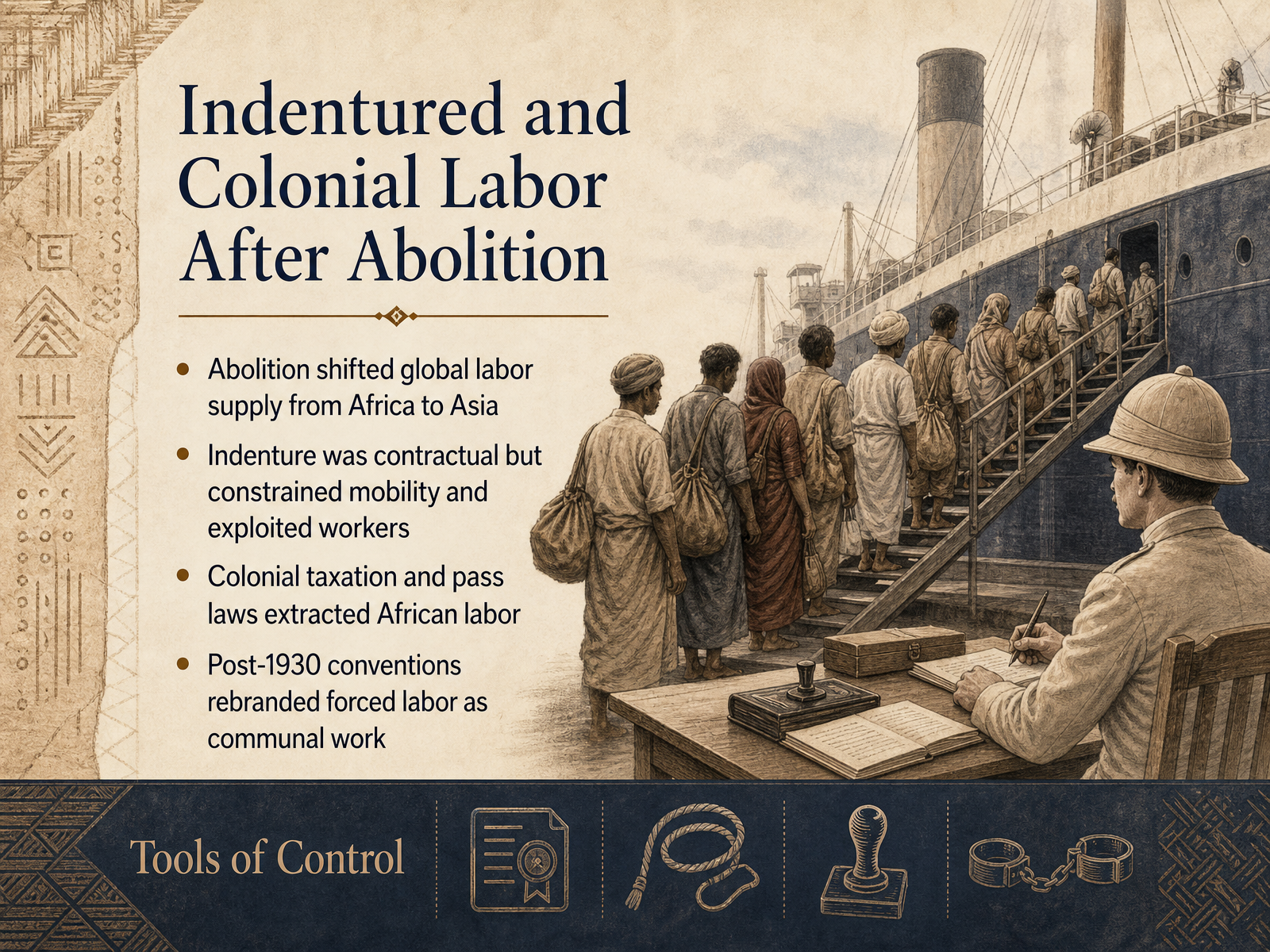
2 min - 09Indentured and Colonial Labor After AbolitionAbolition did not end coerced labor; it redirected it. As formal slavery declined in the nineteenth century, the global demand for plantation and colonial labor shifted increasingly from Africa to Asia. Indentured workers, especially from India and China, signed contracts promising passage, wages, and eventual return. Yet in practice, indenture constrained mobility through long terms, debt, and legal penalties, often trapping workers in conditions that many contemporaries and later historians have called a new system of slavery. In colonial Africa, taxation and pass laws served a similar function. African men were often forced to seek cash work to pay colonial taxes, while pass systems restricted where they could move, live, and labor. These legal tools extracted African labor for European mines, farms, and infrastructure without direct enslavement. After the International Labour Organization's Forced Labour Convention of nineteen thirty, colonial states formally restricted forced labor, but many continued to extract unpaid work through exemptions and rebranding. For instance, compulsory road building, soil conservation, and so-called communal or traditional labor often relied on local chiefs and administrators to deliver workers. In several territories, this unpaid communal labor could be commuted into tax payments, converting labor obligation into fiscal extraction. The terminology changed, but the demand for African labor remained central to colonial economies. Next, we turn to industrialization and the rise of wage labor.
 2 min
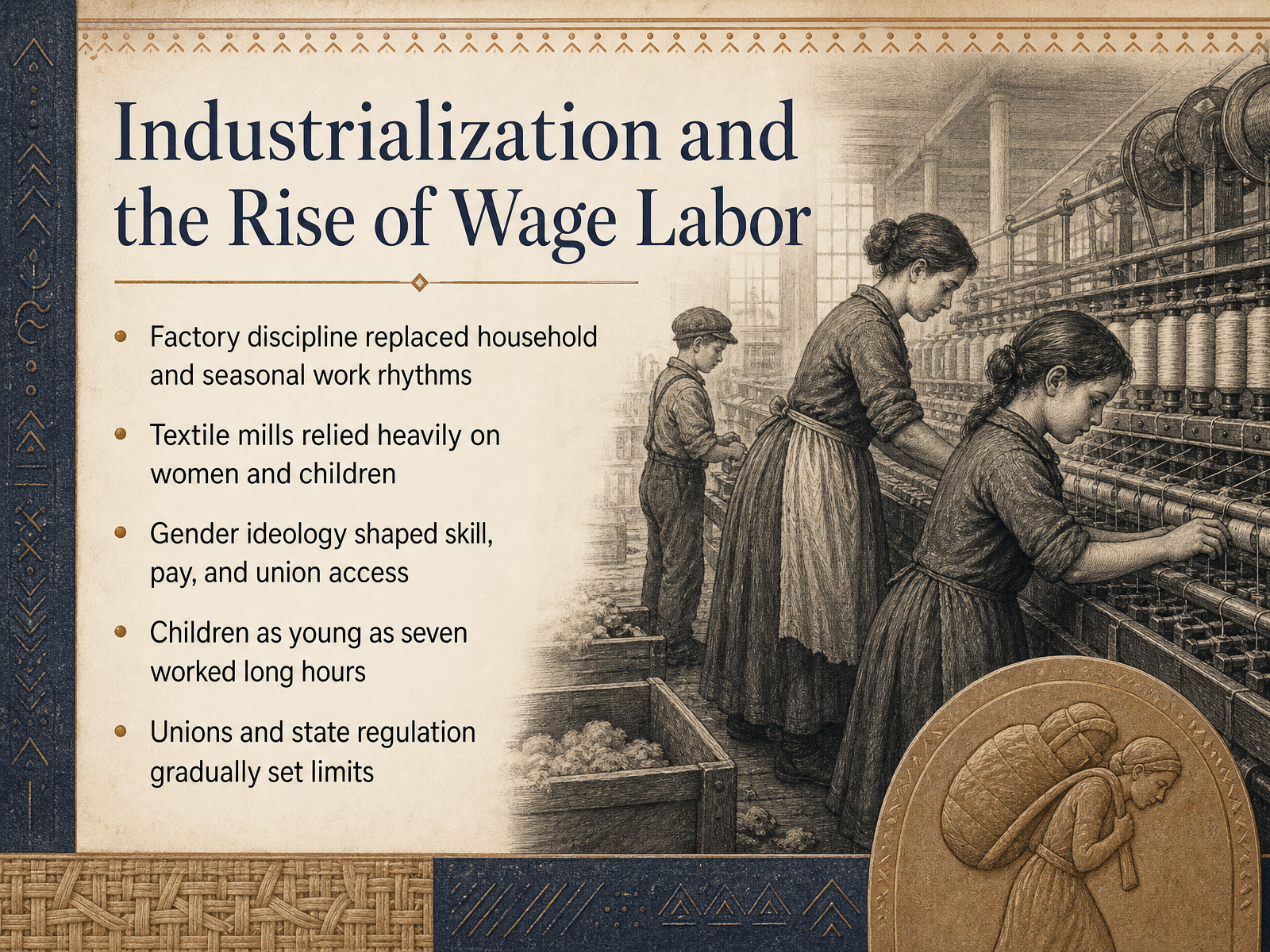
2 min - 10Industrialization and the Rise of Wage LaborNow let’s turn to a profound change in how people worked, when industrialization replaced the flexible rhythms of farms and homes with something new: factory discipline. For the first time, large numbers of workers answered to fixed hours, machine-driven paces, and strict supervision. Textile mills became some of the most visible sites of this shift. In cotton, flax, and wool factories, women and children often made up the majority of workers, sometimes more than half. Children as young as seven or nine could work twelve hours a day, six days a week, in hot and crowded conditions. Gender shaped much of what happened inside those mills. Skilled roles, like mule spinning, were often reserved for men and defended by unions, while women and girls were pushed toward lower-paid tasks such as piecing broken threads. Over time, unions and state regulation gradually set limits. The Factory Act of eighteen thirty-three introduced inspectors, and the Ten Hours Bill of eighteen forty-seven reduced hours for women and children. These changes didn’t happen quickly, but they established a new idea: that working conditions should be subject to public oversight. Next, we’ll explore how these early struggles grew into broader labor movements and legal reform.
 2 min
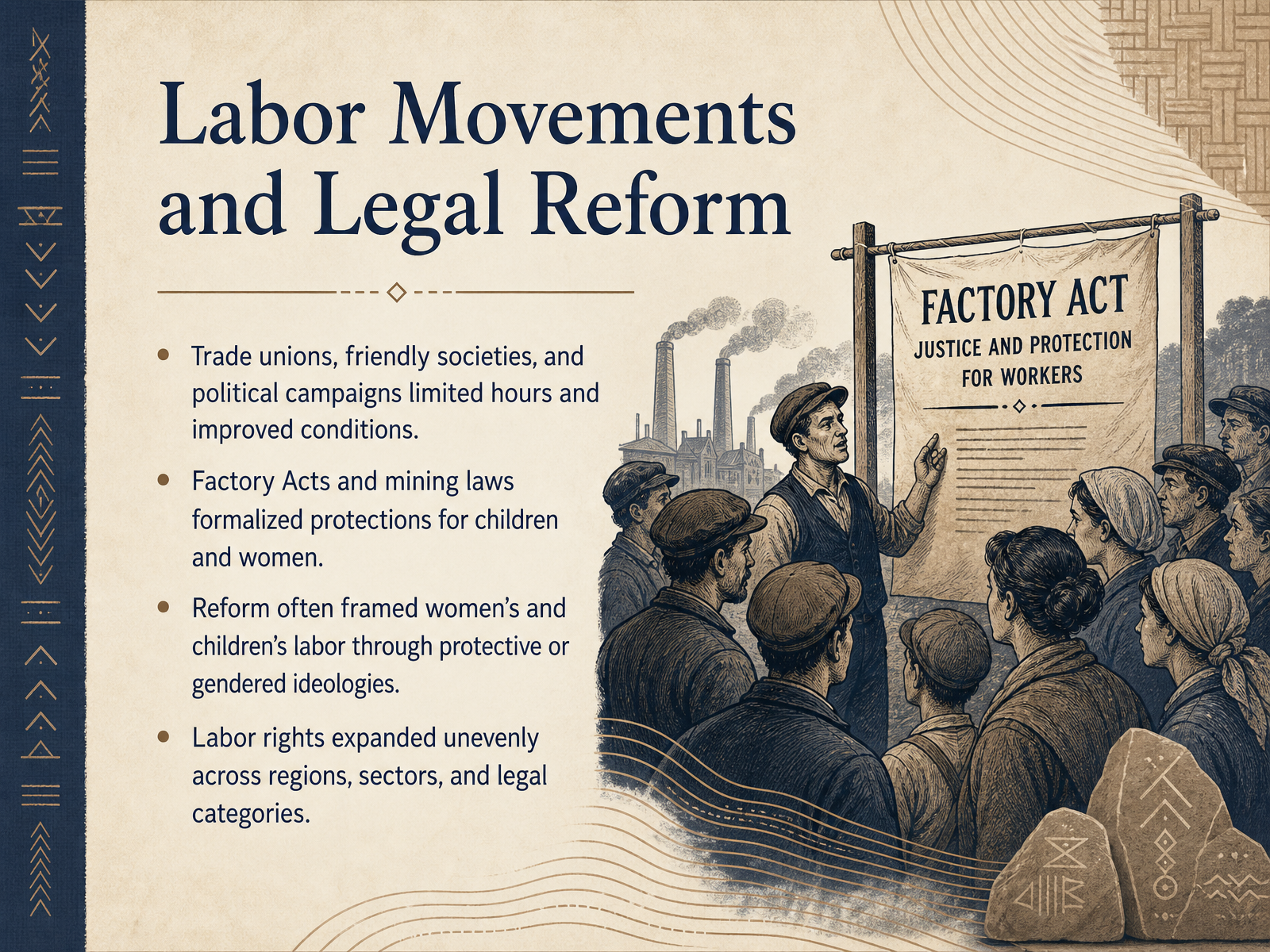
2 min - 11Labor Movements and Legal ReformNow let's turn to a turning point in this history: the rise of labor movements and legal reform. In nineteenth-century industrial economies, workers began to organize through trade unions, friendly societies, and political campaigns to limit working hours and improve conditions. Friendly societies were mutual aid groups where members pooled small regular payments to support each other during sickness or hardship. Trade unions focused more directly on wages, hours, and workplace bargaining. These efforts led to new laws, including the Factory Acts in Britain, which set minimum ages for child workers, capped working hours, and created paid inspectors to enforce the rules. Mining laws likewise began to restrict underground work for children and women. But we should note that reform was often shaped by protective or gendered ideas. Many campaigns framed women's and children's labor not simply as an economic issue, but as a moral or social danger that required state intervention. As a result, legal protections expanded unevenly, varying by region, by industry, and by legal category. Some workers gained enforceable rights while others remained outside formal protection. This uneven pattern carries us into the next slide: comparative patterns of labor system change.
 digitalcommons.law.buffalo.edueconomics.mit.edusciencedirect.com+22 min
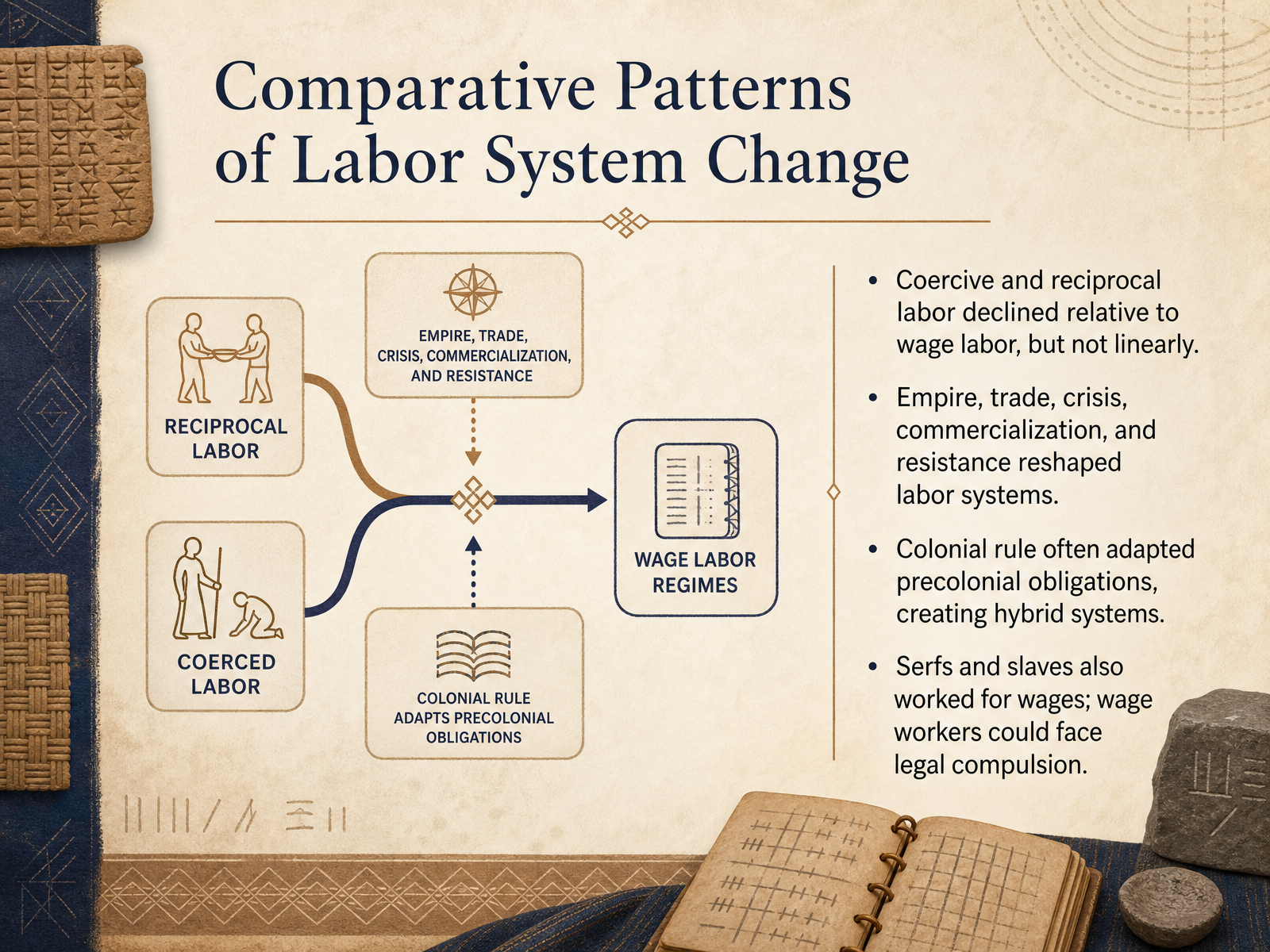
 - 12Comparative Patterns of Labor System ChangeAs we step back and compare across civilizations, the long-term pattern is not a simple march from unfree labor to free wage work. Coercive and reciprocal forms did decline relative to wage labor over time, but the change was uneven, with reverses and overlaps. Major forces reshaped labor systems: empire building, long-distance trade, economic crisis, commercialization, and the resistance of workers themselves. Under colonial rule, preexisting obligations were rarely abolished outright. Instead, colonizers adapted local labor customs into hybrid systems, blending older forms of tribute or service with new market demands. We also see that categories were porous. Serfs and enslaved people sometimes labored for wages, while nominally free wage workers could still face legal compulsion, such as imprisonment for breaking a work contract. In short, labor systems changed through adaptation and combination, not clean replacement. In the next slide, we will examine the legacies these historical labor systems have left behind.
 digitalcommons.law.buffalo.edueconomics.mit.edusciencedirect.com+22 min
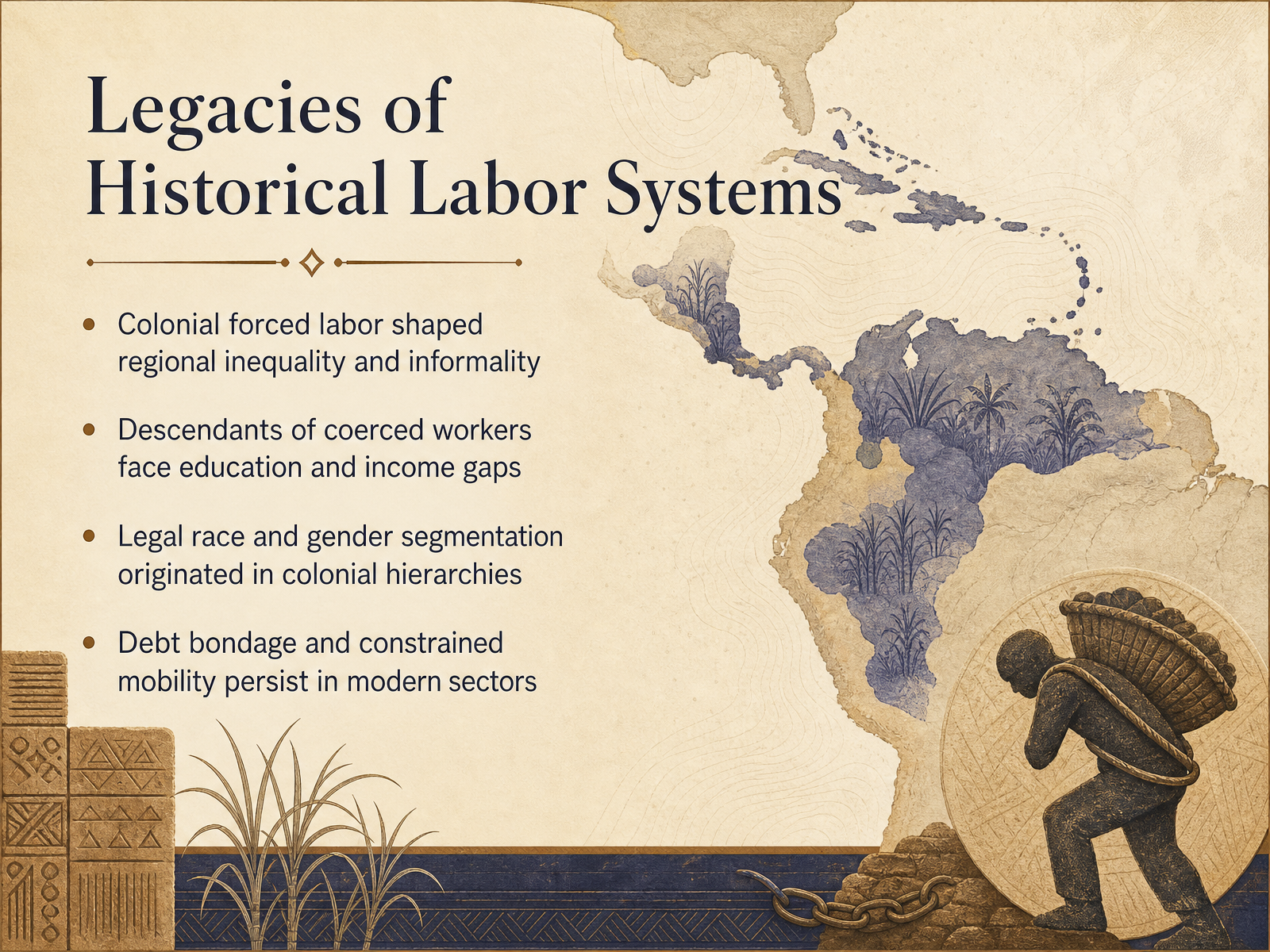
 - 13Legacies of Historical Labor SystemsAs we move from individual case studies to their longer shadows, we can see how historical labor systems continue to shape opportunities and constraints today. In parts of West Africa, areas tied to high value colonial cash crop production developed more formal employment, while surrounding regions slid toward informal work. That dual structure still affects income security for millions. In Ecuador, descendants of indigenous workers held under concertaje, a debt based forced labor arrangement, earn roughly sixteen percent less in formal income than descendants of uncoerced workers. They also tend to have less education and a higher chance of informal employment. Similar patterns appear in Latin America, where colonial legal categories sorted Black, indigenous, and European workers into different statuses. Early twentieth century labor laws often reinforced those lines, excluding agricultural and domestic workers, many of whom were indigenous or Black women, from basic protections. The result was a gendered and racialized informal sector. Debt bondage did not simply disappear with formal abolition. In some modern sectors, travel costs, recruiters fees, and contract rules can trap workers in arrangements where leaving means severe penalties. These are not identical to colonial forced labor, but they echo its logic of constrained mobility and limited bargaining power. Understanding these continuities helps us see why legal equality alone is not enough to undo deeply embedded labor hierarchies. In our next slide, we will connect these patterns to forced labor, informal work, and the present.
 digitalrepository.unm.edu2 min
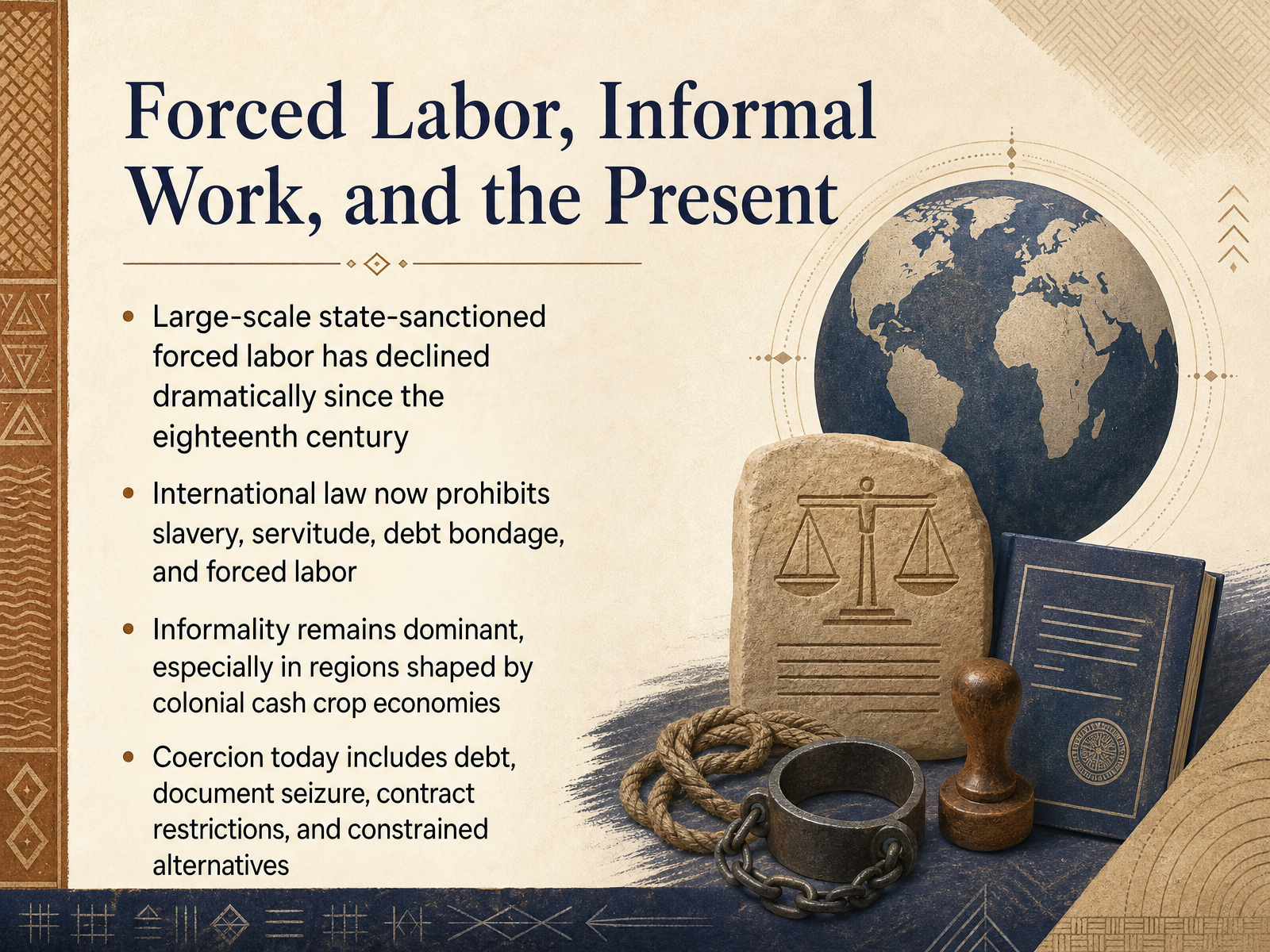
 - 14Forced Labor, Informal Work, and the PresentThe scale of coercive labor has changed profoundly over the last two centuries. In seventeen eighty nine, according to a long-run dataset, one hundred sixty five of the one hundred seventy four countries tracked had not yet abolished what researchers call large scale forced labor. By twenty twenty four, that count had fallen to just nine countries. International law now sets out formal prohibitions against slavery, servitude, debt bondage, and forced labor, and most governments treat these practices as abhorrent. Yet legal declarations are not the same as lived conditions. In much of the world, informality remains the dominant arrangement, meaning work that is not registered, regulated, or protected by legal frameworks. In West Africa, for example, close to ninety percent of working age people are informally employed, and scholars trace part of that pattern to colonial cash crop economies that concentrated formal protections in certain export zones while leaving surrounding regions exposed. Contemporary coercion can also be quieter than plantation forced labor. It may appear as debt, passport or document seizure, restrictive contracts, or workplaces where leaving carries severe practical penalties. The Indonesian oil palm sector, for instance, shows how casual and contract arrangements can create constraints that look formally voluntary but limit real alternatives. So the present is best understood as a shift in form, not a simple story of uninterrupted freedom. We will now turn from these continuities to the key principles and takeaways in our final slide.
 digitalrepository.unm.edu2 min
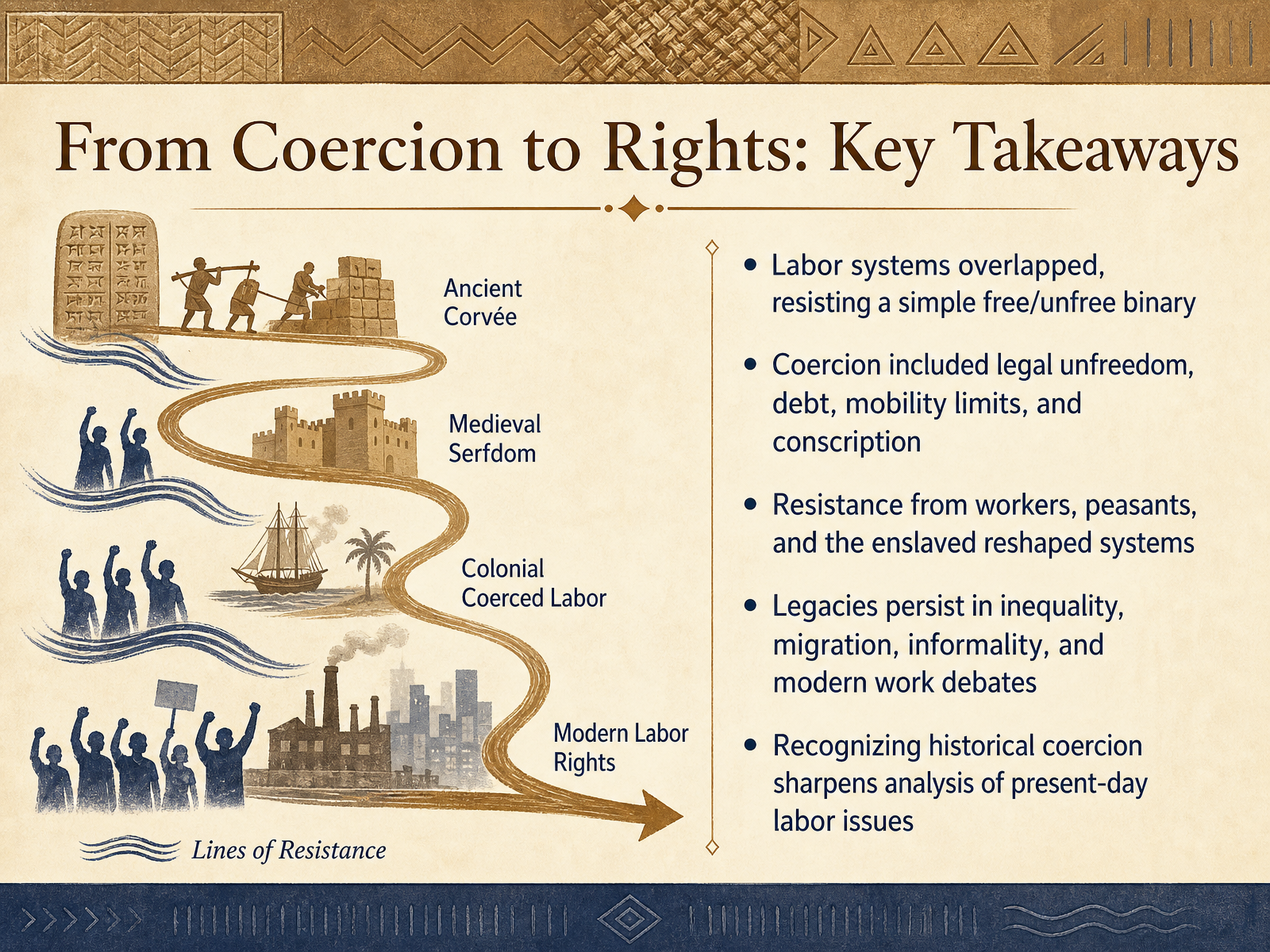
 - 15From Coercion to Rights: Key TakeawaysAs we close, let's pull together the most important takeaways from our journey across these labor systems. The first is a caution. Throughout history, labor rarely fits into a clean split between free and unfree. Even wage workers could face legal compulsion, while some contract laborers kept a surprising degree of bargaining power. The real picture is a spectrum, not a simple binary. Second, coercion took many forms. It appeared as slavery and debt bondage, but also as restricted movement, compulsory public works, and military conscription. Each carried different limits on personal freedom. Third, labor systems were never static. Workers, peasants, and enslaved people pushed back constantly, through bargaining, flight, collective action, and legal challenges. That resistance truly reshaped economic life. Finally, these histories are not distant. They echo today in inequality, migration, informal work, and ongoing debates about fair wages and worker protections. Noticing those echoes helps us ask sharper questions about the present. Thank you for exploring this difficult but vital history. Carry these questions forward with you.
 digitalcommons.law.buffalo.edueconomics.mit.edusciencedirect.com+22 min
Take the deck with you
Download this course as a file — free, no sign-up needed.
- PDF handoutEvery slide page, ready to print or share.16 pages · 6.9 MBDownload
- Narrated PowerPointThe deck that presents itself — every slide carries the digital human's narration video.16 pages · 21.2 MBDownload
- PowerPoint slidesThe full deck as a .pptx — open it in PowerPoint, Keynote, or Google Slides.16 pages · 6.9 MBDownload
Free to use in your own training — please keep the PersonWise credit page at the end.
Have your own deck? Turn it into a course
Sources consulted
Web sources consulted while building this course.
- https://pure.uva.nl/ws/files/49405177/_9783110428353_Handbook_Global_History_of_Work_Handbook_Global_History_of_Work.pdf — pure.uva.nl
- https://www.degruyterbrill.com/document/doi/10.1515/9783110424584-016/pdf — degruyterbrill.com
- Slavery in the World: An Essay on Comparisons — digitalcommons.library.uab.edu
- Slavery and Its Transformations: Prolegomena for a Global and Comparative Research Agenda — cambridge.org
- Globalization and Coerced Labour in Early Modern Asia and Africa | Comparativ — comparativ.net
- Labor â•fi Free or Coerced? An Historical Reassessment of Differences and Similarities — digitalcommons.law.buffalo.edu
- 14.773 Political Economy of Institutions and Development. Lecture 4: Labor Coercion — economics.mit.edu
- Essays in explorations Coerced and free labor: Property rights and the development of the labor force ☆ — sciencedirect.com
- Labor – Free or Coerced? An Historical Reassessment of Differences and Similarities — digitalcommons.law.buffalo.edu
- The Historical Development of the Concept of Forced Labor and the Open Boundaries of its Definition Today — digitalrepository.unm.edu
- Work Organization in the Middle Kingdom, Ancient Egypt — journals.sagepub.com
- The Administration of Corvee Work and Corvee — jstage.jst.go.jp
- (PDF) Labor in the Early States: An Early Mesopotamian Perspective — academia.edu
- [PDF] 2. Home and Work in Early Bronze Age Mesopotamia: “Ration Lists ... — sprachwiss.uni-muenchen.de
- "Reconstructing the Organization of Old-Babylonian Agricultural Labour Through Dockets" — iris.unime.it
- The economics of Greco-Roman slavery — sciencedirect.com
- The Comparative Economics of Slavery in the Greco-Roman World — papers.ssrn.com
- The economics of Greco-Roman slavery — ideas.repec.org
- Slavery (Chapter 5) - The Cambridge Companion to the Roman Economy — cambridge.org
- 12 Comparing Ancient Slaveries - Greek and Roman Slaveries [Book] — oreilly.com