Product Life Cycle Management Fundamentals
Begin
14 pages · ~28 min
Product Life Cycle Management Fundamentals
Learn the core concepts, purpose, and real-world examples of product life cycle management to effectively guide products from introduction to decline.
What you’ll learn
- 01Product Life Cycle Management: Concepts, Purpose, and ExamplesWelcome. Product life cycle management is not just a framework—it's the operating discipline that guides a product from concept to retirement. In this session, we'll define PLM clearly, with examples tailored for product managers, operations teams, and cross-functional leaders. One thing to get straight upfront: the market-facing life cycle—introduction, growth, maturity, decline—is not the same as PLM as an operating discipline. PLM is about how you govern data, processes, and decisions across that journey. We'll cover the core concepts, the purpose it serves, the roles that make it work, governance, real-world examples, and practical first steps you can apply immediately. You'll leave with a shared vocabulary and a clear view of where PLM creates leverage in your organization. Let's get into why deliberate life cycle management matters.n-ix.commonday.comthinknectar.com+21 min
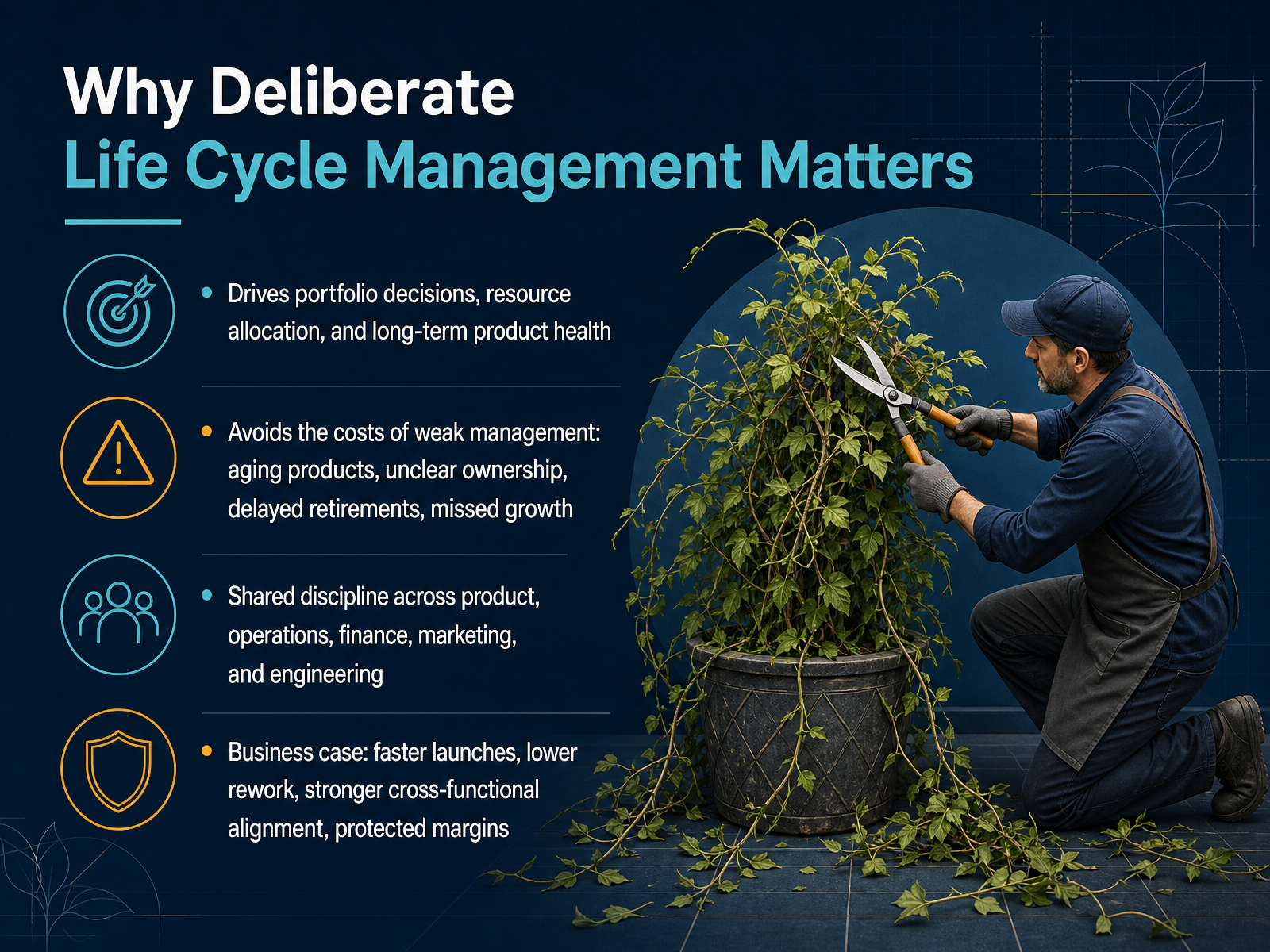
- 02Why Deliberate Life Cycle Management MattersLet’s talk about why deliberate life cycle management matters. Without it, your portfolio decisions, your resource allocation, and your long-term product health are all at risk. You end up with aging products, unclear ownership, and delayed retirements. That is where growth and margin quietly leak away. Discipline must be shared. It cannot sit only with product. Operations, finance, marketing, and engineering all need a common framework. That alignment is what protects your business. The business case is concrete. Faster launches. Lower rework. Stronger cross-functional alignment. Protected margins. Companies that get this right launch on time and keep their products profitable. Companies that don’t spend their time firefighting preventable problems. The choice is yours. Make lifecycle management a deliberate practice, not an afterthought. Up next, we’ll cover the core concepts and the vocabulary you need to move forward.
 n-ix.commonday.comthinknectar.com+22 min
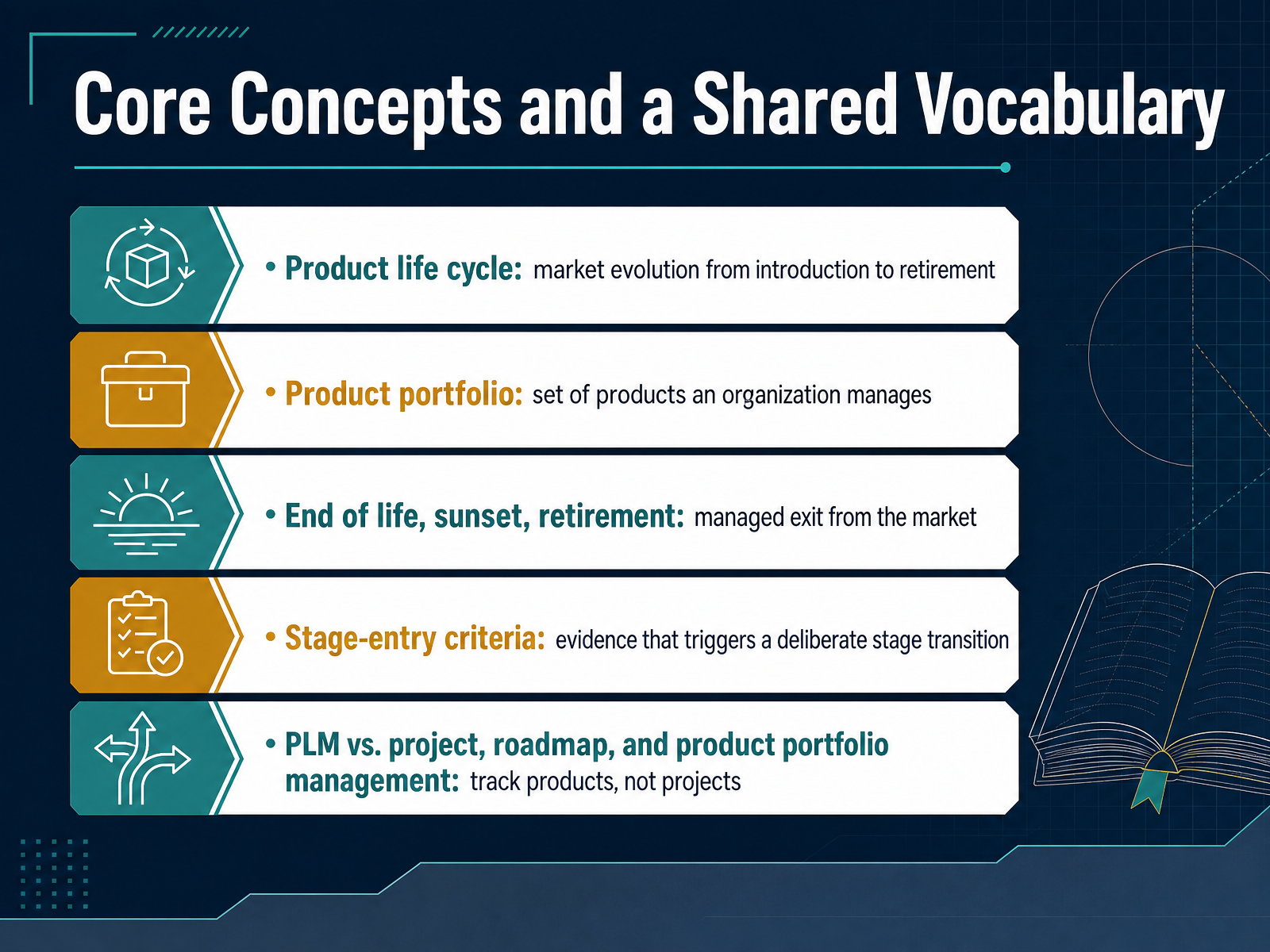
 - 03Core Concepts and a Shared VocabularyLet’s align on a shared vocabulary before we go further. The product life cycle is the market evolution of a product from introduction through retirement. Use it to read where your product is and what the market expects next. The product portfolio is the set of products your organization manages. Life cycle management guides individual products. Portfolio management balances the mix, allocating investment across bets at different stages. End of life, sunset, retirement, they all mean the same thing: a managed exit from the market. Done well, it protects revenue, customers, and brand trust. Stage-entry criteria are your evidence-based triggers. Don’t move stages on opinion. Define the metrics that signal a deliberate transition. Now the critical distinction. PLM tracks products, not projects. A project has an end date. A product has a continuous life. Roadmaps and delivery plans support the product, but they are not the product. Keep that frame clear across your team and your stakeholders. Next, let’s move to the standard life cycle stages, updated for how we actually work today.
 launchnotes.comguvi.inen.wikipedia.org+21 min
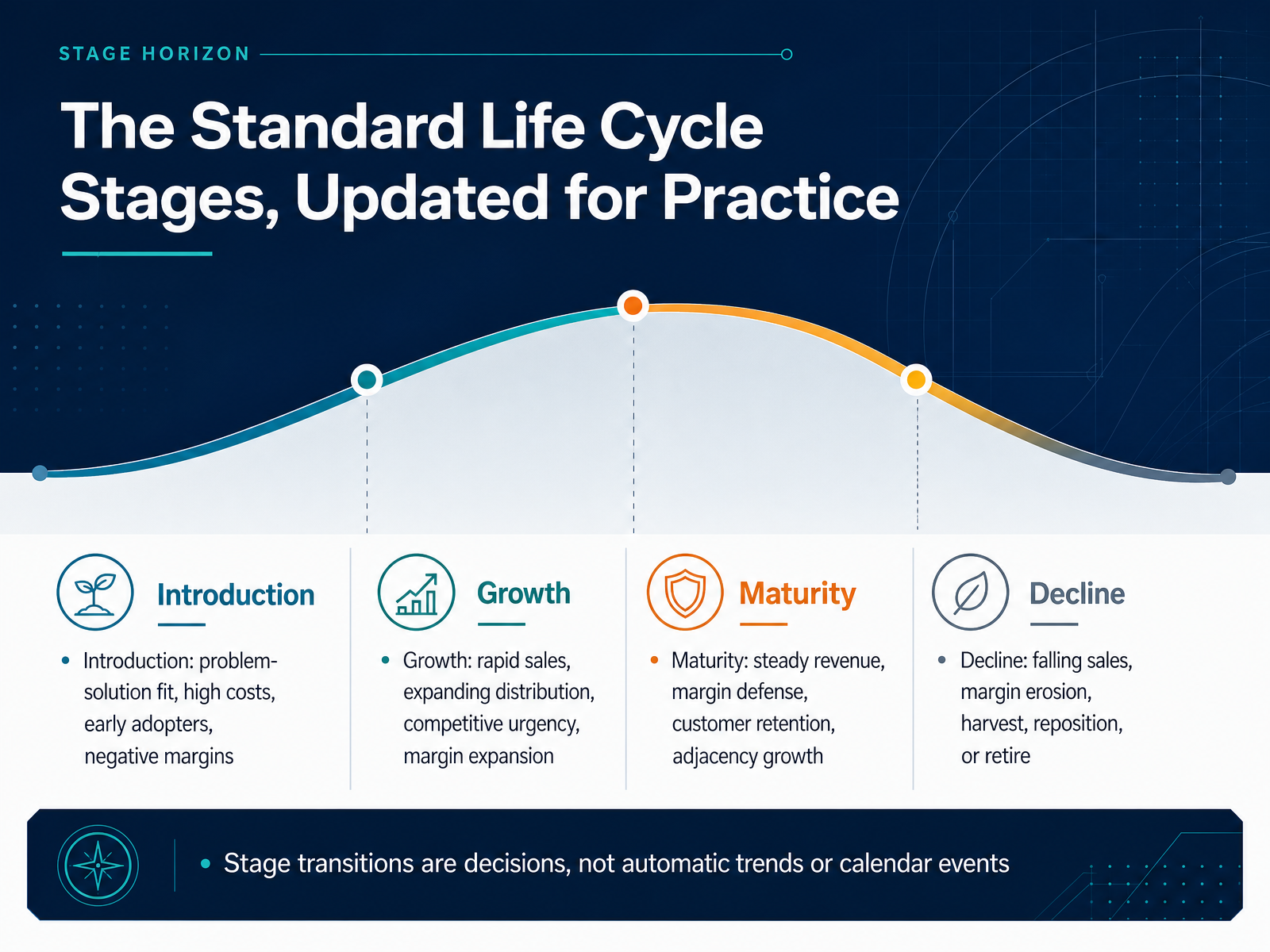
 - 04The Standard Life Cycle Stages, Updated for PracticeLet's map the standard stages onto what you actually manage. Introduction: problem-solution fit is the only goal. Costs are high. Margins are negative. You have early adopters, not a market. Your roadmap question is simple: does anyone care enough to pay? Growth changes the game. Sales accelerate. Distribution expands. Competitors take notice, so urgency becomes your operating principle. Margin expands as you scale. The question shifts to: how do we win the segment before someone else does? Maturity is where most revenue lives, and where most capacity quietly gets wasted. Sales plateau. Competition peaks. Your job is margin defense, customer retention, and finding adjacent value pools through your existing channel. Fend off the temptation to keep feeding features to mature products. Decline demands an honest grown-up conversation. Sales fall. Margins erode. You have three real options: harvest, reposition, or retire. Continuing to invest at growth levels is the most common and most expensive mistake. One crucial point: stage transitions are decisions, not automatic trends or calendar events. Revenue data lags. Watch leading indicators like acquisition cost and cohort retention to spot transitions six to twelve months early. From Stages to Management: The Operating Discipline.
 roadmap.oneinvestopedia.comcoursera.org+22 min
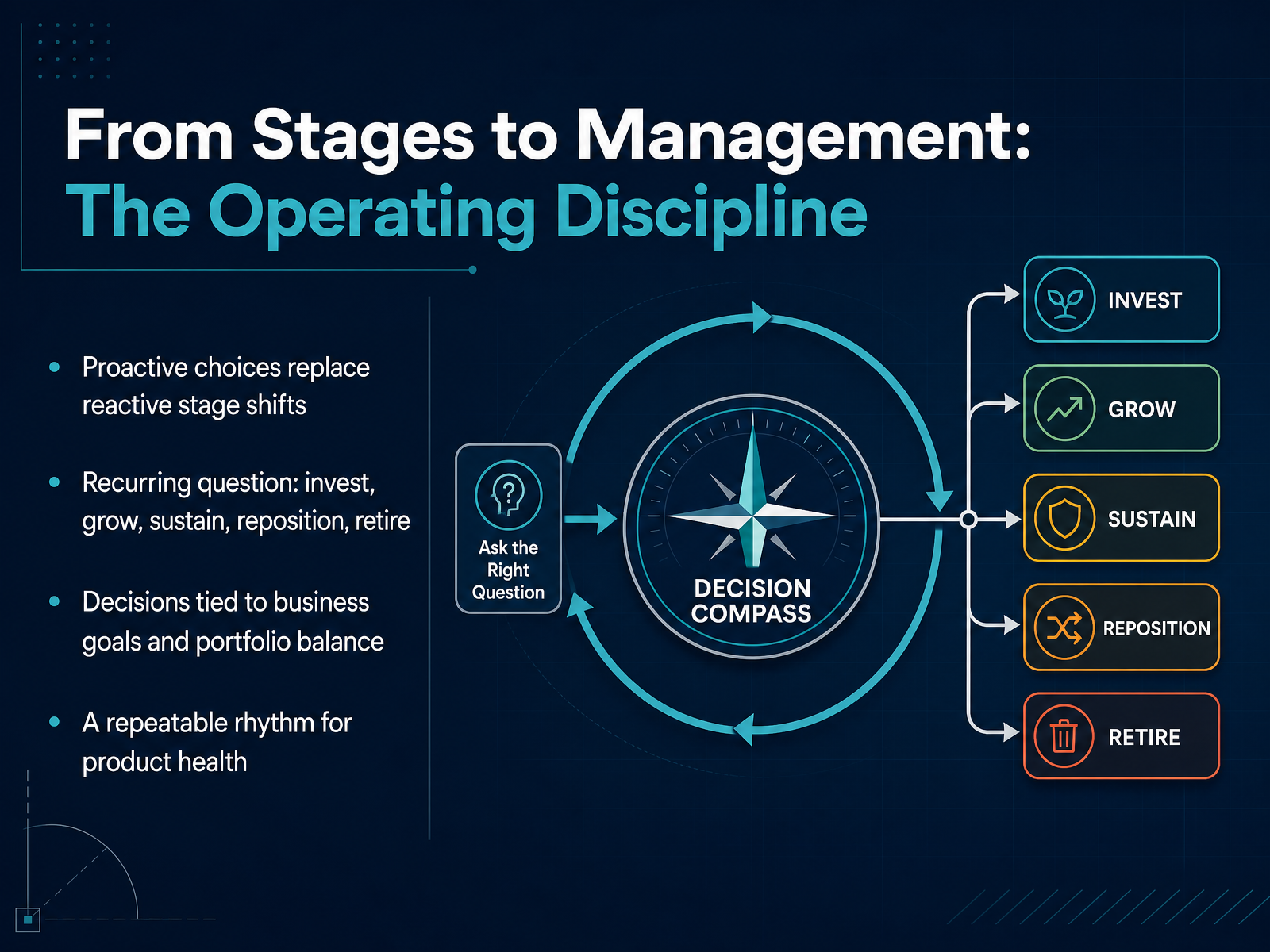
 - 05From Stages to Management: The Operating DisciplineNow let's shift from theory to execution. Lifecycle management only creates value when it becomes operating discipline. That means proactive choices replace reactive stage shifts. You don't wait for a sales slump to decide what happens next. You ask the recurring question on a regular cadence. Invest, grow, sustain, reposition, or retire. Those are the only real options. Every decision must tie to business goals and portfolio balance. A mature product might deserve more investment than a flashy new one because it funds your growth bets. Review choices together, not in isolation. This creates a repeatable rhythm for product health. Think of it as a portfolio review, built into how you work. The goal is to make the implicit explicit, and turn lifecycle management from an annual exercise into a continuous operating muscle. That discipline sets the stage for ownership. Let's look at what the product manager owns at each stage.
 mckinsey.comdeloitte.comatlassian.com+21 min
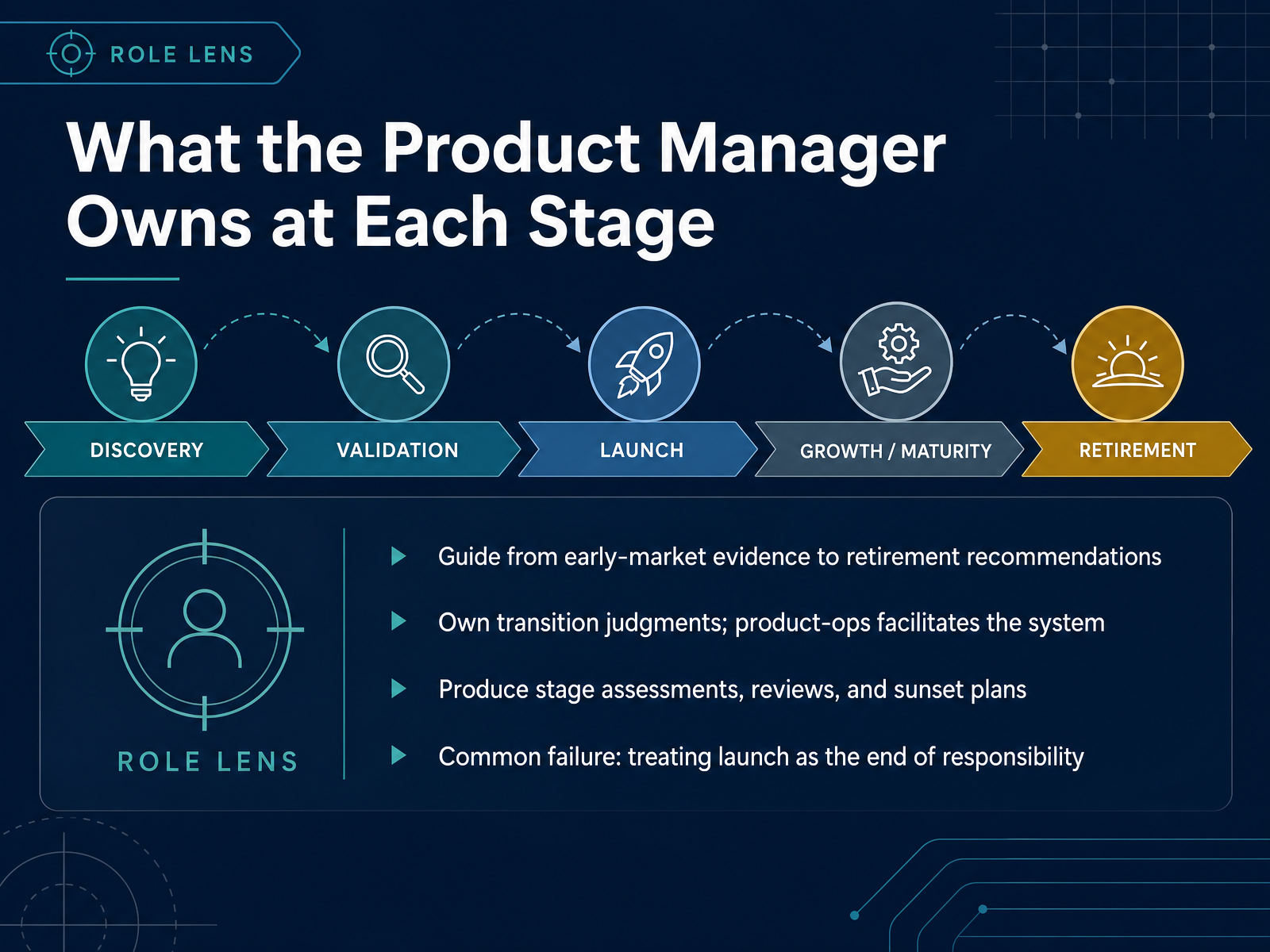
 - 06What the Product Manager Owns at Each StageSo what does the product manager actually own across all four stages? The answer is the transition judgments. You guide the product from early-market evidence in introduction all the way to a retirement recommendation in decline. You own the call on when to scale, when to defend, and when to sunset. Product operations builds and runs the system that gives you the data to make those calls. Your job is to produce the stage assessments, the formal reviews, and the sunset plans that keep leadership honest. Here is where most teams fail. They treat launch as the finish line. It is not. Launch is just the end of the beginning. The real value shows up when you manage the product deliberately through maturity and decline, not when you celebrate the release. The most common failure is handing off the product after launch and walking away. Do not do that. Own the full arc. That ownership is what separates product managers from feature shippers. Next, we will examine the product operations role and how it owns the system without owning the decision.
 roadmap.oneinvestopedia.comcoursera.org+21 min
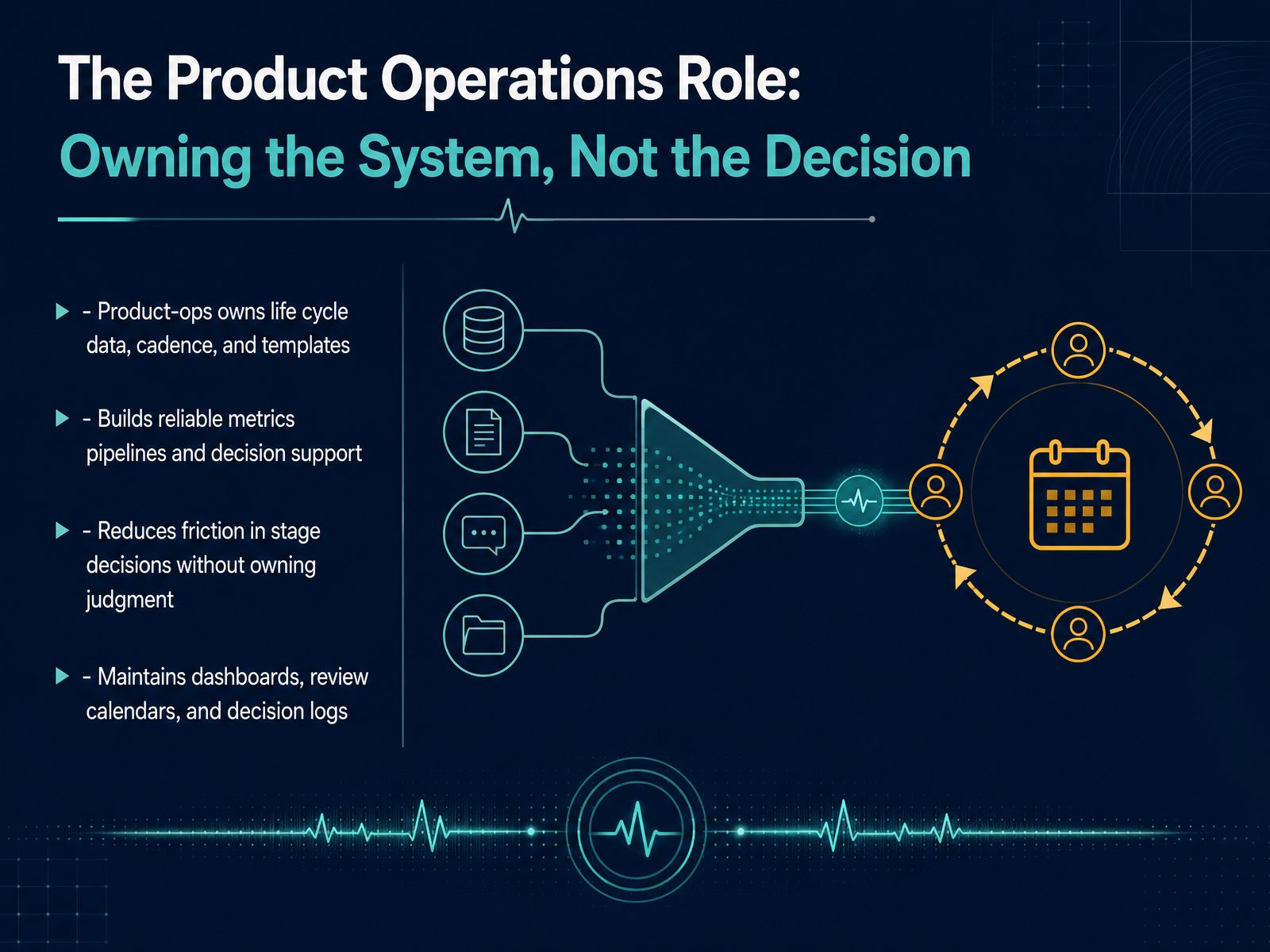
 - 07The Product Operations Role: Owning the System, Not the DecisionNow let’s talk about who actually runs the system. Product operations does not make the judgment calls. It owns the machinery that makes those calls reliable. That means owning life cycle data, the cadence of reviews, and the templates teams use. It builds the metrics pipelines and decision support that turn raw signals into clear evidence. It removes friction from stage decisions without ever replacing the judgment of product leaders. So when you see product ops, think infrastructure. They maintain dashboards, review calendars, and decision logs. They make sure every gate has a consistent basis for discussion. Consider a launch gate. Without product ops, data pulls happen overnight in spreadsheets. With them, the dashboard is live, the history is logged, and the conversation is about the product, not the numbers. That is a real reduction in decision friction. So the next question is how governance layers on top of this system to define who gets to decide what.
 mckinsey.comdeloitte.comatlassian.com+21 min
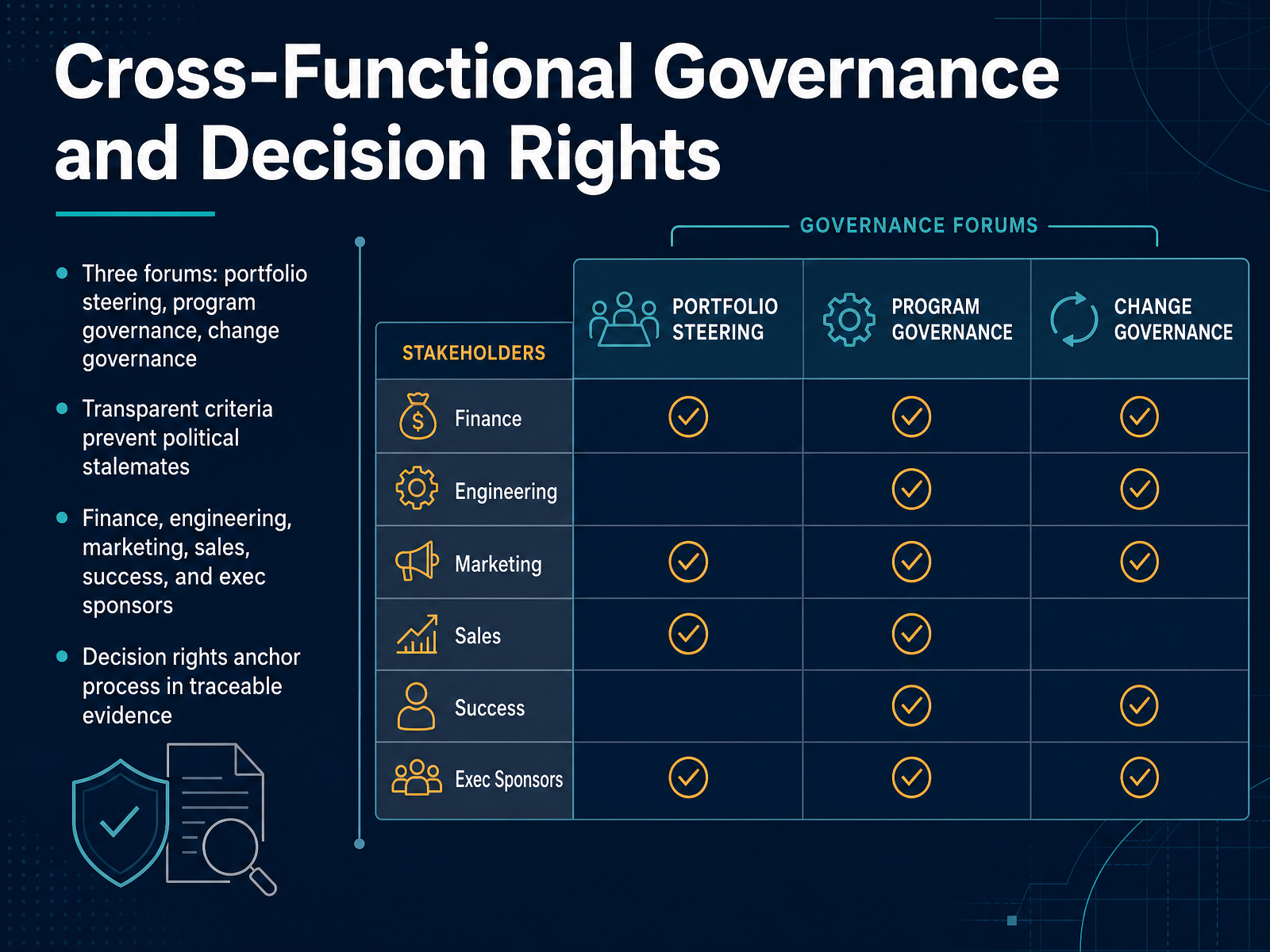
 - 08Cross-Functional Governance and Decision RightsHere’s where governance gets practical. Start with three forums. Portfolio steering sets the investment mix. Program governance moves programs through their gates. Change governance handles significant shifts after launch. Keep them connected, but don’t collapse them into one. That invites confusion. Next, make criteria transparent. When everyone knows how decisions are made, you avoid political stalemates. Finance, engineering, marketing, sales, success, and executive sponsors all need a seat. But that’s only effective if decision rights are explicit. Who can commit engineering resources? Who signs off on a launch with open risks? Ambiguity here fuels escalation. Instead, anchor decisions in traceable evidence—readiness criteria, approval records, and actual data. Then governance depends on facts, not on who argues loudest. Remember, structure without evidence is just ceremony. Use those three forums to enforce discipline. Connecting them to clear criteria and clear ownership turns governance into a competitive advantage. After this, we’ll look at the portfolio view for stage mix and resource allocation.
 mckinsey.comdeloitte.comatlassian.com+21 min
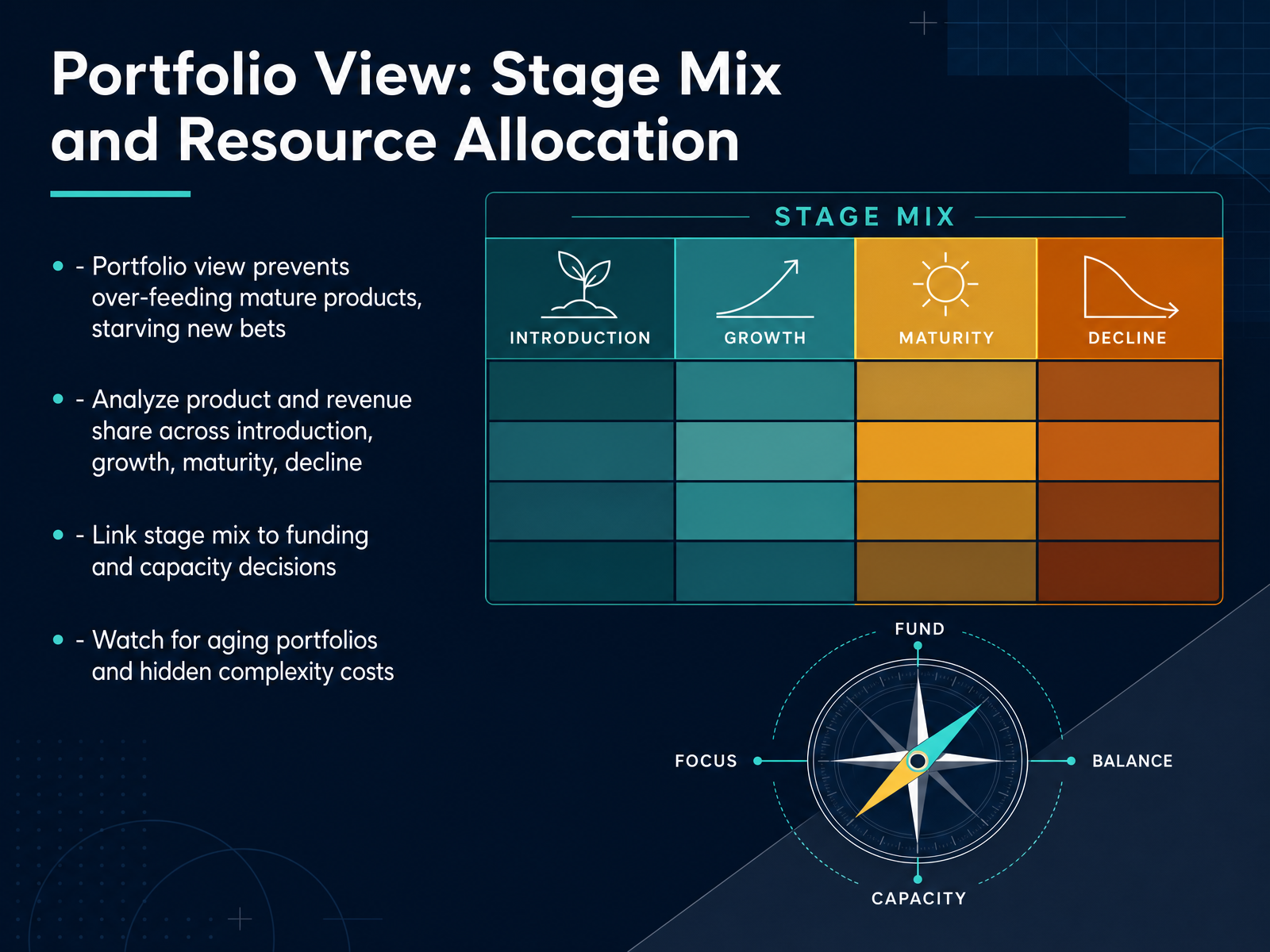
 - 09Portfolio View: Stage Mix and Resource AllocationLet us shift to the portfolio view. This is where life cycle management becomes a real business lever. The core risk is simple: organizations systematically over-feed mature products and under-fund new bets. You have seen it happen. The flagship product consumes engineering capacity, while the introduction stage products get side-of-desk attention. A portfolio view stops that pattern. Start by mapping your revenue and product share across introduction, growth, maturity, and decline. This is not an academic exercise. It reveals whether your portfolio holds a healthy balance of cash generators and future growth engines. Once you see the mix, link it directly to funding and capacity decisions. A product in decline should not consume growth-stage resources. A product in introduction should not be starved because it lacks current revenue. Watch the warning signs closely. An aging portfolio shows too much revenue concentrated in maturity and decline. Hidden complexity costs often follow when you maintain too many low-margin products without visible returns. The balance is the goal: enough mature products to fund the bets, and enough new bets to secure the future. Next, we will look at examples across product types and industries.
 mckinsey.comdeloitte.comatlassian.com+22 min
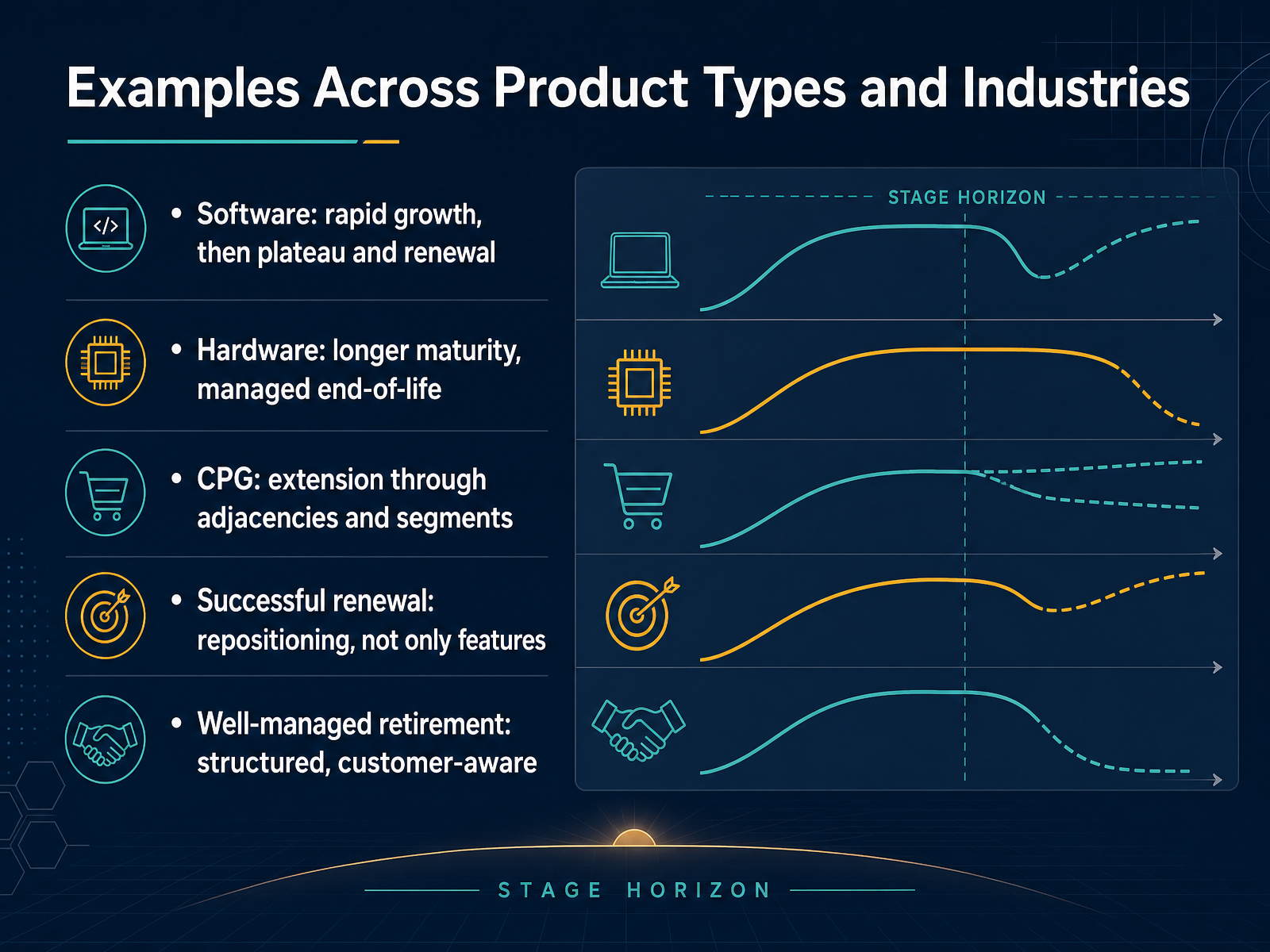
 - 10Examples Across Product Types and IndustriesLet's make this concrete. Software products move fast. Growth is steep, but the plateau hits quickly. That's when you see aggressive feature additions just to stay relevant until a real renewal, like shifting to a cloud model, resets the curve. Hardware is different. Think of an industrial machine. Its maturity phase can last decades. The goal there isn't a dramatic reset; it's a well-managed end of life. That means structured phase-out, planned parts availability, and a clear migration path for your customers. Consumer packaged goods rarely see a single dramatic death. The play is extension. Arm and Hammer took baking soda from the kitchen to the fridge and the laundry room. They attacked adjacent segments to keep the curve alive. So what separates the winners? Successful renewal is repositioning, not just shipping new features. And well-managed retirement is structured and customer-aware, not a sudden shutdown. That discipline protects your reputation and frees capital for your next big bet. Now, if renewal is the goal, let's look at how to choose between refreshing what you have and building what comes next.
 n-ix.commonday.comthinknectar.com+22 min
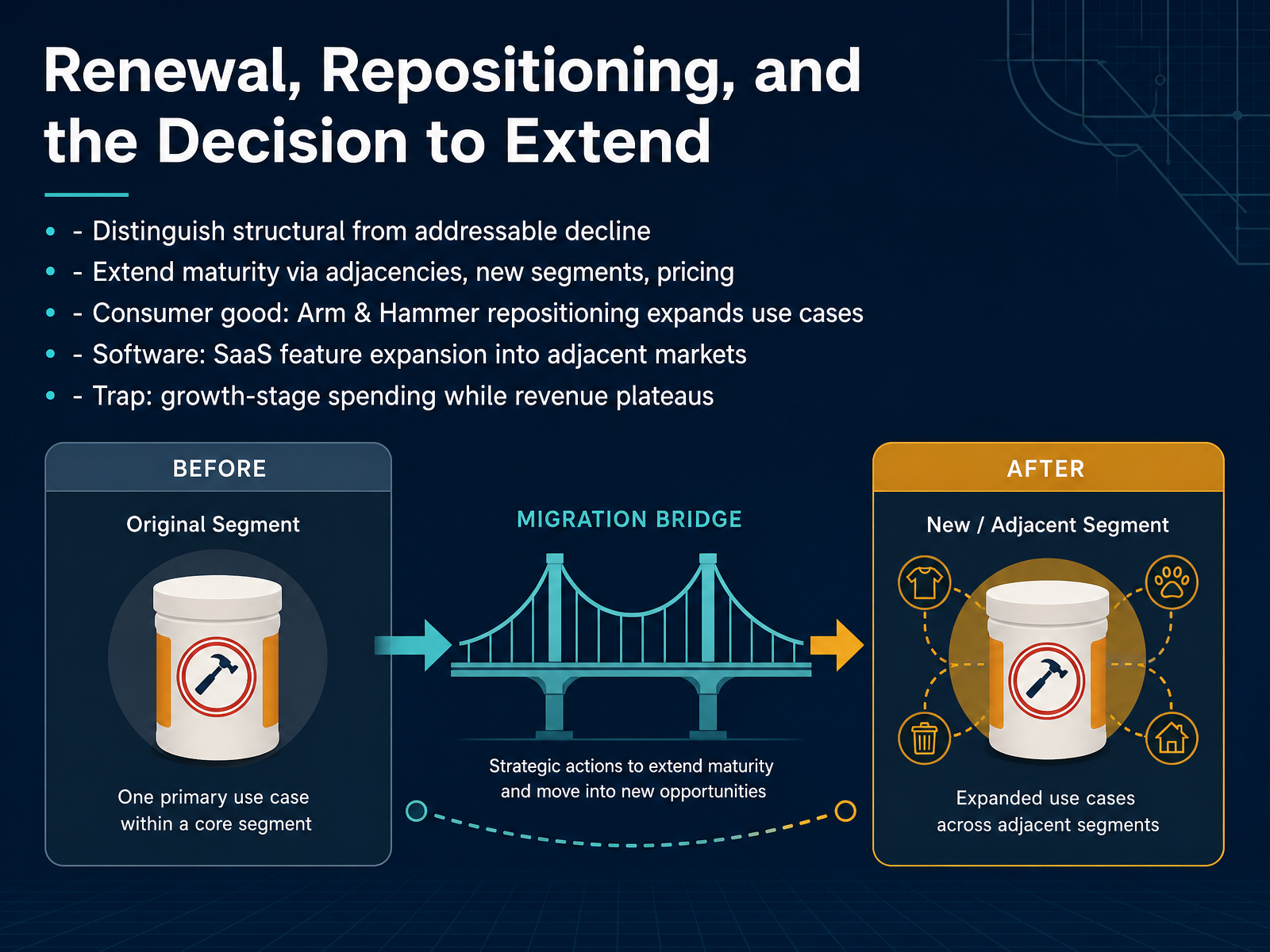
 - 11Renewal, Repositioning, and the Decision to ExtendNow let's get practical about extending a product's life. The key is distinguishing structural decline from addressable decline. Structural means the category itself is dying. Think film cameras. Addressable means your specific product has a solvable problem or an untapped opportunity. Investing in a structural decline burns capital. Ignoring an addressable decline hands market share to competitors. So how do you extend a mature product? Attack adjacencies, open new segments, and revisit your pricing model. Consider consumer goods. Arm and Hammer took a simple baking soda product and repositioned it. They expanded use cases from baking to deodorizing refrigerators, cleaning, even personal care. That repositioning opened entirely new markets and extended the product's life for decades. Now consider software. A mature SaaS product can expand into adjacent markets by leveraging its existing feature set and distribution. That's cheaper than building from zero. But here is the trap. If revenue plateaus, do not keep spending at growth-stage levels. This is the most common and most costly mistake in portfolio management. Be disciplined. Match investment to market reality.
 roadmap.oneinvestopedia.comcoursera.org+21 min
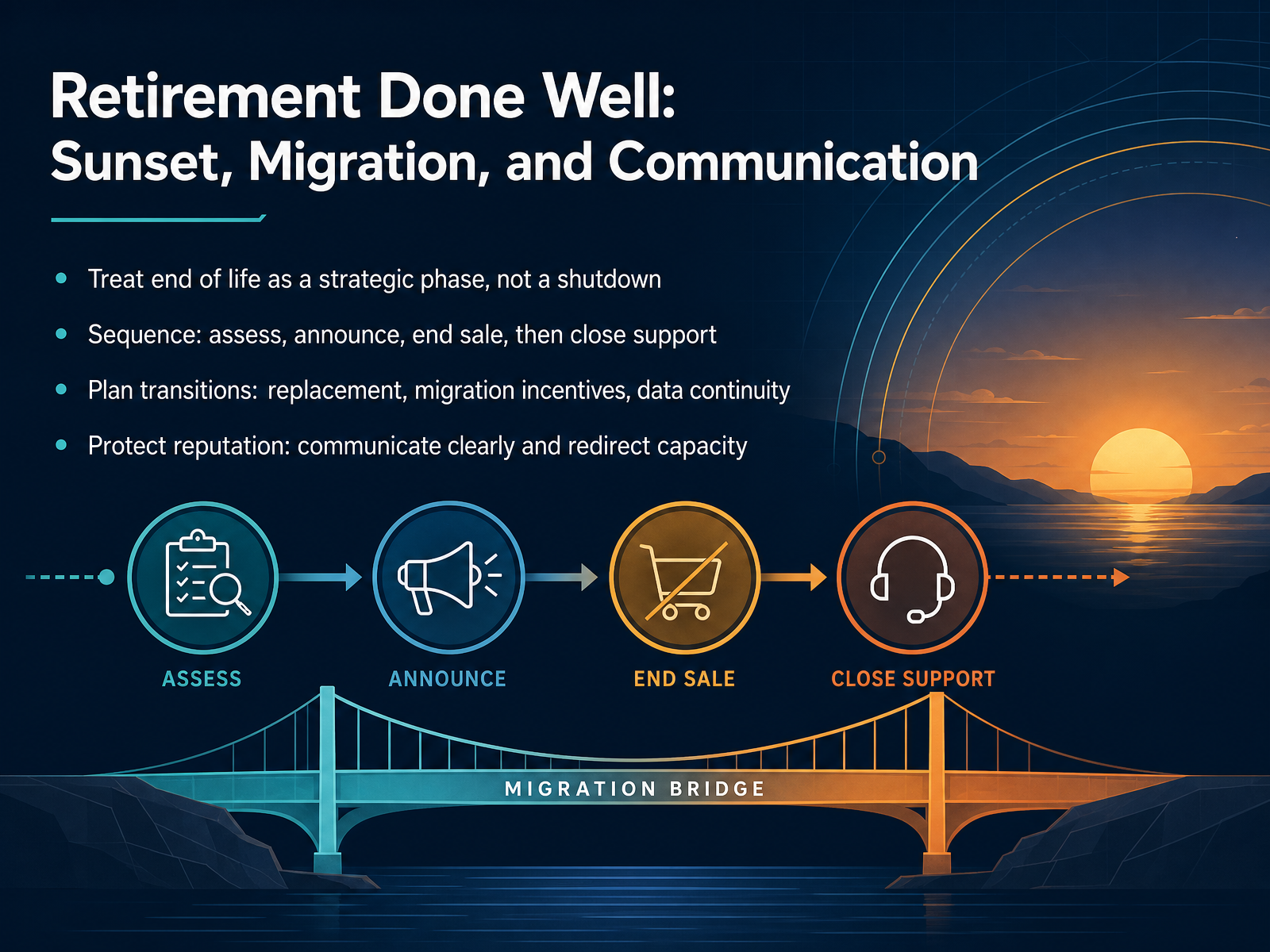
 - 12Retirement Done Well: Sunset, Migration, and CommunicationLet’s be clear: ending a product well is a strategy, not a shutdown. The sequence matters. Assess the business case first. Then announce the timeline. Stop sales on a fixed date. And finally, close support. Each step needs its own plan. Your customers need a clear path forward. Offer a replacement, migration incentives, and guaranteed data continuity. Think of the cost of switching. Remove that friction for them. Done right, this protects your reputation. Communicate clearly and consistently. Redirect your best capacity toward the successor product. A clean retirement turns a potential churn risk into a renewal opportunity. That is how you leave the market with your brand intact. Next, let’s turn this into action with some practical starting points for your organization.
 roadmap.oneinvestopedia.comcoursera.org+21 min
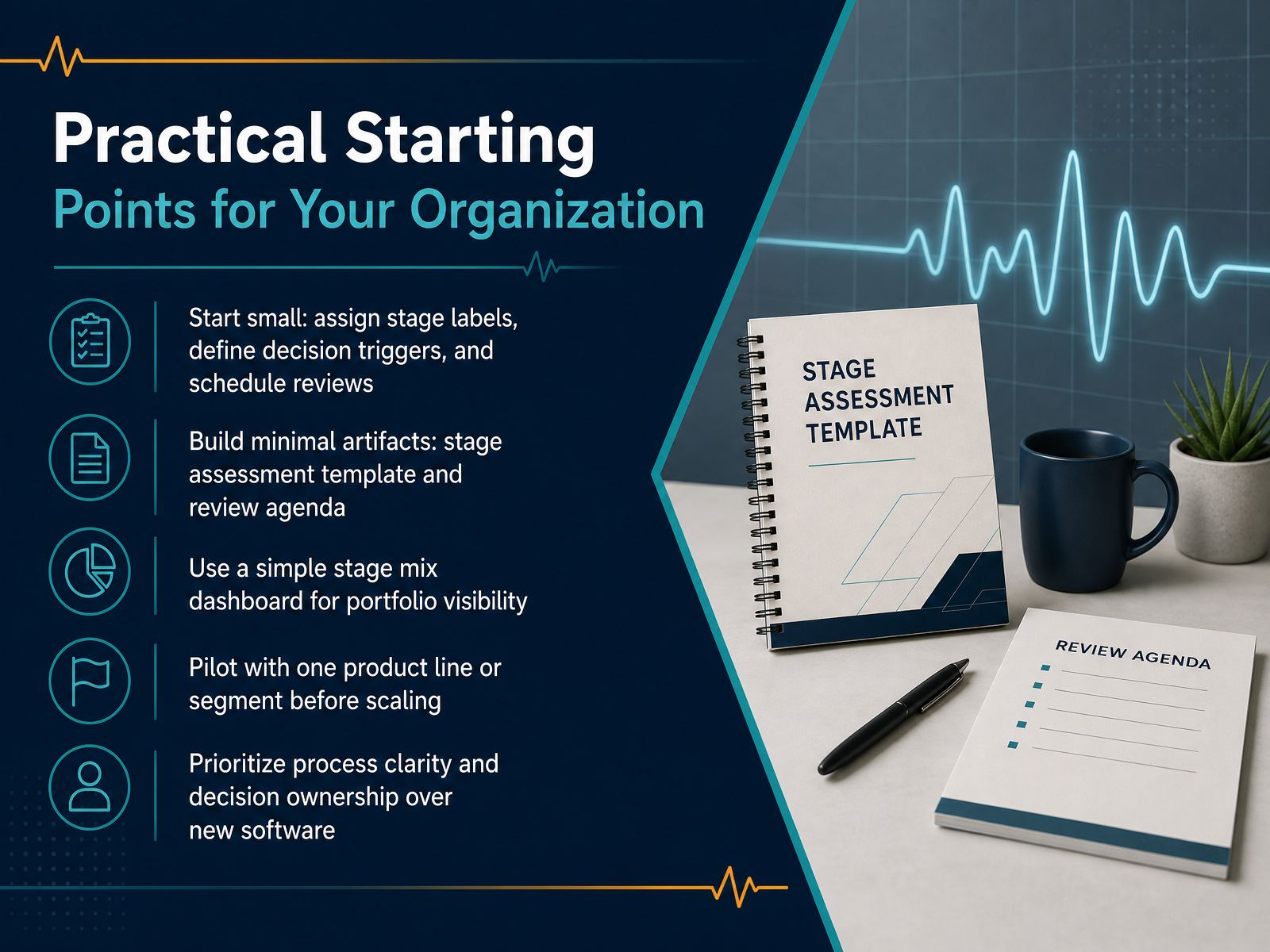
 - 13Practical Starting Points for Your OrganizationIt all starts with a disciplined, but deliberately small, pilot. Begin by assigning lifecycle stage labels to one product line. Define the decision triggers that escalate a review. And schedule regular check-ins, not red tape, just cadence. Build two minimal artifacts. A stage assessment template that captures the evidence, and a review agenda that forces the difficult trade-off conversations. Keep your portfolio visible with a stage-mix dashboard. This shows where investment sits across the portfolio without complex systems. Pilot this with a single segment. Prove the model works, learn where it breaks, then scale. Clarity wins this initiative. Lead with process and decision ownership, not software implementation. A governed spreadsheet beats an ignored enterprise system. Start this week. And that leads us directly to who owns these next steps by role, and your immediate action plan.
 umbrex.commonday.comthinknectar.com1 min
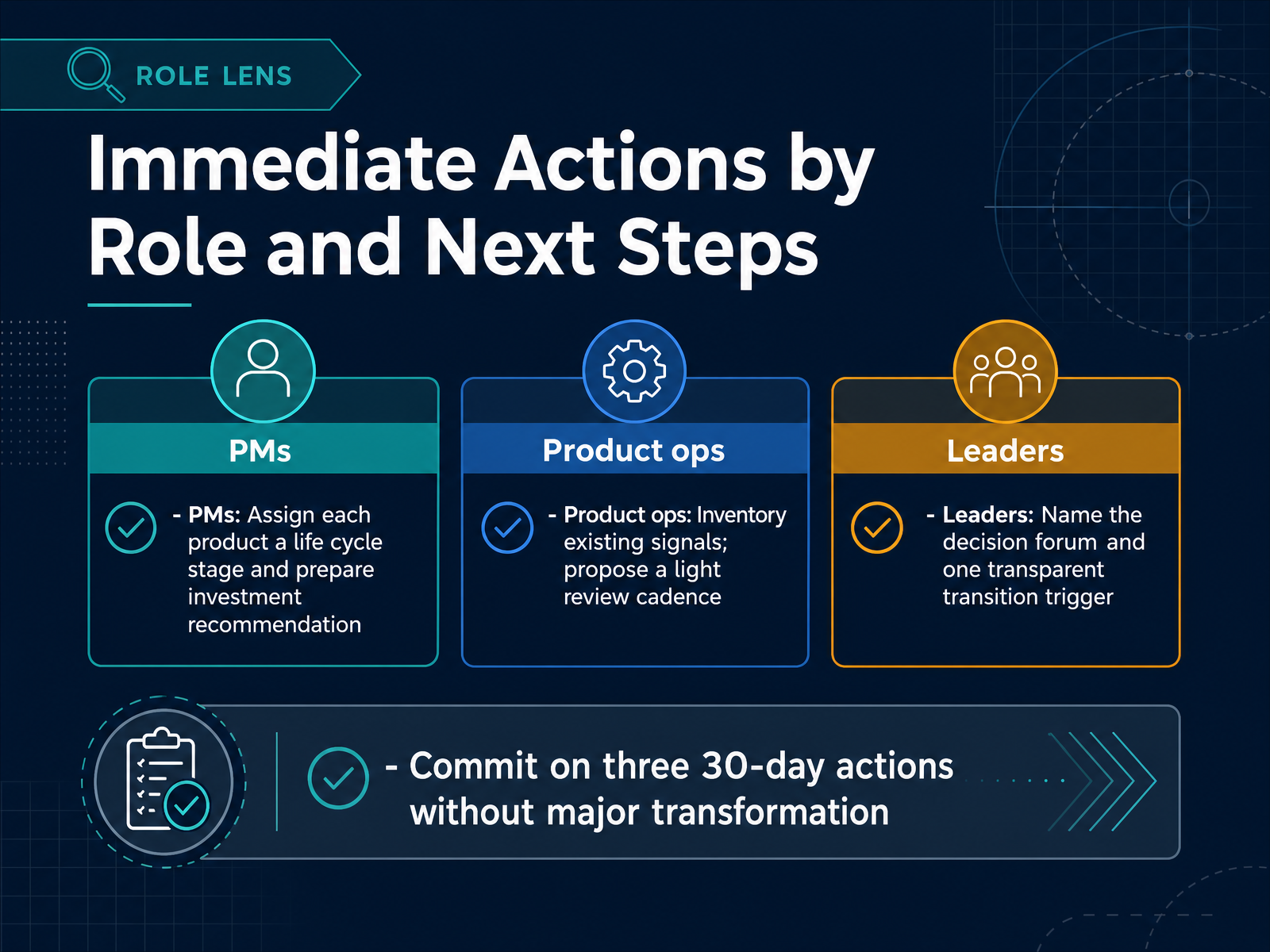
 - 14Immediate Actions by Role and Next StepsLet's turn this into action. Product managers, assign each product a lifecycle stage. Prepare an investment recommendation for each one. Product operations, inventory the signals you already track. Propose a light review cadence around them. Leaders, name the decision forum. And pick one transparent trigger for lifecycle transitions. Then commit to three 30-day actions. No major transformation required. Start with the product that has the most at stake. Test the framework there. Learn what works, and then expand. That's how lifecycle discipline becomes standard practice. Thank you for your focus today. You have the concepts and the roadmap. The next step is your first portfolio review. Make it happen.
 umbrex.commonday.comthinknectar.com1 min
Take the deck with you
Download this course as a file — free, no sign-up needed.
- PDF handoutEvery slide page, ready to print or share.15 pages · 3.5 MBDownload
- Narrated PowerPointThe deck that presents itself — every slide carries the digital human's narration video.15 pages · 12.8 MBDownload
- PowerPoint slidesThe full deck as a .pptx — open it in PowerPoint, Keynote, or Google Slides.15 pages · 3.4 MBDownload
Free to use in your own training — please keep the PersonWise credit page at the end.
Have your own deck? Turn it into a course
Sources consulted
Web sources consulted while building this course.
- Product lifecycle management: Complete guide [2026] - N-iX — n-ix.com
- Product Lifecycle Management (PLM): Complete Guide For 2026 — monday.com
- Nectar Blog | Product Lifecycle Management: A Guide for Product Managers — thinknectar.com
- What is PLM and why does your company need it by 2026? — orienteed.com
- Product Lifecycle Management - EFS Consulting — efs.consulting
- Product Lifecycle Management (PLM): Definition & Examples — launchnotes.com
- Product Life Cycle Management Explained: Practical Guide2026 — guvi.in
- Product lifecycle — en.wikipedia.org
- Understanding Product Lifecycle Management (PLM) — investopedia.com
- What Is Product Lifecycle Management? — ibm.com
- Product Life Cycle Stages: What Your Roadmap Should Look Like at Each Stage - RoadmapOne — roadmap.one
- Product Life Cycle Explained: Stage and Examples - Investopedia — investopedia.com
- What Is the Product Life Cycle? 4 Stages + How to Manage Them — coursera.org
- Product Lifecycle Stages: A Complete Guide for Product Managers — hellopm.co
- What Is Product Lifecycle? 4 Stages + How to Manage Them | Coursera — coursera.org
- The bottom-line benefit of the product operating model — mckinsey.com
- Product operating Model Framework | Deloitte US — deloitte.com
- What is a Product Operating Model? [How to Create One] - Atlassian — atlassian.com
- Product Strategy and Innovation Governance — umbrex.com
- Product Operating Model Beyond Digital | Arthur D. Little — adlittle.com