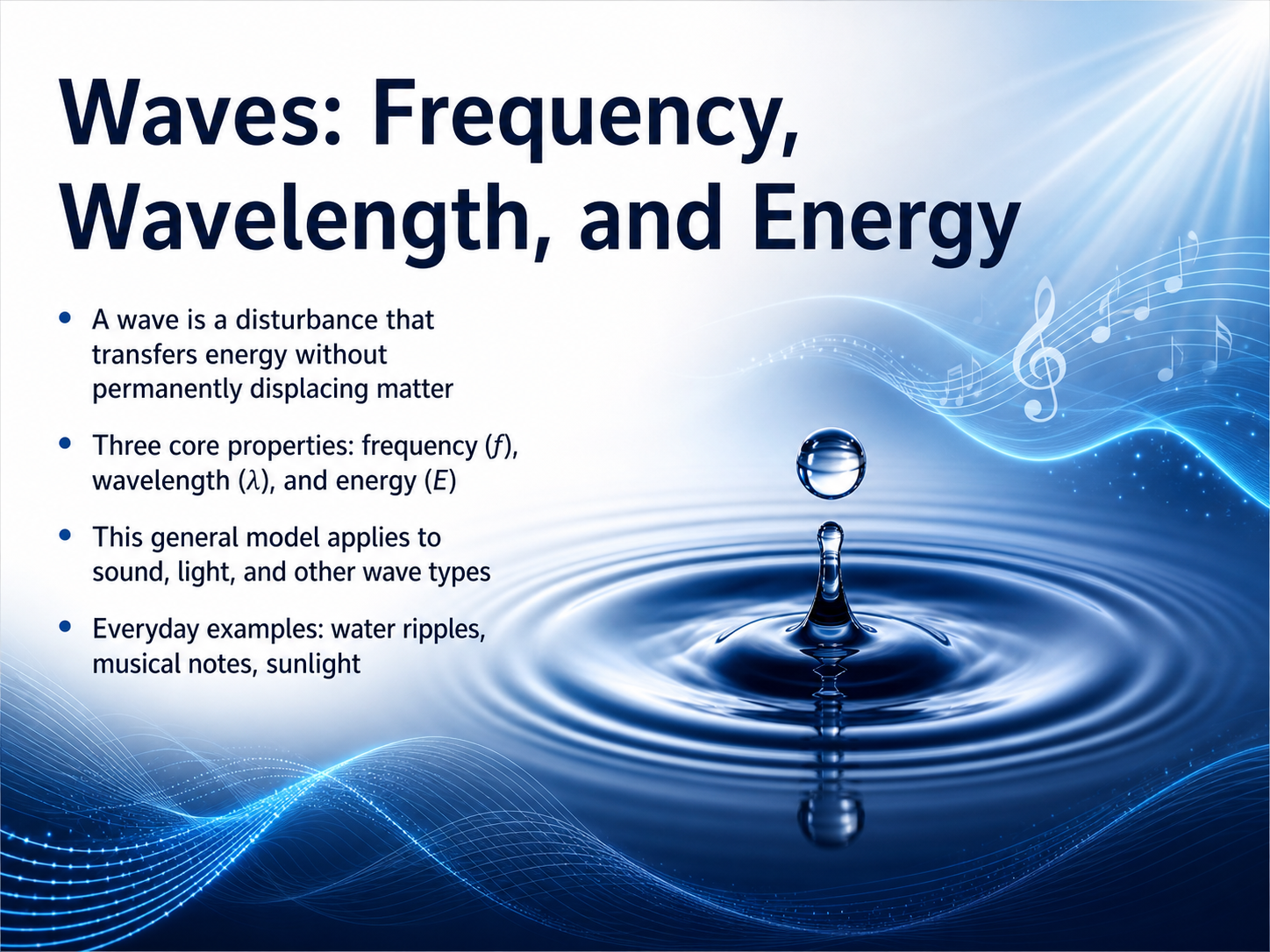
Waves: Frequency, Wavelength, Energy
Begin
16 pages · ~32 min
Waves: Frequency, Wavelength, Energy
This training explains the relationship between wave frequency, wavelength, and energy for learners exploring basic physics concepts.
What you’ll learn
- 01Waves: Frequency, Wavelength, and EnergyWelcome to this module on waves. Our goal is to build a clear, foundational model of how waves behave, focusing on three core properties: frequency, wavelength, and energy. Let's start with a simple definition. A wave is a disturbance that transfers energy without permanently displacing matter. For example, when you drop a pebble into a pond, ripples spread outward. The water molecules move up and down but don't travel with the ripples. Three properties help us describe any wave. Frequency, often measured in hertz, counts how many wave cycles pass a point each second. Wavelength, usually represented by the Greek letter lambda, is the distance between two identical points, like crest to crest. Energy is related to both the frequency and the amplitude of the wave. This general model applies across many areas. In later sections, we will use these same ideas to understand how sound travels and how light behaves. You can already see examples in everyday life, from the vibrations of a musical note to the sunlight that reaches us. Right now, keep these three properties in mind: frequency, wavelength, and energy. Next, we will explore what defines a wave in more detail.openstax.orgopenstax.orgsciencelearn.org.nz+22 min
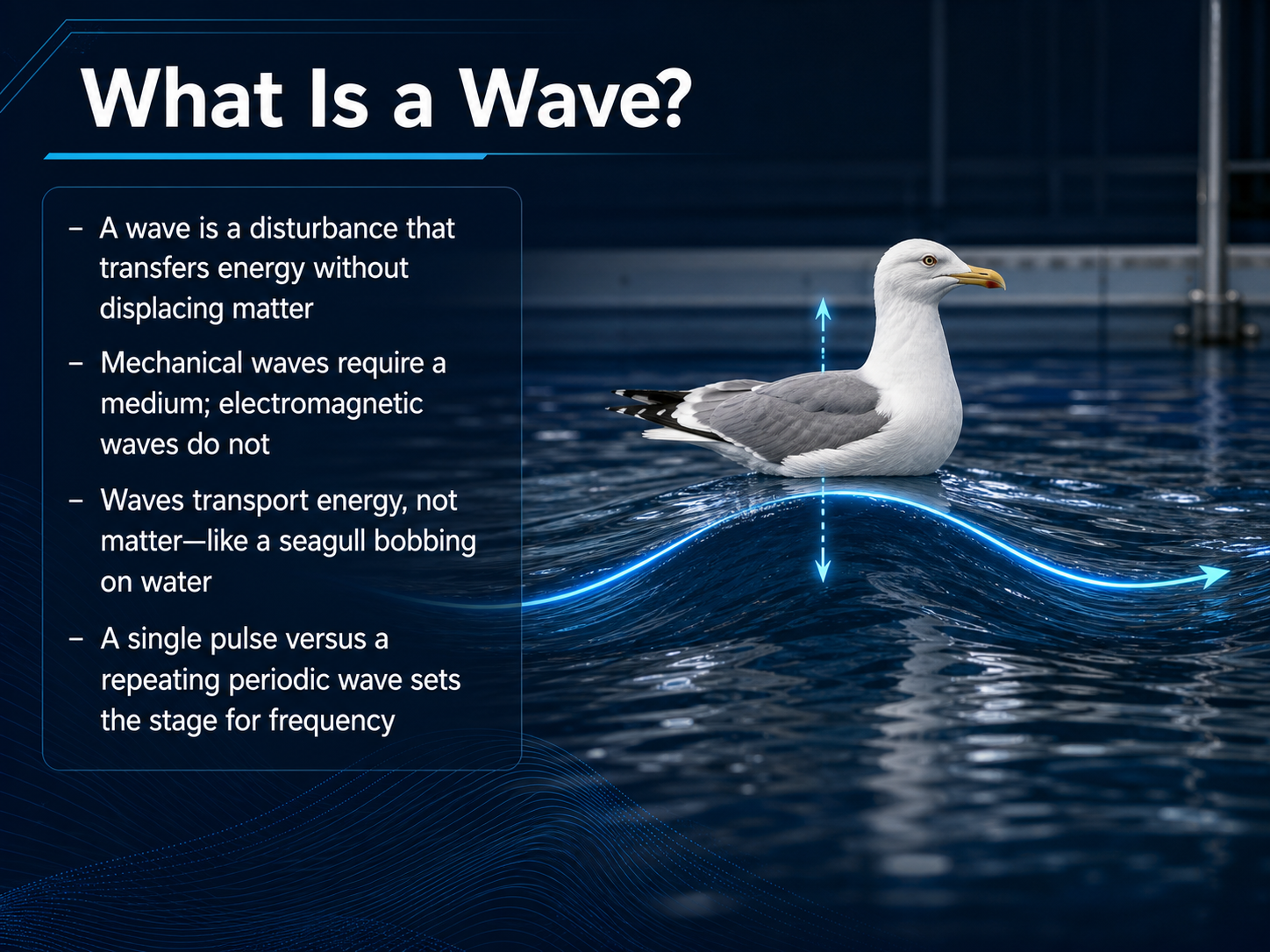
- 02What Is a Wave?Now, let's build our foundation by defining exactly what a wave is. At its simplest, a wave is a disturbance that transfers energy from one place to another. Crucially, it does this without permanently moving matter along with it. Think of a seagull resting on the ocean. As a wave passes, the bird bobs up and down, but it is not carried forward to the shore. The energy moves, but the water, and the seagull, simply cycle in place. We also classify waves based on what they travel through. Mechanical waves, like sound, need a physical medium such as air or water. Electromagnetic waves, like light, do not; they can travel through the vacuum of space. Finally, it helps to distinguish between a single, isolated pulse, like a quick jerk on a rope, and a continuous, repeating wave. This repeating, or periodic, wave is what gives us the concept of frequency, which we will explore next. Now that we have this basic model, we can look at the two main shapes a wave can take. Let's move on to transverse and longitudinal waves.
 1 min
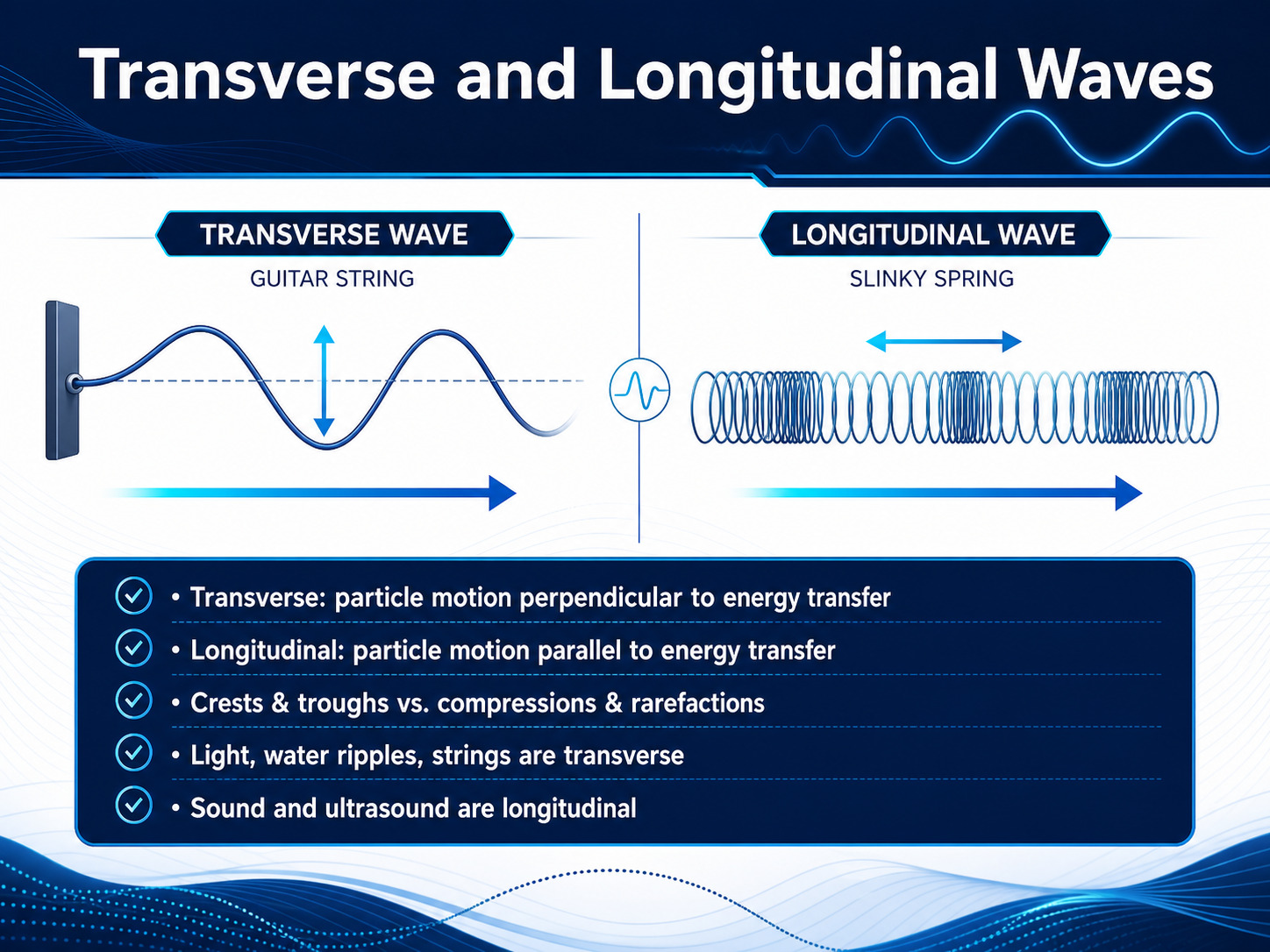
1 min - 03Transverse and Longitudinal WavesNow, let's look at the two main ways that waves move energy. The key difference is the direction the particles move relative to the direction the energy travels. In a transverse wave, the particles move perpendicular, or at a right angle, to the energy. Think of a ripple on a pond, or shaking a rope up and down, while the wave itself travels horizontally. We describe these waves using peaks called crests and valleys called troughs. In a longitudinal wave, the particles move parallel, or in the same line, as the energy. Picture pushing and pulling a spring. The wave travels through a series of compressions, where particles are squeezed together, and rarefactions, where they are spread apart. This directly connects to our upcoming topics. Transverse waves include light and water ripples. Longitudinal waves are how sound and ultrasound travel. Understanding this distinction is your foundation for visualizing how light forms images and how sound reaches your ears. Next, we will build on this by examining the specific parts of a wave, including amplitude, wavelength, and frequency.
 2 min
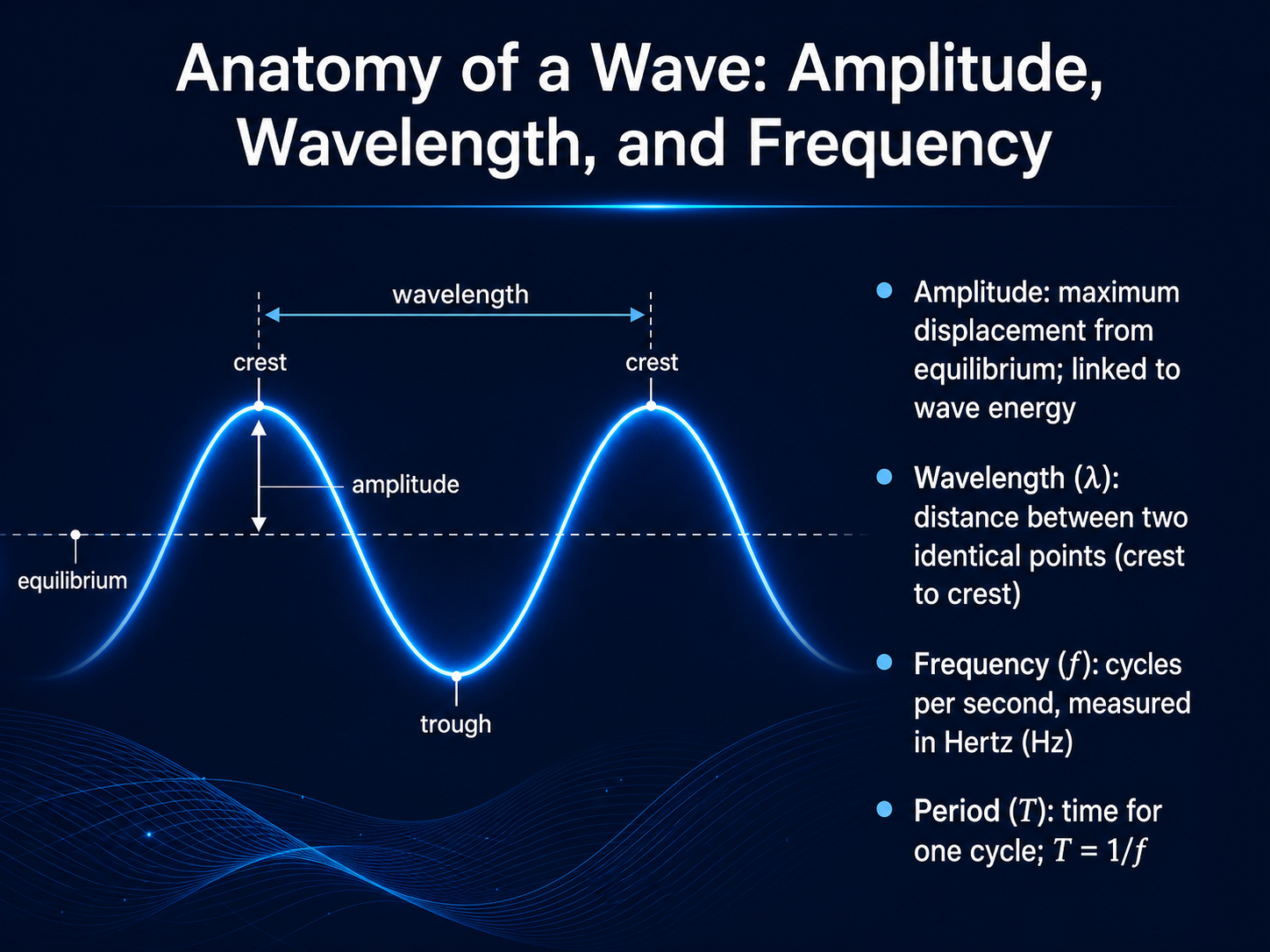
2 min - 04Anatomy of a Wave: Amplitude, Wavelength, and FrequencyNow let's look at the key parts that make up a wave. We call these the anatomy of the wave, focusing on amplitude, wavelength, and frequency. First, amplitude. This is the maximum distance a point moves from its rest, or equilibrium, position. Think of a water wave: the amplitude is the height of the crest above the calm water level. Amplitude is important because it's directly linked to the wave's energy. A taller ocean wave carries more energy. Next is wavelength, often represented by the Greek letter lambda. Wavelength is simply the distance between two identical points on consecutive waves, like from one crest to the very next crest. Finally, frequency describes how many complete wave cycles pass a fixed point in one second. We measure frequency in Hertz, or cycles per second. A related idea is the period, which is the time it takes for just one full cycle to complete. The period and frequency are closely related: the period equals one divided by the frequency. We'll build on these definitions next, when we connect them together using the wave equation.
 2 min
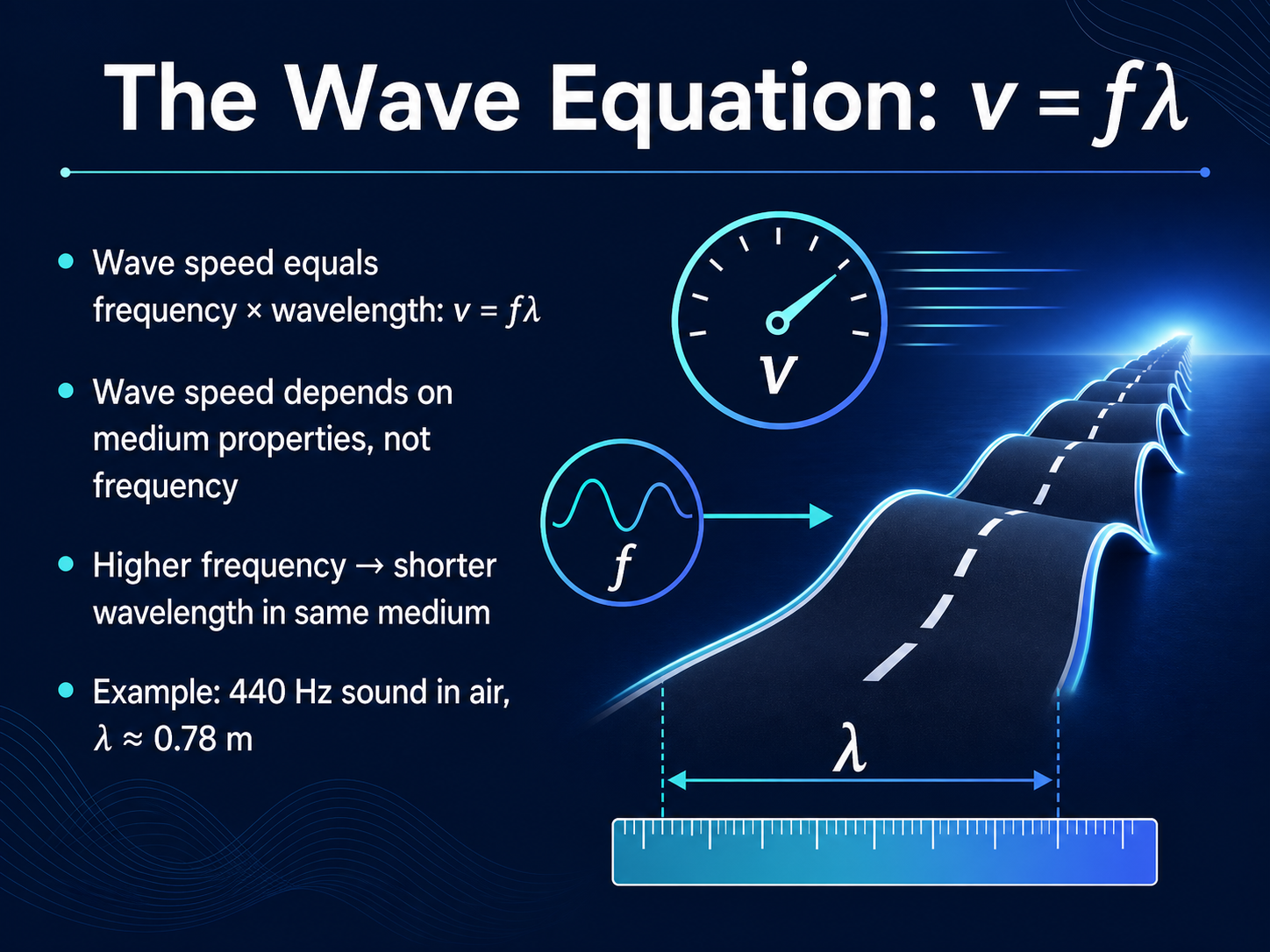
2 min - 05The Wave Equation: v = fλNow let's bring frequency and wavelength together into a single relationship called the wave equation. The wave equation states that wave speed equals frequency times wavelength, written as v equals f lambda. Here, v is the wave speed, f is the frequency, and lambda is the wavelength. To understand this, think about what happens when a wave travels. Each complete cycle stretches over one wavelength, and the number of cycles passing per second is the frequency. Multiplying them tells you how far the wave moves in one second, which is the speed. A key point is that wave speed depends on the properties of the medium, not on the frequency. In a given medium, like room-temperature air, sound travels at a fixed speed. So if you increase the frequency, the wavelength must get shorter to keep the speed constant. For example, a 440 hertz tuning fork produces sound in air with a wavelength of roughly 0.78 meters. Higher frequency would mean a shorter wavelength, and lower frequency would mean a longer one. This relationship is foundational for both sound and optics, where changing frequency shifts the color of light or the pitch of a note. Next, we will apply this equation to solve a few practical problems in 'Applying the Wave Equation: Practice and Insights.'
 2 min
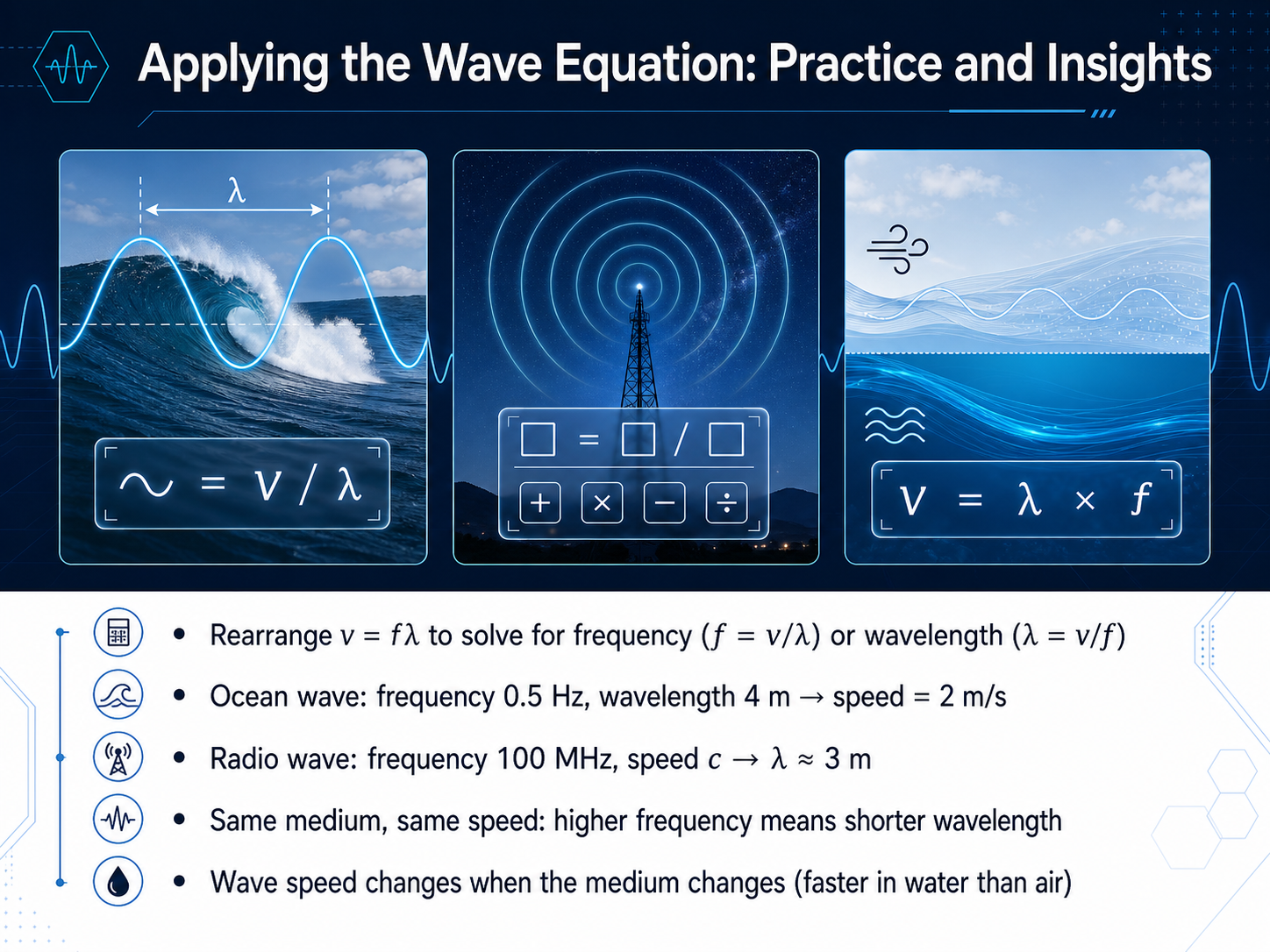
2 min - 06Applying the Wave Equation: Practice and InsightsNow that we have the equation, let's practice applying it and see what insights it gives us. The wave equation is v equals f lambda. We can rearrange it to solve for frequency, f equals v over lambda, or for wavelength, lambda equals v over f. Let's try an ocean wave example. If a wave has a frequency of 0.5 hertz and a wavelength of 4 meters, its speed is 0.5 times 4, which equals 2 meters per second. Next, consider a radio wave, which travels at the speed of light, c. If its frequency is 100 megahertz, we find the wavelength by dividing c by the frequency. That gives a wavelength of about 3 meters. This reveals a core relationship: in the same medium, where speed is constant, a higher frequency always means a shorter wavelength. It's an inverse relationship you'll see again in sound and light. Finally, remember that wave speed itself changes when the medium changes. Sound travels faster in water than in air, for example. With this foundation, we can next explore what happens when we change a wave's energy, looking at amplitude and intensity.
 2 min
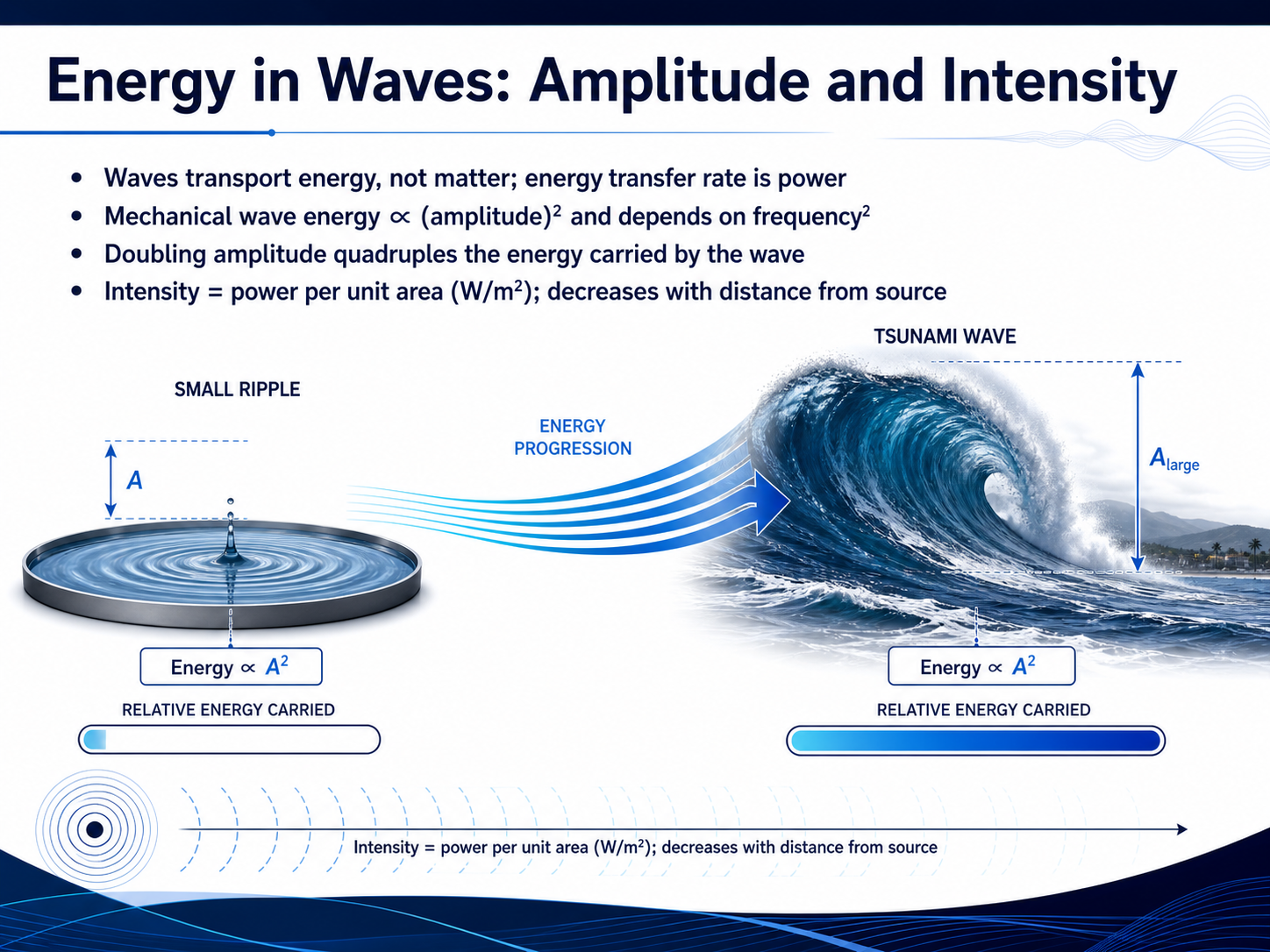
2 min - 07Energy in Waves: Amplitude and IntensityNow let's look at what waves actually carry. Waves transport energy, not matter. The medium itself stays put; it's the disturbance and the energy that travel. The rate at which energy is transferred is called power. For mechanical waves, the energy is proportional to the amplitude squared, and it also depends on the frequency squared. Amplitude is the maximum displacement from rest. In practical terms, if you double a wave's amplitude, you quadruple the energy it carries. That's a big jump. Next, intensity is defined as power per unit area, measured in watts per square meter. Think of a pebble dropped in a pond. The energy spreads out over a growing circle, so the intensity decreases as you move farther from the source. This relationship will be key when we discuss how light and sound behave over distance. Coming up next, we'll explore photon energy and the electromagnetic wave.
 1 min
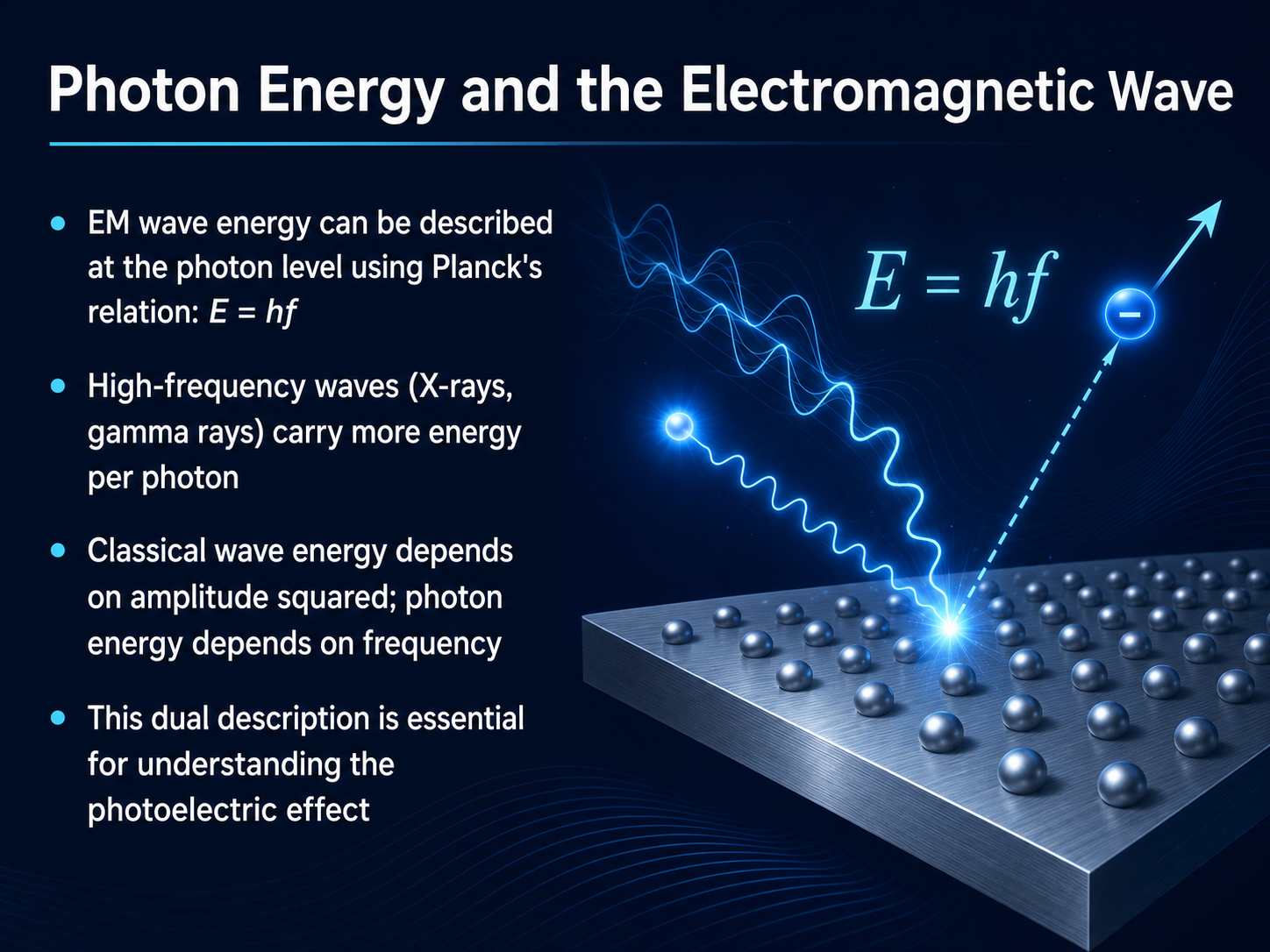
1 min - 08Photon Energy and the Electromagnetic WaveNow let's shift our perspective from the continuous wave to the individual energy packet. When we look at electromagnetic waves at the photon level, energy is no longer about the wave's height, or amplitude. Instead, it's tied directly to frequency. This relationship is captured by Planck's relation, which states that photon energy, E, equals a constant, h, multiplied by the frequency, f. The constant h is extremely small, but the principle is profound. A high-frequency wave, like an X-ray or gamma ray, is made of photons that each carry a huge amount of energy. A low-frequency radio wave, on the other hand, is made of much lower-energy photons. This is a crucial distinction from classical waves, like water waves, where a taller wave simply carries more energy. In the quantum world, it's the frequency that determines the punch packed by each photon. This dual description, where we can view light as a continuous wave or as a stream of particles, is key to understanding phenomena like the photoelectric effect, which we'll explore soon. Up next, we'll synthesize these ideas by looking at the full electromagnetic spectrum.
 2 min
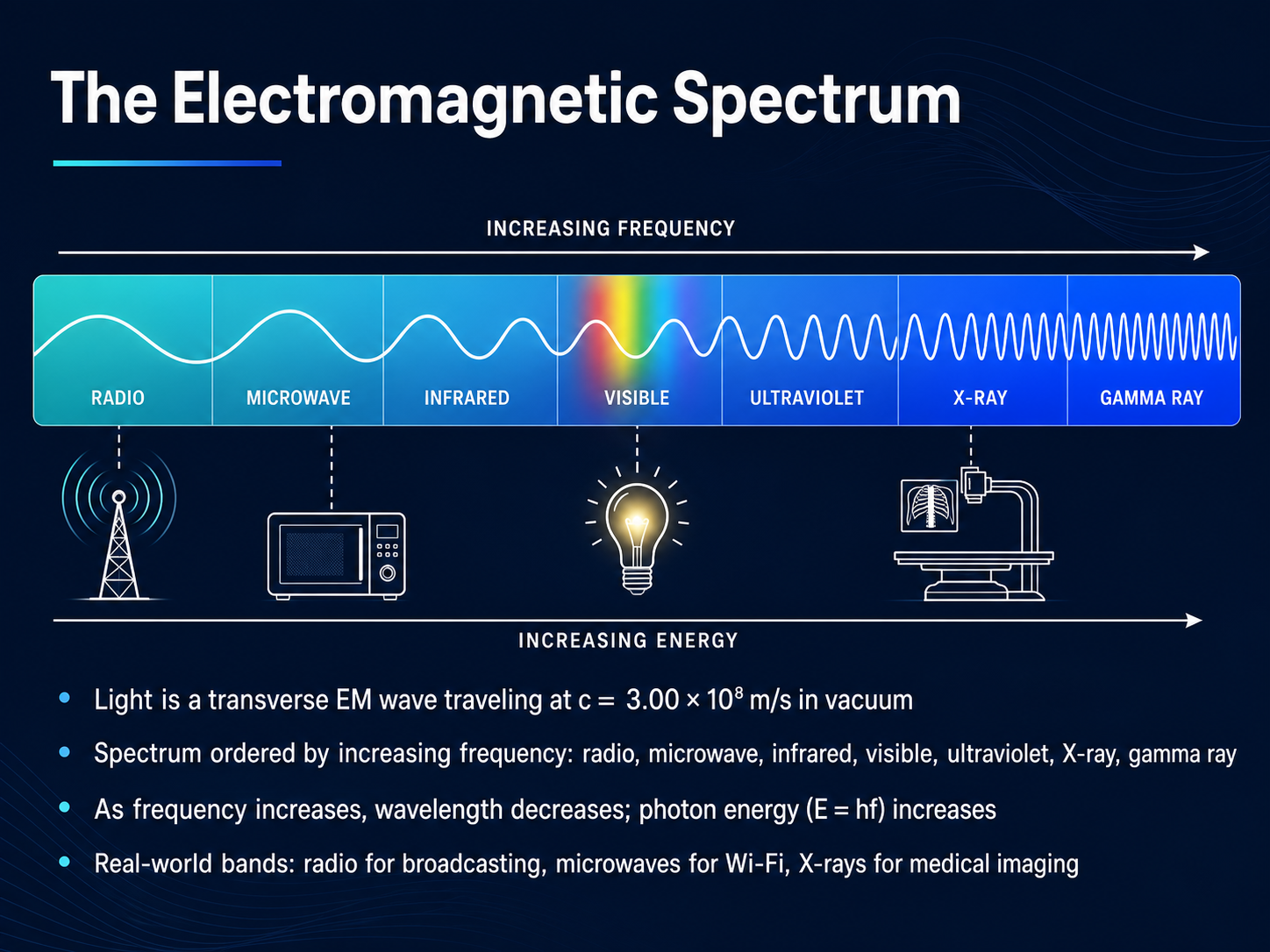
2 min - 09The Electromagnetic SpectrumNow let's build a complete picture of light by looking at the electromagnetic spectrum. Light is a transverse wave made of electric and magnetic fields, and in a vacuum, it always travels at a constant speed: three hundred million meters per second, often written as three point zero zero times ten to the eighth meters per second. We organize the spectrum by arranging waves from lowest to highest frequency. That order runs from radio waves, to microwaves, then infrared, the narrow visible band we see, ultraviolet, X-rays, and finally gamma rays. As the frequency goes up, the wavelength gets shorter, and the energy carried by each photon increases, following the relationship E equals h f. This single model connects many real-world technologies. Radio waves carry broadcasts, microwaves power Wi-Fi, and X-rays create medical images. In the next slide, we'll zoom into the visible band to explore how color, frequency, and wavelength relate.
 2 min
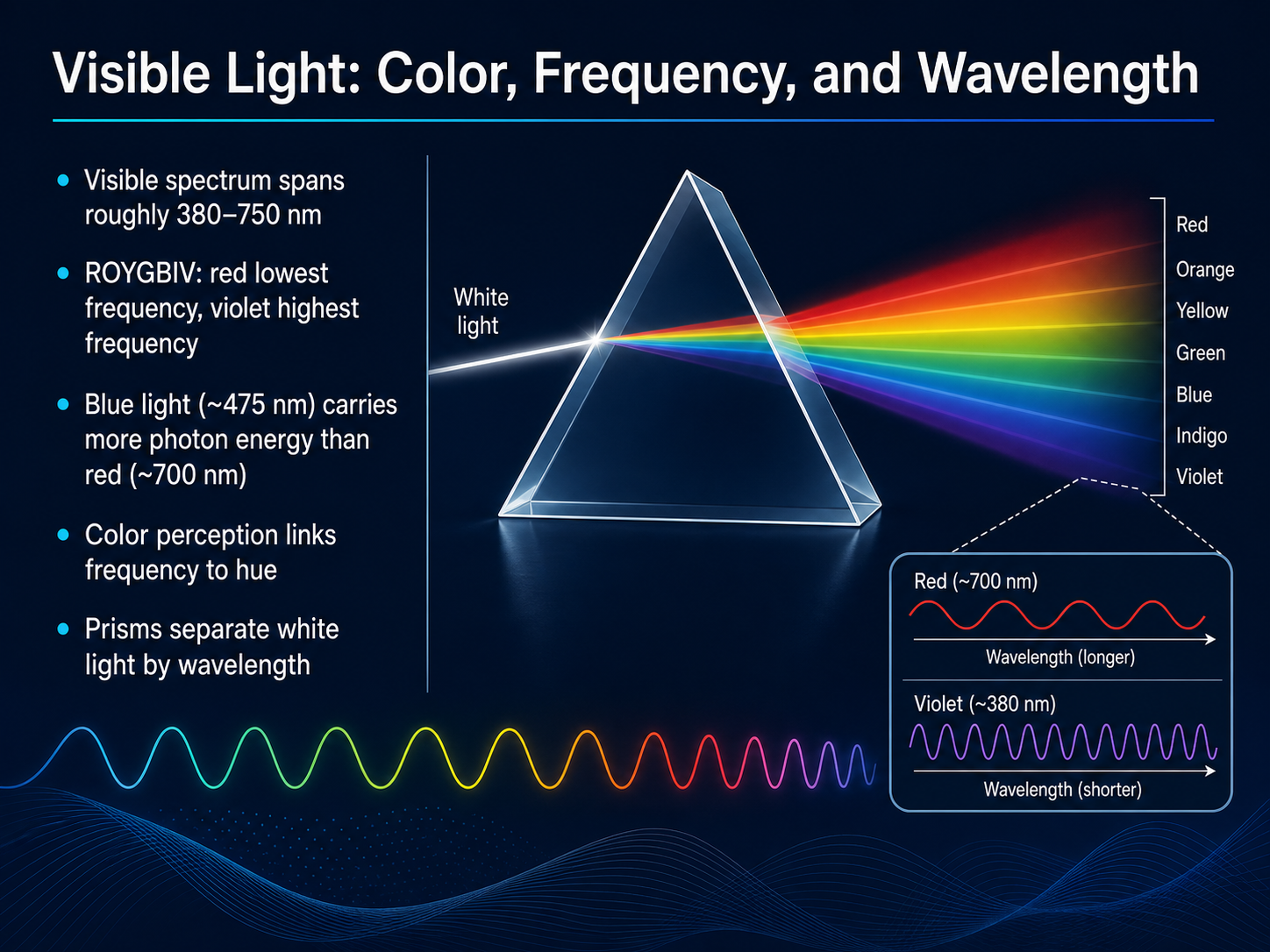
2 min - 10Visible Light: Color, Frequency, and WavelengthNow let's look at the specific range of waves we can actually see—visible light. The visible spectrum spans wavelengths from roughly 380 nanometers to 750 nanometers. A nanometer is one billionth of a meter, so these waves are incredibly small. We often remember the order of colors with the acronym ROYGBIV: red, orange, yellow, green, blue, indigo, violet. Red light has the lowest frequency and the longest wavelength in this range, around 700 nanometers. Violet light is at the other end, with the highest frequency and shortest wavelength. This relationship between frequency and wavelength directly connects to the energy each photon carries. For example, blue light, with a wavelength near 475 nanometers, has a higher frequency and therefore carries more energy than red light. This is a key concept we will use later. Our perception of color is simply our eyes and brain interpreting the frequency of the light wave as a specific hue. You can see this separation clearly when a prism splits white light into its component colors, spreading them out by wavelength. This same principle of separating waves by their properties will help us understand sound and optics in the upcoming sections. Next, we will connect this behavior directly to how sound waves work.
 2 min
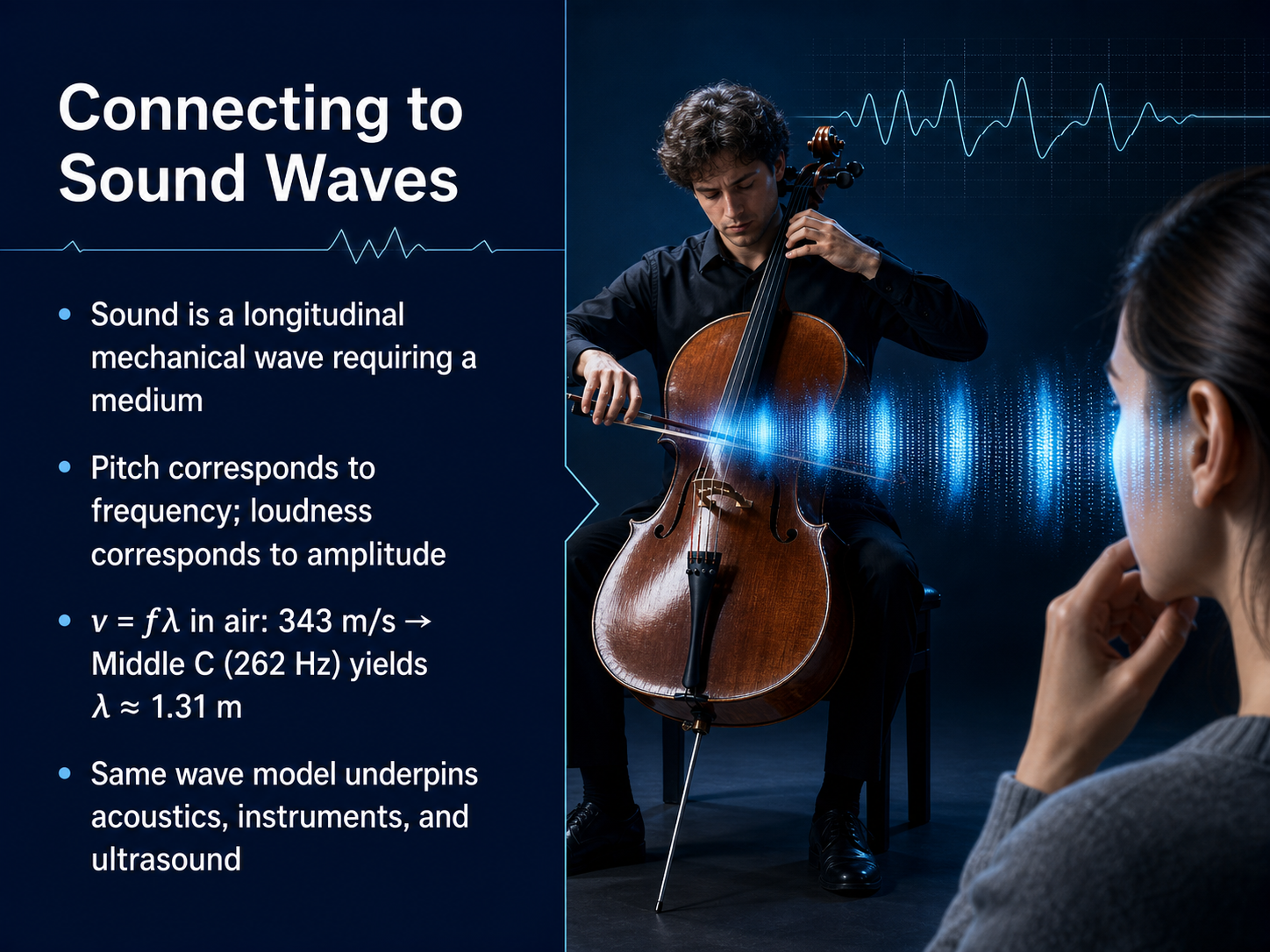
2 min - 11Connecting to Sound WavesNow let's connect our wave model to something you experience every day: sound. Sound is a longitudinal wave, meaning the particles in the medium vibrate back and forth in the same direction the wave travels. It's also a mechanical wave, which means it requires a medium, like air or water, to move through. The pitch you hear directly corresponds to the frequency of the wave. A higher frequency means a higher pitch. Loudness, on the other hand, corresponds to the amplitude, the size of those particle vibrations. This means the same fundamental equation, speed equals frequency times wavelength, applies perfectly. For sound traveling in air at room temperature, the speed is about 343 meters per second. Let's use a concrete example. The musical note Middle C has a frequency of 262 hertz. If we plug those numbers into our equation, we find its wavelength is about 1.31 meters. This is the distance between consecutive pressure peaks. This identical wave model is the foundation for understanding room acoustics, the design of musical instruments, and even medical ultrasound imaging. Next, we'll see how this same framework connects to light and optics.
 2 min
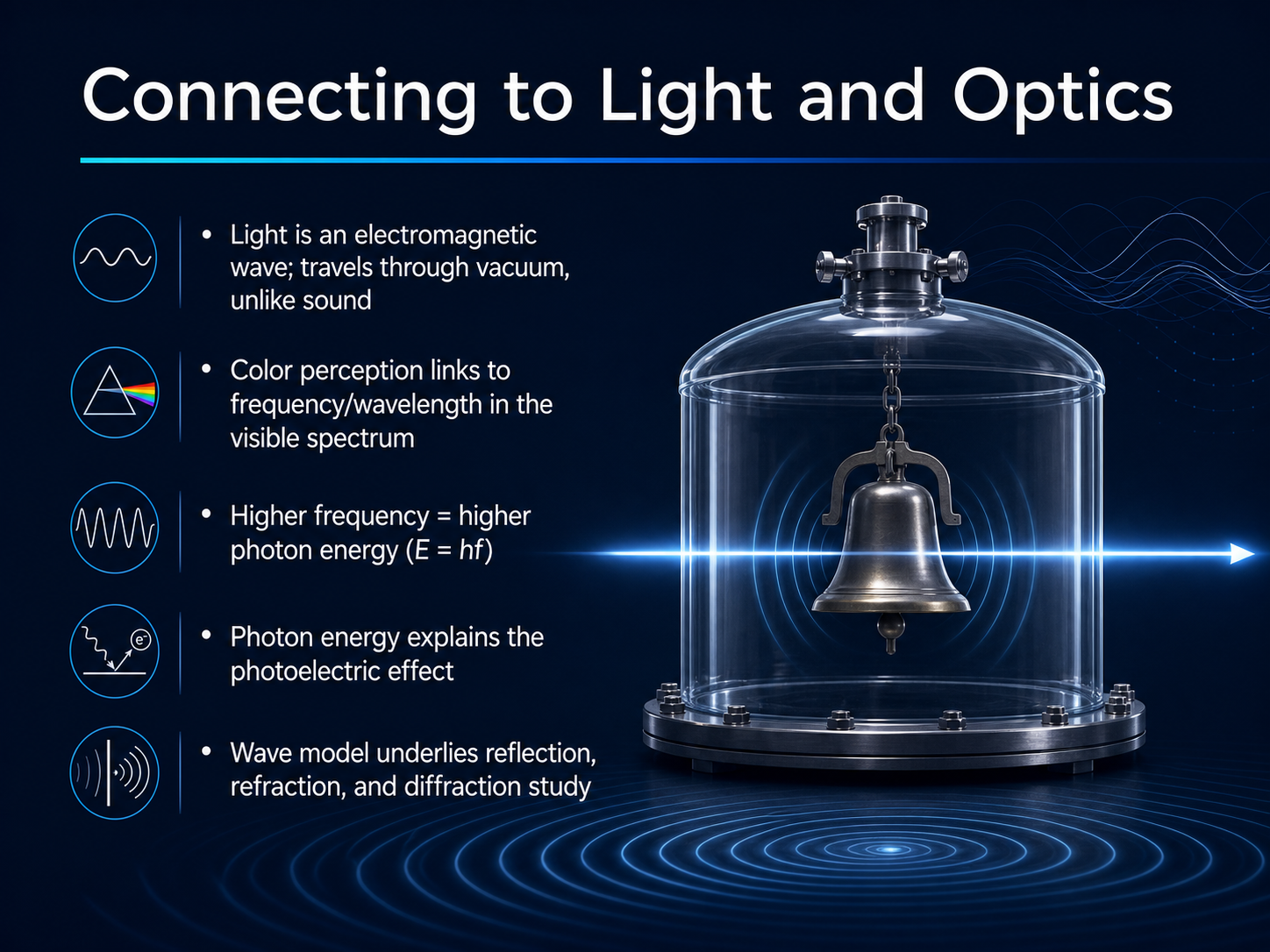
2 min - 12Connecting to Light and OpticsNow that we have a solid wave model, let's connect it directly to light and optics. Light is an electromagnetic wave, which means it can travel through the vacuum of space, unlike sound waves which need a medium. When we see color, our eyes are actually detecting the frequency, or the wavelength, of light in the visible spectrum. There's also a direct relationship between frequency and energy in a single particle of light, a photon. Higher frequency light carries higher photon energy, described by the equation E equals h f. This photon energy is the key to understanding the photoelectric effect, where light can knock electrons out of a material. Finally, the wave model itself is the foundation for studying reflection, refraction, and diffraction, which we'll explore next. Speaking of practical uses, let's move on to some real-world applications and technology.
 1 min
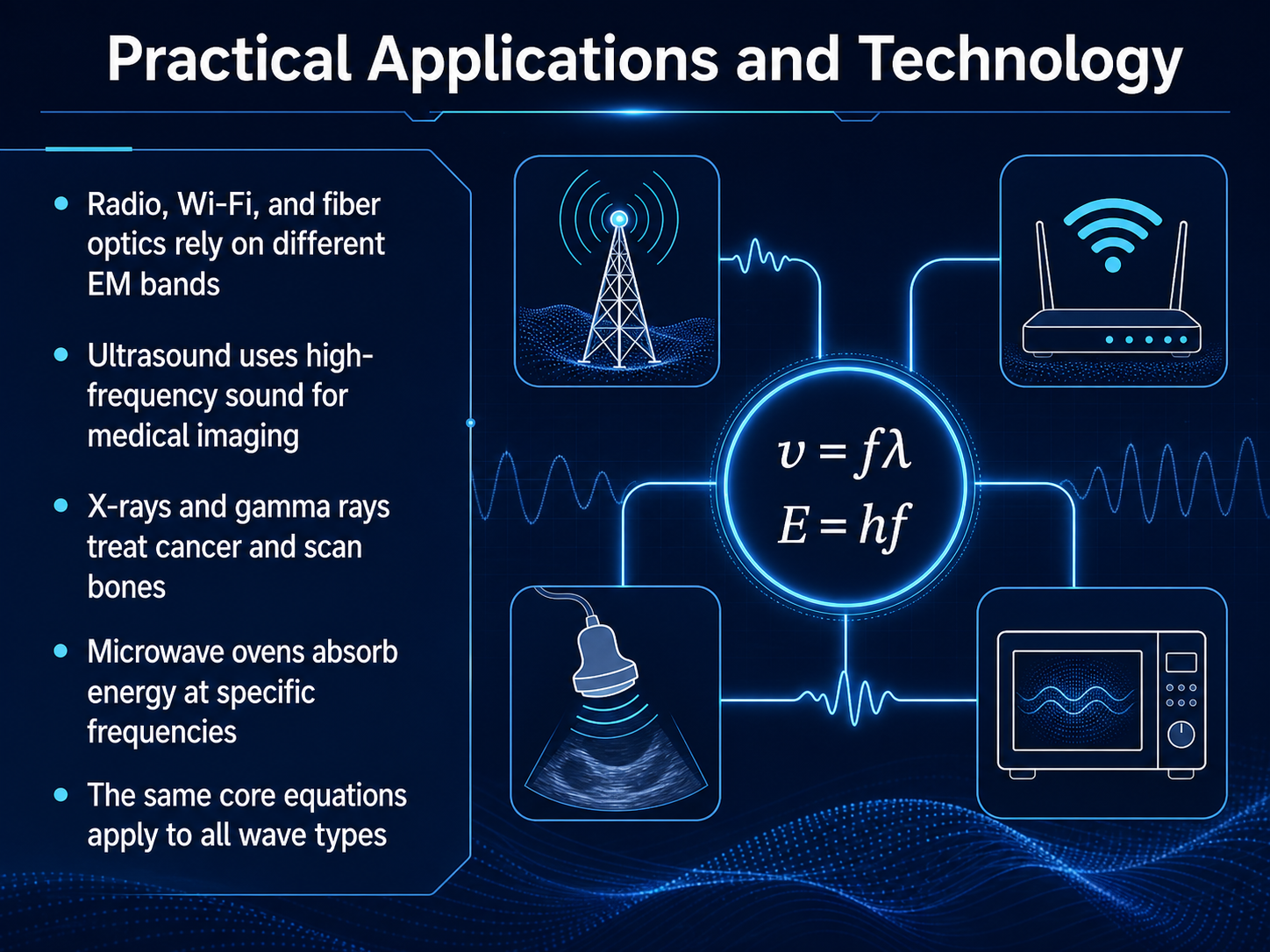
1 min - 13Practical Applications and TechnologyNow let's see how these wave principles show up in the technology we use every day. Radio, Wi-Fi, and fiber optics all depend on different bands of the electromagnetic spectrum. For example, radio waves carry broadcast signals over long distances, while fiber optics use light waves to transmit internet data through thin glass cables. In medicine, ultrasound imaging relies on high-frequency sound waves to look inside the body safely. X-rays and gamma rays, with much higher energy, are used to scan bones and even target cancer cells. Another familiar application is the microwave oven. It works because water molecules absorb energy at a specific microwave frequency, heating your food. The key takeaway is that the same core equations that relate frequency, wavelength, and energy apply to all these wave types, whether we're dealing with sound, light, or radio. Next, we’ll preview how waves interact with materials through reflection, refraction, and diffraction.
 2 min
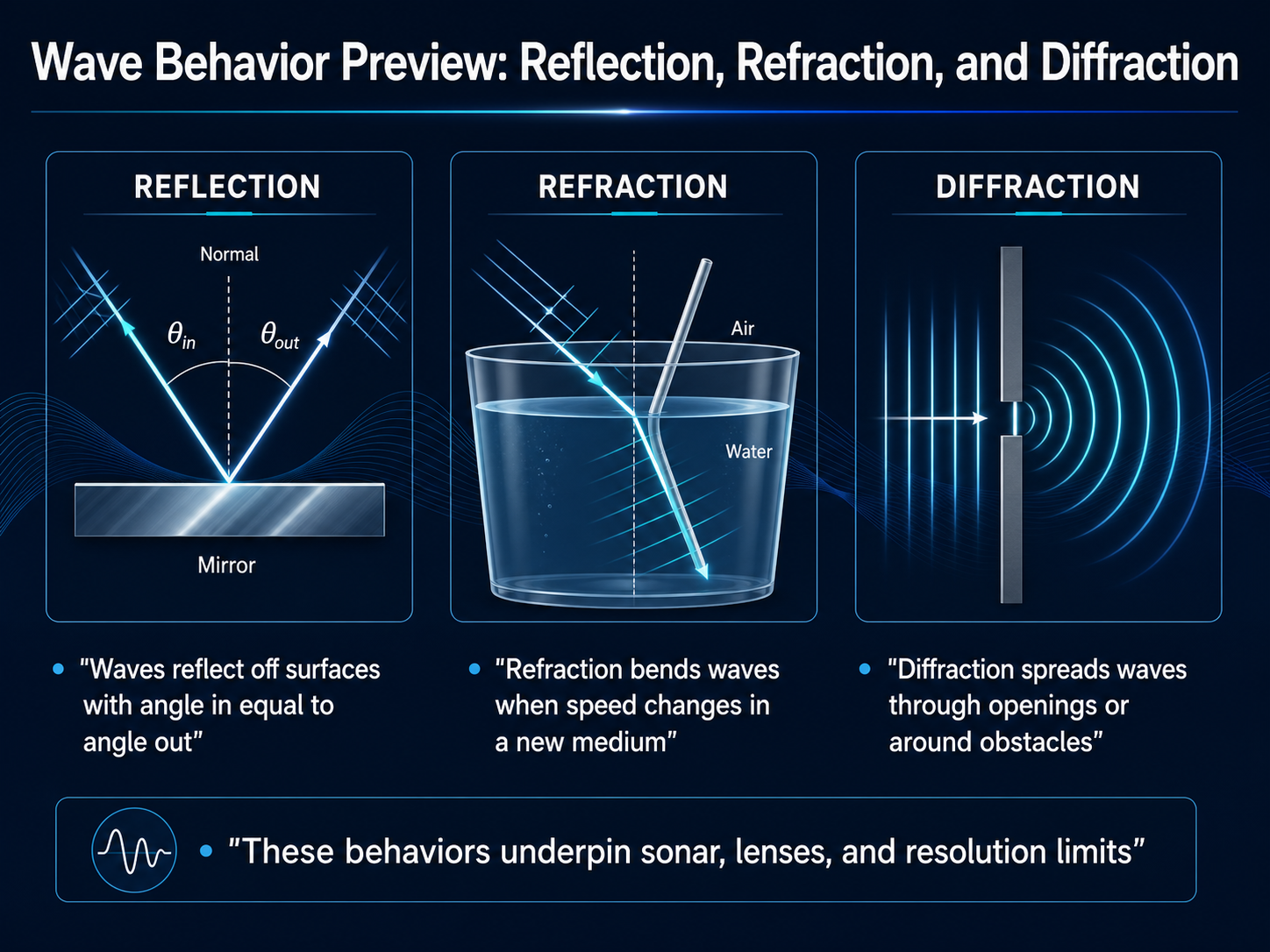
2 min - 14Wave Behavior Preview: Reflection, Refraction, and DiffractionNow let's preview three important behaviors that all waves can exhibit. First, reflection. When a wave hits a surface, it bounces off. The angle at which it strikes the surface equals the angle at which it leaves, much like a billiard ball bouncing off a cushion. Second, refraction. This occurs when a wave passes from one medium into another and its speed changes. That change in speed causes the wave to bend. You'll see this clearly when we study how lenses focus light. Third, diffraction. When a wave passes through a narrow opening or moves around an obstacle, it spreads out. This bending around corners is why we can hear someone talking in a hallway even when we can't see them. These three behaviors, reflection, refraction, and diffraction, are the foundation for technologies like sonar, for the design of camera lenses, and even for the resolution limits of microscopes. Next, we'll wrap up with a summary of the core relationships we've covered.
 2 min
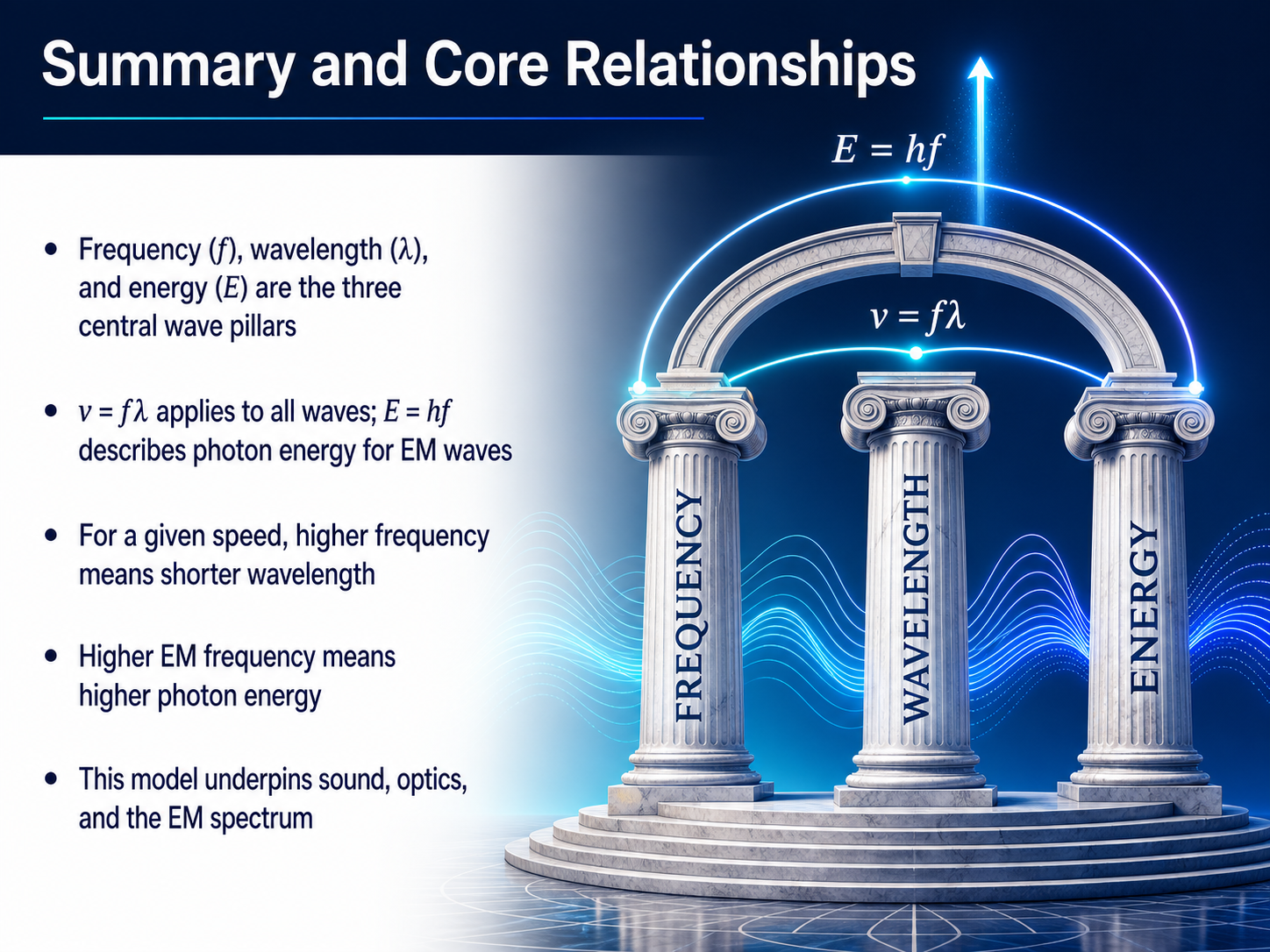
2 min - 15Summary and Core RelationshipsLet's bring together the three core pillars of our wave model. Frequency, abbreviated f, measures how many complete wave cycles pass a point each second. Wavelength, represented by the Greek letter lambda, is the distance from one crest to the next. And for electromagnetic waves, energy, E, tells us how much a single photon can transfer. The universal wave equation, velocity equals frequency times wavelength, applies to all waves. It means that when wave speed is fixed, a higher frequency must come with a shorter wavelength. For electromagnetic waves, we add another key relationship, energy equals Planck's constant h times frequency. So a higher EM frequency means higher photon energy. This is why ultraviolet light carries more energy per photon than infrared light. These relationships form the foundation for everything that follows. They will help you understand how pitch relates to string length in sound, and why different colors of light refract at different angles in optics. When you're ready, we'll move into a quick Check Your Understanding to reinforce these ideas.
 1 min
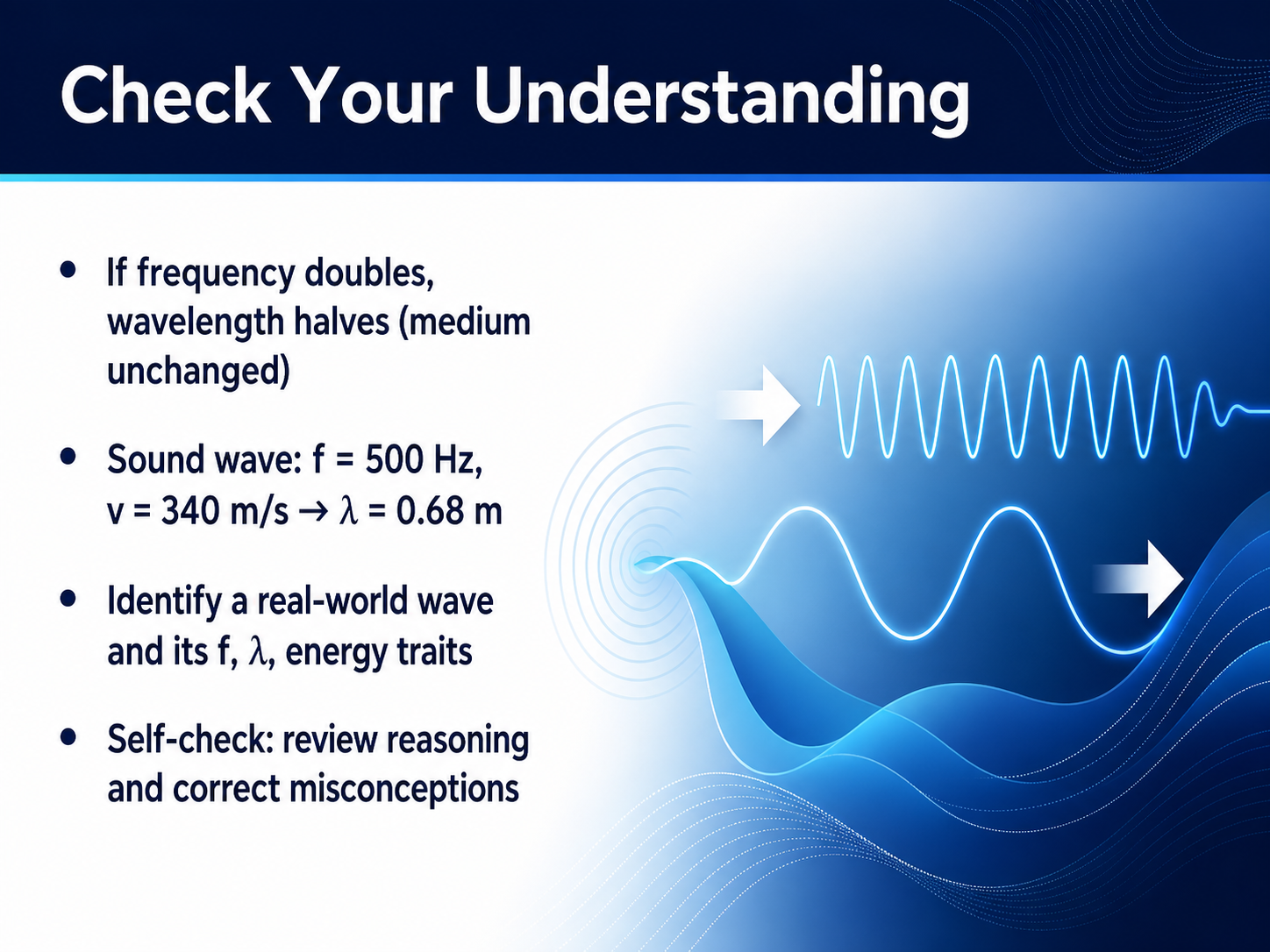
1 min - 16Check Your UnderstandingLet's solidify what we have covered. First, recall the core relationship: if the frequency of a wave doubles while the medium stays the same, the wavelength must be cut in half. Speed is frequency times wavelength, so they balance each other. Let's apply this. Imagine a sound wave with a frequency of 500 hertz traveling through the air at 340 meters per second. What is the wavelength? We rearrange the equation and divide 340 meters per second by 500 hertz, which gives us 0.68 meters. Now, try connecting this to the world around you. Think of a real-world wave, perhaps an ocean swell or a musical note. See if you can identify its approximate frequency, wavelength, and energy traits. Finally, do a quick self-check. Review your reasoning on the relationship between these properties and correct any misconceptions. You now have the foundational model needed for exploring sound and optics. Thank you for your focus, and well done.
 2 min
2 min
Take the deck with you
Download this course as a file — free, no sign-up needed.
- PDF handoutEvery slide page, ready to print or share.17 pages · 4.2 MBDownload
- Narrated PowerPointThe deck that presents itself — every slide carries the digital human's narration video.17 pages · 31.9 MBDownload
- PowerPoint slidesThe full deck as a .pptx — open it in PowerPoint, Keynote, or Google Slides.17 pages · 4.1 MBDownload
Free to use in your own training — please keep the PersonWise credit page at the end.
Have your own deck? Turn it into a course
Sources consulted
Web sources consulted while building this course.
- 13.2 Wave Properties: Speed, Amplitude, Frequency, and Period - Physics | OpenStax — openstax.org
- 16.1 Traveling Waves - University Physics Volume 1 | OpenStax — openstax.org
- Fundamentals of waves — Science Learning Hub — sciencelearn.org.nz
- 16.4 Energy and Power of a Wave - University Physics Volume 1 | OpenStax — openstax.org
- 16.9 Waves - College Physics | OpenStax — openstax.org