Cybersecurity Analyst Core Responsibilities
Begin
14 pages · ~28 min
Cybersecurity Analyst Core Responsibilities
Cybersecurity training covering the analyst role, key responsibilities, and essential skills for professionals entering or advancing in this field.
What you’ll learn
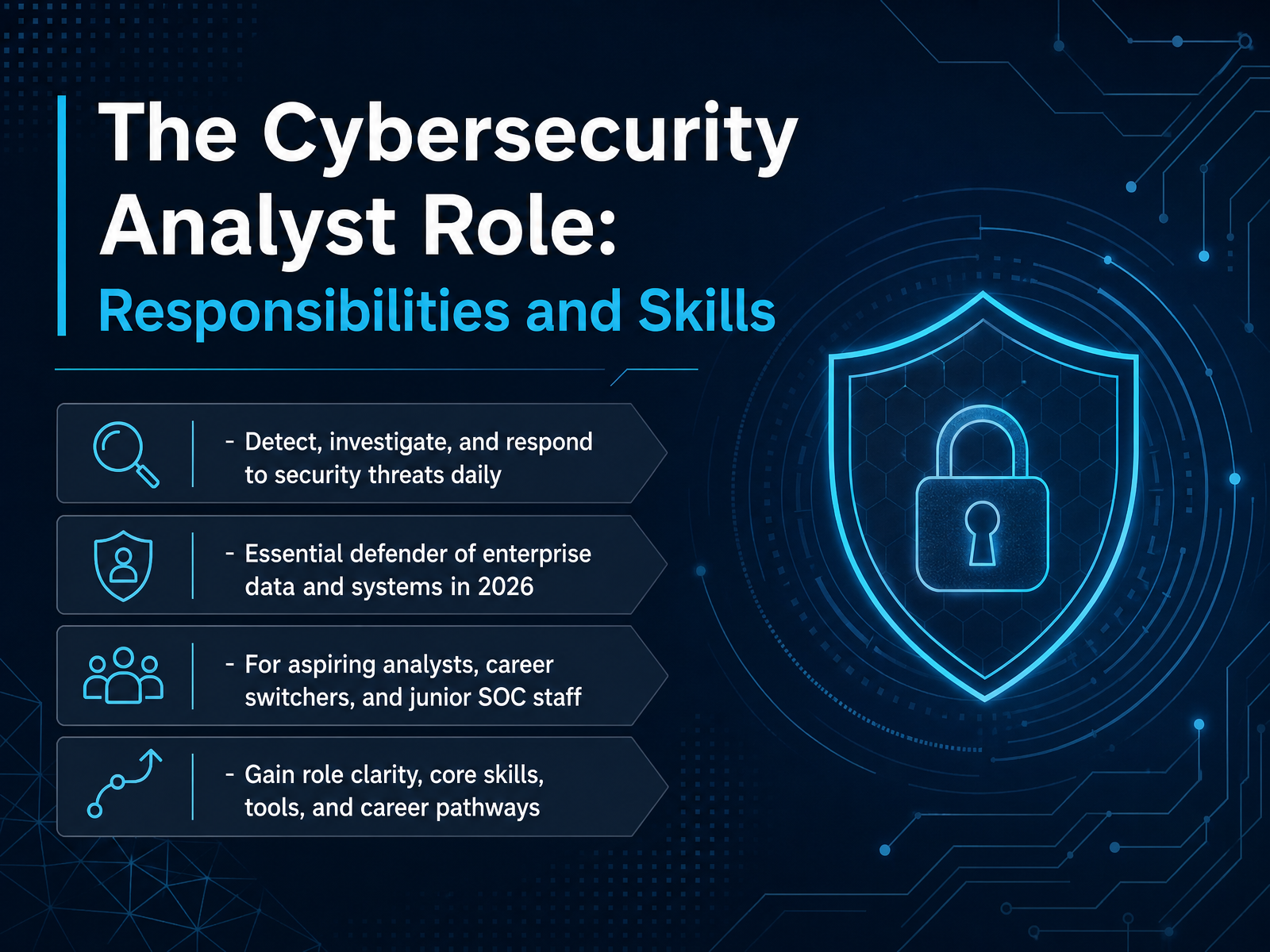
- 01The Cybersecurity Analyst Role: Responsibilities and SkillsWelcome. If you're aiming to become a cybersecurity analyst, or you're already in IT and ready to step into security, you're in the right place. Today we'll look at what this role really involves: the daily work of detecting threats, investigating them, and responding before they become disasters. By 2026, you'll be a key defender of enterprise data and systems, and this course will give you role clarity, the core skills you need, the tools you'll use, and a clear career path. Think of yourself as the organization's early warning system, not just a ticket pusher. We'll talk about what that means in practice, and I'll share real scenarios to show you how it works. By the end, you'll know exactly what to focus on next. Let's start with a broad view of the role and its core mission.1 min
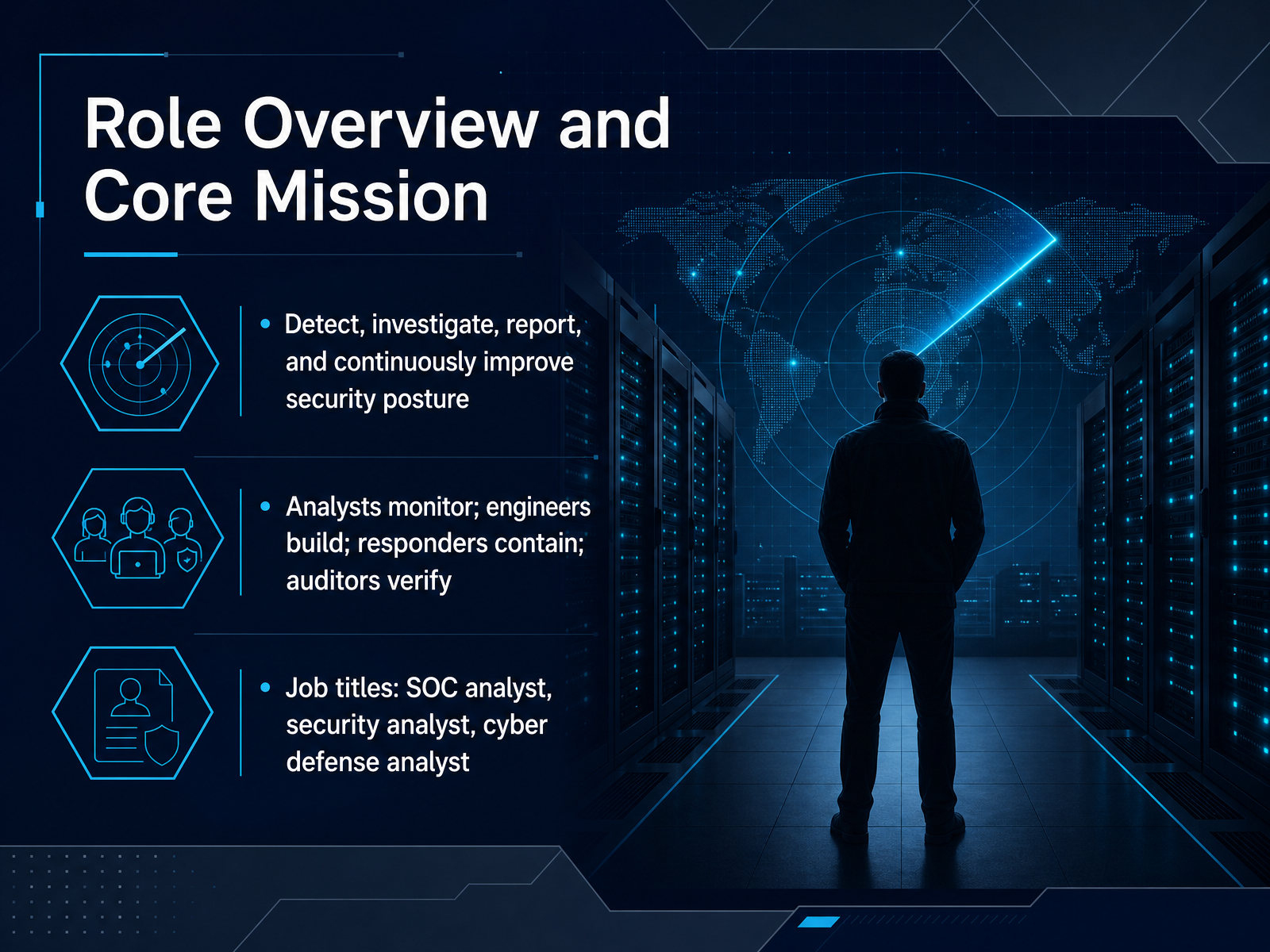
- 02Role Overview and Core MissionNow let's zoom out and define the analyst's core mission. You're the one who detects threats, investigates them, reports clearly, and helps the whole team get better over time. Remember the division of labor: analysts monitor, engineers build, responders contain, and auditors verify. You're not expected to do it all, but you are the eyes and ears of the operation. You'll see job titles like SOC analyst, security analyst, or cyber defense analyst, but the heart of the role stays the same. You're a strategic problem solver who turns raw alerts into clear actions. That's the mission in a nutshell. Next, let's look at where analysts actually work and how that shapes your daily routines.
 1 min
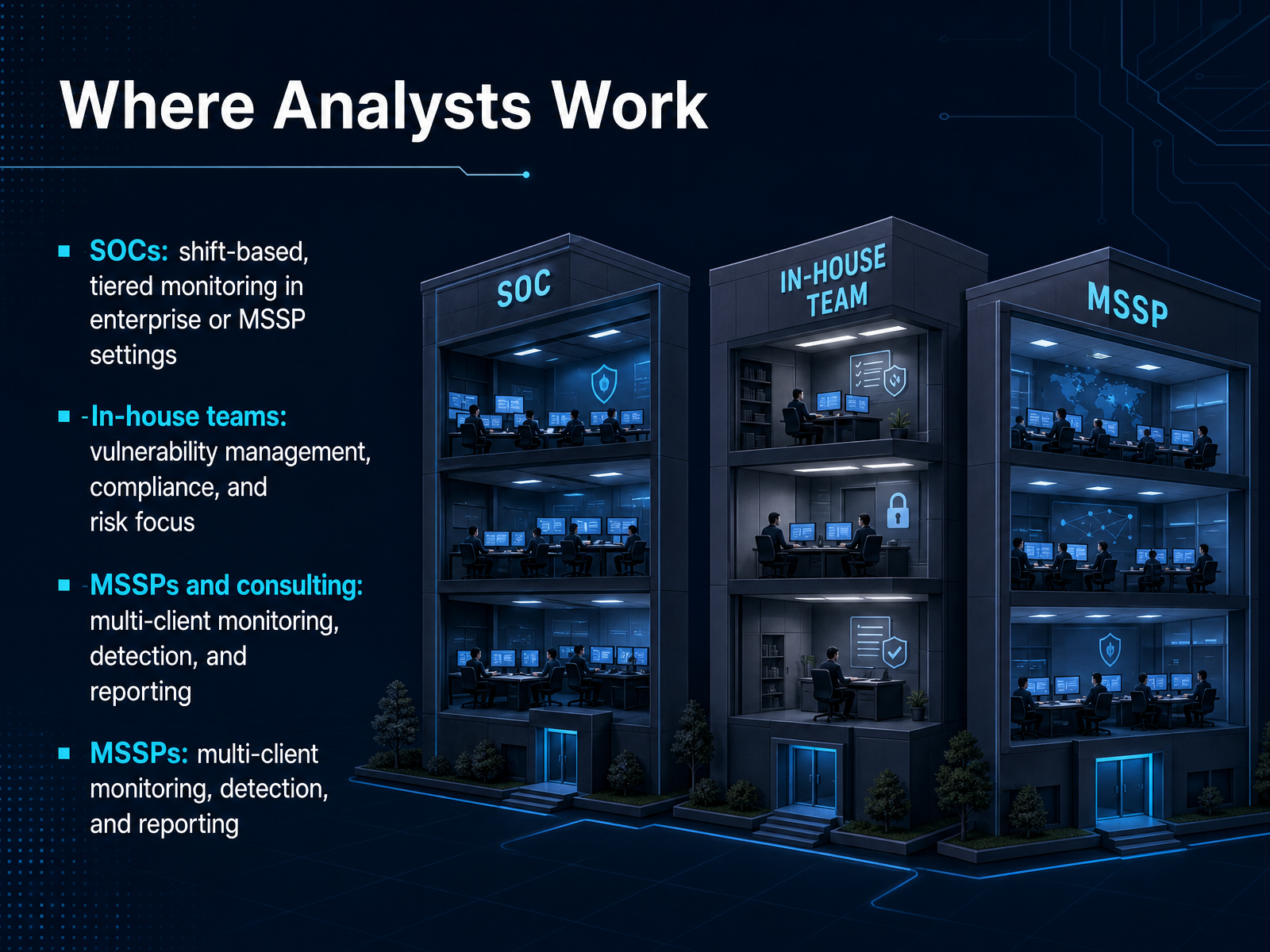
1 min - 03Where Analysts WorkNow let's talk about where cybersecurity analysts actually work, because the setting shapes the daily rhythm. Many analysts start in a Security Operations Center, or SOC. That's shift-based, tiered monitoring, often in a large enterprise or a managed security service provider. You're watching alerts, triaging incidents, and handing off what needs deeper investigation. Others work in-house for a single organization, focusing on vulnerability management, compliance, and risk. That means knowing your company's systems and helping teams fix issues before they become breaches. Then there's the MSSP and consulting route. There, you're monitoring multiple clients at once, detecting threats across different networks, and writing clear reports for people who need answers fast. Each setting demands the same core mindset, though: turning raw data into decisive action. Whatever path you choose, the work is less about tools and more about judgment. Take note of which environment matches your strengths. Next, we'll look at the core responsibilities that define your day-to-day impact.
 1 min
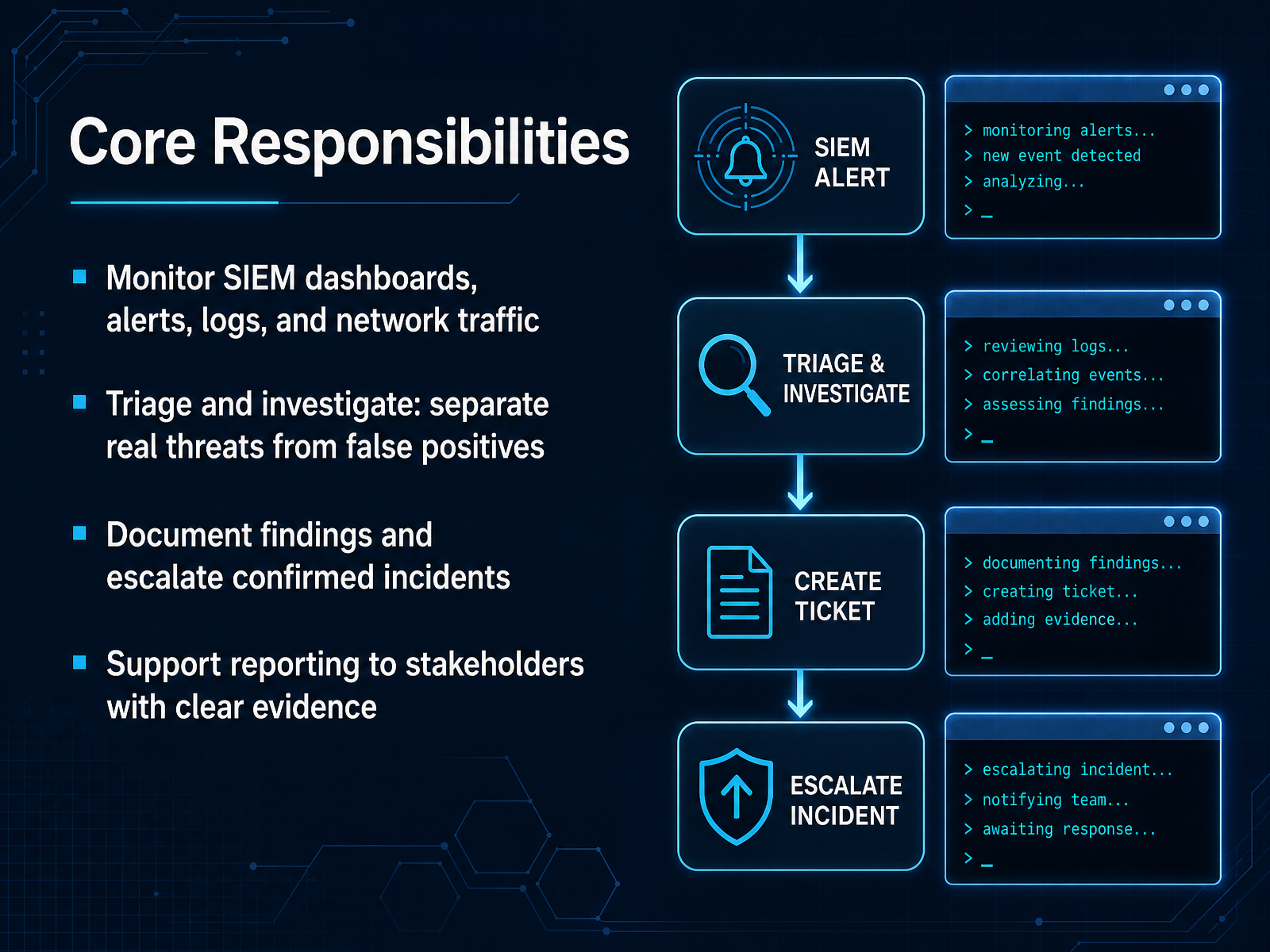
1 min - 04Core ResponsibilitiesLet’s walk through what you’ll actually do day to day. Start with monitoring. You’ll keep an eye on your SIEM dashboards, review alerts, dig into logs, and watch network traffic for anything unusual. But monitoring is only half the job. The real skill is triage. You’ll sort through the noise and figure out what’s a genuine threat and what’s just a false positive. Think of it like a fire alarm. Most times it’s burnt toast, but occasionally it’s a real fire. Your job is to tell the difference quickly. When you do find something real, you document it. Clear notes on what you saw, when you saw it, and why it matters. Then you escalate to the right team with confidence. Finally, you support reporting to stakeholders. That means translating technical findings into plain language with clear evidence, so managers and clients understand the risk and the impact. Keep this rhythm in mind: monitor, triage, document, escalate. It’s a steady loop that keeps the organization safe. Next, let’s step into a real workday and see how this plays out in practice.
 1 min
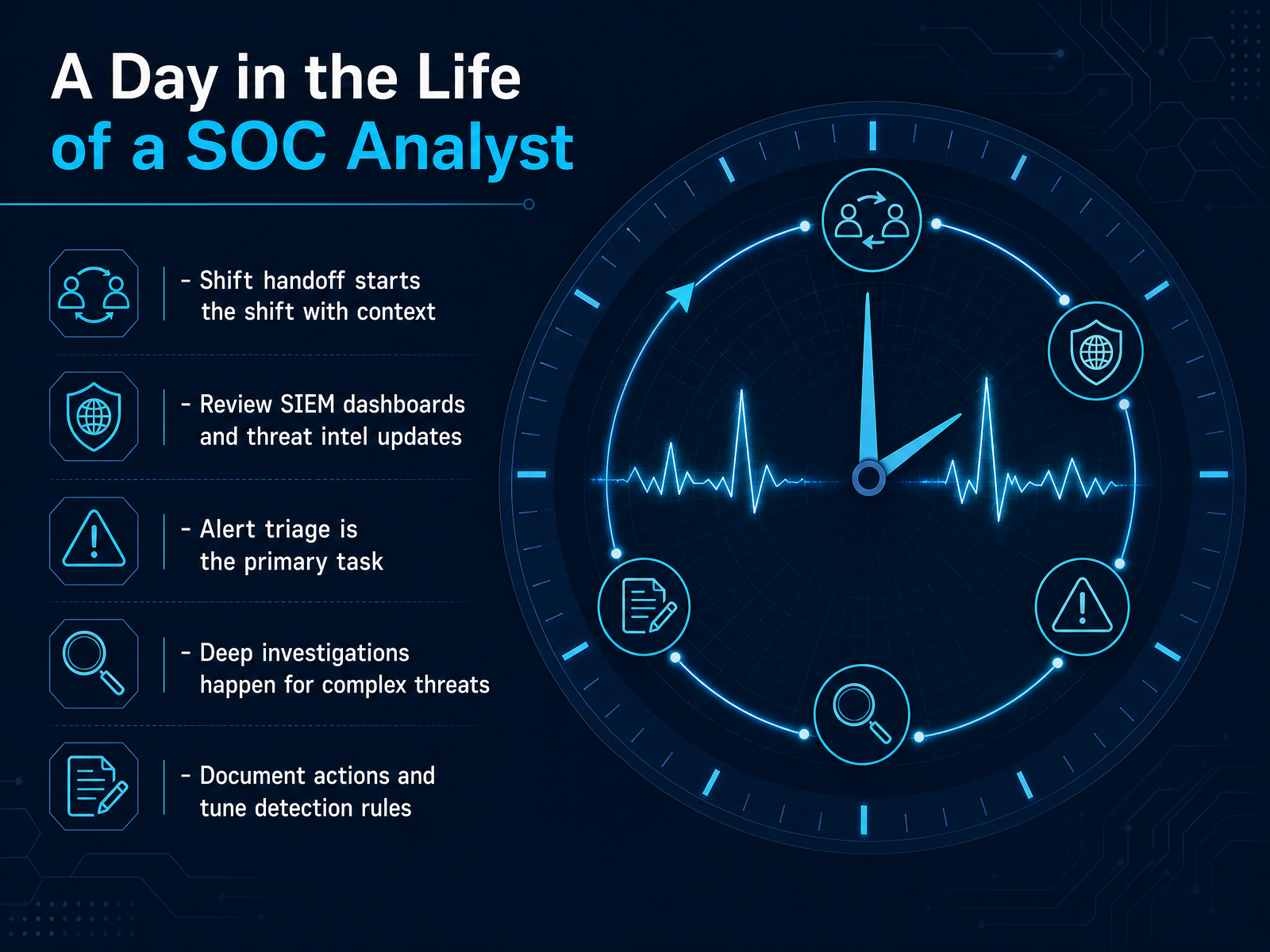
1 min - 05A Day in the Life of a SOC AnalystSo what does a shift actually look like? It starts with handoff. The outgoing team walks you through what happened, what is still open, and what deserves extra attention. That context is gold. Then you check the dashboards and the latest threat intel to see if anything new is targeting your industry. From there, it is triage time. Alerts come in, and your job is to sort the real threats from the noise. That is the core of the role. When something complex shows up, you go deep. You dig into logs, trace the behavior, and piece together what the attacker is doing. And when the dust settles, you document everything and fine-tune the detection rules so the next alert is cleaner. It is a rhythm of investigate, respond, and improve. Next, let’s talk about the key technical skills that make all of this possible.
 1 min
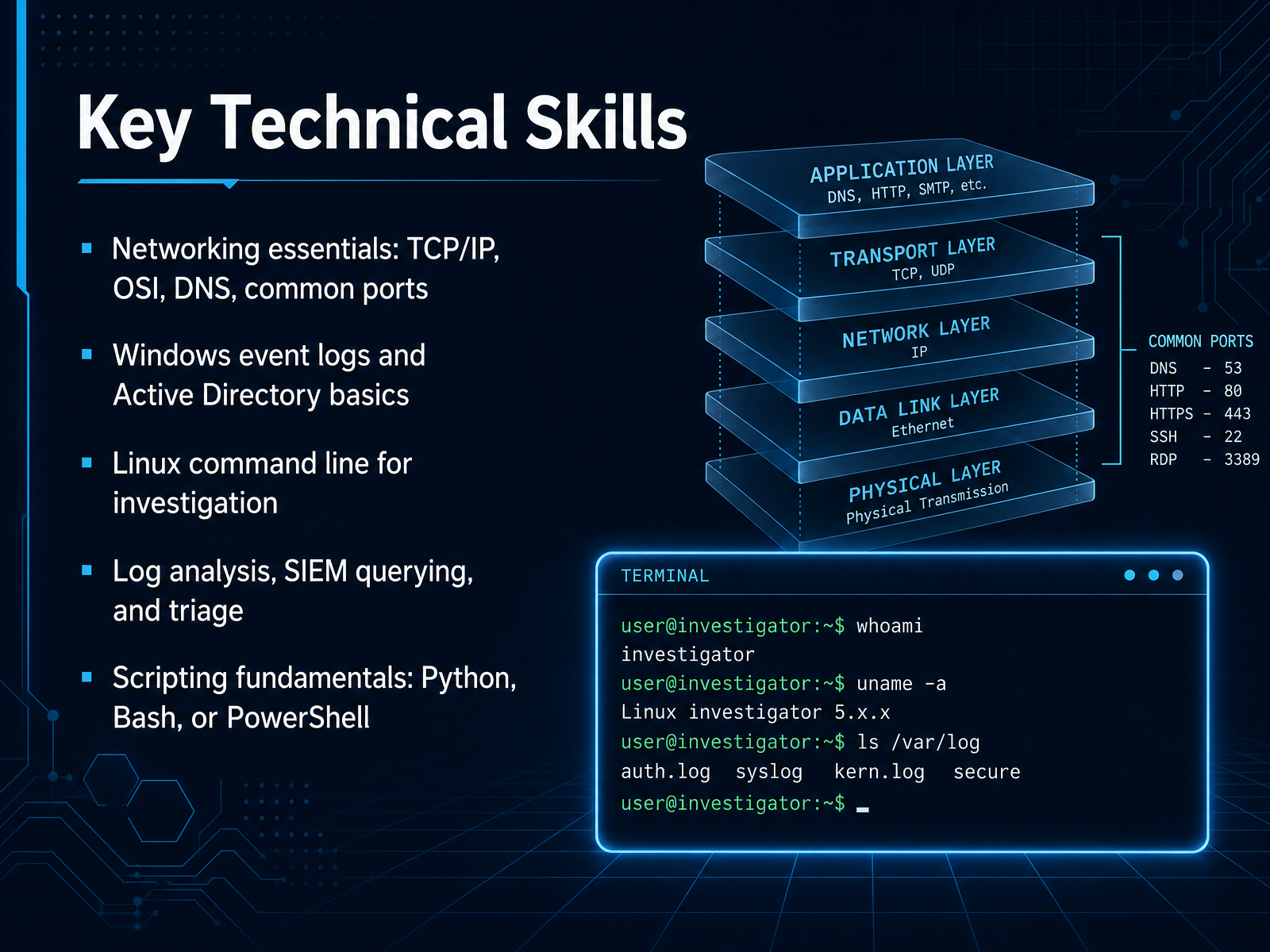
1 min - 06Key Technical SkillsLet’s get practical and talk about the technical toolkit you’ll actually use. First, networking essentials. You need a solid grip on TCP/IP, the OSI model, DNS, and common ports. Think of them as the map of how data travels. You can’t investigate a traffic puzzle without knowing the roads. Next, Windows event logs and Active Directory basics. Most corporate environments run on them, and suspicious logins often leave traces right there. Spend time understanding what normal looks like. Then, Linux command line. You don’t need to be a sysadmin, but you need to be comfortable navigating and searching quickly. Your investigations will often start there. After that, log analysis and SIEM querying. This is your core triage workflow: pulling the right logs, asking the right questions, and deciding what deserves a deeper look. Finally, scripting fundamentals in Python, Bash, or PowerShell. Automation is your friend. It helps you turn repetitive checks into consistent checks. Even a few simple scripts can dramatically cut your response time. Remember, you’re not memorizing every technical detail today. You’re building the layers you’ll rely on. Master these basics, and you’ll be ready for the next step: understanding the threats themselves.
 1 min
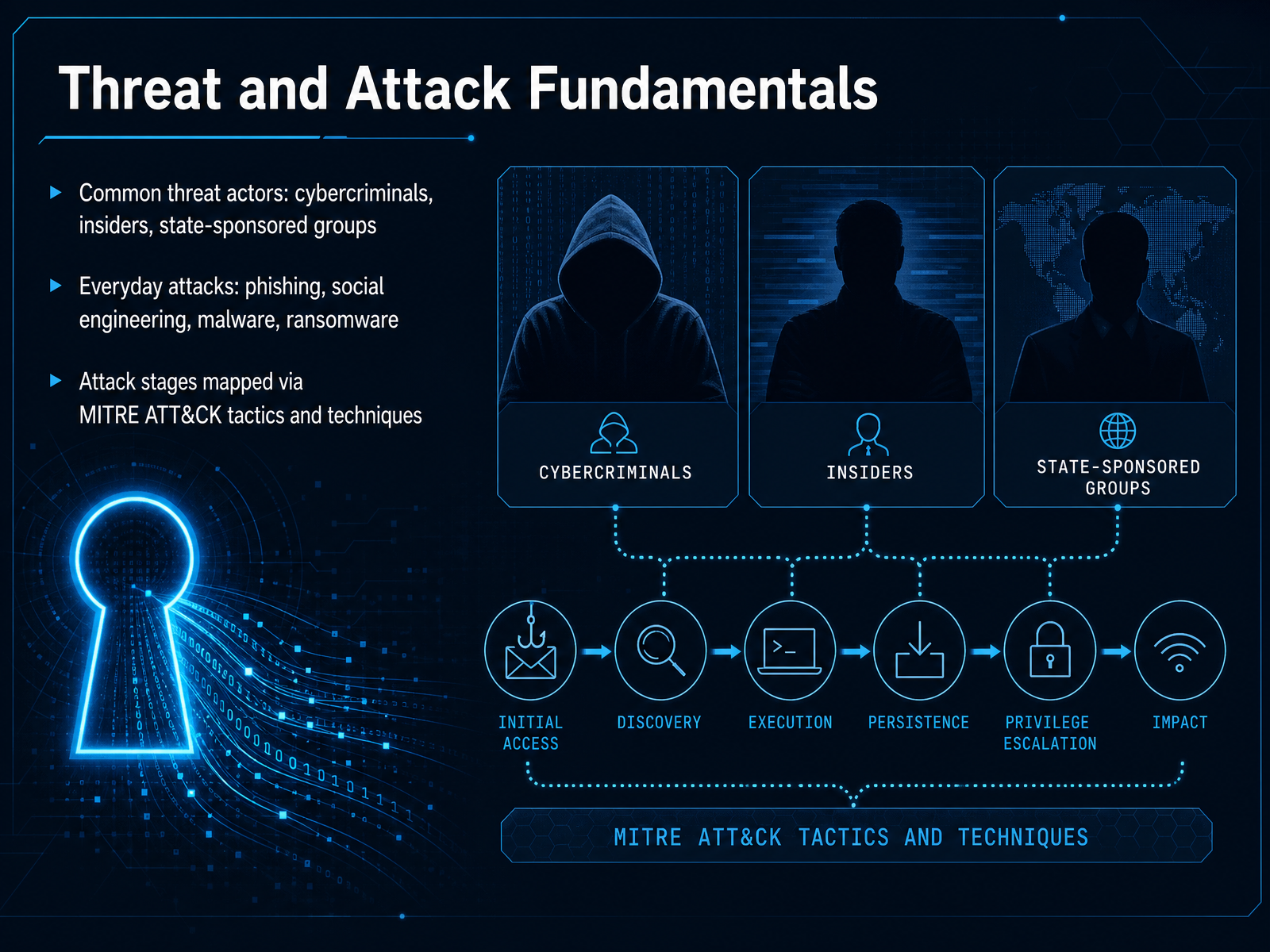
1 min - 07Threat and Attack FundamentalsNow let’s get into the fundamentals of threats and attacks. First, know your actors. Cybercriminals are usually after money. Insiders, whether careless or malicious, already have access. And state-sponsored groups are after strategic data. Each one behaves differently, so you need to tailor your defenses accordingly. On the attack side, phishing is still the number one entry point. Social engineering plays on trust. Malware and ransomware follow once that trust is broken. Remember that most attacks are not random. They follow stages, starting with reconnaissance and ending with impact. That’s where the MITRE ATT&CK framework helps. It maps each stage to specific tactics and techniques. So when you see an alert, you can ask, where are we in this chain? And more importantly, what should we do next? That shift, from reacting to an event to understanding the full attack lifecycle, is what really defines your role. Keep that perspective ready, because next we will look at the analytical and behavioral skills you will need to act on it.
 1 min
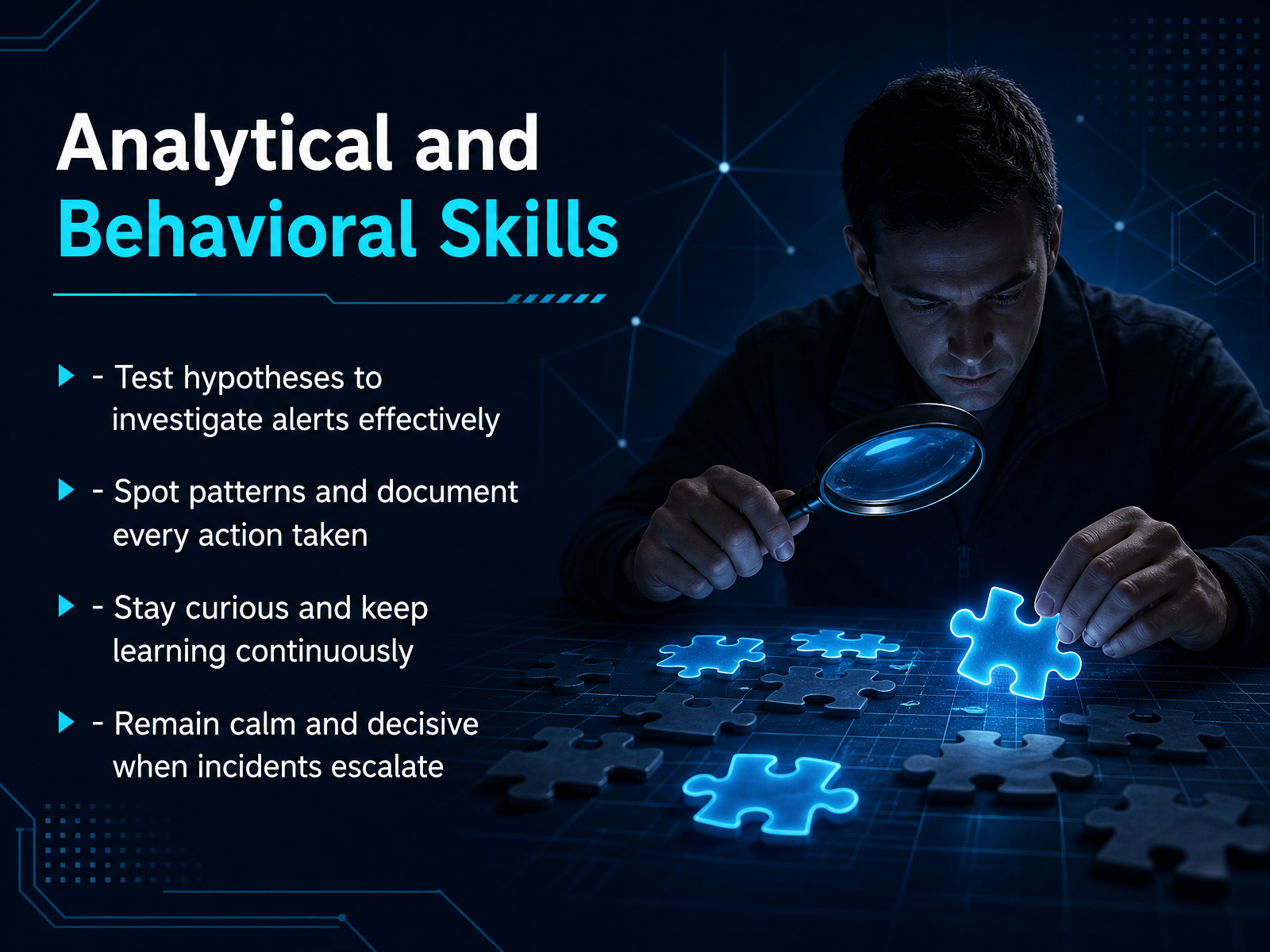
1 min - 08Analytical and Behavioral SkillsNow let's talk about the analytical and behavioral side of the role. Because technical knowledge alone won't carry you through a tough investigation. Start by treating every alert like a hypothesis. Ask yourself, what would have to be true for this alert to be real? Then test it. Look at the logs, check the timeline, and rule out the false positives before you act. Documenting every step is just as important. Write down what you checked, what you found, and what you decided. That record protects you, your team, and your organization later. Next, stay curious. Threats evolve constantly, and so should you. Read the write-ups, ask questions, and dig into anomalies just because they seem odd. That curiosity is what turns a good analyst into a great one. And finally, when an incident escalates, stay calm and decisive. The pressure will spike. The noise will increase. But your voice should stay steady. Prioritize the biggest risk, make the call, and keep moving. So here is your takeaway for today. Build your investigation on clear hypotheses, document as you go, and keep learning. Your composure under pressure is what makes the team trust you. Up next, we will look at the common tools and technologies that support you in this work every day.
 2 min
2 min - 09Common Tools and TechnologiesNow let's get hands-on with the core tools you'll use every day. First, Security Information and Event Management platforms, or SIEMs. Splunk, Sentinel, QRadar, Elastic SIEM — these aggregate logs from across your network, making it possible to search through millions of events in seconds. Then there are Endpoint Detection and Response tools, or EDR. CrowdStrike, SentinelOne, Defender for Endpoint. They sit on individual devices, watching for suspicious behavior and giving you the ability to isolate a machine before an infection spreads. Next up is SOAR, which stands for Security Orchestration, Automation, and Response. SOAR platforms take repetitive parts of incident response—like collecting logs or opening tickets—and automate them, so you can focus on the complex decisions. Threat intelligence feeds are also critical. They enrich the alerts you're seeing with real-world context, like known attacker infrastructure or emerging malware signatures. And don't overlook the classics. Wireshark gives you packet-level visibility when you need to dig into raw network traffic. You won't use it every day, but when you do, it's a game changer. The takeaway is simple: tools are multipliers for your expertise, not substitutes for it. Spend time getting comfortable with interface and workflow of your primary SIEM and EDR, and remember the fundamentals underneath. Next, we'll talk about communication and reporting, where you'll translate all this technical detail into decisions that actually move the needle.
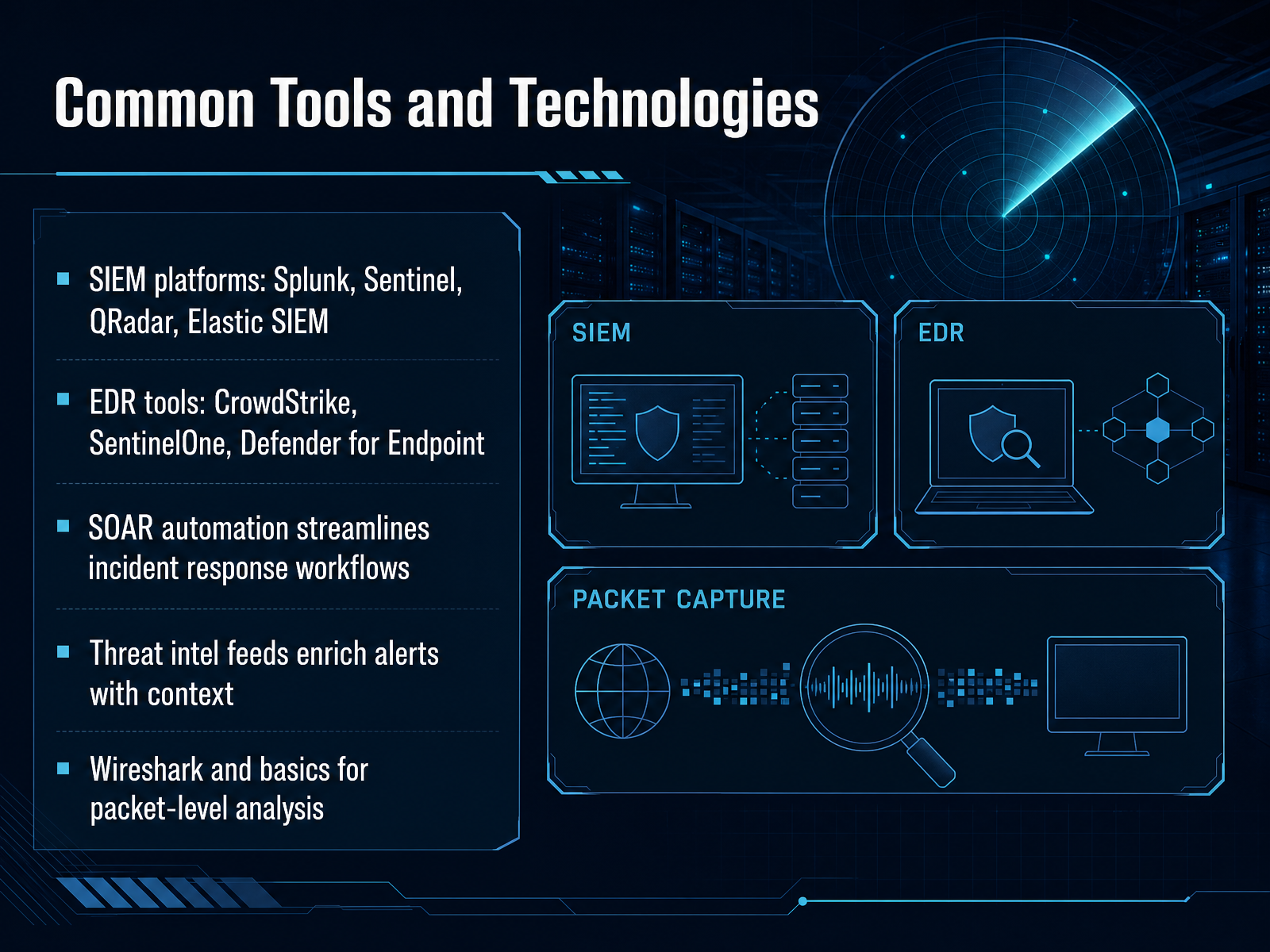 2 min
2 min - 10Communication and ReportingLet’s talk about communication and reporting, because this is where your technical work becomes visible to the rest of the organization. Start with clear incident notes, tickets, and shift handoffs. Imagine picking up a ticket where the last analyst wrote, "Weird traffic, maybe malware." That’s not helpful. Instead, describe what you saw, when you saw it, and what you already checked. That gives the next person a running start. Escalation is similar. When you hand something to a senior analyst or manager, bring precise detail: what’s affected, what evidence you have, and what you’ve tried so far. That saves everyone time and builds trust. Finally, practice translating technical findings for non-technical stakeholders. A manager may not care about the exact malware family, but they do care about business risk and what it means for operations. Say things like, "We found a suspicious download on three employee laptops. We’re containing it now and expect no customer data exposure." That kind of clarity guides decisions. Remember, every report you write is a chance to show your value as a strategic partner. Now, let’s move into how you turn those reports into action with the incident response and investigation workflow.
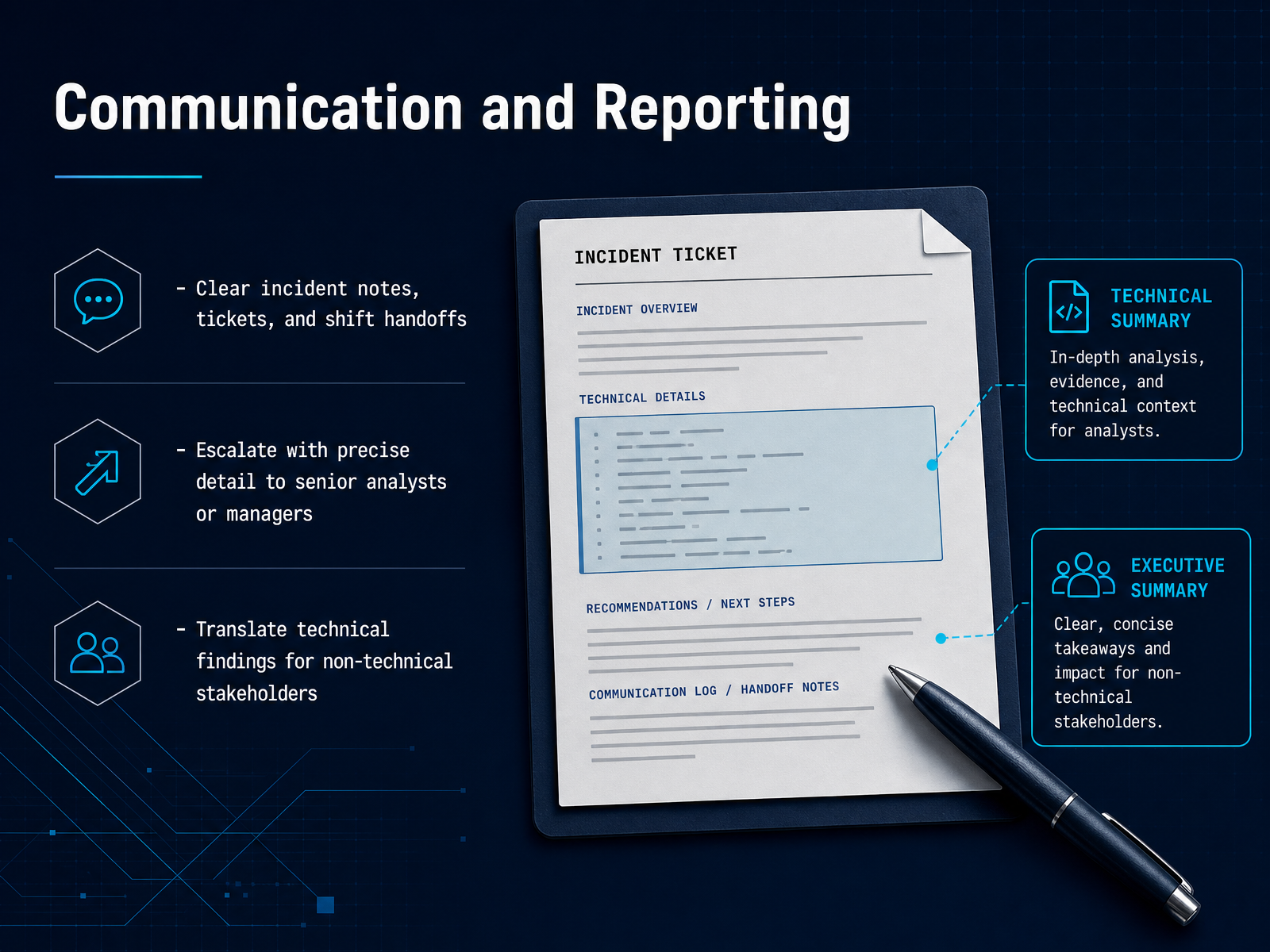 1 min
1 min - 11Incident Response and Investigation WorkflowLet’s walk through the incident response workflow, because this is where your analytical skills really shine. Think of it as a structured way to handle chaos. The NIST lifecycle gives you five clear phases: detect, contain, eradicate, recover, and learn. You spot the anomaly, you stop it from spreading, you remove the threat, you restore normal operations, and then you review what happened so you can do better next time. That last piece, learning, is what separates reactive teams from mature ones. Now, in practice, you won’t be improvising every step. You’ll follow playbooks. These are pre-written procedures that guide you from alert to triage, then into investigation, and finally to containment. For example, a phishing email alert might trigger a playbook that tells you exactly how to isolate the mailbox and what indicators to check for. This keeps your response consistent and fast. Work is also divided by tiers. Tier one triages, meaning they sort and prioritize alerts. Tier two investigates deeper, hunting for root causes. Tier three handles complex escalations, like full malware analysis. You’ll start at tier one, but remember, every tier builds on the same logical thinking. Before you know it, you’ll be the one guiding others through the workflow. Next, let’s look at how these skills can shape your career paths.
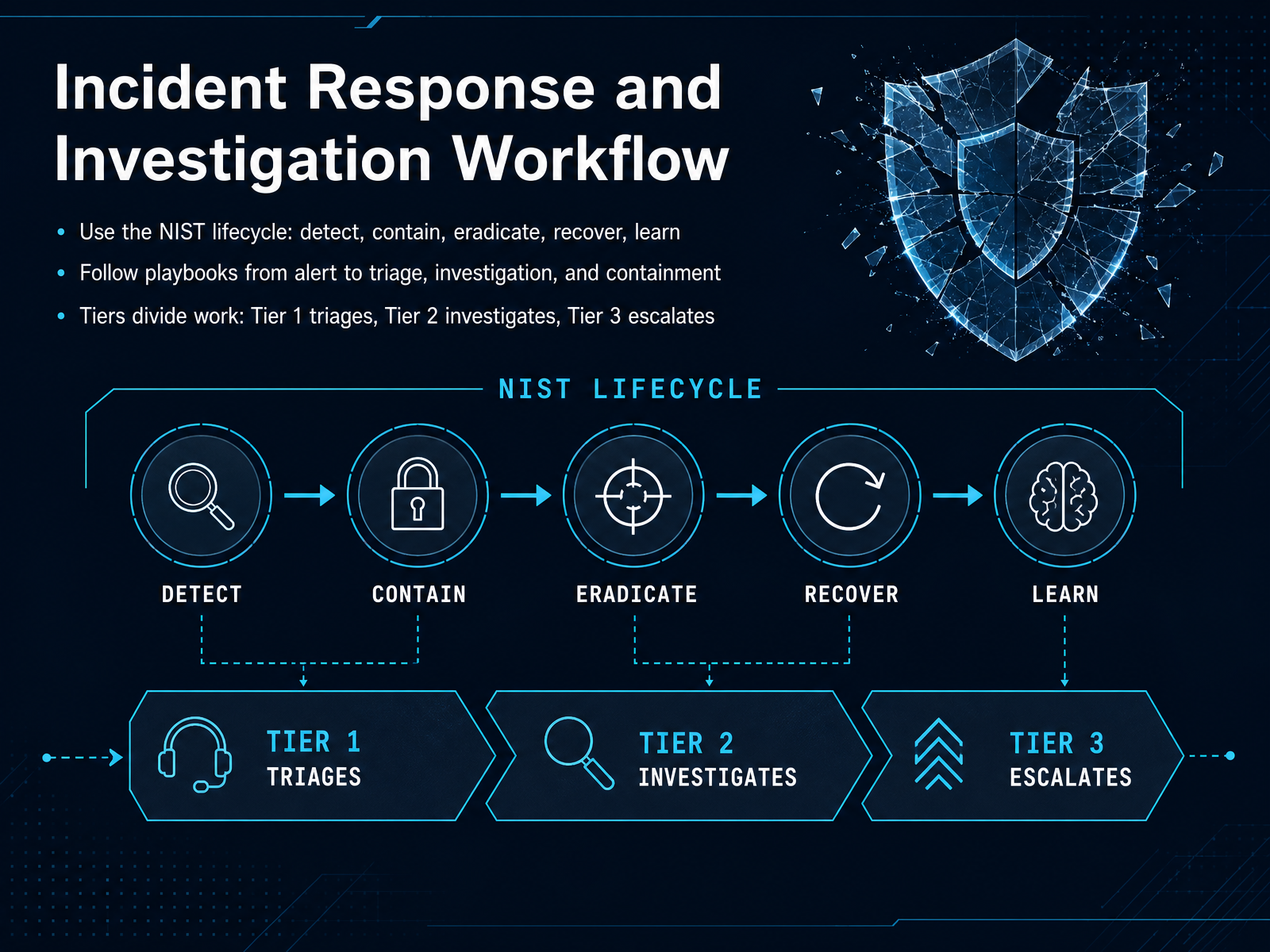 1 min
1 min - 12Career PathsLet’s talk about where this role can take you, because the analyst seat is rarely a dead end. Most people start at the entry level, often as a SOC Tier 1 analyst or a junior security analyst, and a lot of that work involves vulnerability management, triaging alerts, and learning the rhythm of your organization’s defenses. From there, growth usually means moving into Tier 2 or Tier 3 SOC work, where you dig into investigations that need more context. Some analysts pivot into threat hunting, actively searching for the quiet signs of compromise before an alarm even sounds, or they become detection engineers, building the rules that make the tools sharper. After a few years, many choose to specialize, and two big lanes right now are cloud security and identity security, since that’s where attackers keep focusing their energy. Others step into adjacent roles, like security engineer, incident responder, or a governance, risk, and compliance analyst, which is often called GRC for short. The key takeaway here is that your early years are about building pattern recognition and a solid technical foundation, and those skills carry you into whichever direction fits your strengths best. So, think about what kind of problem you enjoy solving most, because that choice shapes your next move. Up next, we’ll map out the certifications and learning pathways that can support each of these directions.
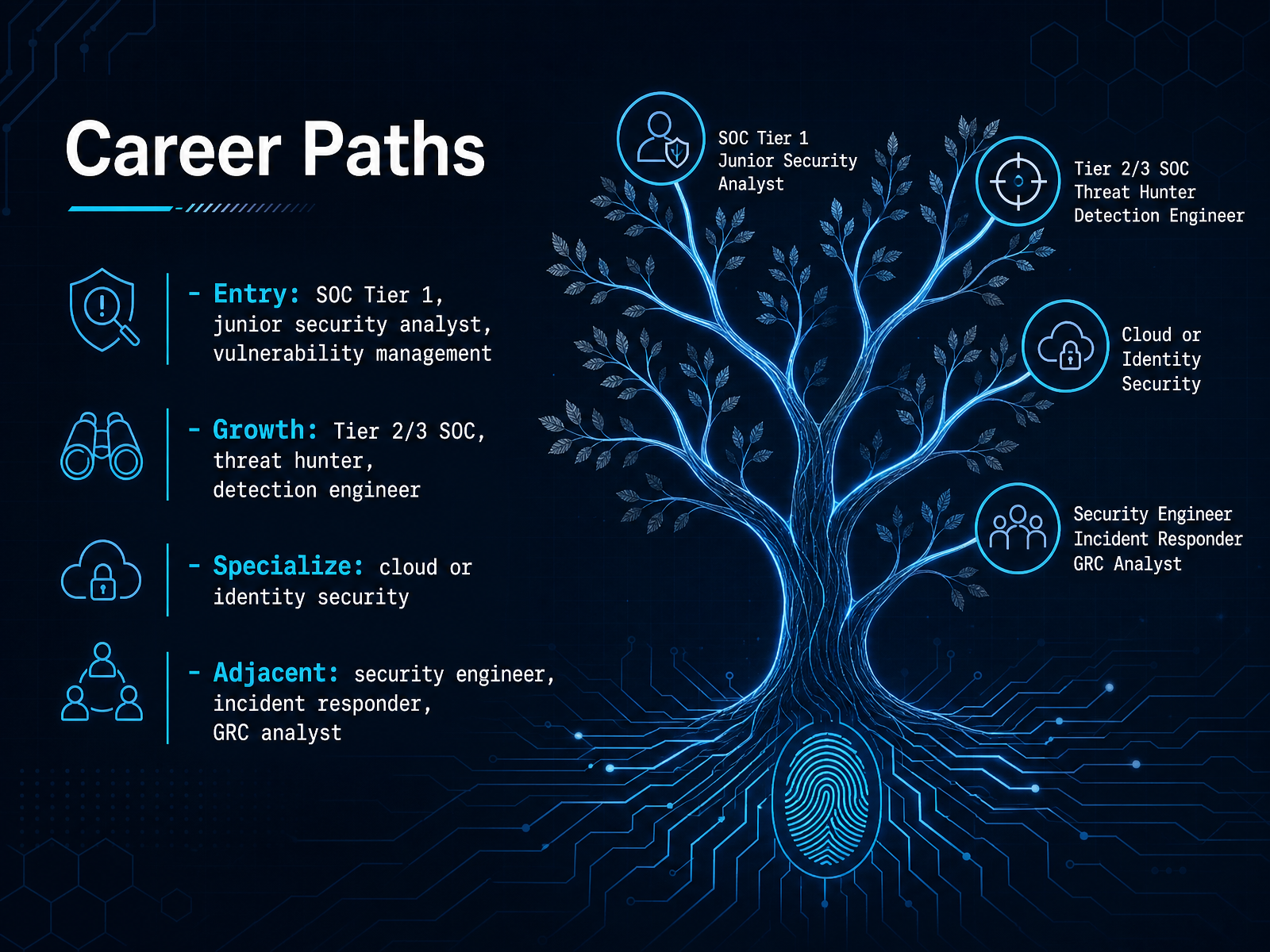 2 min
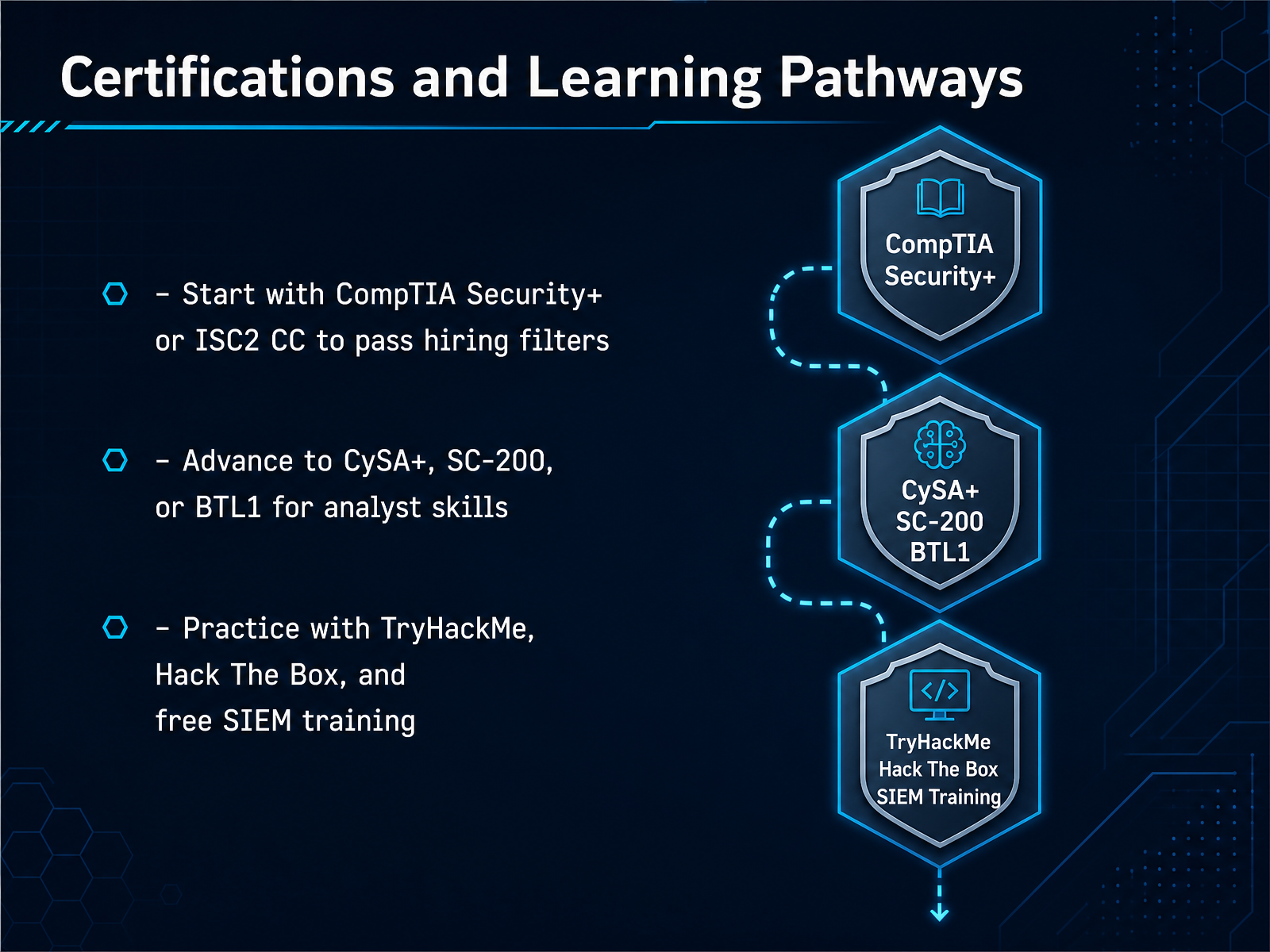
2 min - 13Certifications and Learning PathwaysNow let’s talk about certifications and learning pathways. If you’re job hunting, start with CompTIA Security+ or the ISC2 Certified in Cybersecurity. These are the ones that get your resume past the automated filters. Think of them as your ticket into the conversation. Once you’re in, that’s when you build analyst-specific skills. CySA+, SC-200, or Blue Team Level 1 are great choices here. They focus on detection, response, and the day-to-day work of monitoring and investigating. But certifications alone won’t make you sharp. You need reps. That’s where platforms like TryHackMe and Hack The Box come in. They give you real scenarios to practice on. And if you can, get hands-on with free SIEM training. That’s where you’ll actually feel the rhythm of triaging alerts. Here’s the takeaway: use certifications to open doors, but use practice to build the confidence you’ll need once you’re through them. Keep that momentum going, because next we’re looking at practical next steps you can take right away.
 2 min
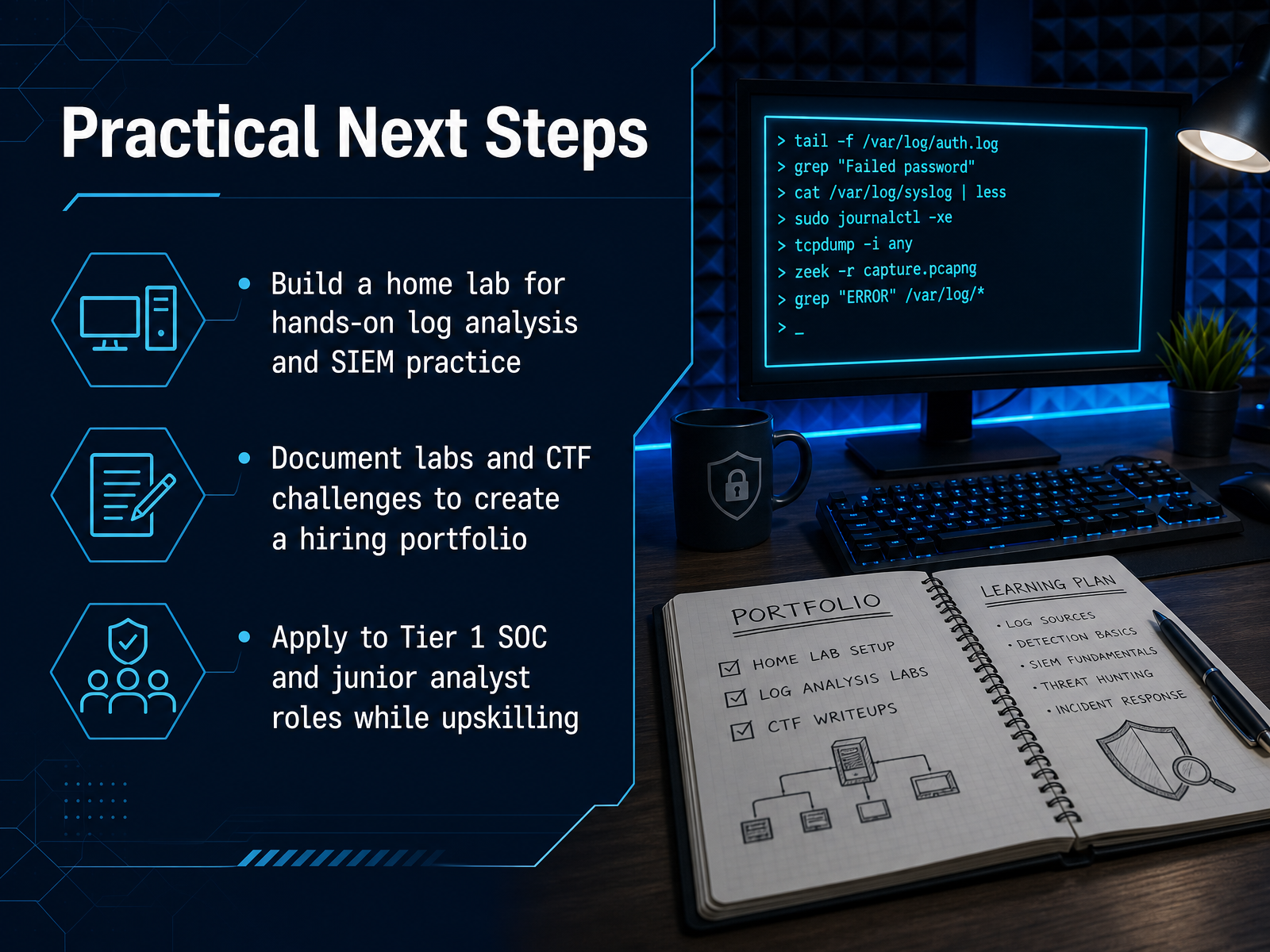
2 min - 14Practical Next StepsSo, where do you go from here? Start by building a home lab. You can use free tools like Splunk Free or the Elastic Stack to practice log analysis and SIEM queries. Run some attacks in a sandboxed environment and watch how they appear in the logs. Hands-on practice is the fastest way to build confidence. Next, document everything. Keep a portfolio of your lab setups, your write-ups of CTF challenges, and any incident scenarios you worked through. Treat this like a hiring portfolio. It shows managers that you can think through problems and explain your decisions. That is exactly what we look for. Finally, apply to Tier 1 SOC roles and junior analyst positions even while you are still upskilling. Many teams hire for curiosity and work ethic, then train the technical details. Your lab work shows you already have the mindset. Start small, stay consistent, and keep building. The role is demanding, but it rewards people who take initiative. You have the roadmap now. Go make it happen. Thank you for your time, and best of luck on your journey.
 2 min
2 min
Take the deck with you
Download this course as a file — free, no sign-up needed.
- PDF handoutEvery slide page, ready to print or share.15 pages · 3.6 MBDownload
- Narrated PowerPointThe deck that presents itself — every slide carries the digital human's narration video.15 pages · 14.6 MBDownload
- PowerPoint slidesThe full deck as a .pptx — open it in PowerPoint, Keynote, or Google Slides.15 pages · 3.5 MBDownload
Free to use in your own training — please keep the PersonWise credit page at the end.
Have your own deck? Turn it into a course