Begin
14 pages · ~28 min
Responsible AI Platform Architecture
Equip technical teams to select and architect Responsible AI platforms, balancing tradeoffs in risk, compliance, and scalability.
A digital instructor presents all 14 pages. Hold “Ask” at any point and ask out loud — the answer comes from this course. No sign-up needed.
What you’ll learn
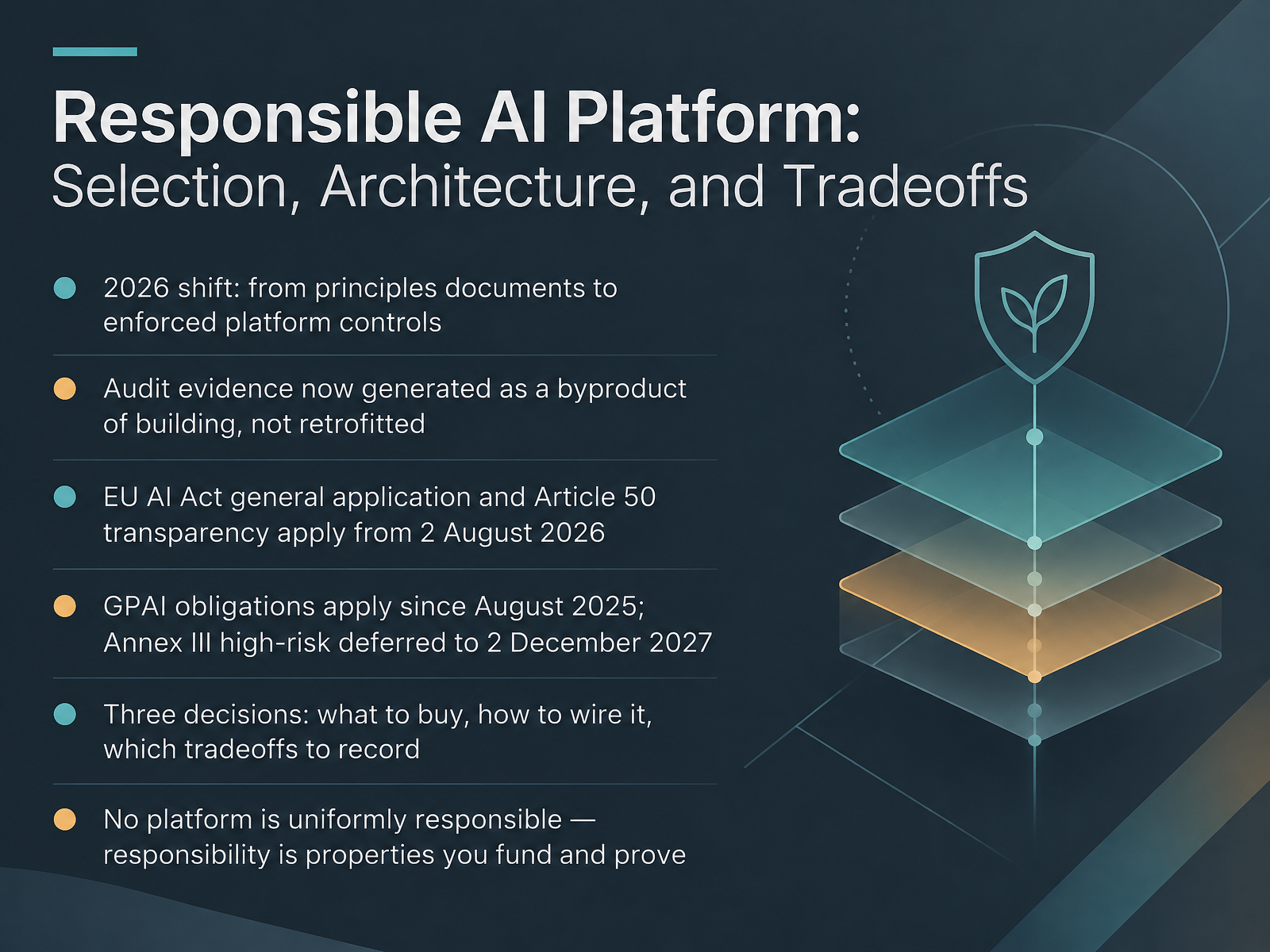
- 01Responsible AI Platform: Selection, Architecture, and TradeoffsWelcome. Over the next fourteen slides, we're going to work through responsible AI platforms: how to select them, how to architect them, and which tradeoffs you simply have to record and defend. This isn't a principles conversation. 2026 is the year the shift became real, from principles documents to enforced platform controls. Audit evidence is now generated as a byproduct of building, not retrofitted before an inspection. The dates matter. EU AI Act general application and Article 50 transparency apply from the second of August, 2026. General-purpose AI obligations have applied since August 2025, while Annex III high-risk requirements are deferred to the second of December, 2027. So three decisions sit in front of us. What to buy. How to wire it. And which tradeoffs to record, with named owners. Here's the framing I want you to hold: no platform is uniformly responsible. Responsibility is a set of properties you fund and prove, control by control. Next, we look at why platform engineering is the pressure point now: regulation, market behavior, and the failure modes that force the investment.ai-act-service-desk.ec.europa.eudigital-strategy.ec.europa.eufpf.org+22 min
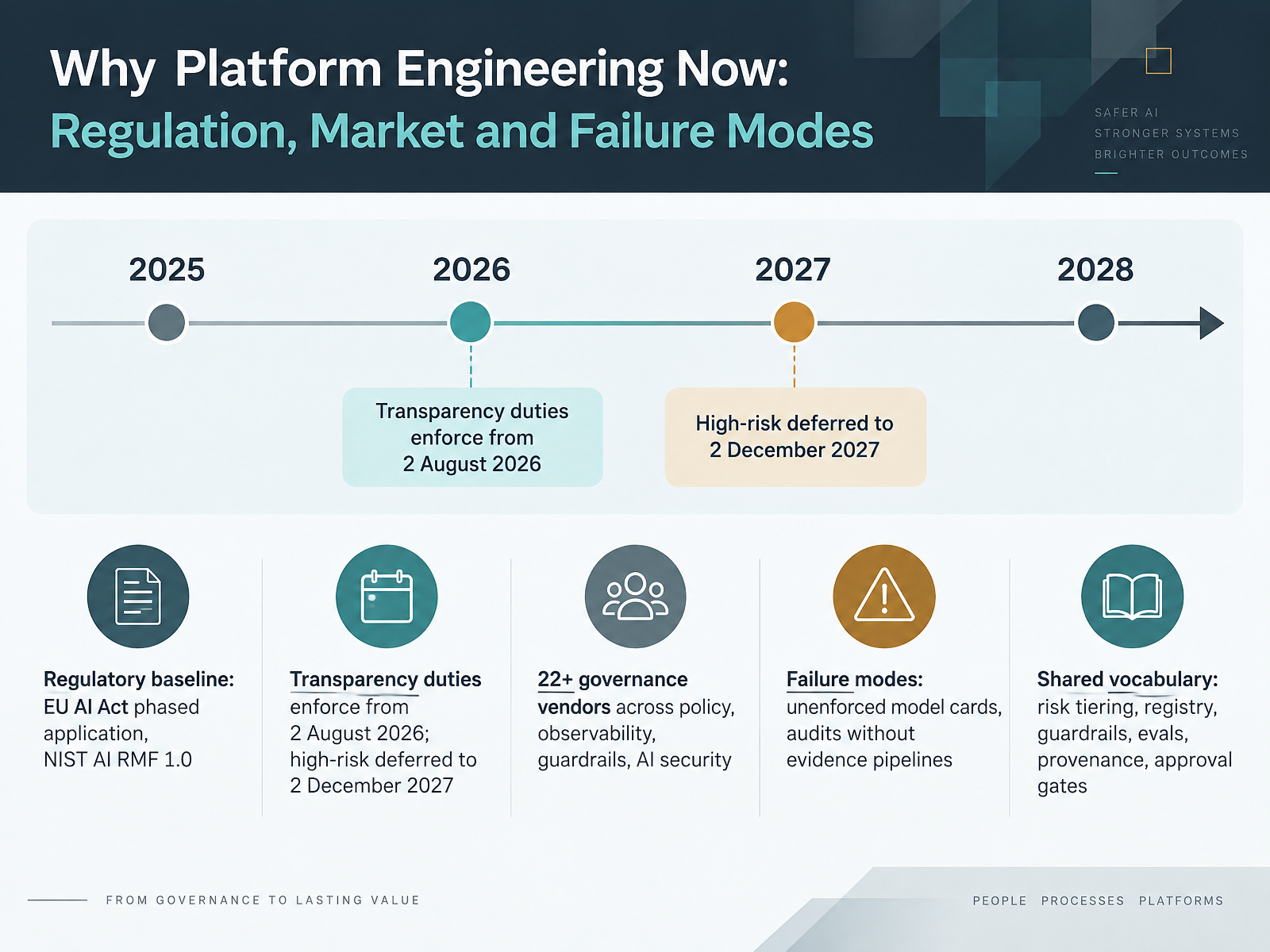
- 02Why Platform Engineering Now: Regulation, Market and Failure ModesLet us start with why platform engineering has become urgent. The regulatory baseline is real. The EU AI Act applies in phases, and NIST AI RMF 1.0 gives us a shared risk vocabulary. Transparency duties become enforceable on the second of August, twenty twenty-six. High-risk obligations were deferred to the second of December, twenty twenty-seven. That gap is a window. Use it to build evidence pipelines before audits arrive. The market now has more than twenty-two governance vendors across policy, observability, guardrails, and AI security. That choice is a tradeoff, not a shortcut. And the failure modes are predictable. Model cards no one enforces. Audits with no evidence pipeline behind them. So across platform, risk, and compliance roles, we need one shared vocabulary. Risk tiering, registry, guardrails, evaluations, provenance, and approval gates. From Principles to Enforceable Capabilities.
 ai-act-service-desk.ec.europa.eudigital-strategy.ec.europa.eufpf.org+22 min
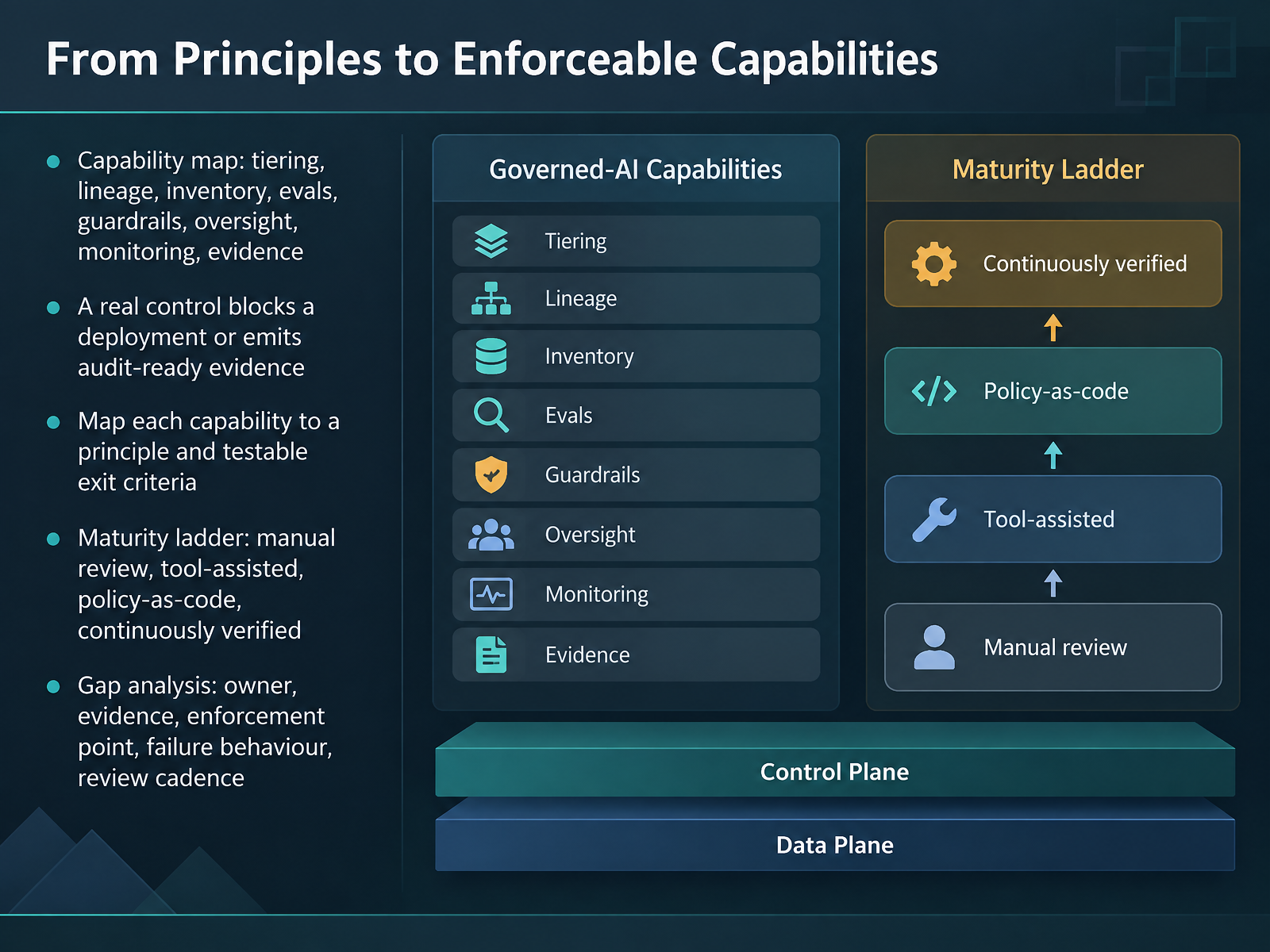
- 03From Principles to Enforceable CapabilitiesLet's move from principles to enforceable capabilities. A capability map has eight parts: tiering, lineage, inventory, evals, guardrails, oversight, monitoring, and evidence. Here's the test that matters. A real control either blocks a deployment or emits audit-ready evidence. If it does neither, it's documentation, not governance. Take a high-risk hiring model. Tiering flags it, evals test it for bias, and guardrails gate its release. The block is the control. The bias report is the evidence. Next, map each capability to a principle and to testable exit criteria. That mapping is what turns intent into something an auditor can verify. Then place yourself on the maturity ladder: manual review, tool-assisted, policy-as-code, continuously verified. Most enterprises sit at tool-assisted today. Finally, run a gap analysis across five fields: owner, evidence, enforcement point, failure behaviour, and review cadence. Failure behaviour matters most. Does the system deny, degrade, or route to a human? Next, we build, buy, or compose, and how to evaluate vendors.
 modulos.aiciopages.comkosmoy.com+22 min
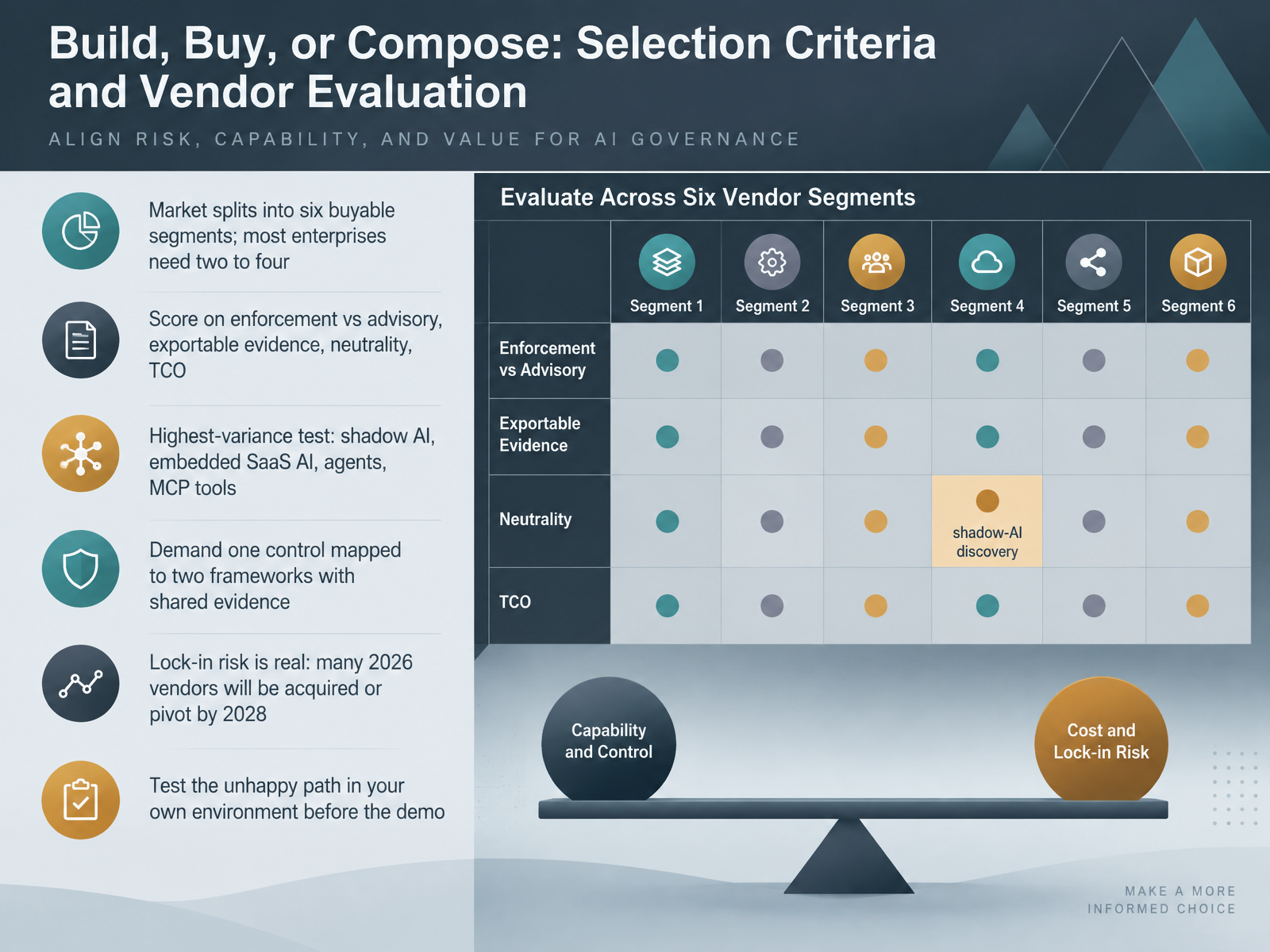
- 04Build, Buy, or Compose: Selection Criteria and Vendor EvaluationLet's talk about selection. The market splits into roughly six buyable segments: policy and compliance registries, observability, runtime enforcement, red teaming, enterprise suites, and platform-embedded governance. Most enterprises need two to four of them, not one. So score vendors on four questions. Does the control enforce, or only advise? Can you export evidence an external auditor accepts? Is the tool neutral across clouds and model providers, or does it lock you to one estate? And what is the true total cost of ownership, including integration and administration? The highest-variance test is discovery. Shadow AI, AI embedded in SaaS you already license, agents, and MCP tools. Ask the vendor to find AI you didn't tell them about. Demand one control mapped to two frameworks with shared evidence, because EU AI Act and ISO 42001 overlap by roughly forty to fifty percent. Lock-in risk is real. Many 2026 vendors will be acquired or pivot by 2028, so contract annually, not for five years. And test the unhappy path in your own environment before the polished demo. What happens when a model changes without notice, or an agent exceeds its authority? Next, we look at the architecture that makes this work: the control plane, the data plane, and the enforcement points.
 modulos.aiciopages.comkosmoy.com+22 min
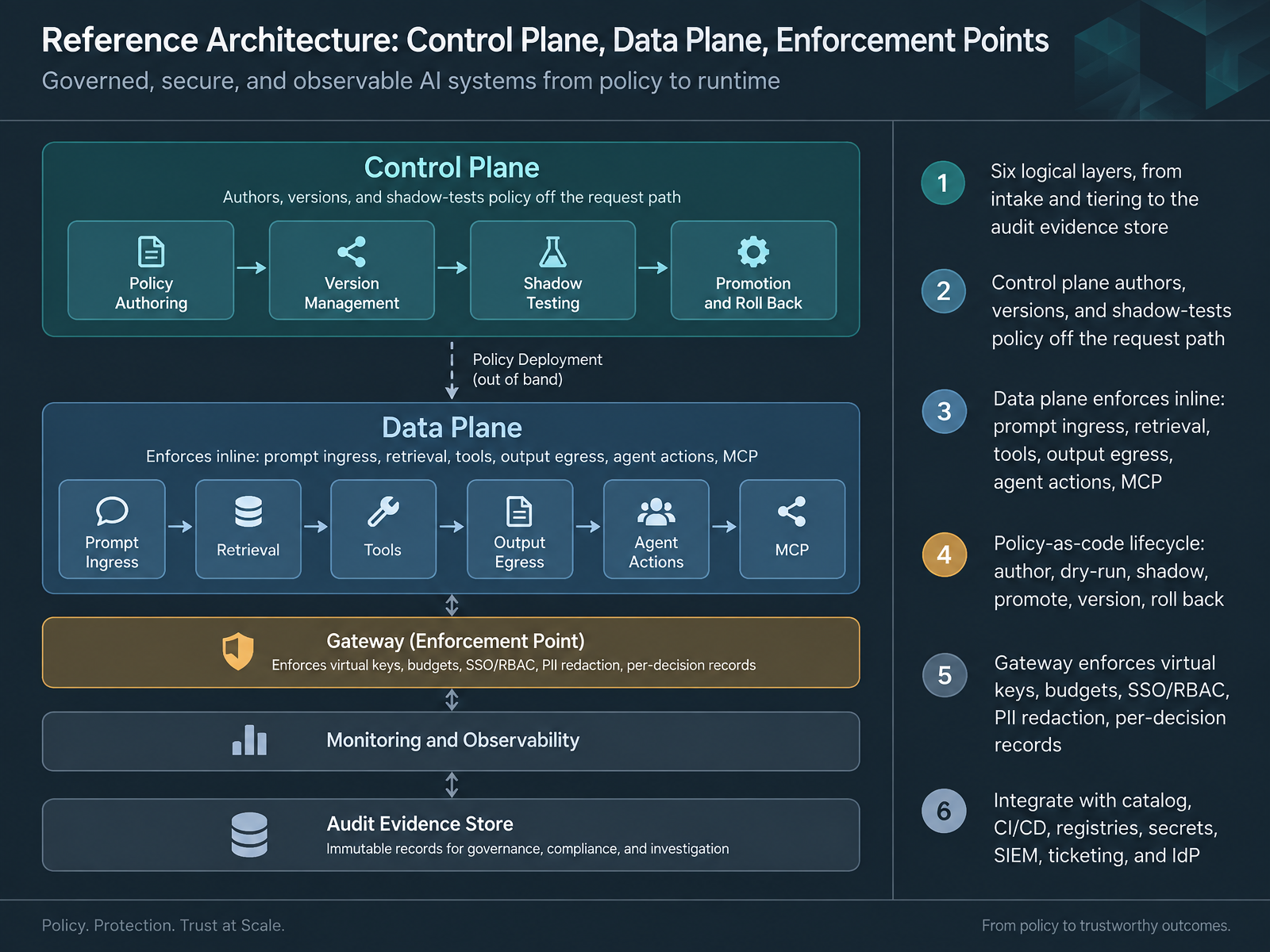
- 05Reference Architecture: Control Plane, Data Plane, Enforcement PointsLet's walk through the reference architecture. It has six logical layers, from intake and tiering at the top down to the audit evidence store. Two planes do the real work. The control plane authors, versions, and shadow-tests policy off the request path, so policy changes never slow down live traffic. The data plane enforces inline at every enforcement point: prompt ingress, retrieval, tools, output egress, agent actions, and MCP. Policy-as-code follows a lifecycle: author, dry-run, shadow, promote, version, and roll back. A gateway handles virtual keys, budgets, SSO and RBAC, PII redaction, and per-decision records. And it integrates with your catalog, CI and CD, registries, secrets, SIEM, ticketing, and identity provider. The tradeoff: central enforcement means one critical path. Next, Controls in Depth: Guardrails, Evaluation and Human Oversight.
 dvarahq.comgetmaxim.aicompelframework.org+21 min
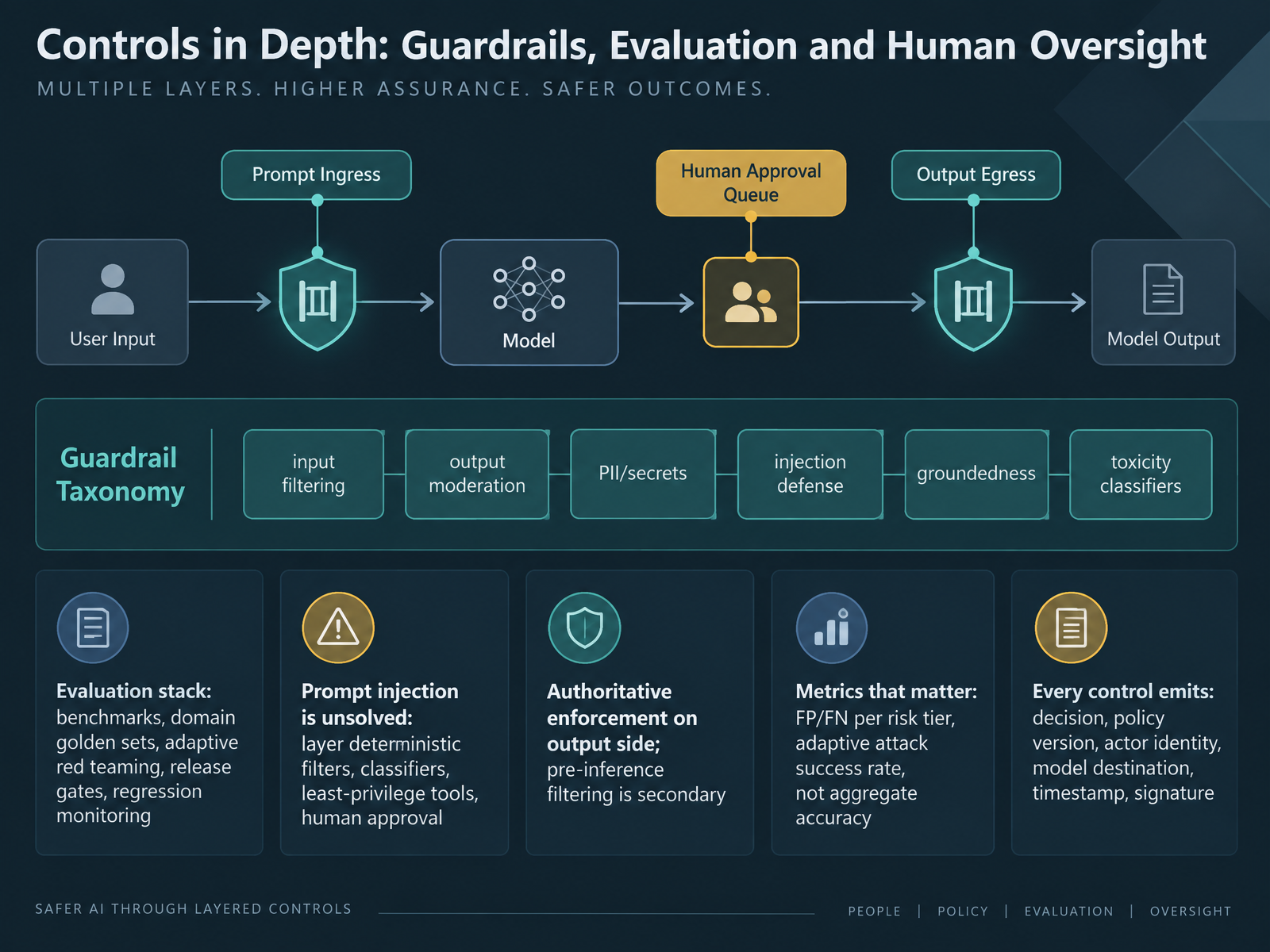
- 06Controls in Depth: Guardrails, Evaluation and Human OversightNow let's get concrete about controls in depth. Start with the guardrail taxonomy: input filtering, output moderation, PII and secrets detection, injection defense, groundedness checks, and toxicity classifiers. Then the evaluation stack: benchmarks, your domain golden sets, adaptive red teaming, release gates, and regression monitoring in production. One caveat you must internalize: prompt injection is unsolved. So layer deterministic filters, classifiers, least-privilege tools, and human approval for irreversible actions. Architecturally, the authoritative enforcement point sits on the output side, after the model responds. Pre-inference filtering matters, but it is secondary, because a compliant prompt can still produce non-compliant output. Measure per risk tier, not in aggregate. False positive and false negative rates per tier, and adaptive attack success rate. Aggregate accuracy hides the failures your risk owners actually care about. And every control must emit the same six fields: decision, policy version, actor identity, model destination, timestamp, and a tamper-evident signature. That record is what turns controls into evidence. Next, Cost and Latency of Control: Findings You Can Budget Against.
 dvarahq.comgetmaxim.aicompelframework.org+22 min
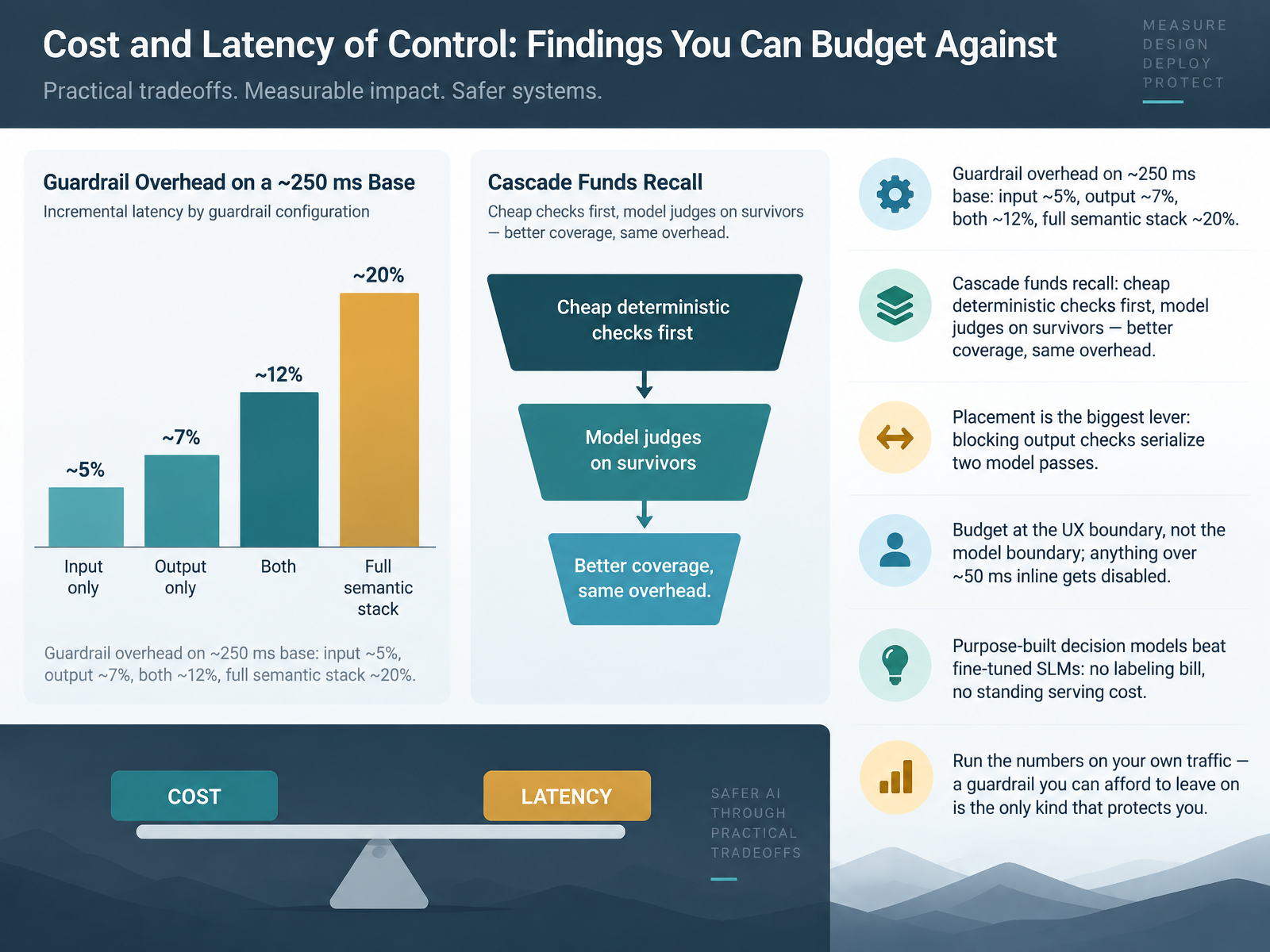
- 07Cost and Latency of Control: Findings You Can Budget AgainstLet's put real numbers behind the guardrail tradeoff. Against a two hundred fifty millisecond base model, input checks add about five percent, output checks about seven, both together about twelve, and a full semantic stack roughly twenty percent. Those are numbers you can defend in a budget review.
Two findings matter most. First, cascade: run cheap deterministic checks first, then let a model judge only the survivors. You get better recall at essentially the same overhead. Second, placement is your biggest lever. A blocking output check serializes two model passes, so the user waits for both.
Budget at the UX boundary, not the model boundary. In practice, anything over about fifty milliseconds inline gets disabled during an incident, and a guardrail someone turns off protects no one. Purpose-built decision models also beat fine-tuned small models on total cost: no labeling bill, no standing serving cost, no waiting for a training cycle.
So run the numbers on your own traffic. A guardrail you can afford to leave on is the only kind that actually protects you.
Next, we move to security, privacy, and the AI supply chain as platform primitives.
 arize.comdev.toplurai.ai+22 min
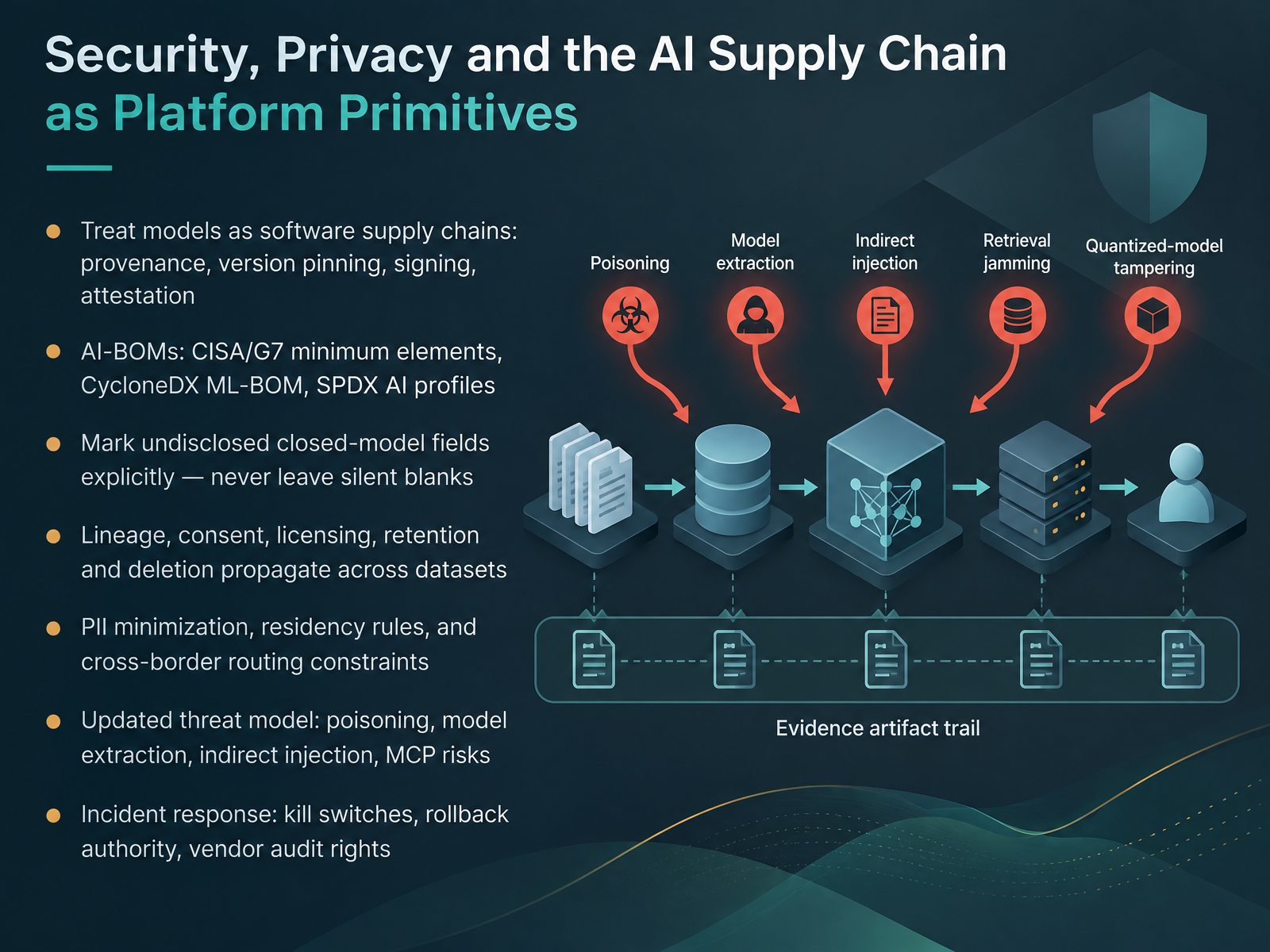
- 08Security, Privacy and the AI Supply Chain as Platform PrimitivesNow let's treat security, privacy, and the AI supply chain as platform primitives, not add-ons. Models are software supply chains. So apply the same discipline: provenance, version pinning, signing, and attestation. Your output is an AI bill of materials. CISA and G7 minimum elements set the baseline; CycloneDX ML-BOM and SPDX AI profiles give you machine-readable formats. One rule matters most here. For closed models, mark undisclosed fields explicitly. Never leave a silent blank. Blanks look like clean data, and that is exactly how audit failures start. Data lineage, consent, licensing, retention, and deletion propagate across every dataset. So do PII minimization, residency rules, and cross-border routing constraints. Update your threat model as well: poisoning, model extraction, indirect prompt injection, and MCP risks. And decide incident response before you need it. Kill switches, rollback authority, and vendor audit rights are design decisions, not escalation surprises. Next, let's look at the tradeoffs that decide the design. Tradeoffs That Decide the Design.
 ai-act-service-desk.ec.europa.eudigital-strategy.ec.europa.eufpf.org+22 min
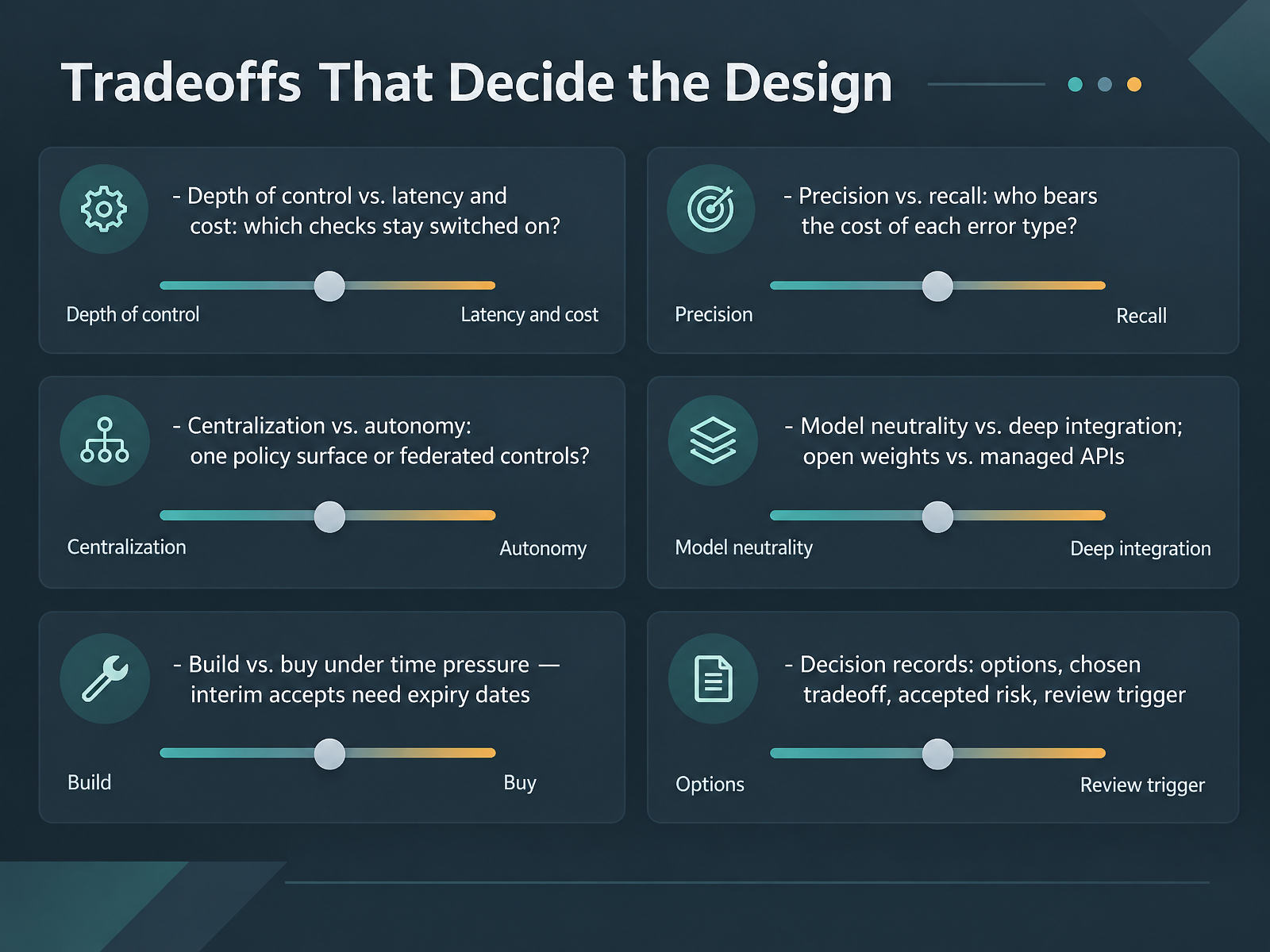
- 09Tradeoffs That Decide the DesignLet's talk about the tradeoffs that actually decide your design. Start with depth of control versus latency and cost. Guardrails sit on the hot path, so anything over about two hundred milliseconds gets disabled during an incident. Decide which checks stay switched on for every request, and which run asynchronously or on a sample. Then precision versus recall. A false positive turns away a legitimate customer. A false negative lets harm through. Name who bears each cost before you set the threshold. Next, centralization versus autonomy. One policy surface at a gateway gives you consistent enforcement and one audit trail, but federated controls let teams move fast. Most enterprises land at the gateway for identity, spend, and content, with local rules layered on top. Model neutrality versus deep integration is the same tension. Managed APIs ship in days but add a network hop and a third party in your request path. Open weights give you control and residency, but you own serving and drift. Build versus buy under time pressure is honest only when interim accepts carry expiry dates. Finally, keep decision records. Options considered, the tradeoff chosen, the accepted risk, and the review trigger. That record is what turns a design debate into an auditable decision. Next, we move to the operating model: roles, decision rights and evidence ownership.
 arize.comdev.toplurai.ai+22 min
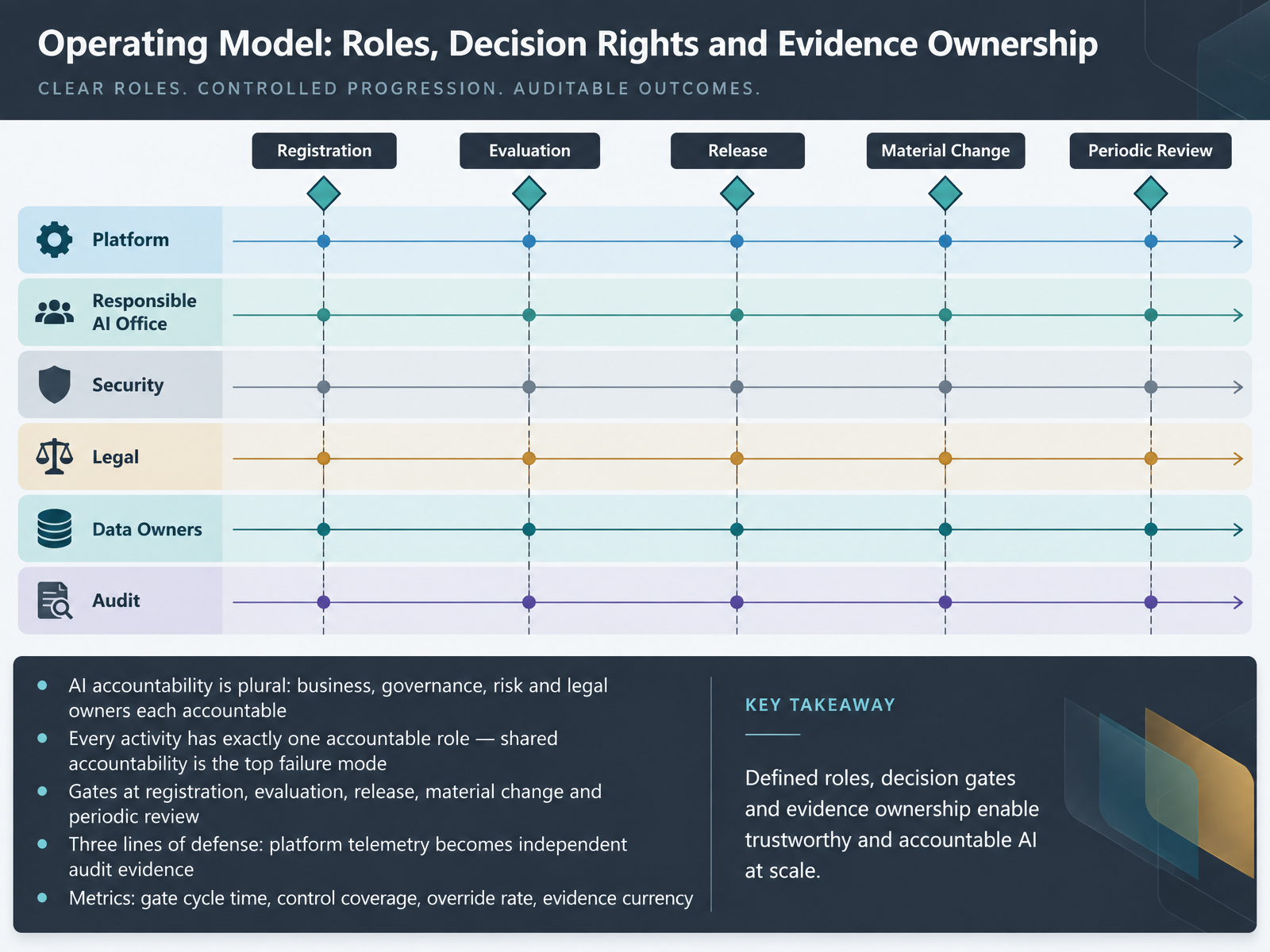
- 10Operating Model: Roles, Decision Rights and Evidence OwnershipLet's look at the operating model itself. AI accountability is plural. A business owner, a governance lead, a risk officer, and legal each carry real accountability. That is normal, and it is correct. But here is the rule that matters most. Every activity has exactly one accountable role. Shared accountability is the top failure mode, because when everyone owns it, no one does. So you place gates at registration, evaluation, release, material change, and periodic review, and each gate names one accountable approver. Then structure around three lines of defense. The first line builds and runs controls. The second line sets standards and challenges. The third line, internal audit, needs independent evidence. That is where platform telemetry earns its keep. Logs, approvals, and override records become audit evidence without extra manual effort. Track four metrics. Gate cycle time, control coverage, override rate, and evidence currency. If evidence is stale, the control is not operational. Next, we move to the Adoption Roadmap and Common Pitfalls.
 2 min
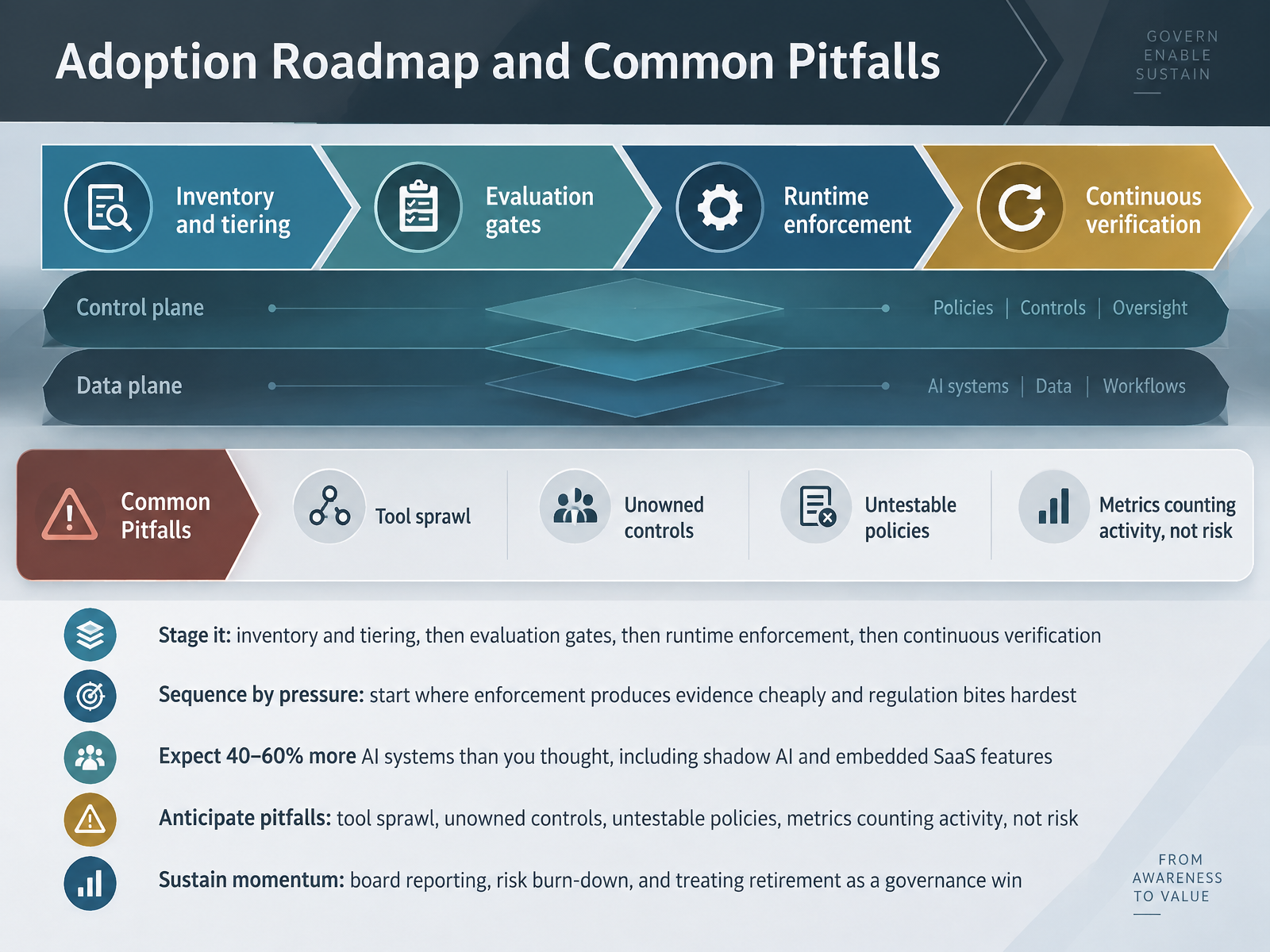
- 11Adoption Roadmap and Common PitfallsNow let's talk about sequencing. Stage your rollout in four moves: inventory and tiering, then evaluation gates, then runtime enforcement, then continuous verification. Each stage produces evidence the next one depends on. Sequence by pressure, not by elegance. Start where enforcement generates evidence cheaply and regulation bites hardest, such as a customer-facing system in a regulated market. Then plan for volume surprises. Expect forty to sixty percent more AI systems than you thought, including shadow AI and embedded features inside software you already license. Four pitfalls to watch: tool sprawl across overlapping platforms, unowned controls, policies nobody can test, and metrics that count activity rather than risk. To sustain momentum, give the board a recurring view, burn down risk quarter over quarter, and treat retirement as a governance win, not a failure. That is how programs stay credible after the first year. Next, we move from roadmap to evaluation: Workshop Part 1, Scoring Candidate Configurations Against Your Risk Tiers.
 ciopages.commodulos.aikosmoy.com+22 min
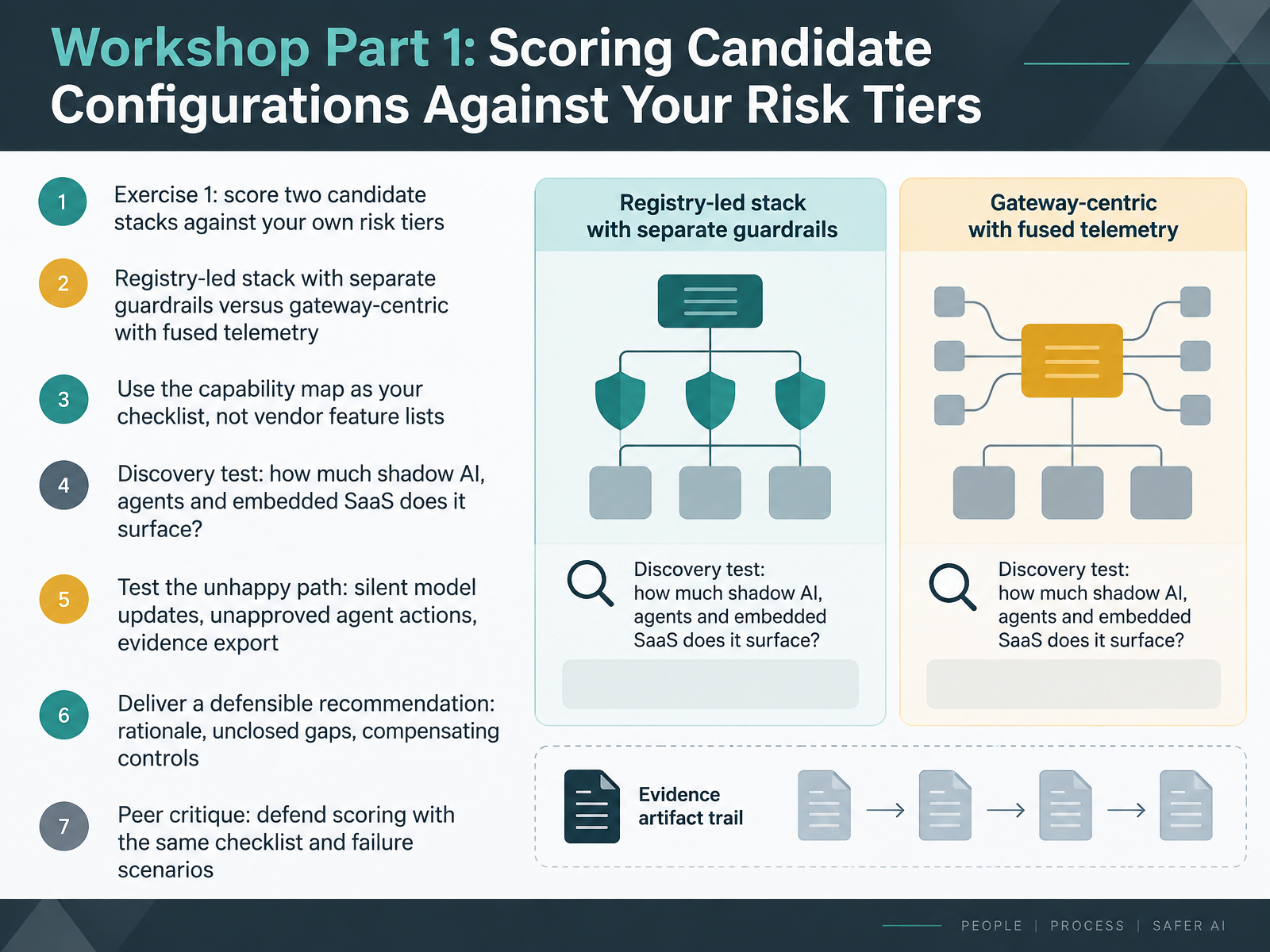
- 12Workshop Part 1: Scoring Candidate Configurations Against Your Risk TiersNow let us put that capability map to work. In Workshop Part One, you will score two candidate configurations against your own risk tiers. Candidate one is registry-led, with separate guardrails. Candidate two is gateway-centric, with fused telemetry. Use the capability map as your checklist, not the vendor feature list. First, run the discovery test. How much shadow AI, agent activity, and embedded AI in SaaS does each stack surface? Second, test the unhappy path. What happens on a silent model update, an unapproved agent action, or an evidence export request at audit time? Then deliver a defensible recommendation. State your rationale, name the gaps you could not close, and list compensating controls. Finally, peer critique. Defend your scoring using the same checklist and the same failure scenarios. Aim for a recommendation your risk committee could sign without rework. Next, Workshop Part Two, Enforcement-Point Architecture for a High-Risk Use Case.
 modulos.aiciopages.comkosmoy.com+22 min
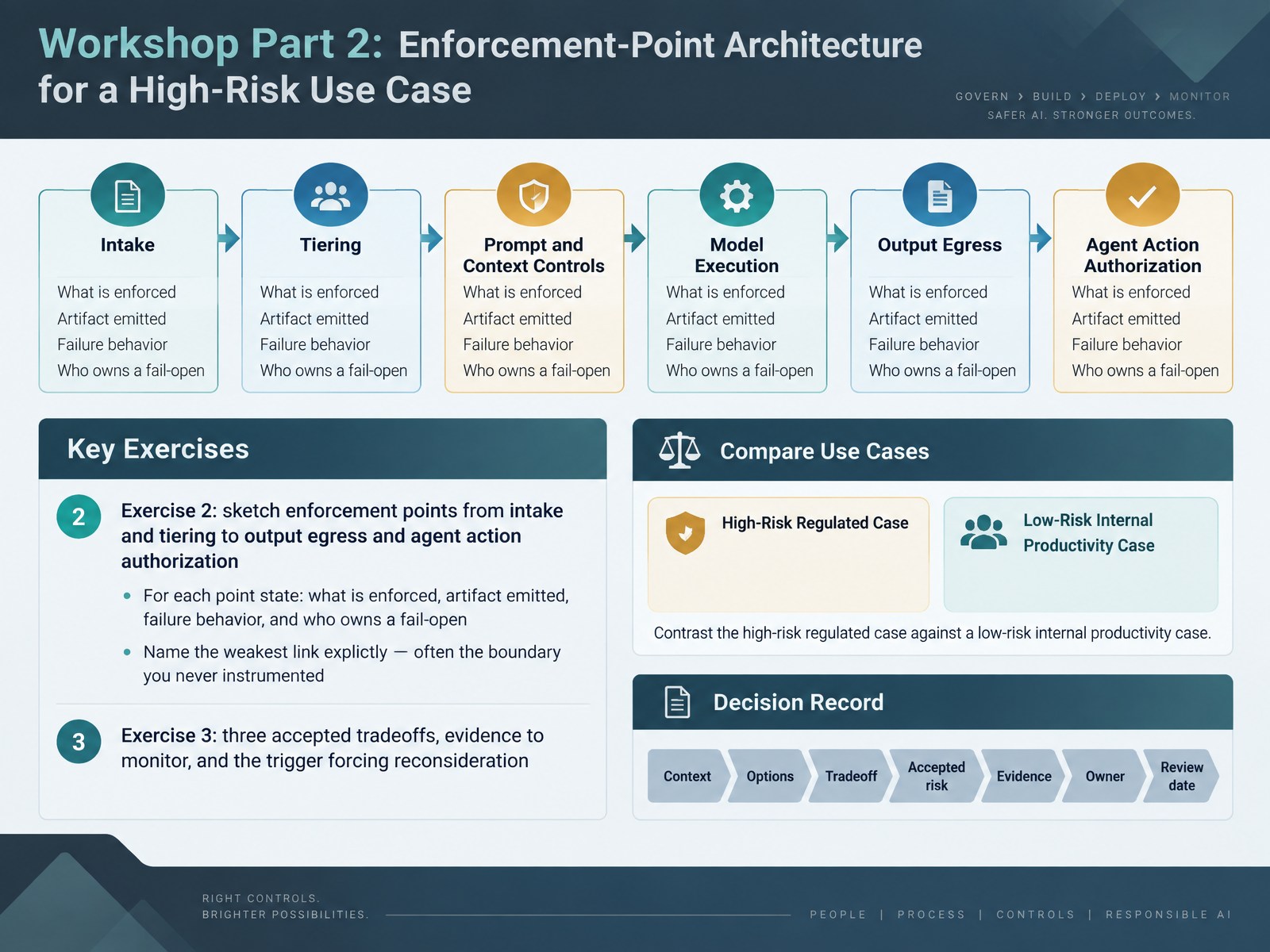
- 13Workshop Part 2: Enforcement-Point Architecture for a High-Risk Use CaseNow let's apply that. In this second workshop exercise, you sketch the enforcement points for one high-risk use case, from intake and tiering all the way to output egress and agent action authorization. At each point, state four things: what is enforced, what artifact is emitted, what happens on failure, and who owns a fail-open decision. That last one is where most teams stall, because fail-open is a risk acceptance, not an engineering default. Name your weakest link out loud. It is usually the boundary you never instrumented. Then, for exercise three, document three accepted tradeoffs, the evidence you will monitor, and the trigger that forces reconsideration. Now contrast the high-risk regulated case against a low-risk internal productivity tool. The regulated case needs output-side enforcement, tamper-evident audit records, and human approval on side effects. A low-risk internal tool can often live with input filtering and basic logging. Different evidence, different oversight. Close by filling in the decision record: context, options, tradeoff, accepted risk, evidence, owner, and review date. Next, we move to committing back at work, covering owners, evidence, and review triggers.
 dvarahq.comgetmaxim.aicompelframework.org+22 min
- 14Committing Back at Work: Owners, Evidence and Review TriggersLet's close by turning all of this into commitments you make back at work.
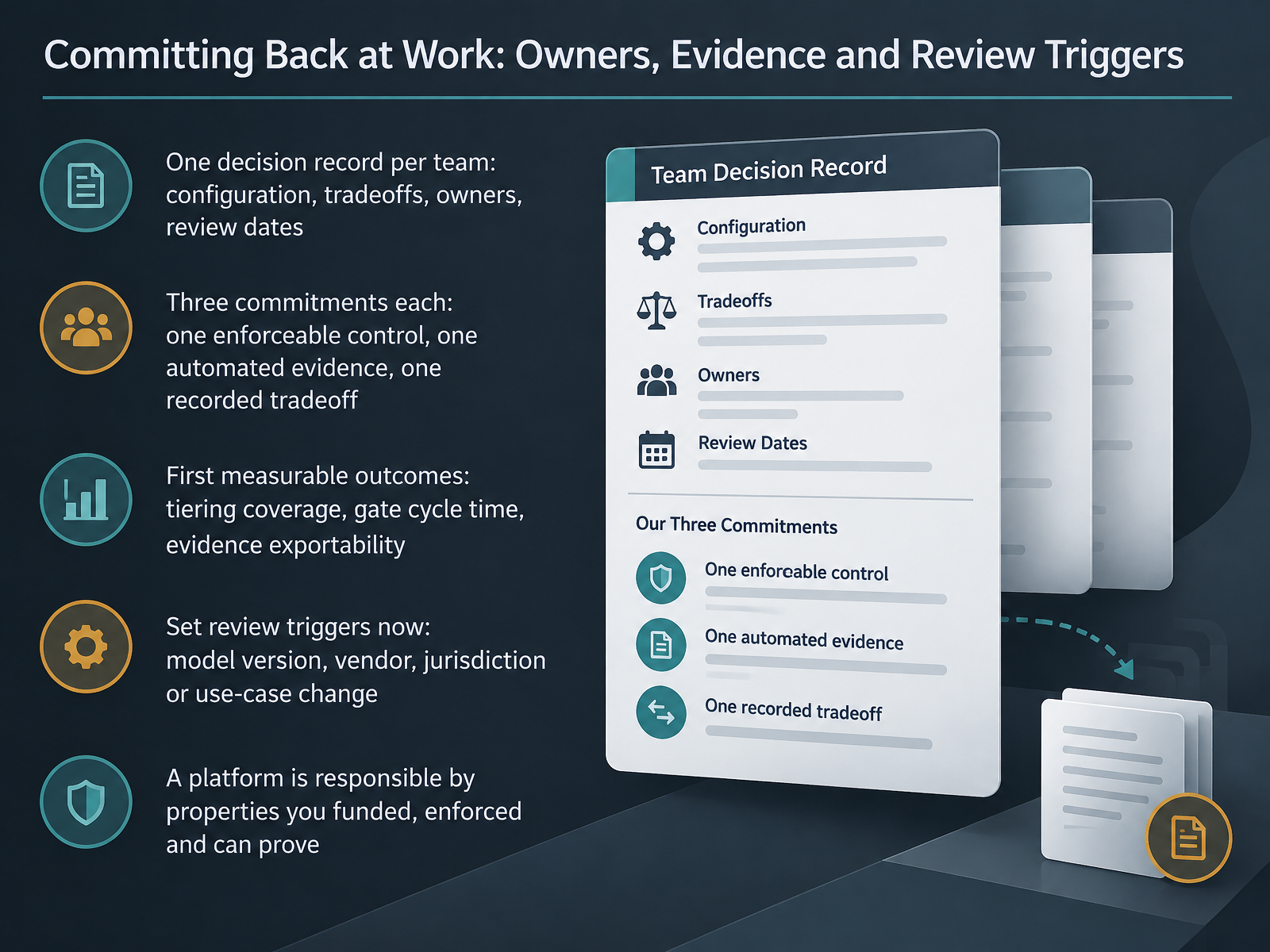
Start with one decision record per team: configuration, tradeoffs, owners, and review dates. Then, each team commits to three things: one enforceable control, one automated evidence stream, and one recorded tradeoff. For example, an enforceable control might be a hard gate before any high-risk model reaches production. The automated evidence is the audit log that gate produces. The recorded tradeoff is the residual risk someone formally accepted.
Measure early outcomes: tiering coverage, gate cycle time, and whether your evidence exports cleanly. If your evidence cannot leave the platform, an auditor will not accept it.
Set review triggers now: a model version change, a vendor change, a new jurisdiction, or a new use case. Then revalidate.
Remember the closing line. A platform is responsible by the properties you funded, enforced, and can prove. Thank you for working through this with me. Go make one commitment real this week.
 modulos.aiciopages.comkosmoy.com+22 min
Take the deck with you
Download this course as a file — free, no sign-up needed.
- PDF handoutEvery slide page, ready to print or share.15 pages · 3.4 MBDownload
- Narrated PowerPointThe deck that presents itself — every slide carries the digital human's narration video.15 pages · 15.8 MBDownload
- PowerPoint slidesThe full deck as a .pptx — open it in PowerPoint, Keynote, or Google Slides.15 pages · 3.2 MBDownload
Free to use in your own training — please keep the PersonWise credit page at the end.
Have your own deck? Turn it into a course
Sources consulted
Web sources consulted while building this course.
- Timeline for the Implementation of the EU AI Act — ai-act-service-desk.ec.europa.eu
- AI Act | Shaping Europe's digital future - European Union — digital-strategy.ec.europa.eu
- General application of the AI Act begins. The AI Omnibus does not change the general application date, except for provisions subject to specific application dates. — fpf.org
- AI Act Timeline (post-Omnibus) | NicFab Blog — nicfab.eu
- (new) key deadlines — unizo.be
- https://www.modulos.ai/best-ai-governance-platforms/ — modulos.ai
- Buyer's Guide: AI Governance & Responsible AI | CIOPages Buyer Guide — ciopages.com
- 14 AI Governance Platforms: The Full 2026 MQ Set, Scored | Kosmoy — kosmoy.com
- AI Governance Software Buyer's Guide 2026 | EU AI Act | Confir — confir.eu
- How to Evaluate AI Governance Software in 2026 - Cranium AI — cranium.ai
- LLM Policy as Code: Version-Controlled Governance for Model and Agent Access | DVARA — dvarahq.com
- Enterprise AI Security: A Reference Architecture for Governing Model Traffic — getmaxim.ai
- Artifact Template: LLM Gateway Policy | COMPEL Framework — compelframework.org
- AI Policy Enforcement Architecture Guide | EVE Core — docs.eveaicore.com
- LLM Gateway - Generative AI Atlas — awslabs.github.io
- Real-Time LLM Guardrails with Jev: Latency and Cost | Arize AI — arize.com
- I put 6 LLM guardrail tools inline and measured what they cost me. Here is the latency-vs-recall tradeoff. - DEV Community — dev.to
- Lessons from deploying thousands of LoRA guardrails in production — plurai.ai
- Serving hundreds of guardrails in real-time on a single GPU — plurai.ai
- LLM Guardrails: How Much Safety Can You Afford? | by Armin Norouzi, Ph.D | CodeToDeploy | May, 2026 | Medium — medium.com