Begin
16 pages · ~32 min
Small Bodies of the Solar System
Learn to identify and differentiate comets, asteroids, and meteoroids in this concise astronomy training for space enthusiasts and students.
A digital instructor presents all 16 pages. Hold “Ask” at any point and ask out loud — the answer comes from this course. No sign-up needed.
What you’ll learn
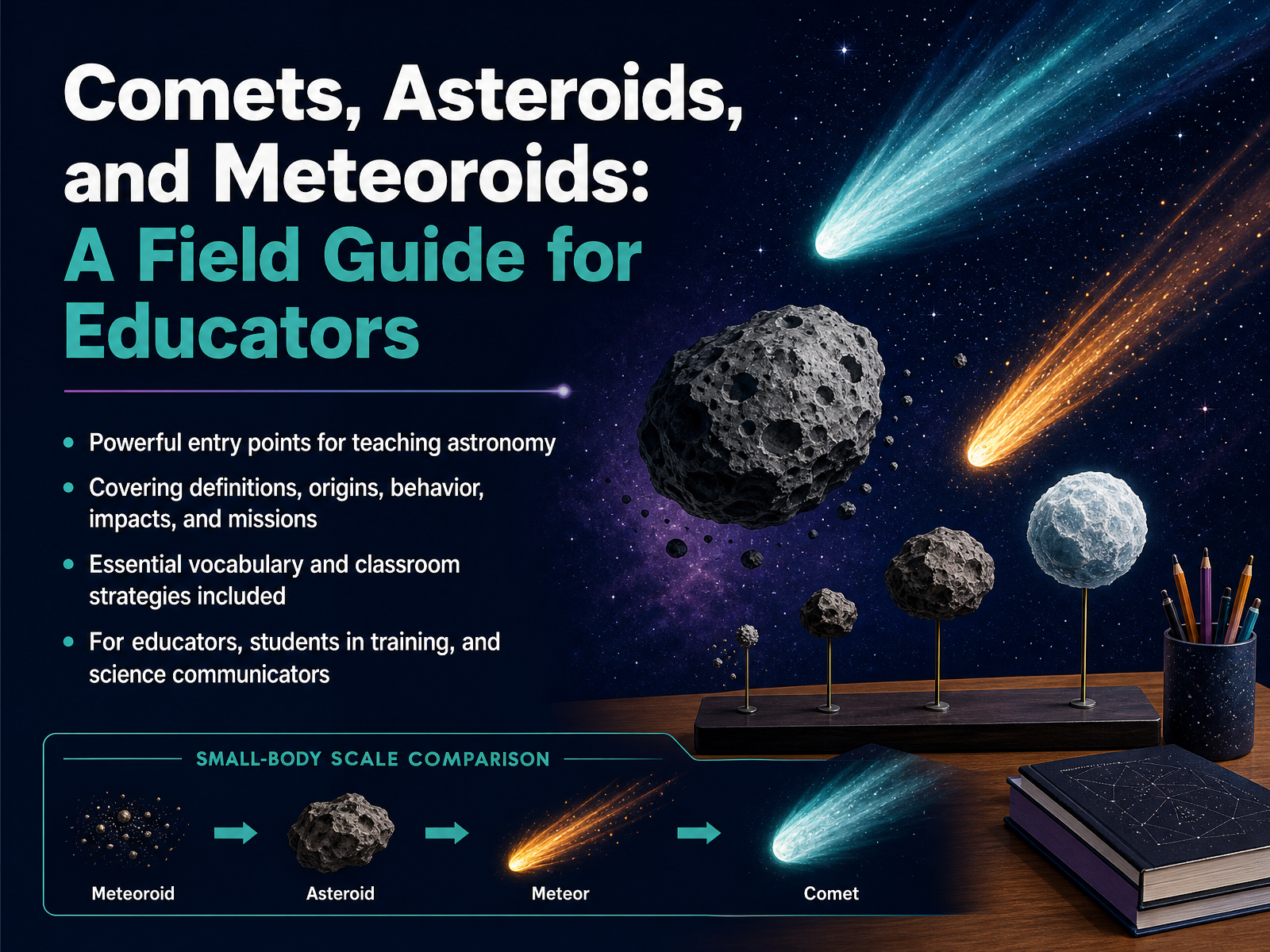
- 01Comets, Asteroids, and Meteoroids: A Field Guide for EducatorsWelcome, everyone. I'm so glad you're here. Today, we're going to explore some of the most fascinating wanderers in our solar system: comets, asteroids, and meteoroids. Think of this as a field guide, designed just for you. Whether you're an educator looking for powerful ways to spark curiosity in the classroom, a student eager to understand these cosmic travelers, or a science communicator ready to share their story, you've come to the right place. We'll start with the basics, covering what each of these objects really is and where they come from. Then, we'll look at how they behave, the incredible missions that have visited them, and why they matter to us here on Earth. You'll also leave with essential vocabulary and practical classroom strategies to bring these concepts to life. These small bodies are more than just rocks and ice; they're time capsules from the birth of our solar system. So, let's begin this journey together, starting with why these small bodies are such powerful entry points for learning and engagement.science.nasa.govscience.nasa.govscience.nasa.gov+21 min
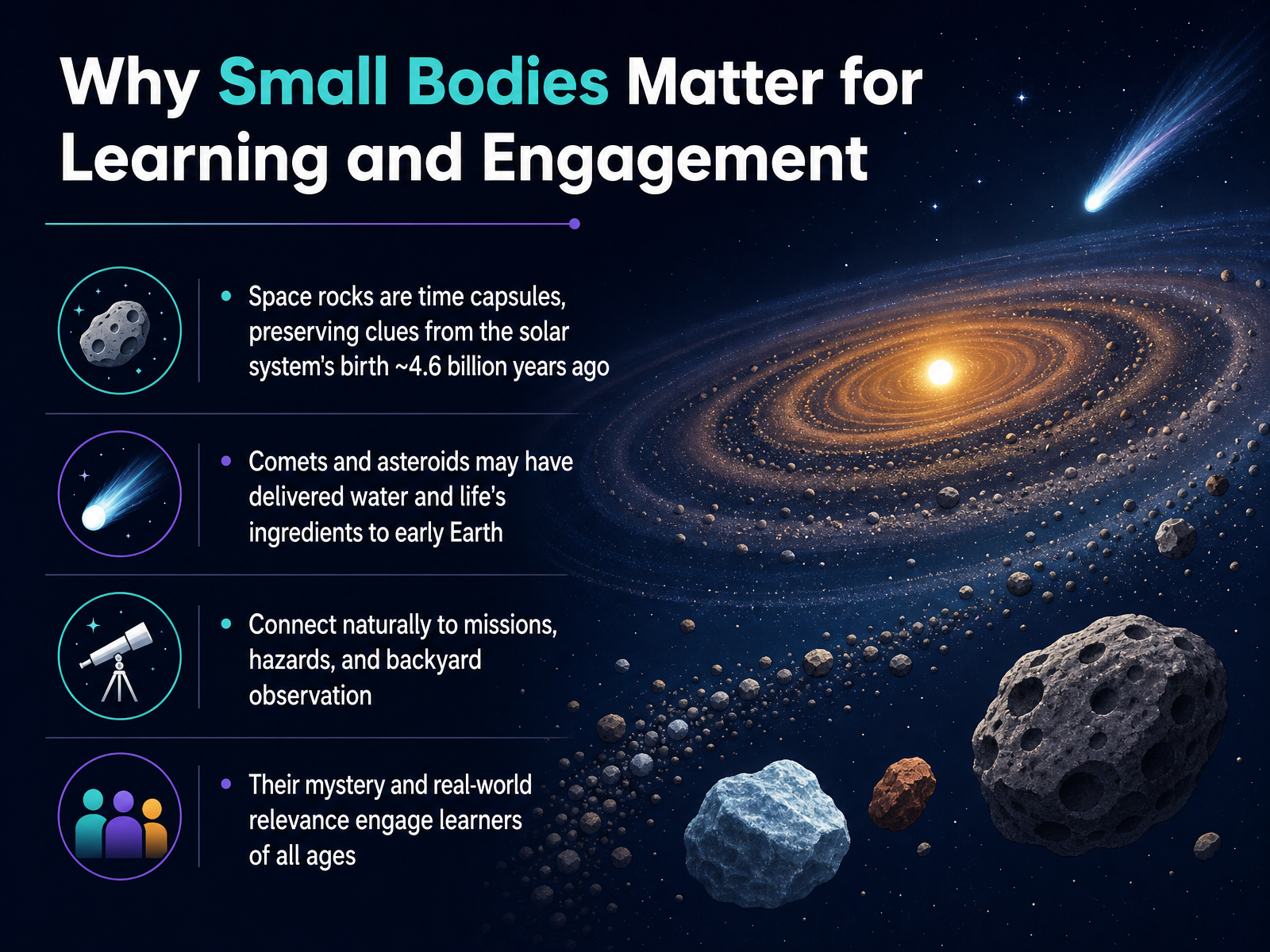
- 02Why Small Bodies Matter for Learning and EngagementNow, let’s talk about why these small bodies deserve our attention. They are not just tiny specks in the night sky — they are time capsules. Each one is a frozen record from about four point six billion years ago, right when our solar system was just taking shape. Comets and asteroids probably delivered water and the raw ingredients for life to early Earth. That means the water you drink today may have once been part of a comet. They also connect naturally to exciting missions, to the real science of planetary defense, and to simple backyard stargazing. Their mystery and real-world relevance make them perfect for engaging learners of all ages. So, as we move forward, let’s think of these space rocks as storytellers — what might they reveal about our cosmic origins? Next, let’s look at the shared building blocks and how we use key terms.
 science.nasa.govscience.nasa.govscience.nasa.gov+22 min
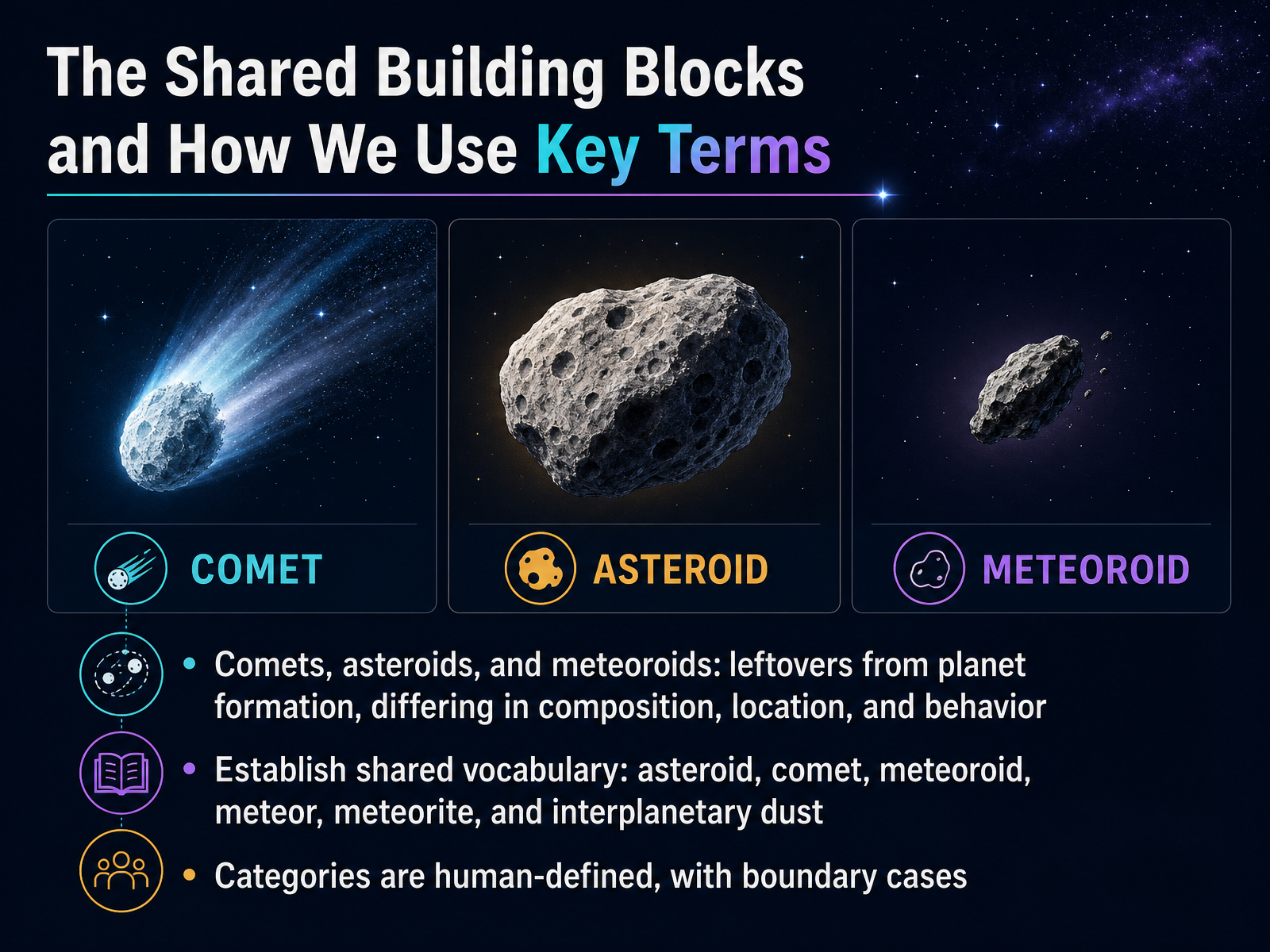
 - 03The Shared Building Blocks and How We Use Key TermsNow let's talk about what these objects have in common. Comets, asteroids, and meteoroids are all leftovers from the formation of our solar system, about four and a half billion years ago. They're like the scraps that didn't get swept up when the planets were built. They differ in their composition, their location, and how they behave. To talk about them clearly, we need a shared vocabulary. Let's establish that now. An asteroid is a rocky body in orbit around the Sun. A comet is an icy body that can develop a coma and tail when it nears the Sun. A meteoroid is a smaller fragment, anything from a grain of dust up to about one meter across. Once a meteoroid enters our atmosphere and burns up, we call the flash of light a meteor. If a piece survives its fiery journey and lands on the ground, we call that a meteorite. And truly tiny particles drifting through space are interplanetary dust. Now, a gentle reminder. These categories are human-defined, and nature loves boundary cases. An object's characteristics can blur the lines. Let's move on to our core definitions next, where we'll pin down the difference between a meteoroid, a meteor, and a meteorite.
 iau.orgiau.orgiauarchive.eso.org+22 min
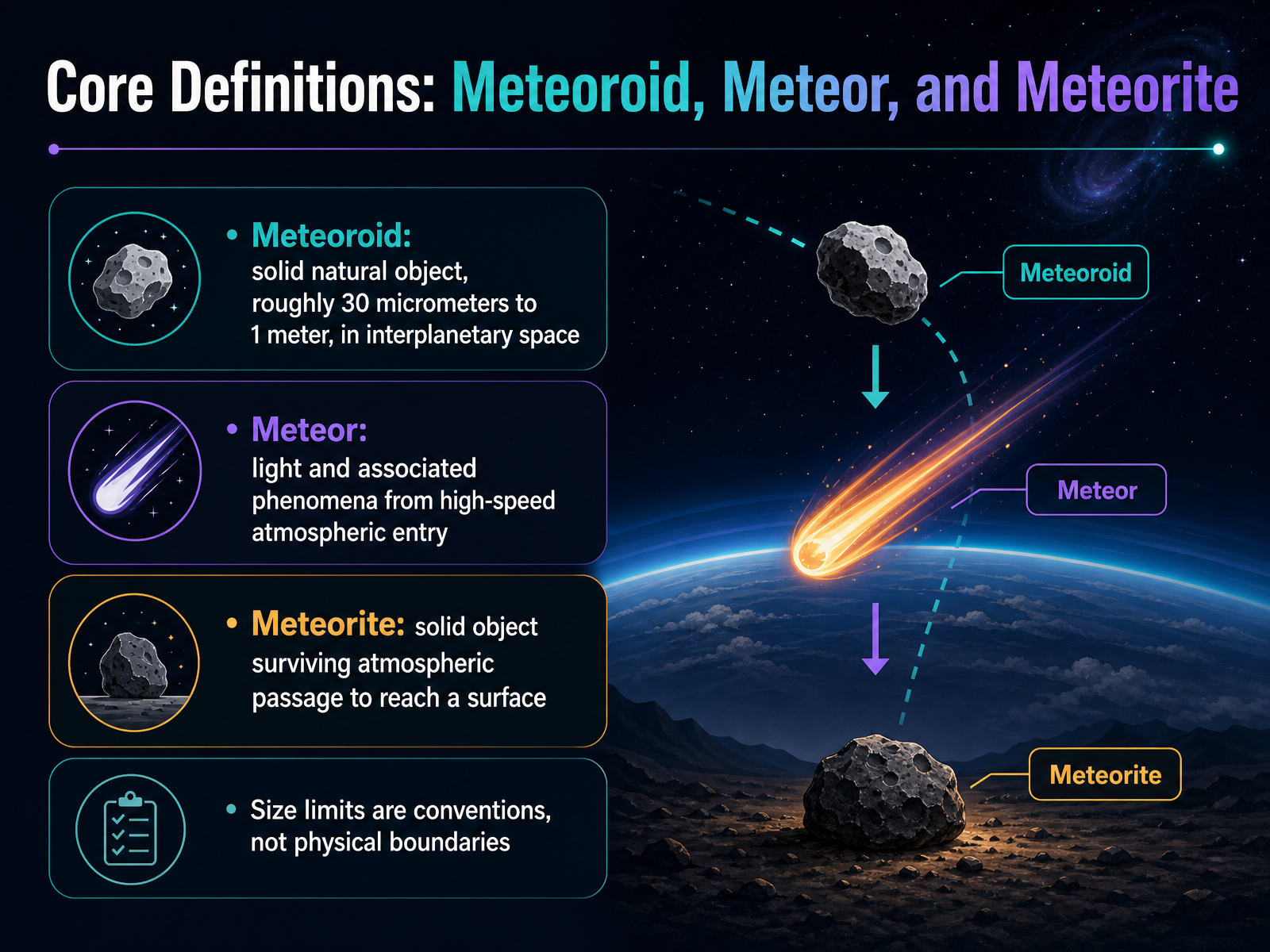
 - 04Core Definitions: Meteoroid, Meteor, and MeteoriteSo now that we know what comets and asteroids are on a big scale, it's time to shrink things down and talk about the smaller players. These three terms are often mixed up, but they actually describe very different things. A meteoroid is simply a solid natural object moving through interplanetary space. Think of it as a space rock on its own journey, ranging from about thirty micrometers to one meter in size, roughly from a grain of dust to a small boulder. But here is the key distinction. A meteor is not the object itself; it is the light and the flash we see when that object plunges into our atmosphere at high speed. That streak of light we call a shooting star? That is a meteor. Now, if any piece of that original object survives the fiery passage and actually lands on the ground, we call it a meteorite. So the rock in space is the meteoroid, the flash is the meteor, and the rock in your hand is the meteorite. One important thing to remember is that these size limits are just conventions. They are not hard physical boundaries. Nature loves a continuous spectrum. Now, let's look at how comets and asteroids compare in composition, orbit, and behavior.
 iau.orgiau.orgiauarchive.eso.org+22 min
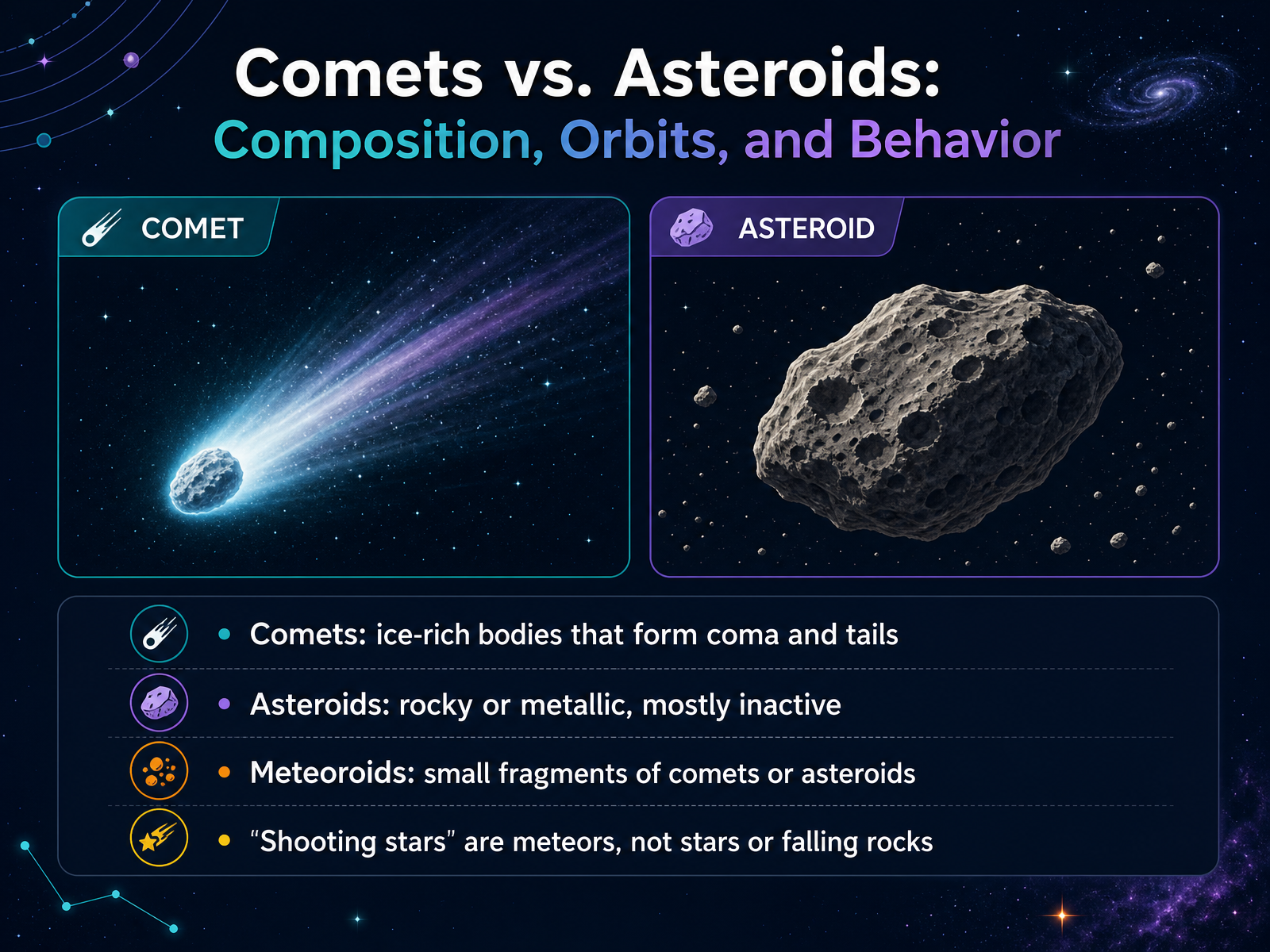
 - 05Comets vs. Asteroids: Composition, Orbits, and BehaviorNow let’s clarify the distinctions among comets, asteroids, and meteoroids—they’re often confused, but each has its own identity. Think of a comet as a cosmic snowball, made mostly of ice, with some rock and dust mixed in. When a comet gets close to the Sun, that ice starts to vaporize, creating a glowing coma around the nucleus and sometimes a beautiful tail that stretches millions of miles. An asteroid, on the other hand, is like a rocky leftover from the solar system’s formation—mostly rock and metal, and usually inactive. It doesn’t have that dramatic tail. Now, meteoroids are the small fragments—pieces of comets or asteroids—that drift through space. And here’s a common myth: when you see a “shooting star,” that’s not a star at all. It’s a meteor, the bright light produced when a meteoroid burns up in our atmosphere. So remember: comets are icy, asteroids are rocky, and meteoroids are the little pieces that create those fleeting streaks of light. Next, we’ll explore where these objects actually live—from the asteroid belt to the distant Oort cloud.
 iau.orgiau.orgiauarchive.eso.org+22 min
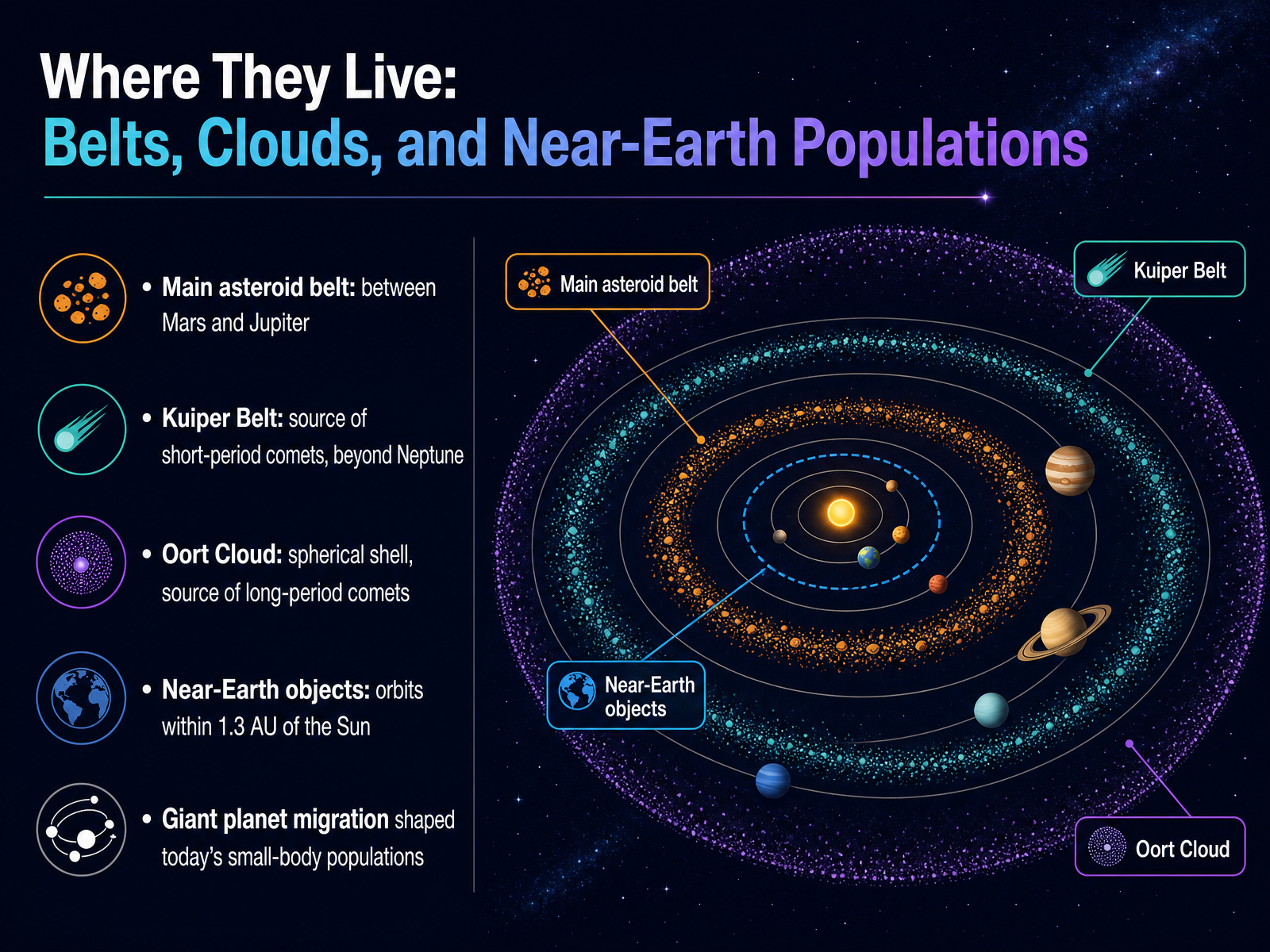
 - 06Where They Live: Belts, Clouds, and Near-Earth PopulationsNow let's zoom out and look at where these space rocks actually call home. Our solar system is like a vast neighborhood with different districts, and each one holds its own population of small bodies. First, there's the main asteroid belt, a wide ring of rocky fragments sitting between Mars and Jupiter. Think of it as the inner-city leftovers, rocky debris that never managed to form a planet. Farther out, beyond Neptune, lies the Kuiper Belt. This is a cold, icy region that feeds us the short-period comets, the ones that loop back around the Sun in under two hundred years. But if we go even farther, to the very edge of the Sun's influence, we find the Oort Cloud. Imagine a giant, spherical bubble wrapping around the entire solar system. That's where long-period comets come from, visitors that take thousands, even millions of years to complete a single orbit. And then there are the near-Earth objects, the ones that get close to our own path, within one point three astronomical units of the Sun. These are the ones we watch most closely. Now, here's a fascinating twist. These populations weren't always in these places. Giant planet migration, the slow drift of Jupiter, Saturn, Uranus, and Neptune, sculpted everything. It flung some bodies outward and pulled others in. Up next, we look at the recent evidence that tells us exactly how these populations formed and migrated over time.
 annualreviews.orgnature.comarxiv.org+22 min
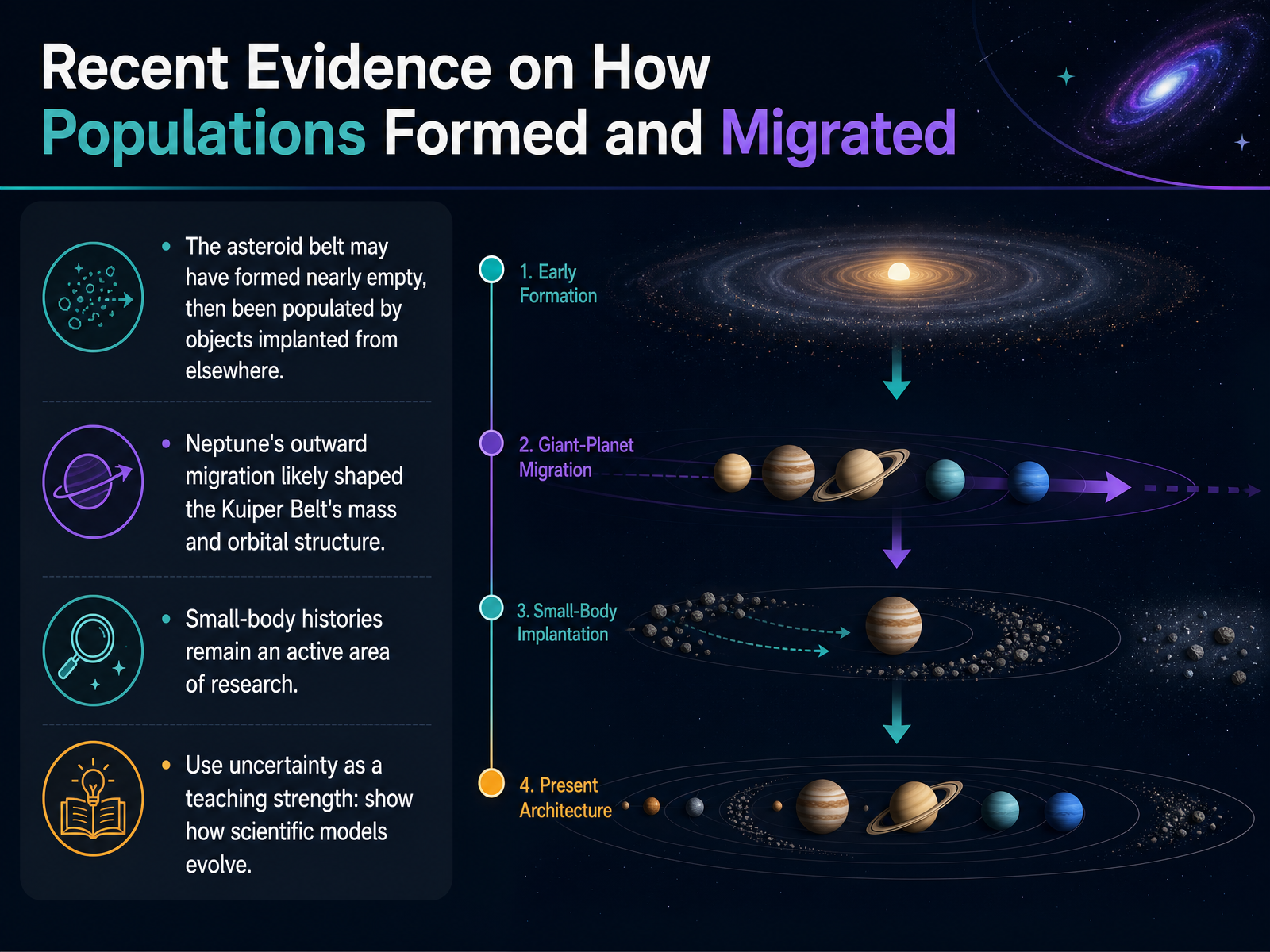
 - 07Recent Evidence on How Populations Formed and MigratedNow let's look at some recent evidence about how these populations formed and migrated. This is where our picture gets really interesting. For a long time, we assumed the asteroid belt was born with a lot of material and then lost most of it. But recent models suggest it may have started nearly empty, and was then populated by objects from elsewhere in the solar system. Think of it as a cosmic collection point for leftovers from different regions. Meanwhile, Neptune's outward migration seems to have sculpted the Kuiper Belt, shaping its mass and the structure of its orbits. All of this means the histories of these small bodies are still being actively researched. And that uncertainty is not a weakness, it's a strength. It shows how scientific models are always evolving, always being refined by new evidence. So when you teach this, embrace the questions. They are the perfect hook for sparking curiosity. Now, let's zoom in on what a comet actually looks like. We'll explore its anatomy and the source of its activity.
 annualreviews.orgnature.comarxiv.org+21 min
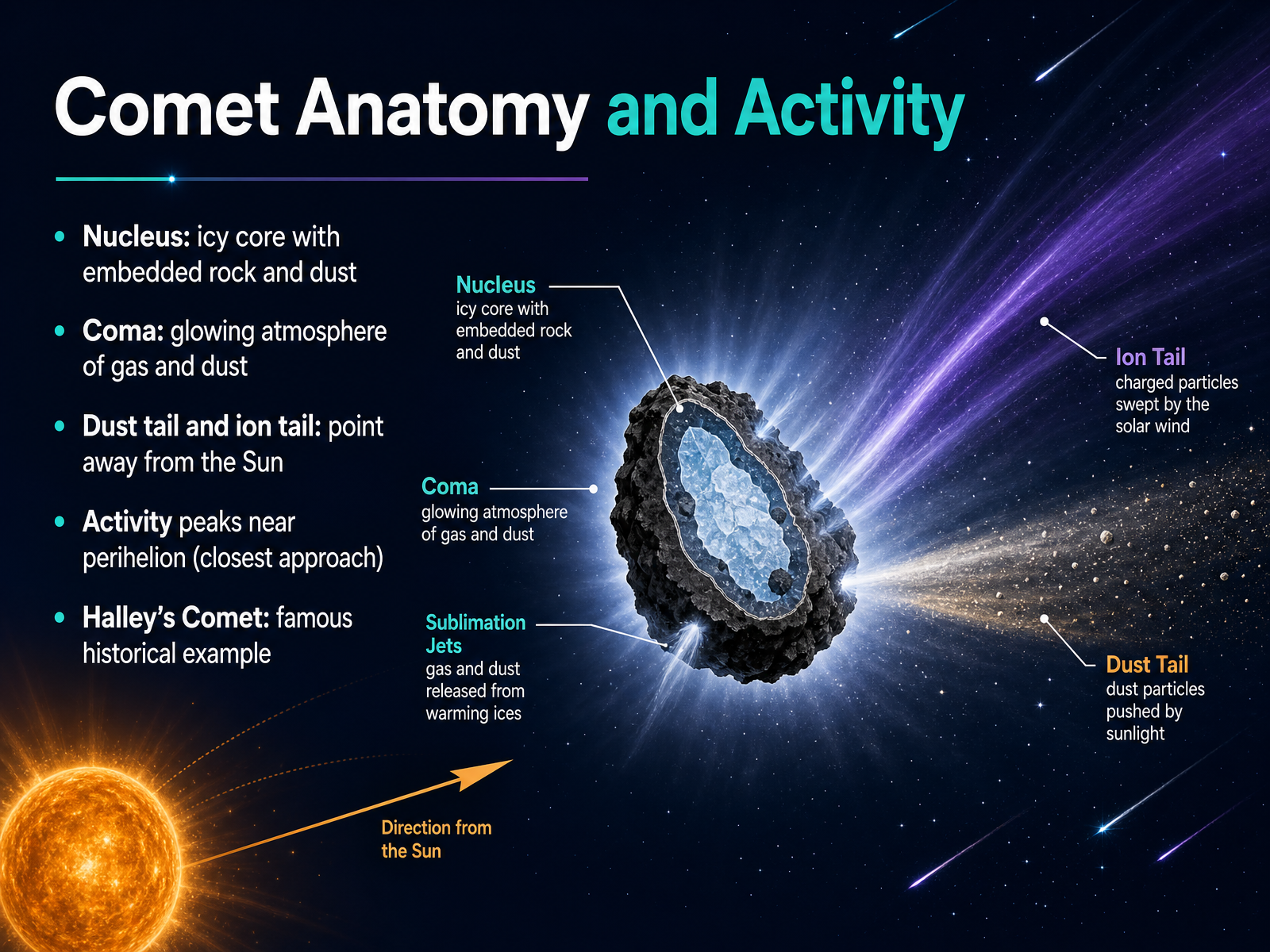
 - 08Comet Anatomy and ActivityNow let's open up a comet and see how it truly works. At the heart of every comet is the nucleus, a frozen core of ice mixed with rock and dust. Think of it as a cosmic dirtball, but instead of soil, it's packed with ancient ices. When this nucleus drifts closer to the Sun, something remarkable happens. The heat causes those ices to vaporize, releasing gas and dust into a glowing cloud around the core called the coma. This is the comet's temporary atmosphere. And then come the tails. Driven by the solar wind, two distinct tails always point away from the Sun—one made of dust, the other of glowing ionized gas. This whole display peaks when the comet reaches perihelion, its closest approach to the Sun. The famous Halley's Comet is a perfect example, lighting up our skies every seventy-six years and stirring awe each time. So as we gaze at these celestial visitors, remember that their tails are a direct message from the Sun itself.
 science.orgjpl.nasa.govscience.org+21 min
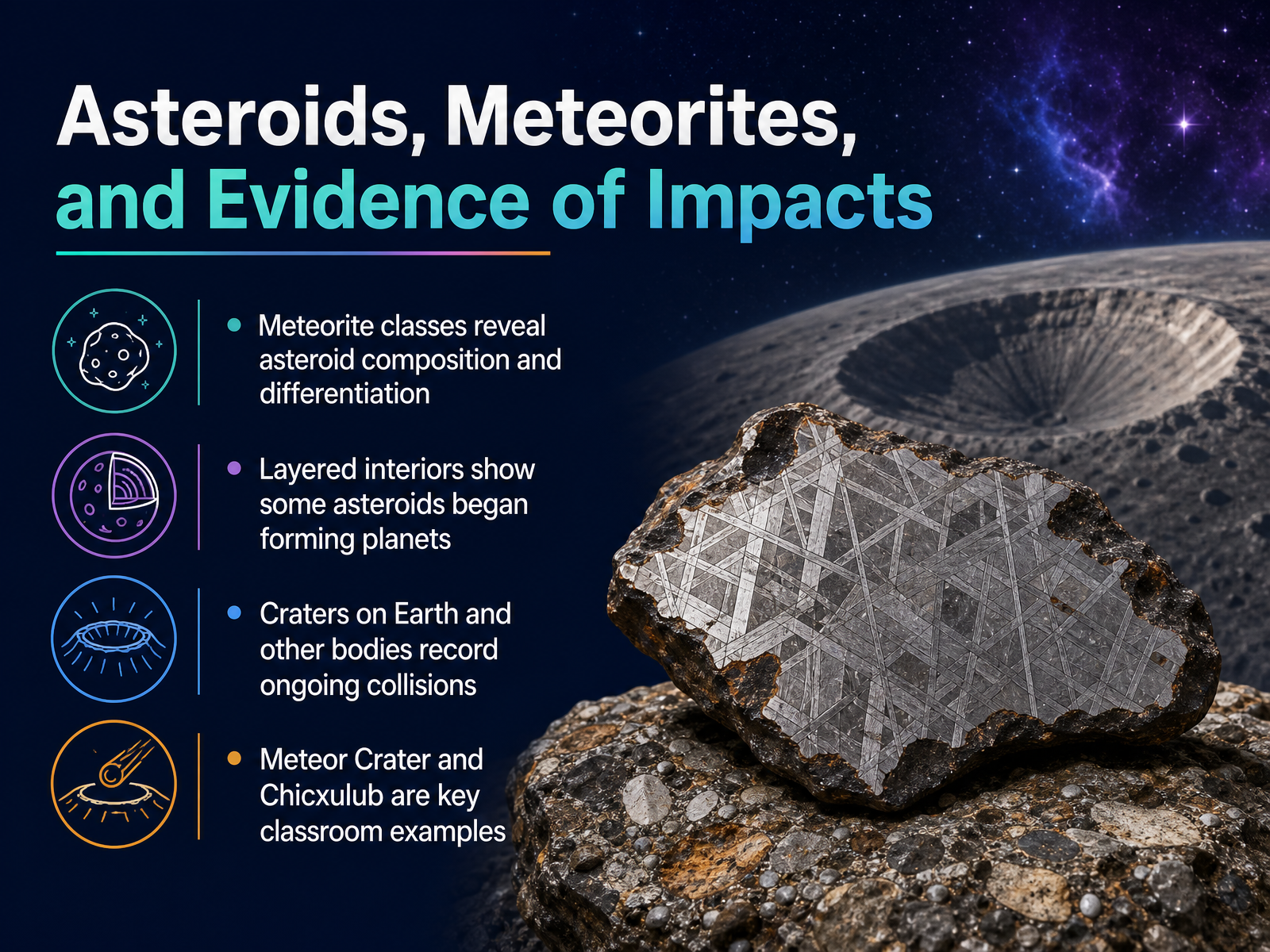
 - 09Asteroids, Meteorites, and Evidence of ImpactsNow let’s turn to something remarkable: what meteorites tell us about asteroids, and the scars they leave behind. When a meteorite survives its fiery journey to Earth, it’s like a tiny messenger from deep space. By studying these rocks, scientists learn about an asteroid’s composition and even its inner structure. Some asteroids, like Vesta and Ceres, have layered interiors—dense cores, lighter mantles, and crusts. That’s a sign they were well on their way to becoming planets, but their growth just stopped. And then there are the impact craters. Earth’s own Meteor Crater in Arizona is a dramatic reminder that collisions are ongoing. On a much larger scale, the Chicxulub crater in Mexico is linked to the extinction of the dinosaurs. These examples aren’t just history—they’re evidence that our solar system is still an active, dynamic place. Now, let’s zoom in on the streaks of light we see in the night sky, as we talk about meteors, fireballs, and meteor showers.
 science.nasa.govscience.nasa.govscience.nasa.gov+22 min
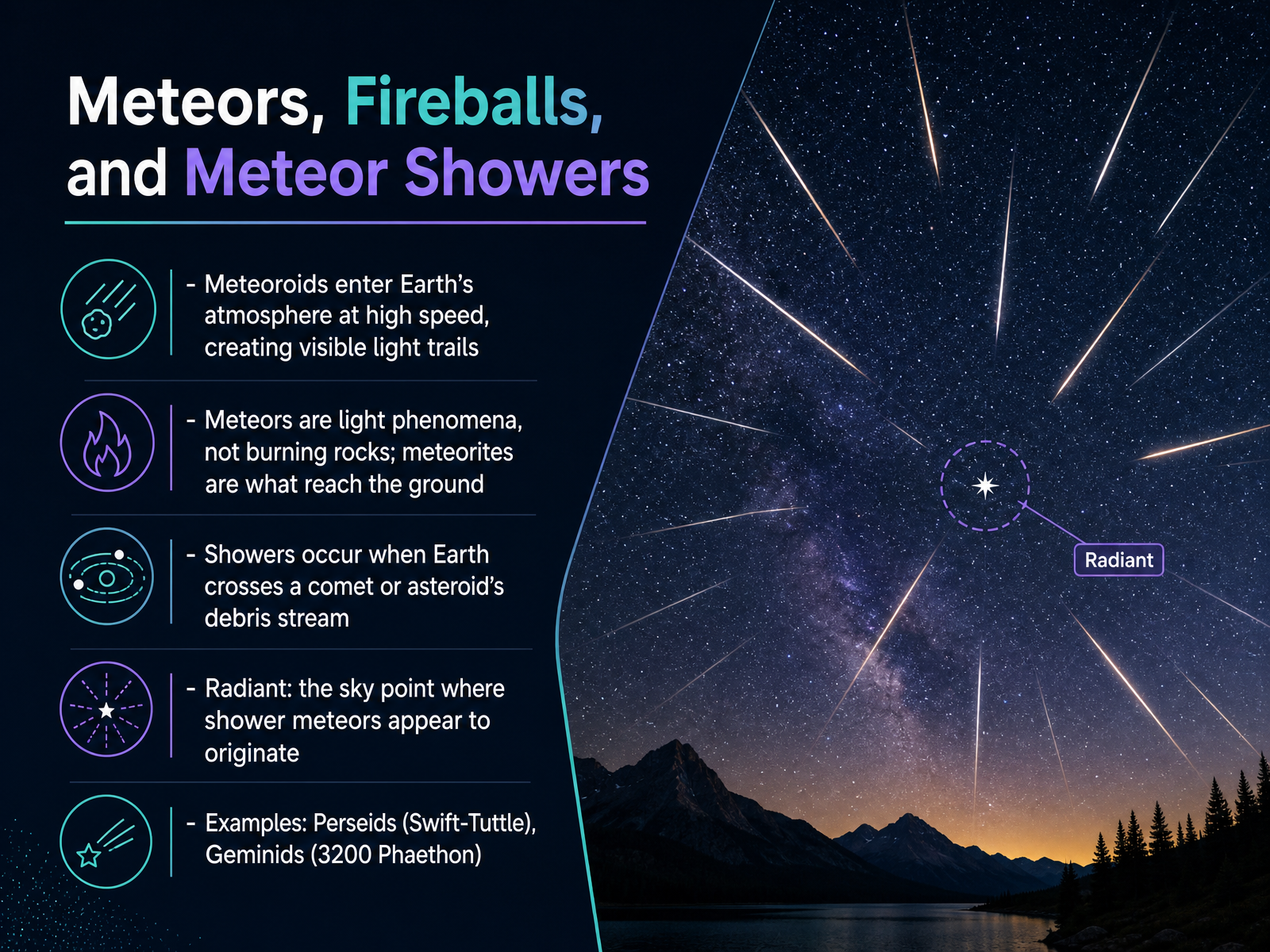
 - 10Meteors, Fireballs, and Meteor ShowersNow let's talk about what happens when these small bodies meet our atmosphere. A meteor is the light we see, not the rock itself — more like the sparkler's flash, not the wire. The rock burning up is the meteoroid, and if a piece survives all the way to the ground, we call it a meteorite. When Earth crosses a debris stream left by a comet or asteroid, we get a meteor shower. All those streaks seem to pour from one point in the sky called the radiant. The Perseids in August come from Comet Swift-Tuttle, while the Geminids in December trace back to an asteroid named 3200 Phaethon. Next, let's look at how we protect ourselves from these cosmic visitors in planetary defense and the DART mission.
 iau.orgiau.orgiauarchive.eso.org+21 min
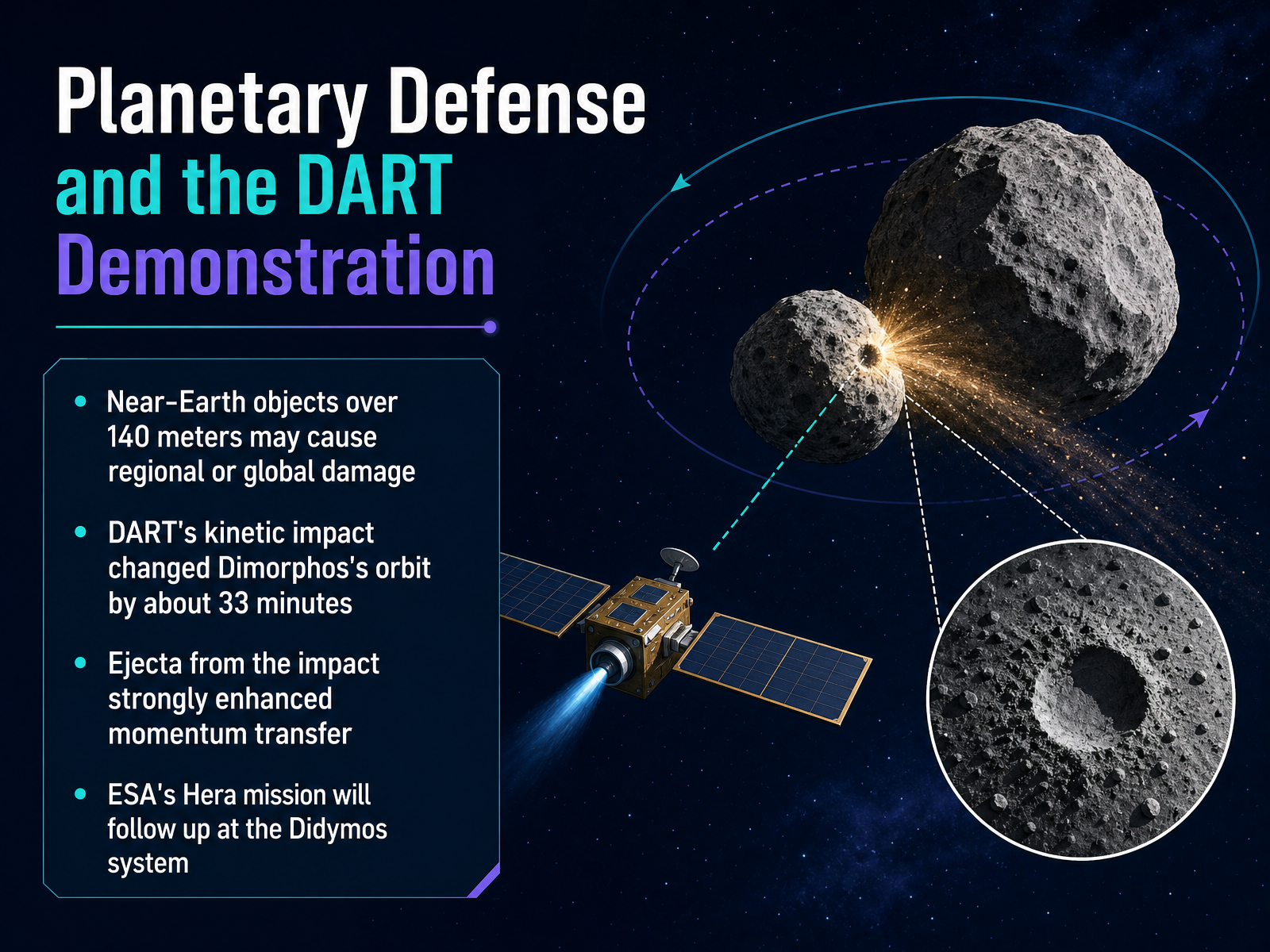
 - 11Planetary Defense and the DART DemonstrationNow, let's talk about how we actually defend our planet. Near-Earth objects larger than 140 meters are a real concern because an impact from one could cause regional or even global damage. That's why NASA built the DART mission. In September 2022, DART deliberately slammed into a small moonlet called Dimorphos, which orbits the asteroid Didymos. The impact was a success, changing Dimorphos's orbit by about 33 minutes. That might not sound like much, but it's a huge win for planetary defense. What made it even more effective was the ejecta, the tons of rock blasted into space. This debris acted like a rocket exhaust, giving Dimorphos an extra push beyond the spacecraft's impact. This momentum enhancement means kinetic impactors may be more powerful than we expected. Next, ESA's Hera mission will visit the Didymos system to study the aftermath and refine our models. We're learning how to nudge dangerous asteroids away, and that’s an incredible step for our survival. Next, let's look at current missions and what we're discovering from recent samples.
 1 min
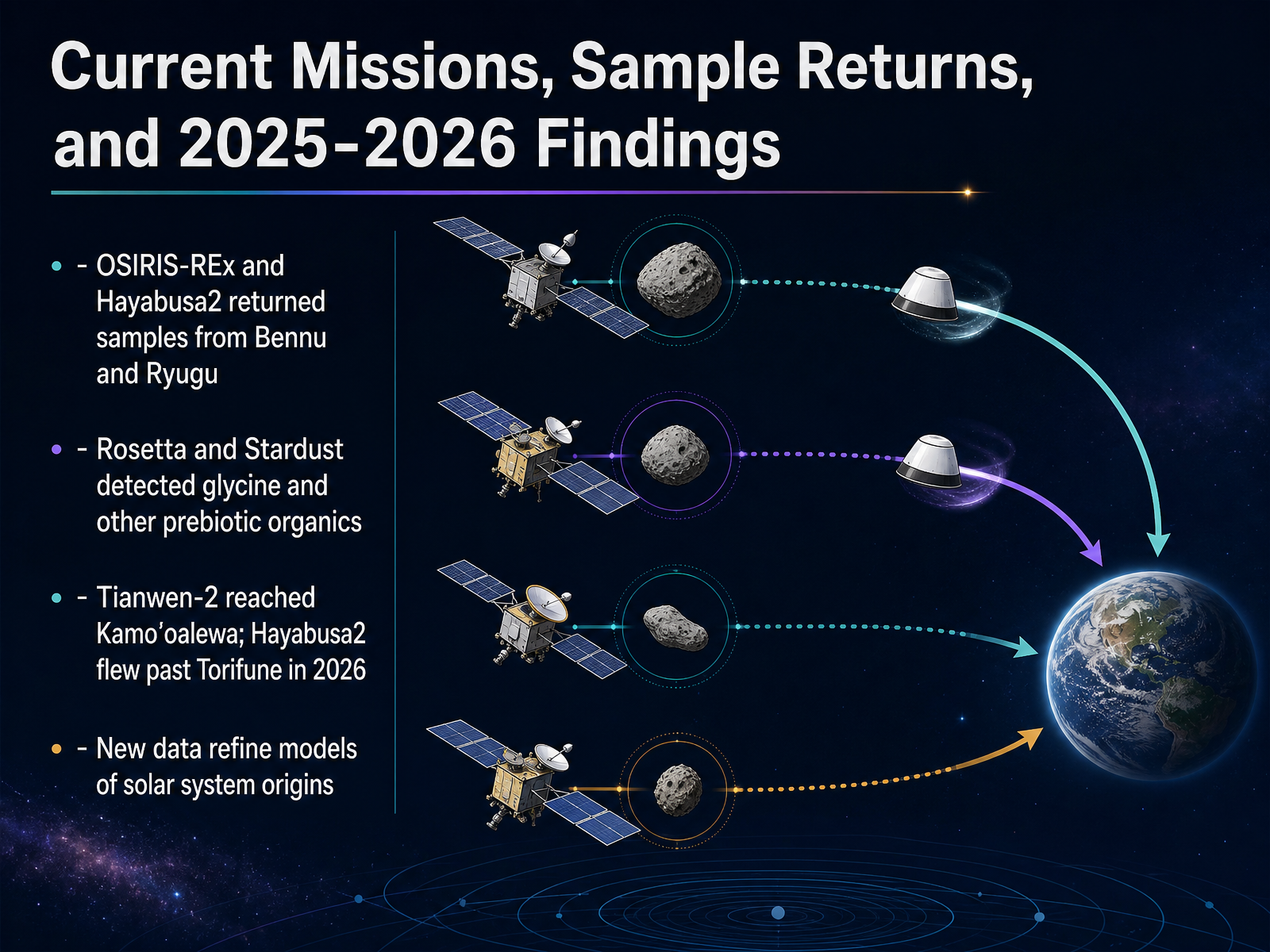
1 min - 12Current Missions, Sample Returns, and 2025-2026 FindingsLet's bring this all together with a look at current missions and what we're learning right now. Sample-return missions are rewriting the textbooks. NASA's OSIRIS-REx brought back material from Bennu, and Japan's Hayabusa2 returned samples from Ryugu. Both are carbon-rich asteroids, and their grains are packed with water-bearing minerals and organic compounds. Meanwhile, Rosetta and Stardust detected glycine, an amino acid, on a comet. Combined, these findings strongly suggest that the building blocks for life were delivered from space. And the pace hasn't slowed. In 2026, China's Tianwen-2 reached the small quasi-moon Kamoʻoalewa, and Japan's Hayabusa2 flew past the contact-binary asteroid Torifune. Each new image and measurement refines our models of how the solar system formed and evolved. These aren't just distant rocks; they're time capsules. So, with all these discoveries in mind, how do we bring this excitement into the classroom? Let's explore that next.
 science.orgjpl.nasa.govscience.org+22 min
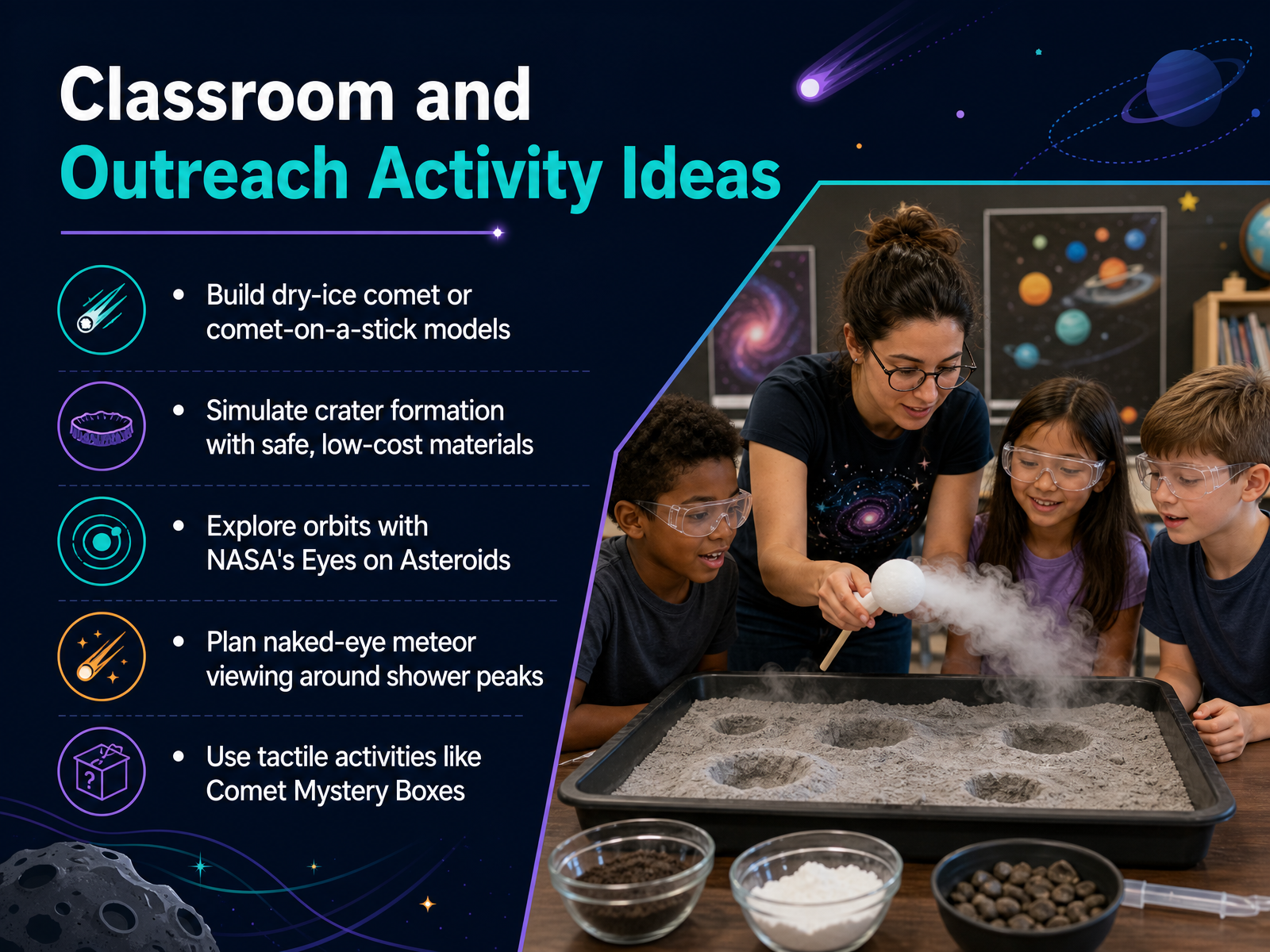
 - 13Classroom and Outreach Activity IdeasNow that we understand what these space rocks are, let's explore how to bring them into the classroom. Start with building a dry-ice comet model to demonstrate the icy, porous nature of a comet's nucleus. You can also create a comet-on-a-stick to show how the solar wind forms a comet's tail as it approaches the Sun. To explore impacts, simulate crater formation using a tray of flour and cocoa powder, dropping different-sized objects from different heights. For a digital experience, use NASA's Eyes on Asteroids to visualize the orbits of real space rocks. And when conditions are right, plan a naked-eye meteor viewing session around a known meteor shower peak — just a dark sky, warm clothes, and a bit of patience. For tactile learners, try the Comet Mystery Boxes, where students reach into sealed boxes and feel materials that represent a comet's characteristics. The goal is to make these distant objects feel tangible, accessible, and truly exciting. Up next: common misconceptions about comets, asteroids, and meteoroids, and how to correct them.
 science.nasa.gov1 min
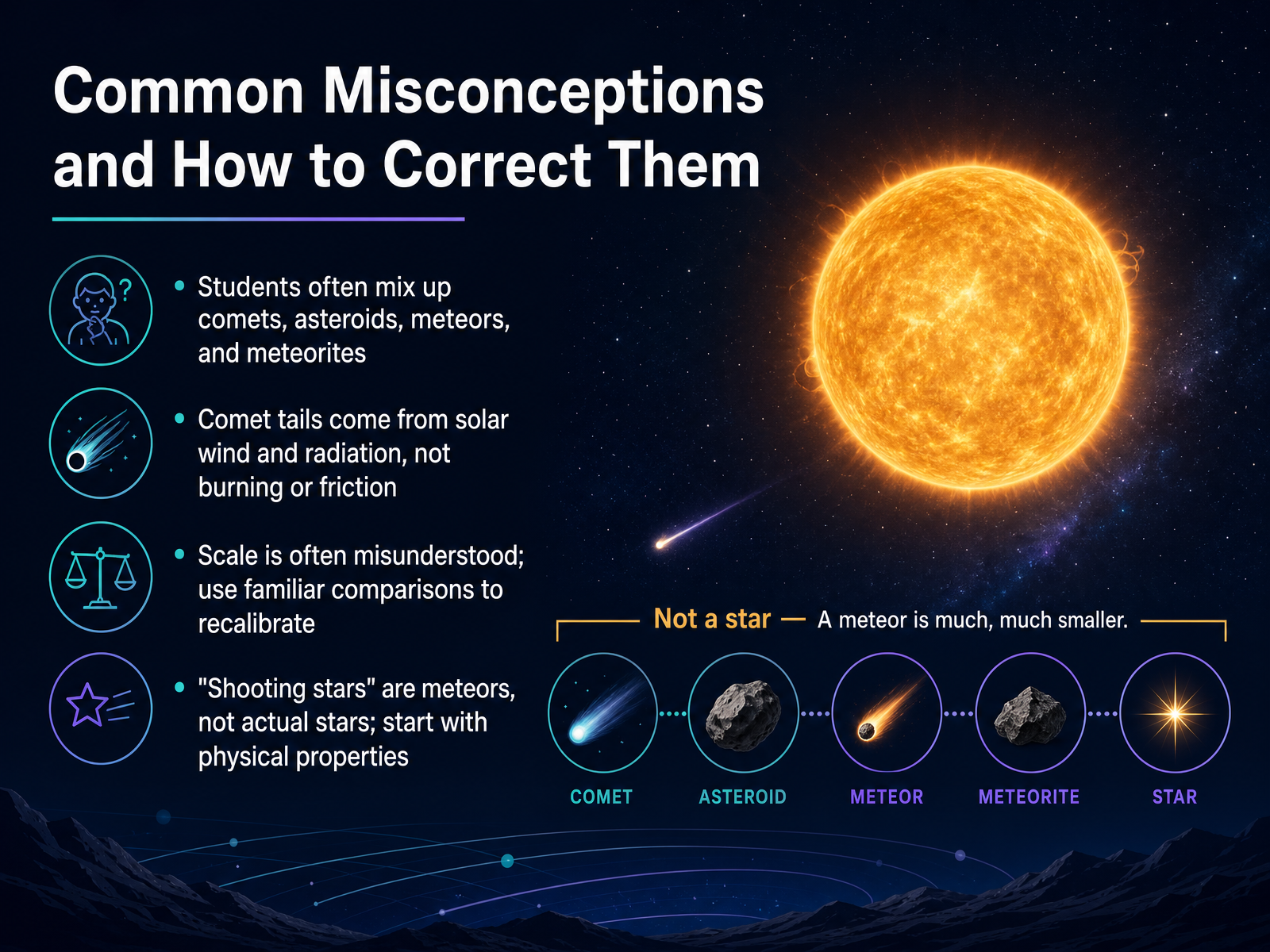
 - 14Common Misconceptions and How to Correct ThemLet's take a moment to clear up some common mix-ups. Students often use comet, asteroid, meteor, and meteorite as if they were the same thing. They're not. A comet is an icy dirtball from the outer solar system. An asteroid is a rocky leftover from planet formation. And a meteor is just the flash of light we see when a small piece burns up in our atmosphere. Because they look similar from Earth, it's easy to see why they get confused. Another big one: a comet's tail is not caused by burning or friction. It's created by solar wind and radiation pushing dust and gas away from the nucleus. Think of it like steam rising off a hot drink on a cold morning. It's a release, not a burn. Also, scale is hard to grasp. Compare a comet's nucleus to a city, and an asteroid to a mountain. That helps reset the mental ruler. And when someone wishes upon a shooting star, remind them it's not a star at all. It's a tiny meteoroid lighting up as it streaks through the air. These physical distinctions are where understanding starts. Next, we'll look at teaching strategies that make these ideas stick in the classroom.
 science.nasa.gov2 min
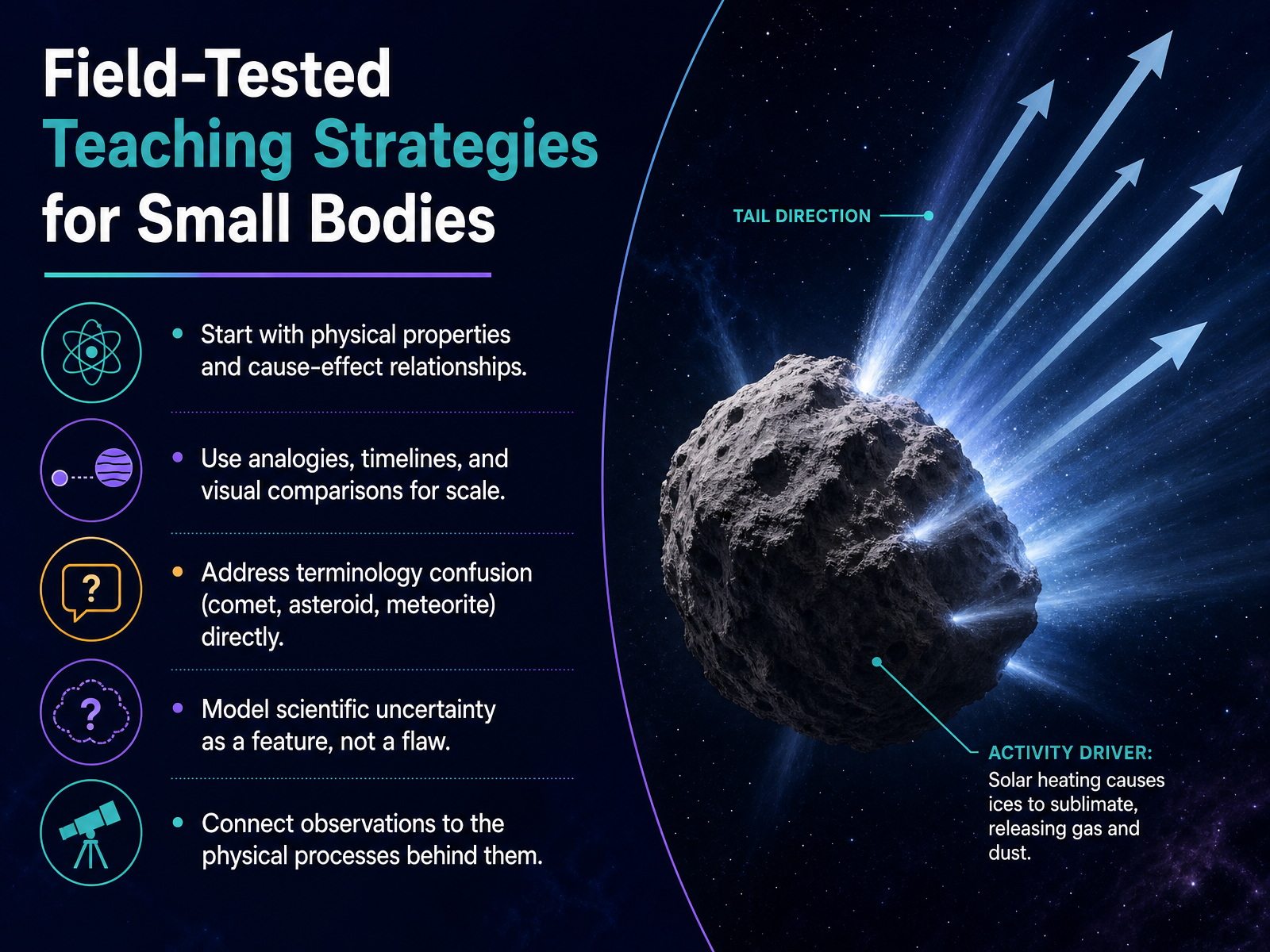
 - 15Field-Tested Teaching Strategies for Small BodiesNow let's turn those insights into practice with some field-tested teaching strategies. Start with physical properties and cause-effect relationships. Before talking about tails or orbits, ground students in what these objects actually are: an icy dirtball, a rocky leftover, a speck of dust. Then build up to why a comet's tail points away from the Sun, or why a meteor heats up. Use analogies, timelines, and visual comparisons for scale. If a student thinks a comet is the size of a tennis ball, show them a picture of a city next to one. Address terminology confusion directly. Comet, asteroid, meteorite — these words get tangled in everyday language. Take a moment to untangle them explicitly. Model scientific uncertainty as a feature, not a flaw. When we say we are not sure how many objects are out there, that is not a weakness; it is the engine of discovery. Finally, connect observations to the physical processes behind them. A shooting star is not a star; it is friction doing its work. Keep these strategies in mind, and you will turn confusion into curiosity. That is a good place to pause. Next, we will gather the summary and curated resources for further learning.
 science.nasa.gov2 min
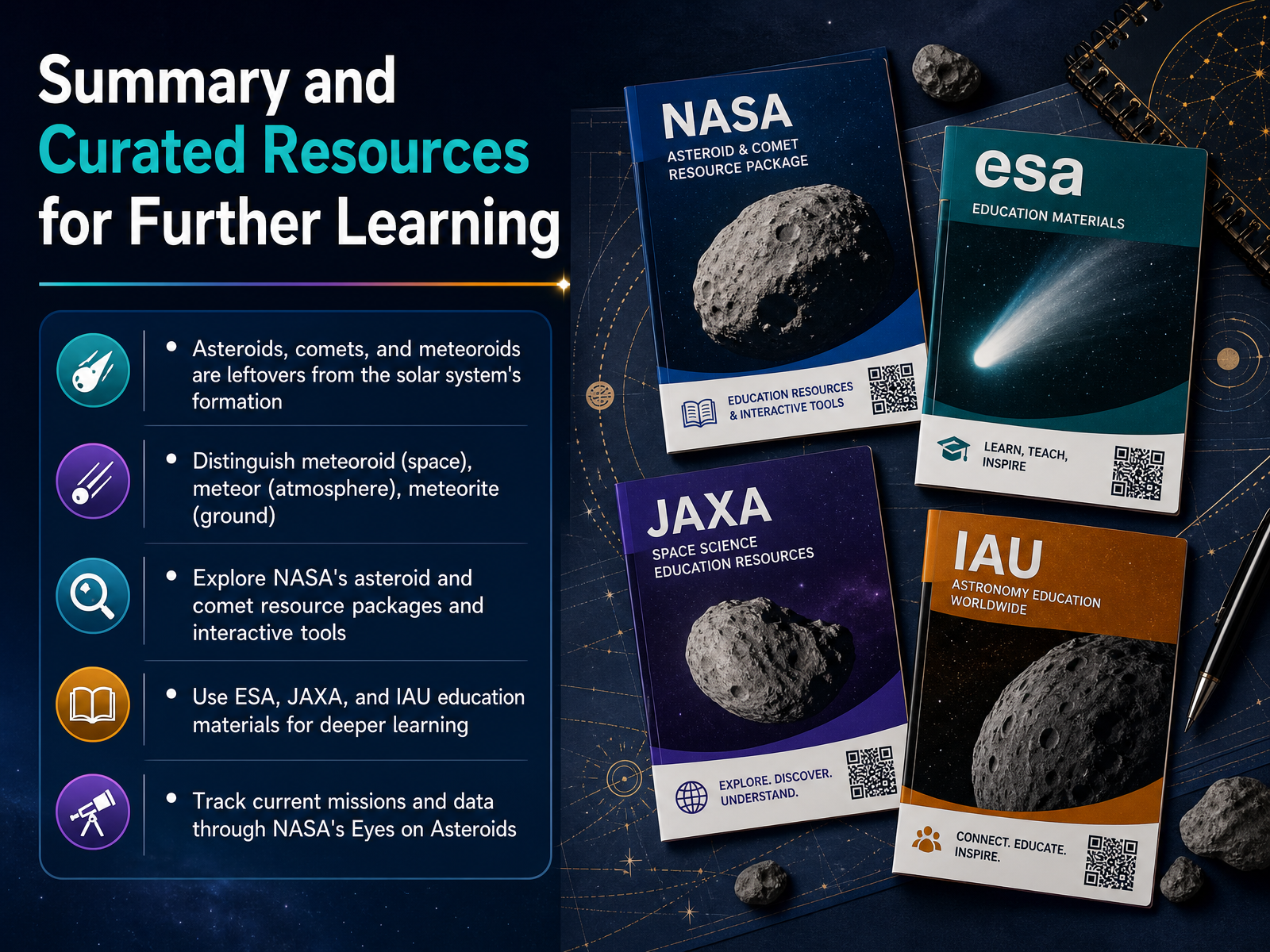
 - 16Summary and Curated Resources for Further LearningWe’ve reached the end of our journey through the solar system’s leftover treasures. Let’s take a moment to bring it all together. Asteroids, comets, and meteoroids are ancient remnants from the formation of our solar system, about four point six billion years ago. Remember the simple distinction: a meteoroid is the small rock in space, a meteor is the bright streak of light when it burns up in our atmosphere, and a meteorite is what survives the trip and lands on the ground. For those eager to explore further, NASA offers incredible resource packages, full of activities, videos, and interactive tools that make these concepts come alive. You can also dive into educational materials from the European Space Agency, JAXA, and the International Astronomical Union for even deeper learning. And to see the science in action, be sure to track current missions and real-time data through NASA’s Eyes on Asteroids. Thank you for joining me on this exploration. The sky is full of wonders, and now you have the tools to understand them even better. Keep looking up. There is always more to discover.
 science.nasa.govscience.nasa.govscience.nasa.gov+22 min
Take the deck with you
Download this course as a file — free, no sign-up needed.
- PDF handoutEvery slide page, ready to print or share.17 pages · 5.2 MBDownload
- Narrated PowerPointThe deck that presents itself — every slide carries the digital human's narration video.17 pages · 18.3 MBDownload
- PowerPoint slidesThe full deck as a .pptx — open it in PowerPoint, Keynote, or Google Slides.17 pages · 5.2 MBDownload
Free to use in your own training — please keep the PersonWise credit page at the end.
Have your own deck? Turn it into a course
Sources consulted
Web sources consulted while building this course.
- Asteroids, Comets, and Meteors — science.nasa.gov
- Asteroids, Comets & Meteors: Facts - NASA Science — science.nasa.gov
- 10 Things: What's That Space Rock? - NASA Science — science.nasa.gov
- Asteroids and Comets | NASA Jet Propulsion Laboratory (JPL) — jpl.nasa.gov
- Keeping an Eye on Space Rocks | NASA Jet Propulsion Laboratory (JPL) — jpl.nasa.gov
- Definitions of terms in meteor astronomy — iau.org
- Microsoft Word - MeteorDefinitions_approved.doc — iau.org
- Definitions of terms in meteor astronomy — iauarchive.eso.org
- Meteors & Meteorites: The IAU Definitions of Meteor Terms | IAU — iauarchive.eso.org
- Frequently Asked Questions (FAQs) — cneos.jpl.nasa.gov
- Transneptunian Space | Annual Reviews — annualreviews.org
- The formation of the Kuiper belt by the outward transport of bodies during Neptune's migration | Nature — nature.com
- [2012.07932v2] Origin and dynamical evolution of the asteroid belt — arxiv.org
- On the origin of the Kuiper belt | Celestial Mechanics and Dynamical Astronomy | Springer Nature Link — link.springer.com
- Chapter 2 - Kuiper belt: Formation and evolution — sciencedirect.com
- Prebiotic chemicals—amino acid and phosphorus—in the coma of comet 67P/Churyumov-Gerasimenko | Science Advances — science.org
- Deep Impact | NASA Jet Propulsion Laboratory (JPL) — jpl.nasa.gov
- Deep Impact Observations by OSIRIS Onboard the Rosetta Spacecraft — science.org
- The landing(s) of Philae and inferences about comet surface mechanical properties — science.org
- The Large Smooth Patch on Comet 9P/Tempel 1: Remnant of a Recent Past Event - IOPscience — iopscience.iop.org