Begin
14 pages · ~28 min
Customer Education Platform Selection
This training helps customer education teams evaluate platforms, design scalable architectures, and make informed tradeoffs. Ideal for managers, instructional designers, and technical leads.
A digital instructor presents all 14 pages. Hold “Ask” at any point and ask out loud — the answer comes from this course. No sign-up needed.
What you’ll learn
- 01Customer Education Platform: Selection, Architecture, and TradeoffsWelcome. I'm glad you're here. Over the next fourteen slides, we're going to work through one of the more consequential decisions customer education teams face this year: how to select a platform, and how to architect it well. Here's the frame. By twenty twenty-six, customer education has become a growth lever for retention, adoption, and expansion. But platform choice is never a standalone purchase. The platform, your content, your data, your operating model, and your commercial terms are really one joint decision. If you optimize for a rich learning experience, you accept more admin effort and maintenance load. If you optimize for low cost, you accept less integration depth and slower reporting. Across this course, we'll cover requirements, build versus buy, architecture, analytics, proof of concept, total cost of ownership, rollout, and risk. You'll leave with four deliverables: a scored shortlist, an architecture blueprint, a three-year total cost of ownership model, and a tradeoff register. This is a cross-functional decision. Education leads, customer success operations, enablement and learning teams, plus I T and procurement each own a piece. So let's treat each other as peers at the same table. Coming up next, the business case, and the decision you are actually making.absorbai.comthinkific.combnnbloomberg.ca+22 min
- 02The Business Case and the Decision You Are Actually MakingLet's frame the decision in front of us.
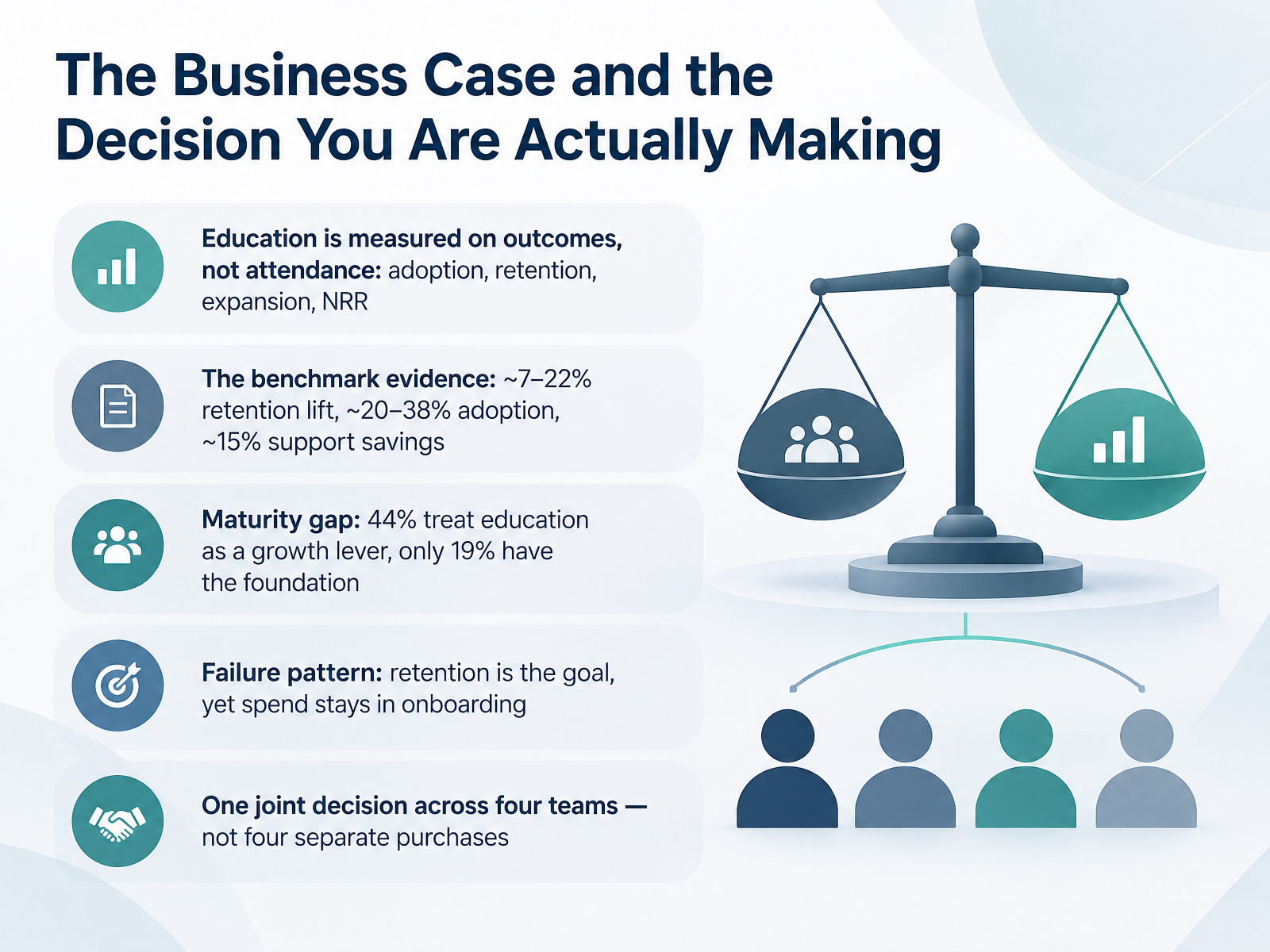
First, how education gets measured. Leadership doesn't ask what people learned. They ask what changed: adoption, retention, expansion, net revenue retention. The benchmark evidence backs that up. Formal programs report roughly a seven to twenty-two percent retention lift, twenty to thirty-eight percent better adoption, and about fifteen percent in support savings.
Now the gap. Forty-four percent of organizations say education is a growth lever, but only nineteen percent have the foundation to sustain it: a sponsor, a budget, current content, lifecycle engagement.
And here's the failure pattern. Fifty-seven percent name retention as their top goal, yet forty-two percent concentrate spend on onboarding, well before the renewal and expansion moments where churn risk actually sits.
So the decision isn't four separate purchases. It's one joint decision across customer education, customer success operations, enablement or L and D, and I.T. and procurement. If you optimize for learner experience alone, you accept weaker data and security. If you optimize for procurement ease alone, you accept heavier admin effort and slower content updates.
One takeaway: treat this as a shared decision with explicit tradeoffs, not a single team's tool purchase.
Next, let's look at the platform categories themselves: L M S, L X P, digital adoption, community, and knowledge base.
 absorbai.comthinkific.combnnbloomberg.ca+22 min
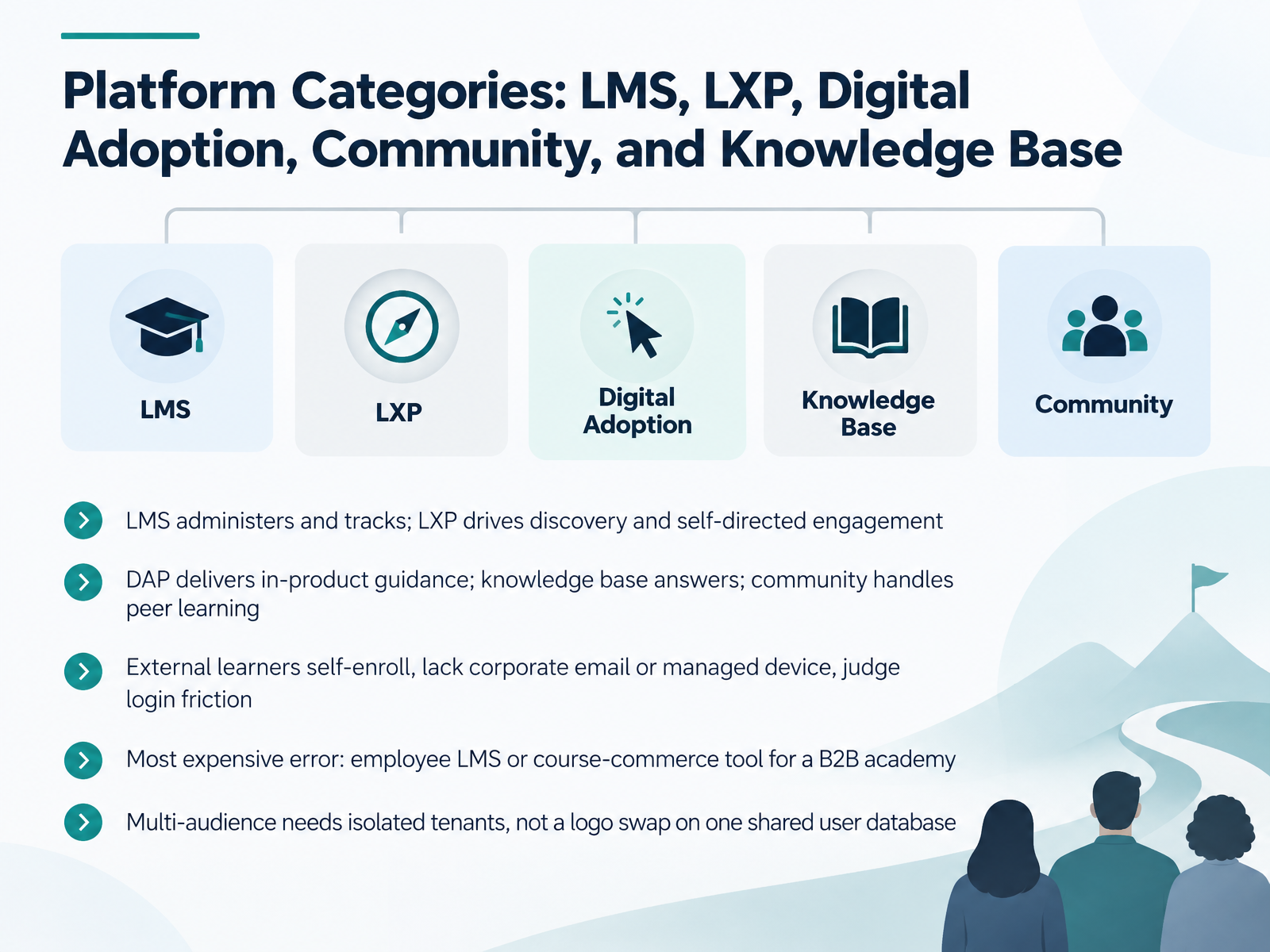
- 03Platform Categories: LMS, LXP, Digital Adoption, Community, and Knowledge BaseNow let's map the platform landscape, because these categories do different jobs. An LMS administers and tracks structured training. An LXP drives discovery and self-directed engagement. A digital adoption platform delivers guidance inside your product. A knowledge base answers questions. And community handles peer learning. Here's the decisive point. Your external learners self-enroll, they often have no corporate email and no managed device, and they judge you on login friction. So if you optimize for a shared account with a logo swap, you accept that one audience may see another's data. The most expensive error is buying an employee LMS or a course-commerce tool for a B2B academy. And multi-audience programs usually need isolated tenants, not one shared user database. In short, match the category to the audience first. Next, Translating Business Goals into Testable Requirements.
 getcor.aigitnux.orgknowlify.com+21 min
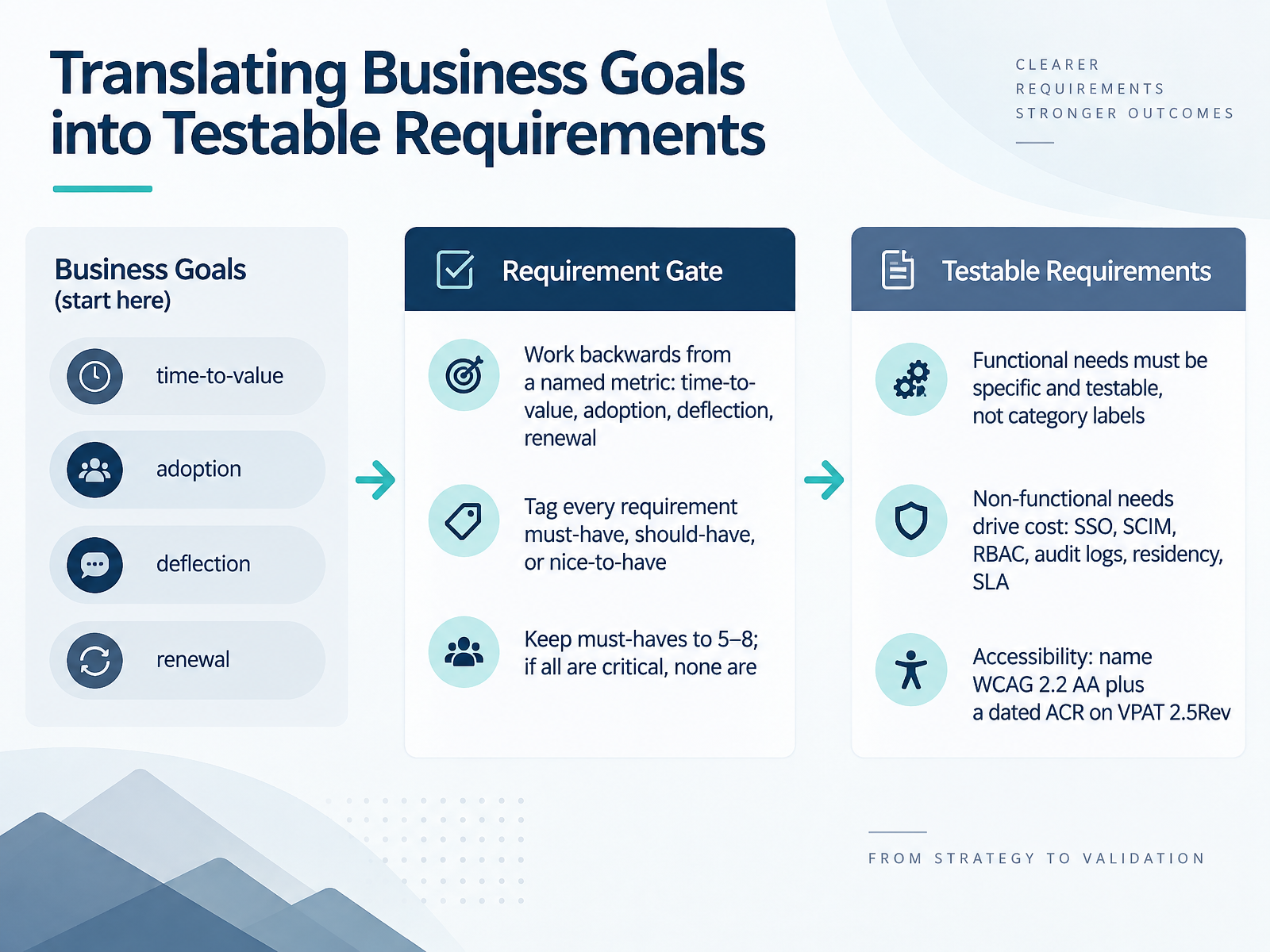
- 04Translating Business Goals into Testable RequirementsNow let's turn those business goals into requirements you can actually test. Start with one named metric: time-to-value. If you optimize for a faster start, you accept less depth in early onboarding. Then tag every requirement as must-have, should-have, or nice-to-have. Keep must-haves to five to eight. If everything is critical, nothing is. Functional needs must be specific, not a category label. Instead of saying reporting, say admins can export completion data by learner and date. Non-functional needs drive cost: single sign-on, SCIM provisioning, role-based access control, audit logs, data residency, and uptime SLAs. For accessibility, name WCAG 2.2 AA plus a dated ACR on VPAT 2.5 Rev. Next, we will look at build, buy, or compose, and where AI fits.
 learnworlds.comedzlms.comlisticler.com+21 min
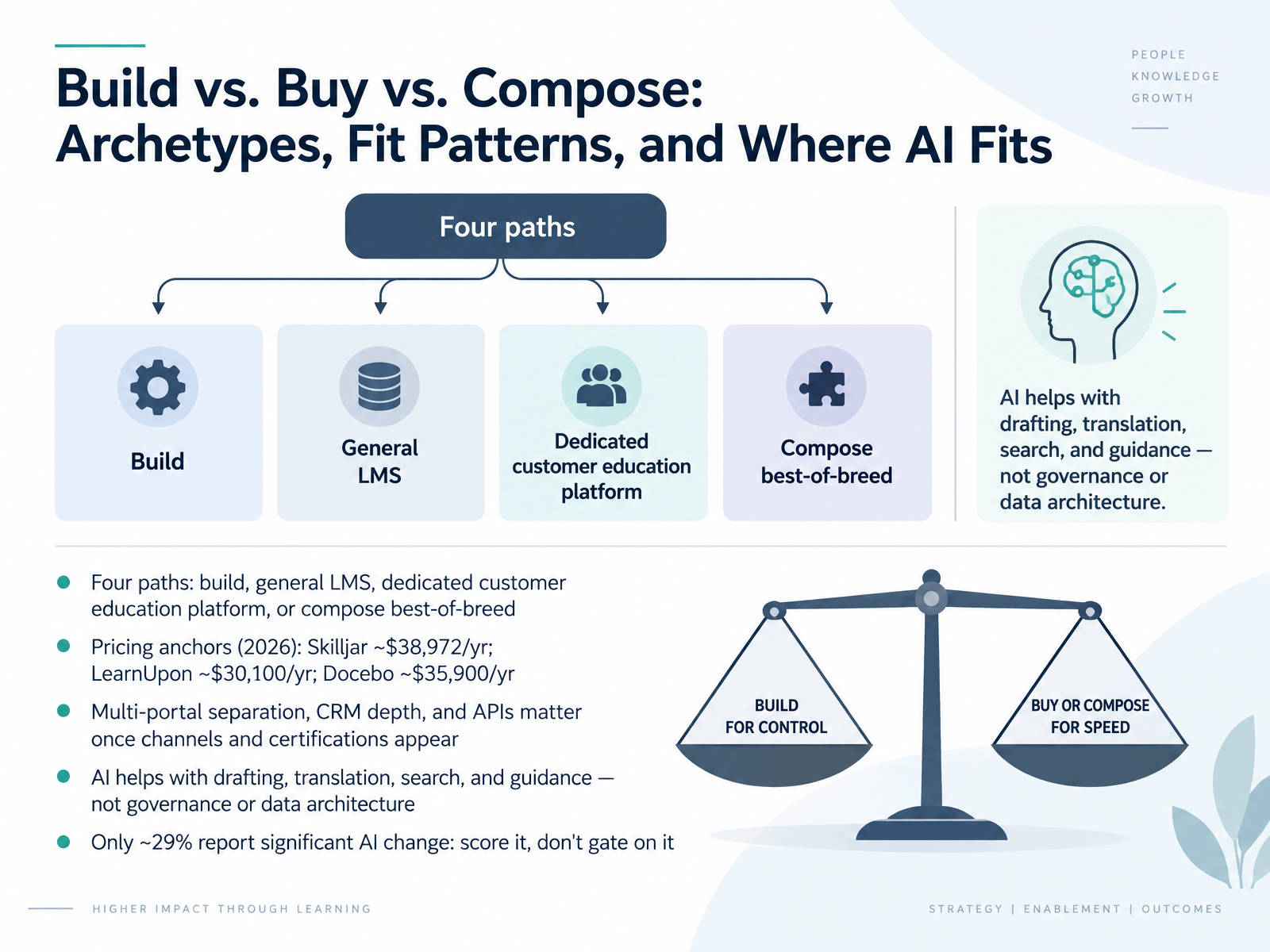
- 05Build vs. Buy vs. Compose: Archetypes, Fit Patterns, and Where AI FitsLet's look at your four paths: build it yourself, a general LMS, a dedicated customer education platform, or compose best of breed. For pricing anchors in 2026, Skilljar runs about thirty-eight thousand nine hundred seventy-two dollars a year, LearnUpon about thirty thousand one hundred, and Docebo about thirty-five thousand nine hundred. But cost is only the entry point. Once you add channels and certifications, three questions decide fit: multi-portal separation, CRM depth, and API coverage. If you optimize for a low starting price, you accept weaker governance and more manual admin later. Now, where does AI fit? It helps with drafting, translation, search, and guidance, not governance or data architecture. And only about twenty-nine percent of programs report significant change from AI so far, so score it as a capability, don't gate your decision on it. Next, we move into the Target Architecture Blueprint and Integration Priorities.
 getcor.aigitnux.orgknowlify.com+22 min
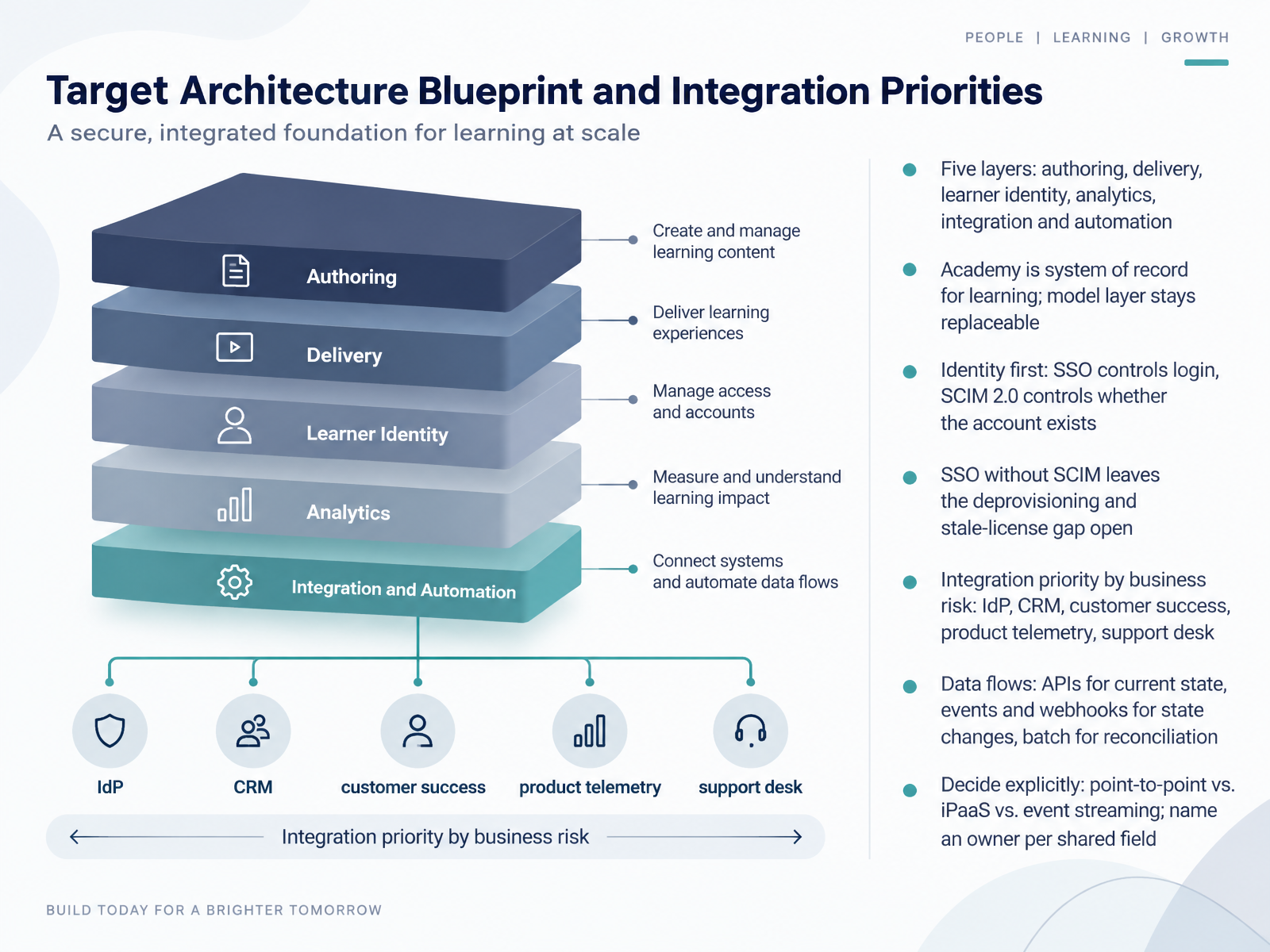
- 06Target Architecture Blueprint and Integration PrioritiesNow let us anchor the decisions in a target architecture. Think of your platform as five layers: authoring, delivery, learner identity, analytics, and integration and automation. Your academy stays the system of record for learning, but the model layer stays replaceable, so you are never locked in.
Start with identity, because it carries the most risk. Single sign on controls how a learner logs in. SCIM 2.0 controls whether the account exists at all. SSO without SCIM leaves the deprovisioning gap open: leavers keep access, and you keep paying for stale licenses.
Then sequence integrations by business risk: your identity provider first, then CRM and customer success, then product telemetry, then the support desk. For data flows, use APIs for current state, events and webhooks for state changes, and batch for reconciliation. Decide explicitly between point to point, an iPaaS, or event streaming, and name an owner for every shared field.
If you optimize for speed, you accept tighter coupling and more maintenance. If you optimize for governance, you accept more upfront design work.
That sets up our next topic: Identity, Provisioning, and Security Requirements for External Learners.
 auth0.comsysgenpro.comsupport.thinkific.com+22 min
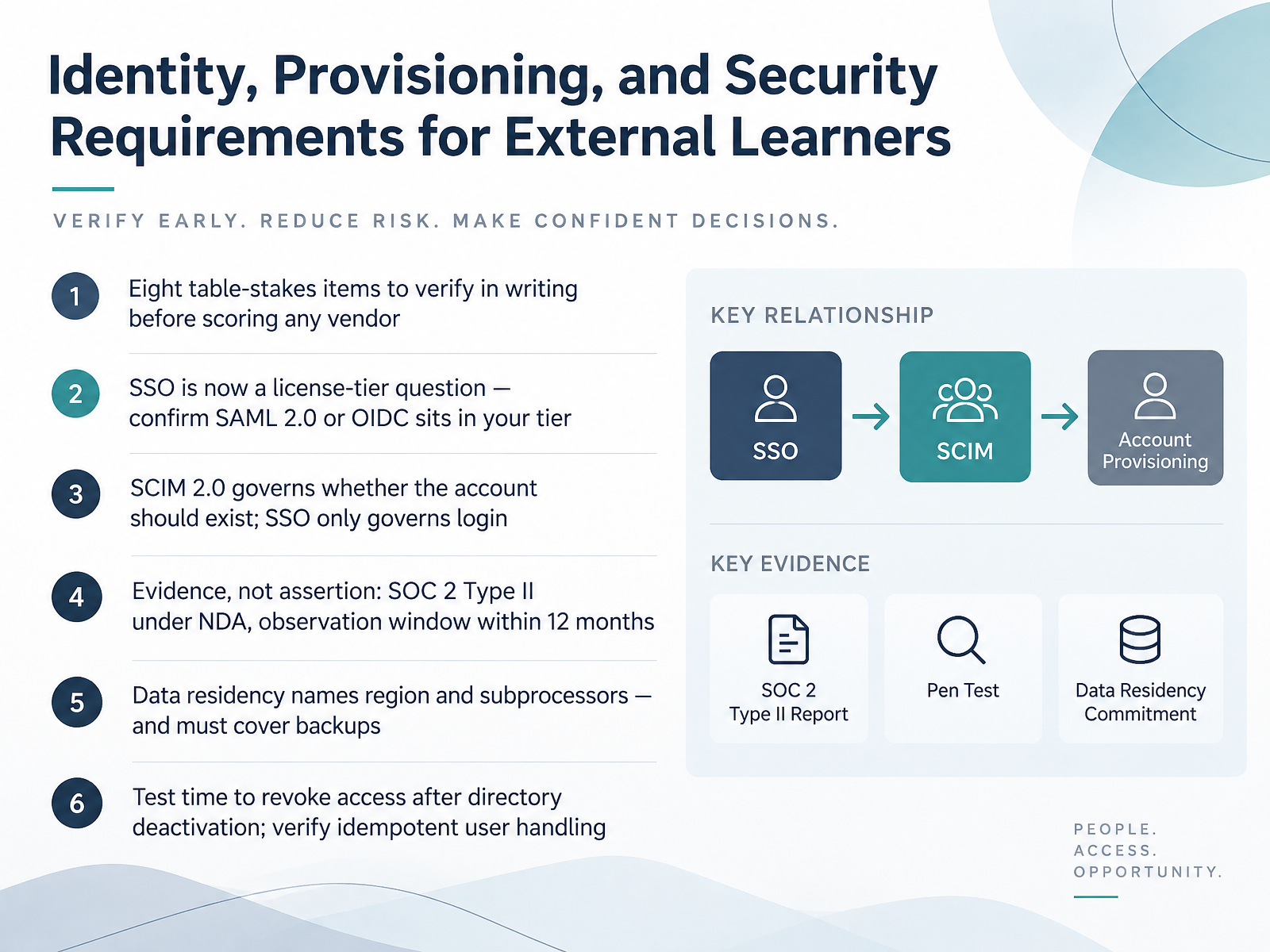
- 07Identity, Provisioning, and Security Requirements for External LearnersLet's turn to identity, provisioning, and security. This is the slide your IT and procurement colleagues care about most, because getting it wrong stops a rollout cold. There are eight table-stakes items to verify in writing before you score any vendor. Missing one in writing is a reason to walk away. Start with single sign-on. SSO is now mostly a license-tier question, so confirm that SAML 2.0 or OIDC sits inside the tier you're actually buying, not behind an upgrade. Remember the split: SCIM 2.0 governs whether the account should exist, while SSO only governs login. Without SCIM, leavers stay active, and that's your audit finding. Next, ask for evidence, not assertion. Request the SOC 2 Type II report under NDA, with an observation window inside the last twelve months. Then data residency: it must name the region and the subprocessors, and it must cover backups, because a backup in another region breaks the commitment. One practical test: deactivate a test user in your directory, then measure how long the platform takes to revoke access. Good platforms use idempotent user handling, so repeated requests don't create duplicates or errors. The takeaway: if you optimize only for learner experience here, you accept hidden admin load and audit risk later, so lock these in writing first. Next, Data, Analytics, and Proving Business Impact.
 learnworlds.comedzlms.comlisticler.com+22 min
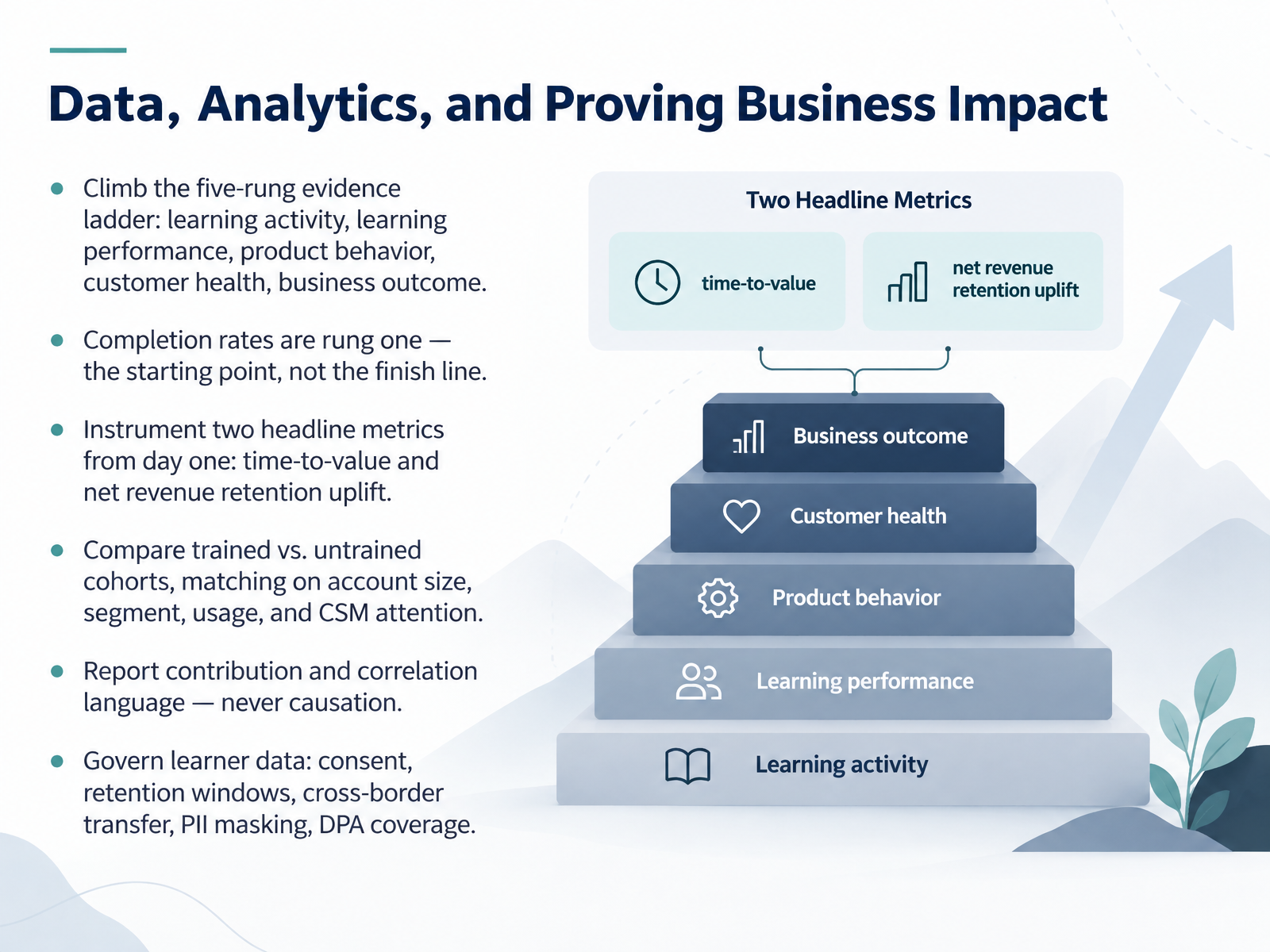
- 08Data, Analytics, and Proving Business ImpactNow let's talk about data, analytics, and proving business impact. The core idea here is an evidence ladder with five rungs: learning activity, learning performance, product behavior, customer health, and business outcome. Completion rates sit on rung one. They are your starting point, not your finish line. So instrument two headline metrics from day one: time to value and net revenue retention uplift. A practical example: compare trained versus untrained cohorts, matched on account size, segment, usage, and CSM attention. That matching step matters, because without it someone will challenge your numbers. And always report contribution and correlation language, never causation. Finally, govern learner data deliberately: consent, retention windows, cross-border transfer, PII masking, and DPA coverage. The tradeoff is simple: if you optimize for volume of reporting, you accept weaker evidence and more scrutiny. Next, we move into evaluation, scoring, proof of concept, and decision governance.
 absorbai.comauth0.comsysgenpro.com+21 min
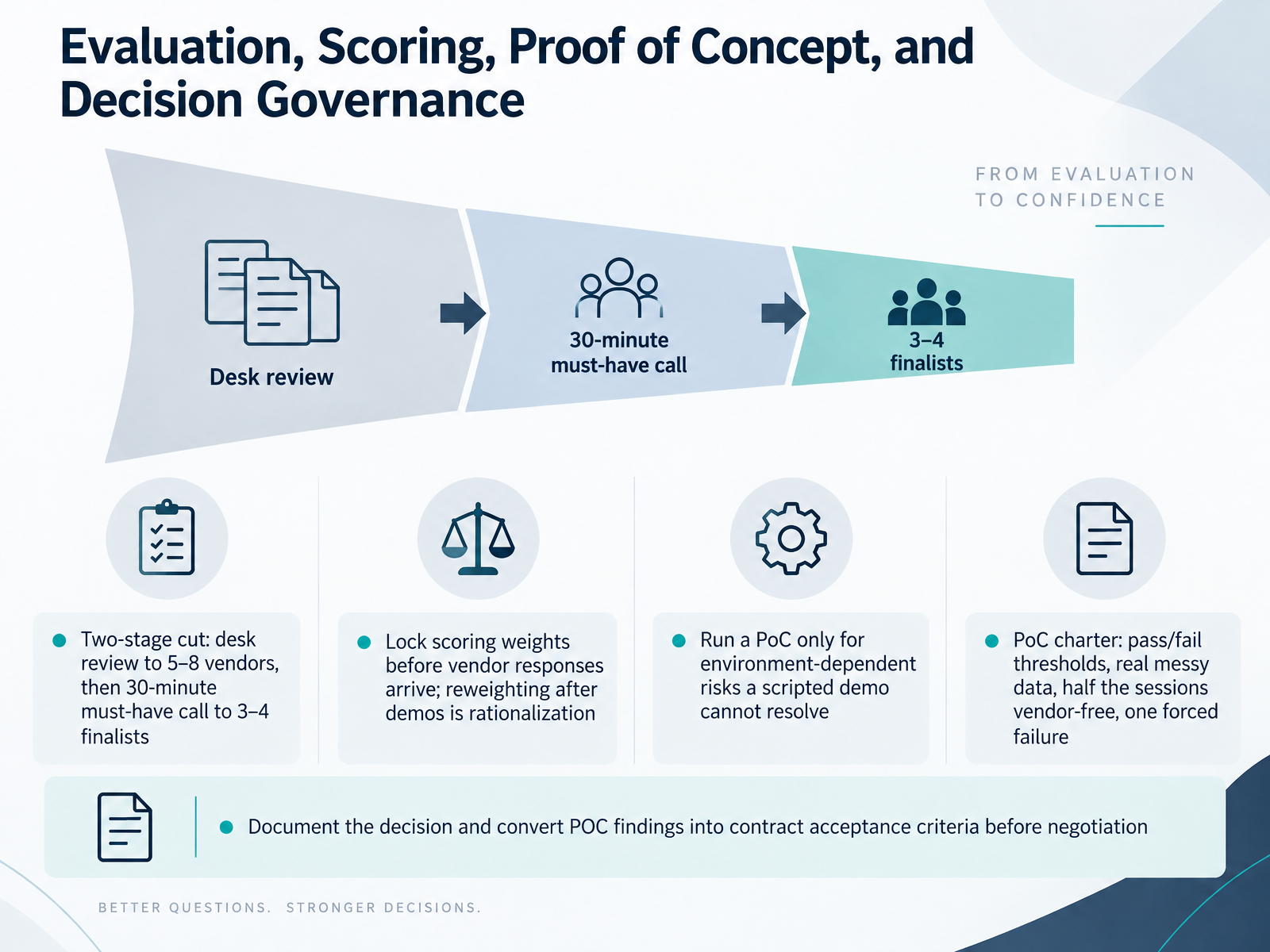
- 09Evaluation, Scoring, Proof of Concept, and Decision GovernanceLet's talk about how you turn all this into a defensible decision. Start with a two stage cut. Do a desk review down to five to eight vendors, then run a thirty minute must have call to reach three or four finalists. Next, lock your scoring weights before vendor responses arrive. Reweighting after demos is rationalization, not evaluation. Then, run a proof of concept only for environment dependent risks a scripted demo cannot resolve. Write a charter with pass fail thresholds, real messy data, at least half the sessions vendor free, and one forced failure. For example, kill an integration mid test and see whether the platform alerts loudly or fails silently. Keep it to four to six weeks, and document everything, because those findings become your contract acceptance criteria before negotiation. The tradeoff is simple. If you optimize for speed and skip governance, you accept a decision you cannot defend later. Choose a disciplined process you can stand behind.
 learnworlds.comedzlms.comlisticler.com+22 min
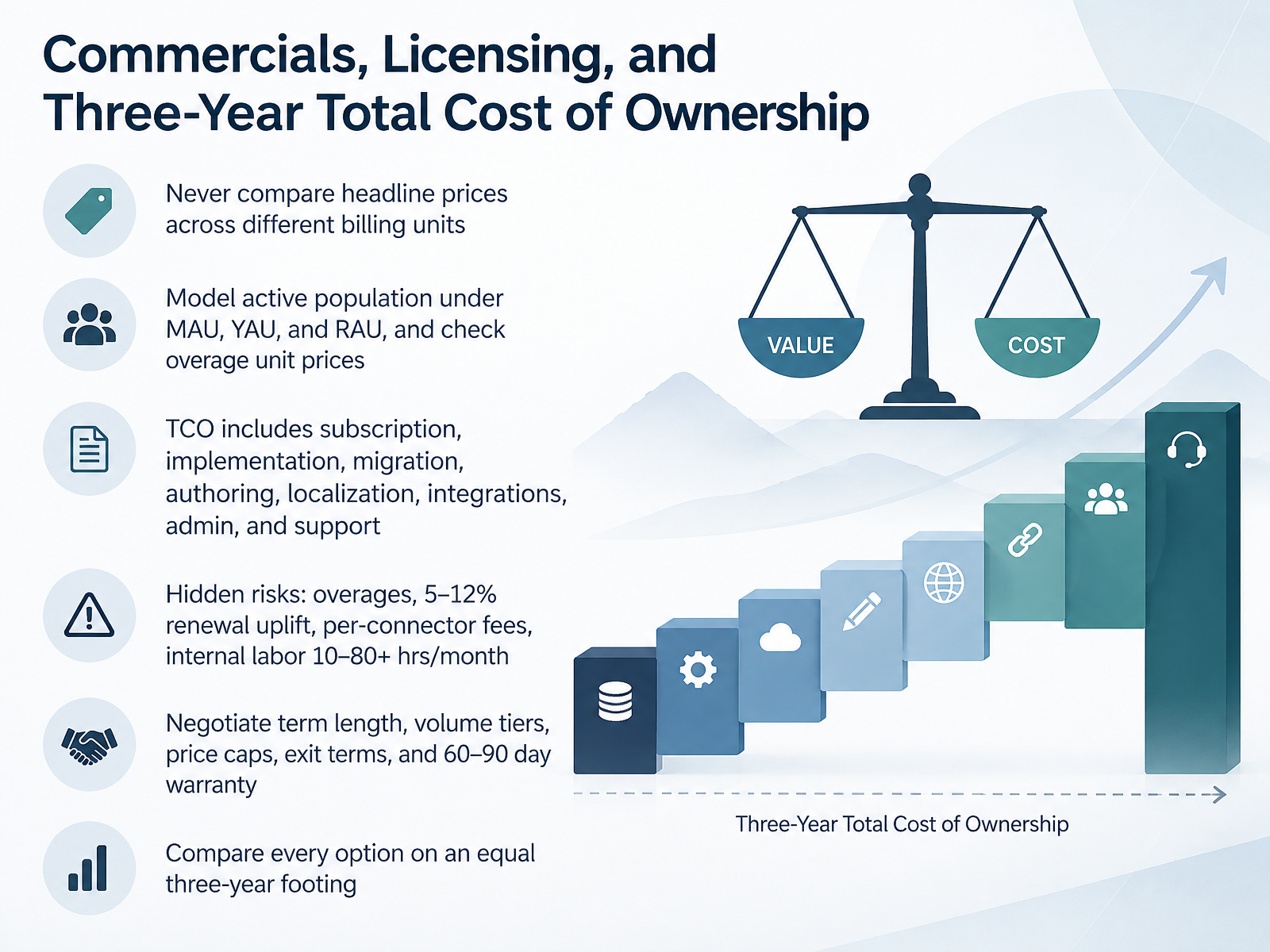
- 10Commercials, Licensing, and Three-Year Total Cost of OwnershipLet's turn to the commercial side. This is where a promising shortlist can quietly become an unaffordable program. Start with one rule: never compare headline prices across different billing units. Monthly active users, yearly active users, and registered active users are not the same thing. Model your own active population under each unit, then check the overage unit price. A platform quoted at thirty-five thousand nine hundred dollars a year for five hundred yearly active users can carry an overage of one hundred fifty dollars per unit. Now build the full three-year total cost of ownership: subscription, implementation, migration, authoring, localization, integrations, admin time, and support. Watch the hidden risks. Overages, renewal uplift of five to twelve percent, per-connector fees, and internal labor that runs ten to over eighty hours a month. If you optimize for the lowest subscription, you may accept higher integration and admin costs. So negotiate term length, volume tiers, price caps, exit terms, and a sixty to ninety day warranty. Then compare every option on an equal three-year footing. Next, we look at implementation, migration, and the operating model.
 getcor.aigitnux.orgknowlify.com+22 min
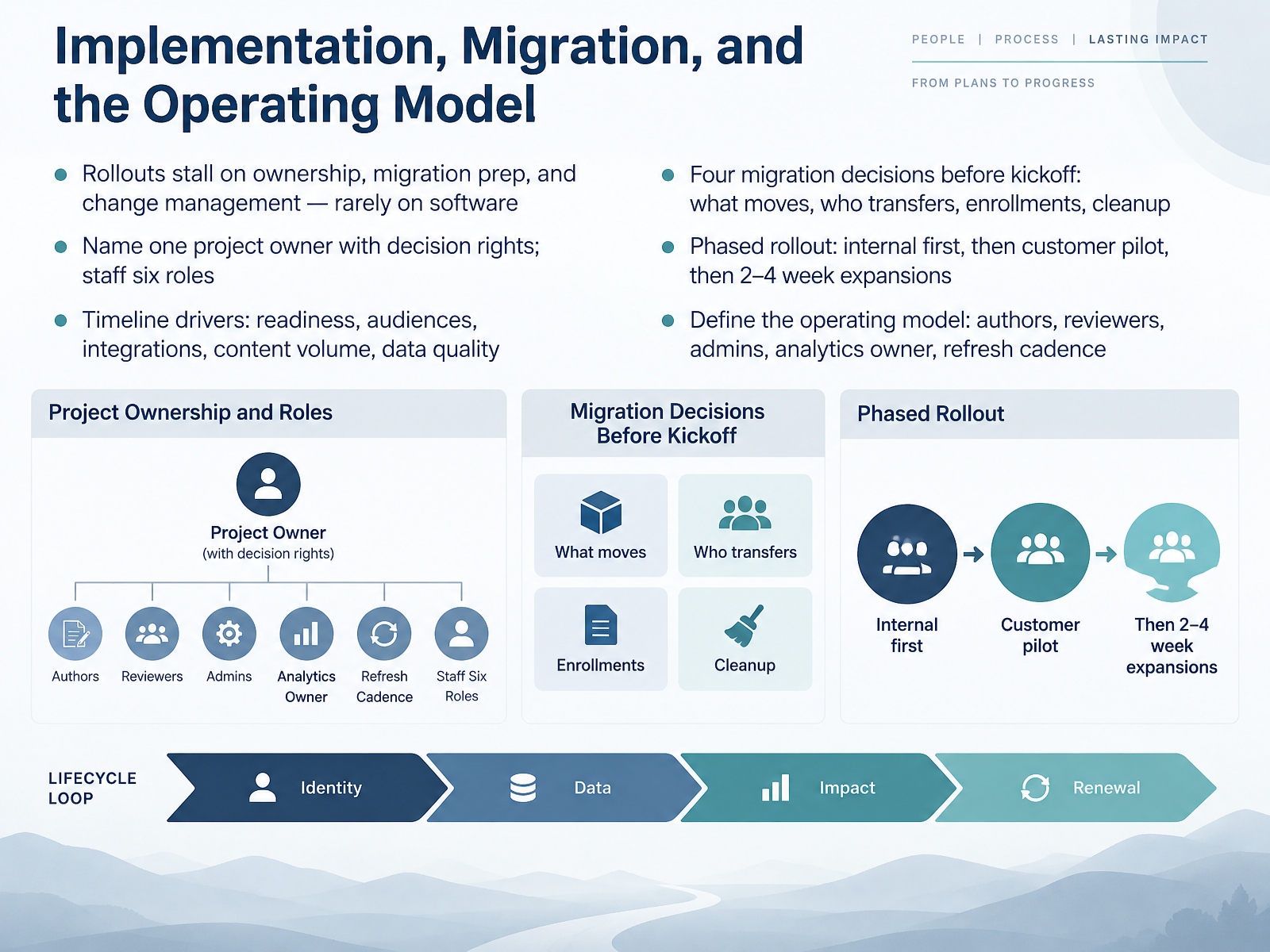
- 11Implementation, Migration, and the Operating ModelLet's focus on turning all of this into an operating reality: implementation, migration, and the ongoing model. The key insight is that rollouts rarely stall on software. They stall on ownership, migration prep, and change management. So if you optimize for technical speed, you accept organizational drag later. Start by naming one project owner with real decision rights, and staff six roles around them. Your timeline depends on readiness, audiences, integrations, content volume, and data quality, not on the vendor's feature list. Before kickoff, make four migration decisions: what content moves, which users transfer and with what status, how in-progress enrollments are handled, and who cleans up messy data. If you skip that cleanup, you accept delays during configuration. Then roll out in phases: internal first, then a customer pilot, then expansions in two to four week intervals. Finally, define the operating model with clear roles for authors, reviewers, admins, an analytics owner, and a refresh cadence. Treat the operating model as a go-live gate, not an afterthought. That's how you protect learner trust and avoid a stalled launch. Next, we'll look at risk, governance, and future-proofing the decision.
 2 min
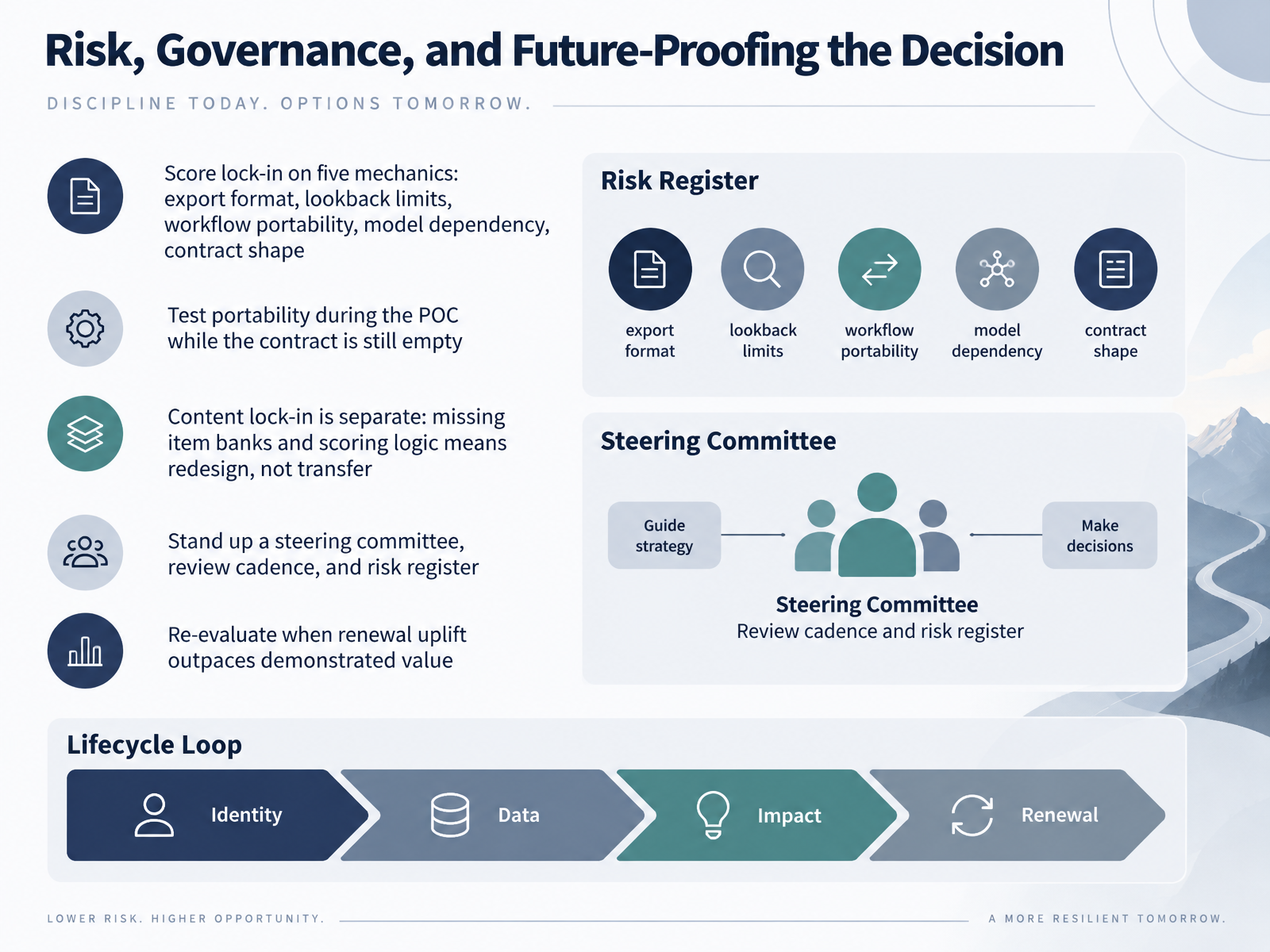
- 12Risk, Governance, and Future-Proofing the DecisionLet's talk about risk, governance, and future-proofing the decision. Lock-in is not one risk. It is five. Score each on a mechanical fact, not a promise: the export format, how far back exports reach, whether your workflows and prompts move in a readable format, which models the platform depends on and who chooses them, and the contract shape, meaning notice period and post-termination export window, stated in days. Run the portability test during the proof of concept, while the contract is still empty. Ask for a sample export and a migration scenario. Content lock-in is a separate problem. If item banks and scoring logic cannot come out in a usable form, you are looking at redesign, not transfer. Then set up governance: a steering committee, a regular review cadence, and a risk register. Treat renewal uplift that outpaces demonstrated value as your re-evaluation trigger. The takeaway: portability is an acceptance criterion, not a sales promise. Next, we move into the decision workshop, where we score a shortlist and commit to tradeoffs.
 getcor.ai2 min
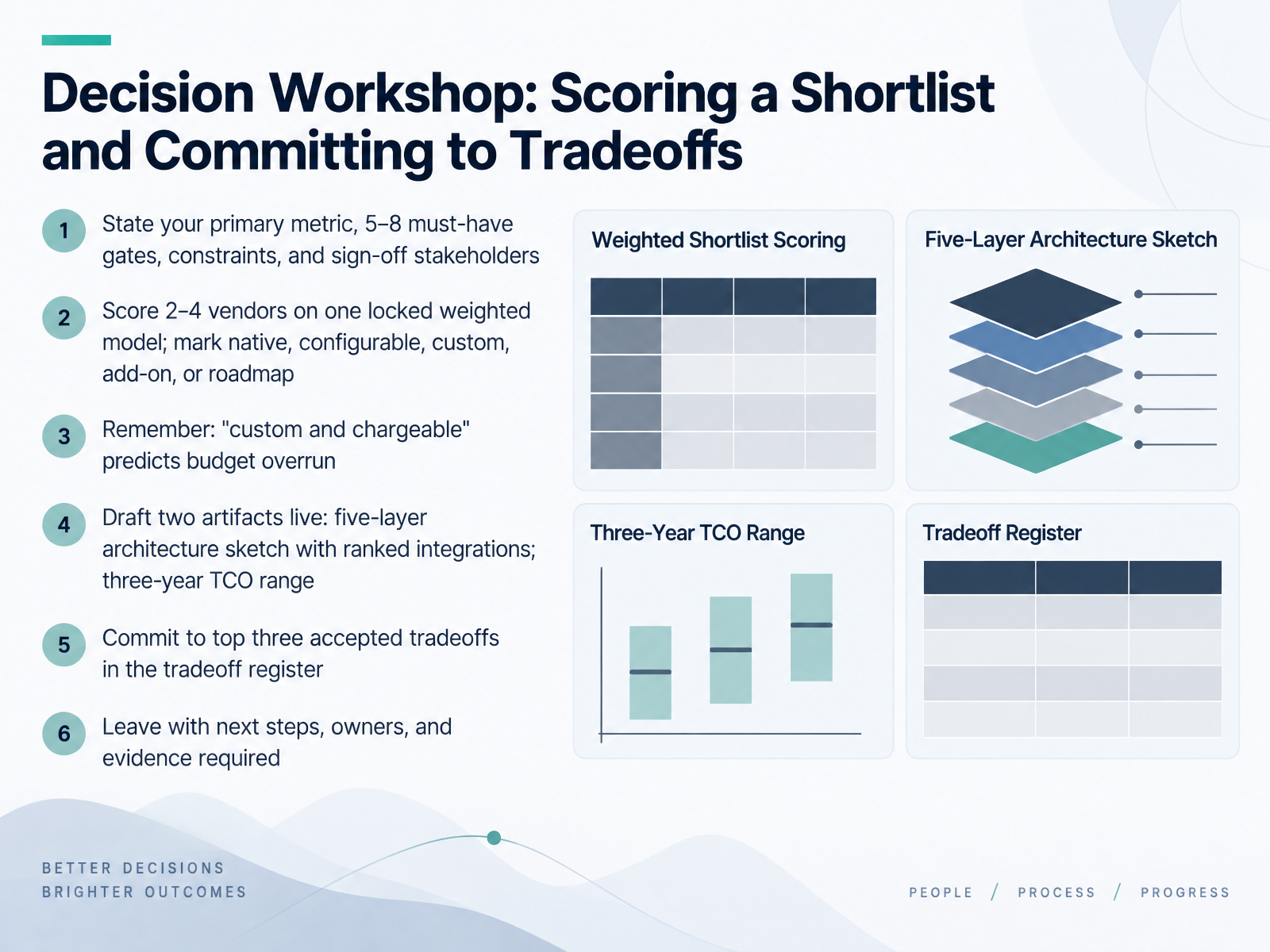
- 13Decision Workshop: Scoring a Shortlist and Committing to TradeoffsNow let's put all of this into one working session: scoring your shortlist and committing to tradeoffs. Start by locking four things: your primary metric, five to eight must-have gates, your constraints, and the stakeholders who will sign off. For example, if your primary metric is activated learners, a gate might be single sign-on in the base licence. Next, score two to four vendors on one weighted model you set before any demo, and mark each capability as native, configurable, custom, add-on, or roadmap. Watch for the phrase custom and chargeable, because it reliably predicts budget overrun. Live in the room, draft two artifacts: a five-layer architecture sketch with your integrations ranked, and a three-year total cost of ownership range. Then commit to your top three accepted tradeoffs in the tradeoff register, and leave with next steps, owners, and the evidence each owner owes. The takeaway is simple: lock the model first, then let the scores and the tradeoffs make the decision defensible. Coming up next, the Recommendation Package and 90-Day Path Forward.
 learnworlds.comedzlms.comlisticler.com+22 min
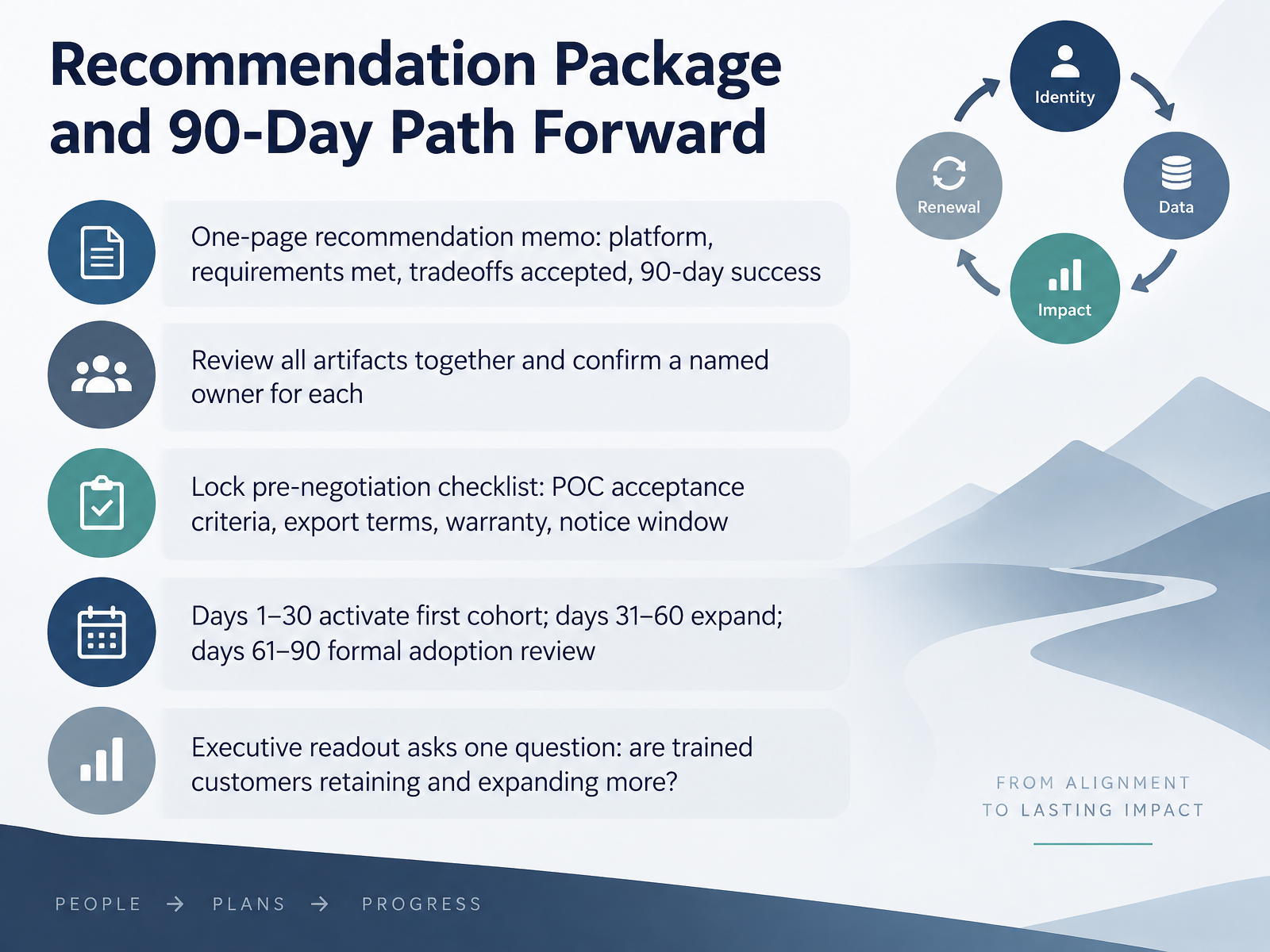
- 14Recommendation Package and 90-Day Path ForwardLet's close with your recommendation package and a ninety-day path. First, write a one-page recommendation memo: the platform you're choosing, the requirements it meets, the tradeoffs you've accepted, and what success looks like at ninety days. If you can't write that page clearly, the decision isn't clear yet.
Next, review every artifact together, and confirm one named owner for each. Remember, any item without an owner's name next to it is your first project risk. Then lock the pre-negotiation checklist: proof of concept acceptance criteria, data export terms, warranty, and the notice window. Those four items protect you after signing.
For the rollout, follow a thirty, sixty, ninety cadence. Days one to thirty, activate your first cohort. Days thirty-one to sixty, expand. Days sixty-one to ninety, run a formal adoption review.
Finally, take it to your executives, and ask one question: are trained customers retaining and expanding more? That reframes education from a cost into a growth initiative. Thank you for working through this with me, and good luck building your recommendation package.
 absorbai.com2 min
Take the deck with you
Download this course as a file — free, no sign-up needed.
- PDF handoutEvery slide page, ready to print or share.15 pages · 3.2 MBDownload
- Narrated PowerPointThe deck that presents itself — every slide carries the digital human's narration video.15 pages · 15.1 MBDownload
- PowerPoint slidesThe full deck as a .pptx — open it in PowerPoint, Keynote, or Google Slides.15 pages · 3.1 MBDownload
Free to use in your own training — please keep the PersonWise credit page at the end.
Have your own deck? Turn it into a course
Sources consulted
Web sources consulted while building this course.
- The state of customer education in 2026 | Absorb LMS Software — absorbai.com
- From Learning To Revenue — thinkific.com
- New Absorb Software and Lighthouse Research & Advisory Study Reveals How the Highest-Performing Customer Education Programs Turn Learning into Measurable Growth — bnnbloomberg.ca
- What Has Changed in Customer Education in 2026? — check-n-click.com
- Customer Education Software 2026 Trends and Forecasts 2033: Analyzing Growth Opportunities — archivemarketresearch.com
- Customer Education and LMS Platforms Compared (2026): Pricing and Features | Cor — getcor.ai
- Top 10 Best Customer Education Software (2026 Review) — gitnux.org
- The 15 Best LMS Platforms in 2026 (By Use Case) | Knowlify — knowlify.com
- 28 Best Learning Management Systems (LMS) in 2026 Compared — itechguides.com
- LMS Comparison Chart 2026: Choosing Your Platform by Corporate Workflow Fit — uteach.io
- The Ultimate LMS RFP Checklist: Selecting the Right Partner Training LMS — learnworlds.com
- eLearning RFP Template + Scoring Rubric (Free Download) — edzlms.com
- Enterprise Education & Learning Checklist: SSO, Compliance, and the Stuff That Matters | Listicler — listicler.com
- LMS RFP Template: Guiding Your Vendor Evaluation Process — d2l.com
- LMS RFP Template & Requirements Checklist | Learnifier — learnifier.com
- Driving Business Outcomes with Inbound SCIM and Event Streams — auth0.com
- SaaS Integration Architecture for Customer Success, CRM, and ERP | SysGenPro ERP — sysgenpro.com
- Integrate Thinkific with HubSpot — support.thinkific.com
- Configure SCIM Provisioning with Udemy’s SCIM API – Udemy Business — business-support.udemy.com
- SCIM Integration - Scope, Setup and Usage | Scheer IMC - Customer Documentation (EN) — doc-en.scheer-imc.com