Negotiation Teaching Workflow
Begin
14 pages · ~28 min
Negotiation Teaching Workflow
A practical guide for trainers on teaching negotiation skills, covering key concepts, techniques, and a step-by-step workflow to deliver effective training sessions.
What you’ll learn
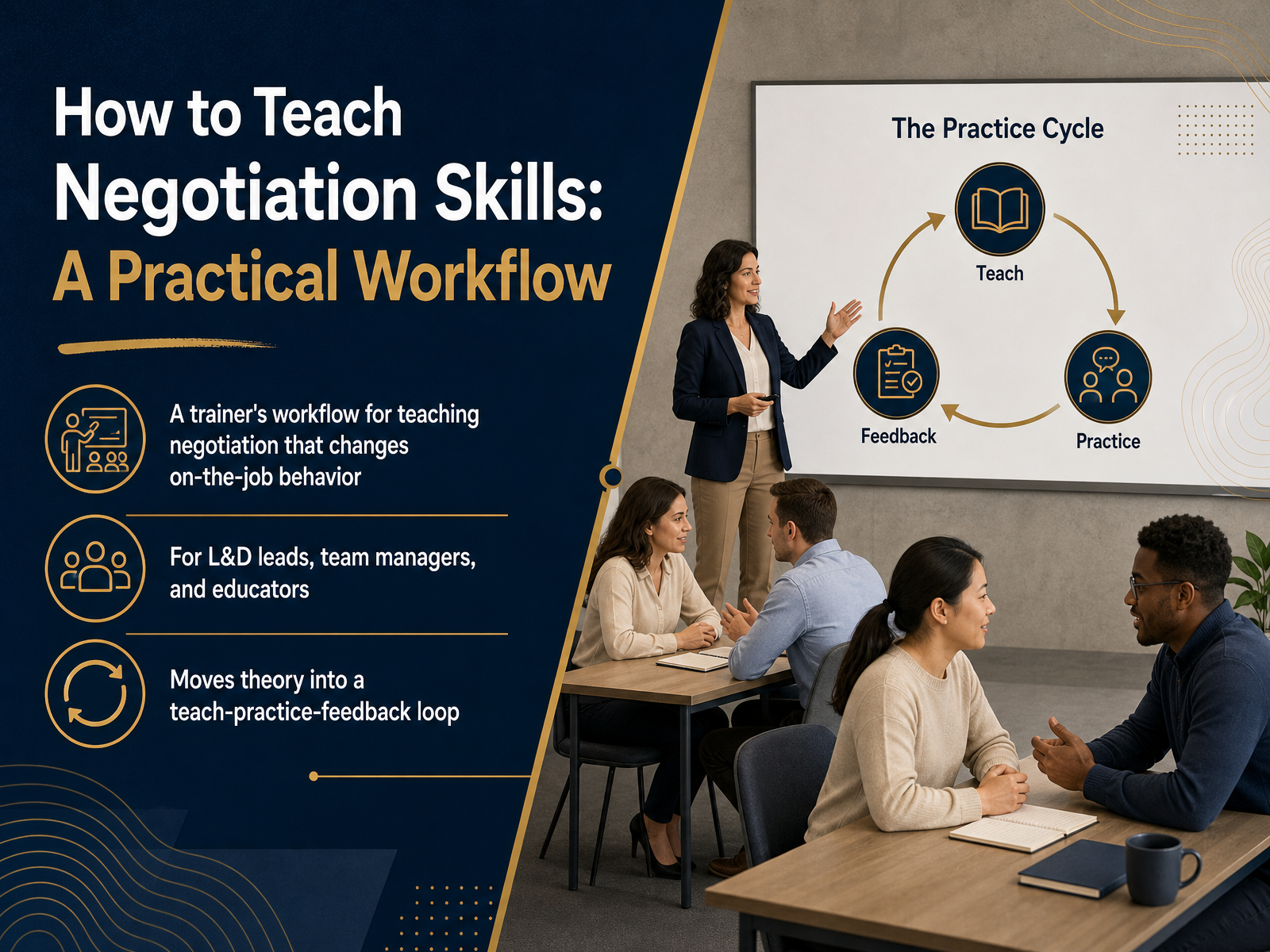
- 01How to Teach Negotiation Skills: A Practical WorkflowWelcome, and thank you for joining. If you're responsible for developing leaders or improving how your teams collaborate, you already know that negotiation is not a natural talent, it is a teachable skill. Today, we're going to walk through a practical workflow for teaching negotiation that actually changes on the job behavior. Not just delivering theory, not just running a one off workshop. Our goal is to build a structured loop of teaching, practice, and feedback that sticks. We'll focus on what works in the real classroom, with real time constraints and real pressure. This is about giving your learners a repeatable process they can use the very next day. Let's get started.pon.harvard.edupon.harvard.edunegotiationstraininginstitute.com+21 min
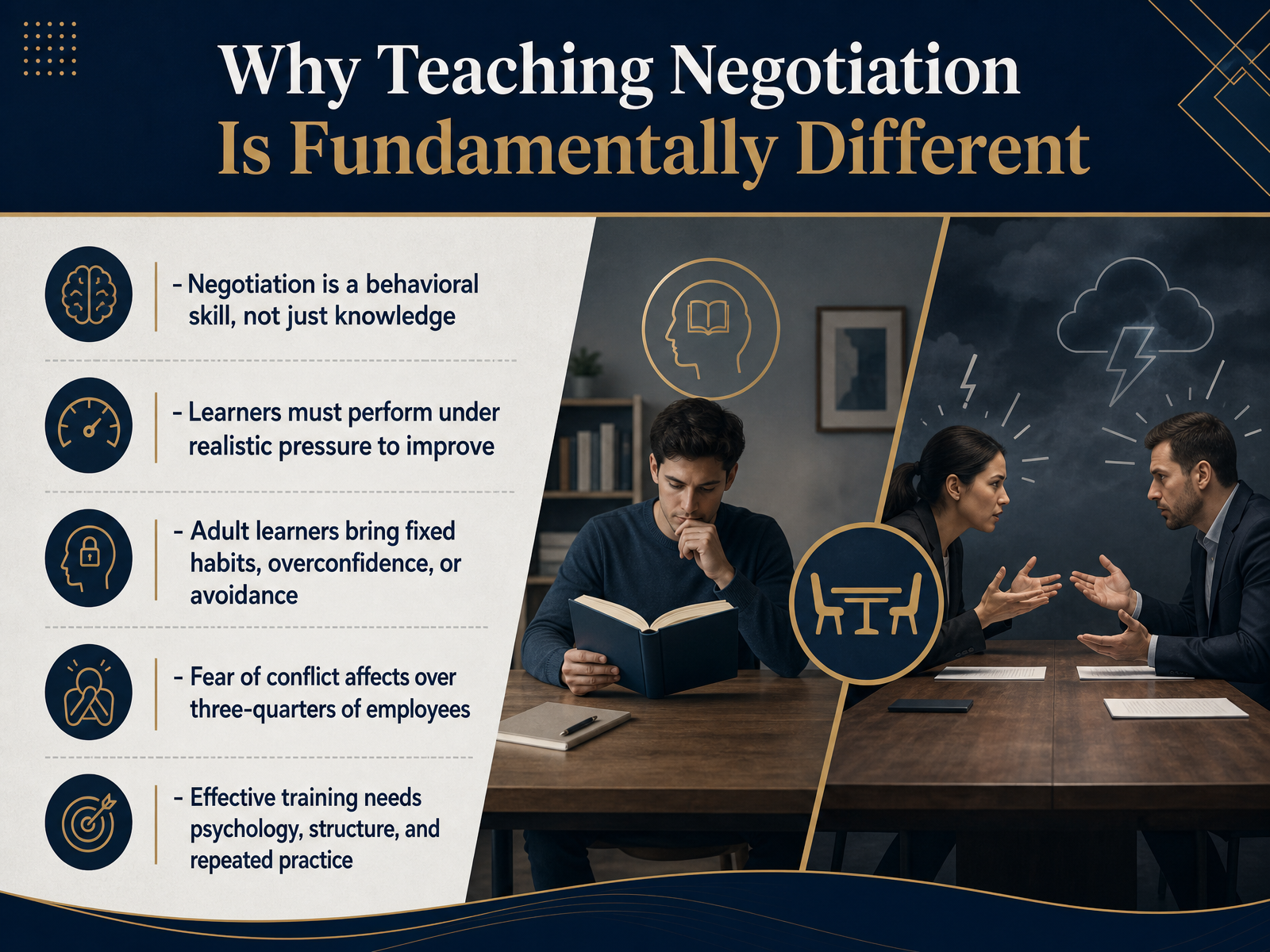
- 02Why Teaching Negotiation Is Fundamentally DifferentHere’s the key point. Teaching negotiation is not like teaching product knowledge or company policy. That’s because negotiation is a behavioral skill, not just knowledge. You can’t learn it by reading a slide. Your learners have to perform under realistic pressure to actually improve. And that’s where it gets tricky with adult learners. They come in with fixed habits. Some are overconfident, some avoid conflict altogether. In fact, fear of conflict affects over three quarters of employees. That’s a huge barrier. Think about the last time you saw a capable manager freeze or give in too early in a tough conversation. That’s not a knowledge gap, it’s a behavior gap under pressure. So your training needs to combine psychology, structure, and repeated practice. That’s a very different design problem than a typical compliance course. It’s also why this is the most interesting training you’ll ever deliver. Now, let’s look at the foundational concepts to teach first.
 oecd.orgoecd.orgtrainingmag.com+21 min
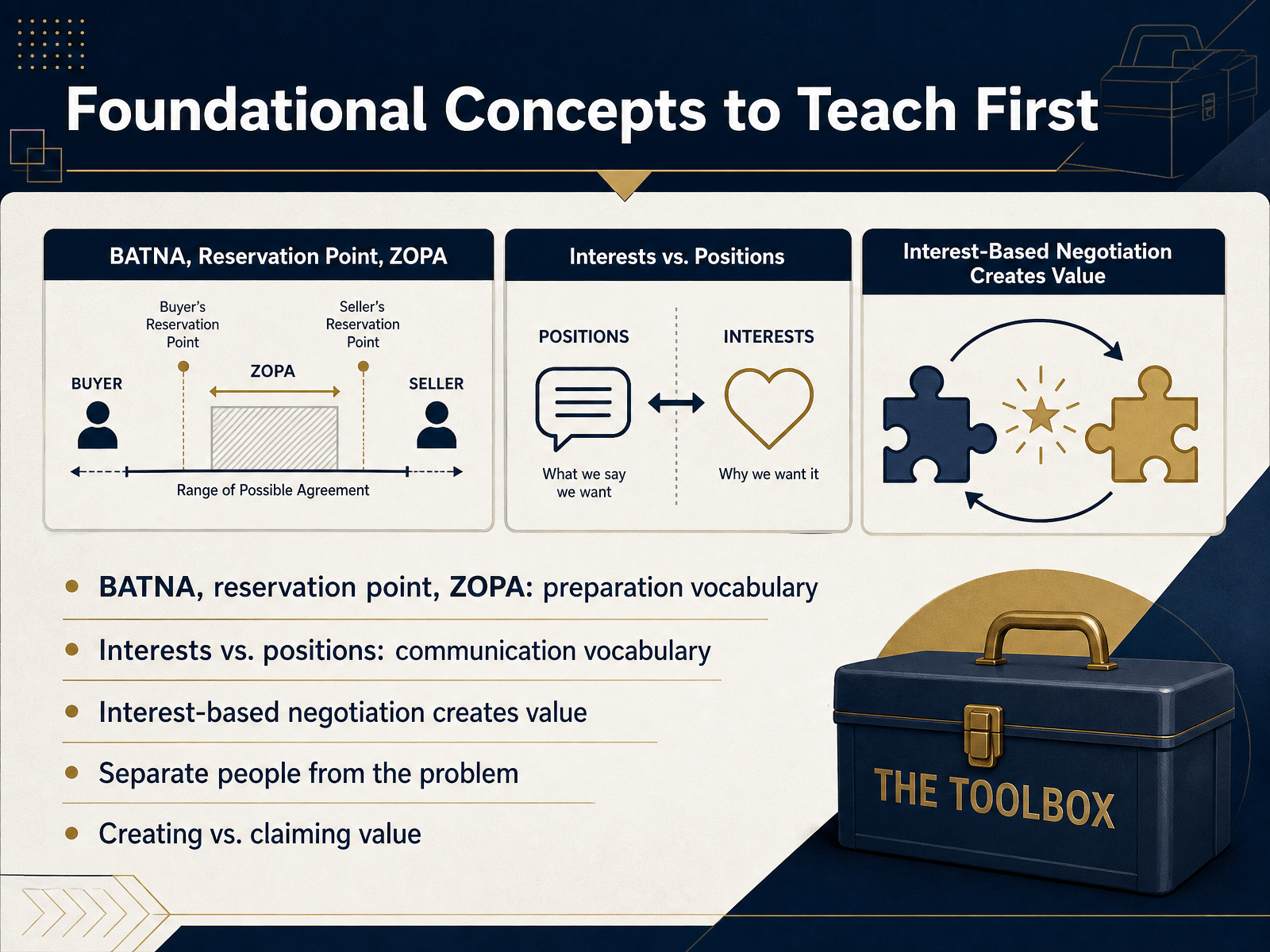
 - 03Foundational Concepts to Teach FirstNow let’s talk about the concepts your learners need before they ever sit down at the table. Start with the preparation vocabulary: BATNA, reservation point, and ZOPA. BATNA is their best alternative if no deal happens. It sets their walk-away point, and it’s the real source of their power. The ZOPA is the overlap between what both sides are willing to accept. If there’s no overlap, there’s no deal. Then move to communication vocabulary: interests versus positions. A position is what someone says they want. An interest is why they want it. Teach them to ask 'why' until they hit the real need underneath. That’s how interest-based negotiation creates value. Instead of fighting over a fixed pie, they explore what each side actually cares about and trade on what matters. This also supports a core principle: separate the people from the problem. Be tough on the issue, not on each other. And finally, frame the whole exercise around creating value before claiming it. Invent options first. Divide the benefits later. If your students only remember two things, make it this: know your walk-away, and always ask why. Now, let’s look at the repeatable workflow you can use to teach all of this in class.
 journals.sagepub.comsmacna.orgpon.harvard.edu+22 min
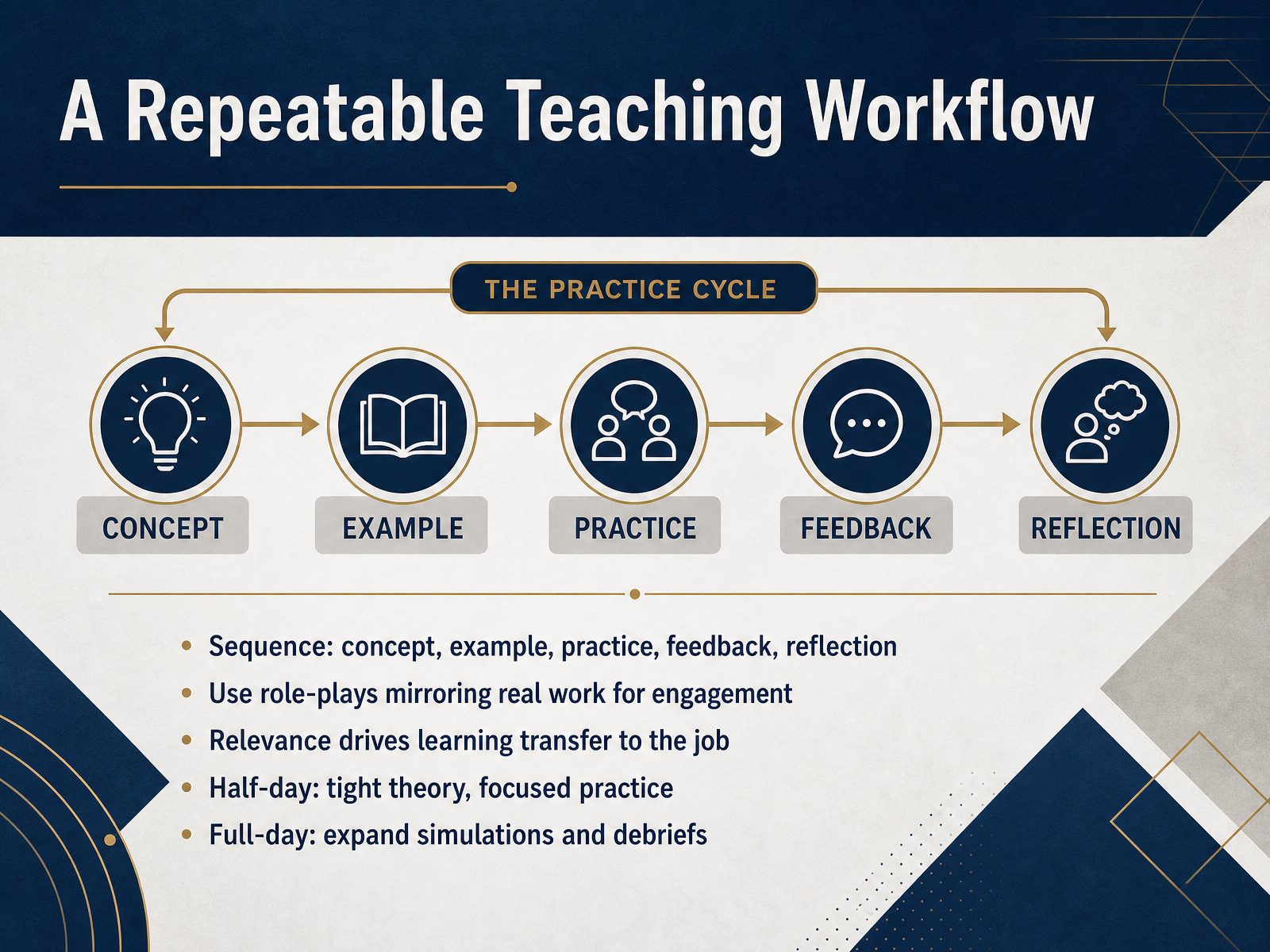
 - 04A Repeatable Teaching WorkflowNow let's talk about the workflow itself. The key is to keep it simple and repeatable: concept, example, practice, feedback, reflection. That's the sequence that works. Start with a tight concept, show a concrete example, then let participants try it in a role-play that mirrors their real work. That relevance is what drives learning transfer. If they can see themselves in the scenario, they'll actually use the skill on the job. For a half-day session, keep theory tight and focus on one or two practice rounds. For a full day, expand the simulations and give more time for debriefs. Don't skip the reflection step—that's where the learning sticks. So remember: short concept, realistic practice, structured feedback, and a few minutes to reflect. That's the engine. Next, let's look at designing practice that feels real and safe.
 scholarship.law.missouri.edujamesbaker.thinkport.orglenny.com+21 min
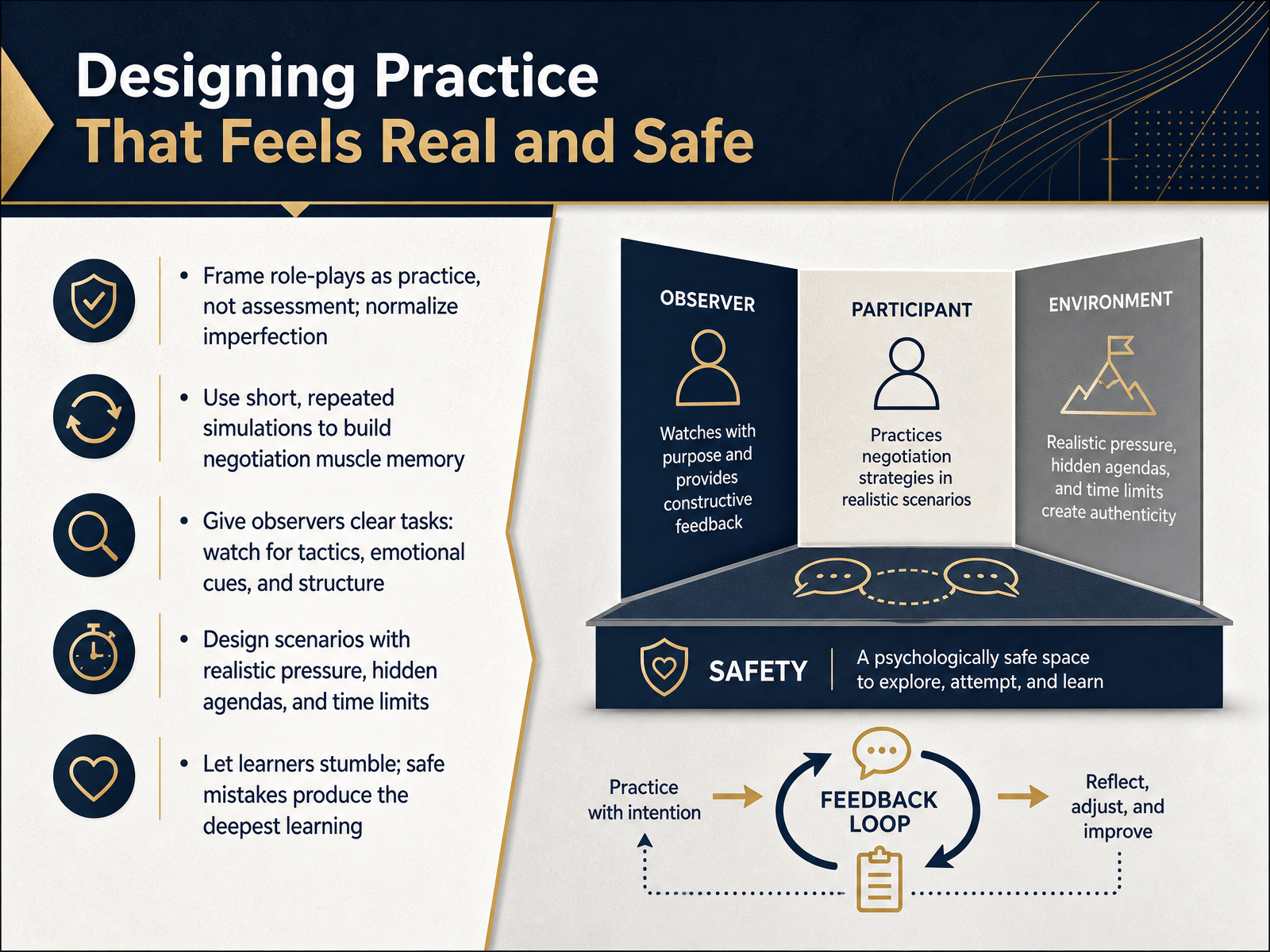
 - 05Designing Practice That Feels Real and SafeNow let's talk about designing practice that feels both real and safe. The key is to frame every role-play as practice, not assessment. Normalize imperfection from the start. Tell your participants, this is where you're allowed to stumble. That removes the fear and opens the door to real learning. Use short, repeated simulations, not one long, high-stakes scenario. Repetition builds muscle memory. Ten minutes of focused practice, a quick reset, then another round, that's far more effective than a single forty-minute exercise. Give observers a clear job. Tell them to watch for specific tactics, emotional cues, and how the negotiation is structured. When observers know what to look for, the feedback they give becomes sharp and useful. Build pressure into the scenario itself. Add a hidden agenda, a tight deadline, a difficult counterpart. That's what makes it feel real. And let learners struggle a bit. Safe mistakes are where the deepest insights come from. If everyone sails through, they haven't learned anything. They've just performed. So be deliberate about the pressure and the safety, and you'll see the learning stick. Next, let's talk about structuring the debrief to drive insight.
 onlinelibrary.wiley.comonlinelibrary.wiley.com1 min
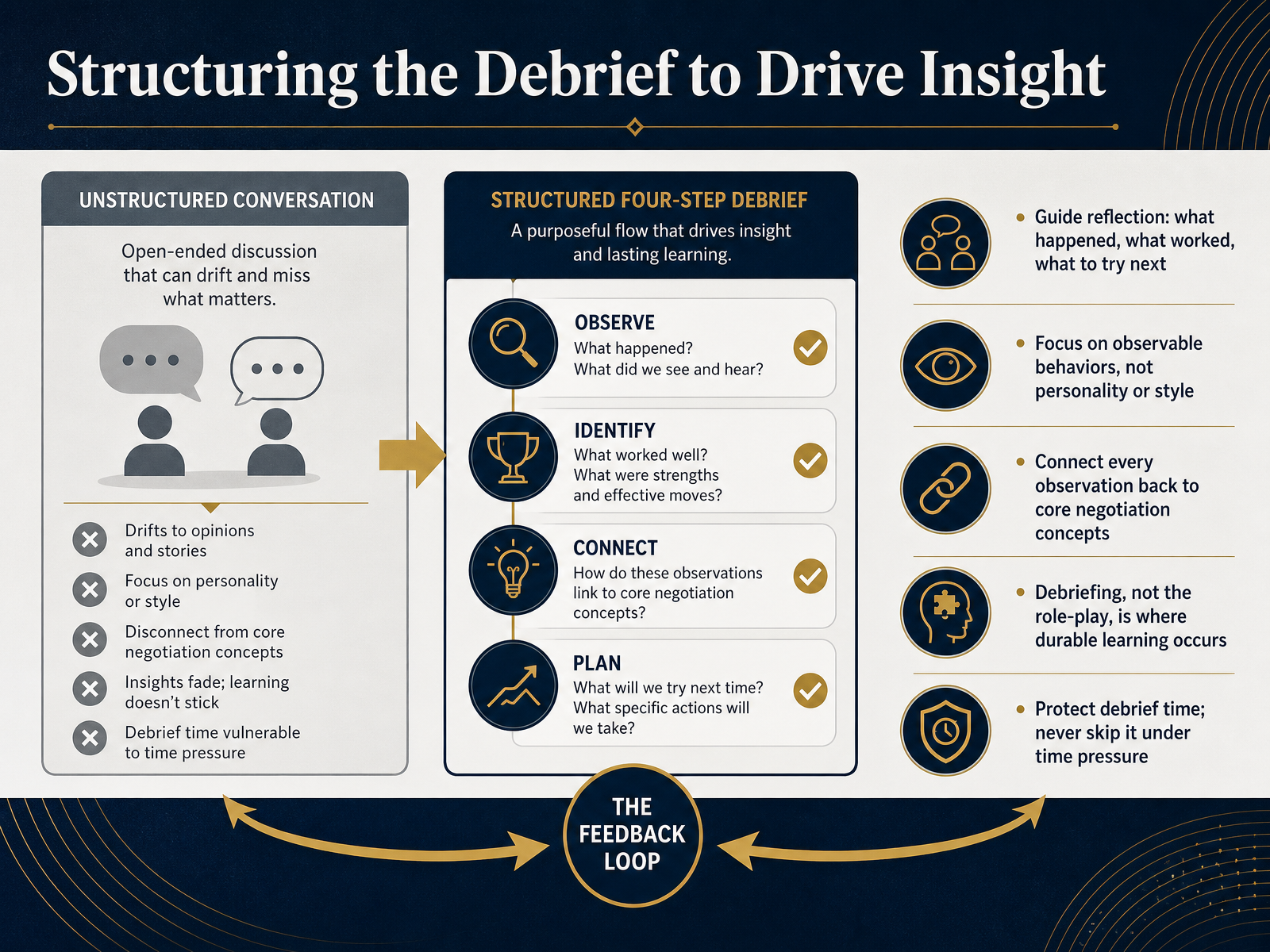
 - 06Structuring the Debrief to Drive InsightNow let's talk about the part that makes role-plays actually stick: the debrief. This is where learning happens, so protect this time like it's the most valuable part of your session — because it is. Start by guiding reflection with three simple questions: What happened? What worked? What would you try differently? Keep the focus on observable behaviors, not on personality. Instead of saying 'you were too aggressive,' say 'I noticed you interrupted three times when she was explaining her constraints.' Connect everything back to the core concepts you're teaching. If someone made an unplanned concession, anchor it to the principle of conditional concessions. Research shows that debriefed learners significantly outperform those who just practice and move on. So even when time is tight, never skip the debrief. Cut the role-play short if needed, but protect the reflection. That's where experience turns into insight. Next, we'll cover how to give feedback that actually changes behavior.
 onlinelibrary.wiley.comscholarship.law.missouri.edupon.harvard.edu1 min
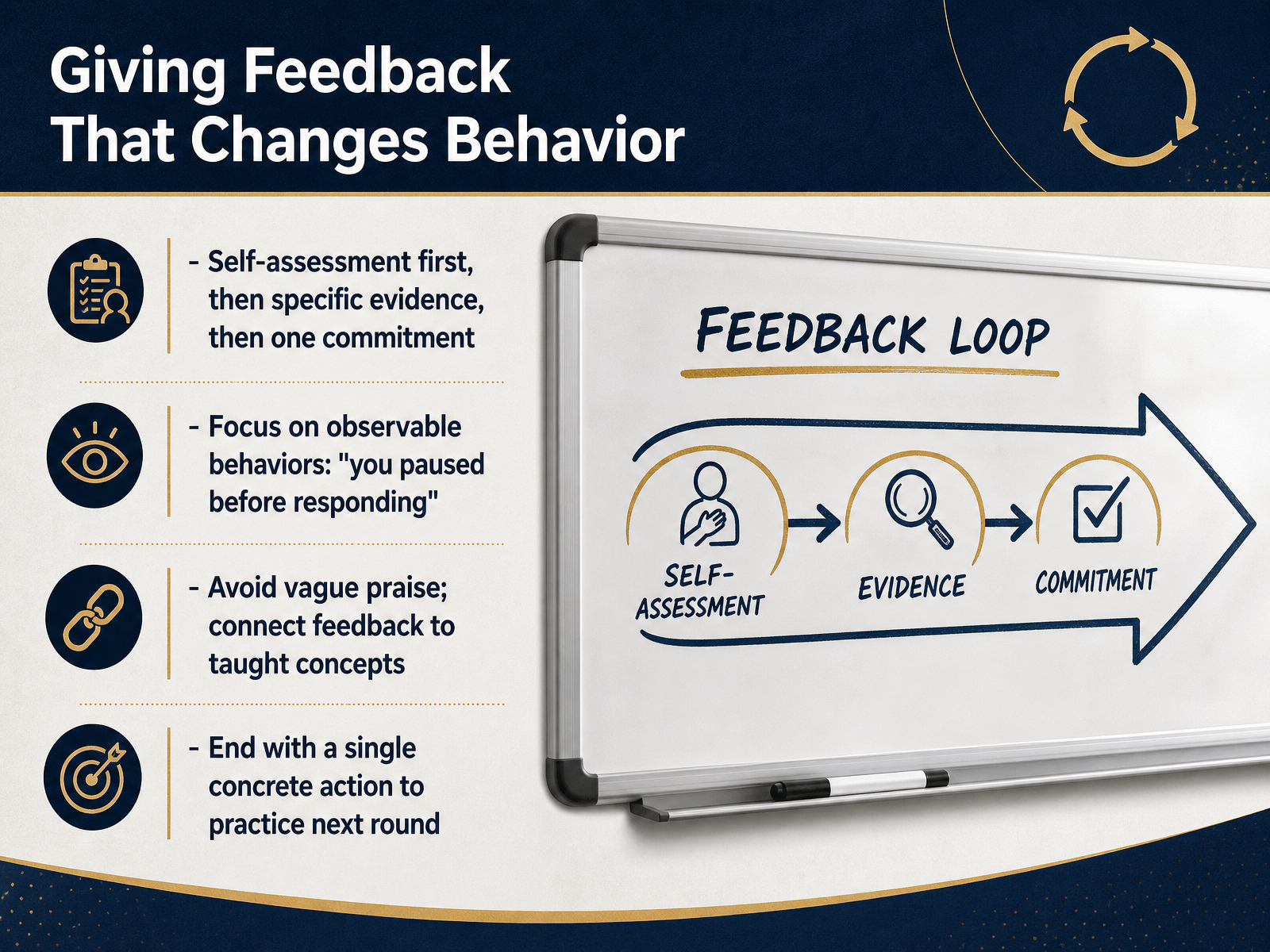
 - 07Giving Feedback That Changes BehaviorLet's talk about the part that actually changes behavior: the feedback you give after a simulation. Practice without reflection just produces repetition. So here's a structure that works. Start with self-assessment. Before you say anything, ask the participant: where did you feel strong, and where did you feel stuck? This gets them reflecting honestly before they hear your perspective. Then, bring in specific evidence. Don't say 'you did well.' Say 'you paused before responding when they pushed on price, and that gave you room to ask a better question.' Focus only on observable behaviors. Connect your feedback directly to the concepts you taught, like anchoring or active listening. And here's the most important rule: avoid vague praise. Saying 'good job' feels nice, but it doesn't build skill. End every debrief with one single, concrete commitment. One action they will practice in the next round. It's better to nail one behavior change than to list five suggestions that get forgotten. Next, let's look at how to evaluate learning progress without over-formalizing the process.
 onlinelibrary.wiley.comscholarship.law.missouri.edupon.harvard.edu1 min
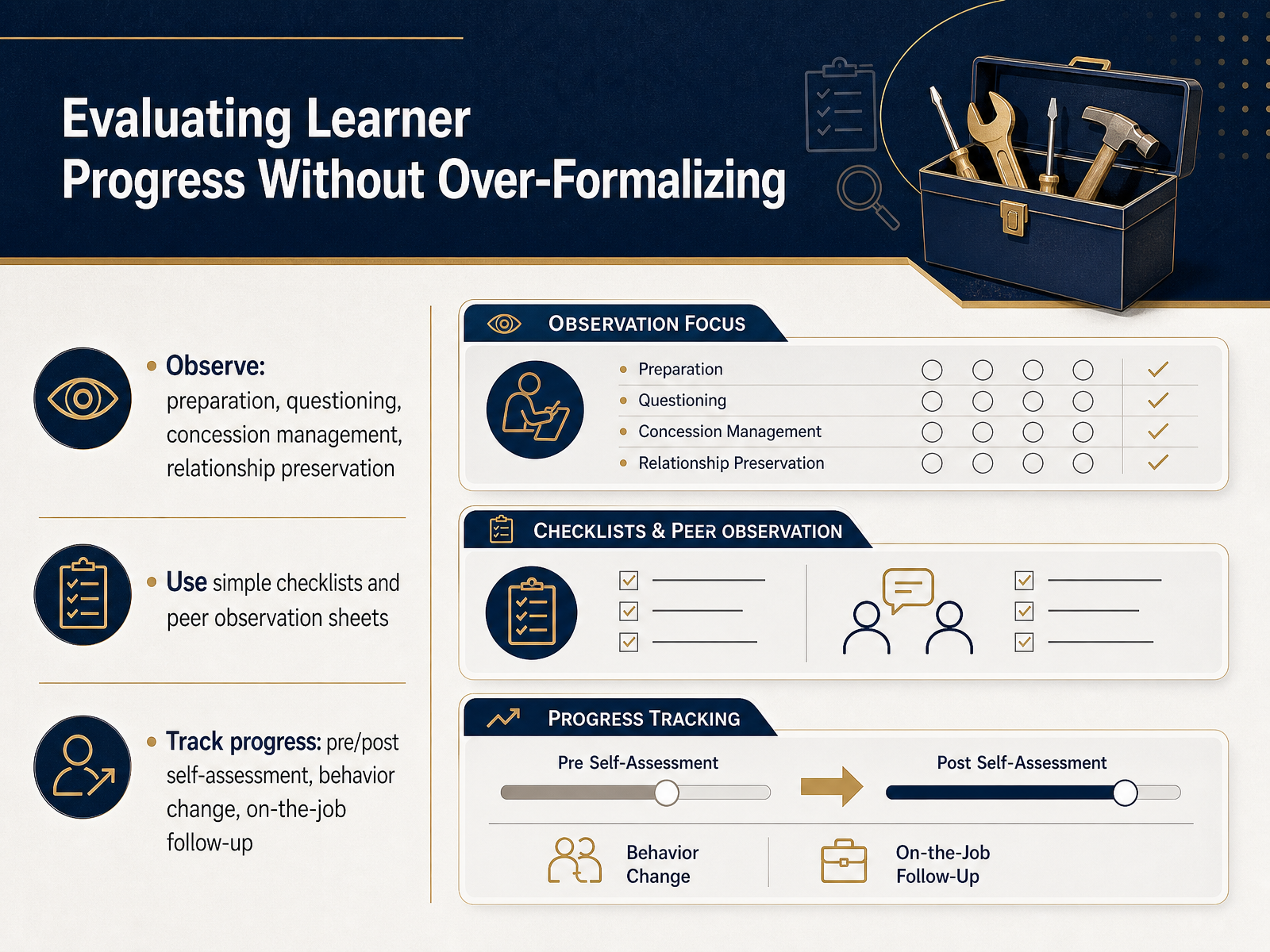
 - 08Evaluating Learner Progress Without Over-FormalizingNow let's talk about evaluating progress without turning your training into a bureaucratic nightmare. You don't need formal exams or lengthy reports. Instead, focus on what you can actually observe during practice sessions. Watch for preparation, how they ask questions, how they manage concessions, and whether they preserve the relationship while pushing for their interests. A simple checklist works wonders here. Have learners observe each other with a one-page peer observation sheet. It keeps everyone engaged and gives instant feedback from a different angle. For tracking over time, use a pre-and-post self-assessment. Ask them to rate their own confidence and skill before the training starts, then again at the end. The real proof, though, shows up on the job. So follow up with them a few weeks later. Ask what they tried differently in an actual negotiation and what happened as a result. That behavior change is your strongest evidence of learning. Keep evaluation light, practical, and tied to real behavior, and your people will actually welcome it. Next, let's look at adapting this workflow for different audiences.
 2 min
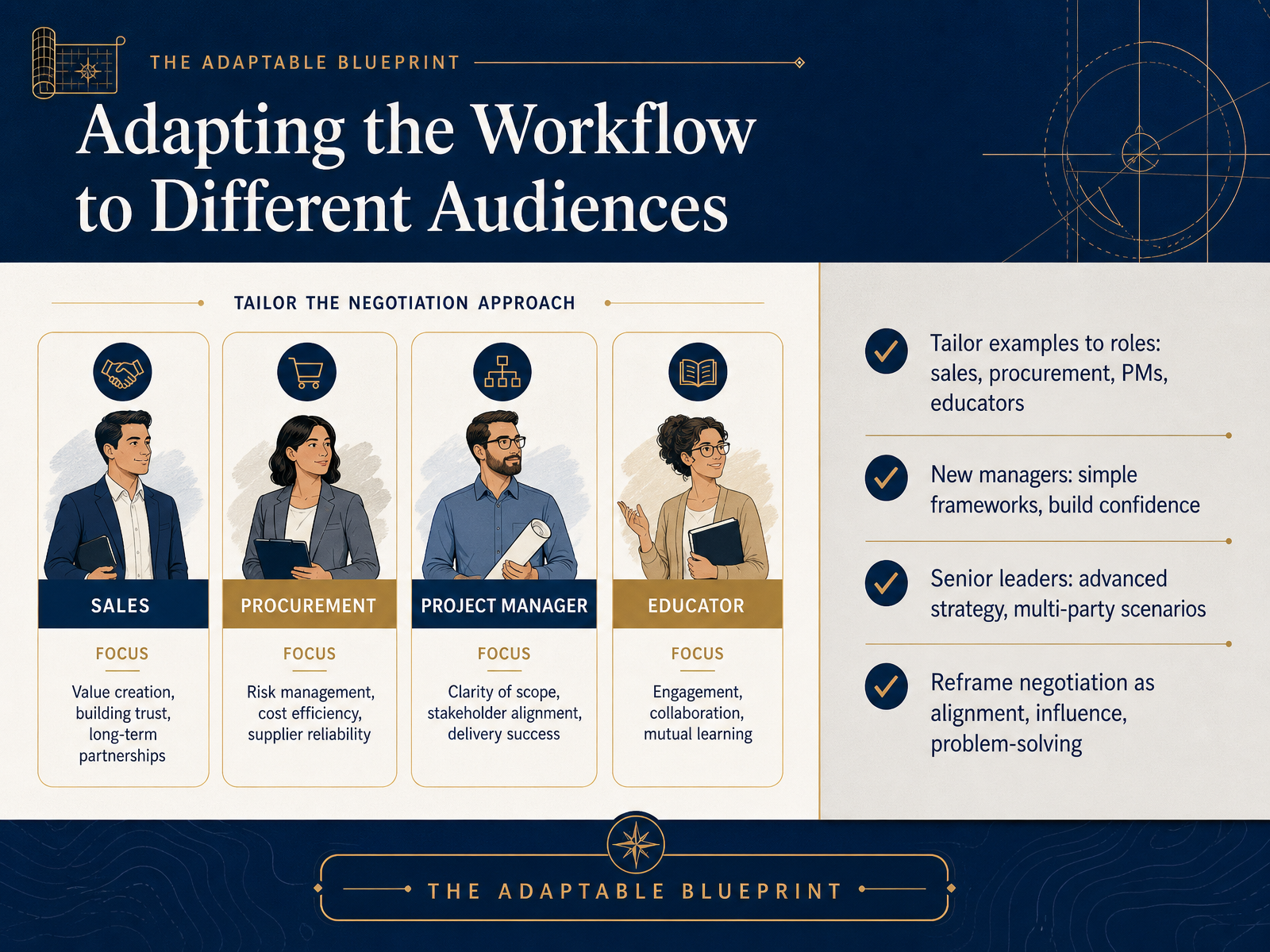
2 min - 09Adapting the Workflow to Different AudiencesNow, let's talk about adapting the workflow to different audiences. This is where the real skill comes in. A salesperson, a procurement officer, and a project manager all negotiate differently. So tailor your examples to their roles. For sales, focus on closing deals and protecting margins. For procurement, it's about managing suppliers and avoiding cost creep. For project managers, it's about scope, deadlines, and stakeholders. New managers need simple frameworks and a focus on building confidence. Keep it structured, predictable, and safe to practice. Senior leaders, on the other hand, need advanced strategy and multi-party scenarios. They thrive on complexity, so give them live deal coaching or sophisticated simulations. And here's a key reframe. Instead of calling it negotiation, frame it as alignment, influence, and problem-solving. That lowers anxiety and makes the skills feel universal, not just for the boardroom. Remember, one size does not fit all. Know your audience, adapt your scenarios, and you'll keep everyone engaged. Up next: common trainer mistakes and how to avoid them.
 oecd.orgoecd.orgtrainingmag.com+21 min
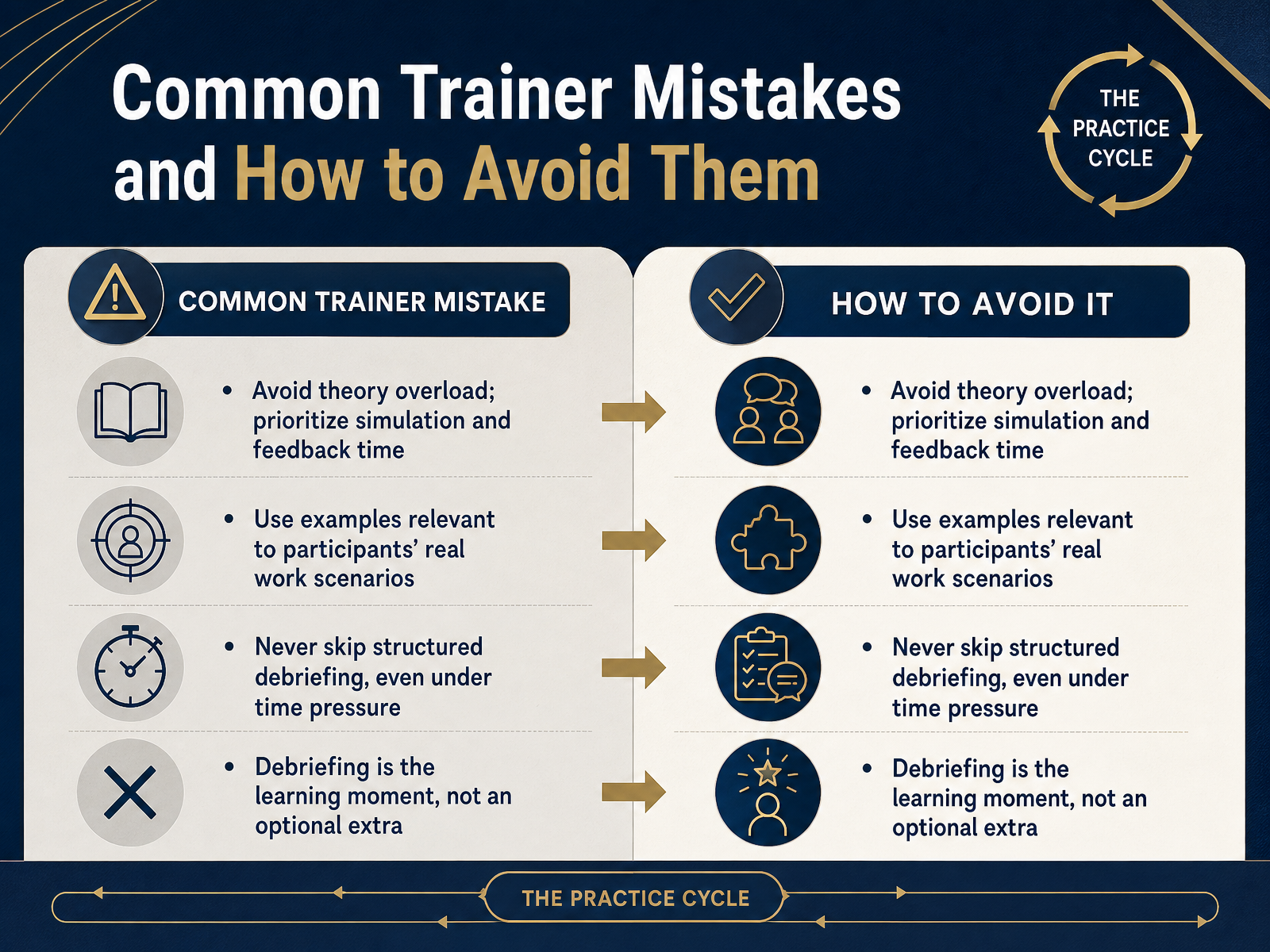
 - 10Common Trainer Mistakes and How to Avoid ThemLet's talk about the mistakes even experienced trainers make, because avoiding them is half the battle. First, don't overload participants with theory. They don't need a lecture on negotiation research—they need time to practice and get feedback. If you catch yourself explaining a framework for too long, cut it short and get them into a simulation. Second, always use examples that mirror their real work. A generic case about car sales won't resonate with someone who negotiates vendor contracts or internal budgets. Tailor the scenarios to their world, and they'll engage immediately. Third—and this is critical—never skip the debrief, even when you're running late. The debrief is where the actual learning happens. It's when participants realize what they did well, where they folded under pressure, and what they'll do differently next time. If you have to trim something, trim the theory or the second role-play—not the reflection. Remember, your goal isn't to cover everything; it's to make sure the skills stick. Now, let's talk about how to make this training stick long after participants leave the room.
 scholarship.law.missouri.edupon.harvard.edu2 min
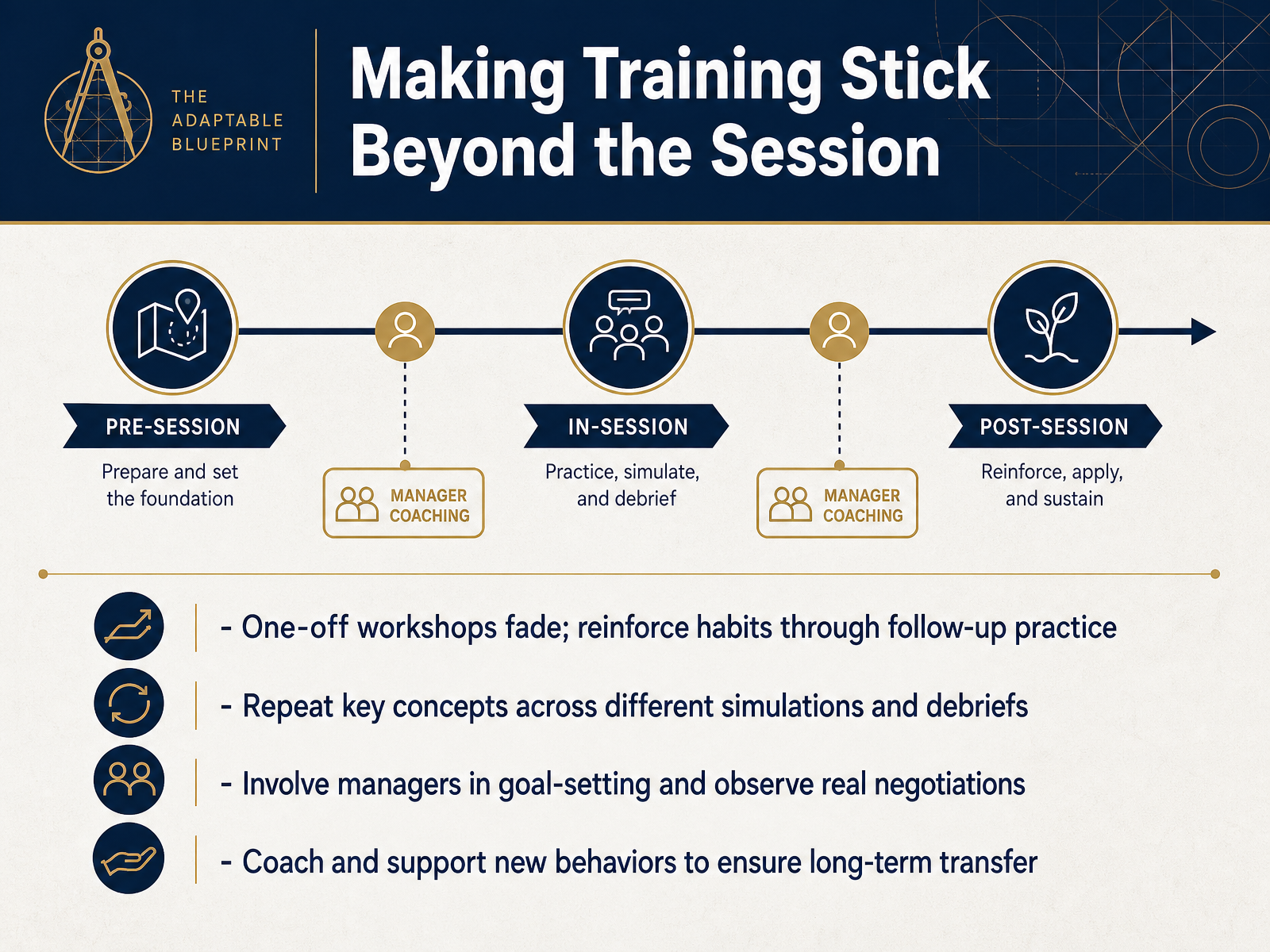
 - 11Making Training Stick Beyond the SessionLet's talk about the part that actually determines whether your training changes anything: what happens after the session ends. A one-off workshop, no matter how engaging, will fade. Within weeks, people slide back into their old habits. So plan for reinforcement from day one. Repeat the core concepts, but always in different contexts. Take framing an opening offer, for example. Have them practice it in a vendor negotiation, then in an internal resource discussion, then in a client renewal. The repetition across different simulations and debriefs is what builds the mental muscle. Next, get managers involved early. Have them help set each participant's goals before the session, and then have them observe real negotiations afterward. That observation creates accountability. Finally, coach the new behaviors. Don't just hope they stick. Schedule follow-up conversations, review what worked, and correct what didn't. That's where the transfer happens. Up next, we'll turn this into a concrete implementation checklist you can use before, during, and after your next training program.
 pon.harvard.edupon.harvard.edunegotiationstraininginstitute.com+21 min
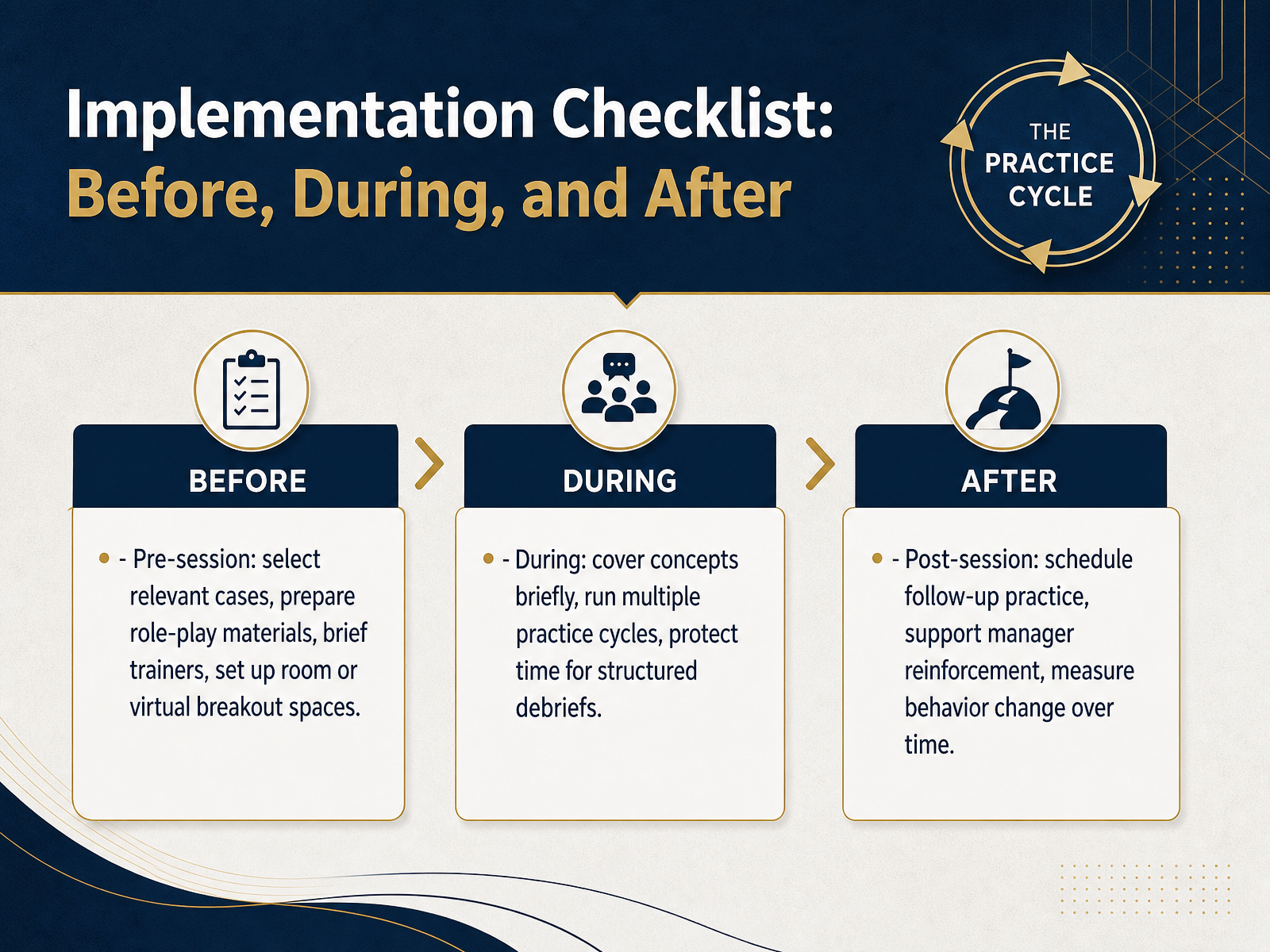
 - 12Implementation Checklist: Before, During, and AfterLet’s walk through a practical checklist for the entire training lifecycle. Before the session, pick cases that genuinely mirror your team’s real negotiations. If you don’t have a current scenario, adapt a standard one by changing the industry details. Make sure your role-play materials are ready, every trainer is briefed on the flow, and your room or virtual breakout spaces are set up so participants can move into pairs in under a minute. During the session, keep concept time lean. You want most of the day spent in practice cycles. Protect the debrief time no matter what, because that’s where the real learning sticks. After the session, schedule follow-up practice, bring managers in to reinforce the habits, and measure whether behavior is actually changing back on the job. That’s the loop that turns a workshop into a skill. Next, let’s look at how to handle different participant profiles.
 pon.harvard.edubigbangpartnership.co.uk1 min
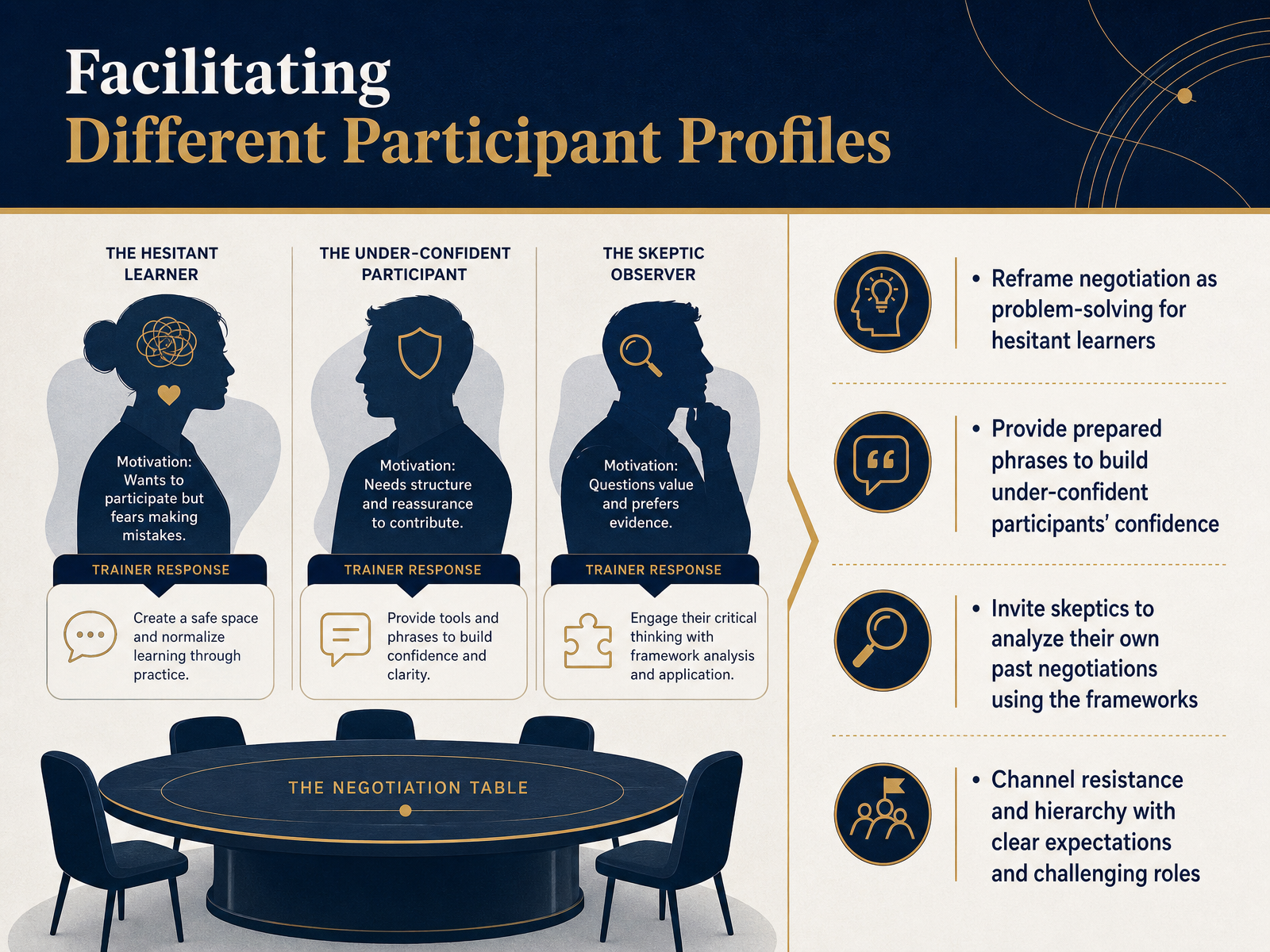
 - 13Facilitating Different Participant ProfilesNow let's talk about the different people you'll have in the room. For the hesitant learners, the ones who see negotiation as a battle, reframe it as problem-solving. That simple shift reduces their fear immediately. For those lacking confidence, hand them prepared phrases to practice with. Providing the exact words removes the anxiety of figuring out what to say in the moment. Then there are the skeptics. Don't avoid them, engage them. Ask them to analyze a difficult negotiation from their own past using our frameworks. It's a powerful way to show the value and build peer learning. Finally, if you have that dominant, resistant participant, don't fight them. Channel that energy. Give them a challenging role where they have to work hard to reach an agreement. Meeting each participant where they are turns potential friction into momentum for the entire group. Next, let's pull these ideas together into a clear action plan.
 scholarship.law.missouri.edupon.harvard.eduoecd.org+21 min
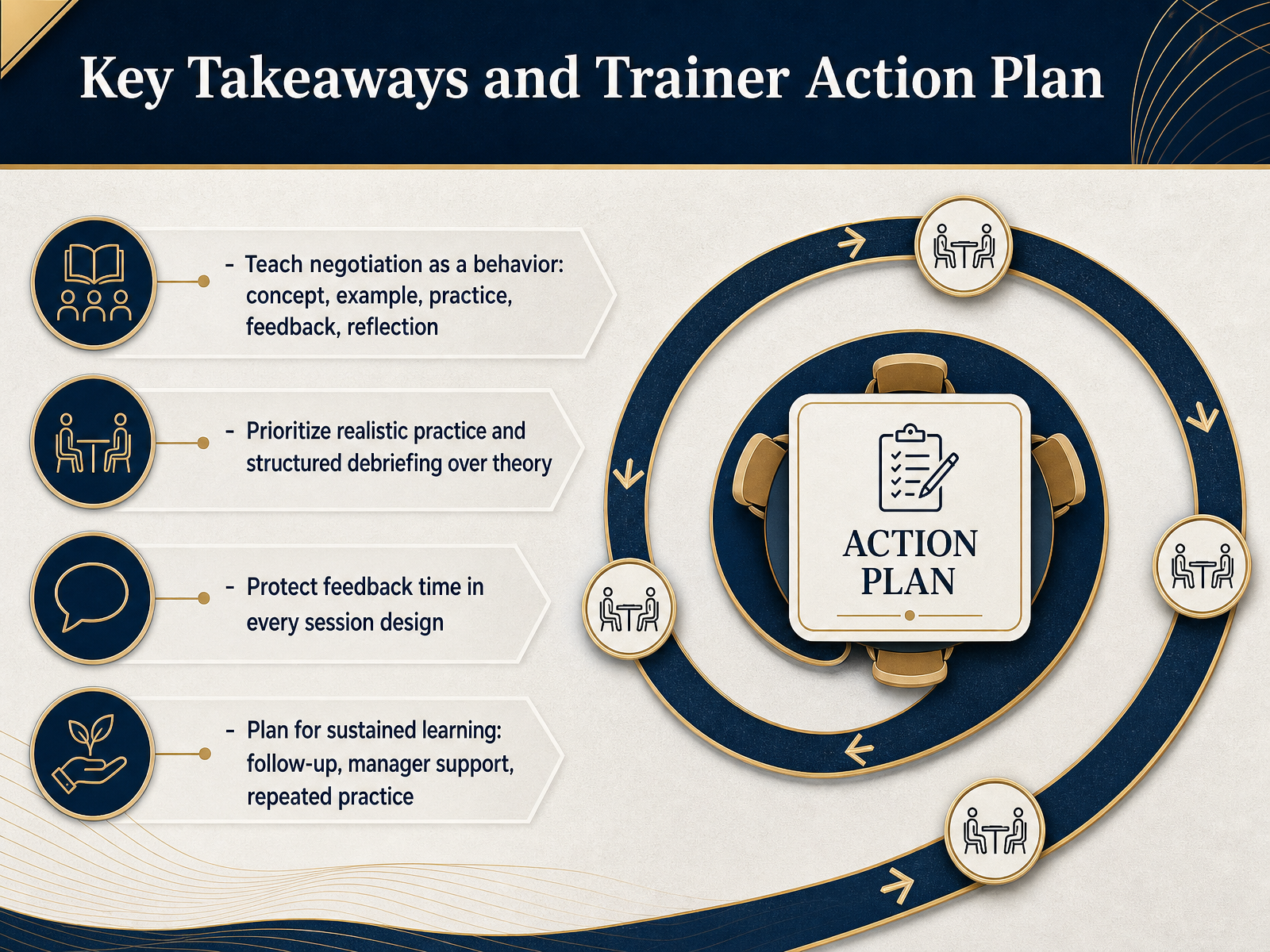
 - 14Key Takeaways and Trainer Action PlanLet’s close with the big picture. Negotiation is not a talent you’re born with. It’s a behavior you can build. Teach it as a loop: concept, example, practice, feedback, reflection. And in every session, protect the time for debriefing. That’s where the real learning happens, not in the lecture. If you are short on time, cut theory, never cut practice. And remember, the training doesn’t end when the classroom door closes. Plan for sustained learning. Schedule follow-ups, get managers involved, and build in repeated practice. One-off workshops feel good, but lasting skill requires reinforcement on the job. So, before you leave, pick one action. Maybe it’s reserving ten more minutes for feedback. Maybe it’s booking a follow-up session. Just take that first step. Thank you for your work, and I’m confident your next session will make a real difference.
 pon.harvard.edupon.harvard.edunegotiationstraininginstitute.com+21 min
Take the deck with you
Download this course as a file — free, no sign-up needed.
- PDF handoutEvery slide page, ready to print or share.15 pages · 4.6 MBDownload
- Narrated PowerPointThe deck that presents itself — every slide carries the digital human's narration video.15 pages · 25.4 MBDownload
- PowerPoint slidesThe full deck as a .pptx — open it in PowerPoint, Keynote, or Google Slides.15 pages · 4.5 MBDownload
Free to use in your own training — please keep the PersonWise credit page at the end.
Have your own deck? Turn it into a course
Sources consulted
Web sources consulted while building this course.
- 10 Negotiation Training Skills Every Organization Needs - PON - Program on Negotiation at Harvard Law School — pon.harvard.edu
- Implement Negotiation Training in Your Organization - PON - Program on Negotiation at Harvard Law School — pon.harvard.edu
- How Managers Can Coach Their Teams to Be Better Negotiators | NTI — negotiationstraininginstitute.com
- How to Teach Negotiation Skills at Work | A Guide for Leaders and L&D Teams | Aligned — alignednegotiation.com
- Principles for Designing Negotiation Instruction — scholarship.law.missouri.edu
- Helping adults overcome barriers to training (EN) — oecd.org
- What can be done?: Trends in Adult Learning — oecd.org
- If Everyone Negotiates at Work, Why Don’t We Train Them? — trainingmag.com
- How to Take Down Barriers to Adult Learning — learningstream.com
- Powerful Negotiation Skills for Training Providers - Institute for Adult Learning — ial.edu.sg
- Teaching the Basics of Negotiation in One Class — journals.sagepub.com
- Interest-Based Negotiation: — smacna.org
- How to Find the ZOPA in Business Negotiations - PON - Program on Negotiation at Harvard Law School — pon.harvard.edu
- Four Key Concepts: Your Starting Points | Harvard Business Impact Education — hbsp.harvard.edu
- Harvard Negotiation: BATNA, ZOPA, Interests — SAP Analytics Academy — analyticslegends.ai
- James Baker | Negotiation Workshop — jamesbaker.thinkport.org
- Lenny.com — lenny.com
- The Art of Negotiation Exercise Design: Five Basic Principles to Produce Powerful Learning Experiences — onlinelibrary.wiley.com
- Negotiation Skills Workshop Toolkit - The Big Bang Partnership — bigbangpartnership.co.uk
- A Practical Guide to Negotiation Simulation Writing — onlinelibrary.wiley.com