Begin
14 pages · ~28 min
Crafting Strong Academic Paragraphs
This training helps English-language learners write clear, well-structured academic paragraphs, covering topic sentences, supporting evidence, and cohesive flow for essays and reports.
A digital instructor presents all 14 pages. Hold “Ask” at any point and ask out loud — the answer comes from this course. No sign-up needed.
What you’ll learn
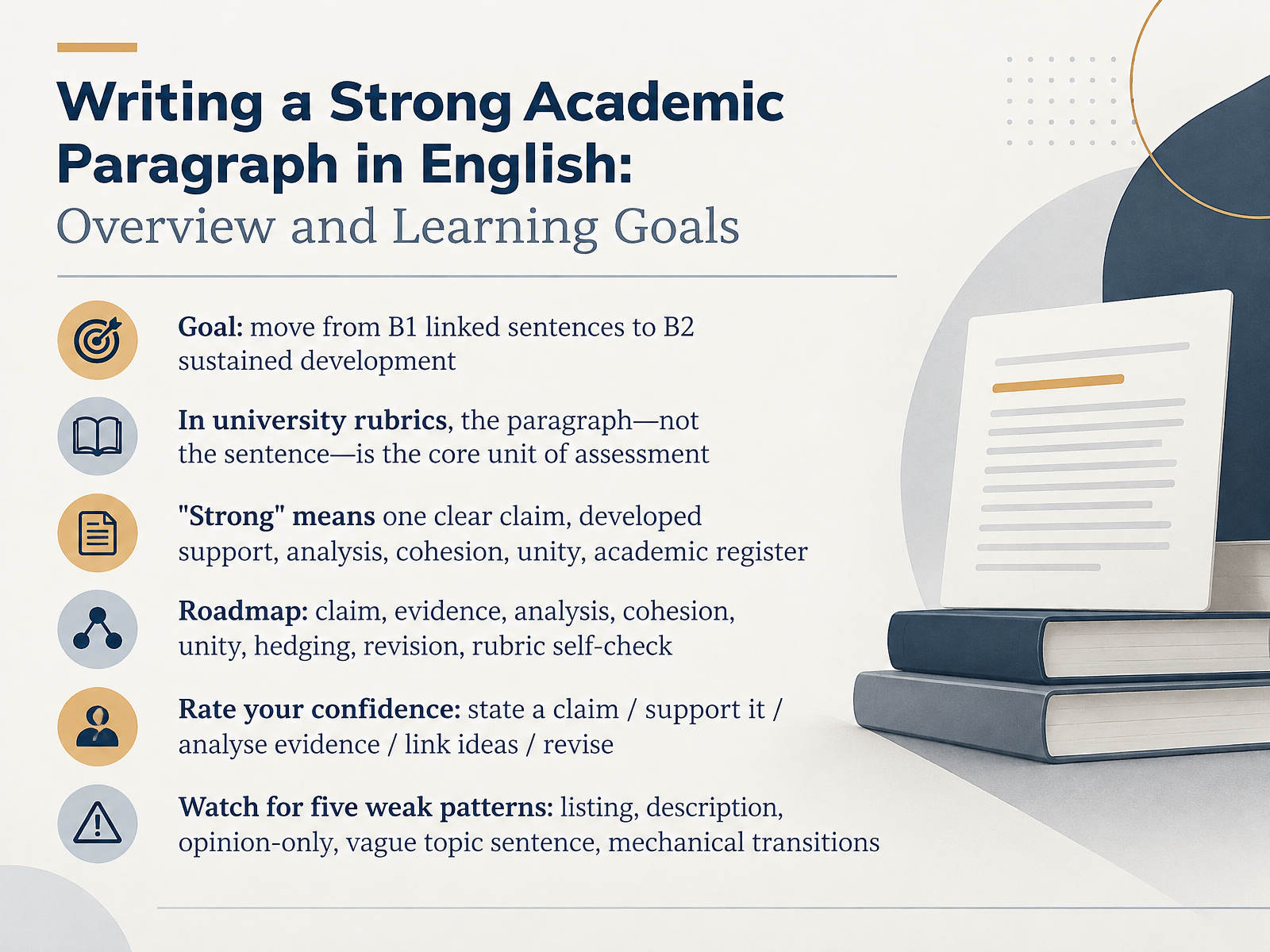
- 01Writing a Strong Academic Paragraph in English: Overview and Learning GoalsWelcome. If you are writing academic assignments in English and you are ready to move beyond B1, this course is for you. Our goal is to help you shift from linking separate sentences to sustaining a full development, which is what B2 writing demands. Here is the key idea. In university rubrics, the paragraph, not the sentence, is the core unit of assessment. Your markers judge how well each paragraph makes one clear claim, supports it with evidence, analyses that evidence, and connects smoothly to the next idea. A strong paragraph also shows cohesion, which means ideas flow logically, unity, which means everything stays on one point, and an academic register, which is the formal tone expected at university. Over the next slides, we will work through a roadmap: stating a claim, using evidence, analysing it, building cohesion and unity, hedging your language, revising, and checking your work against a rubric. To start, rate your confidence in five areas: stating a claim, supporting it, analysing evidence, linking ideas, and revising. And watch for five weak patterns: listing, pure description, opinion without support, vague topic sentences, and mechanical transitions. By the end, you will have practical tools to strengthen every paragraph you write. Let us begin with What Makes a Paragraph 'Academic'.cefrhub.airm.coe.intblogs.helsinki.fi+22 min
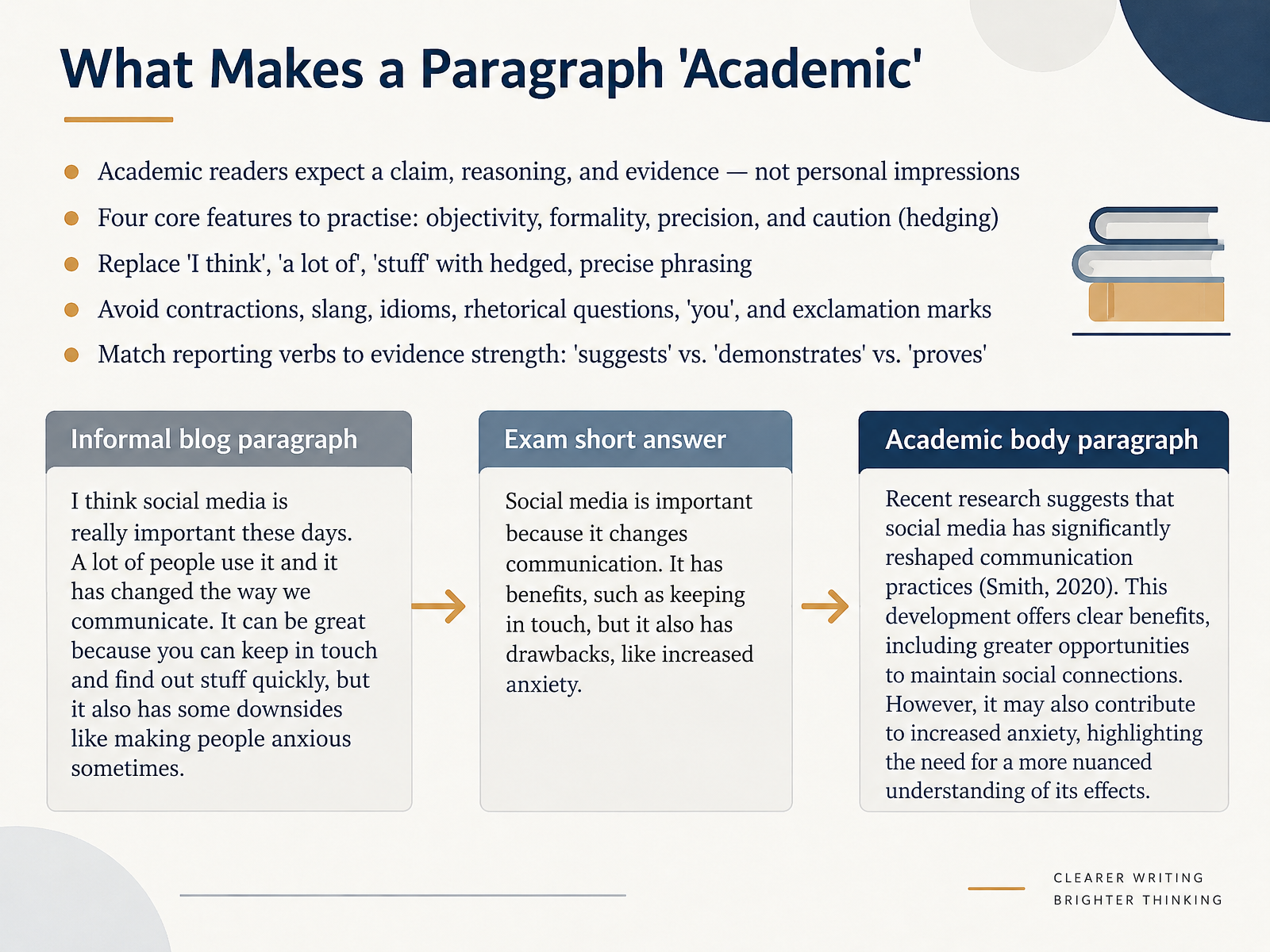
- 02What Makes a Paragraph 'Academic'Now let's define what actually makes a paragraph academic. Academic readers expect three things working together: a claim, reasoning, and evidence. They are not interested in personal impressions. So there are four core features to practise. Objectivity means focusing on research rather than feelings. Formality means avoiding casual, conversational language. Precision means choosing exact, accurate words. And caution, or hedging, means matching your certainty to your evidence. In practice, replace personal phrases like I think, a lot of, or stuff with hedged, precise wording. Instead of I think this proves, write these results suggest. Also avoid contractions, slang, idioms, rhetorical questions, the pronoun you, and exclamation marks. One more key habit: match your reporting verbs to the strength of your evidence. Suggests is cautious. Demonstrates is stronger. Proves is very strong, and rarely justified by a single source. Get these features right, and your writing will sound credible and controlled. Next, we look at the first building block: the topic sentence, and how to make a clear, arguable claim.
 ncl.ac.ukstudents.unimelb.edu.aulibraryguides.vu.edu.au+22 min
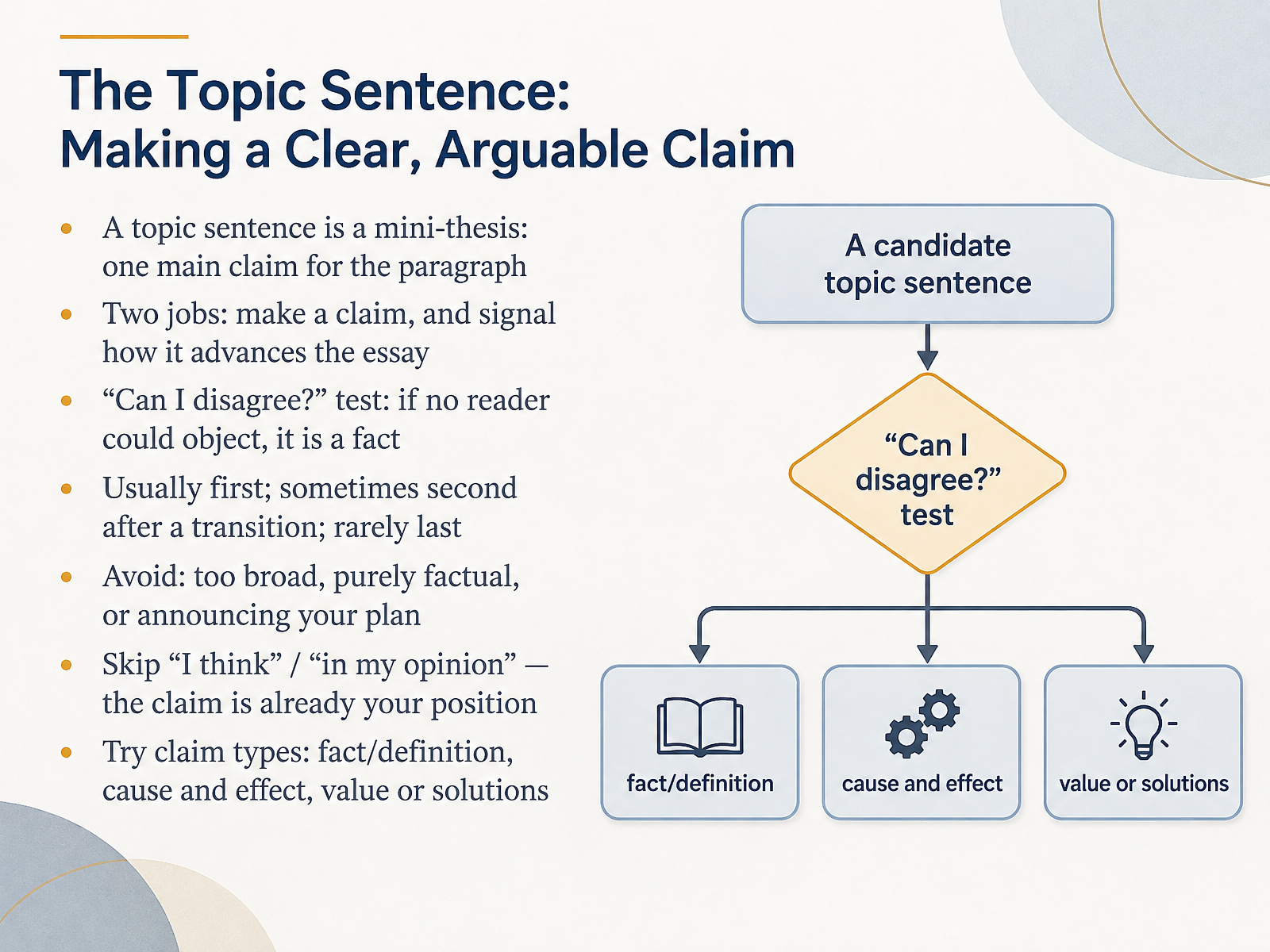
- 03The Topic Sentence: Making a Clear, Arguable ClaimLet's move on to the topic sentence, which is the engine of your paragraph. Think of it as a mini-thesis: one main claim that the whole paragraph will support. It has two jobs: make a claim, and show how that claim moves your essay forward. Here is a quick test. Ask yourself, can I disagree? If no reasonable reader could object, you have written a fact, not a claim. For example, "Marx wrote about capitalism" is a fact. "Marx critiques capitalism by exposing its flaws" is a claim. Most topic sentences come first. Sometimes they come second, after a short transition. Rarely, they come last for emphasis. Be careful to avoid claims that are too broad, purely factual, or that simply announce your plan. Also skip phrases like "I think" or "in my opinion." Your claim is already your position. Instead, try a claim type: fact or definition, cause and effect, value, or solutions. Next, let's look at supporting that claim, in Supporting the Claim: Evidence.
 advice.writing.utoronto.cawritingcenter.fas.harvard.eduowl.purdue.edu+22 min
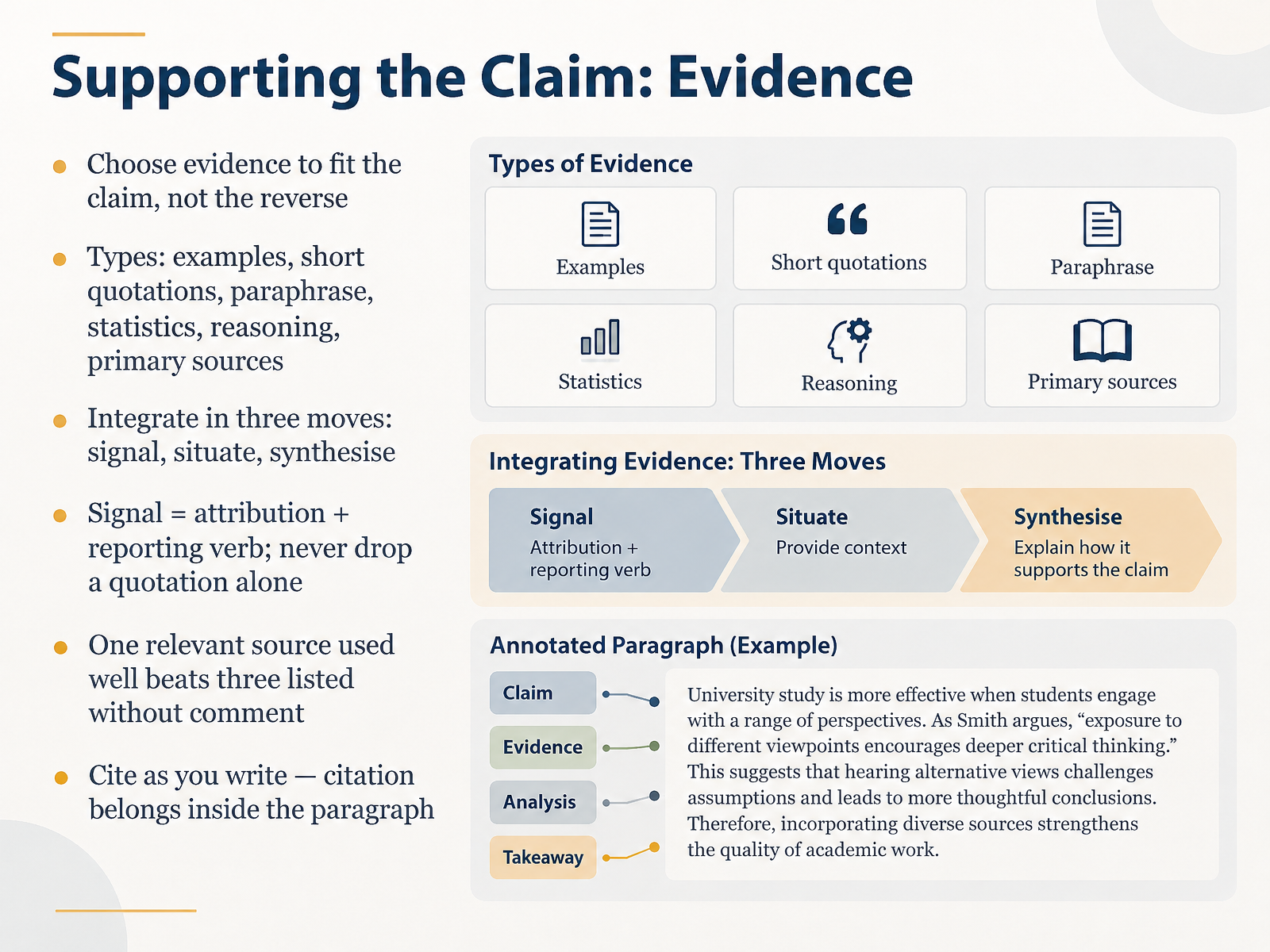
- 04Supporting the Claim: EvidenceNow let's talk about evidence. The first principle is simple: choose evidence to fit the claim, not the reverse. You have a point to prove, so you go looking for the right support. Not the other way around.
Evidence comes in many forms. Examples, short quotations, paraphrase, statistics, reasoning, and primary sources. Any of these can work if they genuinely support your claim.
Once you have your evidence, integrate it in three moves: signal, situate, and synthesise. Signal means attribution plus a reporting verb. Name the author, then choose a verb that shows your stance, like argues, notes, or alleges. Never drop a quotation alone in a sentence. It needs your framing around it.
Here's the key point: one relevant source used well beats three listed without comment. Depth matters more than quantity. And cite as you write. Citation belongs inside the paragraph, not saved for later.
Next, we'll look at how to turn that evidence into real argument.
 uwaterloo.cawritingcenter.fas.harvard.eduvanderbilt.edu+22 min
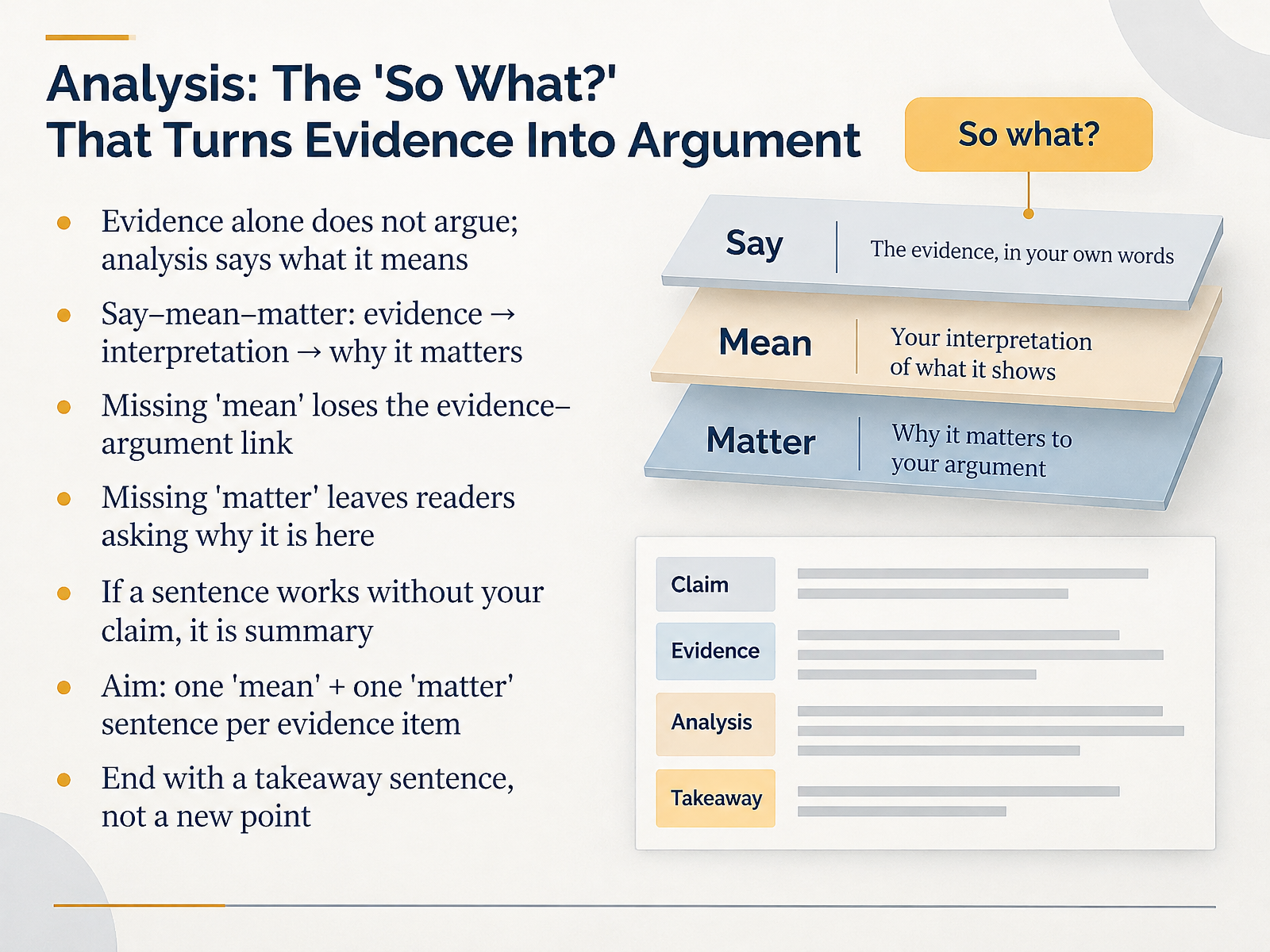
- 05Analysis: The 'So What?' That Turns Evidence Into ArgumentNow let's look at analysis, the so what that turns evidence into an argument. Evidence alone does not argue. Analysis says what the evidence means. A useful pattern is say, mean, matter. You state what the evidence says, interpret what it means, then explain why it matters. Skip the mean, and the link between evidence and argument disappears. Skip the matter, and readers ask why the evidence is even there. Here is a quick test. If a sentence still works without your claim, it is probably summary, not analysis. So aim for one mean and one matter sentence per piece of evidence. And close the paragraph with a takeaway, not a new point. Next, we move on to cohesion, linking sentences and ideas.
 uwaterloo.cawritingcenter.fas.harvard.eduvanderbilt.edu+21 min
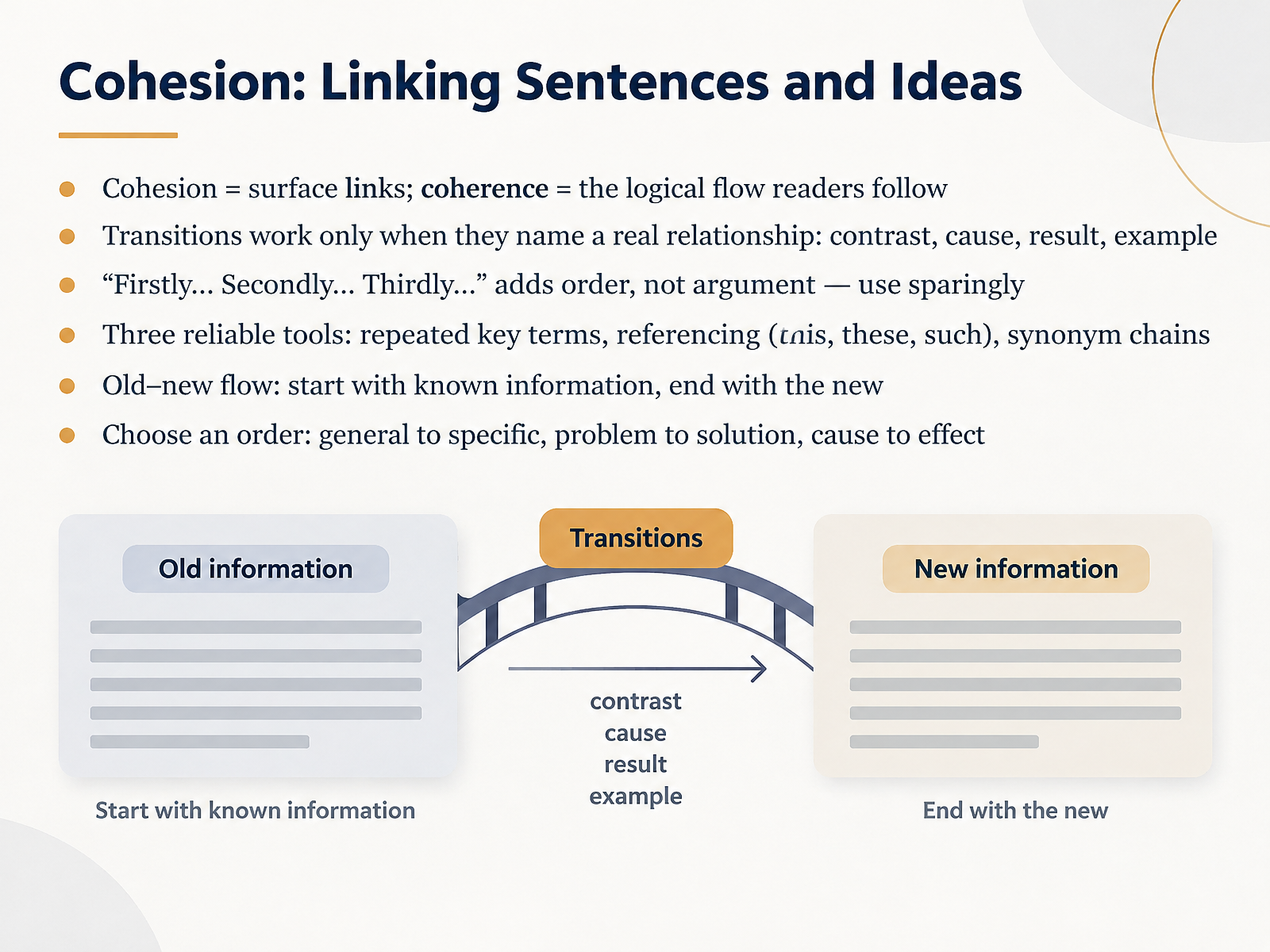
- 06Cohesion: Linking Sentences and IdeasNow let's connect your sentences so the argument flows. Cohesion is the set of surface links between sentences. Coherence is the logical flow readers follow. Transitions only work when they name a real relationship, such as contrast, cause, result, or example. Words like firstly, secondly, thirdly add order, not argument, so use them sparingly. Three reliable tools are repeating key terms, referencing with words like this, these, and such, and synonym chains. Try old-new flow: start with known information and end with the new. Finally, choose an order that fits your purpose, such as general to specific, problem to solution, or cause to effect. That is the logic that keeps readers moving with you. Next, let's look at unity, keeping one idea per paragraph.
 smu.educefrhub.airm.coe.int+21 min
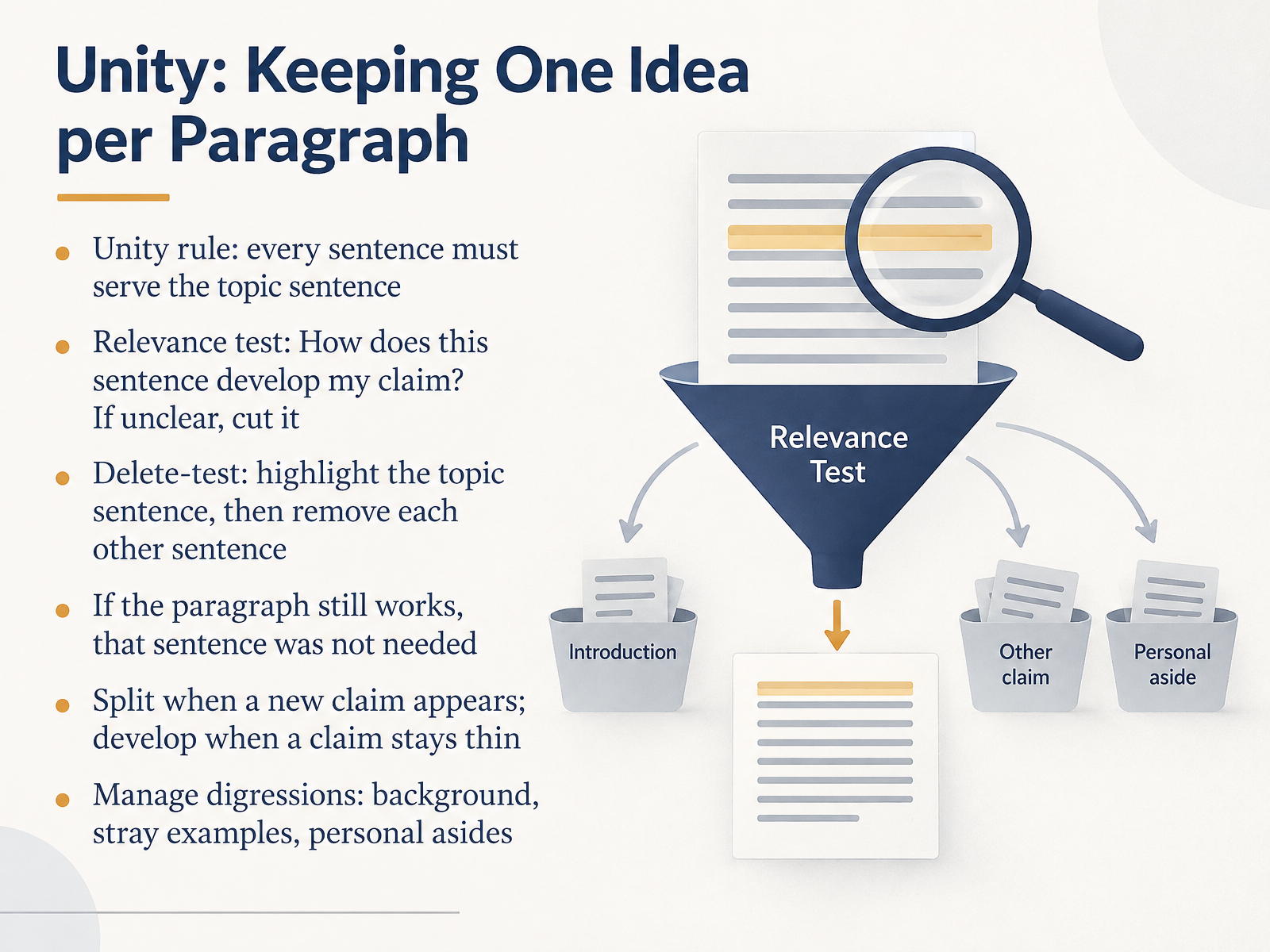
- 07Unity: Keeping One Idea per ParagraphNext, we'll focus on unity. Unity means keeping one idea per paragraph. Here is the rule. Every sentence in a paragraph must serve the topic sentence. When you check a sentence, ask yourself: how does this sentence develop my claim? If the answer is unclear, cut it. A useful method is the delete-test. Highlight the topic sentence, then remove each other sentence one at a time. If the paragraph still works without that sentence, it was not needed. Then, split the paragraph when a new claim appears. Develop it further when a claim stays thin. Also watch for digressions, like background details, stray examples, or personal asides. These can be useful elsewhere, but inside this paragraph they weaken unity. Keep one idea, develop it fully, and your writing becomes clearer and more persuasive. Coming up next: Academic Register: Hedging, Objectivity, and Precision.
 smu.eduadvice.writing.utoronto.cawritingcenter.fas.harvard.edu+22 min
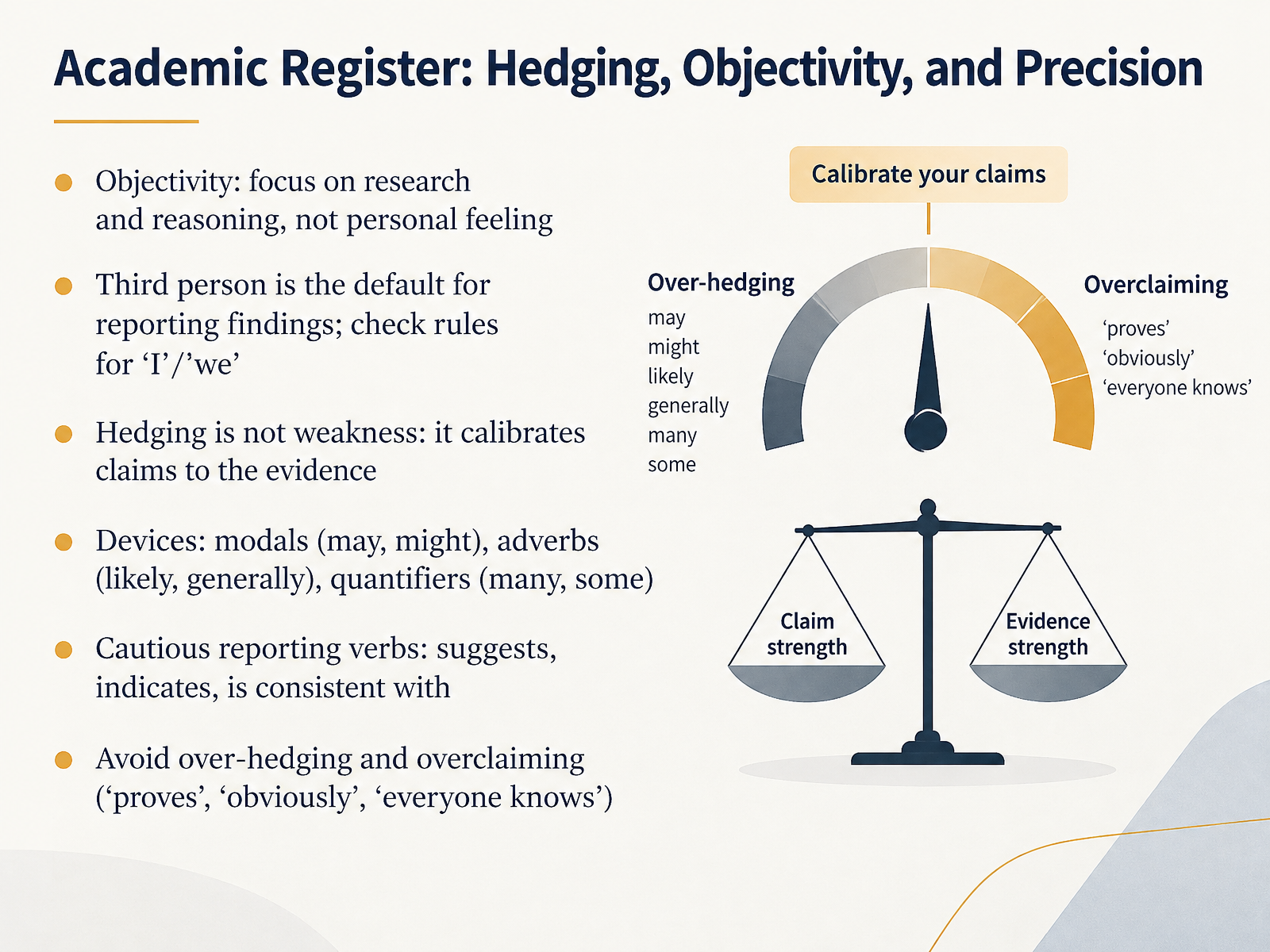
- 08Academic Register: Hedging, Objectivity, and PrecisionNow let's talk about academic register, starting with three habits: hedging, objectivity, and precision. Objectivity means you focus on research and reasoning, not on personal feeling. So instead of writing "I feel this policy is unfair," you write "The evidence suggests this policy disadvantages lower-income groups." Third person is the default for reporting findings, though many style guides now allow I or we for describing your own methods, so check your department's rules. Next, hedging. Hedging is not weakness. It calibrates your claims to the evidence. You do this with modals like may or might, adverbs like likely or generally, and quantifiers like many or some. You also choose cautious reporting verbs. "Suggests," "indicates," and "is consistent with" are usually more accurate than "proves." But avoid both extremes. Over-hedging sounds unsure, while overclaiming words like "proves," "obviously," or "everyone knows" invite disagreement. Aim for the middle. Let's move on to common B1 to B2 paragraph problems and how to fix them.
 ncl.ac.ukstudents.unimelb.edu.aulibraryguides.vu.edu.au+22 min
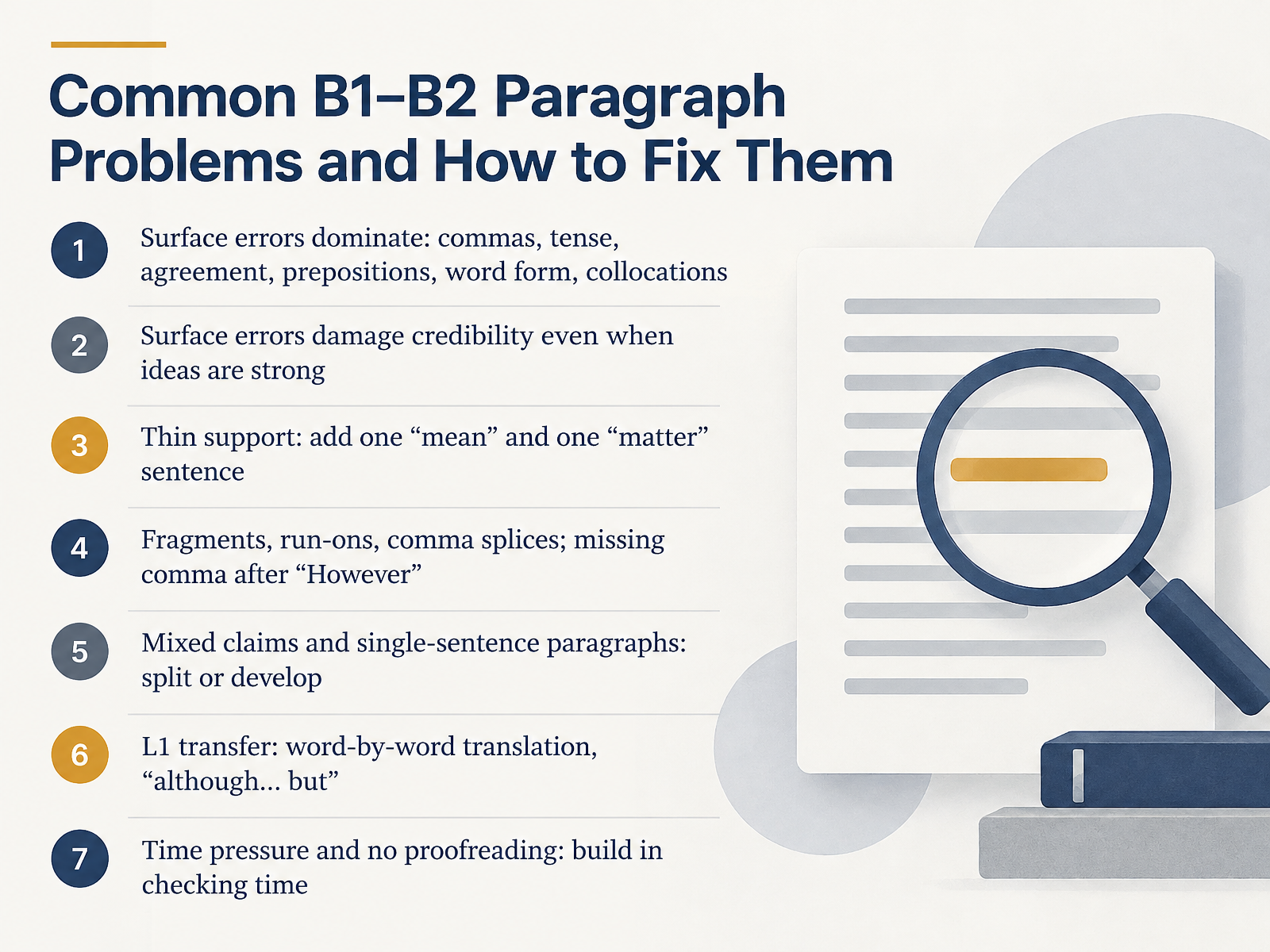
- 09Common B1–B2 Paragraph Problems and How to Fix ThemNow let's look at the paragraph problems that come up most often at your level, and how to fix them. First, surface errors: commas, tense, agreement, prepositions, word form, and collocations. These small slips damage your credibility, even when your ideas are strong. Second, thin support. If a point feels empty, add one sentence explaining what it means, and one saying why it matters. Third, sentence-level faults: fragments, run-ons, comma splices, and a missing comma after words like however. Fourth, mixed claims or single-sentence paragraphs. Split them, or develop them. Fifth, first-language transfer, such as word-by-word translation or although paired with but. And sixth, time pressure. Students often skip proofreading, so build in checking time before you submit. Fix these habits, and your paragraphs will read as clear and credible writing. Next, we ask: Genre Awareness: Does Your Paragraph Type Change Your Paragraph?
 2 min
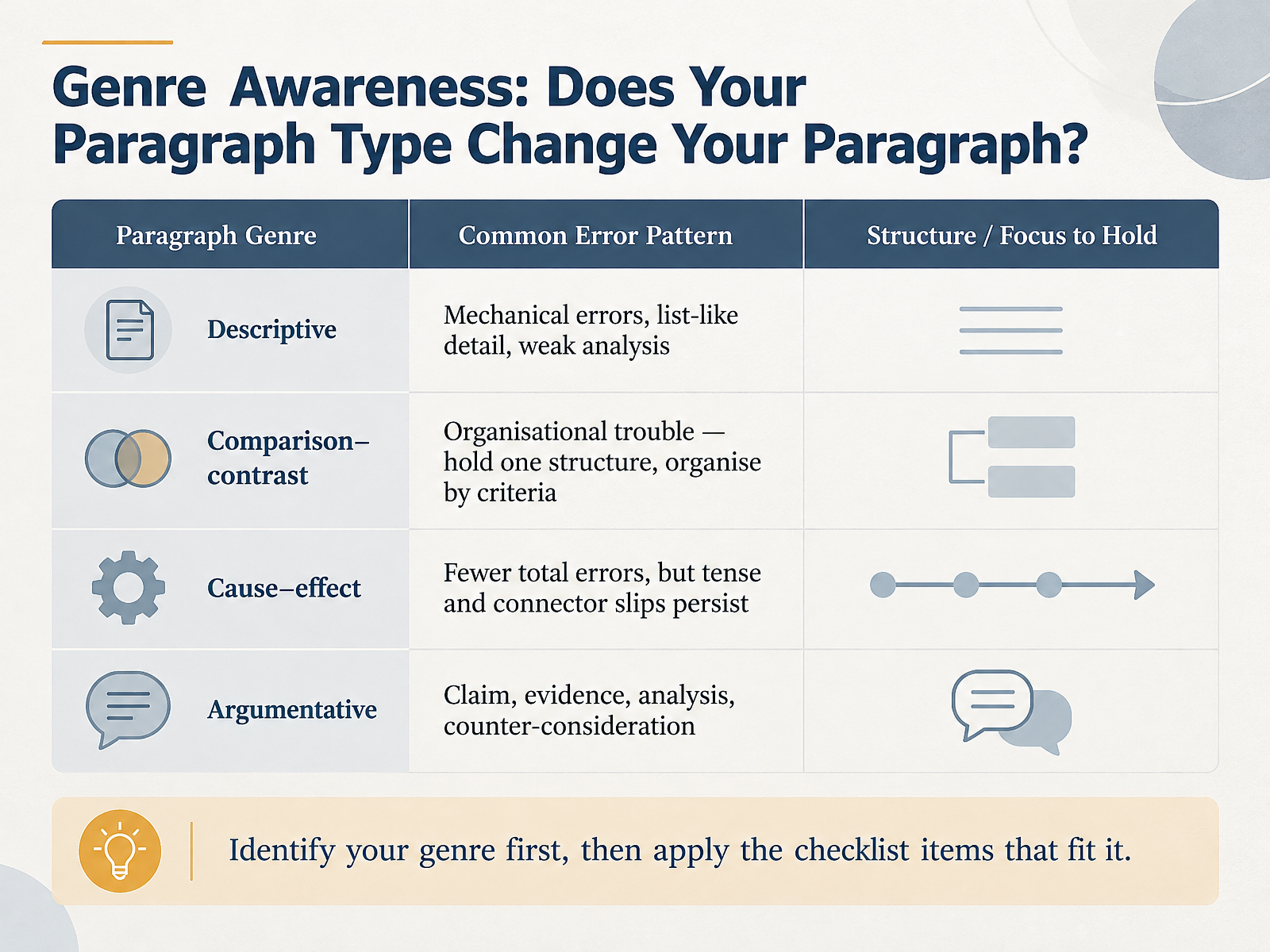
- 10Genre Awareness: Does Your Paragraph Type Change Your Paragraph?Now, let's talk about genre awareness. Does your paragraph type change your paragraph? Recent genre studies show that grammar errors dominate across all paragraph types, but the specific problems shift. Descriptive paragraphs often show mechanical errors, list-like detail, and weak analysis. Comparison and contrast paragraphs run into organisational trouble. So hold one structure and organise by criteria. Cause and effect paragraphs have fewer total errors overall, but tense problems and connector slips still persist. Argumentative paragraphs need a clear claim, evidence, your analysis, and a counter-consideration. For example, a comparison paragraph organised point by point may confuse readers if you switch to block structure halfway through. So identify your genre first, then apply the checklist items that fit it. Next, we'll look at a writing routine: plan, draft, revise.
 1 min
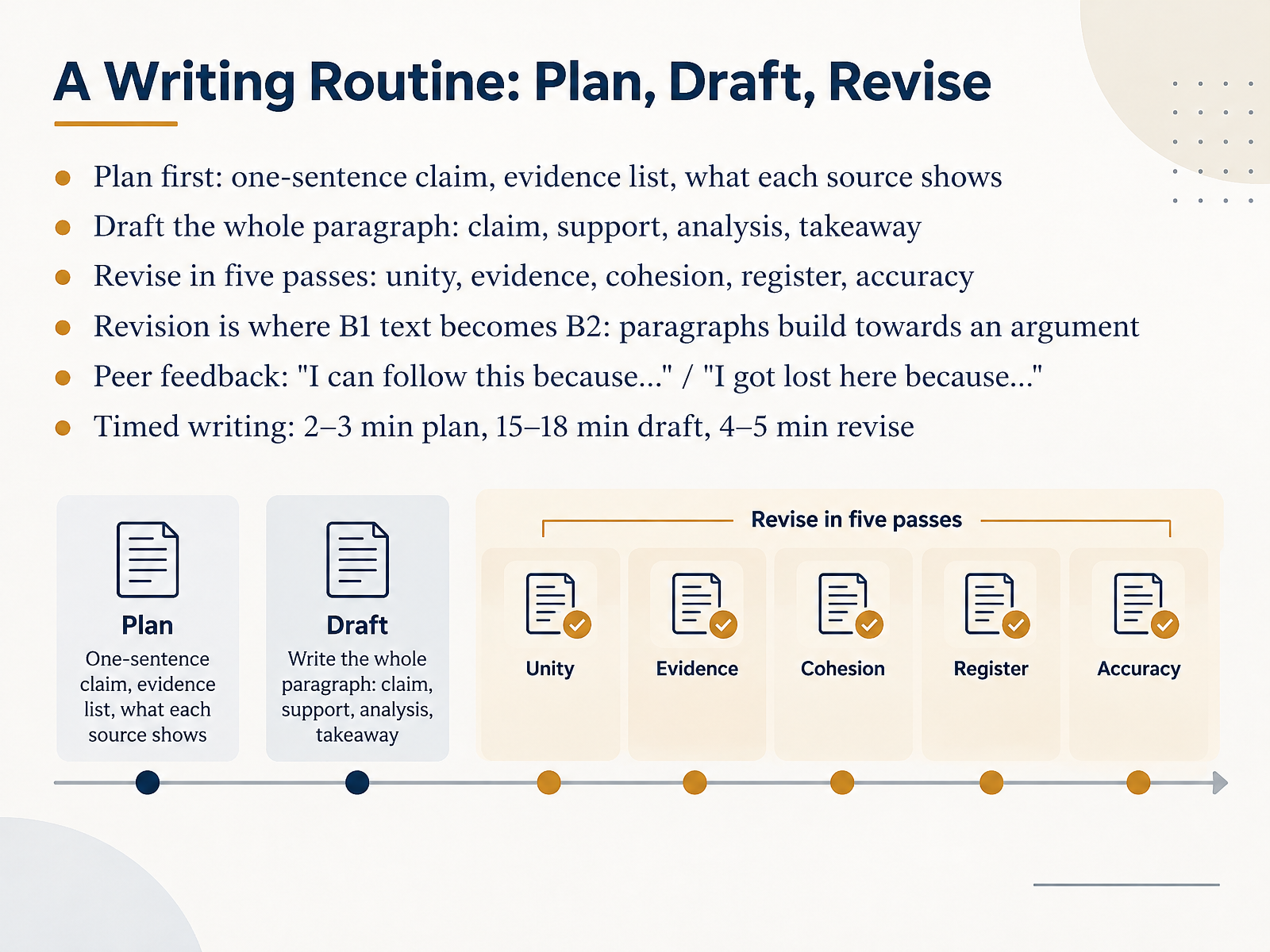
- 11A Writing Routine: Plan, Draft, ReviseLet's bring all of this together into a writing routine you can actually follow. Start by planning. Write your claim in one sentence, list your evidence, and note what each source shows. Then draft the whole paragraph without stopping: claim, support, analysis, takeaway. After that, revise in five passes. First unity, then evidence, then cohesion, then register, then accuracy. This is where B1 writing becomes B2. A B1 paragraph stands alone; a B2 paragraph builds towards an argument. Peer feedback helps too. Ask your partner to say, I can follow this because, or I got lost here because. And when you write under time pressure, try this split: two to three minutes planning, fifteen to eighteen minutes drafting, and four to five minutes revising. Next, let's practise on a real draft.
 cefrhub.airm.coe.intblogs.helsinki.fi+21 min
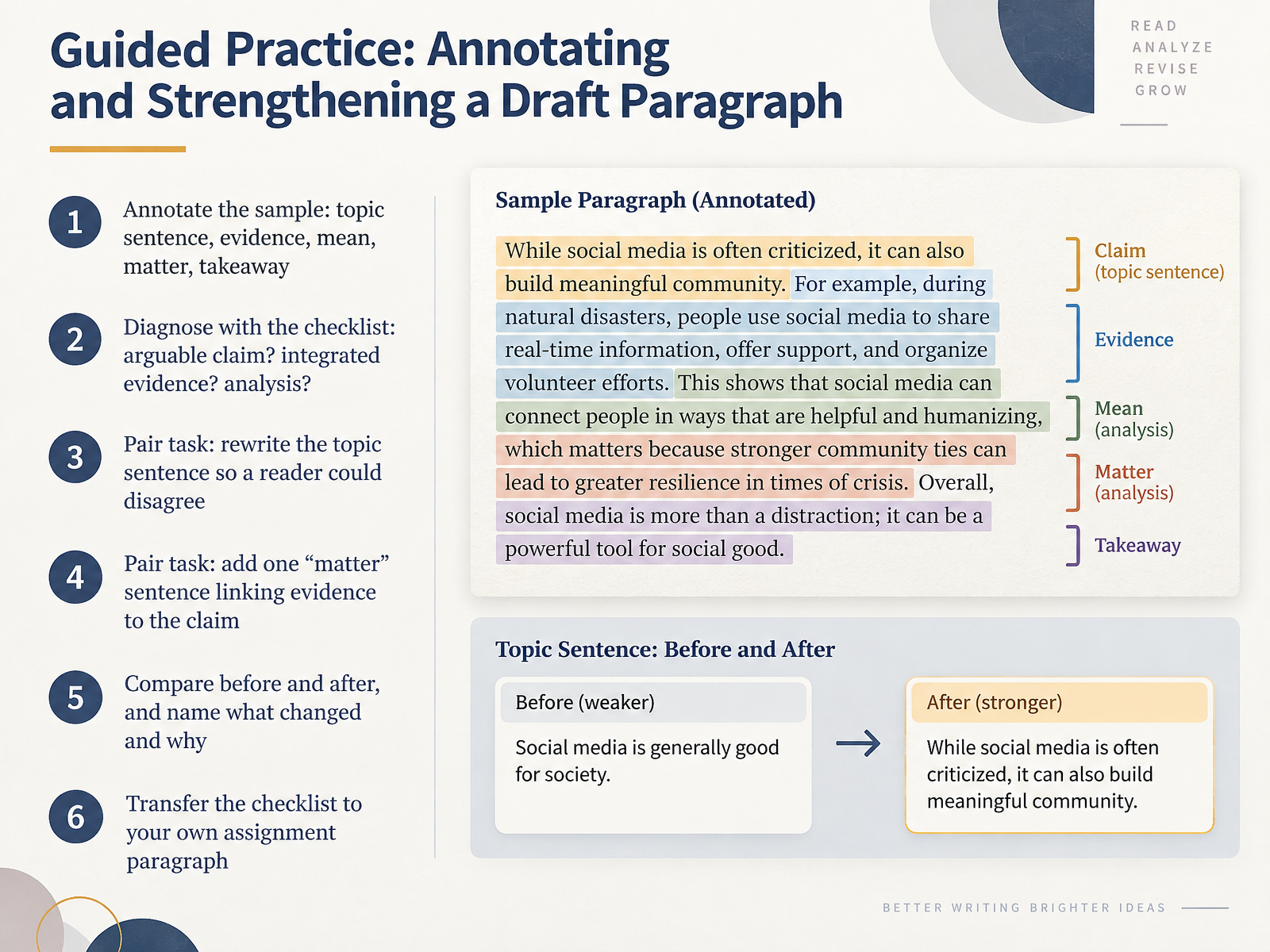
- 12Guided Practice: Annotating and Strengthening a Draft ParagraphNow let's put these ideas into practice together. You have a sample draft paragraph, and we will work through it step by step. Start by annotating it. Mark the topic sentence, the evidence, the mean, the matter, and the takeaway. Next, diagnose it with a short checklist. Is the claim arguable? Can a reasonable reader disagree? Is the evidence integrated into your own sentences? And is there real analysis, not just summary? Then, in pairs, rewrite the topic sentence so that a reader could disagree with it. Add one matter sentence that links the evidence to your claim. Compare before and after, and name what changed and why. Finally, transfer this same checklist to a paragraph in your own assignment. That is how you build stronger writing one paragraph at a time. Coming up next, Checking Your Paragraph Quality: A Compact Rubric.
 advice.writing.utoronto.cawritingcenter.fas.harvard.eduowl.purdue.edu+21 min
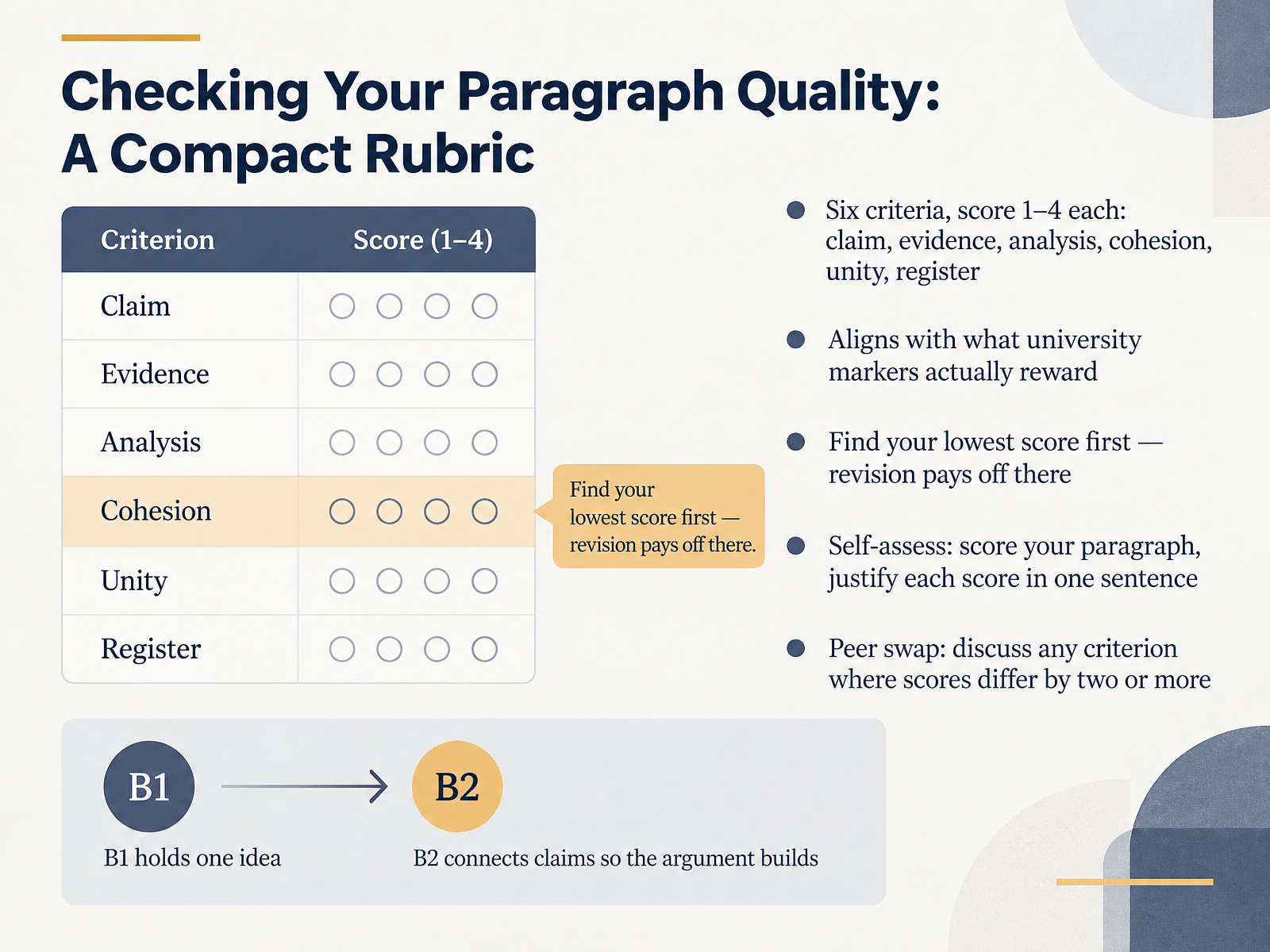
- 13Checking Your Paragraph Quality: A Compact RubricNow let us pull everything together with a compact rubric you can use on your own work. Six criteria, scored one to four. Claim: is your main point clear and arguable? Evidence: is it relevant and credible? Analysis: do you explain what the evidence means? Cohesion: do sentences and ideas link smoothly? Unity: does the whole paragraph serve one idea? Register: is the tone academic and appropriate? These match what university markers actually reward. Here is the practical move. Find your lowest score first. That is where revision pays off most. Then self assess: score your paragraph and justify each score in one sentence. Finally, swap with a peer and discuss any criterion where your scores differ by two or more. And remember the level difference. At B one, hold one clear idea. At B two, connect your claims so the argument builds. Next, we move from paragraph to essay, and your two week plan.
 smu.educefrhub.airm.coe.int+22 min
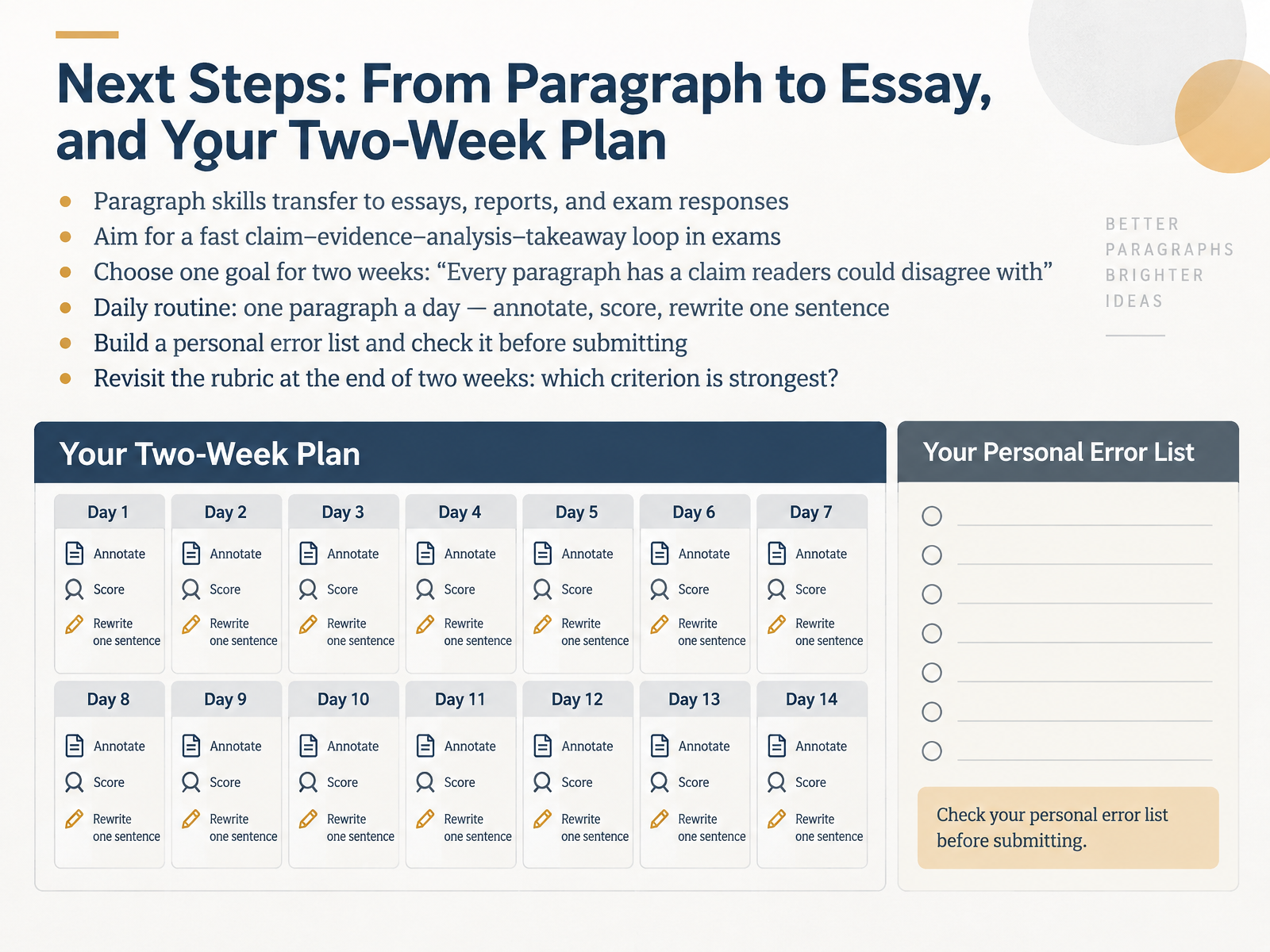
- 14Next Steps: From Paragraph to Essay, and Your Two-Week PlanLet's bring everything together with a plan you can actually follow. The paragraph skills you have practiced transfer directly to essays, reports, and exam responses, so this work pays off everywhere. In exams, aim for a fast claim, evidence, analysis, takeaway loop. For example, one sentence states your claim, one gives evidence, one explains what it means, and one closes the point. Now choose one goal for the next two weeks. A strong option is this: every paragraph has a claim readers could disagree with. Then build a daily routine. Write one paragraph a day. Annotate it, score it, and rewrite just one sentence. Also keep a personal error list and check it before you submit anything. At the end of two weeks, revisit the rubric and ask which criterion is now your strongest. You have done the hard part already. Keep writing, and trust the process. Thank you for joining me.
 smu.educefrhub.airm.coe.int+22 min
Take the deck with you
Download this course as a file — free, no sign-up needed.
- PDF handoutEvery slide page, ready to print or share.15 pages · 3.7 MBDownload
- Narrated PowerPointThe deck that presents itself — every slide carries the digital human's narration video.15 pages · 13.0 MBDownload
- PowerPoint slidesThe full deck as a .pptx — open it in PowerPoint, Keynote, or Google Slides.15 pages · 3.6 MBDownload
Free to use in your own training — please keep the PersonWise credit page at the end.
Have your own deck? Turn it into a course
Sources consulted
Web sources consulted while building this course.
- Written Production B1–B2: CEFR Descriptors | CEFRHub — cefrhub.ai
- Common European Framework of Reference for Languages: Learning, Teaching, Assessment — rm.coe.int
- Productive activities and strategies | CEFTrain Project — blogs.helsinki.fi
- The CEFR Levels - Common European Framework of ... — coe.int
- CEFR Writing Descriptors — cefrlevels.com
- Features of Academic Writing | Academic Skills Kit | Newcastle University — ncl.ac.uk
- Academic style — students.unimelb.edu.au
- Key features of Academic Writing - FYRE (First Year ... — libraryguides.vu.edu.au
- Express uncertainty in writing — monash.edu
- Writing Features Introduction – UEfAP — uefap.org
- Using Topic Sentences - Advice on Academic Writing — advice.writing.utoronto.ca
- Anatomy of a Body Paragraph | Harvard College Writing Center — writingcenter.fas.harvard.edu
- Strong Thesis Statements - Purdue OWL® - Purdue University — owl.purdue.edu
- 9.2: Topic Sentences - Humanities LibreTexts — human.libretexts.org
- Thesis Statements and Topic Sentences — cmu.edu
- Integrating Evidence Effectively | Writing and Communication Centre | University of Waterloo — uwaterloo.ca
- Structure of an Analytical Paragraph — vanderbilt.edu
- Building Strong Body Paragraphs | Writing and Communication Centre | University of Waterloo — uwaterloo.ca
- The Nuts & Bolts of Integrating | Harvard Guide to Using Sources — usingsources.fas.harvard.edu
- Writing — smu.edu