Begin
14 pages · ~28 min
Species Interactions: Competition, Predation, Symbiosis
This training explores competition, predation, and symbiosis, helping learners understand how species interact and shape ecosystems. Ideal for biology students and ecology enthusiasts.
A digital instructor presents all 14 pages. Hold “Ask” at any point and ask out loud — the answer comes from this course. No sign-up needed.
What you’ll learn
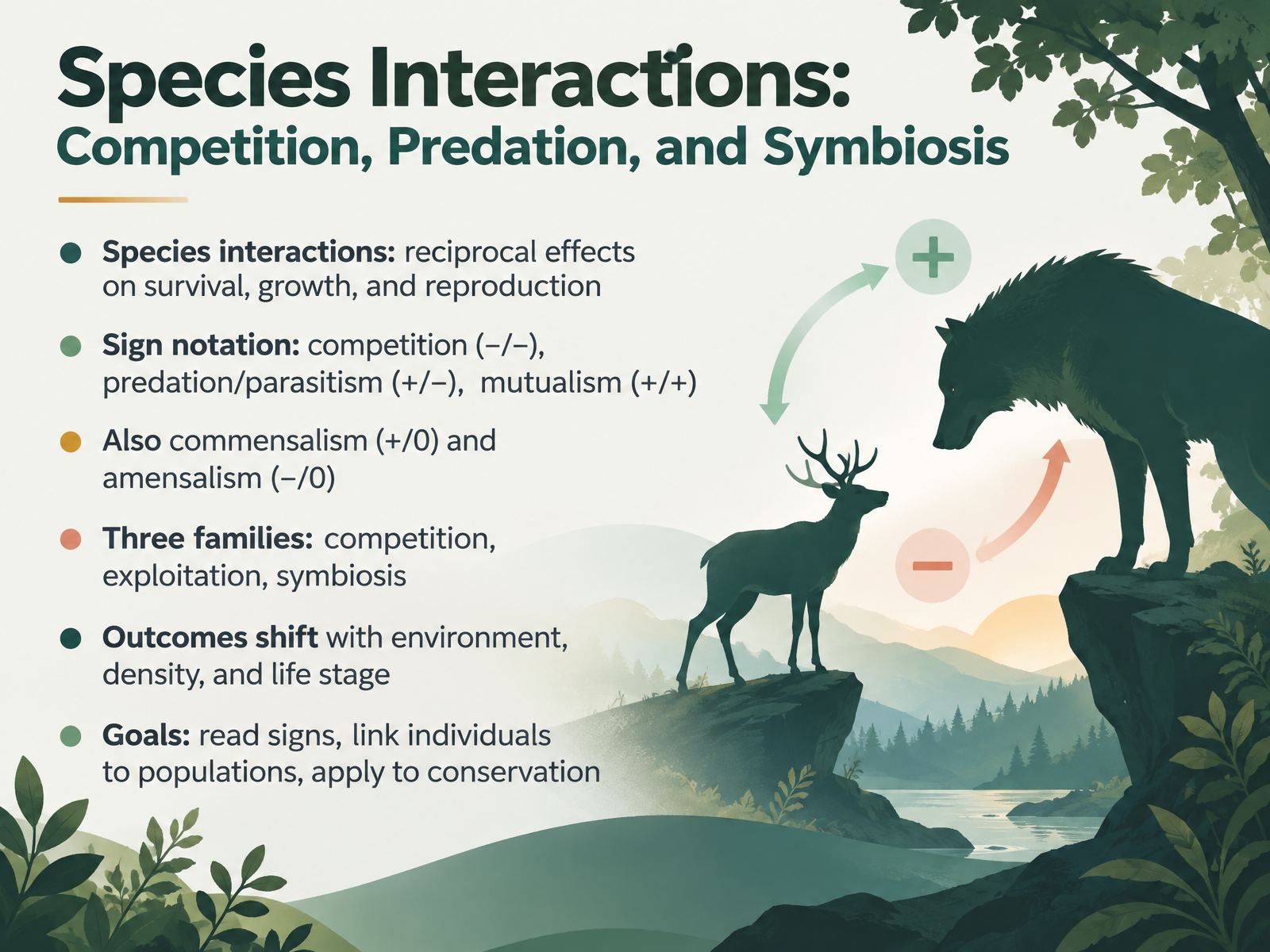
- 01Species Interactions: Competition, Predation, and SymbiosisWelcome. Today we're going to look at how species affect one another: competition, predation, and symbiosis. By the end, you'll be able to read the plus and minus signs ecologists use, and connect individual interactions to whole populations. Let's start with a definition. A species interaction is a reciprocal effect between two species, something that changes survival, growth, or reproduction for each one. Ecologists summarize those effects with signs. A minus means harm, a plus means benefit, and a zero means no clear effect. So competition is a minus minus interaction, because both species lose. Predation and parasitism are plus minus, because one gains and one is harmed. Mutualism is plus plus, because both benefit. There are also commensalism, which is plus zero, and amensalism, which is minus zero. Notice that these pairings form three families: competition, exploitation, and symbiosis. And keep in mind that outcomes are not fixed. They can shift with environment, population density, and life stage. That flexibility is the core of this lesson. Next, we'll see why reading the signs correctly matters so much.amityregion5.orgbio.libretexts.orgopenstax.org+22 min
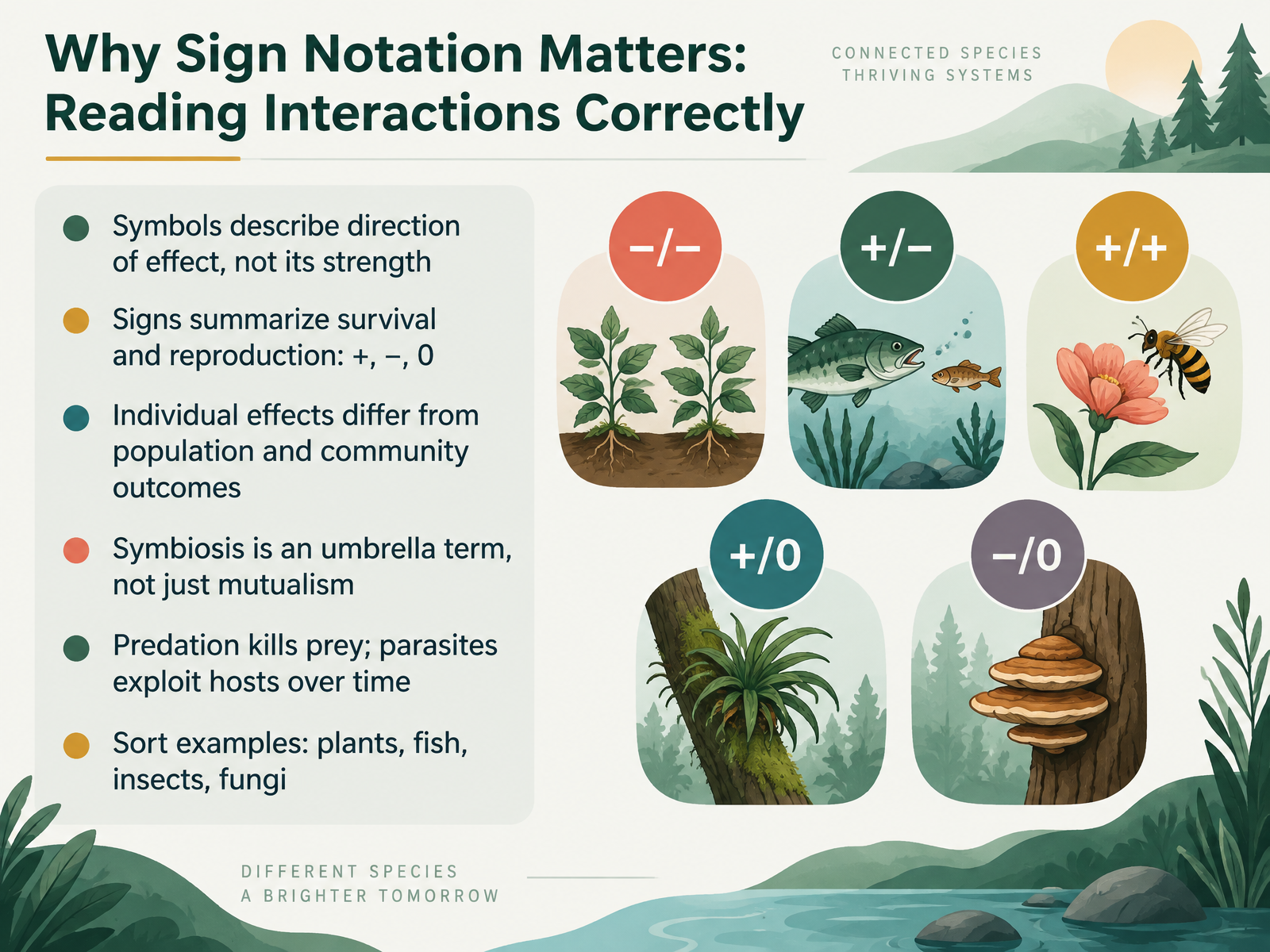
- 02Why Sign Notation Matters: Reading Interactions CorrectlyLet's start with how ecologists read interactions. The plus, minus, and zero signs describe the direction of an effect, not its strength. A plus means an organism's survival or reproduction improves. A minus means it is harmed. A zero means no clear effect is detected. Competition is minus minus, because both species lose. Predation is plus minus, because the predator benefits and the prey is killed. Keep two cautions in mind. Individual effects can differ from population and community outcomes. And symbiosis is an umbrella term that includes mutualism, commensalism, and parasitism, not just mutualism. Also, predation kills prey, while a parasite exploits its host over time. Try sorting your plants, fish, insects, and fungi examples with these signs. Next, we look at competition in more detail.
 amityregion5.orgbio.libretexts.orgopenstax.org+21 min
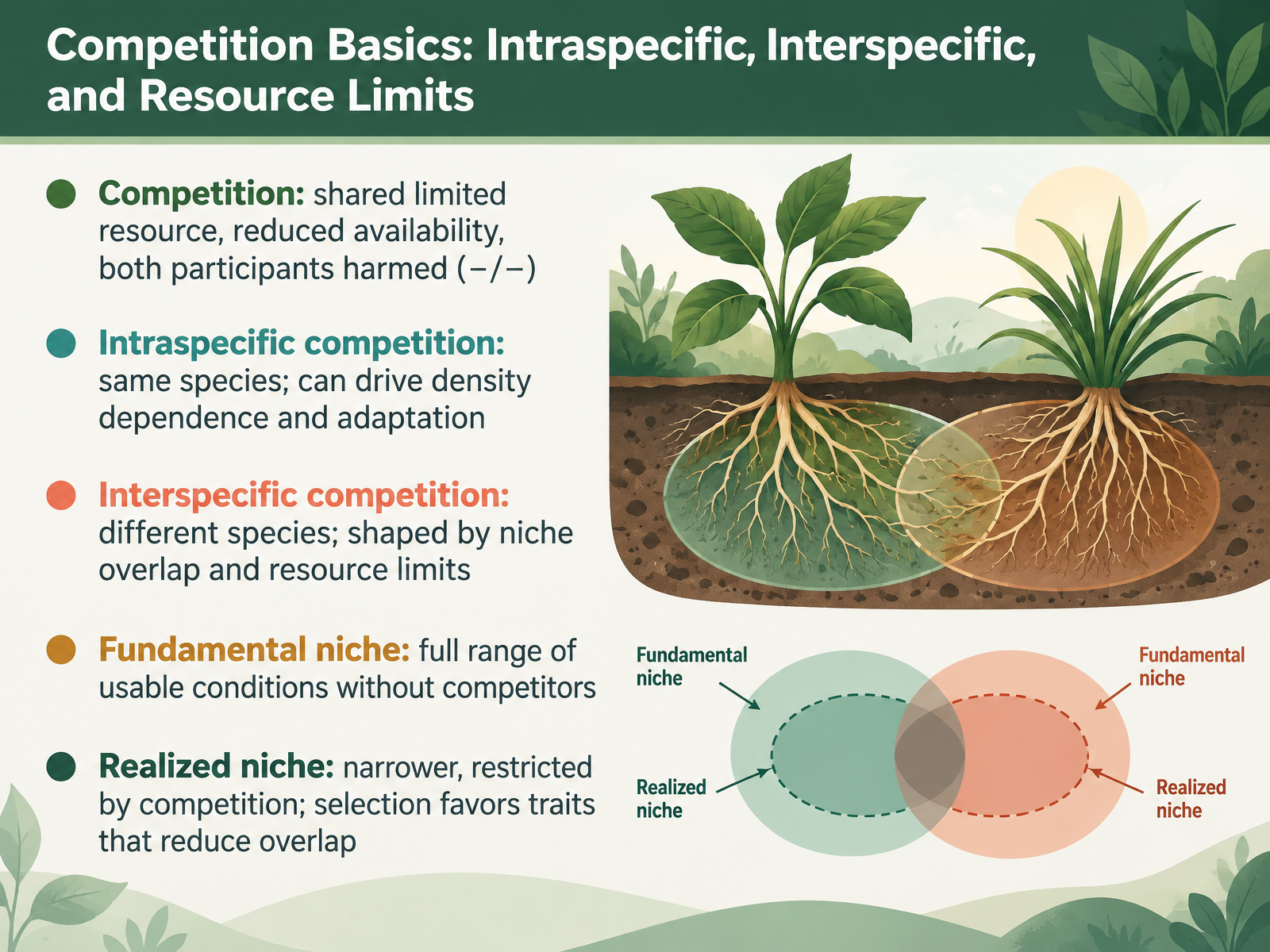
- 03Competition Basics: Intraspecific, Interspecific, and Resource LimitsNow let's look at competition itself. Competition happens when individuals use a shared resource that is in limited supply, and that use reduces how much is available to others. The sign is minus, minus, because both participants are harmed. Intraspecific competition occurs between members of the same species. Because it intensifies as numbers grow, it can drive density dependence, and it can favor adaptation over time. Interspecific competition occurs between different species. Its strength depends on how much their niches overlap and on the limits of the resource. A niche is the set of conditions and resources a species can use. The fundamental niche is the full range available without competitors. The realized niche is smaller, because competition restricts it. Selection then favors traits that reduce overlap, letting species coexist. Next, we examine exploitation, interference, and apparent competition.
 amityregion5.orgbio.libretexts.orgopenstax.org+22 min
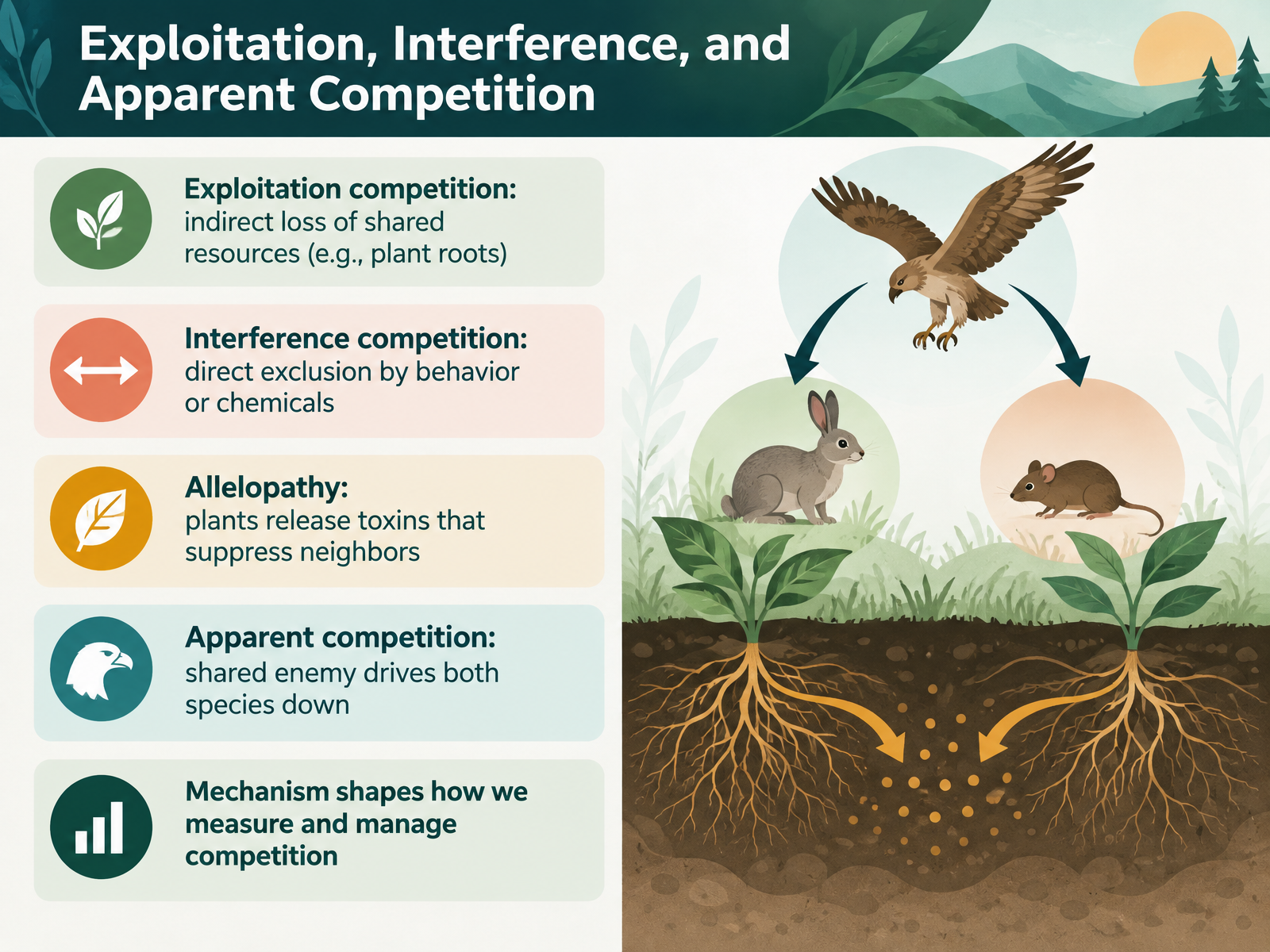
- 04Exploitation, Interference, and Apparent CompetitionSo far we have treated competition as a general negative interaction. Now let us look at how competition actually happens, because the mechanism matters. Exploitation competition is indirect. Two species simply use the same limited resource, and each one reduces what is left for the other. Think of plant roots drawing water and nutrients from the same soil. Interference competition is direct. One species actively excludes another through behavior or chemicals. Allelopathy is a chemical form of interference. A plant releases toxins that suppress its neighbors. Apparent competition is different again. Two species do not compete for a resource at all. They share a common enemy, such as a predator, and that shared enemy drives both populations down. Each of these mechanisms shapes how ecologists measure competition and how we manage it in real habitats. Next, we ask when competing species can coexist, or when one excludes the other, in Coexistence or Exclusion: Niche Overlap and Character Displacement.
 amityregion5.orgbio.libretexts.orgopenstax.org+22 min
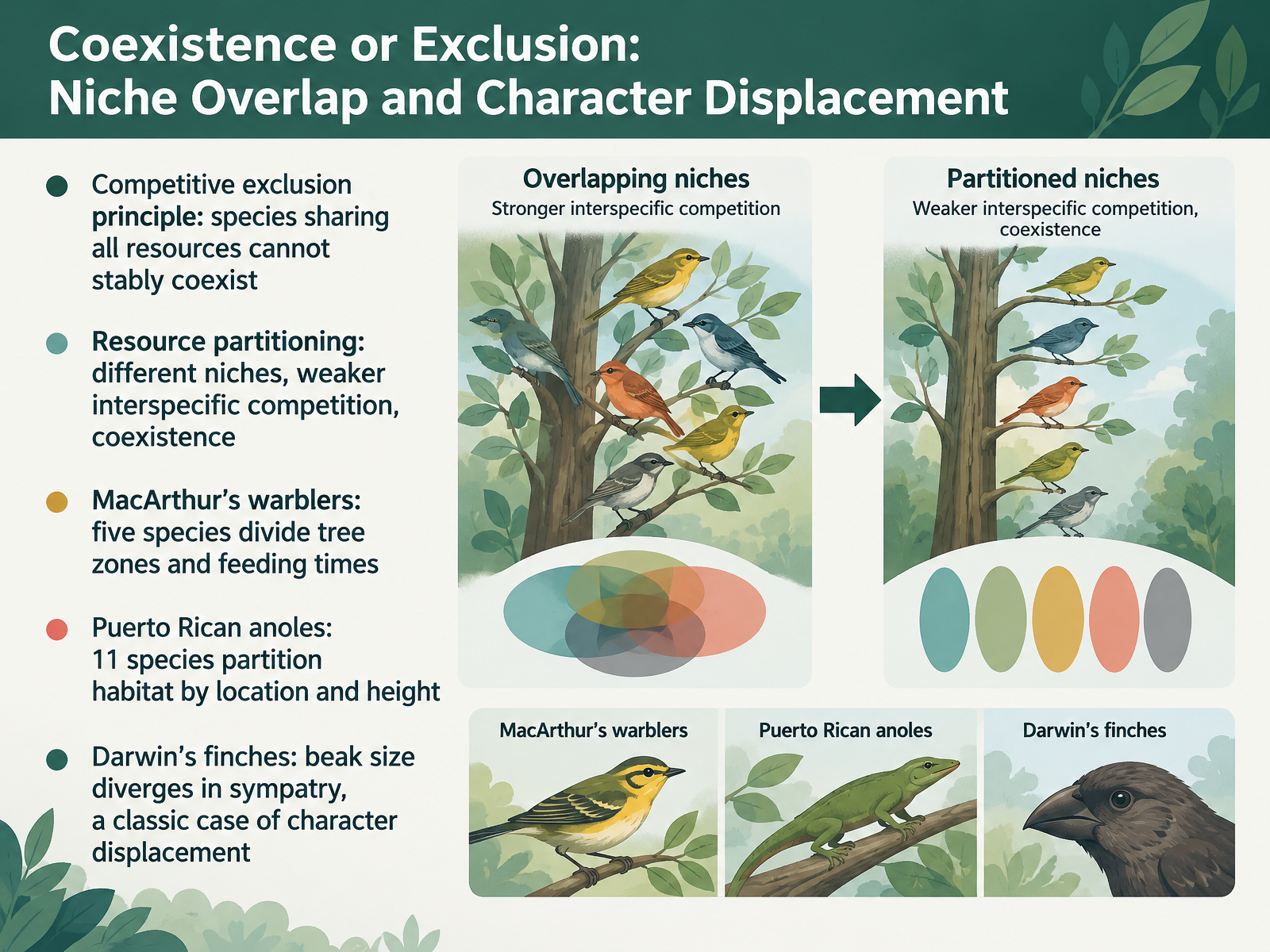
- 05Coexistence or Exclusion: Niche Overlap and Character DisplacementNow let's look at what decides whether competitors coexist or one excludes the other. The competitive exclusion principle states that species sharing all resources cannot stably coexist. One will eventually outcompete the other. Resource partitioning offers an alternative: species use different niches, interspecific competition weakens, and coexistence becomes possible. MacArthur's warblers illustrate this. Five species divide tree zones and feeding times. Puerto Rican anoles show it at larger scale, with eleven species dividing habitat by location and height. Darwin's finches show the evolutionary version. In sympatry, where species occur together, beak size diverges, a classic case of character displacement. The takeaway is that niche overlap is the variable to watch. Next, we examine Character Displacement in Action.
 bioprinciples.biosci.gatech.educell.comraider.pressbooks.pub+22 min
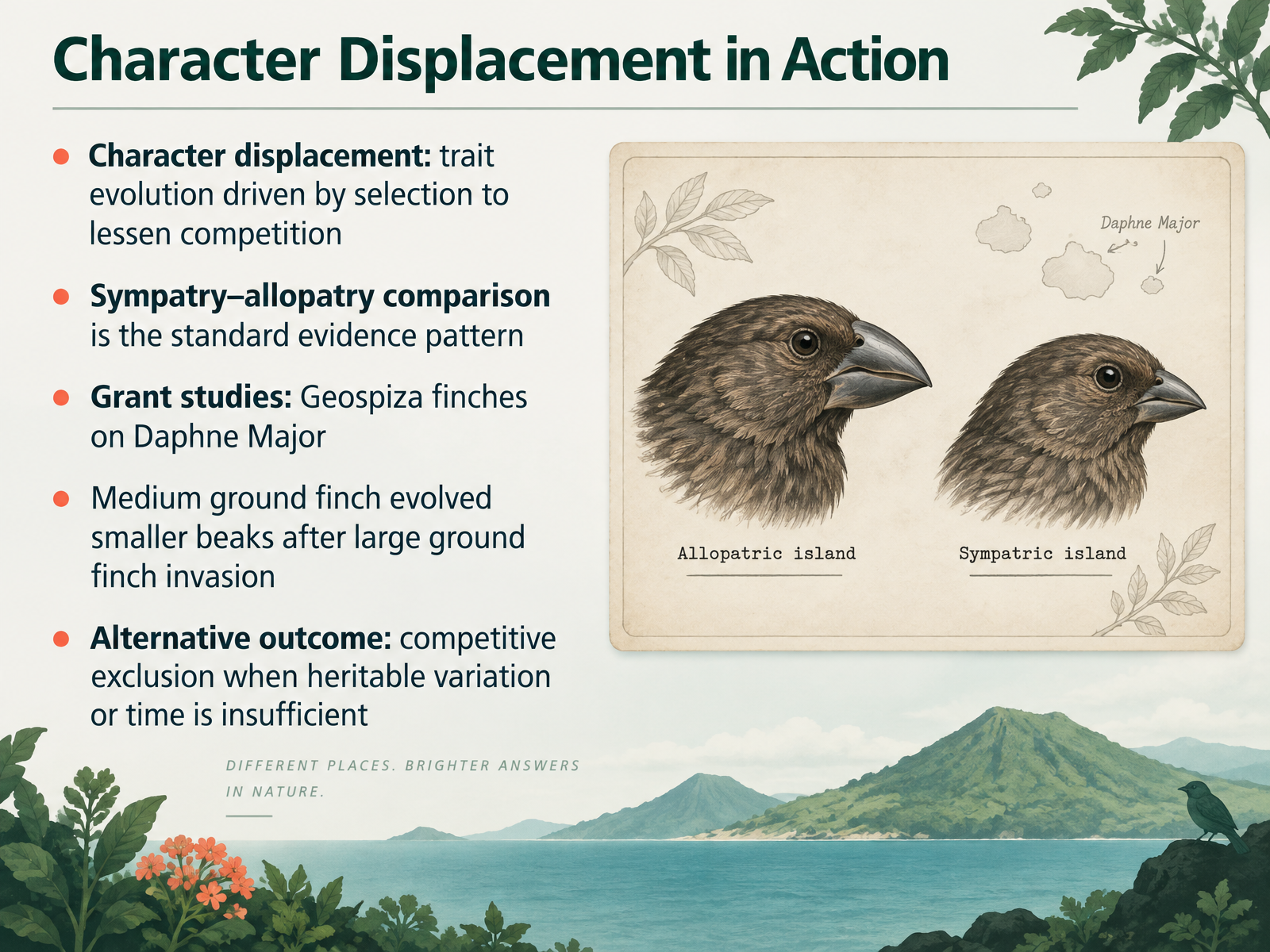
- 06Character Displacement in ActionCharacter displacement is trait evolution driven by natural selection to lessen competition between species. Here is the standard evidence pattern. Researchers compare populations living together in sympatry with populations living apart in allopatry. If the traits differ more where the species overlap, that pattern suggests competition shaped those traits. The Grants documented this process directly with Geospiza finches on Daphne Major. The medium ground finch lived alone until the larger ground finch invaded and took the large seeds. Finches with smaller beaks could harvest smaller seeds that were less in demand, and the Grants recorded an evolutionary shift toward smaller beaks. But this is not the only possible outcome. If a trait lacks enough heritable variation, or if there is not enough time, the weaker competitor may instead be excluded entirely. That outcome is called competitive exclusion. Next, we turn to predation, defined broadly through herbivory, carnivory, and parasitoidism.
 bioprinciples.biosci.gatech.educell.comraider.pressbooks.pub+22 min
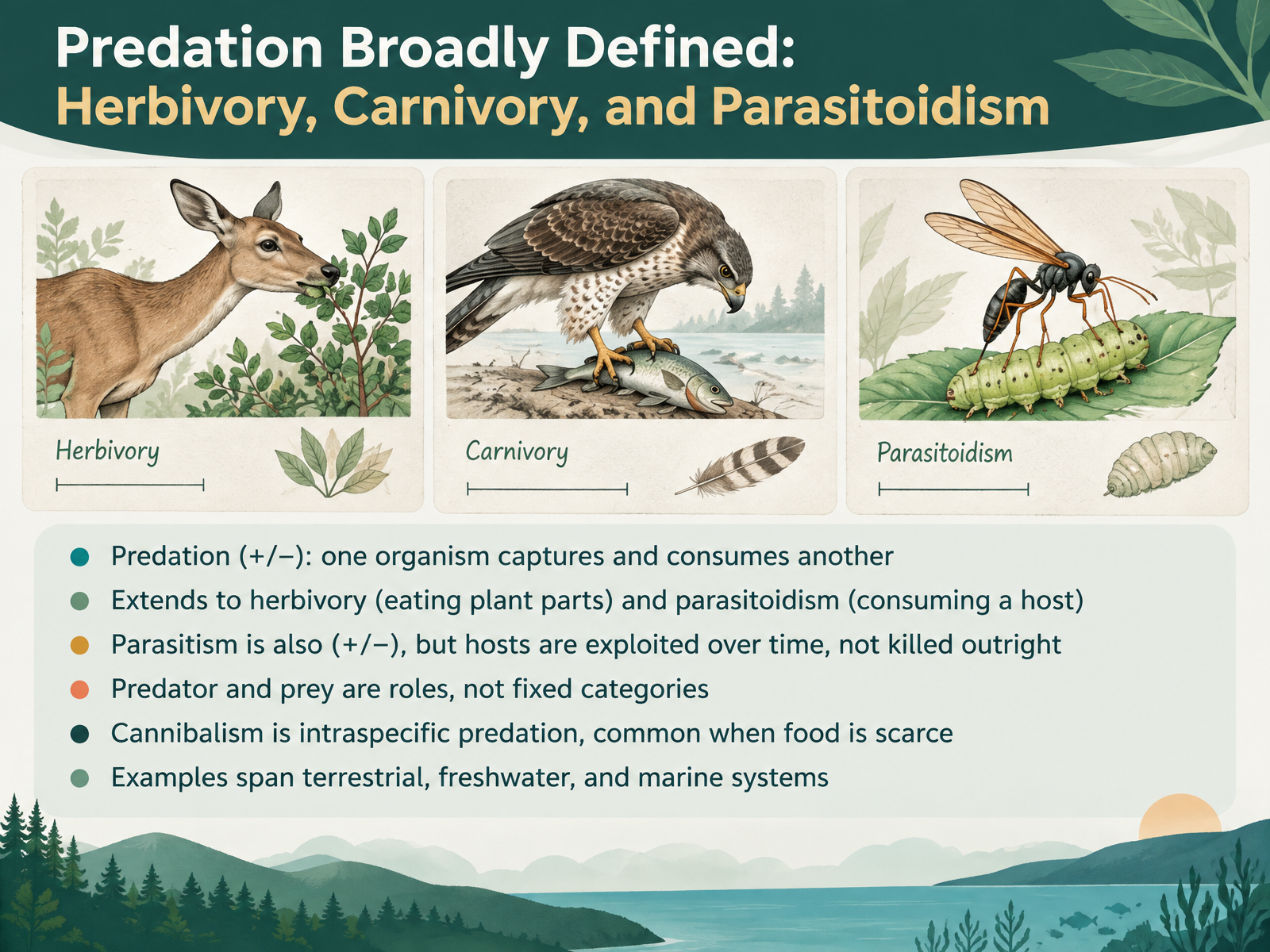
- 07Predation Broadly Defined: Herbivory, Carnivory, and ParasitoidismLet's widen our definition of predation. At its core, predation is a plus minus interaction: one organism, the predator, captures and consumes another, the prey. But it covers more than a lion hunting an antelope. Herbivory, eating plant parts, is predation on plants. Parasitoidism is another form, where an insect larva consumes a host from the inside, usually killing it. Parasitism is also plus minus, but here the host is exploited over time rather than killed outright. A tick feeding on a dog is a familiar example. Keep in mind that predator and prey are roles, not fixed categories. The same species can be predator in one interaction and prey in another. Cannibalism is intraspecific predation, meaning within a single species. It is common when food is scarce. These examples span terrestrial, freshwater, and marine systems. Next, we'll look at how predators respond to prey density in Functional and Numerical Responses.
 amityregion5.orgbio.libretexts.orgopenstax.org+22 min
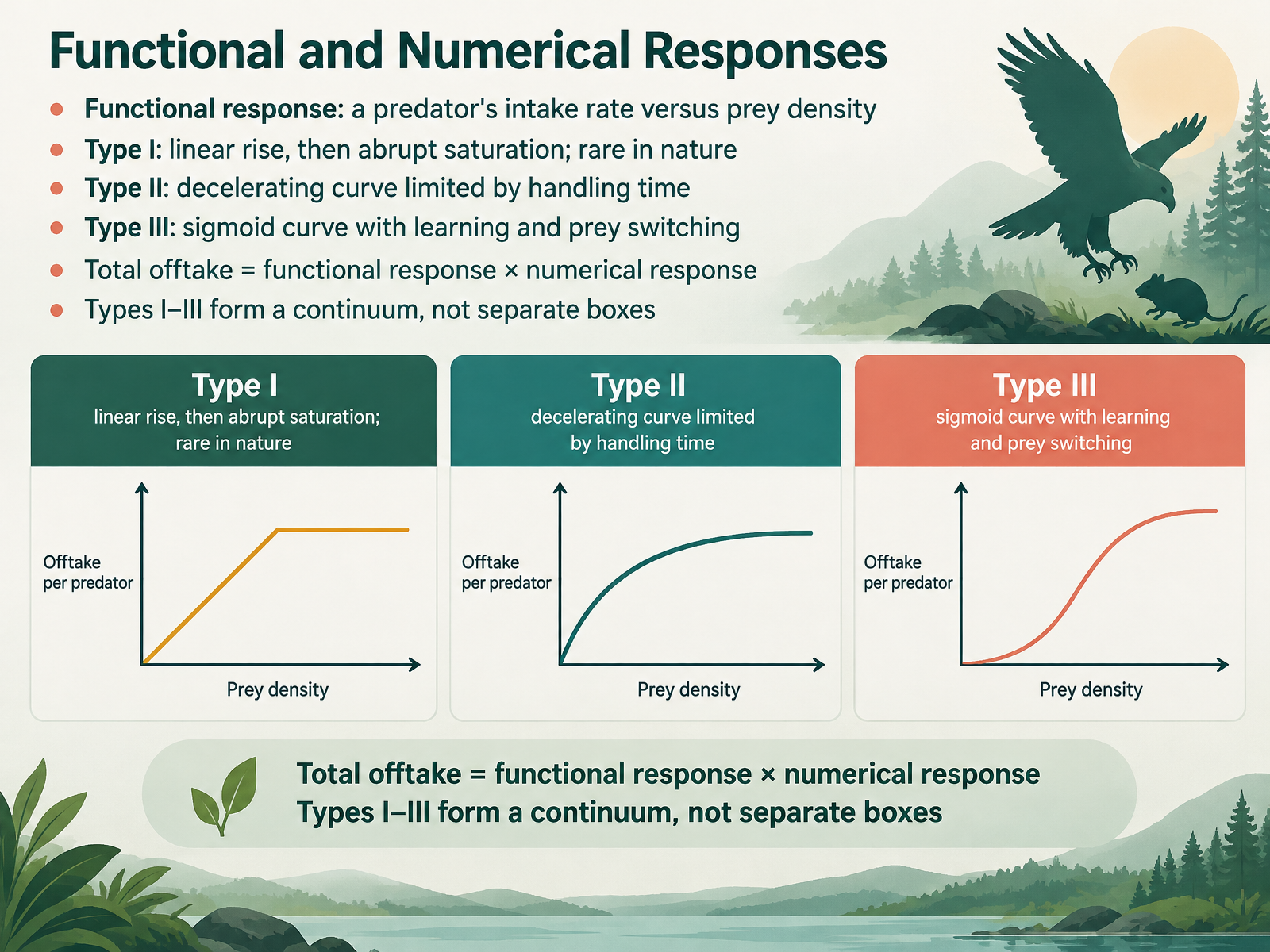
- 08Functional and Numerical ResponsesLet's look now at how a predator's kill rate changes as prey density changes. The functional response describes a single predator's intake rate, meaning how many prey it catches per unit time, plotted against prey density. Holling described three types. Type One rises in a straight line, then saturates abruptly, and it is rare in nature. Type Two rises but decelerates, limited by handling time, the time spent catching, killing, and eating each prey item. A weasel hunting rodents is a common example. Type Three is sigmoid. At low prey density it rises slowly, then accelerates as predators learn and switch to the most abundant prey. Total offtake for the whole predator population equals the functional response times the numerical response, which is how predator numbers grow with food. Keep in mind that these types form a continuum, not separate boxes. Next, we turn to predator-prey cycles and trophic cascades.
 pmc.ncbi.nlm.nih.govhahana.soest.hawaii.edumontana.edu+22 min
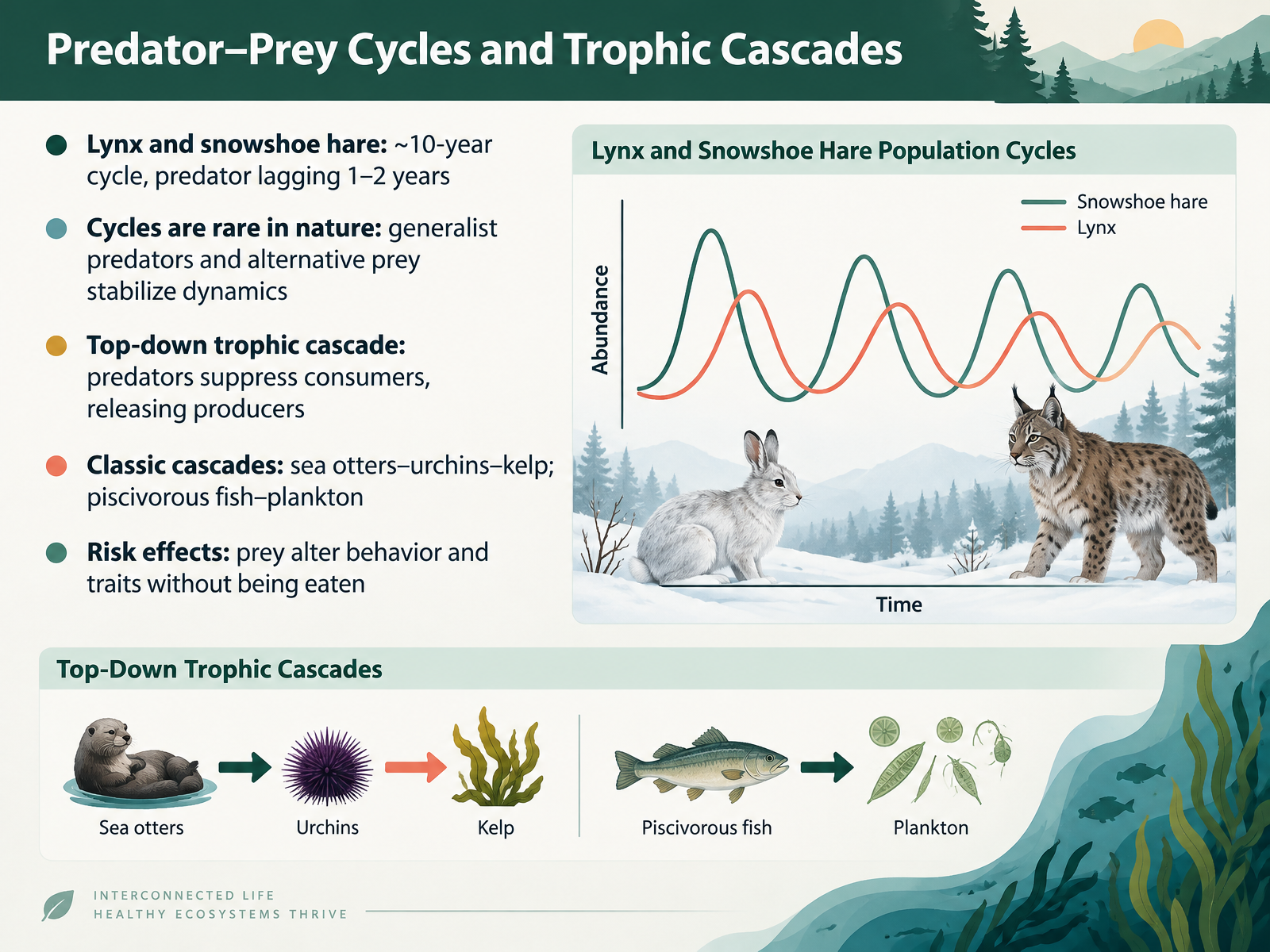
- 09Predator–Prey Cycles and Trophic CascadesNow let's look at how predation plays out over time. Predators and prey can fluctuate in cycles. The classic case is the lynx and snowshoe hare, with a cycle of about ten years. The predator population lags one to two years behind the prey. Cycles like this are actually rare in nature. Generalist predators that eat several prey species tend to stabilize the dynamics. Another key idea is the trophic cascade, a top-down effect. Predators suppress the consumers below them, which releases the producers. A well-known cascade runs from sea otters to urchins to kelp. A second one runs from fish-eating fish down to plankton. Finally, consider risk effects. Prey change their behavior and traits to avoid being eaten, even when they survive. So predation shapes communities through both direct killing and fear, and these effects can ripple through the whole food web. Next, we turn to symbiosis: mutualism, commensalism, and parasitism.
 pmc.ncbi.nlm.nih.govhahana.soest.hawaii.edumontana.edu+22 min
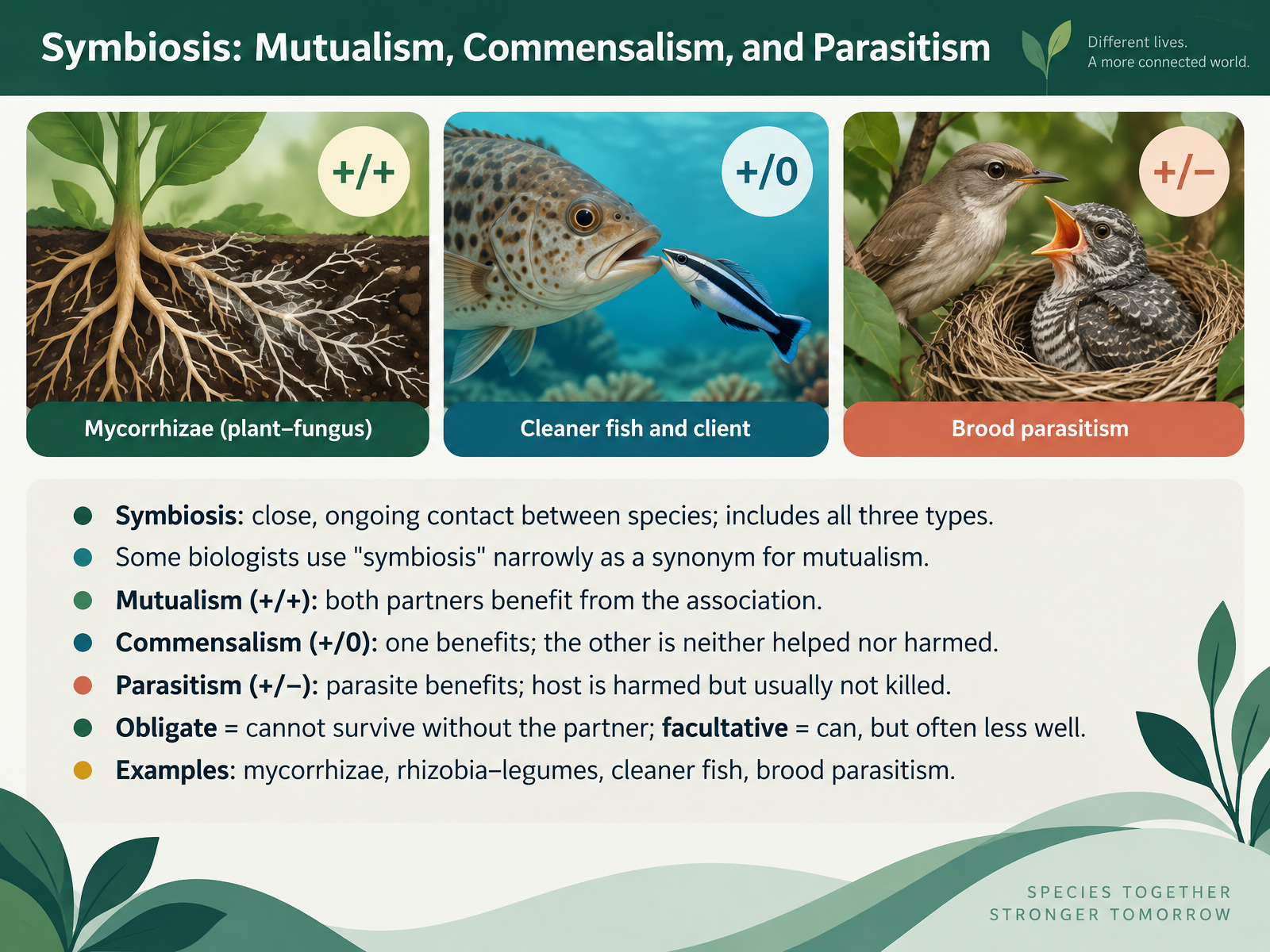
- 10Symbiosis: Mutualism, Commensalism, and ParasitismNow we turn to symbiosis. Symbiosis means close, ongoing contact between species. It includes mutualism, commensalism, and parasitism. A note on usage: some biologists use symbiosis narrowly, as a synonym for mutualism. In this course, we use the broad definition. Mutualism is a plus plus interaction. Both partners benefit. Commensalism is plus zero. One partner benefits, and the other is neither helped nor harmed. Parasitism is plus minus. The parasite benefits, and the host is harmed, but usually not killed. Partners can also be obligate, meaning they cannot survive without each other, or facultative, meaning they can survive alone, but often less well. Clear examples include mycorrhizae, the fungi and plant roots that exchange nutrients. Rhizobia and legumes, where bacteria fix nitrogen for the plant. Cleaner fish that remove parasites from larger clients. And brood parasitism, where one bird lays eggs in another bird's nest. This frames our next topic: Cheating, Sanctions, and the Parasite-Mutualist Continuum.
 amityregion5.orgbio.libretexts.orgopenstax.org+21 min
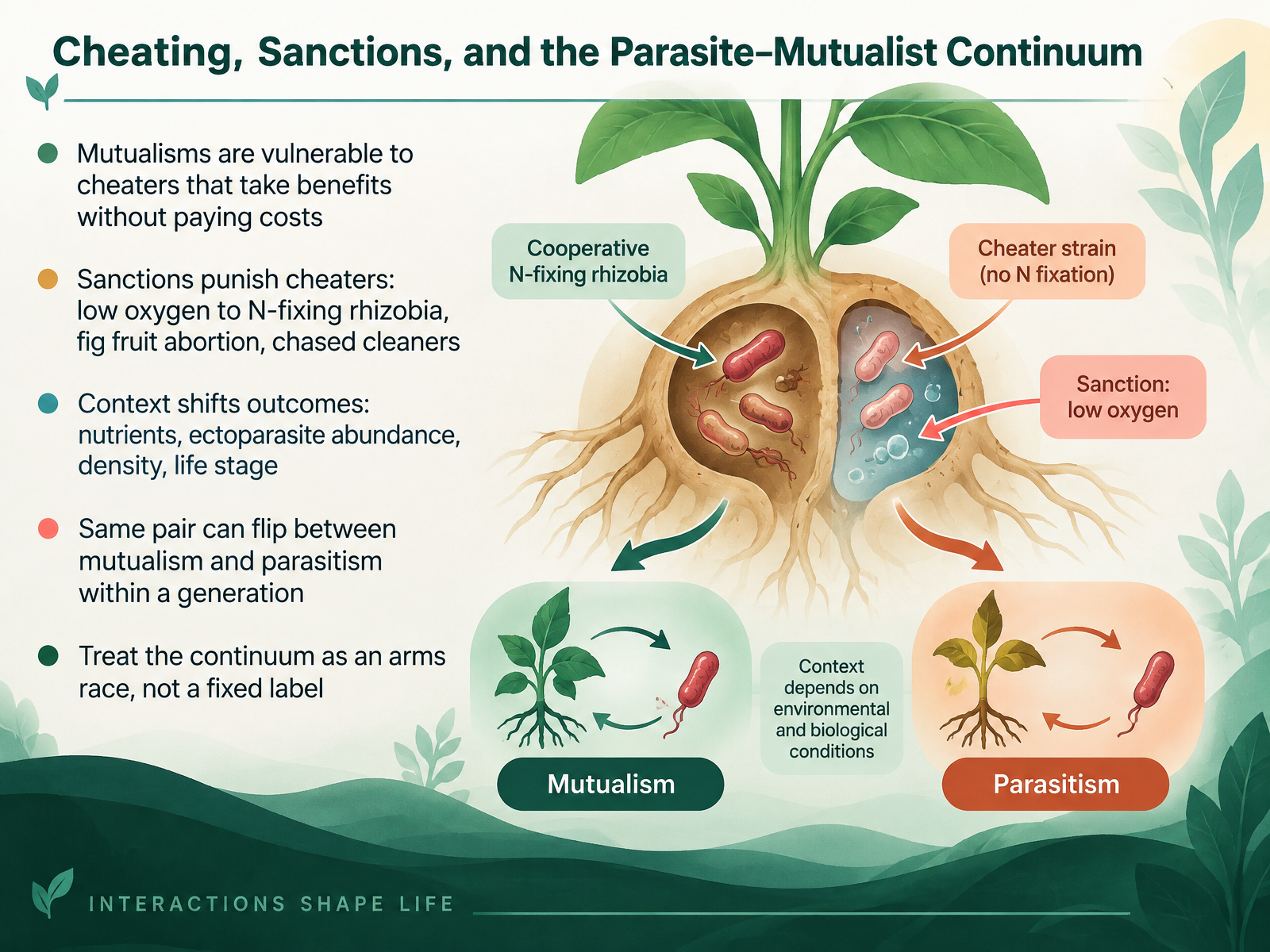
- 11Cheating, Sanctions, and the Parasite–Mutualist ContinuumNow let's look at what keeps mutualisms honest. A cheater is a partner that takes the benefits of an interaction without paying the cost of providing its service. Mutualisms are vulnerable to these cheaters. So how do partners respond? Through sanctions, which are penalties that reduce the fitness of uncooperative partners. Consider rhizobia, nitrogen-fixing bacteria in root nodules. When they fail to fix nitrogen, the plant lowers the oxygen supply to those nodules as a sanction. Fig trees abort fruits when their pollinating wasps lay eggs without bringing pollen. And cleaner fish that bite their clients instead of cleaning them are chased away. Context matters too. Nutrient levels, the abundance of ectoparasites, population density, and life stage can all shift the outcome. In cleaning gobies, where ectoparasites are scarce, cleaners bite more often, and the same pair slides toward parasitism. The same pair can flip between mutualism and parasitism within a single generation. So treat this as a continuum, an ongoing arms race, rather than a fixed label. Next, we'll move on to interaction strength, keystone species, and indirect effects.
 doi.orgnph.onlinelibrary.wiley.comhal.sorbonne-universite.fr+22 min
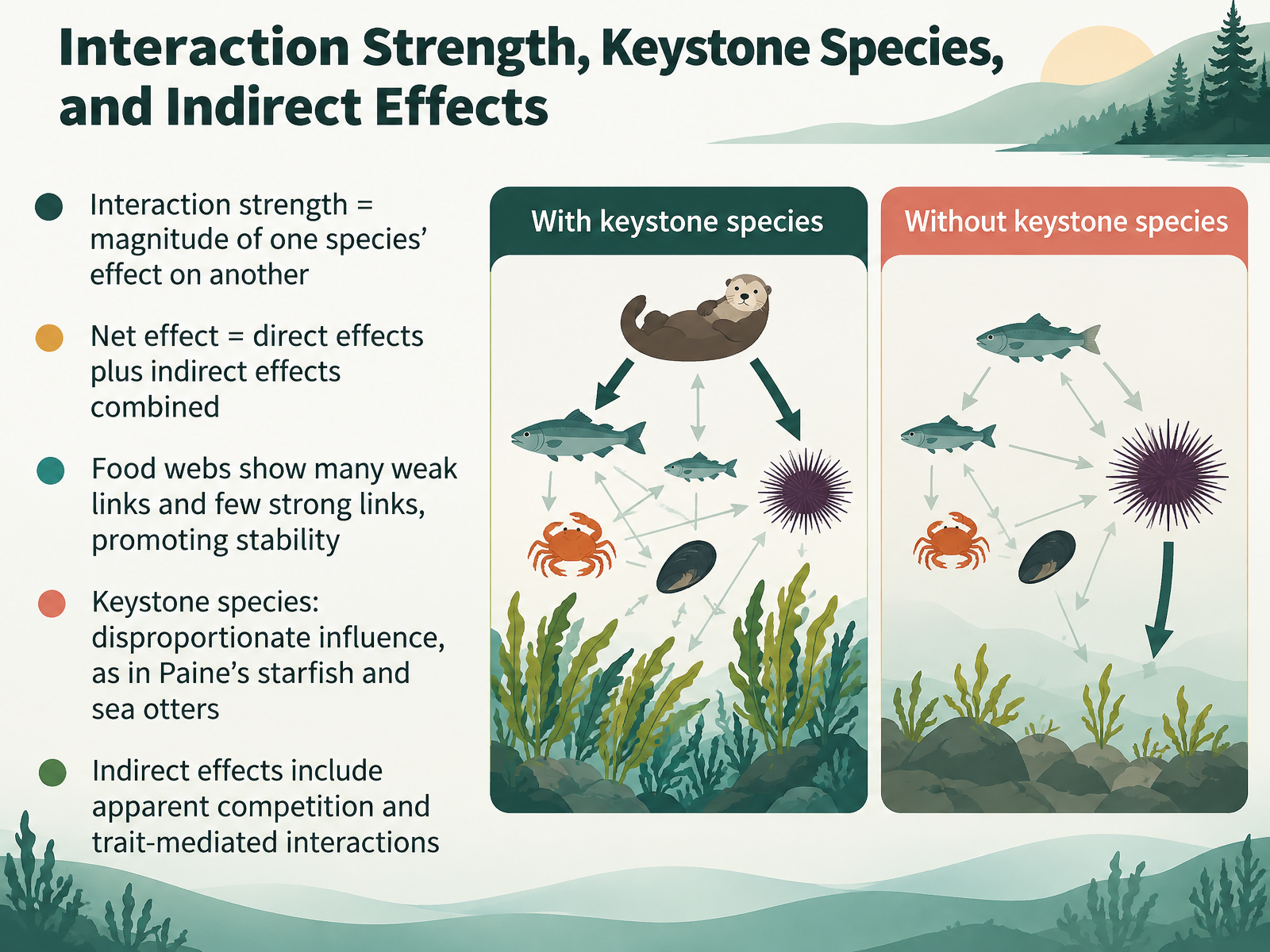
- 12Interaction Strength, Keystone Species, and Indirect EffectsLet's move from the types of interactions to their strength. Interaction strength is the magnitude of one species' effect on another. Pause here, because magnitude matters. A net effect is the sum of direct effects and indirect effects combined. In real food webs, we tend to see many weak links and only a few strong links. That pattern helps promote stability. A keystone species has disproportionate influence relative to its abundance. In Paine's classic starfish experiments, removing the predator let mussels dominate and reduced diversity. Sea otters show the same principle by controlling sea urchins. Indirect effects include apparent competition and trait-mediated interactions. Apparent competition happens when one species increases a shared predator, which then suppresses another. Trait-mediated interactions happen when species change behavior or habitat use because a predator is nearby. The key takeaway is this. Stability depends on the pattern of strong and weak links, not just on which species are present. Coming up next, we apply these ideas in Applied Ecology: Conservation, Agriculture, and Invasion.
 2 min
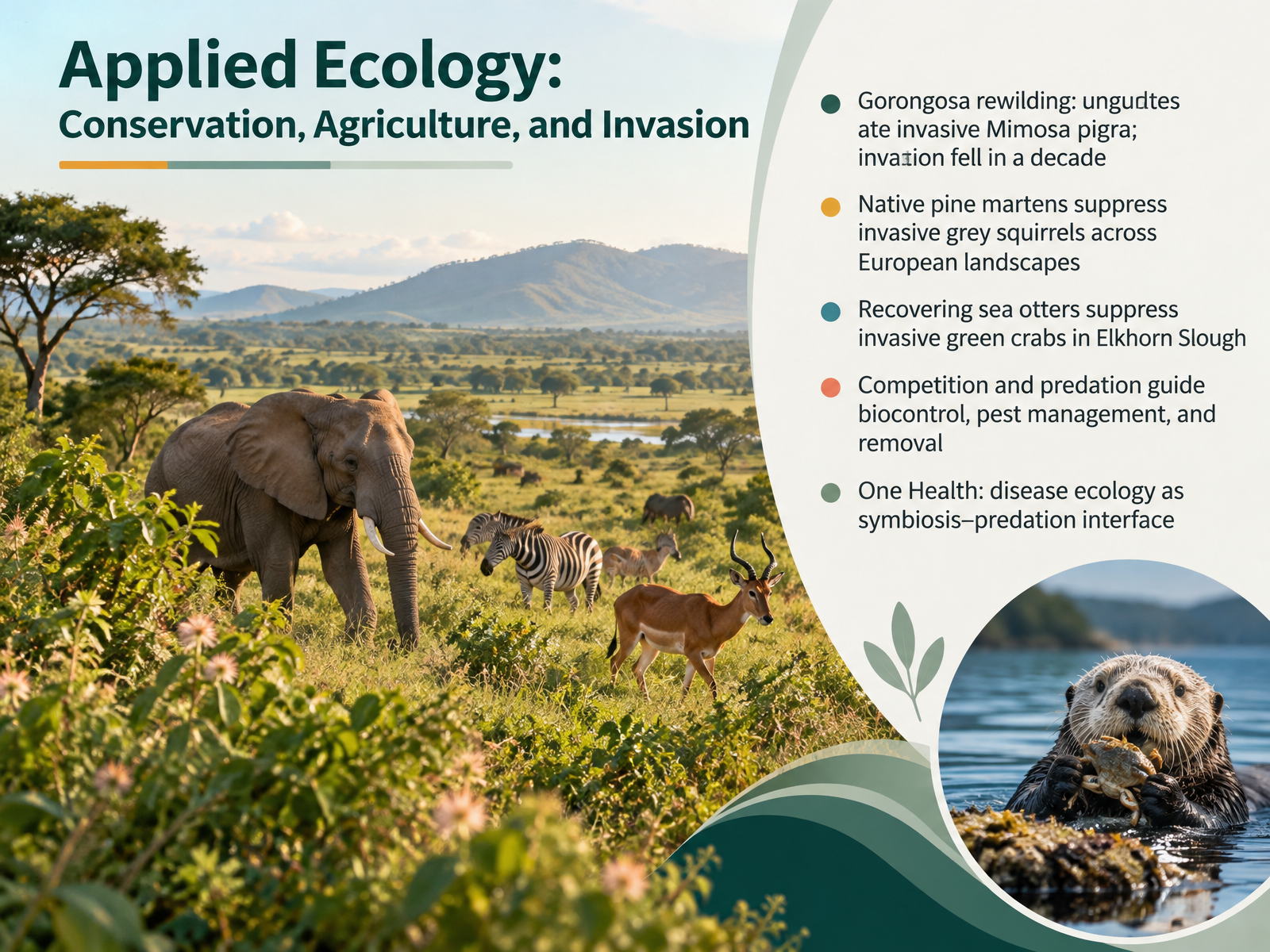
- 13Applied Ecology: Conservation, Agriculture, and InvasionNow let's put these interactions to work. Applied ecology uses competition and predation as management tools. Start in Gorongosa National Park, in Mozambique. There, recovering ungulates, meaning hoofed grazing mammals, fed heavily on the invasive shrub Mimosa pigra. Within one decade, the invasion fell back to its pre-war baseline. Now consider Europe. Native pine martens, a predatory relative of the weasel, suppress invasive grey squirrels across whole landscapes. Predation is the mechanism. Next, in Elkhorn Slough, California, recovering sea otters suppress invasive green crabs. Where otters cannot reach, crabs persist. These cases show how competition and predation guide biological control, pest management, and removal programs. One Health extends this logic. It treats human, animal, and environmental health as one connected system, and disease ecology sits right at the symbiosis and predation interface. The takeaway is that restoring a species interaction can be a conservation strategy. Next, we turn to teaching, synthesis, and assessment.
 2 min
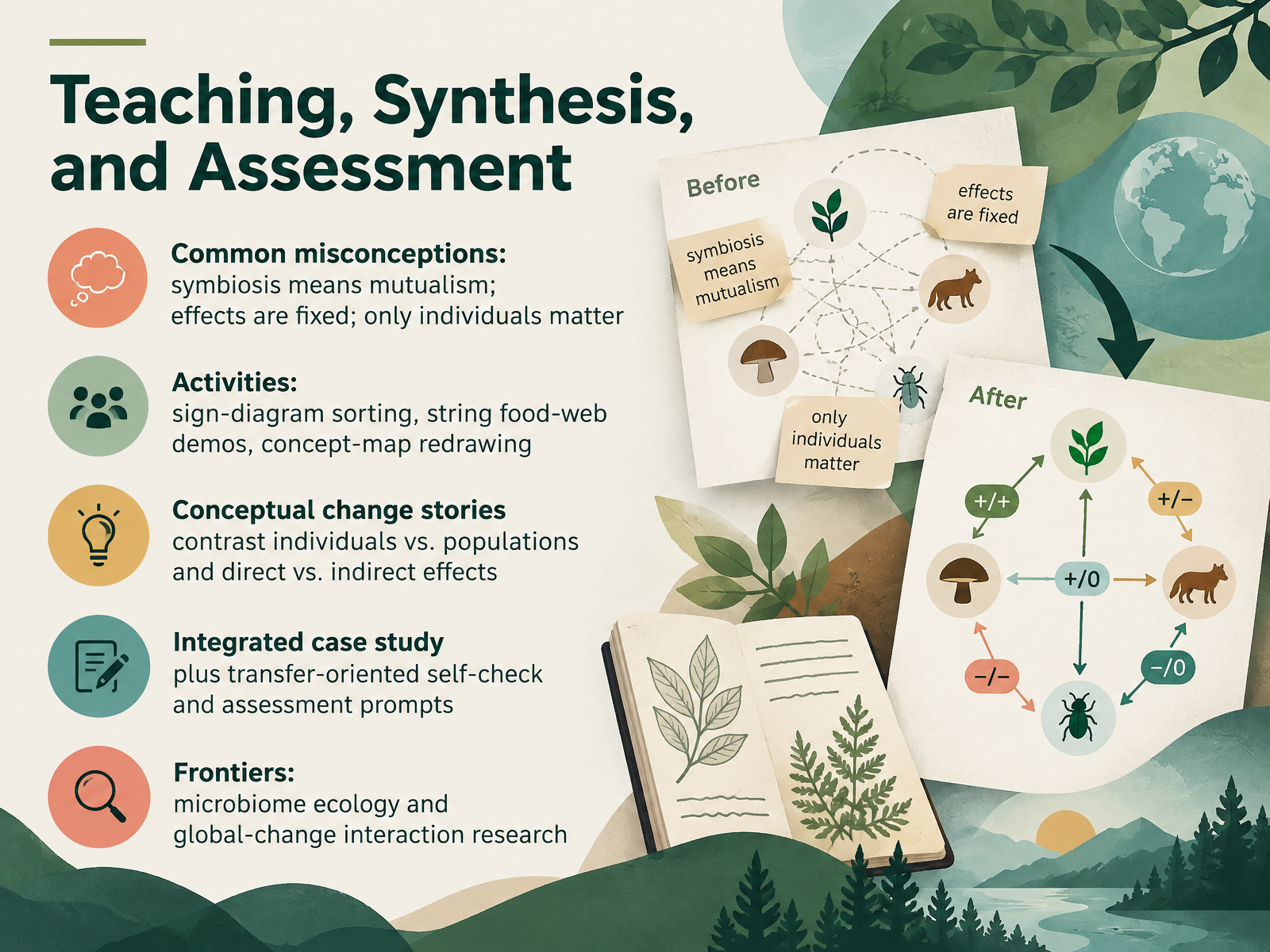
- 14Teaching, Synthesis, and AssessmentLet's close by turning to teaching, synthesis, and assessment. Three misconceptions are common. One: students assume symbiosis means mutualism, when it is the umbrella term. Two: they treat effects as fixed, though a plus for one partner can shift with context. Three: they reason about individuals instead of populations. Misconceptions are not erased by simple correction. They must be identified, then challenged repeatedly. Activities help here. Sign-diagram sorting asks students to classify interactions and justify the signs. String food-web demonstrations let students feel how a change to one population ripples through others, directly and indirectly. Concept-map redrawing, revised as understanding grows, reveals how ideas connect. Conceptual change stories explicitly contrast individuals with populations, and direct with indirect effects. Finish with an integrated case study, then a self-check and assessment prompts that ask students to transfer reasoning to a new context. Looking forward, two frontiers stand out: microbiome ecology, where competition can stabilize a community, and global-change interaction research. Thank you for working through these interactions with care. Keep asking how the signs, the populations, and the context fit together, and you will keep reasoning well.
 2 min
Take the deck with you
Download this course as a file — free, no sign-up needed.
- PDF handoutEvery slide page, ready to print or share.15 pages · 4.4 MBDownload
- Narrated PowerPointThe deck that presents itself — every slide carries the digital human's narration video.15 pages · 15.5 MBDownload
- PowerPoint slidesThe full deck as a .pptx — open it in PowerPoint, Keynote, or Google Slides.15 pages · 4.4 MBDownload
Free to use in your own training — please keep the PersonWise credit page at the end.
Have your own deck? Turn it into a course
Sources consulted
Web sources consulted while building this course.
- Community — amityregion5.org
- 8.3: Summary of interactions — bio.libretexts.org
- 19.4 Community Ecology - Concepts of Biology | OpenStax — openstax.org
- Interactions Between Populations — zo.utexas.edu
- Species Interactions – An Interactive Introduction to Organismal and Molecular Biology, 2nd ed. — openbooks.lib.msu.edu
- Resources and Competition | Biological Principles — bioprinciples.biosci.gatech.edu
- Character displacement: Current Biology — cell.com
- Chapter 23: Niches and Competition – Introductory Biology 2 — raider.pressbooks.pub
- MacArthur's Warblers — web.stanford.edu
- Character displacement — en.wikipedia.org
- Understanding patterns and processes in models of trophic cascades — pmc.ncbi.nlm.nih.gov
- https://hahana.soest.hawaii.edu/cmoreserver/summercourse/2010/documents/Holling_1959b.pdf — hahana.soest.hawaii.edu
- Prey density — montana.edu
- A macro-ecological approach to predators’ functional response — biorxiv.org
- Functional response — en.wikipedia.org
- Cheaters must prosper: reconciling theoretical and empirical perspectives on cheating in mutualism — doi.org
- Conflict, cheats and the persistence of symbioses - Douglas - 2008 - New Phytologist - Wiley Online Library — nph.onlinelibrary.wiley.com
- PARASITISM, COMMENSALISM, AND MUTUALISM — hal.sorbonne-universite.fr
- Our Current Understanding of Commensalism — doi.org
- Host sanctions and pollinator cheating in the fig tree–fig wasp mutualism — pmc.ncbi.nlm.nih.gov