Idioms and Everyday Expressions
Begin
14 pages · ~28 min
Idioms and Everyday Expressions
This training helps English learners understand and use common idioms and everyday expressions naturally in conversation.
What you’ll learn
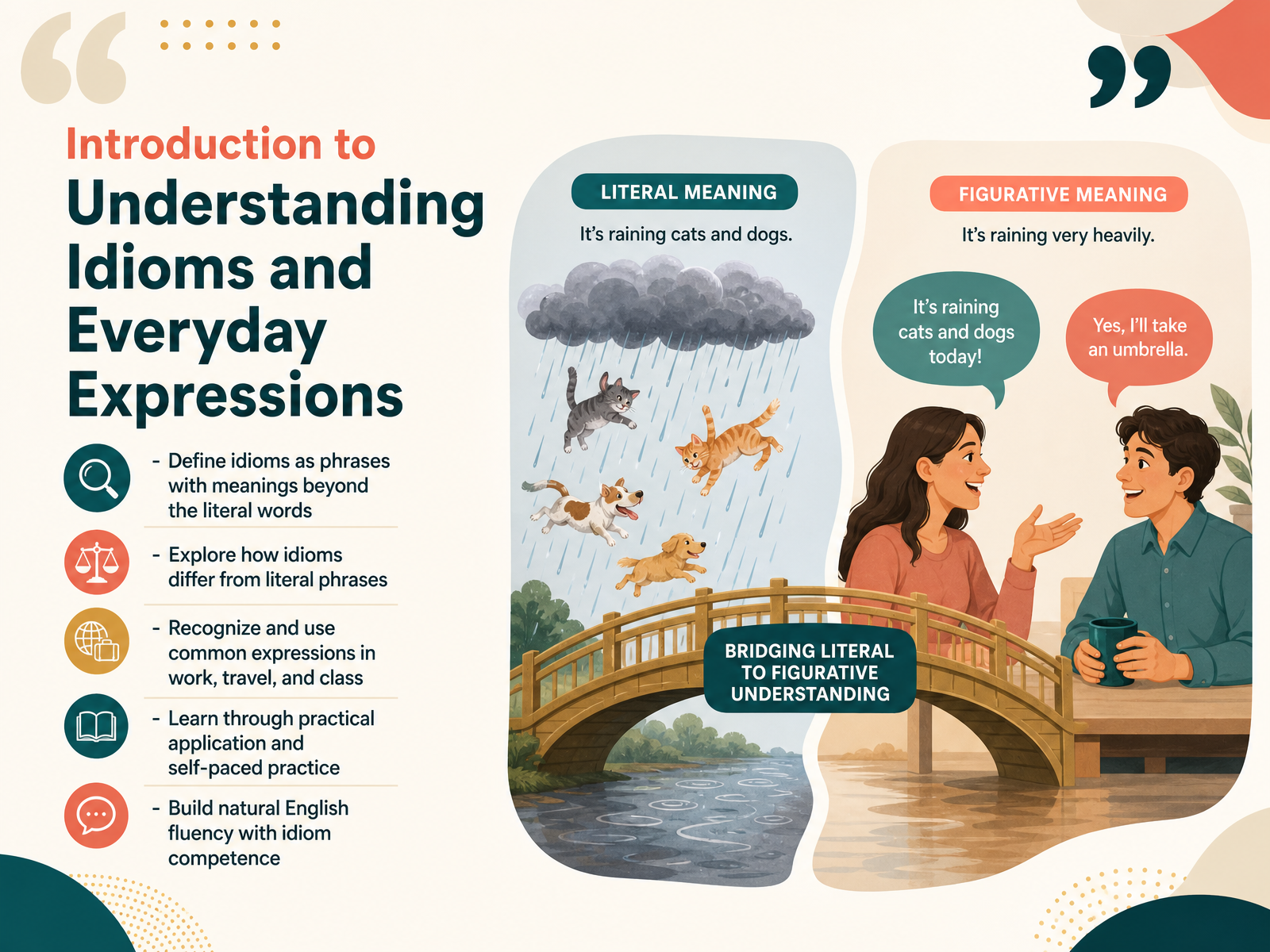
- 01Introduction to Understanding Idioms and Everyday ExpressionsWelcome! I'm so glad you're here. Today, we're diving into the colorful world of English idioms and everyday expressions. Now, you might be wondering, what exactly is an idiom? Simply put, it's a phrase where the meaning goes beyond the literal words. For example, if someone says they're feeling "under the weather," they don't mean they're standing under a cloud. They just mean they feel a bit sick. Throughout this lesson, we'll explore how these expressions differ from plain language, and we'll practice recognizing them in work, travel, and classroom settings. Don't worry if they seem strange at first. Even native speakers stumble over new ones. The goal here is to build your natural fluency and boost your confidence. We'll learn through practical examples and self-paced practice. By the end, you'll not only understand common expressions but also feel comfortable using them in your everyday conversations. Let's get started and see just why idioms are so important for true fluency.doi.orgslovakedu.comdoi.org+21 min
- 02Why Idioms Matter for FluencySo, let’s ask a simple question: Why do idioms actually matter? Well, think about how you feel when you speak English. If you only use textbook phrases, your words can sound stiff, or even a little too formal. Idioms are what make your English sound natural, like a native speaker’s. You might hear one and think, “Wait, what does that mean?” That is completely normal. In fact, frustration is part of the learning process. You will not master these overnight. But here’s the good news. Every time you hear an idiom at work or while traveling, your brain is building a new connection. With exposure and regular practice, your listening skills will sharpen, and your confidence will grow. You will start to catch the real meaning behind the words. So, keep going. We are about to see how idioms work, moving from literal to figurative meaning. Let’s dive in.
 1 min
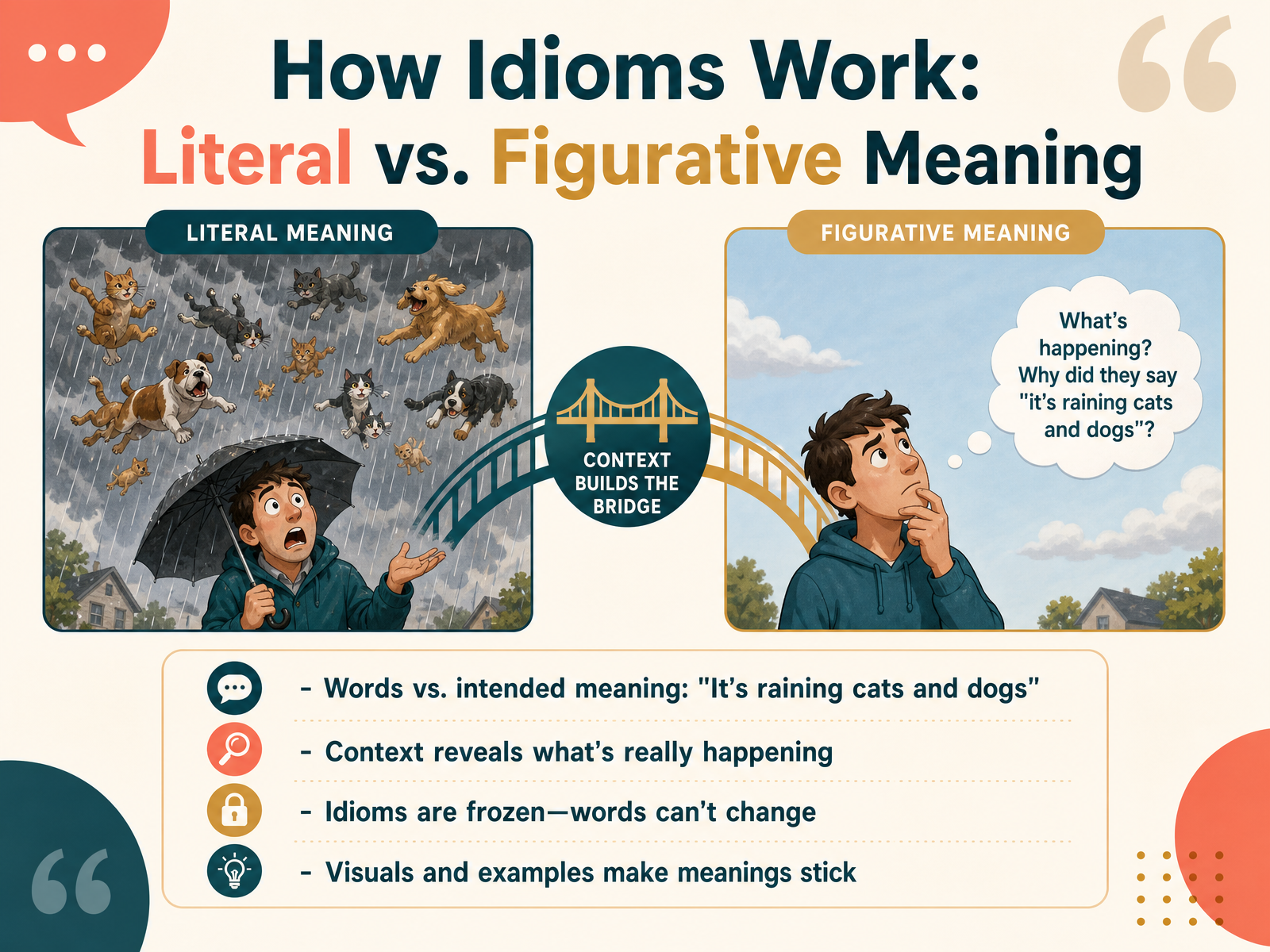
1 min - 03How Idioms Work: Literal vs. Figurative MeaningNow let’s look at how idioms actually work. You might hear someone say, “It’s raining cats and dogs.” But if you look outside, you won’t see any animals falling from the sky. The words say one thing, but the meaning is totally different. That’s the key: idioms have a literal meaning and a figurative meaning. The literal meaning is the exact words. The figurative meaning is what the speaker really wants to say. So “raining cats and dogs” simply means it’s raining very heavily. The context — like seeing someone arrive soaked and shaking off their umbrella — tells you which meaning to use. Here’s another important point: idioms are frozen. That means you can’t change the words. You wouldn’t say, “It’s raining dogs and puppies” or “It’s pouring cats and kittens.” It just doesn’t work. The phrase stays exactly the same. When you learn an idiom, try picturing it in your mind. That image will help you remember the meaning much faster. So remember: words can be tricky, but context and practice will guide you. Up next, we’ll explore everyday expressions you’ll hear at work.
 2 min
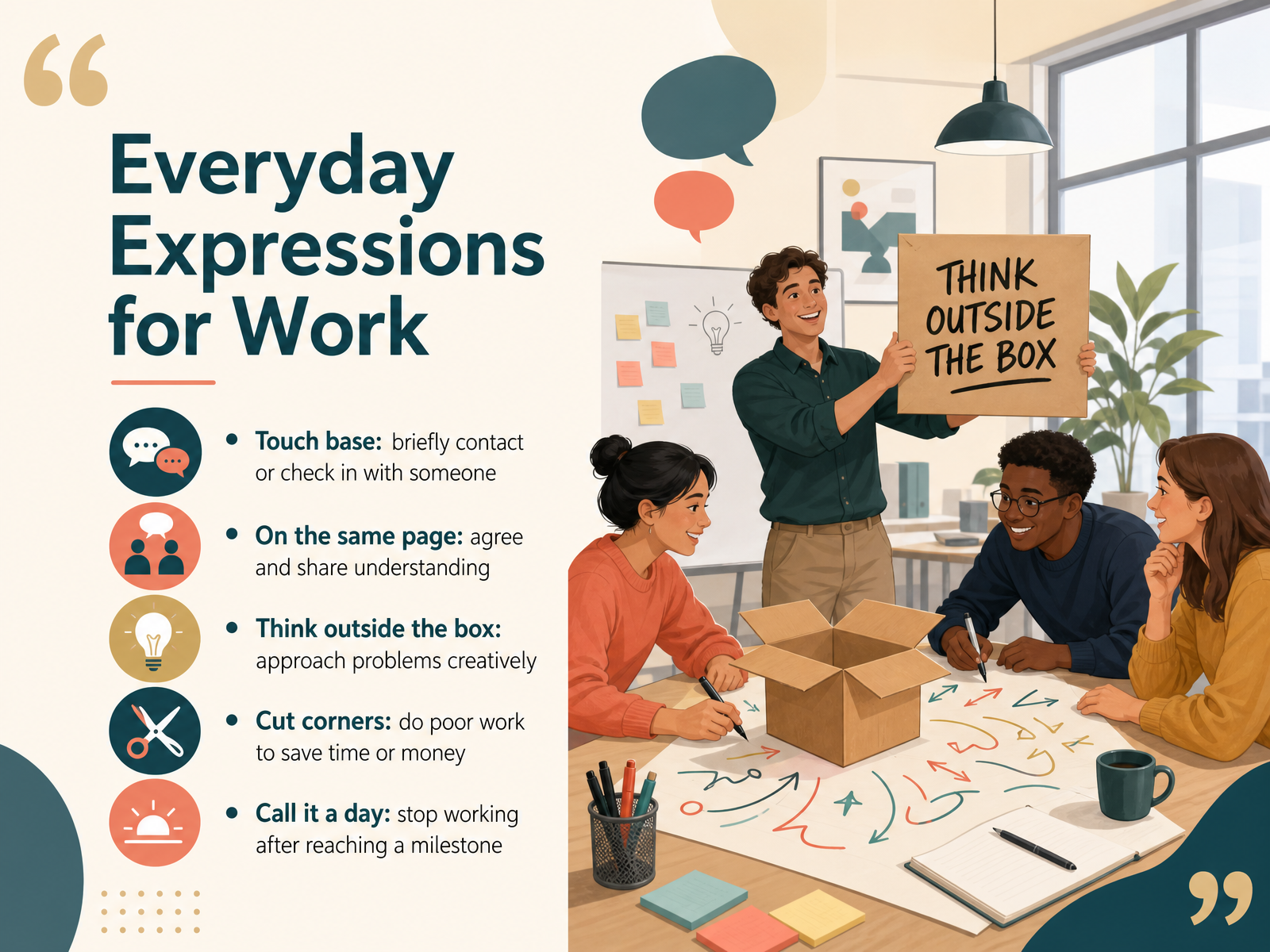
2 min - 04Everyday Expressions for WorkNow let's look at some expressions that will help you in everyday work situations. First, to touch base simply means to briefly contact someone or check in. You might hear this one at work: 'Let's touch base on Friday about the project.' Now, being on the same page means you agree and share a common understanding. For example, 'Before we start, I want to make sure we're all on the same page.' To think outside the box means to approach problems creatively, like suggesting a completely new idea in a meeting. However, to cut corners means to do poor work just to save time or money, which is always a bad idea. Finally, to call it a day means to stop working after reaching a milestone, often said at the end of a long day. So, to recap, you might touch base with a colleague, make sure you are on the same page, and think outside the box—without cutting corners—before you finally call it a day. Next, we'll explore some everyday expressions you can use while traveling.
 fluentjoy.comenglishlearningtips.comfluentjoy.com+21 min
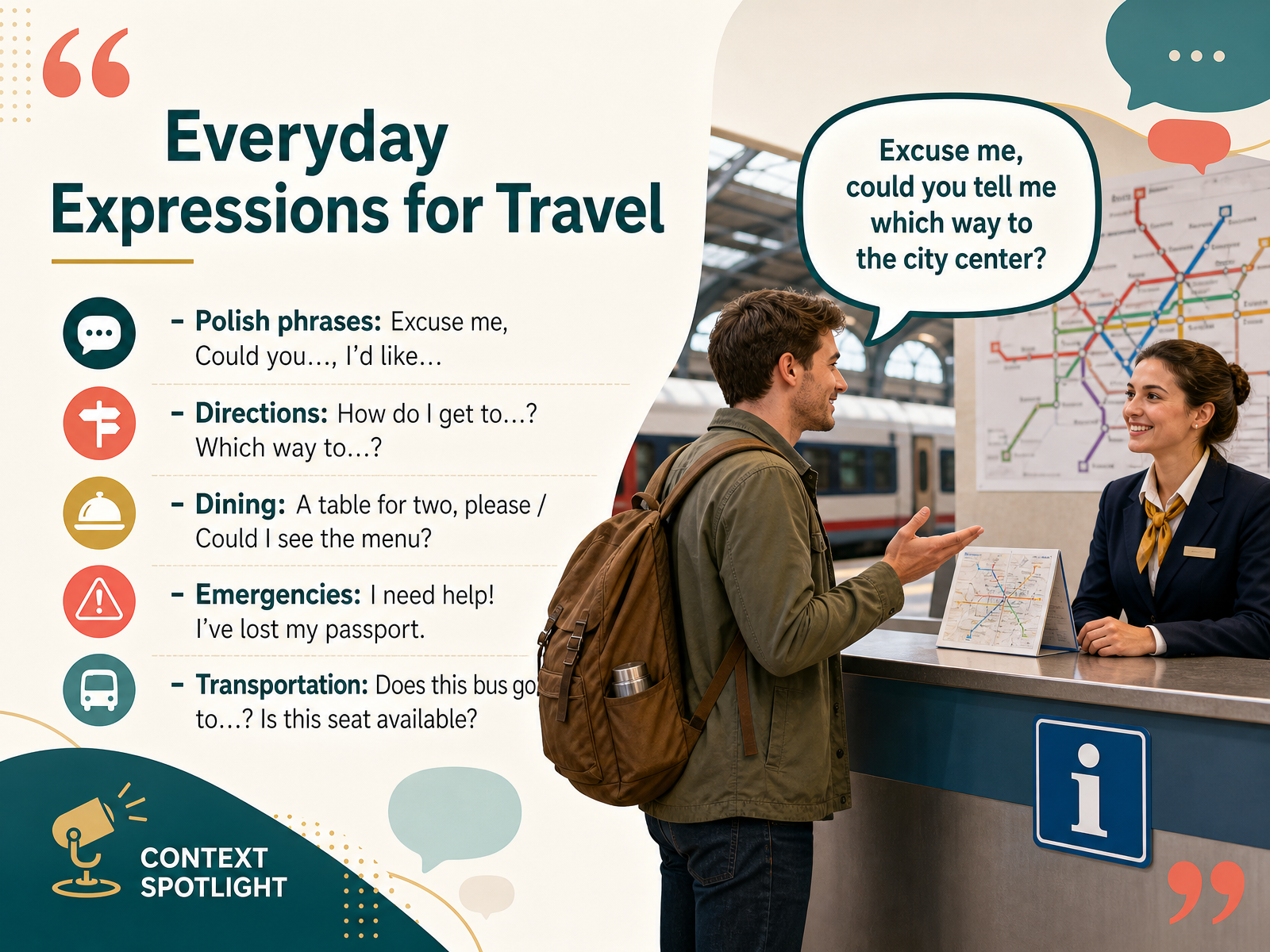
 - 05Everyday Expressions for TravelLet's look at everyday expressions you will actually use when you travel. These are the phrases that get you from the airport to the hotel to the restaurant and back again. First, start with politeness. You might hear this one at work too. If you need someone's attention, say, 'Excuse me.' If you need to make a request, say, 'Could you…' as in, 'Could you help me?' Or, 'I'd like a ticket, please.' These three small phrases open almost any door when you travel. For getting around, ask, 'How do I get to the station?' or 'Which way to the museum?' Maybe you already know these. But the key is to say them smoothly. When you arrive at a restaurant, try saying, 'A table for two, please.' Then, once you sit down, 'Could I see the menu?' Easy. Now, big picture. In an emergency, you need to be clear, not perfect. 'I need help!' or 'I've lost my passport.' Simple and direct is best. And for buses and trains, ask, 'Does this bus go to the city center?' or 'Is this seat available?' You can manage most travel moments with just these four groups of phrases. Before we move on, try saying each one out loud once. Then, let's see how you can figure out unfamiliar idioms from context, without memorizing long lists.
 ef.compracticeme.appenglishwithsaid.com+22 min
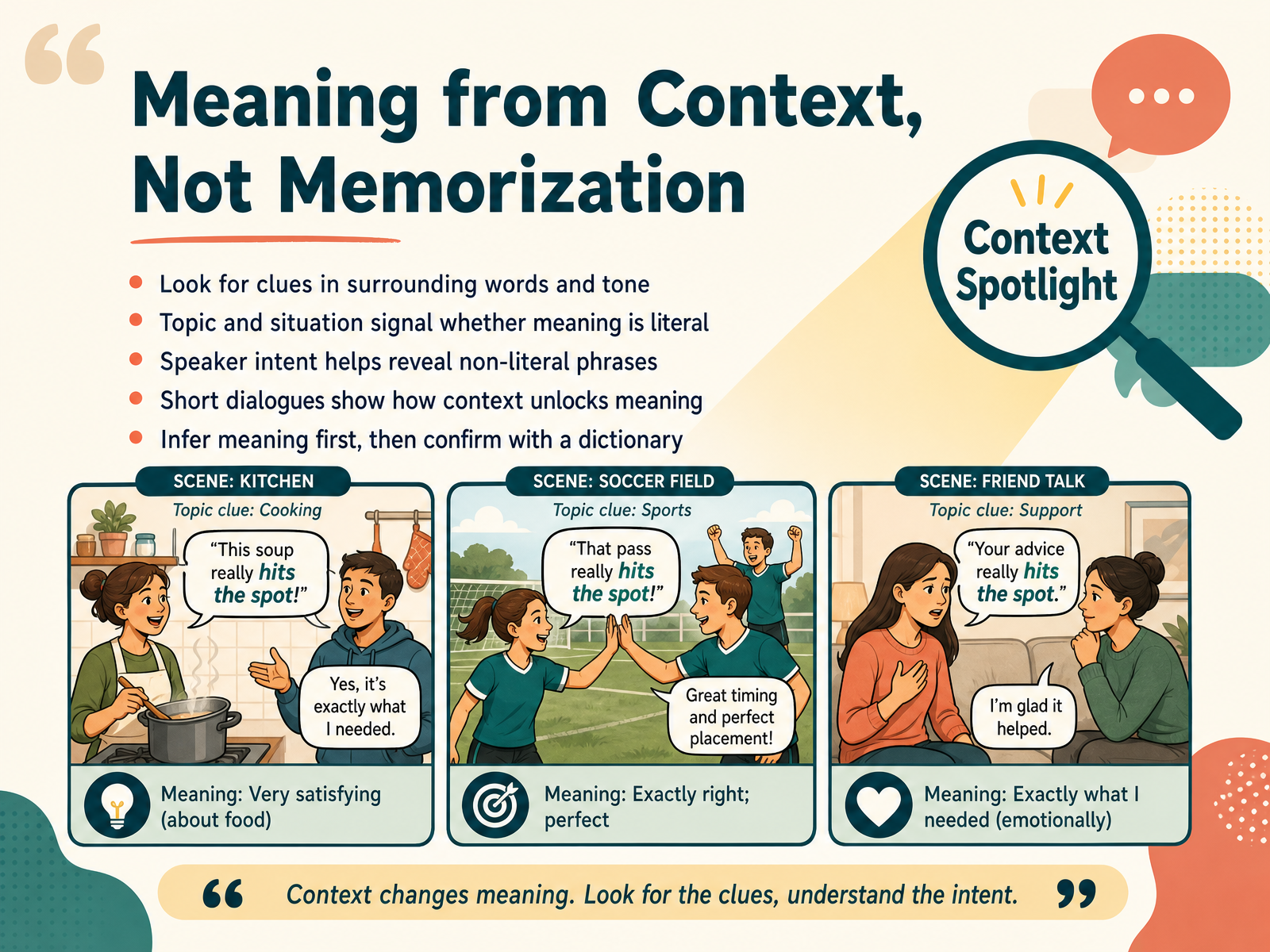
 - 06Meaning from Context, Not MemorizationHere is a little secret about idioms: you do not always need to memorize their definitions. Often, you can figure them out from the situation. Look at the words around the phrase, and listen to the tone of voice. That gives you strong clues. Also, think about the topic. If a coworker says, 'We are all in the same boat,' during a busy project, they are not talking about boats. The situation tells you they mean you are all sharing the same challenge. Another big clue is speaker intent. Ask yourself: is this person serious, joking, or trying to comfort me? That helps you spot when the words are not literal. Let me show you a quick example. At the airport, your friend says, 'My flight got canceled. I am back to square one.' You do not need a dictionary. You know they are frustrated and must start over. So, your process should be: guess the meaning from context first, then check a dictionary to confirm. Try this today. When you hear a new expression, pause and look for the situation clues before you translate it. You will find that you already understand more than you think. Next, we will look at some common pitfalls and easily confused pairs, so you can steer clear of small mix-ups.
 1 min
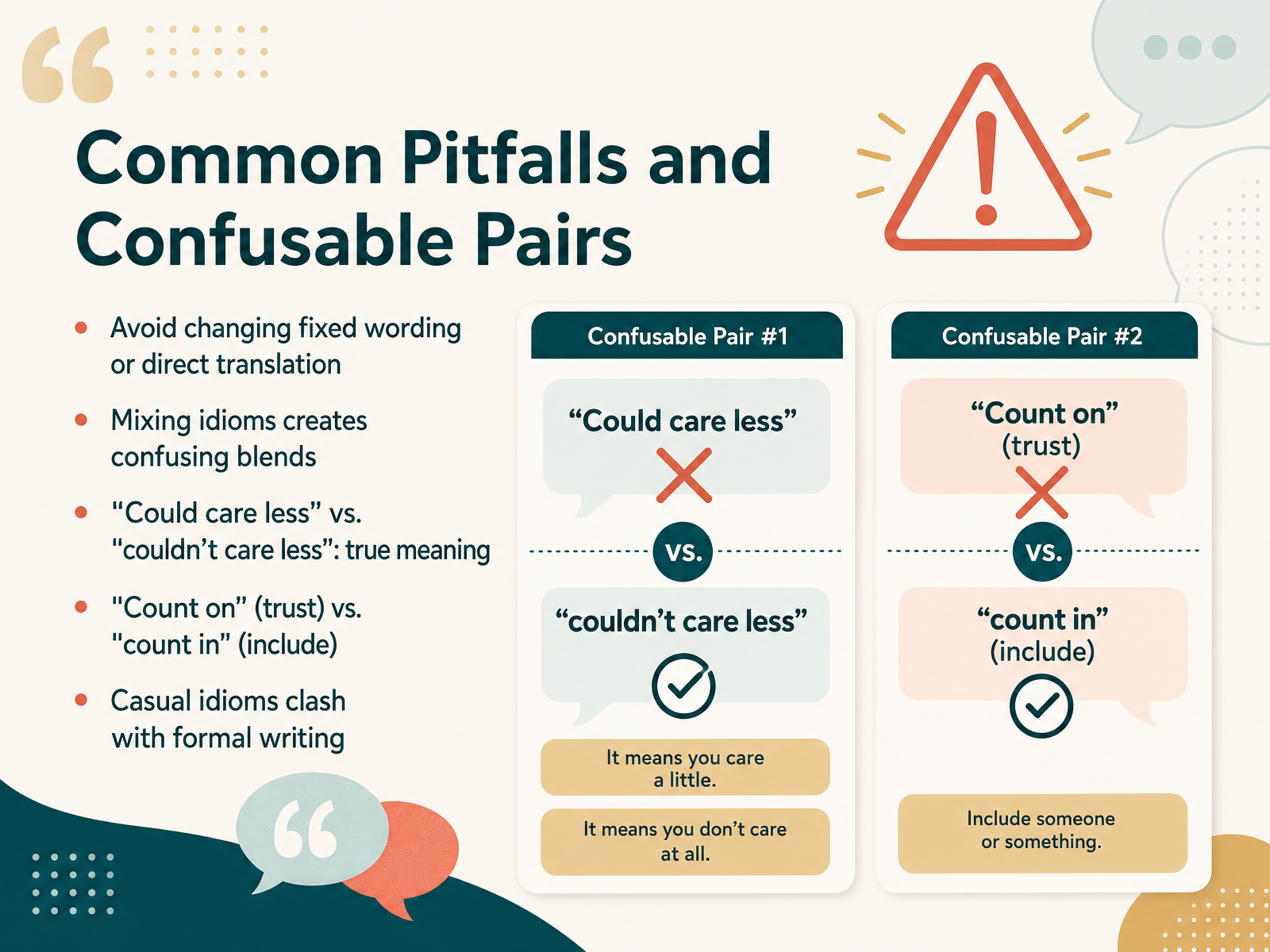
1 min - 07Common Pitfalls and Confusable PairsLet’s look at some common pitfalls and confusable pairs. A good rule to remember: idioms are fixed. Don’t change the wording or translate directly from your language. For example, don’t say “on the same road” when you mean “on the same page”. And be careful not to mix two idioms together. Imagine saying “we’ll burn that bridge when we get there” – it sounds like a blend of “burn bridges” and “cross that bridge when we come to it”. The meaning gets messy. Now, here’s a classic mix-up: “could care less” versus “couldn’t care less”. If you say “I could care less”, it actually means you do care at least a little. The correct phrase is “I couldn’t care less” – meaning you don’t care at all. Listen for that tiny “n’t” – it makes all the difference. Also, watch your prepositions. “Count on” means trust, while “count in” means include. So you might say, “I can count on you to help,” but “you can count me in for the meeting.” Finally, remember that casual idioms can clash with formal writing. “Spill the beans” is fine in conversation, but in a report, say “reveal the details”. Next, let’s explore some idiom families and themes.
 englishonline.britishcouncil.orgidiominsider.comdoi.org+21 min
 - 08Idiom Families and ThemesHere’s a helpful trick for remembering idioms: group them by theme. Think about time, emotions, weather, body parts, even food. One theme can create many expressions that share the same image. For example, time idioms like “in the nick of time” or “behind the times” all paint a picture of how we see the clock. Grouping them this way strengthens your memory and makes recall faster. When you hear one idiom, your brain can connect it to others in the same family. Try building a starter grid. Write down a theme at the top, and list workplace and travel idioms underneath. You might have a weather grid with “under the weather” for feeling sick, or a body grid with “keep an eye on” for watching something. It’s a simple system that really works. Now, let’s look at where these expressions come from and why some regions use them differently.
 1 min
1 min - 09Culture, Origins, and Regional VariationNow, let’s explore where idioms come from and why they can vary so much. Many everyday expressions actually reflect history, sports, farming, or even sailing. For example, when someone says “batting a thousand,” they’re using a baseball term to mean doing really well—even if you’ve never played baseball! Here’s where it gets interesting: the same phrase can mean different things in the US versus the UK. Take the word “table.” In American English, if you “table” an idea, you’re proposing it for discussion. But in British English, to “table” something means to postpone it. Same word, opposite meanings! That can be confusing, but it’s also what makes language so fascinating. When you’re curious about where an idiom comes from, it’s easier to remember. And don’t worry if regional expressions puzzle you—even native speakers get confused. The key is to keep exploring and ask questions when you’re unsure. Next, we’ll practice putting some of these idioms into real situations.
 1 min
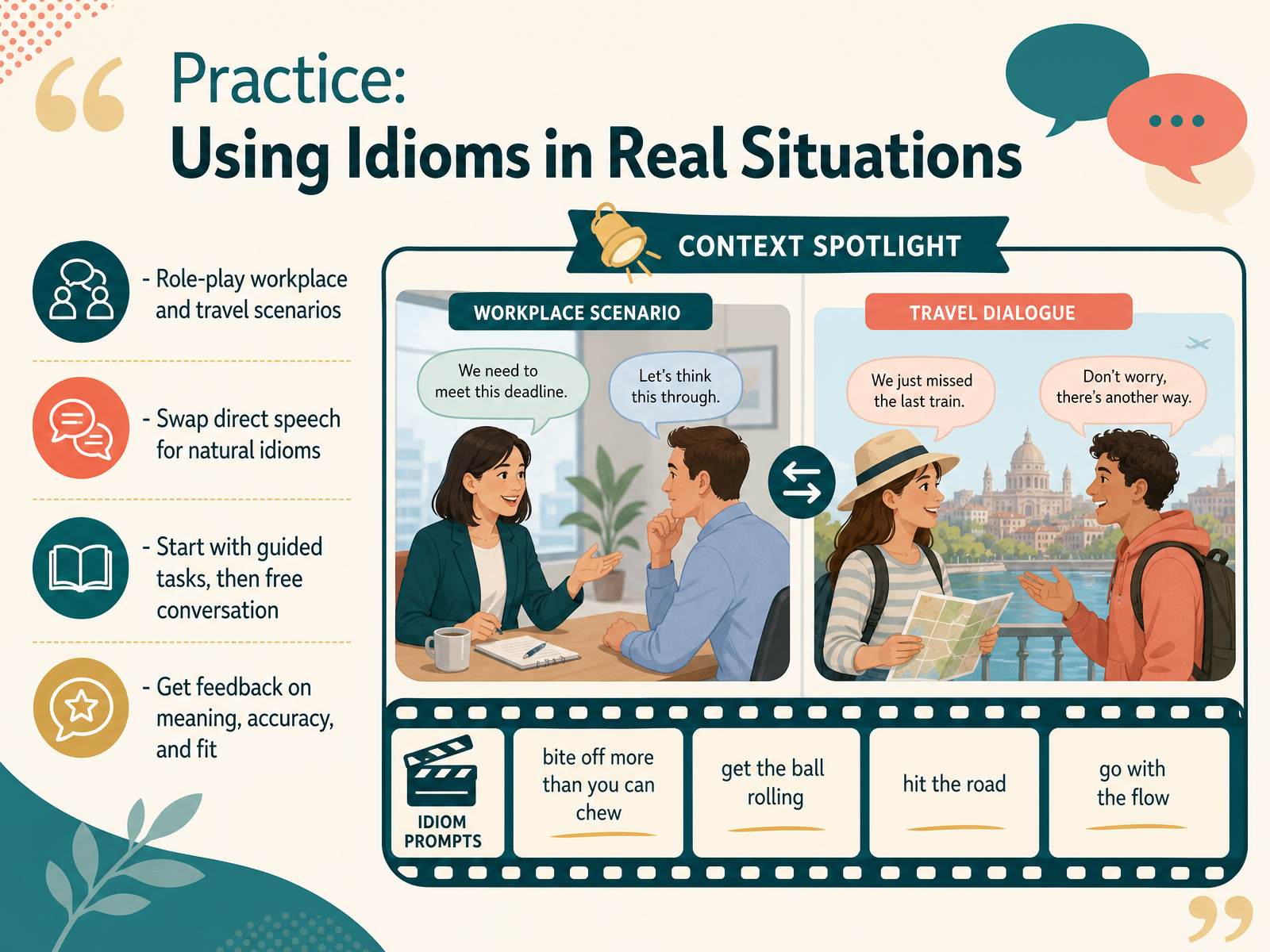
1 min - 10Practice: Using Idioms in Real SituationsNow let’s put these idioms to work in real-life situations. You might hear this one at work or on the go. Try a role-play where you’re in a meeting or at a train station. Instead of saying, “I don’t understand,” try, “I’m a bit lost here,” and see how it feels. Start with guided tasks, where I give you the scenario and you pick the right idiom. Then, move into free conversation, where you choose the expressions naturally. Ask yourself, does the idiom fit the situation? Is the meaning clear? And is the tone appropriate? For example, saying “I’m under the weather” to your boss is fine, but to a doctor, you might just say, “I feel sick.” Getting feedback on meaning, accuracy, and fit will help you fine-tune your choices. Remember, idioms are like spices. A little goes a long way, and practice makes them natural. Next, we’ll look at building your own idiom toolkit for everyday success.
 1 min
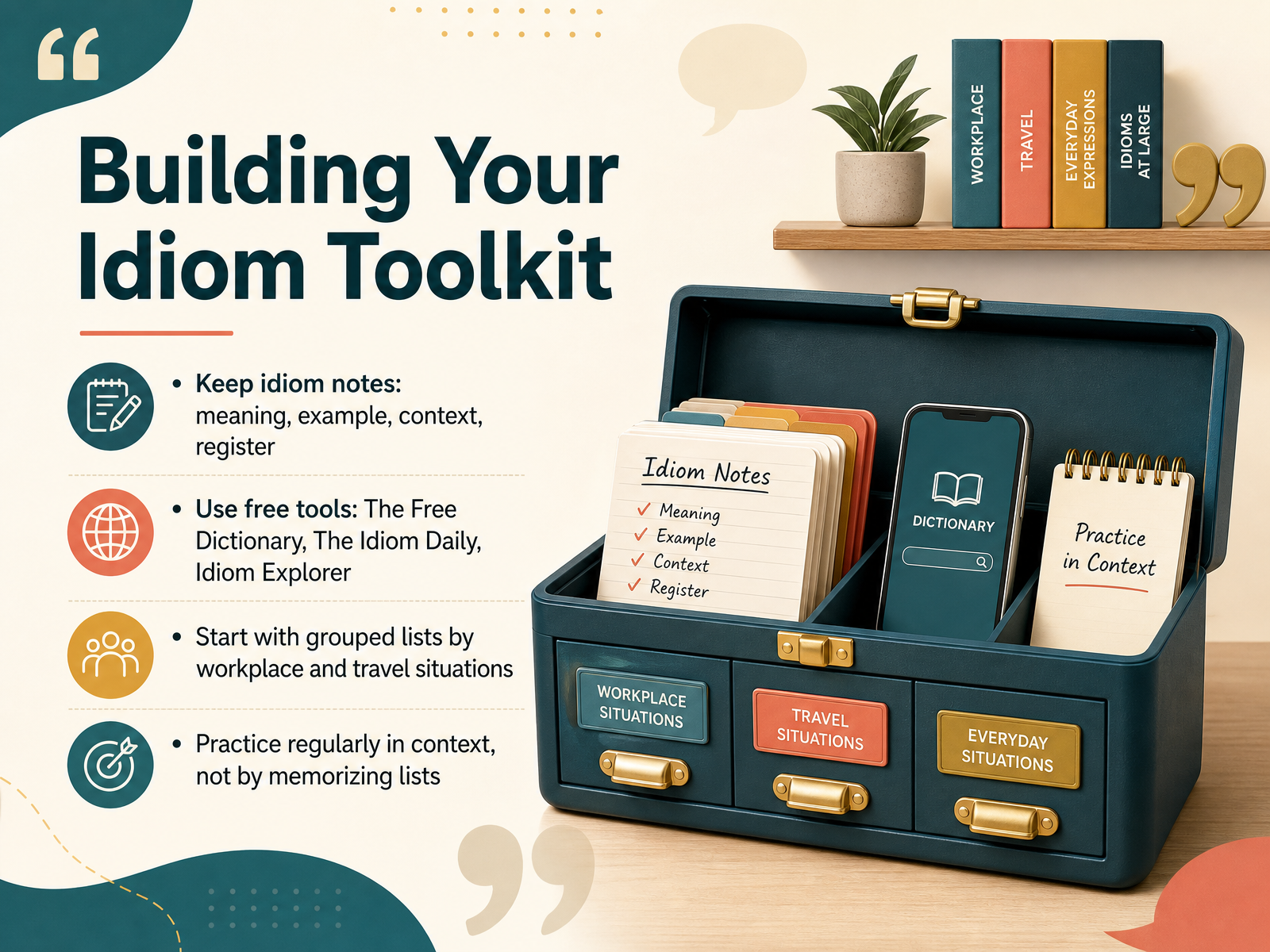
1 min - 11Building Your Idiom ToolkitNow, let’s talk about building your own idiom toolkit. This is where you turn what you’ve learned into a habit. First, start keeping idiom notes. For each expression, write down four things: the meaning, an example sentence, the context where you heard it, and whether it’s formal or casual. That last part matters. You probably won’t say “cut to the chase” in a formal report, but it’s perfect in a team meeting. Next, use free tools to help you. The Free Dictionary has over sixty thousand entries, and The Idiom Daily gives you real-life examples with quizzes. Idiom Explorer is another great option, with idioms grouped by difficulty and theme. Don’t try to learn everything at once. Instead, start with grouped lists for situations you actually face, like workplace conversations or travel. Finally, practice regularly in context. Use the idiom in a sentence you might say today, not just memorize a list. That’s how it sticks. Up next, we’ll do a quick self-check and review some common mistakes.
 2 min
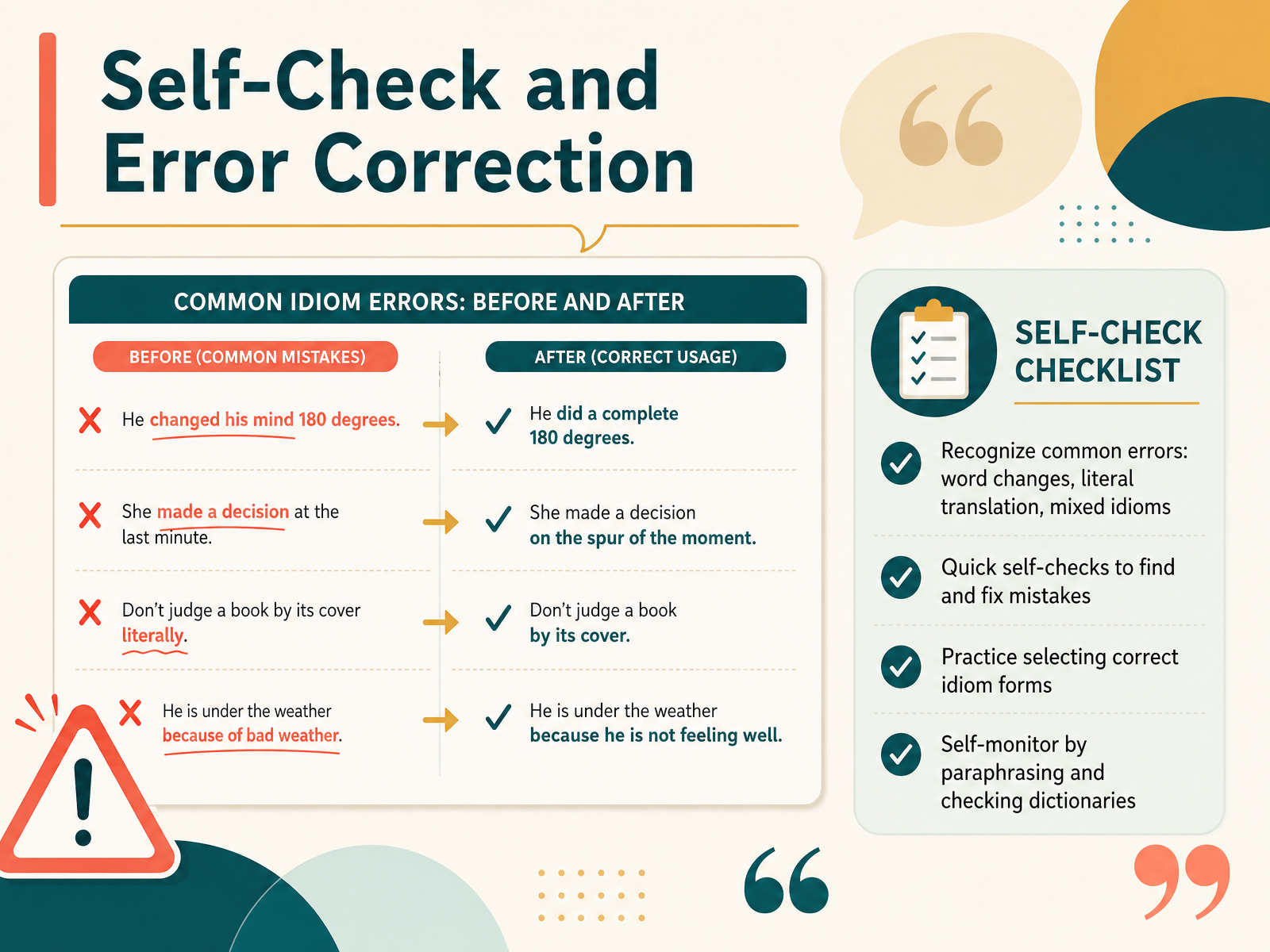
2 min - 12Self-Check and Error CorrectionNow, let’s talk about catching your own mistakes. When you use idioms, a few common errors pop up. You might change a word by accident, translate directly from your own language, or mix two idioms together. Don’t worry, it happens to everyone. Here’s a quick check you can do. First, ask yourself: Does this phrase sound right in English? If you’re not sure, try paraphrasing. Say the idea in simpler words. Then, check a dictionary or a trusted app to confirm the exact idiom. Let’s try one. Which is correct: “It’s raining cats and dogs” or “It’s raining cats and puppies”? Did you choose the first one? Yes, because we keep idioms exactly as they are. Practicing this way builds your self-monitoring skill. You’ll start to notice errors before others do. Next, we’ll look at creating your own practice plan to keep improving every day. Let’s continue.
 1 min
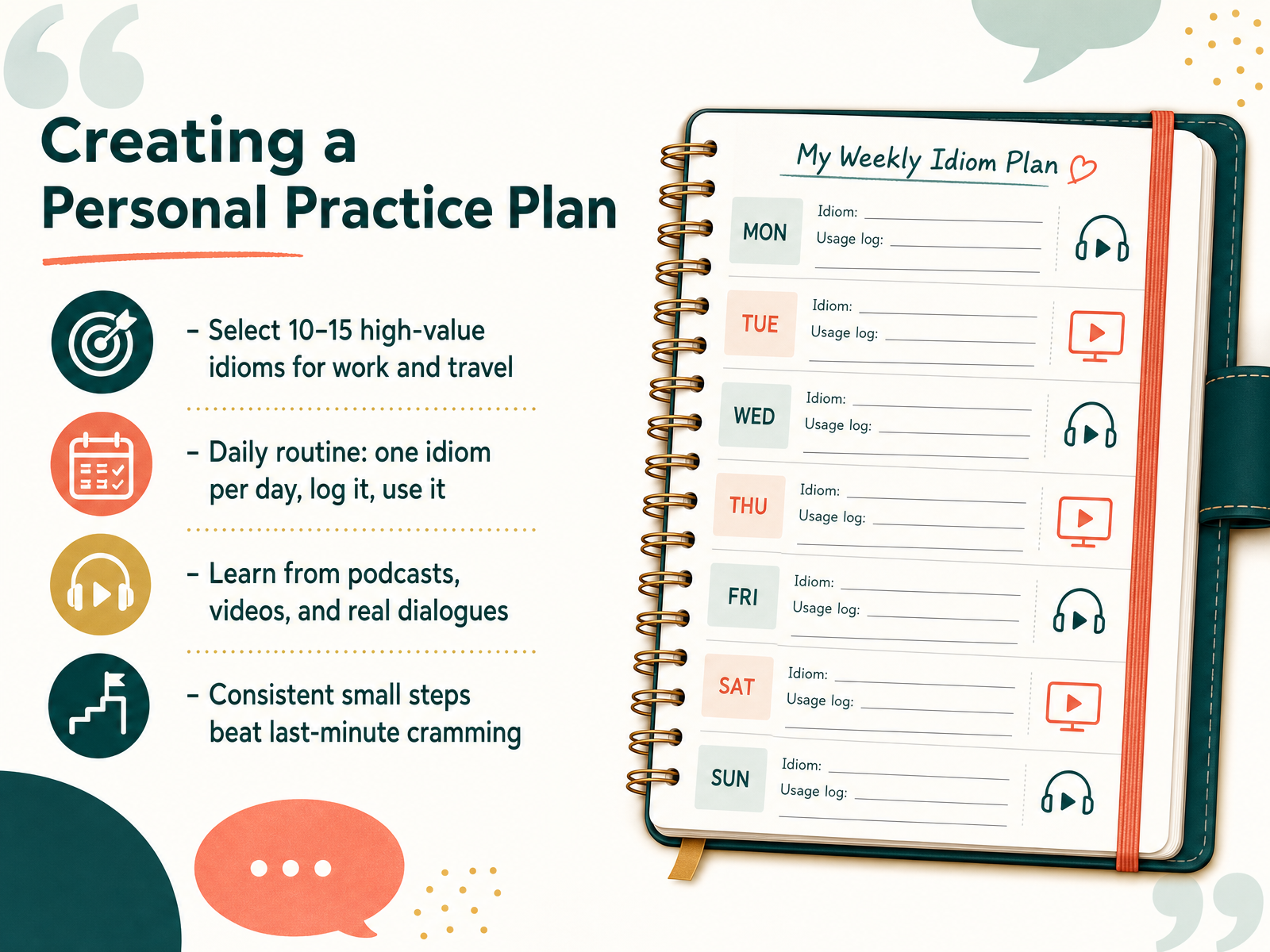
1 min - 13Creating a Personal Practice PlanNow let’s turn all of this into a simple plan you can actually stick to. Start by choosing ten to fifteen high-value idioms, the ones you’re most likely to hear at work or while traveling. Focus on expressions that feel useful to you personally. Then build a small daily routine: pick one idiom each day, write it down in a notebook or your phone, and use it in a sentence, even a simple one. Practice it out loud. Real progress comes from daily exposure, not last-minute cramming. Listen for idioms in podcasts, video clips, and real conversations, and don’t worry if you miss them at first. With consistent small steps, those expressions will start to feel natural. And remember, this plan is yours, so make it enjoyable. Up next, let’s recap our key takeaways and discuss your next steps.
 doi.orgslovakedu.comdoi.org+21 min
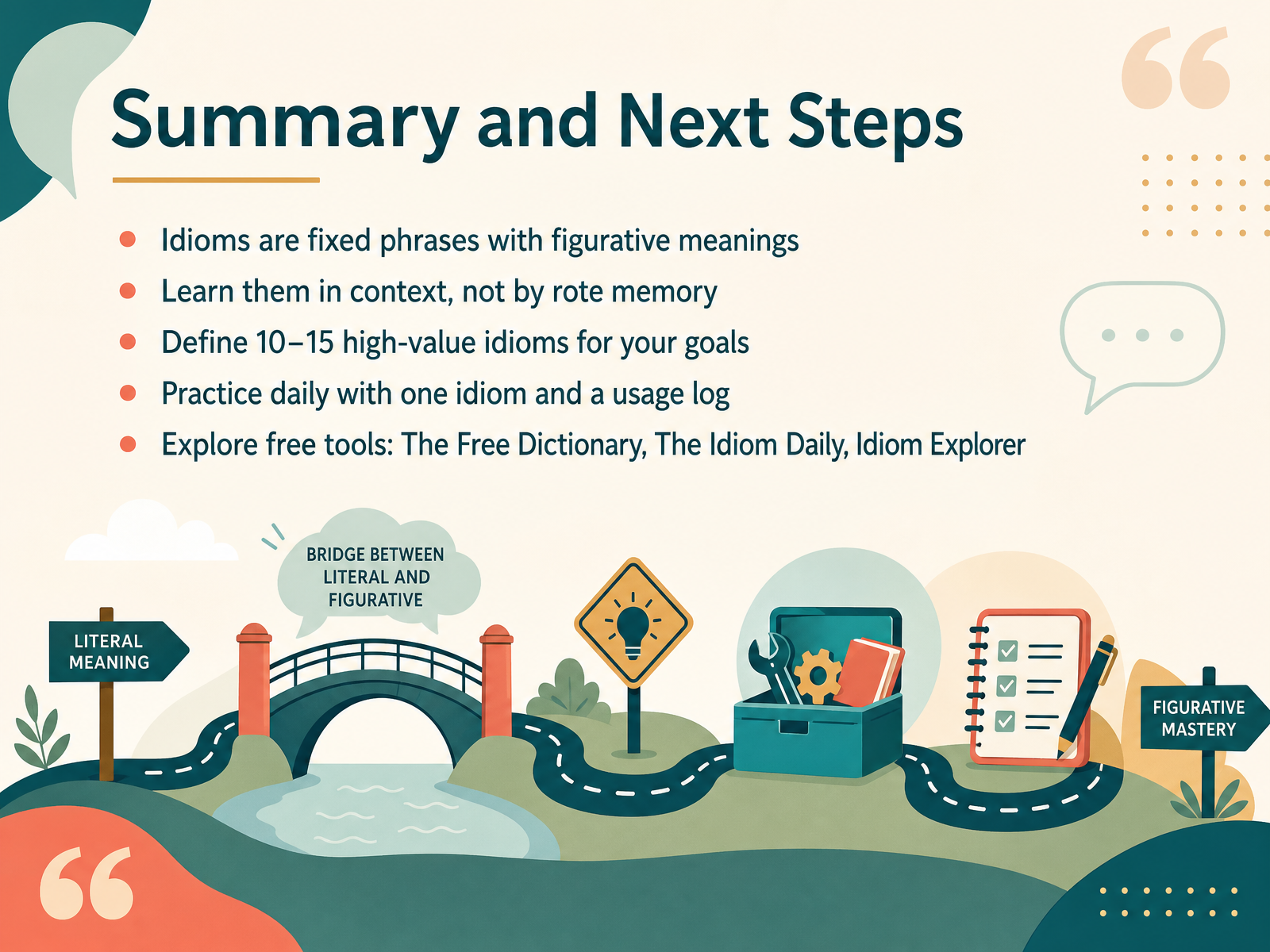
 - 14Summary and Next StepsSo, let’s bring it all together. Idioms are fixed phrases with figurative meanings. That’s the core idea. Now, don’t try to memorize a long list. Instead, learn them in context. Hear it, see it, use it. Choose ten to fifteen high-value idioms that match your goals, whether for work or travel. Then, practice daily with just one idiom and keep a usage log. Write one sentence. Say it out loud. Make it yours. And remember, you don’t need to do this alone. Explore free tools like The Free Dictionary, The Idiom Daily, and Idiom Explorer. They can boost your practice anytime. Thank you for sticking with this. You now have the tools to sharpen your ear and make your English more colorful. Keep going, keep using those phrases, and enjoy the journey.
 1 min
1 min
Take the deck with you
Download this course as a file — free, no sign-up needed.
- PDF handoutEvery slide page, ready to print or share.15 pages · 3.9 MBDownload
- Narrated PowerPointThe deck that presents itself — every slide carries the digital human's narration video.15 pages · 15.3 MBDownload
- PowerPoint slidesThe full deck as a .pptx — open it in PowerPoint, Keynote, or Google Slides.15 pages · 3.9 MBDownload
Free to use in your own training — please keep the PersonWise credit page at the end.
Have your own deck? Turn it into a course
Sources consulted
Web sources consulted while building this course.
- Teaching Idioms To Intermediate Level Learners: Problems And Solutions — doi.org
- The effects of English Idioms teaching on EFL Intermediate Learners’ speaking fluency :: SlovakEdu — slovakedu.com
- TEACHING IDIOMATIC EXPRESSIONS TO LEARNERS OF ENGLISH AS A FOREIGN LANGUAGE — doi.org
- Why Teach Idioms? A Challenge to the Profession — files.eric.ed.gov
- Mastering English Idioms: Essential Phrases For Intermediate Learners — speakenglishalfresco.com
- Workplace Idioms in English | Sound Natural and Professional — fluentjoy.com
- Common workplace idioms: A guide to professional business English – English Learning Tips — englishlearningtips.com
- Business English Expressions: Learn Workplace Idioms with Videos — fluentjoy.com
- 10 Common Business English Idioms – With Easy Explanations, Listening, and Quizzes — realbusinessenglish.com
- Everyday Work Idioms - B1 Lesson Plan | betterclass — betterclass.net
- 40 essential English phrases for travel — ef.com
- English for Travel: Essential Phrases & Practice Guide | Practice Me — practiceme.app
- 100 Useful English Sentences for Traveling Abroad — englishwithsaid.com
- 120 Travel Expressions in English for Everyday Conversations — eslinfo.com
- Travel English: Vocabulary, phrases & expressions for ... — preply.com
- Common Idiom Mistakes: How Prepositions Can Make Or Break Your Idioms — englishonline.britishcouncil.org
- Idiom Mistakes Students Often Make and How to Fix Them — idiominsider.com
- Common Mistakes EFL Learners Make When Using Idiomatic Expressions: A Case Study of Saudi Tertiary Level EFL Learners — doi.org
- Common Writing Mistakes ESL Students Make – and How to Catch Them - The Idioms — theidioms.com
- English Expressions Used Incorrectly: Avoid These Common Mistakes! - My WordPress — hpteacher.com