Literary Genres: Form, Convention, Meaning
Begin
14 pages · ~28 min
Literary Genres: Form, Convention, Meaning
Explore literary genres by examining their forms, conventions, and meanings to understand how genre shapes storytelling and audience expectations.
What you’ll learn
- 01Literary Genres: Form, Convention, and MeaningWelcome. In this session, we will examine literary genres not as fixed labels, but as discoverable patterns of form, convention, and meaning. Our goal is to build a repeatable framework you can use to analyze and work with genre in any context. Let us begin with a foundational idea. A literary genre is a group of texts that share formal features, stylistic patterns, and audience expectations. Think of genre as a tacit contract, one that shapes interpretation before a single word is read. When you pick up a detective novel, you already expect a crime, an investigation, and a resolution. That expectation is not random. It is triggered by the genre. But genres are not rigid boxes. Scholars describe them as evolving families of resemblances. A text participates in a genre. It does not simply belong to one, and it may participate in several at once. This fluidity is what makes genre a powerful tool. Developing genre literacy gives readers, writers, and content creators what researchers call rhetorical flexibility, the ability to adapt communication to different situations and audiences. The practical outcome for you is a clear, repeatable method. You will learn to map the formal features of a text, identify its conventions, and uncover how those choices generate meaning for a specific audience. Let us now move to a closer look at what genre is, and what it does.en.wikipedia.orgbritannica.comisko.org+22 min
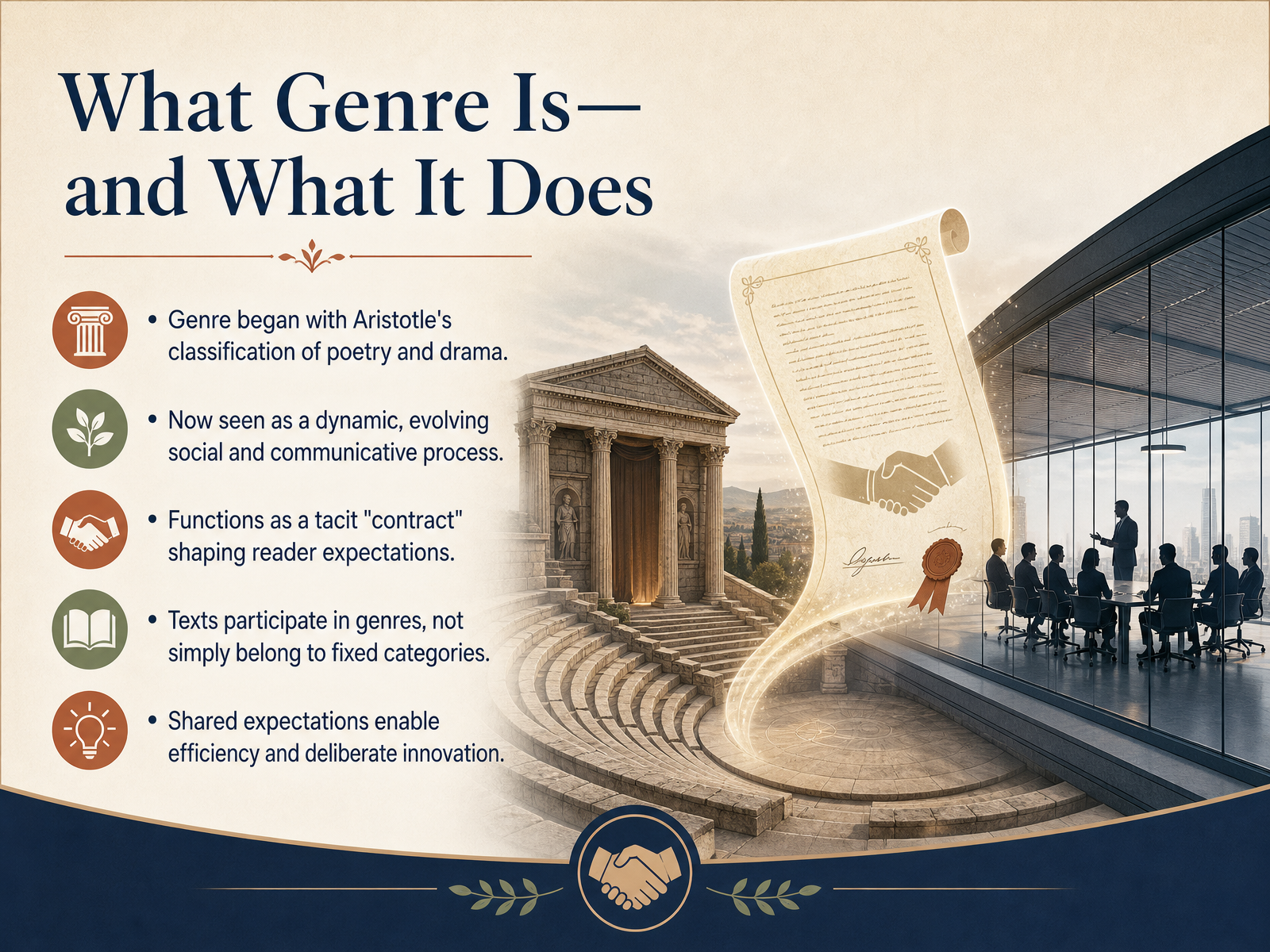
- 02What Genre Is—and What It DoesUnderstanding genre begins by seeing it not as a fixed label, but as a living process. The impulse to classify literature traces back to Aristotle, who sorted works like epic, tragedy, and comedy into distinct species. But modern scholarship treats genre differently. Instead of rigid categories, literary form now operates as a tacit contract between writer and reader, shaping what audiences expect and how they interpret a text. A work doesn’t simply belong to a genre; it participates in one, drawing on shared conventions of style, mood, and structure. This participation makes communication more efficient, because familiar patterns let a writer signal meaning quickly. At the same time, those patterns create room for deliberate innovation. When you and I share the same horizon of expectations, even a small departure from convention becomes meaningful. So the question isn’t whether a text fits a box. The question is how it uses—and sometimes reshapes—the signals that genre provides. Let’s carry that idea into the next slide, where we’ll unpack the building blocks of form and convention.
 en.wikipedia.orgbritannica.comisko.org+22 min
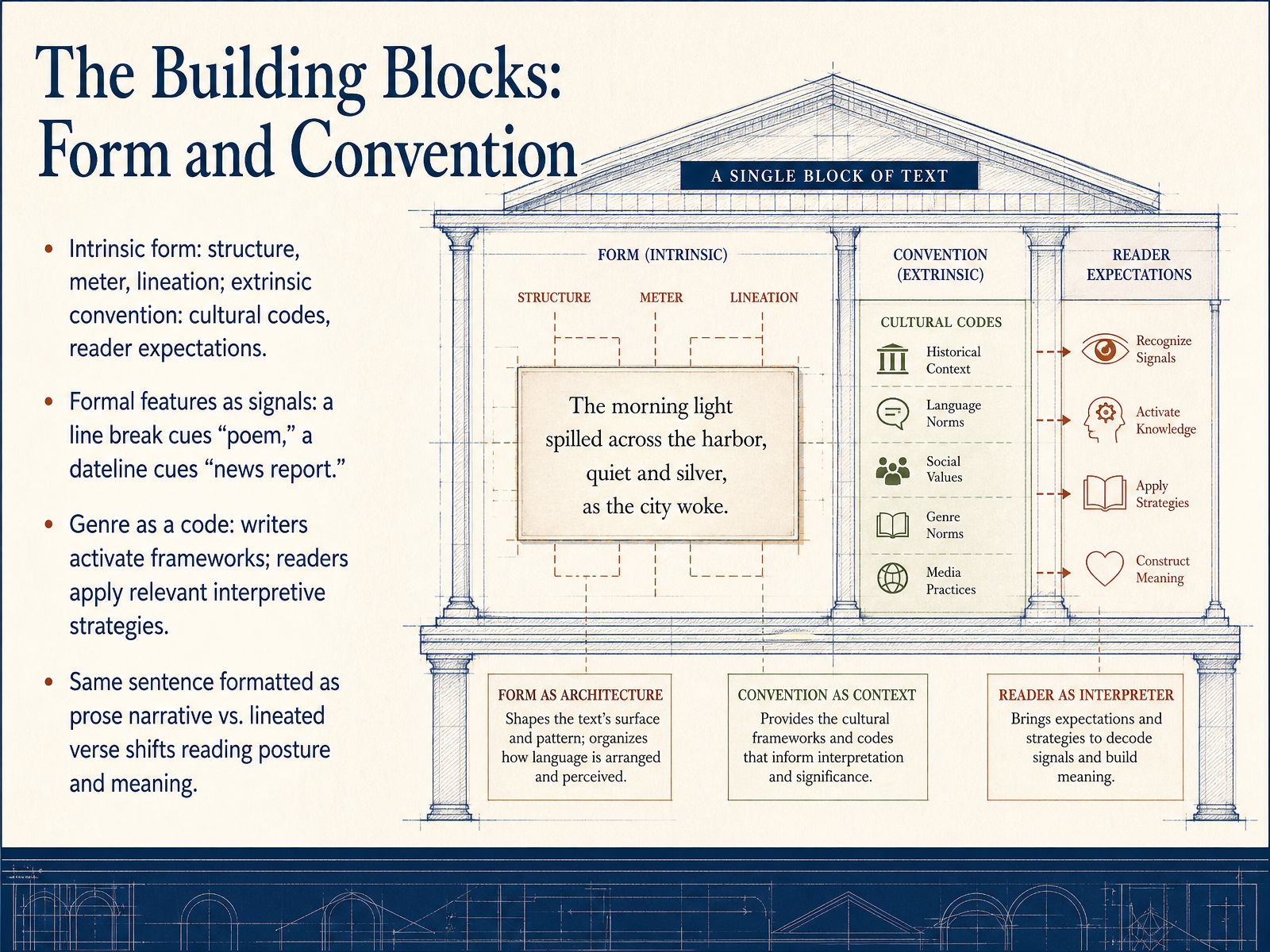
 - 03The Building Blocks: Form and ConventionNow let's examine the building blocks: form and convention. We can think of form in two layers. Intrinsic form covers elements like structure, meter, and lineation—the internal shape of a text. Extrinsic convention refers to cultural codes and reader expectations that surround it. These formal features act as signals. A line break cues 'poem,' while a dateline cues 'news report.' Taken together, they make genre function as a code: a writer activates a framework, and a reader applies relevant interpretive strategies. To see this in action, consider a single sentence. Format it as prose narrative, and you read for story and sequence. Take that same sentence and break it into lineated verse, and your reading posture shifts immediately. You begin listening for rhythm, compression, and layered meaning. The form itself changes what you expect to find. Genre, then, is not just a label. It is a contract of expectations that shapes how meaning is built and received. Up next, we will explore how genre actively structures the organization of a text.
 writ109f.andmuchmuchmore.comfaculty.washington.edutextjournal.scholasticahq.com+22 min
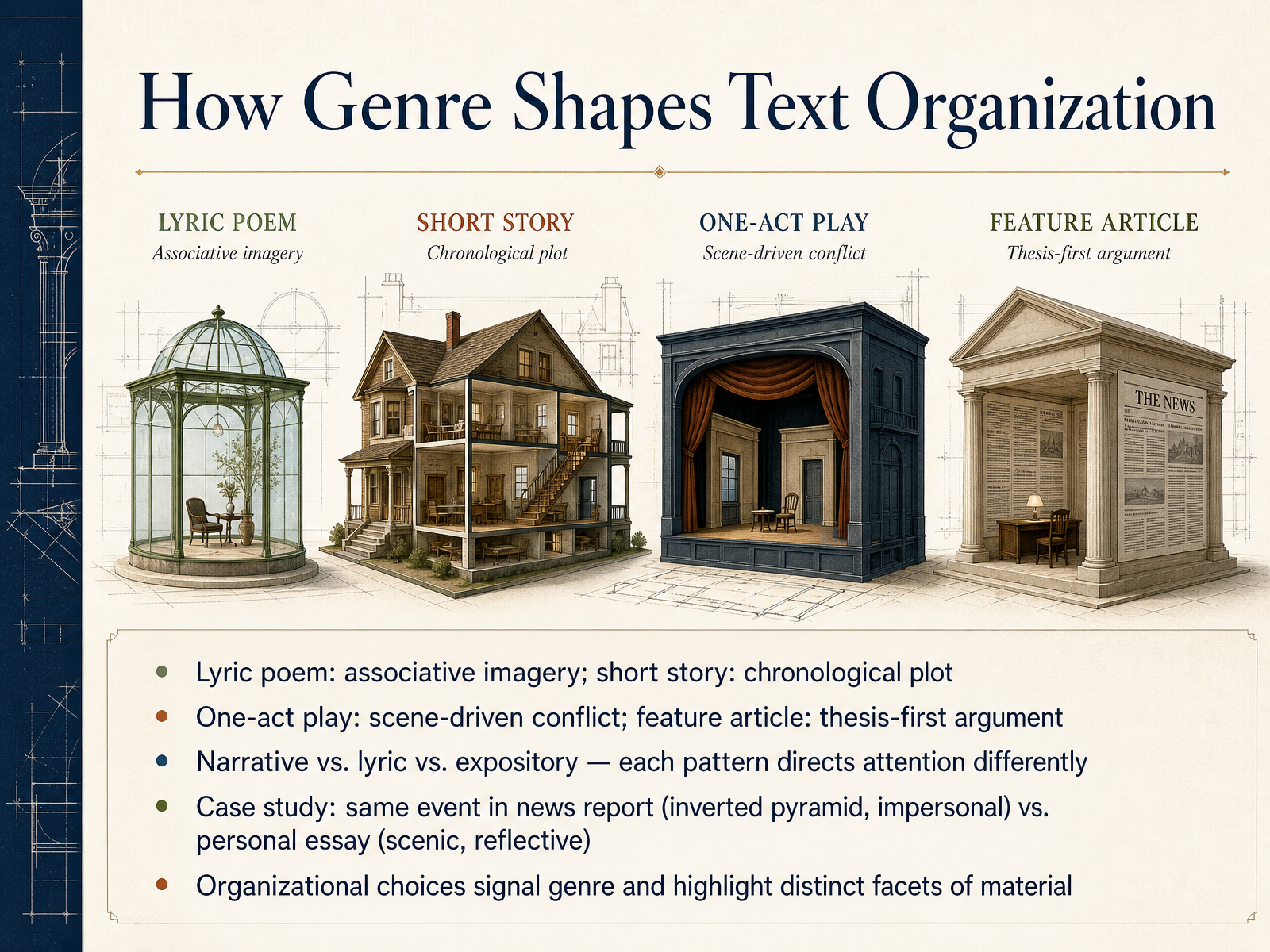
 - 04How Genre Shapes Text OrganizationLet’s make these patterns concrete by comparing how the same event can take radically different shapes depending on the genre that frames it. On one side, a news report. Its organizing principle is the inverted pyramid: the most critical facts arrive first—who, what, when, where, why—and information tapers down by importance. The voice is impersonal, the structure is not chronological, and there is no formal conclusion. On the other side, a personal essay about the same event. Here the organization is scenic, reflective, and shaped around personal growth. Chronology may bend, but tension and interior meaning drive the structure. A lyric poem, by contrast, would organize through associative imagery rather than plot. A one-act play would rely on scene-driven conflict. Each pattern—narrative, lyric, or expository—directs the reader’s attention to a different facet of the material. The organizational choices are not neutral; they signal genre and highlight what a writer considers most worth noticing. Up next, we’ll examine another layer of these signals: how a text’s outer frame, its paratext, primes us for what we’re about to read.
 pulitzercenter.orgjerz.setonhill.edujerz.setonhill.edu+22 min
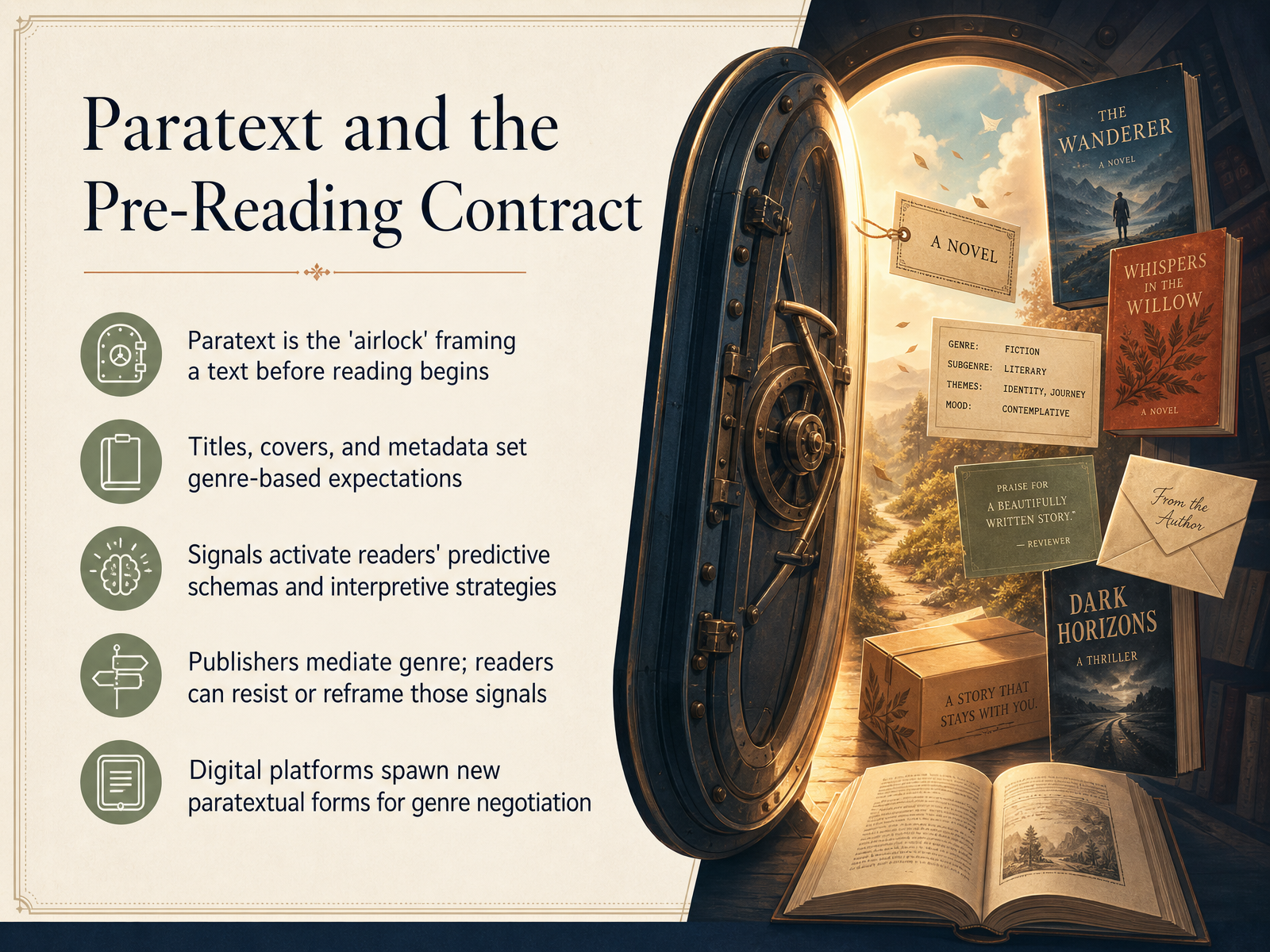
 - 05Paratext and the Pre-Reading ContractNow let's consider what happens before we even read the first sentence of a story. That moment is shaped by paratext. Think of paratext as the airlock that frames a text. It is everything surrounding the main narrative, from the title and cover design to the author's name and the publisher's logo. These elements do more than decorate the book. They create what we can call a pre-reading contract. As Gérard Genette explained, this airlock helps us pass from our world into the fictional world without confusion. When you see a shadowy cover and a title in a jagged font, your mind instantly activates a set of expectations. You prepare to read a mystery or a thriller, and you adjust your interpretive strategy accordingly. Publishers deliberately use these signals to mediate genre for us. However, as readers, we are not passive. We can resist those cues or reframe them, choosing to read a text against its marketed category. Today, digital platforms create entirely new paratextual spaces. BookTok videos, algorithm-driven recommendations, and social media discussions now negotiate genre before we ever open a file. These digital paratexts still set up expectations, but they often emerge from communities of readers rather than just publishers. Next, we will look more closely at how those expectations function as a contract between genre and the reader.
 theses.ncl.ac.ukdoi.orgspectrum.library.concordia.ca+22 min
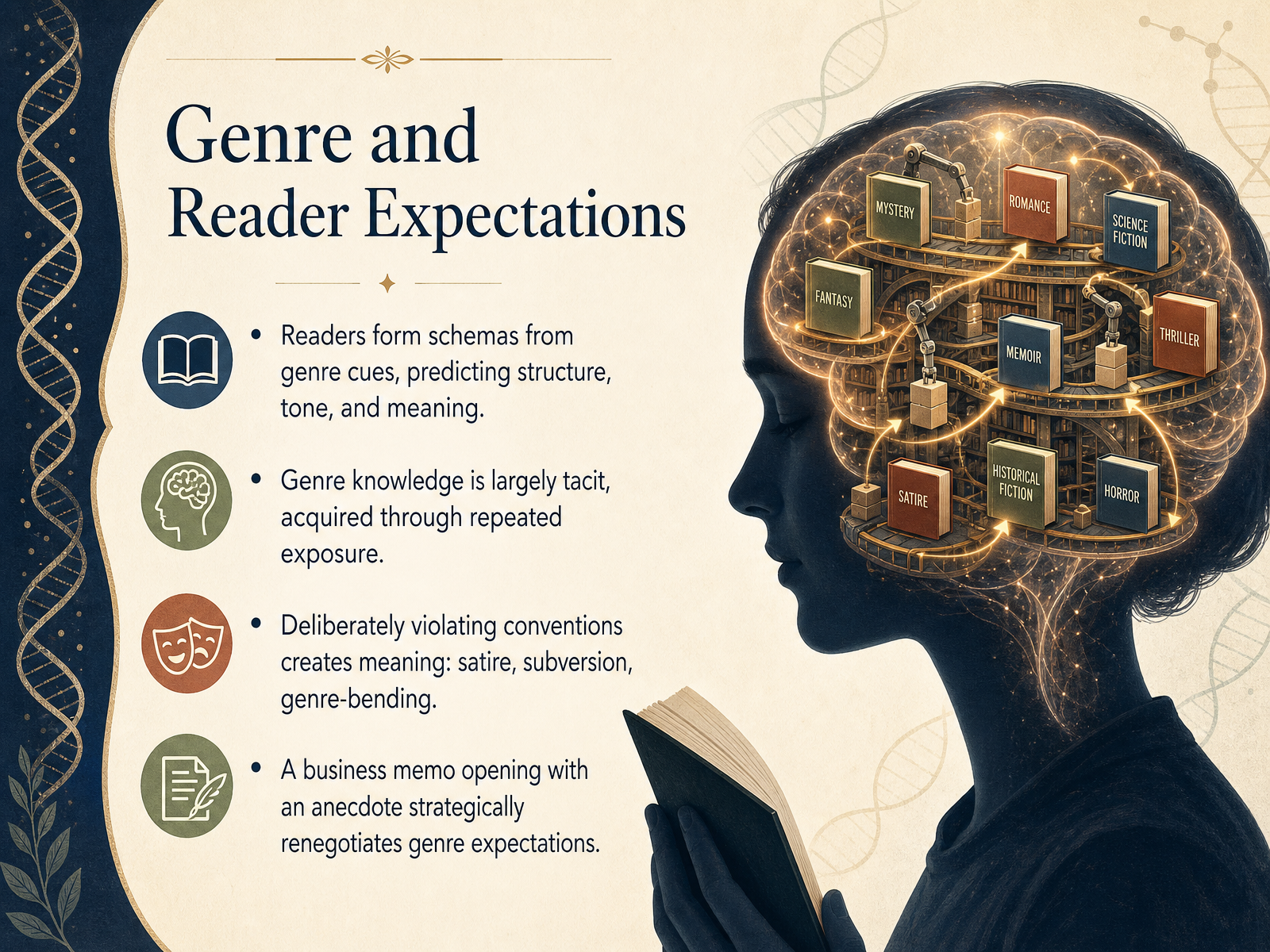
 - 06Genre and Reader ExpectationsNow let’s turn to how genres actually work for the reader. We’ve been talking about form and convention; this slide connects those to reader expectations. When a reader encounters a text—say, an email that looks like a business memo—they immediately activate a schema. That schema is a mental model built from repeated exposure to similar texts. Most of this genre knowledge is tacit. Readers don’t consciously list rules; they just feel what belongs and what doesn’t. That feeling lets them predict structure, tone, and likely meaning before they’ve read a single full sentence. But here’s where it gets interesting. When a writer deliberately violates a convention, that violation creates meaning. Satire works this way. So does genre-bending fiction. And so does a business memo that opens not with a summary, but with a personal anecdote. That choice isn’t a mistake. It strategically renegotiates what the memo can do and how the reader should engage. So deliberate violations aren’t just rule-breaking; they’re a form of communication readers can recognize and interpret. Next, we’ll see how form itself can carry meaning when we move to ‘When Form Becomes Meaning: Semanticized Form.’
 writ109f.andmuchmuchmore.comfaculty.washington.edutextjournal.scholasticahq.com+22 min
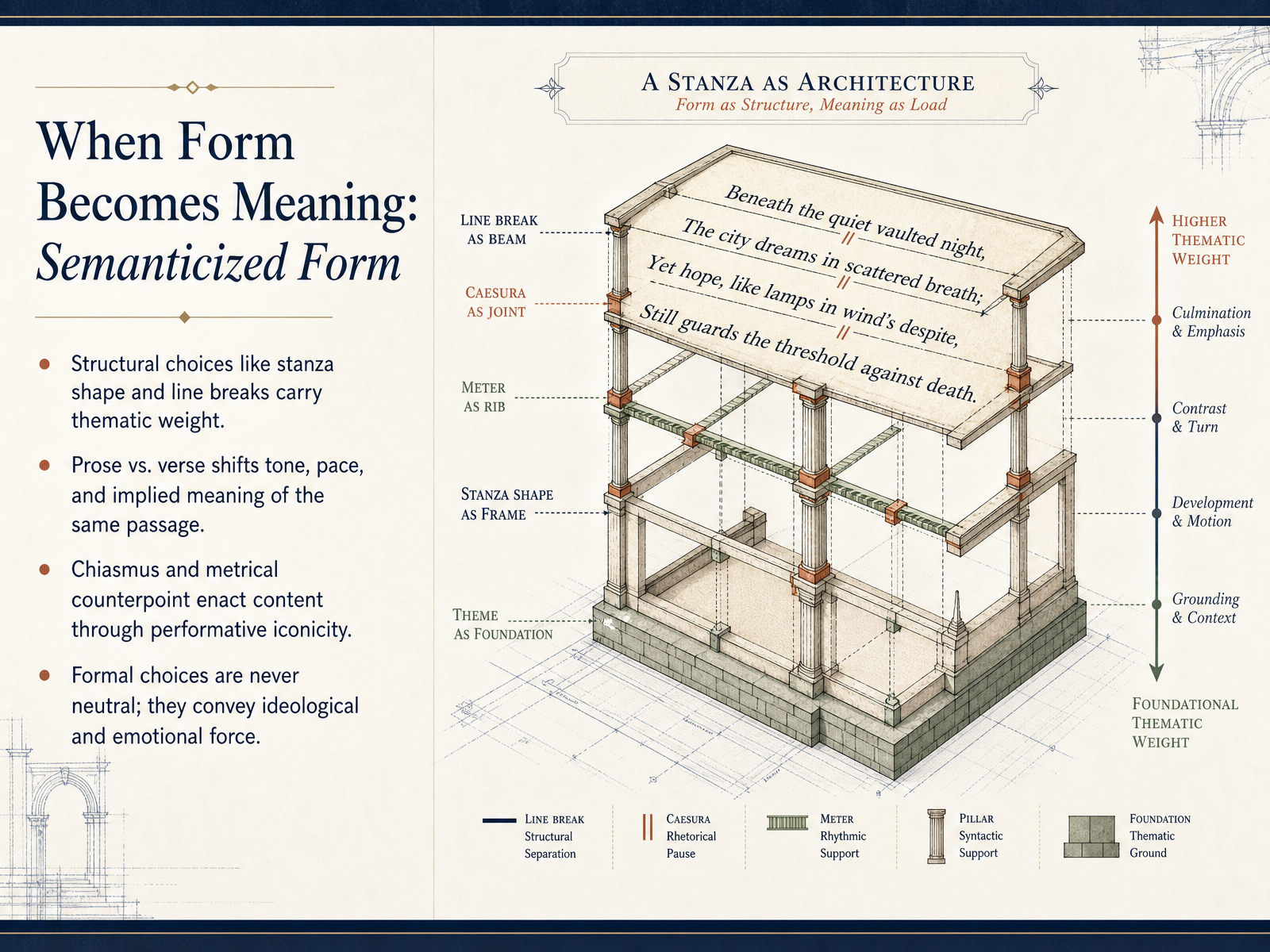
 - 07When Form Becomes Meaning: Semanticized FormMoving from the general concept of convention, we now consider what happens when structure itself carries meaning. This is called semanticized form. Think of it this way: a poet's choice of stanza shape is never just decoration. A short, fragmented line can enact hesitation or breathlessness, while a long, steady line can build an accumulating weight. In the same text, the shift between prose and verse reorganizes the experience. Prose often signals the everyday, the rational, or the mundane, whereas verse elevates tone or exposes interior feeling. The difference creates meaning before we even process the content. Some techniques become even more direct, performing their content through what we call performative iconicity. For instance, a chiasmus—a verbal pattern that crosses itself like A B B A—can physically mirror themes of reversal or balance. And metrical counterpoint, where a rhythm works against the expected meter, may embody tension or instability. The key principle here is that formal choices are never neutral. A line break, a rhythmic shift, or a fixed stanza always carries both ideological and emotional force. Recognizing that force turns structure into an argument you can read. Next, we will explore how these forces play out when genres mix in Genre Hybridity and Evolving Conventions.
 writ109f.andmuchmuchmore.comfaculty.washington.edutextjournal.scholasticahq.com+22 min
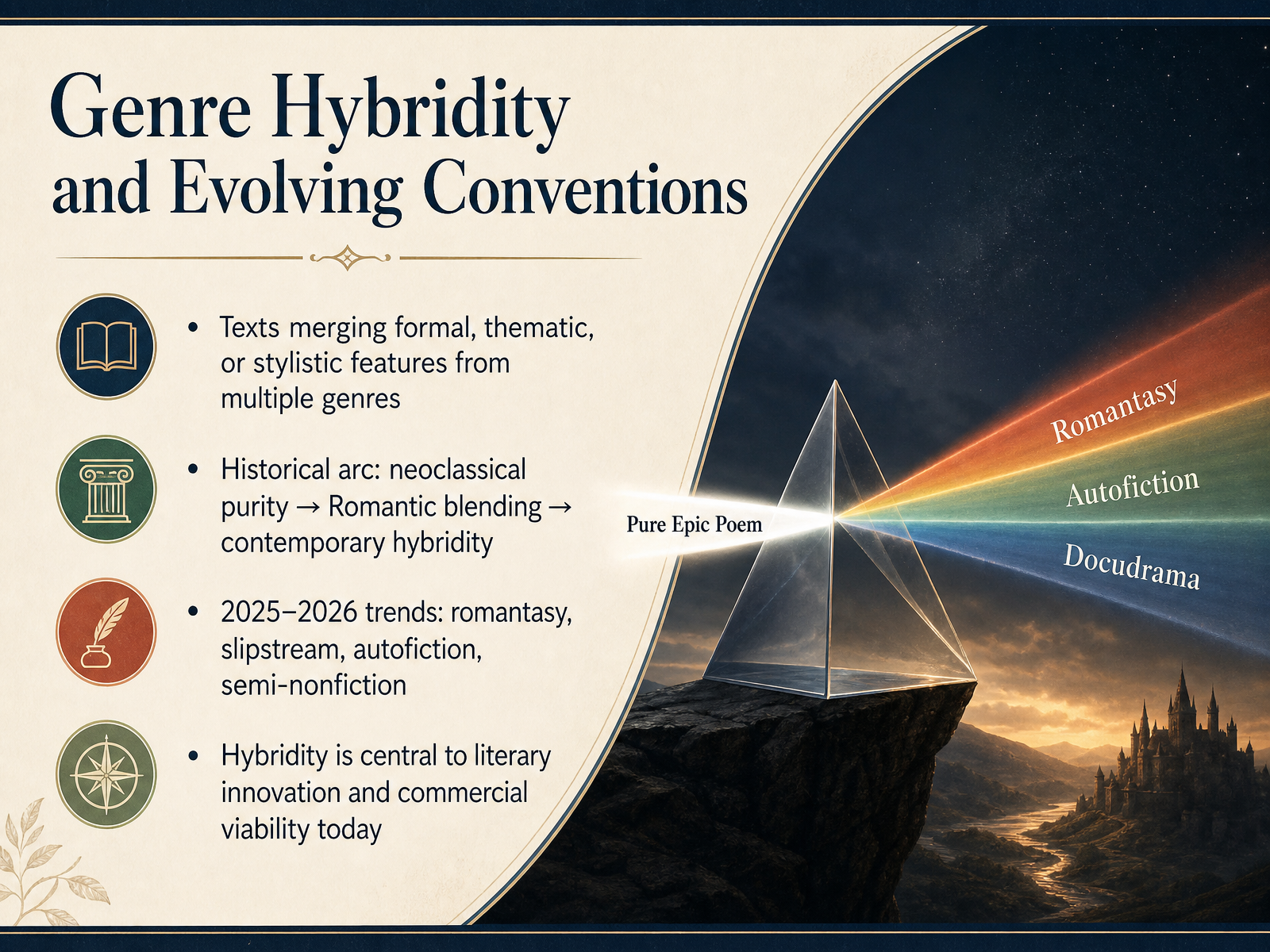
 - 08Genre Hybridity and Evolving ConventionsLet's turn now to genre hybridity and how conventions evolve. A hybrid text isn't a casual mix. It merges formal, thematic, or stylistic features from multiple genres into a single, coherent work. Recognizing this pattern helps you see that genre boundaries are not walls, but resources. Historically, this arc is clear. Neoclassical thinking favored purity, a strict adherence to poetic justice and unified form. The Romantics then began blending modes, mixing lyric intensity with narrative and philosophical reflection. Today, contemporary hybridity is the norm, not the exception. As we look at twenty twenty-five and twenty twenty-six, several labels have become prominent. Romantasy fuses romance with fantasy worlds. Slipstream blurs the lines between literary fiction, science fiction, and fantasy. Autofiction merges autobiographical content with novelistic invention. And semi-nonfiction uses fictional devices to compress and illuminate real-world structures of perception. These are not fringe experiments. Hybridity is now central to both literary innovation and commercial viability. It allows writers to meet complex realities with flexible forms. Next, we will examine how digital platforms are accelerating this trend and creating entirely new genre landscapes.
 en.wikipedia.orgbritannica.comisko.org+22 min
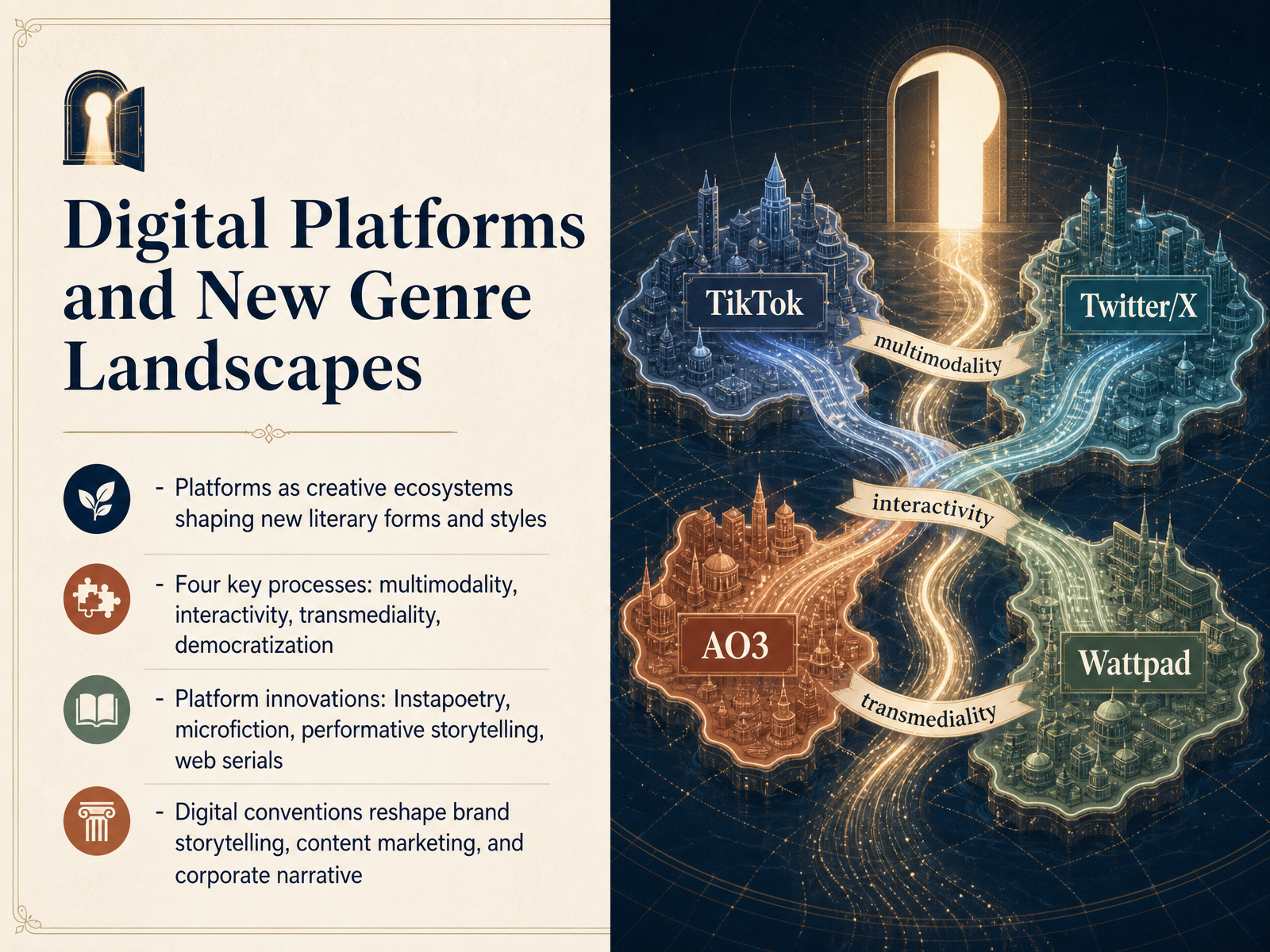
 - 09Digital Platforms and New Genre LandscapesNow let's consider how digital platforms have created entirely new landscapes for literary genres. Platforms like Instagram, X, TikTok, and Wattpad are not just distribution channels. They function as creative ecosystems that shape new literary forms and styles. Research identifies four key processes driving this change: multimodality, interactivity, transmediality, and democratization. For instance, Instapoetry blends text with image in a single visual-verbal experience. Microfiction on X compresses narrative into a few sentences. TikTok encourages performative storytelling where audio and video become part of the text. Web serials on platforms like Wattpad allow authors to adapt plotlines based on reader feedback in real time. These digital conventions do not stay online. They reshape brand storytelling, content marketing, and corporate narrative by introducing fragmentary structures and participatory expectations into professional communication. Next, we will apply these insights by recognizing genre in professional practice.
 2 min
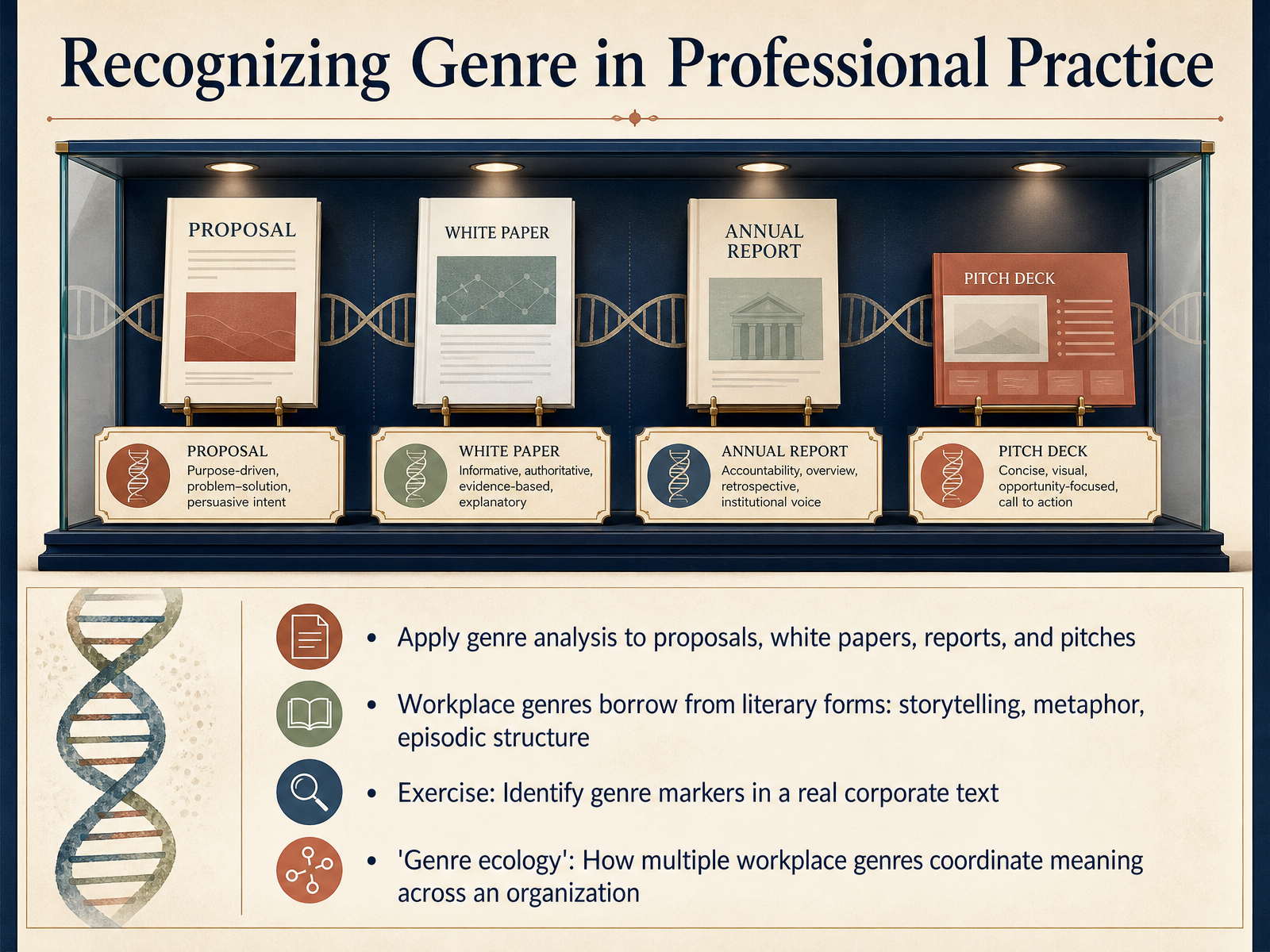
2 min - 10Recognizing Genre in Professional PracticeNow let's shift our focus to professional practice. Genre analysis is not just an academic exercise; it is a tool you can apply directly to proposals, white papers, reports, and pitches. In these workplace documents, you will often find elements borrowed from literary forms—such as storytelling that builds a case, metaphors that frame a problem, or episodic structures that guide a reader through complex data. To build this skill, you will complete an exercise where you identify genre markers in a real corporate text. Look for the conventions and expectations that shape the document's organization and meaning. This leads us to a broader concept: genre ecology. In any organization, multiple workplace genres coordinate meaning together. An email might launch an idea, a report might detail the analysis, and a pitch deck might drive the final decision. Each genre plays a role in a larger system of communication. Understanding this ecology helps you see how individual documents contribute to a collective purpose. Next, we will explore business storytelling and the lessons we can draw directly from literary genre.
 2 min
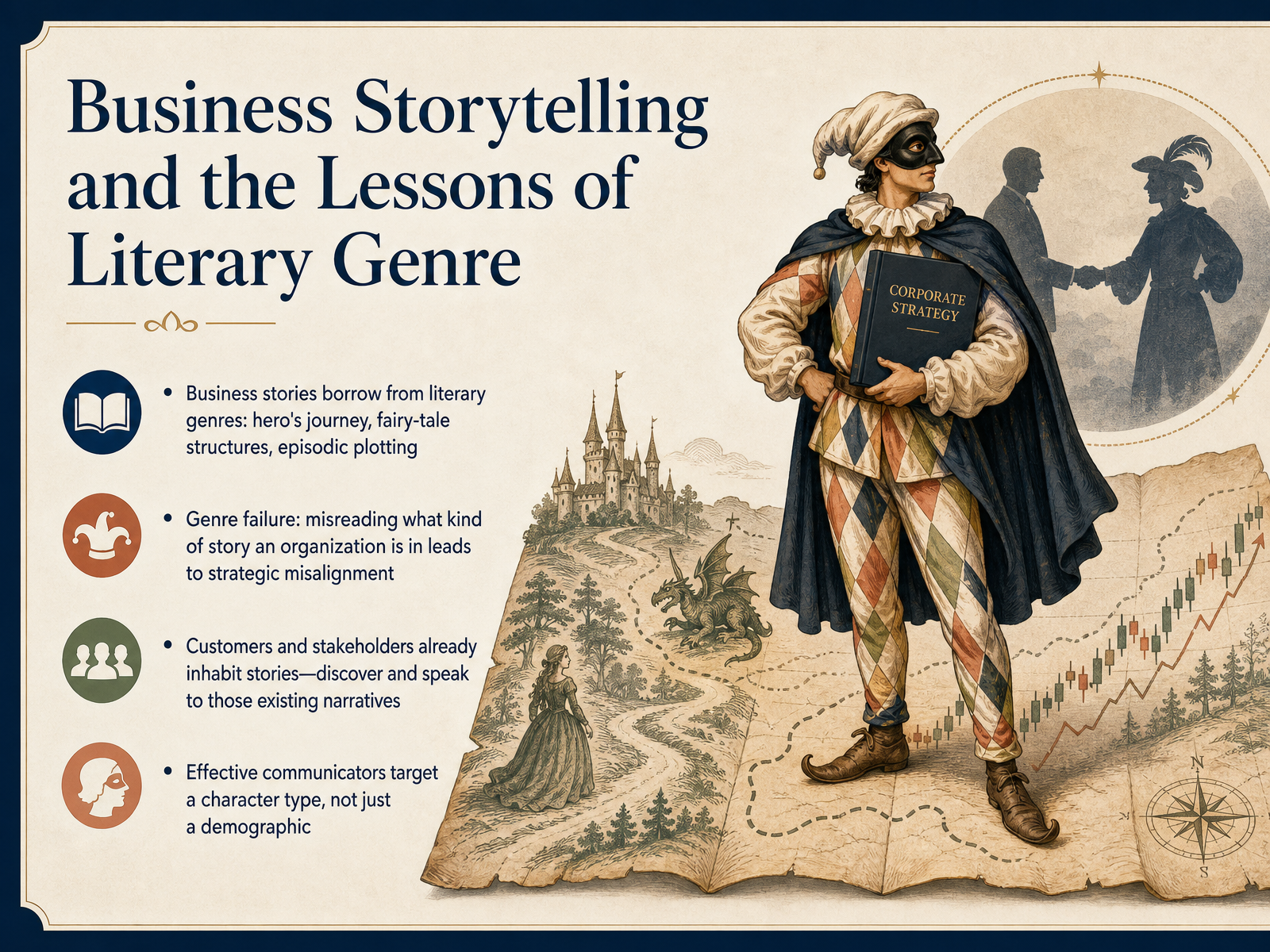
2 min - 11Business Storytelling and the Lessons of Literary GenreBusiness storytelling borrows directly from literary forms. Think of the hero's journey in brand origin stories, fairy tale structures in management books, or episodic plotting in corporate communications. These genres are not just decoration. They shape what an audience expects and how they interpret the message. But when an organization misreads its own story, the result is often what scholars call genre failure. A company facing an internal crisis that acts as if it is on an epic external adventure will likely misalign its strategy. Stakeholders and customers already inhabit stories with their own heroes, villains, and definitions of success. The effective communicator does not invent from scratch but discovers those existing narratives and speaks to them. This is why you should target a character type, not just a demographic. Demographics describe who someone is on paper. Story reveals who they believe themselves to be. Now, let's move from recognizing these patterns to applying them. The next slide introduces a practical framework for genre analysis.
 2 min
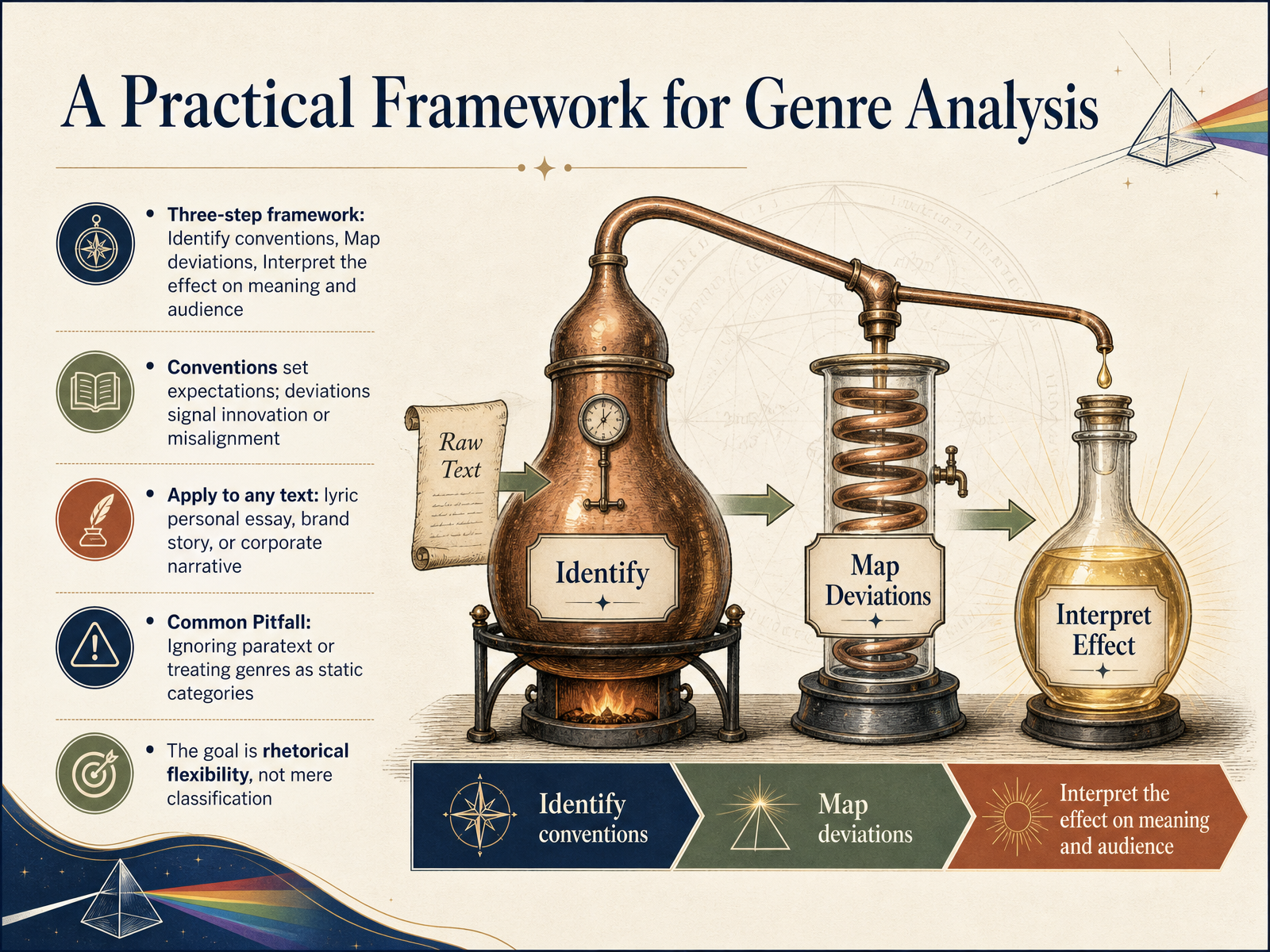
2 min - 12A Practical Framework for Genre AnalysisSo far, we have examined form, convention, and expectation as separate ideas. Now, let us bring them together into a practical, repeatable framework for genre analysis. This framework has three steps. First, identify the conventions. Ask yourself: what patterns of plot, character, or structure does this text share with others of its kind. Second, map the deviations. Look for where the text breaks or bends those patterns. Third, interpret the effect. Ask yourself: how does that deviation change the meaning for the audience. Conventions set a baseline of expectations. Deviations signal either deliberate innovation or a strategic misalignment with the reader's horizon of expectation. You can apply this framework to any text. A lyric personal essay borrows from poetry. A brand story borrows from the hero's journey. A corporate narrative might adapt the structure of a confessional memoir. One common pitfall to avoid is ignoring paratext. Things like a book's cover, a company's mission page, or even a job title all frame the genre and the contract with the reader. Another pitfall is treating genres as static, fixed categories. Genres are dynamic. They evolve through use. Your goal is not to lock a text into a single classification. The goal is rhetorical flexibility, the ability to read and write with an awareness of how generic choices shape response. In the next slide, we will move from analysis to application, exploring how this awareness guides your own writing decisions.
 writ109f.andmuchmuchmore.comfaculty.washington.edutextjournal.scholasticahq.com+22 min
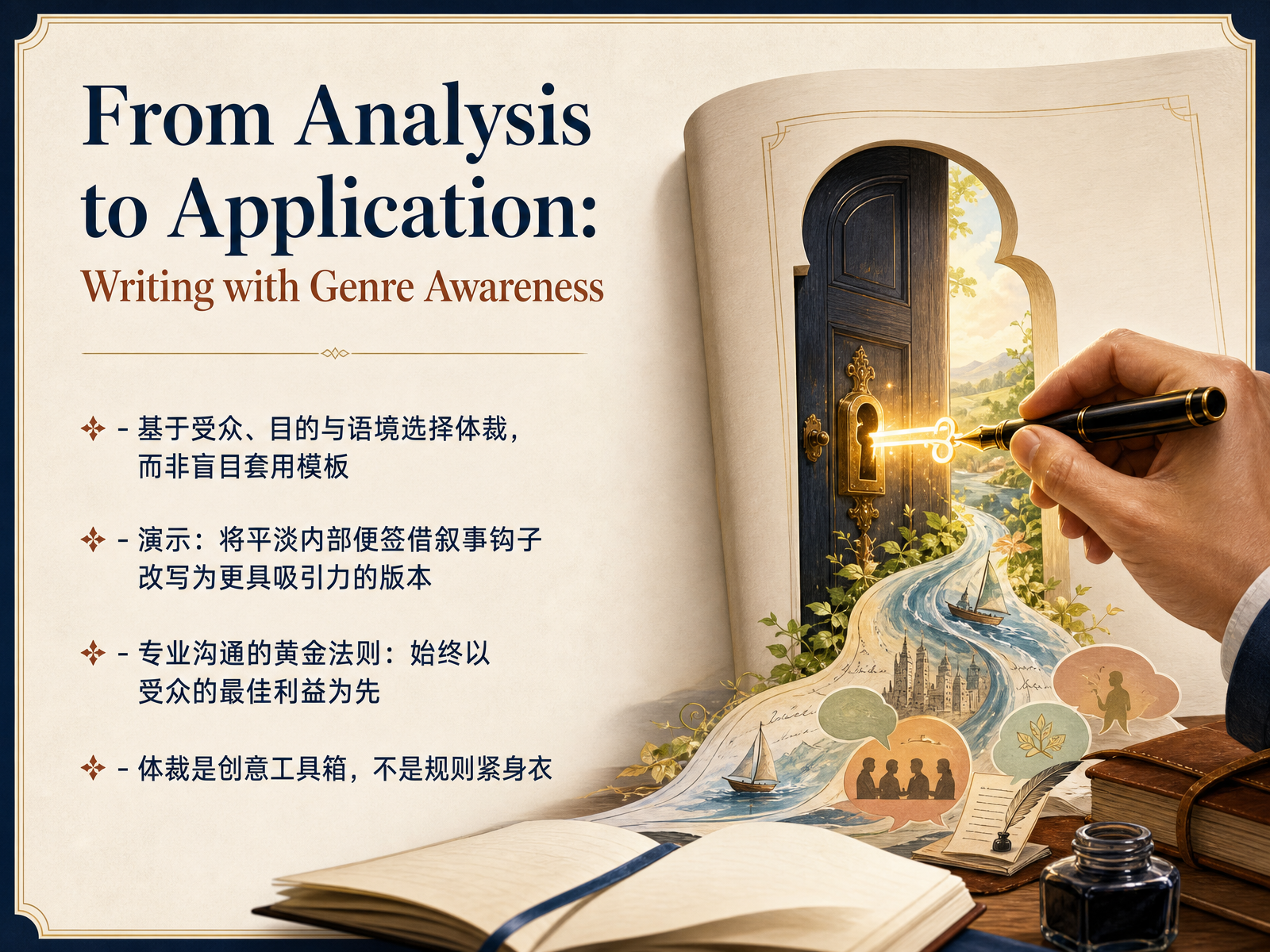
 - 13From Analysis to Application: Writing with Genre AwarenessNow let's move from analysis to application, and talk about writing with genre awareness. This slide is about making conscious choices rather than blindly filling in templates. The first principle: select a genre based on your audience, your purpose, and the context of the message. For example, a routine office update and a grant proposal call for entirely different forms, even if you are discussing the same project. To demonstrate this, we'll take a flat internal memo and rewrite it using a narrative hook—a short, engaging opening that draws the reader in. This shows how a deliberate genre choice can transform the same core information into something more compelling. This connects to what I'll call the golden rule of professional communication: always act in the best interest of your audience. If genre conventions do not serve the reader's needs, those conventions should be adapted. Remember, genre is a creative toolkit, not a restrictive set of rules. You are allowed to make strategic choices that best serve your message and your reader. Now, let's pull all of this together with our final slide: a summary and some practical takeaways.
 2 min
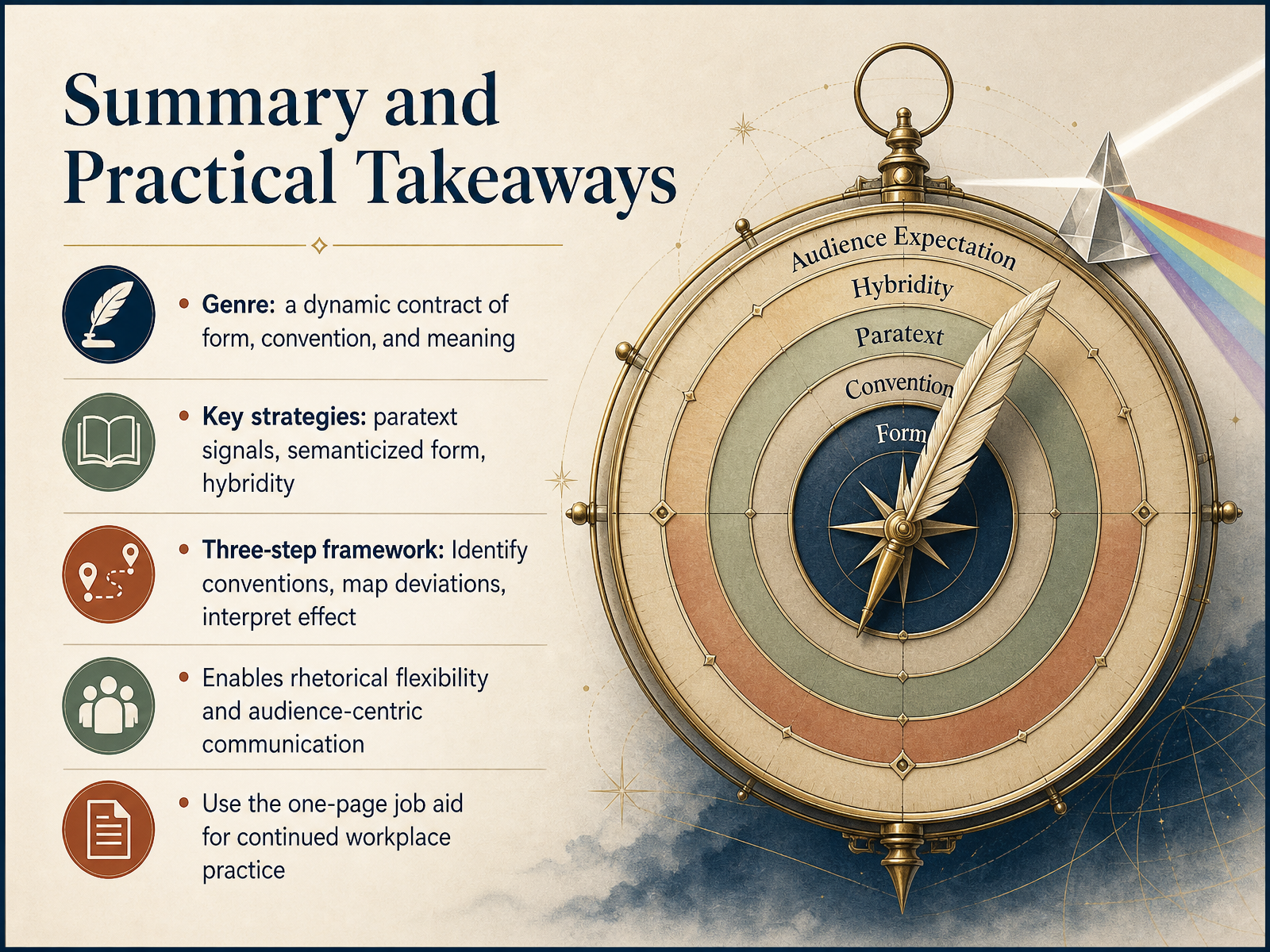
2 min - 14Summary and Practical TakeawaysWe have arrived at the final slide, so let us consolidate what we have covered. Genre is not merely a label. It is a dynamic contract between author and audience, built on recognized forms, conventions, and the meanings they generate. Throughout the course, we practiced three analytical strategies: reading paratext signals as genre clues, recognizing how form takes on semantic weight, and identifying hybridity where conventions combine or collide. Those strategies feed into our core three-step framework. First, identify the dominant conventions at play. Second, map specific deviations from those conventions. Third, interpret what those deviations accomplish for the reader. This method gives you rhetorical flexibility. It sharpens your ability to anticipate audience expectations and make deliberate, audience-centric choices in your own writing. To help you apply these skills beyond the course, refer to the one-page job aid included with your materials. It distills the framework for continued workplace practice. Thank you for your engagement. Genre analysis is a skill that grows with use, and I encourage you to treat every text you encounter as an opportunity to read with a genre-conscious eye.
 en.wikipedia.orgbritannica.comisko.org+22 min
Take the deck with you
Download this course as a file — free, no sign-up needed.
- PDF handoutEvery slide page, ready to print or share.15 pages · 5.6 MBDownload
- Narrated PowerPointThe deck that presents itself — every slide carries the digital human's narration video.15 pages · 19.5 MBDownload
- PowerPoint slidesThe full deck as a .pptx — open it in PowerPoint, Keynote, or Google Slides.15 pages · 5.5 MBDownload
Free to use in your own training — please keep the PersonWise credit page at the end.
Have your own deck? Turn it into a course
Sources consulted
Web sources consulted while building this course.
- Literary genre — en.wikipedia.org
- Genre literature — britannica.com
- Genre (IEKO) — isko.org
- GENRE — webdelprofesor.ula.ve
- Genre | Encyclopedia.com — encyclopedia.com
- Genre — writ109f.andmuchmuchmore.com
- An Introduction to Genre Theory — faculty.washington.edu
- Kim Wilkins — textjournal.scholasticahq.com
- Genres in Action: The Pragmatics of Literary Interpretation — doi.org
- What's in a Genre?: The Relationship Between Reader and Text — digitalcommons.uri.edu
- Journalistic vs. Personal Writing — pulitzercenter.org
- Journalism Tips: News Story vs. English Essay — jerz.setonhill.edu
- English Essay vs. News Story - Media Lab (Draft) — jerz.setonhill.edu
- News Writing Fundamentals — writingcenter.gmu.edu
- https://brightspotcdn.byui.edu/44/cb/d9cedc6a47f6b5ca3781ffd29251/elements-of-a-personal-essay.pdf — brightspotcdn.byui.edu
- Doing it by the Book: The Uses of Paratext in Creating Expectation and Determining Structural Genre in Contemporary British Fiction — theses.ncl.ac.uk
- Genre and ... — doi.org
- Decoding Paratextual Boundaries of Interpretation: A Study of Paratext in Contemporary Literary Production — spectrum.library.concordia.ca
- (PDF) Paratexts 2.0: New Perspectives on Twenty-First Century Literary Narrative. — academia.edu
- Paratextuality — doi.org