Technology and Power Through History
Begin
14 pages · ~28 min
Technology and Power Through History
Explores how technology has shaped power dynamics across historical periods, helping learners analyze the relationship between innovation, control, and societal change.
What you’ll learn
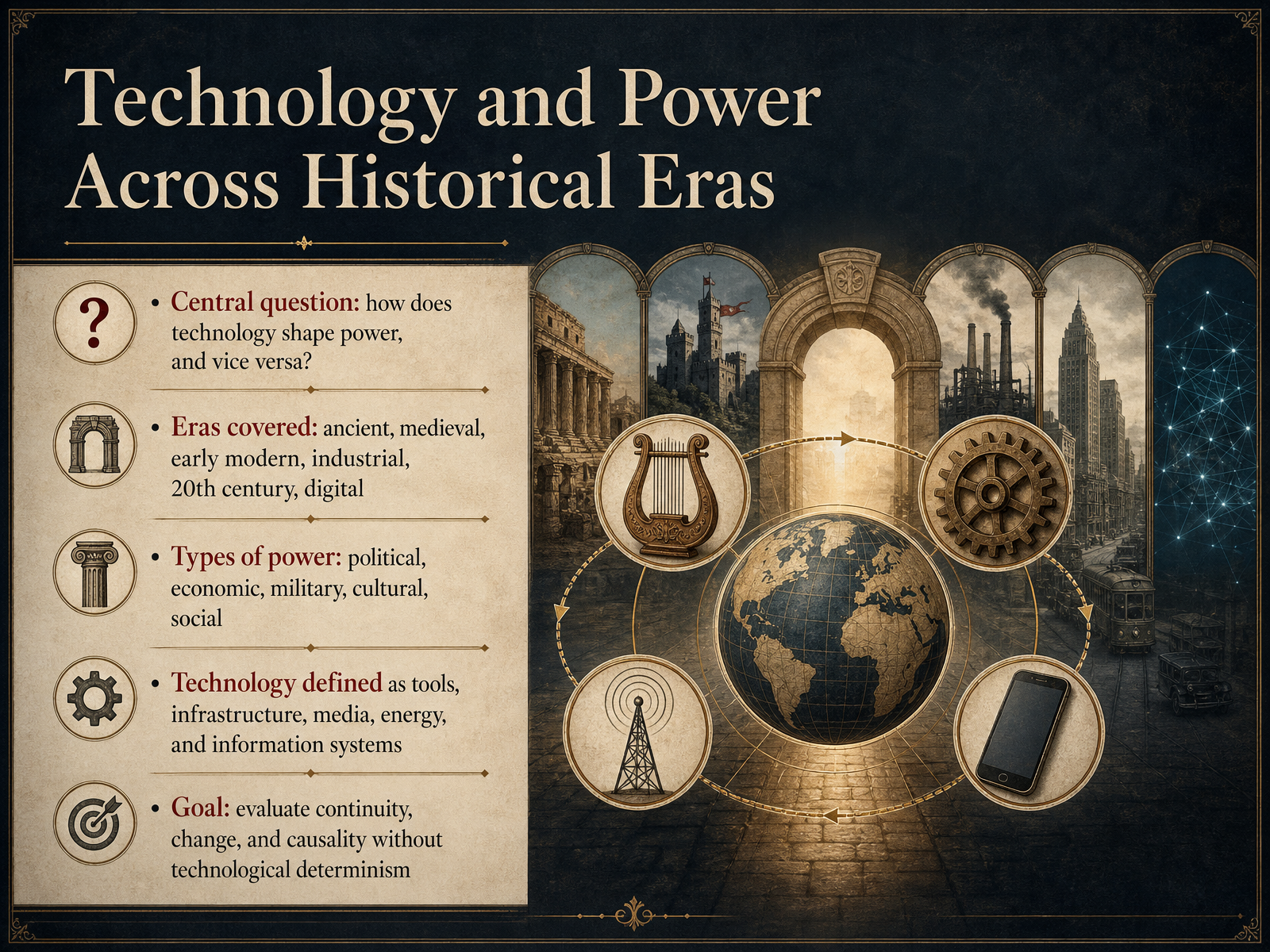
- 01Technology and Power Across Historical ErasWelcome, everyone. In this course, we will explore a profound question that connects every era of human history: how does technology shape power, and how does power shape technology in return? We will journey from the ancient world through the medieval period, the early modern age, the industrial revolution, and into our current digital landscape. As we go, we will look at power in its many forms, not just political or military, but also economic, cultural, and social power. For our purposes, technology means more than just shiny gadgets. It includes tools, infrastructure, media, energy systems, and the ways we organize information. Our goal is not to say that technology alone determines the course of history. Instead, we will evaluate the subtle dance between continuity and change, and carefully examine the chain of cause and effect. By the end, I hope you will think critically about the forces that have built our world, and the choices we face today. With that foundation in mind, let's begin by defining some core concepts, including what we really mean by technological systems and their relationship to society.britannica.comworldhistorycommons.orgpress.uchicago.edu+22 min
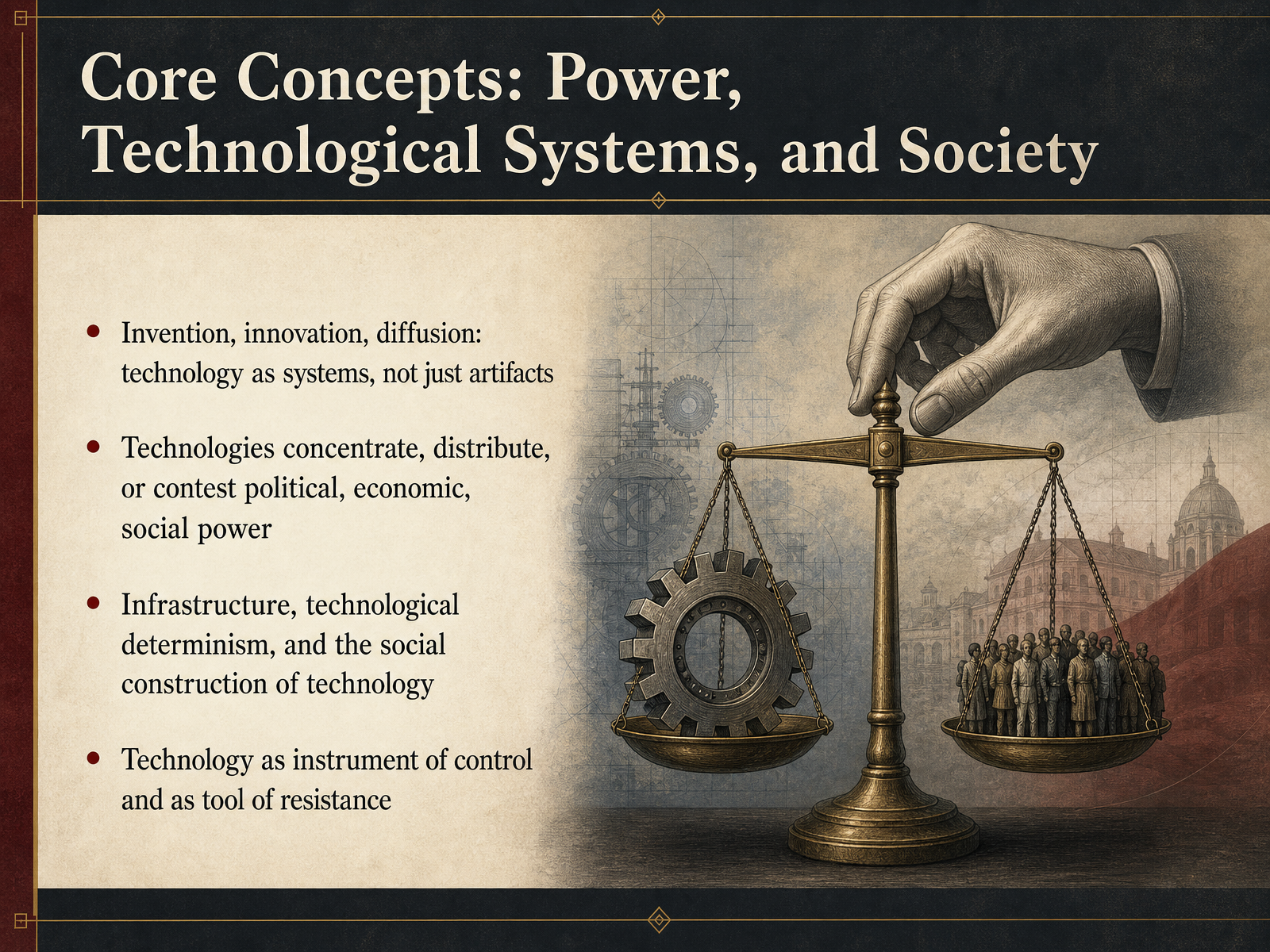
- 02Core Concepts: Power, Technological Systems, and SocietyBefore we walk through specific eras, let's establish the basic ideas that will guide us. First, technology is more than a collection of artifacts. Think of it as a system that includes invention, innovation, and diffusion. A printing press matters because of the networks of paper, ink, literacy, and distribution that grew around it. Second, any technology can concentrate power, distribute power, or contest power. The Ottoman example makes this clear. Rulers embraced gunpowder weapons because those weapons strengthened central authority. Yet the same rulers resisted the printing press for centuries, because printed books threatened the religious authorities who helped legitimize their rule. So we must avoid a simple view of progress. Technology can be an instrument of control, but it can also serve as a tool of resistance. Third, we need to distinguish between technological determinism, the idea that technology drives history on its own, and the social construction of technology, which emphasizes the choices people make. Keep this tension in mind as we move to our first case.
 digitalcommons.lib.uconn.edusciencedirect.comideas.repec.org+21 min
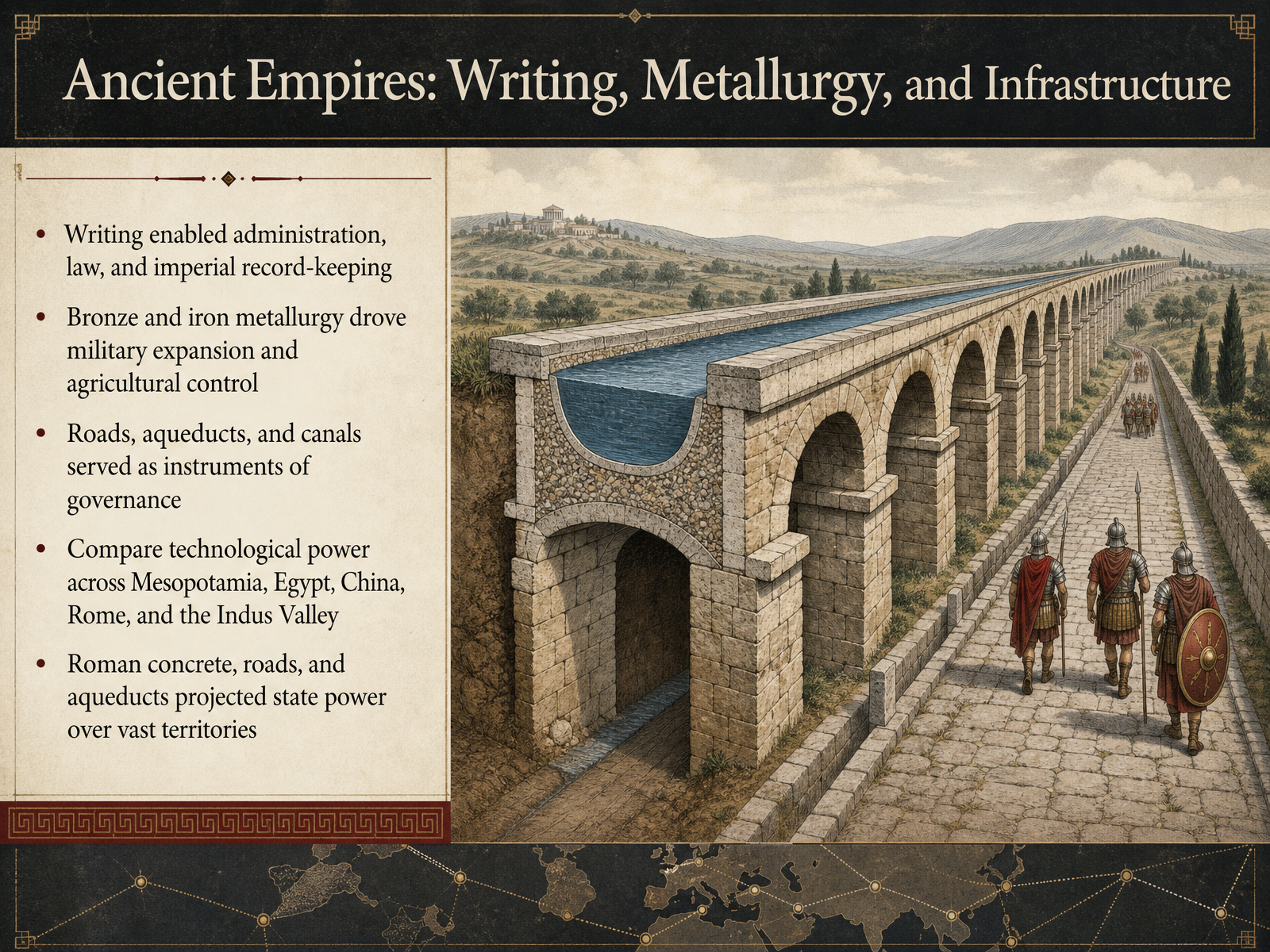
 - 03Ancient Empires: Writing, Metallurgy, and InfrastructureLet's turn now to the ancient world, where the first large-scale empires began to connect technology directly with political control. Writing stands out here. It allowed rulers to standardize law, collect taxes, and keep records across huge distances. Metallurgy was equally decisive. Bronze and then iron weapons gave armies a real advantage, while metal tools strengthened farming. Infrastructure, though, may have been the most visible form of power. Roads moved soldiers, aqueducts supplied cities, and canals managed water for agriculture. These projects were not just practical; they were statements of authority. When we compare Mesopotamia, Egypt, China, Rome, and the Indus Valley, we see similar patterns, but different materials and designs. Rome, for example, used concrete to build roads and aqueducts that projected state power across its territories. So technology did not simply support these empires; it helped define their reach and their limits. Next, we'll see how new innovations reshaped power in the medieval period, from gunpowder and print to the control of land itself.
 1 min
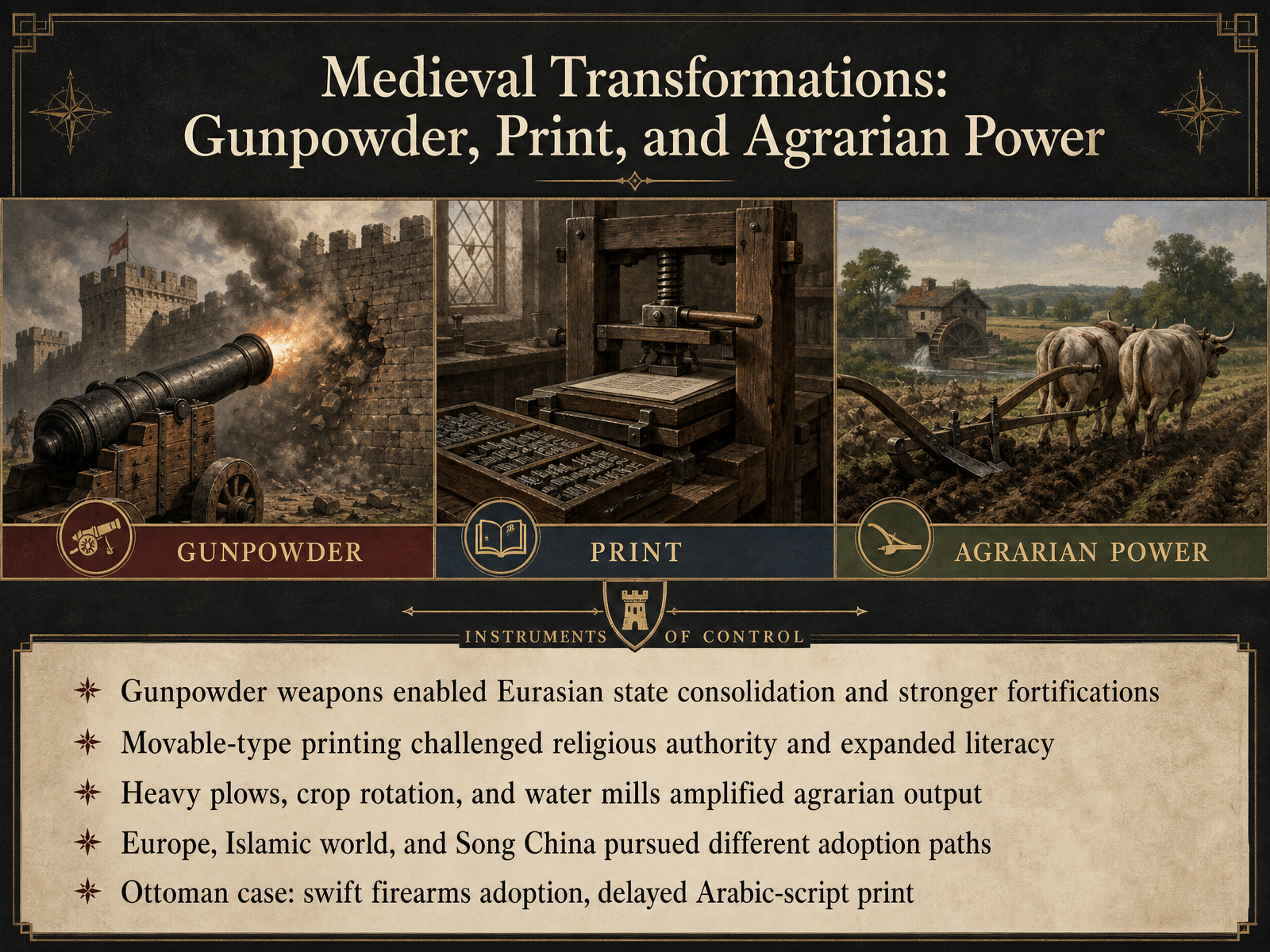
1 min - 04Medieval Transformations: Gunpowder, Print, and Agrarian PowerLet's now move into an era of dramatic change across Eurasia, the medieval transformations that reshaped the relationship between technology and power. Consider three developments. First, gunpowder weapons. The Ottomans, for example, were remarkably quick to adopt firearms and cannons. They even established a permanent standing army, the Janissaries, specialized in using them. This military technology helped rulers consolidate states and build stronger fortifications. Second, movable-type printing. This challenged religious authority by expanding literacy and spreading knowledge more widely, but its adoption was not uniform. The Ottomans banned printing in Arabic script for nearly three centuries, not because they were technologically backward, but because mass printing threatened the legitimacy that religious authorities provided to the sultan. Military technology strengthened the ruler's hand, while print could weaken it. Finally, agrarian power grew through heavy plows, crop rotation, and water mills. These innovations amplified output, but Europe, the Islamic world, and Song China each pursued different adoption paths. The Ottoman case is striking: swift firearms adoption, yet delayed print. As we turn next to early modern empires, we'll see how navigation, trade, and the military revolution accelerated these shifts in power.
 digitalcommons.lib.uconn.edusciencedirect.comideas.repec.org+22 min
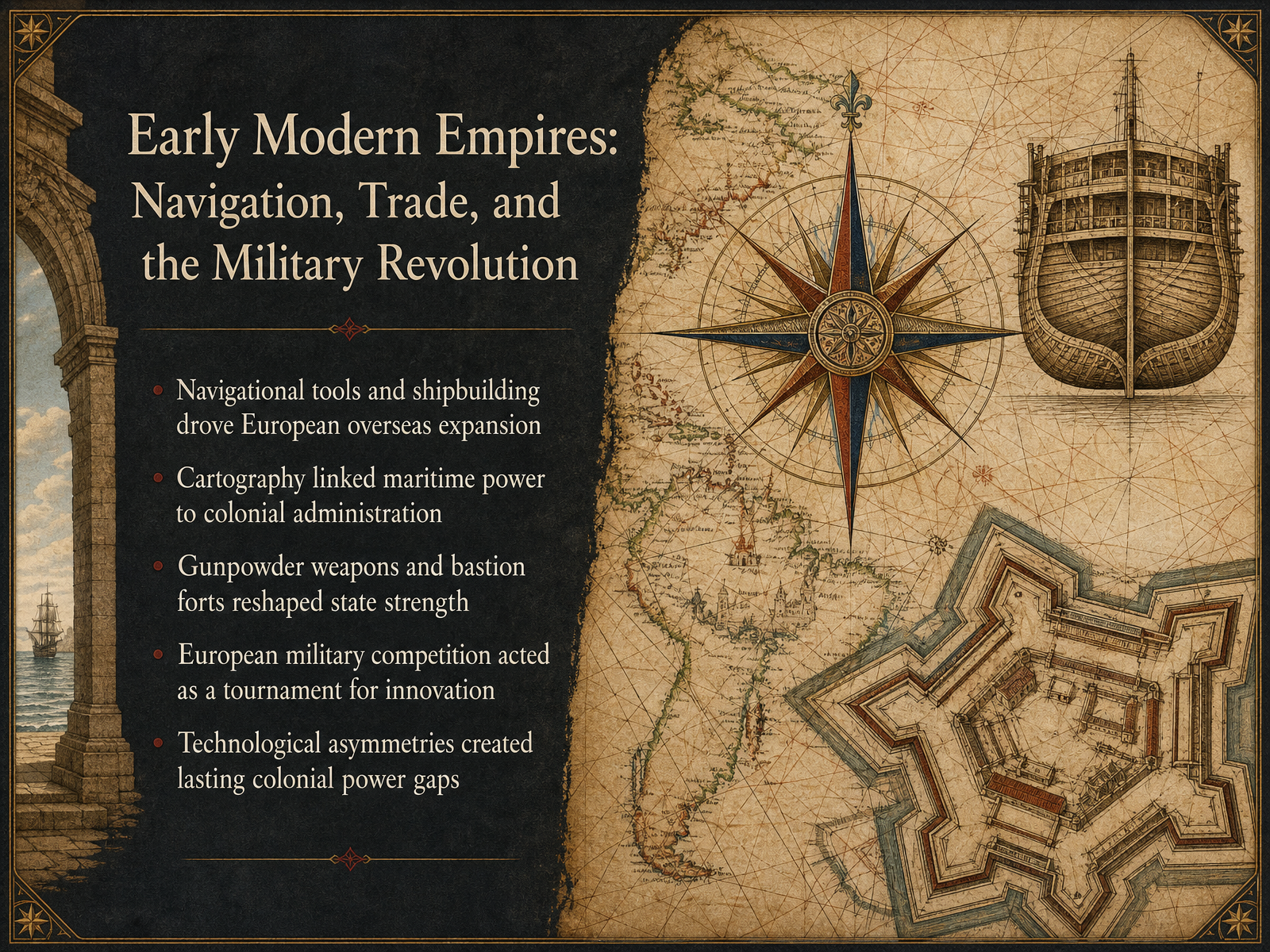
 - 05Early Modern Empires: Navigation, Trade, and the Military RevolutionNow let's turn to the early modern era, when navigational tools and advances in shipbuilding drove European overseas expansion. Cartography became a tool of empire, linking maritime power directly to colonial administration. On land, gunpowder weapons and bastion forts reshaped the strength of states, making older fortifications obsolete and rewarding rulers who could mobilize money and expertise. Historians often describe European military competition as a kind of tournament. Rulers invested heavily in better artillery, firearms, and fortifications because losing meant losing everything, not just profit. This competition pushed military innovation faster than in regions without the same political pressures. At the same time, technological asymmetries created lasting colonial power gaps. Societies that had gunpowder weapons, oceangoing ships, and centralized supply systems often held decisive advantages over those that did not. This advantage was not always about inventing the technology first, but about organizing around it more effectively. So the early modern world shows us that technology alone does not create power. It is the combination of tech, organization, and political motivation that changes the global balance. Next, we will see how these patterns intensified during the Industrial Revolutions, when energy, production, and social power were transformed again.
 digitalcommons.lib.uconn.edusciencedirect.comideas.repec.org+22 min
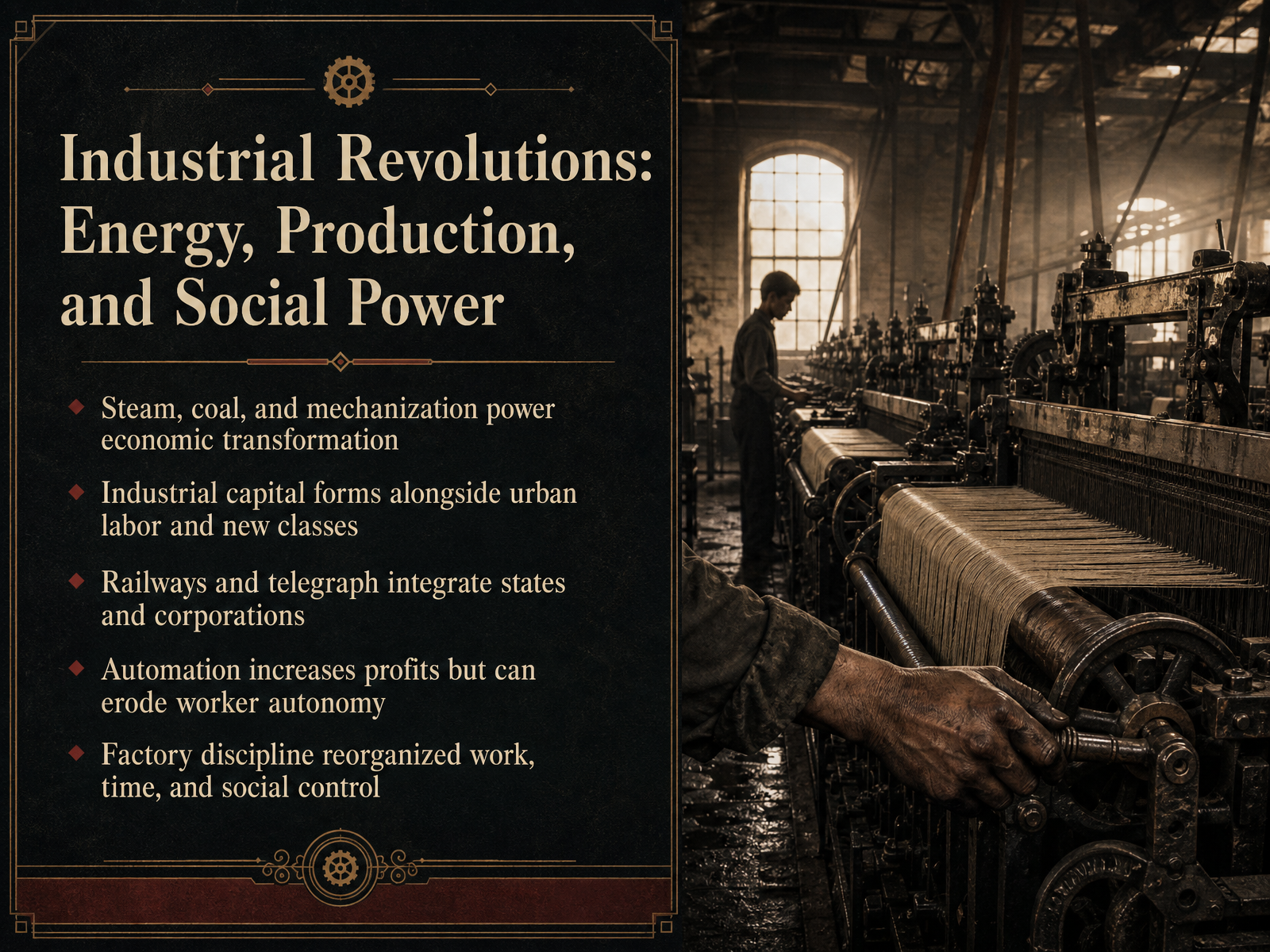
 - 06Industrial Revolutions: Energy, Production, and Social PowerNow let's turn to the Industrial Revolutions, and the deep link between energy, production, and social power. Steam and coal did more than power machines. They transformed entire economies. Mechanization created industrial capital, and alongside it, a new urban labor force and new social classes. Railways and the telegraph pulled states and corporations together, integrating space and time in ways never before possible. But this power came with a price. Automation could generate enormous profits, yet it often eroded worker autonomy. Factory discipline reorganized daily life itself. Work, time, and social control were reshaped around the machine's rhythm. The result was not just economic growth, but a new kind of society. In the next section, we'll see how these forces scale up in the twentieth century, through mass media, nuclear technology, and bureaucratic power.
 annualreviews.orgjstage.jst.go.jpcambridge.org+21 min
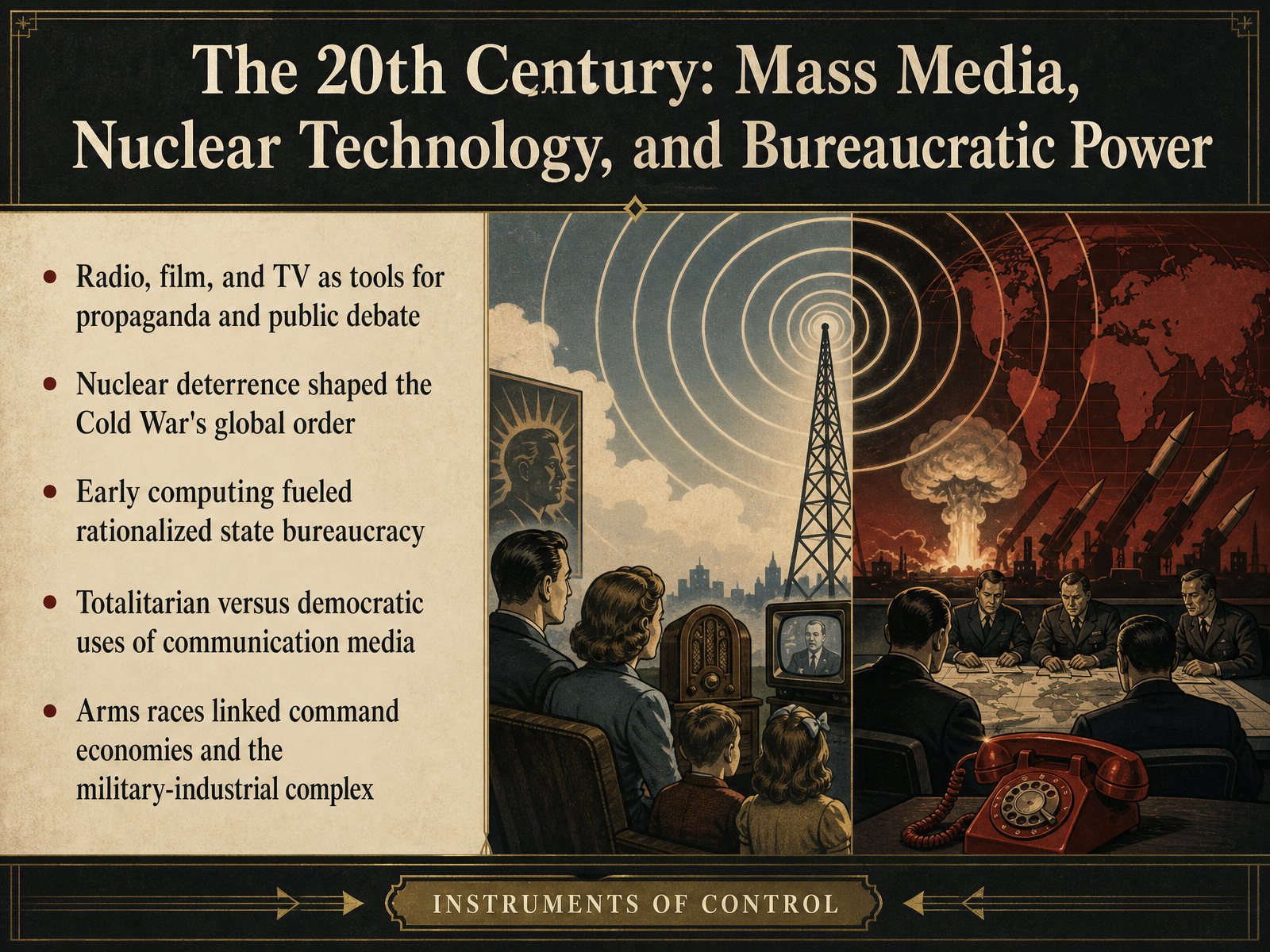
 - 07The 20th Century: Mass Media, Nuclear Technology, and Bureaucratic PowerThe twentieth century changed the relationship between technology and power in ways earlier eras could hardly imagine. Radio, film, and television turned communication into a mass experience. Governments quickly recognized their potential. In democratic societies, these media opened space for public debate and investigative journalism. In totalitarian states, they became instruments of propaganda, carefully shaped to control public perception. At the same time, nuclear technology introduced a grim new logic to global politics. The threat of mutual destruction did not simply end wars. It structured the Cold War, turning deterrence into a permanent feature of international order. Early computing added another layer. Bureaucracies began using data to plan economies, manage populations, and coordinate large institutions. This rationalized power in new ways. It also blurred the line between civilian administration and military planning. Arms races tied command economies to defense industries. The result was a military industrial complex that shaped both foreign policy and domestic priorities. In this century, power was no longer just about territory or production. It was increasingly about information, fear, and organizational capacity. Next, we turn to the digital era, where platforms, data, and networked power begin to reshape politics once again.
 2 min
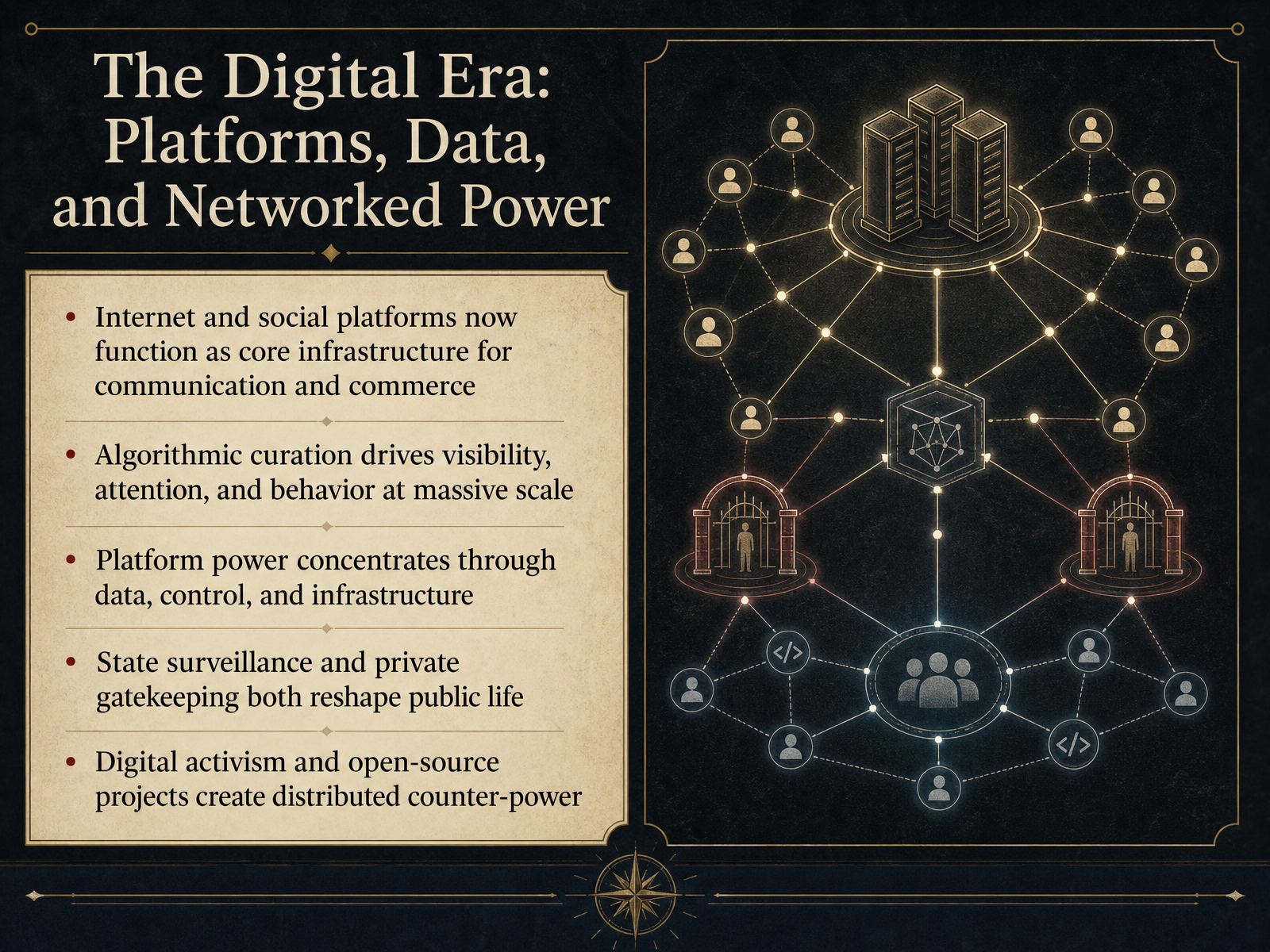
2 min - 08The Digital Era: Platforms, Data, and Networked PowerNow let us turn to the digital era, where power increasingly flows through platforms, data, and networks. The internet is no longer just a tool for communication. It now functions as core infrastructure for commerce, civic life, and even how we understand the world around us. But here is the crucial shift: the platforms that run this infrastructure are not neutral pipes. Their algorithms actively curate what we see, shaping visibility and attention at a massive scale. Think of the recommendation systems on video sites or the ranking of a social feed. These are private rules with public consequences. This concentration of power rests on three pillars: control over data, control over infrastructure, and direct algorithmic governance of behavior. Yet this power is not held by platforms alone. Governments equally employ digital infrastructure for surveillance, and both private gatekeepers and state authorities reshape public life. However, we are also seeing forms of resistance. Digital activism and open source projects create distributed counter-power, offering alternative ways to organize and communicate. This tension between concentrated platform power and distributed networks directly informs our next discussion, which examines contemporary debates over artificial intelligence, surveillance, and regulation.
 publications.lawschool.cornell.edudiva-portal.orgcambridge.org+22 min
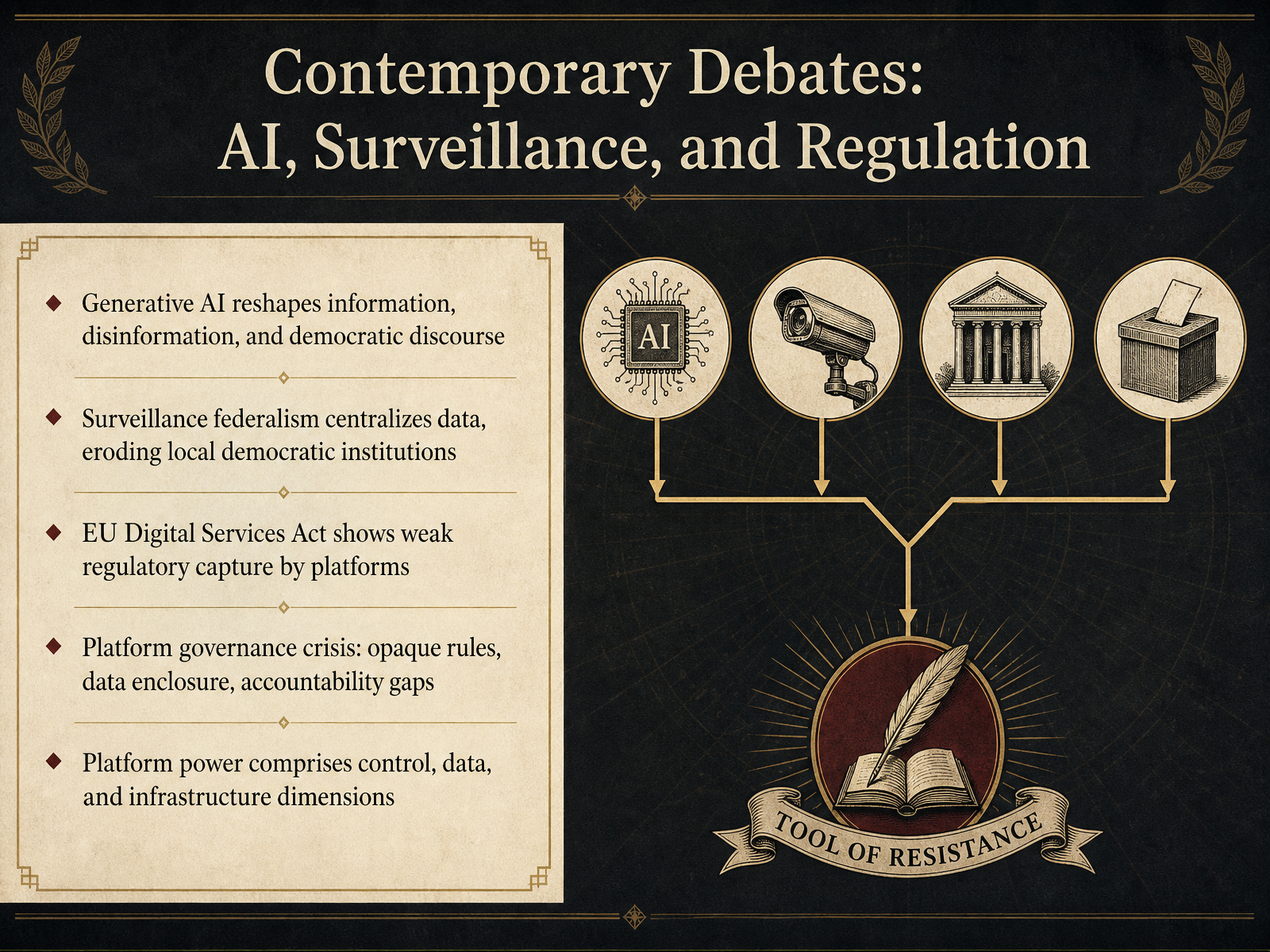
 - 09Contemporary Debates: AI, Surveillance, and RegulationNow we move into our own moment, where these questions become urgent. Consider what has changed with generative AI. It is not just that information can be produced faster. It is that the line between authentic speech and manufactured speech has become harder to locate. Democratic discourse depends on shared facts, and when information itself becomes negotiable, the foundation of debate weakens. At the same time, a quieter form of power has appeared. Governments can now centralize data through national digital systems. Scholars call this surveillance federalism. The point is not simply that data is collected, but that centralized data quietly bypasses local democratic institutions. Decisions once made through local deliberation become technical decisions made elsewhere. Regulation has tried to respond. The European Digital Services Act was designed to constrain very large platforms. Yet researchers argue that platforms shaped the legislation itself, softening liability into something closer to responsibility. The result is a form of weak regulatory capture, one that protects platforms while offering limited public accountability. Behind all of this sits a deeper structure. Platform power is not just about money or market share. It operates through control over what users see, through exclusive command of data, and through ownership of the infrastructure that makes digital life possible. So the real debate is not whether platforms have power, but whether that power can be made accountable. That question of accountability is precisely what carries us into the next slide, where we step back and look for patterns of continuity and change.
 publications.lawschool.cornell.edudiva-portal.orgcambridge.org+22 min
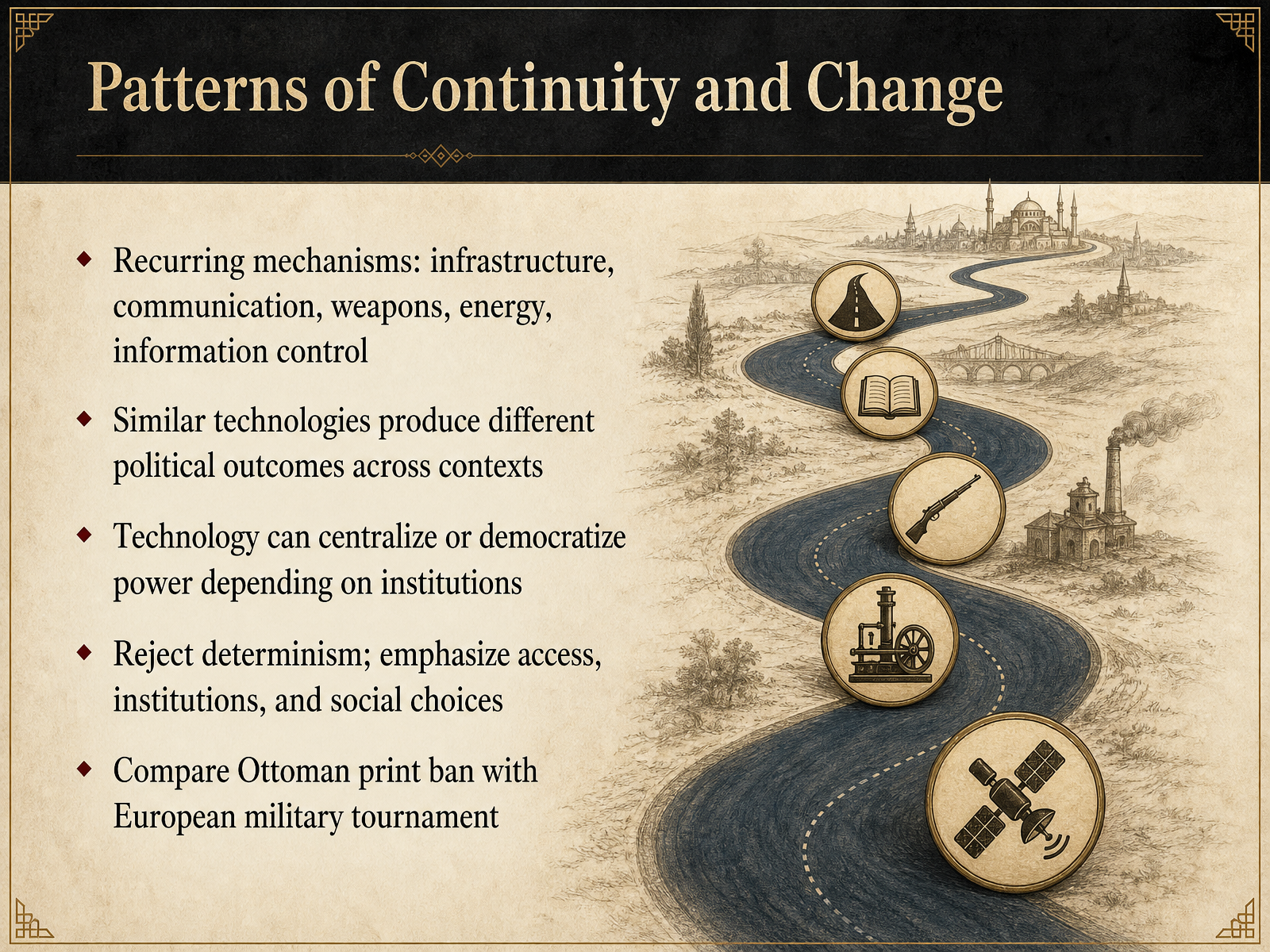
 - 10Patterns of Continuity and ChangeNow let's step back and look for patterns across the eras. We have seen recurring mechanisms throughout this course. Infrastructure, communication, weapons, energy, and the control of information all play a role in shaping power. But the same technology does not produce the same political outcome everywhere. Context is crucial. Technology can centralize power, or it can democratize it, and that depends on institutions and social choices. Consider the printing press. In Europe, it spread rapidly and encouraged broad participation. In the Ottoman Empire, rulers blocked printing in Arabic script for nearly three hundred years. This was not simple conservatism. They feared that mass printing would undermine the religious authorities who helped legitimize their rule. So we have to reject technological determinism. Technology sets possibilities and pressures, but human decisions about access and institutions decide the final outcome. In our next segment, we will discuss teaching strategies that help avoid that deterministic trap.
 digitalcommons.lib.uconn.edusciencedirect.comideas.repec.org+21 min
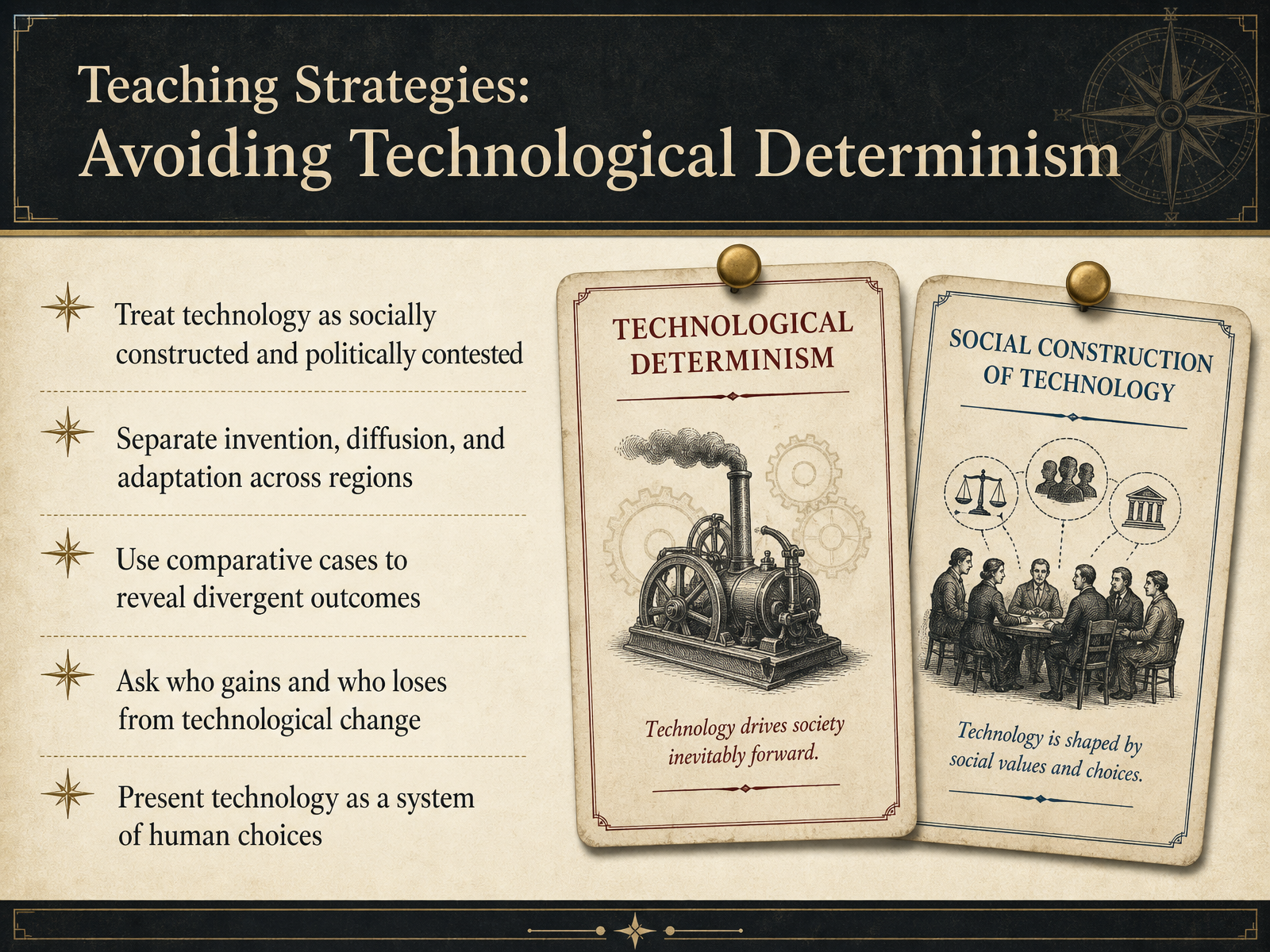
 - 11Teaching Strategies: Avoiding Technological DeterminismA common trap when teaching the history of technology is to treat invention as an unstoppable force that drives society forward on its own. A better approach is to show technology as something shaped by human choices, politics, and the uneven ways it spreads. Start by separating invention from diffusion and adaptation. A device may be created in one place, but whether it is adopted, resisted, or reshaped often depends on local conditions. Use comparative cases to reveal divergent outcomes. For example, the same telegraph technology supported very different forms of imperial control, commercial expansion, and local resistance depending on where it was installed. Ask students who gained and who lost from each change. In the case of electrification, some communities gained access quickly, while others waited for decades, and those gaps often followed lines of class, race, and geography. This framing presents technology as a system of human choices, and that makes the classroom discussion richer. Next, we look at concrete classroom tools, including maps, patents, propaganda, and manuals.
 2 min
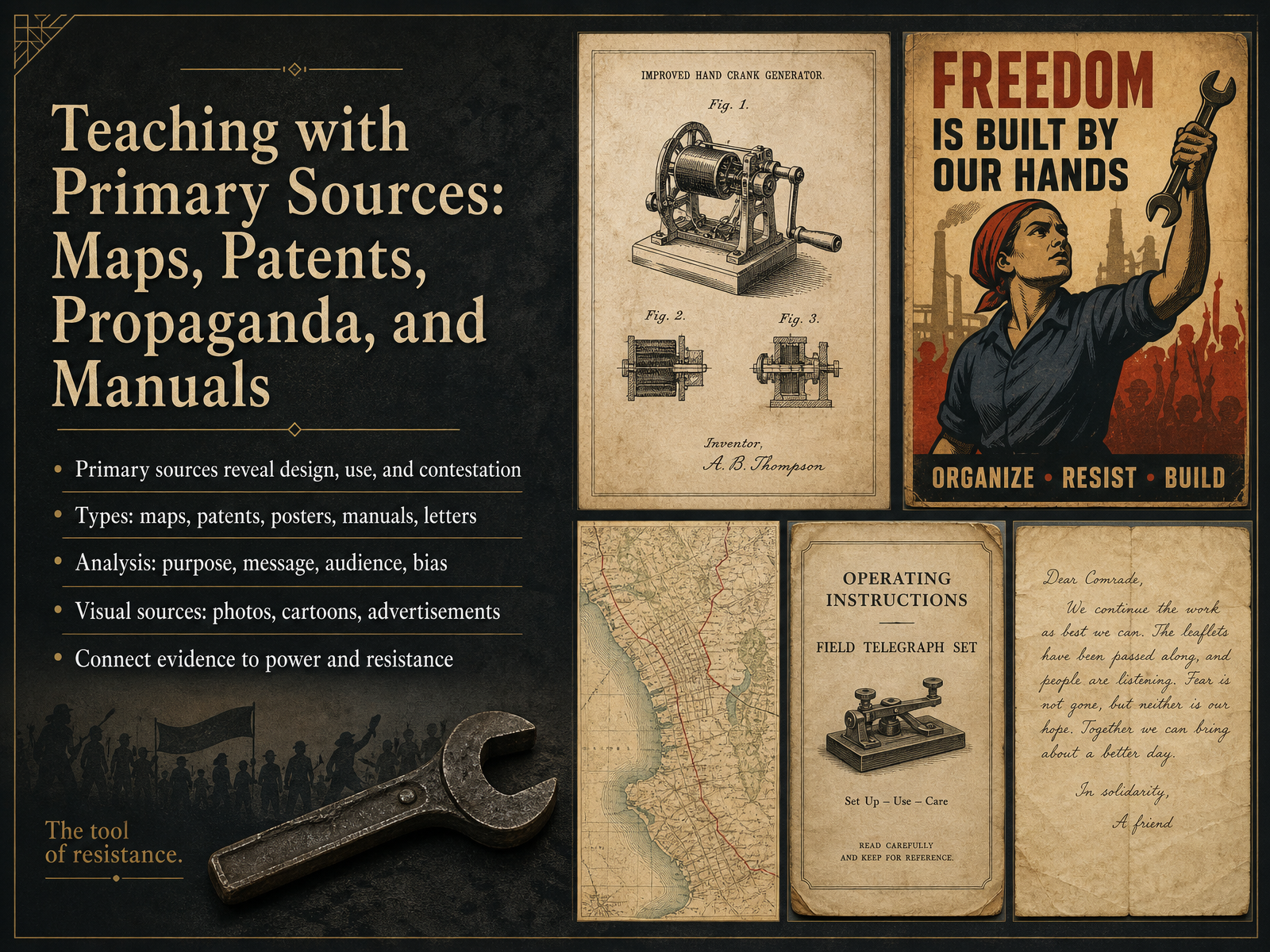
2 min - 12Teaching with Primary Sources: Maps, Patents, Propaganda, and ManualsNow let's turn our attention to how we actually teach this history, using the raw materials of the past. Primary sources are not just illustrations of what happened; they are artifacts of design, use, and even resistance. Think of a patent drawing, a wartime propaganda poster, or a factory manual. Each one reveals decisions about who was meant to hold power. When we ask students to identify the purpose, the intended message, and the audience, we move beyond simply observing an object and begin to uncover its bias. A map, for example, is not neutral geography. It encodes claims to territory and control. A photograph might seem purely objective, but the photographer's choice of subject and framing shapes its story. Connecting this evidence to power and resistance helps students see how technology has always been contested, and how ordinary people respond to change. In our next segment, we'll move from these objects of analysis to hands-on classroom activities and discussion prompts.
 1 min
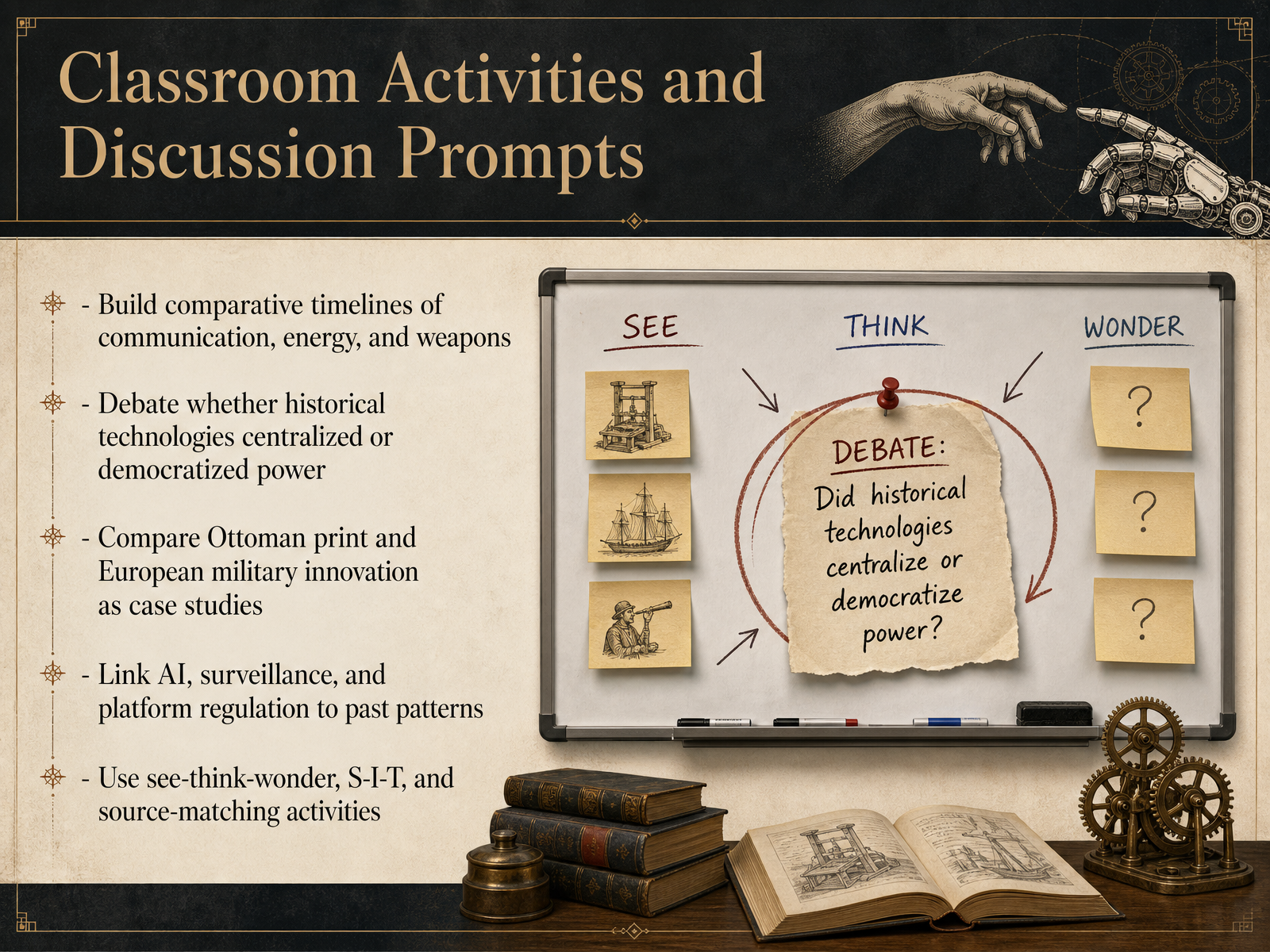
1 min - 13Classroom Activities and Discussion PromptsLet's turn from theory to practice, because the best way to understand how technology and power interact is to work with evidence directly. One useful starting point is to build comparative timelines of communication, energy, and weapons. Seeing those three threads side by side often reveals patterns that a single timeline hides. You might also set up a structured debate around one central question. Did a given technology centralize power in fewer hands, or did it distribute power more widely? That debate works well with case studies. For example, compare Ottoman printing, which faced strong restrictions, with European military innovation, which often spread through state competition. The contrast is striking. And of course, connect the past to the present. Ask how artificial intelligence, surveillance systems, and platform regulation echo earlier struggles over print, telegraph, or electricity. For classroom methods, tried and true routines like see think wonder, the S I T strategy of noting what is surprising, interesting, and troubling, and source matching activities all help students slow down and think critically. The goal is not to declare one technology good and another bad. The goal is to help learners see that power is never a fixed result. It is always being negotiated. Let's carry that idea into our final section on assessment and further learning.
 2 min
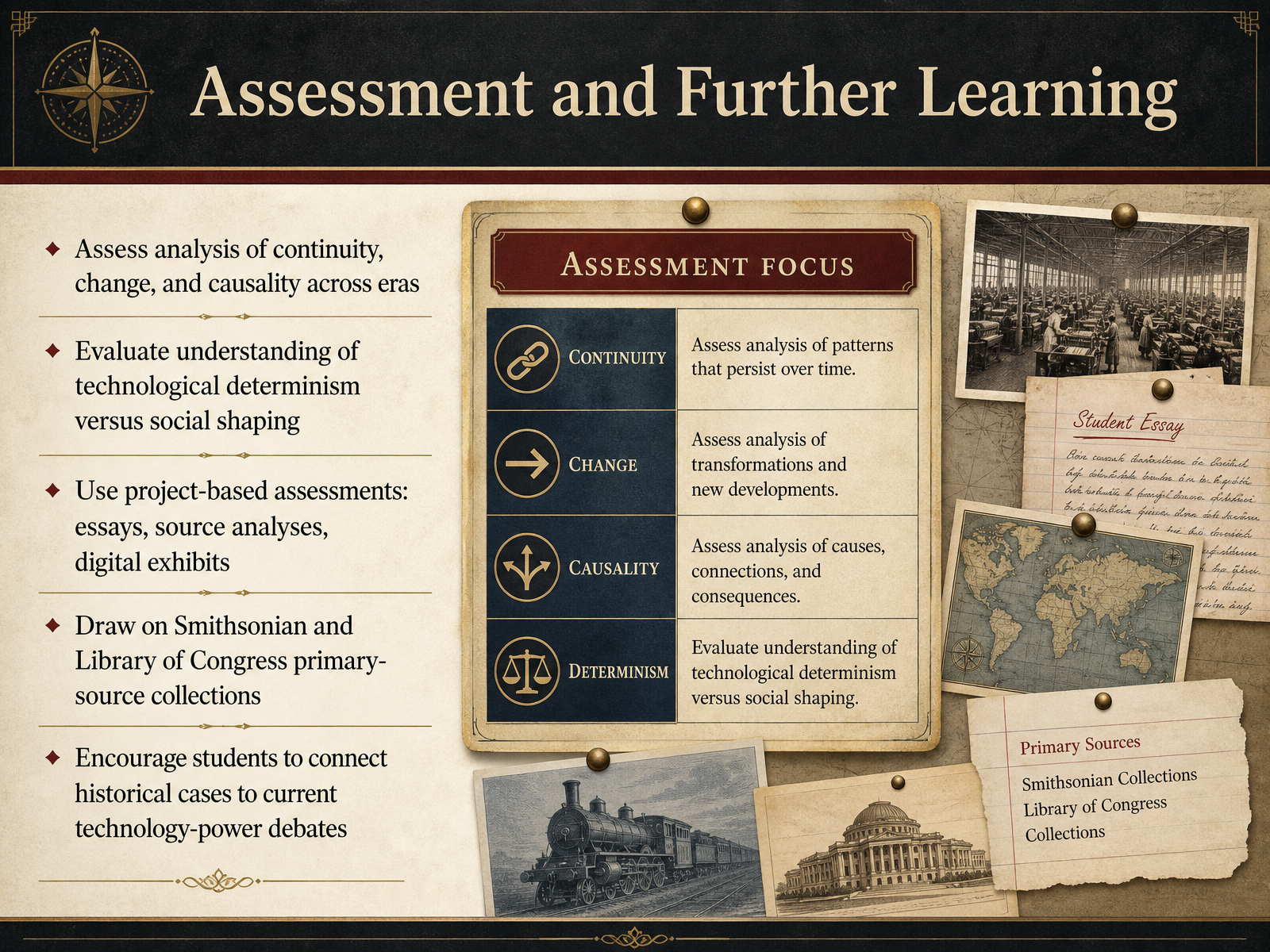
2 min - 14Assessment and Further LearningAs we close this course, I want to leave you with a clear picture of how your learning will be assessed and how you can keep exploring these ideas. The goal is not just to remember dates, but to show you can analyze continuity, change, and causality across the eras we have studied. You should also be able to evaluate why technology changes, moving beyond the simple idea that technology drives everything, and instead consider how society shapes the tools we use. To do this, we will use project based assessments like essays and source analyses, and we will build digital exhibits using primary sources from the Smithsonian and the Library of Congress. These collections let you see history through the objects and documents people left behind. As you work, I encourage you to connect historical cases to current debates about technology and power. Look around you. The conversations we are having today about artificial intelligence, social media, or automation are not new. They echo the debates of the past. So, take these skills of investigation, comparison, and critical thinking with you. Thank you for your engagement, and keep asking good questions.
 1 min
1 min
Take the deck with you
Download this course as a file — free, no sign-up needed.
- PDF handoutEvery slide page, ready to print or share.15 pages · 6.6 MBDownload
- Narrated PowerPointThe deck that presents itself — every slide carries the digital human's narration video.15 pages · 19.7 MBDownload
- PowerPoint slidesThe full deck as a .pptx — open it in PowerPoint, Keynote, or Google Slides.15 pages · 6.6 MBDownload
Free to use in your own training — please keep the PersonWise credit page at the end.
Have your own deck? Turn it into a course
Sources consulted
Web sources consulted while building this course.
- History of technology | Evolution, Ages, & Facts — britannica.com
- Primer: Technology | World History Commons — worldhistorycommons.org
- The Pursuit of Power: Technology, Armed Force, and Society since A.D. 1000, McNeill — press.uchicago.edu
- History of technology — en.wikipedia.org
- History of technology - Perceptions, Impact, Evolution | Britannica — britannica.com
- Guns and Books: Legitimacy, Revolt and Technological Change in the Ottoman Empire — digitalcommons.lib.uconn.edu
- The political economy of mass printing: Legitimacy and technological change in the Ottoman Empire — sciencedirect.com
- The political economy of mass printing: Legitimacy and technological change in the Ottoman Empire — ideas.repec.org
- Gunpowder Weaponry and the Rise of the Early Modern State — journals.sagepub.com
- Political Economy of Mass Printing — media.economics.uconn.edu
- Learning From Ricardo and Thompson: Machinery and Labor in the Early Industrial Revolution and in the Age of Artificial Intelligence | Annual Reviews — annualreviews.org
- Mechanization of Production and the Conversion of Labor-power into a Commodity — jstage.jst.go.jp
- Factory Discipline — cambridge.org
- Factor prices and induced technical change in the industrial revolution — onlinelibrary.wiley.com
- Karl Marx and the Satanic Mills: Factory Politics Under Early Capitalism in England, the United States, and Russia — journals.uchicago.edu
- Constitutional Accountability in the Platform Age: A Three-Dimensional Framework for Algorithmic Governance – Cornell International Law Journal — publications.lawschool.cornell.edu
- Anatomy of platform power capitalism: Faces, forms, and regulation — diva-portal.org
- Platform power and regulatory capture in digital governance | Business and Politics | Cambridge Core — cambridge.org
- Platform rule: Facebook,corporate power,and networked publics — sage.cnpereading.com
- Algorithms and Democracy — sitra.fi