Industrialization Across Regions
Begin
14 pages · ~28 min
Industrialization Across Regions
This training explores how industrialization developed differently across global regions, examining economic, social, and historical factors for students of world history and economic development.
What you’ll learn
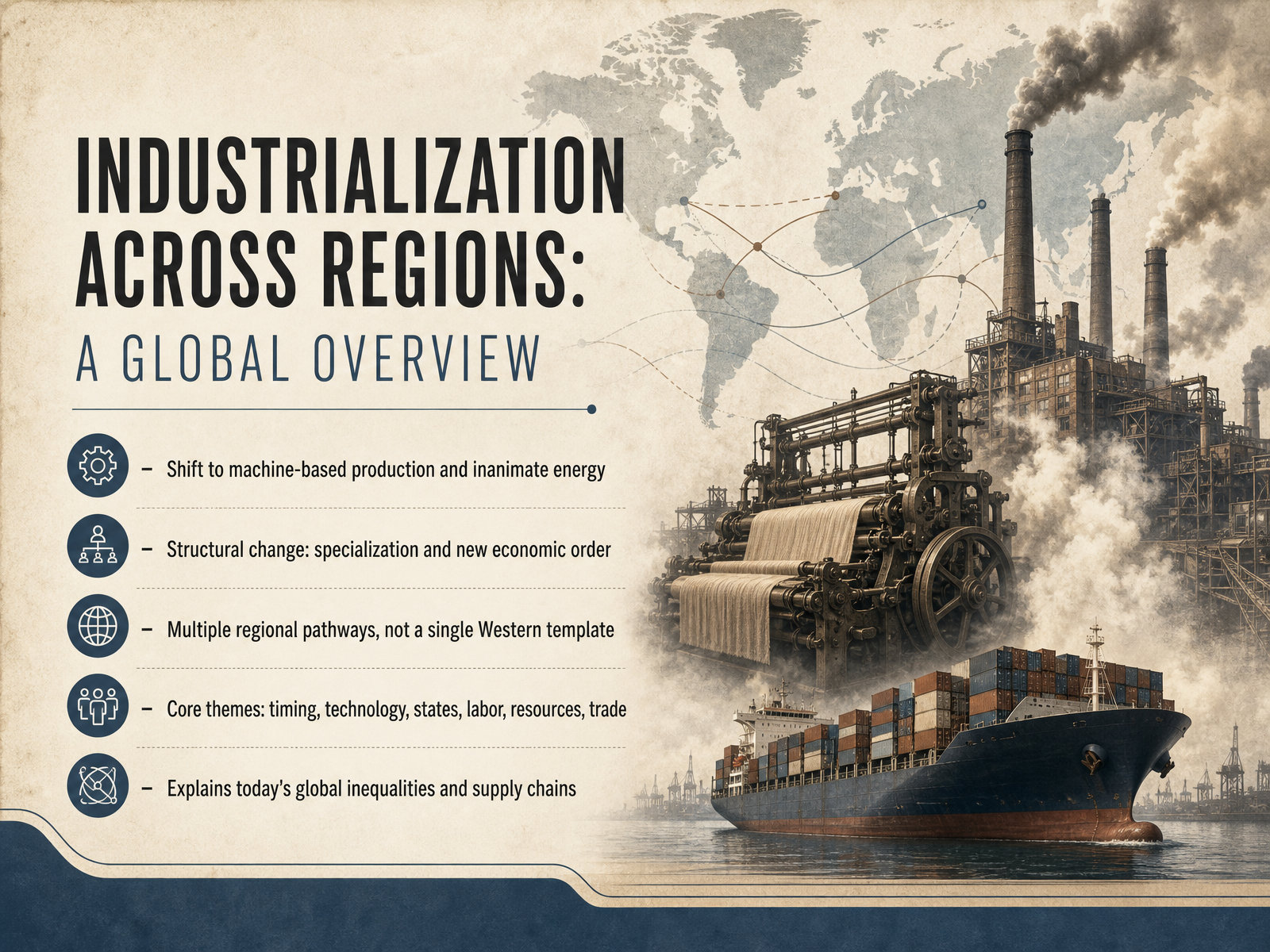
- 01Industrialization Across Regions: A Global OverviewWelcome to our course on industrialization across regions. When we talk about industrialization, we mean a profound shift, a move from producing things by hand in small workshops, to machine-based production powered by inanimate energy like coal and steam. This change did more than just build factories. It restructured whole societies, creating specialized labor and a new economic order. But here is the key idea for our journey together: there was never just one single path to industrialization, no single Western template that everyone simply copied. Instead, we'll explore multiple regional pathways, each shaped by local timing, available technology, the role of the state, labor forces, resources, and of course, trade. Understanding these differences helps explain why our world looks the way it does today, from global inequalities to the complex supply chains that bring goods to our doors. In this first section, we'll lay the groundwork. Next, we'll turn to the core concepts and the comparative methods historians use to study this story.britannica.comlink.springer.compure.iiasa.ac.at+22 min
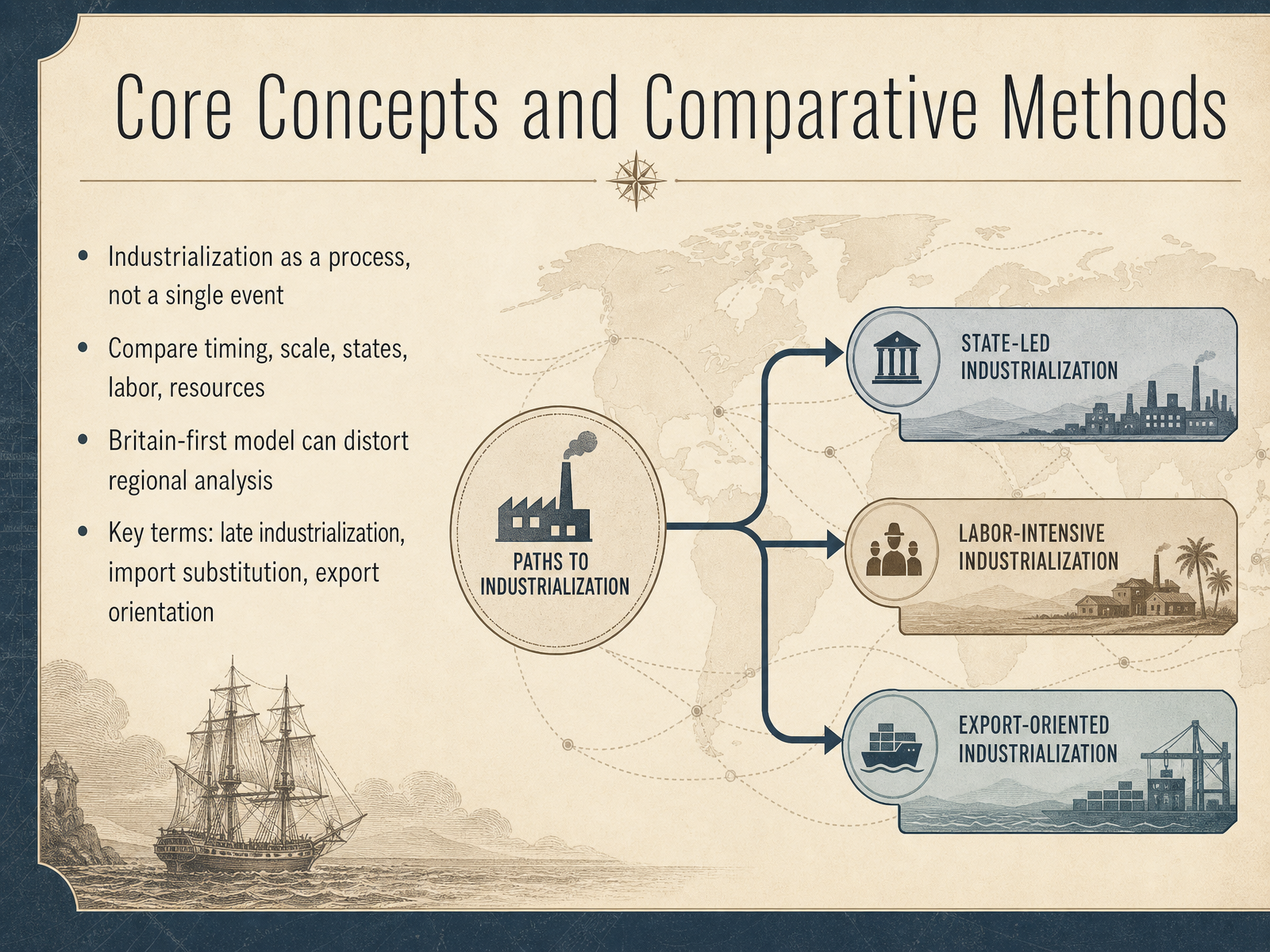
- 02Core Concepts and Comparative MethodsNow let's think about how we compare industrialization across different regions. The first idea is that industrialization is not a single event that happens once and is done. It is a long process, unfolding at different speeds and in different shapes depending on where you look. To compare regions fairly, we look at timing, meaning when factory growth took off. We look at scale, how quickly it spread. We also look at the role of states, the type of labor available, and access to resources like coal or iron. One common mistake is to treat Britain as the only yardstick. Britain may have started early, but that model can distort what happened in India, Japan, or Latin America. To help with comparison, historians use terms like late industrialization, import substitution, and export orientation. Late industrialization simply means a country began industrial growth after the early starters. Import substitution means building domestic factories to replace goods that were once imported. Export orientation means focusing factory production on selling to foreign markets. These are tools for seeing the variety behind the word industrialization, not just a single path. That comparative mindset will help us understand the first major case, Britain and the First Industrial Revolution.
 cambridge.organnualreviews.orgsociostudies.org+22 min
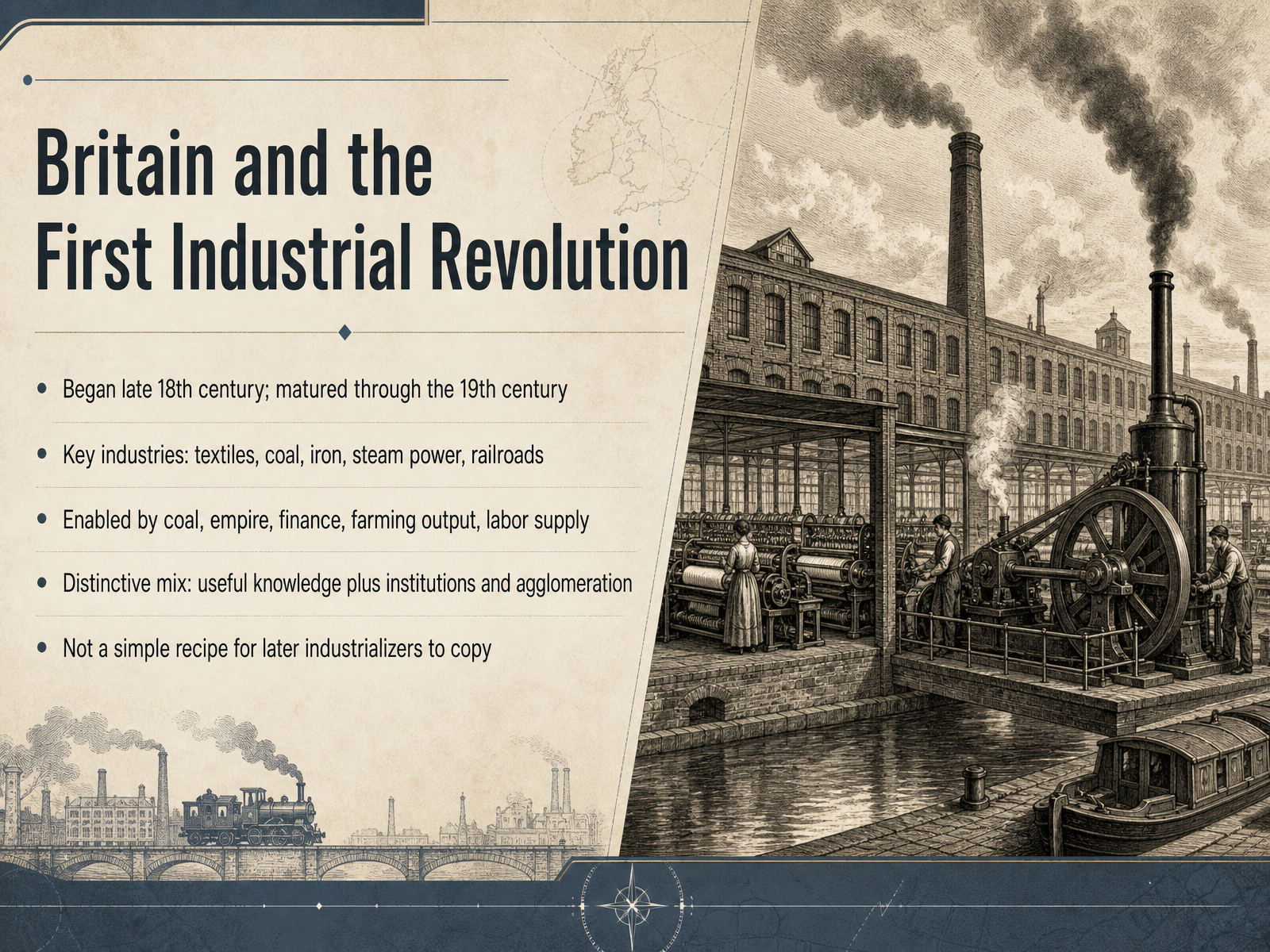
 - 03Britain and the First Industrial RevolutionNow let's turn to where the modern story begins: Britain in the late eighteenth century. Imagine a world powered by muscle, wind, and water. Britain began to change that formula, maturing through the nineteenth century on the strength of textiles, coal, iron, and the steam engine, all linked by new railroads. The fuel for this transformation came from a distinctive mix. Britain had accessible coal, a global empire, a developed financial system, and an agricultural sector that could feed a growing factory workforce. But resources alone weren't enough. Historians often point to something deeper: a supply of useful knowledge, paired with institutions that protected property and encouraged invention. Cities and industrial districts created what economists call agglomeration, the powerful effect of skilled people and ideas clustering together. The crucial lesson is that Britain's path was not a simple recipe. Coal, capital, and clever institutions combined in a particular time and place. Later industrializers would have to find their own way. Next, we'll look at how Western Europe responded with multiple national models of its own.
 cambridge.organnualreviews.orgsociostudies.org+21 min
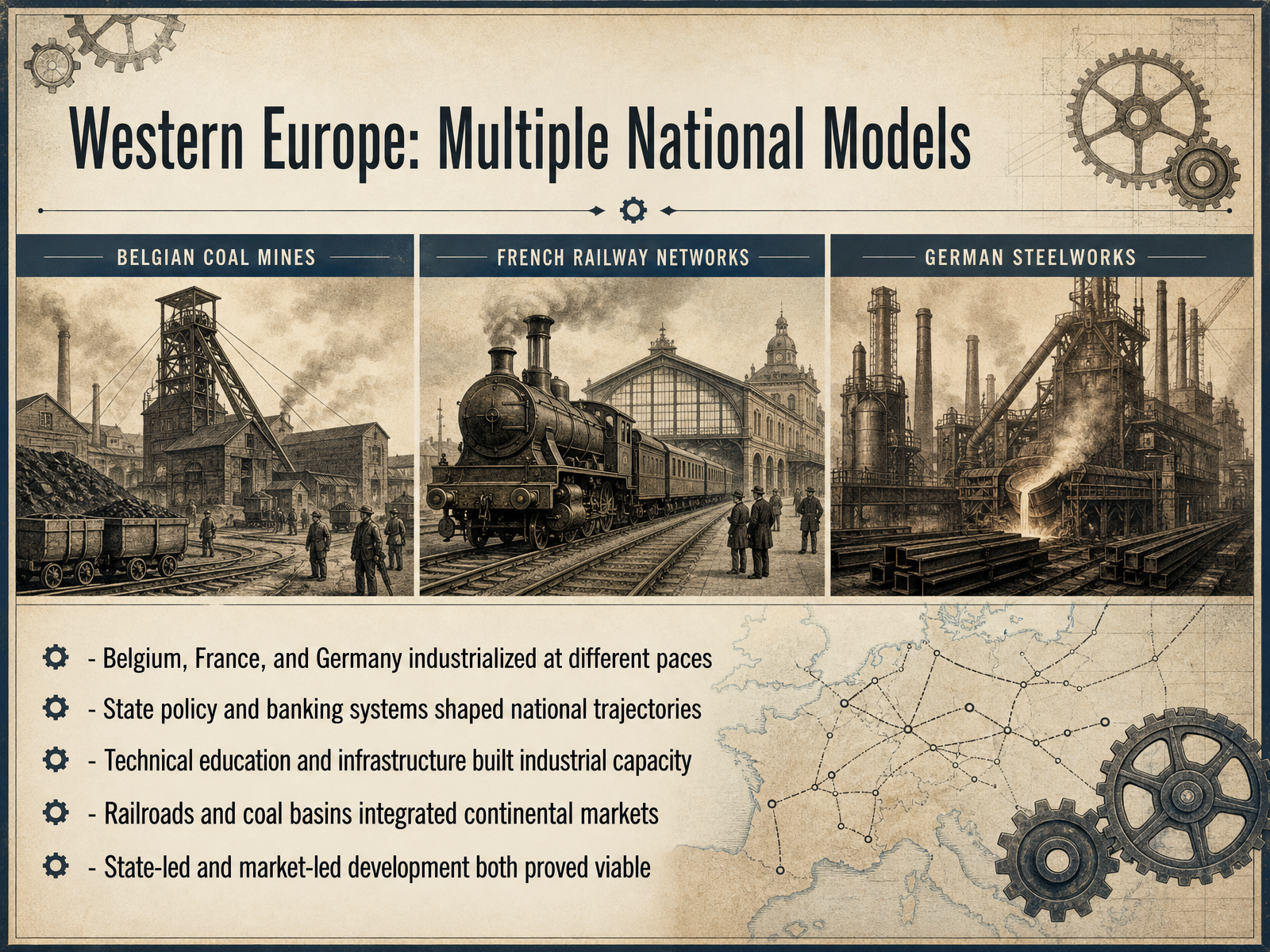
 - 04Western Europe: Multiple National ModelsWhen we look across Western Europe, we see that industrialization was not a single, uniform event. Belgium, France, and Germany each followed their own timeline and their own set of rules. Take Belgium, for example. By the eighteen thirties, it was already a leader on the continent, using its rich coal basins and early railways to move goods and people efficiently. France moved more gradually. Its path was shaped by a powerful state and a cautious banking system, which favored steady, smaller-scale workshops over sudden factory growth. Germany, by contrast, caught up dramatically later in the century. It combined active government support with technical schools and a dense rail network, linking its coal-rich regions into a single, powerful market. What is striking is that both approaches, state-led planning and market-driven growth, proved viable. There was no single recipe for success. The shared lesson is that infrastructure, education, and finance could be mixed in different ways to build industrial power. Next, we will cross the Atlantic to explore how the United States used its vast resources to create a new scale of industry.
 cambridge.organnualreviews.orgsociostudies.org+21 min
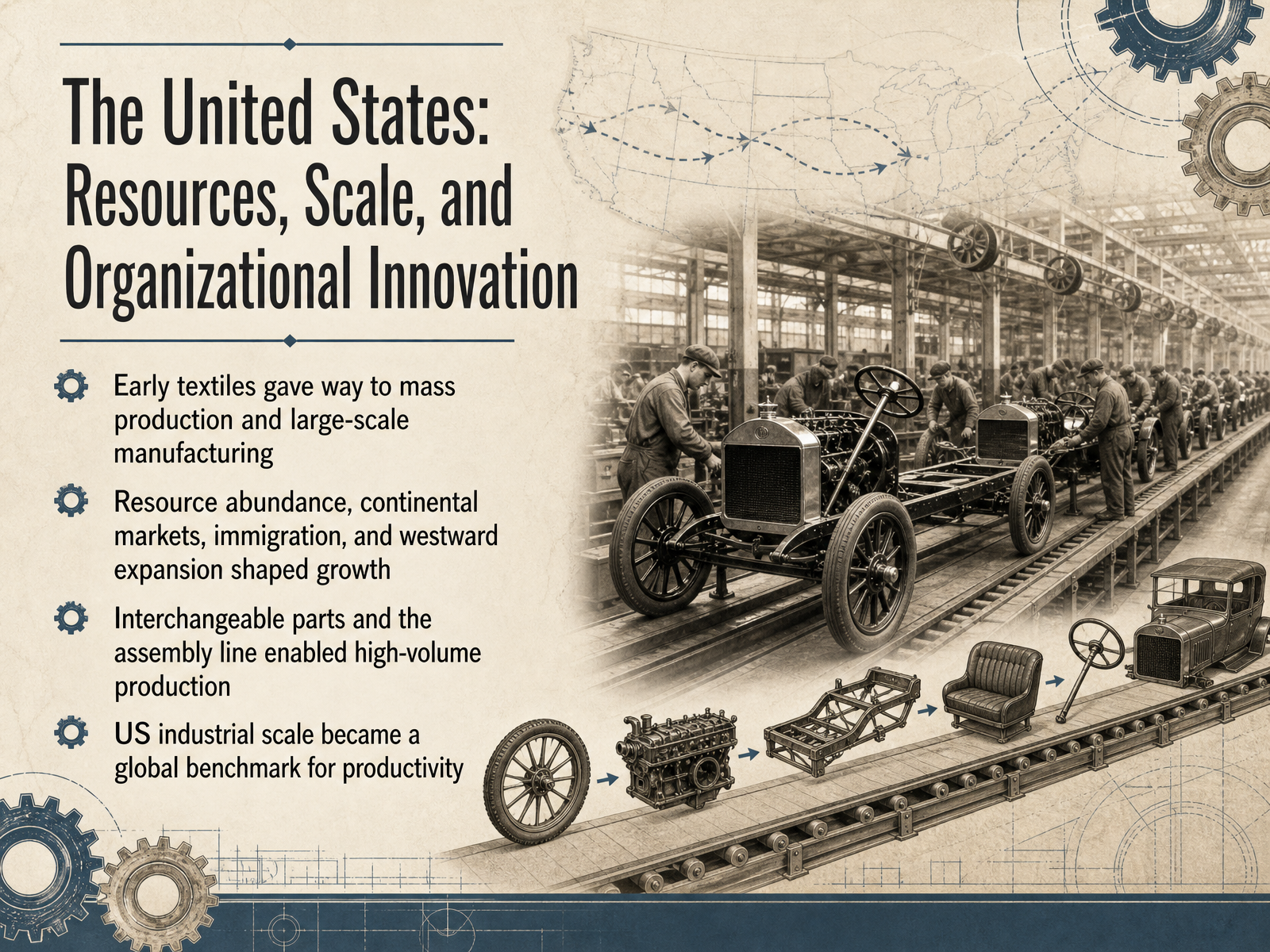
 - 05The United States: Resources, Scale, and Organizational InnovationIn the United States, industrialization took a different turn. Early textile mills in New England showed what machines could do, but the real American story became one of scale. The country had vast natural resources, a growing continental market, and waves of immigrants arriving to work. Westward expansion kept opening new land and new demand. What set the United States apart was not just resources, but organization. The idea of interchangeable parts meant a broken piece could be swapped with another just like it, no custom fitting needed. Later, the assembly line broke production into small, repeated steps. Workers stayed in place while the work moved to them. This approach made high-volume manufacturing possible, and it turned the United States into a global benchmark for productivity. Other nations began to study American factories, not just for what they made, but for how they made it. Next, we turn to Russia and Japan, two late industrializers that followed a very different path.
 britannica.comlink.springer.compure.iiasa.ac.at+21 min
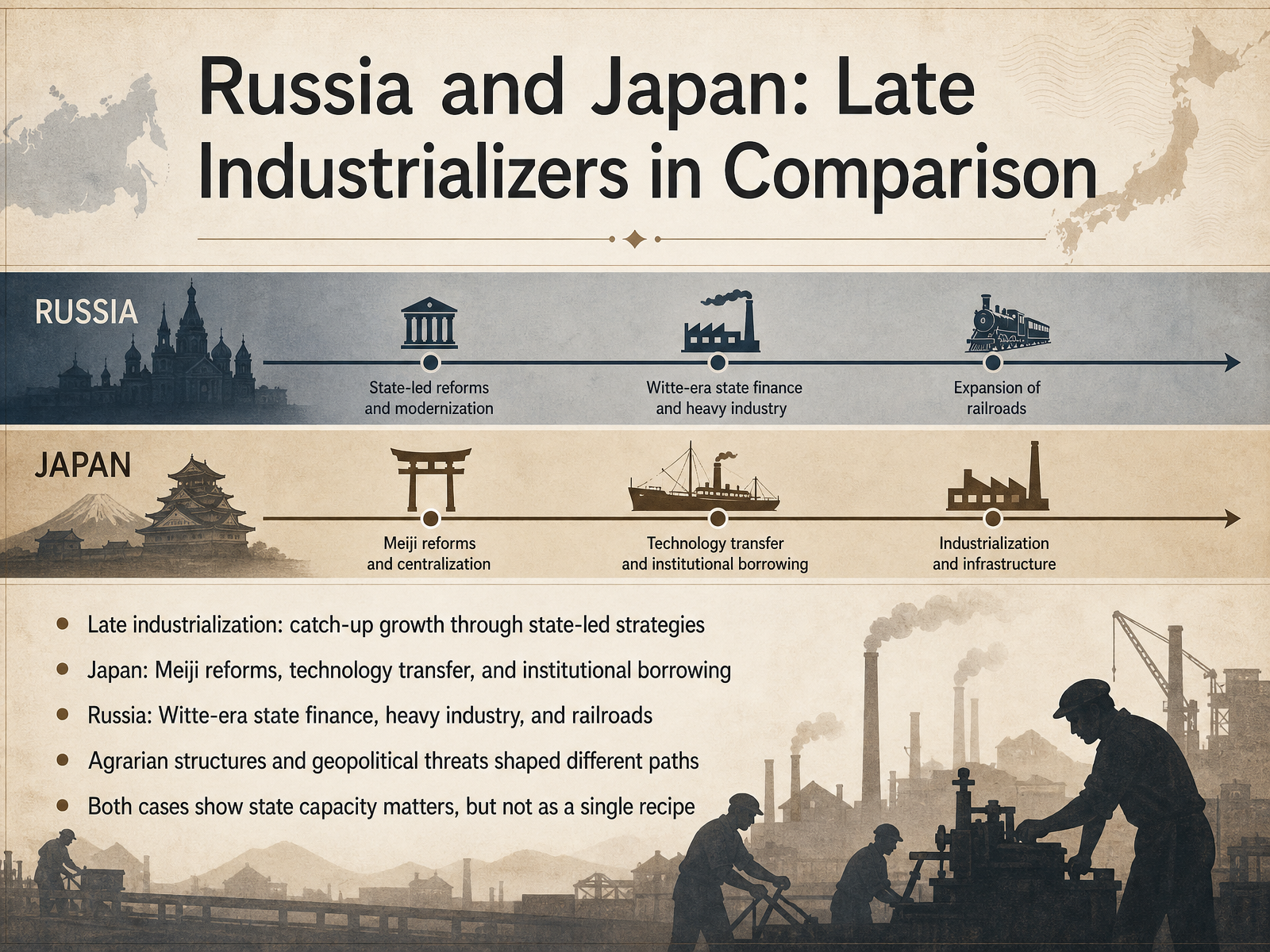
 - 06Russia and Japan: Late Industrializers in ComparisonNow let's look at two countries that took a much more deliberate path to the factory age: Russia and Japan. Both began industrializing late in the nineteenth century, and both leaned heavily on the state to close the gap. But the way they did it was quite different. Japan, after the Meiji Restoration in eighteen sixty-eight, sent students abroad and hired foreign experts, copying institutions and importing technology directly. It was a focused effort to build modern industry without falling under foreign control. Russia, under finance minister Sergei Witte in the eighteen nineties, relied on state finance to fund heavy industry and an expanding railroad network. In both cases, older agrarian structures and the fear of foreign powers shaped what leaders thought was possible. What the comparison really shows is that state capacity matters, but there is no single recipe for successful industrialization. The Russian project collapsed under revolution, while Japan's created a new industrial power. With that in mind, we turn next to a region where export-oriented industrialization created another path entirely.
 cambridge.orgroutledge.comcambridge.org+22 min
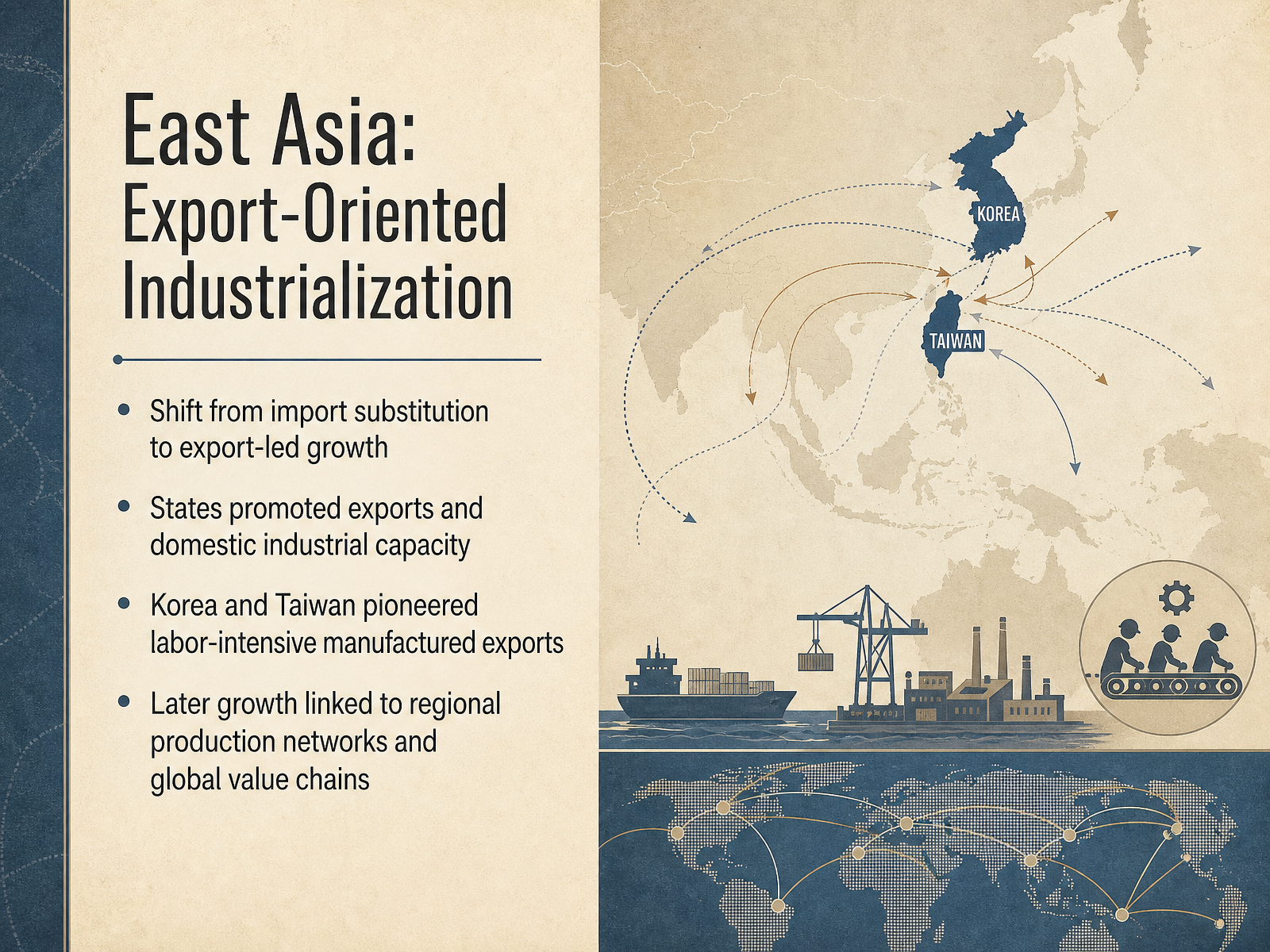
 - 07East Asia: Export-Oriented IndustrializationIn East Asia, the path to industrial power took a different turn. Countries here shifted away from making goods only for themselves, and instead began producing for the world. We call this export oriented industrialization. The idea was simple. Governments actively promoted exports while also building up their own domestic industrial capacity at the same time. South Korea and Taiwan were the pioneers. Starting in the nineteen sixties, they focused on labor intensive manufactured goods, products like textiles and simple electronics that required a lot of workers. This export push brought in foreign money and accelerated their economic growth dramatically. Over time, this model evolved. Growth became deeply linked to regional production networks and global value chains. A single product might be designed in one country, have its parts made in another, and be assembled in a third. This connected approach transformed East Asia into a manufacturing powerhouse. Next, we will look at how industrialization unfolded under colonial and postcolonial conditions.
 documents1.worldbank.orgsouthcentre.intideas.repec.org+21 min
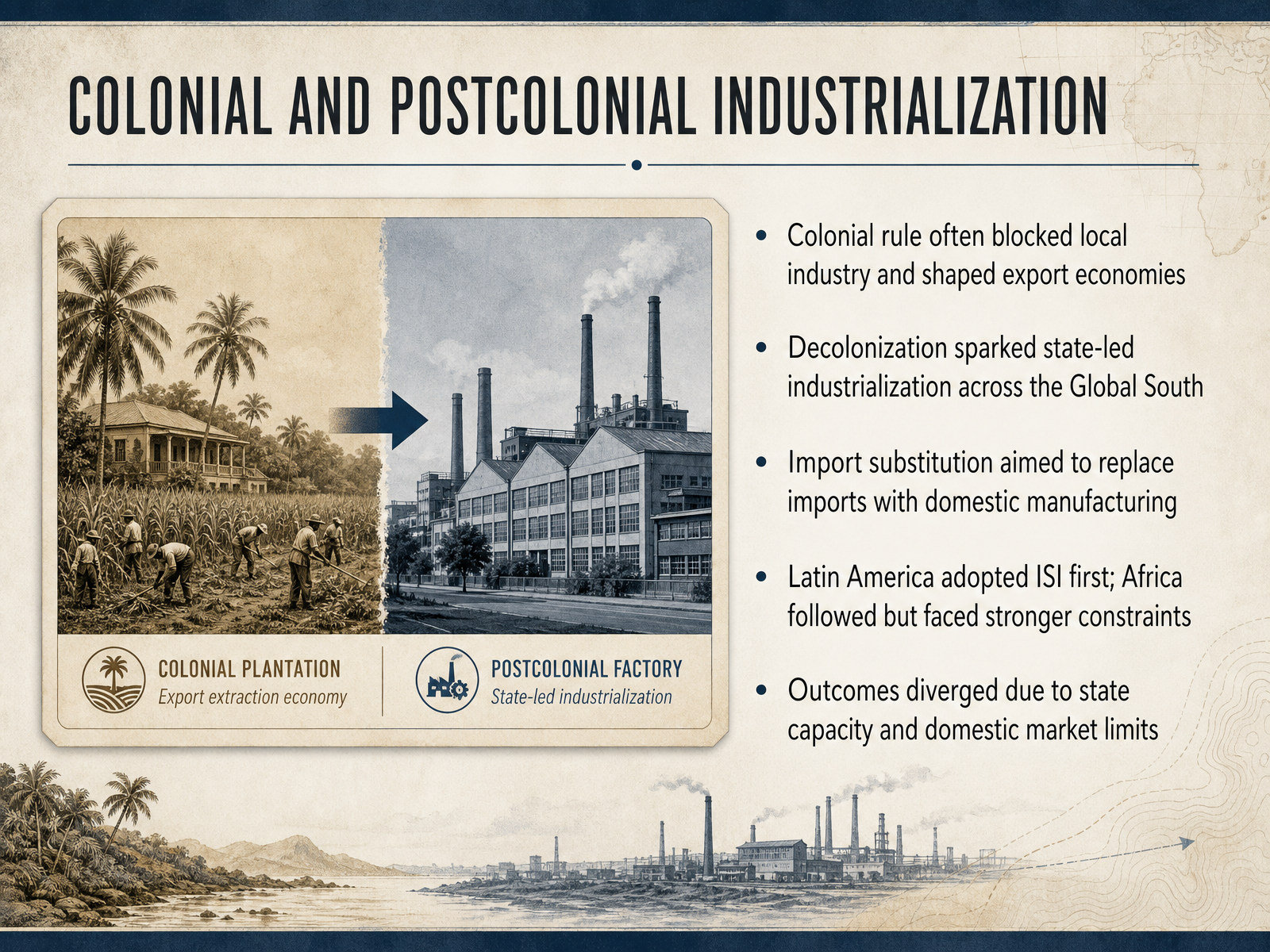
 - 08Colonial and Postcolonial IndustrializationNow, look at what happened when colonial rule ended and new nations took charge of their own economies. Colonial powers had often kept their colonies as raw material suppliers, which blocked local industry from growing. After independence, many governments in the Global South tried to change that through state-led industrialization. A common approach was import substitution, a policy that aimed to replace foreign-made goods with products manufactured at home. Latin American countries such as Brazil, Mexico, and Argentina adopted this strategy most deliberately in the nineteen fifties and early sixties. African nations, many of them independent by the late fifties and sixties, followed the same path. Yet their results diverged sharply. Africa faced much stronger limits: smaller domestic markets, weaker state capacity, and deeper shortages of skilled labor and capital. So the same idea produced very different outcomes depending on local conditions. Next, we turn to resource frontiers and global supply chains.
 1 min
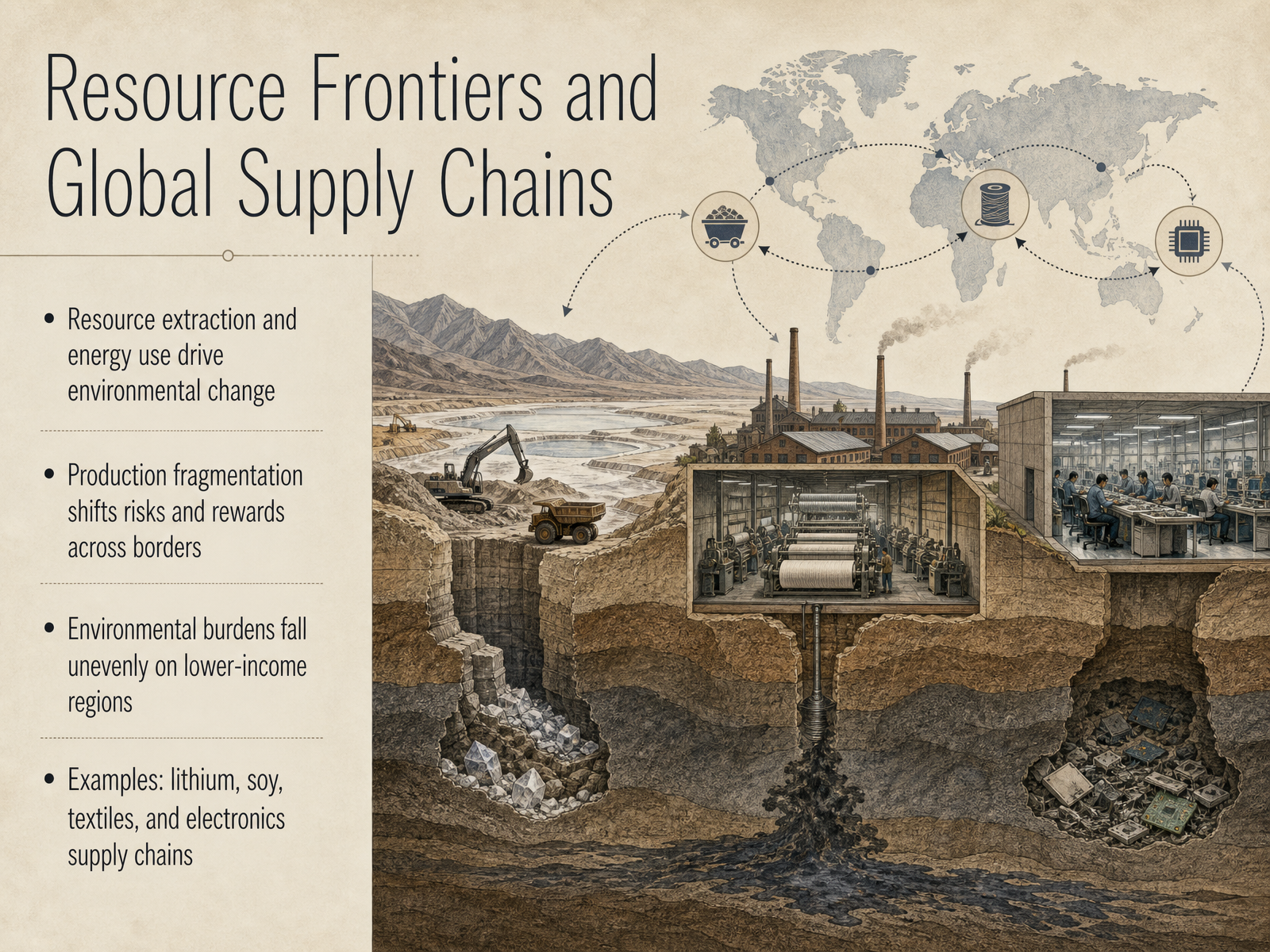
1 min - 09Resource Frontiers and Global Supply ChainsAs industrialized economies matured, they began reaching across borders for the materials and labor that could keep costs down and production moving. This created what we can think of as resource frontiers, places where extraction and manufacturing expand to feed global supply chains. Consider lithium mined in the high deserts of Argentina, or soy grown across Brazil's Cerrado. These products flow into batteries, animal feed, and processed foods consumed far away. Production is fragmented, split across countries, so risks and rewards are not shared equally. Environmental burdens, like water depletion, toxic waste, and deforestation, tend to fall hardest on lower-income regions. Electronics assembled in one place rely on minerals from another, while textile dyeing pollutes rivers near factories that serve distant markets. The pattern is consistent. Wealthier consumers gain convenience and cleaner local environments, while the ecological costs accumulate elsewhere, often out of sight. Understanding this geography of extraction and disposal helps us see industrialization not as a single national story, but as a connected global system with very uneven consequences. Next, we'll turn from these supply chains to the ways industrialization rebuilt cities, reshaped labor, and widened inequality.
 1 min
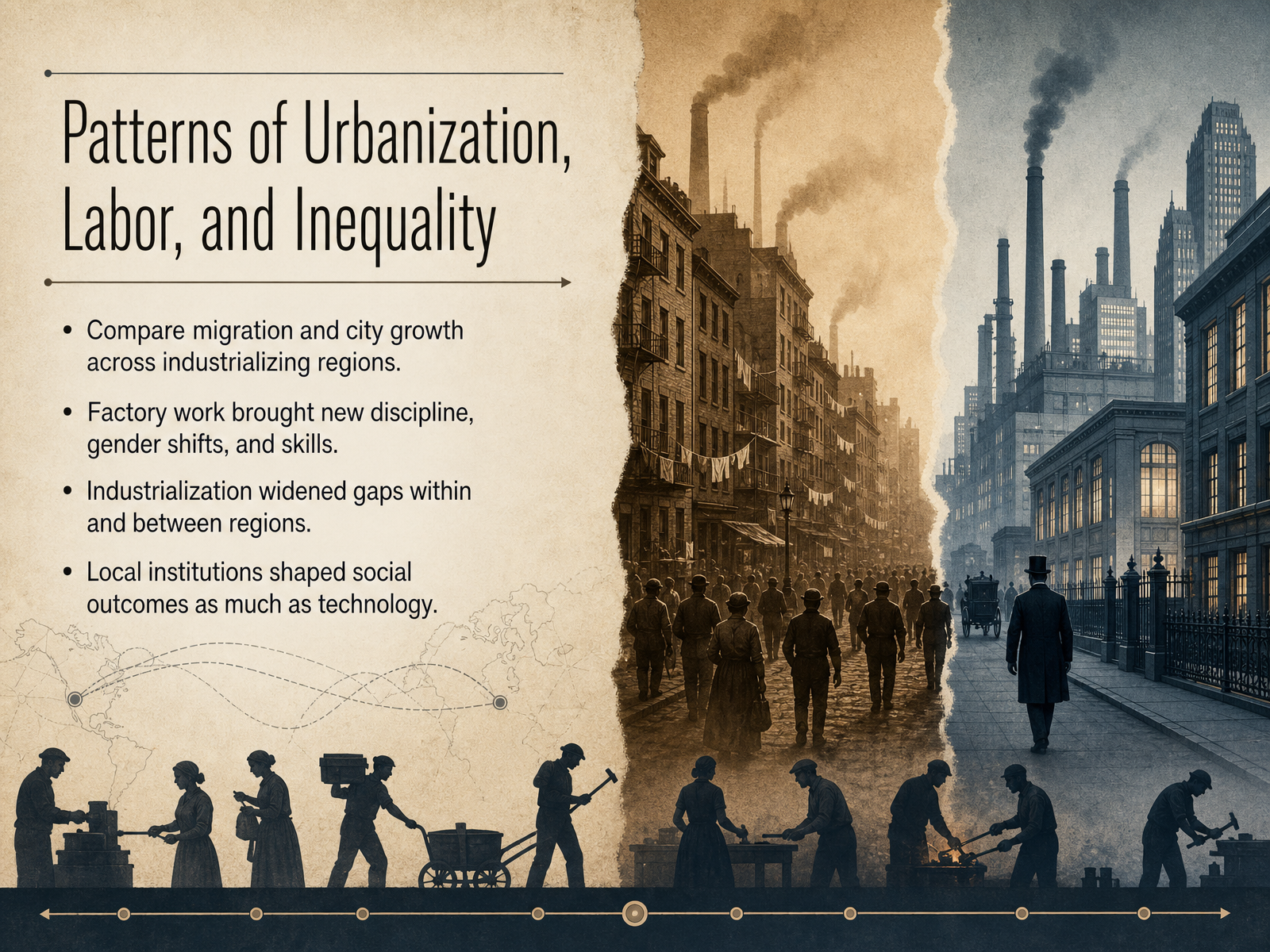
1 min - 10Patterns of Urbanization, Labor, and InequalityNow, let us turn from the machinery itself to the human landscape it created. As factories rose, they pulled millions of people from the countryside into swelling cities. Manchester in England, for example, became a symbol of this new urban world by the eighteen forties, and similar transformations unfolded in places like Chicago and Osaka, each with its own rhythm. Inside the factory gates, work followed a new kind of discipline. The clock, not the season, dictated the day, and the workforce itself changed, with more women and children entering wage labor, though their roles and pay often differed sharply from men's. At the same time, industrialization did not lift everyone equally. It widened gaps, both within nations, between factory owners and laborers, and across regions, as industrial cores pulled ahead of suppliers of raw materials. But technology was not the only force at work. Local institutions, like unions, charities, schools, and city governments, shaped who benefited and who was left behind. So we see that the factory floor and the city street were as powerful as the steam engine in deciding the human outcomes of this era. Next, we will examine the other side of this story, as we move to deindustrialization and post-industrial transitions.
 britannica.comlink.springer.compure.iiasa.ac.at+22 min
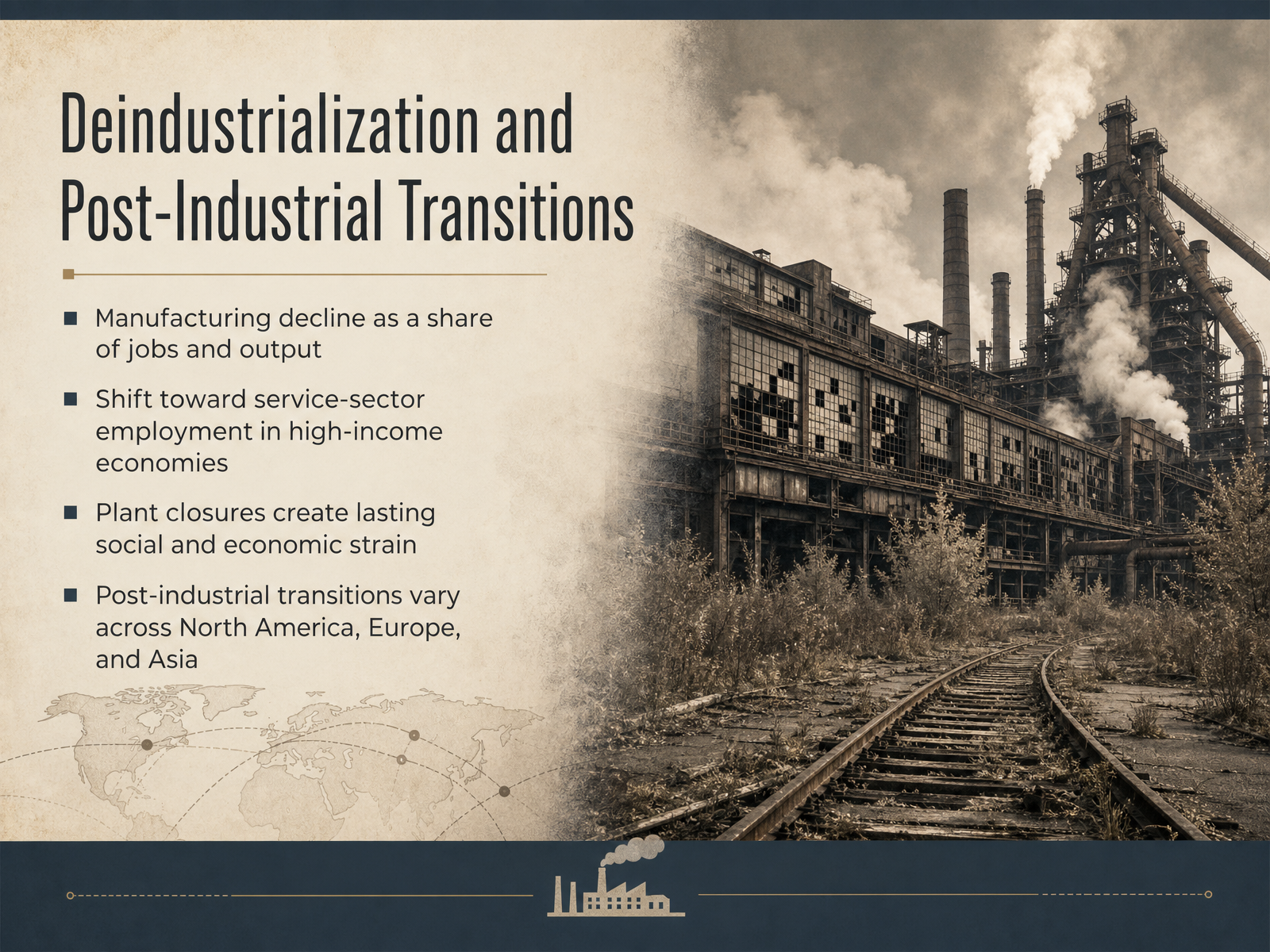
 - 11Deindustrialization and Post-Industrial TransitionsNow we turn to a different kind of change, one that moves in the other direction. In many high-income economies, manufacturing has been shrinking as a share of both jobs and output. That is what we mean by deindustrialization. It does not mean these countries stopped producing things, but factories now employ far fewer people than they once did, and services such as health care, finance, and education have taken over as the main sources of work. The human cost is real. When a plant closes in a town built around it, the loss is not only economic. Families lose stability, and whole communities can struggle for years to find a new purpose. But the story is not the same everywhere. In parts of North America and Western Europe, the shift toward services came with high incomes and new kinds of work. In parts of Asia, manufacturing often declined only after long periods of industrial growth, and some countries still rely heavily on factory jobs as they move up the income ladder. So post-industrial life looks different depending on where you stand, and local history shapes what comes next. Up next, we will look at the legacies and lessons that these regional experiences leave behind.
 britannica.comlink.springer.compure.iiasa.ac.at+22 min
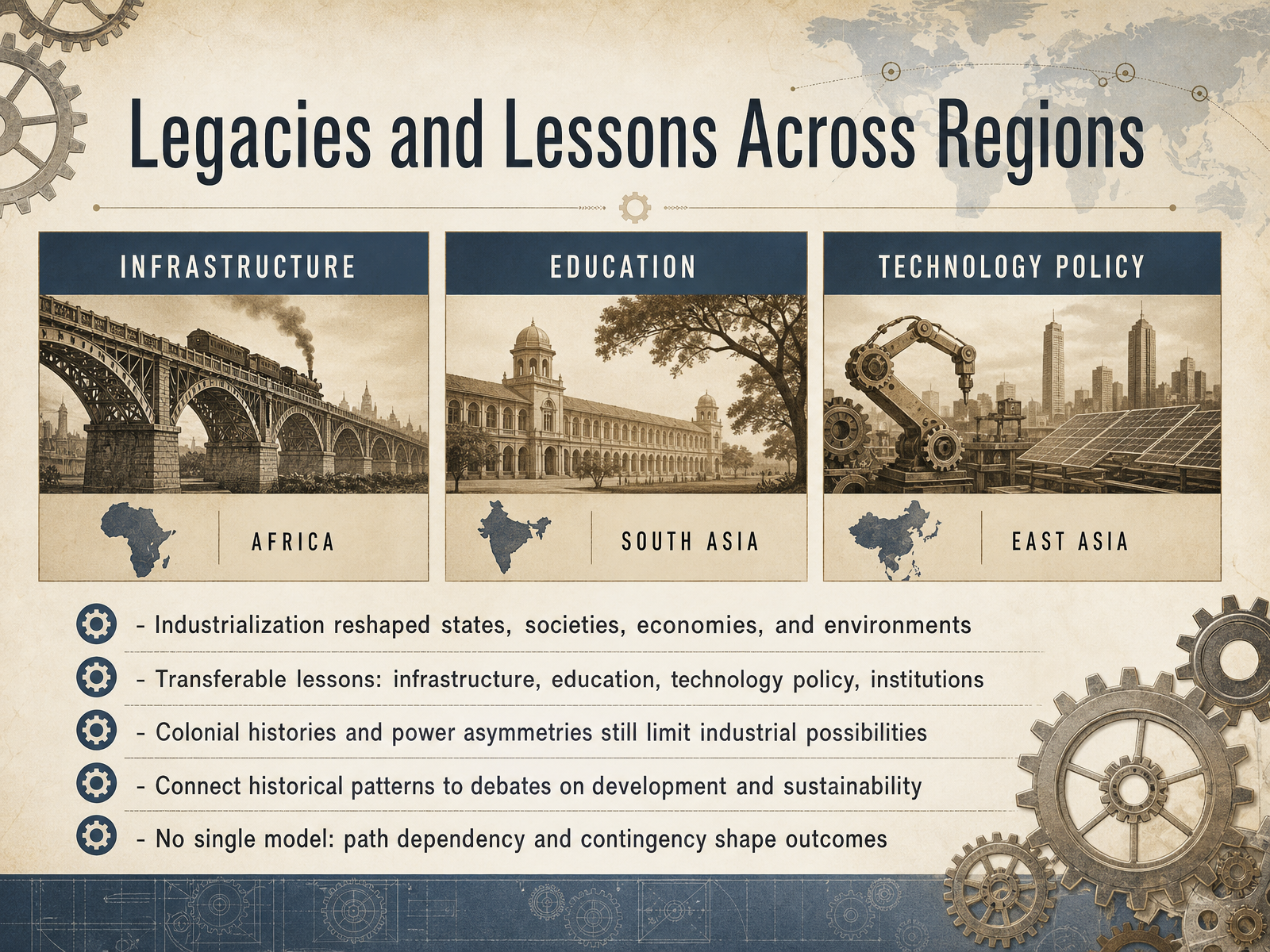
 - 12Legacies and Lessons Across RegionsStepping back, the legacies here are not simply about machines. Industrialization reshaped states, societies, economies, and even the environment. Looking across regions, we can see some transferable lessons. Things like investing in infrastructure, education, technology policy, and stable institutions often mattered. Yet the weight of history is heavy. Colonial histories and unequal power relationships still limit industrial possibilities in many places today. These historical patterns connect directly to current debates on development and sustainability. The most important takeaway is that there was no single model for success. Path dependency, the idea that past choices limit future options, and contingency, the role of chance, shaped outcomes everywhere. Britain’s path was not Japan’s. Latin America’s experience differed from sub-Saharan Africa’s. Understanding these varied paths helps us ask better questions about the future. Next, we will explore a case study on comparative development in practice.
 cambridge.organnualreviews.orgsociostudies.org+22 min
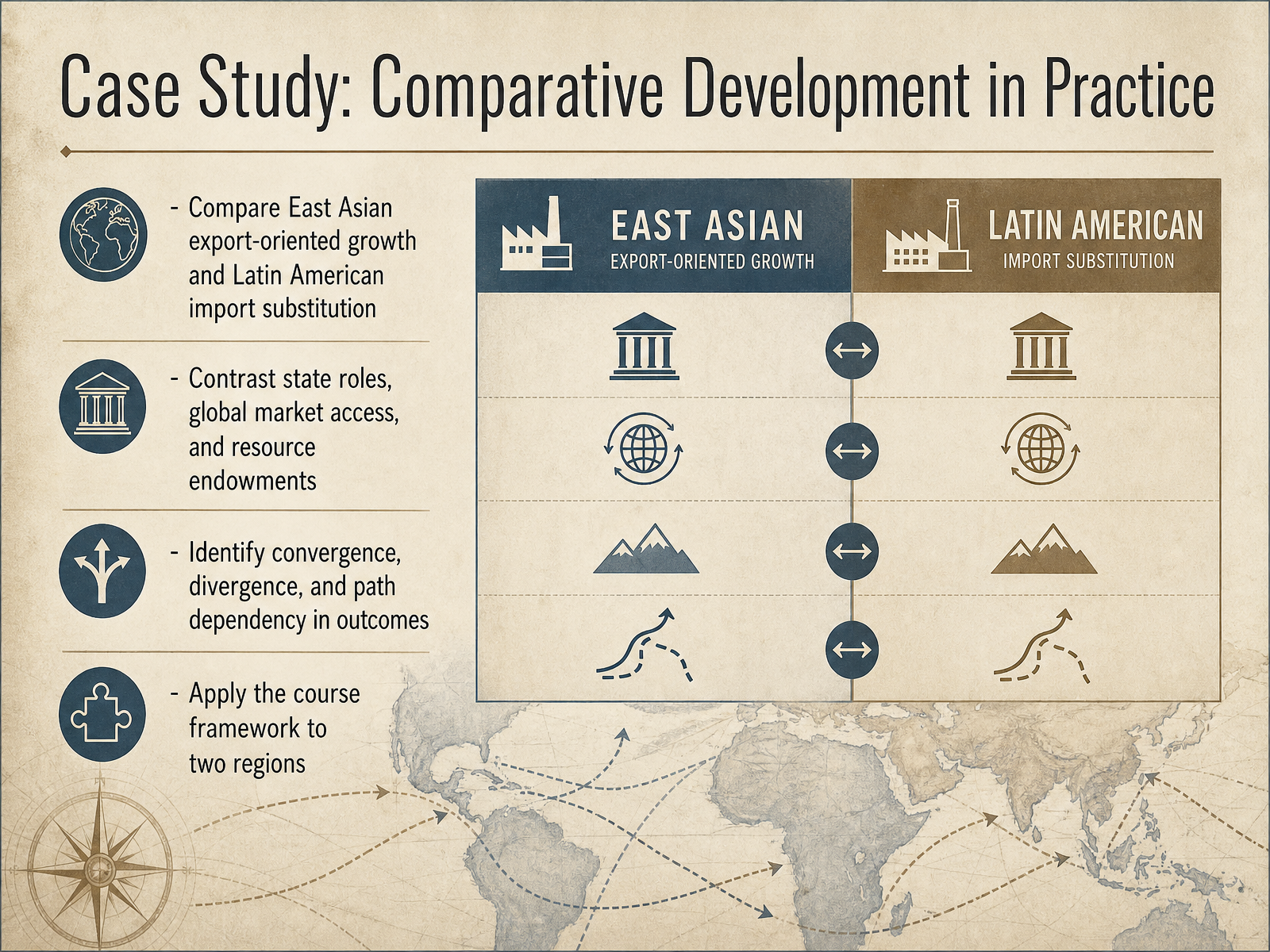
 - 13Case Study: Comparative Development in PracticeNow let's bring these threads together with two regions that chose very different paths. Think of East Asia, where countries like South Korea and Taiwan shifted toward export-oriented growth around the nineteen sixties. They focused on labor-intensive manufactured goods, sold to the wider world. The state often guided this process, setting export targets and supporting domestic firms. That outward push helped turn small economies into global producers. In contrast, many Latin American countries, such as Brazil and Argentina, leaned toward import substitution. They wanted to build domestic industry by making products locally instead of buying them from abroad. The state protected those young industries with tariffs and trade barriers. But over time, those protected firms often faced high costs and limited competition. The results diverged. East Asian economies generally moved toward global convergence, while many Latin American economies saw slower growth and path dependency, sticking with familiar strategies even as they became less effective. So the framework here is not just abstract. It helps us see how state roles, market access, and resources shape real outcomes. In our final slide, we will step back and think about teaching these patterns across regions.
 documents1.worldbank.orgsouthcentre.intideas.repec.org+21 min
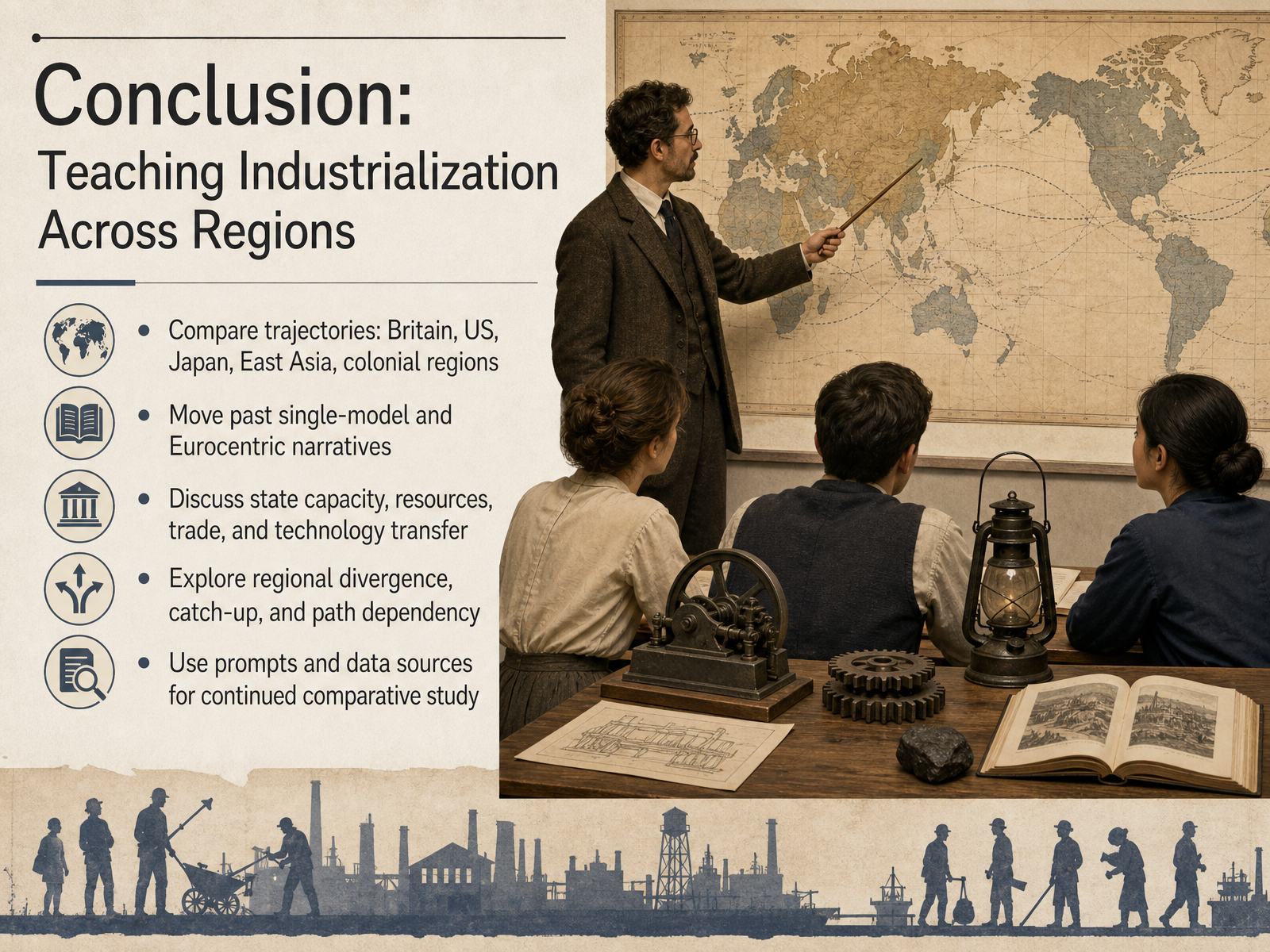
 - 14Conclusion: Teaching Industrialization Across RegionsAs we close, let's step back and see the bigger picture. Industrialization was never a single road. Britain's early start, the resource-rich expansion of the United States, Japan's state-guided catch-up, and the varied experiences of East Asia and colonial regions all tell different stories shaped by state capacity, resources, trade, and the movement of technology. Moving past a single-model or Eurocentric view lets us appreciate both regional divergence and later catch-up, and how early choices set paths that still matter today. We can continue the comparison with careful prompts and reliable data sources. Thank you for thinking through this global story together. Keep asking how place, power, and circumstance shape the ways societies industrialize.
 britannica.comlink.springer.compure.iiasa.ac.at+22 min
Take the deck with you
Download this course as a file — free, no sign-up needed.
- PDF handoutEvery slide page, ready to print or share.15 pages · 6.2 MBDownload
- Narrated PowerPointThe deck that presents itself — every slide carries the digital human's narration video.15 pages · 17.9 MBDownload
- PowerPoint slidesThe full deck as a .pptx — open it in PowerPoint, Keynote, or Google Slides.15 pages · 6.2 MBDownload
Free to use in your own training — please keep the PersonWise credit page at the end.
Have your own deck? Turn it into a course
Sources consulted
Web sources consulted while building this course.
- Industrialization — britannica.com
- Geography of Industrialization | Springer Nature Link — link.springer.com
- Industrialization as a Historical Phenomenon — pure.iiasa.ac.at
- WIDER Working Paper 2021/28-A manufacturing renaissance? Industrialization trends in the developing world — wider.unu.edu
- WIDER Working Paper 2017/34 Variation in structural change around the world, 1985–2015: Patterns, causes, and implications — wider.unu.edu
- Eurasian Historical Comparisons | Social Science History | Cambridge Core — cambridge.org
- Industrial Policy and the Great Divergence | Annual Reviews — annualreviews.org
- Rethinking 'Industrial Revolution' from a Global Perspective — sociostudies.org
- Labour-Intensive Industrialization in Global History: A Review Essay — ideas.repec.org
- An Economic History of Regional Industrialization - 1st Edition - Bas — routledge.com
- Reforming States, Agricultural Transformation, and Economic Development in Russia and Japan, 1853–1913 | Comparative Studies in Society and History | Cambridge Core — cambridge.org
- States And Markets: Comparing Japan And Russia - 1st Edition - Guoli L — routledge.com
- Japan and Russia: Bureaucratic Politics in a Comparative Context — cambridge.org
- Gerschenkron, Amsden, and Japan: The State in Late ... — cambridge.org
- Financing Late Industrialization: Evidence from the State Bank of the Russian Empire | The Journal of Economic History | Cambridge Core — cambridge.org
- The paper examines the industrial policies applied in Taiwan and Korea during the nineteen-sixties. It is showrn that following the com- pletion of the process of inport substitution in consumer durables and their inputs in the late fifties, both countries have adopted an outward- looking developmen — documents1.worldbank.org
- Research Paper 57, November 2014 — southcentre.int
- The East Asian Export-Led Industrialization in the Global ... — ideas.repec.org
- WIDER Research Paper 2006-76 Rethinking Import-substituting Industrialization: Development Strategies and Institutions in Taiwan and China — wider.unu.edu
- Industrial policy in the era of global value chains: Towards a developmentalist framework drawing on the industrialisation experiences of South Korea and Taiwan — onlinelibrary.wiley.com