Public Speaking: Goals to Execution
Begin
14 pages · ~28 min
Public Speaking: Goals to Execution
Course on public speaking fundamentals, teaching learners to define clear speaking goals and execute effective presentations with confidence.
What you’ll learn
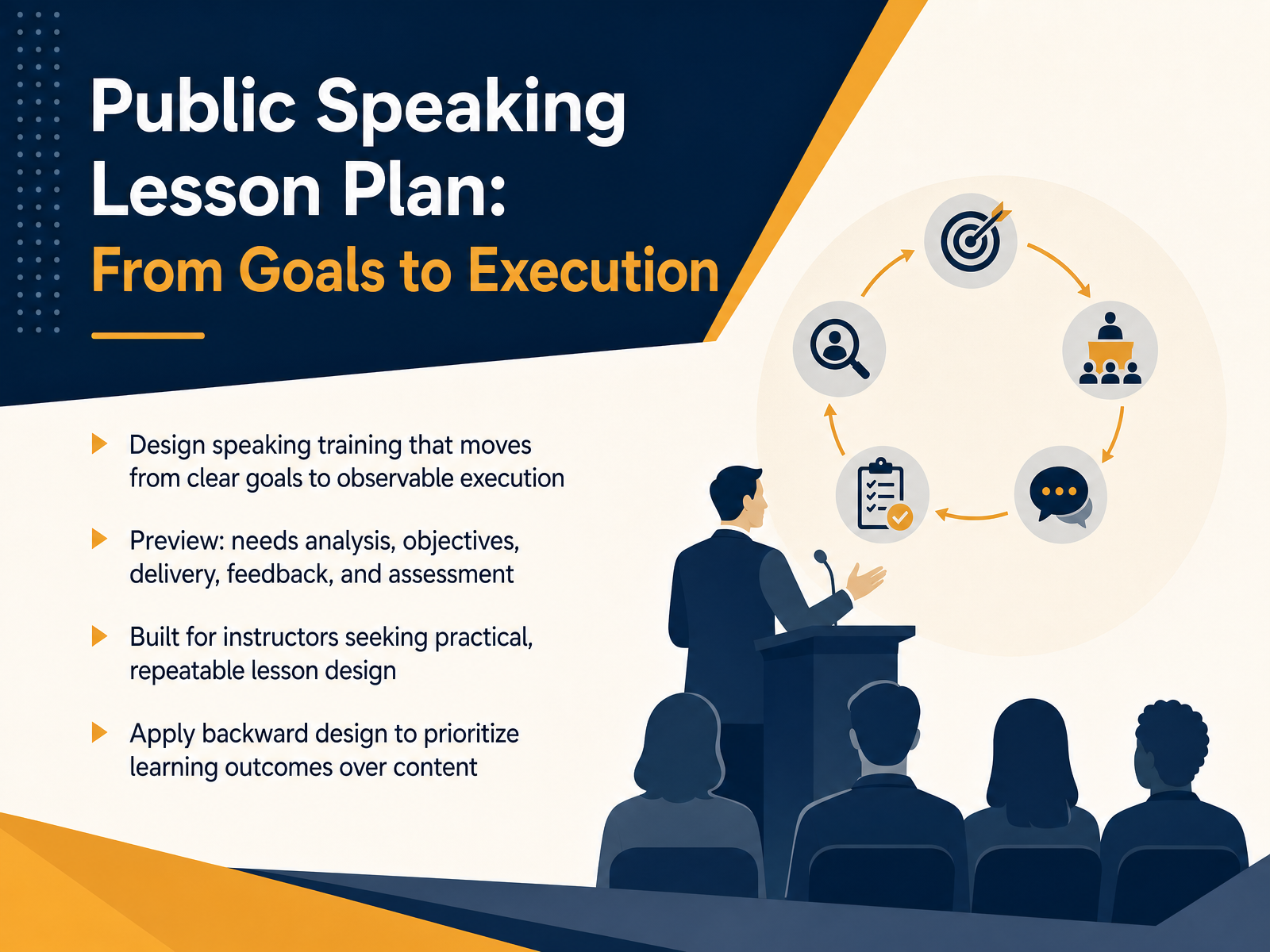
- 01Public Speaking Lesson Plan: From Goals to ExecutionWelcome. If you’re here, you already know that teaching public speaking is about more than assigning speeches. It’s about building a structured path from clear goals to observable execution. Today, we’re going to walk through a lesson plan framework that works in any classroom or workshop. We’ll cover needs analysis, setting precise objectives, guiding delivery, giving feedback, and assessing real growth. This is designed for instructors who want a repeatable process, not a one-off activity. So we’ll anchor everything in backward design. That means we start with the learning outcomes, then build content and activities to reach them. No more coverage for coverage’s sake. Every speech, every exercise, every evaluation should serve a purpose your students can see. Let’s begin with why goal-first design matters.uttyler.edulit.edumy.nctc.edu+21 min
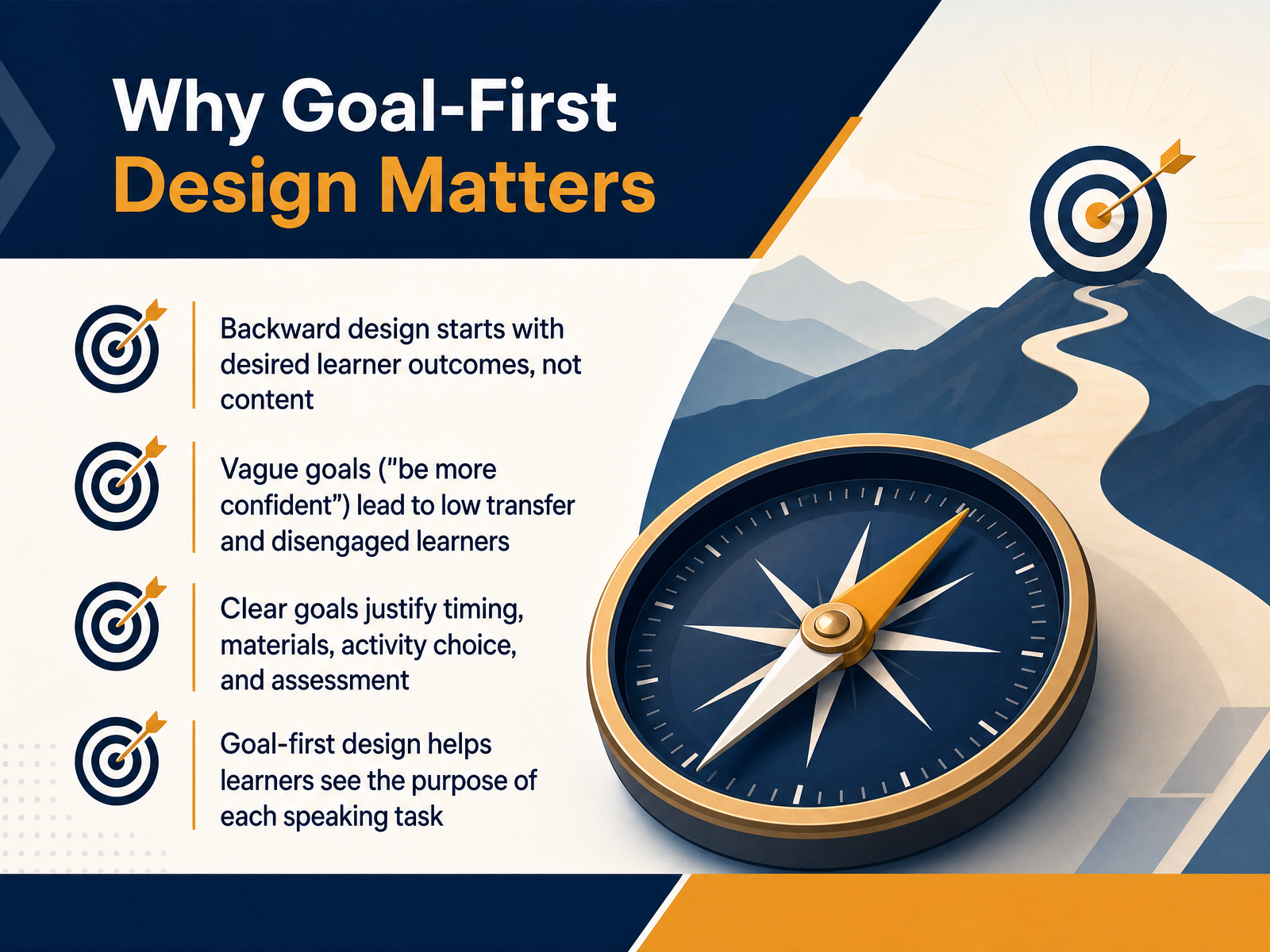
- 02Why Goal-First Design MattersLet's talk about why starting with the end in mind changes everything in our teaching. Backward design flips the traditional process. Instead of picking content first, we ask: what should learners actually be able to do when they walk out? That's the anchor. And here's the challenge we all face. Vague goals like 'be more confident' sound nice, but they're hollow. They lead to low transfer and disengaged learners because there's no clear target. When we define precise, observable outcomes, everything snaps into focus. We can justify the timing of each module, choose materials that serve a purpose, and select activities that build real skill. And assessments stop being arbitrary. They measure what we said we'd teach. Goal-first design also transforms the learner's experience. When they see why each speaking task exists, the work becomes relevant, not busywork. They see the scaffold. They see the purpose. As instructors, we already know this. We're not just covering chapters. We're engineering competence. Start with the destination, and you'll know exactly how to get there. Next, let's look at diagnosing learner needs and context.
 uttyler.edulit.edumy.nctc.edu+22 min
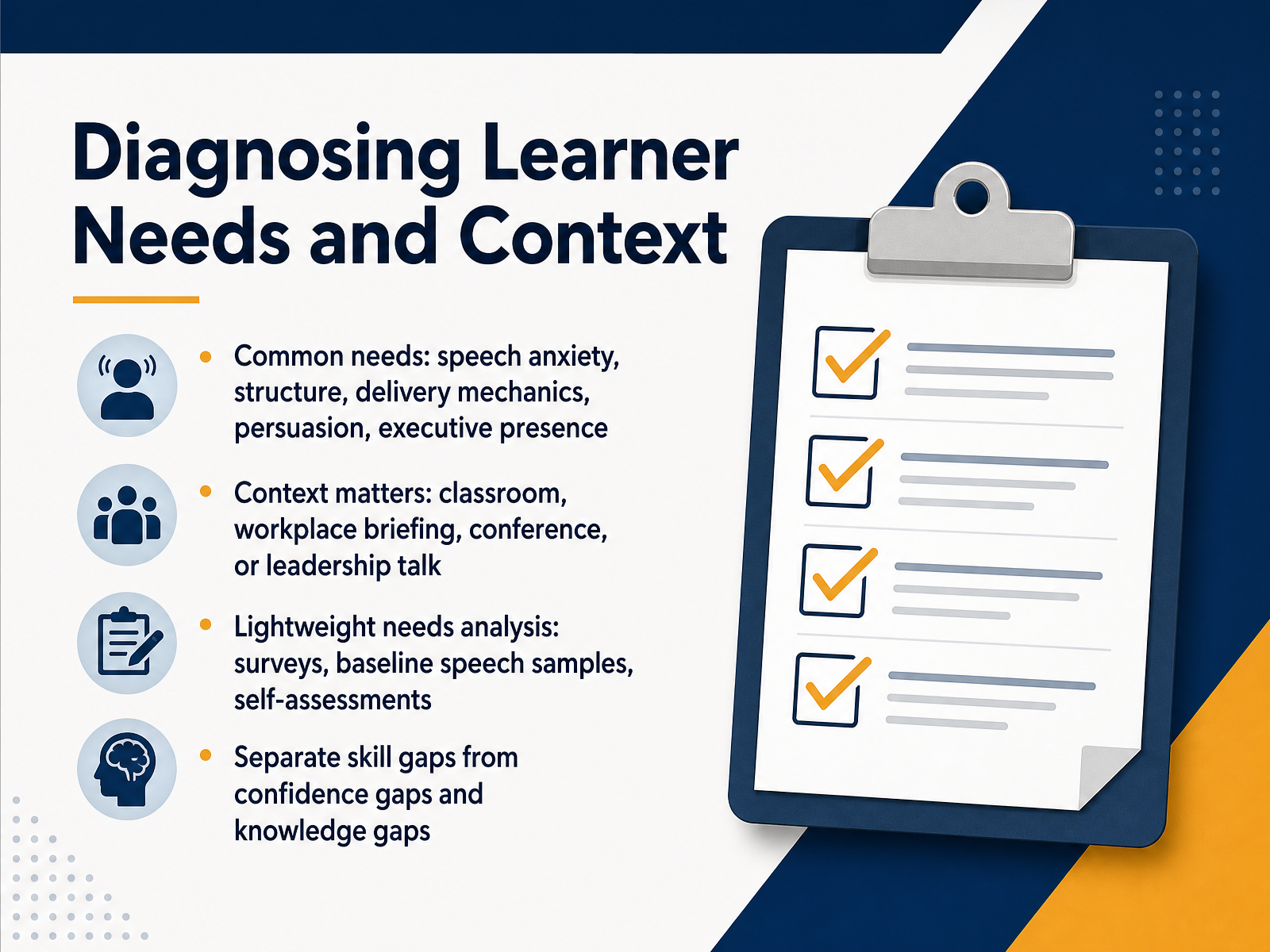
 - 03Diagnosing Learner Needs and ContextBefore you can set goals, you need to know what actually needs fixing. Let's talk about diagnosis. Start by understanding the common pain points your learners bring in. We typically see these. Speech anxiety, which is almost always present. A need for stronger structure. Challenges with delivery mechanics. The desire to persuade effectively. And for professionals, that push for executive presence. But here is the key. Context changes everything. The same person may present confidently in a classroom, but become rigid in a workplace briefing. A conference stage demands different skills than a leadership talk to the board. So, gather data early with a lightweight needs analysis. Use surveys, collect baseline speech samples, and ask for self-assessments. And here is the most important diagnostic step. Separate skill gaps from confidence gaps and knowledge gaps. A learner can know how to structure a speech and still freeze from anxiety. That is not a teaching problem, that is a coaching problem. Diagnose the true gap first, and your training will hit the mark.
 ejournal1.unud.ac.idlink.springer.comeric.ed.gov+22 min
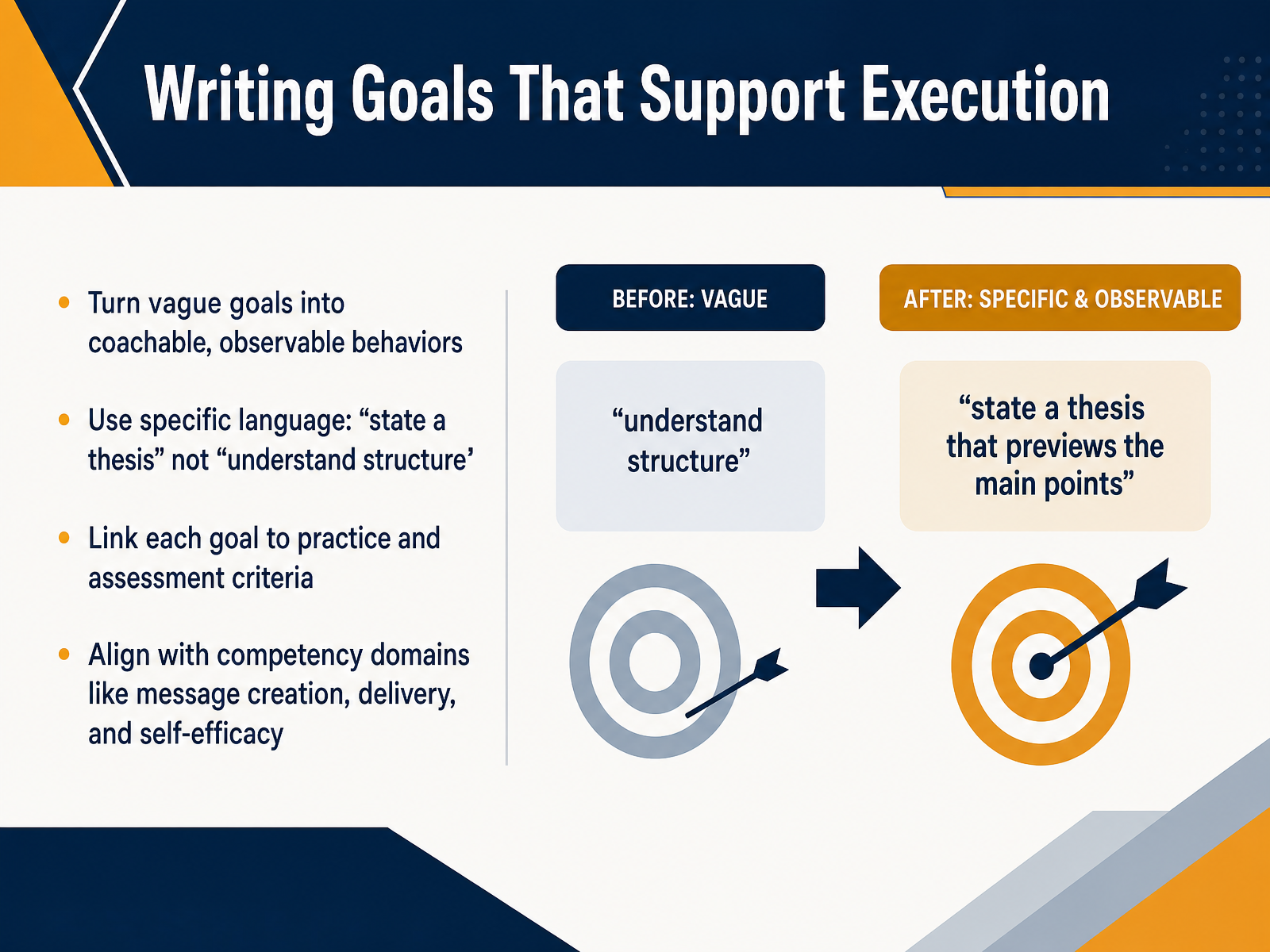
 - 04Writing Goals That Support ExecutionLet us turn those broad goals into concrete execution plans. The shift begins with language. Replace vague ambitions with coachable, observable behaviors. Do not write, understand structure. Write, state a thesis in the opening thirty seconds. Specific verbs make feedback possible. They tell the learner exactly what success looks like. Next, anchor every goal to a practice activity and an assessment criterion. If the goal is to gesture naturally, then practice includes a timed rehearsal and assessment checks for purposeful hand movement. Finally, align each objective to competency domains. Message creation, delivery, critical analysis, and self-efficacy each require distinct attention. For instance, a course goal about reducing anxiety belongs under self-efficacy, not delivery. That alignment ensures your rubric measures what you actually taught. Remember, a goal is only as strong as its clarity. Observable behaviors, tied to practice and assessment, aligned to competencies. That is the architecture of execution. Now, let us consider how those objectives translate into a lesson structure.
 ecommons.udayton.eduoklahoma.govmy.nctc.edu+21 min
 - 05From Objectives to Lesson StructureNow let's turn those objectives into a lesson skeleton. Think of the session as five clear movements: warm-up, instruction, guided practice, independent application, and feedback. Build that skeleton early, and you give your learners a roadmap they can feel. The discipline here is subtraction. Cut your content down to the minimum viable. One technique mastered beats five techniques introduced. Sequence each stage so it builds toward observable execution. Introduce a concept, model it, then let your learners try it in a low-stakes pair before they step up alone. Time-box every stage and make your transitions visible. Say, 'We have eight minutes for drafting, then we move to delivery.' Visible transitions keep momentum and reduce anxiety. A practical example: a warm-up where speakers greet the room, a micro-lecture on rhetorical appeals, then guided practice with color-coded feedback, and you have a session that moves from theory to confident execution in under an hour. Get the skeleton right, and the rest of your lesson plan writes itself. Next, let's talk about choosing execution-first activities.
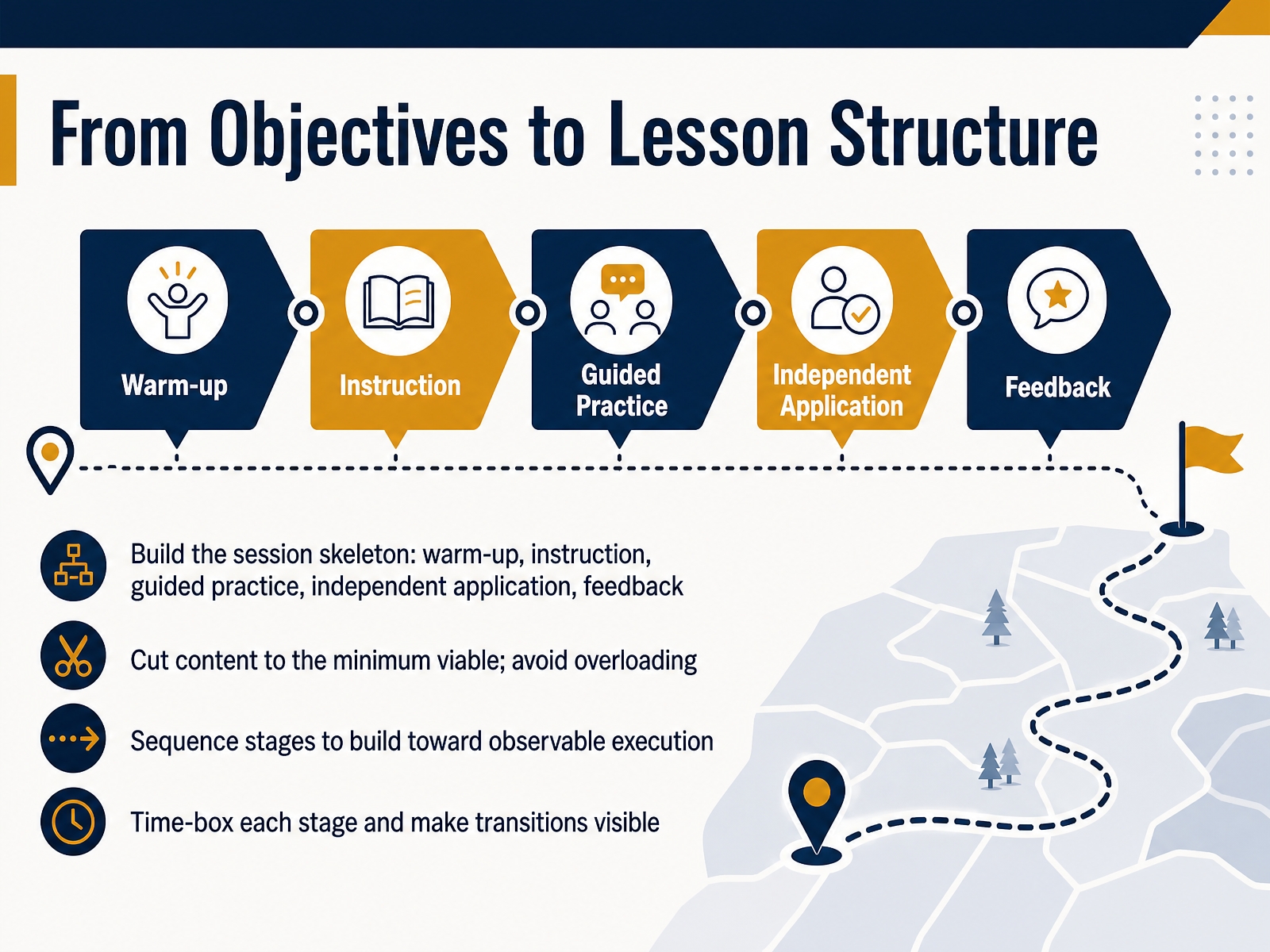 digitalcommons.dartmouth.eduteachingenglish.org.ukmoneyinstructor.com+22 min
 - 06Choosing Execution-First ActivitiesNow let's talk about choosing activities that put execution first. The guiding principle is simple: match the activity type to the goal type. If your learners need to organize complex ideas, use a structure-building exercise. If they're preparing for a persuasive pitch, run a simulated Q&A where they defend their position under pressure. Want to build quick thinking? Give them impromptu prompts with no prep time. The formats you have on hand are impromptu talks, prepared deliveries, role-plays, and peer coaching. But here's the key—keep the activity-to-outcome link visible to your learners. Tell them exactly which skill this exercise is building and why it matters. For example, before starting a role-play where one person pitches to skeptical executives, say, 'This will sharpen your ability to handle objections under stress.' Also remember that group size, time, and setting should shape your choice. A twenty-minute rehearsal with two colleagues works beautifully for high-stakes Q&A prep. A large class might do better with small-group impromptu rounds. Test each activity yourself first. If it feels awkward or unclear, refine it before you run it. Execution-first means every exercise moves your learners closer to the real-world speaking moment. Build that bridge explicitly, and they'll walk across it with confidence. Up next, we'll look at how to build a feedback loop that turns practice into lasting improvement.
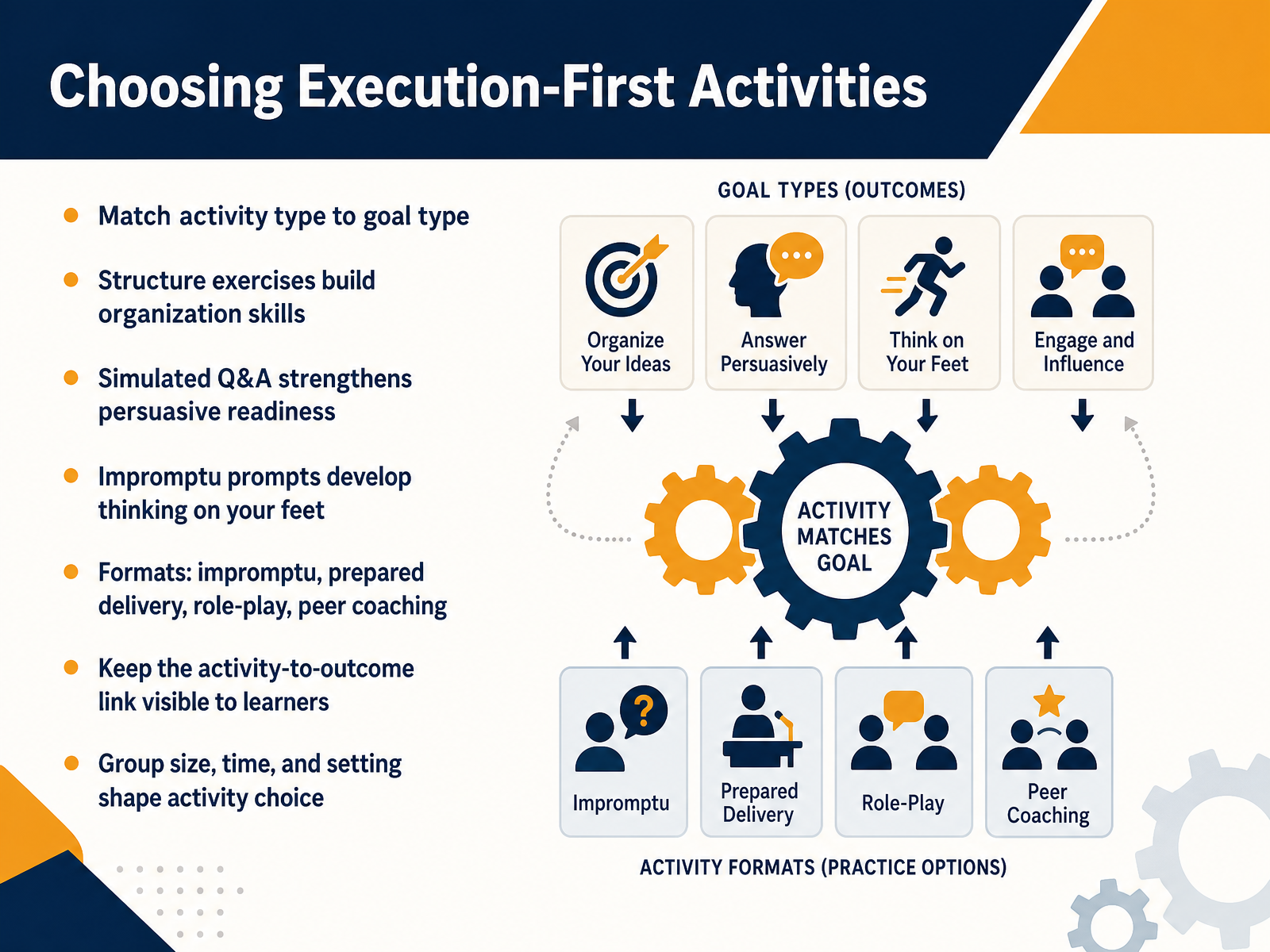 digitalcommons.dartmouth.eduteachingenglish.org.ukmoneyinstructor.com+21 min
 - 07Building a Feedback LoopLet's talk about how to close the loop between instruction and performance. A strong feedback loop is what turns a speech into a learning moment. First, tie every prompt back to the goal you set at the start. If the goal was vocal variety, don't just say 'great energy.' Say, 'Your pace slowed during the opening, which built suspense, and that worked well.' That's specific. Next, use a structured tool. Simple rubrics will keep you from defaulting to vague praise or unchecked opinion. A quick observation sheet for eye contact, gesture, and clarity makes every evaluation consistent. Balance encouragement with actionable correction. The idea is to affirm what worked, then give one clear next step. And make that step small. Not 'be more confident,' but 'pause two seconds after the first slide.' Frame it so the speaker can see it, do it, and measure it. That's how feedback builds momentum, not anxiety. Now let's look at how to design rubrics that actually guide your assessment choices.
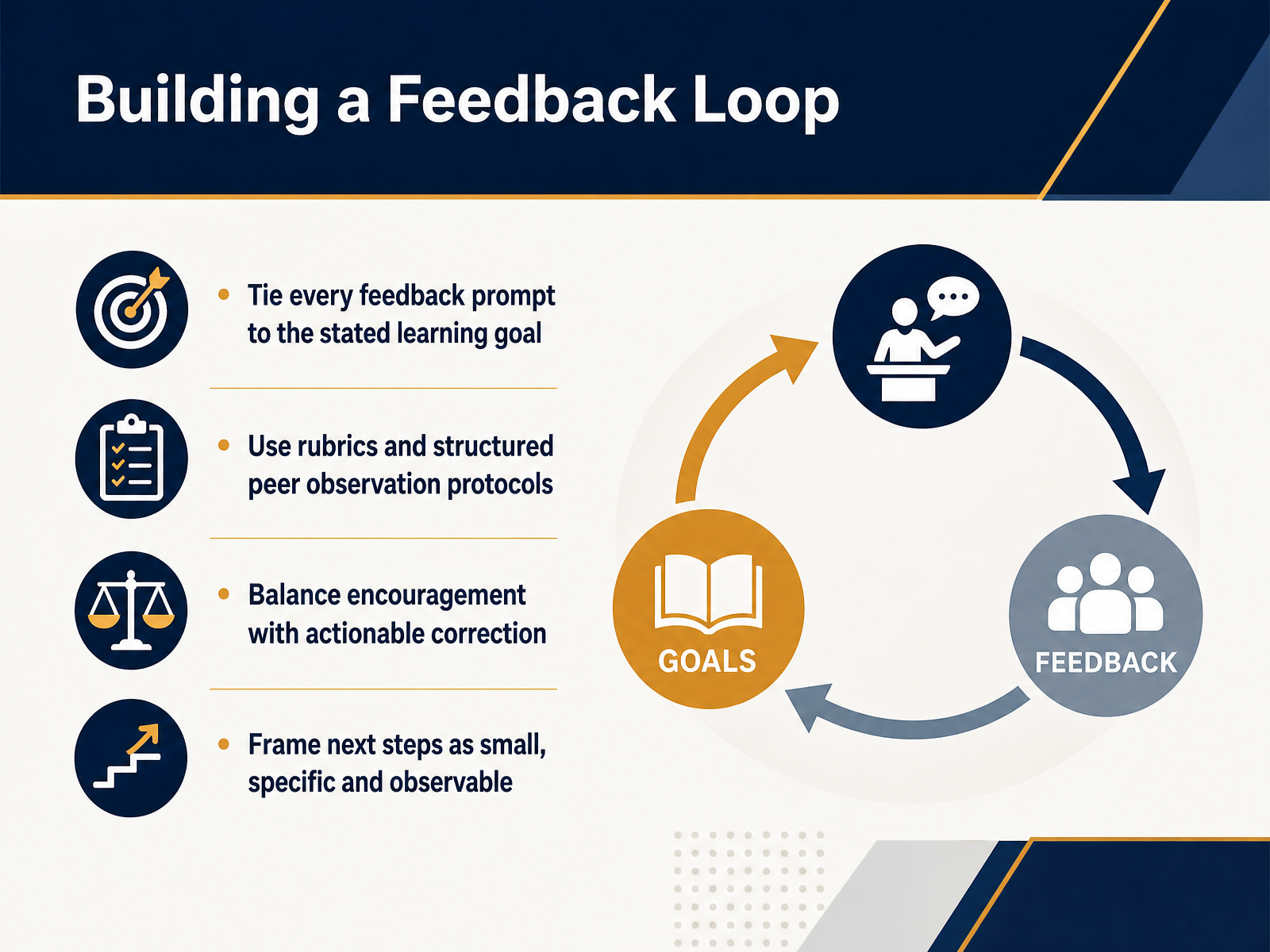 ejournal1.unud.ac.idlink.springer.comeric.ed.gov+22 min
 - 08Rubrics and Assessment DesignNow let's talk about making assessment work for you, not against you. Rubrics are your best tool for turning subjective impressions into clear, observable criteria. Think content, structure, delivery, and audience awareness. That last one matters more than most trainers realize. Use analytic rubrics. They break performance into specific components so you can say exactly where a speaker shines and where they need work, instead of offering vague praise or criticism. Share the rubric before anyone steps up to speak. Transparency reduces anxiety and focuses preparation. Your learners will know exactly what good looks like. Then layer the feedback. Have speakers self-assess first, bring in peer review next, and close with your own evaluation. Each perspective adds a different piece of the picture. The result is feedback that is specific, actionable, and fair. Ready to tackle what often holds execution back? Let's look at common bottlenecks next.
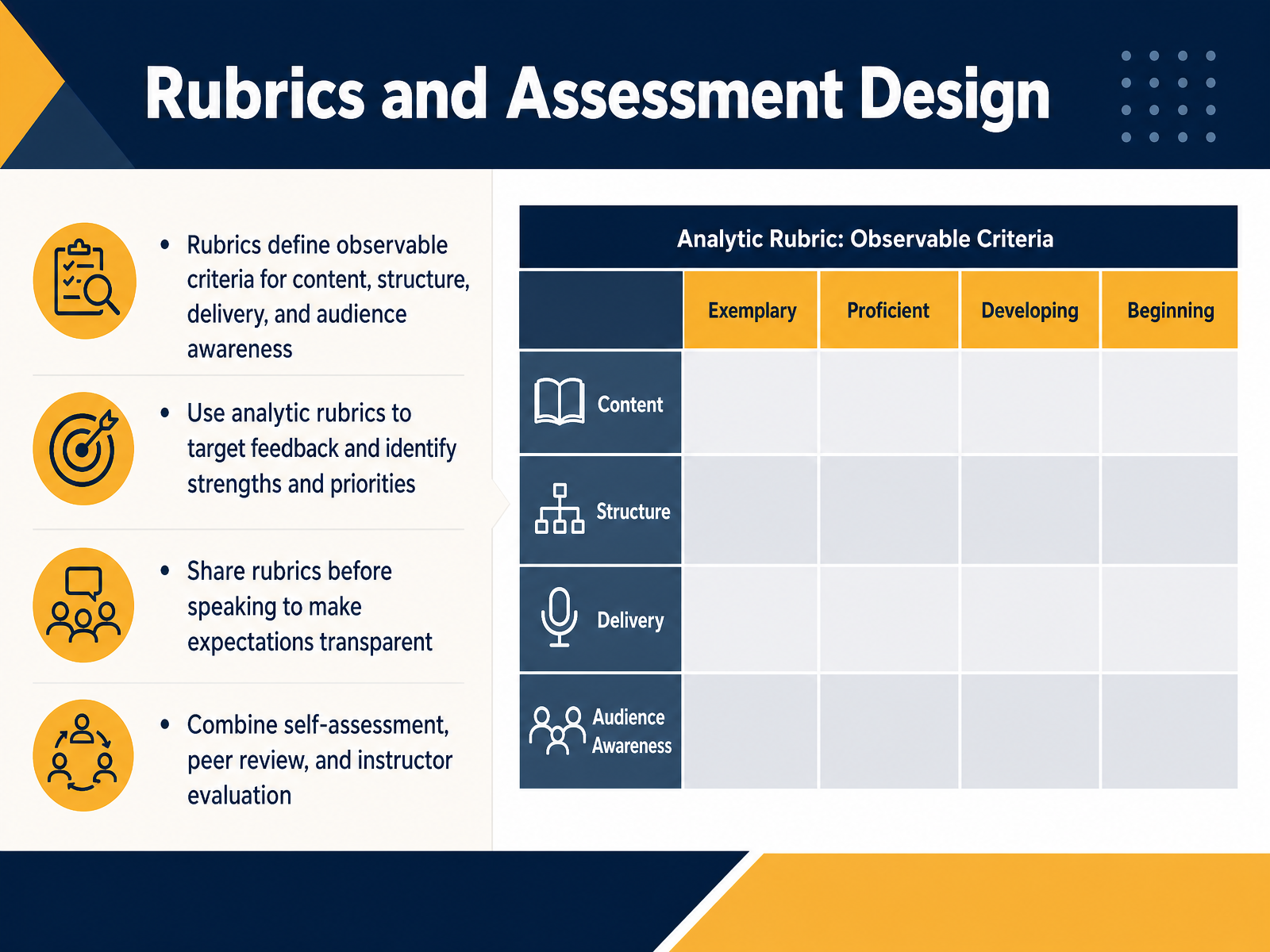 ejournal1.unud.ac.idlink.springer.comeric.ed.gov+21 min
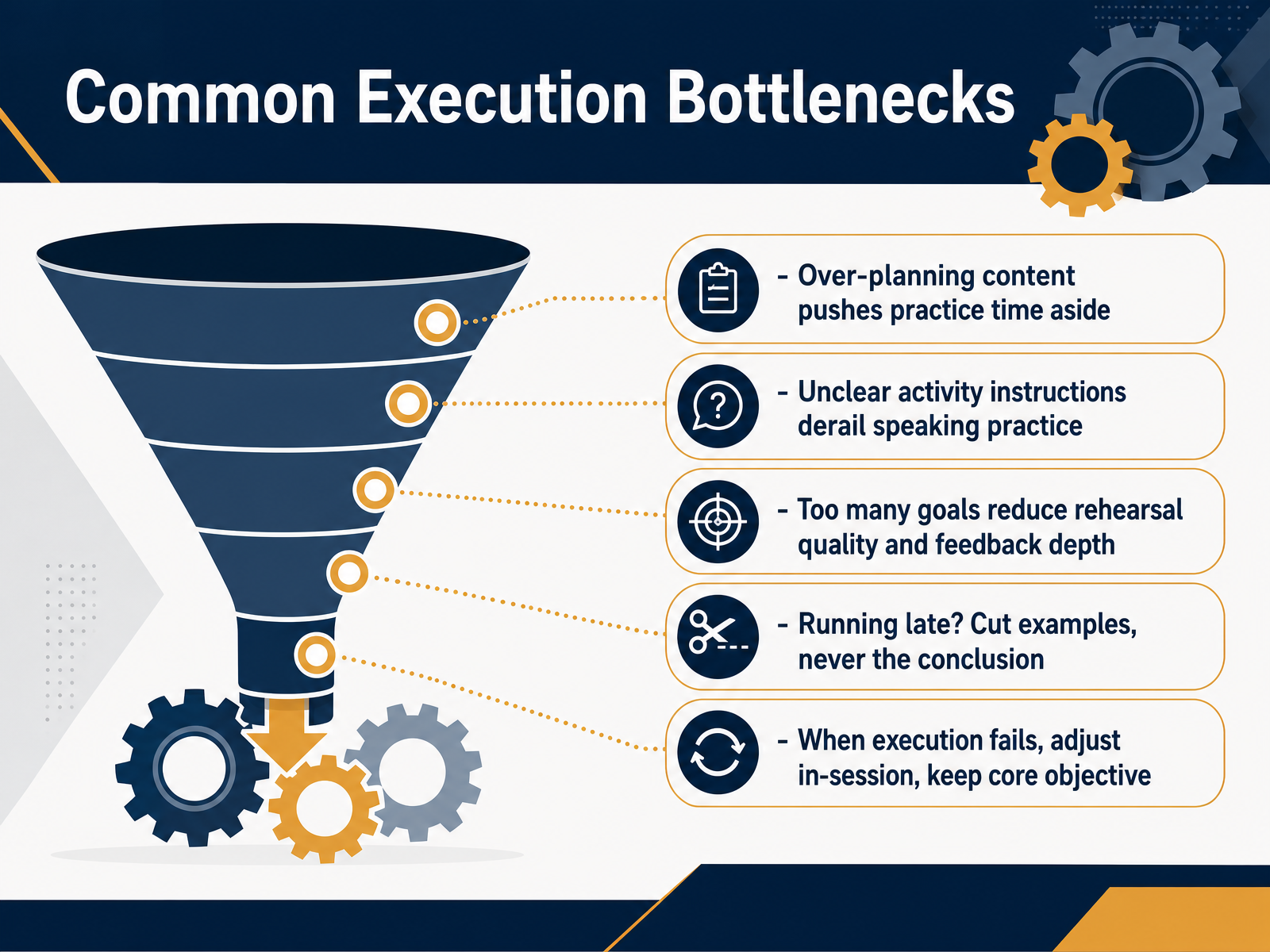
 - 09Common Execution BottlenecksLet's look at where execution most often stalls. The first bottleneck is over-planning. We polish slides endlessly, yet practice time shrinks. The solution is simple. Timebox content creation and protect rehearsal as non-negotiable. Next, unclear activity instructions. Ambiguity stops learners cold. Give a one-sentence objective and then demonstrate the task. 'You have two minutes. Focus on one vocal variation. Watch me first.' That clarity drives progress. Too many goals also dilute quality. Force learners to pick a single skill for each practice round. Deep feedback on one skill beats shallow comments on five. And when you run late, amend your examples, not your conclusion. The closing crystallizes the lesson. Protect it ruthlessly. Execution fails when we cling to the plan. Adjust in-session, keep the core objective visible, and make that objective small enough to win. Next, we will sequence the session to manage both time and learner anxiety.
 digitalcommons.dartmouth.eduteachingenglish.org.ukmoneyinstructor.com+22 min
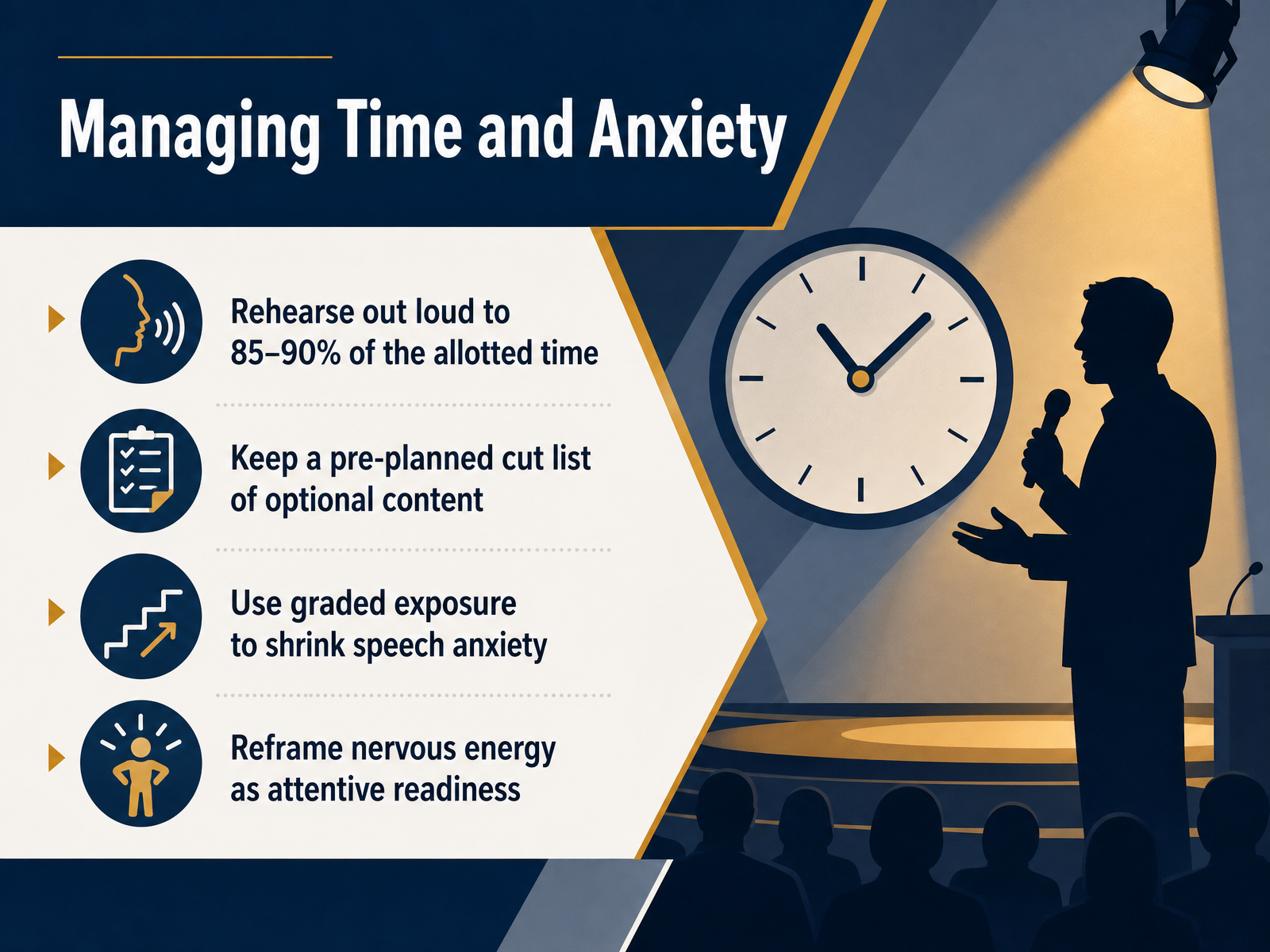
 - 10Managing Time and AnxietyLet's talk about the two forces that can derail any great lesson: the clock and your nerves. First, time management. Rehearse out loud, with a timer, until you hit roughly eighty-five to ninety percent of your allotted time. That buffer is your safety net for unexpected pauses, tech hiccups, or a lively Q and A. And always prepare a cut list before you step on stage. Know exactly which optional examples or stories you will drop if time runs short. Never cut your conclusion; it is your final impression. Now, for anxiety, use graded exposure. Start by practicing alone, then for a colleague, then for a small group, and gradually increase the audience size. Each successful repetition teaches your nervous system the threat is smaller than it feels. Finally, reframe that nervous energy. A racing heart and sharpened focus are your body preparing for a performance, not signaling danger. Interpret it as attentive readiness. The goal is not to eliminate anxiety. It is to channel it into presence. Now, let's move on to building a reusable lesson plan template that ties all of this together.
 speechanddebate.orgdigitalcommons.dartmouth.edu2 min
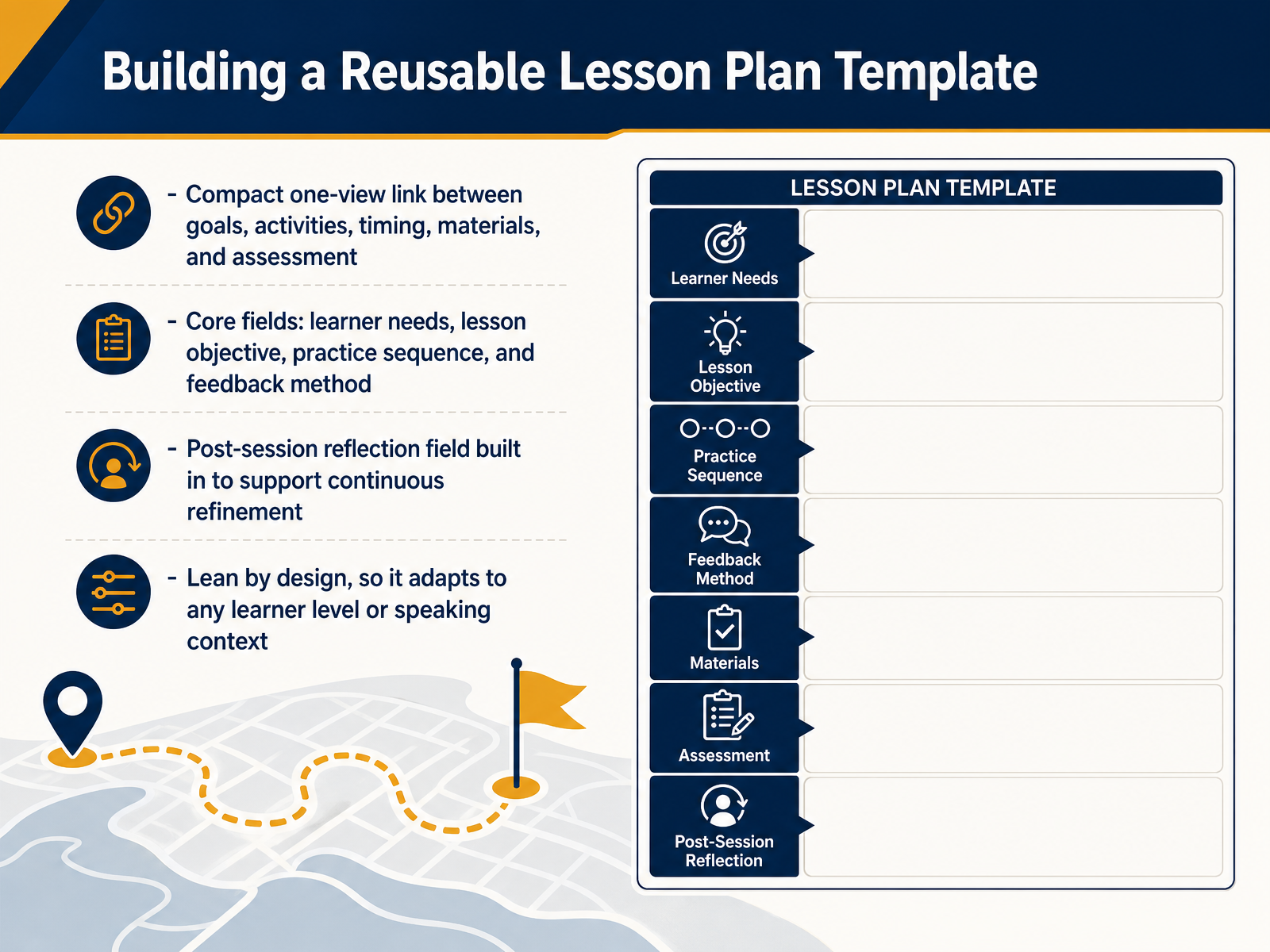
 - 11Building a Reusable Lesson Plan TemplateNow let's talk about turning the plan into a reusable asset. This is a template designed for a single view. One compact page that connects your goals, your activities, timing, materials, and assessment. You don't need to hunt for information across multiple documents. You need to see the whole session at a glance. The core fields mirror our workflow: learner needs, lesson objective, practice sequence, and the feedback method. Write them in that order, and your lesson logic stays tight. For example, if your learners need confidence with impromptu speaking, the objective states it, the practice sequence builds it, and your feedback method reinforces it. The power here is the built-in post-session reflection field. You capture what worked and what fell flat while it's fresh. That field is your engine for continuous refinement. Use the template, then refine it. The design is lean on purpose, so it adapts to any learner level or speaking context. You can scale it from a ten-minute warm-up to a three-hour intensive workshop. Your planning should stay flexible. So, build the template once, and let it work for you across every class you teach. That brings us to putting the plan into practice.
 speechanddebate.orguttyler.edulit.edu+22 min
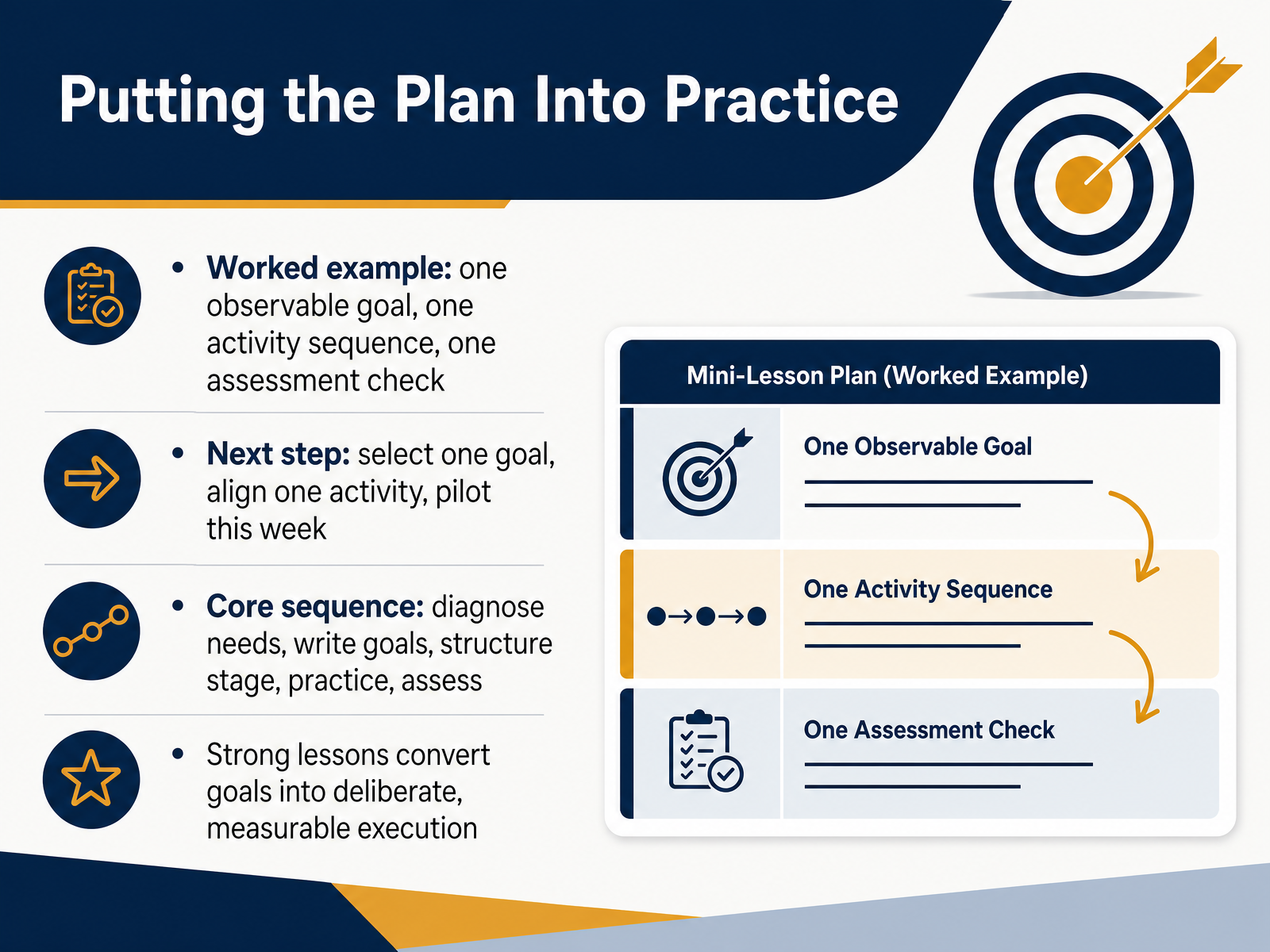
 - 12Putting the Plan Into PracticeSo let's make this concrete. Take one observable goal, pair it with one activity sequence, and attach one assessment check. For example, if the goal is reducing filler words, the activity is a two-minute impromptu speech with peer counting, and the check is a before-and-after count. Your next step is simple. Select one goal, align one activity, and pilot it this week. Run the core sequence: diagnose needs, write goals, structure the stage, practice, and assess. That loop keeps every session deliberate. Strong lessons convert goals into measurable execution, not vague intentions. The planning is done. Now it is time to move into practice and rehearsal activities.
 speechanddebate.orgdigitalcommons.dartmouth.eduteachingenglish.org.uk+21 min
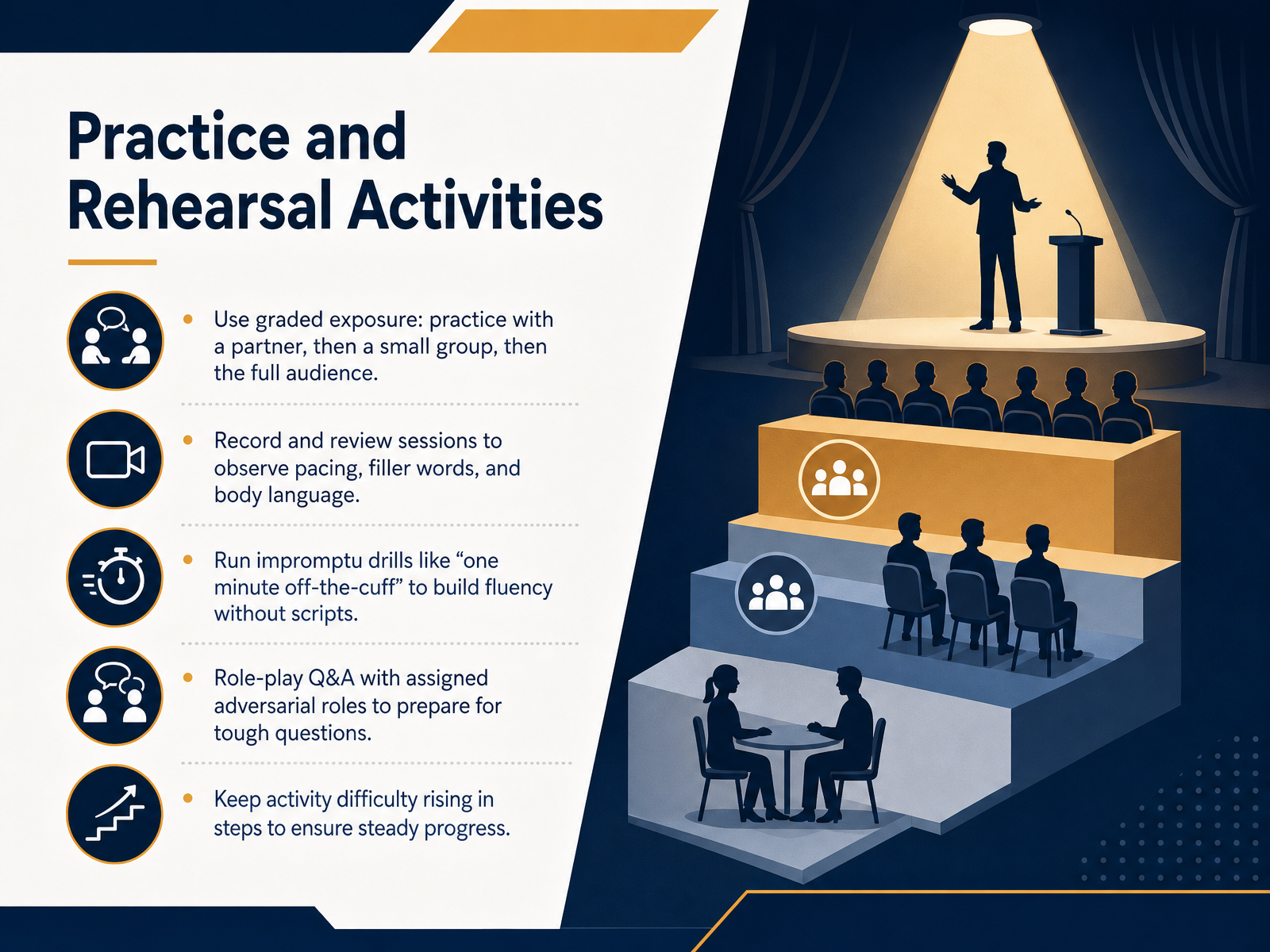
 - 13Practice and Rehearsal ActivitiesPractice is where confidence gets built, but it needs structure to work. Start with graded exposure. Have learners present to a single partner first, then a small group, and finally the full audience. Each step raises the stakes just enough to build tolerance without triggering panic. Next, bring in the camera. Record every session and review it. Our self-perception rarely matches reality; video reveals filler words, pacing issues, and nervous habits we simply do not feel when we are speaking. Then, break the script dependency with impromptu drills. The one minute off the cuff exercise works brilliantly. Give a random topic, no prep time, and let them speak. It builds fluency and proves they know more than they think. For tougher moments, role play the Q and A. Assign adversarial roles like the skeptic or the devil's advocate. Let them interrupt naturally and push back hard. This stress test exposes gaps before the real meeting. Keep the difficulty rising in deliberate steps. When the pressure increases gradually, progress feels steady, and that is when real transformation happens. Next, we will turn these activities into a concrete action plan.
 digitalcommons.dartmouth.eduteachingenglish.org.ukmoneyinstructor.com+22 min
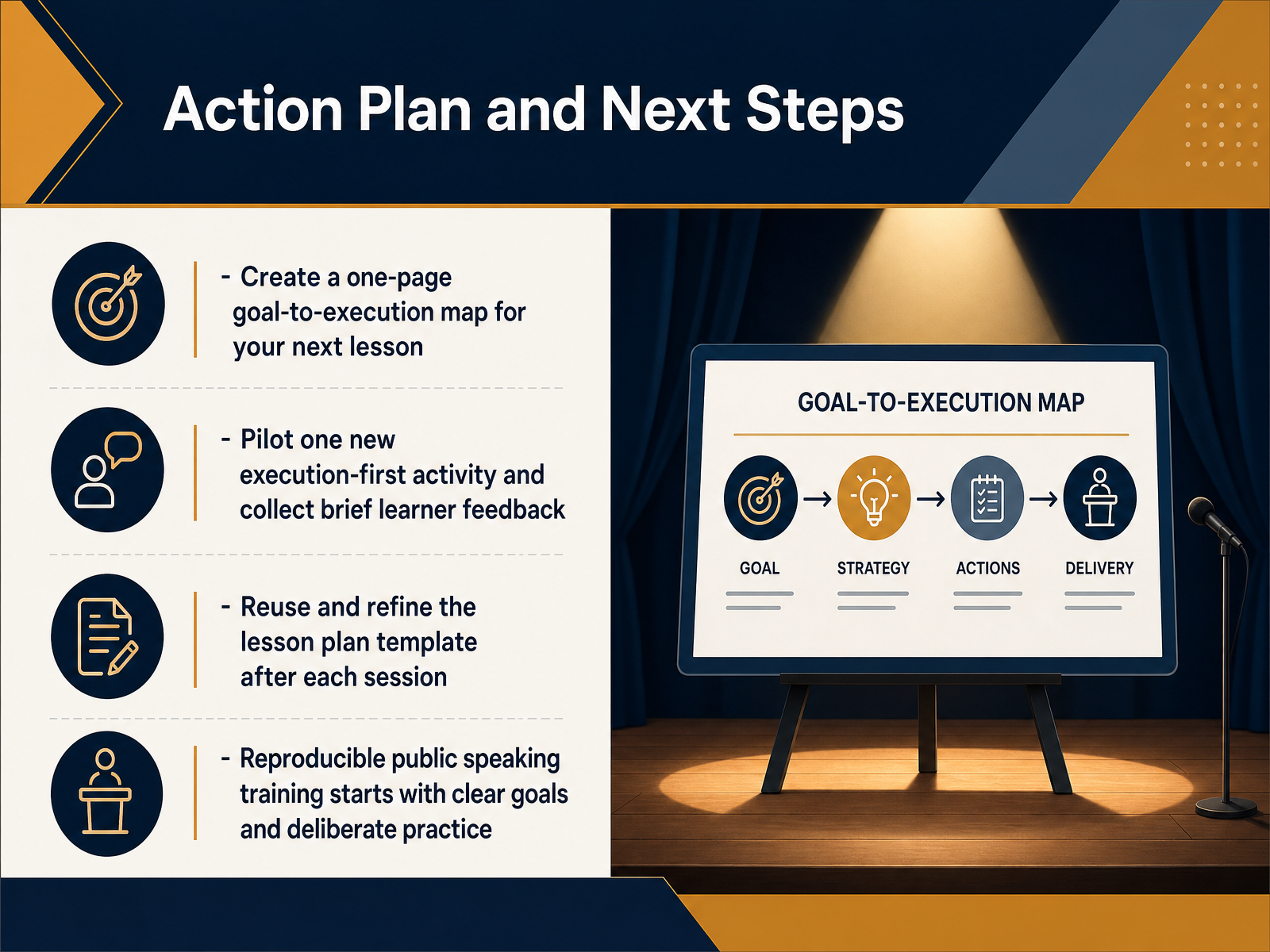
 - 14Action Plan and Next StepsSo here is where we turn insight into action. Start by creating a one-page goal-to-execution map for your next lesson. This keeps your objectives, your activities, and your assessments aligned. Next, commit to piloting just one new execution-first activity. Try it, then ask your learners for brief feedback on what worked and what didn't. Finally, treat your lesson plan like a living document. Reuse your template, but refine it after each session. Change the format, add new activities, adjust the timing. Reproducible public speaking training doesn't come from rigid scripts. It comes from clear goals, deliberate practice, and a willingness to adapt. Take this framework, make it your own, and go build speakers who are ready for any room. Thank you for your time, and good luck with your next session.
 speechanddebate.orgdigitalcommons.dartmouth.edu1 min
Take the deck with you
Download this course as a file — free, no sign-up needed.
- PDF handoutEvery slide page, ready to print or share.15 pages · 3.3 MBDownload
- Narrated PowerPointThe deck that presents itself — every slide carries the digital human's narration video.15 pages · 25.1 MBDownload
- PowerPoint slidesThe full deck as a .pptx — open it in PowerPoint, Keynote, or Google Slides.15 pages · 3.2 MBDownload
Free to use in your own training — please keep the PersonWise credit page at the end.
Have your own deck? Turn it into a course
Sources consulted
Web sources consulted while building this course.
- CMST 1315 .003 | Public Speaking — uttyler.edu
- SPCH 1315-9M1 - Fall 2025 – Public Speaking — lit.edu
- Syllabus | SPCH 1315 0301 - PUBLIC SPEAKING | MyNCTC Home — my.nctc.edu
- Using Backward Design to Plan Your Course — teaching.resources.osu.edu
- Page 1 — lit.edu
- Need Analysis untuk Pengembangan Bahan Ajar Mata Kuliah Public Speaking and Presentation | Humanis — ejournal1.unud.ac.id
- Rubric formats for the formative assessment of oral presentation skills acquisition in secondary education — link.springer.com
- ERIC - ED553452 - The Development of a Valid and Reliable General Analytic Rubric for a College-Level Public-Speaking Course, ProQuest LLC, 2013 — eric.ed.gov
- Measuring Essential Learning Outcomes for Public Speaking — ir.library.illinoisstate.edu
- A1. Public Speaking Higher Order Learning Goals (HOLGS) — myusf.usfca.edu
- [PDF] Measuring Essential Learning Outcomes for Public Speaking — ecommons.udayton.edu
- Oklahoma Public Speaking Competencies — oklahoma.gov
- Syllabus | SPCH 1315 0810 - PUBLIC SPEAKING | MyNCTC Home — my.nctc.edu
- SPCH 1315-9M2 - Fall 2025 – Public Speaking — lit.edu
- Learning Outcomes | Public Speaking — courses.lumenlearning.com
- Audience Attention: A Lesson in Confident Public Speaking — digitalcommons.dartmouth.edu
- Public speaking skills | TeachingEnglish | British Council — teachingenglish.org.uk
- The Communication Process — Public Speaking Lesson Plan — moneyinstructor.com
- PUBLIC SPEAKING — speechanddebate.org
- Tech-Enhanced Speaking Lesson – Willy's ELT Corner — willyrenandya.com