Begin
13 pages · ~26 min
UX Design Maturity Models
A concise overview of UX design maturity models for designers and product teams, explaining stages, assessment criteria, and how to advance organizational UX practice.
A digital instructor presents all 13 pages. Hold “Ask” at any point and ask out loud — the answer comes from this course. No sign-up needed.
What you’ll learn
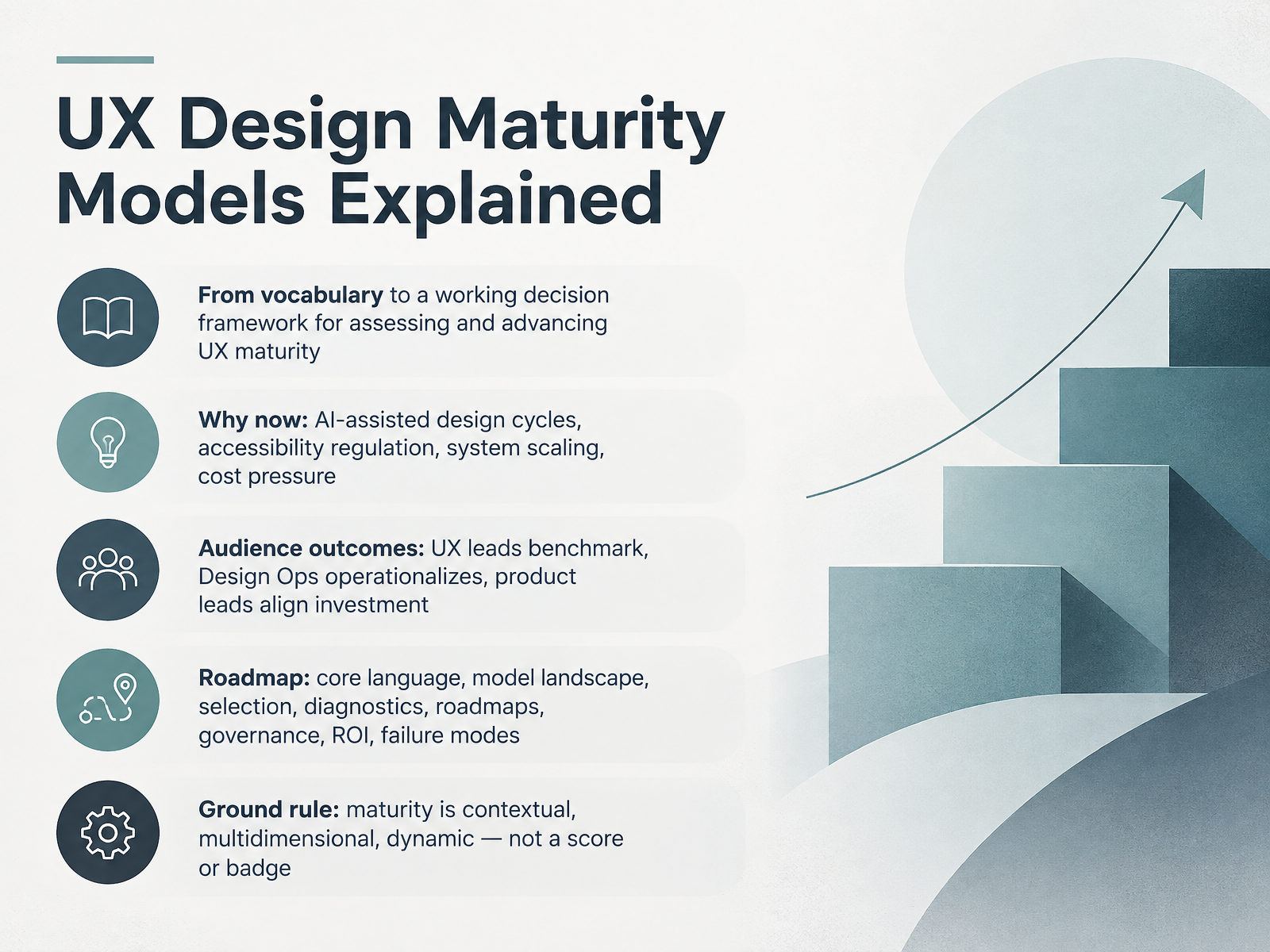
- 01UX Design Maturity Models ExplainedWelcome. Over the next few slides, we are going to move UX maturity from vocabulary to a working decision framework, so you can assess where your organization actually is and advance it deliberately. This matters now for concrete reasons. AI-assisted design cycles are compressing timelines. Accessibility regulation is raising the floor. Design systems are scaling, and cost pressure is forcing hard trade-offs. Maturity models help you make those trade-offs visible instead of arguing from taste. Each of you gets something different here. UX leads get a way to benchmark honestly. Design Ops gets language to operationalize. Product leads get a frame for aligning investment. We will cover core language, the model landscape, how to select one, diagnostics, roadmaps, governance, return on investment, and common failure modes. One ground rule before we start. Maturity is contextual, multidimensional, and dynamic. It is not a score or a badge. Treat it as a decision aid, and it stays useful. Next, we will build core concepts and a shared language.1 min
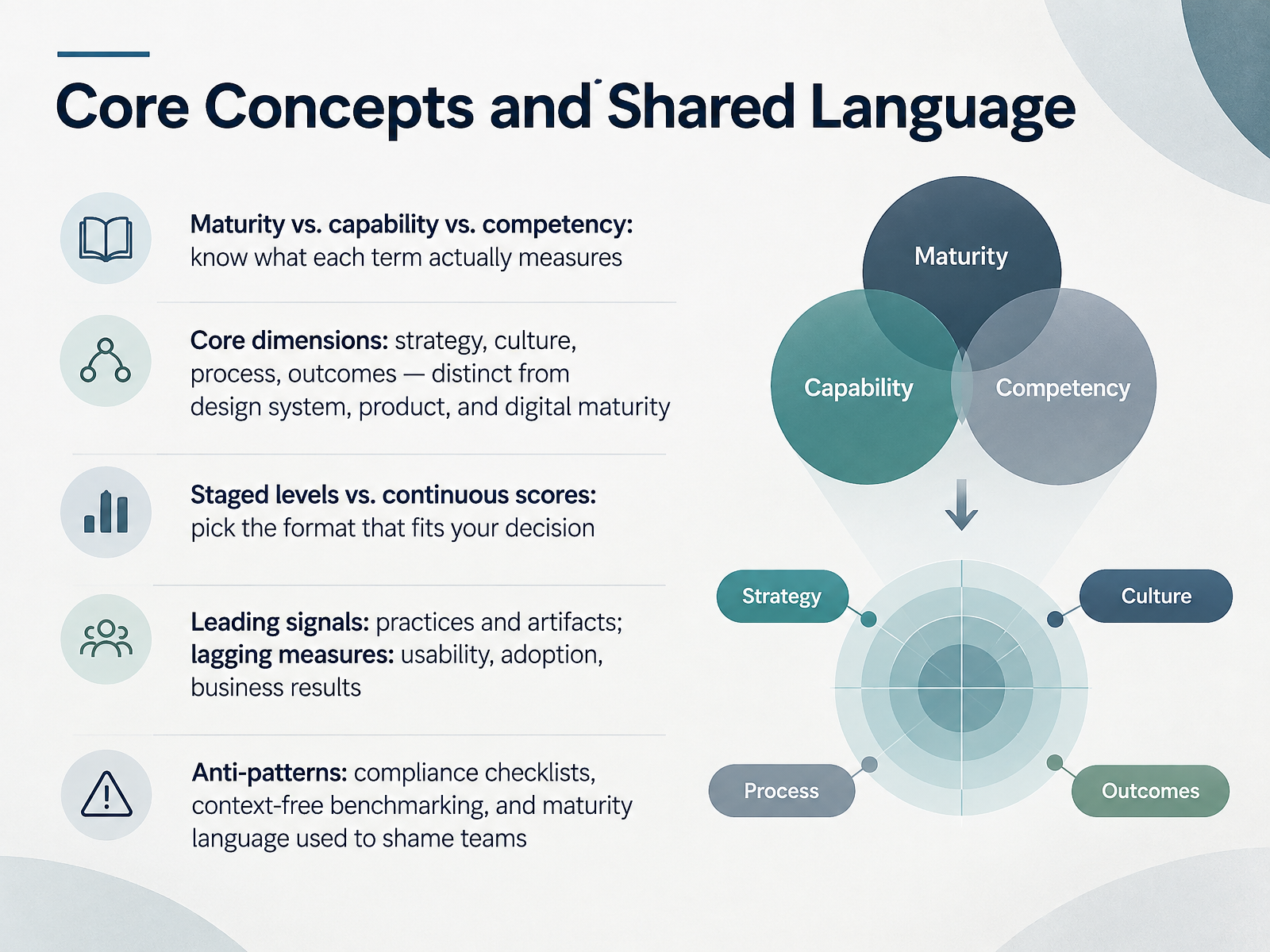
- 02Core Concepts and Shared LanguageLet's align on the words we use, because mismatched language quietly derails maturity work. Maturity, capability, and competency measure different things. Maturity is how well your organization sustains UX over time. Capability is what your teams can actually do. Competency is what an individual knows and can apply. Keep those separate, or you will build an assessment that answers none of them. Next, scope the dimensions you score. Strategy, culture, process, and outcomes are core. They are not the same as the maturity of your design system, your product, or your digital channel. Mixing them produces a number that looks precise and means nothing. Then choose your format. Staged levels help you communicate a journey and set investment priorities. Continuous scores help you track movement and compare across teams. Pick based on the decision in front of you, not on what looks sophisticated. Watch your signals too. Practices and artifacts are leading indicators. Usability, adoption, and business results are lagging, and they confirm what already happened. Finally, avoid the common anti-patterns. Compliance checklists, context-free benchmarking, and maturity language used to shame teams. All three destroy trust and kill participation. So hold the shared language: separate the concepts, scope the dimensions, match the format to the decision, and use the model to open conversations, not close them. Next, we look at how these models evolved, in The Model Landscape: From Pioneering Stages to Modern Multidimensional Frameworks.
 2 min
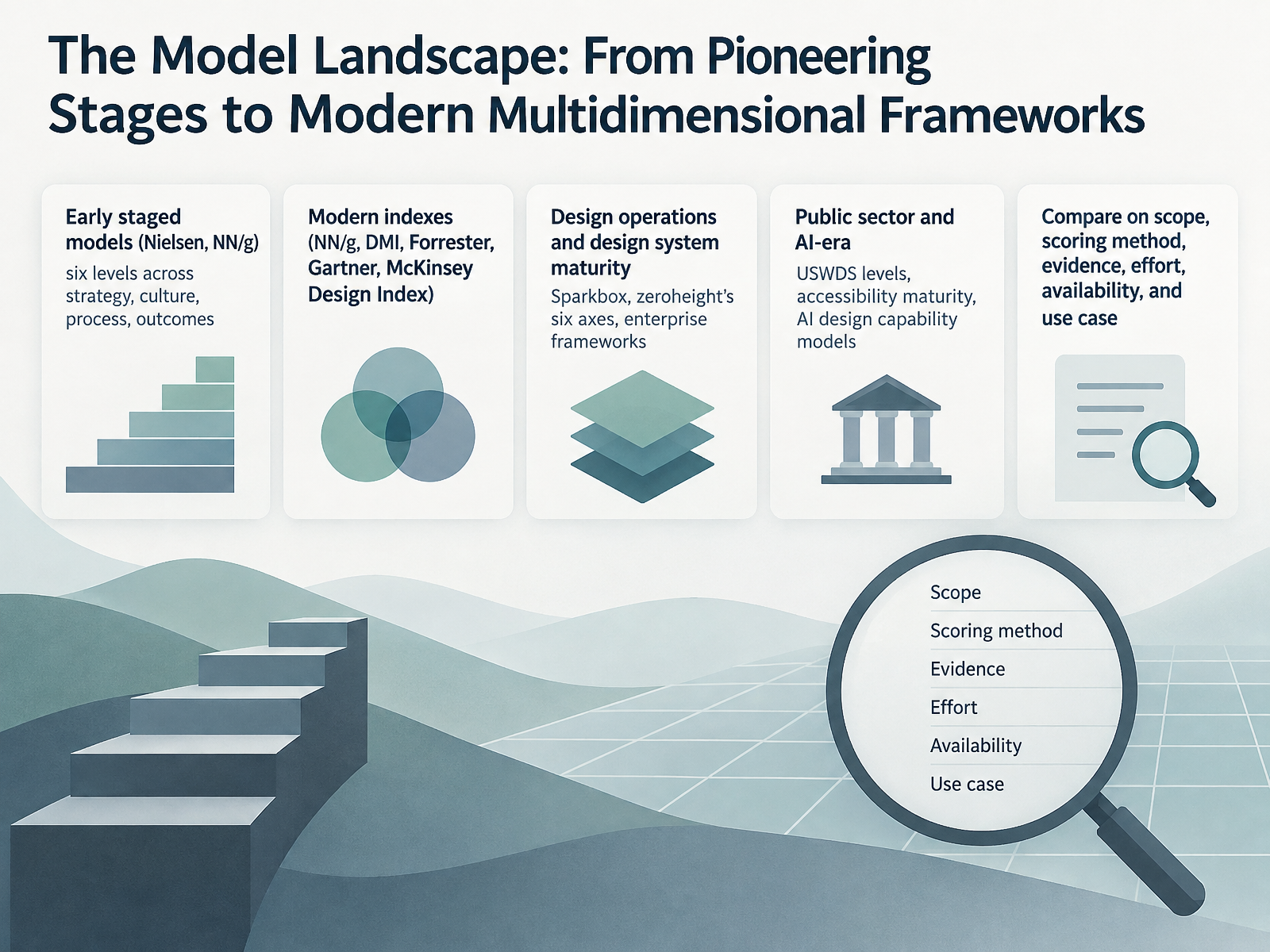
2 min - 03The Model Landscape: From Pioneering Stages to Modern Multidimensional FrameworksLet's map the landscape you'll actually choose from. The early staged models, like Nielsen's, gave us six levels across strategy, culture, process, and outcomes. Useful shorthand, but they assume a linear climb. Modern indexes from NN/g, the Design Management Institute, Forrester, Gartner, and McKinsey take a different trade-off. They score breadth over depth, so they're easier to benchmark externally but harder to act on internally. Then you have design operations and design system maturity, from Sparkbox, zeroheight's six axes, and enterprise frameworks. These go deep where staged models go wide. They're the ones you use when your bottleneck is delivery, not ambition. Public sector and AI era models, like USWDS levels, accessibility maturity, and AI design capability frameworks, add a new constraint. They measure whether you can ship responsibly, not just whether you have a mature process. So compare them on scope, scoring method, evidence required, effort to adopt, availability, and use case. That's how you avoid buying a Ferrari to drive to the corner store. Next, we'll look at where the models agree and diverge.
 2 min
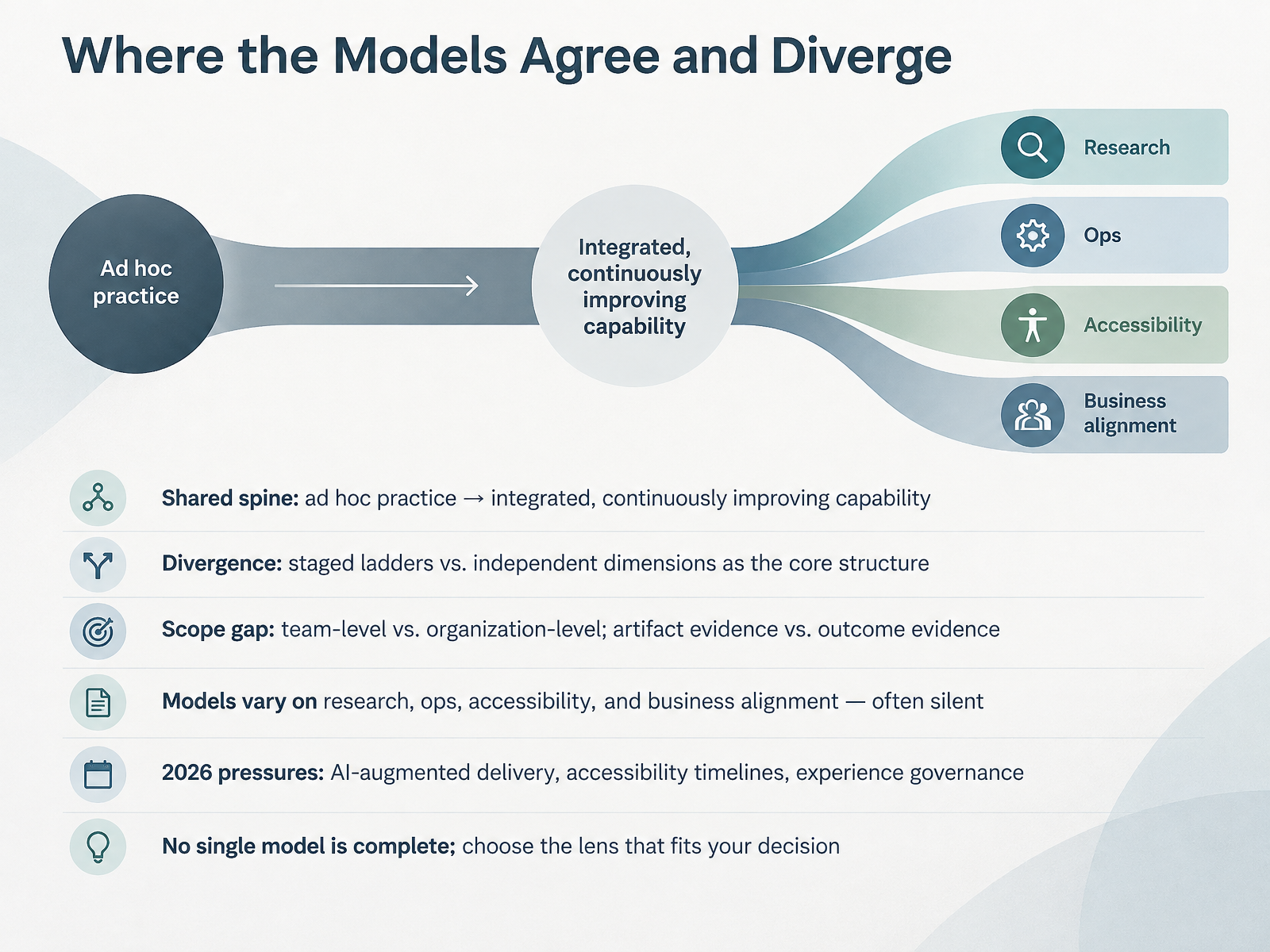
2 min - 04Where the Models Agree and DivergeLet's look at where the models agree and where they diverge. Almost all of them share one spine: you move from ad hoc practice toward integrated, continuously improving capability. That part is settled. Here's where it gets messy. Some models use staged ladders, where you climb from one level to the next. Others treat dimensions as independent, so research can be strong while ops is weak. That choice changes your roadmap. Another gap is scope. Some models measure team-level maturity, others the whole organization. And they split on evidence: do you prove maturity with artifacts, or with outcomes? Most models are also silent or thin on research operations, accessibility, and business alignment. In twenty twenty-six, that silence costs you, given AI-augmented delivery, accessibility timelines, and experience governance. So no single model is complete. Pick the lens that fits the decision in front of you. Next, we'll cover how to choose and adapt a model.
 2 min
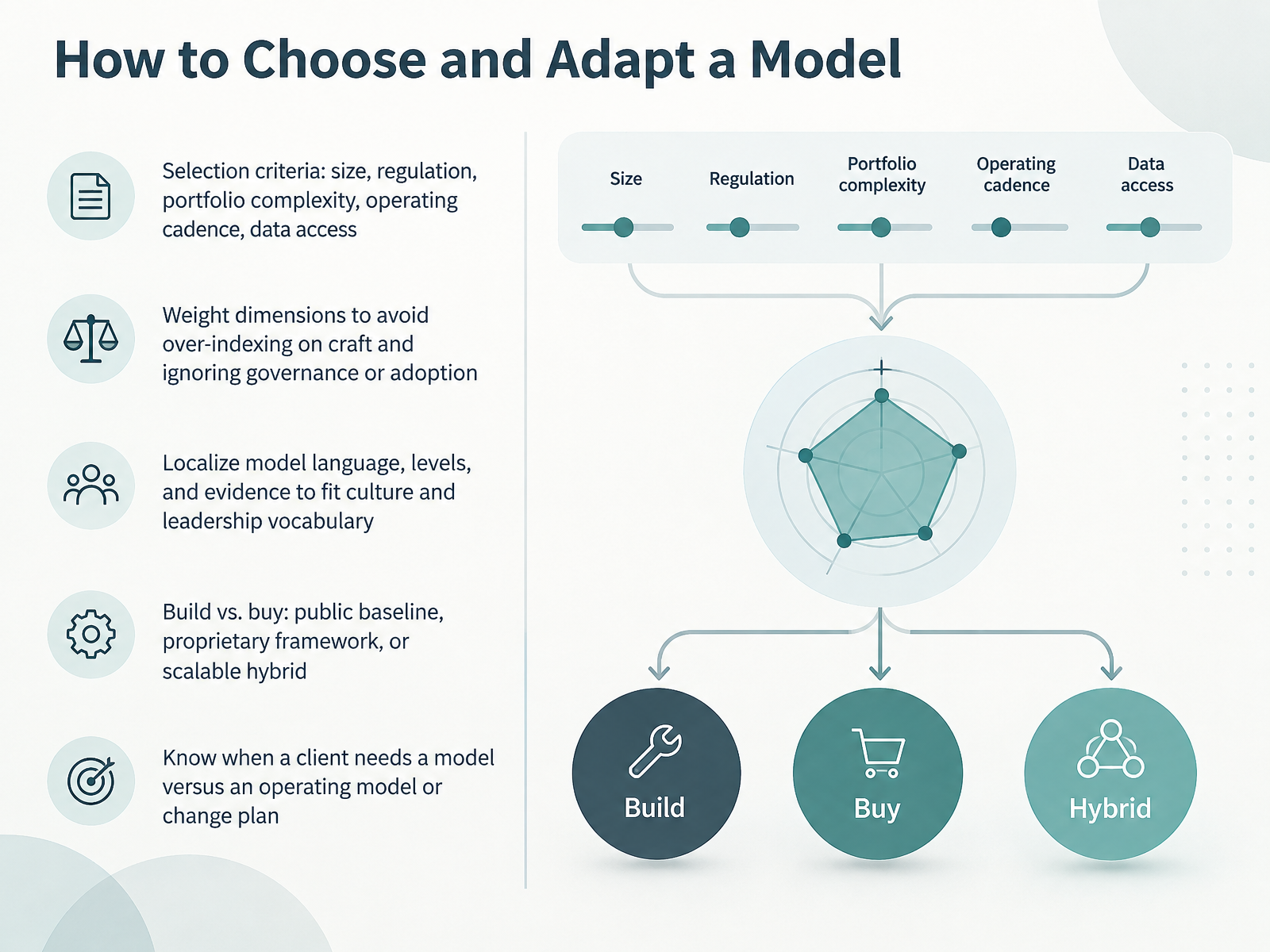
2 min - 05How to Choose and Adapt a ModelLet's talk about how to choose and adapt a model, not just admire one. Start with selection criteria that actually constrain you. Company size, regulatory load, portfolio complexity, operating cadence, and data access. A regulated bank and a two-product startup do not need the same structure. Then weight the dimensions. Most teams over-index on craft and under-index on governance, adoption, and measurement. If your model scores craft but ignores how decisions get funded and sustained, it will stall. Localize the language, the levels, and the evidence you ask for. If leadership talks about risk and throughput, frame maturity that way. On build versus buy, you have three routes. A public baseline is fast and credible. A proprietary framework fits your operating reality but costs maintenance. A scalable hybrid often wins. Use a public model for shared language, then overlay your own evidence and gates. Finally, know the ask. Sometimes a client needs a maturity model. Sometimes they need an operating model, or a change plan. Choosing the wrong artifact wastes quarters. Next, we'll look at assessment and diagnostic methods.
 2 min
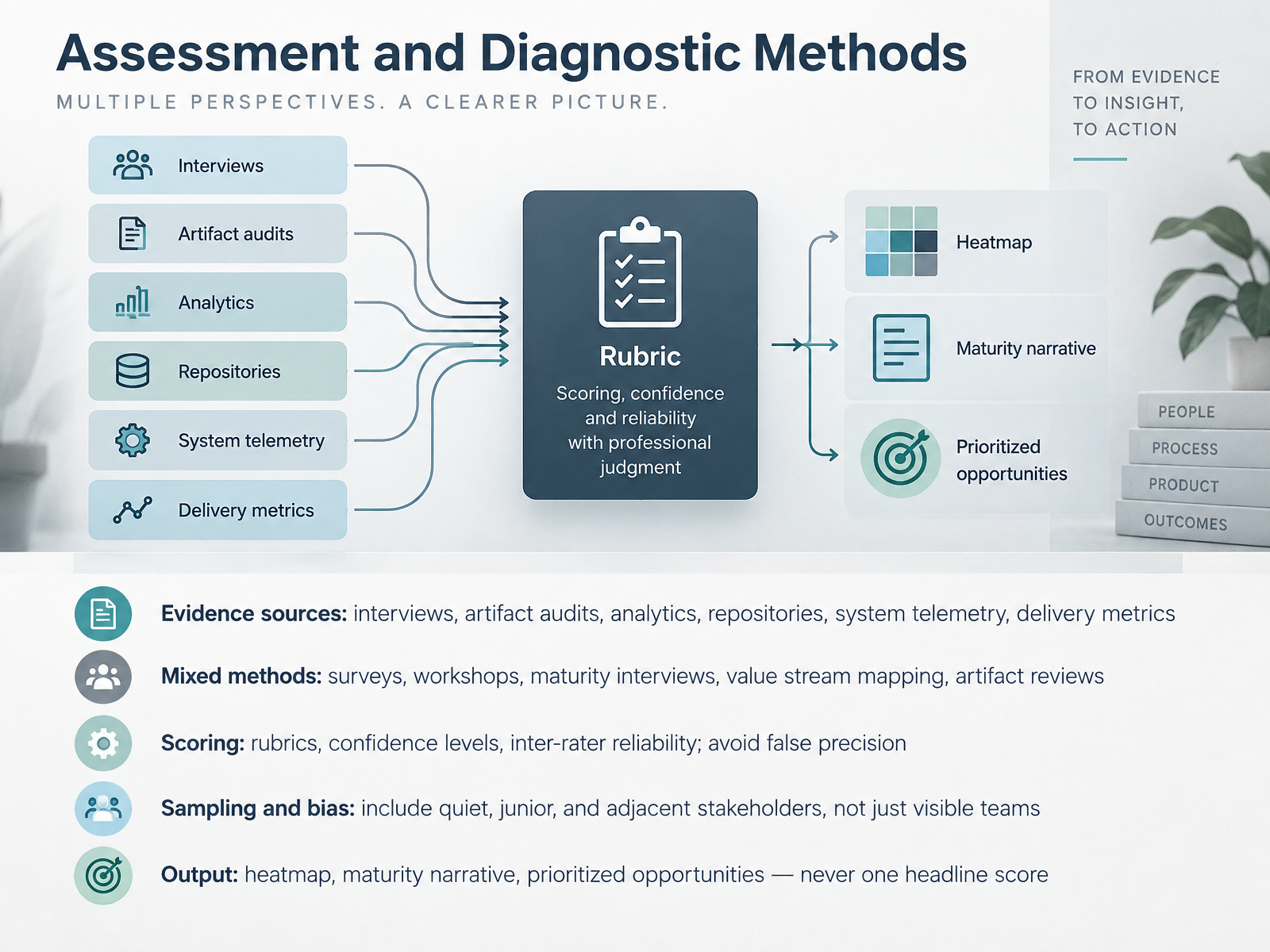
2 min - 06Assessment and Diagnostic MethodsNow let's talk about how you actually assess maturity in the field. Start with evidence sources: interviews, artifact audits, analytics, repositories, system telemetry, and delivery metrics. No single source tells the whole story. Blend them with surveys, workshops, maturity interviews, value stream mapping, and artifact reviews. When you score, use rubrics and confidence levels, and check inter rater reliability across assessors. Resist false precision. A team is not a seven point three. On sampling, deliberately include quiet, junior, and adjacent stakeholders, not just visible teams. Otherwise you are measuring who shows up, not how the organization works. The output matters just as much: a heatmap, a maturity narrative, and prioritized opportunities. Never a single headline score. A score invites gaming and hides context. The narrative drives decisions. Coming up next, lightweight diagnostics when a full assessment is not feasible.
 2 min
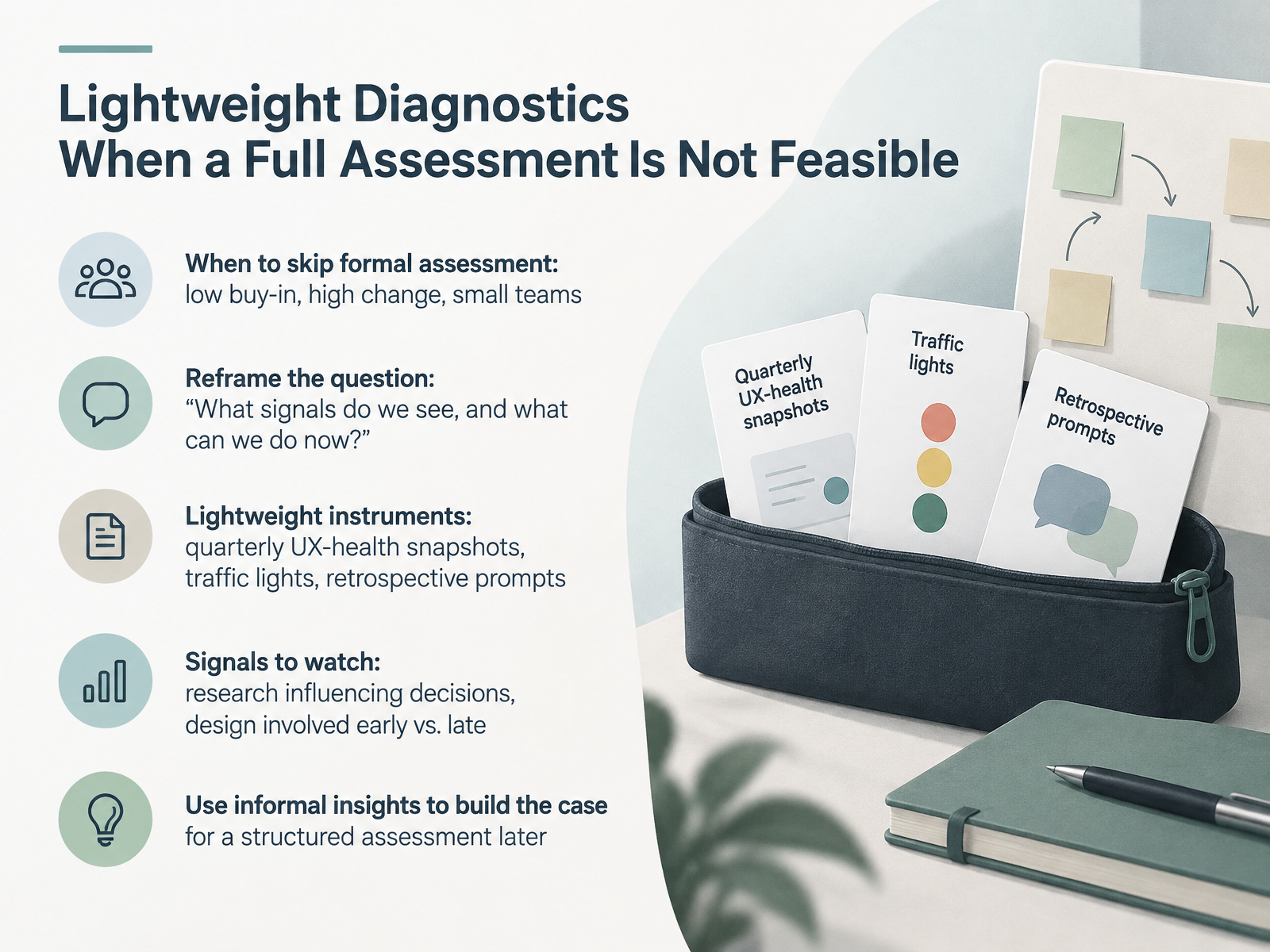
2 min - 07Lightweight Diagnostics When a Full Assessment Is Not FeasibleSo let's face the situation many of you are in right now. You want a full maturity assessment, but the conditions aren't there. Buy-in is low. The org is changing fast. Or the team is simply too small to justify a heavy process. In that case, don't force it. Skip the formal assessment, and reframe the question. Instead of asking what level are we at, ask what signals do we see, and what can we do now. Lightweight instruments work here. A quarterly UX health snapshot. A simple traffic light for each product area. Retrospective prompts that surface friction without a scoring model. Then watch behavioral signals. Is research actually influencing decisions, or sitting in a report nobody opens. Is design involved early, shaping the problem, or late, polishing screens. Those patterns tell you more than a maturity score. And here's the trade-off. Informal insights are fast and low-risk, but they won't satisfy executives who want a number. So use them deliberately, to build the case for a structured assessment later. Next, let's look at how these signals become an actionable roadmap. From Findings to an Actionable Roadmap.
 2 min
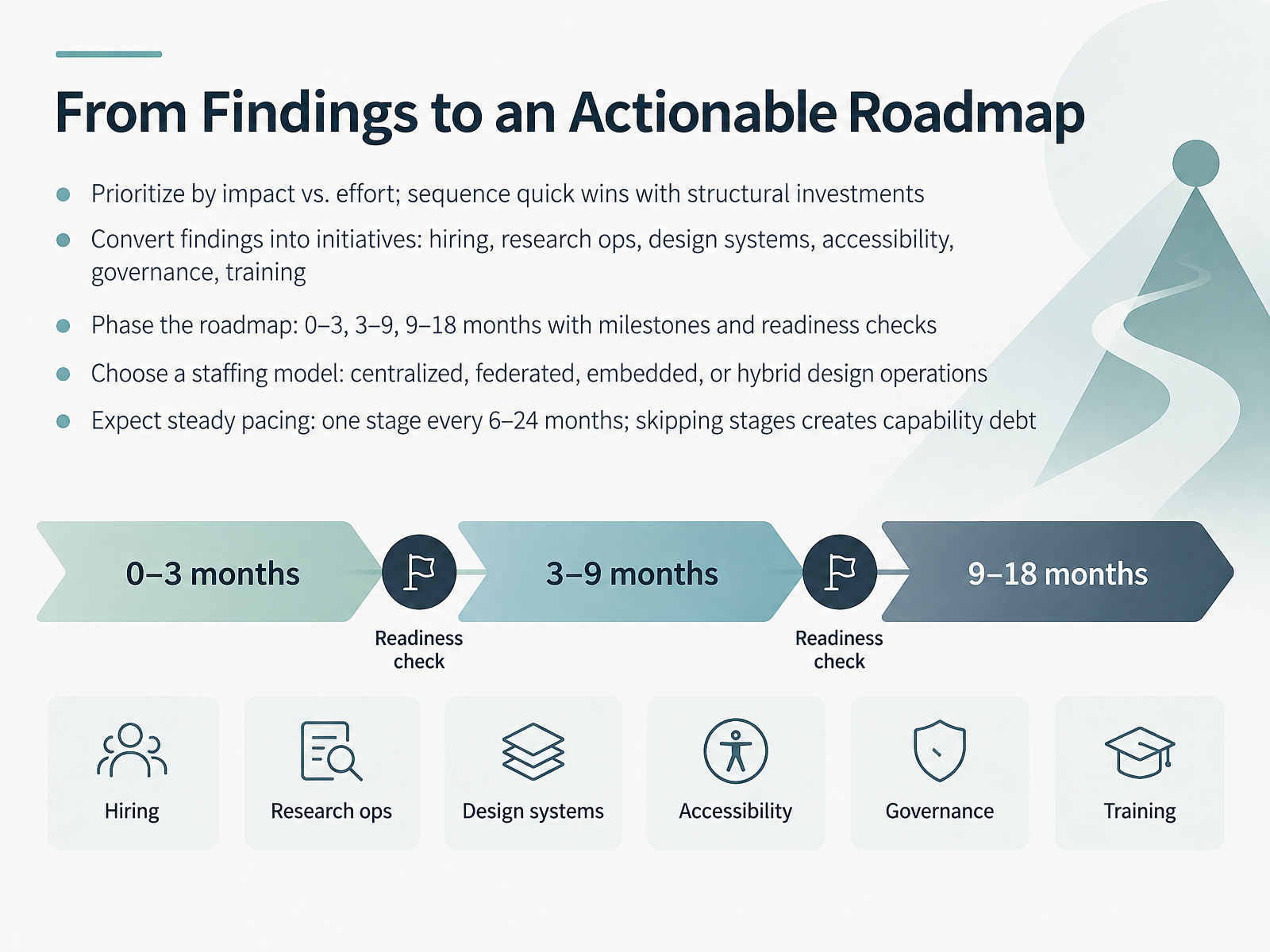
2 min - 08From Findings to an Actionable RoadmapNow let's turn findings into a roadmap you can actually execute. First, prioritize by impact versus effort, then sequence quick wins alongside structural investments, because early credibility buys you room for the harder work. Convert findings into concrete initiatives, such as hiring, research operations, a design system, accessibility programs, governance, and training. Next, phase the roadmap into zero to three, three to nine, and nine to eighteen months, with milestones and readiness checks at each phase. Then choose your staffing model, whether centralized, federated, embedded, or a hybrid design operations approach. Expect steady pacing, roughly one stage every six to twenty-four months. Skipping stages creates capability debt, and you will pay it back later with interest. Next, we will look at change management and adoption.
 1 min
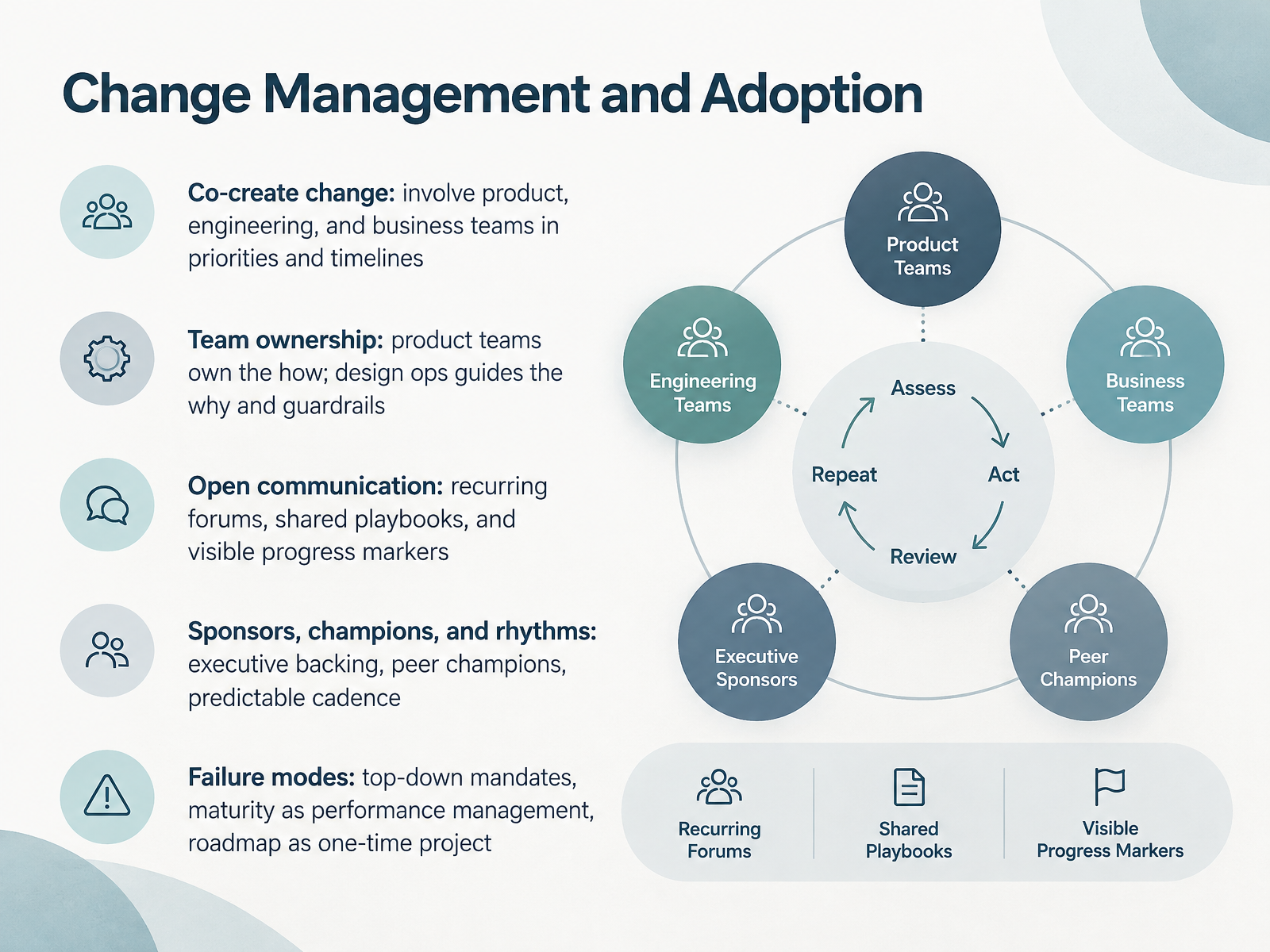
1 min - 09Change Management and AdoptionLet's talk about change management and adoption, because a maturity model only works if people actually use it. First, co-create the change. Bring product, engineering, and business teams into priorities and timelines. When they help set the pace, they stop resisting it. Second, team ownership. Product teams own the how. Design ops guides the why and the guardrails. That split keeps autonomy and consistency in balance. Third, open communication. Recurring forums, shared playbooks, and visible progress markers keep everyone aligned without constant meetings. Fourth, sponsors, champions, and rhythms. You need executive backing, peer champions, and a predictable cadence. Sponsors clear blockers. Champions spread practice. Now the failure modes. Top-down mandates breed compliance, not capability. Treating maturity as performance management turns growth into a scoreboard. And treating the roadmap as a one-time project means momentum dies after the launch. Watch for those three. They show up in real organizations, and they quietly stall progress. Next, we will look at governance, metrics, and operating cadence.
 2 min
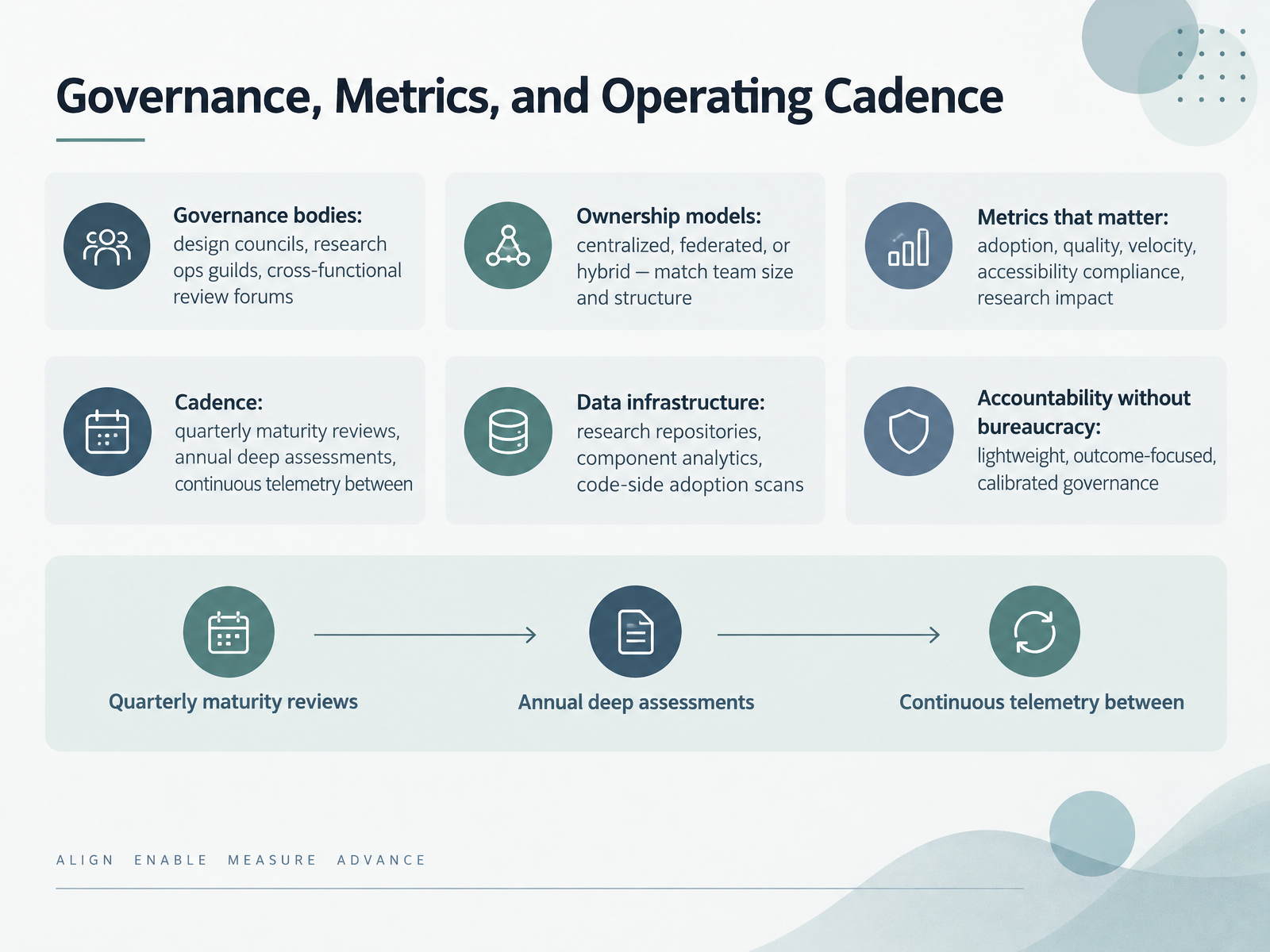
2 min - 10Governance, Metrics, and Operating CadenceLet us talk about the machinery that keeps maturity moving: governance, metrics, and operating cadence. Governance does not mean a committee that slows you down. It means clear forums. A design council for standards. A research ops guild for methods and repositories. A cross functional review for decisions that span teams.
Then choose an ownership model. Centralized works when you are small and need consistency. Federated works when product teams are strong and close to users. Hybrid is usually the honest answer at scale.
For metrics, pick a small set you will actually review. Adoption, quality, velocity, accessibility compliance, and research impact. If a metric cannot change a decision, drop it.
Set a cadence. Quarterly maturity reviews, annual deep assessments, and continuous telemetry in between. That telemetry depends on infrastructure: research repositories, component analytics, and code side adoption scans.
The goal is accountability without bureaucracy. Lightweight, outcome focused, calibrated governance. That is next: building the business case and speaking to executives.
 2 min
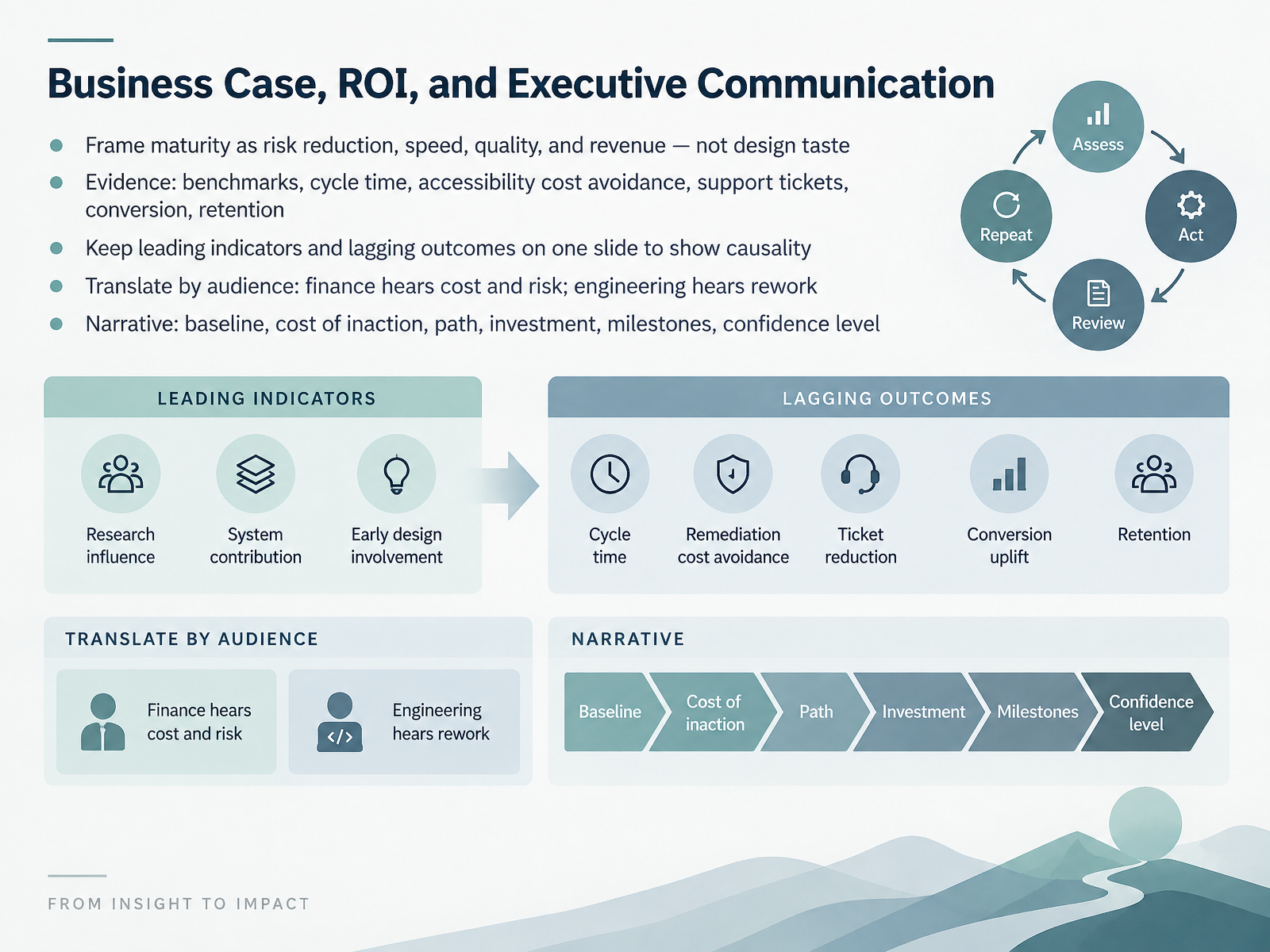
2 min - 11Business Case, ROI, and Executive CommunicationLet's talk about how to make maturity legible to the people who fund it. Frame it as risk reduction, speed, quality, and revenue, not design taste. When you bring evidence, mix leading indicators and lagging outcomes on one slide. Cycle time and accessibility cost avoidance show trajectory. Support tickets, conversion, and retention show results. That combination lets executives see causality instead of correlation. Then translate by audience. Finance hears cost and risk. Engineering hears rework. Product hears time to market. The narrative stays the same underneath. You start with the baseline. You name the cost of inaction. You lay out the path, the investment, the milestones, and your confidence level. Be honest about uncertainty, because that builds credibility. One quick example. If you claim a redesign will lift conversion, show the cycle time reduction that gets you there faster. The numbers do the persuading, not the vocabulary. So keep the story disciplined, evidence-led, and tuned to the room. Next, we'll look at common failure modes and critical perspectives.
 2 min
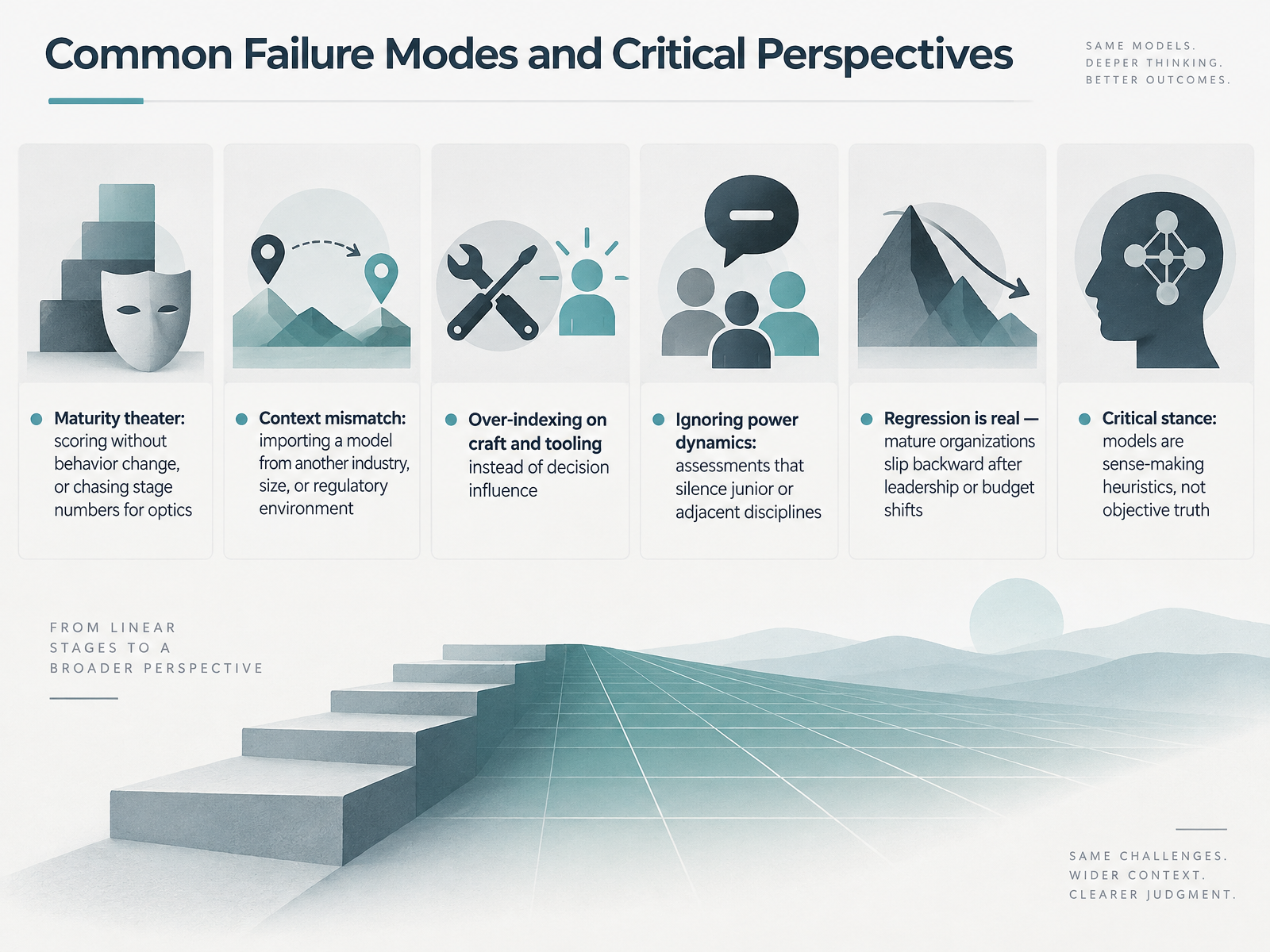
2 min - 12Common Failure Modes and Critical PerspectivesLet's talk about where maturity models go wrong, because they usually fail in predictable ways. The first is maturity theater: teams chase stage numbers for optics, score themselves, and change nothing about how decisions actually get made. Second, context mismatch. A model built for a large regulated enterprise rarely transfers cleanly to a forty person startup, and the reverse is just as true. Third, over-indexing on craft and tooling. A polished design system matters less than your ability to influence the roadmap. Then there is power dynamics. If assessments only capture senior voices, you silence juniors and adjacent disciplines, and you lose the real signal. And remember, regression is real. Organizations slip backward after a leadership change or a budget cut, and that is normal, not failure. So keep a critical stance. These models are sense-making heuristics, not objective truth. Use them to start better conversations, not to end them. Next, we move into putting it into practice, with a ninety day starter plan.
 2 min
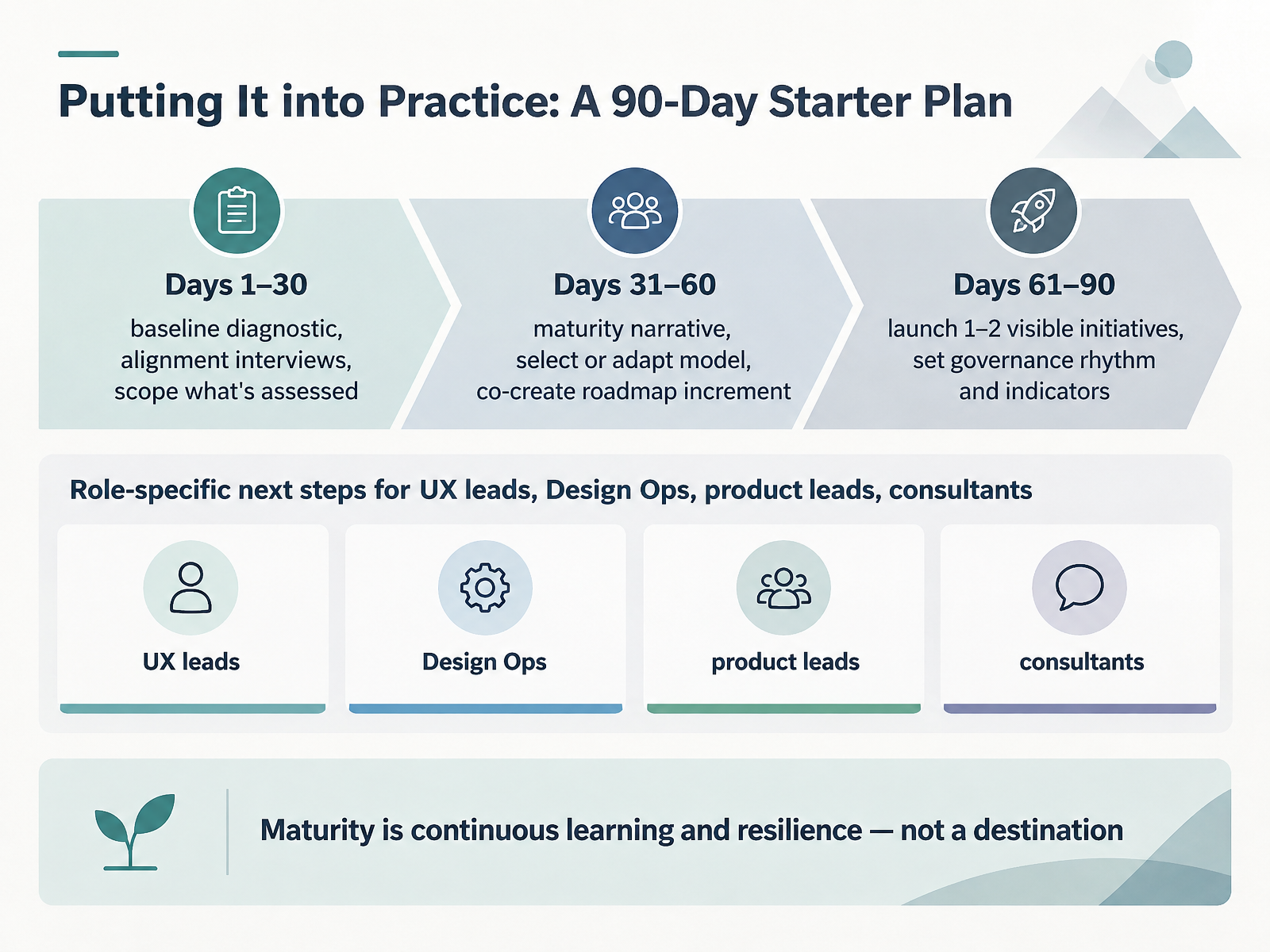
2 min - 13Putting It into Practice: A 90-Day Starter PlanSo let's make this real. Here's a ninety-day starter plan you can actually run. Days one to thirty: run a baseline diagnostic, hold alignment interviews across product, design, and engineering, and scope exactly what gets assessed. Resist the urge to boil the ocean.
Days thirty-one to sixty: turn those findings into a maturity narrative. That story matters more than the model. Then select or adapt a model, and co-create one roadmap increment with the people who'll execute it. Not a three-year plan. One increment.
Days sixty-one to ninety: launch one or two visible initiatives, and set a governance rhythm with a small set of indicators. Visible progress buys you the political capital for the harder work later.
Your next steps differ by role. UX leads: own the narrative and the diagnostic. Design Ops: build the measurement system and the cadence. Product leads: connect maturity work to delivery outcomes, not process theater. Consultants: leave behind capability, not dependency.
One last thing. Maturity is continuous learning and resilience. It is not a destination. You do not arrive. You keep adapting as the org and the market shift around you.
Thank you for staying with this. Go run your first thirty days. Start small, stay honest, and keep learning.
 2 min
2 min
Take the deck with you
Download this course as a file — free, no sign-up needed.
- PDF handoutEvery slide page, ready to print or share.14 pages · 3.0 MBDownload
- Narrated PowerPointThe deck that presents itself — every slide carries the digital human's narration video.14 pages · 15.6 MBDownload
- PowerPoint slidesThe full deck as a .pptx — open it in PowerPoint, Keynote, or Google Slides.14 pages · 2.9 MBDownload
Free to use in your own training — please keep the PersonWise credit page at the end.
Have your own deck? Turn it into a course