Begin
14 pages · ~28 min
Instructional Design Roadmap Development
This training guides instructional designers in building a practical roadmap to plan, prioritize, and align learning projects with organizational goals.
A digital instructor presents all 14 pages. Hold “Ask” at any point and ask out loud — the answer comes from this course. No sign-up needed.
What you’ll learn
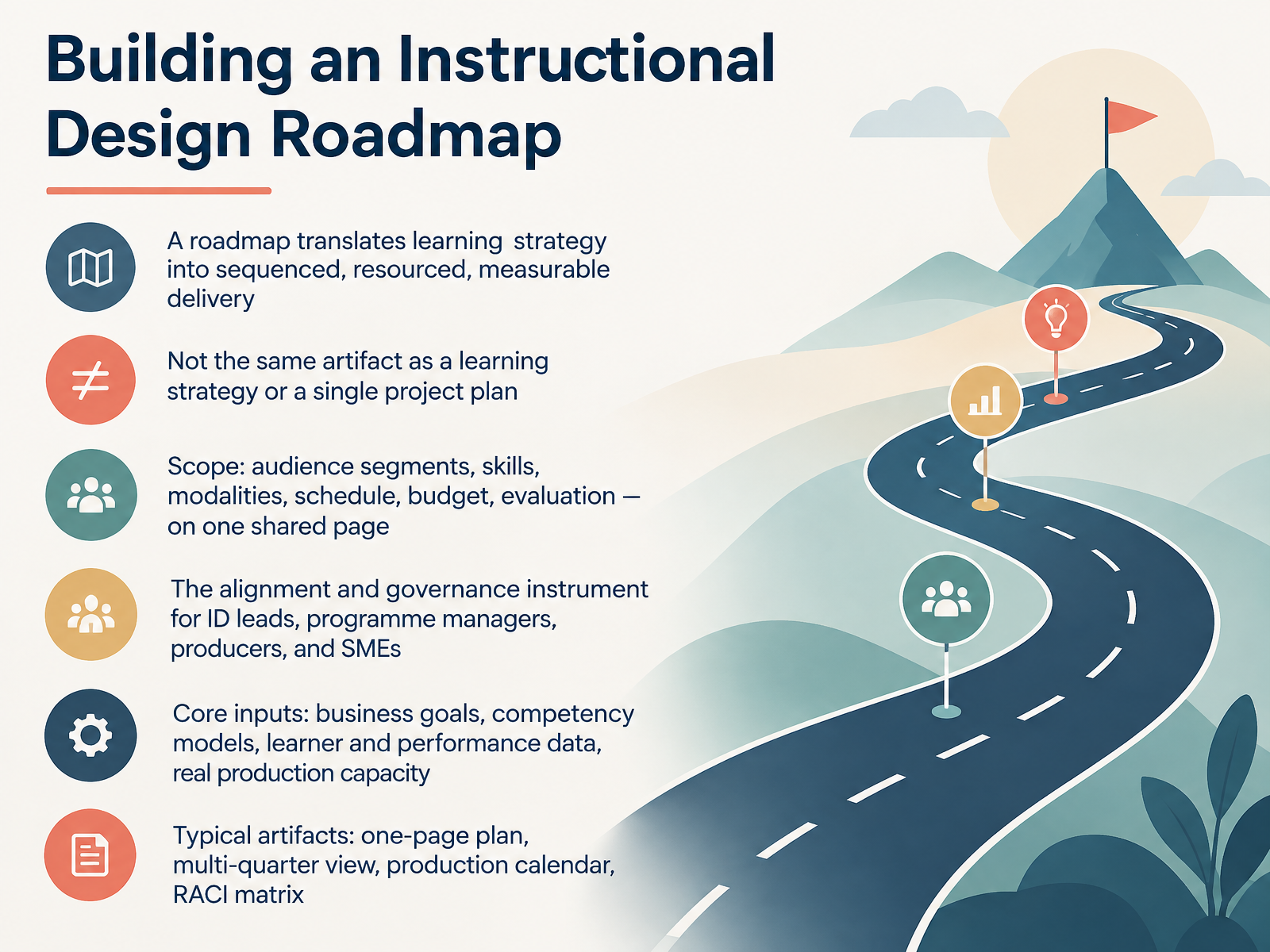
- 01Building an Instructional Design RoadmapWelcome. Over the next few slides, we're going to build an instructional design roadmap together. So let's start with what a roadmap actually is. A roadmap translates your learning strategy into sequenced, resourced, and measurable delivery. It is not the same artifact as a learning strategy, and it is not a single project plan. Think of it as the alignment and governance instrument you and your stakeholders work from. Scope covers audience segments, skills, modalities, schedule, budget, and evaluation, all on one shared page. Core inputs come from business goals, competency models, learner and performance data, and real production capacity. Typical artifacts include a one-page plan, a multi-quarter view, a production calendar, and a RACI matrix. Here's your takeaway. A good roadmap shows what gets built, when, and who owns it. Next, we'll look at why roadmaps fail and what changes in 2026.clickup.comdevlinpeck.comdevlinpeck.com+21 min
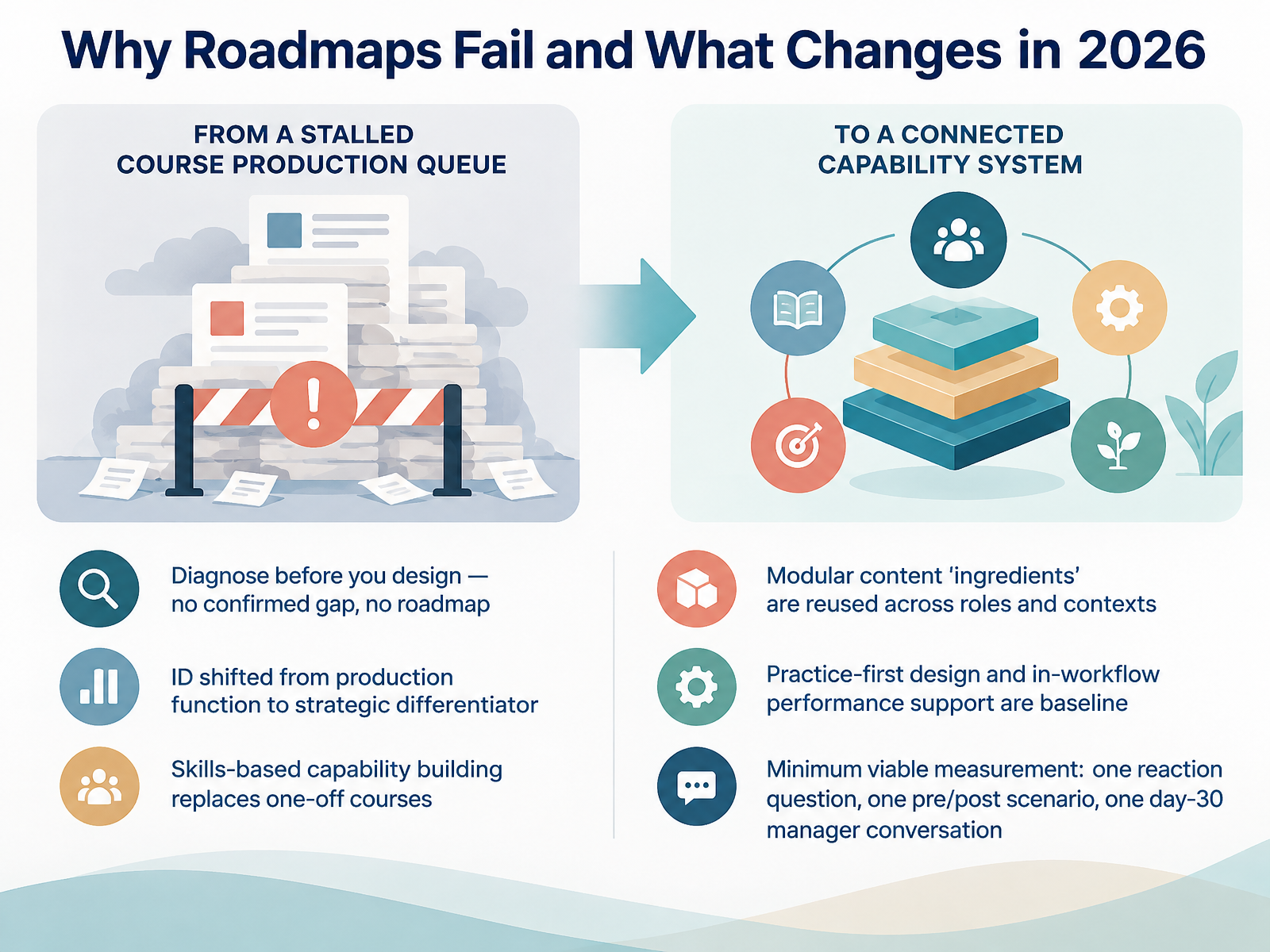
- 02Why Roadmaps Fail and What Changes in 2026Let's start with why roadmaps fail, and what has changed this year. The first failure point is skipping diagnosis. If you have not confirmed a real performance gap, you do not build a roadmap around it. No confirmed gap, no roadmap. The bigger shift is this. Instructional design has moved from a production function to a strategic differentiator. We are no longer just shipping courses. We are building capability. That means skills-based pathways replace one-off courses, and modular content ingredients get reused across roles and contexts. Practice-first design and in-workflow performance support are now the baseline, not the stretch goal. And keep measurement lean but real. One reaction question. One pre and post scenario. One manager conversation at day thirty. That is three data points, and it tells you whether your design actually worked. Next, we look at the business drivers and capability demand signals. That is where your roadmap gets its mandate.
 aicoursecreator.eskilled.iotrainercentric.invideolearningai.com+22 min
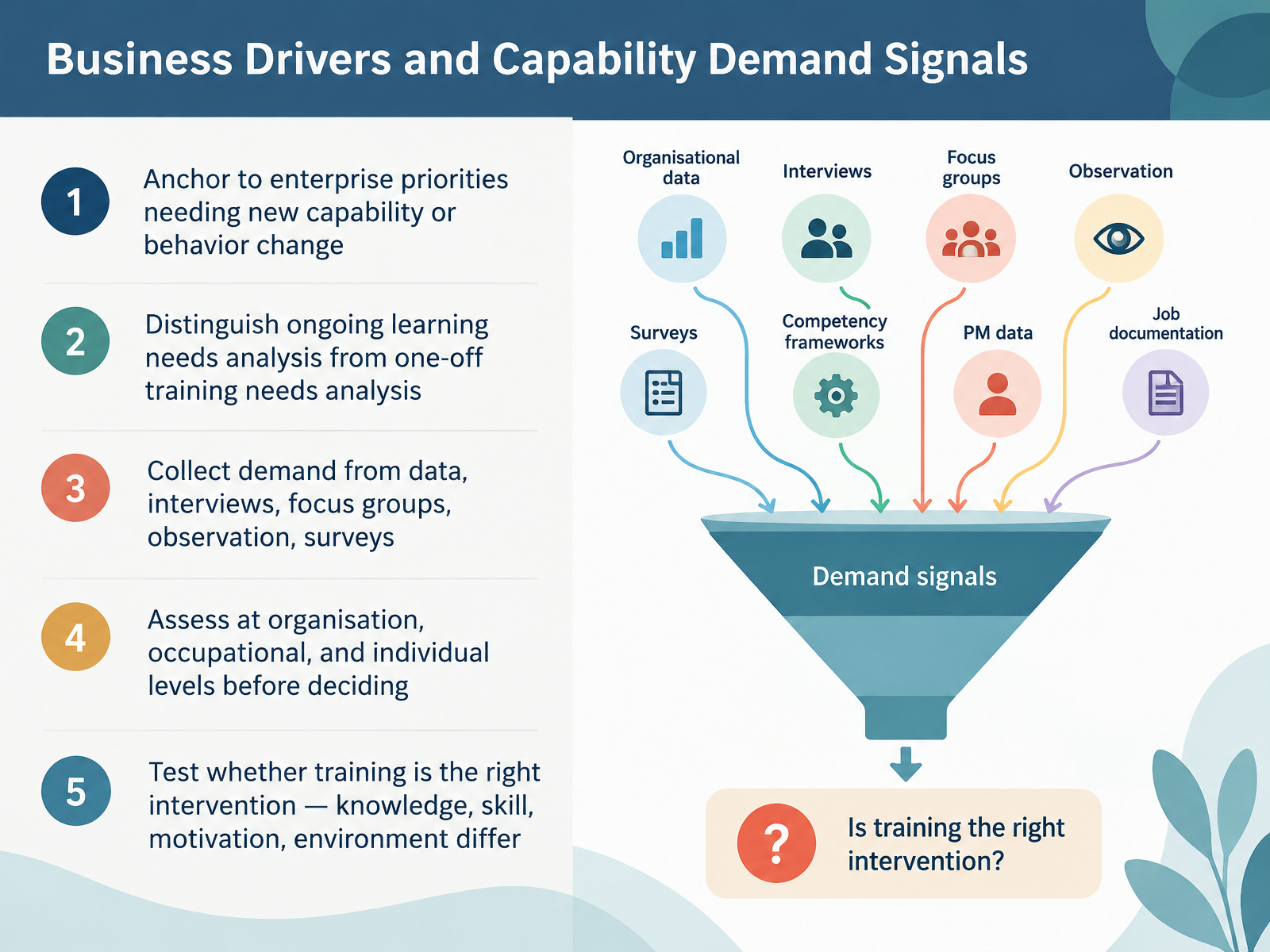
- 03Business Drivers and Capability Demand SignalsLet's talk about the signals that should drive your roadmap before you commit to anything. Start with business drivers. Anchor every initiative to an enterprise priority that needs new capability or behavior change. Next, be clear on the difference between ongoing learning needs analysis and a one-off training needs analysis. The first is a continuous health check on capability. The second is a single event tied to one course. Both have a place, but they answer different questions. Then gather demand from multiple sources: organizational data, interviews, focus groups, observation, and surveys. One method alone will mislead you. Assess at three levels: organization, occupation, and individual. A gap at one level does not always mean the same fix at another. And finally, test your assumption. Ask whether training is really the right intervention. Knowledge, skill, motivation, and environment each demand a different response. If the barrier is environmental, a course will not solve it. Let's move on to defining success measures before you draft anything.
 cipd.orgtd.orgsqa.org.uk+22 min
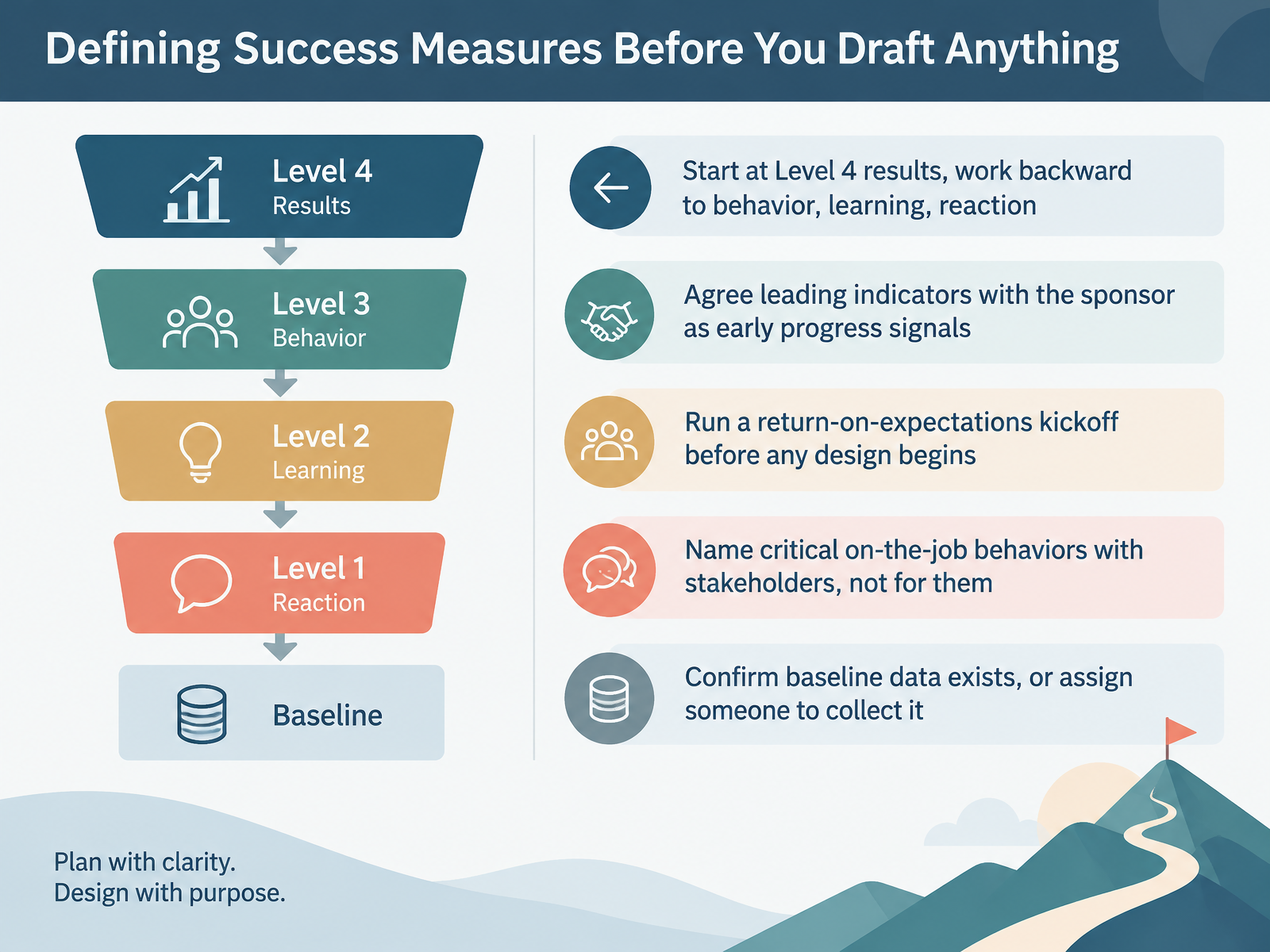
- 04Defining Success Measures Before You Draft AnythingLet's talk about defining success measures before you draft anything. This is where we run the project backward. Start at Level 4 results, the business outcome your sponsor actually owns. Then work backward to the critical behaviors, the learning, and finally the reaction measures. Here's the practical move. Agree on leading indicators with your sponsor as early progress signals, so you're not waiting a year to show movement. Run a return-on-expectations kickoff before any design begins. In that meeting, ask what success looks like, how it's measured today, and who owns the number. Name the critical on-the-job behaviors with stakeholders, not for them. Their words carry weight when you report later. And confirm baseline data exists, or assign someone to collect it. No baseline means no credible comparison. Lock these down first, and the rest of the roadmap has something solid to stand on. Next, we'll look at the core components of a high-quality roadmap.
 kirkpatrickpartners.comdevlinpeck.comkirkpatrickpartners.com+21 min
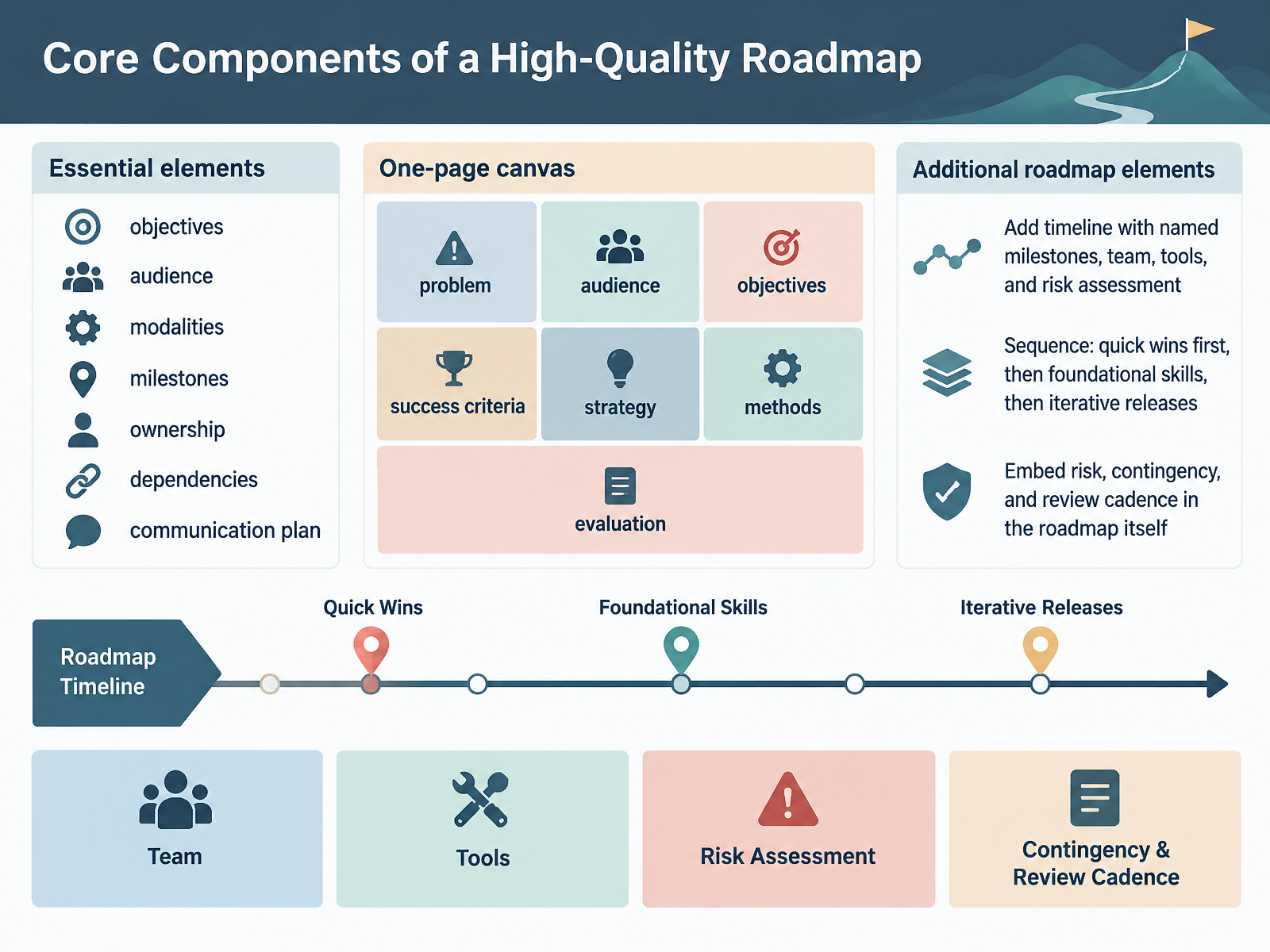
- 05Core Components of a High-Quality RoadmapSo what actually goes into a high-quality roadmap? Start with the essentials. Objectives, audience, modalities, milestones, named owners, dependencies, and a communication plan. If any one of those is missing, you'll feel it later, usually at the worst possible moment.
Many teams keep this on a single page. A one-page canvas works well here. Problem, audience, objectives, success criteria, strategy, methods, and evaluation. One page forces the hard conversations early, while they're still cheap to fix. Then add the operational layer. A timeline with named milestones, the team, the tools, and a risk assessment.
Now think about sequence. Quick wins first, then foundational skills, then iterative releases. That order builds momentum and buy-in without stalling the deeper work. And here's the part people skip. Embed risk, contingency, and your review cadence in the roadmap itself. When a dependency slips, you already know what moves.
So keep it to one page where you can, name your owners, and sequence for momentum. That's the roadmap that actually survives contact with the project. Next, let's look at choosing your delivery model and design approach.
 clickup.comdevlinpeck.comdevlinpeck.com+22 min
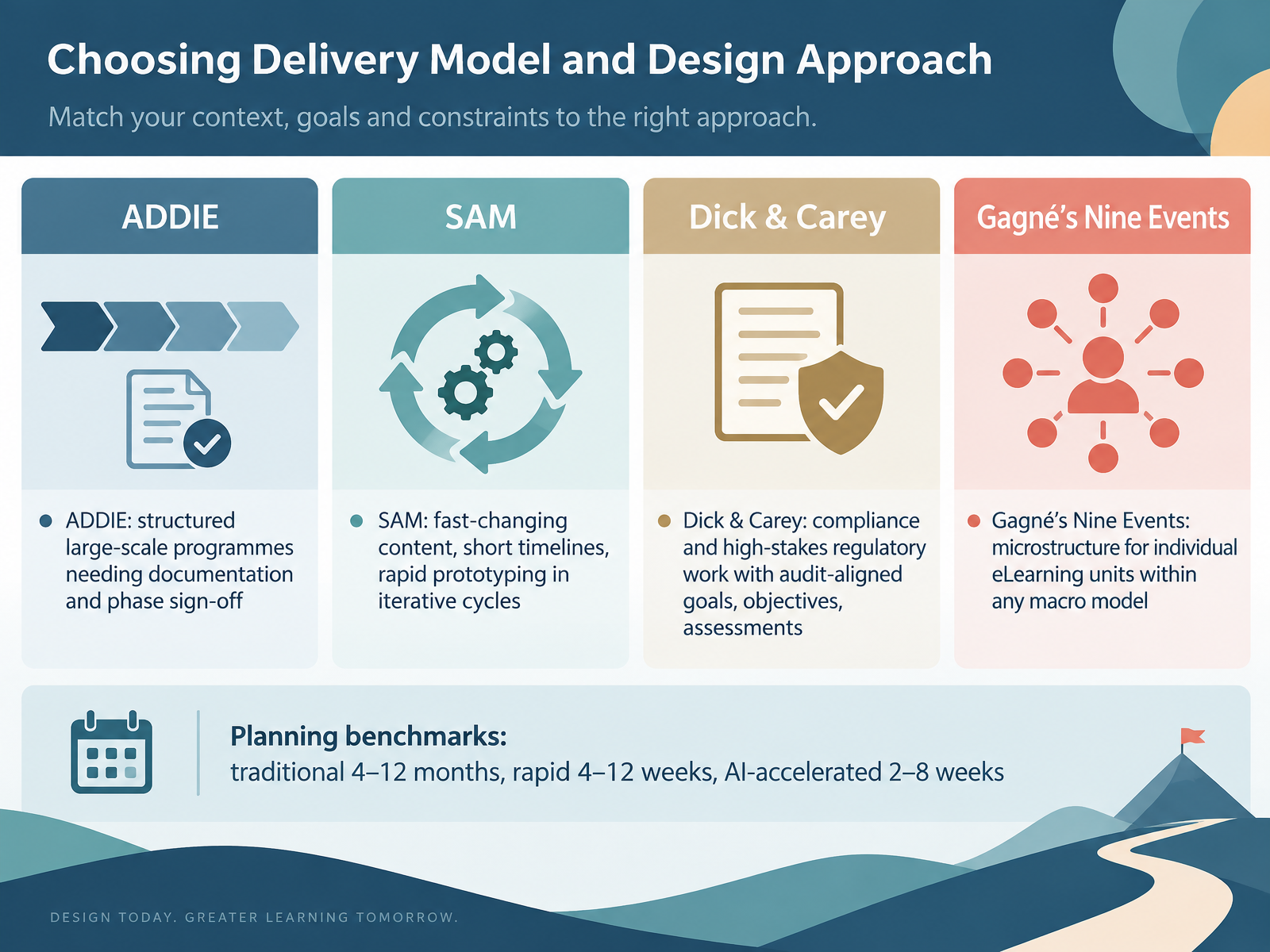
- 06Choosing Delivery Model and Design ApproachNow let's talk about choosing your delivery model and design approach. This is where model selection gets real, and it depends on four variables: timeline, stakes, stakeholder availability, and the nature of the performance gap. ADDIE works well for structured, large-scale programmes that need documentation and phase sign-off. SAM fits fast-changing content and short timelines, where you prototype in quick, iterative cycles. Dick and Carey is your choice for compliance and high-stakes regulatory work, because its goals, objectives, and assessments stay aligned for audit. Think of Gagné's Nine Events as the microstructure for individual eLearning units inside any macro model. Here's what many of us actually do: hybrid practice. Use ADDIE's phase structure for governance, then run SAM-style prototyping inside design and development. For planning, set realistic benchmarks. Traditional projects run four to twelve months. Rapid work runs four to twelve weeks. With AI acceleration, many projects land between two and eight weeks. Pick the model that matches your constraints, then defend those phase gates. Next, we'll look at scoping and prioritizing the learning portfolio.
 aicoursecreator.eskilled.iotrainercentric.invideolearningai.com+22 min
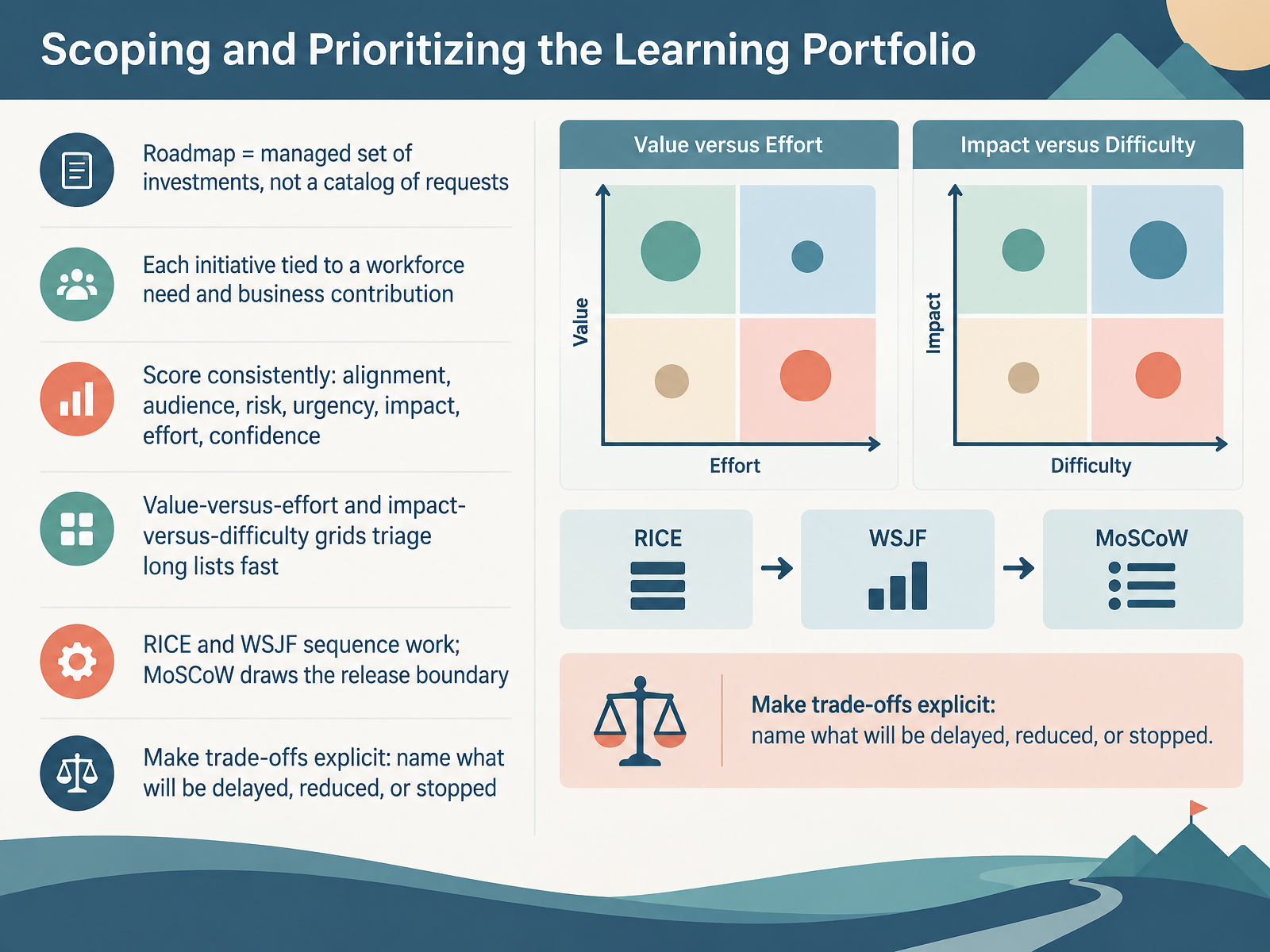
- 07Scoping and Prioritizing the Learning PortfolioLet's talk about how we scope and prioritize the portfolio. Here's the mindset shift: a roadmap is a managed set of investments, not a catalog of requests. So we tie every initiative to a workforce need and an expected business contribution, and we say that out loud. Then we score consistently. Alignment, audience, risk, urgency, impact, effort, and confidence. When your list is long, triage it fast with a value versus effort grid or an impact versus difficulty grid. For sequencing, RICE and WSJF help you order the work. MoSCoW draws the release boundary. Just remember, frameworks make the math visible. Judgment still makes the call. And make the trade-offs explicit. If something new comes in, name what gets delayed, reduced, or stopped. That's the discipline that protects real capacity. Next, let's move into sequencing, phasing, and milestone planning.
 2 min
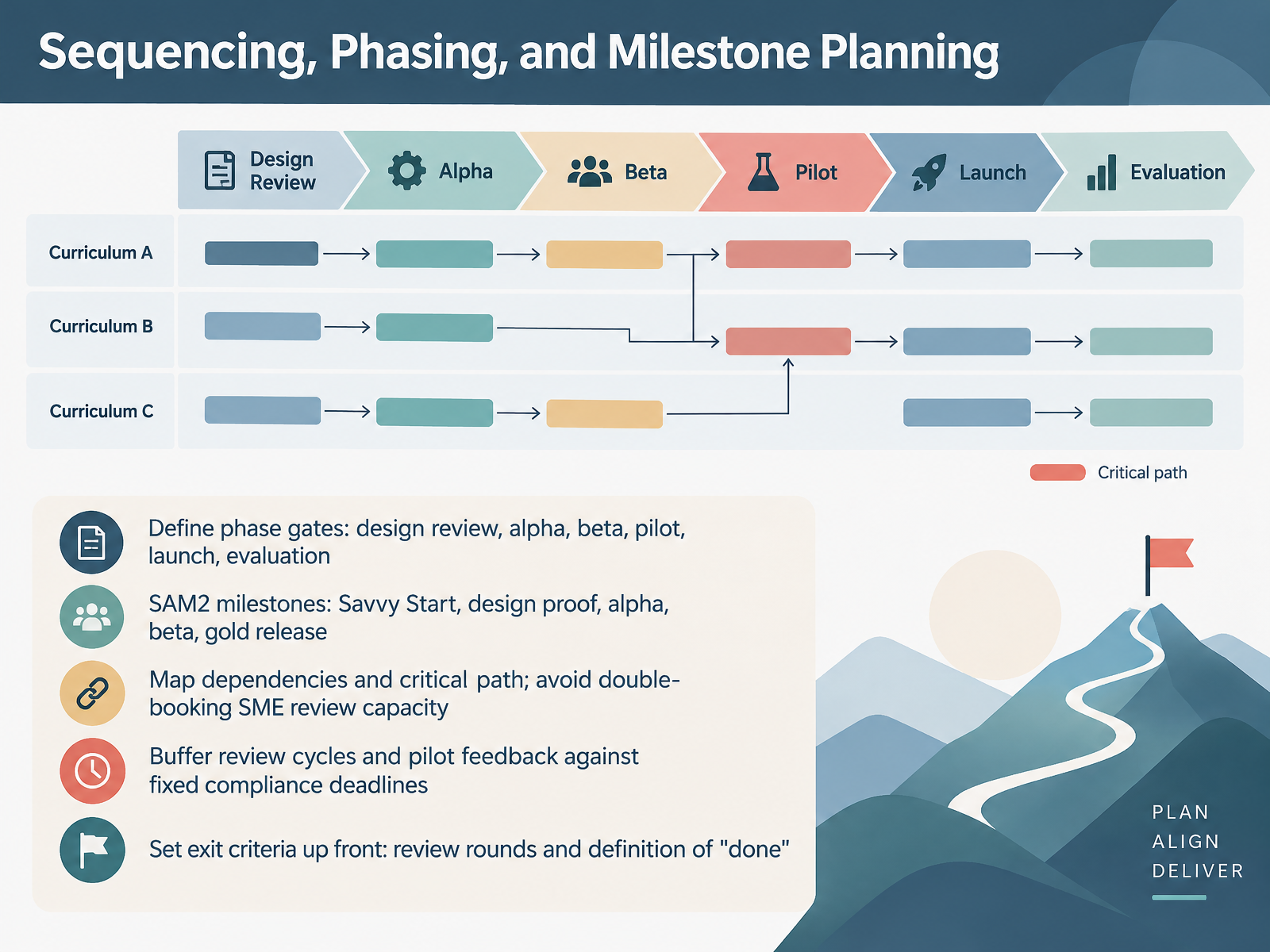
- 08Sequencing, Phasing, and Milestone PlanningLet's talk about sequencing, phasing, and milestones. Most teams blend approaches here. Use ADDIE-style phase gates where you need formal sign-off: design review, alpha, beta, pilot, launch, evaluation. If you're running SAM2, your named milestones are the Savvy Start, the design proof, then alpha, beta, and gold. Whichever model you pick, map dependencies and the critical path before you commit dates. One common trap: double-booking your subject matter experts across reviews. Check their calendar, not just the plan. Buffer review cycles and pilot feedback against fixed compliance deadlines, because revisions always take longer than the schedule says. And set exit criteria up front. How many review rounds does each deliverable get? What does done actually mean? Two rounds per module, then it ships unless a functional defect appears. That is a real definition of done. Write it down before the first cycle starts, so you're not negotiating at the end. Next, we'll look at how to assign roles and plan capacity across your teams, in Roles, Responsibilities, and Capacity Planning.
 clickup.comdevlinpeck.comdevlinpeck.com+22 min
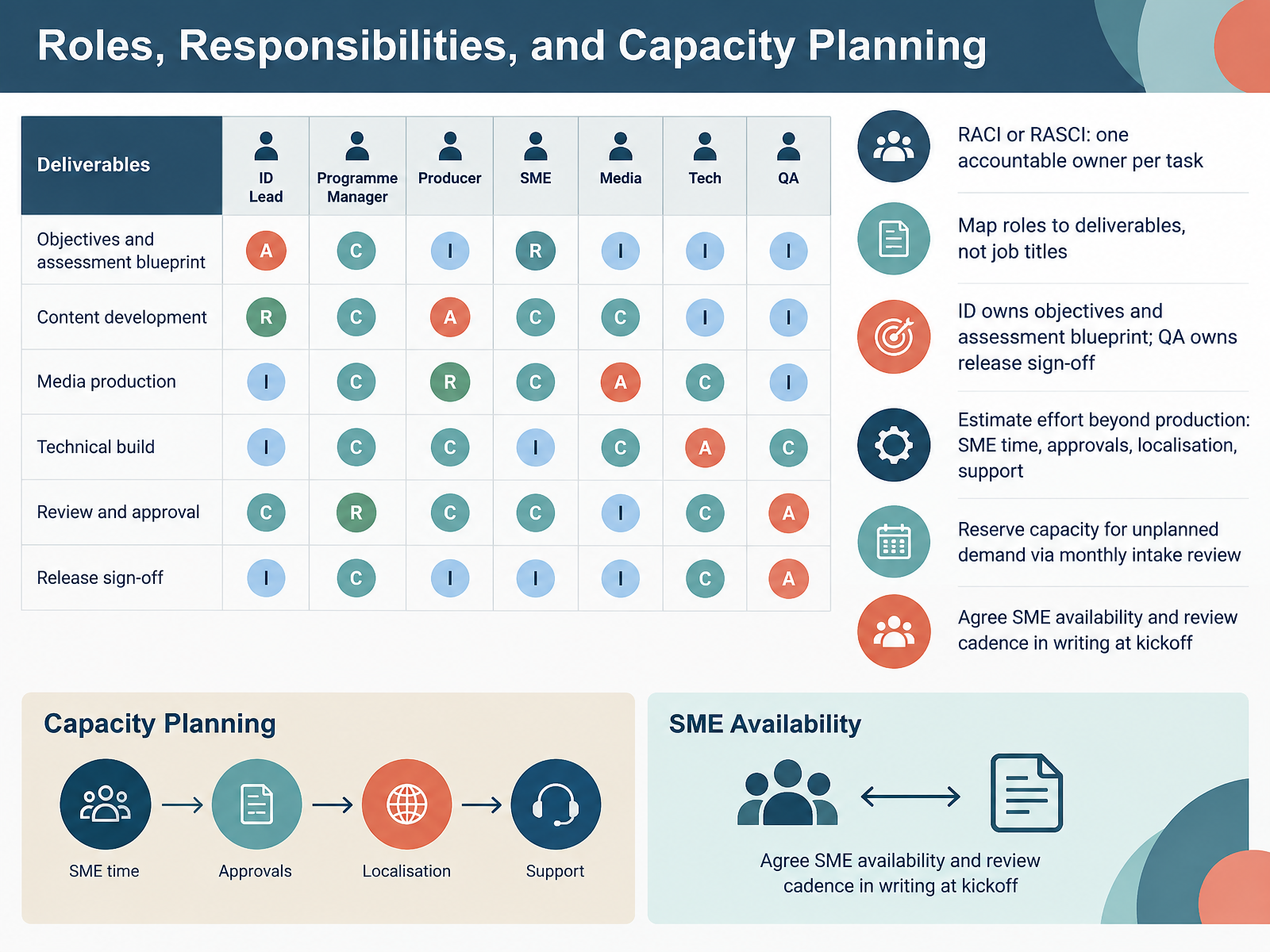
- 09Roles, Responsibilities, and Capacity PlanningNow let's talk about roles, responsibilities, and capacity planning. Start with a RACI or RASCI chart. The one rule that matters most is this. Every task gets exactly one accountable owner. One person signs off. Not two. Then map roles to deliverables, not job titles. Say who owns the objectives and the assessment blueprint. Say who owns release sign-off. Your instructional designers own the blueprint. QA owns the go-live decision. When you estimate effort, look past production hours. Add subject matter expert time, approval cycles, localisation, and post-launch support. Those are the items that quietly break timelines. Reserve capacity for unplanned demand, and run a monthly intake review so new requests land in a known queue. Finally, at kickoff, agree SME availability and the review cadence in writing. Verbal promises fade. Written ones hold. Next, we move into governance, risk, and quality gates.
 2 min
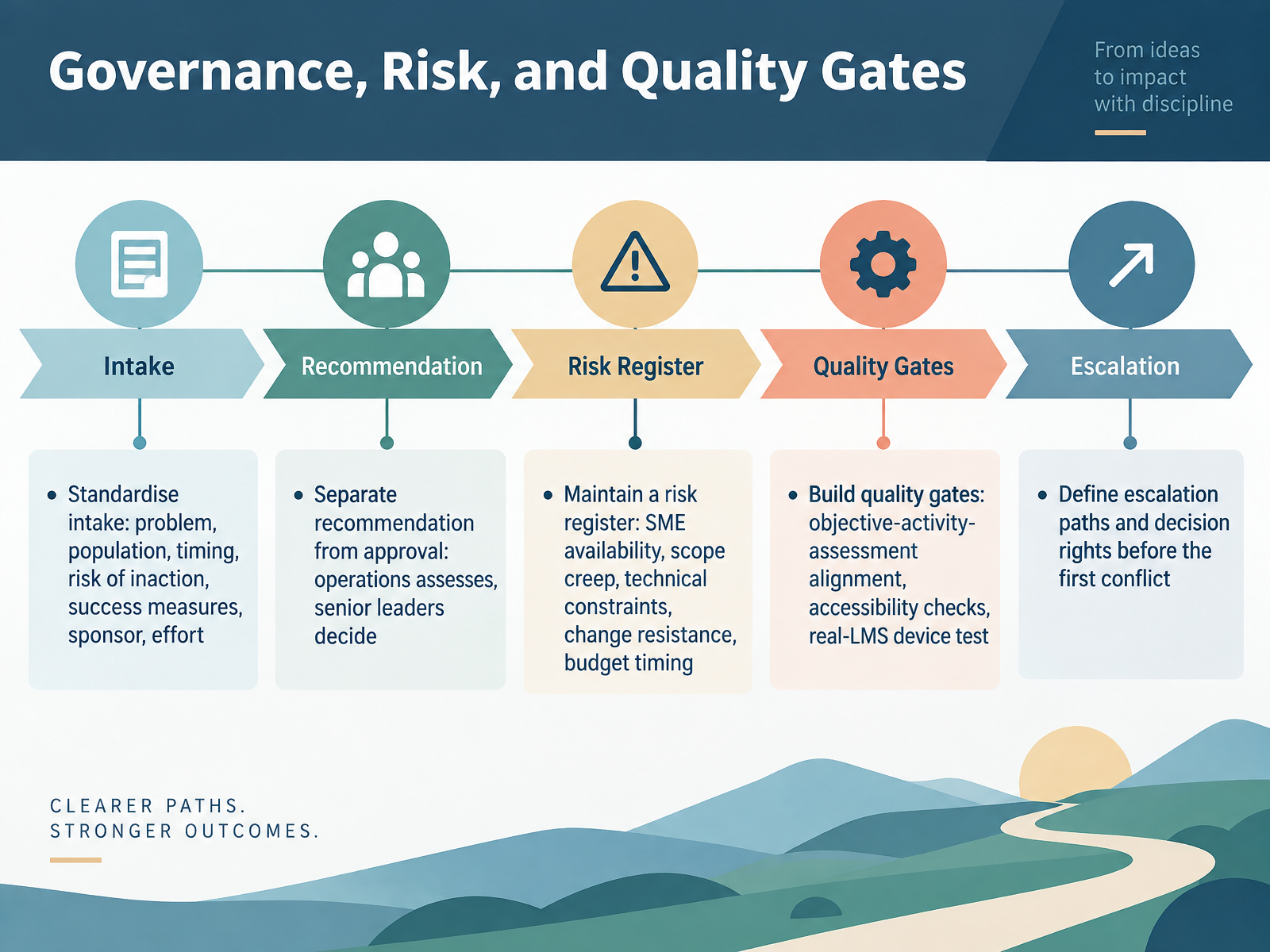
- 10Governance, Risk, and Quality GatesLet's talk about how we keep this roadmap honest once delivery is underway.
First, separate recommendation from approval. Your learning operations team assesses the request. Senior leaders decide. That keeps objectivity intact and stops governance from becoming a negotiation.
Second, standardise intake. Capture the problem, the population, the timing, the risk of doing nothing, the success measures, the sponsor, and the rough level of effort. If you can't answer those questions, you're not ready to prioritise.
Third, maintain a risk register. SME availability, scope creep, technical constraints, change resistance, and budget timing are the usual suspects. Track them before they track you.
Fourth, build quality gates. Check objective to activity to assessment alignment, run accessibility checks, and do a real device and LMS test.
Finally, define escalation paths and decision rights before the first conflict. Not during it.
Next, we'll look at the tools and data that keep this all connected. Tools, Data, and a Single Source of Truth.
 clickup.comdevlinpeck.comdevlinpeck.com+22 min
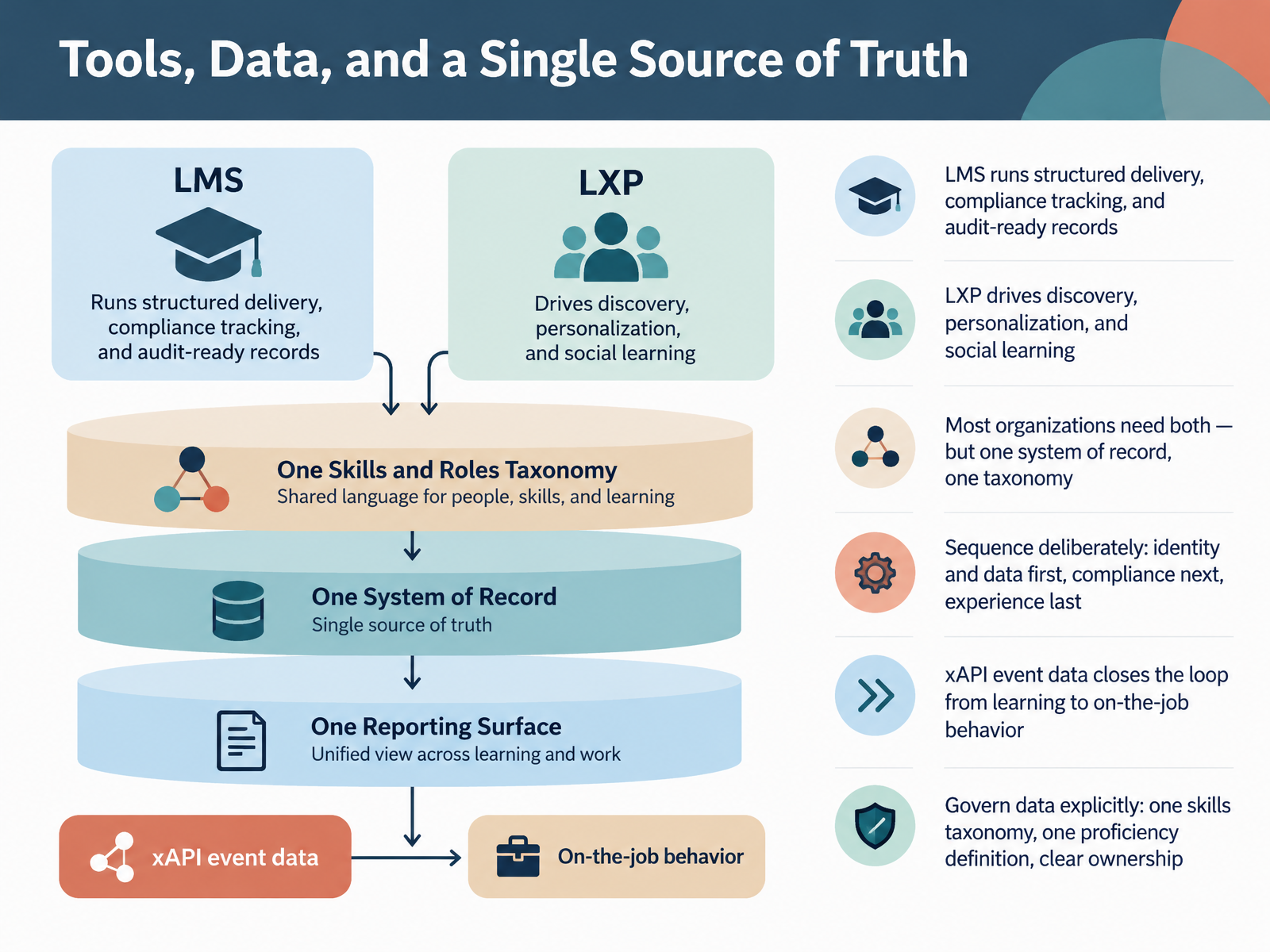
- 11Tools, Data, and a Single Source of TruthNow let's talk about tools, data, and a single source of truth. Start with what each system does. The LMS runs structured delivery, compliance tracking, and audit-ready records. The LXP drives discovery, personalization, and social learning. Most organizations need both, but here's the non-negotiable: one system of record and one taxonomy. You can run two platforms. What you cannot run is two versions of the truth. So sequence deliberately. Identity and data first. Compliance next. Experience last. Teams that reverse this launch something engaging that cannot pass an audit. Then they spend a quarter rebuilding the foundation underneath it. Next, close the loop. xAPI event data connects learning to on-the-job behavior, not just login counts. Finally, govern your data explicitly. One skills taxonomy. One proficiency definition. Clear ownership. That is how you keep reporting trustworthy. Next, we will look at communication, stakeholder alignment, and change management.
 2 min
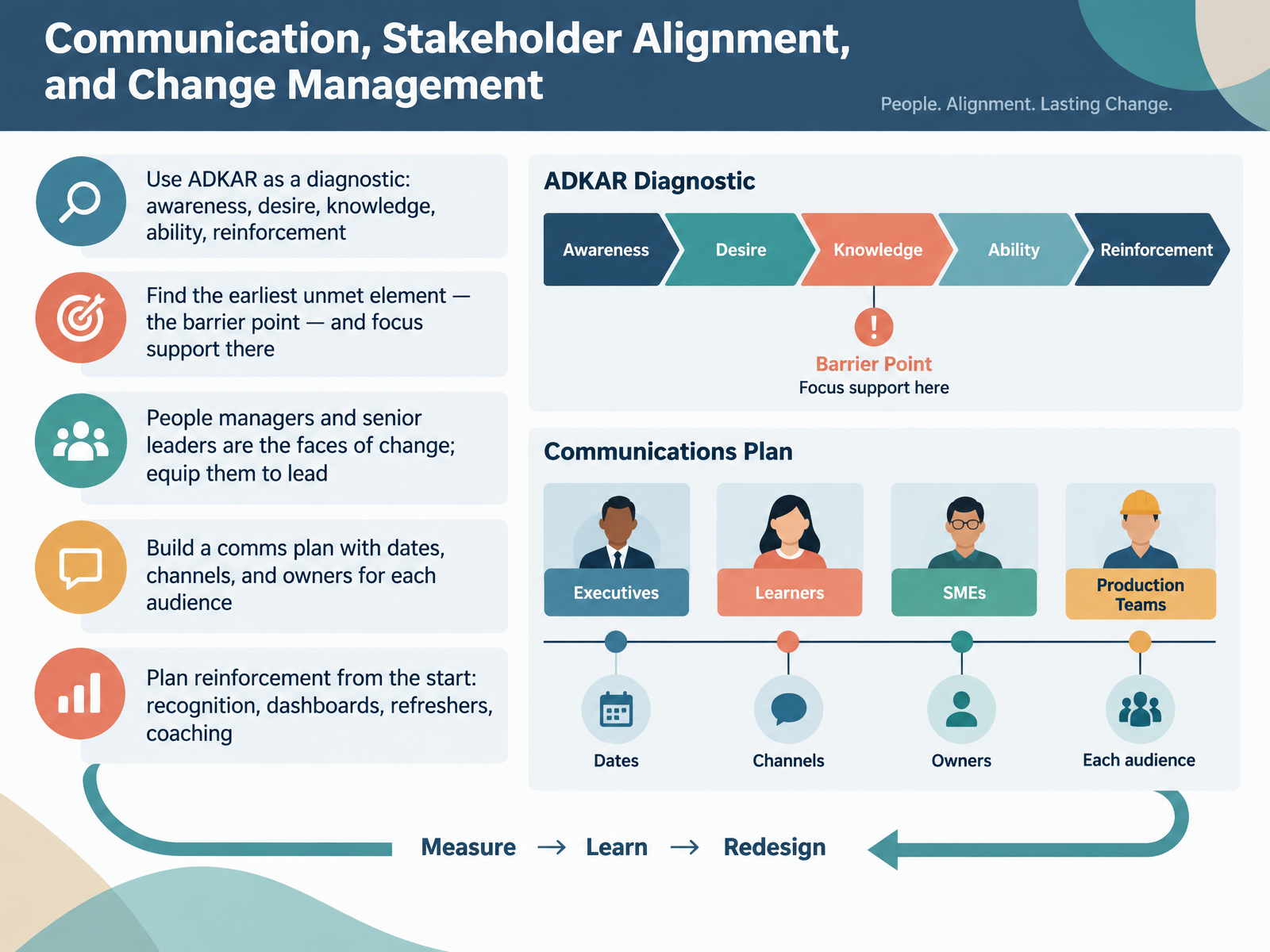
- 12Communication, Stakeholder Alignment, and Change ManagementLet's talk about the people side of your roadmap: communication, stakeholder alignment, and change management. Use the ADKAR model as a diagnostic. That's awareness, desire, knowledge, ability, and reinforcement. Ask where each group is stuck. Find the earliest unmet element, what Prosci calls the barrier point, and focus your support there. If awareness is thin, no amount of training will land. People managers and senior leaders are the faces of change. Equip them with talking points, FAQs, and timelines so they can lead in their own teams. Then build a comms plan with dates, channels, and owners for each audience. And plan reinforcement from the start: recognition, dashboards, refreshers, and coaching. That's how adoption lasts. Next, we'll look at review cadence and course correction.
 2 min
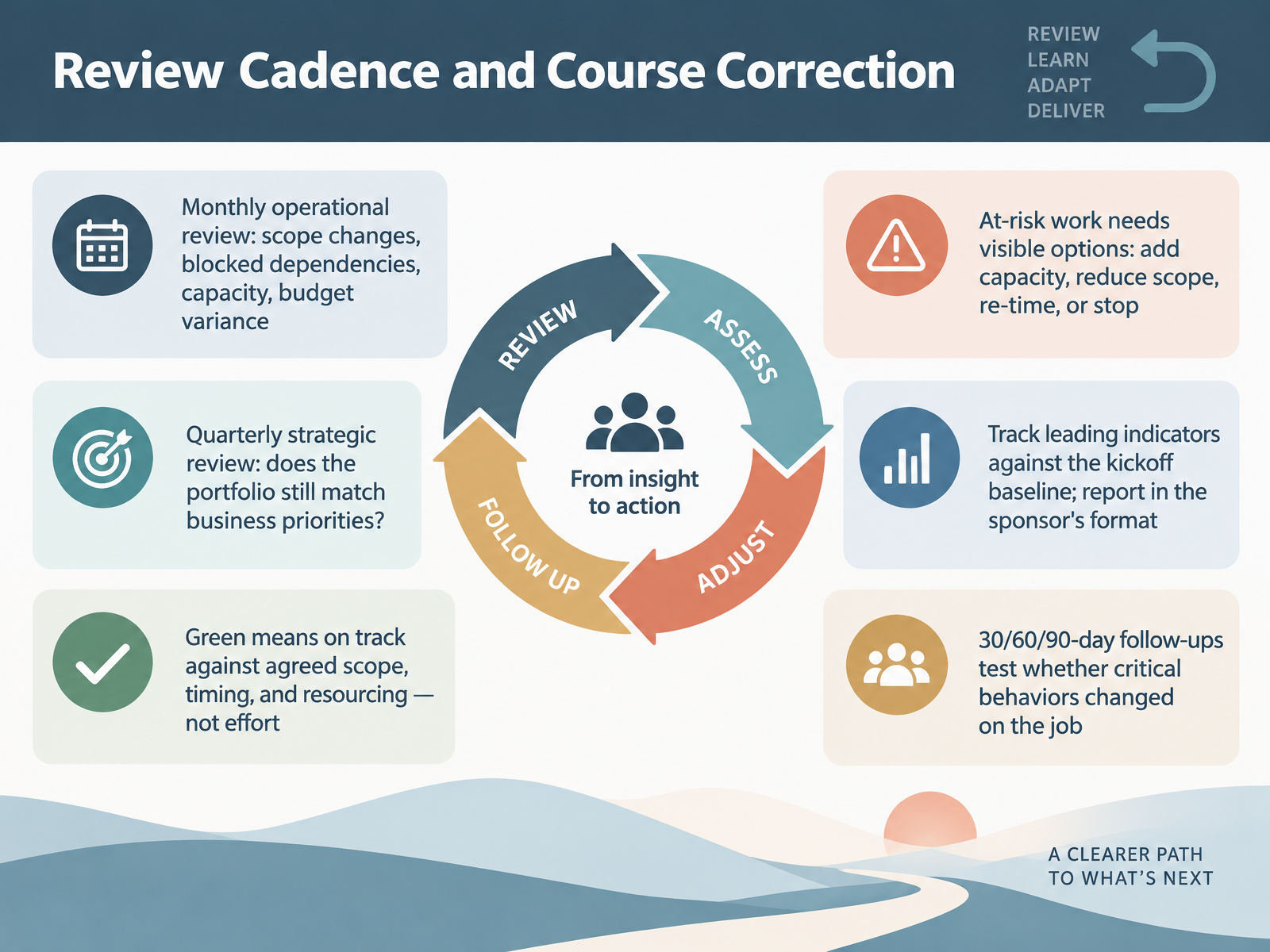
- 13Review Cadence and Course CorrectionNow let's talk about review cadence and course correction. A roadmap only stays honest if you revisit it on a rhythm. So hold two reviews. Monthly, look at operations: scope changes, blocked dependencies, capacity, and budget variance. Then quarterly, step back and ask the strategic question. Does this portfolio still match our business priorities? Here's a rule worth defending. Green means on track against agreed scope, timing, and resourcing. It does not mean the team is working hard. When work is at risk, make the options visible. Add capacity, reduce scope, re-time, or stop. Track leading indicators against the kickoff baseline, and report in the sponsor's format, not yours. Finally, use thirty, sixty, and ninety day follow-ups to test whether critical behaviors actually changed on the job. That is the difference between activity and impact. Next, we'll look at continuous improvement and the next roadmap cycle.
 kirkpatrickpartners.comdevlinpeck.comkirkpatrickpartners.com+22 min
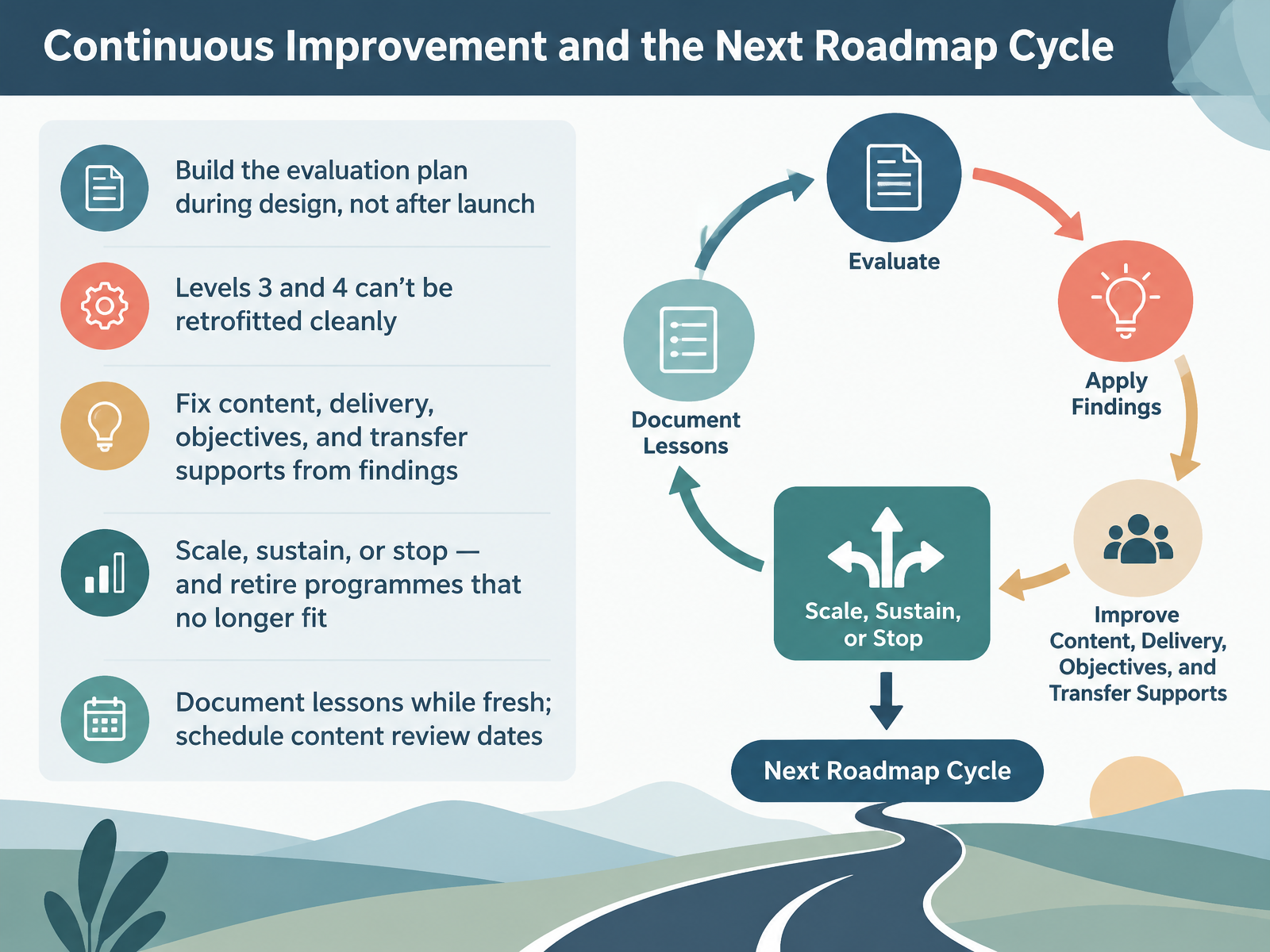
- 14Continuous Improvement and the Next Roadmap CycleLet's close the loop on the roadmap. Build your evaluation plan during design, not after launch. Levels three and four, behavior and results, can't be retrofitted cleanly. So start with the business result, work backward to the behaviors, then decide what evidence you'll collect and when. When findings come in, fix what they point to. That might be the content, the delivery, the objectives, or the transfer supports like manager coaching and job aids. Then make a real decision about each program: scale it, sustain it, or stop it. Retiring a program that no longer fits is a legitimate outcome, not a failure. One last habit. Document lessons while they're fresh, and schedule your content review dates before the next cycle starts. That's the roadmap. Keep it honest, keep it current, and keep it tied to results. Thanks for working through this with me, and go build the next cycle well.
 kirkpatrickpartners.comdevlinpeck.comkirkpatrickpartners.com+22 min
Take the deck with you
Download this course as a file — free, no sign-up needed.
- PDF handoutEvery slide page, ready to print or share.15 pages · 3.3 MBDownload
- Narrated PowerPointThe deck that presents itself — every slide carries the digital human's narration video.15 pages · 13.9 MBDownload
- PowerPoint slidesThe full deck as a .pptx — open it in PowerPoint, Keynote, or Google Slides.15 pages · 3.2 MBDownload
Free to use in your own training — please keep the PersonWise credit page at the end.
Have your own deck? Turn it into a course
Sources consulted
Web sources consulted while building this course.
- Project Plan Template for Instructional Design | Template by ClickUp™ — clickup.com
- Instructional Design Document Template: Guide and Example | Devlin Peck — devlinpeck.com
- The Instructional Design Project Checklist — devlinpeck.com
- The Learning Design Canvas™ — Free Download | Instructional Design Central (IDC) — instructionaldesigncentral.com
- Learning Management Work Breakdown Structure Template | Template by ClickUp™ — clickup.com
- Instructional Design Best Practices for e-Learning in 2026 & 2027 — aicoursecreator.eskilled.io
- Instructional Design Models: Everything You Need Including Free Templates [2026] - TrainerCentric — trainercentric.in
- Instructional Design Best Practices: 2026 Guide for Success | VideoLearningAI — videolearningai.com
- Fundamentals of Instructional Design Best Practices: 2026 Guide for Success - Weje.io — weje.io
- Instructional Design Best Practices for 2026 | Colossyan — colossyan.com
- Learning needs analysis | Factsheets — cipd.org
- Training Needs Assessment Certificate Program for L&D | ATD — td.org
- Unit L&D1 Identify Collective Learning and Development Needs (FD3N 04) — sqa.org.uk
- Identify collective learning and development needs — files.ukstandards.org.uk
- Needs Assessment — shrm.org
- An Introduction to The New World Kirkpatrick ® Model — kirkpatrickpartners.com
- Kirkpatrick Evaluation Plan Template — devlinpeck.com
- Kirkpatrick Blended Evaluation Plan® — kirkpatrickpartners.com
- Building a Culture of Evaluation: The New Kirkpatrick Model for Performance and Innovation — assets.td.org
- Kirkpatrick Model Toolkit — artofservice.com.au