Begin
14 pages · ~28 min
Cybersecurity Portfolio Development
Build a professional cybersecurity portfolio that showcases your hands-on skills to employers. Ideal for aspiring and practicing security professionals.
A digital instructor presents all 14 pages. Hold “Ask” at any point and ask out loud — the answer comes from this course. No sign-up needed.
What you’ll learn
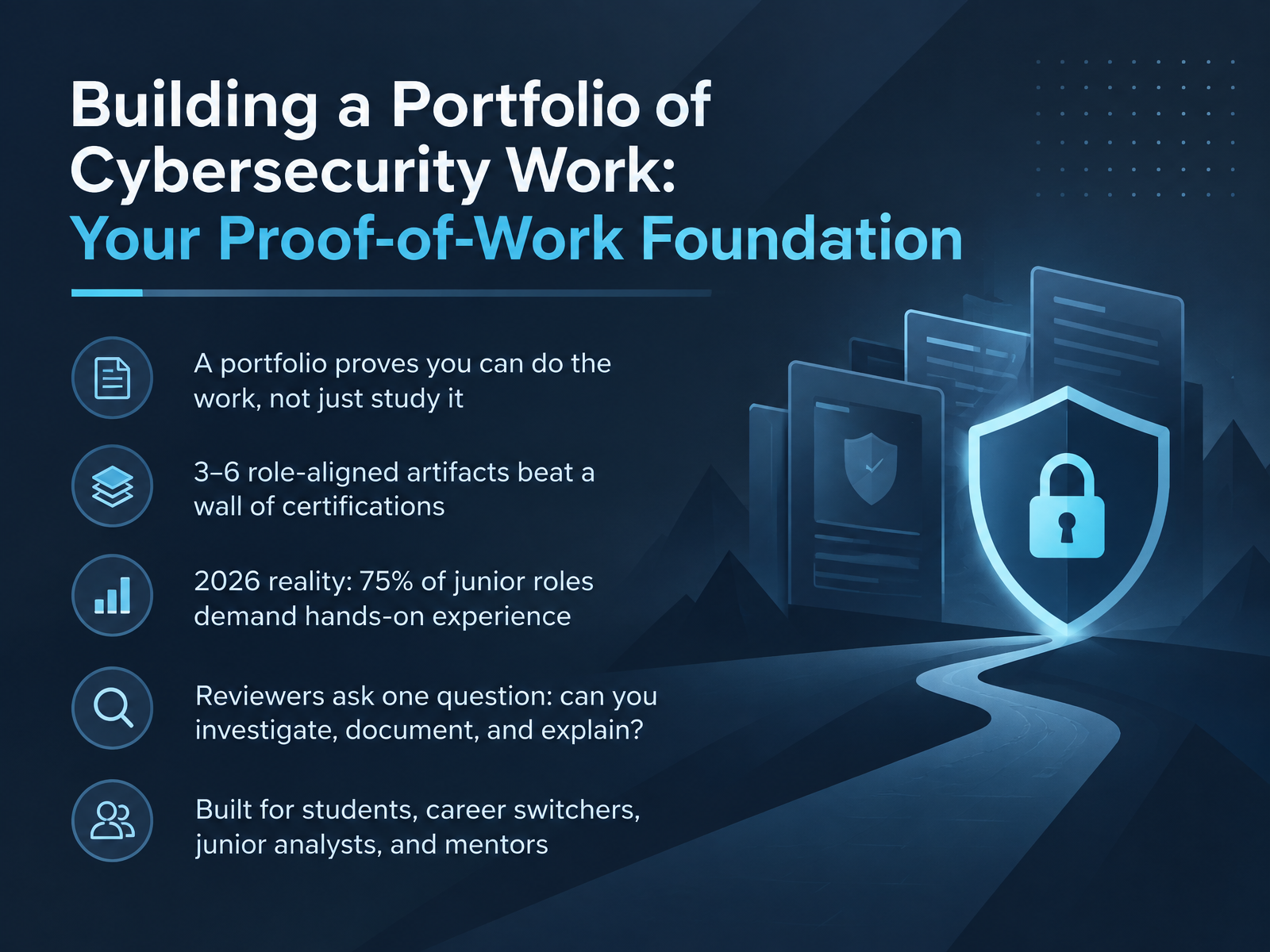
- 01Building a Portfolio of Cybersecurity Work: Your Proof-of-Work FoundationWelcome. I am glad you are here. Over the next few slides, we are building something practical: a portfolio of cybersecurity work. Think of it as your proof-of-work foundation. Here is the core idea. A portfolio proves you can do the work, not just study it. And in 2026, that matters. Roughly seventy-five percent of junior roles now demand hands-on experience. So instead of a wall of certifications, aim for three to six artifacts aligned to one target role. Maybe a phishing email analysis, a log review, or an incident writeup. Reviewers really ask one question: can you investigate, document, and explain? This course is built for students, career switchers, junior analysts, and mentors checking evidence of defensive skills. Your first action: pick one role you are aiming for. That focus will guide everything else. Next, let us look at why certifications open doors, but proof gets you hired.ituonline.comituonline.comthecareercompass-newsletter.beehiiv.com+22 min
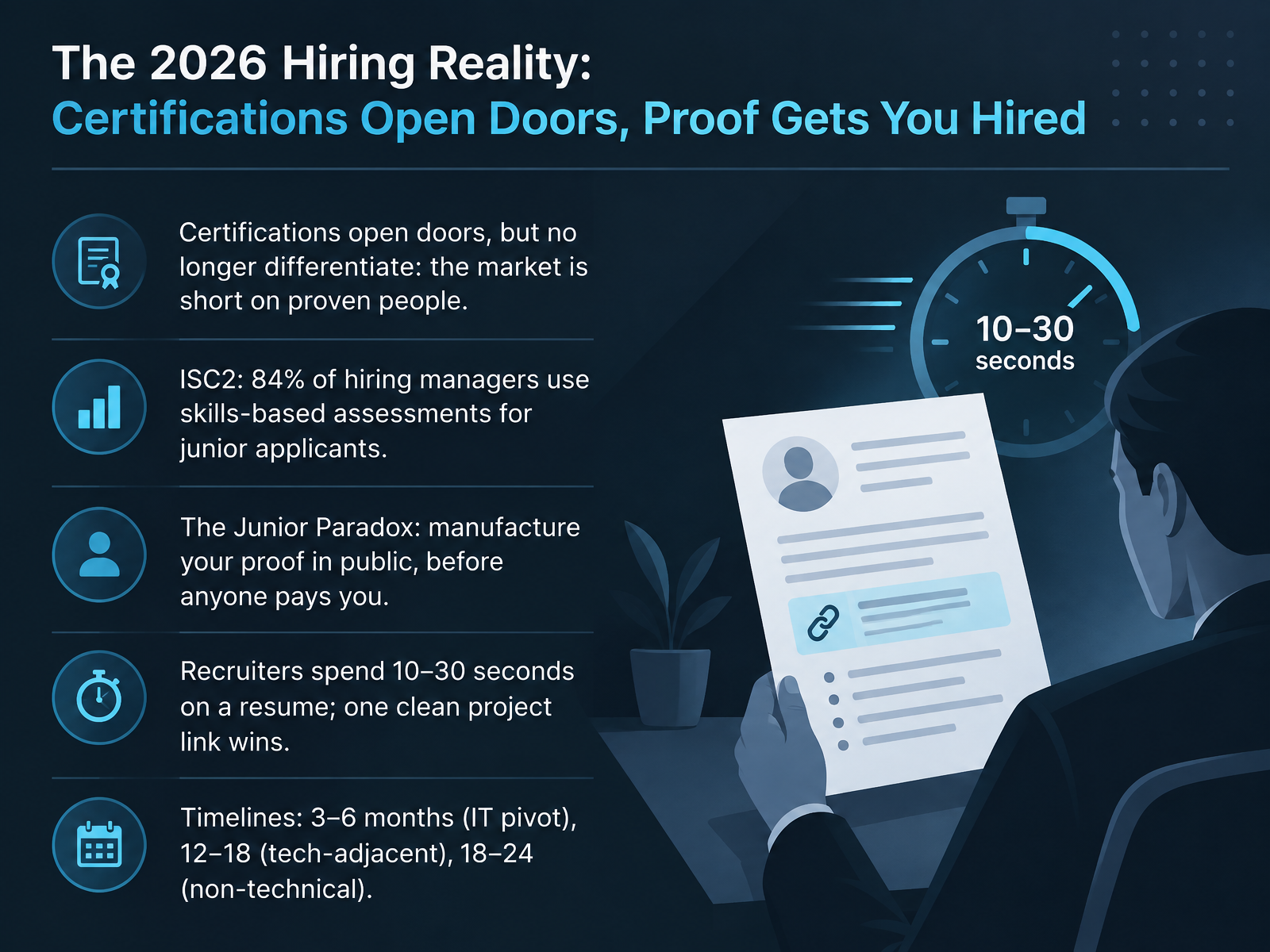
- 02The 2026 Hiring Reality: Certifications Open Doors, Proof Gets You HiredLet's talk about the hiring reality you're walking into. Certifications open doors. They no longer differentiate you. Employers are short on people who can prove they've done the work, not people who studied it. Consider this. ISC2 found that eighty-four percent of hiring managers now use skills-based assessments for junior applicants. That means your certificate gets you considered, and your evidence gets you hired. Here's the tricky part, often called the Junior Paradox. You need experience to get the job, but you need the job to get experience. The way out is simple to say and hard to do. Manufacture your proof in public, before anyone pays you. Recruiters spend ten to thirty seconds on a resume, so one clean project link wins attention. And be patient with timelines. Three to six months if you're pivoting from IT. Twelve to eighteen from a tech-adjacent background. Eighteen to twenty-four if you're coming from a non-technical role. Your next action is to pick one project to build and document publicly. What Counts as Defensive Security Evidence.
 ituonline.comituonline.comthecareercompass-newsletter.beehiiv.com+22 min
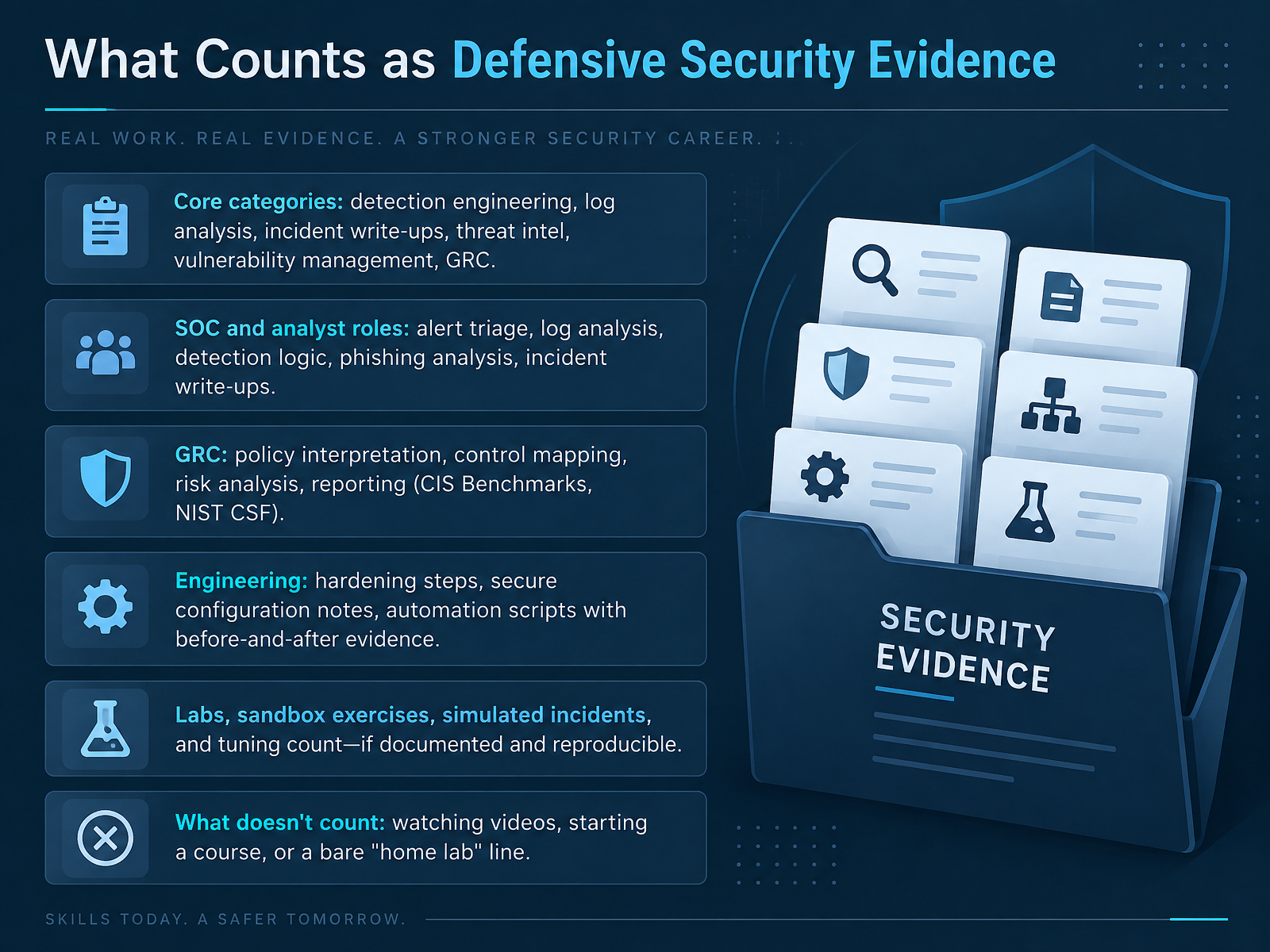
 - 03What Counts as Defensive Security EvidenceLet's talk about what actually counts as defensive security evidence. Think of evidence as proof you can do the work, not just that you studied it. There are several core categories. Detection engineering, which means writing the logic that spots suspicious behavior. Log analysis, incident write-ups, threat intel, vulnerability management, and governance, risk, and compliance. For SOC or analyst roles, that means alert triage, log analysis, detection logic, phishing analysis, and incident write-ups. For GRC, show policy interpretation, control mapping, and risk analysis, using frameworks like the CIS Benchmarks or the NIST Cybersecurity Framework. For engineering, hardening steps and automation scripts with before-and-after evidence. Labs, sandbox exercises, simulated incidents, and detection tuning all count, but only if they are documented and reproducible. Here is what does not count. Watching videos, starting a course, or a bare home lab line with no detail. Next, let's look at public-safe evidence, confidentiality, NDAs, and ethical limits.
 ituonline.comituonline.comthecareercompass-newsletter.beehiiv.com+22 min
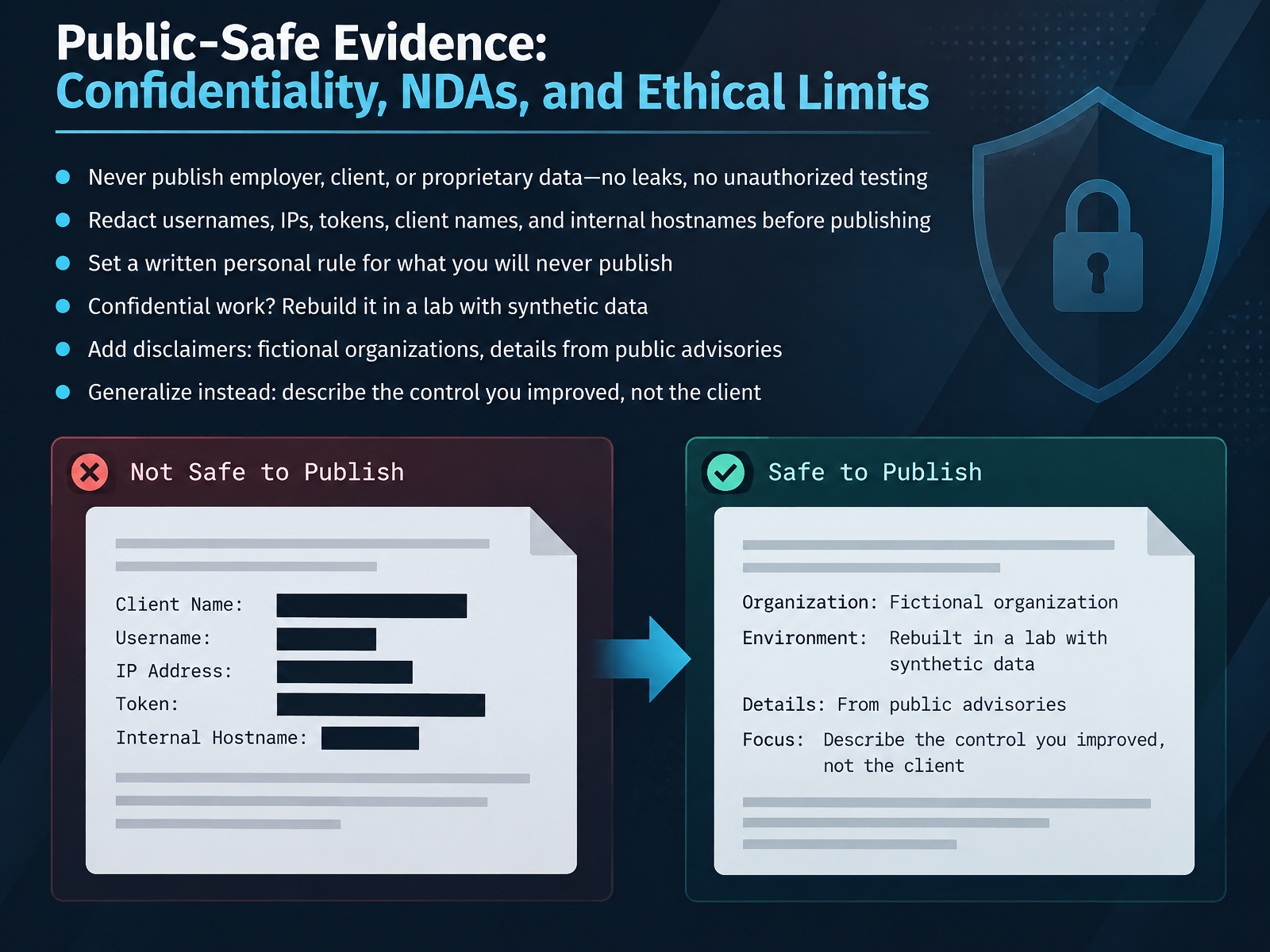
 - 04Public-Safe Evidence: Confidentiality, NDAs, and Ethical LimitsLet's talk about keeping your evidence public-safe. This is where good judgment shows, and hiring managers notice it. First rule: never publish employer, client, or proprietary data. No leaks, and no unauthorized testing on systems you don't own. Second, redact before you publish. Strip usernames, IP addresses, tokens, client names, and internal hostnames. Write down your own personal rule for what you will never share, and keep it visible while you work. What if the real project is confidential? Rebuild it in a lab with synthetic data. Same skill, safe evidence. Add a short disclaimer: fictional organizations, details drawn from public advisories. And when in doubt, generalize. Describe the control you improved, not the client. Why does this matter? Because a portfolio should prove you can be trusted with sensitive work, not just that you can do it. Ethical limits are part of the skill. Next, let's talk about focus. Pick One Lane and Three Artifacts.
 ituonline.comituonline.comthecareercompass-newsletter.beehiiv.com+21 min
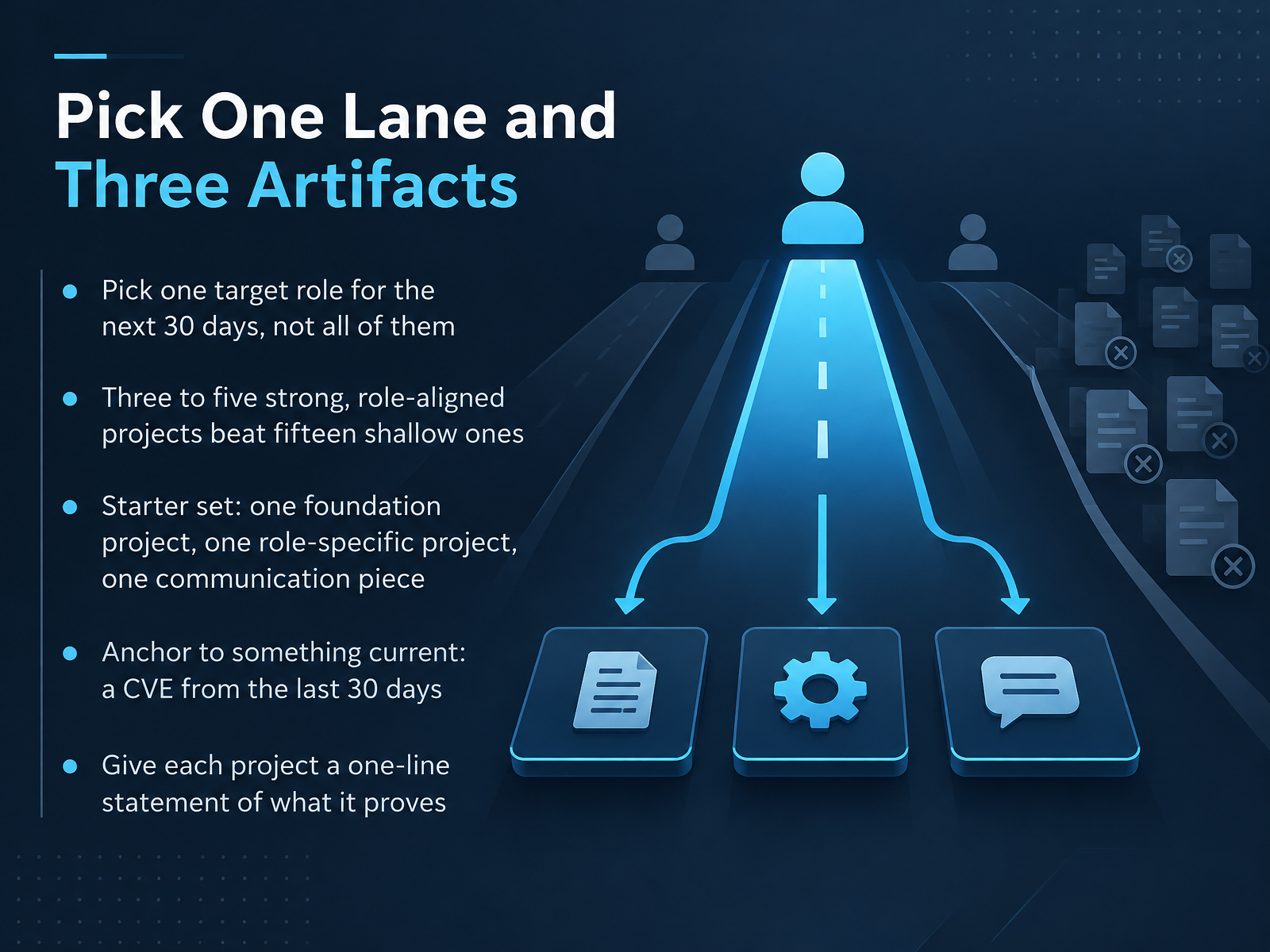
 - 05Pick One Lane and Three ArtifactsLet's talk about narrowing your focus. Here is the core idea. Pick one target role for the next thirty days. Not every role, just one. Why? Because a portfolio that tries to appeal to SOC, cloud, GRC, and pentesting at the same time usually feels generic. A hiring manager wants to see role fit in under five minutes. So choose the lane that matches your current evidence. Then build three to five strong, role-aligned projects. Three focused projects beat fifteen shallow ones. Every time. Your starter set looks like this. One foundation project, one role-specific project, and one communication piece. For a SOC candidate, that could be a basic log analysis lab, a phishing investigation writeup, and a short LinkedIn post explaining what you learned. Next, anchor to something current. Pick a CVE, a common vulnerability and exposure, from the last thirty days. Build a small detection or scenario around it. That shows you are paying attention right now, not studying last year's news. Finally, give each project a one-line statement of what it proves. For example, this proves I can triage failed login events and document the reasoning. That single line tells a recruiter exactly what role you are ready for. From raw work to case study, a repeatable structure.
 ituonline.comituonline.comthecareercompass-newsletter.beehiiv.com+22 min
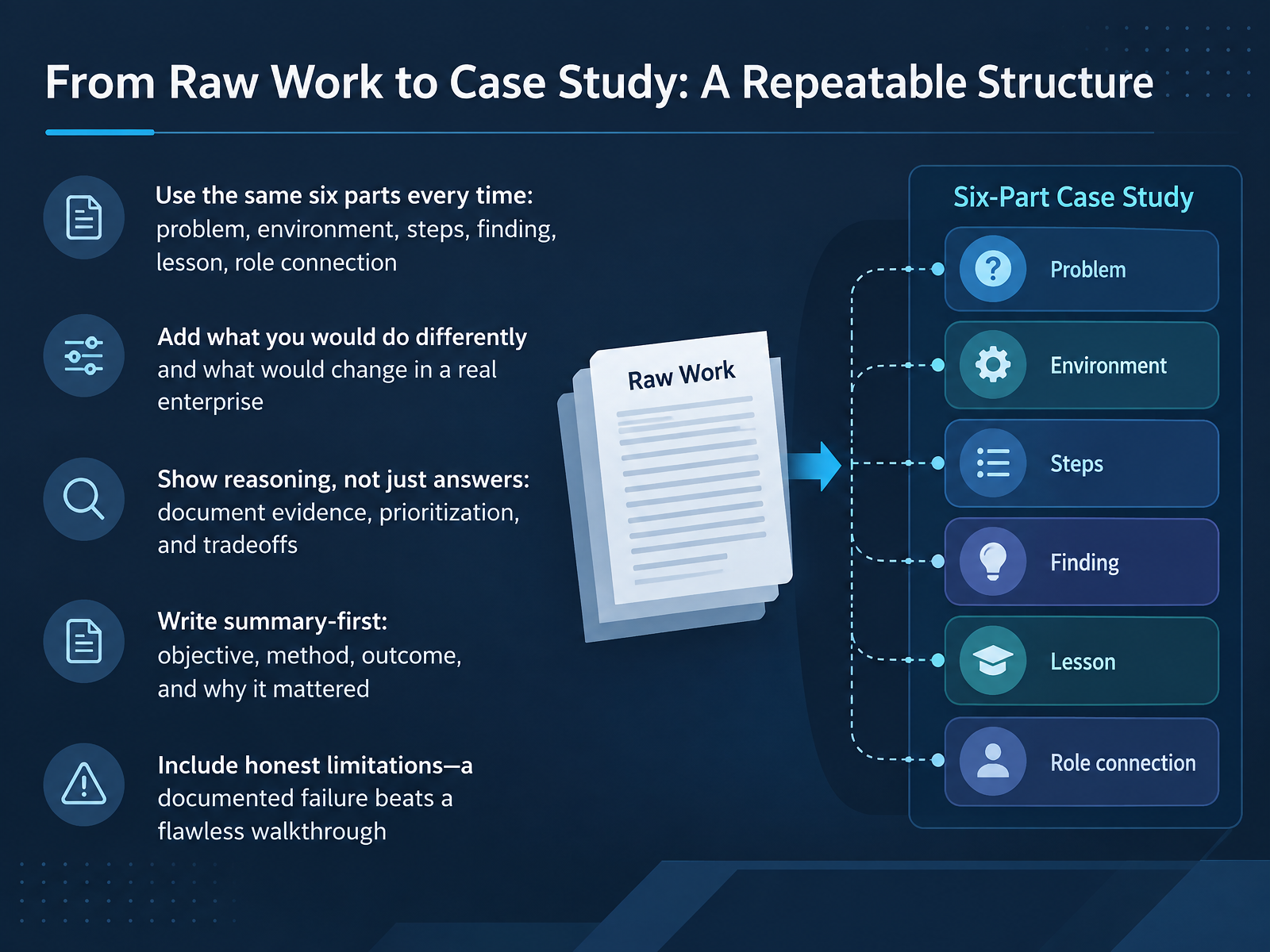
 - 06From Raw Work to Case Study: A Repeatable StructureNow let's turn raw work into a case study using one repeatable structure. Use the same six parts every time: problem, environment, steps, finding, lesson, and role connection. The problem is what you are trying to understand. The environment is the tools and setup you used. The steps are what you actually did. The finding is what you noticed. The lesson is what you learned. And the role connection explains how this maps to the job you want. Do not make a hiring manager guess. Then add what you would do differently, and what would change in a real enterprise. Show your reasoning, not just your answers. Document the evidence you reviewed, how you prioritized, and the tradeoffs you weighed. Write summary first, so the objective, method, outcome, and why it mattered are clear in the opening lines. And include honest limitations. A documented failure beats a flawless walkthrough, because it proves you can reflect and improve. Pick one project this week, apply these six parts, and you already have a case study you can discuss. Next, let's look at templates that make this even easier: incident reports, case studies, and journals.
 ituonline.comituonline.comthecareercompass-newsletter.beehiiv.com+22 min
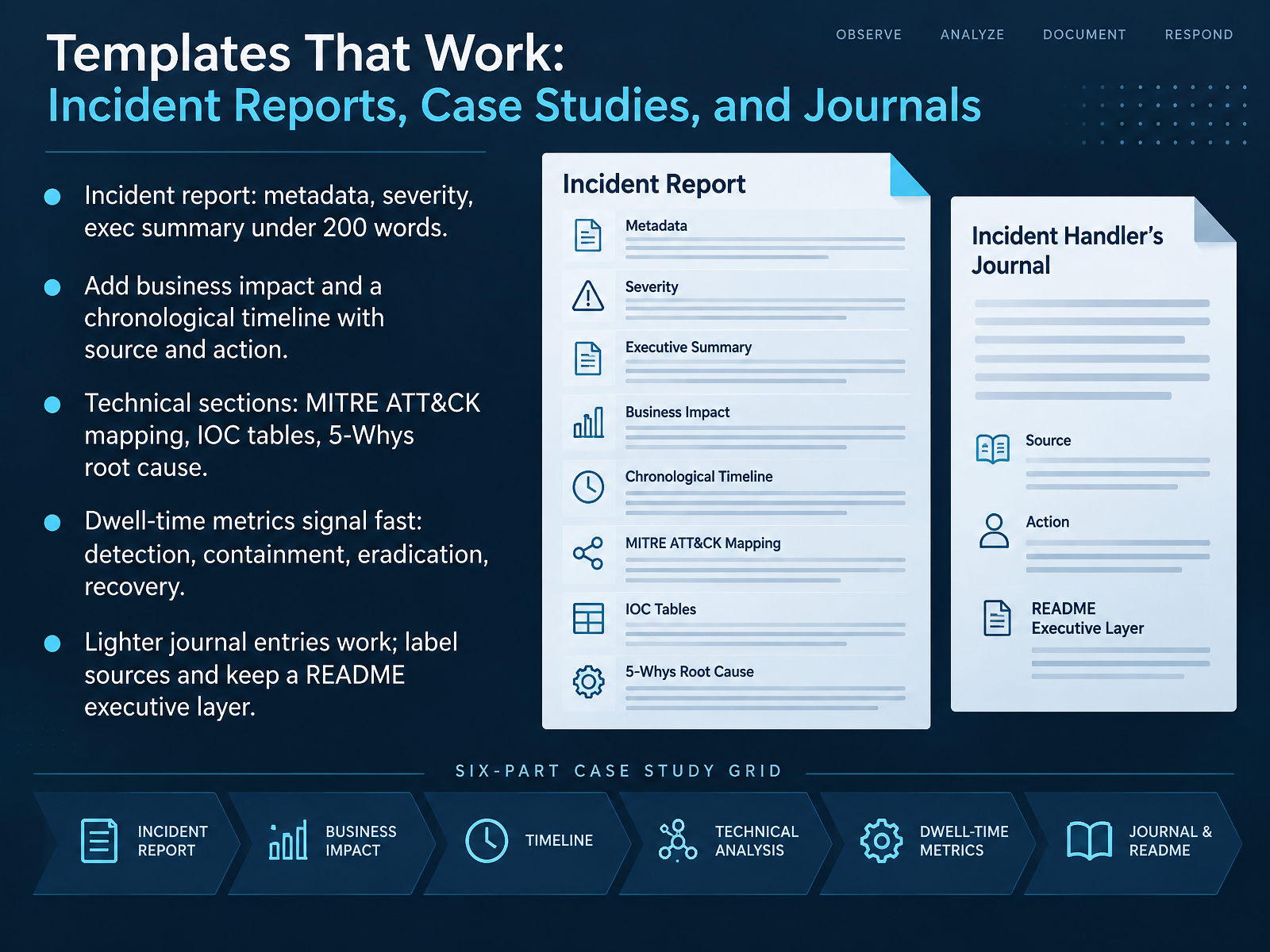
 - 07Templates That Work: Incident Reports, Case Studies, and JournalsLet's look at three templates that work well in a portfolio: incident reports, case studies, and journals. Start with the incident report. At the top, include metadata: an incident ID, severity, status, and key dates. Then write an executive summary under two hundred words. It should explain what happened, the business impact, and how it was resolved. Next, add a chronological timeline with three columns: what happened, the source, and the action taken. For technical depth, map activity to MITRE ATT&CK, which catalogs attacker techniques, build an indicator of compromise table, and run a Five Whys root cause analysis. Also track dwell time: detection, containment, eradication, and recovery. Quick times signal a skilled analyst. If a full report feels heavy, keep lighter journal entries. Just label your sources, and add a README that serves as an executive layer. Which template will you start with this week? Next, let's build a public home base reviewers can navigate.
 github.comnoraj.github.iogithub.com+21 min
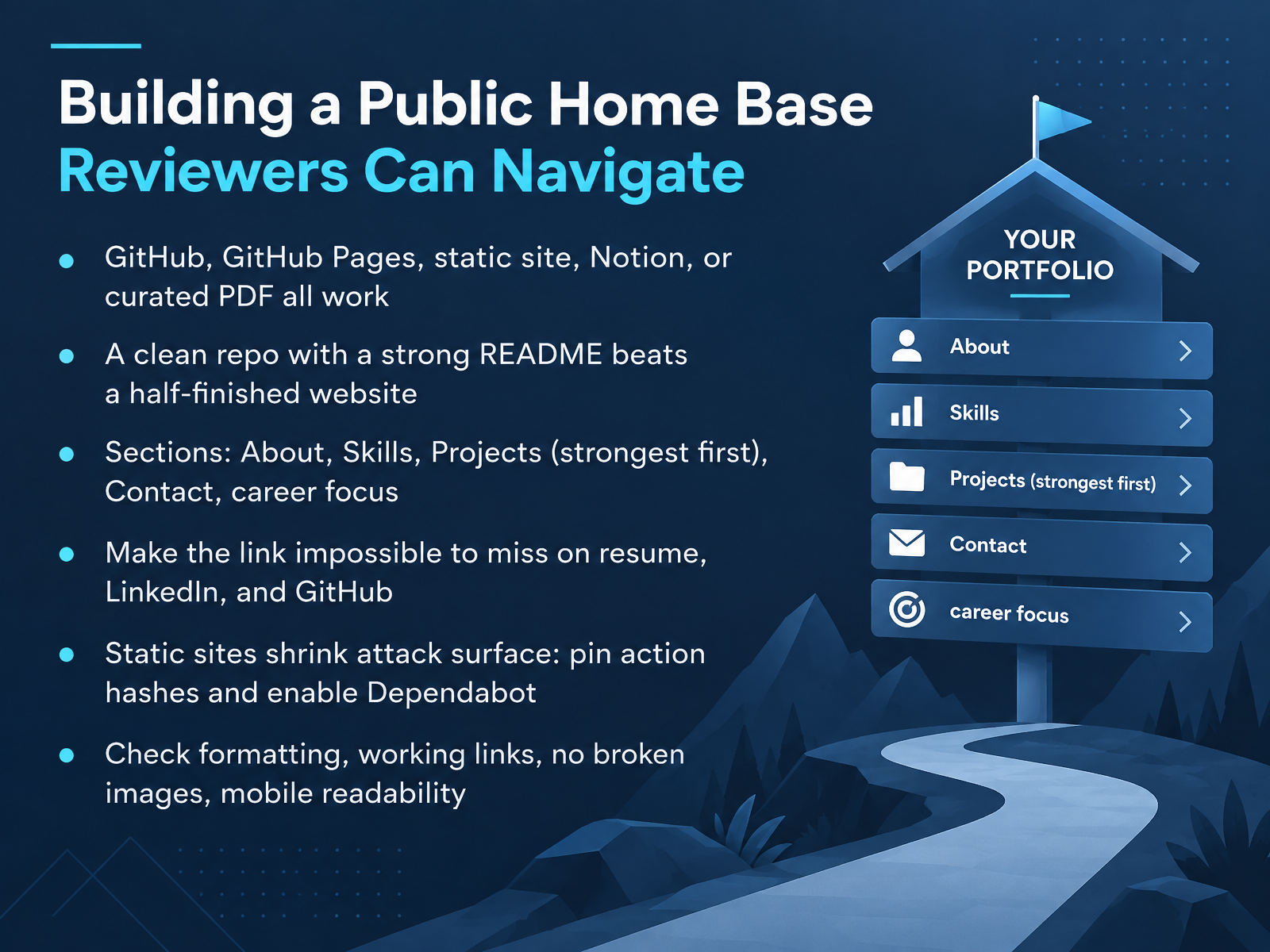
 - 08Building a Public Home Base Reviewers Can NavigateNow, let's make sure reviewers can actually find your work. Your public home base can be a GitHub profile, GitHub Pages, a static site, Notion, or a curated PDF. The format matters less than the clarity. A clean repository with a strong README will always beat a half-finished website. So what should it contain? An About section, your Skills, your Projects with the strongest evidence first, Contact details, and a one-line career focus statement. Then make that link impossible to miss on your resume, your LinkedIn, and your GitHub profile. If a reviewer has to dig for it, they will move on. There is also a nice defensive bonus here. Static sites shrink your attack surface because there is no database or admin login to exploit. If you use GitHub Actions, pin action hashes and enable Dependabot to catch vulnerable dependencies. Before you share the link, check your formatting, test that every link works, confirm no images are broken, and read it on a phone. Could a hiring manager understand who you are and what role you want in under a minute? Next, we look at writing clearly and ethically for mixed audiences.
 ituonline.comituonline.comthecareercompass-newsletter.beehiiv.com+22 min
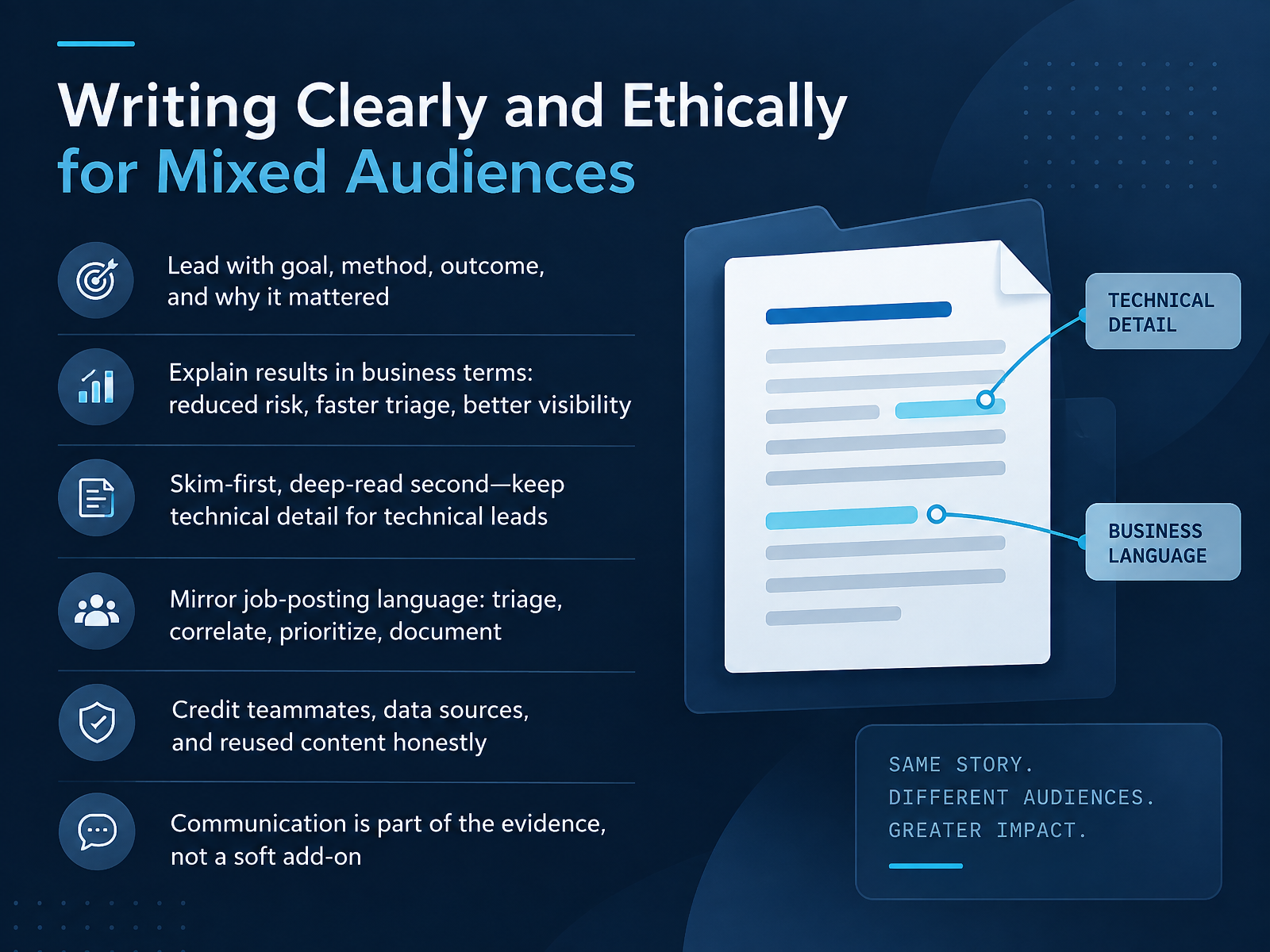
 - 09Writing Clearly and Ethically for Mixed AudiencesNow let's focus on how you write about your work, because clear and ethical communication is part of the evidence. Start every project summary with four things: the goal, the method, the outcome, and why it mattered. Then translate results into business terms. Did you reduce risk, speed up triage, or improve visibility? Hiring managers care about those outcomes. Write for two readers. First, keep the top scannable for a recruiter who has under five minutes. Second, keep the technical detail lower down for a technical lead who wants to trust your reasoning. Mirror the language of real job postings. If postings say triage, correlate, prioritize, and document, use those words naturally. Be honest about credit. Name teammates, data sources, and reused content, and mark clearly what is your own work. Never publish sensitive data. Sanitize logs, usernames, and client details. Remember, communication is not a soft add-on. It is how a reviewer sees your judgment. Next, we will look at tailoring evidence to role, framework, and interview.
 ituonline.comituonline.comthecareercompass-newsletter.beehiiv.com+21 min
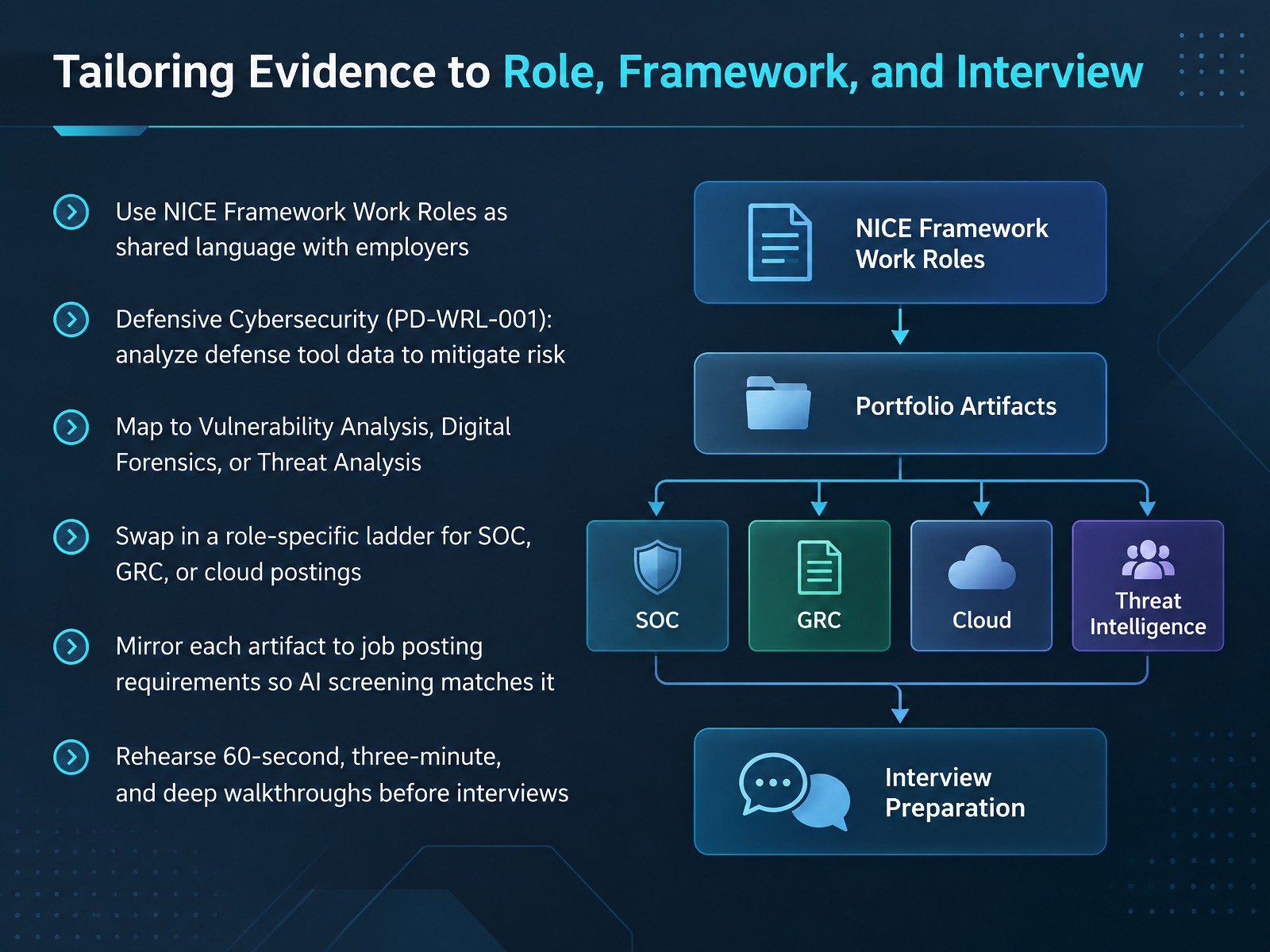
 - 10Tailoring Evidence to Role, Framework, and InterviewNow let's talk about tailoring your evidence to a specific role. A helpful shared language here is the NICE Framework. It's a standard vocabulary for describing cybersecurity work, so when you use it, employers recognize the terms. One relevant work role is Defensive Cybersecurity. It involves analyzing data from defense tools to reduce risk. So think about the phrase reduce risk, because that's what hiring managers care about. And you can map your projects to related roles, like Vulnerability Analysis, Digital Forensics, or Threat Analysis. Then swap in a role-specific ladder for the roles you actually want, whether that's SOC, GRC, or cloud. Next, mirror your artifacts to the exact wording in the job posting. If the posting says triage, correlate, and document, use those words. That helps human reviewers and AI screening tools see the match. Finally, rehearse three versions of each project before an interview. A sixty-second overview, a three-minute explanation, and a deep technical walkthrough. Preparing those lengths helps you communicate clearly no matter how the conversation unfolds. Next, we'll look at quality control, peer review, and detection validation habits.
 nist.govniccs.cisa.govniccs.cisa.gov+22 min
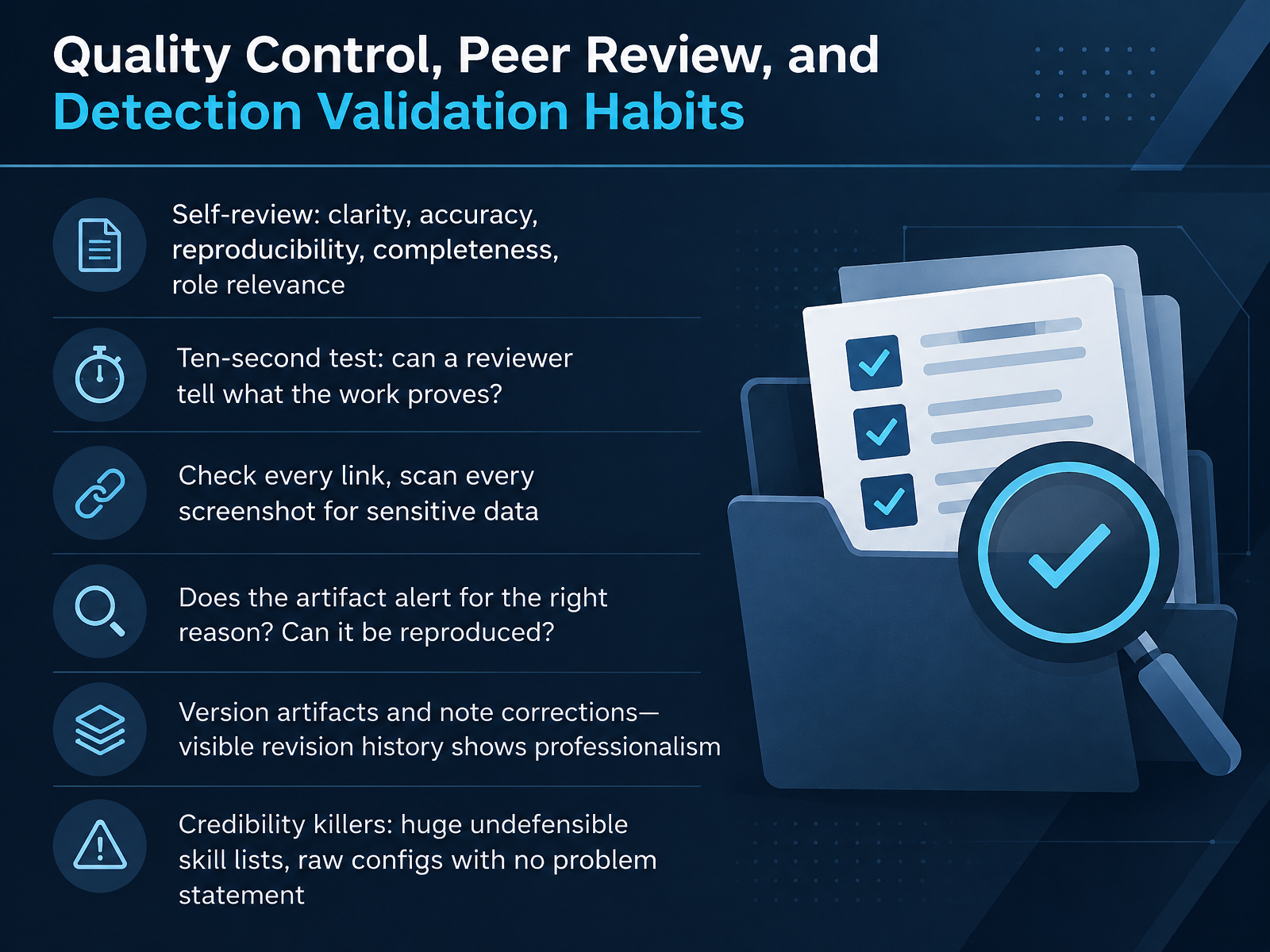
 - 11Quality Control, Peer Review, and Detection Validation HabitsNow let's talk about quality control. Before you publish anything, review your own work for five things. Clarity, accuracy, reproducibility, completeness, and role relevance. Then apply the ten-second test. Can a reviewer tell what the work proves, just by skimming it? If not, rewrite the opening line.
Next, check every link, and scan every screenshot for sensitive data. Ask yourself a tougher question. Does the artifact alert for the right reason? And can someone else reproduce it? That is what validation means here: proving the detection fires because of the behavior, not because of a lucky keyword.
Version your artifacts and note corrections. A visible revision history shows professionalism, not weakness. Finally, avoid credibility killers, like huge undefensible skill lists, or raw configs with no problem statement. Strong work is legible, honest, and repeatable.
Next, we will look at maintaining and growing the portfolio over your career.
 acsmi.orggrcwithgaurav.comgithub.com+22 min
 - 12Maintaining and Growing the Portfolio Over Your CareerNow let's talk about keeping your portfolio alive over the long term.
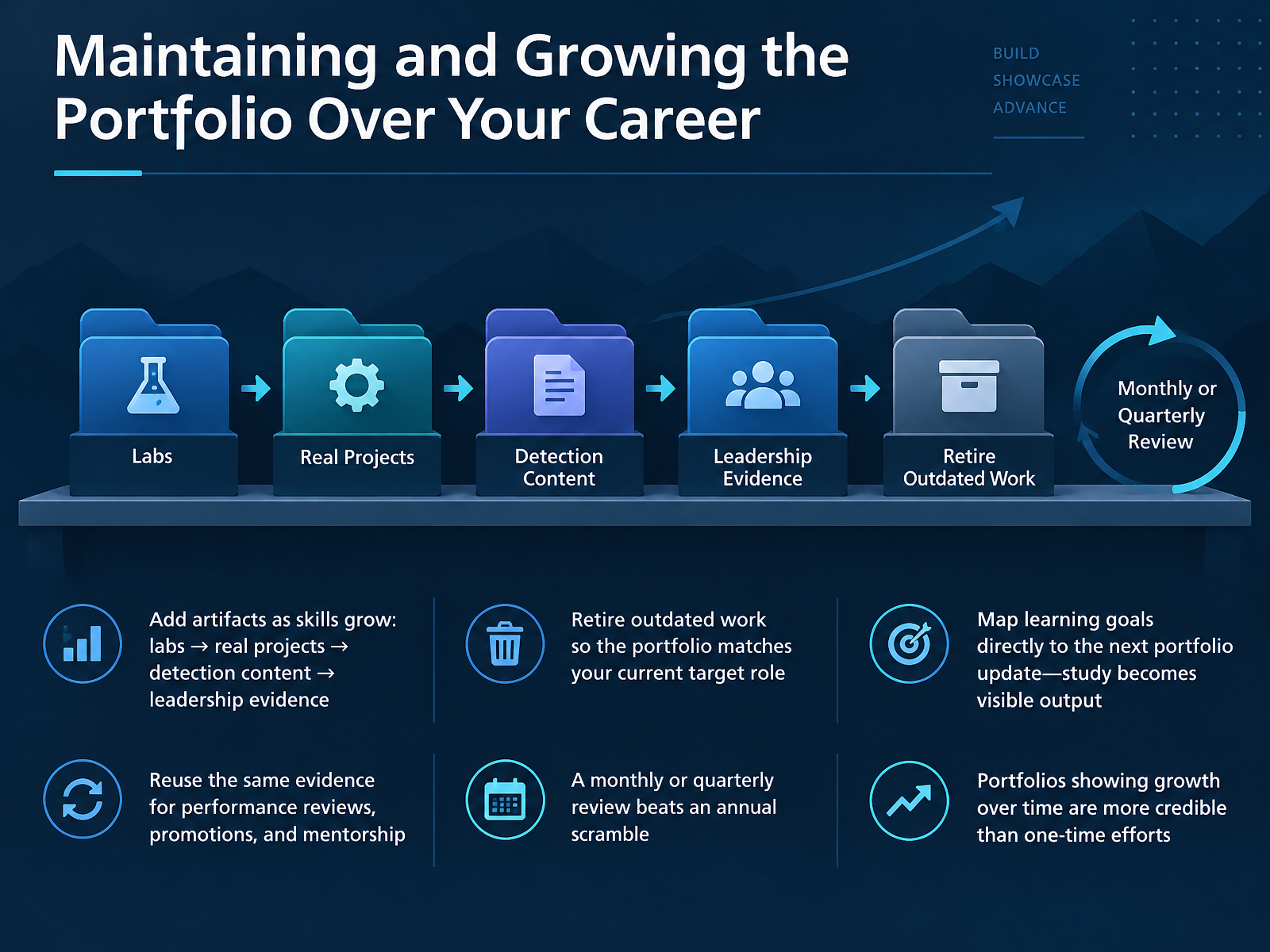
Think of it as a living record, not a one-time project. As your skills grow, you add new artifacts. You might move from lab write-ups to real projects, then to detection content, and eventually to leadership evidence like mentoring notes or process improvements.
At the same time, retire outdated work. If a project no longer matches the role you're targeting, let it go. A focused portfolio beats a cluttered one.
Here's a practical habit: map each learning goal directly to your next portfolio update. When you study a new topic, turn it into a visible output. That way, study becomes proof.
And remember, you can reuse the same evidence for performance reviews, promotions, and mentorship. It's not just for job hunting.
A monthly or quarterly review beats an annual scramble. Portfolios that show growth over time are more credible than one-time efforts. So ask yourself: what will you add this month?
Next up, we'll look at Reconnaissance Week and choosing your lane and target roles.
 ituonline.comituonline.comthecareercompass-newsletter.beehiiv.com+22 min
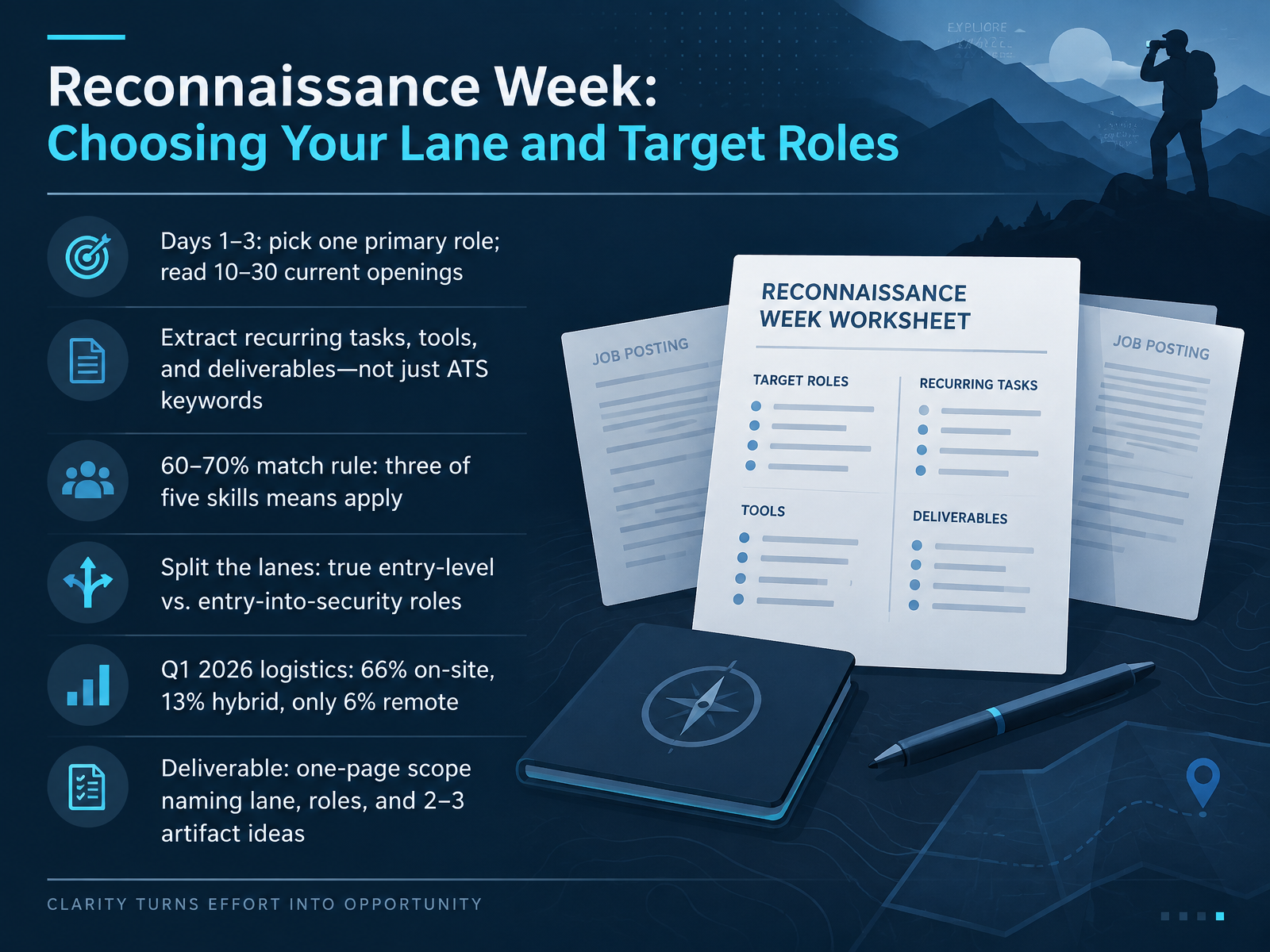
 - 13Reconnaissance Week: Choosing Your Lane and Target RolesNow let's talk about your reconnaissance week. Before you build a single artifact, you need to choose your lane. On days one through three, pick one primary role, then read ten to thirty current job openings for that role. As you read, extract the recurring tasks, tools, and deliverables. Don't just copy the keywords that screening software looks for; look for what the work actually involves. Next, apply the sixty to seventy percent match rule. If a posting lists five required skills and you have three of them, apply anyway. Hiring managers at the entry level expect a match of about sixty to seventy percent, not a perfect one. Also, split the lanes. True entry-level roles welcome you with no prior security work. Entry-into-security roles assume a year or two of general I.T. experience underneath. Read the responsibilities, not just the title. One more logistics note. In the first quarter of twenty twenty-six, about sixty-six percent of entry-level postings were on-site, thirteen percent hybrid, and only six percent fully remote. Plan for that. Your deliverable this week is a one-page scope naming your lane, your target roles, and two to three artifact ideas. With your lane chosen, let's move on to shipping it. Ship It: Weeks Two through Four, Publication, Review, and Next Steps.
 ituonline.comituonline.comthecareercompass-newsletter.beehiiv.com+22 min
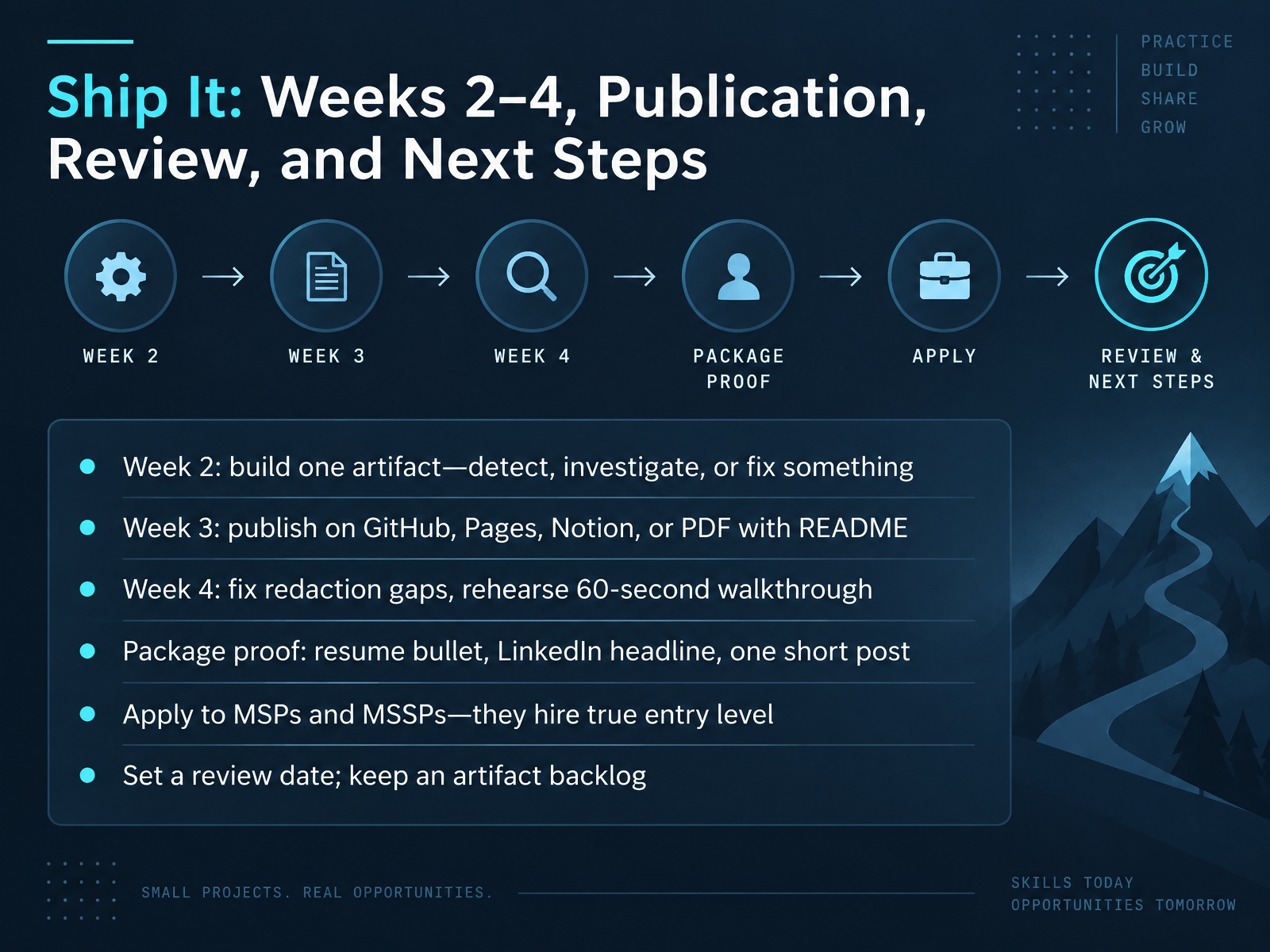
 - 14Ship It: Weeks 2–4, Publication, Review, and Next StepsLet's finish with your four week plan. In week two, build one artifact. Detect, investigate, or fix one thing. Just one. Maybe you investigate a suspicious login and write up what you found. In week three, publish it. GitHub, a Pages site, Notion, or a sanitized PDF with a clear README. A README is simply a short front page explaining what the project proves. In week four, close the gaps. Fix any redaction problems, meaning remove usernames, real IP addresses, and client details, then rehearse a sixty second walkthrough of your project. Now package the proof. Add one resume bullet, refresh your LinkedIn headline so it states a result, and write one short post. Then apply to managed service providers and managed security service providers. They hire at true entry level and give you broad exposure fast. Finally, set a review date and keep an artifact backlog, because three documented projects look like a habit. You have done the hard part. Keep shipping, and good luck. Thank you for learning with me.
 ituonline.comituonline.comthecareercompass-newsletter.beehiiv.com+21 min
Take the deck with you
Download this course as a file — free, no sign-up needed.
- PDF handoutEvery slide page, ready to print or share.15 pages · 3.3 MBDownload
- Narrated PowerPointThe deck that presents itself — every slide carries the digital human's narration video.15 pages · 13.9 MBDownload
- PowerPoint slidesThe full deck as a .pptx — open it in PowerPoint, Keynote, or Google Slides.15 pages · 3.2 MBDownload
Free to use in your own training — please keep the PersonWise credit page at the end.
Have your own deck? Turn it into a course
Sources consulted
Web sources consulted while building this course.
- How To Build A Strong Cybersecurity Portfolio For Job Interviews – ITU Online IT Training — ituonline.com
- Building A Cybersecurity Portfolio That Proves Your Skills – ITU Online IT Training — ituonline.com
- The Career Compass #74 — thecareercompass-newsletter.beehiiv.com
- The Career Compass #72 — thecareercompass-newsletter.beehiiv.com
- Cybersecurity Resume With No Experience: Reddit Hiring Advice + Project Evidence Recruiters Can Verify — acsmi.org
- develku/Incident-Investigation-Portfolio — github.com
- Offensive Security Incident Responder Exam Report — noraj.github.io
- README.md — github.com
- nirakaramishra-cse/incident-handlers-journal — github.com
- cli-tool/components/skills/development/security-compliance/examples/incident-response-template.md at main · davila7/claude-code-templates — github.com
- NICE Releases NICE Framework Components v2.2.0 | NIST — nist.gov
- Defensive Cybersecurity [NICE Framework Work Role] | NICCS — niccs.cisa.gov
- NICE Workforce Framework for Cybersecurity (NICE Framework) | NICCS — niccs.cisa.gov
- Getting Started with the NICE Framework | NIST — nist.gov
- NICE Framework Work Role Videos | NIST — nist.gov
- Cybersecurity Portfolio Projects: 25 Projects Recruiters Can Actually Evaluate — acsmi.org
- How to Build a Cybersecurity Portfolio That Actually Gets You Hired (Not Just GitHub Repos) | GRCWithGaurav — grcwithgaurav.com
- tdt1114/detection-engineering-portfolio — github.com
- Nessidgtl/detection-engineering-lab — github.com
- Abdullah0417/dfir-detection-engineering-portfolio — github.com