Brand Reputation Strategy: Goals & Tradeoffs
Begin
14 pages · ~28 min
Brand Reputation Strategy: Goals & Tradeoffs
Learn to define brand reputation goals, evaluate strategic choices, and navigate tradeoffs to protect and enhance your organization's standing.
What you’ll learn
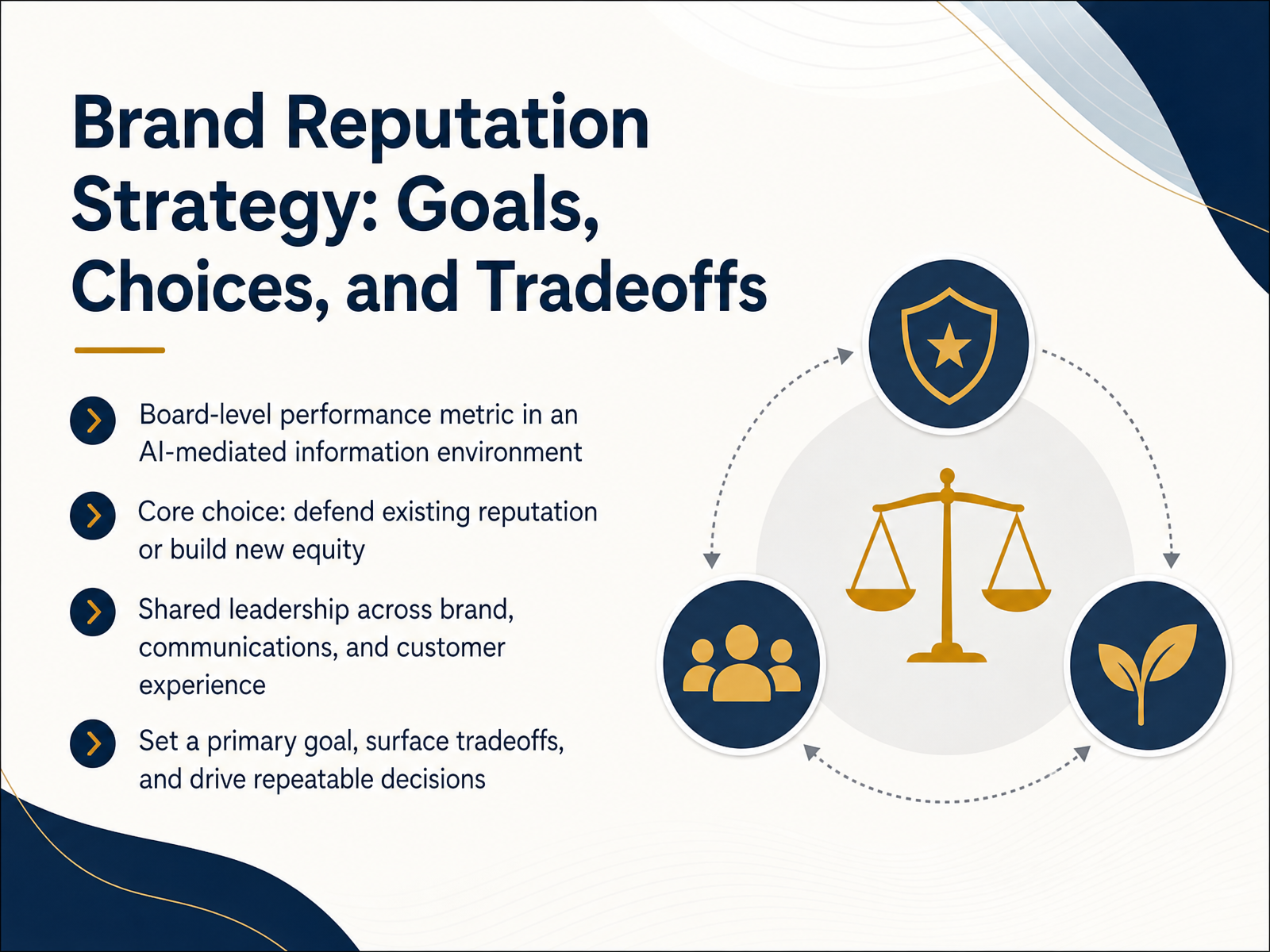
- 01Brand Reputation Strategy: Goals, Choices, and TradeoffsWelcome. This course is for leaders who own brand, communications, and customer experience, and who now answer to the board for reputation as a performance metric. Reputation is no longer a supporting concern. In an AI-mediated information environment, it is a measurable business asset that shapes valuation, pipeline, and trust before the first conversation happens. Your core choice is strategic: defend the reputation you have built, or invest in building new equity for the future. Both paths are valid, but they demand different resources, different risk tolerance, and different measures of success. Effective reputation strategy is shared leadership across brand, communications, and customer experience. No single function owns it. Your job is to set a primary goal, surface the tradeoffs openly, and drive repeatable decisions that hold up under pressure. As you proceed, keep this in mind: the goal is not to avoid criticism, but to build a reputation that earns the benefit of the doubt when it matters most. In the next section, we will clarify what brand reputation actually is, and what it is not, so you can lead from a precise foundation.reputationrise.co.ukbrand24.comthebestreputation.com+22 min
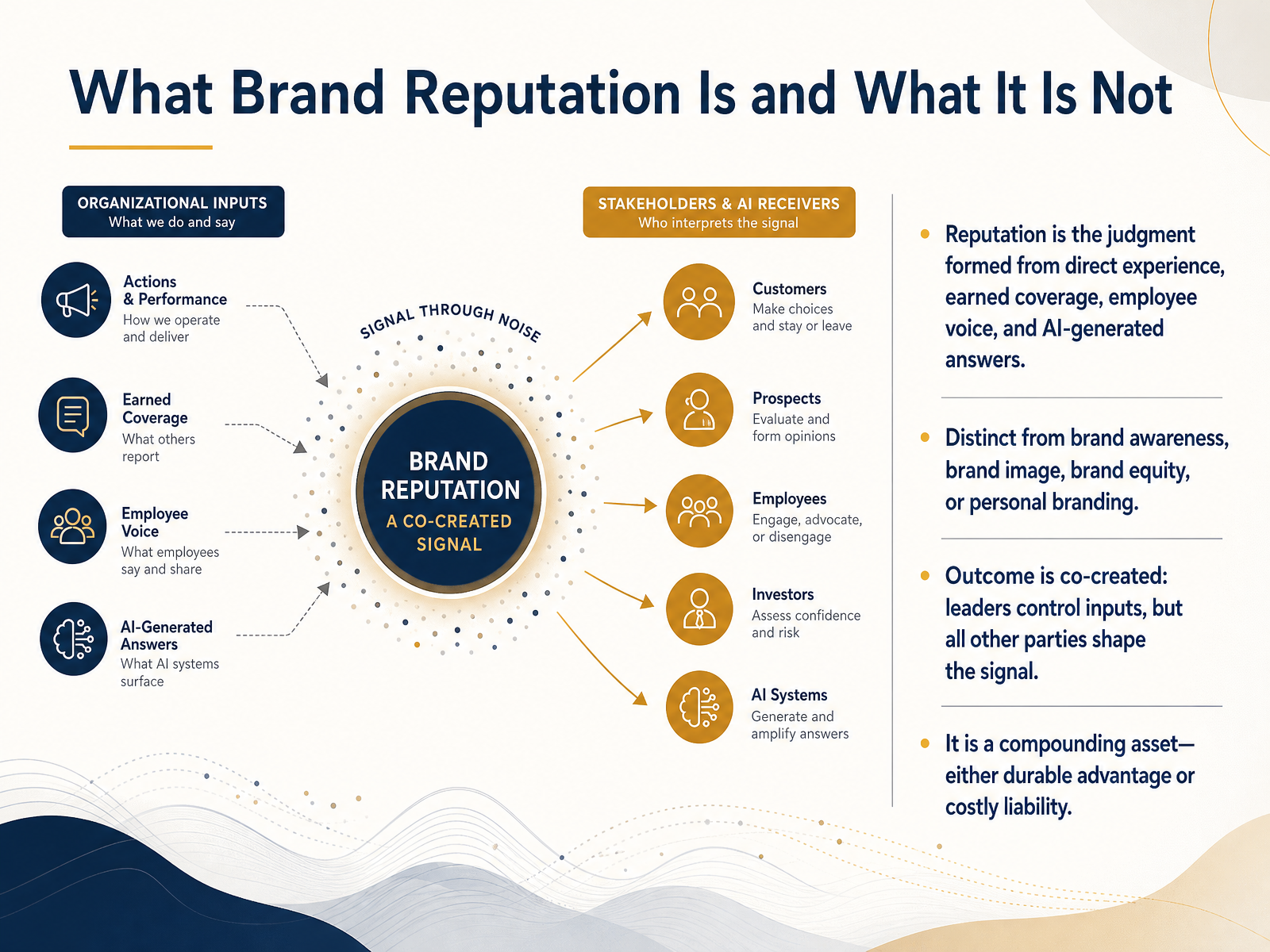
- 02What Brand Reputation Is and What It Is NotLet’s clarify what we’re actually managing. Brand reputation is not what you say about yourself. It is the judgment others form from direct experience, earned coverage, employee voice, and increasingly, AI-generated answers. That judgment is co-created: you control the inputs, but customers, journalists, employees, and algorithms shape the signal. This is what separates reputation from brand awareness, brand image, or personal branding. Awareness is about being known. Reputation is about being trusted. And that trust compounds over time, either as a durable advantage or a costly liability. When your team faces a perception gap, resist the urge to treat it as a messaging problem. It is an asset-management problem. The choices you make today determine whether that asset appreciates or erodes. Now let’s move to defining the strategic goal.
 reputationrise.co.ukbrand24.comthebestreputation.com+21 min
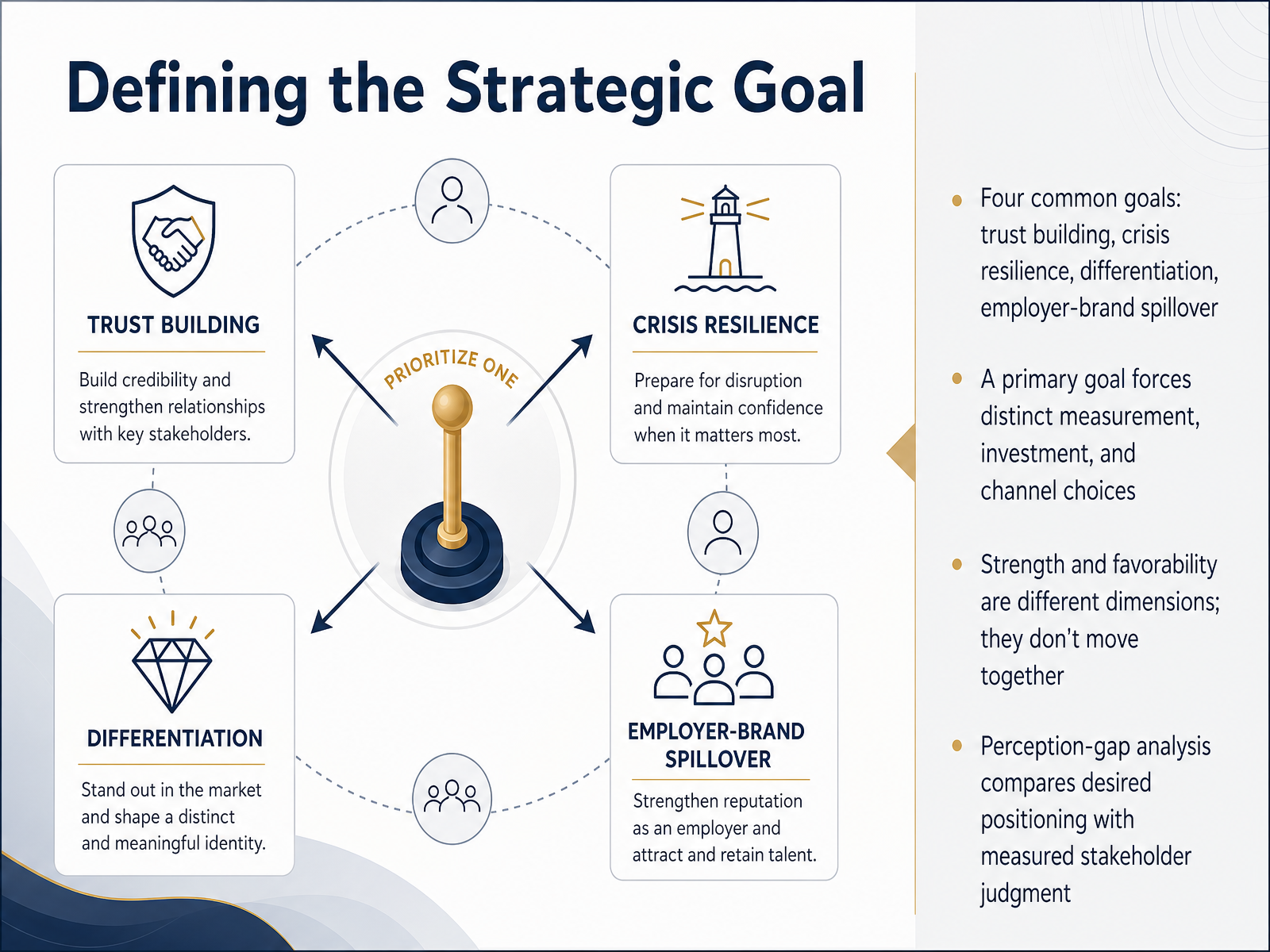
 - 03Defining the Strategic GoalLet's move to the heart of your reputation strategy: defining the strategic goal. Most teams pursue one of four overarching goals: building trust, ensuring crisis resilience, carving out differentiation, or leveraging employer-brand spillover. Your primary goal matters because it dictates your measurement framework, your investment priorities, and your channel choices. Choosing one is not about ignoring the others; it's about directing resources with precision. Also, resist treating strength and favorability as the same metric. They are distinct dimensions that rarely move in tandem. For example, a brand can be strongly associated with innovation but viewed unfavorably on that front due to a past product failure. To ground your choice, conduct a perception-gap analysis. This compares your desired positioning against the measured judgment of your key stakeholders. That comparison reveals where reality diverges from your strategic intent, highlighting exactly where your reputation program must focus its energy. Ultimately, a clearly defined goal turns reputation from an abstract concept into a measurable business driver. Next, we'll explore how stakeholder expectations shape the tradeoffs you must navigate.
 thestrategystory.cominfinet.vipyoungurbanproject.com+22 min
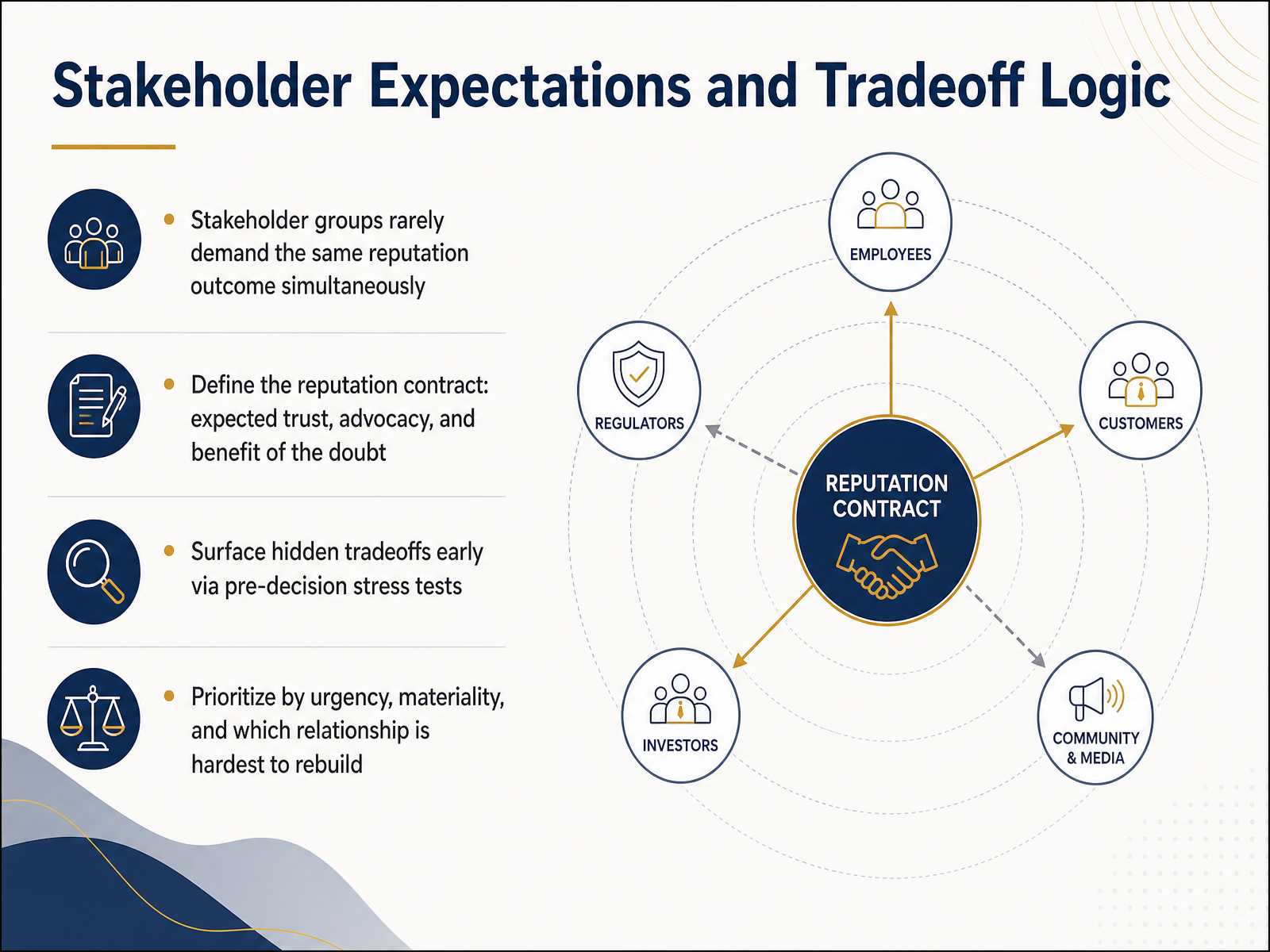
 - 04Stakeholder Expectations and Tradeoff LogicNow let's get practical about tradeoffs. Your stakeholder groups rarely demand the same reputation outcome at the same time. Customers want product excellence. Investors want stability. Regulators want governance. Each is valid. None is your whole strategy. The discipline begins by defining the reputation contract. This is the explicit answer to what trust, advocacy, and benefit of the doubt your business model truly depends on. You cannot earn equal measures of each from every audience. The tradeoff logic emerges when you surface hidden conflicts early. Run pre-decision stress tests. Before you commit to a reputation goal, simulate the response from each critical stakeholder and see where the friction appears. Prioritize by urgency first, materiality second, and repair difficulty third. If all pressures are equal, favor the relationship hardest to rebuild. That logic keeps your goals honest because every choice to prioritize one audience is also a decision to deprioritize another. Strategy is saying no to good options. Reputation strategy is knowing which relationship you can afford to test. Next, let's turn to how reputation translates into measurable business value.
 thestrategystory.cominfinet.vipyoungurbanproject.com+22 min
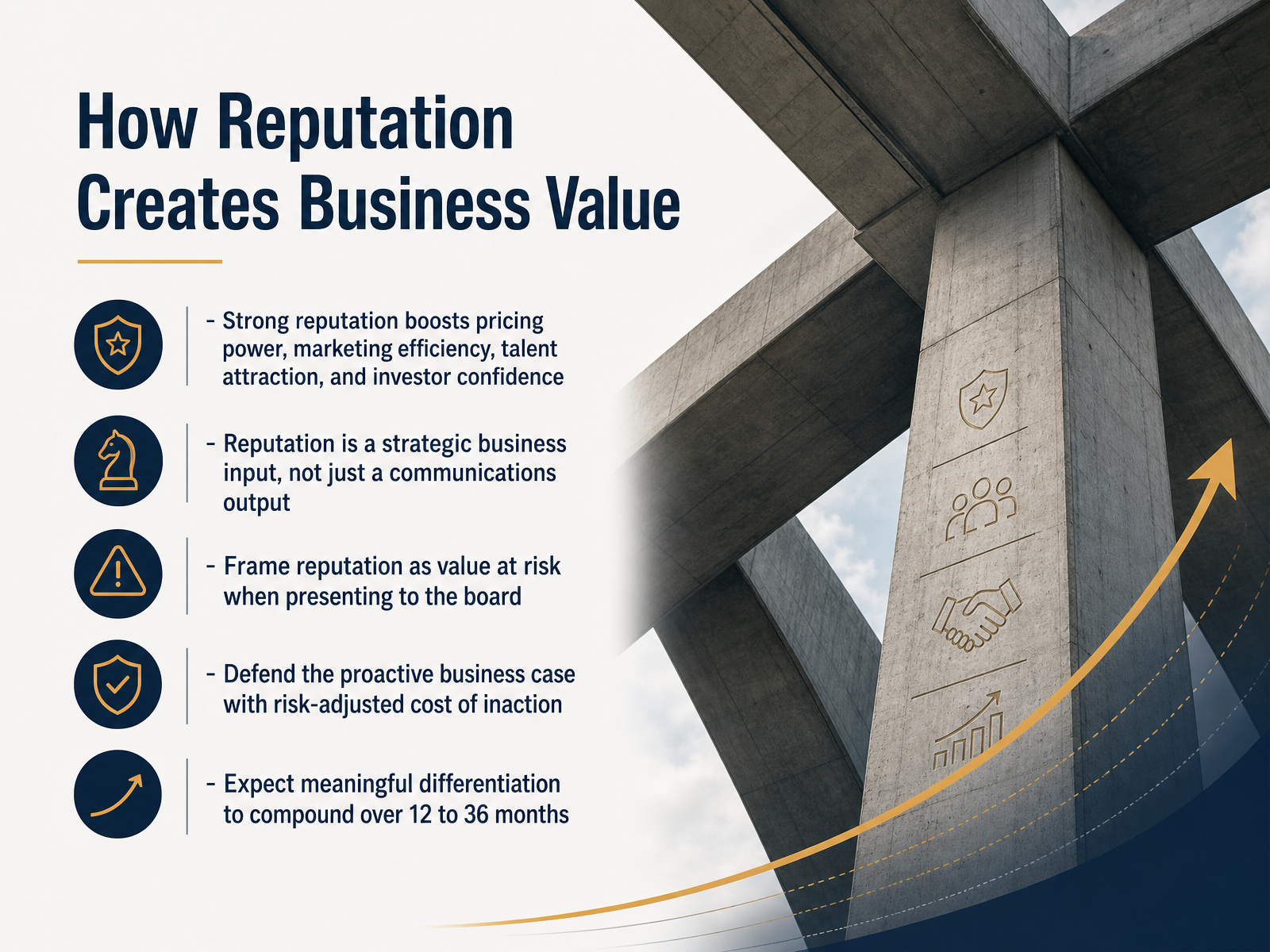
 - 05How Reputation Creates Business ValueNow let's get specific about why this all matters. A strong reputation isn't just a nice-to-have—it's a business performance multiplier. It gives you pricing power, because customers pay more for brands they trust. It makes your marketing more efficient, since positive signals reduce friction at every stage of the funnel. It attracts top talent, and it gives investors confidence when they're evaluating your risk profile. The key shift is to frame reputation not as a communications output, but as a strategic input. When you present to the board, talk about value at risk. Show them what a material reputation event could cost, and then defend the proactive business case with the risk-adjusted cost of inaction. That number usually dwarfs the program cost. Remember, meaningful differentiation doesn't happen overnight. It typically compounds over twelve to thirty-six months of consistent investment. The first year closes your most visible gaps and builds infrastructure; the following two years are where authority work truly separates you from competitors. That's the timeline you need to set expectations around. Now let's look at how you'll measure progress with leading indicators and a measurement architecture.
 reputationrise.co.ukbrand24.comthebestreputation.com+22 min
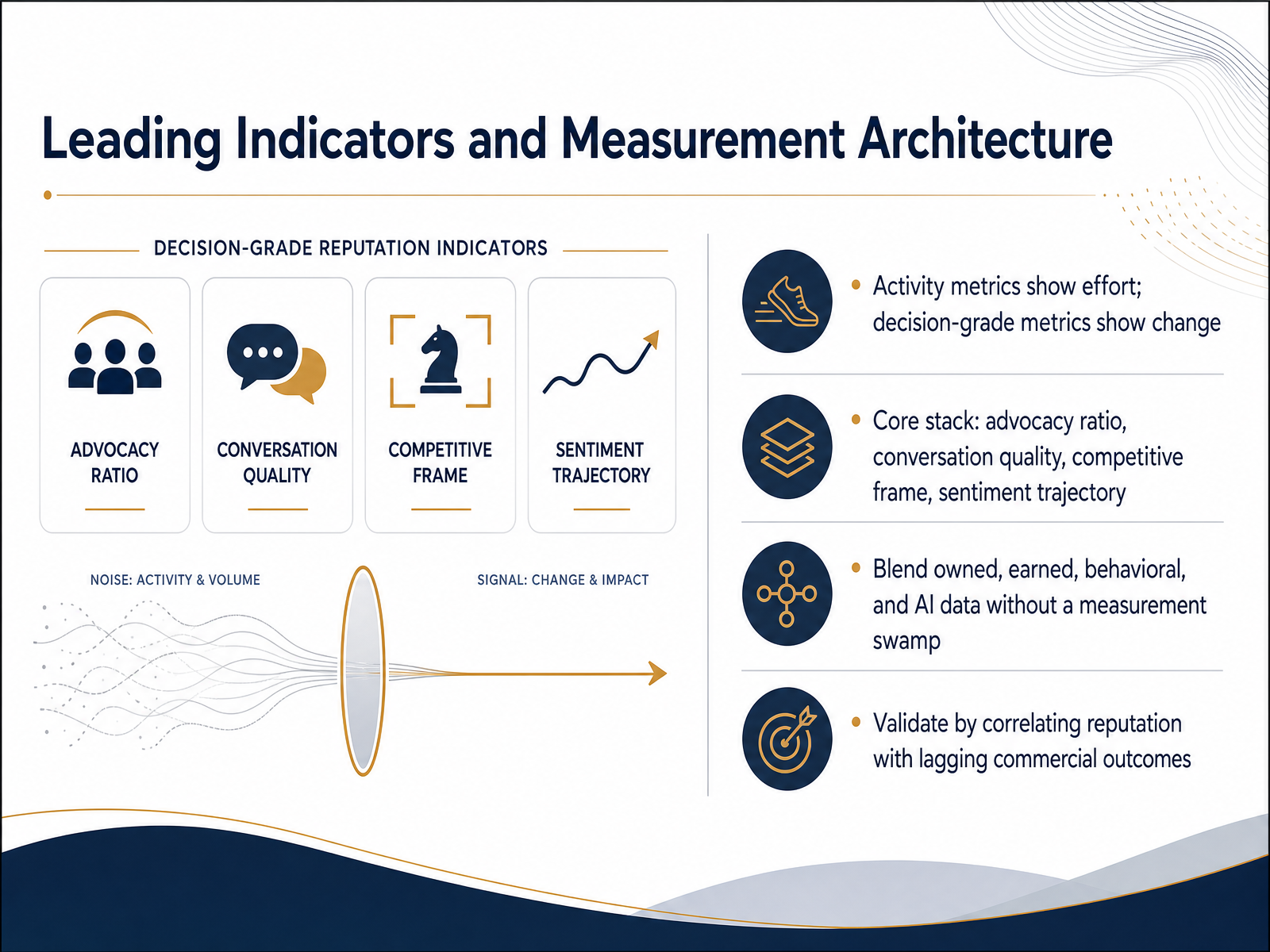
 - 06Leading Indicators and Measurement ArchitectureNow let's talk about measurement architecture, because this is where reputation strategy either earns its seat at the table or loses it. The distinction is simple: activity metrics show effort, but decision-grade metrics show change. Your executive team doesn't need to know how many mentions you generated. They need to know whether market perception is shifting in your favor, and what that means for revenue. Start with a core stack of four indicators. Advocacy ratio measures genuine, unprompted recommendations. Conversation quality tells you whether people are substantively engaging with your value, or just recognizing your name. Competitive frame tracks whether you are the reference point in your category, or the challenger. And sentiment trajectory captures direction of change, not absolute tone. An absolute score tells you very little. The trajectory tells you whether the coming quarter improves or deteriorates. Blend owned, earned, behavioral, and AI data sources, but resist the urge to track everything. A measurement swamp produces noise, not insight. Keep the stack lean, and validate it by correlating your leading indicators with lagging commercial outcomes. If your advocacy ratio today doesn't predict pipeline sixty days out, recalibrate. The goal is a predictive signal you can act on before the quarter ends, not a retrospective report. We'll now look at how that measurement changes when AI becomes the primary research tool for your buyers.
 the-brand-algorithm.comforbes.compulsarplatform.com+22 min
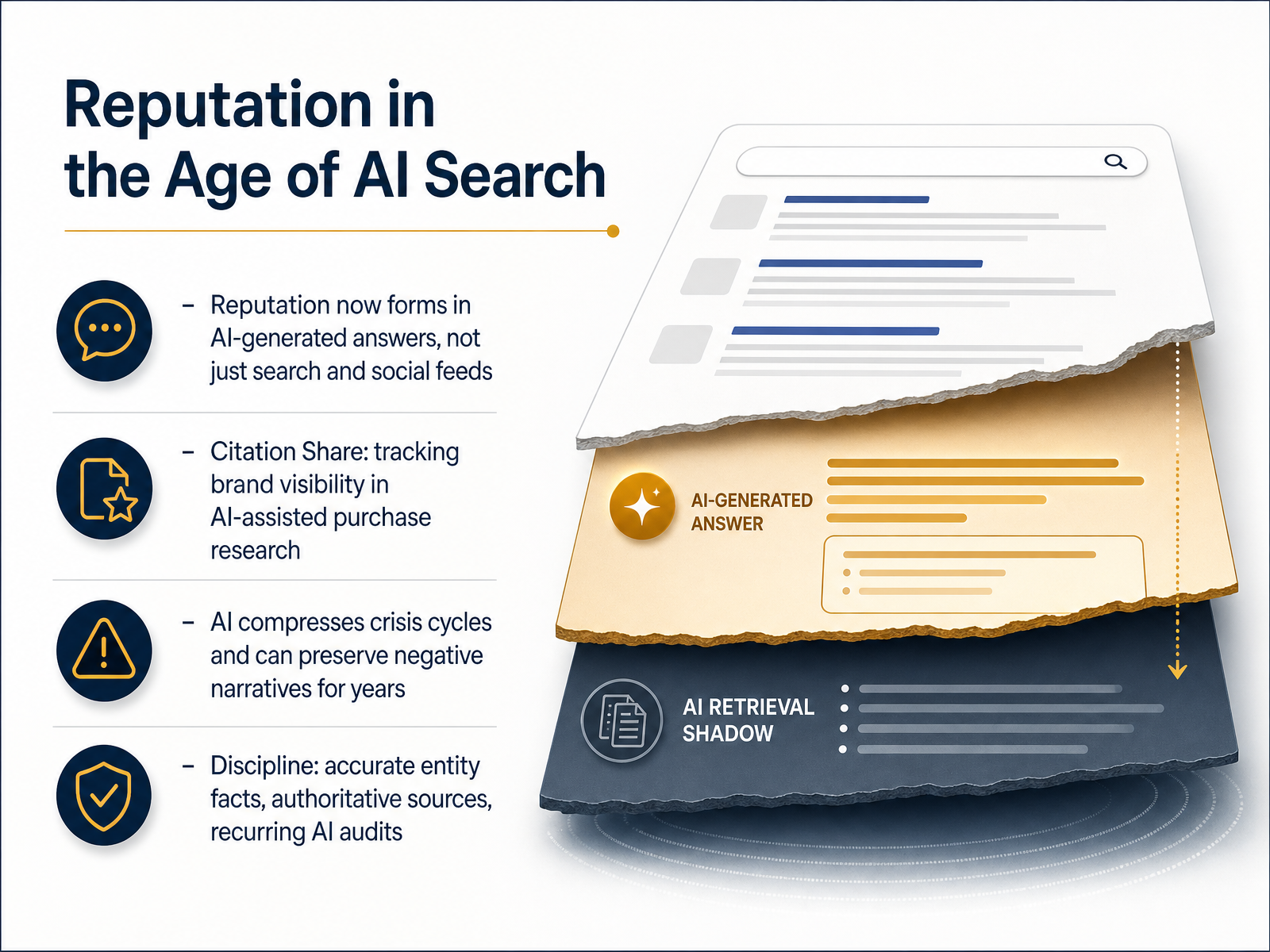
 - 07Reputation in the Age of AI SearchThis is where the game has structurally changed. Reputation now forms inside AI-generated answers, not just search results or social feeds. Your team faces this when a buyer asks an assistant for the best provider in your category, and the brand cited is the brand discovered. Measure what we call Citation Share, your percentage of brand mentions across AI answers for your category prompts. Track it quarterly against named competitors, because it is the leading indicator of consideration. Also understand that AI compresses crisis cycles. The window between an incident and a stakeholder verdict has collapsed from days to minutes, while the AI engines can preserve negative narratives for years. Discipline here is non-negotiable. Maintain accurate entity facts, build authoritative primary sources, and run recurring AI audits. Make the correct answer the easiest one to assemble. Now, let's look at how to shift from defense to offensive reputation moves.
 reputationrise.co.ukbrand24.comthebestreputation.com+21 min
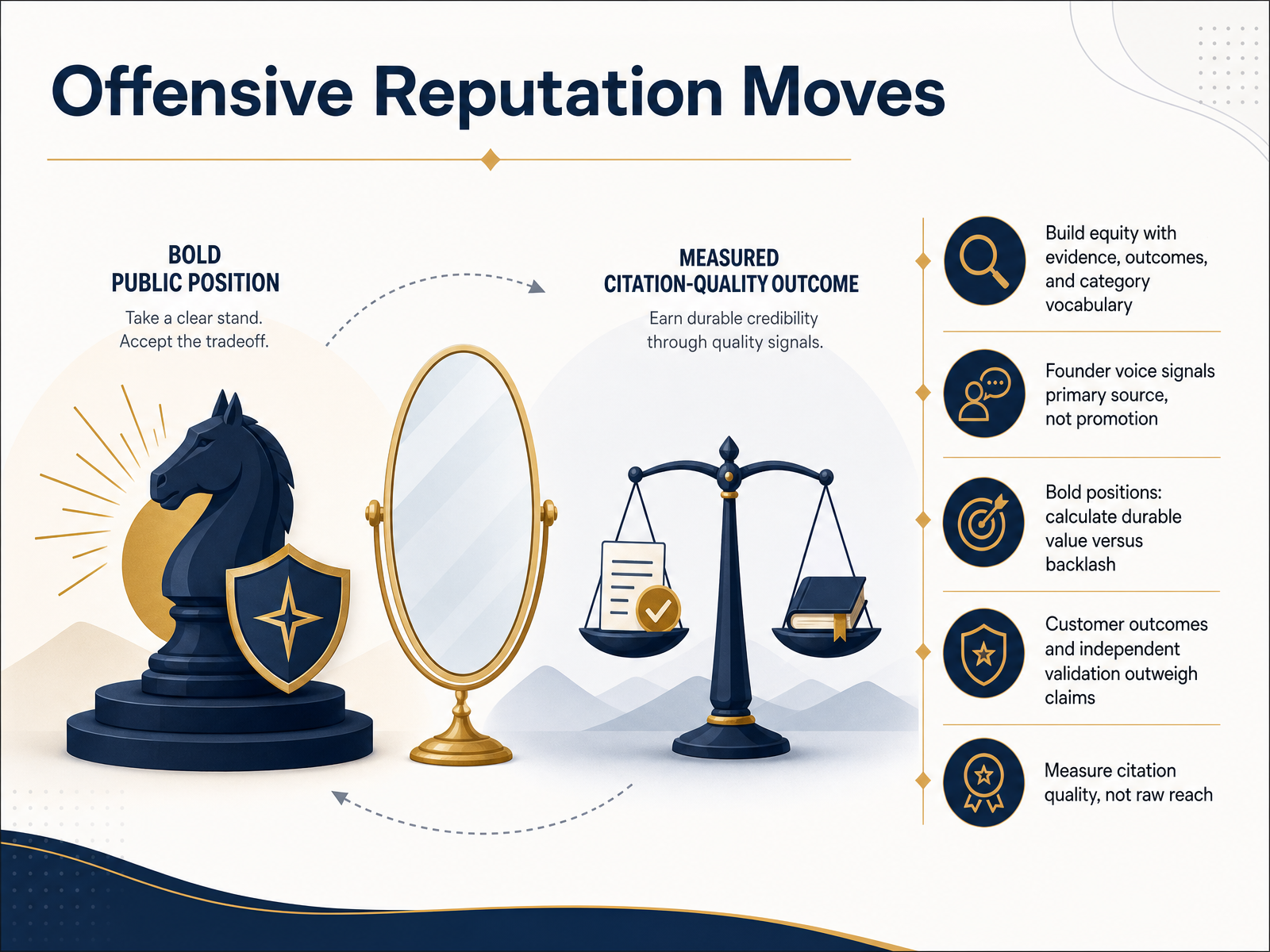
 - 08Offensive Reputation MovesLet’s shift to offensive reputation moves. These are the deliberate choices you make to build equity before you need it. The first move is building credibility with evidence, outcomes, and category vocabulary. When you’re in front of a buyer, a regulator, or an AI engine, the brand that speaks the language of the category is the brand that gets invited into the conversation. The second move is founder voice. A named principal who speaks about the work signals primary source, not promotion. This matters because in AI-driven retrieval, founder commentary compounds authenticity faster than corporate messaging ever will. The third move is bold positions. Before you commit, calculate the durable value against the potential backlash. Some positions are worth it, but only if you’re ready to absorb the short-term noise. The fourth move is proof. Customer outcomes and independent validation are primary-source material. Claims are weak; documented results are retrieval-ready. Finally, measure citation quality, not raw reach. A single citation in the right context outranks a thousand impressions. Your goal is to be the brand that AI and your buyers reference with confidence. Up next, we’ll look at defensive reputation discipline.
 reputationrise.co.ukbrand24.comthebestreputation.com+22 min
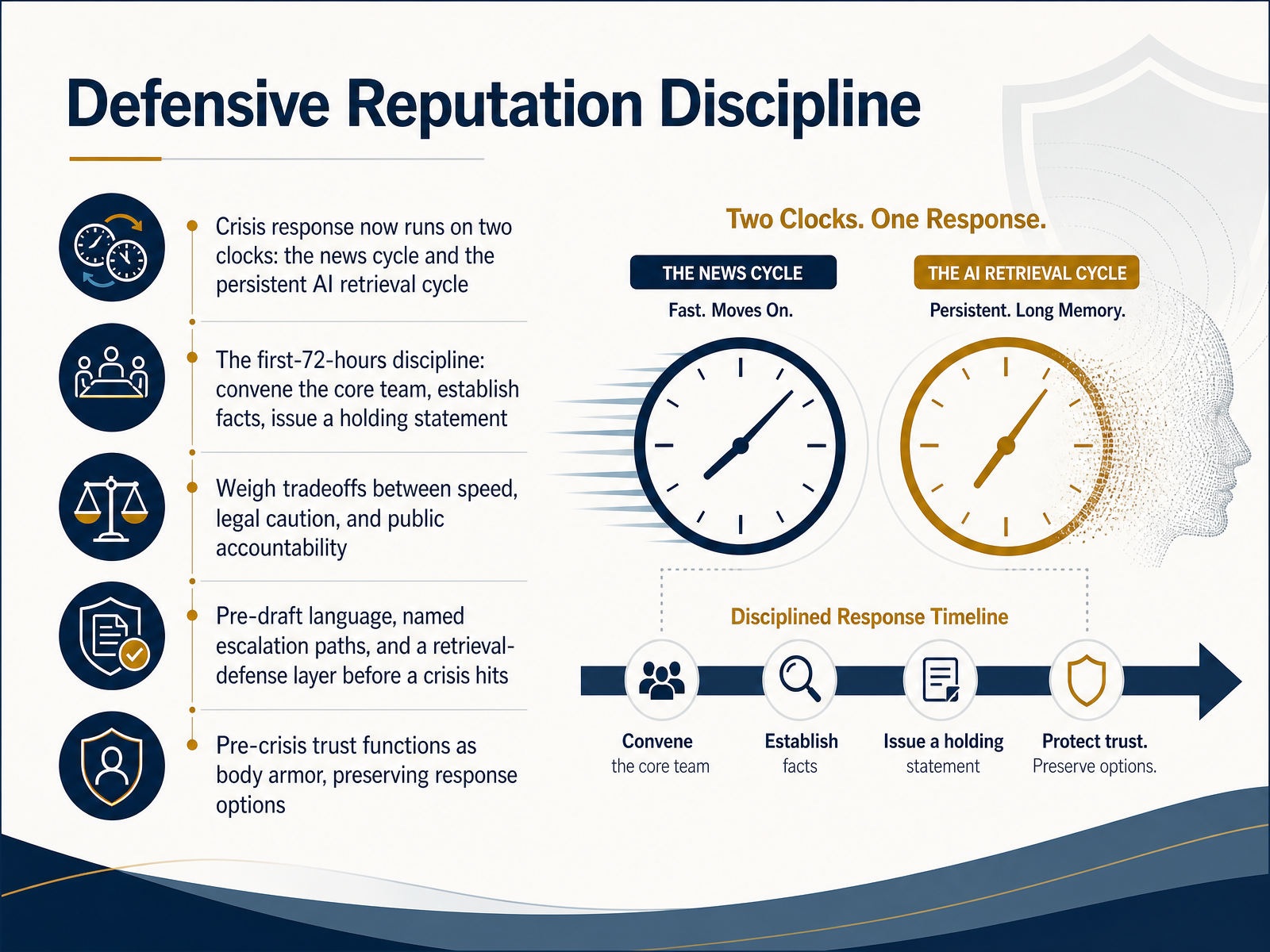
 - 09Defensive Reputation DisciplineNow let’s move into defensive reputation discipline. Your crisis response in this environment runs on two clocks simultaneously. The first is the traditional news cycle, which closes in about seventy-two hours. The second is the AI retrieval cycle, which never closes, and it keeps compounding for years. You have to manage both in parallel. The first seventy-two hours still demand core discipline. Convene the core team, establish the facts, issue a holding statement, and do it fast. But your response needs a human voice, so be careful with legal caution. Over-lawyered language won’t be believed, and it won’t be cited. You’re weighing speed against accuracy, and accountability against exposure. Your pre-drafted language, named escalation paths, and a retrieval-defense layer should all exist before an incident happens. That’s what lets you respond inside sixty minutes with pre-approved, human-sounding language. One more thing. Pre-crisis trust is your body armor. If you have a deep corpus of primary-source content before a crisis, the engines have authoritative material to retrieve. If you don’t, the crisis becomes the only thing they know. Build the reservoir of trust now, because it preserves your options when everything goes sideways. Next, we’ll look at the customer-experience link to reputation.
 everything-pr.comronntorossian.comeverything-pr.com+22 min
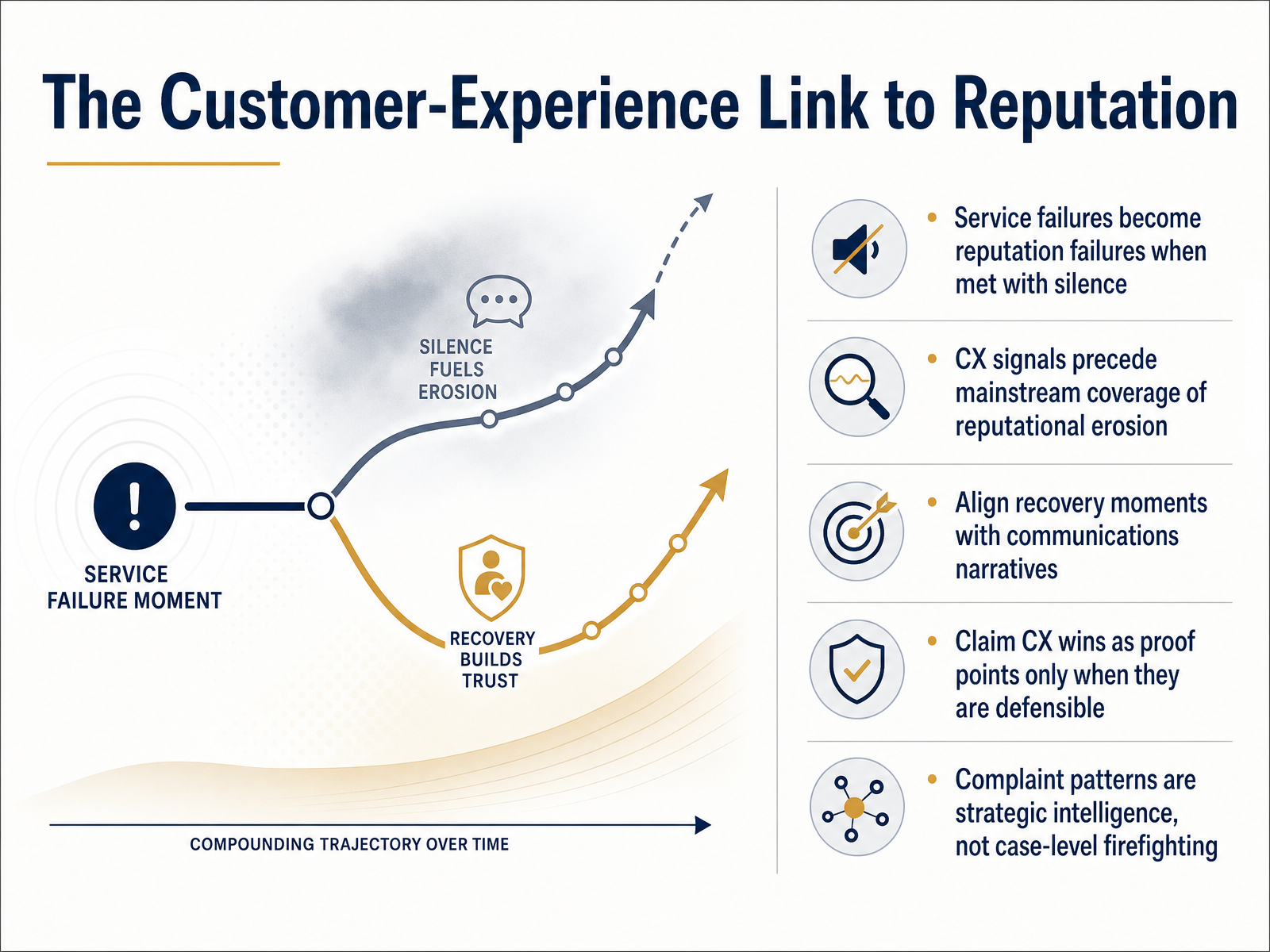
 - 10The Customer-Experience Link to ReputationLet’s turn to the customer-experience link, because this is where reputation strategy becomes operational. Service failures become reputation failures when they are met with silence. The failure itself is not the story; the absence of a response is. Your team faces this when a complaint thread goes unanswered for days, and then a journalist or an analyst picks it up. By then, you are defending the silence, not fixing the problem. Remember that CX signals precede mainstream coverage. Shifts in sentiment and complaint patterns lead broader reputational erosion by thirty to ninety days. If you only react to headlines, you are always late. So align your recovery moments with your communications narratives. When you fix an issue, make sure the public story matches the customer’s lived experience. And claim CX wins as proof points only when they are defensible. A single polished case study will not hold up if the underlying metrics do not. Treat complaint patterns as strategic intelligence, not case-level firefighting. They tell you where your product, your service, or your messaging is breaking. That intelligence should feed directly into your internal alignment and decision rights, which we will cover next.
 reputationrise.co.ukbrand24.comthebestreputation.com+22 min
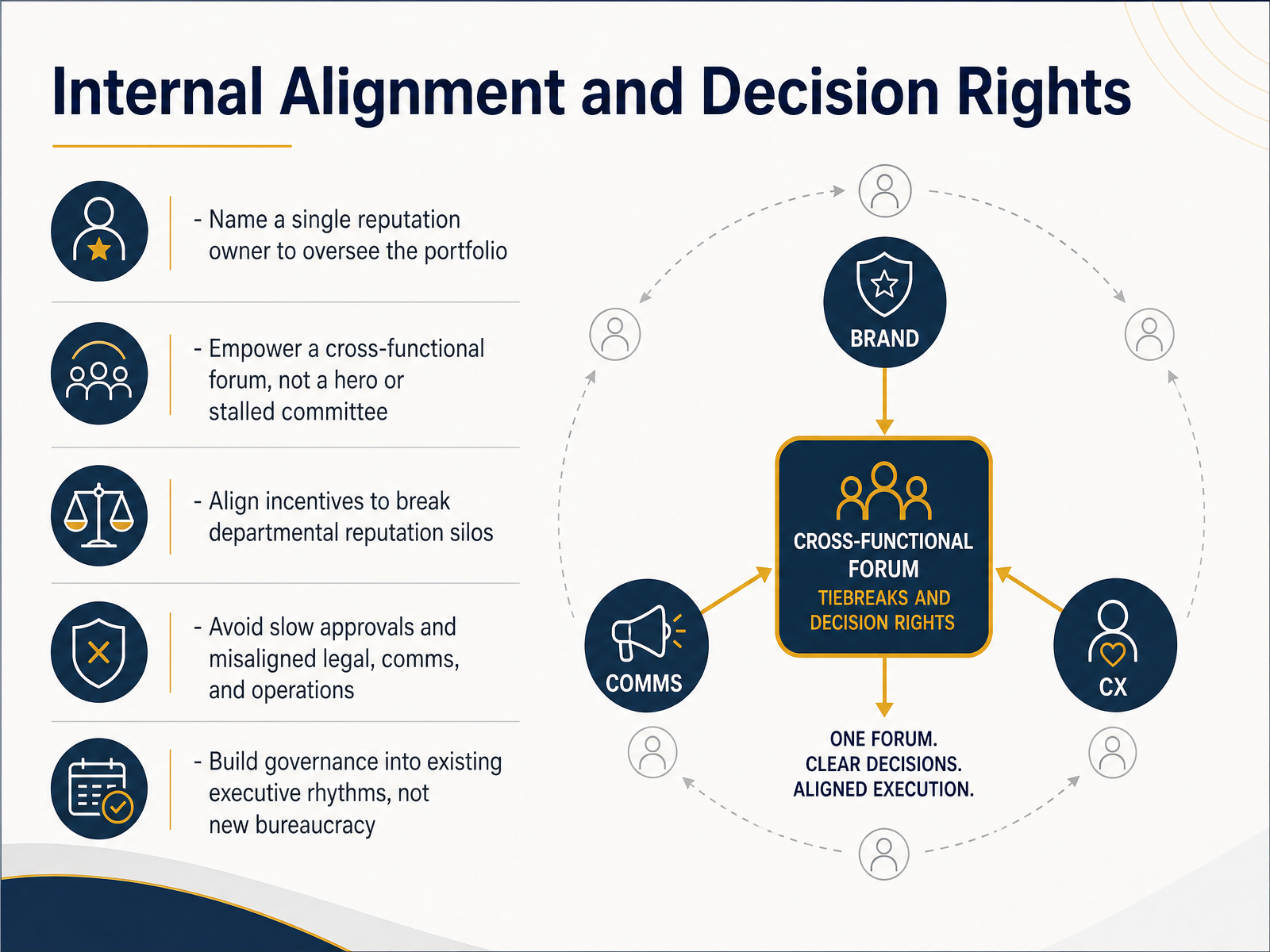
 - 11Internal Alignment and Decision RightsInternal alignment is where most reputation strategies stall. Not because of bad intent, but because of unclear ownership. Name a single reputation owner to oversee the entire portfolio. This role coordinates, prioritizes, and escalates across the business. When everyone owns reputation, no one does. But avoid creating a bottleneck, which is why you empower a cross-functional forum, not a hero or a stalled committee. Your team faces this when legal, communications, and operations all need to approve a single response. The forum creates speed with accountability. Now align incentives to break departmental silos; a comms metric that conflicts with a sales target will always lose. The goal is to avoid slow approvals and misaligned messaging between legal, comms, and operations. Build governance into existing executive rhythms, not new bureaucracy. Attach reputation reviews to the quarterly business review the leadership team already attends. This embeds decision rights where the authority already lives and prevents reputation from becoming a side project. The takeaway? Clear ownership, cross-functional input, and aligned incentives turn reputation from a shared hope into a managed asset. Next, we translate this into a practical decision framework.
 reputationrise.co.ukbrand24.comthebestreputation.com+22 min
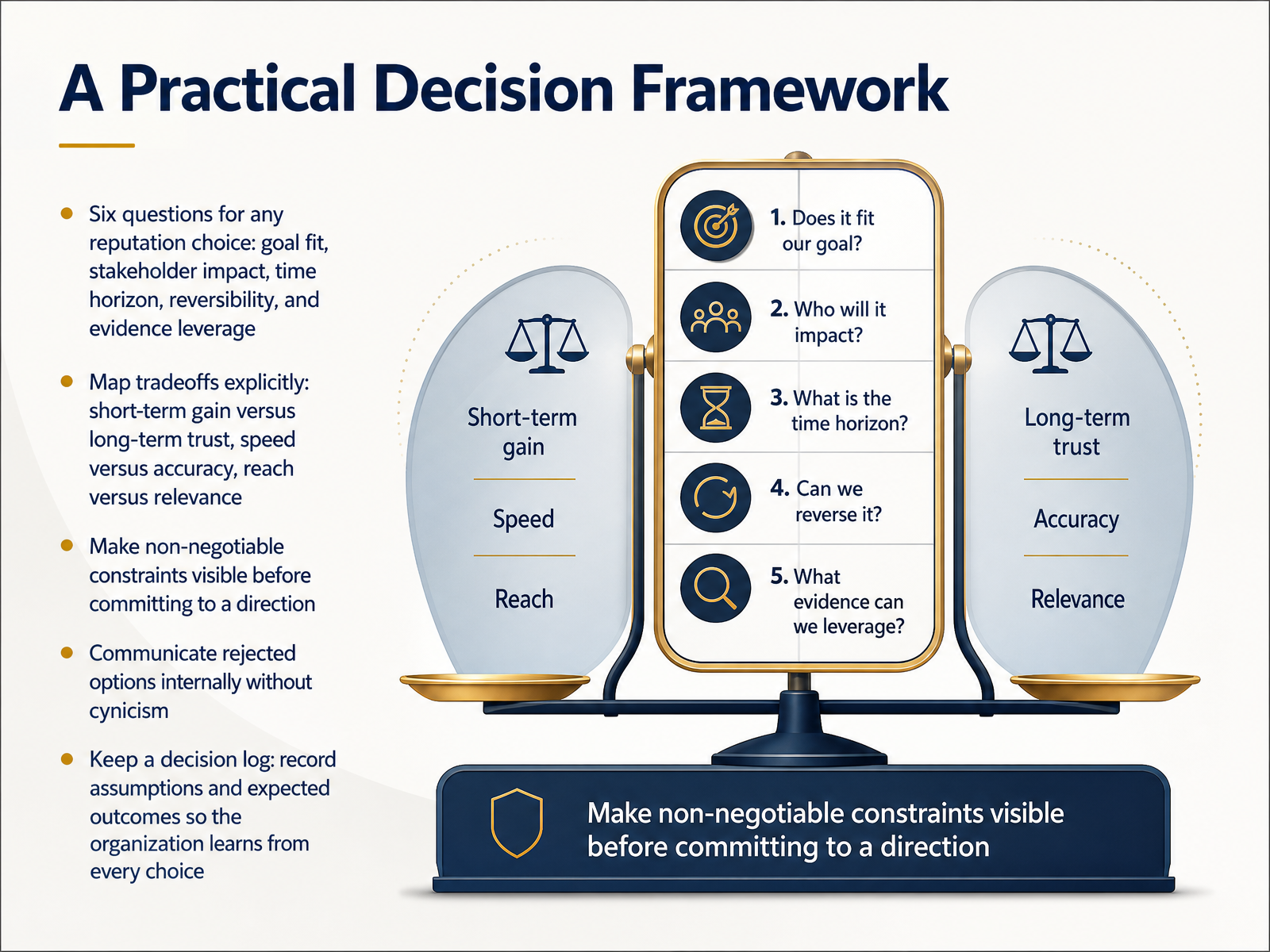
 - 12A Practical Decision FrameworkLet’s turn this into practice. When your team faces a reputation choice, use six questions to pressure-test it. Fit with strategic goals. Stakeholder impact. Time horizon. Reversibility. And the evidence you can leverage to support the decision. If you cannot articulate the evidence, you are not ready to act.
Now map the tradeoffs explicitly. Short-term gain versus long-term trust. Speed versus accuracy. Reach versus relevance. When you name these tensions out loud, you convert them from abstract anxiety into manageable variables.
Before committing to any direction, make your non-negotiable constraints visible. These act as guardrails that protect your core integrity when pressure builds. What will you never compromise on, regardless of the potential upside? Document that now.
And when you reject an option, be transparent internally. Communicate the reasoning without cynicism. Your team needs to understand why a path was closed so they can trust the decision process and remain engaged on the next challenge.
Finally, keep a decision log. Record the assumptions behind each choice and the outcome you expect. This turns every decision into a learning opportunity, helping the organization refine its judgment over time.
With this framework, you move from reactive reputation management to deliberate strategic stewardship. Now let’s shift from strategy to operating rhythm.
 thestrategystory.cominfinet.vipyoungurbanproject.com+22 min
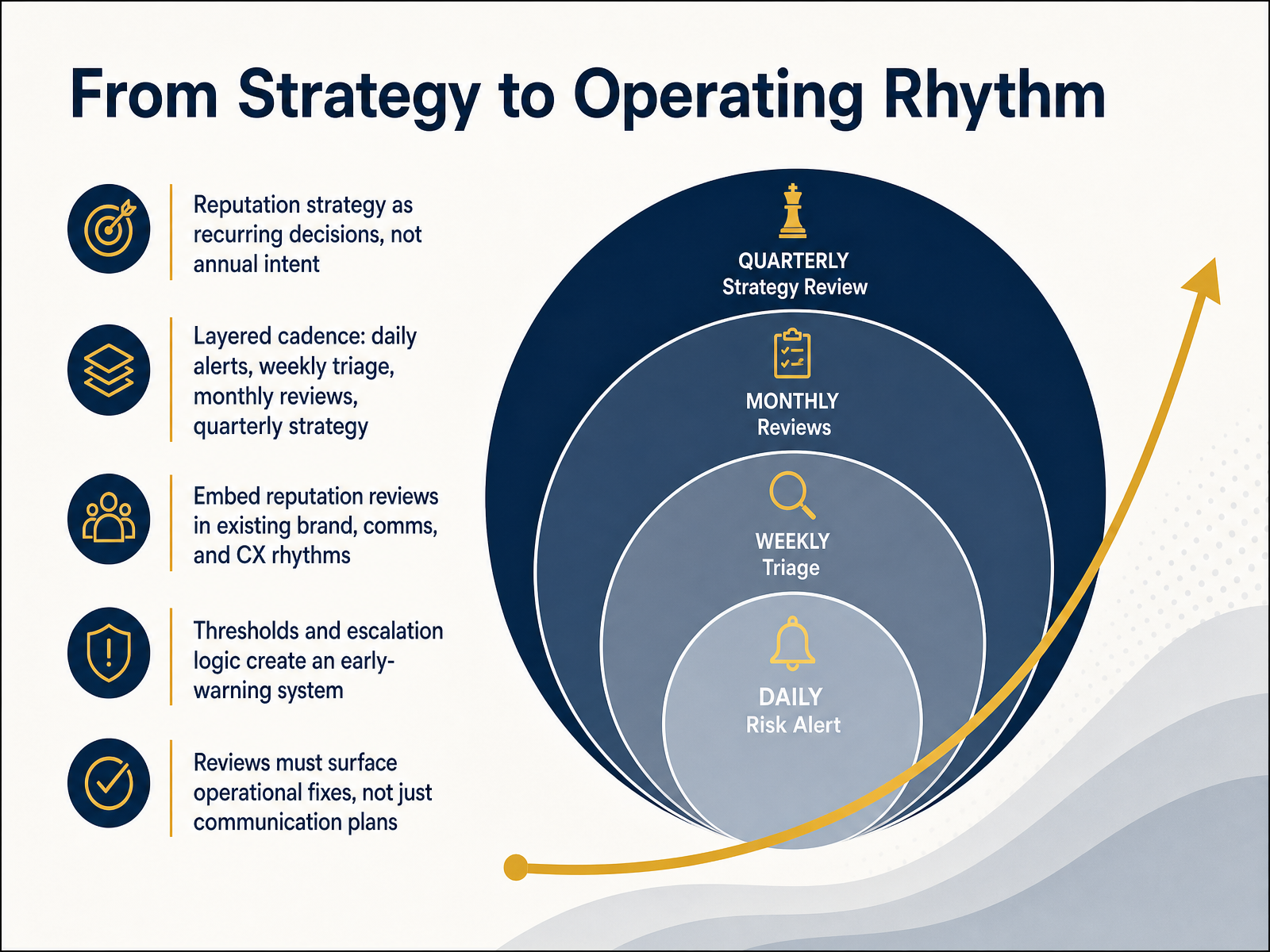
 - 13From Strategy to Operating RhythmLet’s talk about turning strategy into an operating rhythm, because a reputation strategy that only gets reviewed annually is just an aspiration. Your team faces this when a signal emerges mid-quarter and no one knows who decides whether it matters. The fix is a layered cadence. Daily alerts catch anomalies in mentions or sentiment trajectory. Weekly triage separates signal from noise. Monthly reviews connect reputation movement to pipeline, retention, and recruiting data from thirty to sixty days prior. Quarterly, you step back to reassess thresholds and strategic direction. Embed these reviews directly into your existing brand, communications, and customer experience rhythms. If reputation is a separate meeting nobody attends, it won’t drive decisions. Set thresholds and escalation logic so spikes, sentiment drops, or narrative shifts trigger the right level of response automatically. Crucially, reviews must surface operational fixes, not just communication plans. A negative trend driven by a product issue won’t be solved by a press release. Identify the root cause and assign ownership for the fix. This rhythm turns reputation from a reporting exercise into an early-warning system that protects revenue and accelerates recovery. Next, we’ll walk through the first ninety days: the concrete agenda for reputation leaders to put this operating system in place.
 the-brand-algorithm.comforbes.compulsarplatform.com+22 min
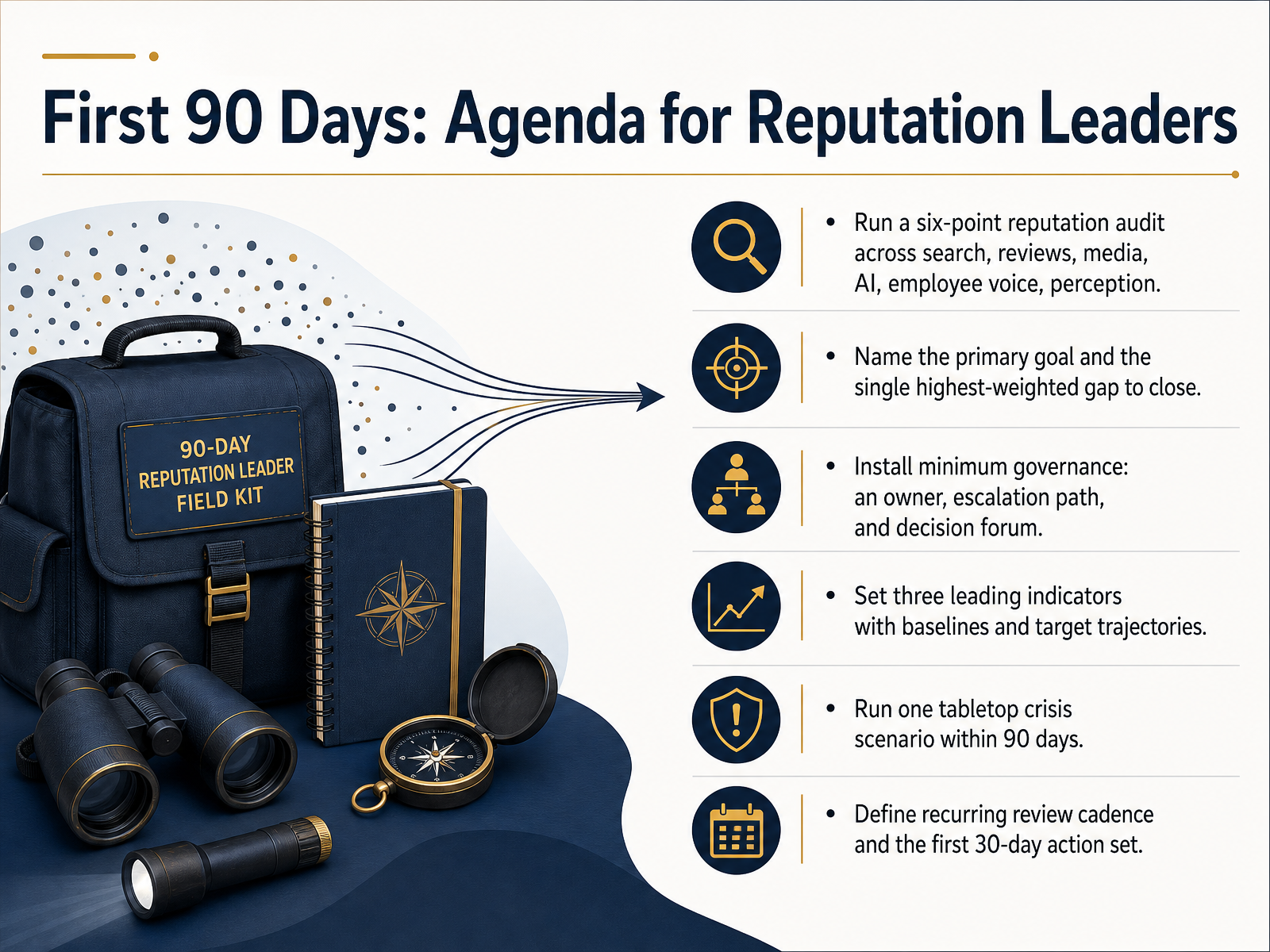
 - 14First 90 Days: Agenda for Reputation LeadersThis is your agenda for the first ninety days, and it is designed to convert this strategy into operational reality. Start with a six-point reputation audit across search, reviews, media, AI surfaces, employee voice, and actual stakeholder perception. That is your baseline. Then, name the single primary goal from that audit with full conviction, and because you cannot close every gap at once, identify the one highest-weighted gap that will unlock the most commercial value. Install minimum governance early, and keep it lean: one accountable owner, a clear escalation path, and a standing decision forum where tradeoffs get resolved in hours, not weeks. Now set just three leading indicators, and anchor each to a baseline and a target trajectory. These are not vanity metrics. They are the early warning system that leadership will review against actual business outcomes. Run one tabletop crisis scenario inside the first ninety days, even if it feels premature. The goal is to expose decision-making gaps while the stakes are still low. Finally, define your recurring cadence, monthly reporting, quarterly reviews, and list the specific thirty-day actions that will prove momentum before the quarter ends. Execution here determines whether reputation becomes a genuine strategic asset... or remains an aspiration. You have the playbook. Now build the discipline.
 thestrategystory.cominfinet.vipyoungurbanproject.com+22 min
Take the deck with you
Download this course as a file — free, no sign-up needed.
- PDF handoutEvery slide page, ready to print or share.15 pages · 3.6 MBDownload
- Narrated PowerPointThe deck that presents itself — every slide carries the digital human's narration video.15 pages · 14.9 MBDownload
- PowerPoint slidesThe full deck as a .pptx — open it in PowerPoint, Keynote, or Google Slides.15 pages · 3.5 MBDownload
Free to use in your own training — please keep the PersonWise credit page at the end.
Have your own deck? Turn it into a course
Sources consulted
Web sources consulted while building this course.
- Executive Reputation Management: A Board-Level Framework for 2026 | Reputation Rise — reputationrise.co.uk
- Brand Reputation Management: Expert Guide [2026] | Brand24 — brand24.com
- Brand and Reputation Management: The 2026 Playbook — thebestreputation.com
- The 2026 Brand Strategy Playbook | Ronn Torossian — ronntorossian.com
- Business Online Reputation: The Strategic Guide for 2026 - Incremys — incremys.com
- Reputation as Competitive Strategy: How Smart Companies Turn Brand Perception Into Market Advantage - The Strategy Story — thestrategystory.com
- Reputation Management Strategy: A Step-by-Step Framework | INFINET — infinet.vip
- Reputation Management Strategy for Real-World Results (2026) — youngurbanproject.com
- What Are The 7 Dimensions Of Reputation? A Practical Framework For High-Stakes Brands - Hayden Koch — haydenkoch.net
- Building unshakable trust - KPMG International — kpmg.com
- Social Reputation as a Leading Business Indicator — the-brand-algorithm.com
- Reputation Work Is Now Measured In Outcomes, Not Rankings — forbes.com
- Brand Reputation Monitoring: A Complete Guide for 2026 • Pulsar Platform — pulsarplatform.com
- From Vanity Metrics to Decision-Grade Reputation | RepTrak — reptrak.com
- Measuring What Happens Between Coverage and Commerce | RepTrak — reptrak.com
- Crisis Communications Strategy: Your 2026 Playbook — everything-pr.com
- The 2026 Crisis Communications Playbook | Ronn Torossian — ronntorossian.com
- How to Build a Crisis Communications Plan | 2026 | EPR — everything-pr.com
- Crisis Management — kekstcnc.com
- Brand Crisis Management Guide: Detect, Respond & Recover | Pendulum — pendulumintel.com