Begin
14 pages · ~28 min
Ng et al. AI Literacy Framework
This training introduces the Ng et al. AI Literacy Framework, covering its core components and practical applications for educators and professionals.
A digital instructor presents all 14 pages. Hold “Ask” at any point and ask out loud — the answer comes from this course. No sign-up needed.
What you’ll learn
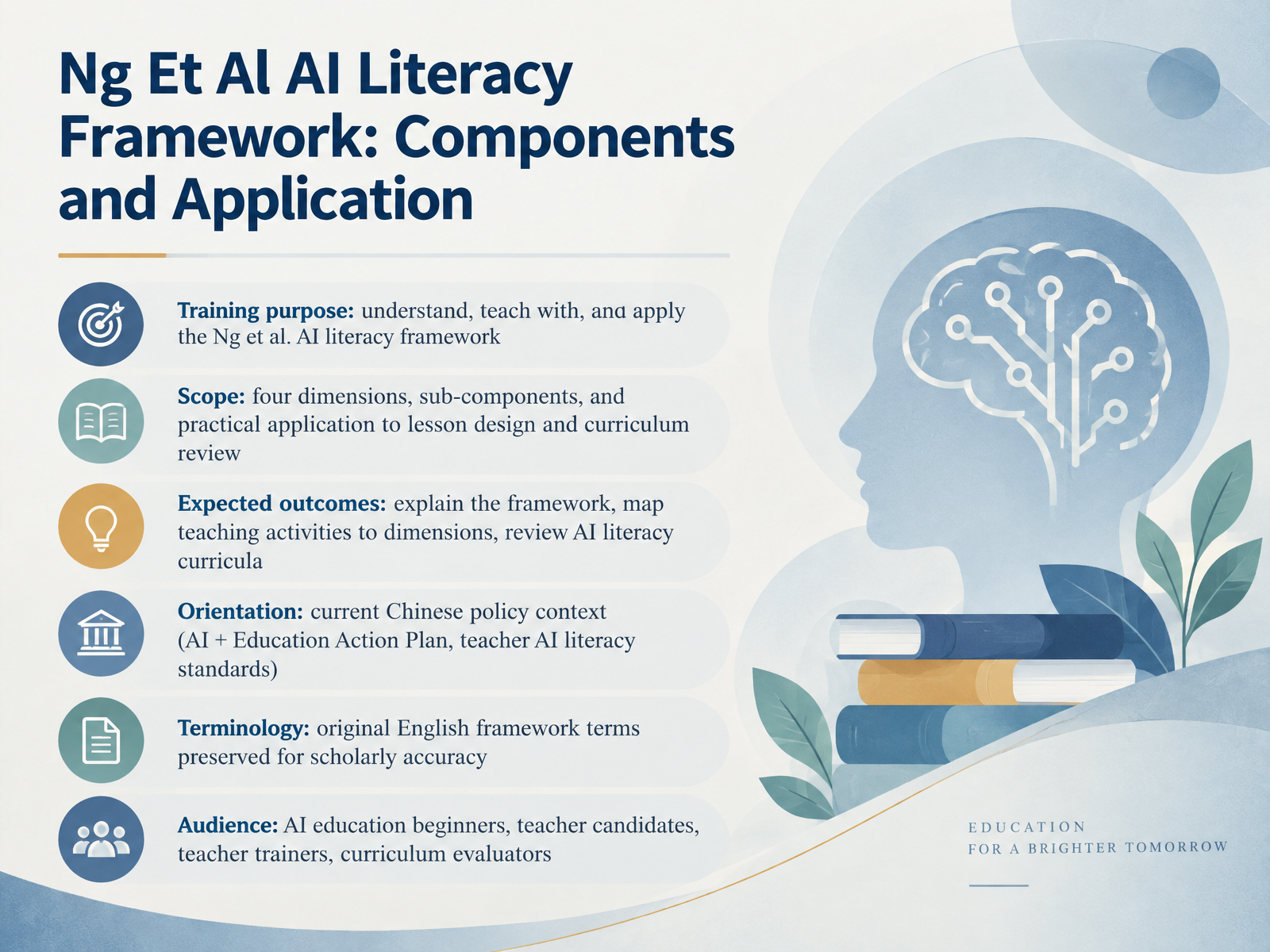
- 01Ng Et Al AI Literacy Framework: Components and ApplicationWelcome. In this session, we explore the Ng et al. AI literacy framework, a widely used foundation for AI curriculum design. Our purpose is threefold: to understand the framework, to teach with it, and to apply it in your own setting. We will examine its four dimensions and sub-components, then connect them to lesson design and curriculum review. By the end, you should be able to explain the framework, map teaching activities to its dimensions, and review AI literacy curricula with confidence. We will also orient the work within the current Chinese policy context, including the AI plus Education Action Plan and emerging teacher AI literacy standards. One note on terminology: we keep the original English framework terms for scholarly accuracy. This session is designed for AI education beginners, teacher candidates, teacher trainers, and curriculum evaluators. Let us begin by asking why AI literacy matters now, and what the policy context tells us.sciencedirect.comdoi.orgray.yorksj.ac.uk+22 min
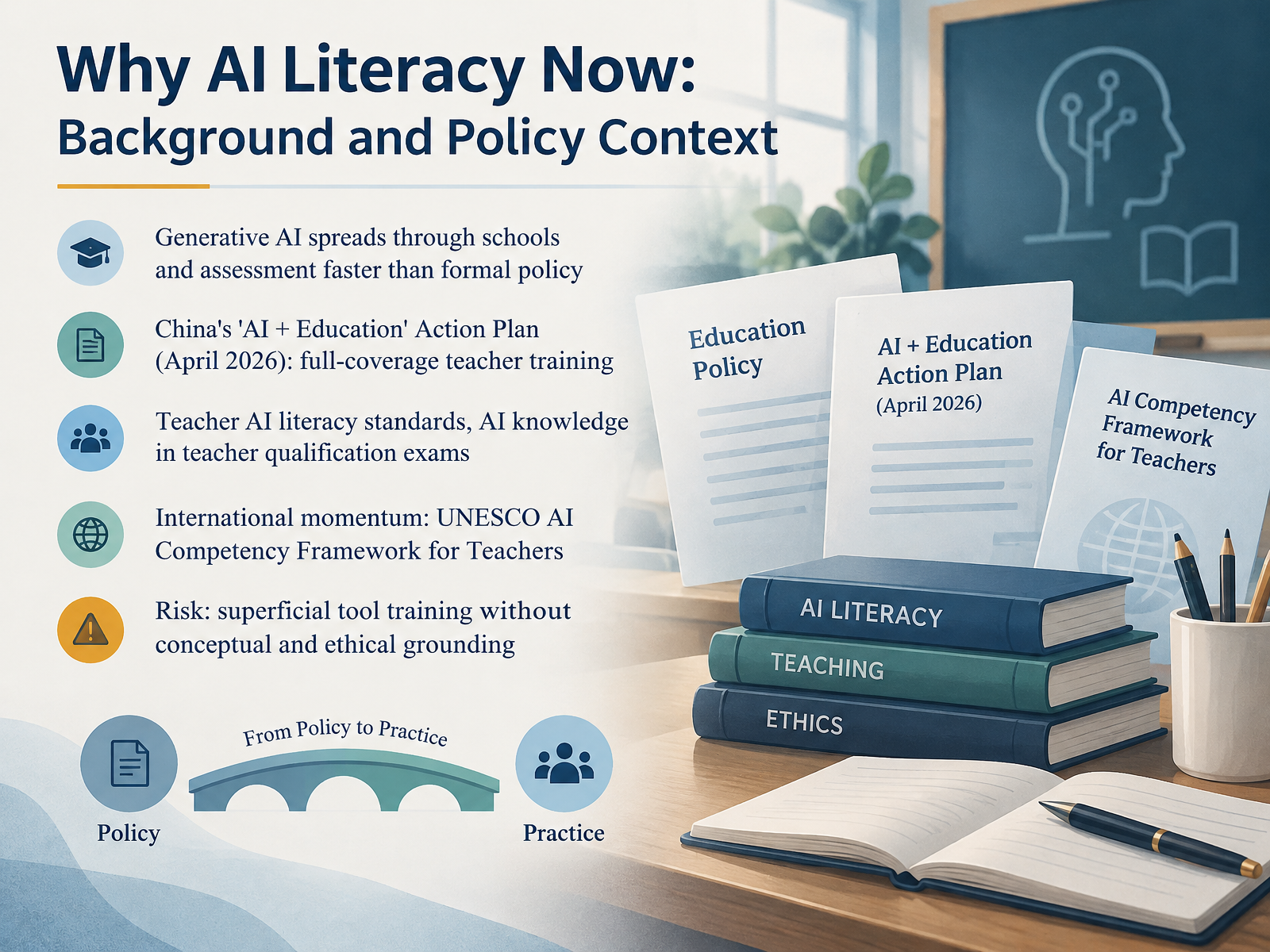
- 02Why AI Literacy Now: Background and Policy ContextLet's look at why AI literacy matters right now. Generative AI has moved into schools and assessment practices faster than formal policy can keep up. In response, China issued its AI plus Education Action Plan in April 2026. It calls for full-coverage teacher training, a national teacher AI literacy standard, and AI knowledge in teacher qualification exams. Internationally, we see similar momentum, such as UNESCO's AI Competency Framework for Teachers. But consider the risk here. If your program offers only superficial tool training, teachers may use AI without conceptual understanding or ethical grounding. That is exactly what we need to avoid. So the policy context gives us both a mandate and a warning as we design teacher learning. Next, we turn to the origins of the framework and how it relates to other models.
 gov.cnmoe.gov.cnenglish.gov.cn+21 min
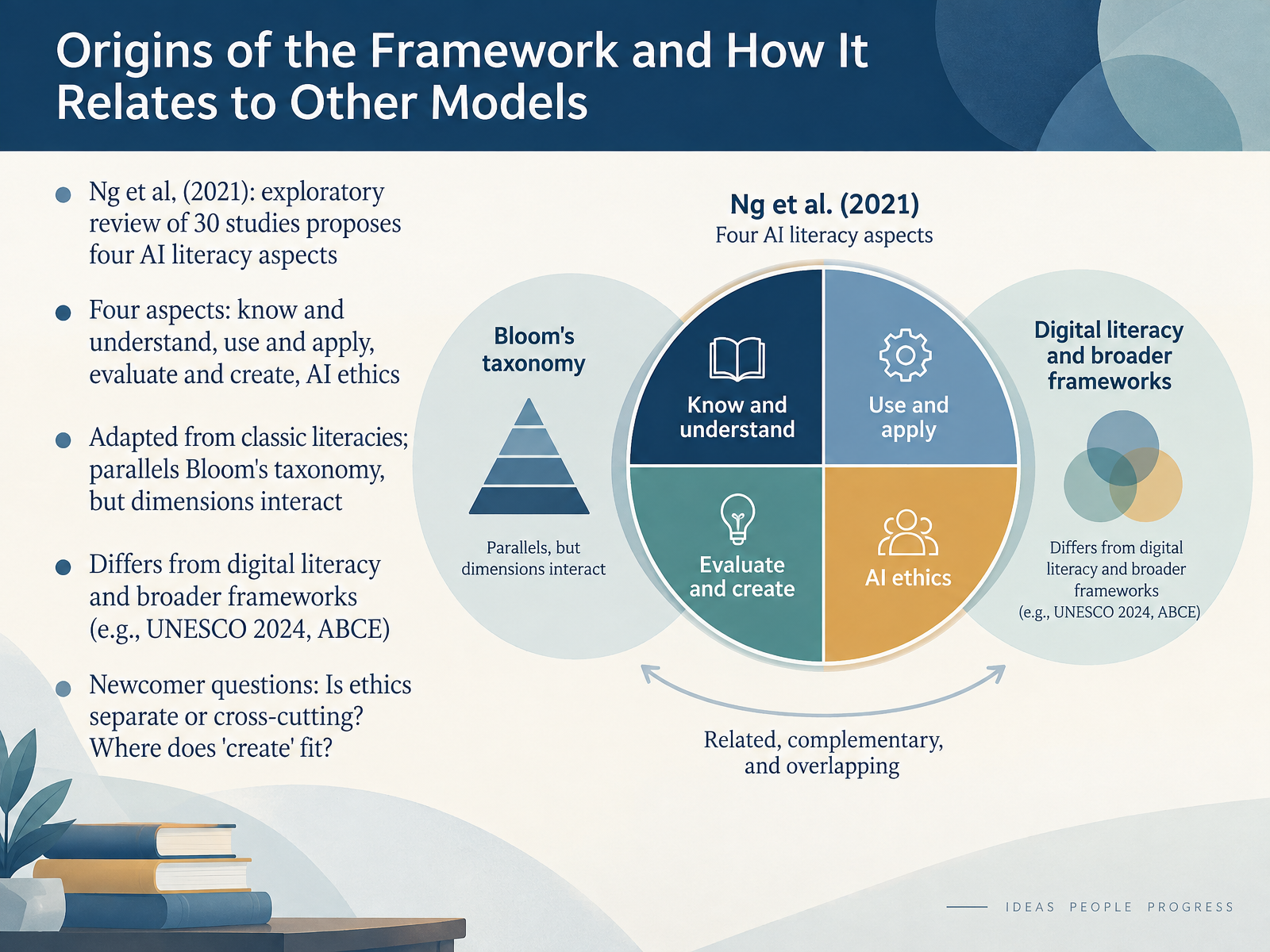
- 03Origins of the Framework and How It Relates to Other ModelsLet's turn to where this framework came from. In twenty twenty-one, Ng and colleagues published an exploratory review. They analyzed thirty peer-reviewed studies and proposed four aspects of AI literacy. They are: know and understand, use and apply, evaluate and create, and AI ethics. The authors adapted these from classic literacies, so the structure echoes Bloom's taxonomy. But here is the key point. The dimensions interact. When students create an AI artifact, they also apply knowledge and evaluate outputs at the same time. This differs from digital literacy and from broader frameworks such as the UNESCO twenty twenty-four guidance or the ABCE model. As a newcomer, you may ask two questions. First, is ethics separate or cross-cutting? In practice, treat it as cross-cutting, because fairness and transparency surface in every task. Second, where does create fit? It is the higher-order end of the cognitive dimension, not a separate skill set. Now let's look at the four dimensions at a glance.
 sciencedirect.comdoi.orgray.yorksj.ac.uk+22 min
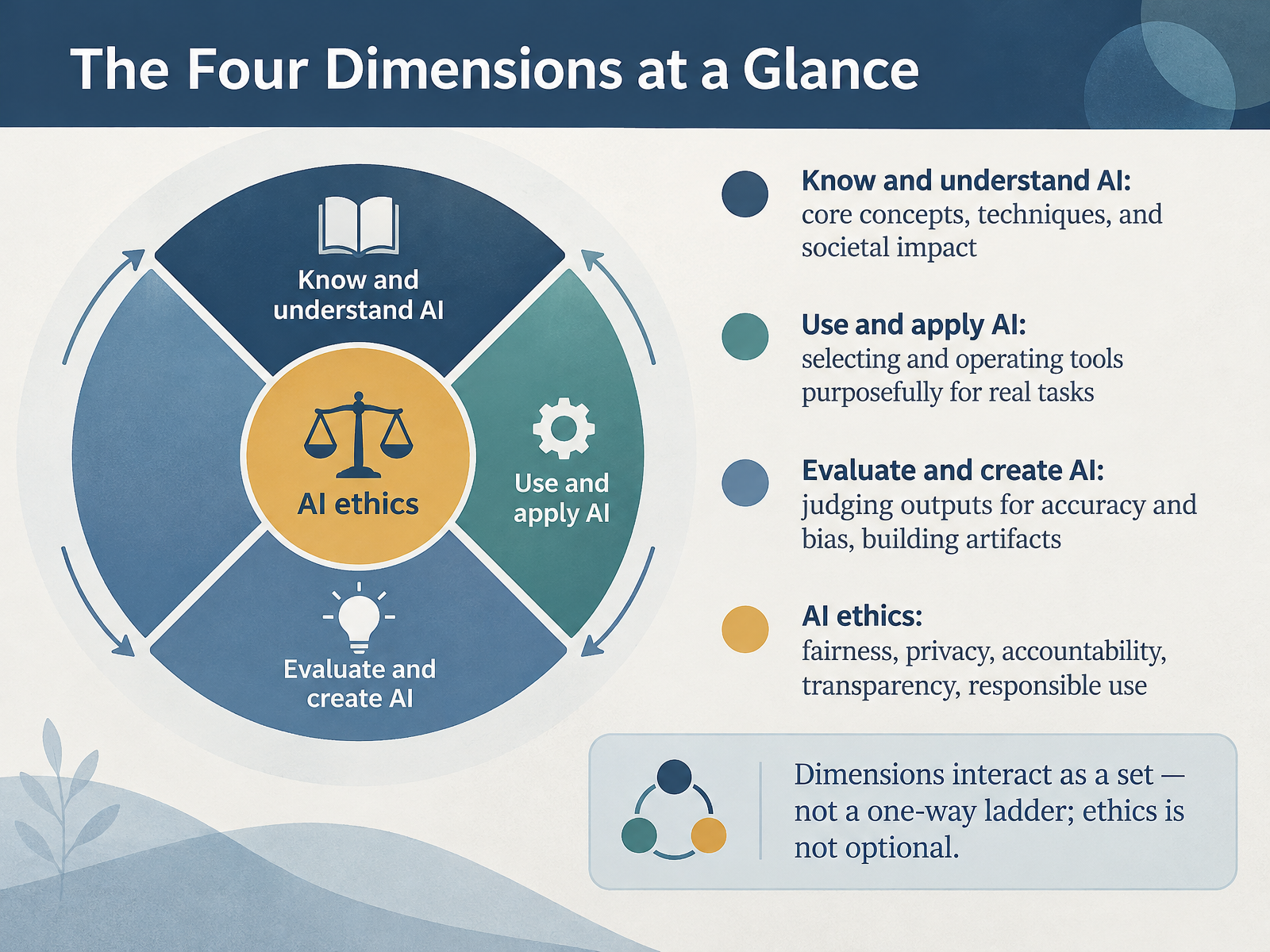
- 04The Four Dimensions at a GlanceSo let's take the four dimensions at a glance. The first is know and understand AI: core concepts, techniques, and societal impact. In practice, that could mean a teacher explaining how a recommendation system learns from data. The second is use and apply AI: selecting and operating tools purposefully for real tasks, such as drafting lesson materials or planning an assessment. The third is evaluate and create AI. Here, you judge outputs for accuracy and bias, and you build artifacts, for example a short quiz reviewed before classroom use. The fourth is AI ethics: fairness, privacy, accountability, transparency, and responsible use. Now, these dimensions interact as a set. They are not a one-way ladder, and ethics is not optional. When you design your program, map activities across all four rather than treating ethics as a final add-on. We'll now go deeper into the first dimension. Know and Understand AI: Core Concepts for Educators.
 sciencedirect.comdoi.orgray.yorksj.ac.uk+22 min
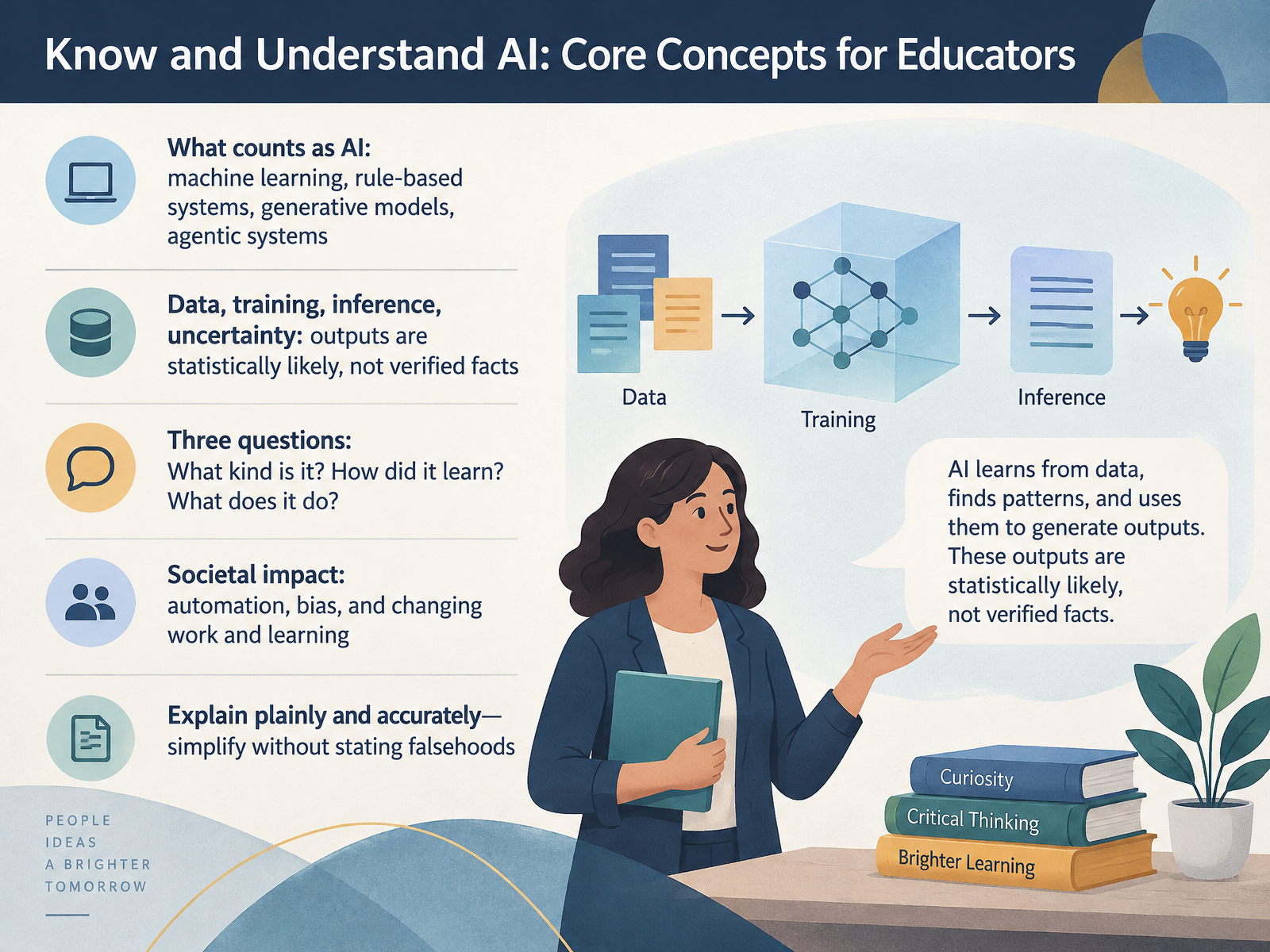
- 05Know and Understand AI: Core Concepts for EducatorsLet's turn now to what educators need to know and understand about AI itself. What counts as AI? There are several kinds. Machine learning systems learn patterns from data. Rule-based systems follow fixed instructions. Generative models produce text or images. Agentic systems can take actions. Key terms here are data, training, and inference. After training, the model makes inferences. But outputs are statistically likely, not verified facts, so they can sound confident and still be wrong. A simple habit is to ask three questions of any tool. What kind is it? How did it learn? What does it do? We should also discuss societal impact, including automation, bias, and changing work and learning. When you explain AI in your program, simplify without stating falsehoods. Plain language is only useful if it is also true. Next, we look at how this knowledge becomes practice in Use and Apply AI: From Tool Operation to Purposeful Pedagogy.
 educatorstechnology.comignite-sites.gcu.edudmccreary.github.io+22 min
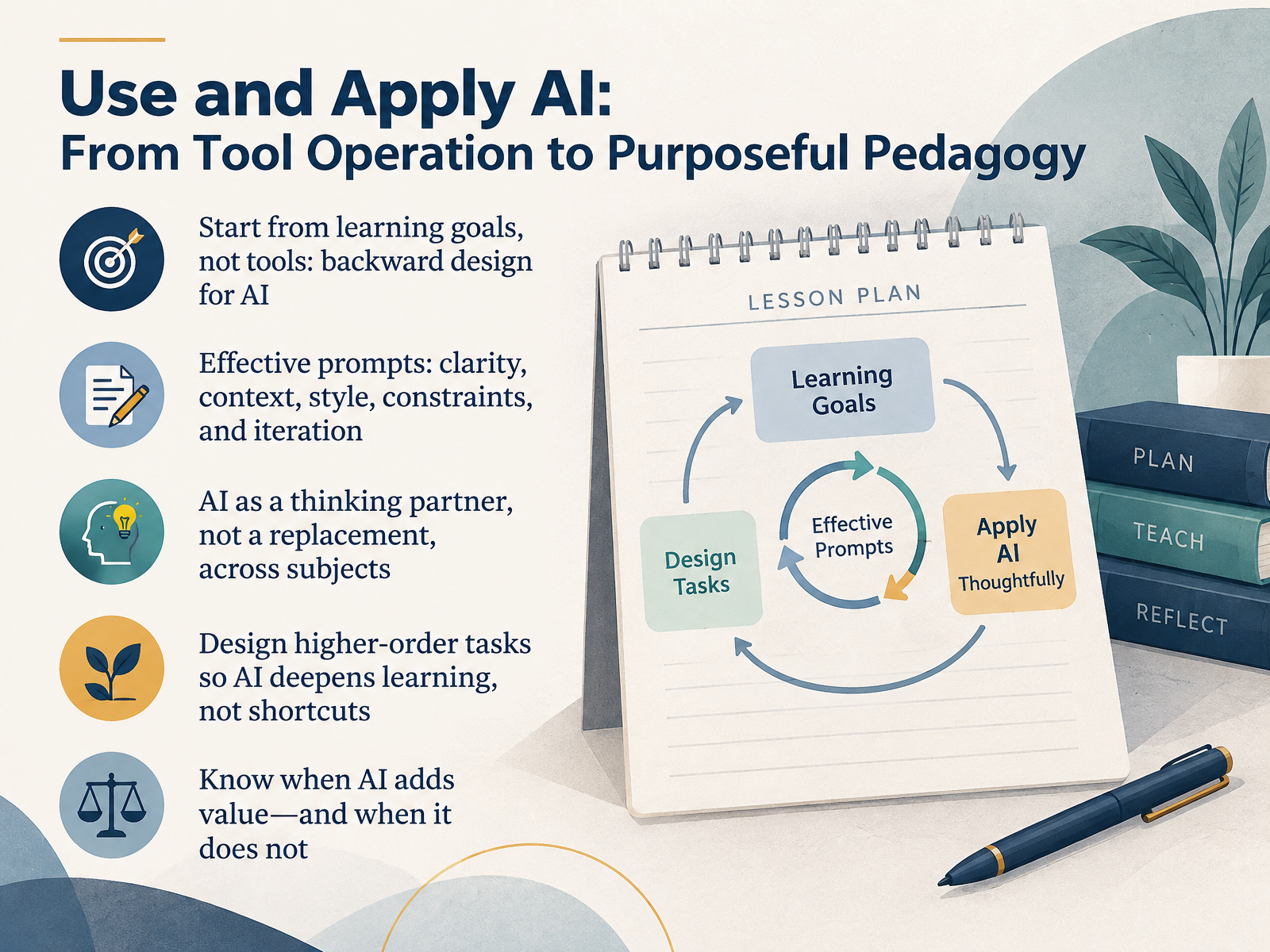
- 06Use and Apply AI: From Tool Operation to Purposeful PedagogyLet's move from understanding AI to using it well. The key idea here is to start from your learning goals, not from the tools. This is backward design for AI. Ask what students should understand, then decide whether and how AI helps. Pause here for a moment, because this order matters. When you write prompts, aim for clarity, context, desired style, constraints, and iteration. For example, your program might ask a chatbot to draft a lesson outline for a given grade level, then refine it across two or three rounds. Consider AI as a thinking partner, not a replacement, across subjects. Design higher-order tasks, so AI deepens learning rather than offering shortcuts. And know when AI adds value, and when it does not. Takeaway: let pedagogy lead, and let the tool follow. Next, we turn to evaluating and creating with AI, focusing on critical judgment and production.
 educatorstechnology.comignite-sites.gcu.edudmccreary.github.io+22 min
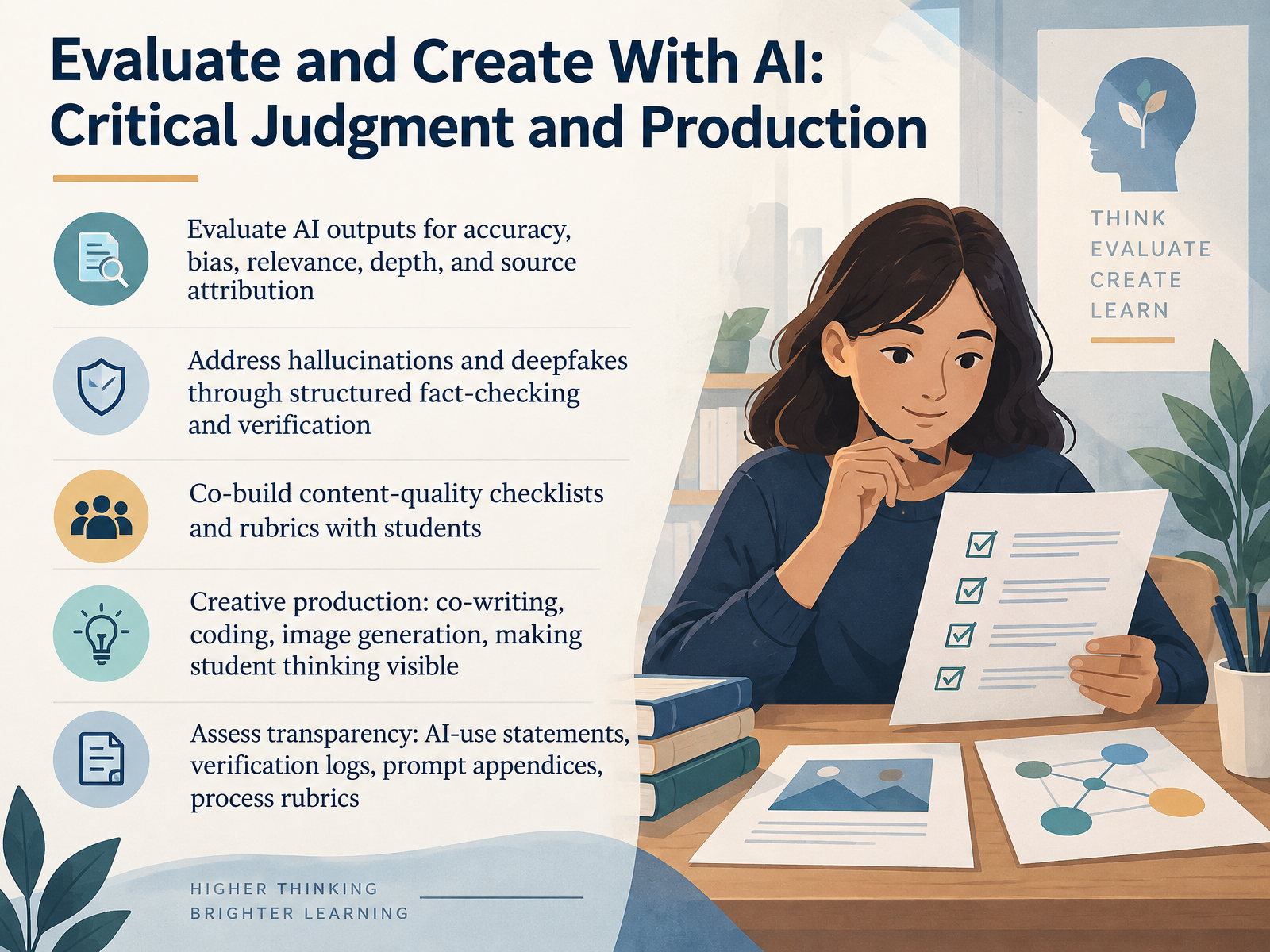
- 07Evaluate and Create With AI: Critical Judgment and ProductionNow we arrive at the highest level of the Ng framework: evaluating and creating with AI. When your students evaluate an AI output, ask them to judge it on accuracy, bias, relevance, depth, and source attribution. For example, a chatbot may invent a citation that looks convincing. That is a hallucination, and structured fact-checking helps students catch it. Deepfakes work the same way: check the original source, not just the claim. A practical move is to co-build a content checklist or rubric with your students, so they define what quality looks like before they judge an output. On the creative side, students can co-write, code, or generate images with AI, while making their own thinking visible. And assess transparency directly: ask for an AI-use statement, a verification log, a prompt appendix, or a process rubric. Marks should reflect how well students verify and distinguish their own work from the tool's output. So, prioritize judgment and transparency over the final product. Next, we turn to AI ethics and responsible use in schools.
 libguides.csu.edu.auucalgary.caunimelb.edu.au+22 min
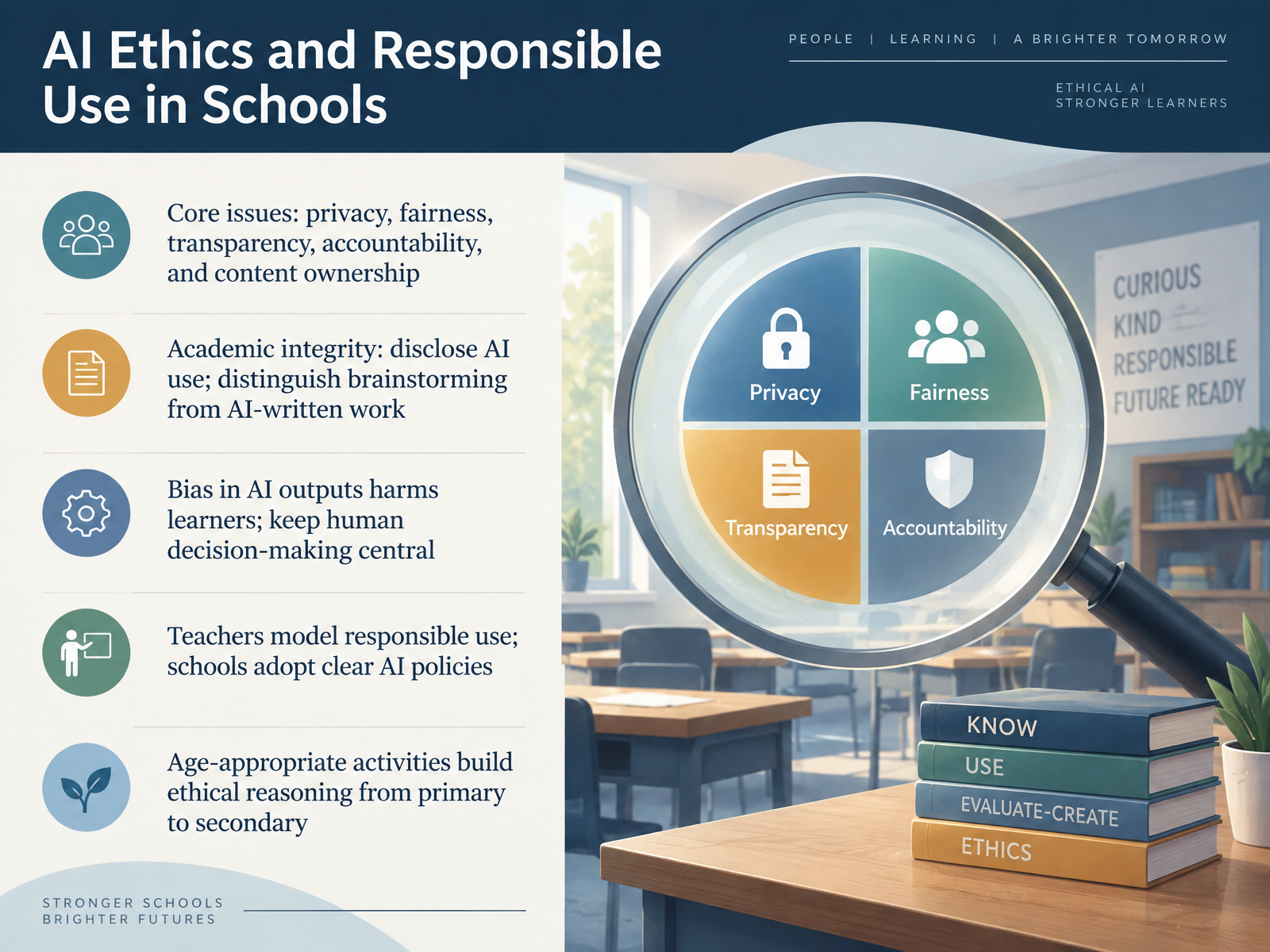
- 08AI Ethics and Responsible Use in SchoolsNext, let's look at AI ethics and responsible use in schools. Five core issues come up again and again: privacy, fairness, transparency, accountability, and content ownership. For example, when you plan an activity, ask whether any personal data enters the tool. Then ask who checks the output, and who owns what the AI produces. Academic integrity is the second piece. Encourage students to disclose AI use, and teach them the difference between brainstorming with AI and submitting AI-written work. A simple reflection note can do this well. Third, bias. AI outputs can reflect human bias, and that can harm learners. So keep human decision-making central. When you assess, review outputs yourself rather than accepting them. Teachers also model responsible use, and schools need clear AI policies that everyone can follow. Finally, design age-appropriate activities that build ethical reasoning, from primary through secondary. Now let's move on to applying the framework to lesson and module design.
 gov.cnmoe.gov.cnenglish.gov.cn+22 min
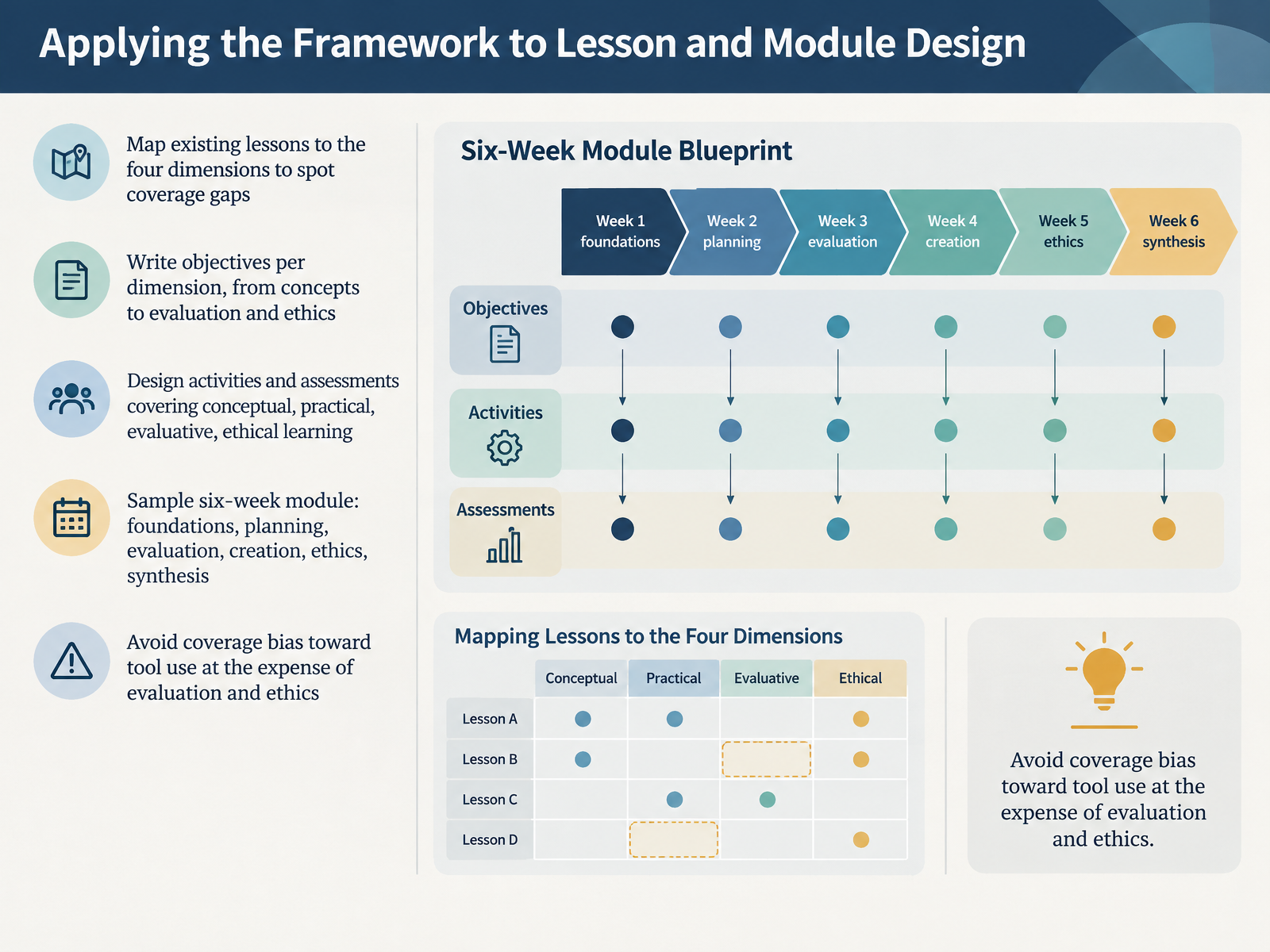
- 09Applying the Framework to Lesson and Module DesignNow let's move from understanding the framework to using it in lesson and module design. A practical first step is to map your existing lessons against the four dimensions. That helps you spot coverage gaps quickly. Next, write objectives for each dimension, moving from concepts to evaluation and ethics. Then design activities and assessments that cover conceptual, practical, evaluative, and ethical learning together. Consider a six-week module: foundations, planning, evaluation, creation, ethics, and synthesis. One caution here: avoid coverage bias toward tool use at the expense of evaluation and ethics. When you assess your program, check that every dimension has evidence. That balance is the takeaway. Next, we look at using the framework for program and course evaluation.
 educatorstechnology.comignite-sites.gcu.edudmccreary.github.io+22 min
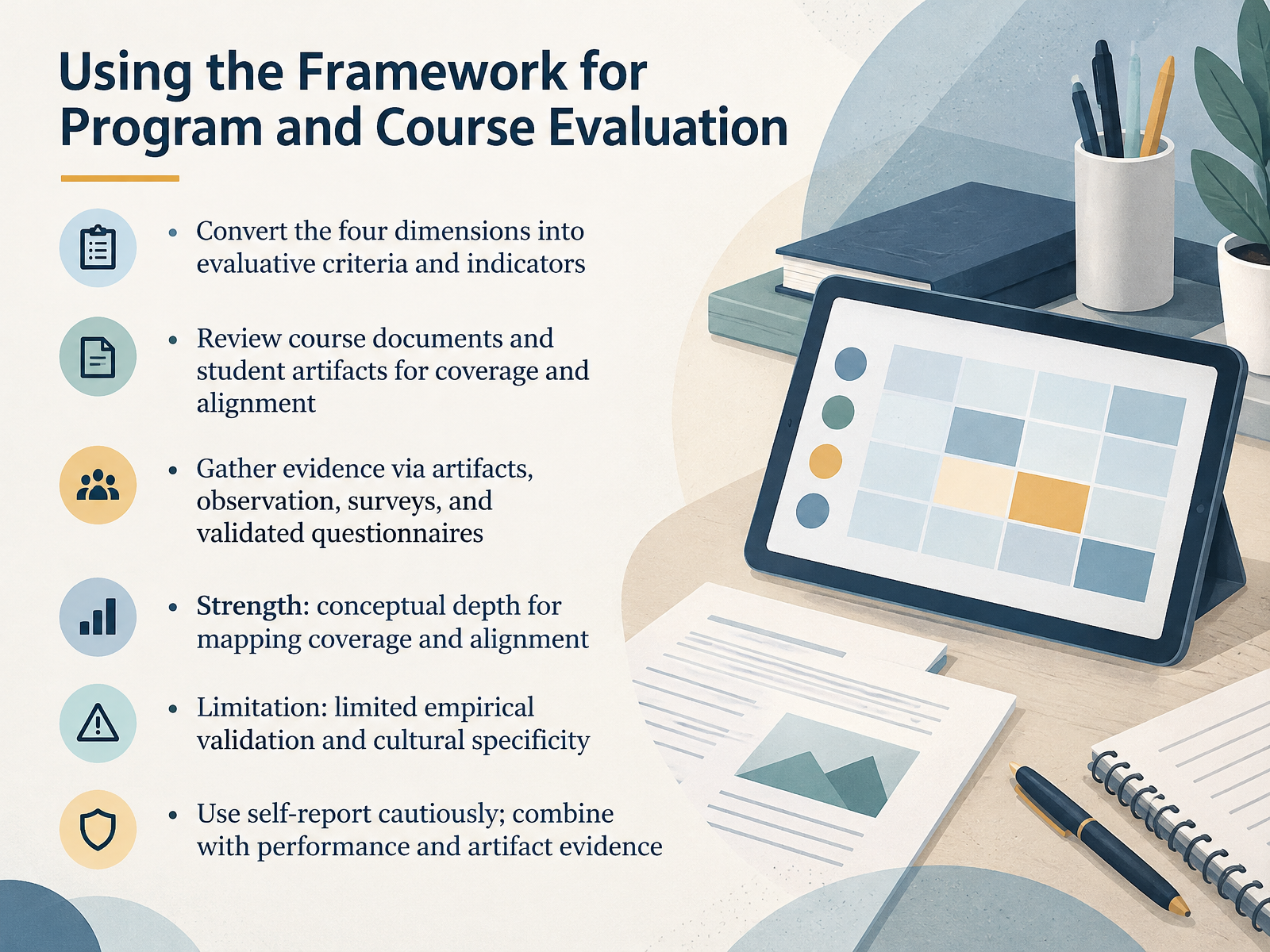
- 10Using the Framework for Program and Course EvaluationLet's turn now to using the framework for program and course evaluation. The first step is to convert the four dimensions into evaluative criteria and indicators. For example, for the ethics dimension, an indicator might be that students can identify a privacy risk in an AI tool. Next, review course documents and student artifacts for coverage and alignment. Ask whether each dimension appears in your syllabus and whether assignments actually require it. Then gather evidence from multiple sources: artifacts, classroom observation, surveys, and validated questionnaires. Here we should be candid about trade-offs. The framework's strength is conceptual depth for mapping coverage and alignment. Its limitation is limited empirical validation and cultural specificity. So use self-report cautiously, and combine it with performance and artifact evidence. That gives your evaluation a firmer footing. This naturally leads us to connecting the framework to Chinese policy and local frameworks.
 2 min
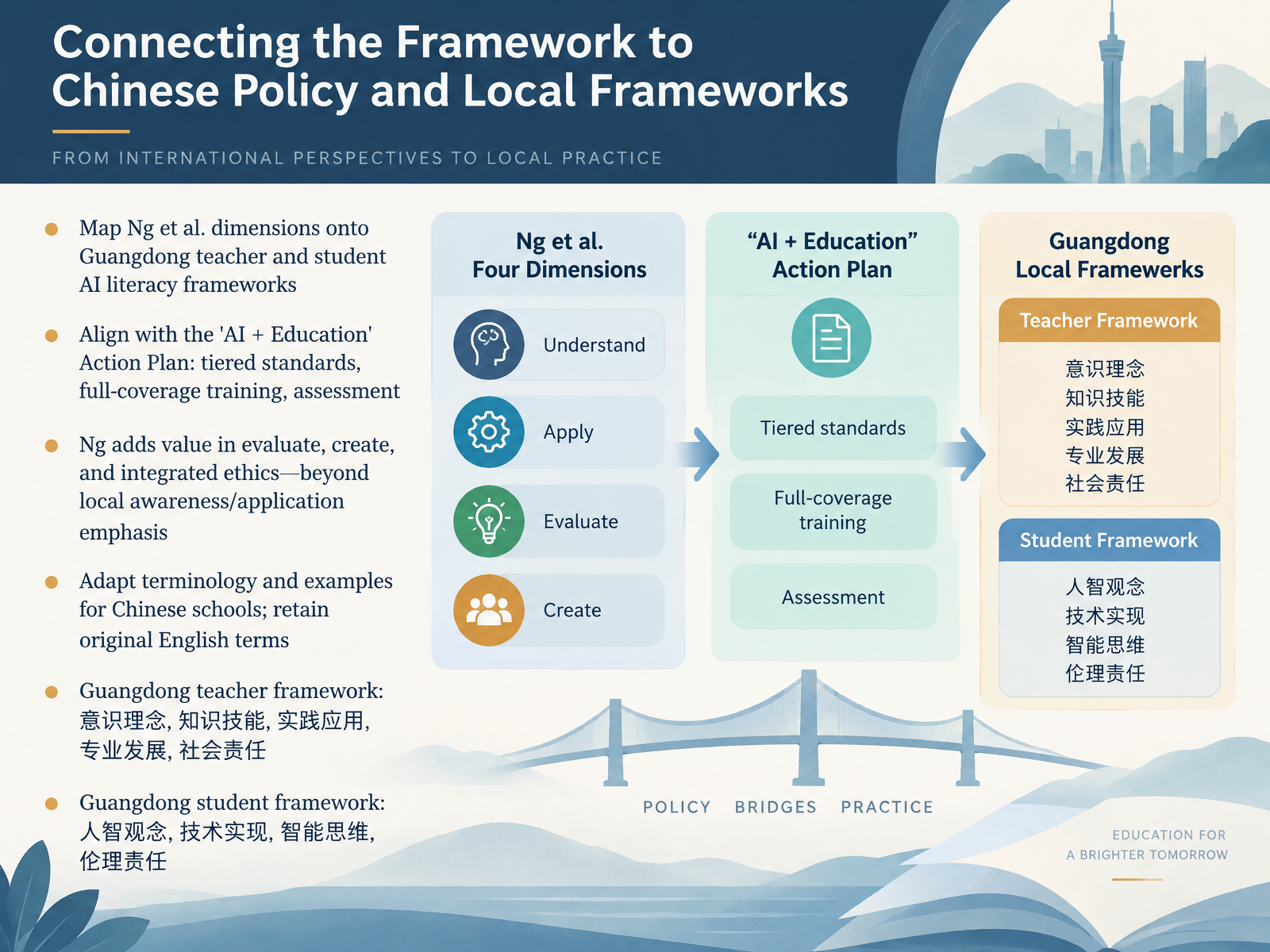
- 11Connecting the Framework to Chinese Policy and Local FrameworksNow let us connect the framework to Chinese policy and local frameworks. Guangdong's 2 plus 1 plan offers two helpful anchors. The teacher framework has five dimensions: awareness and beliefs, knowledge and skills, practical application, professional development, and social responsibility. The student framework has four: views on human and AI relations, technical realization, intelligent thinking, and ethical responsibility. Map Ng and colleagues' four dimensions onto these, then align your program with the AI plus Education Action Plan. That plan calls for tiered standards, full-coverage teacher training, and assessment. Consider a teacher-training module. Local frameworks emphasize awareness and application. Ng adds real value in evaluate, create, and integrated ethics. So when you assess, include project portfolios and artifact-based interviews, not only knowledge tests. Adapt terminology and examples for Chinese schools, but retain the original English terms in research writing. Next, we turn to common pitfalls and critiques of the framework.
 gov.cnmoe.gov.cnenglish.gov.cn+22 min
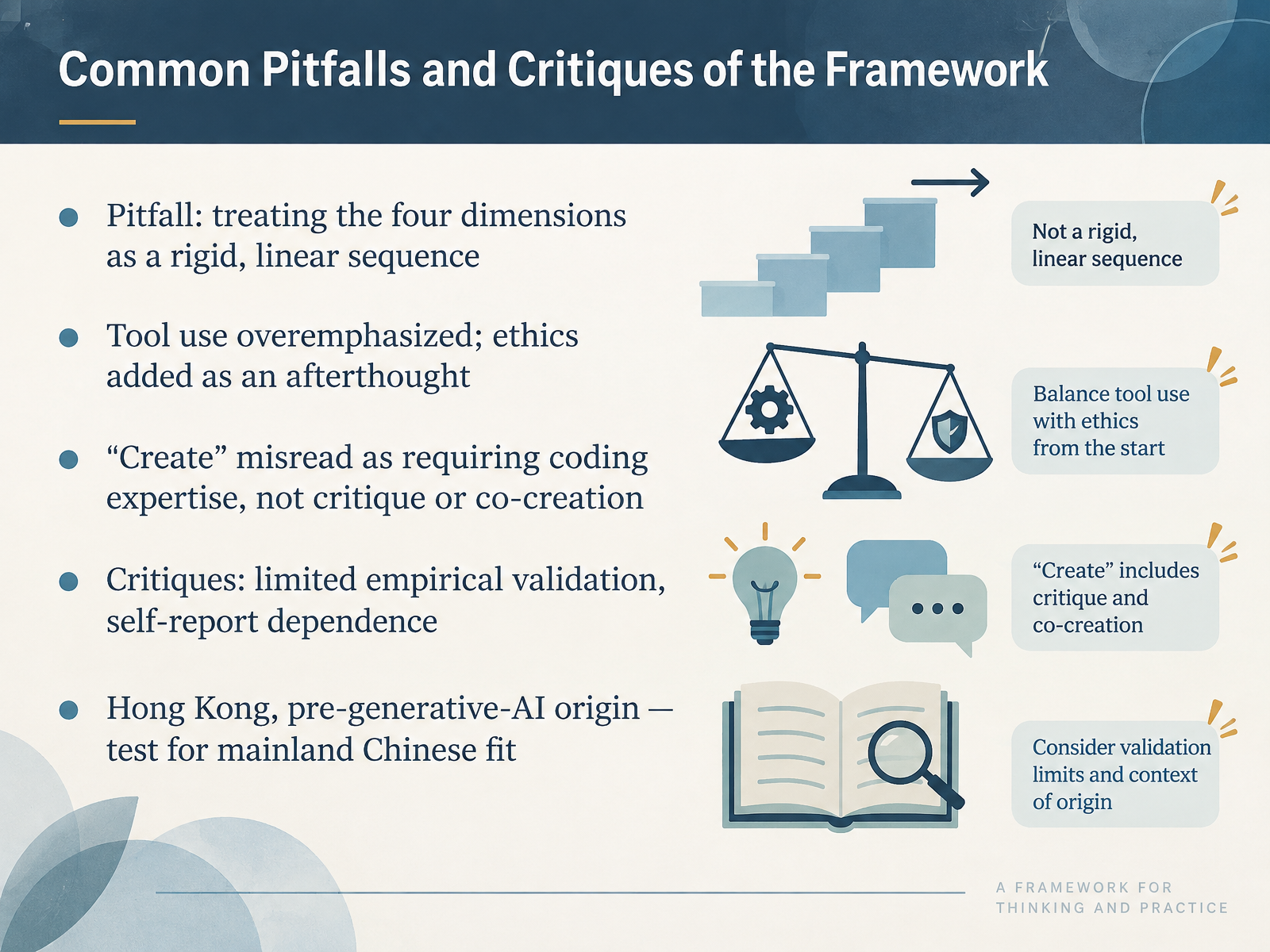
- 12Common Pitfalls and Critiques of the FrameworkLet's turn now to common pitfalls and critiques of the framework. Knowing these helps your program avoid them early. First, a pitfall: treating the four dimensions as a rigid, linear sequence. In practice, learners move back and forth. A student discussing fairness in a chatbot is already engaging ethics while using a tool. Second, tool use is often overemphasized, with ethics added as an afterthought. Build ethical questions into every task, not just the final module. Third, create is sometimes misread as requiring coding expertise. In Ng's framework, create also means critical evaluation and co-creation, such as critiquing an AI output or redesigning a prompt for a classroom task. As for critiques, the empirical validation remains limited, and many studies rely on self-report measures such as questionnaires. Also remember the framework originated in Hong Kong before generative AI, so we should test its fit for mainland Chinese classrooms and curricula. Treat it as a flexible guide, then, not a fixed checklist. In the next segment, we will apply it directly in a workshop activity mapping a lesson to the four dimensions.
 sciencedirect.combera-journals.onlinelibrary.wiley.comdoi.org2 min
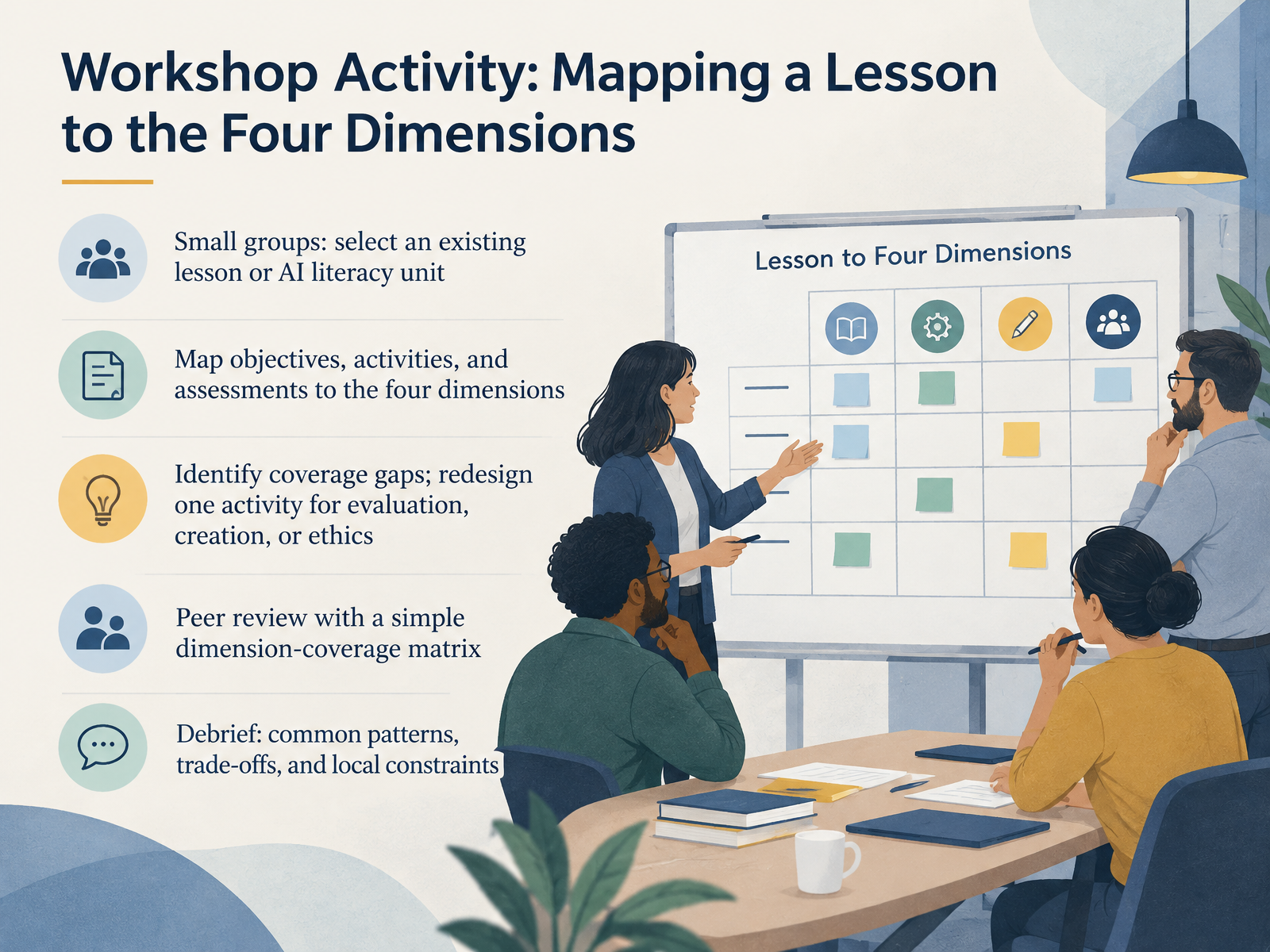
- 13Workshop Activity: Mapping a Lesson to the Four DimensionsNow let's apply what we have discussed. In small groups, select an existing lesson or AI literacy unit, ideally one your own program already uses. First, map its objectives, activities, and assessments to the four dimensions. You may find it helpful to use a simple matrix, with each dimension as a column and lesson elements as rows. Then look for coverage gaps. Most lessons lean heavily on knowledge and use, and touch evaluation or creation only lightly. So ask each group to redesign one activity to strengthen evaluation, creation, or ethics. For example, turn a summary task into a source-checking task where students verify AI claims. Next, run a short peer review using the dimension-coverage matrix, and note evidence for each rating. Close with a debrief on common patterns, trade-offs, and local constraints such as time, access, and policy. Next, we turn to self-assessment, professional learning, and action planning.
 libguides.csu.edu.auucalgary.caunimelb.edu.au+22 min
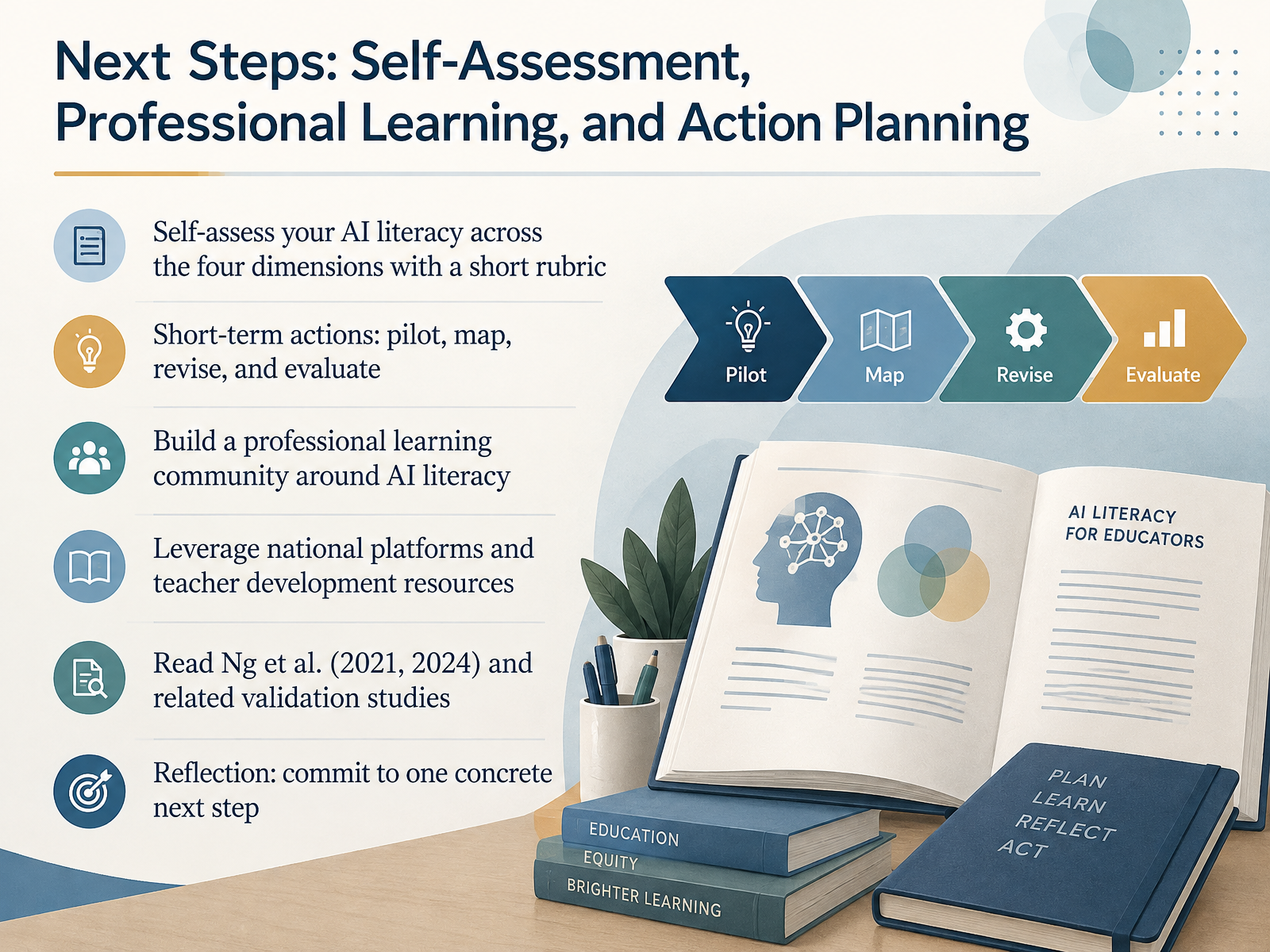
- 14Next Steps: Self-Assessment, Professional Learning, and Action PlanningBefore we close, let's turn this framework into a plan you can actually use. Start with a short self-assessment rubric across the four dimensions. Ask yourself one honest question per dimension, and note where you are strong and where you are not. Then plan short-term actions: pilot one lesson, map it to the four dimensions, revise it, and evaluate what changed. Next, build a professional learning community around AI literacy. Share tested prompts, lesson ideas, and ethical dilemmas with colleagues. Also use national platforms and teacher development resources, such as structured training and diagnostic tools. For deeper grounding, read Ng and colleagues from 2021 and 2024, plus related validation studies. Finally, take a moment to reflect, and commit to one concrete next step this month. Thank you for joining this course. You now have a shared language for AI literacy, and the confidence to begin. Start small, stay curious, and keep learning together.
 sciencedirect.comdoi.orgray.yorksj.ac.uk+21 min
Take the deck with you
Download this course as a file — free, no sign-up needed.
- PDF handoutEvery slide page, ready to print or share.15 pages · 4.0 MBDownload
- Narrated PowerPointThe deck that presents itself — every slide carries the digital human's narration video.15 pages · 14.6 MBDownload
- PowerPoint slidesThe full deck as a .pptx — open it in PowerPoint, Keynote, or Google Slides.15 pages · 4.0 MBDownload
Free to use in your own training — please keep the PersonWise credit page at the end.
Have your own deck? Turn it into a course
Sources consulted
Web sources consulted while building this course.
- Conceptualizing AI literacy: An exploratory review — sciencedirect.com
- AI Literacy and Gen-AI Literacy Frameworks — doi.org
- Factors affecting university students’ generative AI literacy: Evidence and evaluation in the UK and Hong Kong contexts — ray.yorksj.ac.uk
- Design and validation of the <fc>AI</fc> literacy questionnaire: The affective, behavioural, cognitive and ethical approach - Ng - 2024 - British Journal of Educational Technology - Wiley Online Library — bera-journals.onlinelibrary.wiley.com
- Integrating Generative AI into Undergraduate and Postgraduate Curricula: an interactive workshop — doi.org
- 教育部等五部门关于印发《“人工智能+教育”行动计划》的通知_国务院部门文件_中国政府网 — gov.cn
- 教育部办公厅关于组织实施数字化赋能教师发展行动的通知 - 中华人民共和国教育部政府门户网站 — moe.gov.cn
- China aims to build an AI literacy system — english.gov.cn
- 权威解读“2+1”方案!广东省推进中小学人工智能教育新闻发布会举行_广东省教育厅网站 — edu.gd.gov.cn
- 人工智能赋能教师发展现场会举行 - 中华人民共和国教育部政府门户网站 — moe.gov.cn
- AI Simply Explained for Teachers — educatorstechnology.com
- AI Literacy Foundations | Ignite Sites — ignite-sites.gcu.edu
- AI Foundations — What Every Educator Needs to Know - AI Strategy for Education — dmccreary.github.io
- Getting started with AI in the Classroom — cambridge-community.org.uk
- Explore AI in education | Digital Technologies Hub — digitaltechnologieshub.edu.au
- AI-integrated assessments - Information and Digital Literacies GLO - Library Guides at Charles Sturt University — libguides.csu.edu.au
- AI Literacy and Critical Thinking Self-Assessment Rubric — ucalgary.ca
- Using a checklist to evaluate GenAI outputs — unimelb.edu.au
- Principles for criteria and standards in assessment for gen AI use | Tertiary Education Quality and Standards Agency — teqsa.gov.au
- Critical Evaluation of AI Outputs – Fostering AI Literacy: A Guide for Educators in Higher Education — pressbooks.library.virginia.edu