Digital Marketing Portfolio Development
Begin
14 pages · ~28 min
Digital Marketing Portfolio Development
This training helps aspiring digital marketers build a professional portfolio that showcases their skills and projects to attract employers and clients.
What you’ll learn
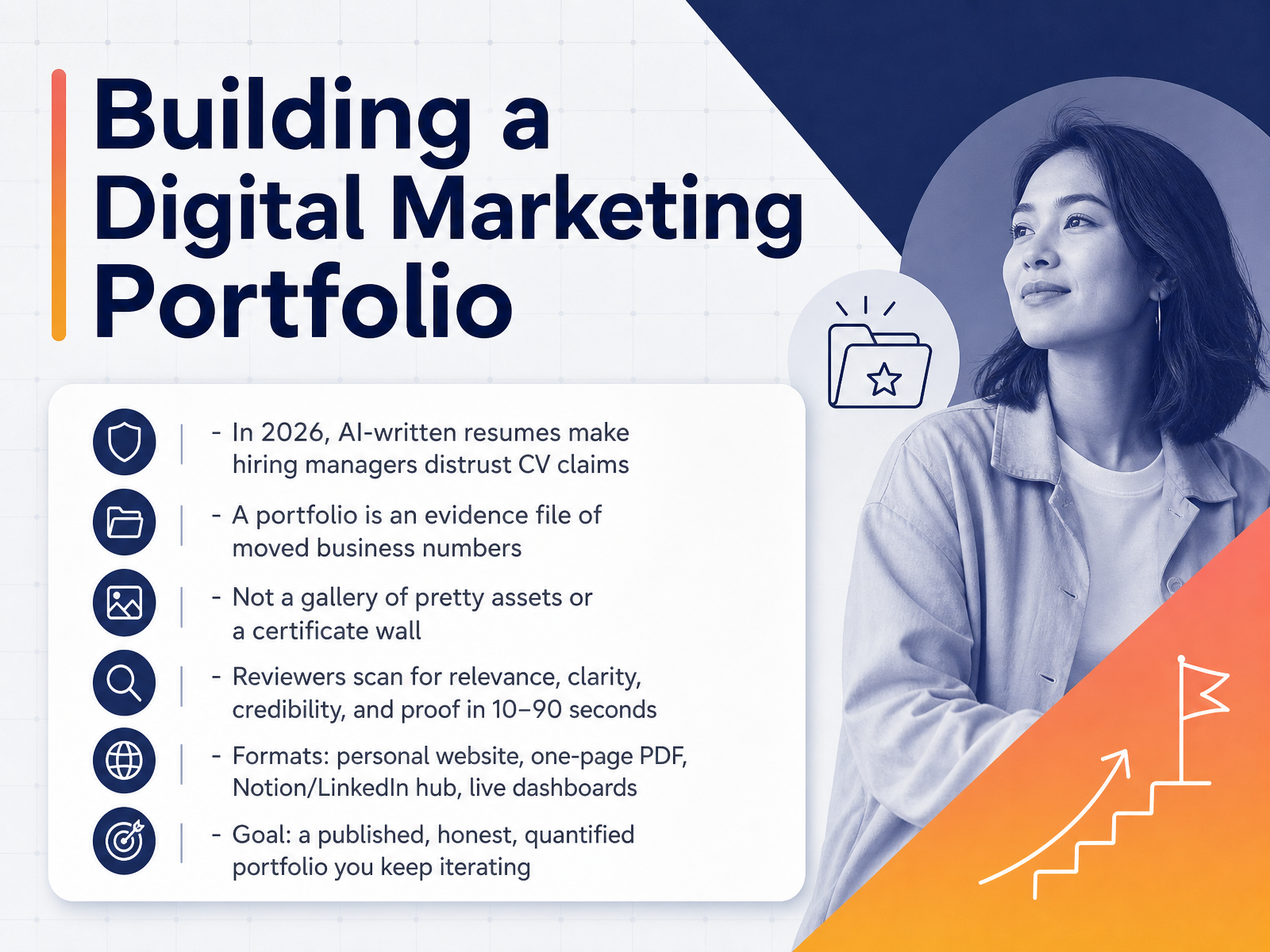
- 01Building a Digital Marketing PortfolioWelcome. I am glad you are here. This course is called Building a Digital Marketing Portfolio, and our goal is simple. By the end, you will have a published, honest, quantified portfolio that shows real evidence of your marketing skills. Let us start with why this matters in 2026. Hiring managers now see so many AI-written resumes that they distrust claims on a CV. A resume says you increased engagement. A portfolio shows the actual numbers. So think of a portfolio as an evidence file of moved business numbers, not a gallery of pretty assets or a wall of certificates. When reviewers open it, they scan for four things: relevance, clarity, credibility, and proof. And they decide in about ten to ninety seconds. That means your format needs to be easy to scan. You can use a personal website, a one-page PDF, a Notion or LinkedIn hub, or live dashboards. Pick the one you can maintain. Your goal is to publish it, keep it honest, quantify your results, and iterate as you gain experience. Next, we will look at who this portfolio is for: students, career switchers, and freelancers.2 min
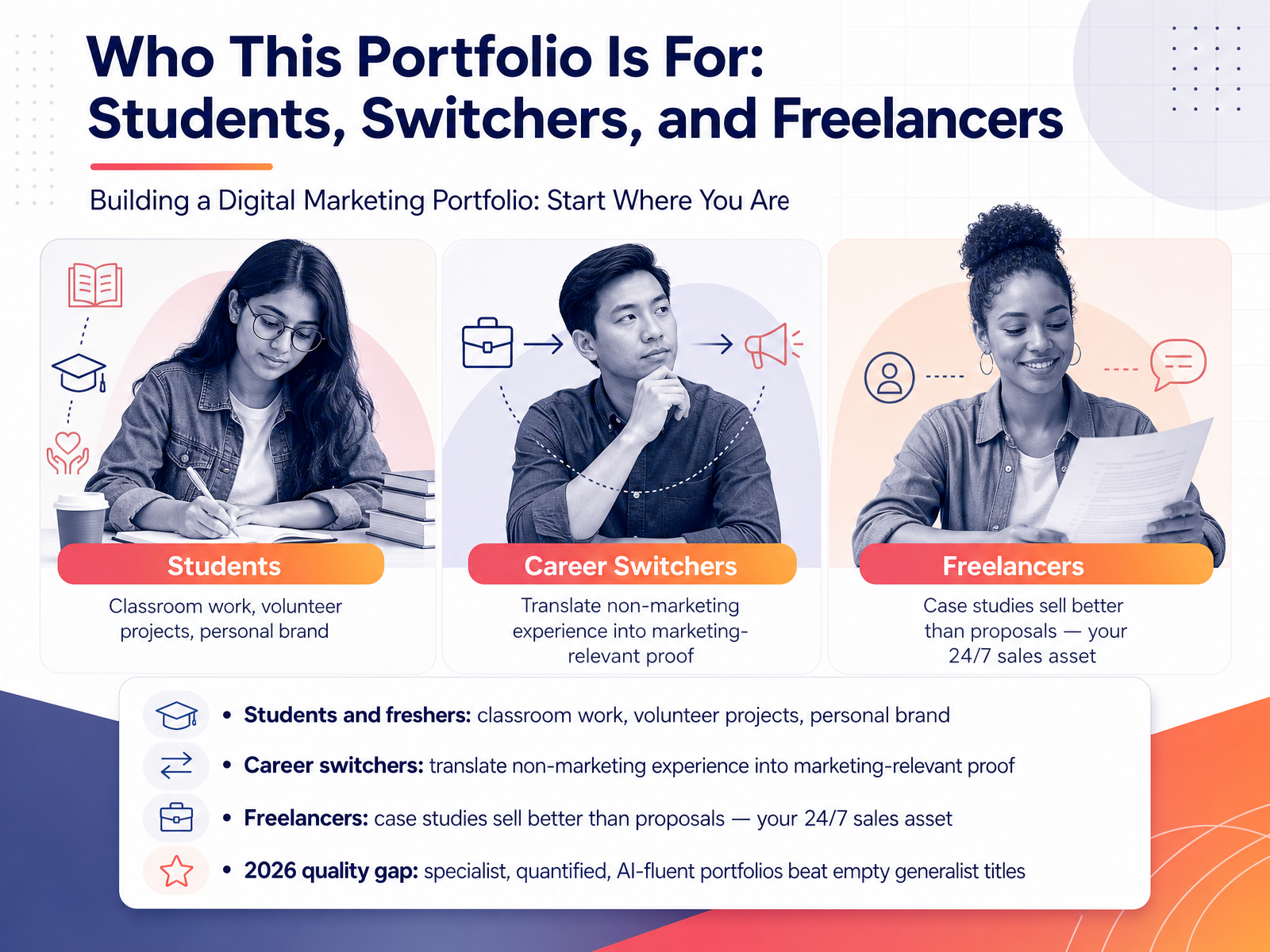
- 02Who This Portfolio Is For: Students, Switchers, and FreelancersNow, let's talk about who this portfolio is actually for. If you're a student or recent graduate, start with what you already have: class projects, volunteer campaigns, and your own personal brand on social media. A simple example is a semester group project where you wrote the Instagram captions and tracked engagement. That counts as real marketing proof. If you're switching careers, your previous work is not wasted. Translate it. A customer service role shows you understand audience pain points. A teaching role shows you can explain complex ideas clearly. For freelancers, case studies sell far better than proposals. Think of a case study as a short story about a client problem, what you did, and the result. It becomes your twenty four seven sales asset, working even while you sleep. And here is the quality gap for twenty twenty six. Hiring managers and clients now expect specialist, quantified, and AI fluent portfolios. Specialist means you focus on one area, like email marketing or paid social. Quantified means you include numbers, such as a fifteen percent increase in click through rate. AI fluent means you show you can use tools like ChatGPT or Canva AI responsibly in your workflow. An empty generalist title like digital marketer will not stand out. Next, let's look at what employers and clients look for in twenty twenty six.
 2 min
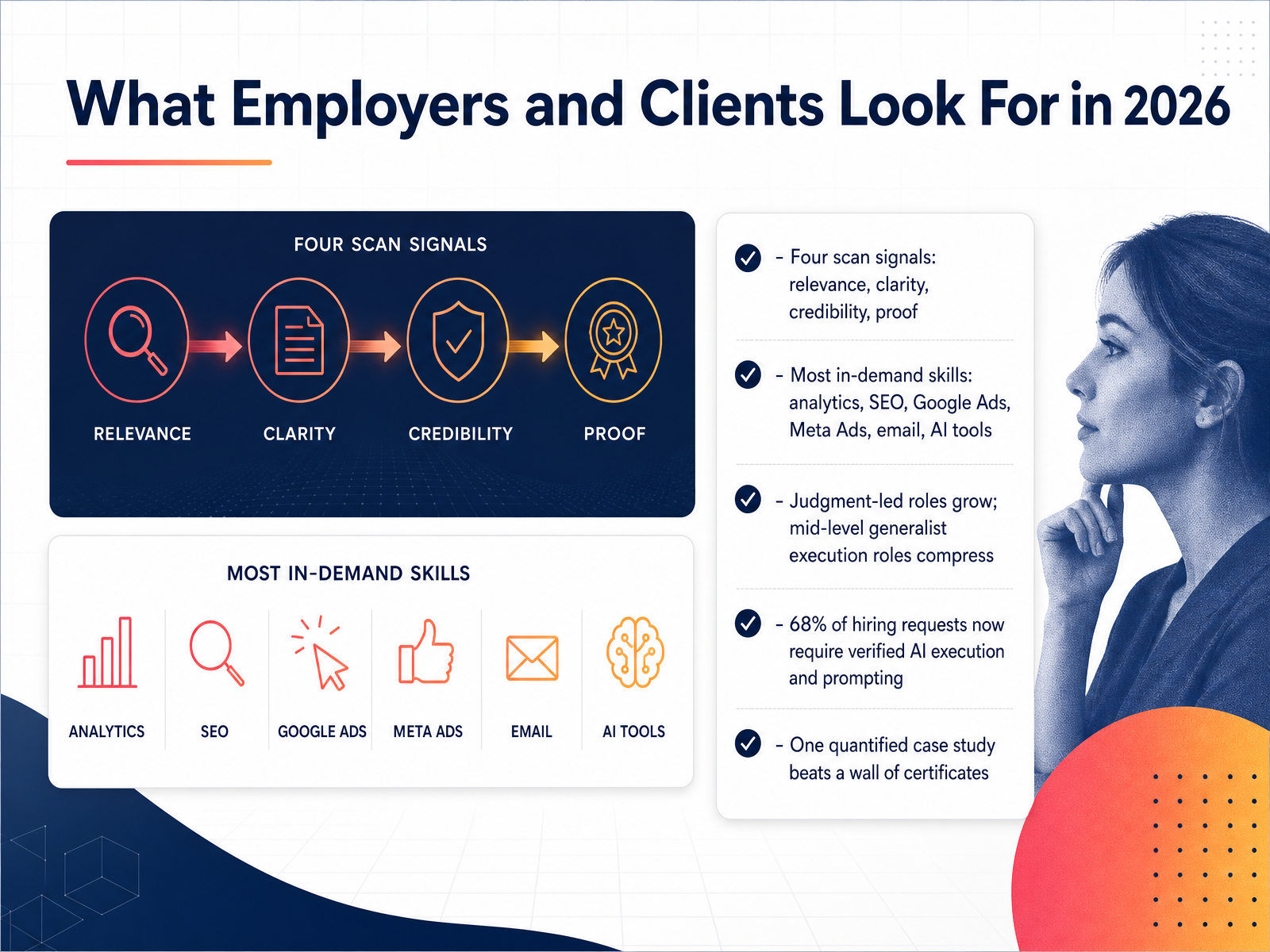
2 min - 03What Employers and Clients Look For in 2026Now let's look at what employers and clients actually look for in 2026. When someone opens your portfolio, they scan for four signals: relevance, clarity, credibility, and proof. Relevance means your work matches the role. Clarity means they understand it in seconds. Credibility means it looks professional. And proof means you can show a real result. So make sure each project hits all four. For example, a class campaign that grew an Instagram account by eight hundred followers shows relevance and proof at once. Next, the skills in demand: analytics, SEO, Google Ads, Meta Ads, email, and AI tools. But the market is shifting. Judgment-led roles are growing, while mid-level generalist execution roles are compressing. In fact, sixty-eight percent of hiring requests now require verified AI execution and prompting. And here is the key takeaway: one quantified case study beats a wall of certificates.
Next, we will cover positioning, choosing what you are known for.
 2 min
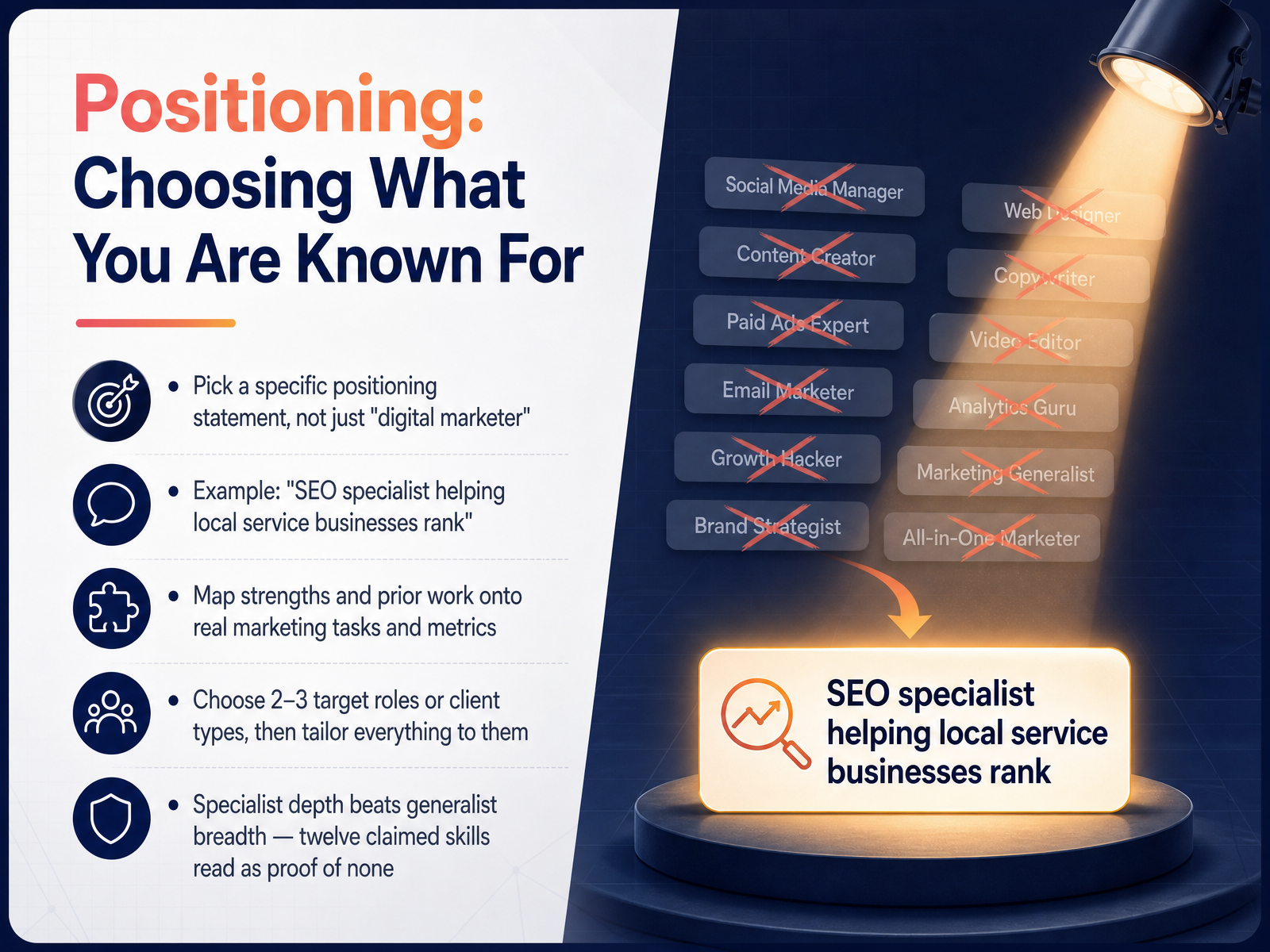
2 min - 04Positioning: Choosing What You Are Known ForLet's talk about positioning. This is where you decide what you want to be known for. Instead of calling yourself a digital marketer, pick a specific positioning statement. For example: an SEO specialist helping local service businesses rank higher in search results. That single sentence tells a hiring manager or client exactly what problem you solve. Next, map your strengths and prior work onto real marketing tasks and metrics. Did you run a class campaign that grew engagement? Did you write blog posts that brought in traffic? Those are portfolio assets. Then choose two or three target roles or client types, and tailor everything to them. Your resume, your samples, your outreach all speak to that same audience. Here is the key: specialist depth beats generalist breadth. Claiming twelve skills on a portfolio often reads as proof of none. So think of it this way. A recruiter spends about seven seconds scanning your profile. A clear position makes you memorable. A long list makes you forgettable.
Now, let's move on to the skills and tools your portfolio must prove.
 1 min
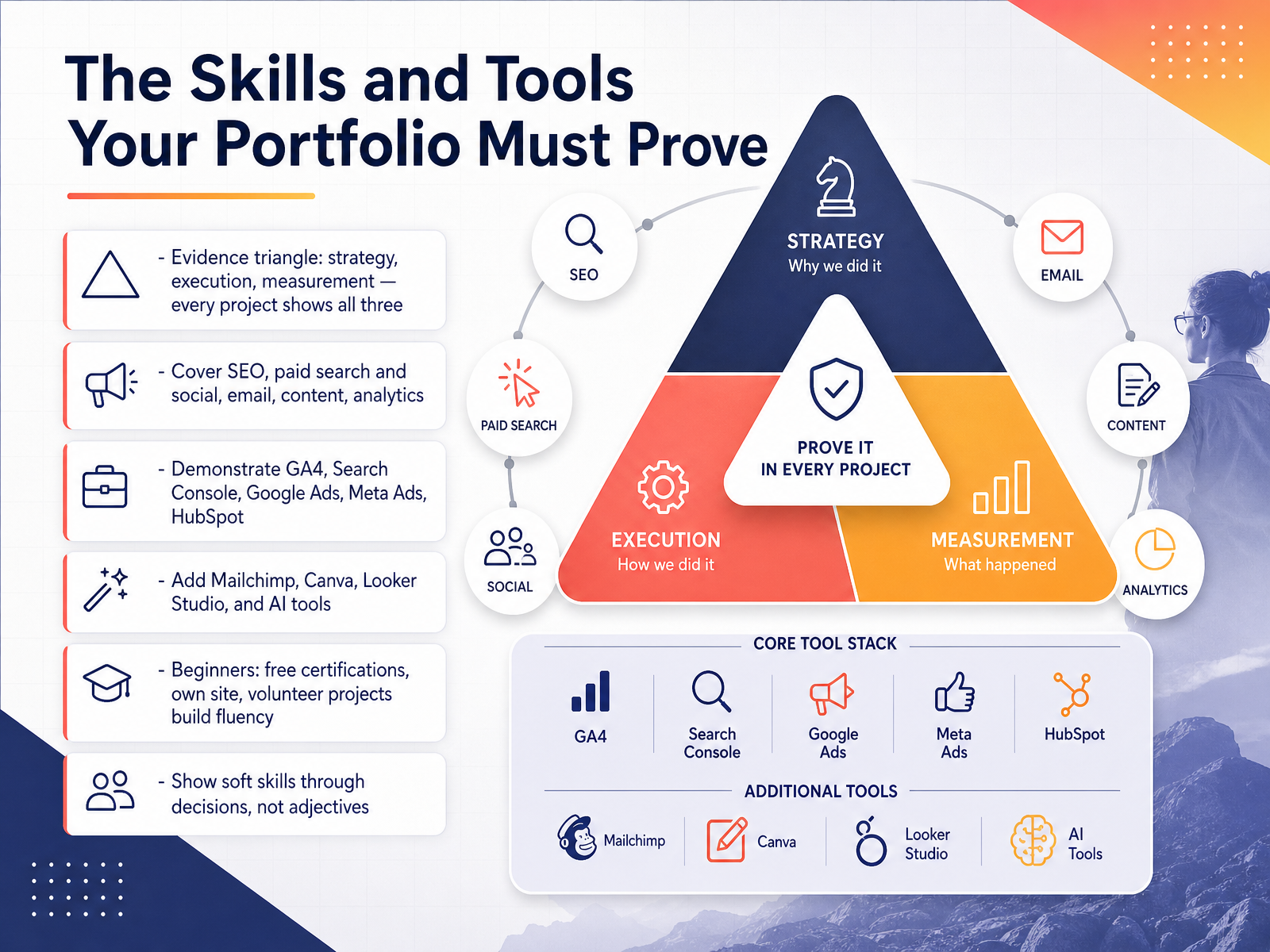
1 min - 05The Skills and Tools Your Portfolio Must ProveSo, what should your portfolio actually prove? Think of it as an evidence triangle: strategy, execution, and measurement. Every strong project shows all three. Strategy means you knew the goal and audience. Execution means you built the thing. Measurement means you checked the results.
Show range across SEO, which is search engine optimization, paid search and social, email, content, and analytics. Name the tools precisely: GA4, Search Console, Google Ads, Meta Ads, and HubSpot. Then add Mailchimp, Canva, Looker Studio, and AI tools.
If you are a beginner, do not wait for a job. Free certifications, your own website, and volunteer projects build real fluency. A student can redesign a local cafe's email welcome series and track open rates.
Finally, show soft skills through decisions, not adjectives. Instead of saying you are organized, explain how you prioritized tasks when a campaign deadline moved. That is what a hiring manager remembers. Next, let us look at getting portfolio-ready experience without a job.
 2 min
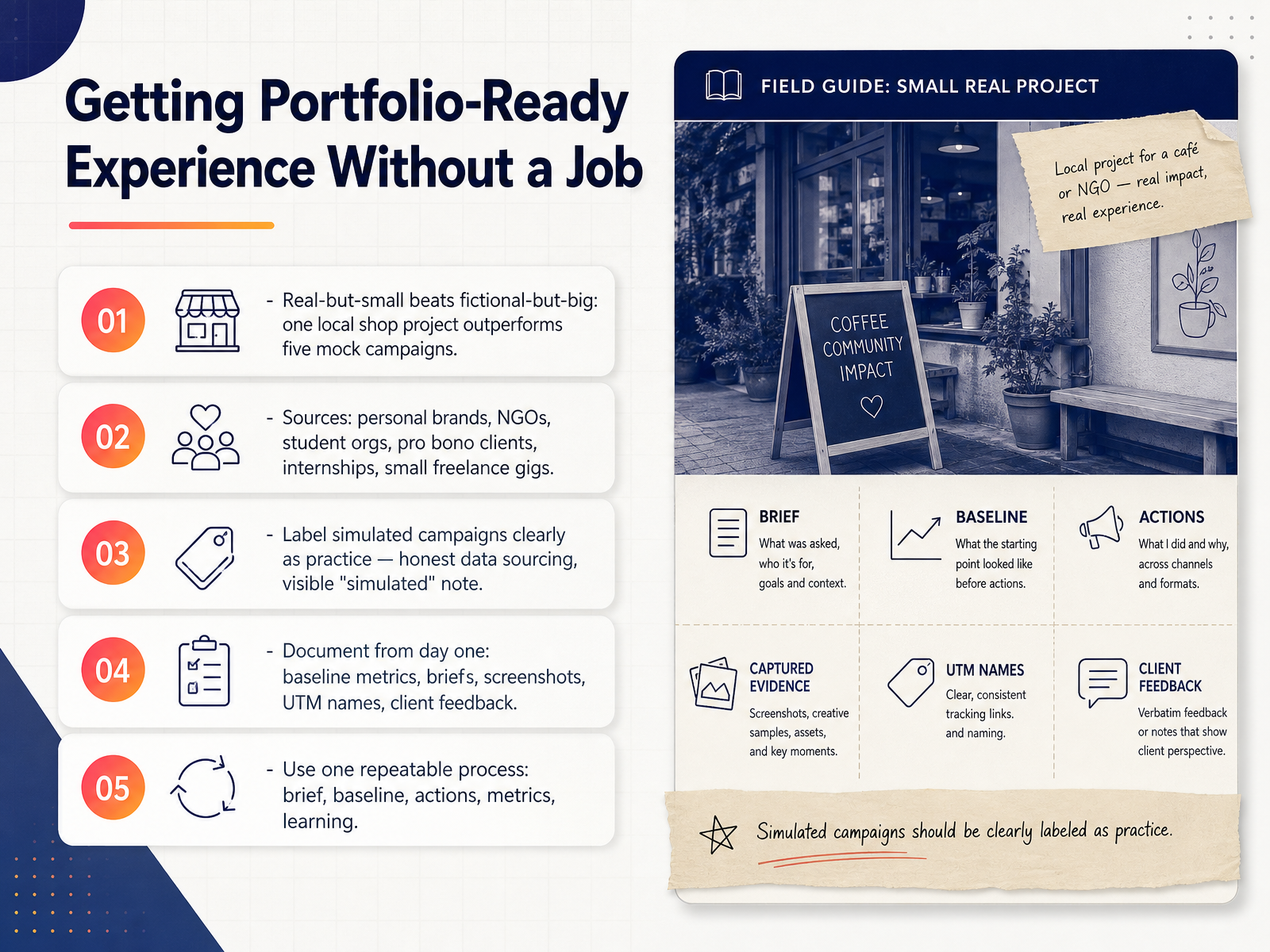
2 min - 06Getting Portfolio-Ready Experience Without a JobNow let's talk about getting portfolio-ready experience without a full-time job. Here's the core principle. Real but small beats fictional but big. One project with a local shop will outperform five mock campaigns in a hiring manager's eyes, because it shows you can work with real constraints, real feedback, and real results. So where do you find these projects? Personal brands, nonprofits, student organizations, pro bono clients, internships, and small freelance gigs. Pick one that fits your schedule. Now, an important note on honesty. If you do create a simulated campaign for practice, label it clearly. Add a visible simulated note, and source your data transparently. Reviewers respect that. From day one, document everything. Baseline metrics before you start. Creative briefs. Screenshots of ads and posts. UTM names, which are the tags you add to links so you can track where traffic comes from. And any client feedback, even casual messages. Finally, use one repeatable process for every project. Brief, baseline, actions, metrics, learning. That structure makes your work easy to evaluate and shows you think like a marketer. Next, let's look at the anatomy of a case study that converts.
 2 min
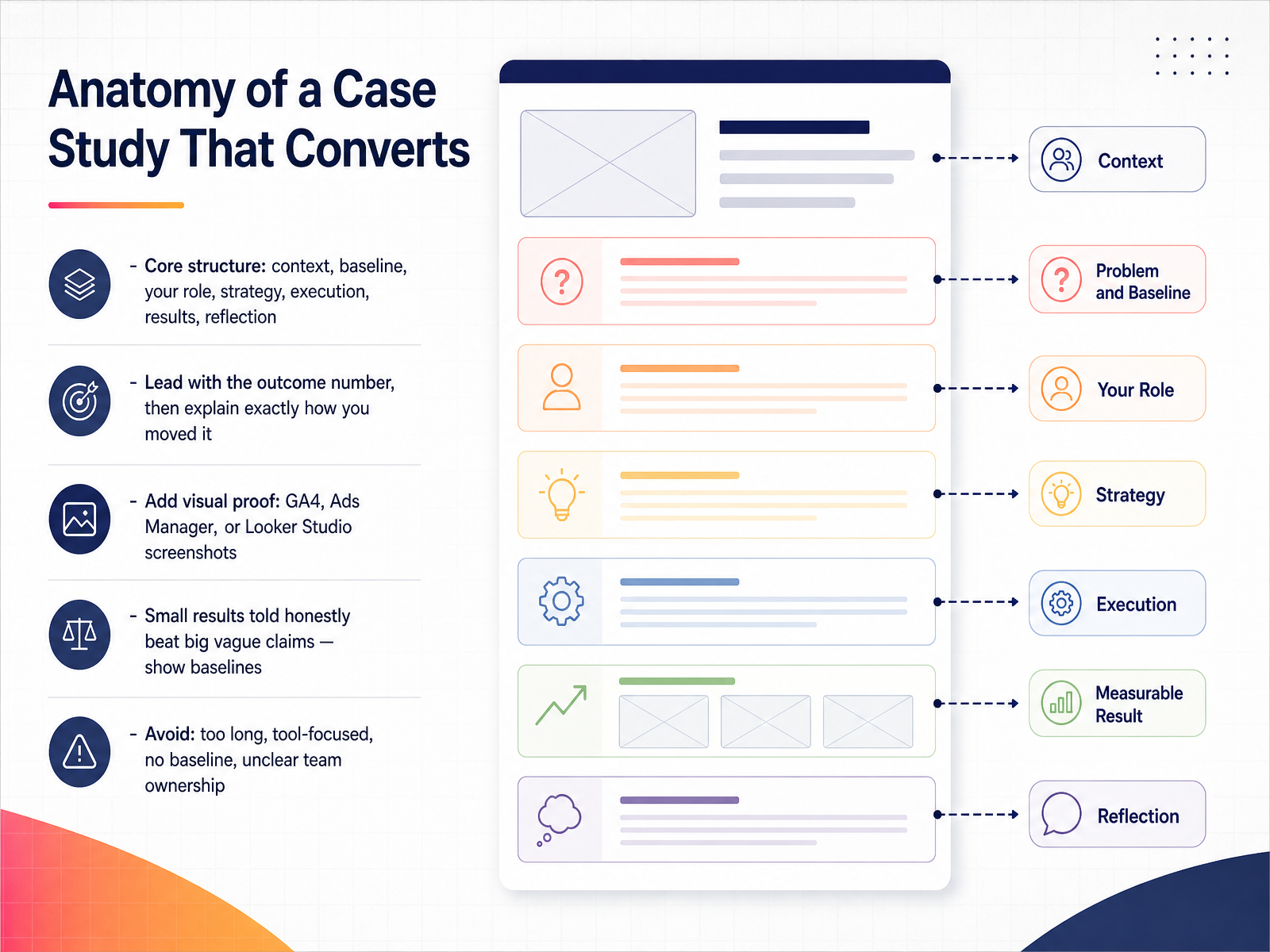
2 min - 07Anatomy of a Case Study That ConvertsNow let's break down the anatomy of a case study that actually converts readers into interview calls. The core structure is context, baseline, your role, strategy, execution, results, and a short reflection. Start with your outcome number, then explain exactly how you moved it. For example, open with organic traffic up forty two percent. Then show the baseline: where traffic started before you touched anything. Next, state your role clearly. Were you the sole strategist, or did you own one channel on a team of five? That distinction matters in a hiring conversation. Add visual proof, like screenshots from Google Analytics four, Ads Manager, or Looker Studio. Small results told honestly beat big vague claims every time. So avoid case studies that run too long, focus only on tools, skip the baseline, or blur who owned what. Those gaps make reviewers question your credibility. Keep it tight, specific, and honest. Coming up next, writing the case study page and your portfolio copy.
 2 min
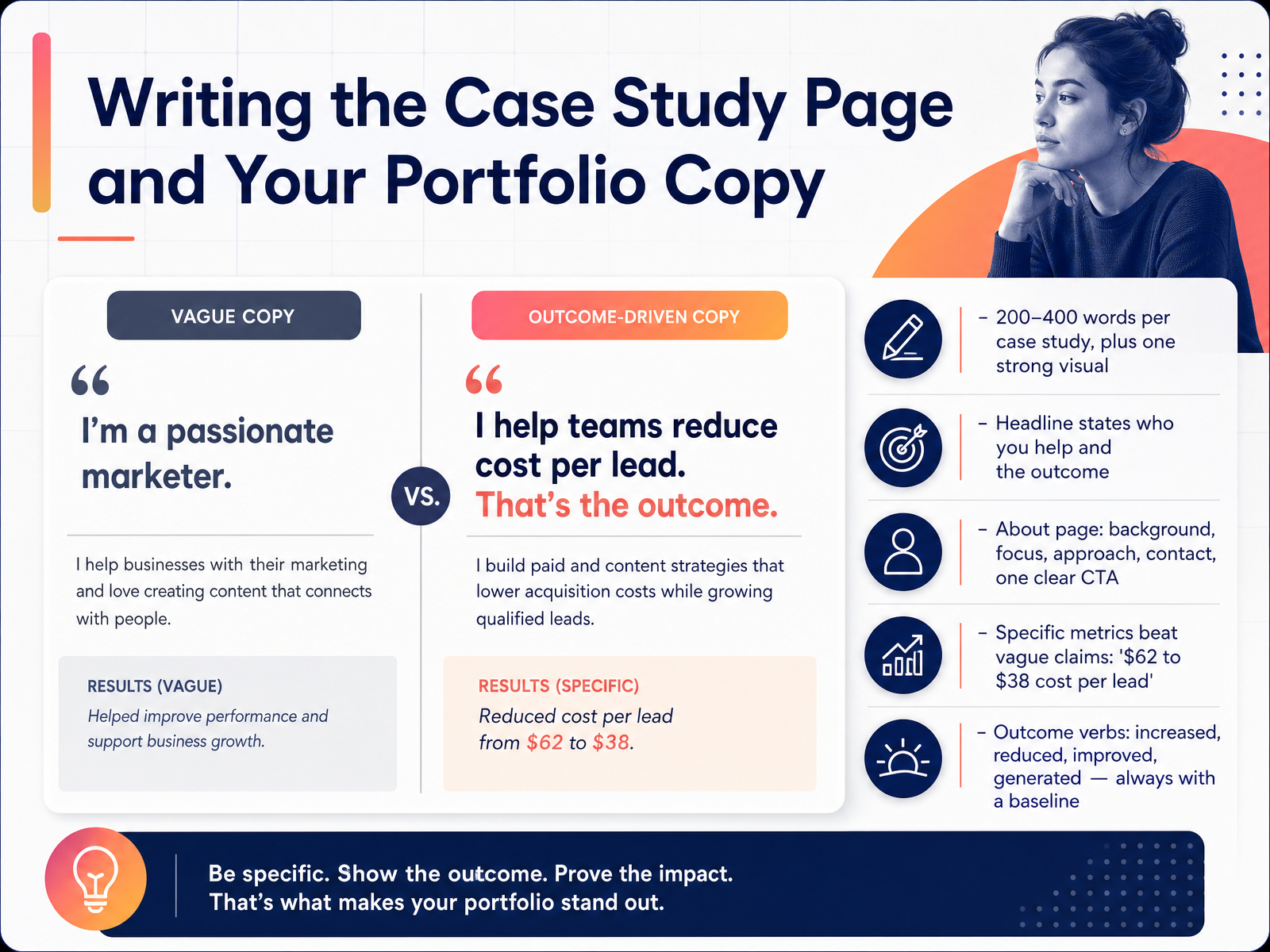
2 min - 08Writing the Case Study Page and Your Portfolio CopyNow let's focus on the words themselves. Your case study is a short story of a problem you solved, so aim for two hundred to four hundred words per project, plus one strong visual like a before-and-after screenshot or a simple results chart. Start with a headline that states who you help and the outcome. For example, 'Helping a local bakery turn Instagram followers into paying customers.' Then write your About page with four parts. Your background, your focus, your approach, and a contact link with one clear call to action, like 'Book a fifteen minute intro call.' When you describe results, be specific. Instead of saying you improved performance, write 'I reduced cost per lead from sixty two dollars to thirty eight dollars.' Use outcome verbs like increased, reduced, improved, and generated, and always give the baseline so the reader can measure the change. Keep every sentence tight. Your reader is a busy hiring manager or client scanning for proof they can trust. Next, we will look at sanitizing real work without losing the proof.
 2 min
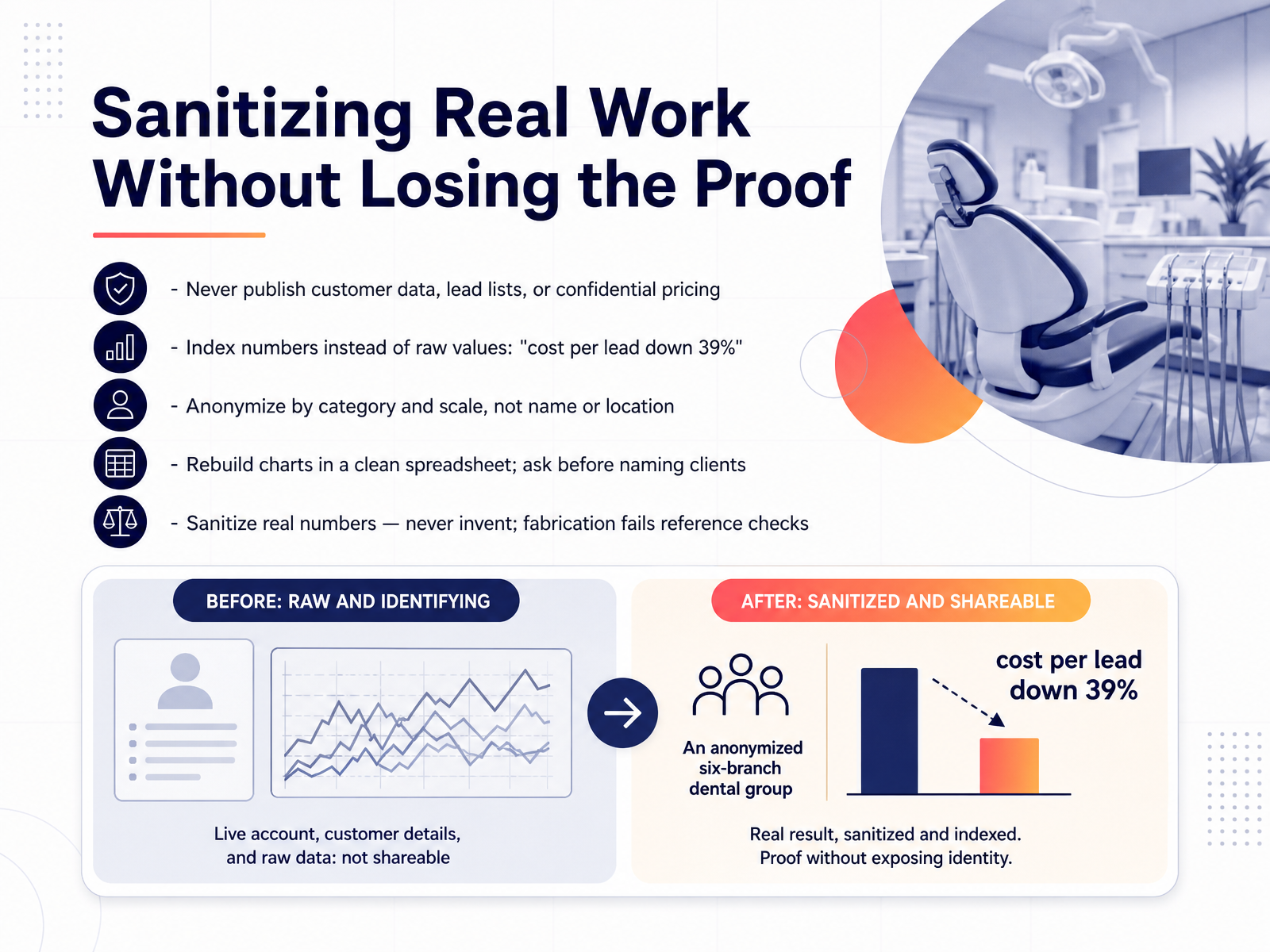
2 min - 09Sanitizing Real Work Without Losing the ProofNow let's talk about sanitizing real work without losing the proof. Your results are your strongest asset, but you cannot publish customer data, lead lists, or confidential pricing. Instead, index your numbers. Say cost per lead dropped thirty nine percent, rather than showing the raw dollar figures. Anonymize by category and scale, not by name or location. So a client becomes a regional home services company with fifty employees. Rebuild your charts in a clean spreadsheet with neutral labels. And always ask before naming a client in your portfolio or on a resume. Most importantly, sanitize real numbers but never invent them. Fabrication fails reference checks and can end an interview instantly. Sanitized truth keeps you credible and safe. Next, let's look at choosing your portfolio platform and format.
 1 min
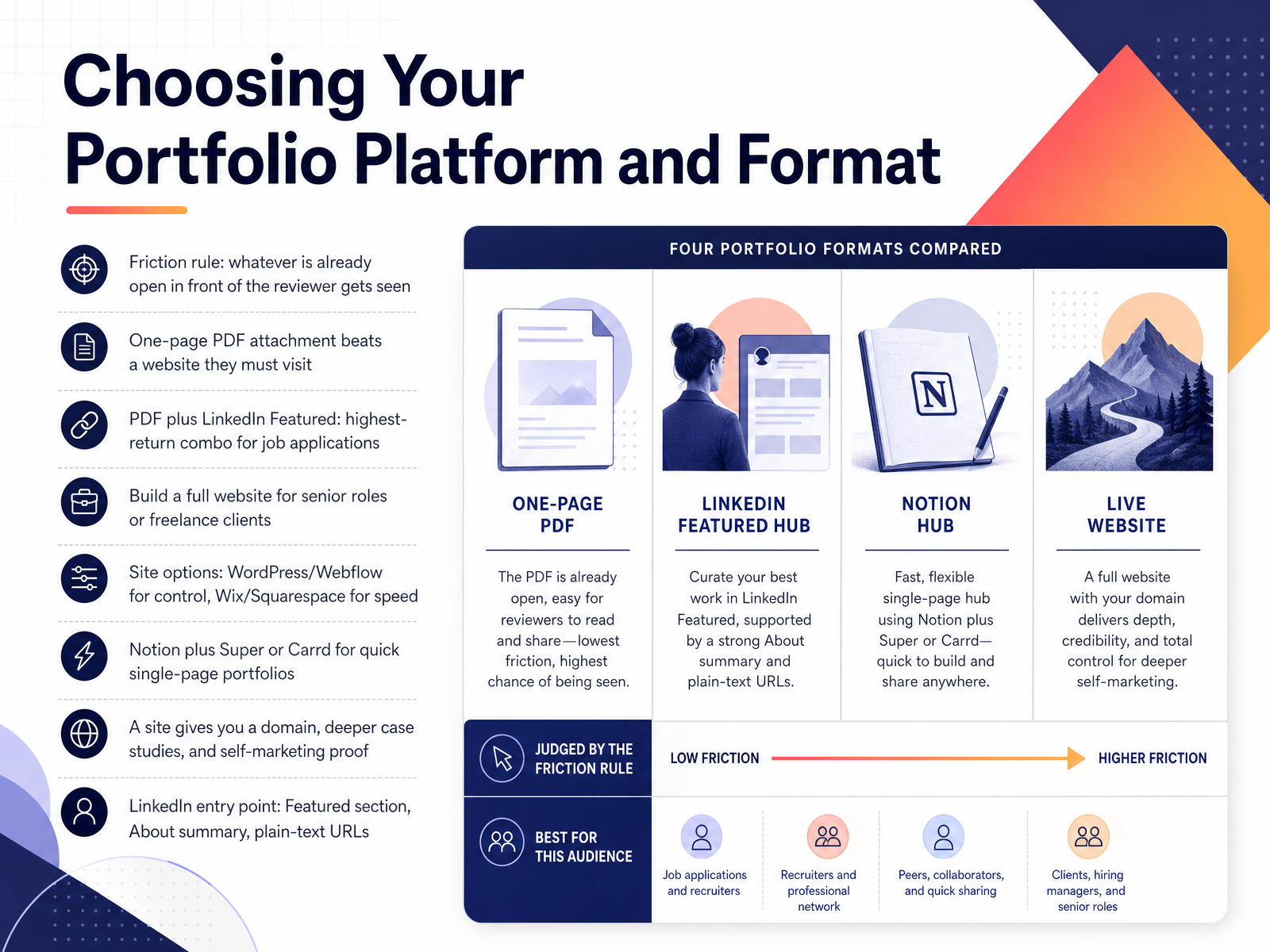
1 min - 10Choosing Your Portfolio Platform and FormatLet's talk about where your portfolio should actually live. Start with the friction rule. Whatever is already open in front of the reviewer gets seen. If a hiring manager has to click a link, wait for a page to load, and hunt for your work, you may lose them. So a one page PDF attachment often beats a website they must visit. For most job applications, the highest return combo is a PDF plus your LinkedIn Featured section. That keeps your work one click away. Build a full website when you are targeting senior roles or freelance clients who expect deeper case studies. For site options, WordPress or Webflow give you control. Wix or Squarespace are faster if you have limited time. For a quick single page portfolio, try Notion plus Super, or Carrd. A site earns you a domain, room for deeper case studies, and proof that you can market yourself. On LinkedIn, use the Featured section, write an About summary, and keep your URLs in plain text so they are easy to copy. Next, we will look at designing for clarity, credibility, and access.
 2 min
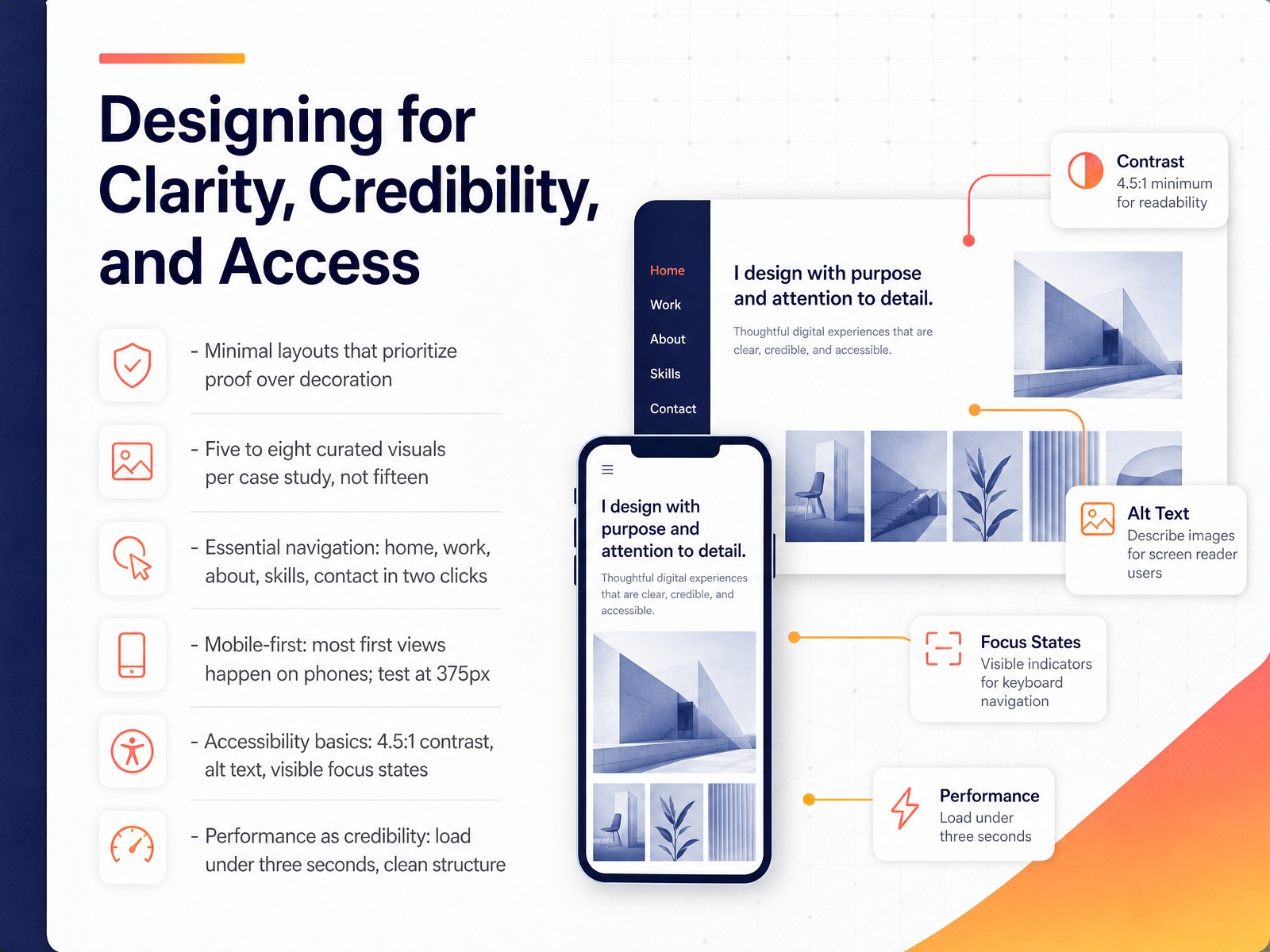
2 min - 11Designing for Clarity, Credibility, and AccessNow let's talk about design. Specifically, clarity, credibility, and access. Your portfolio's job is to make a hiring manager trust your judgment fast. So start with minimal layouts that prioritize proof over decoration. Think of a case study page where the campaign image and results sit front and center, not buried under animations or a busy background. Next, curation. Show five to eight visuals per case study, not fifteen. If you built a social campaign in a class project, pick the strongest six posts and the one results chart that proves engagement. More images do not equal more skill. Then, navigation. A recruiter should reach home, work, about, skills, and contact within two clicks. That is the standard structure they expect. Design mobile first, because most first views happen on phones. Test at three hundred seventy five pixels wide and check that nothing breaks. Accessibility basics matter too. Keep a contrast ratio of four point five to one, write alt text for images, and make focus states visible so keyboard users can navigate. Finally, treat performance as credibility. Aim to load under three seconds. A clean, fast site signals that you respect your visitor's time. Spend one hour checking these items before you share your link. Next, we'll look at launching, sharing, and collecting feedback.
 2 min
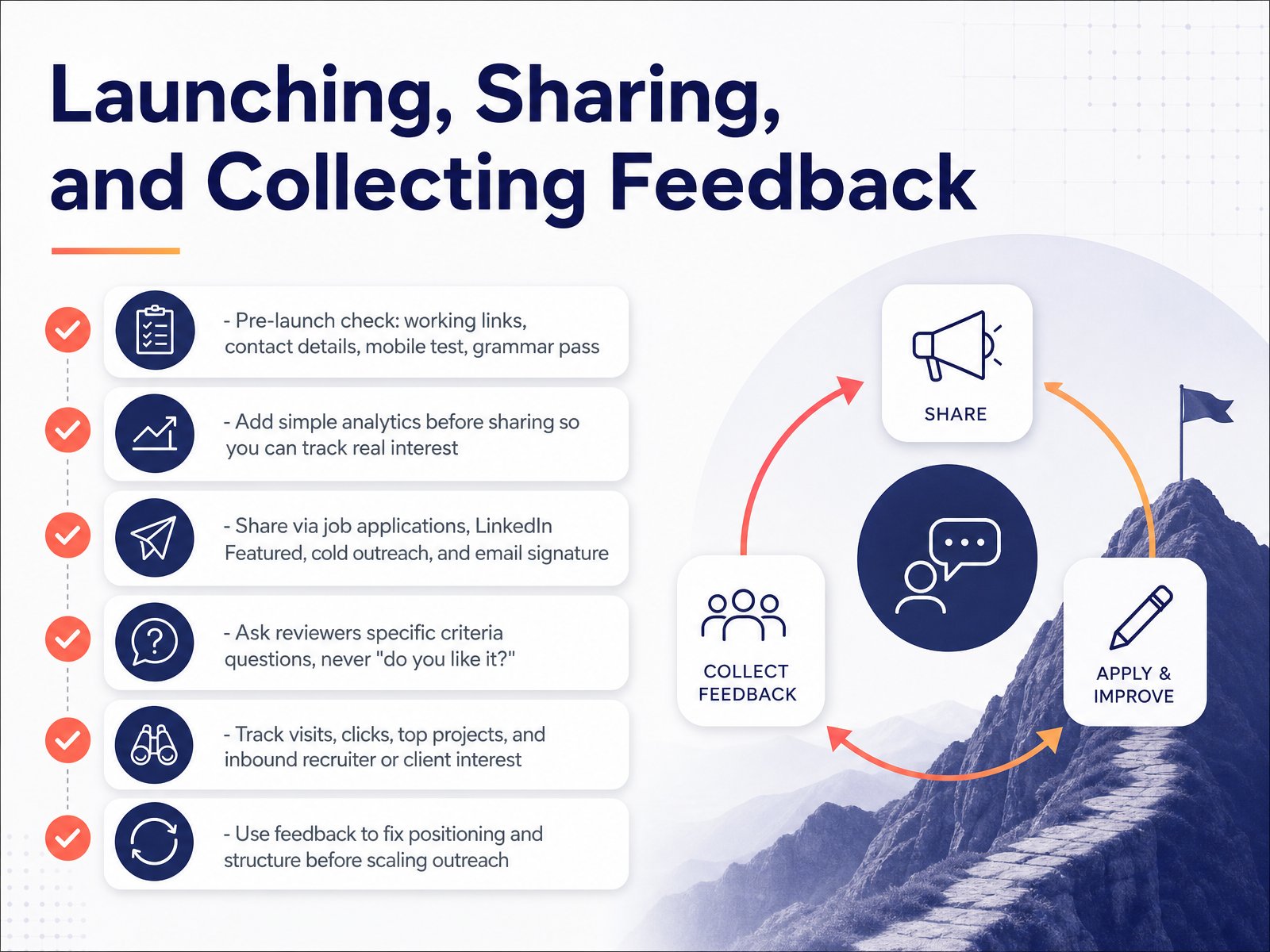
2 min - 12Launching, Sharing, and Collecting FeedbackNow let us get your portfolio in front of real people. Before you share it, run a quick pre launch check. Click every link. Confirm your email and contact details. Open it on your phone, since many recruiters will. Then do one grammar pass. Next, add simple analytics before sharing, so you can track real interest. A free tool like Google Analytics works. Share through job applications, your LinkedIn Featured section, cold outreach, and your email signature. When you ask for feedback, use specific criteria questions, not, do you like it? Try asking, is the value clear in five seconds? Or, which project best shows social media skills? Then track visits, clicks, top projects, and any inbound recruiter or client interest. Use that feedback to fix your positioning and structure before scaling your outreach. That way, you improve the portfolio before more people see it. Next, we will look at tailoring your portfolio for different roles and clients.
 1 min
1 min - 13Tailoring Your Portfolio for Different Roles and ClientsNow let's talk about tailoring your portfolio for different roles and clients. Build one master portfolio first. That's your single source of truth. Then create a tailored view for each application. Think of it like a saved filter you can adjust in minutes. Reorder your case studies. Swap the headline. Lead with the metrics that match the role you want. If the job description says GA4, that's Google Analytics four, and it's true for you, use that exact term. Same with SEO, Meta Ads, or CRM, which stands for customer relationship management. Keep your resume and portfolio telling one story, with identical project names. If your resume says Email Campaign Overhaul, your portfolio should not call it Newsletter Rebuild. Then frame results by industry. E-commerce clients care about ROAS, return on ad spend. SaaS teams care about MQLs, marketing qualified leads. Local businesses care about bookings. Finally, add a short AI-use note. State what AI drafted, what you reviewed, and what you changed. That protects your credibility in a client conversation. So choose the version that fits the room you're in, and keep the evidence consistent. Next, let's look at maintaining and growing your portfolio over time.
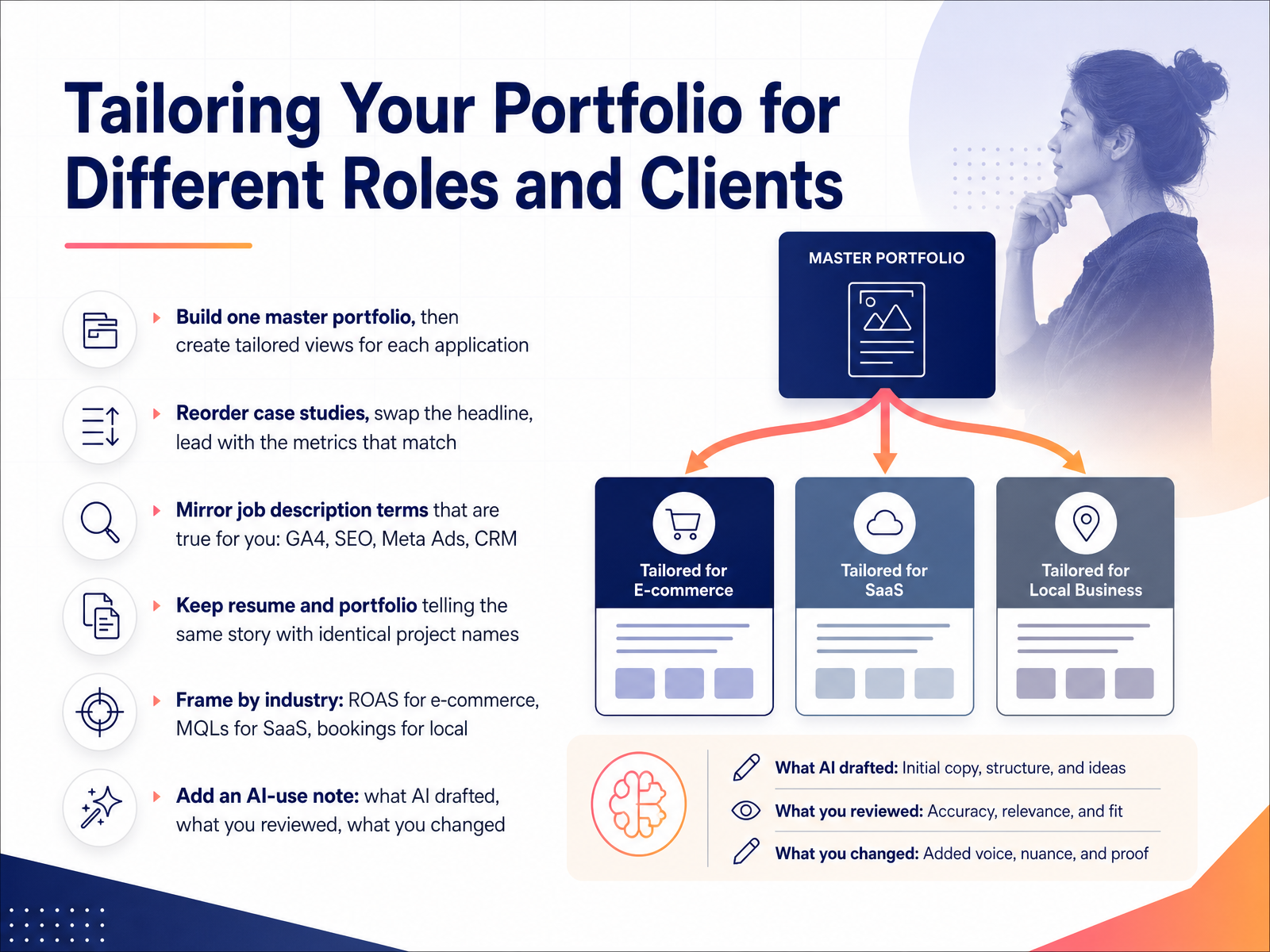 2 min
2 min - 14Maintaining and Growing Your Portfolio Over TimeLet's finish with how to keep your portfolio alive after you build it. First, do a quarterly review. Add new work, retire anything older than two years, and refresh your metrics so your numbers stay current. Second, capture baselines before you start a project, then write the case study while the data is still fresh. For example, note your starting follower count or conversion rate on day one. Third, pair free certifications from Google, HubSpot, or Meta with real project work. The certificate shows initiative, but the project proves you can apply it. Fourth, build a personal brand through LinkedIn activity, published writing, and a simple website that search tools and AI assistants can cite. Finally, track twenty twenty six and twenty twenty seven trends, especially analytics, automation, and AI fluent execution roles. To wrap up this course, remember that your portfolio is never finished. Review it every quarter, document your results as you go, and keep learning in public. You are capable of doing this work, and your next opportunity may come from the very project you start this week. Thank you for your attention, and good luck building your portfolio.
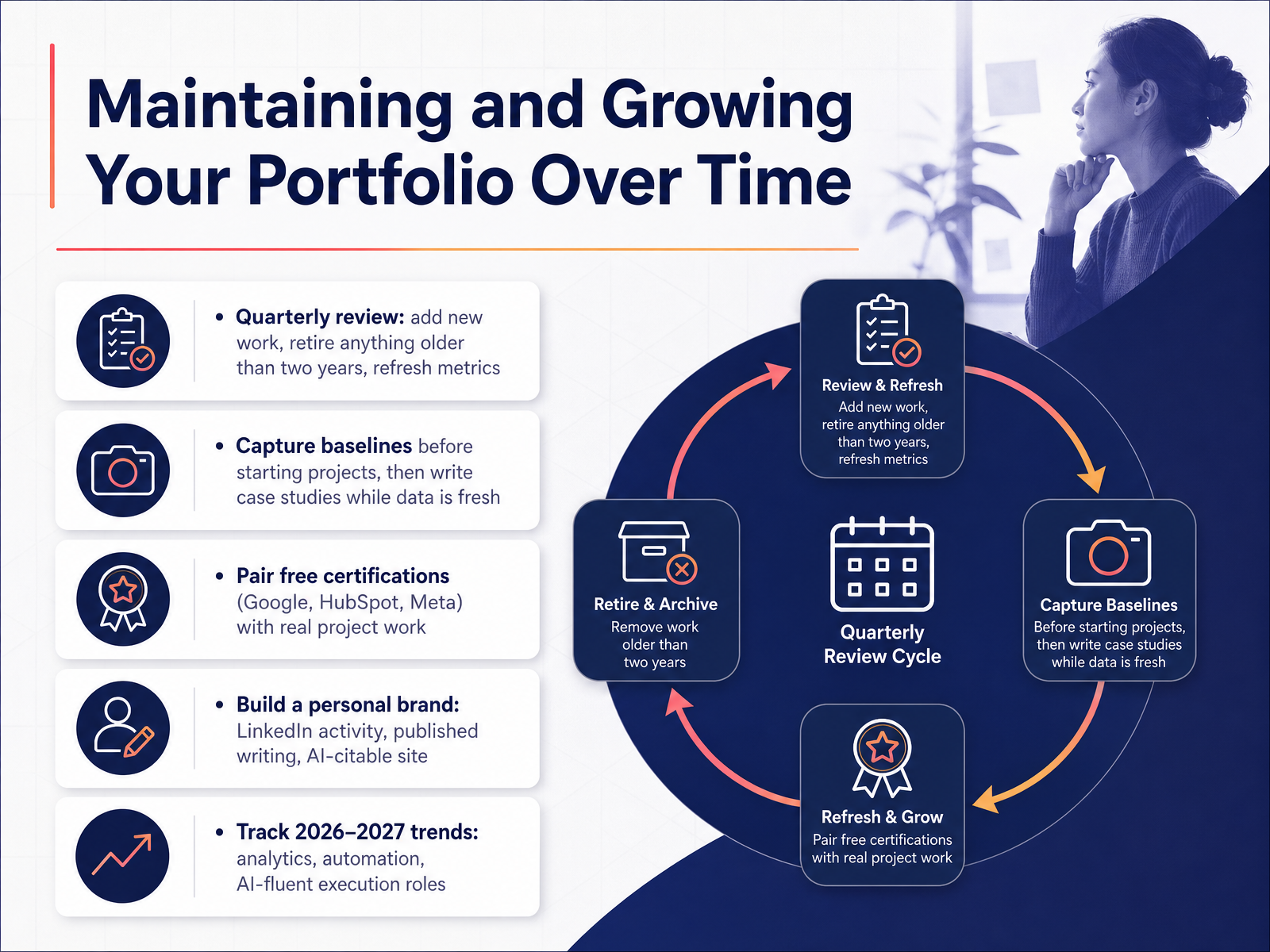 2 min
2 min
Take the deck with you
Download this course as a file — free, no sign-up needed.
- PDF handoutEvery slide page, ready to print or share.15 pages · 3.9 MBDownload
- Narrated PowerPointThe deck that presents itself — every slide carries the digital human's narration video.15 pages · 17.2 MBDownload
- PowerPoint slidesThe full deck as a .pptx — open it in PowerPoint, Keynote, or Google Slides.15 pages · 3.8 MBDownload
Free to use in your own training — please keep the PersonWise credit page at the end.
Have your own deck? Turn it into a course