Begin
14 pages · ~28 min
Narrative Point of View: Who Tells the Story
This training explores narrative point of view, helping writers and storytellers understand how narrative perspective shapes storytelling and why the choice of narrator matters.
A digital instructor presents all 14 pages. Hold “Ask” at any point and ask out loud — the answer comes from this course. No sign-up needed.
What you’ll learn
- 01Narrative Point of View: Who Tells the Story and WhyWelcome. I'm glad you're here. Today we're talking about narrative point of view, or POV. Put simply, it's who tells the story, and why that choice matters.
Here's the key idea. POV is a craft decision, not a label you paste on later. It controls what your reader can access, who they sympathize with, how suspense builds, and what theme comes through.
So ask yourself three questions. Who sees? Who speaks? And what does the narrator know, or deliberately withhold?
Take one simple scene, a character slipping on a wet curb. In first person, you hear, I slipped and ruined my shoes. Close third puts us inside one character's thoughts. Omniscient steps back and sees everyone at once. Same event. Three very different reading experiences.
Across this workshop, we'll explore the narrator spectrum, reliability, psychic distance, common pitfalls, and revision. Our goal is simple. By the end, you'll diagnose your draft's POV and choose it deliberately and consistently.
Next, let's look at the core question: grammar versus narrative stance.eriksimpson.sites.grinnell.eduopenstax.orgliberalarts.oregonstate.edu+22 min
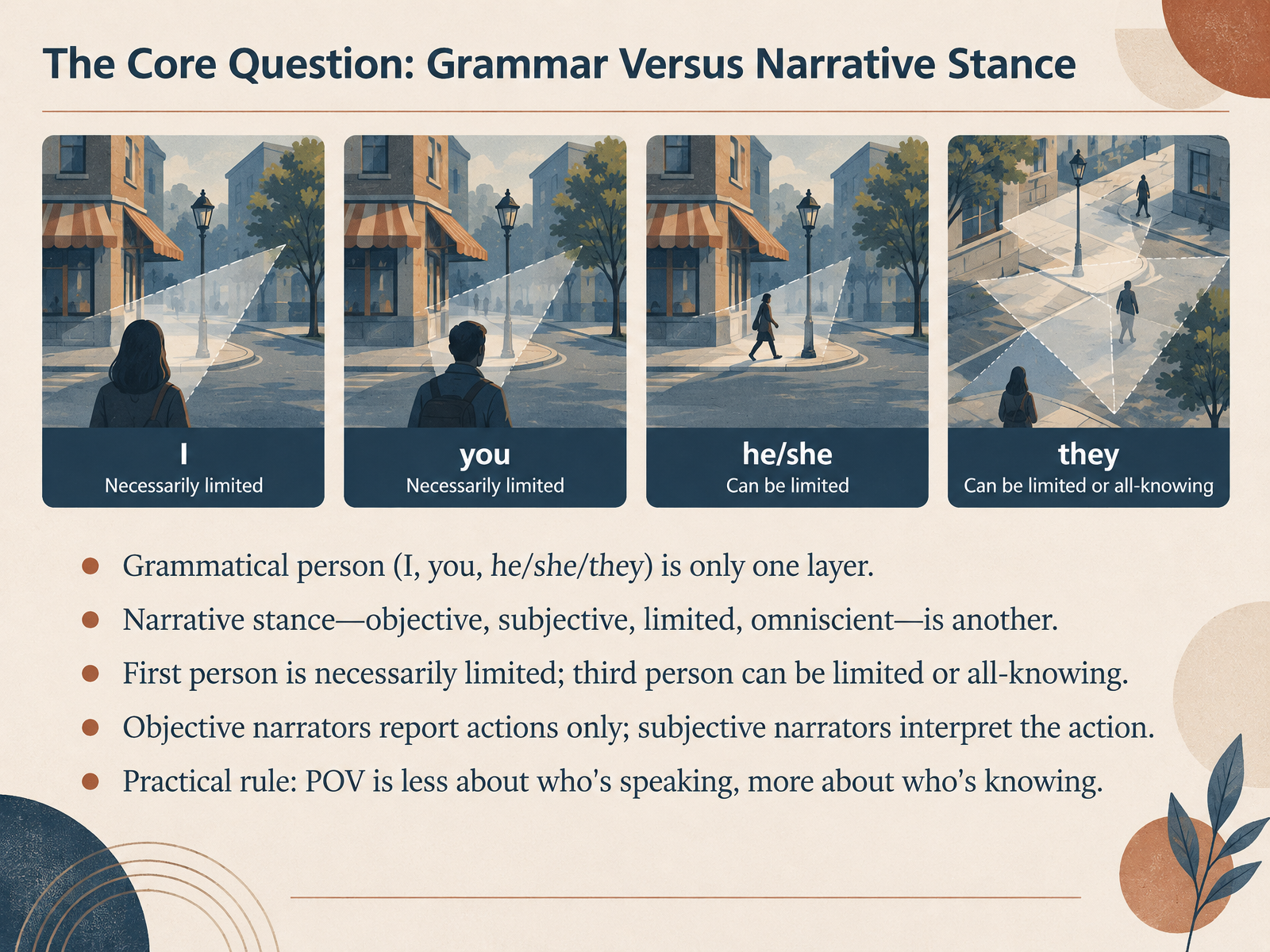
- 02The Core Question: Grammar Versus Narrative StanceLet's clear up a common mix-up. Grammatical person, the I, you, he, she, or they, is only one layer of point of view. Narrative stance is another, and it's the deeper one. Is the telling objective, just reporting action? Or subjective, interpreting it? Is the narrator limited to one mind, or omniscient, knowing everything? Here's the pattern to remember. First person is necessarily limited, because the narrator can only report one mind. Third person can be limited or all-knowing, depending on the stance you choose. So here's your practical rule. Point of view is less about who's speaking, and more about who's knowing. Ask yourself that question about your own draft. Next, let's walk the spectrum from first person to omniscient, and see how that knowing shifts.
 wille.orgsetyourmuseonfire.comstorygrid.com+21 min
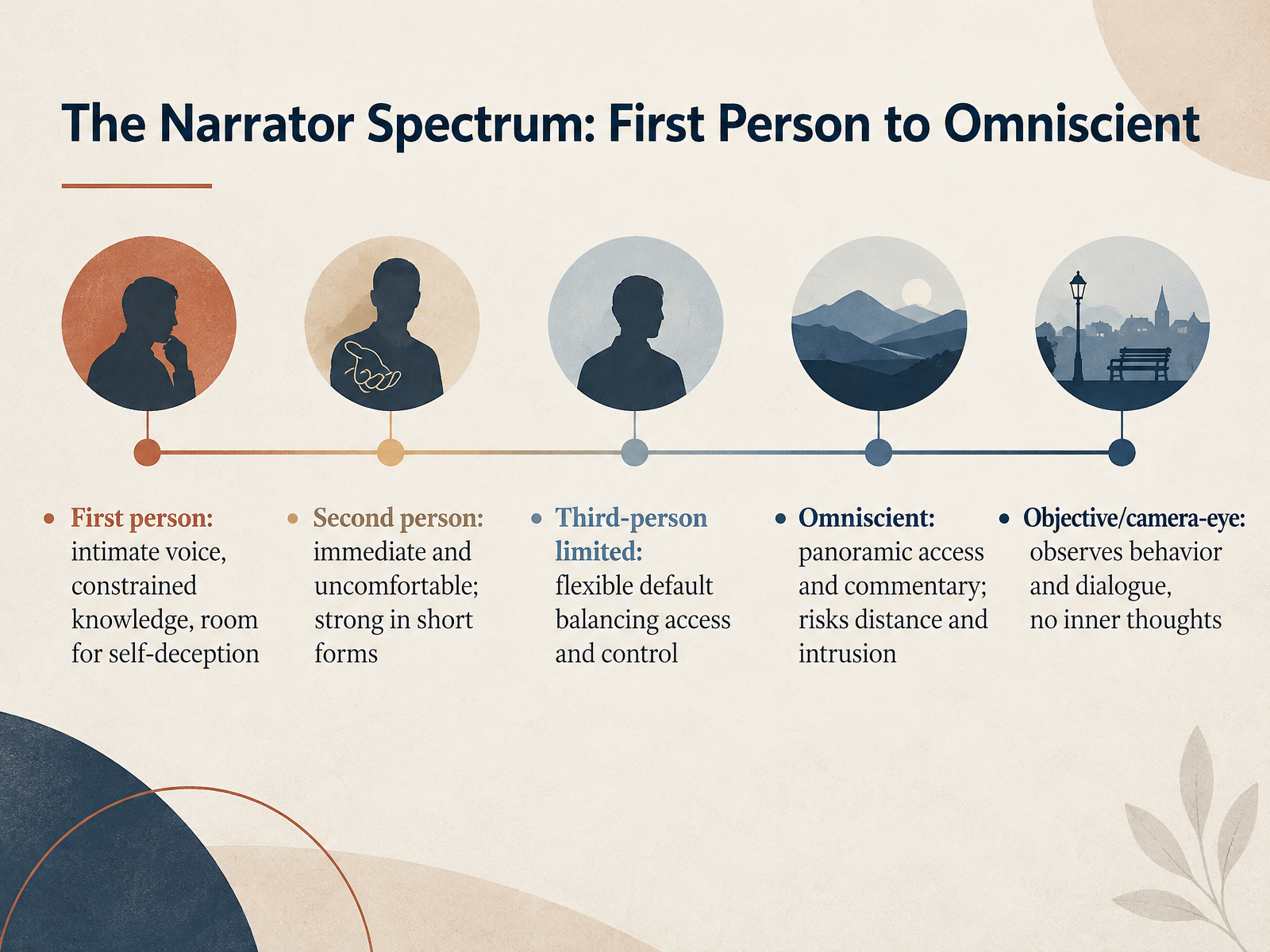
- 03The Narrator Spectrum: First Person to OmniscientNow let's map the choices. Think of point of view as a spectrum, from closeness to distance. First person uses I, and it's intimate, but the narrator only knows what they experience. That constraint is an opportunity. In Gone Girl, the narrators shade the truth, and we feel the self-deception. Second person says you, pulling the reader into the action. It's immediate, even uncomfortable, and it works best in short forms. Third person limited is the flexible default. We stay close to one character's thoughts while the narrator keeps some control. Omniscient gives us panoramic access and commentary, though it risks distance and intrusion. And objective, or camera-eye, shows only behavior and dialogue, no inner thoughts. So ask yourself, how much access does your story need, and how much trust do you want to manage? Next, we'll look at second person and other hybrid forms.
 eriksimpson.sites.grinnell.eduopenstax.orgliberalarts.oregonstate.edu+22 min
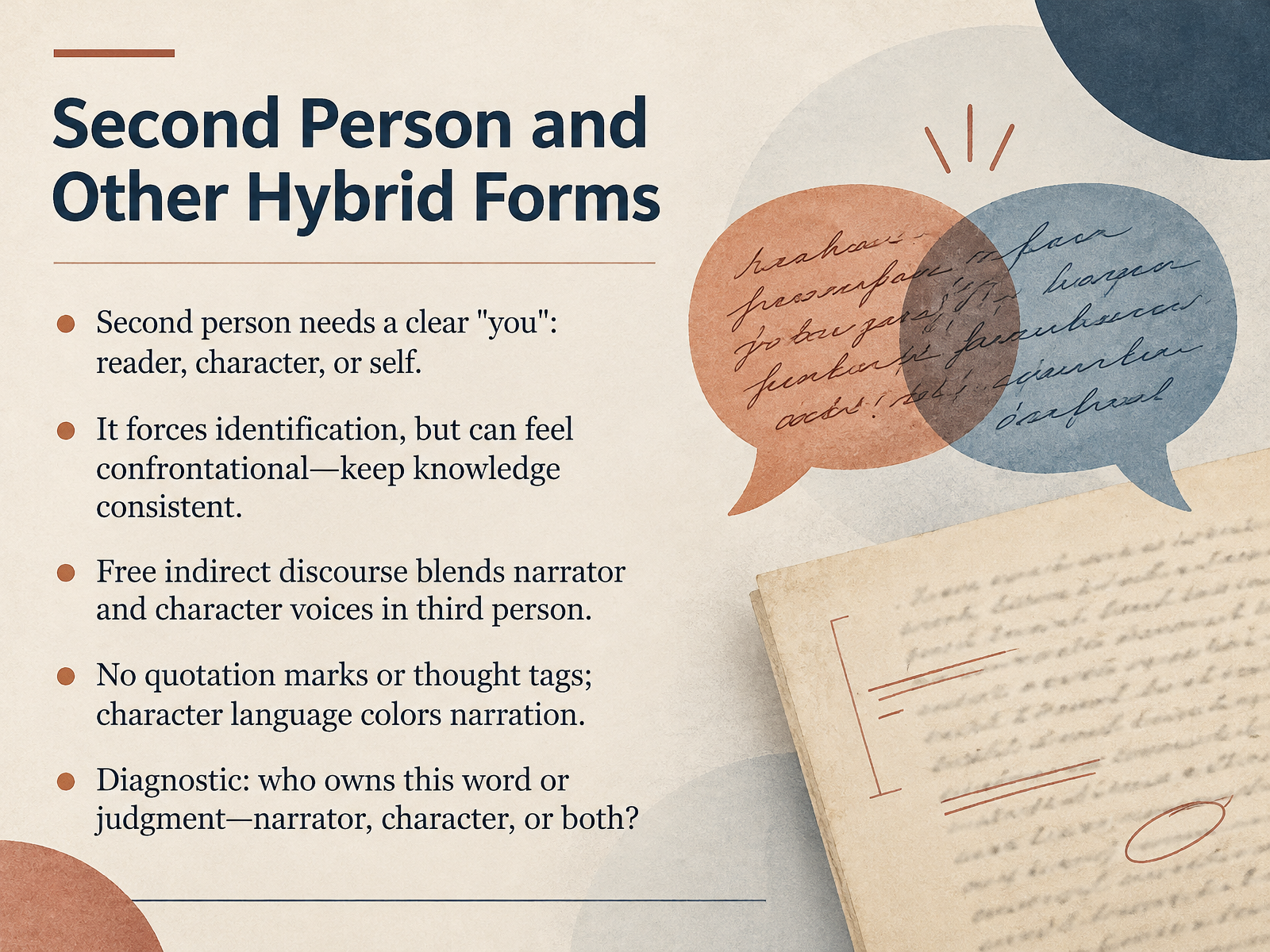
- 04Second Person and Other Hybrid FormsLet's look at second person and a few hybrid forms. Second person only works when you know exactly who "you" is. Is it the reader, a character, or the narrator talking to themselves? Erin Bartnett calls it confrontational, because it forces identification. So keep the character's knowledge consistent. Now, free indirect discourse. That's third person narration that slips into a character's thoughts without quotation marks or thought tags. James Wood's example: "Ted watched the orchestra through stupid tears." Whose word is "stupid"? Probably Ted's. That's your diagnostic question. Who owns this word or judgment, the narrator, the character, or both? Try a paragraph of your own and ask it. Next, we look at reliability and the narrator's mask.
 connotations.defaculty.humanities.uci.eduthewritingguide.blog+22 min
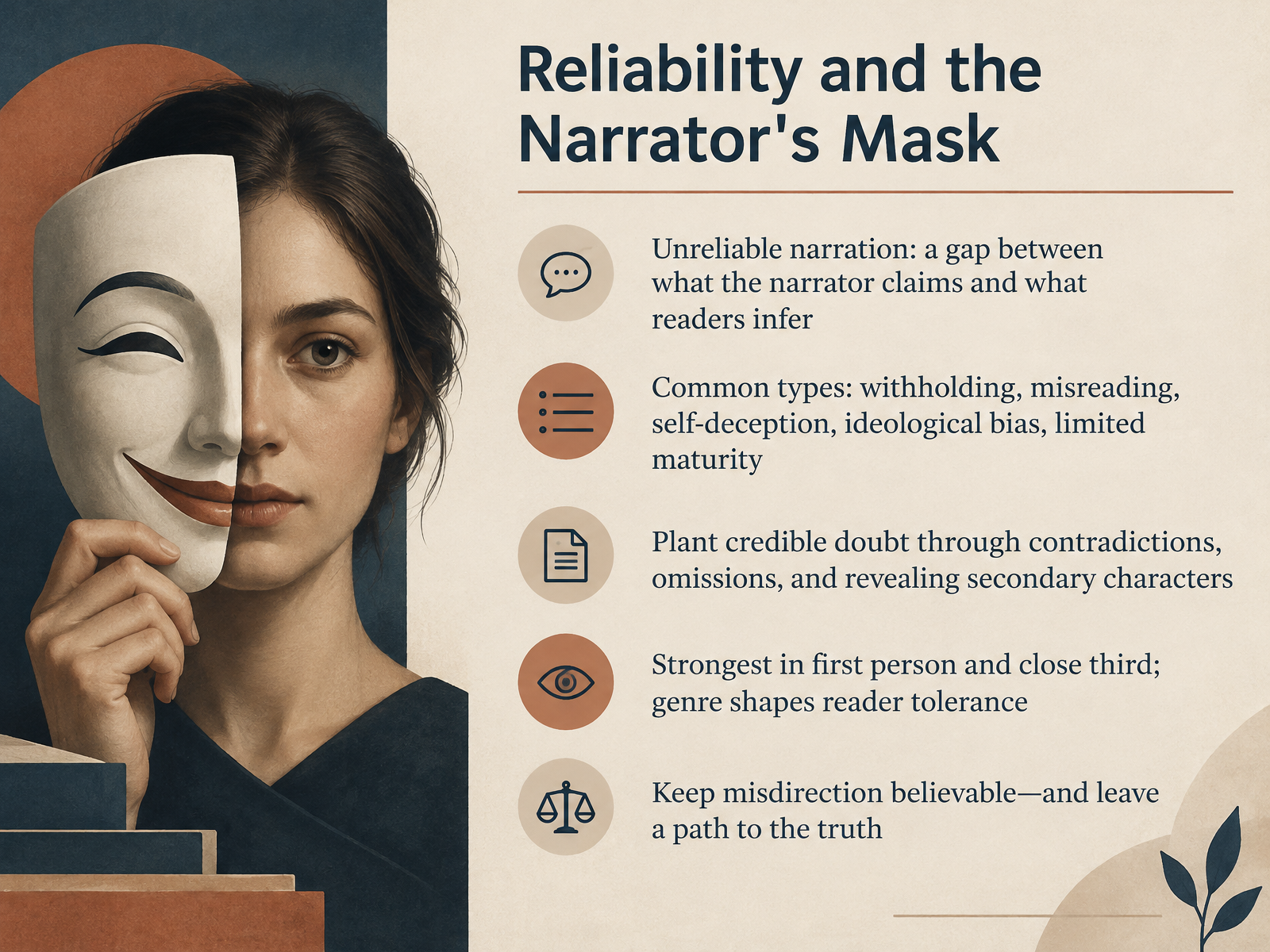
- 05Reliability and the Narrator's MaskNow let's talk about reliability, and the mask your narrator wears. Unreliable narration simply means a gap between what the narrator claims and what readers infer. Think of Patrick McGrath's Spider. Dennis insists his father is the murderer, yet the more he explains, the more we suspect Dennis himself. So the takeaway: let readers build a second version of events behind your narrator's back. Common types include withholding, misreading, self-deception, ideological bias, and limited maturity. Plant credible doubt through contradictions, omissions, and revealing secondary characters. This works best in first person or close third, and genre shapes tolerance. Here's a question for your own work. What is your narrator hiding from us? Keep the misdirection believable, and always leave a path to the truth. Next, we'll look at psychic distance and narrative camera control.
 arro.anglia.ac.ukresolver.obvsg.atnebraskapress.unl.edu+21 min
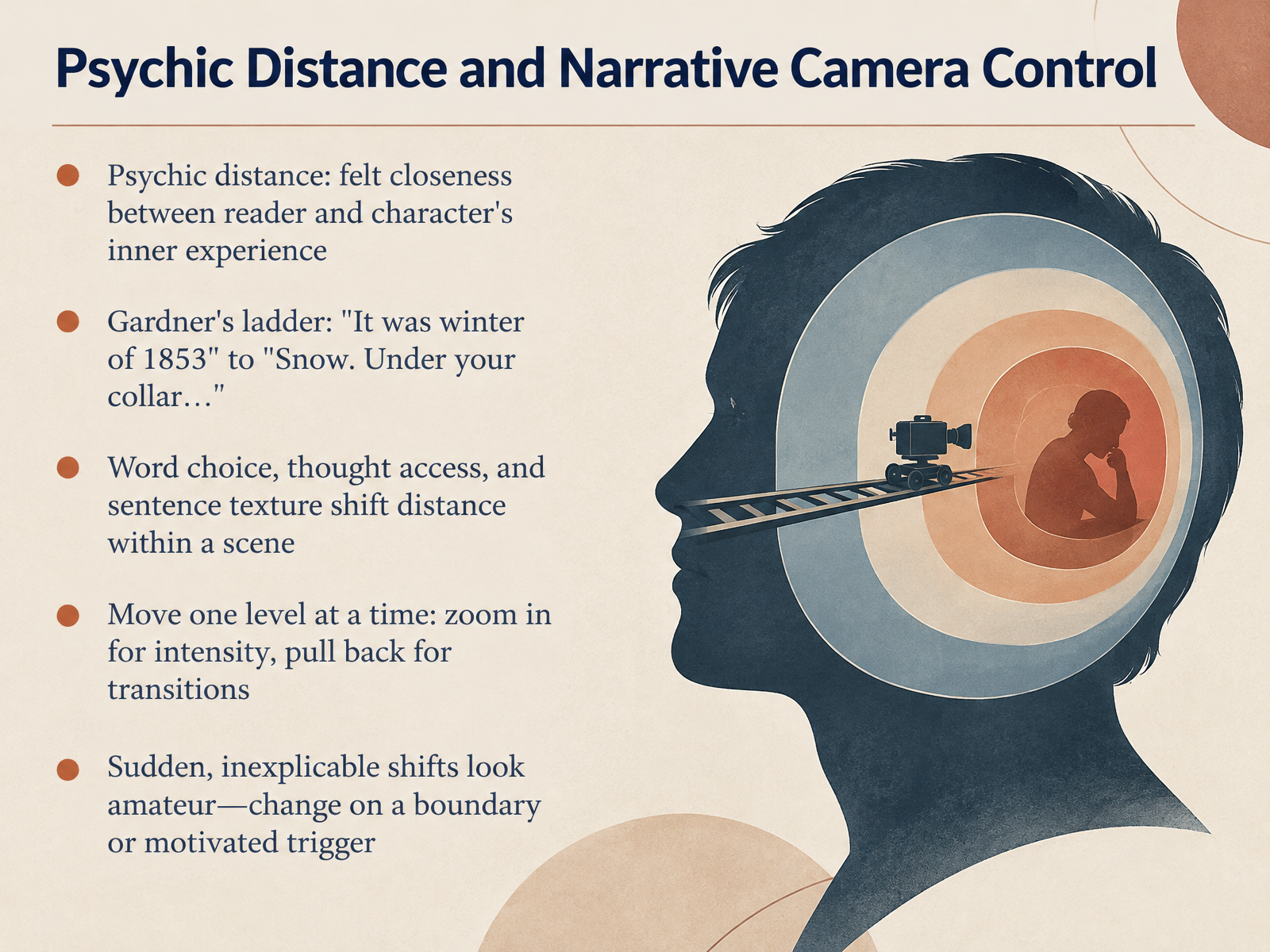
- 06Psychic Distance and Narrative Camera ControlNow let's talk about psychic distance, or as I like to call it, narrative camera control. Psychic distance is the felt closeness between the reader and a character's inner experience. John Gardner gave us a famous ladder. At the far end, "It was winter of the year 1853. A large man stepped out of a doorway." At the close end, "Snow. Under your collar, down inside your shoes, freezing and plugging up your miserable soul." Feel the difference? Word choice, thought access, and sentence texture all shift the distance within a scene. Here's the takeaway: move one level at a time. Zoom in for intensity, pull back for transitions. Sudden, inexplicable shifts look amateur. Change on a boundary or a motivated trigger, like a shock or a memory. So ask yourself, where is your camera right now, and why? Next, we'll look at choosing a point of view for the right reasons.
 1 min
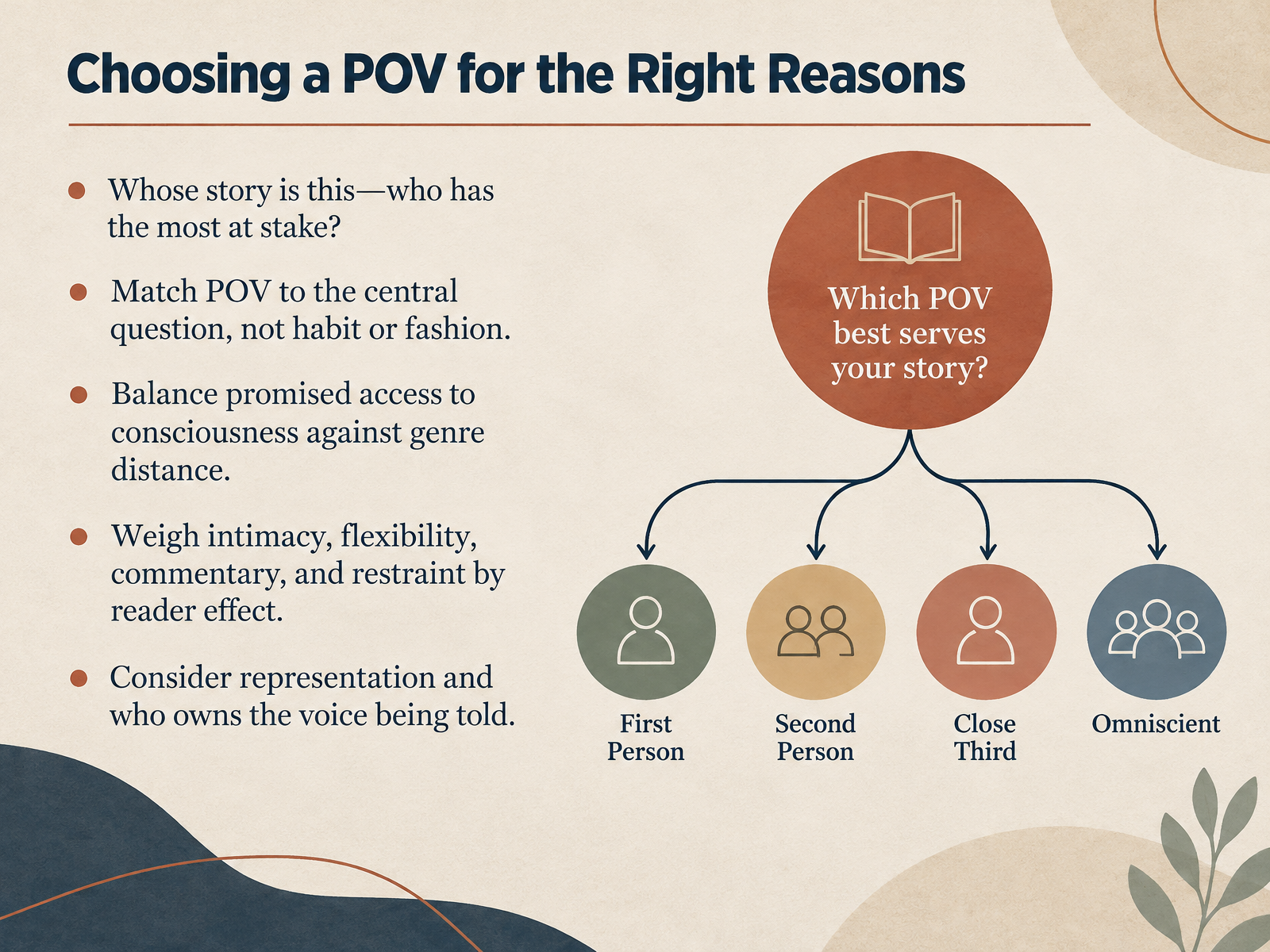
- 07Choosing a POV for the Right ReasonsNow let's talk about choosing a point of view for the right reasons. Start with the most useful question. Whose story is this, and who has the most at stake? Then match your point of view to your story's central question, not to habit or fashion. Next, weigh access against distance. If you promise the reader a character's inner life, deliver it. But some genres need distance. Mysteries gain tension from what stays hidden. So ask what reader effect you want: intimacy, flexibility, commentary, or restraint. And consider representation. Who owns this voice, and are you the right person to tell it? Here's the takeaway. Every point of view is a promise to the reader, so choose the one that best serves the story you're telling. Next, we look at who tells the story and why it matters.
 1 min
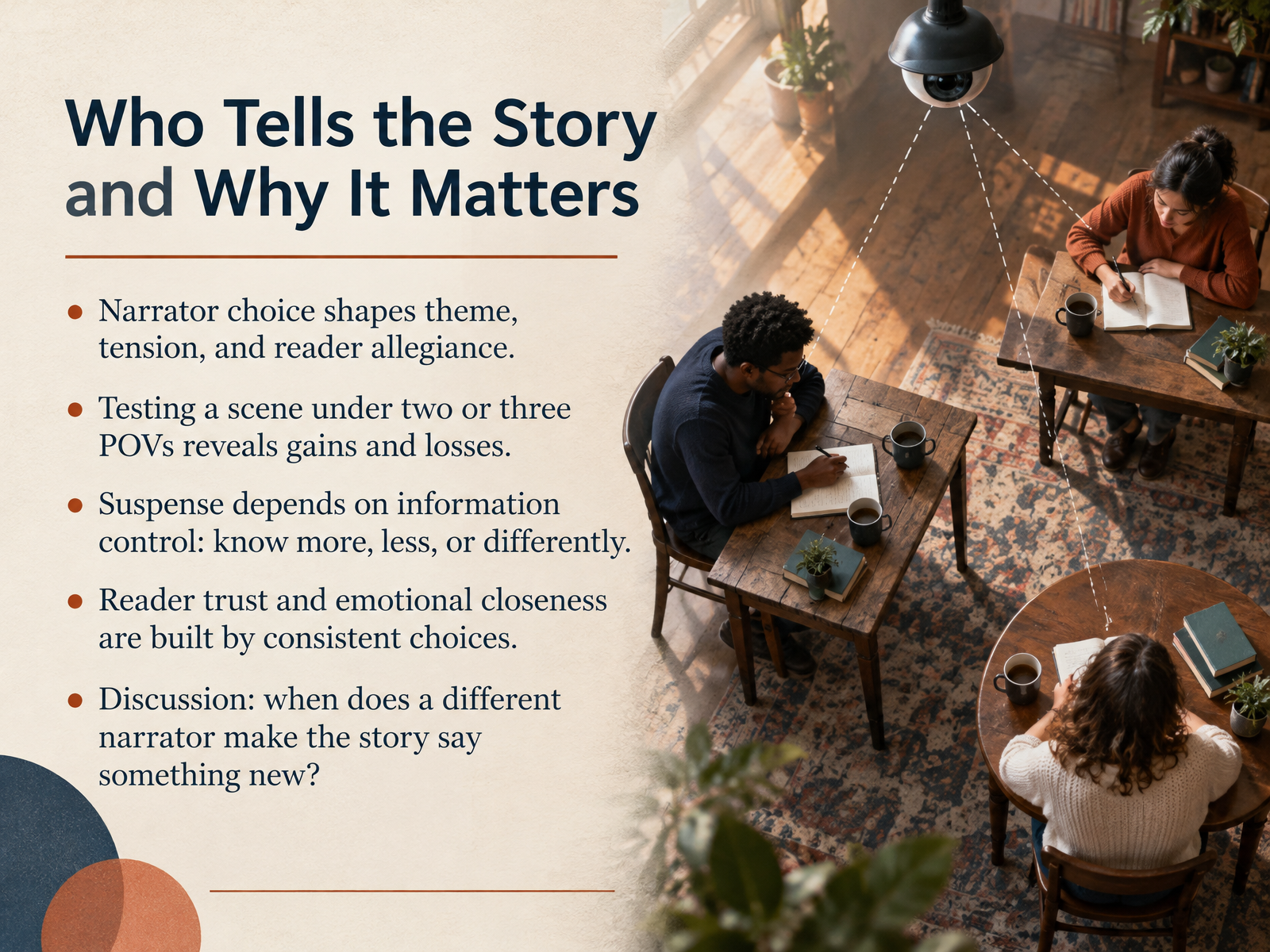
- 08Who Tells the Story and Why It MattersLet's turn to who tells the story, and why it matters. Narrator choice shapes theme, tension, and reader allegiance. Think about The Great Gatsby. Nick Carraway narrates from the edge of the action, and that distance makes Gatsby feel larger than life. Now picture a scene from your own draft. Test it under two or three points of view. You'll quickly see what each one gains and loses. Suspense depends on information control. Make the reader know more than the character, less, or differently. A character opening a door while the reader knows what waits behind it creates a very different anxiety than discovering it together. Reader trust and emotional closeness are built by consistent choices, so stay faithful to what your narrator can know. Here's a question for you. When does a different narrator make the story say something new? Next, we'll look at common POV pitfalls and how to fix them.
 1 min
- 09Common POV Pitfalls and How to Fix ThemNow let's look at the pitfalls that trip up even careful writers, and how to fix them. First, head-hopping. That's an unearned shift into another character's thoughts. Say your heroine senses the villain's plan. How would she know that? Fix it with a scene break, or show his intent through visible behavior instead. Next, POV slips. Track perception verbs like saw, felt, and realized, and verify each belongs to the viewpoint character. Then knowledge errors. Characters can't name people or facts before they learn them. And finally, filtering. Too many saw and felt tags put distance between reader and story. Cut them for closer immersion. When you revise, use this checklist. One POV per scene. Consistent pronouns. Transitions flagged by breaks. Which of these shows up in your own draft? Next, we'll cover practical strategies for choosing and sustaining a POV.
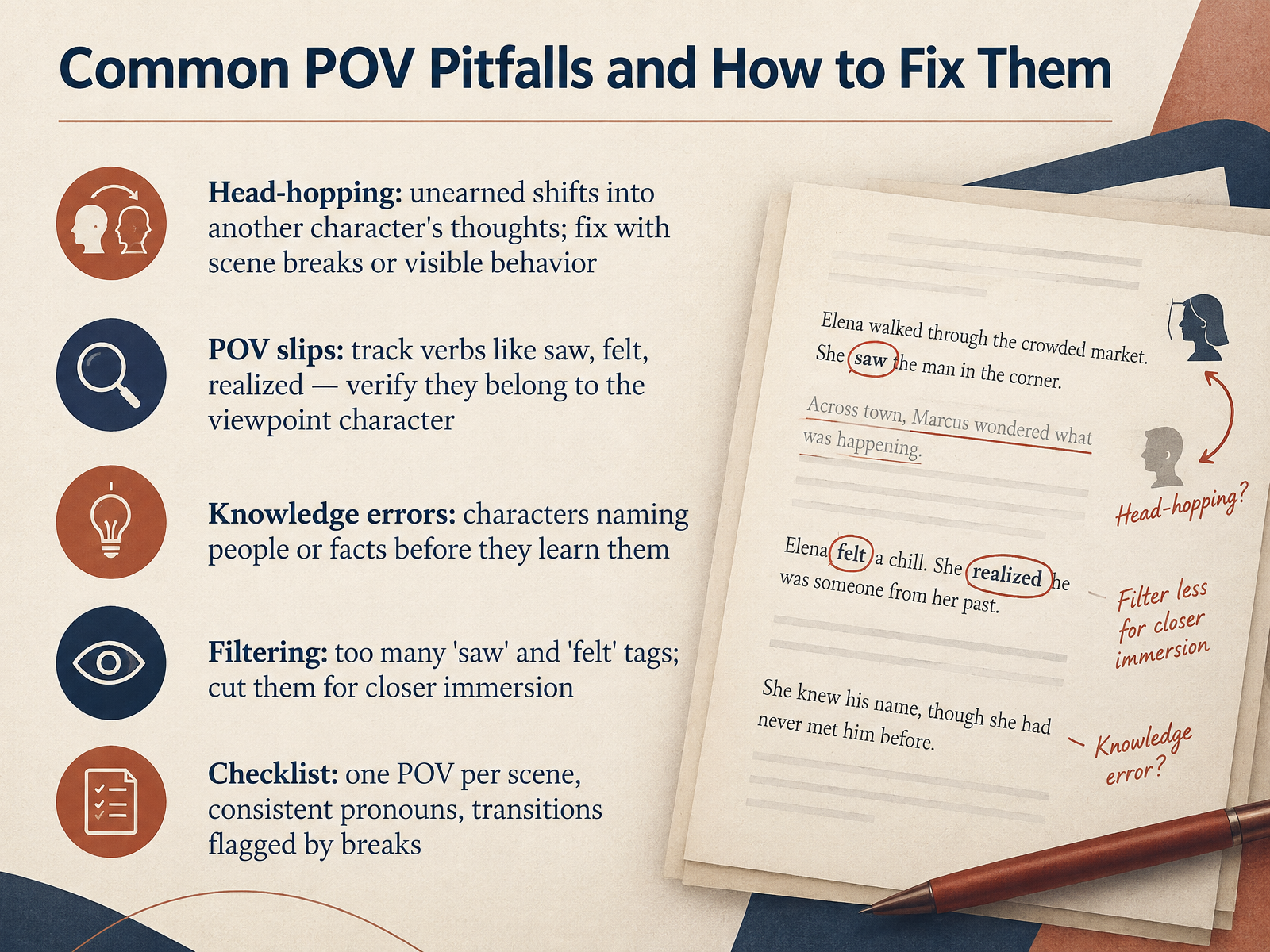 2 min
- 10Practical Strategies: Choosing and Sustaining a POVNow let's get practical about choosing and sustaining point of view. Start with your story's goal, its emotional target, and how much information you want to control. Then check genre norms. What access to consciousness do readers expect? A mystery may demand tight control of what the detective knows. Next, set your POV rules early, and mark every intentional shift clearly so readers never feel lost. Build a POV map: track each scene's narrator, goal, conflict, and outcome. That map makes head hopping visible and easy to fix. Finally, run one revision pass on POV only, separate from proofreading. Read for consistency, distance, and voice. These five habits keep your narrator steady and your reader's trust intact. Next, we'll look at designing a POV map for a long project.
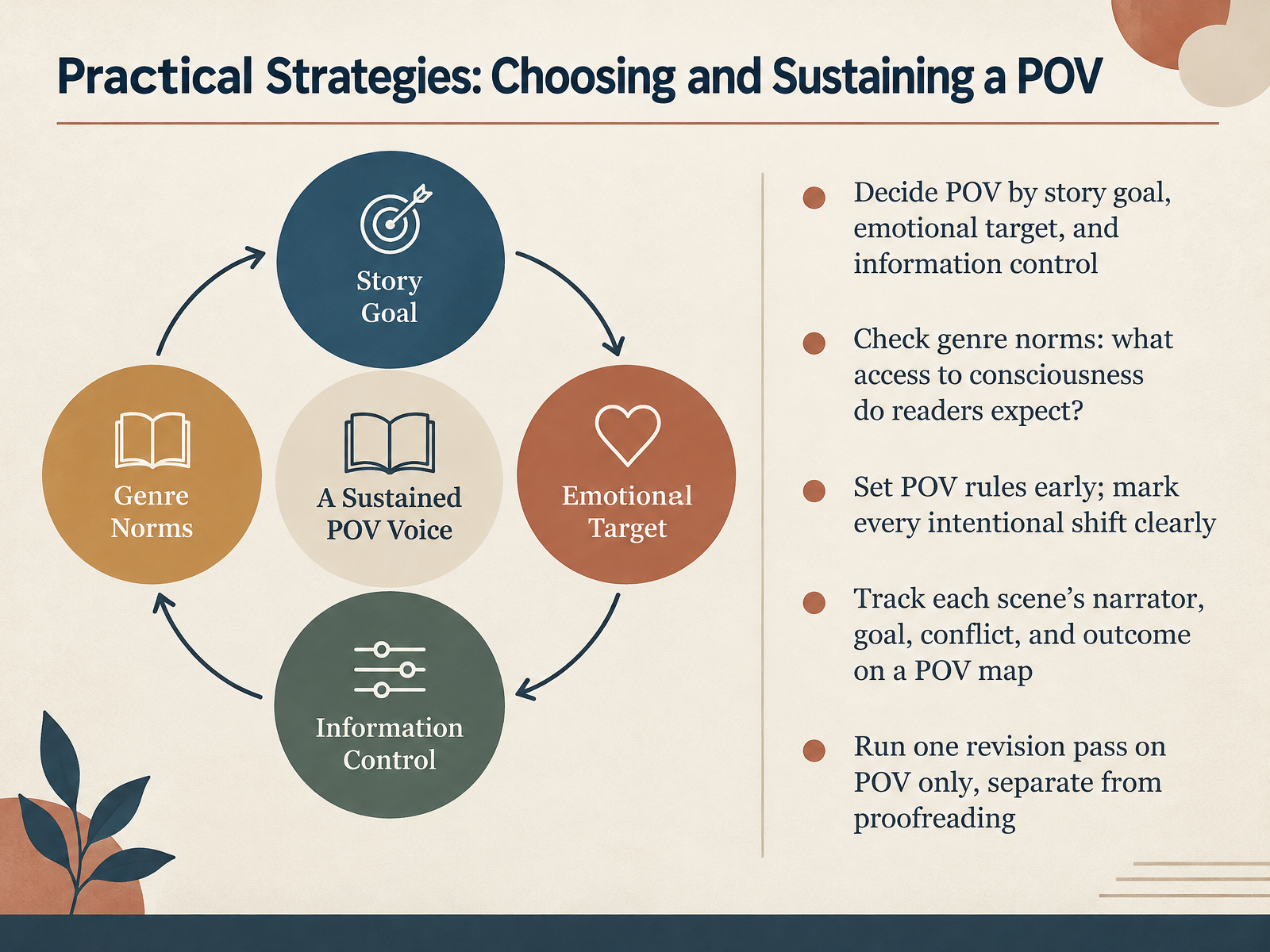 wille.orgsetyourmuseonfire.comstorygrid.com+22 min
- 11Designing a POV Map for a Long ProjectNow let's build a POV map for a long project. It's simple: one line per scene, listing the viewpoint, the goal, the conflict, and the outcome. When you lay scenes side by side like this, a reverse outline shows you which scenes don't actually need their own narrator. You may find two viewpoints chasing the same goal, or one character watching while another does all the acting. Then check your narrators. Do they differ in diction, priorities, habits, and blind spots? If two voices could swap lines without anyone noticing, the distinction isn't doing its job. So write a one-line POV mission for each major narrator, something like, her view reveals the cost of hiding fear. Finally, track continuity: names, knowledge gained, and the order characters learn facts. That's your map. It keeps a long project honest. Next, we'll put these tools to work in Diagnose and Repair: Guided POV Exercises.
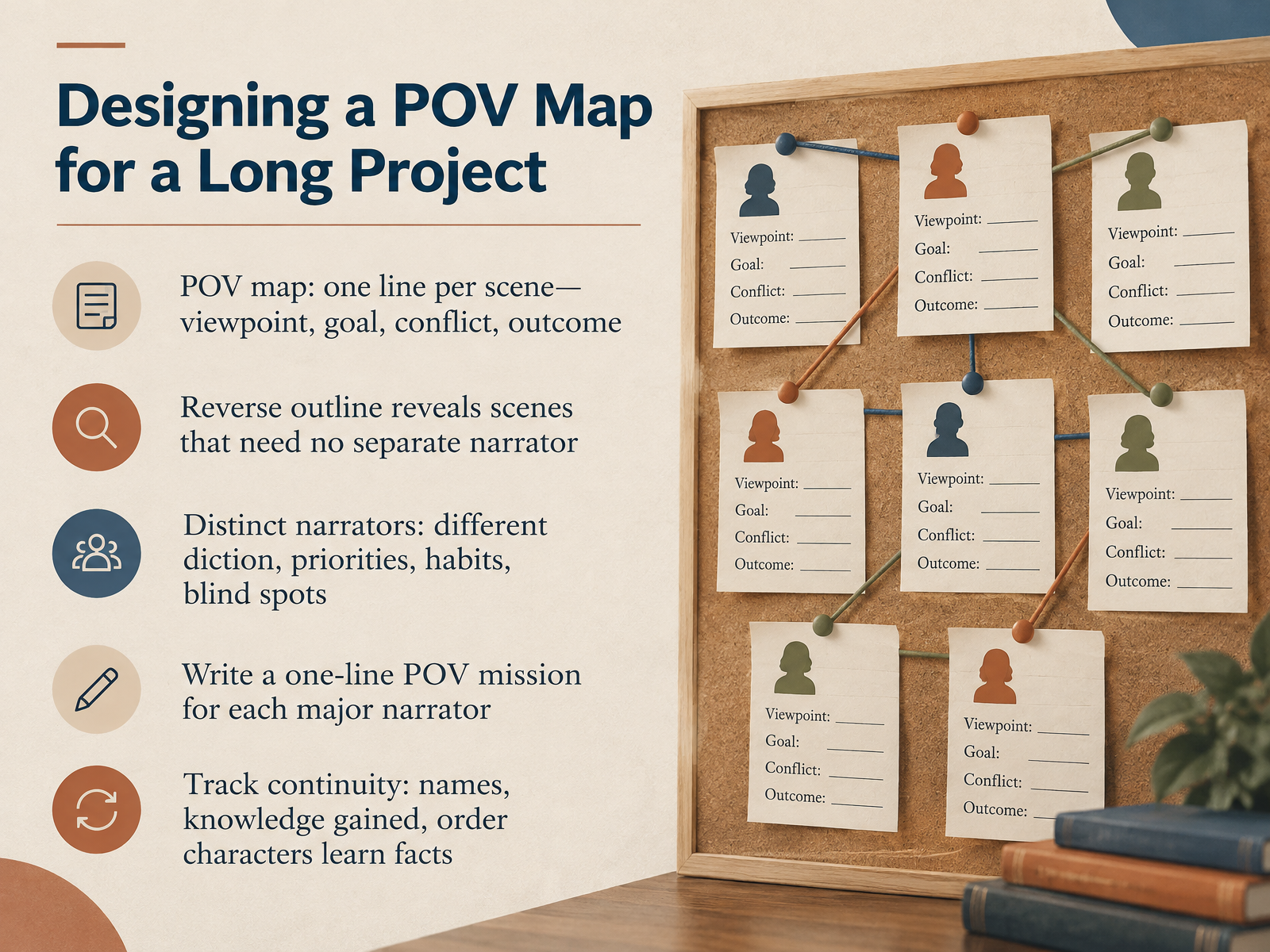 wille.orgsetyourmuseonfire.comstorygrid.com+22 min
- 12Diagnose and Repair: Guided POV ExercisesNow let's put all of this into practice, because point of view is a skill you build by doing, not just by reading about. Here you have three guided exercises. First, read three short excerpts and spot the point of view type, the narrator's stance, and any reliability cues. Ask yourself, could this narrator really know this? Second, rewrite a two-hundred-word scene, then compare what changes in access, sympathy, and suspense. Third, pair up, diagnose one point of view slip in your partner's draft, and propose one concrete fix, such as reframing an inner thought as visible behavior. Working solo? Label lines in your draft as observed, inferred, or known. If a line pretends to be observed but depends on private knowledge, that's a slip. In the debrief, ask yourself, which choices surprised you, and what will you change? Next, we'll assess your point of view choices with a practical rubric.
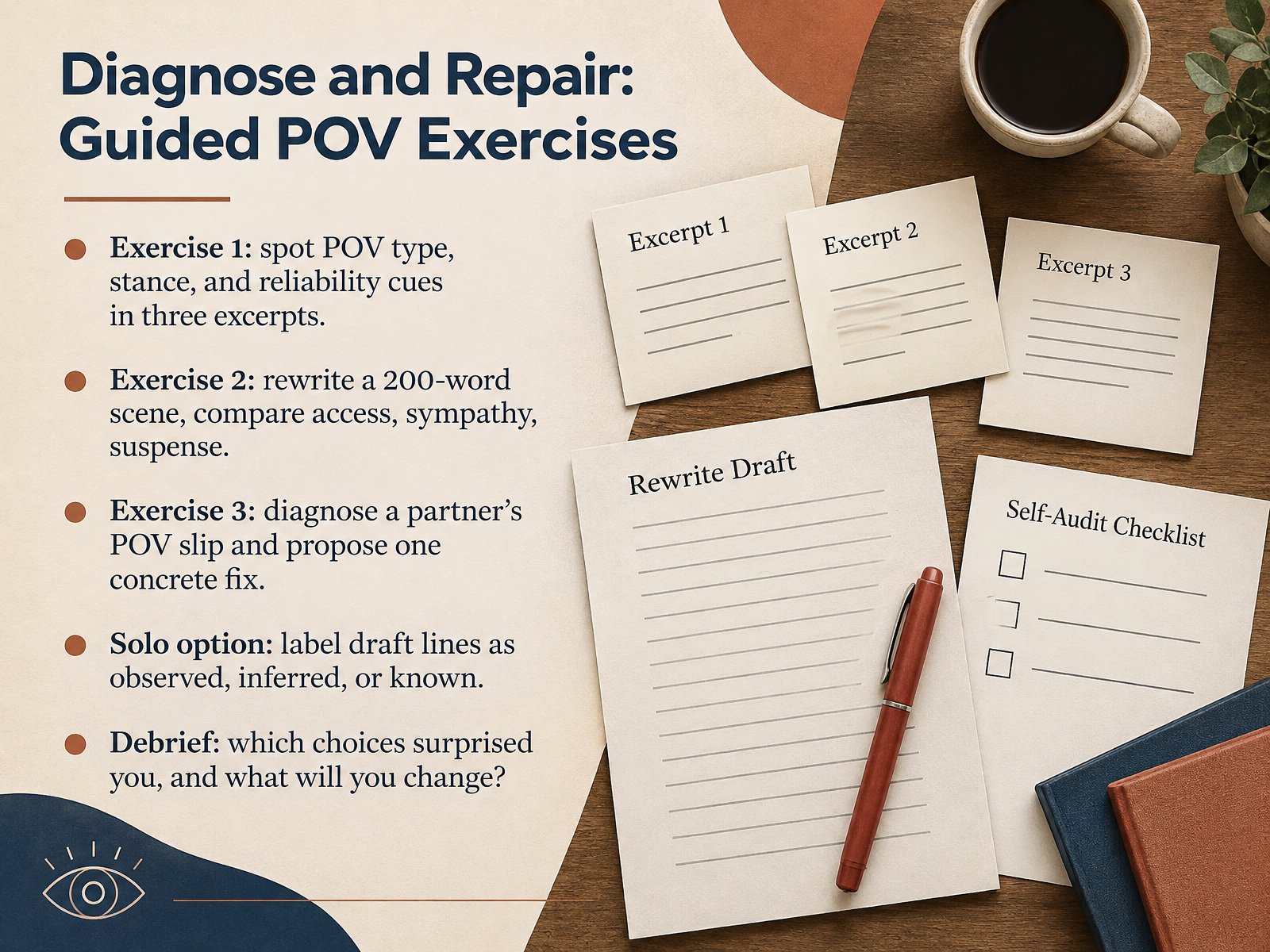 wille.orgsetyourmuseonfire.comstorygrid.com+22 min
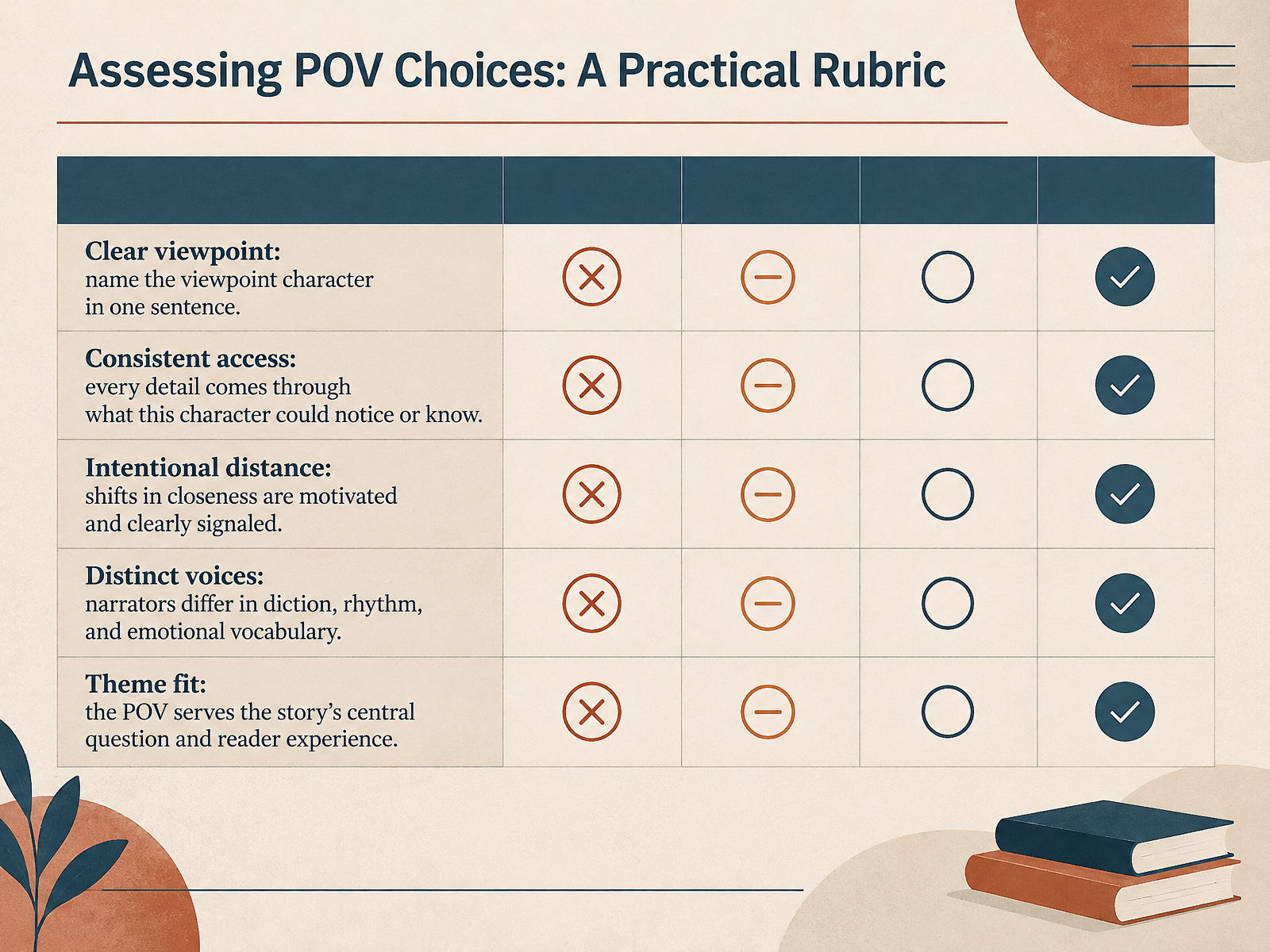
- 13Assessing POV Choices: A Practical RubricLet's put all of this into a practical rubric you can run on any scene. First, clear viewpoint. Can you name the viewpoint character in one sentence? If not, that's your first finding. Second, consistent access. Every detail should come through what this character could notice or know. Remember the classic slip: a character describing their own blue eyes without a mirror. Third, intentional distance. Shifts in closeness should be motivated and clearly signaled, not accidental drift. Fourth, distinct voices. Compare your narrators. Do they differ in diction, rhythm, and emotional vocabulary? If everyone sounds the same, readers lose trust. And fifth, theme fit. Ask whether the point of view serves the story's central question and the reader's experience. Try this rubric on one scene in your own draft. Which line fails first? That's your revision target. Next, we'll apply one POV change together.
 wille.orgsetyourmuseonfire.comstorygrid.com+22 min
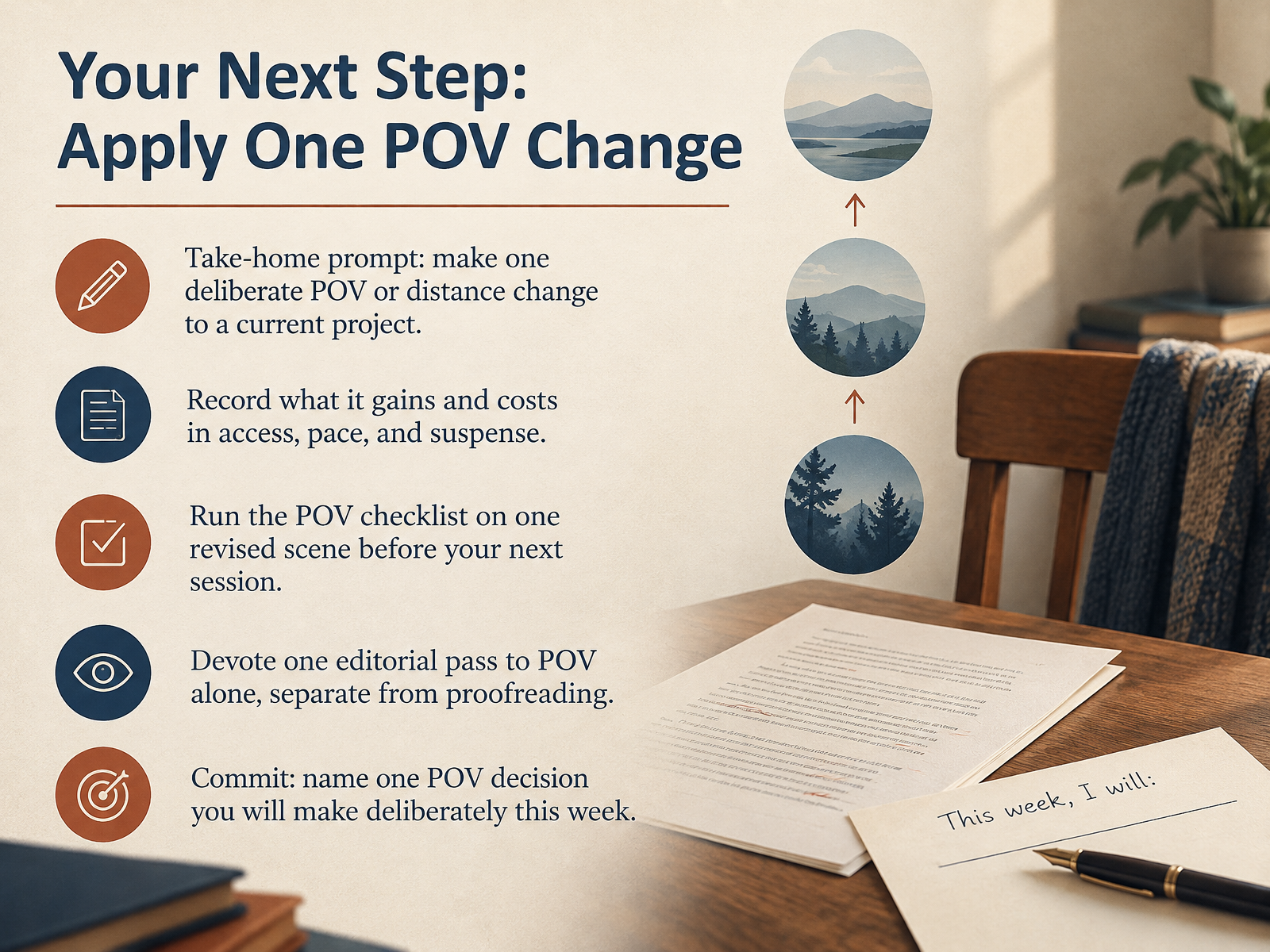
- 14Your Next Step: Apply One POV ChangeSo, how do you take everything from this course and make it real on the page? Start with one small assignment. Make a single deliberate point of view change to a current project. A closer narrator. A bit more distance. One scene told through a different character's eyes. Then record what it gains and what it costs, in access, pace, and suspense.
Next, run a point of view checklist on one revised scene before your next session. Can you name the viewpoint character in a sentence? Could that character know everything on the page? Keep that pass focused on point of view alone, separate from proofreading. Combining the two means you do neither well.
Finally, commit. Name one point of view decision you will make deliberately this week. That is how craft becomes instinct. Thank you for writing with me, and go make that one change with confidence.
 wille.orgsetyourmuseonfire.comstorygrid.com+21 min
Take the deck with you
Download this course as a file — free, no sign-up needed.
- PDF handoutEvery slide page, ready to print or share.15 pages · 4.7 MBDownload
- Narrated PowerPointThe deck that presents itself — every slide carries the digital human's narration video.15 pages · 13.8 MBDownload
- PowerPoint slidesThe full deck as a .pptx — open it in PowerPoint, Keynote, or Google Slides.15 pages · 4.7 MBDownload
Free to use in your own training — please keep the PersonWise credit page at the end.
Have your own deck? Turn it into a course
Sources consulted
Web sources consulted while building this course.
- Connections: Fiction: Point of View — eriksimpson.sites.grinnell.edu
- 4.6 Editing Focus: More on Characterization and Point of View - Writing Guide with Handbook | OpenStax — openstax.org
- What is Point of View? || Definition and Examples | College of Liberal Arts | Oregon State University — liberalarts.oregonstate.edu
- 5: Identity and Society — digfir-published.macmillanusa.com
- Narration | Literature and Writing | Research Starters | EBSCOhost — ebsco.com
- Revising: A Craft Checklist - Andrew Wille Writing Studio - creative writing & book development — wille.org
- The 10 Point Checklist for Novel Revision — Set Your Muse on Fire! — setyourmuseonfire.com
- How to Edit a Manuscript: Objective Tools - Part 1 — storygrid.com
- How to Edit a Manuscript: Part 4 - Story Grid Intensive — storygrid.com
- Point of View Checklist: Fix Common POV Mistakes — critique.space
- In Their Own Words: On Writing in Second Person — connotations.de
- Free Indirect Discourse — faculty.humanities.uci.edu
- 300 Second-Person POV Examples | thewritingguide.blog — thewritingguide.blog
- So You Want to Write in the Second Person - Electric Literature — electricliterature.com
- Second-Person Narration in Literary and Conversational Storytelling — doi.org
- First-person narration: the unreliable narrator in contemporary fiction — arro.anglia.ac.uk
- Inside curious minds : types of unreliable narration in contemporary English novels — resolver.obvsg.at
- Strange Narrators in Contemporary Fiction - Nebraska Press — nebraskapress.unl.edu
- CRAFT STUDY: UNRELIABLE FIRST-PERSON — scholarsbank.uoregon.edu
- Creating a Genuine Rogue: — dash.harvard.edu