Begin
14 pages · ~28 min
Cybersecurity Roles, Responsibilities, and Handoffs
This training defines cybersecurity roles, responsibilities, and handoffs, helping team members clarify ownership and coordinate transitions to reduce gaps and risks.
A digital instructor presents all 14 pages. Hold “Ask” at any point and ask out loud — the answer comes from this course. No sign-up needed.
What you’ll learn
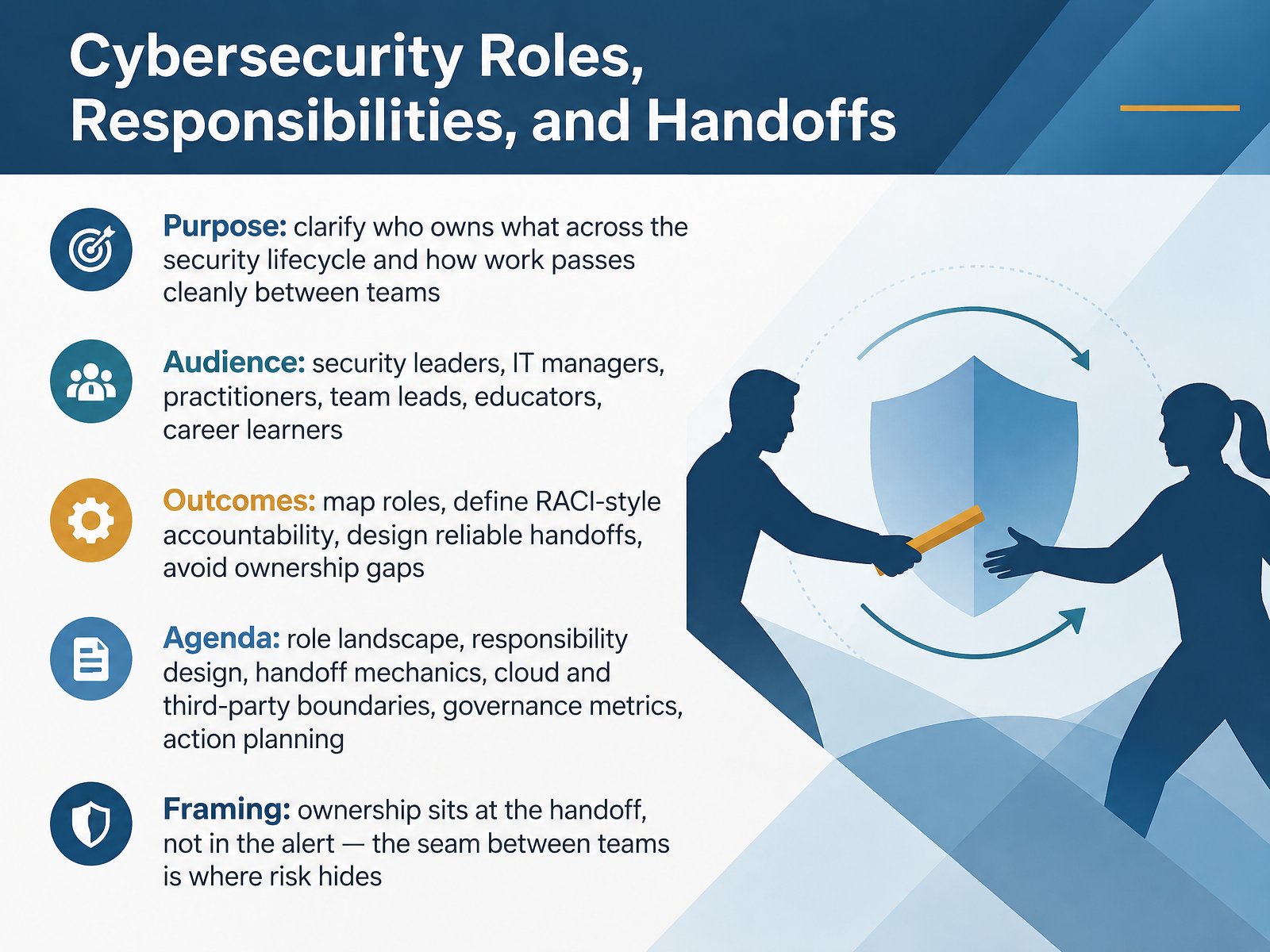
- 01Cybersecurity Roles, Responsibilities, and HandoffsWelcome. This course is about cybersecurity roles, responsibilities, and handoffs. Picture a Tuesday morning. An alert has been triaged, a ticket has changed hands twice, and nobody is sure who owns the fix. That is the situation we are here to prevent. Our purpose is simple. Clarify who owns what across the security lifecycle, and show how work passes cleanly between teams. We are speaking to security leaders, IT managers, practitioners, team leads, educators, and career learners. Together we will map the role landscape, define RACI-style accountability, that is Responsible, Accountable, Consulted, and Informed, design reliable handoffs, and close ownership gaps. We will also cover cloud and third-party boundaries, governance metrics, and action planning. Here is our framing. Ownership sits at the handoff, not in the alert. The seam between teams is where risk hides. Keep that in mind as we move into our next section, Why Role Clarity and Clean Handoffs Matter.nist.govnist.govnist.gov+22 min
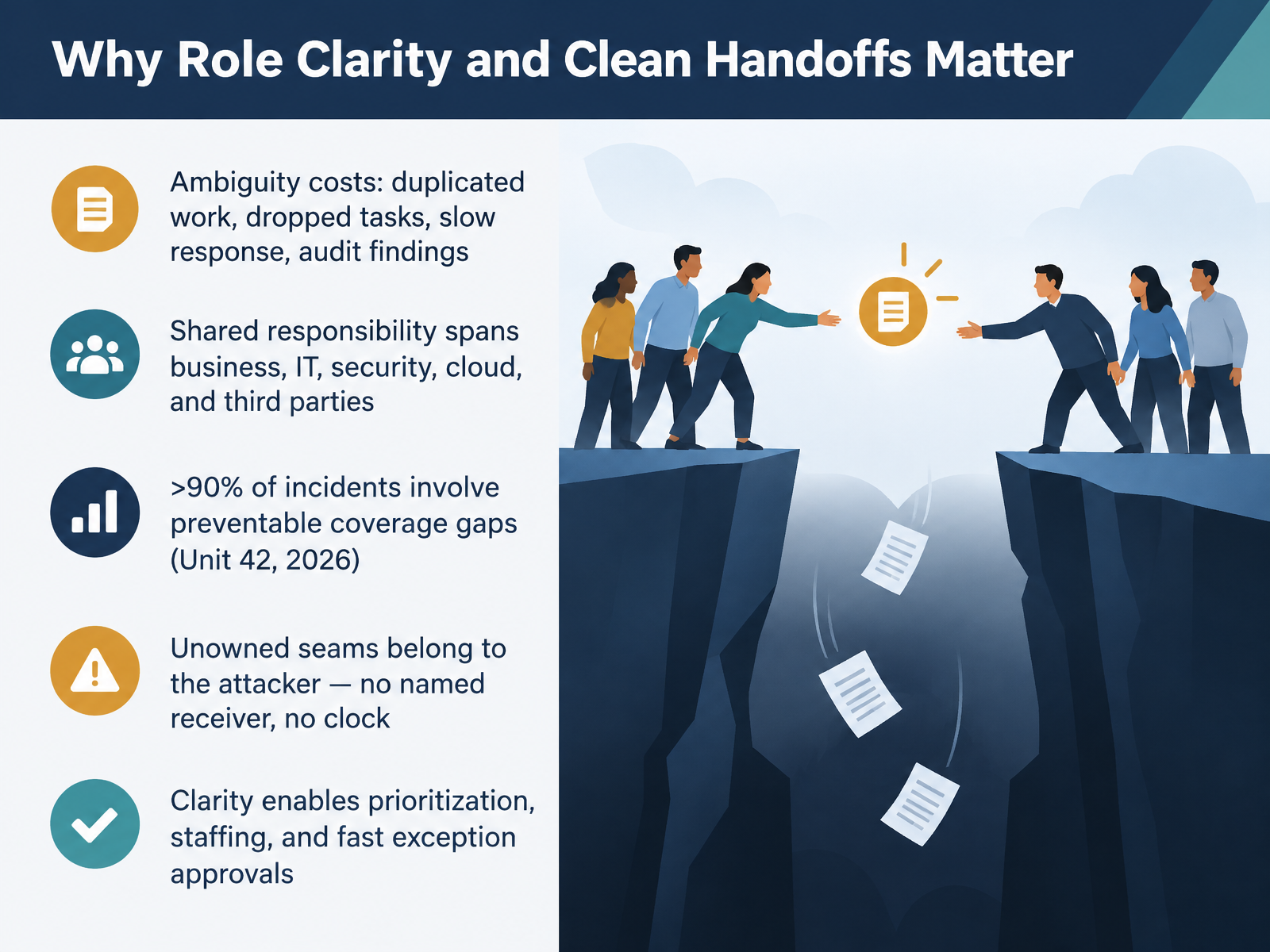
- 02Why Role Clarity and Clean Handoffs MatterLet's start with why role clarity matters. When no one owns a task, you get duplicated work, dropped tasks, slow response, and audit findings. Responsibility today spans business, IT, security, cloud, and third parties. According to Unit 42's 2026 report, more than ninety percent of incidents involved preventable coverage gaps. Here is the core idea. An unowned seam belongs to the attacker. No named receiver, no clock, no one chasing it. So at every handoff, signpost who owns the next action and by when. Clarity also lets you prioritize, staff properly, and approve exceptions fast. Takeaway: name the receiver, set the clock, confirm acceptance.
 nhimg.orgpellera.compaloaltonetworks.com+21 min
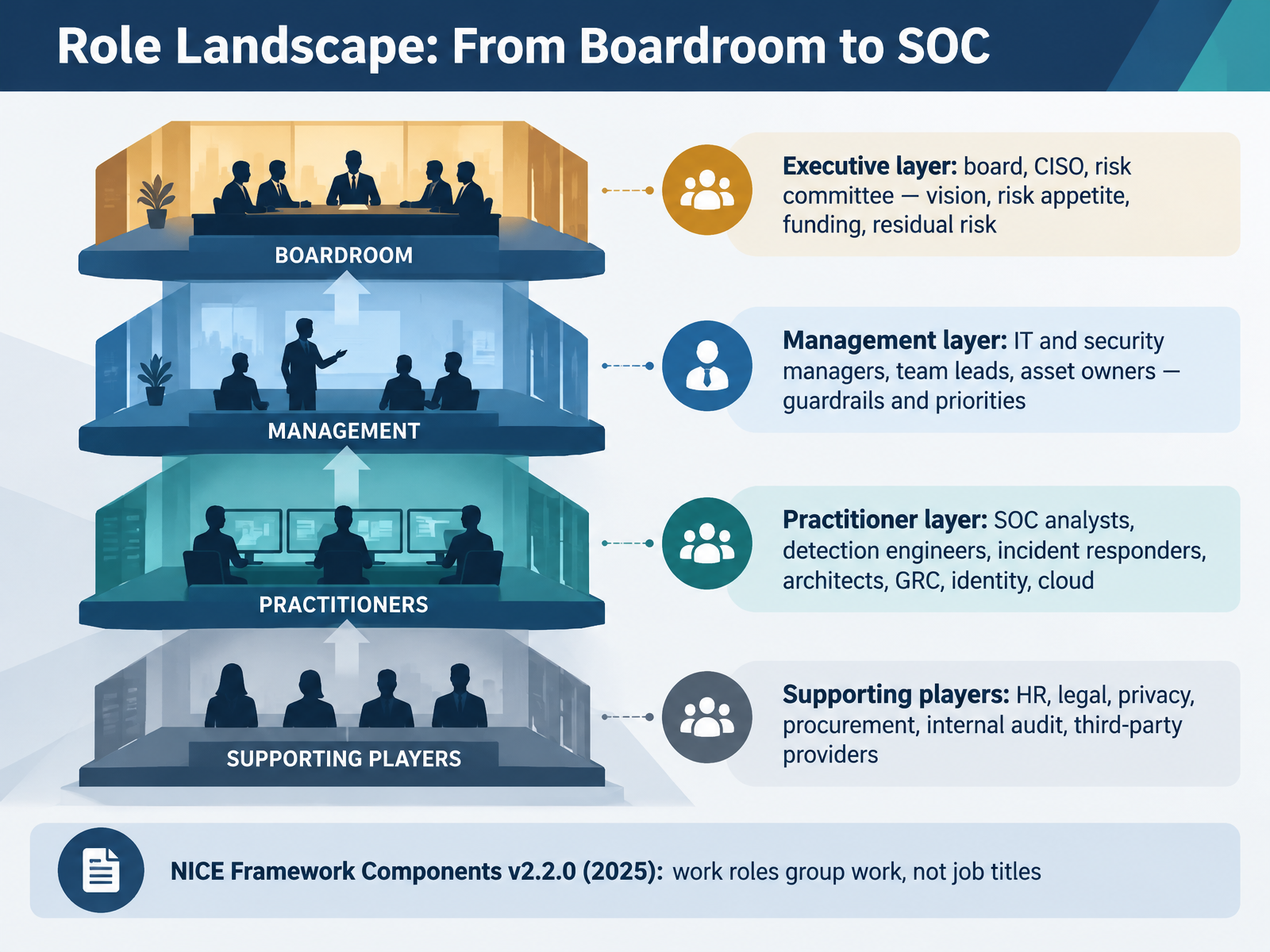
- 03Role Landscape: From Boardroom to SOCSo who actually does what? Think of the role landscape as four layers. At the executive layer, the board, the Chief Information Security Officer, and the risk committee set vision, risk appetite, and funding, and they accept residual risk. At the management layer, IT and security managers, team leads, and asset owners translate that into guardrails and priorities. At the practitioner layer, you find SOC analysts, detection engineers, incident responders, architects, governance, risk, and compliance staff, identity, and cloud. Supporting them are HR, legal, privacy, procurement, internal audit, and third-party providers. One useful anchor: the NICE Framework Components, version two point two point zero, published in twenty twenty-five. NICE groups work roles by the work itself, not by job titles, so one job can hold several roles. As we move on, keep this in mind: map work to roles, not titles. Next, we look at designing accountabilities with RACI and decision rights.
 nist.govnist.govnist.gov+22 min
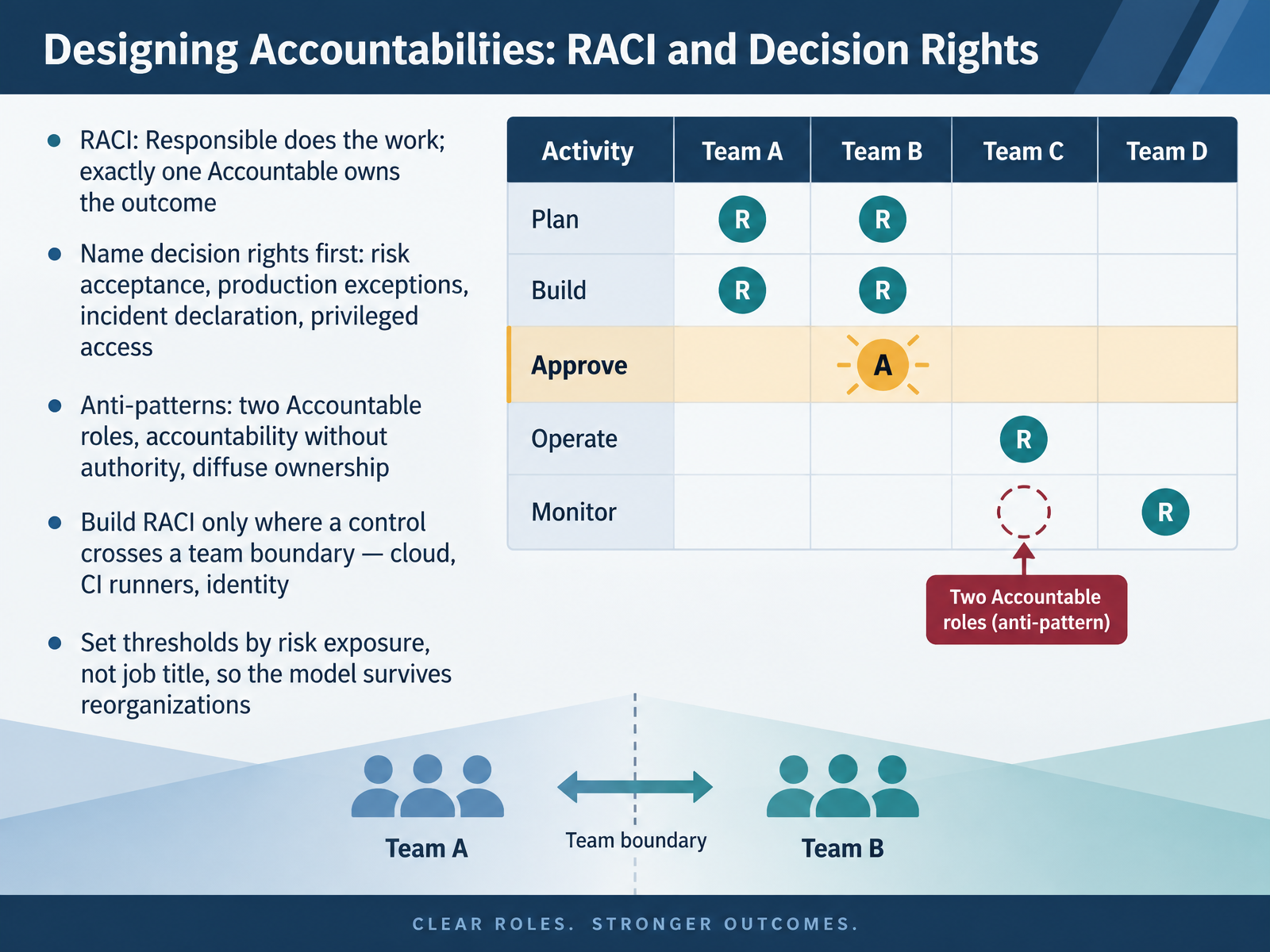
- 04Designing Accountabilities: RACI and Decision RightsLet's talk about designing accountabilities. Picture a production exception landing on a Friday afternoon, with the release blocked. Someone has to decide. RACI stands for Responsible, Accountable, Consulted, and Informed. Responsible does the work, and exactly one Accountable owns the outcome. So name decision rights first: who accepts risk, who approves production exceptions, who declares an incident, and who grants privileged access. Watch for anti-patterns. Two Accountable roles means neither waits or acts. Accountability without authority is just a name on a spreadsheet. And diffuse ownership leaves gaps where teams assume someone else is handling it. Build a RACI only where a control crosses a team boundary. Shared cloud accounts, CI runners, and identity infrastructure are the usual suspects. Set thresholds by risk exposure, not job title, so the model survives reorganizations. Here is the takeaway: one Accountable per decision, named up front. That sets up our next slide on core process handoffs across access, vulnerabilities, incidents, and change.
 cloudaware.comlearn.microsoft.comsecportal.io+22 min
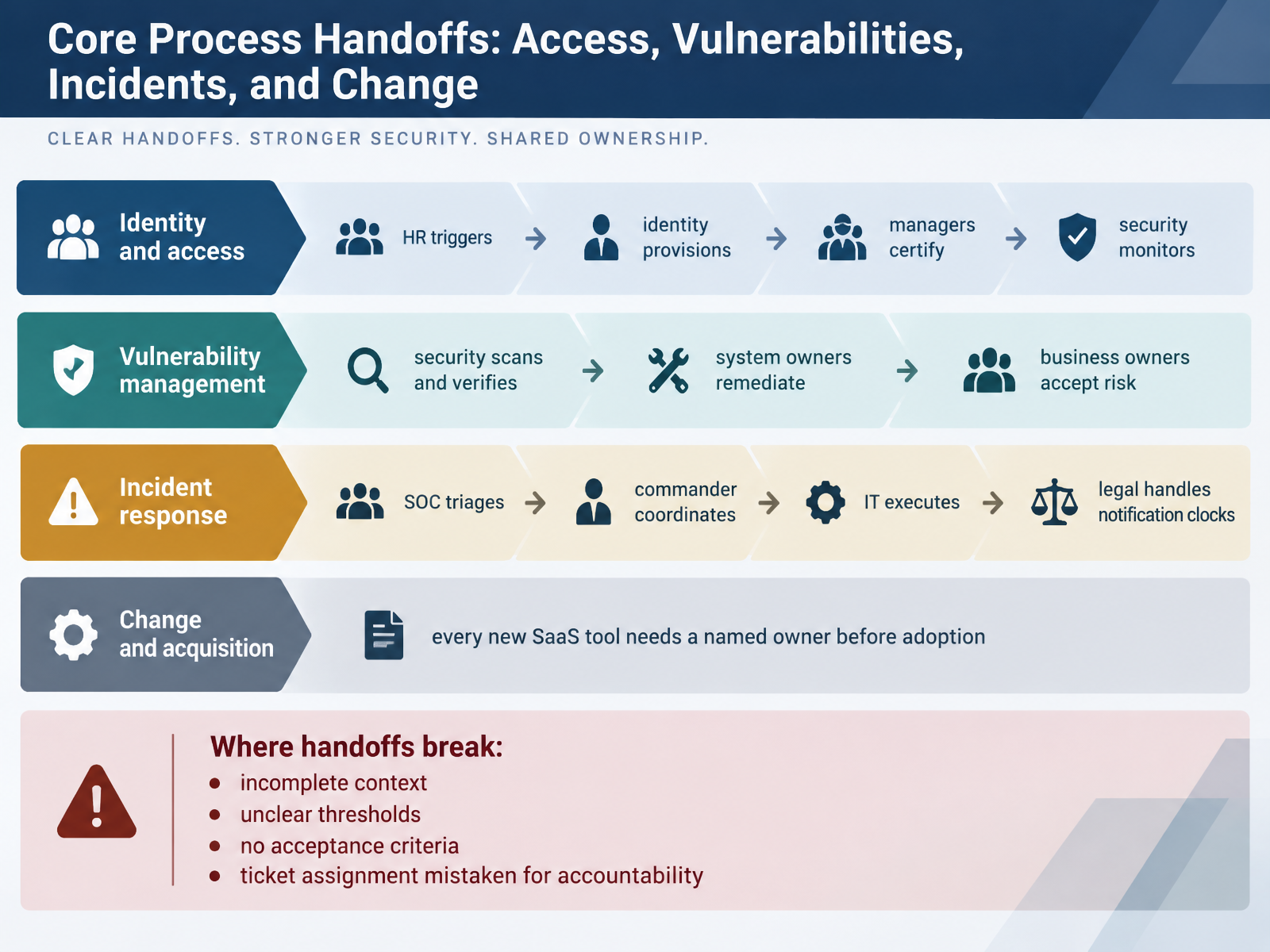
- 05Core Process Handoffs: Access, Vulnerabilities, Incidents, and ChangeLet's walk through the four handoffs that carry most of your security work. Identity and access: HR triggers the change, identity provisions the account, managers certify access, and security monitors for drift. Vulnerability management: security scans and verifies the fix, system owners remediate, and business owners accept residual risk in writing. Incident response: the SOC, or security operations center, triages, the incident commander coordinates, IT executes, and legal owns the notification clocks. Change and acquisition: every new SaaS tool, meaning software as a service, needs a named owner before adoption. Where do these break? Incomplete context, unclear thresholds, missing acceptance criteria, and the big one, treating a ticket assignment as accountability. A ticket moves the work. It does not move the outcome. When you hand off, get a named owner and a confirmed next step, in writing. Remember this: a ticket is not a transfer. Next, we look at the anatomy of a reliable handoff.
 nvlpubs.nist.govdevsecopsatlas.comunderdefense.com+22 min
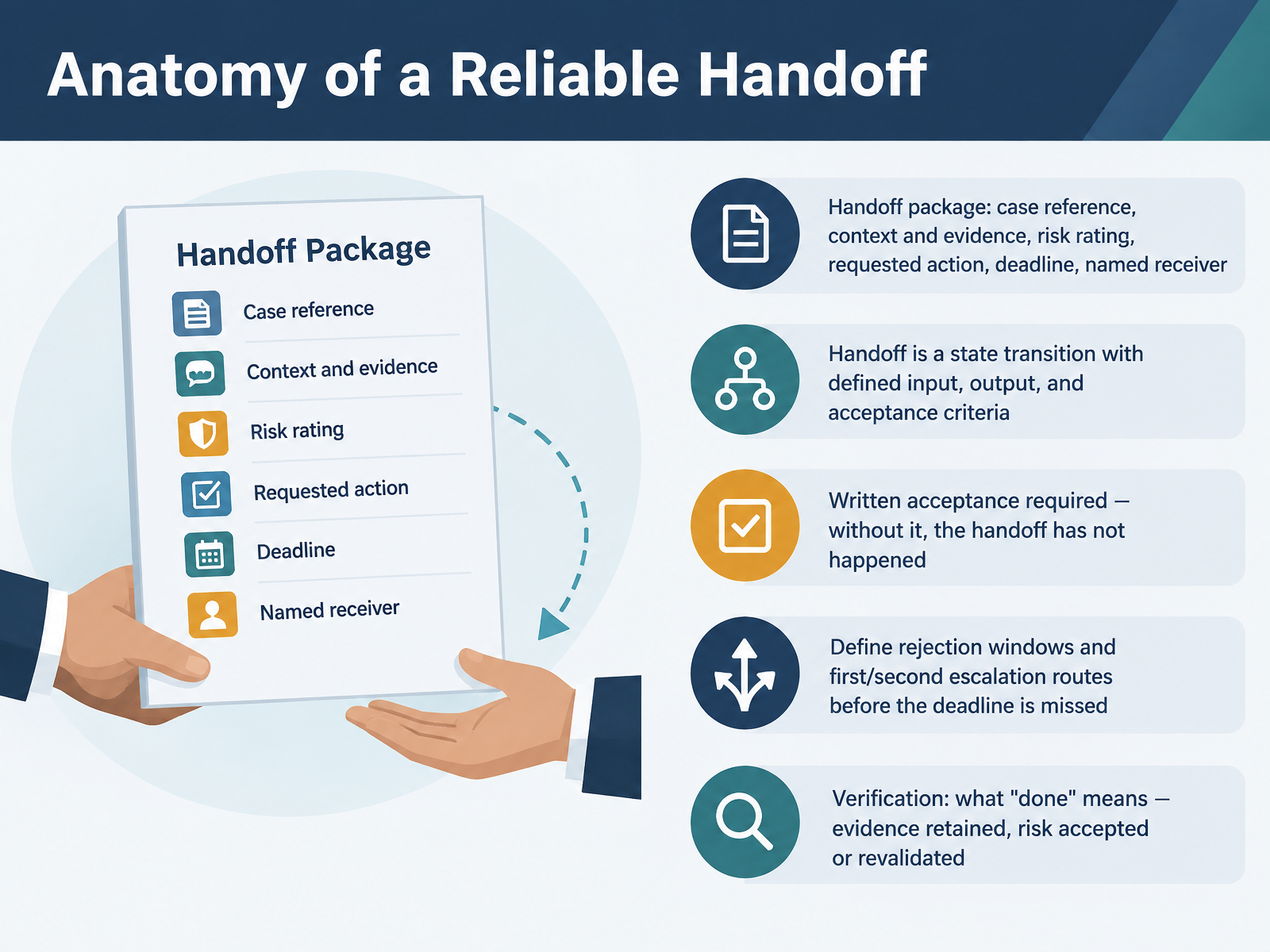
- 06Anatomy of a Reliable HandoffLet's look at what makes a handoff reliable. Picture a security analyst passing an incident to the engineering team. The handoff document carries a case reference, the context and evidence, a risk rating, the requested action, a deadline, and one named receiver. Treat the handoff as a state transition, with defined input, output, and acceptance criteria. Here is the part teams skip: written acceptance is required. Without it, the handoff has not happened, you have only filed a ticket and hoped. So define your rejection windows and your first and second escalation routes before a deadline slips. And agree on verification: what does done mean? The fix is applied, evidence is retained, and the risk is accepted or revalidated. Make that one repeatable sentence your standard. Next, we put this into practice with a critical vulnerability scenario.
 nhimg.orgpellera.compaloaltonetworks.com+22 min
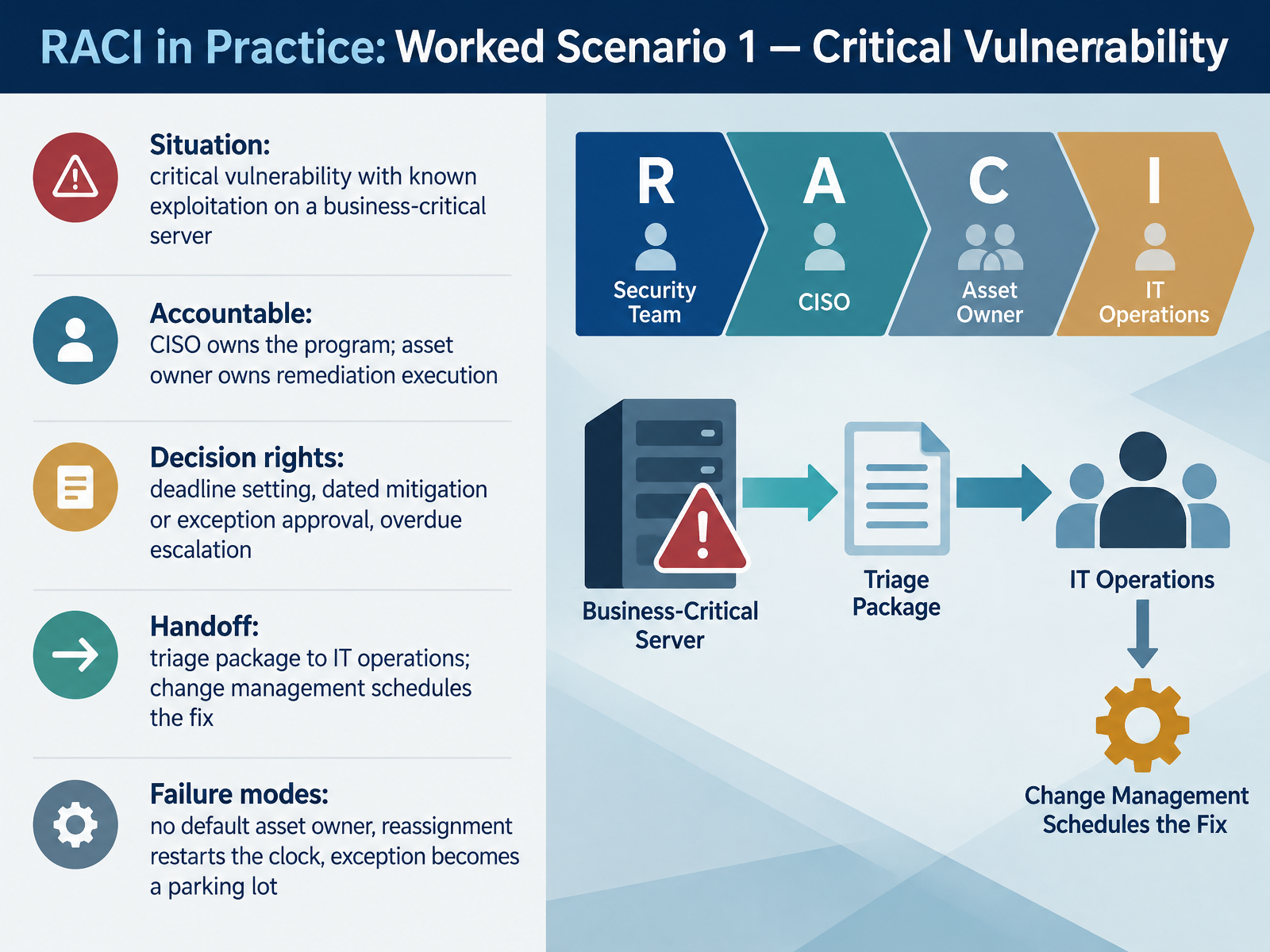
- 07RACI in Practice: Worked Scenario 1 — Critical VulnerabilityLet's walk through a worked scenario. A critical vulnerability with known exploitation lands on a business-critical server. Here is how the roles split. The CISO is accountable for the program: policy, risk appetite, and deadlines. The asset owner is accountable for remediation execution on that server. One accountable party per activity, never two. Decision rights are explicit: who sets the deadline, who approves a dated mitigation or a formal exception, and who triggers escalation when work goes overdue. Now the handoff. Security triages the finding and delivers a package to IT operations. Change management then approves and schedules the fix through a standard or emergency path. Watch three failure modes. No default asset owner means the finding stalls. Reassignment must not restart the clock. And an exception is not a parking lot. It needs a named risk owner, compensating controls, and an expiry date. So remember this: a deadline without a single named owner is a wish, not an SLA. Next, we apply the same RACI logic to a suspected phishing and account compromise.
 cloudaware.comlearn.microsoft.comsecportal.io+22 min
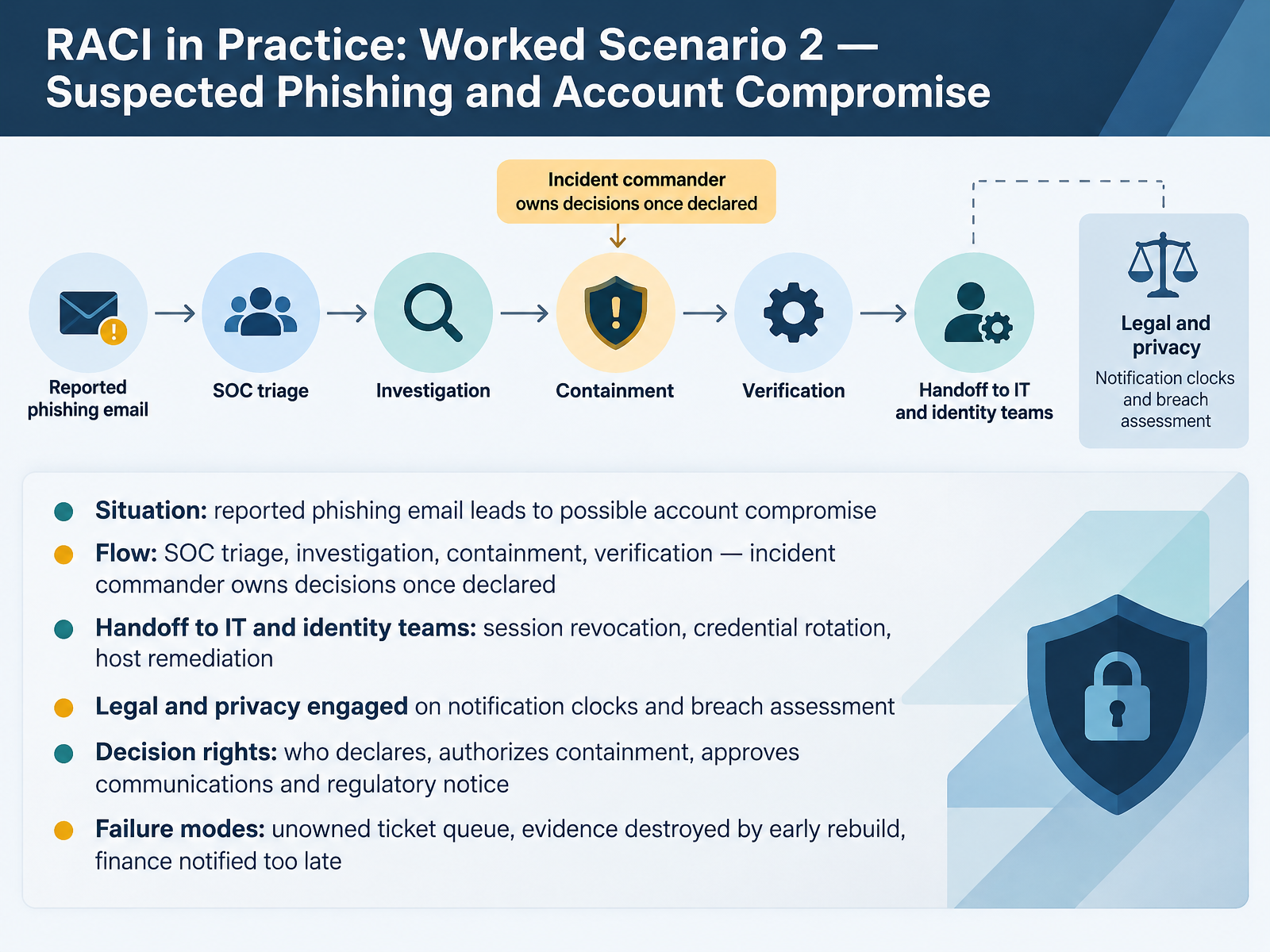
- 08RACI in Practice: Worked Scenario 2 — Suspected Phishing and Account CompromiseLet's work through a second scenario, this time starting with a suspected phishing email that may have led to account compromise. The Security Operations Center, or SOC, triages the report, investigates, contains, and then verifies. Once the incident is formally declared, the incident commander owns the decisions. Here is the handoff point: IT and identity teams take session revocation, credential rotation, and host remediation, and they confirm acceptance in writing. In parallel, Legal and Privacy are engaged on notification clocks and the breach assessment. Decision rights stay simple. Who declares the incident, who authorizes containment, and who approves communications and any regulatory notice. Watch the seams. An unowned ticket queue stalls the response. An early rebuild can destroy evidence. Finance notified too late can close the wire recall window. Takeaway: every handoff needs a named receiver and a clock. Next, we look at an unsanctioned SaaS purchase.
 nvlpubs.nist.govdevsecopsatlas.comunderdefense.com+22 min
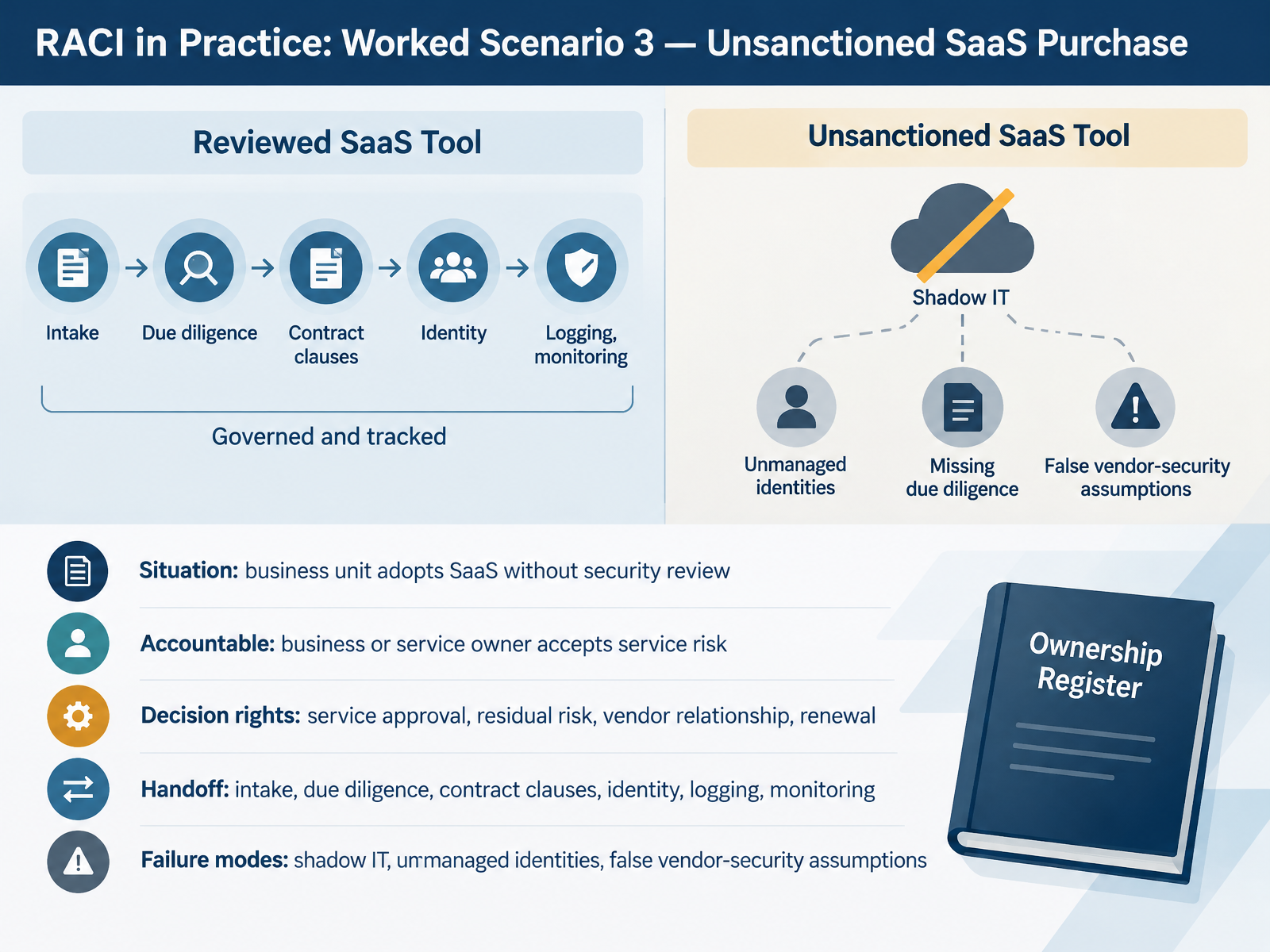
- 09RACI in Practice: Worked Scenario 3 — Unsanctioned SaaS PurchaseLet's walk through a worked scenario. A business unit signs up for a new SaaS, meaning Software as a Service, tool without a security review. This happens often, and the fix is a clear RACI, meaning Responsible, Accountable, Consulted, and Informed. The accountable party is the business or service owner. That person accepts the service risk. Security does not own that decision. We advise, they decide. Decision rights cover four things. Service approval, residual risk, the vendor relationship, and renewal. Then the handoff begins. Intake, due diligence, contract clauses covering security and data, identity provisioning, logging, and monitoring. Signpost the handoff clearly so no step gets dropped. Watch for three failure modes. Shadow IT, where the tool stays invisible. Unmanaged identities, where accounts sit outside single sign on. And false vendor security assumptions, where we trust the provider without checking. Remember this. One accountable owner, explicit handoffs, and no assumptions about who secures what. Next, we look at shared responsibility with cloud and third parties.
 cloudaware.comlearn.microsoft.comsecportal.io+22 min
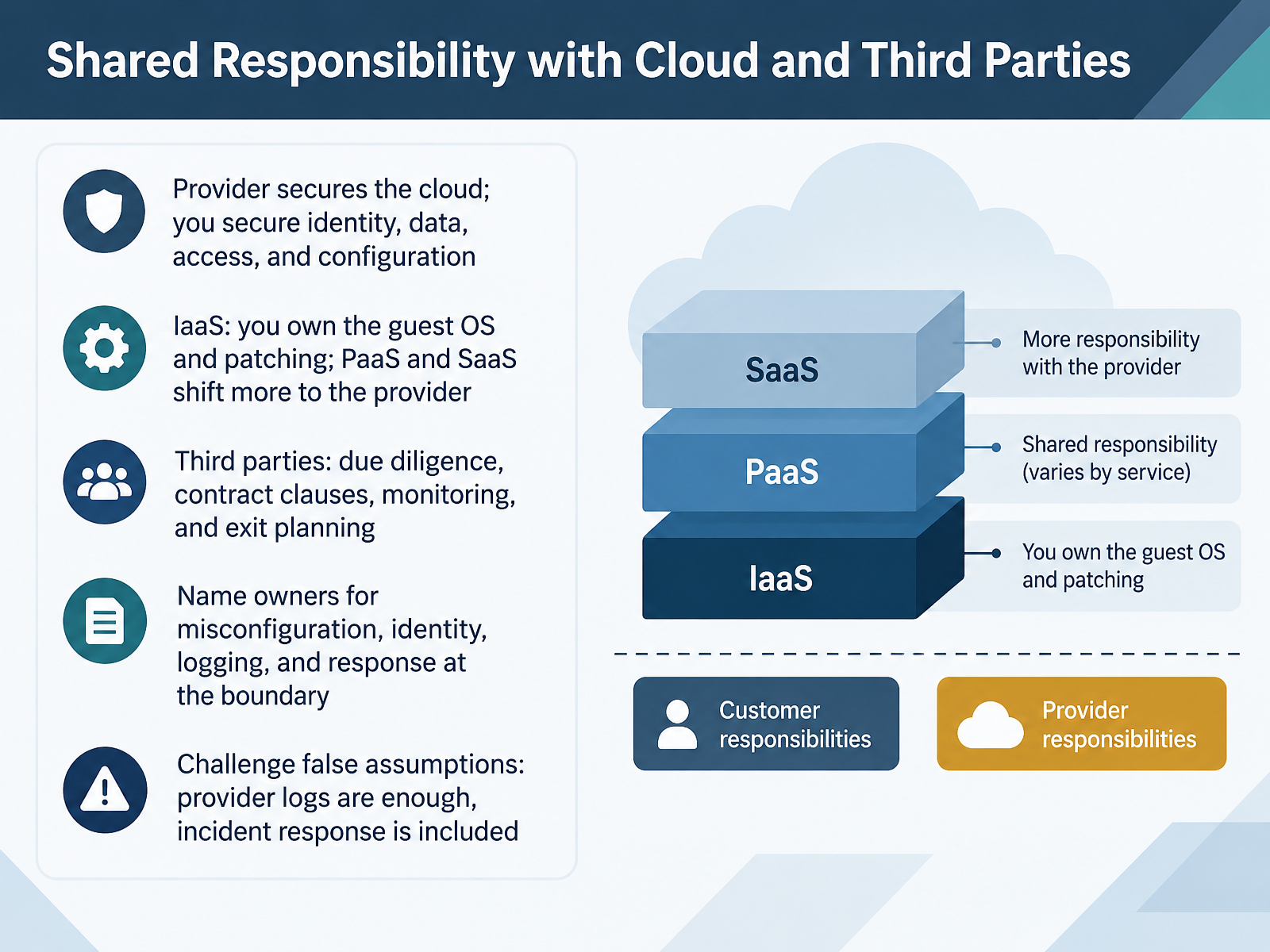
- 10Shared Responsibility with Cloud and Third PartiesNext, let's look at shared responsibility with cloud and third parties. Picture a misconfigured storage bucket at two in the morning. Your provider's infrastructure is secure, but your data is exposed. That is the seam we need to own. The core rule is simple. The provider secures the cloud. You secure identity, data, access, and configuration. The split shifts with the service model. With infrastructure as a service, you own the guest operating system and patching. With platform and software as a service, more shifts to the provider, but your data and access never leave your hands. For third parties, cover due diligence, contract clauses, monitoring, and exit planning. Then name owners for misconfiguration, identity, logging, and response at the boundary. And challenge two false assumptions. Provider logs alone are not enough, and incident response is not automatically included. As responsibility passes to the next owner, confirm who acts next and by when. The takeaway is this: the provider secures the cloud, and we secure what we put in it. That clarity is exactly what the next section builds on, in Making It Stick: Governance Mechanisms.
 cloudaware.comlearn.microsoft.comsecportal.io+22 min
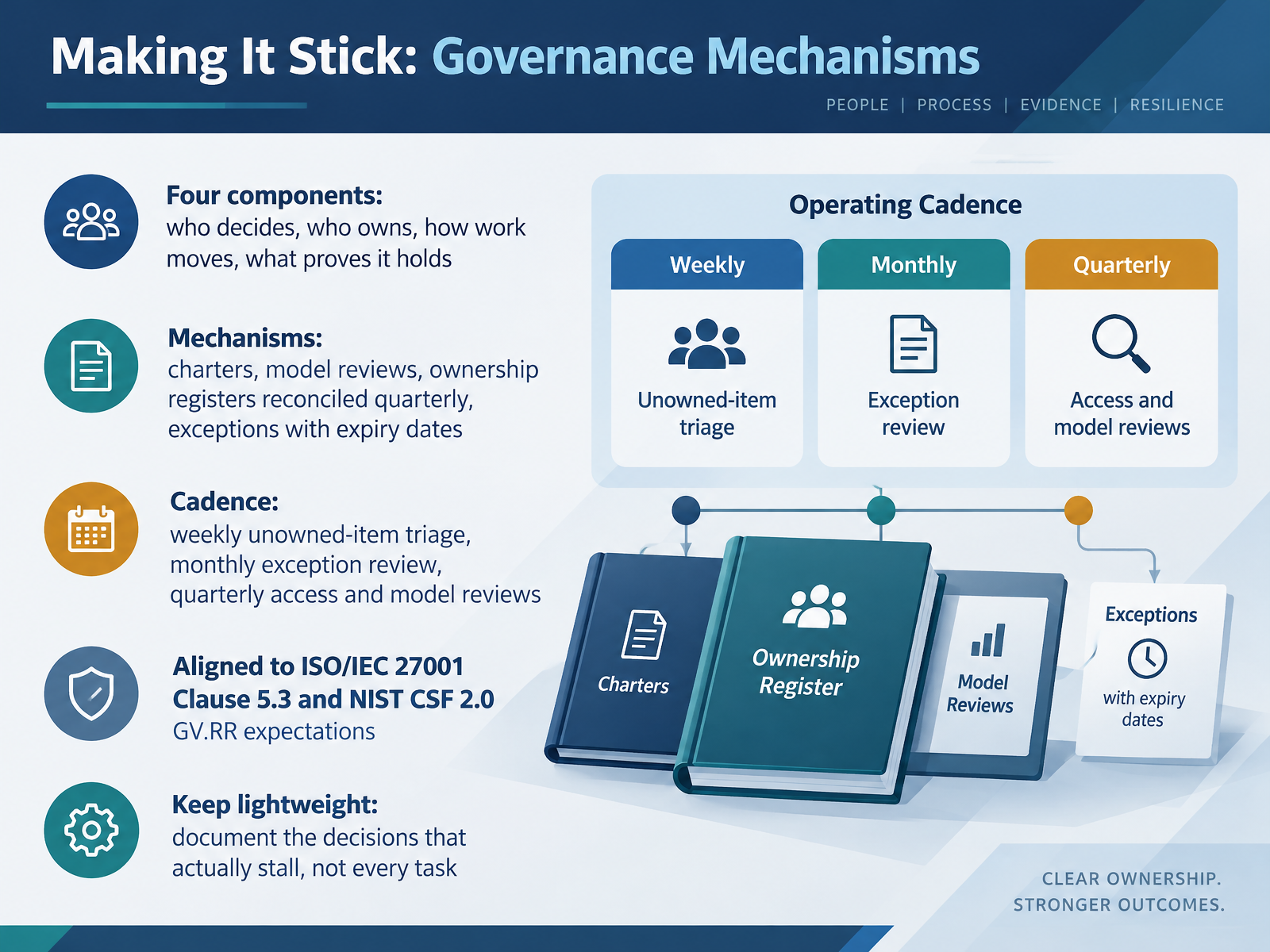
- 11Making It Stick: Governance MechanismsNow, how do you make the model actually stick? Through governance mechanisms. Four components carry it: who decides, who owns, how work moves, and what proves it holds. Keep the artifacts simple. Charters for decision rights. Model reviews on a set cadence. An ownership register, reconciled against the directory every quarter, because every departure is a chance for coverage to drop quietly. And exceptions with expiry dates, so risk acceptance never becomes permanent by default.
The cadence is where this lives. Weekly, we triage unowned items. Monthly, we review open exceptions. Quarterly, we review access and the model itself. This lines up with ISO/IEC 27001 Clause 5.3 and NIST CSF 2.0 GV.RR, which both ask you to assign and communicate roles and authorities.
Here's the trade-off. Governance heavy enough to cover every task becomes busywork nobody reads. So stay lightweight: document the decisions that actually stall, not every task. Your takeaway: one named owner per decision, one expiry per exception.
Next, we look at metrics, culture, and sustaining clarity.
 cloudaware.comlearn.microsoft.comsecportal.io+22 min
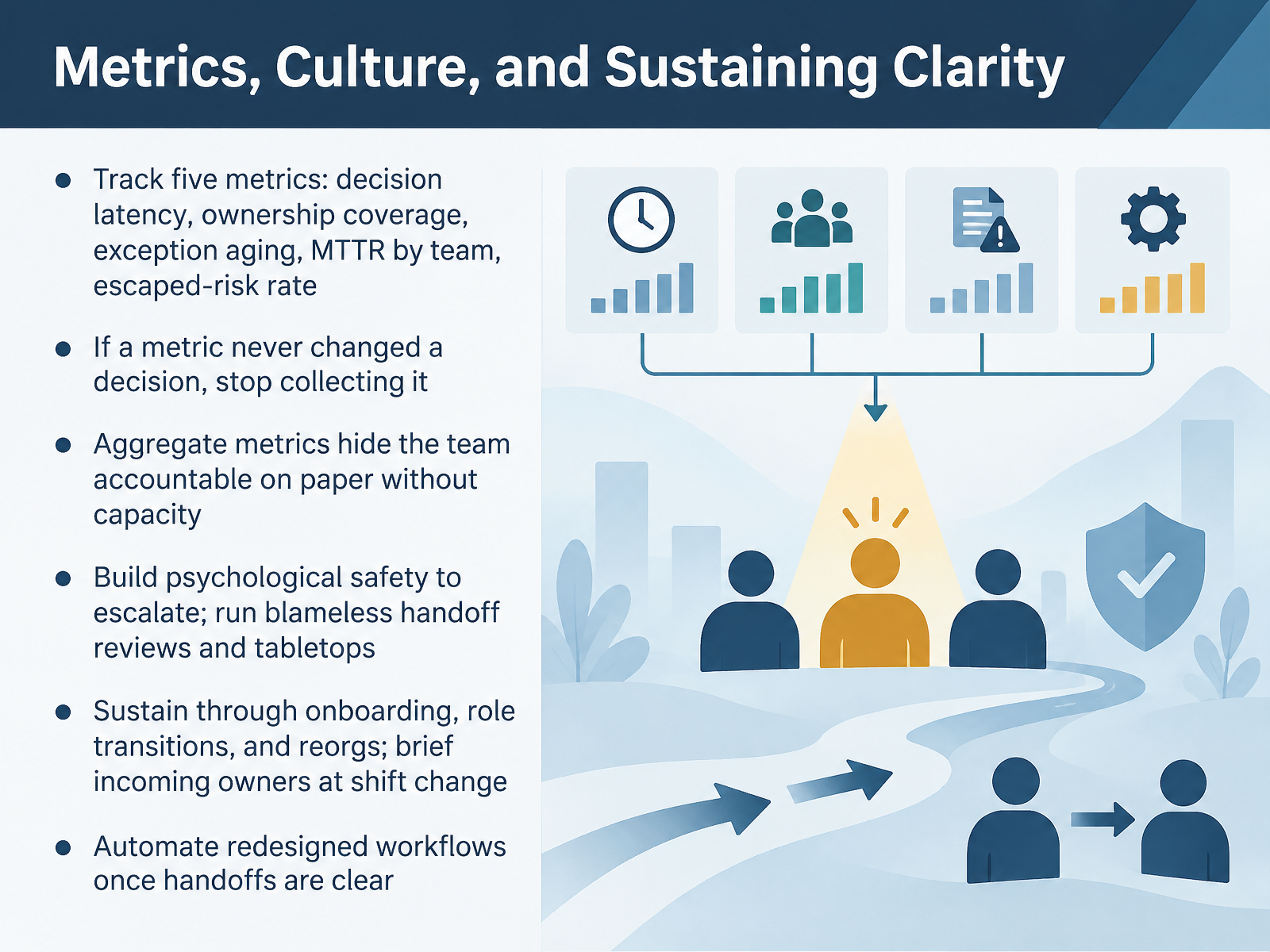
- 12Metrics, Culture, and Sustaining ClarityLet's talk about how you keep clarity from drifting once the model is running. Start with five metrics: decision latency, ownership coverage, exception aging, mean time to remediate by team, and escaped-risk rate. Here's the trade-off. Aggregates are easy to report, but they hide the team that is accountable on paper with no capacity to act. So break remediation out by team. And if a metric has never changed a decision, stop collecting it. Culture matters just as much. People need psychological safety to escalate, so run blameless handoff reviews and tabletops. Sustain clarity through onboarding, role transitions, and reorganizations. At shift change, brief the incoming owner until they acknowledge the work. Then automate redesigned workflows, but only once the handoffs are clear. That is the takeaway: measure what changes decisions, and make every handoff explicit. Next, we move into action planning, with next steps for your team.
 nhimg.orgpellera.compaloaltonetworks.com+22 min
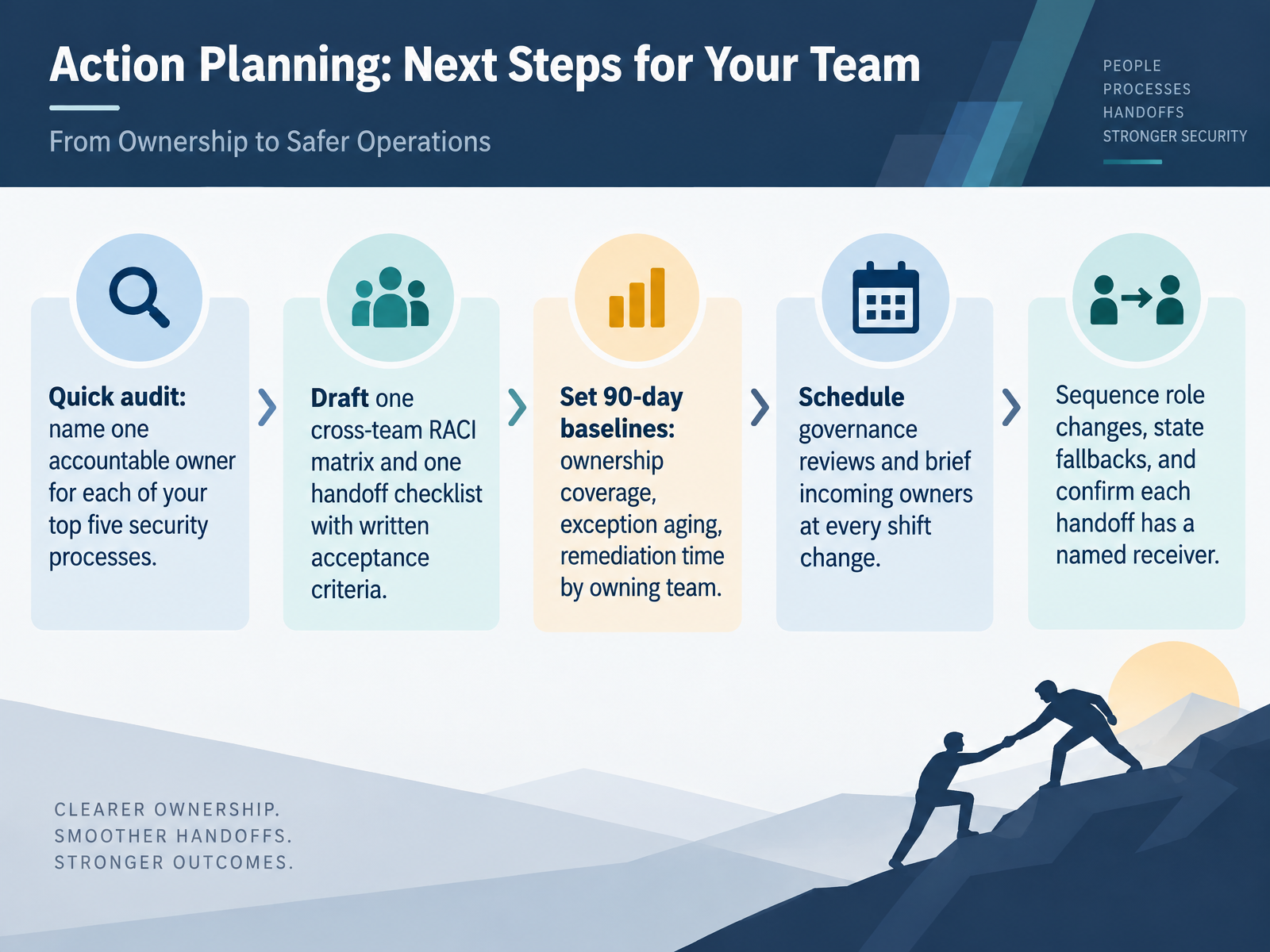
- 13Action Planning: Next Steps for Your TeamNow let's turn the model into a plan. Picture your team on Monday: five critical processes, and nobody sure who signs off. Start with a quick audit. Name one accountable owner for each of your top five security processes. One name per process, not a committee. Next, draft a single cross-team RACI matrix, meaning Responsible, Accountable, Consulted, and Informed, plus one handoff checklist with written acceptance criteria. A handoff is not complete until the receiving owner confirms it in writing. Then set 90-day baselines: ownership coverage, exception aging, and remediation time by owning team. Keep remediation time broken out per team, because an aggregate hides the team that is accountable on paper with no capacity. Here is your handoff point. Schedule governance reviews, and brief incoming owners at every shift change. Sequence role changes, state fallbacks, and confirm each handoff has a named receiver. The takeaway: one accountable owner per process, and every handoff has a named receiver who accepted it. Next, we move to Key Takeaways and Close.
 cloudaware.comlearn.microsoft.comsecportal.io+22 min
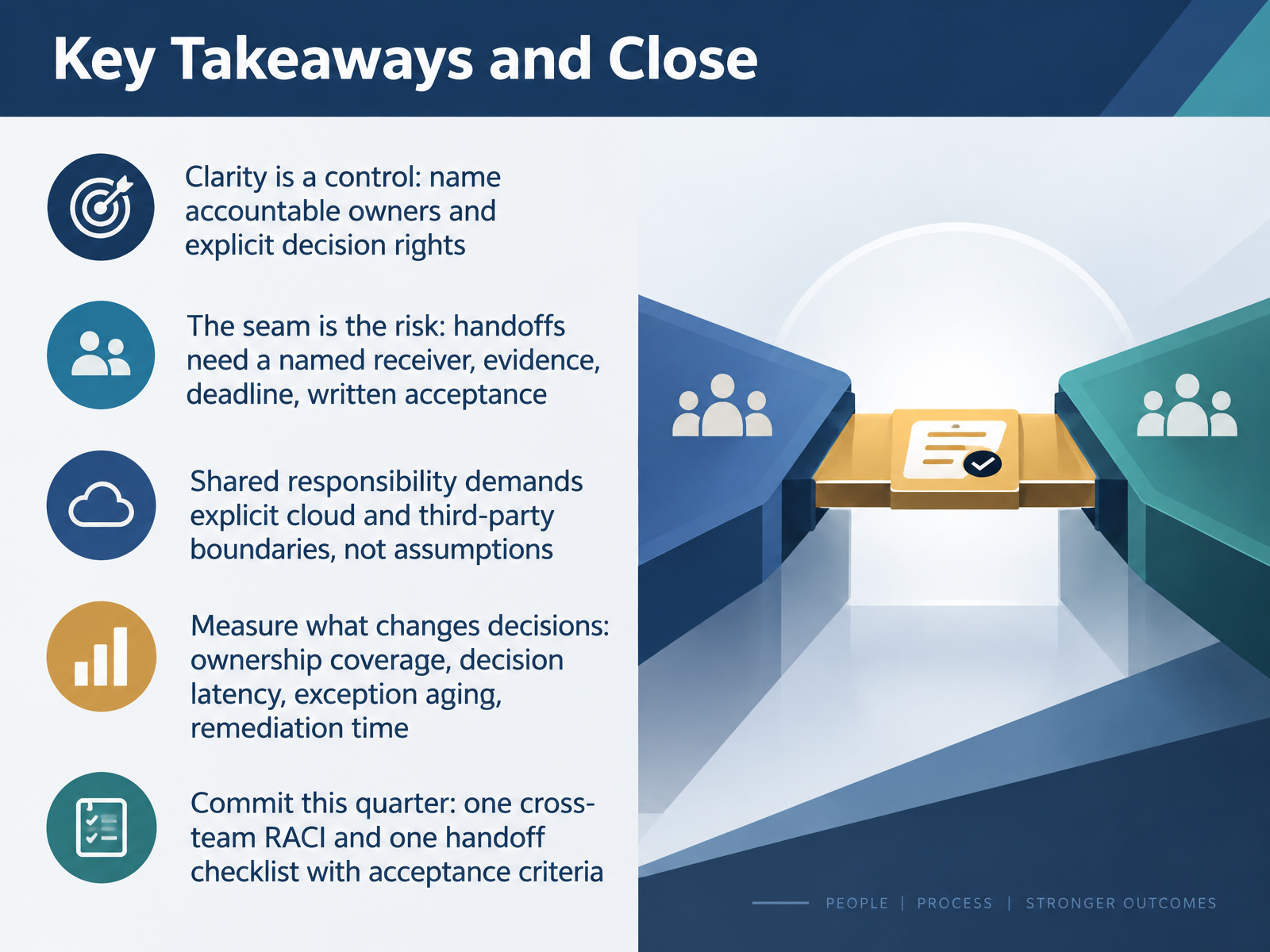
- 14Key Takeaways and CloseLet's bring this together. Clarity is a control. Name the accountable owner and the decision rights in writing. The seam is the risk. Every handoff needs a named receiver, evidence, a deadline, and written acceptance. Shared responsibility demands explicit cloud and third-party boundaries, not assumptions. And measure what changes decisions: ownership coverage, decision latency, exception aging, and remediation time, broken out by team. If a metric never changes a decision, stop collecting it.
Your commitment this quarter is small and concrete: one cross-team RACI, and one handoff checklist with acceptance criteria. Build the RACI only where work crosses a team boundary, and make sure accountability comes with permission to act.
So here is the takeaway to repeat to a colleague: an unowned seam belongs to the attacker, so name the receiver, get acceptance, and close the loop.
Thank you for working through this course. You now have the vocabulary and the practical steps to make ownership visible and handoffs reliable. Start with that single RACI and that single checklist, and build from there. You are ready. Good luck.
 nhimg.orgpellera.compaloaltonetworks.com+22 min
Take the deck with you
Download this course as a file — free, no sign-up needed.
- PDF handoutEvery slide page, ready to print or share.15 pages · 3.3 MBDownload
- Narrated PowerPointThe deck that presents itself — every slide carries the digital human's narration video.15 pages · 12.1 MBDownload
- PowerPoint slidesThe full deck as a .pptx — open it in PowerPoint, Keynote, or Google Slides.15 pages · 3.2 MBDownload
Free to use in your own training — please keep the PersonWise credit page at the end.
Have your own deck? Turn it into a course
Sources consulted
Web sources consulted while building this course.
- NICE Framework: Current Versions | NIST — nist.gov
- NICE Releases NICE Framework Components v2.0.0 | NIST — nist.gov
- Occupations, Jobs, and Work Roles | NIST — nist.gov
- Accomplishments | NIST — nist.gov
- The Evolving NICE Framework: — csrc.nist.gov
- Who is accountable for closing the gap between cloud detection and incident response? — nhimg.org
- Incident Response Handoffs: The Seam You Don't Own, the Attacker Owns - Pellera Technologies — pellera.com
- 2026 Unit 42 Global Incident Response Report - Palo Alto Networks — paloaltonetworks.com
- How Should an Internal Security Team Manage Incident Handoffs with a Managed Detection Services Provider in 2026? — ones.com
- Incident report — NS-2026-1008 — wmouton.gitlab.io
- Vulnerability Management Policy: Free Template & Example — cloudaware.com
- https://learn.microsoft.com/en-us/azure/cloud-adoption-framework/govern/build-cloud-governance-team — learn.microsoft.com
- Free Vulnerability Management RACI Matrix Template — secportal.io
- CLD.6.3.1 Shared roles and responsibilities within a cloud computing environment — it-iso.org
- How to Build a RACI Chart for Vulnerability Management That Actually Works — cybersierra.co
- Incident Response Recommendations and Considerations for Cybersecurity Risk Management: A CSF 2.0 Community Profile — nvlpubs.nist.gov
- Vulnerability Remediation SLA Model: Policy and Examples — devsecopsatlas.com
- SOC Vendor SLA: What to Insist On Before You Outsource Security — underdefense.com
- Incident Response Team Redbook — dir.texas.gov
- Service Level Agreements – Office of Information Security — security.its.northeastern.edu