Begin
14 pages · ~28 min
Reviewing Cybersecurity Projects
This training teaches reviewers how to assess cybersecurity projects, covering key evaluation criteria and best practices. Ideal for team leads and security professionals involved in project reviews.
A digital instructor presents all 14 pages. Hold “Ask” at any point and ask out loud — the answer comes from this course. No sign-up needed.
What you’ll learn
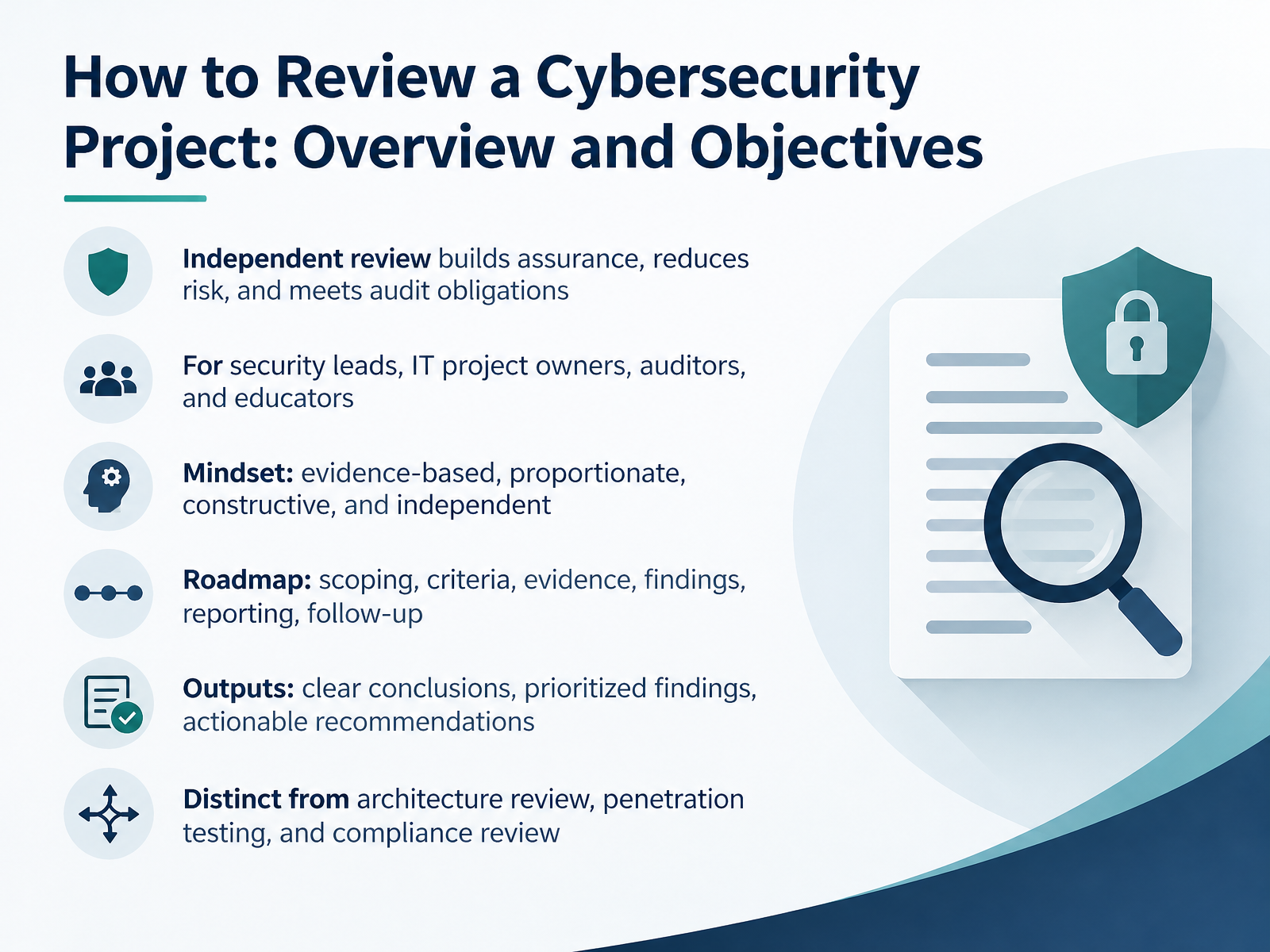
- 01How to Review a Cybersecurity Project: Overview and ObjectivesWelcome. This course shows you how to review a cybersecurity project, and the goal is straightforward. You will learn to run an independent review that builds assurance, reduces risk, and meets audit obligations. The audience is security leads, IT project owners, auditors, and educators, so we skip the basics. The mindset carries the method. Be evidence-based, proportionate, constructive, and independent. Frame judgments as review criteria and trade-offs, not verdicts, because you are balancing audit findings against delivery deadlines. The roadmap runs from scoping and criteria, through evidence and findings, to reporting and follow-up. The outputs are clear conclusions, prioritized findings, and actionable recommendations. Keep in mind what this is not. It differs from architecture review, penetration testing, and compliance review. Those answer narrower questions. This review asks whether the project's security is adequately assured and evidenced across its lifecycle. Throughout, hold one test in mind. Could an independent reader reach your conclusion from the evidence you cite? If not, the finding needs more work. Next, we cover review foundations, including standards, frameworks, and governance.cto.milcto.milopen-exam-prep.com+22 min
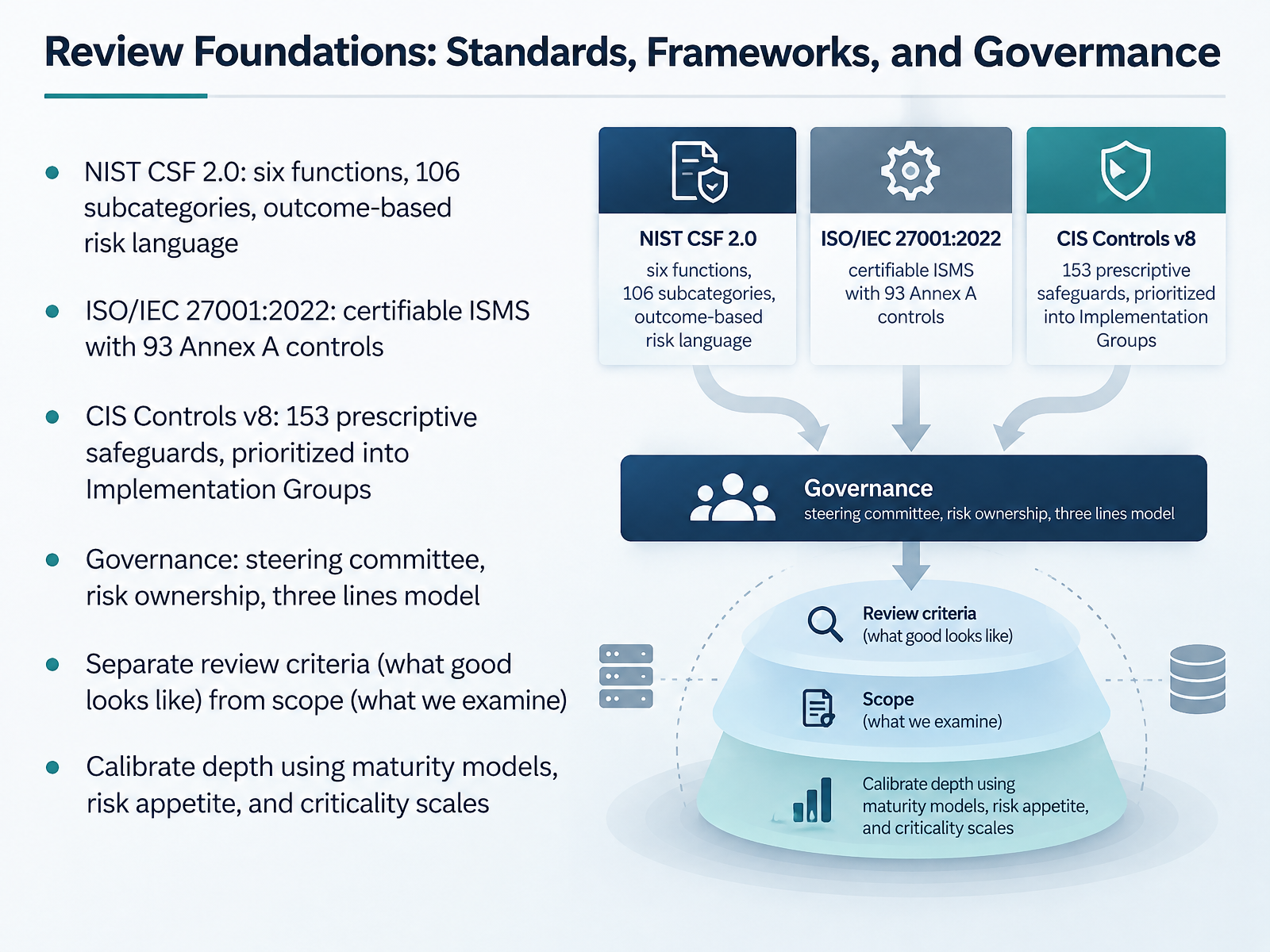
- 02Review Foundations: Standards, Frameworks, and GovernanceLet's establish the review foundations. You will work across three reference frameworks, and you should know what each one is for. NIST CSF 2.0 is outcome-based: six functions, 106 subcategories, and risk language you can take to a steering committee. ISO/IEC 27001:2022 is a certifiable management system, with 93 Annex A controls. CIS Controls v8 gives you 153 prescriptive safeguards, prioritized into Implementation Groups, so you can act this quarter. Governance is the fourth input: a steering committee, named risk owners, and the three lines model. Then separate two things. Review criteria define what good looks like. Scope defines what you examine. Keep them distinct or your findings blur. Calibrate depth using maturity models, risk appetite, and criticality scales, and match that depth to your delivery deadlines. Next, tiering and scoping the review.
 controlmapping.orgcisecurity.orgcisecurity.org+22 min
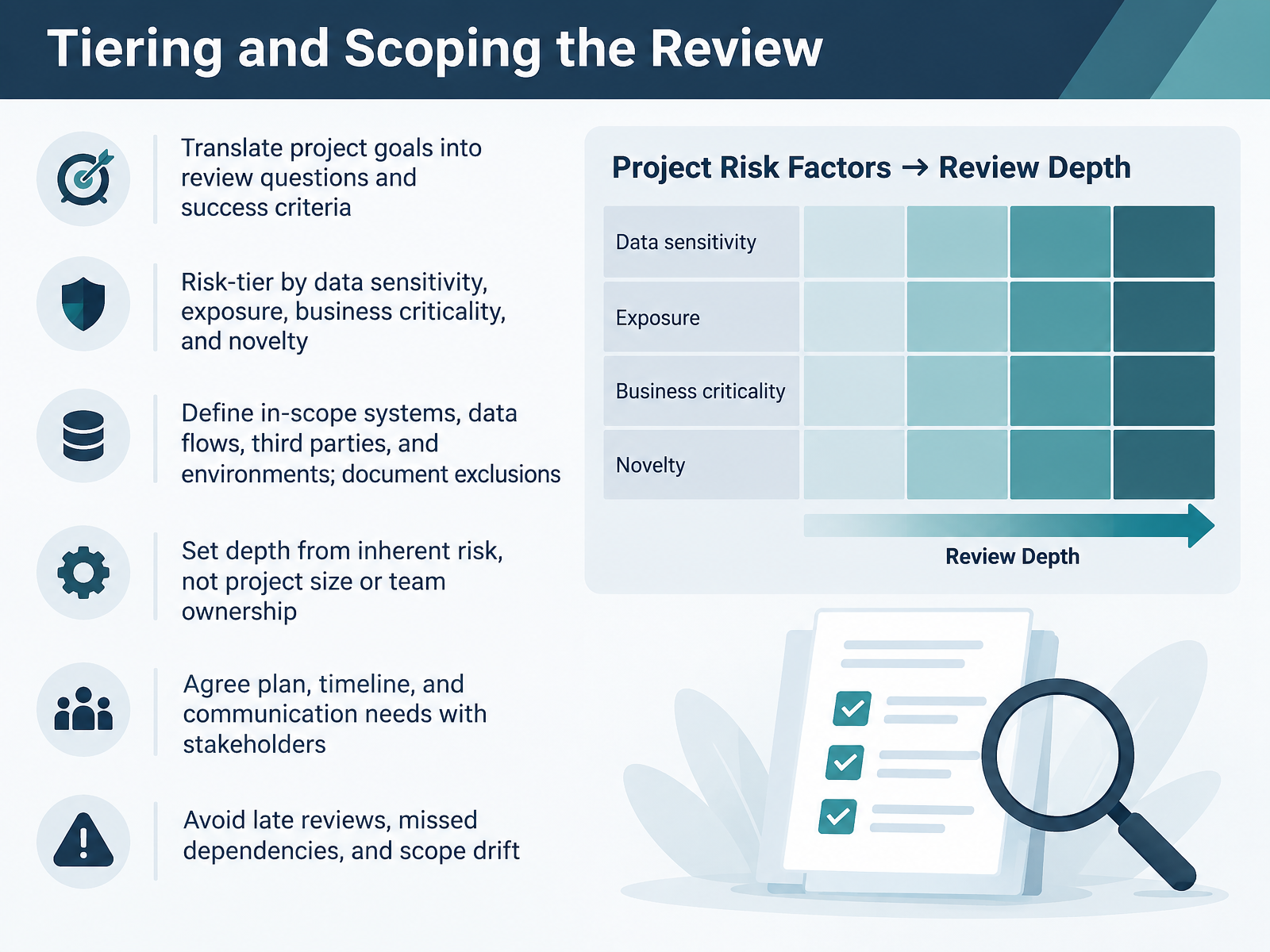
- 03Tiering and Scoping the ReviewLet's look at tiering and scoping. Start by translating project goals into review questions and success criteria. Then risk-tier the project on four factors: data sensitivity, exposure, business criticality, and novelty. Agree those tiers with the business owner, not the delivery team alone. Next, define in-scope systems, data flows, third parties, and environments, and document exclusions in writing. Set review depth from inherent risk, not project size or which team owns it. Then agree the plan, timeline, and communication needs with stakeholders. Watch for three recurring failures: reviews started too late, missed dependencies, and scope drift. Tier first, scope second, and write it down. Next, we move on to security gates across the project lifecycle.
 sans.orgdoi.orgnvlpubs.nist.gov+21 min
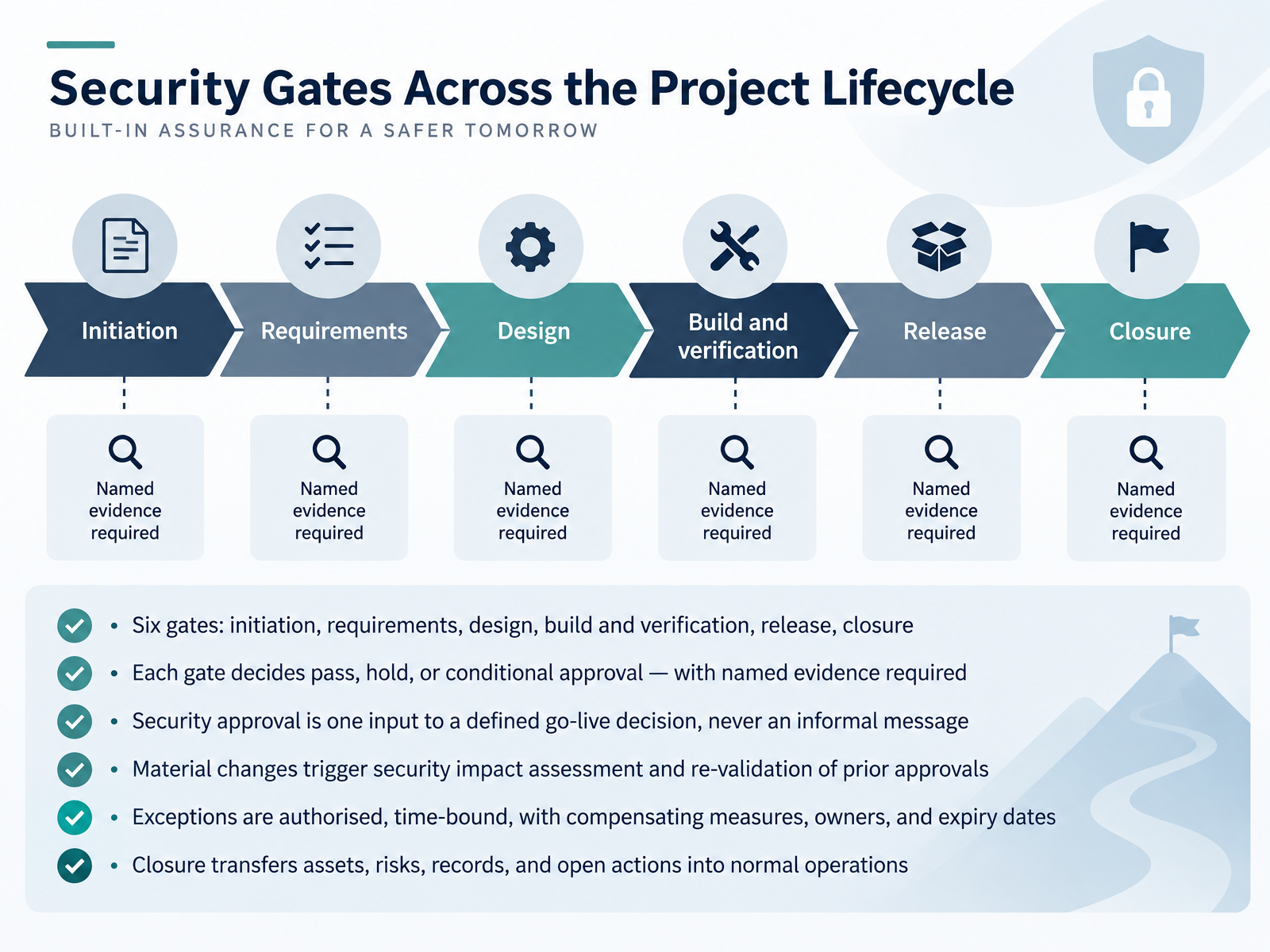
- 04Security Gates Across the Project LifecycleNow let's look at security gates across the lifecycle. There are six: initiation, requirements, design, build and verification, release, and closure. At each gate, the decision is pass, hold, or conditional approval, and the evidence required is named in advance. Treat security approval as one input to a defined go-live decision, not an informal message in a chat. Material changes should trigger a security impact assessment and re-validation of earlier approvals, so a design approved in March is not assumed valid in September. Exceptions are authorised and time-bound, with compensating measures, a named owner, and an expiry date. At closure, transfer assets, risks, records, and open actions into normal operations. Next, we move into design evidence: architecture, threat modeling, and controls.
 security.gov.ukdigital.nsw.gov.aucsrc.nist.gov+22 min
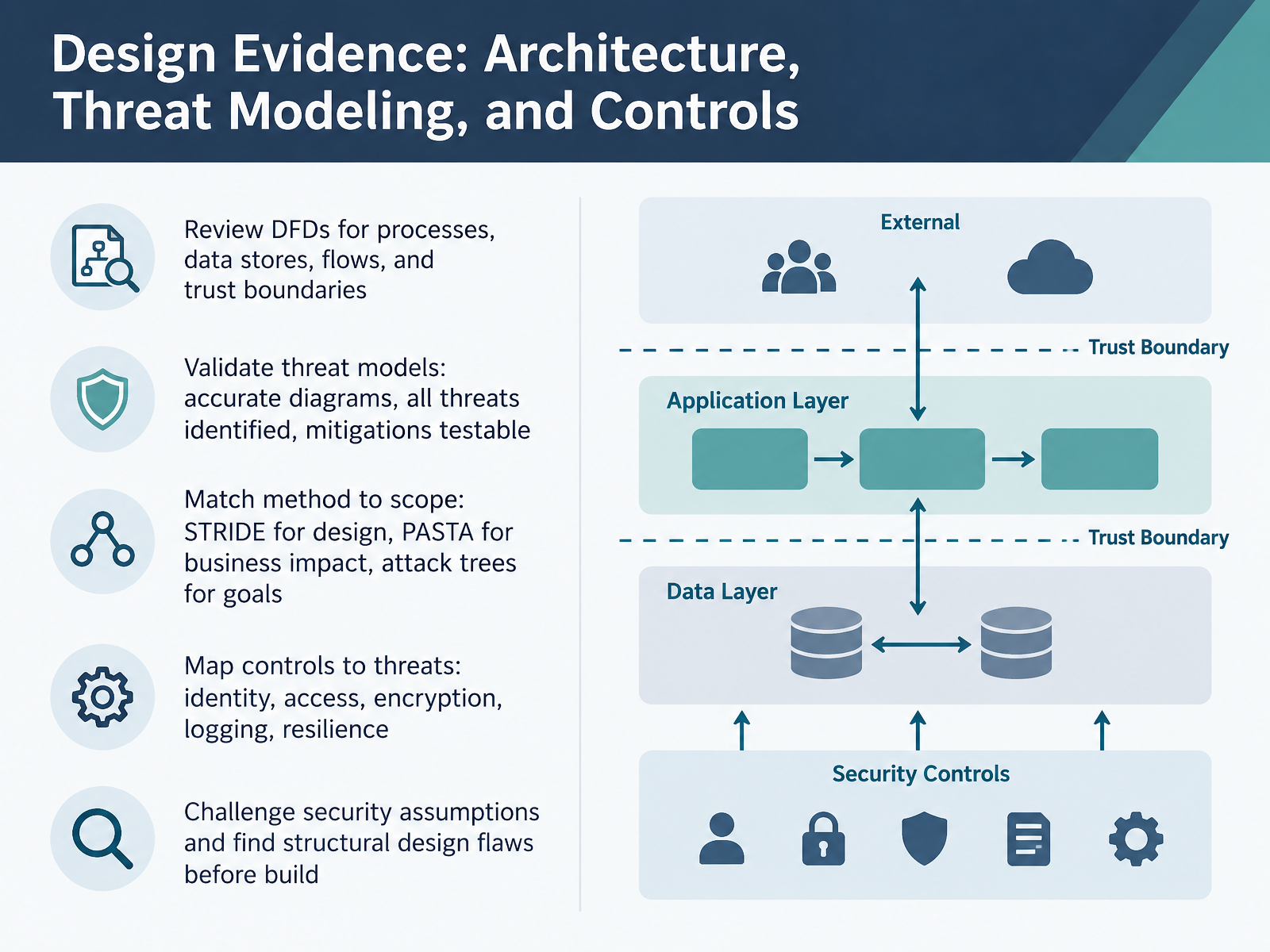
- 05Design Evidence: Architecture, Threat Modeling, and ControlsNow let's look at design evidence. Start with the data flow diagrams. Check that processes, data stores, flows, and trust boundaries are all present. Every boundary crossing is a candidate threat, so confirm those lines are drawn. Then validate the threat model. The diagrams should match the system, threats should be identified across components and flows, and every mitigation should be testable.
Match the method to scope. STRIDE fits technical design. PASTA ties threats to business impact. Attack trees work for a specific attacker goal. State why the chosen method fits, and note what it does not cover. Next, map controls to threats across identity, access, encryption, logging, and resilience. Look for gaps and redundancy.
Finally, challenge the security assumptions. Find structural design flaws before build, where they are cheaper to fix. Next, we move to implementation and operational readiness review.
 2 min
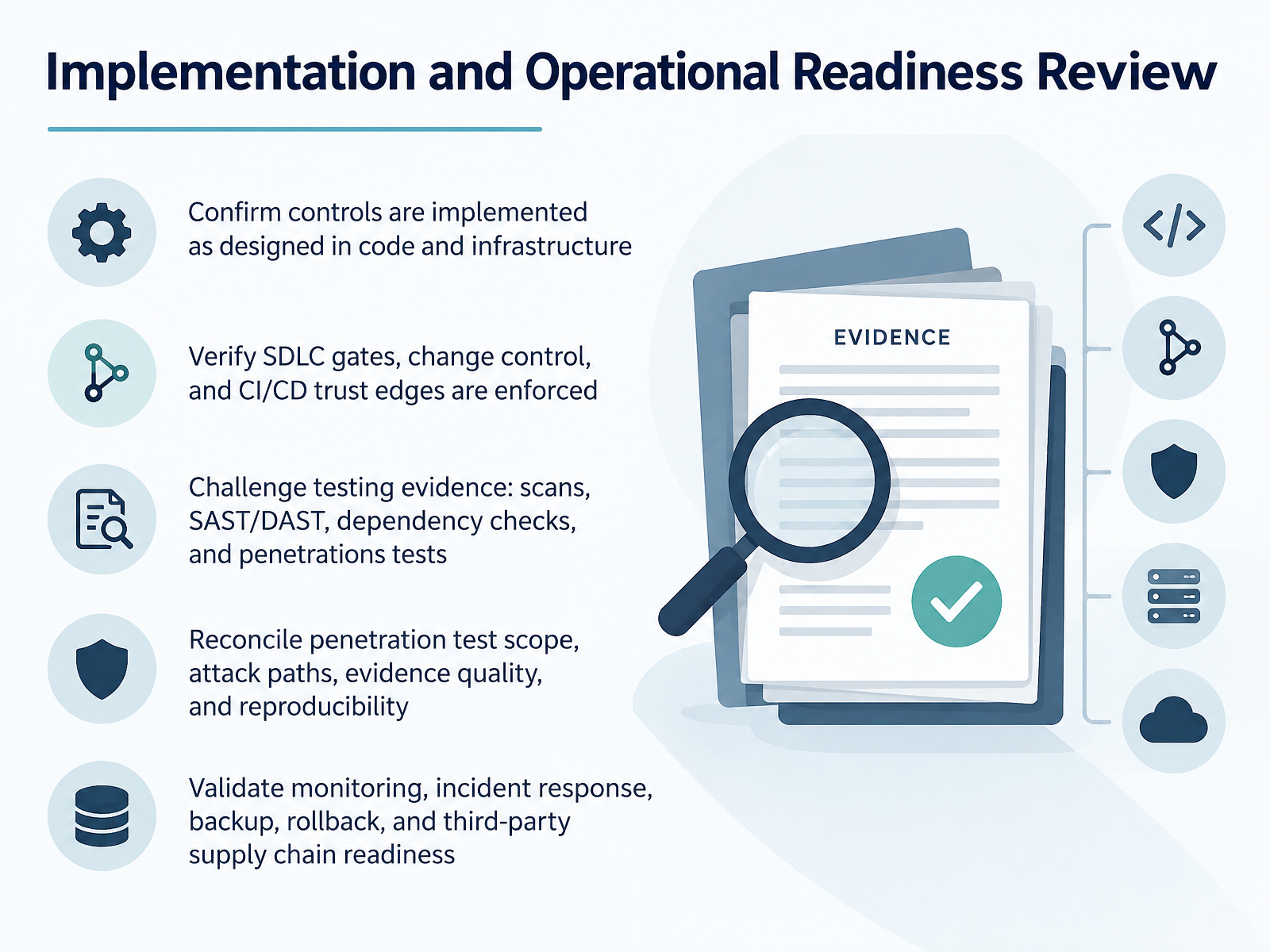
- 06Implementation and Operational Readiness ReviewNow we move to implementation and operational readiness. First, confirm controls are implemented as designed, in code and in infrastructure. Written policy is not evidence; deployed state is. Next, verify SDLC gates, change control, and CI/CD trust edges are enforced. Use negative tests: an unsigned artifact should be refused promotion, and a fork job should not read protected secrets. Then challenge testing evidence. Ask for scans, SAST and DAST results, dependency checks, and penetration tests, with reproducible records and clear owners. Reconcile penetration test scope, attack paths, evidence quality, and reproducibility against the rules of engagement. Confirm what was in scope and what was not. Finally, validate monitoring, incident response, backup, rollback, and third-party supply chain readiness. You are balancing these findings against delivery deadlines, so focus on enforcement evidence and accepted risk. From Evidence to Findings: Condition, Criteria, Cause, Effect.
 cto.milcto.milopen-exam-prep.com+22 min
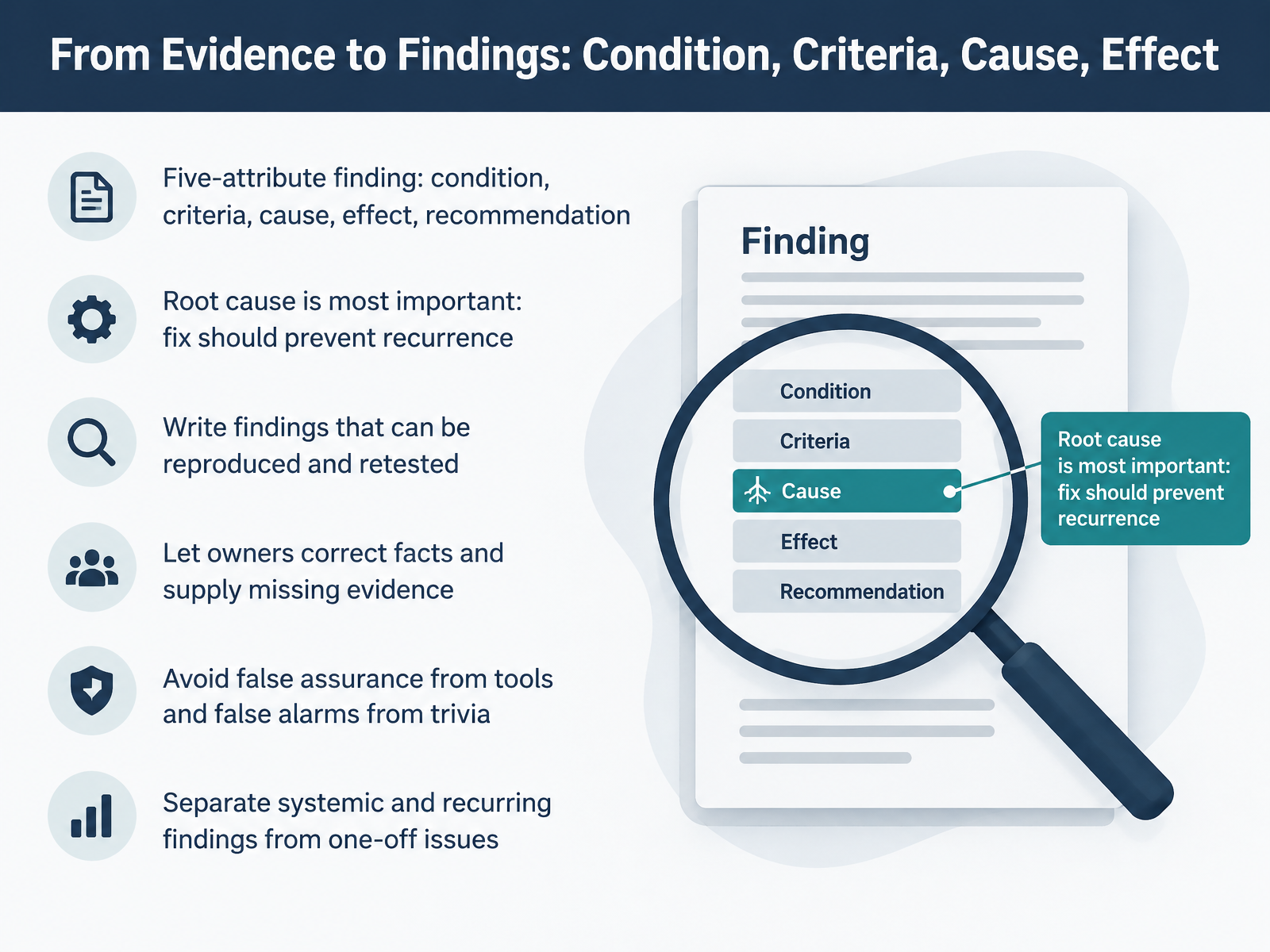
- 07From Evidence to Findings: Condition, Criteria, Cause, EffectNow let's move from raw evidence to well-formed findings. Use the five-attribute structure: condition, criteria, cause, effect, and recommendation. Condition states what you observed. Criteria states what should be true. Effect states the impact, quantified where you can. Cause is the most important attribute. Correcting the root cause should prevent recurrence, not just clear the symptom. Write each finding so another reviewer can reproduce it and retest the fix. Before you publish, give owners a chance to correct facts and supply missing evidence. Keep disagreements on record. Avoid false assurance from tool output and false alarms from trivia. Separate systemic and recurring findings from one-off issues, because they demand different responses. Next, we will look at risk rating and prioritizing remediation.
 2 min
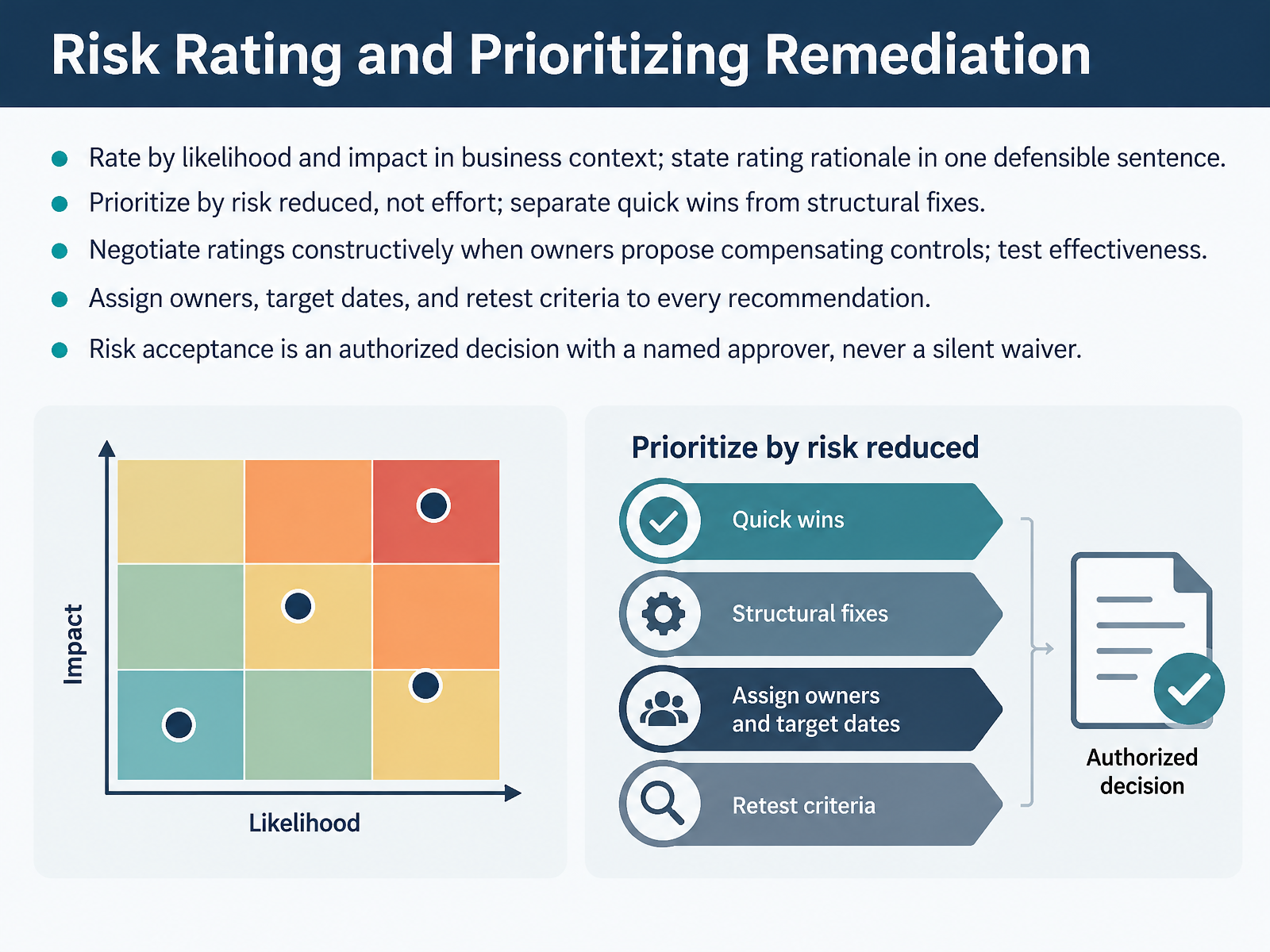
- 08Risk Rating and Prioritizing RemediationNow let's look at risk rating and how you prioritize remediation. Rate each finding by likelihood and impact in the business context, then state the rationale in one defensible sentence. Prioritize by risk reduced, not by effort. Separate quick wins from structural fixes so owners see both. When owners propose compensating controls, negotiate the rating constructively and test whether the control actually works. Every recommendation needs an owner, a target date, and retest criteria. And risk acceptance is an authorized decision with a named approver, never a silent waiver. Next, we move on to reporting and communicating review results.
 1 min
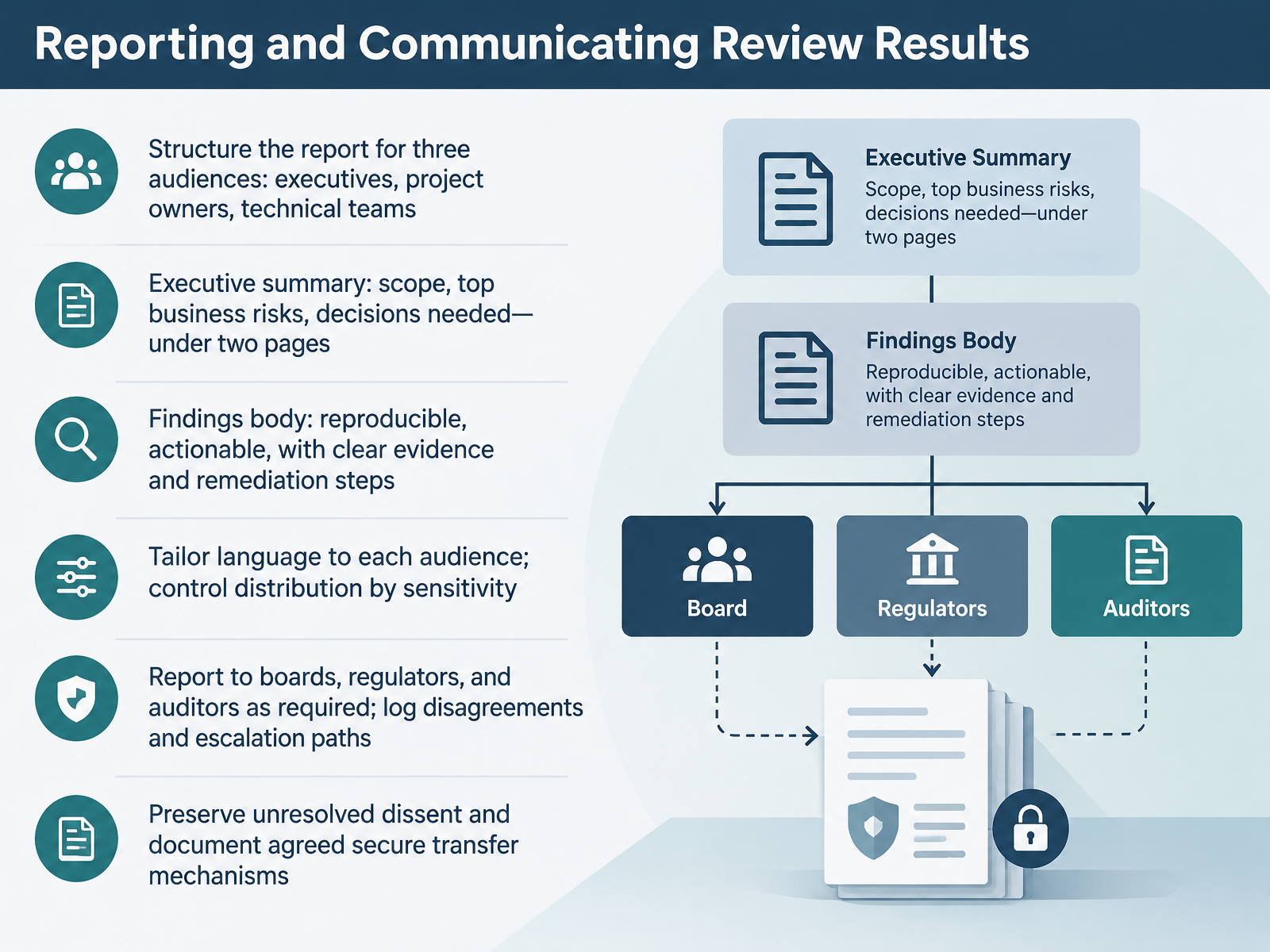
- 09Reporting and Communicating Review ResultsNow let's look at reporting and communicating review results. Structure the report for three audiences: executives, project owners, and technical teams. The executive summary covers scope, top business risks, and the decisions you need, in under two pages. The findings body stays reproducible and actionable, with clear evidence and remediation steps. Tailor the language to each audience, and control distribution by sensitivity. Report to boards, regulators, and auditors as required, and log disagreements and escalation paths. Preserve unresolved dissent rather than smoothing it over, and document agreed secure transfer mechanisms. A useful test: each audience should find what they need without reading the others' sections. That keeps the report trustworthy and the delivery conversation honest. Next, we move to follow-up, verified closure, and continuous improvement.
 2 min
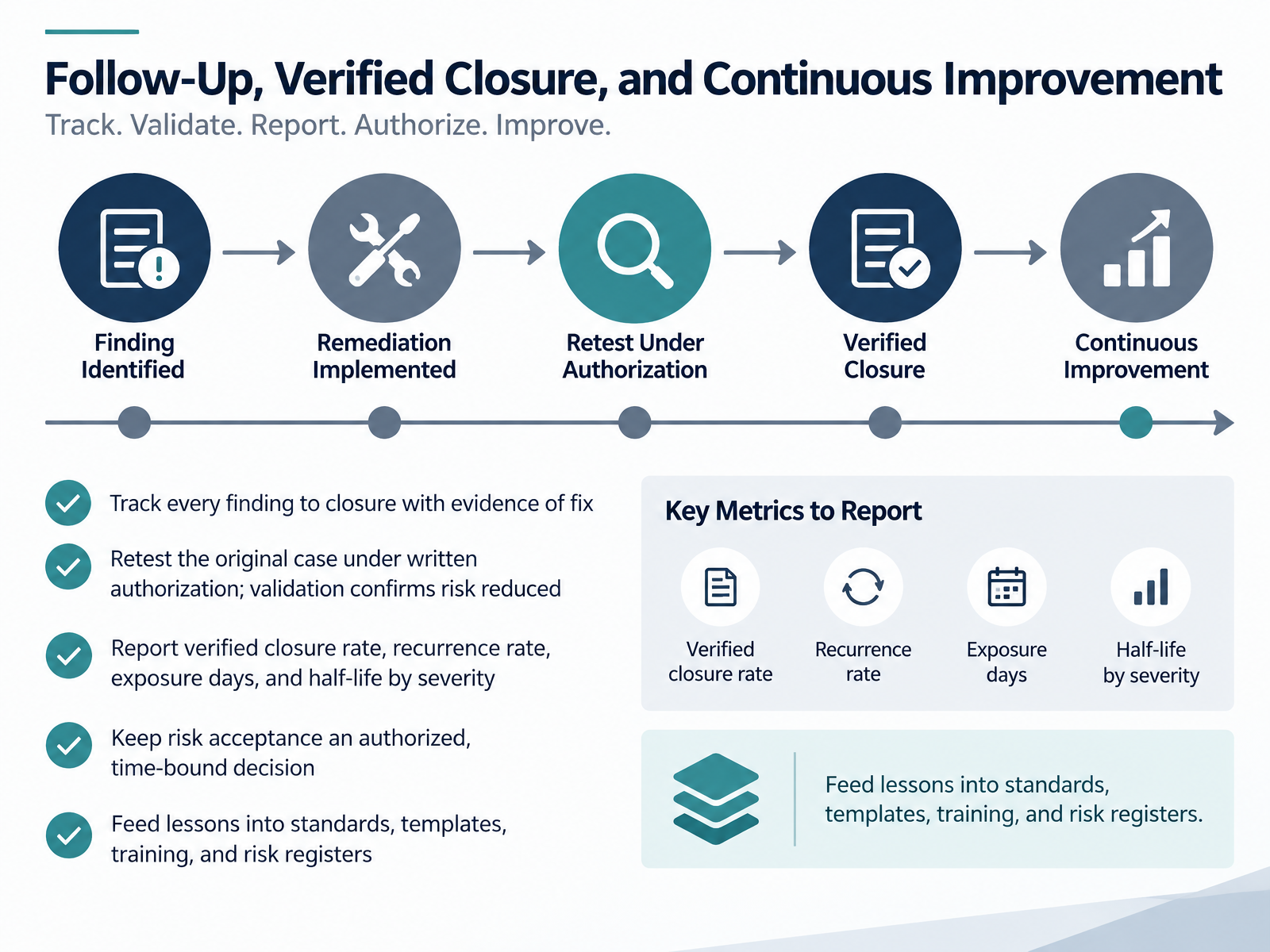
- 10Follow-Up, Verified Closure, and Continuous ImprovementNext, closing the loop. Follow-up is where reviews either hold or quietly erode. Track every finding to closure with evidence of the fix, not just a status change. Then retest the original case under written authorization and stated conditions. Validation confirms the risk actually dropped. Only then close, or keep it open with a time-bound exception. Measure what tells you closure can be trusted: verified closure rate, recurrence rate, exposure days, and half-life by severity. Track these across quarters, not as a single snapshot. Risk acceptance stays an authorized, time-bound decision, reviewed before expiry. Finally, feed lessons into standards, templates, training, and risk registers, so the next project starts stronger. Next, we look at common pitfalls and review anti-patterns.
 2 min
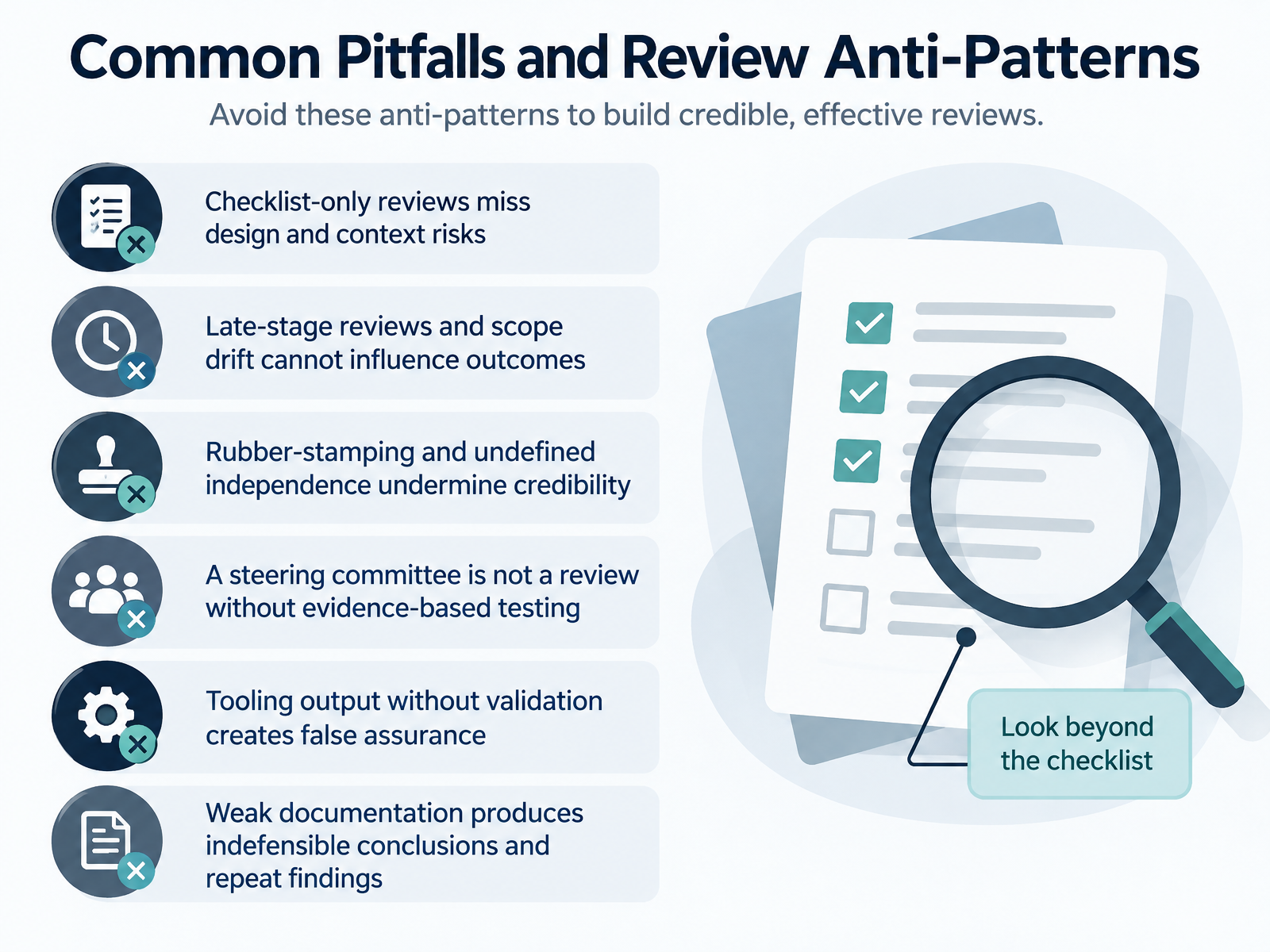
- 11Common Pitfalls and Review Anti-PatternsMoving on, let's look at the common pitfalls and review anti-patterns. A checklist-only review misses design and context risks. It confirms documents exist, not that controls work. Late-stage reviews and scope drift cannot influence outcomes, so raise review early while change is still affordable. Rubber-stamping and undefined independence undermine credibility. Publish your independence criteria and keep conflict attestations. A steering committee is not a review without evidence-based testing. Sample tickets, logs, and change records. Tooling output without validation creates false assurance, so verify the findings before you report them. Weak documentation produces indefensible conclusions and repeat findings. Record what you tested, the evidence, and the root cause. Next, we focus on building reviewer independence and quality assurance.
 1 min
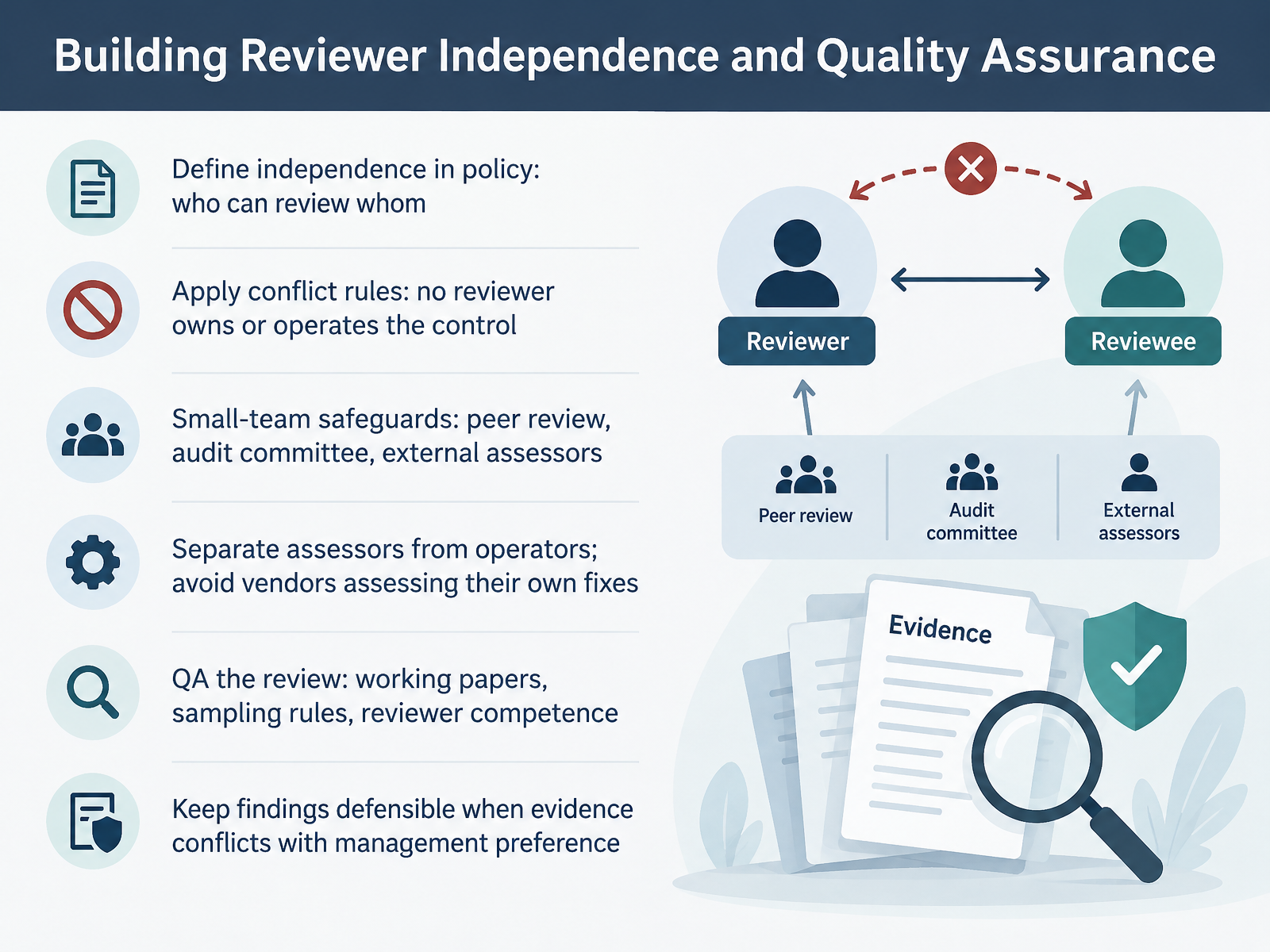
- 12Building Reviewer Independence and Quality AssuranceNext, let's talk about reviewer independence and quality assurance. Start with policy. Define who can review whom, and write it down. Then apply conflict rules. A reviewer must not own, approve, or operate the control under review. In small teams, that is hard, so use safeguards. Cross-functional peer review, audit committee oversight, or an external assessor for high-risk areas. Keep assessors separate from operators. Avoid letting a vendor assess its own fixes. Quality assurance protects the review itself. Keep working papers, define sampling rules, and confirm reviewer competence. When evidence conflicts with management preference, your findings stay defensible if the method is repeatable and documented. Now let's put this into practice, with Applied Practice: End-to-End Review Walkthrough.
 2 min
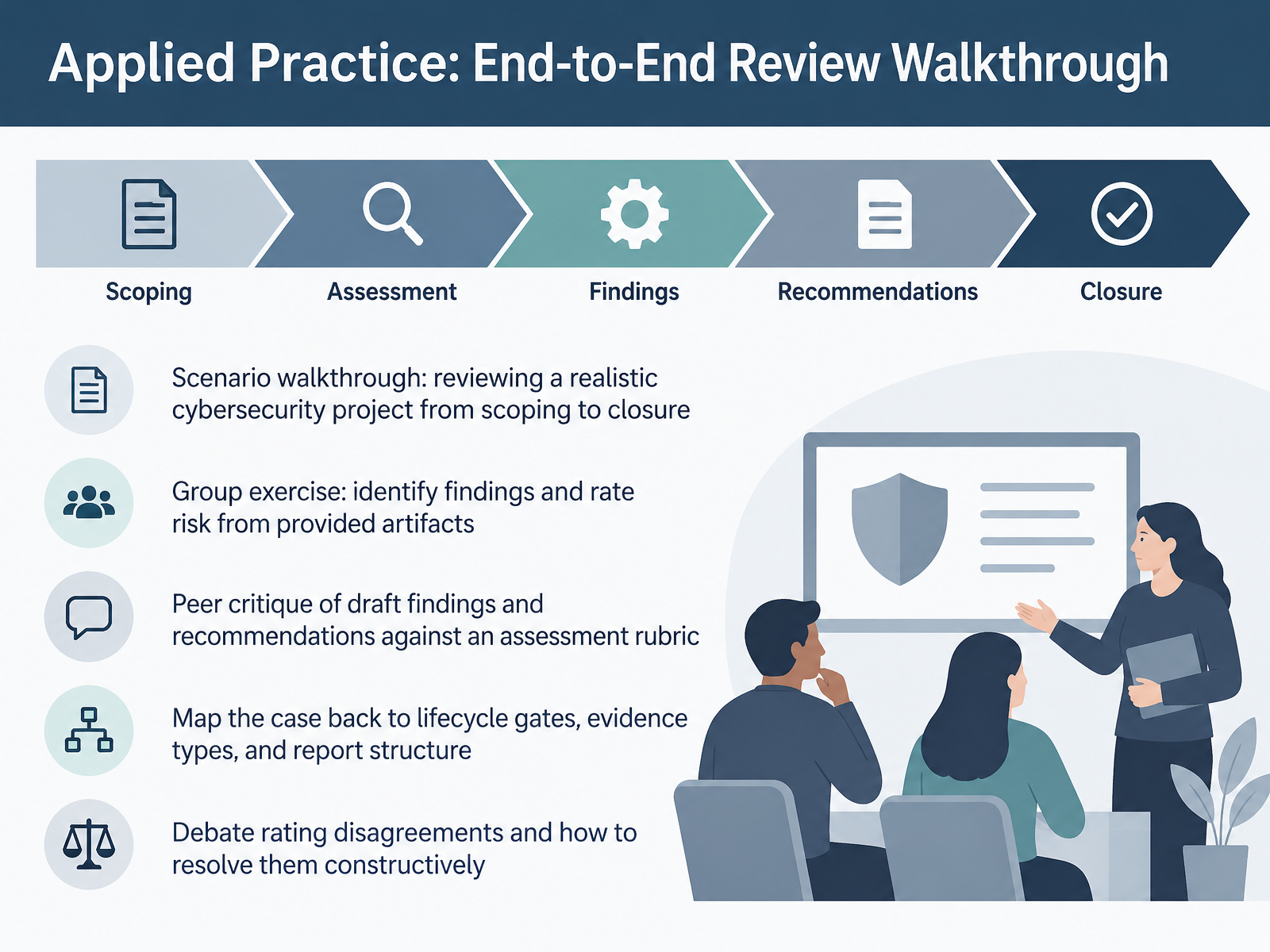
- 13Applied Practice: End-to-End Review WalkthroughNow let's put the method to work end to end. We'll walk through a realistic project, from scoping to closure, and you'll see each gate decision in sequence. In small groups, you'll work the provided artifacts, write findings, and rate risk. Use the five attributes: condition, criteria, cause, effect, recommendation. Keep each finding factual and tied to evidence. Then critique each other's drafts against the rubric. Does the rating match the effect? Is the recommendation addressing cause, or just symptom? Map the case back to lifecycle gates, evidence types, and report structure. Finally, debate the rating disagreements. Where two reviewers diverge, surface the assumption behind each score. Resolve with evidence, not seniority. Record the rationale, and where you still disagree, note it for the sponsor. That keeps audit findings and delivery deadlines in honest tension. Next, we turn this into your own action plan.
 security.gov.ukdigital.nsw.gov.aucsrc.nist.gov+22 min
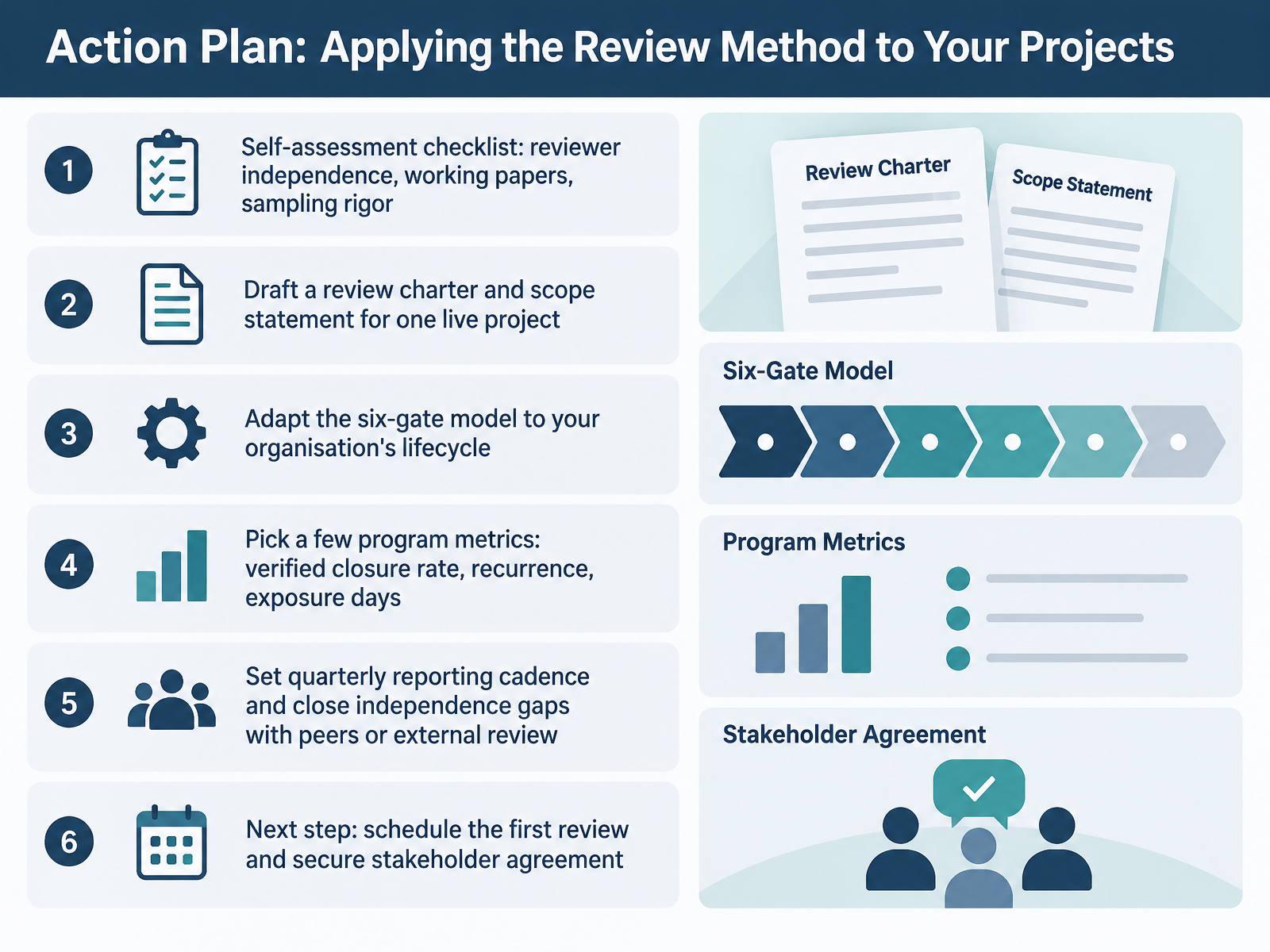
- 14Action Plan: Applying the Review Method to Your ProjectsLet's close with what you can do next week. Start with a short self-assessment checklist: reviewer independence, working papers, and sampling rigor. Then draft a review charter and scope statement for one live project. Adapt the six-gate model to your own lifecycle rather than adopting it unchanged. Pick a few program metrics, such as verified closure rate, recurrence, and exposure days. Set a quarterly reporting cadence, and close independence gaps with peer or external review. One next step: schedule the first review and secure stakeholder agreement. Keep the scope realistic against delivery deadlines. With a defined scope, evidence-based testing, and tracked closure, you can defend your findings and still ship. Thank you for your attention. Apply the method to one project this quarter, and let the evidence guide your next improvement.
 sans.orgdoi.orgnvlpubs.nist.gov+21 min
Take the deck with you
Download this course as a file — free, no sign-up needed.
- PDF handoutEvery slide page, ready to print or share.15 pages · 3.3 MBDownload
- Narrated PowerPointThe deck that presents itself — every slide carries the digital human's narration video.15 pages · 12.0 MBDownload
- PowerPoint slidesThe full deck as a .pptx — open it in PowerPoint, Keynote, or Google Slides.15 pages · 3.2 MBDownload
Free to use in your own training — please keep the PersonWise credit page at the end.
Have your own deck? Turn it into a course
Sources consulted
Web sources consulted while building this course.
- Department of War Cyber Developmental Test and Evaluation Guidebook — cto.mil
- Software Developmental Test and Evaluation in DevSecOps Guidebook — cto.mil
- DevSecOps, SDLC Integration & Supply Chain R | Free Guide 2026 | OpenExamPrep — open-exam-prep.com
- Cloud Security Architecture Review Checklist for 2026 — cloudaware.com
- Cyber Operational Test and Evaluation Guidebook — dote.osd.mil
- Cybersecurity Frameworks Compared — NIST, ISO, CIS, SOC 2, PCI, CMMC | ControlMap — controlmapping.org
- CIS Controls v8 Mapping to NIST CSF 2.0 — cisecurity.org
- CIS Critical Security Controls Navigator - v8 — cisecurity.org
- NIST CSF Mapper — inventivehq.com
- https://controlmapping.org/compare/iso-27001-vs-cis-controls-v8/iso-27001-vs-cis-controls-v8.csv — controlmapping.org
- Scoping Security Assessments - A Project Management ... — sans.org
- An agile IT security model for project risk assessment — doi.org
- Criticality Analysis Process Model: Prioritizing Systems and Components — nvlpubs.nist.gov
- NIST Criticality Analysis — csrc.nist.gov
- Risk Triage and Prototyping in Information Security Engagements — sec.cloudapps.cisco.com
- How to integrate Secure by Design into the government gate review life cycle - UK Government Security - Beta — security.gov.uk
- Gate 5 Review: Guideline and Workbook — digital.nsw.gov.au
- PptxGenJS Presentation — csrc.nist.gov
- Information Security in Projects Under ISO 27001 A.5.8 | AuditPrepared — auditprepared.co
- Evaluating the security impact of changes - UK Government Security - Beta — security.gov.uk