Begin
14 pages · ~28 min
Practical Knowledge Management Workflow
A practical workflow for teams and knowledge managers to identify and overcome common knowledge management challenges.
A digital instructor presents all 14 pages. Hold “Ask” at any point and ask out loud — the answer comes from this course. No sign-up needed.
What you’ll learn
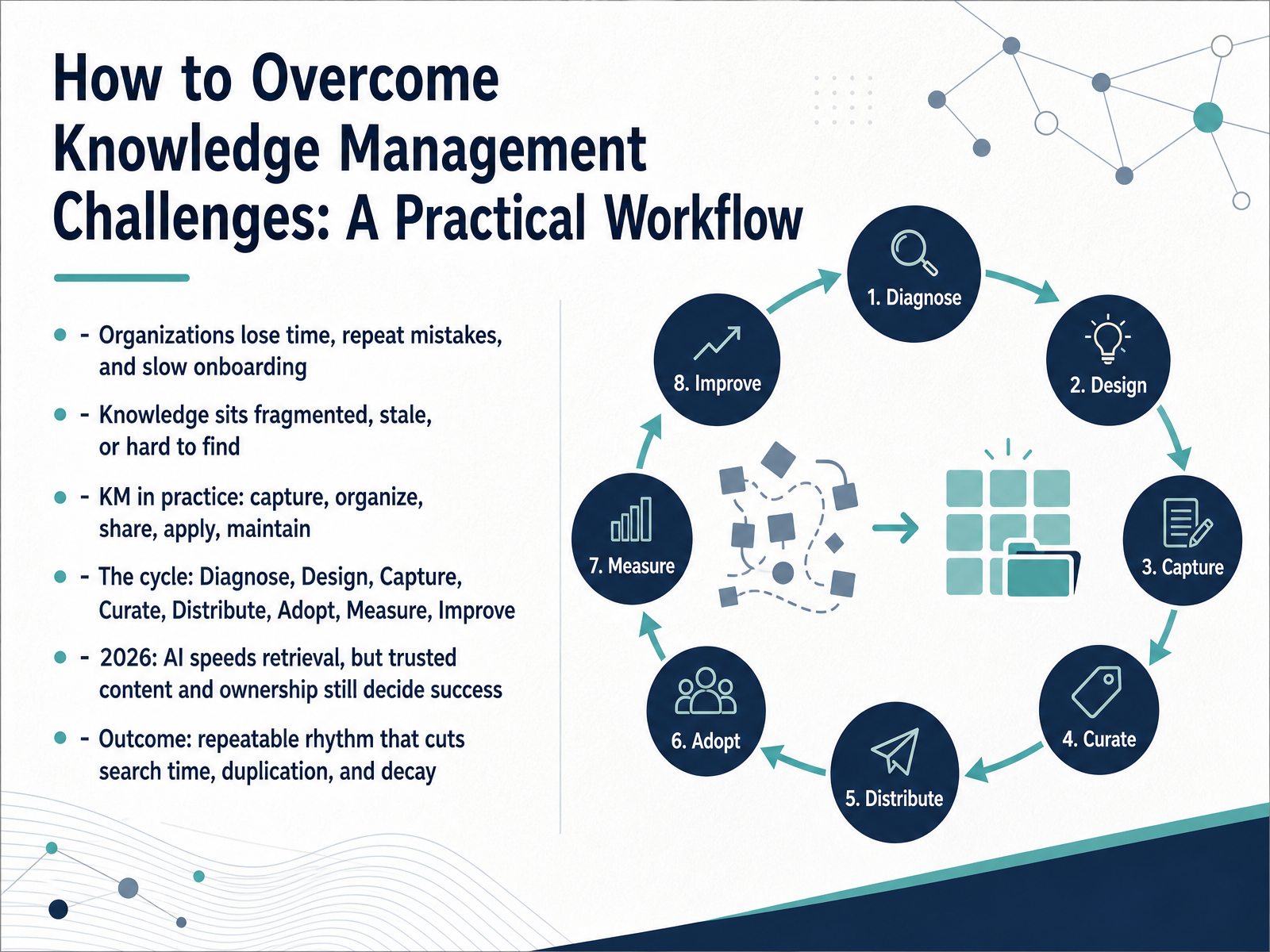
- 01How to Overcome Knowledge Management Challenges: A Practical WorkflowWelcome. Over the next fourteen slides, we are going to build a practical knowledge management workflow you can apply this week. You already know why this matters. Organizations lose time, repeat mistakes, and slow down onboarding. Knowledge sits fragmented, stale, or simply hard to find. So here is the shift. Treat knowledge management as a operating cycle, not a project. Capture, organize, share, apply, maintain. Then run that cycle on a rhythm: Diagnose, Design, Capture, Curate, Distribute, Adopt, Measure, Improve. In 2026, AI speeds up retrieval. But trusted content and clear ownership still decide whether you succeed. AI is only as good as what feeds it. The outcome we are aiming for is a repeatable rhythm that cuts search time, duplication, and content decay. Before we move on, pause here. With your team, name the one step in this cycle that is weakest right now. Then bring it to the next section. Why Knowledge Practices Break Down.kmslh.comknowledge-base.softwarematrixflows.com+22 min
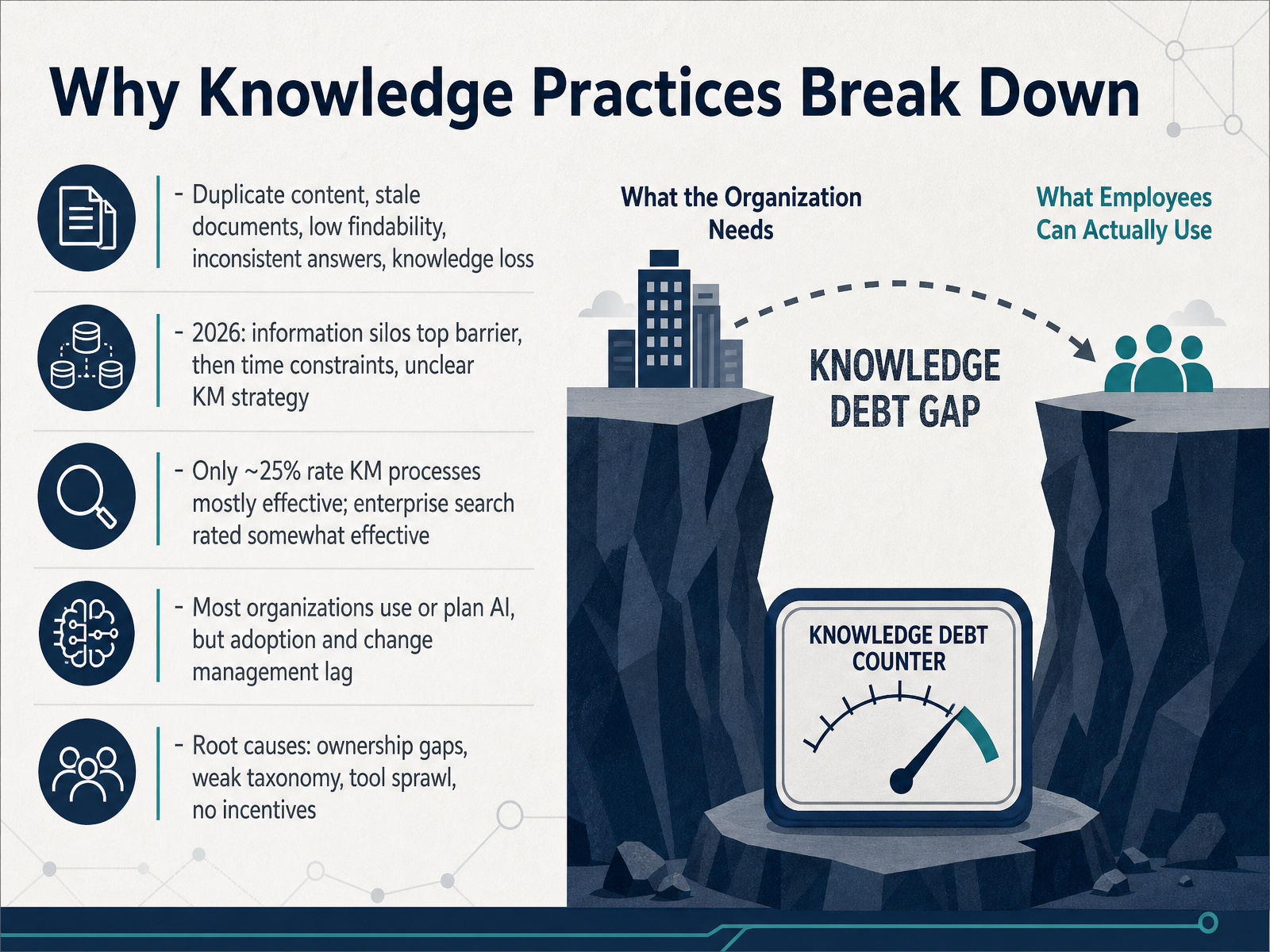
- 02Why Knowledge Practices Break DownLet's look at why knowledge practices break down, because the patterns are predictable. The symptoms show up first. Duplicate content. Stale documents. Low findability. Inconsistent answers. And knowledge walking out the door when someone leaves. In 2026, information silos ranked as the top barrier, ahead of time constraints and an unclear KM strategy. The effectiveness numbers are telling. Only about twenty-five percent of organizations rate their KM processes as mostly effective. Enterprise search fares worse, with most calling it only somewhat effective. Meanwhile, most organizations use AI or plan to, but adoption and change management lag behind the tools. So what's underneath all of this? Four root causes. Ownership gaps, where nobody is accountable for a page. Weak taxonomy, so search can't connect users to answers. Tool sprawl, with knowledge scattered across five or more surfaces. And no incentives, so contributing never becomes a habit. Before we move on, make this concrete. Name the one root cause you're seeing most in your environment right now. That's your starting point. Let's see the full workflow.
 kmslh.comknowledge-base.softwarematrixflows.com+22 min
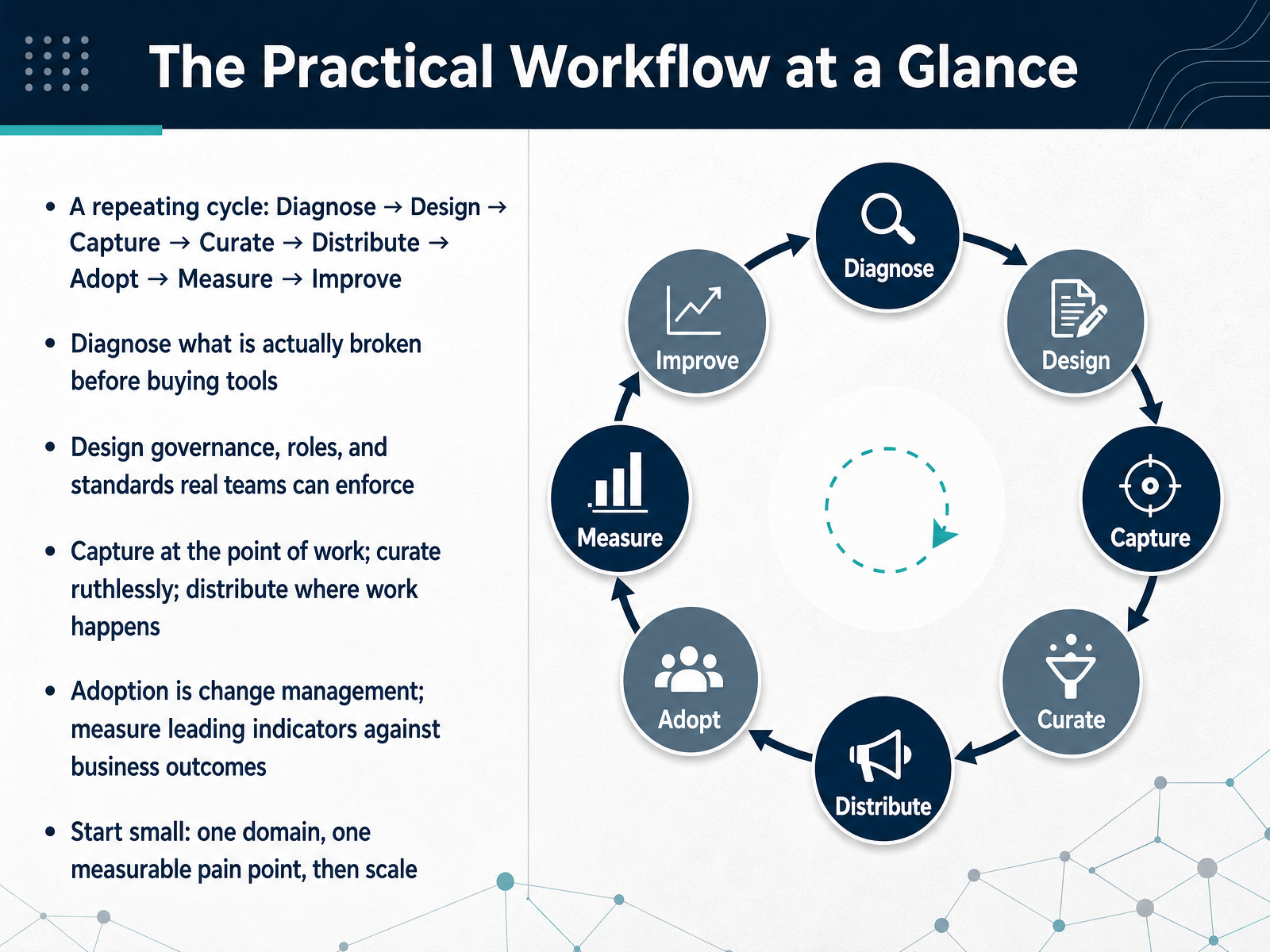
- 03The Practical Workflow at a GlanceLet's walk through the workflow itself. It's a repeating cycle: Diagnose, Design, Capture, Curate, Distribute, Adopt, Measure, and Improve. Then you loop back. First, diagnose what is actually broken before you buy any tools. Talk to the people doing the work. Find where answers go missing. Second, design governance, roles, and standards your real teams can enforce, not a perfect system nobody uses. Third, capture at the point of work. Curate ruthlessly. Distribute where work actually happens. Next, treat adoption as change management, not a launch email. Measure leading indicators against business outcomes, and start small. Pick one domain, one measurable pain point, prove it, then scale. So before we go further, pick your one domain and one pain point. Write them down. That's your starting scope. Of course, none of this works if you skip the first step, so let's look at diagnosing weak knowledge practices.
 kmslh.comknowledge-base.softwarematrixflows.com+22 min
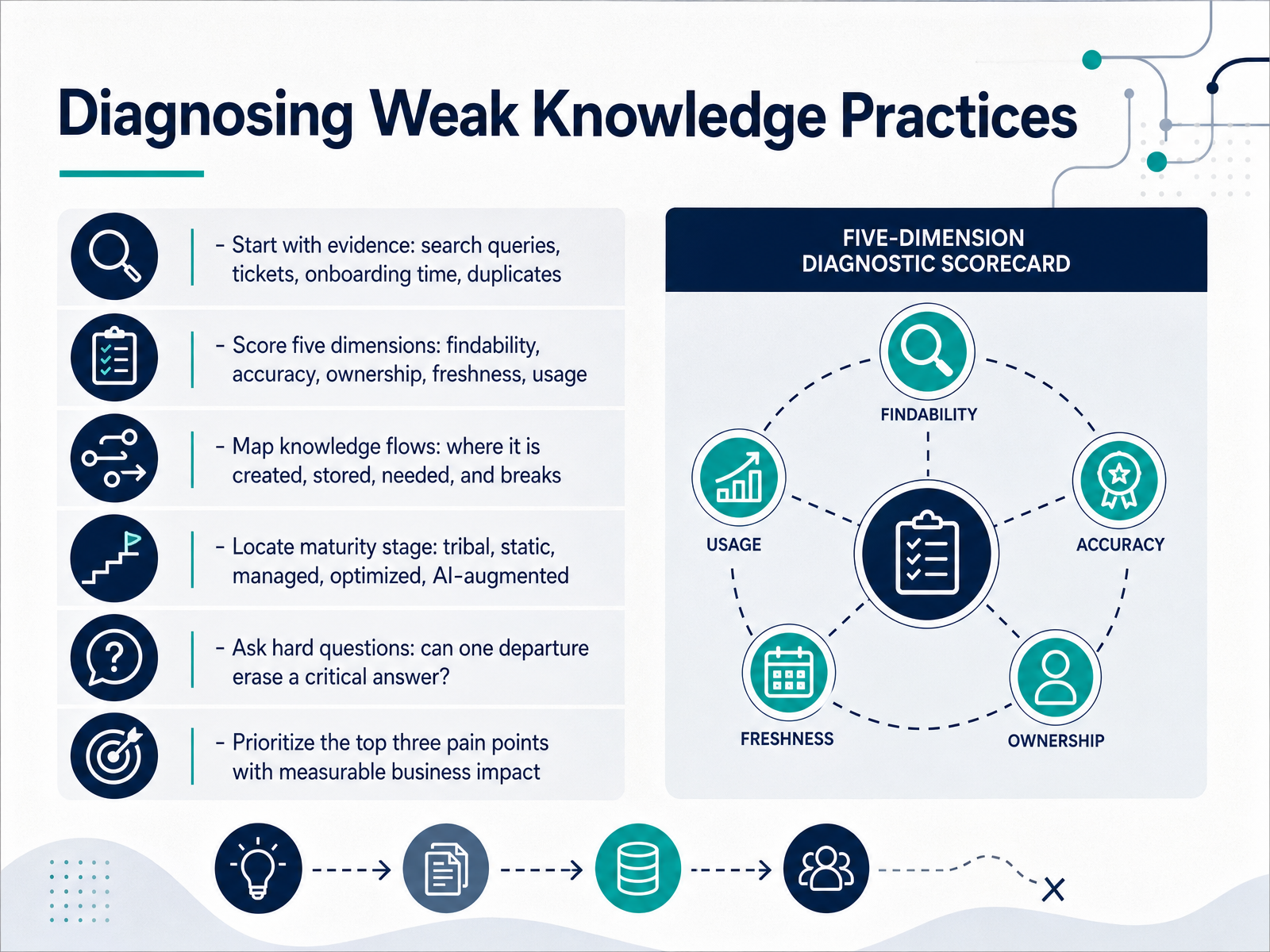
- 04Diagnosing Weak Knowledge PracticesNow let's diagnose your current state. Start with evidence, not opinion. Pull search queries with zero results, ticket trends, onboarding time, and duplicate articles. Next, score five dimensions on a simple one-to-five scale: findability, accuracy, ownership, freshness, and usage. Then map knowledge flows. Where is content created, stored, needed, and where does it break? That break point is your real problem. Locate your maturity stage: tribal, static, managed, optimized, or AI-augmented. Here's the diagnostic question that matters most: can one departure erase a critical answer? If yes, you are still tribal. Finally, prioritize your top three pain points by measurable business impact, such as onboarding weeks, ticket volume, or search failure rate. Pick your three, assign an owner to each, and bring them to the next step: designing governance, roles, and content standards.
 tsia.comapqc.orgkmhelpdesk.com+22 min
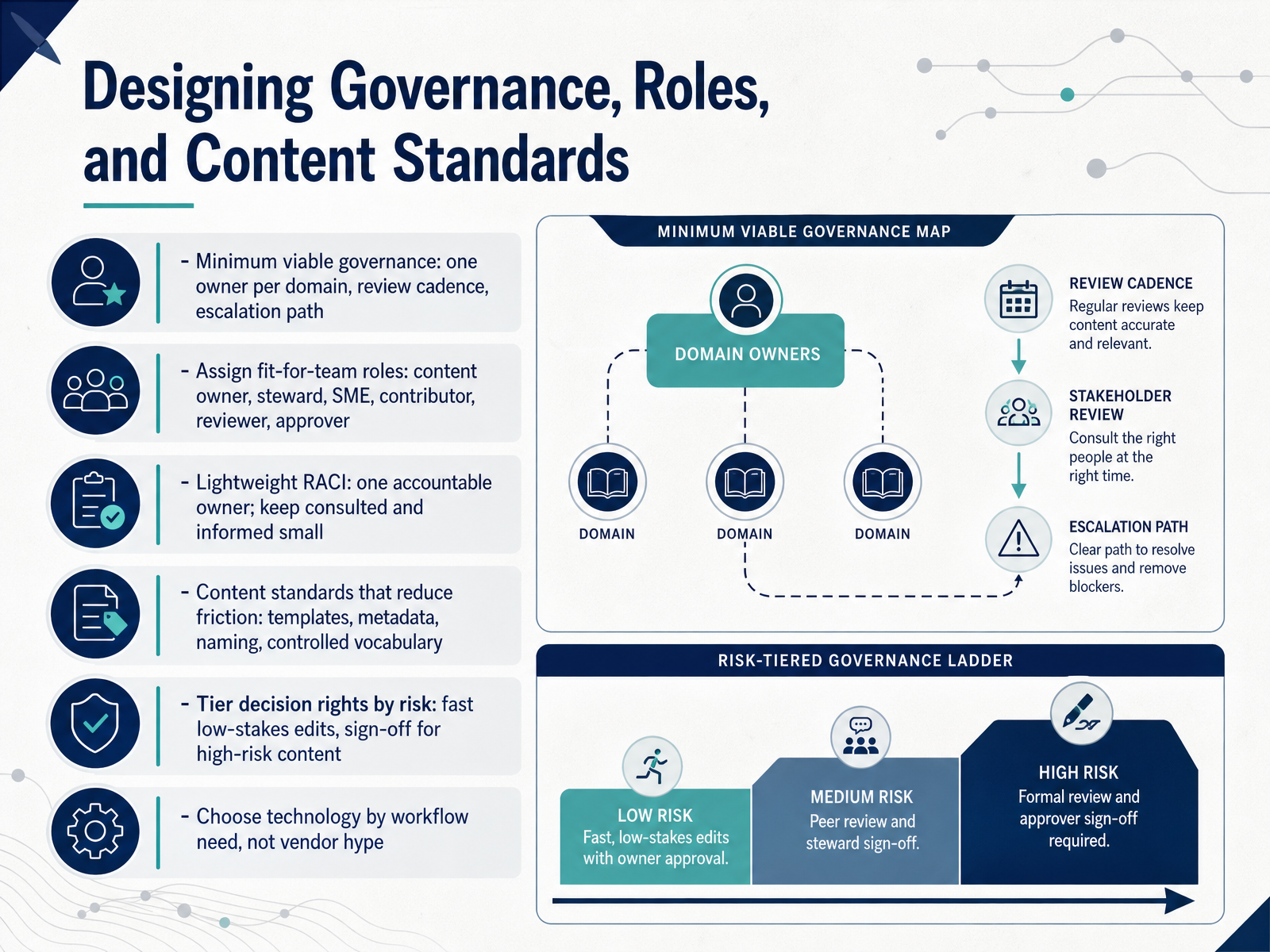
- 05Designing Governance, Roles, and Content StandardsLet's move to the operating model behind everything else: governance, roles, and content standards.
Start with minimum viable governance. One owner per domain, a review cadence, and an escalation path for overdue content. The owner is a named person, not a team. If everyone owns it, no one does.
Then assign roles that fit your size. Content owner, steward, subject matter expert, contributor, reviewer, approver. In a small team, one person can wear several hats. What matters is that each hat exists.
Keep your R A C I lightweight. One accountable owner per article. Keep consulted and informed small, because every consult is a wait.
For standards, use templates, metadata, naming rules, and a controlled vocabulary. Pick one term, like billing, and stick with it.
Now tier decision rights by risk. Let low-stakes edits publish immediately. Route medium changes through a quick owner review. Reserve full sign-off for high-risk content.
And choose technology by workflow need, not vendor hype.
Your action this week: write one register. Content area, owner, review date. That single artifact makes governance real.
Next, building findability: taxonomy, metadata, and content lifecycle.
 kmhelpdesk.comknowledge-base.softwarebloomfire.com+22 min
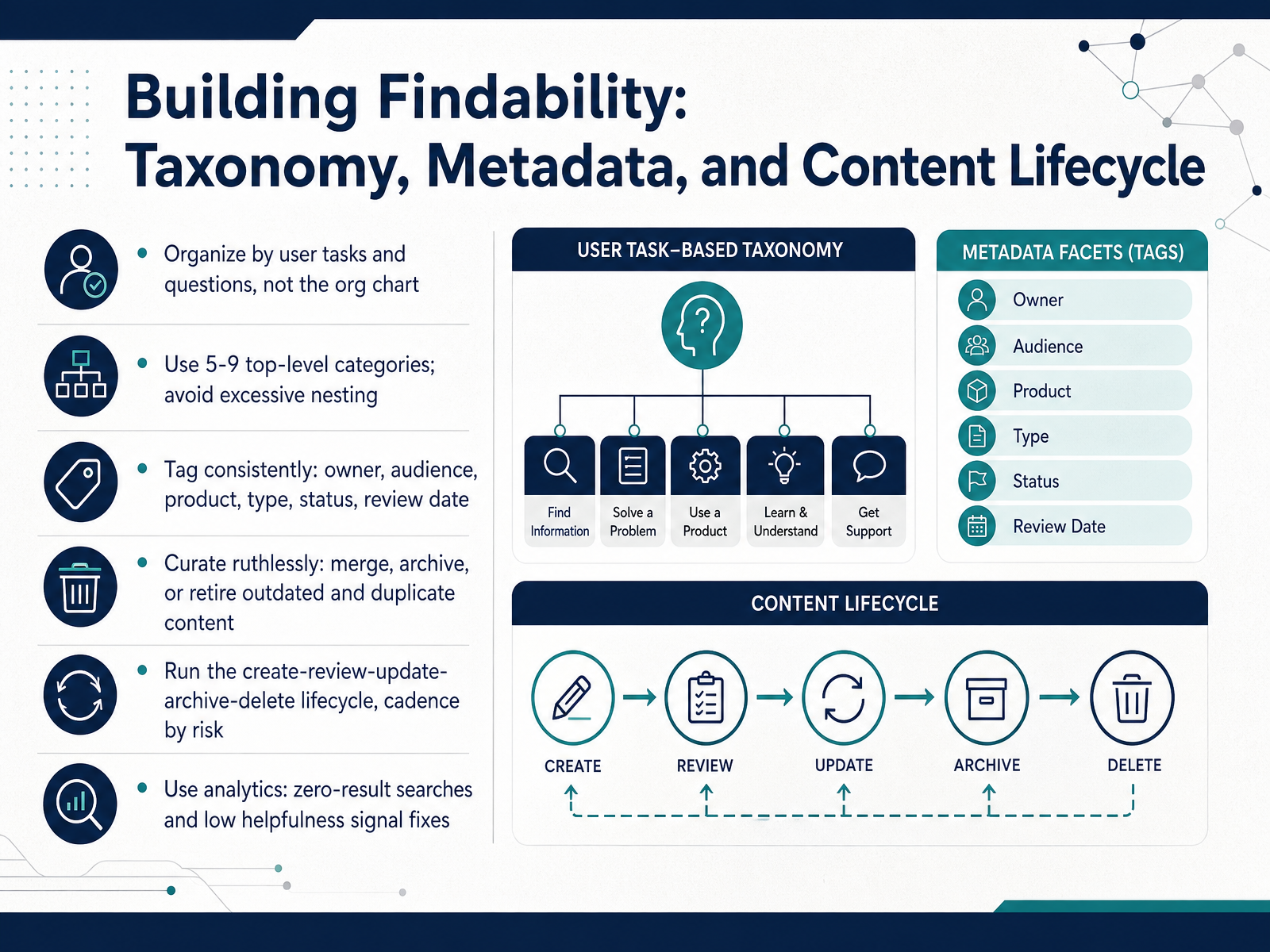
- 06Building Findability: Taxonomy, Metadata, and Content LifecycleNow let's talk about findability. This is where most knowledge bases quietly fail, not because the content is bad, but because nobody can locate it. The core fix starts with one decision: organize by user tasks and questions, not by your org chart. A reader searching "cancel my subscription" should land in that aisle, not in "Billing Operations, Tier Two." Keep five to nine top-level categories, and stop nesting after three levels. Deeper trees hide answers instead of revealing them. Then tag consistently, with the same six fields on every article: owner, audience, product, type, status, and review date. Untamed tags multiply until they mean nothing. Next, curate ruthlessly. Merge duplicates. Archive what is obsolete. Then run the create, review, update, archive, delete lifecycle, and set the cadence by risk. High-risk content gets reviewed every thirty to ninety days. Low-risk evergreen content can wait a year. One checkpoint closes the loop: analytics. Every zero-result search is a missing article or a bad label. Fix it. So your action after this slide: audit your top-level categories this week, confirm every article has an owner and a review date, and assign one person to review your zero-result search report. That signals what to fix first. Next, we'll look at Capturing Knowledge Without Creating Content Debt.
 kmslh.comknowledge-base.softwarematrixflows.com+22 min
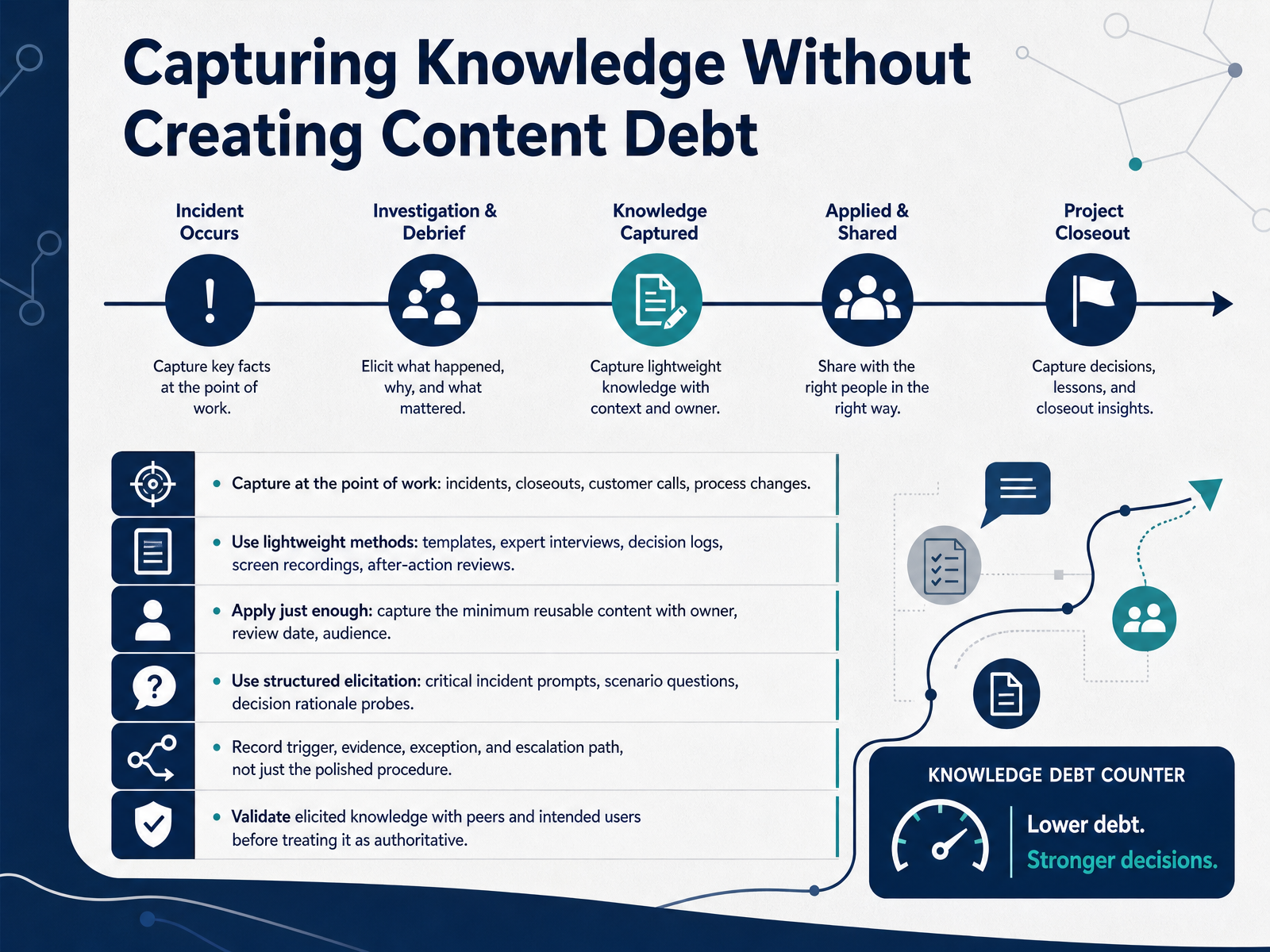
- 07Capturing Knowledge Without Creating Content DebtNow let's talk about capturing knowledge without creating content debt. That debt piles up when every capture turns into a polished document nobody maintains.
So capture at the point of work. Incidents, project closeouts, customer calls, process changes. These are your natural triggers.
Keep methods lightweight. A template, a thirty-minute expert interview, a decision log, a short screen recording, or an after-action review will often do more than a formal writeup.
Then apply just enough. Capture the minimum reusable content, and always attach three fields: an owner, a review date, and the intended audience.
When you interview an expert, use structured prompts. Ask about a critical incident, walk through a scenario, or probe why they chose one option over another.
And record the full picture: the trigger, the evidence, the exception, and the escalation path. Not just the polished procedure.
Finally, validate before you publish. Run elicited knowledge past peers and intended users. Until they confirm it, treat it as provisional, not authoritative.
So here's your action. Pick one recurring trigger on your team this week. Define a lightweight capture format, name an owner and review date, and run one validation pass. That gets you capture without debt. Distributing Knowledge Through the Right Channels.
 greenesconsulting.comzettai-seigi.github.iodovient.com+22 min
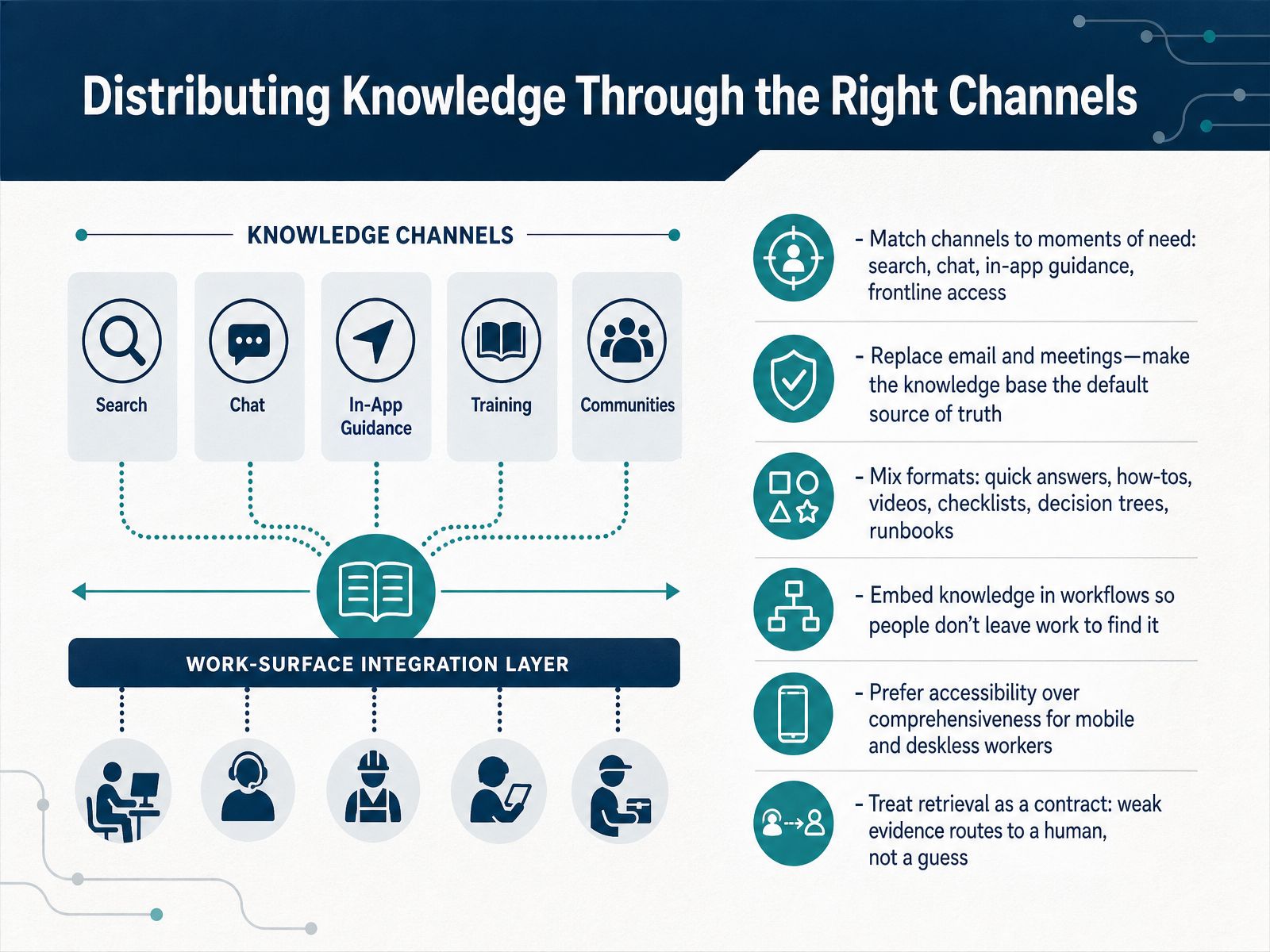
- 08Distributing Knowledge Through the Right ChannelsNow let us talk about distribution. Finding the right channel matters as much as the content itself. Match channels to moments of need: search when someone is investigating, chat for quick peer questions, in-app guidance for tasks at hand, and frontline access for deskless workers. Email and meetings create private knowledge that never comes back. So make the knowledge base the default source of truth, and let those other channels point to it. Mix your formats. Quick answers, how-tos, short videos, checklists, decision trees, and runbooks each serve a different retrieval moment. Then embed knowledge in the workflow so people don't have to leave the work to find it. Prefer accessibility over comprehensiveness. A good procedure someone finds in ten seconds beats a perfect one that takes five minutes. Finally, treat retrieval as a contract. When evidence is weak, the system says so and routes to a human instead of guessing. Here is your action this week: pick one high-friction workflow, audit where people actually look for answers, and consolidate the top three sources into a single, channel-appropriate entry point. Next, we will look at driving adoption and participation.
 realkm.com2 min
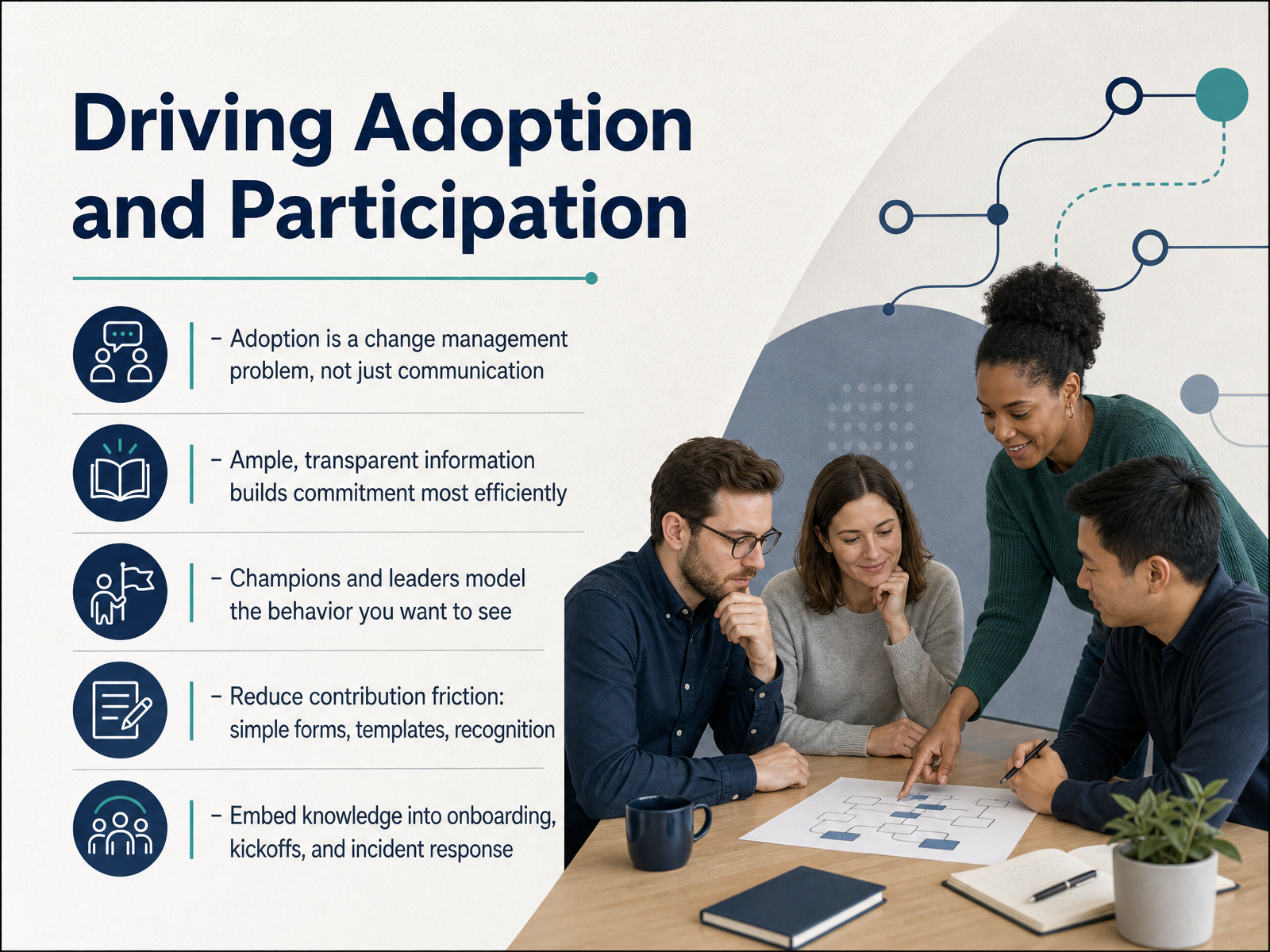
- 09Driving Adoption and ParticipationNow let's talk about driving adoption and participation. Adoption is a change management problem, not just a communication task. Research on major change programs is consistent here. Ample, transparent information does more to build commitment than almost any other instrument, and it costs the least. So keep people in the know, even when the news is incomplete. Next, champions and leaders have to model the behavior you want. If a team lead never contributes, the team will not either. Then reduce contribution friction. Use simple forms, templates, and visible recognition for people who share. And finally, embed knowledge into the moments that already exist. Onboarding. Project kickoffs. Incident response. That is where contribution becomes routine instead of extra work. So before you move on, pick one of those moments and wire knowledge capture into it this week. That sets up the next step, measuring impact with the right indicators.
 realkm.com1 min
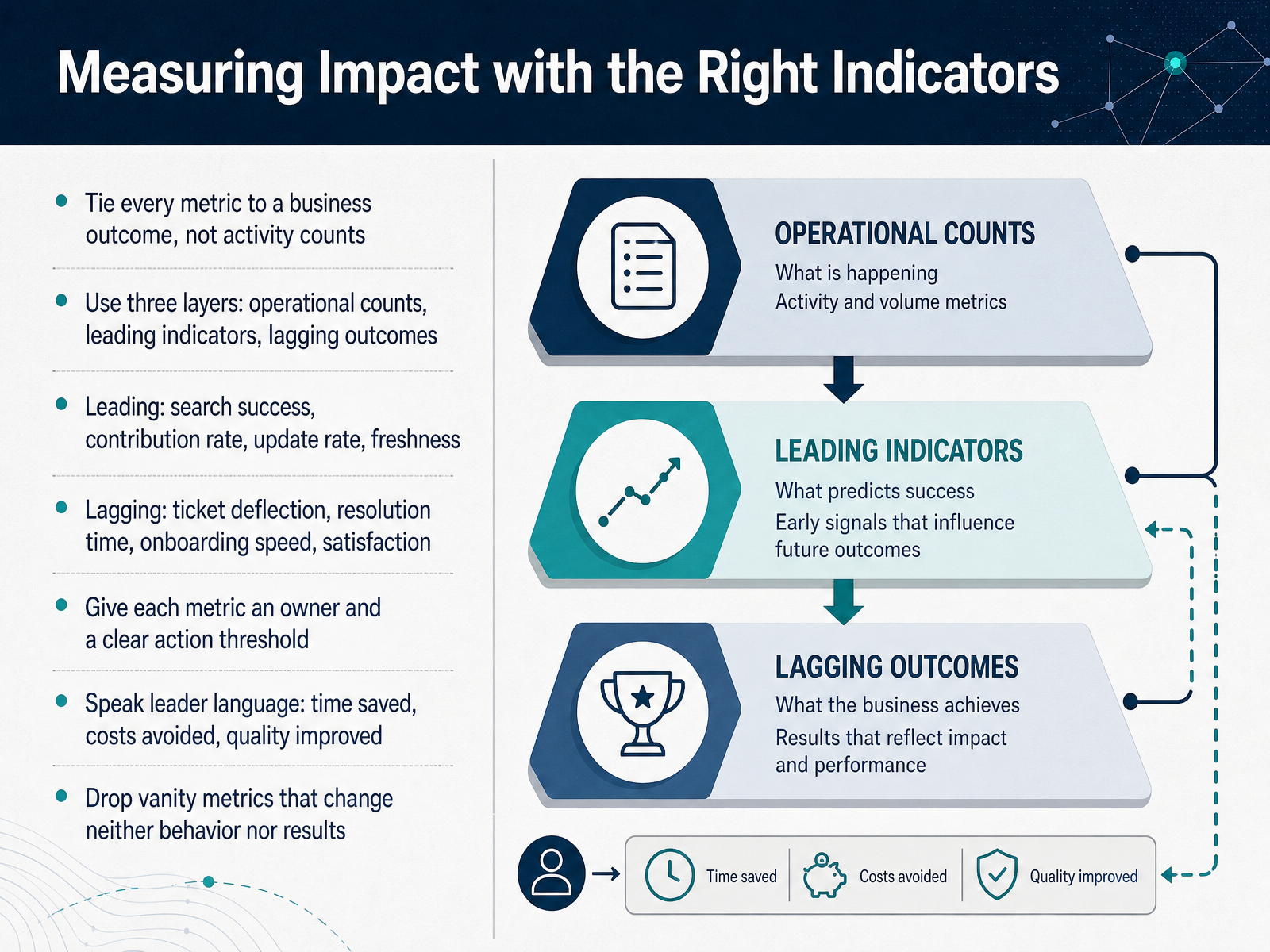
- 10Measuring Impact with the Right IndicatorsNow let us talk about measuring impact with the right indicators. Here is the core rule. Tie every metric to a business outcome, never to activity counts. Use three layers. Operational counts show what is happening now. Leading indicators, like search success, contribution rate, update rate, and content freshness, predict where you are heading. Lagging outcomes, like ticket deflection, resolution time, onboarding speed, and satisfaction, confirm whether it worked. Give each metric one owner and a clear action threshold, so the number triggers a decision. Then speak leader language: time saved, costs avoided, quality improved. Drop any vanity metric that changes neither behavior nor results. Your action now: pick two leading indicators and one lagging outcome, assign owners, and set thresholds this week. Next, we look at improving continuously and avoiding common pitfalls.
 2 min
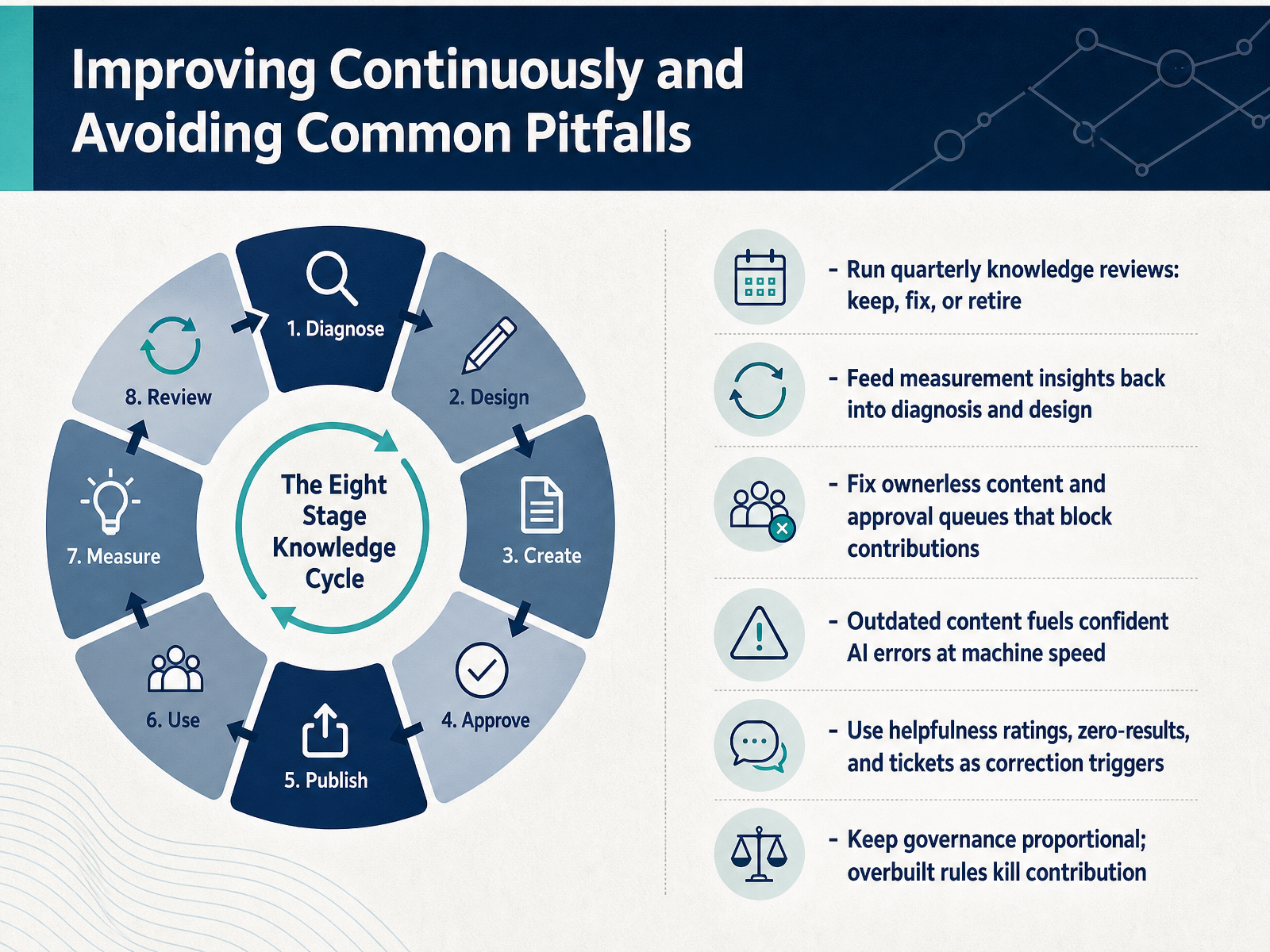
- 11Improving Continuously and Avoiding Common PitfallsLet's talk about keeping the workflow alive and avoiding the traps that quietly undo good knowledge practices. Run a quarterly knowledge review. For each article, decide one of three things: keep it, fix it, or retire it. Then feed what measurement tells you back into diagnosis and design, so search failures and low ratings shape what you build next. Fix the two structural blockers first: ownerless content and approval queues that stall contributions. Remember, outdated content fuels confident AI errors at machine speed, so treat helpfulness ratings, zero-result searches, and tickets as correction triggers, not background noise. Finally, keep governance proportional. Overbuilt rules kill contribution. Decide one date for your next review and who owns it. Next, we'll map this into a thirty, sixty, ninety day action plan.
 kmhelpdesk.comknowledge-base.softwarebloomfire.com+21 min
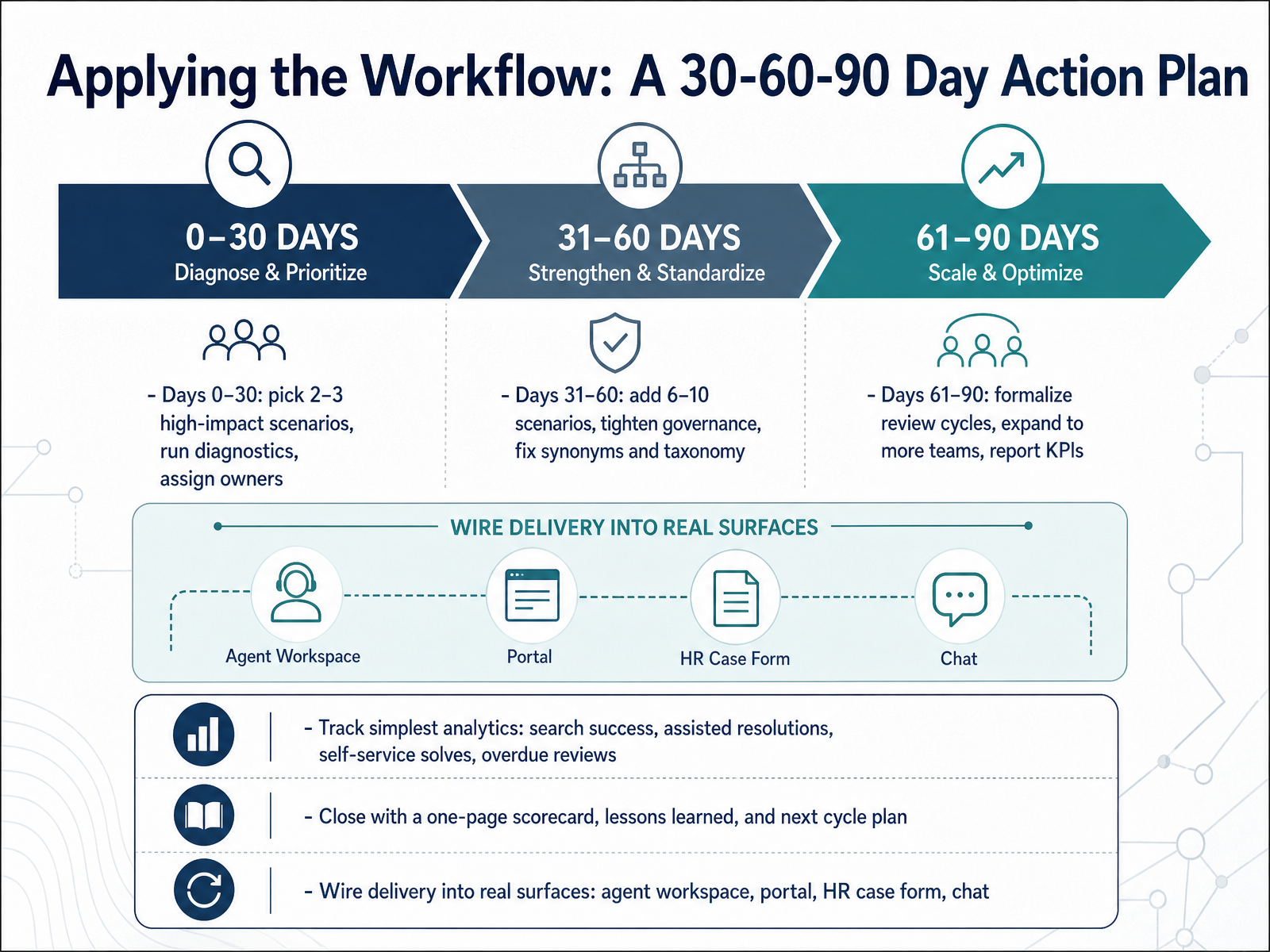
- 12Applying the Workflow: A 30-60-90 Day Action PlanLet's put the workflow on a calendar. Days zero to thirty are about motion. Pick two or three high-impact scenarios, run diagnostics, and assign a named owner to each. Days thirty-one to sixty, scale the loop, not the library. Add six to ten scenarios, tighten governance, and fix synonyms and taxonomy using real search queries. Days sixty-one to ninety, formalize review cycles, expand to more teams, and report KPIs. Throughout, wire delivery into real surfaces: the agent workspace, the portal, the HR case form, and chat. Track the simplest analytics: search success, assisted resolutions, self-service solves, and overdue reviews. Close the quarter with a one-page scorecard, lessons learned, and your next cycle plan. That scorecard earns the next quarter of scope. Next, we'll cover common pitfalls and how to avoid them.
 kmslh.comknowledge-base.softwarematrixflows.com+21 min
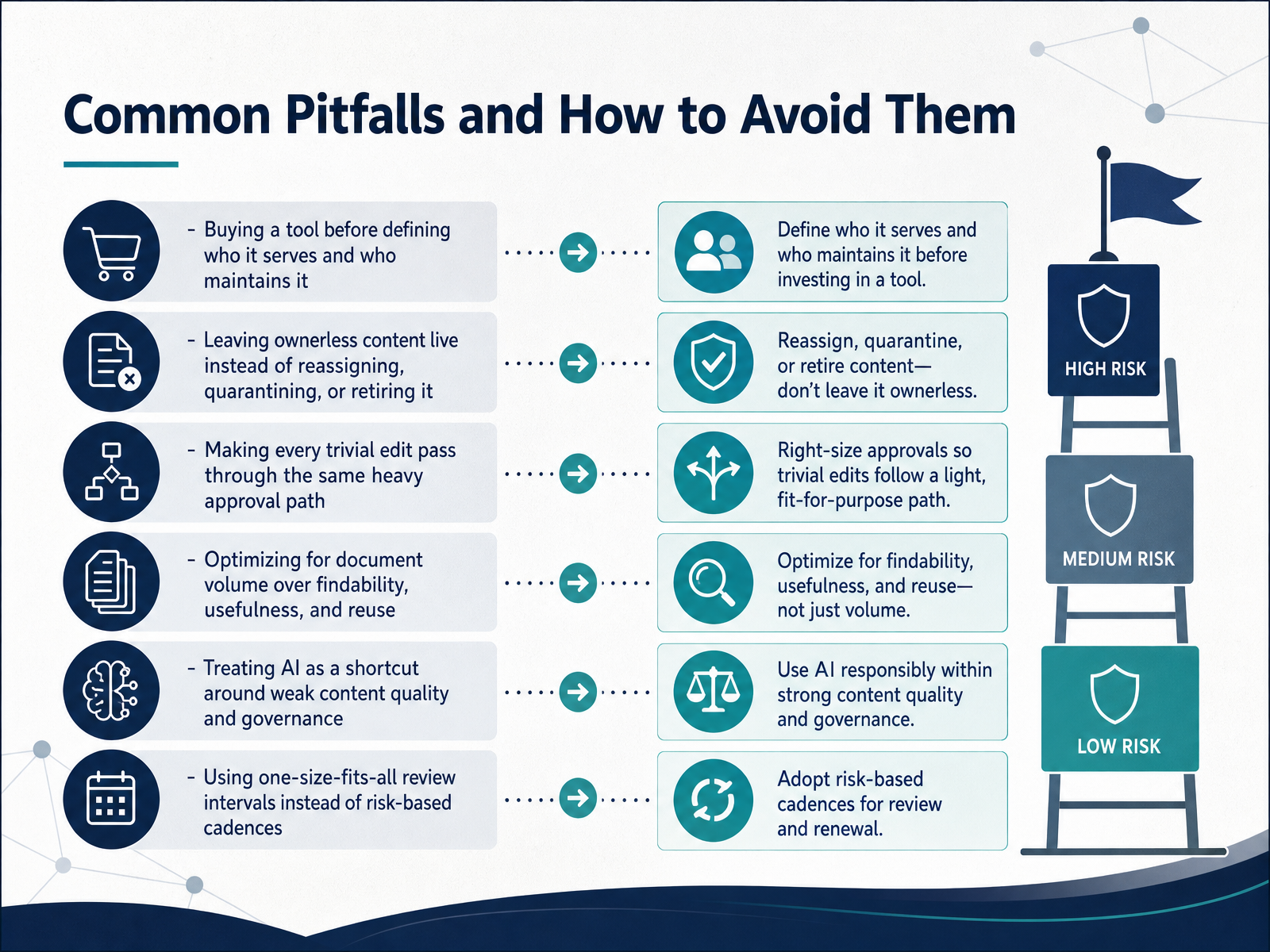
- 13Common Pitfalls and How to Avoid ThemNow let's look at the pitfalls that quietly undo knowledge programs, and how to steer around each one. First, buying a tool before defining who it serves and who maintains it. Fix the audience and the owner first, then choose the platform. Second, ownerless content going live and staying live. Never let that happen. Every article gets a named owner, or it gets reassigned, quarantined, or retired. Third, sending every trivial edit through the same heavy approval path. That kills contribution. Tier your controls: let low-risk edits publish, reserve real sign-off for high-risk content. Fourth, optimizing for document volume over findability, usefulness, and reuse. Count answered questions, not article count. Fifth, treating AI as a shortcut around weak content quality and governance. AI on top of bad content just scales bad answers. Sixth, one-size-fits-all review intervals. Set risk-based cadences, and give every article a review date with someone accountable. So, the decision to take into next week: pick one of these six, and fix it before Friday. Next, we'll pull everything together in Key Takeaways and Next Steps.
 kmhelpdesk.comknowledge-base.softwarebloomfire.com+22 min
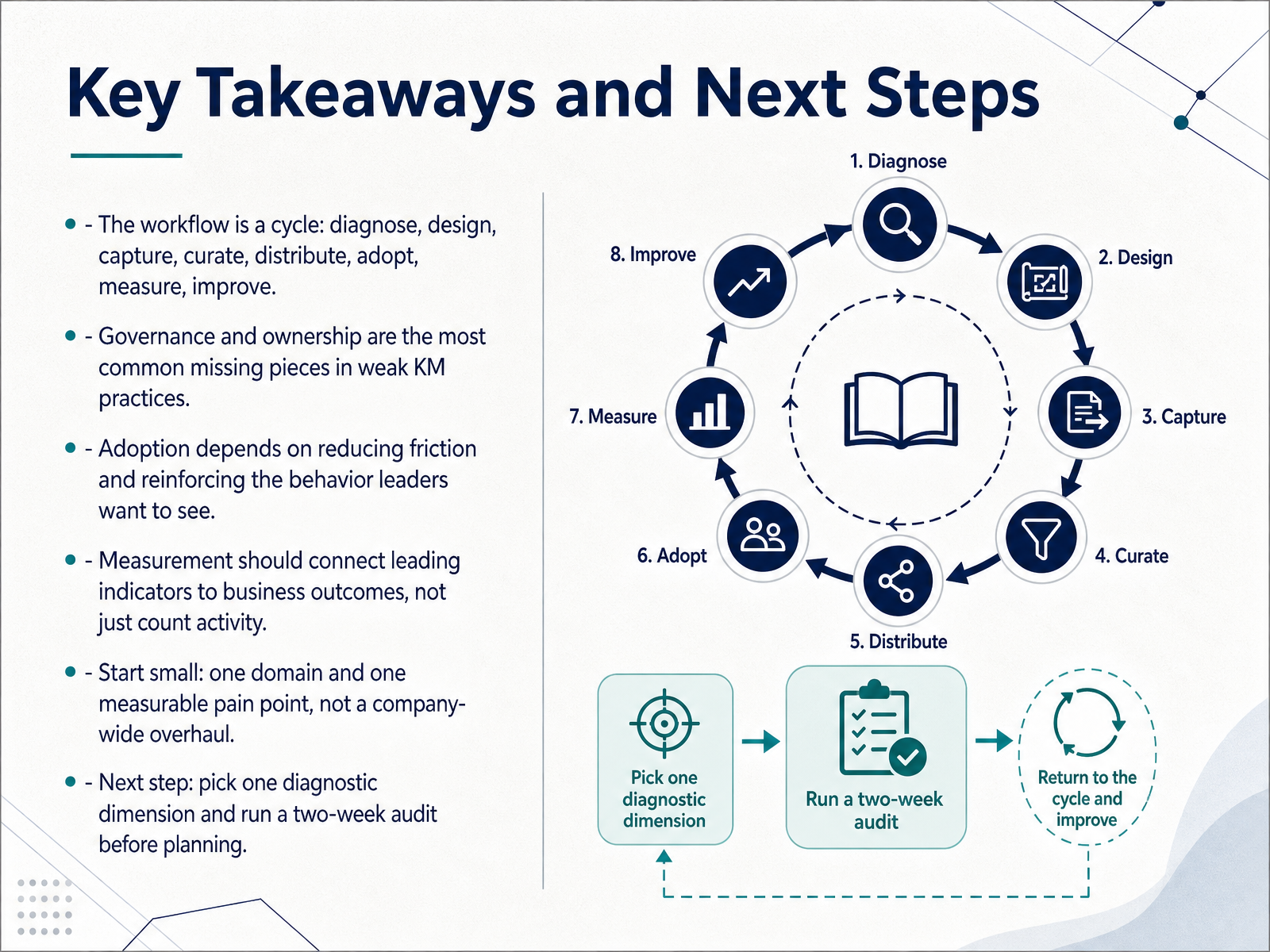
- 14Key Takeaways and Next StepsLet's bring the workflow together. It's a cycle, not a project: diagnose, design, capture, curate, distribute, adopt, measure, then improve. Then you start again, because the work never really stops.
Across everything we covered, two pieces go missing most often: governance and ownership. If everyone owns the knowledge base, no one owns it. Every article needs a named owner and a review date, or it quietly goes stale.
Adoption follows the same logic. Cut friction, and reinforce the behavior you want to see. If people can contribute in the flow of their work, they will.
And when you measure, connect leading indicators, like search success and content freshness, to real business outcomes. Not just page views.
So here's your next step. Start small. Pick one domain, one measurable pain point, and one diagnostic dimension to audit over the next two weeks before you plan anything bigger.
That's the course. Thank you for working through this with me. You already know why knowledge management matters. Now you have a workflow you can put into practice this week. Go pick that one domain, and good luck.
 kmslh.comknowledge-base.softwarematrixflows.com+22 min
Take the deck with you
Download this course as a file — free, no sign-up needed.
- PDF handoutEvery slide page, ready to print or share.15 pages · 4.3 MBDownload
- Narrated PowerPointThe deck that presents itself — every slide carries the digital human's narration video.15 pages · 15.9 MBDownload
- PowerPoint slidesThe full deck as a .pptx — open it in PowerPoint, Keynote, or Google Slides.15 pages · 4.2 MBDownload
Free to use in your own training — please keep the PersonWise credit page at the end.
Have your own deck? Turn it into a course
Sources consulted
Web sources consulted while building this course.
- Knowledge Base Taxonomy: How to Structure and Tag Content for Findability — kmslh.com
- Building a Knowledge Base Information Architecture: A Practical Guide - Knowledge Base Software — knowledge-base.software
- Knowledge Management Taxonomy: Examples & Best ... — matrixflows.com
- Knowledge Base Governance Framework: Owners, Review Cycles, Approval Workflows, and Quality Control - Knowledge Base Software — knowledge-base.software
- Knowledge Base Content Lifecycle: 8-Stage Workflow — knowledge-base.software
- Knowledge Management Maturity Model 3.0 Framework — tsia.com
- APQC's Levels of Knowledge Management Maturity — apqc.org
- Knowledge Management Frameworks — APQC, SECI, KCS | KMHelpDesk — kmhelpdesk.com
- Evidence-Based Assessment of Knowledge Management Systems for Conformance with ISO Standard 30401 and Supporting Data Model — doi.org
- GenAI-KM organizational readiness self-assessment tool – RealKM Magazine — realkm.com
- KM Governance — 5 Pillars & Stewardship | KMHelpDesk — kmhelpdesk.com
- Knowledge Management Governance Models — bloomfire.com
- Knowledge Management Governance: Policies & Compliance — shelf.io
- How to Build a Knowledge Management Governance Model — livepro.com
- Knowledge Capture Interview Guide and Sample Questions — greenesconsulting.com
- Chapter 9: Knowledge Capture and Creation | Knowledge Management Handbook — zettai-seigi.github.io
- Tribal Knowledge Capture Toolkit | Free Download | Dovient — dovient.com
- 10-Question Tacit Knowledge Debrief Protocol (Template) — innovation-creativity.com
- Meegle | Free Download Tacit Knowledge Capture Template — meegle.com
- From knowledge repositories to knowledge infrastructure – RealKM Magazine — realkm.com