Begin
14 pages · ~28 min
Software Engineering Fundamentals
Equip aspiring developers with core software engineering principles, covering design, development, testing, and best practices for building robust applications.
A digital instructor presents all 14 pages. Hold “Ask” at any point and ask out loud — the answer comes from this course. No sign-up needed.
What you’ll learn
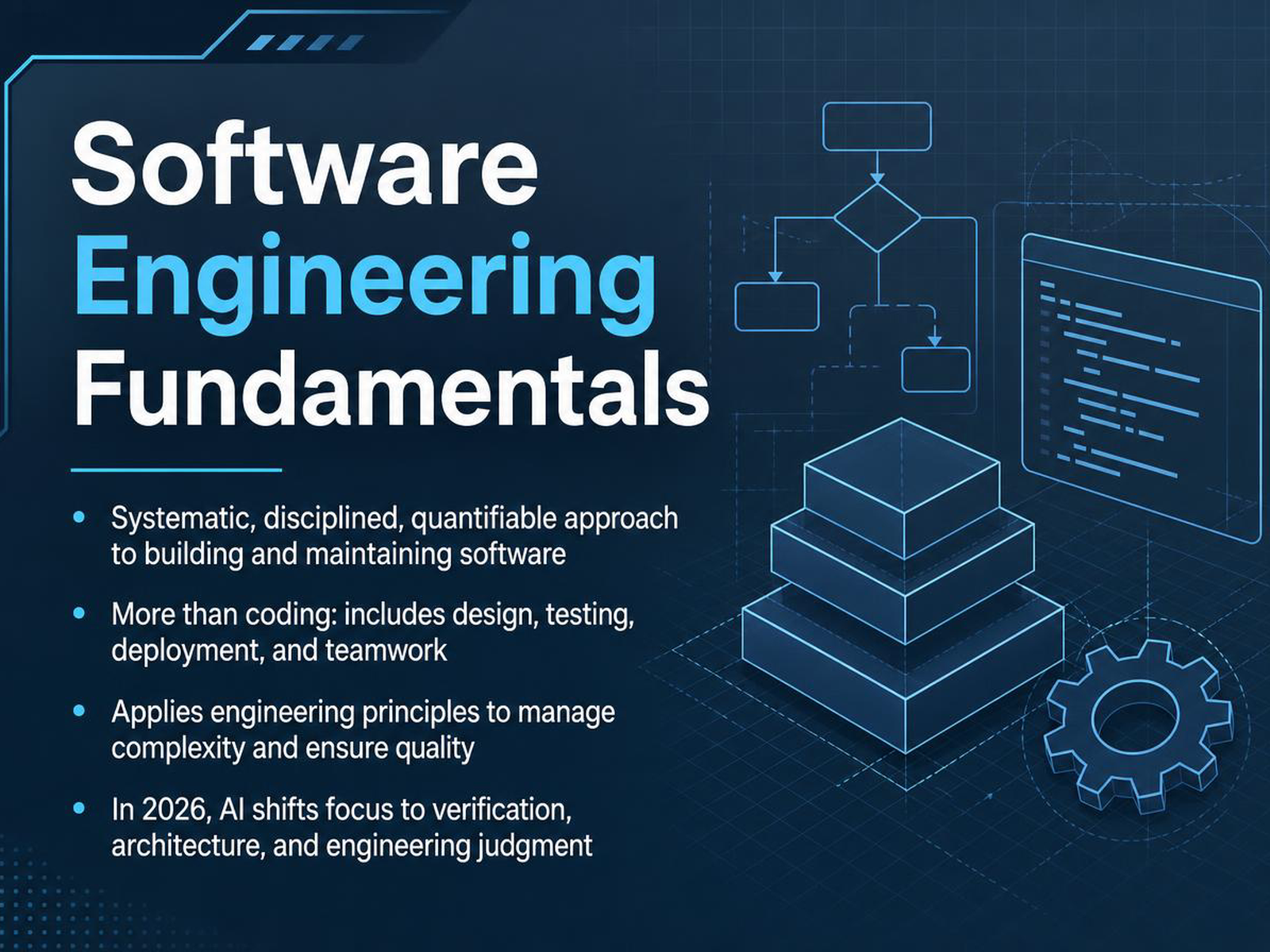
- 01Software Engineering FundamentalsWelcome to Software Engineering Fundamentals. Throughout this course, we're going to build a shared understanding of what it means to engineer software, not just write code. Software engineering is a systematic, disciplined, and quantifiable approach to building and maintaining software. That definition matters because it shifts our focus from producing code to producing reliable systems. It includes design, testing, deployment, and teamwork, all of which we'll explore together. The goal is to apply engineering principles to manage complexity and ensure quality over time. In 2026, the landscape is changing quickly. AI-assisted tooling now handles a great deal of routine implementation. That means our attention moves toward verification, architecture, and the engineering judgment that keeps automated output trustworthy. These are exactly the capabilities we'll develop in the coming slides. Next, we'll look at the modern engineering mindset and what it asks of us.britannica.comen.wikipedia.orgse.inf.ethz.ch+22 min
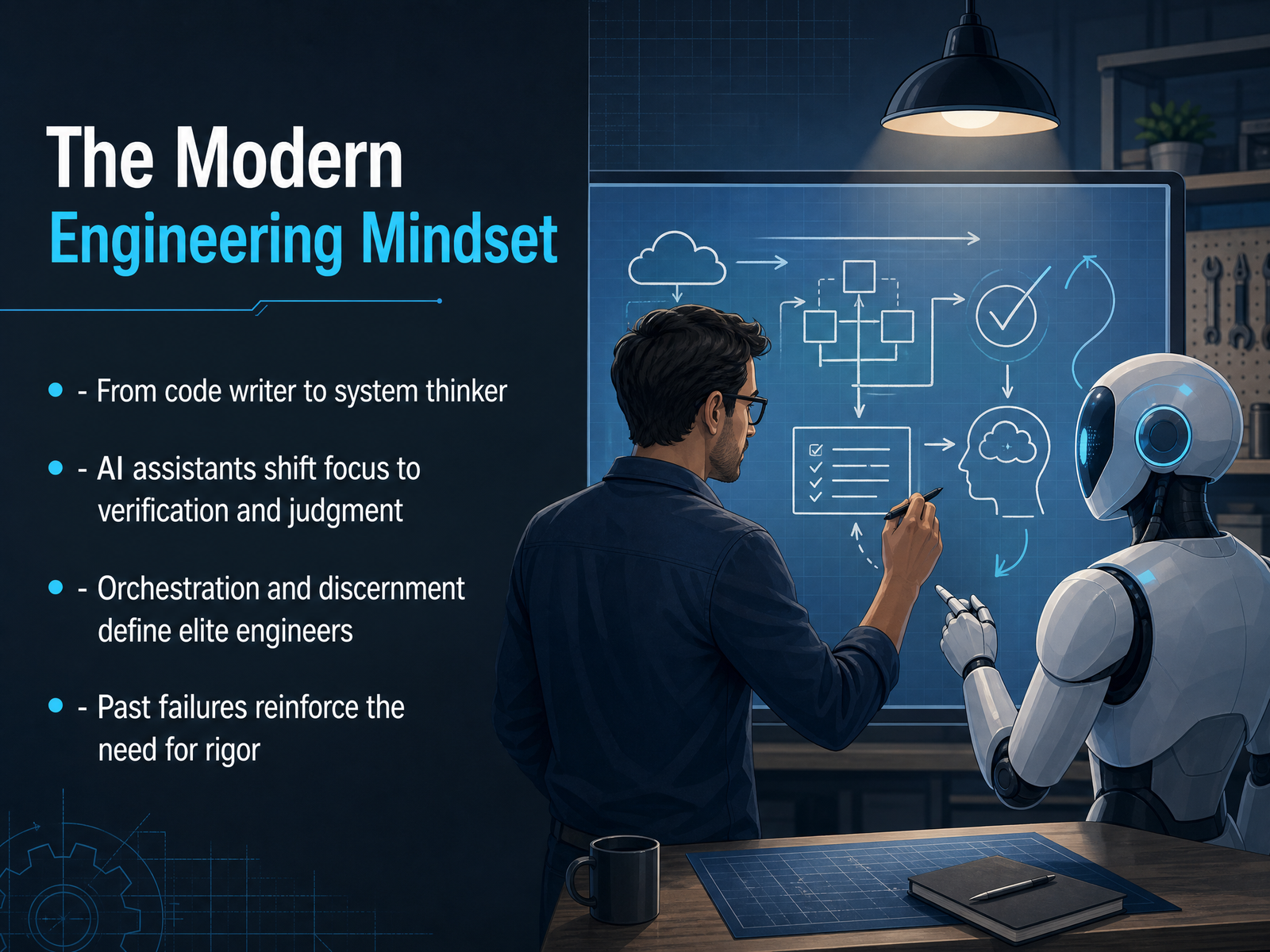
- 02The Modern Engineering MindsetLet's move into the deeper shift happening across the industry. The modern engineering mindset is no longer just about writing code. It is about thinking in systems. You are moving from being a code writer to someone who understands how components interact, how failures cascade, and how small design choices affect an entire platform. AI assistants now handle much of the routine generation. That means your role shifts toward verification and judgment. You decide what the AI should build, and more importantly, you decide whether what it built is actually correct. Elite engineers are increasingly defined by orchestration and discernment. They coordinate tools, services, and teams, and they apply sharp judgment to separate good output from plausible mistakes. History supports this. Many past failures happened because someone trusted a generated answer or skipped careful review. Those failures reinforce the need for rigor. So as you develop your own practice, treat every output as a hypothesis to validate. That discipline is what separates a reliable engineer from a fast one. Next, we will look at the Software Development Life Cycle and where this mindset fits into each phase.
 1 min
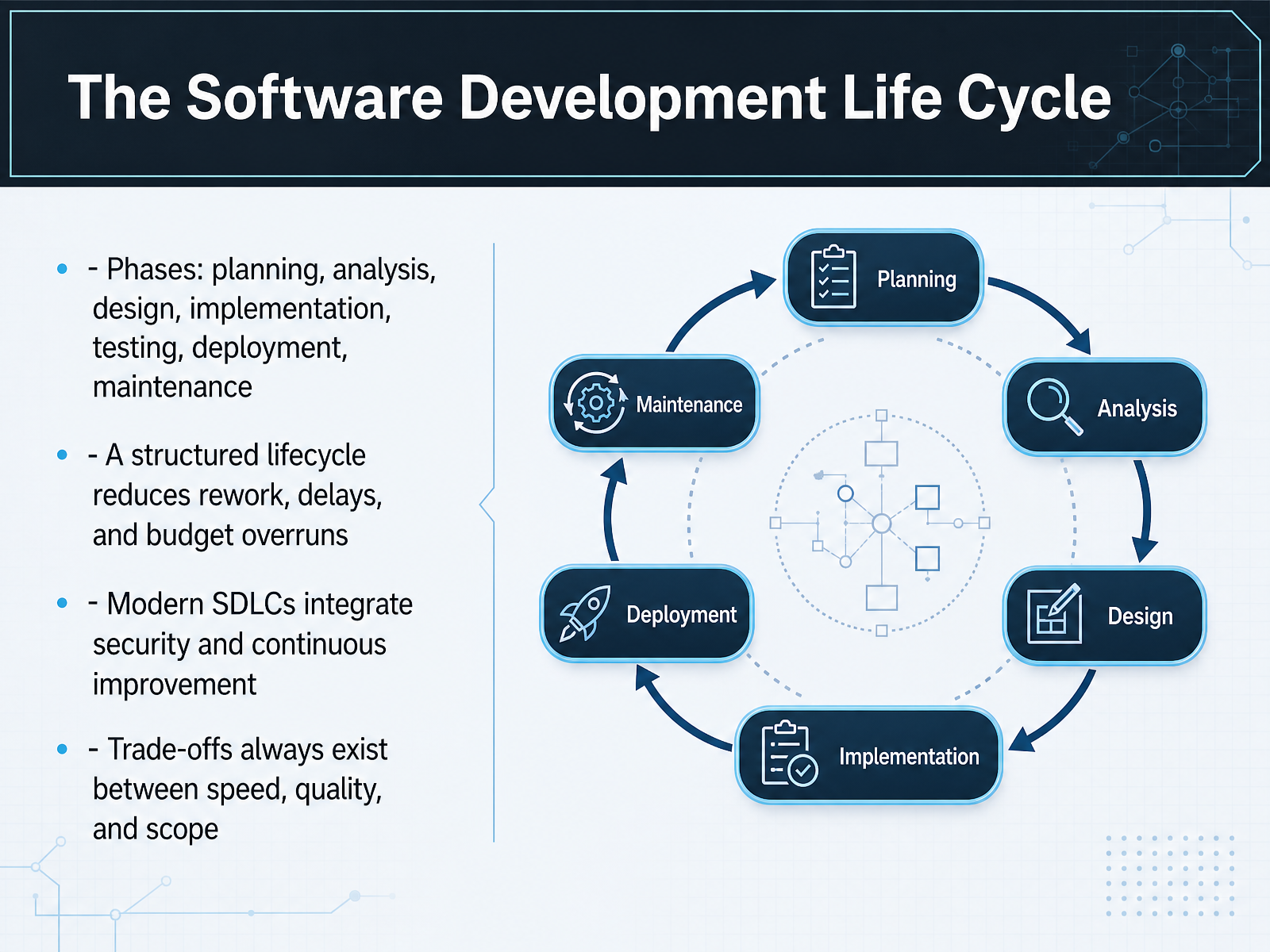
1 min - 03The Software Development Life CycleNow let's turn to the framework that holds all of this together: the Software Development Life Cycle. You'll often hear it called the S D L C. It's a structured sequence of phases, and while the exact names vary by model, you can think of them as planning, analysis, design, implementation, testing, deployment, and maintenance. A structured lifecycle isn't just process for its own sake. It directly reduces rework, delays, and budget overruns, because each phase gives you a checkpoint before you commit more resources. Modern S D L Cs also integrate security and continuous improvement from the start, rather than treating them as afterthoughts. And here's the part that matters most in practice: trade-offs. There's always tension between speed, quality, and scope. You can't maximize all three at once. Understanding that trade-off is exactly what prepares you to choose a model that fits a specific project. That choice is our next topic: selecting an S D L C model.
 lcgc.devenosta.comflexi-project.com+21 min
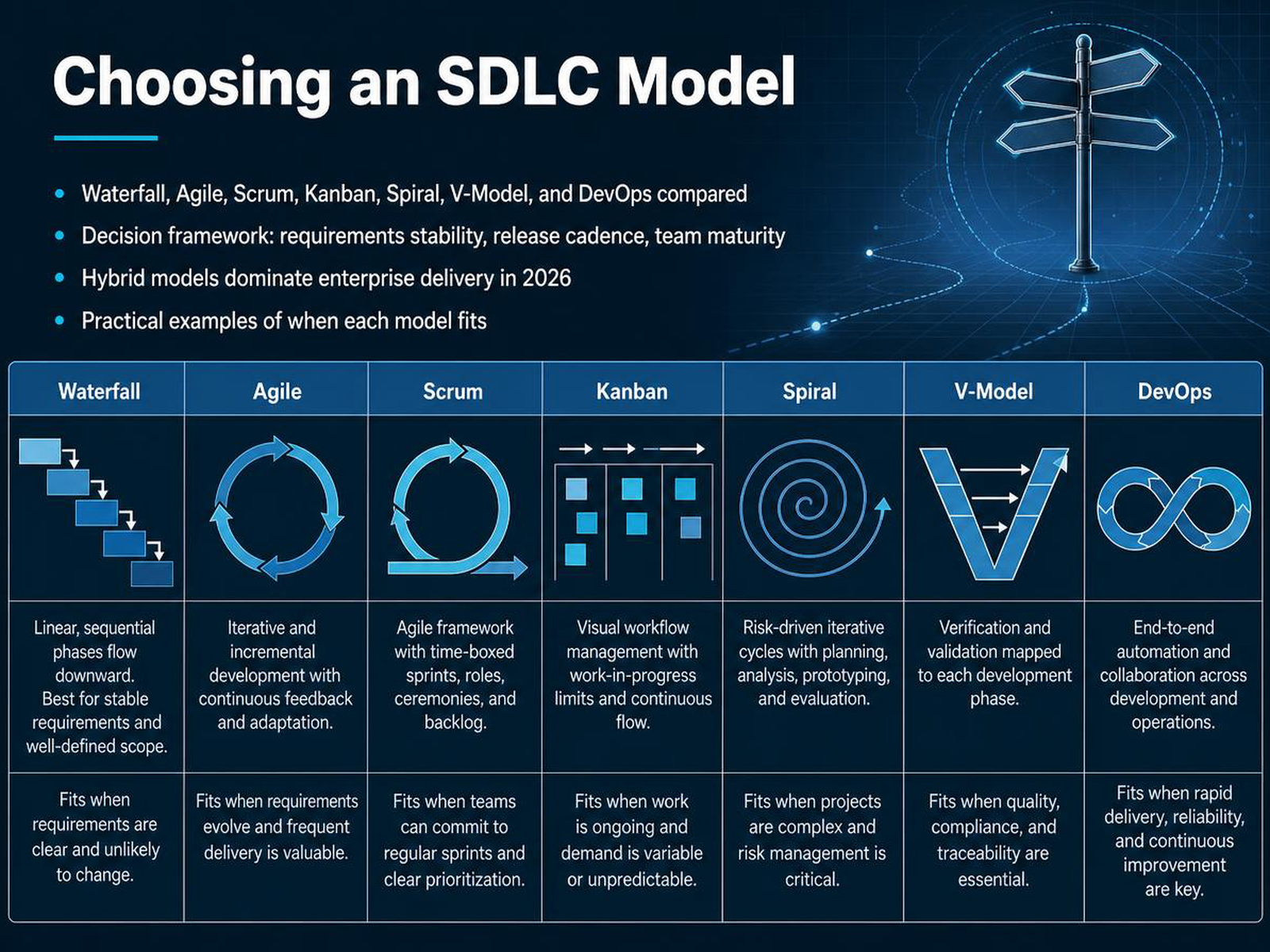
 - 04Choosing an SDLC ModelWith the core engineering mindset in place, let’s look at how teams choose a delivery model. The main options you’ll meet in industry are Waterfall, Agile, Scrum, Kanban, Spiral, the V-Model, and DevOps. Each one trades off predictability against adaptability. The decision usually comes down to three things: requirements stability, release cadence, and team maturity. When requirements are fixed and the path is clear, a plan-driven model like Waterfall or the V-Model fits well, especially in regulated work. When requirements evolve quickly, Agile approaches give you faster feedback loops. Scrum works well for teams that benefit from defined roles and timeboxed sprints. Kanban fits teams that need continuous flow and minimal ceremony. Spiral is useful when risk management is the highest priority. In practice, most enterprise teams now run hybrid models, combining the governance of a plan-driven approach with the speed of Agile delivery. Choosing the right model is less about picking a winner and more about matching your context. Next, we’ll ground this in the core engineering principles that make any of these models work.
 2 min
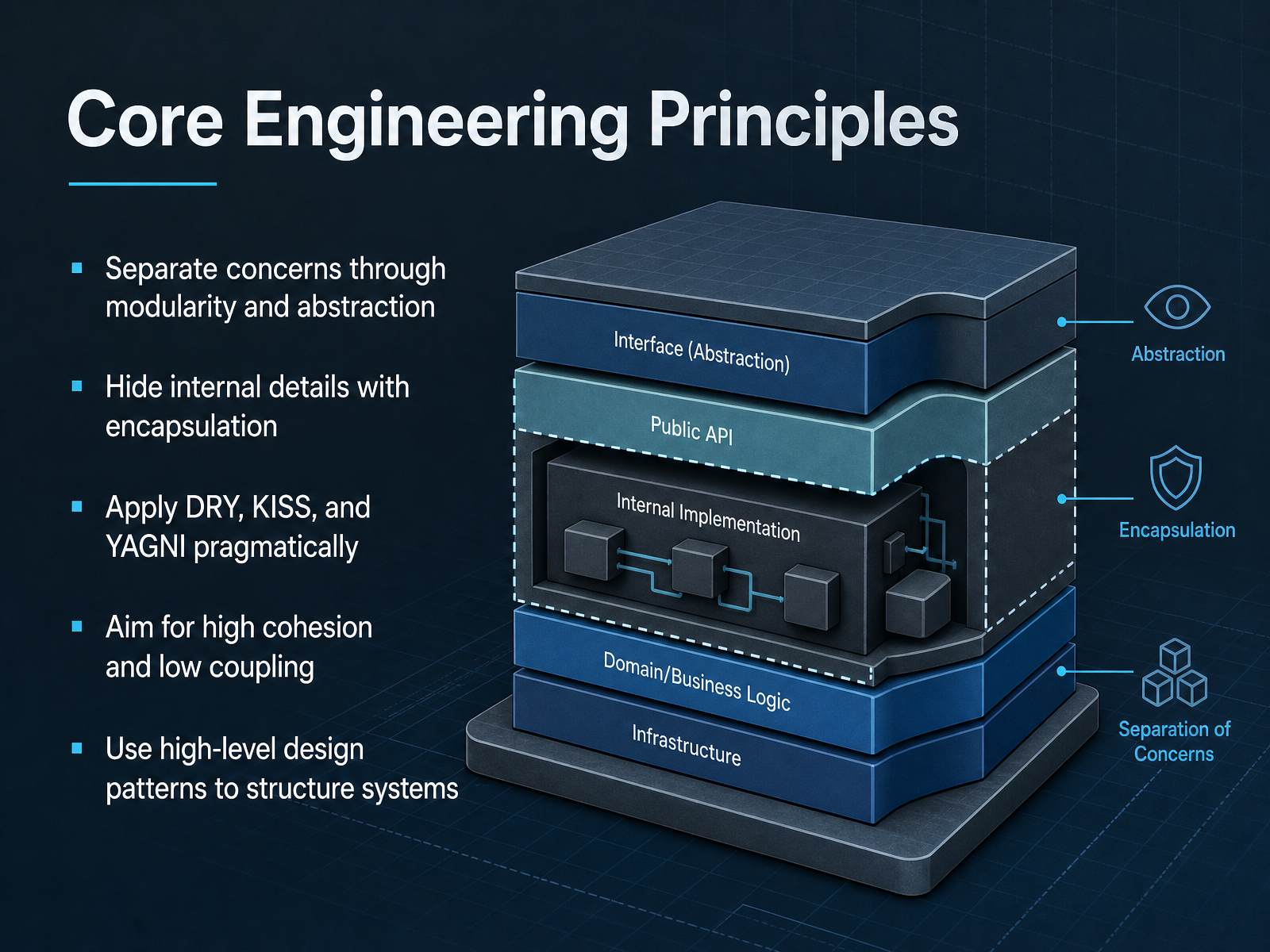
2 min - 05Core Engineering PrinciplesNow let’s look at the core engineering principles that shape how systems are designed and maintained. First, separate concerns through modularity and abstraction. This means each component owns a clear responsibility, so changes stay localized and easier to reason about. Second, use encapsulation to hide internal details. A well designed module exposes only what other parts of the system need. Next, apply DRY, KISS, and YAGNI pragmatically. Avoid duplicating logic, keep solutions as simple as the problem allows, and build only what you need now. Also aim for high cohesion and low coupling. Code that belongs together should live together, while dependencies between modules should stay minimal and stable. Finally, use high level design patterns to structure systems. Patterns like repository, adapter, and observer give teams a shared vocabulary and reduce design risk. Overall, these principles help you keep code understandable, testable, and ready for change. Up next, we will connect these ideas to requirements and project planning.
 2 min
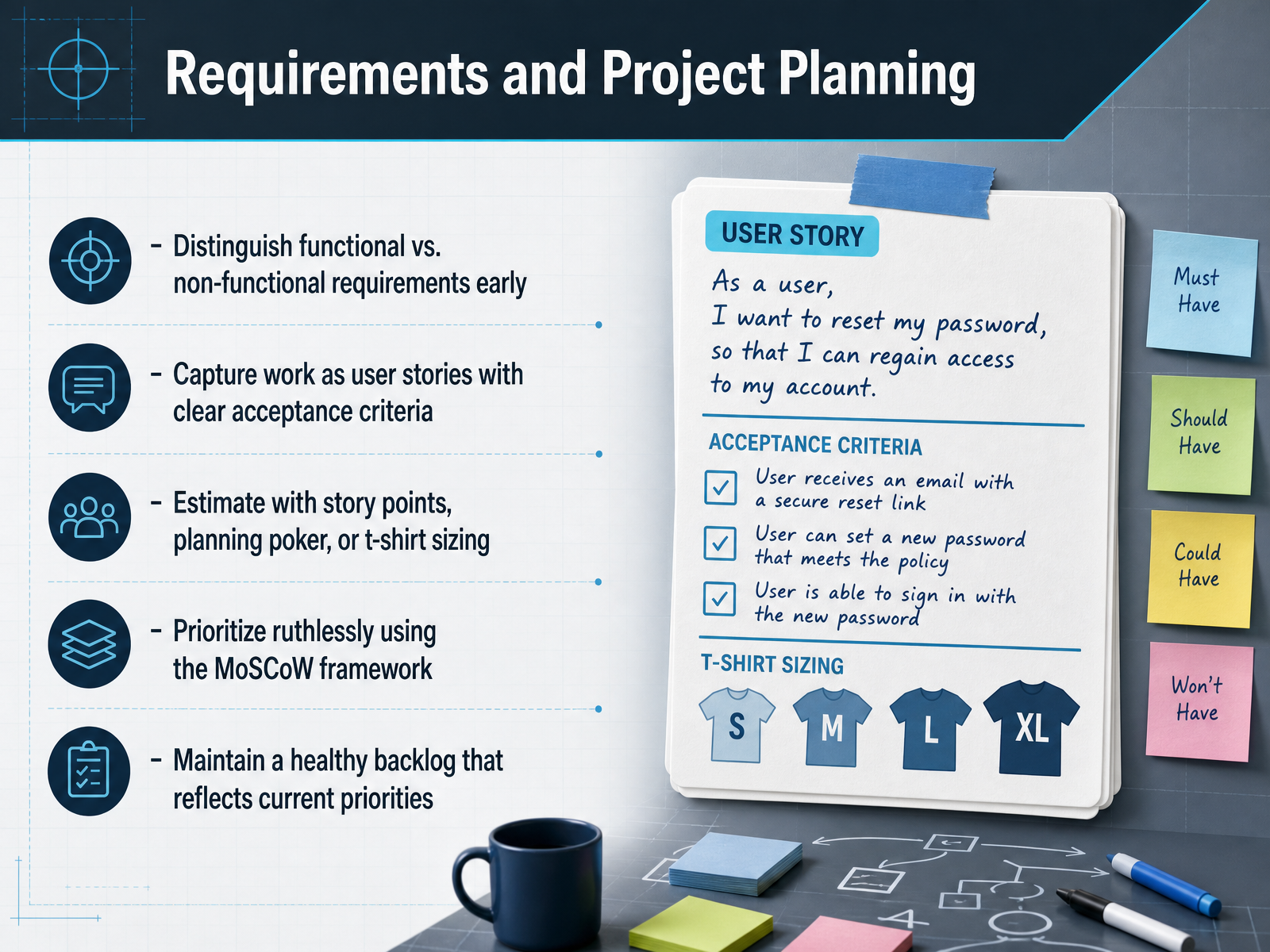
2 min - 06Requirements and Project PlanningMoving into requirements and project planning, this is where solid engineering starts. First, identify both functional and non-functional requirements. Functional requirements define what the system does, like processing a payment or creating a user account. Non-functional requirements define how well it performs under constraints, such as security, scalability, or latency. Capture the work as user stories with clear acceptance criteria, so each item is testable and unambiguous. For estimation, use story points, planning poker, or t-shirt sizing to compare effort without pretending to predict calendar time. Prioritize ruthlessly with the MoSCoW framework by separating must-haves, should-haves, could-haves, and won't-haves for the current cycle. Finally, maintain a healthy backlog that reflects current priorities, not just a long wish list. With a clear plan in place, let's move on to version control and collaboration.
 2 min
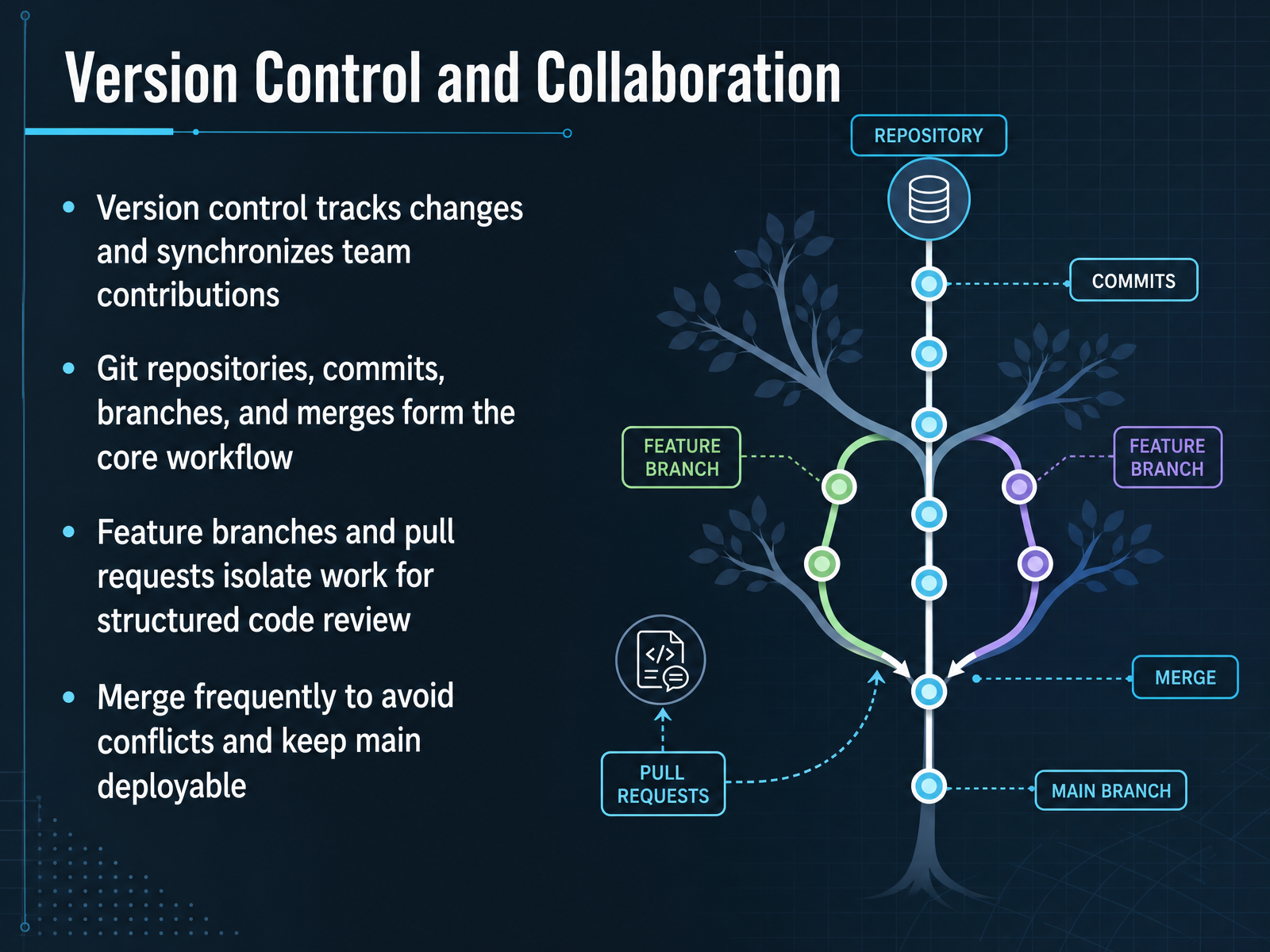
2 min - 07Version Control and CollaborationLet’s turn now to version control and how it shapes team collaboration. Version control tracks every change and synchronizes contributions across your team, but the real discipline comes from the Git workflow. Git repositories, commits, branches, and merges form that core loop. A branch gives you an isolated line of work, and a merge brings that work back into the shared codebase. In practice, feature branches and pull requests keep that process structured. You start a branch for a specific feature, open a pull request, and let the team review the change before it reaches main. That review step matters because it catches issues early and spreads knowledge across the team. Merge frequently to avoid conflicts and keep main deployable. Long lived branches drift, and the longer they drift, the harder they are to integrate. A deployable main is the foundation for reliable continuous delivery. Next, we’ll look at branching strategies that scale.
 docs.aws.amazon.comatlassian.comdocs.gitlab.com+22 min
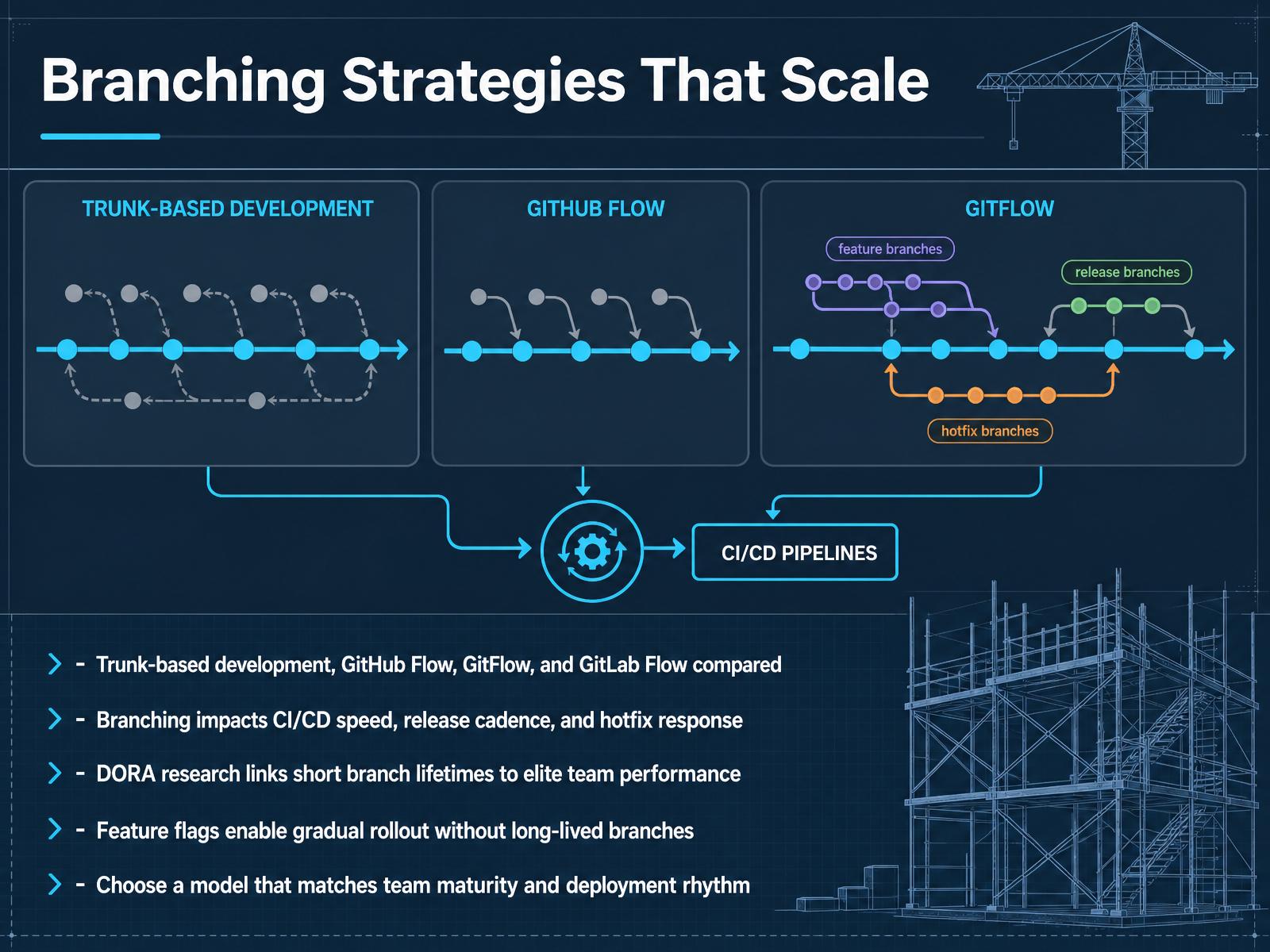
 - 08Branching Strategies That ScaleLet's turn to branching strategies, and how the right model keeps delivery moving without losing control. Trunk-based development, GitHub Flow, GitFlow, and GitLab Flow each make a different trade-off between isolation and integration speed. That choice directly affects CI/CD throughput, release cadence, and how quickly you can ship a hotfix. DORA research consistently links short branch lifetimes to elite team performance. The longer a branch lives, the more merge risk and coordination overhead you carry. Feature flags give you another option here. They let you merge code early and roll out changes gradually, instead of maintaining long-lived branches for half-finished work. The practical takeaway is to choose a model that fits your team maturity and deployment rhythm. Smaller teams shipping continuously often do well with trunk-based development. Regulated or scheduled-release environments may need the structure of GitFlow or GitLab Flow. Whatever you pick, keep branches short and make the merge process routine. Next, we'll connect these delivery practices to Testing and Quality Assurance Fundamentals.
 1 min
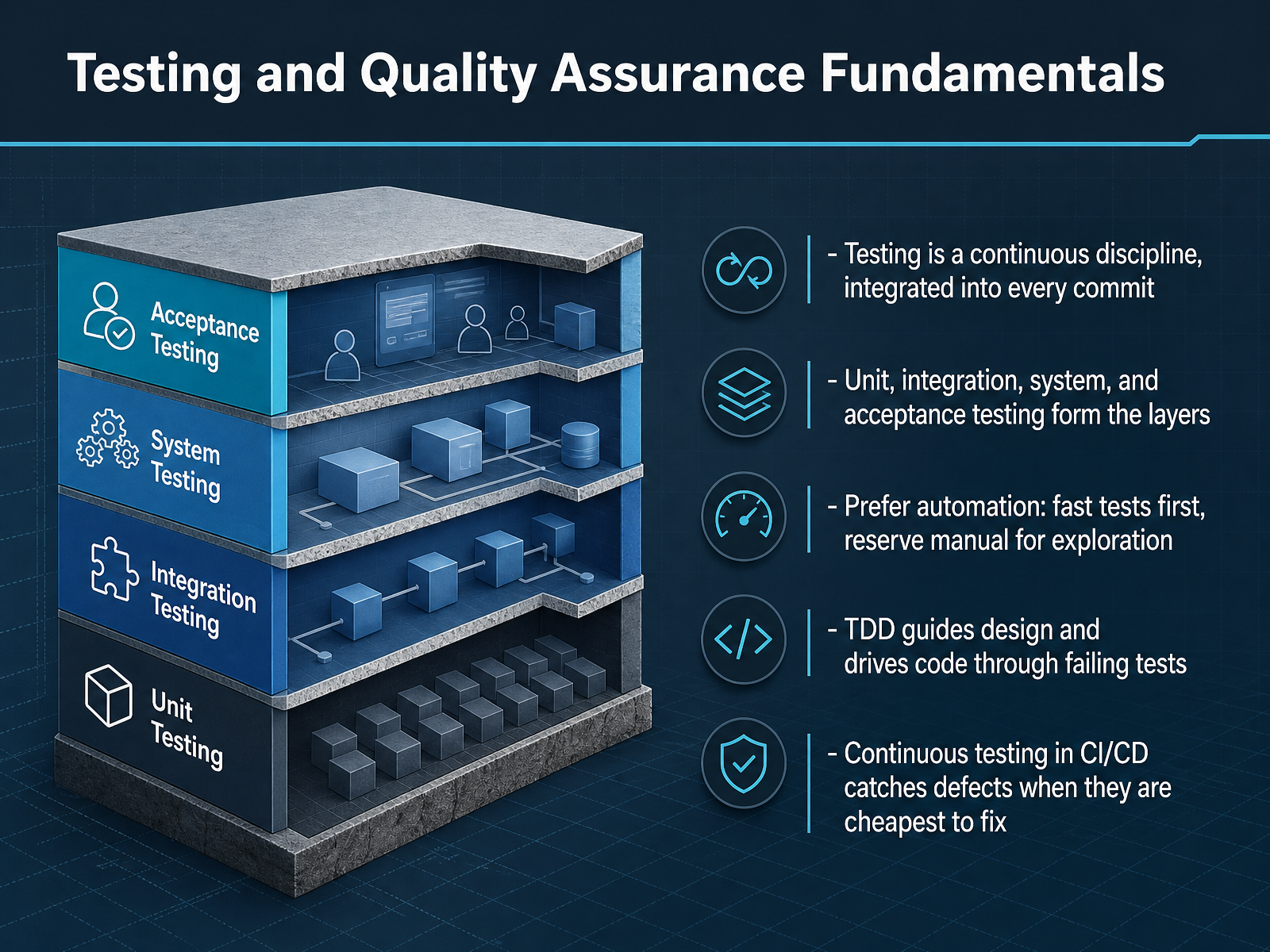
1 min - 09Testing and Quality Assurance FundamentalsNext, let's move into testing and quality assurance. Testing isn't a final gate. It's a continuous discipline that should be integrated into every commit. Think of it as a layered approach. Unit tests verify individual functions in isolation, integration tests confirm components work together, system tests exercise the entire stack, and acceptance tests validate that the product meets your user's needs. Now, we want to automate most of this. Fast, lower-level tests should run constantly, while manual testing is reserved for exploration and discovery. This is where test-driven development helps. TDD guides your design by first writing a failing test, then making it pass. It sounds slower at first, but it produces cleaner interfaces and a faster regression suite. Finally, continuous testing in your CI/CD pipeline catches defects when they are cheapest to fix, which means right after the change is made, not in production. So keep the feedback loop short and push testing down to the lowest possible level.
 ardura.consultingmartinfowler.comcodersera.com+22 min
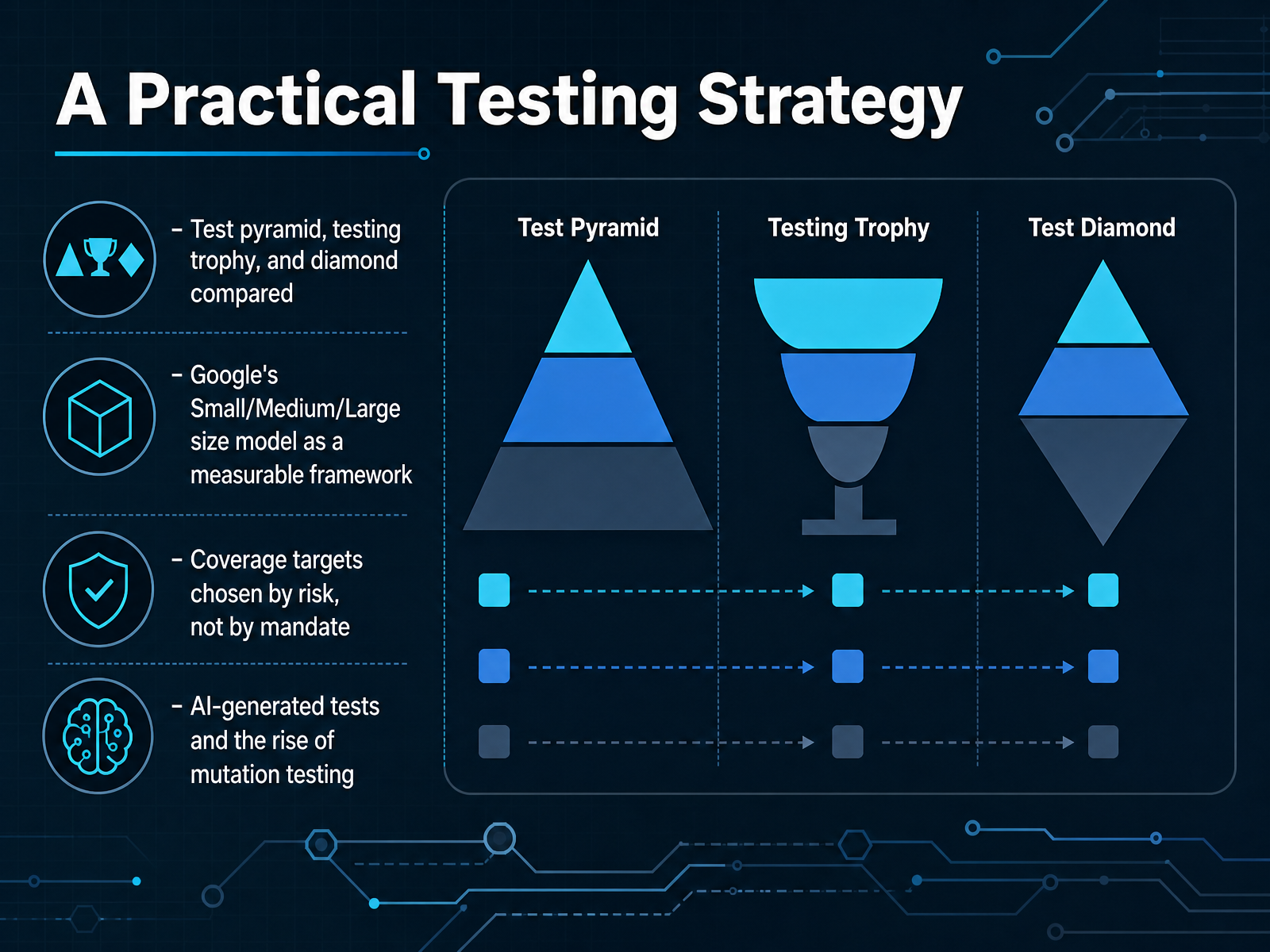
 - 10A Practical Testing StrategyLet’s turn now to a practical testing strategy. You’ll often see the test pyramid, the testing trophy, and the testing diamond compared. Each model suggests a different balance of unit, integration, and end to end tests. Rather than treating one as universally correct, use the comparison to understand what each layer catches, and what it costs. Google’s small, medium, and large size model gives you something more measurable. Small tests run quickly and isolate a single unit. Medium tests integrate a few components, while large tests validate broader system behavior. This framing helps you decide where to focus effort. When setting coverage targets, choose them by risk, not by mandate. A payment path deserves far more coverage than a static help page. Asking for a blanket percentage often drives low value tests. Two trends are changing this space. AI generated tests can accelerate scaffolding, but they still need human review for meaningful assertions. Mutation testing is also gaining traction. It checks whether your test suite actually detects intentional faults, which tells you much more than line coverage. The takeaway is to pick a model that fits your system, target risk, and treat coverage as a signal, not a goal. Next, we’ll explore clean code and maintainability.
 2 min
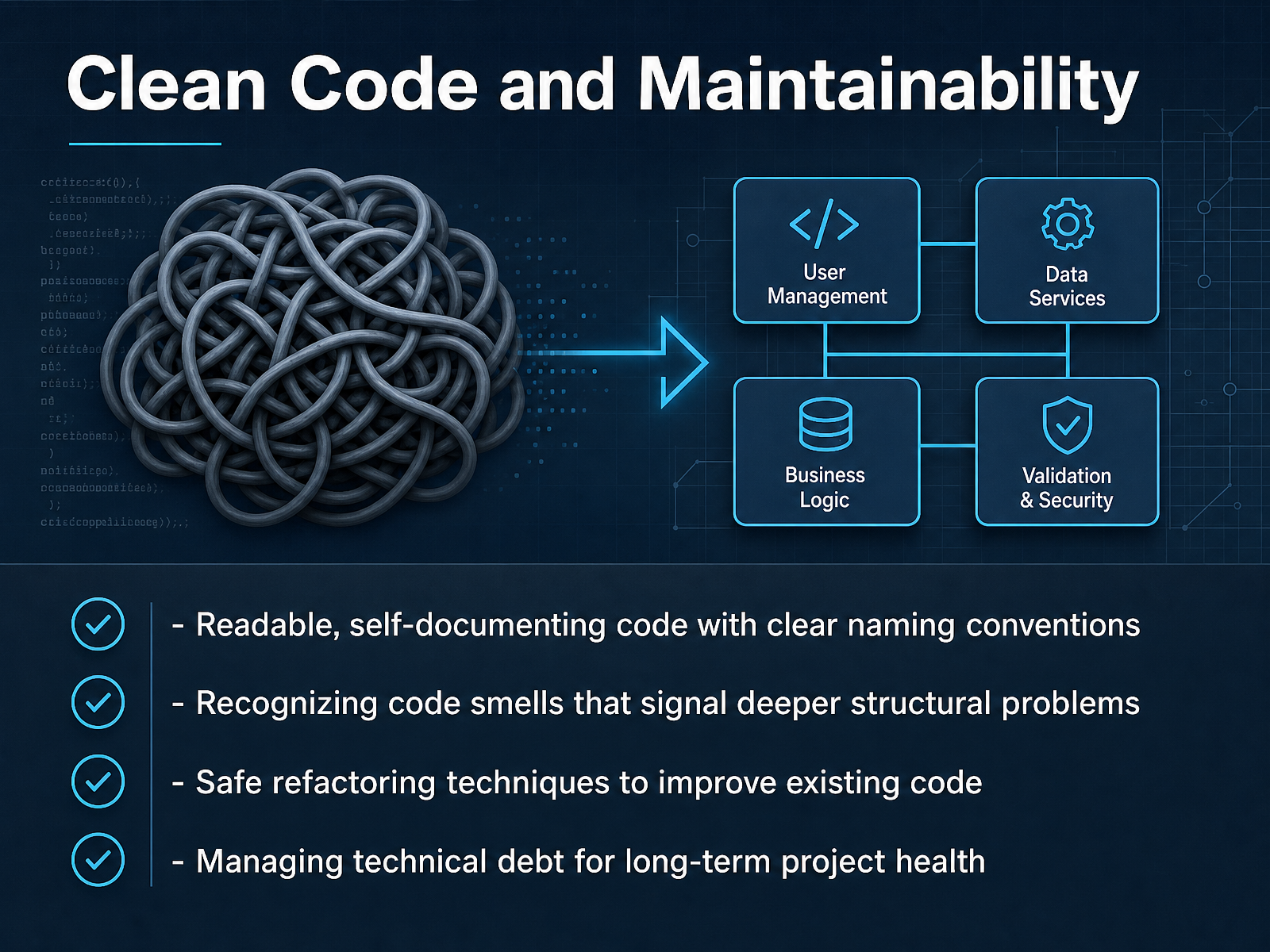
2 min - 11Clean Code and MaintainabilityClean code is less about rigid rules and more about making intent obvious. Good naming conventions turn code into documentation, so a reader can understand purpose without digging through comments. Watch for code smells, like long methods, duplicated logic, or excessive dependencies. These are hints of deeper structural problems. When you find them, refactor in small, safe steps. Adjust names, extract functions, or simplify conditionals, and rely on a passing test suite to confirm behavior hasn't changed. Refactoring also helps manage technical debt. Not every shortcut is bad, but deferred cleanup must be tracked and scheduled. Treat debt as a product decision, not an accident. That mindset keeps the codebase healthy over time. Next, we'll look at debugging and problem solving.
 1 min
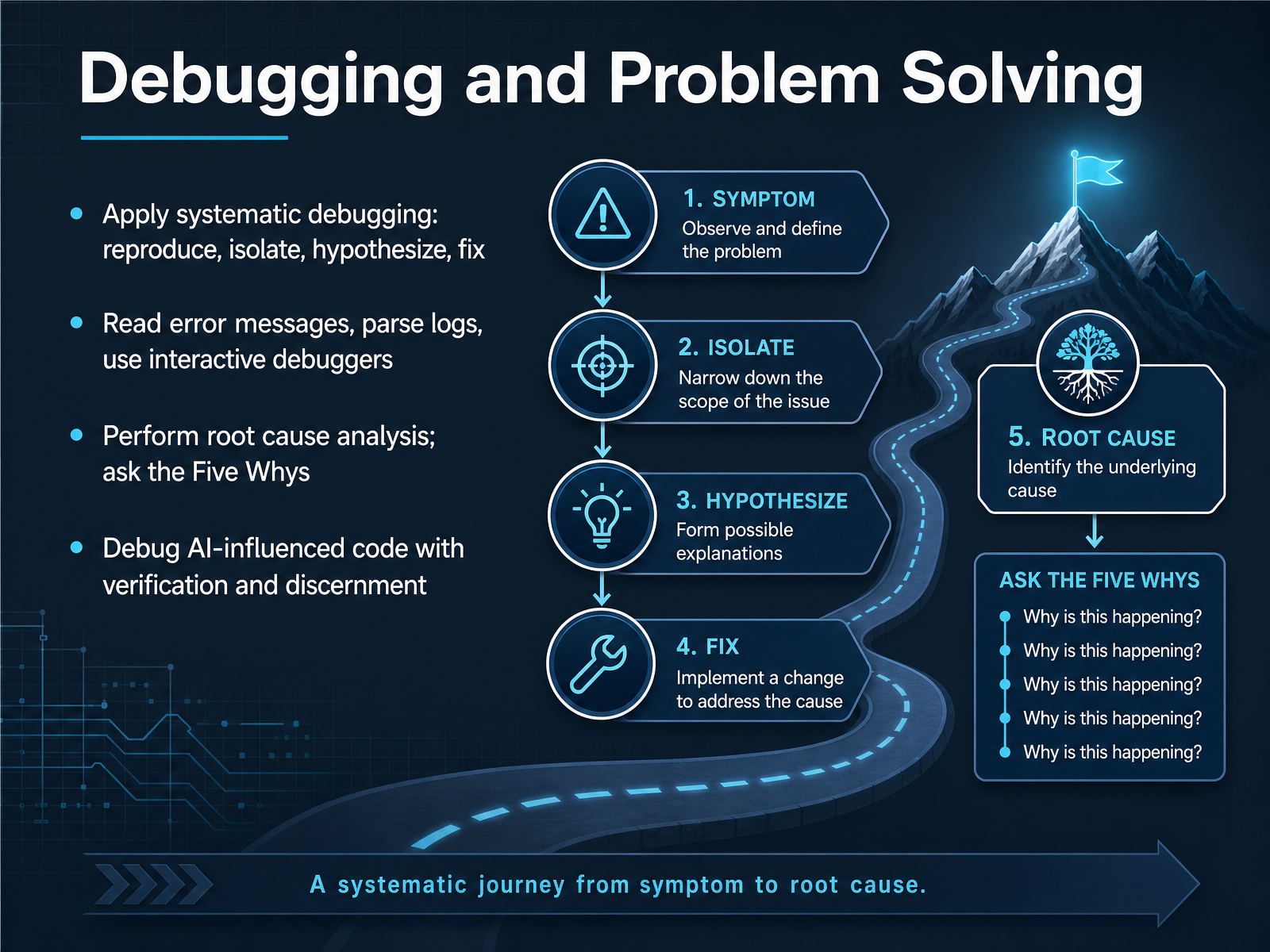
1 min - 12Debugging and Problem SolvingDebugging is less about intuition and more about following a repeatable process. Start by reproducing the issue consistently. Then isolate the smallest piece of code that triggers it. From there, form a hypothesis about why it fails, and only then apply a fix. Read error messages carefully, parse the logs, and use interactive debuggers to inspect state as execution unfolds. When you find a defect, push past the surface symptom with root cause analysis. Ask the Five Whys to trace the failure back to its origin, rather than patching the first visible effect. This matters even more with AI-influenced code. Treat generated snippets as plausible suggestions, not verified solutions. Read them line by line, verify behavior against your test suite, and apply your own judgment before integrating them. Next, we move from problem solving to the operational layer in tools, environments, and DevOps basics.
 1 min
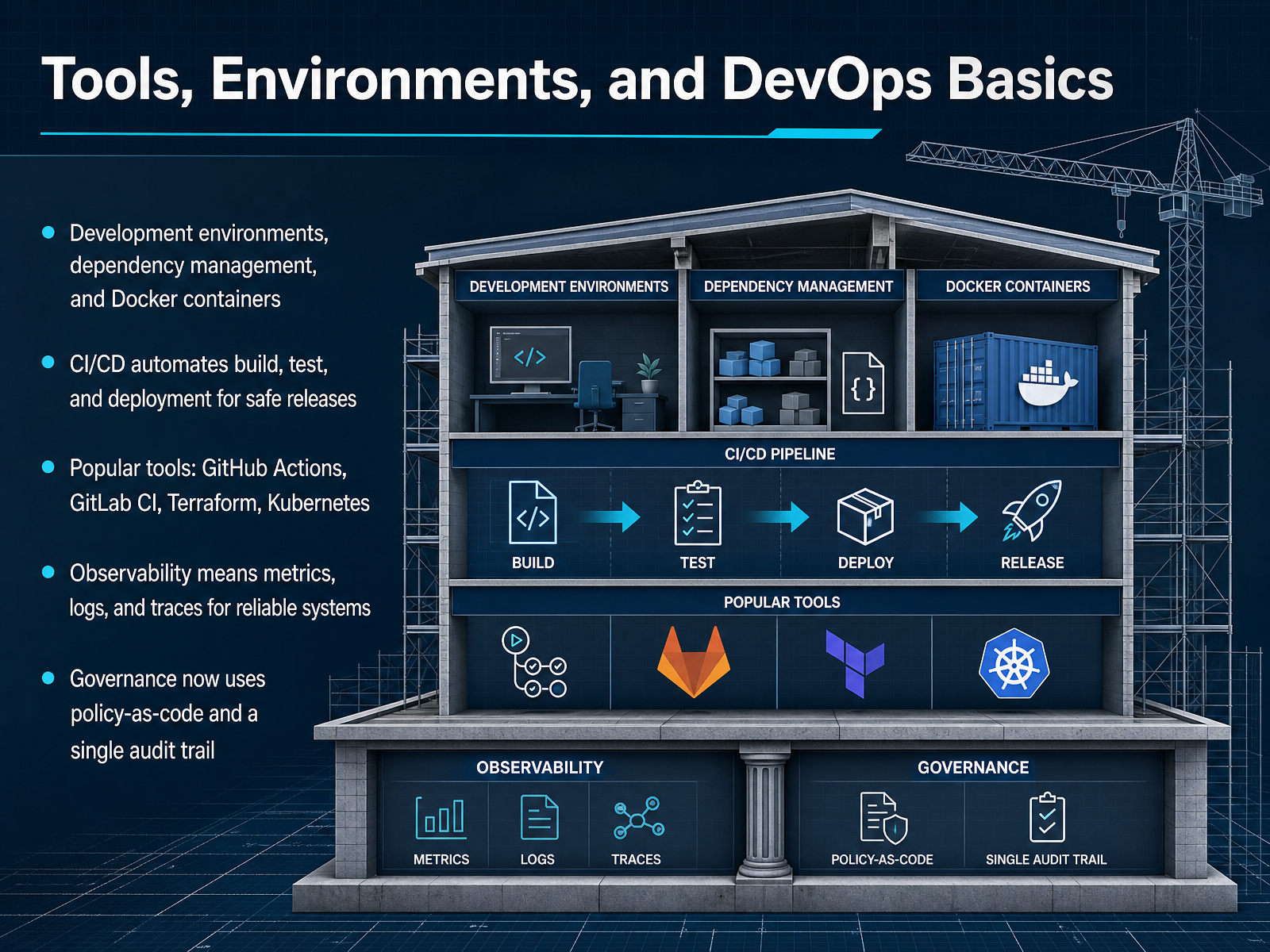
1 min - 13Tools, Environments, and DevOps BasicsLet's move on to the tools, environments, and DevOps practices that turn code into a reliable, shipped product. A good development environment should be repeatable. That means managing dependencies carefully and using containers like Docker to keep behavior consistent from a developer's laptop all the way to production. On top of that, CI and CD automate the build, test, and deployment pipeline, which lets you release changes safely and frequently. Common tools here include GitHub Actions, GitLab CI, and infrastructure automation with Terraform. When your system is running, observability is how you understand its health. You combine metrics, logs, and traces to spot problems quickly and understand user impact. Finally, governance has shifted toward policy-as-code and a unified audit trail, so you can enforce standards without manual review. The key mindset is integration: fewer, well-connected tools tend to scale better than a large pile of disconnected ones. That foundation will serve you well as we look ahead to career pathways and next steps.
 2 min
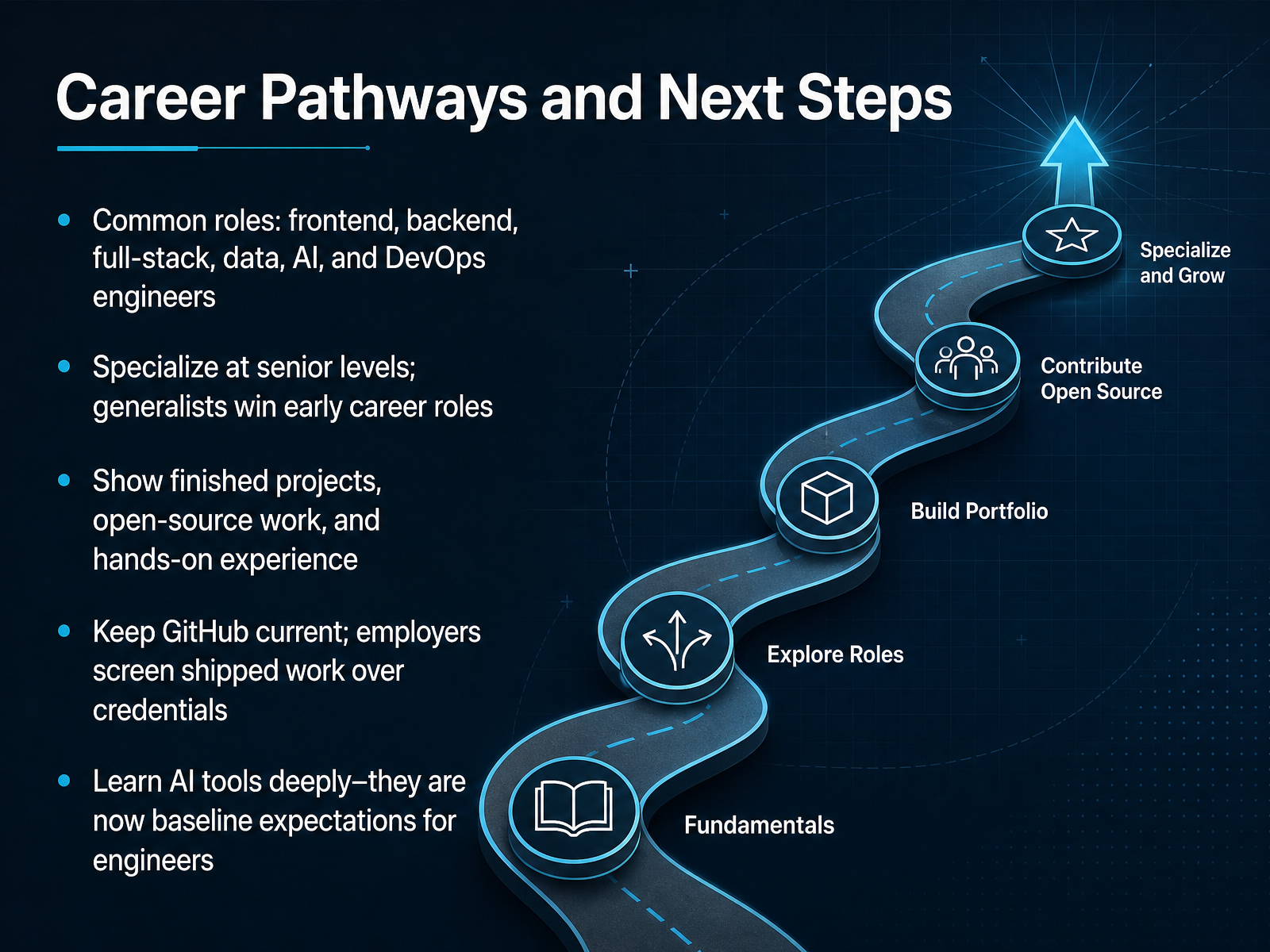
2 min - 14Career Pathways and Next StepsLet's close by mapping where this foundation can take you. Common paths include frontend, backend, full-stack, data, AI, and DevOps engineering. Early in your career, a generalist profile tends to win more opportunities. As you advance, specialization becomes the stronger move. Employers increasingly screen for shipped work over credentials. Keep your GitHub current with finished projects, open-source contributions, and hands-on experience. Show real systems, not just code samples. And treat AI tools as a baseline skill. Fluency with tools like Copilot or Cursor is now expected, but the key is using them to sharpen your judgment, not replace it. If you can combine solid fundamentals, visible work, and responsible AI use, you are positioned well for the path ahead. Thank you for working through this material, and keep building.
 1 min
1 min
Take the deck with you
Download this course as a file — free, no sign-up needed.
- PDF handoutEvery slide page, ready to print or share.15 pages · 3.9 MBDownload
- Narrated PowerPointThe deck that presents itself — every slide carries the digital human's narration video.15 pages · 13.8 MBDownload
- PowerPoint slidesThe full deck as a .pptx — open it in PowerPoint, Keynote, or Google Slides.15 pages · 3.9 MBDownload
Free to use in your own training — please keep the PersonWise credit page at the end.
Have your own deck? Turn it into a course
Sources consulted
Web sources consulted while building this course.
- Software engineering | computer science | Britannica — britannica.com
- Software engineering — en.wikipedia.org
- Software engineering, across two centuries — se.inf.ethz.ch
- Software engineering | IEEE Technology Navigator — technav.ieee.org
- What Is Software Engineering? The Complete 2026 Guide — articsledge.com
- Software Development Life Cycle Models | LCGC — lcgc.dev
- Software Development Life Cycle Models: A 2026 Expert ... — enosta.com
- Software project methodology: how to choose the right one 2026 — flexi-project.com
- What is Software Development Life Cycle (SDLC)? Complete Guide — atlassian.com
- Choosing the Right Software Development Model: 7 SDLC Approaches Explained — emergentsoftware.net
- Git branching strategies - AWS Prescriptive Guidance — docs.aws.amazon.com
- A Guide to Optimal Branching Strategies in Git | Atlassian — atlassian.com
- Branching strategies | GitLab Docs — docs.gitlab.com
- Git Branching Strategies in 2026: GitHub Flow, GitFlow, ... — deployhq.com
- Adopt a Git branching strategy - Azure Repos — learn.microsoft.com
- Stages of Software Testing: Complete 2026 Guide | ARDURA | Blog ARDURA Consulting — ardura.consulting
- The Practical Test Pyramid — martinfowler.com
- Software Testing Complete Guide (2026): Frameworks, AI Tools, CI/CD, Performance — codersera.com
- The Test Pyramid in 2026: Still Relevant, Still Necessary — onpathtesting.com
- Testing Pyramid: Unit vs Integration vs E2E (2026) | Autonoma — getautonoma.com