Begin
14 pages · ~28 min
Ethics and Responsible Cybersecurity Practice
This training helps cybersecurity professionals apply ethical principles and responsible practices in their daily work.
A digital instructor presents all 14 pages. Hold “Ask” at any point and ask out loud — the answer comes from this course. No sign-up needed.
What you’ll learn
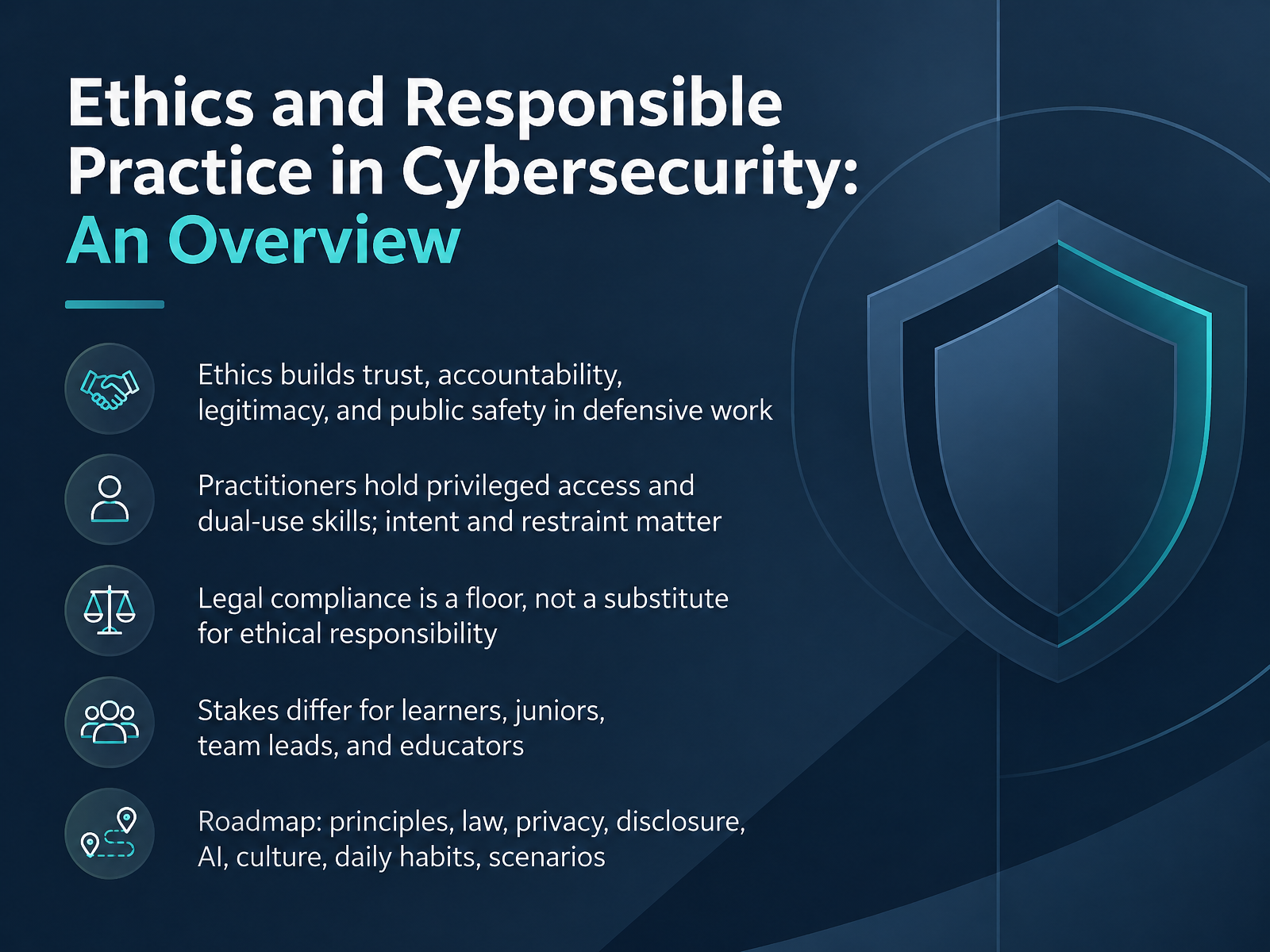
- 01Ethics and Responsible Practice in Cybersecurity: An OverviewWelcome. Over the next fourteen slides, we will look at ethics and responsible practice in cybersecurity, and why they matter in everyday defensive work. Ethics is what builds trust, accountability, legitimacy, and public safety. As practitioners, you hold privileged access and dual-use skills, so intent and restraint matter just as much as technical ability. Legal compliance is a floor, not a substitute for ethical responsibility. The stakes differ for learners, junior professionals, team leads, and educators, so we will frame decisions as practical questions. Who is affected, what authority applies, and what could go wrong. From here, we will move through principles, law, privacy, disclosure, artificial intelligence, culture, daily habits, and realistic scenarios. Let's begin with the shared standards that guide our profession, in a segment called Professional Codes and Shared Ethical Standards.edge.sitecorecloud.ioisc2.orgisc2.org+22 min
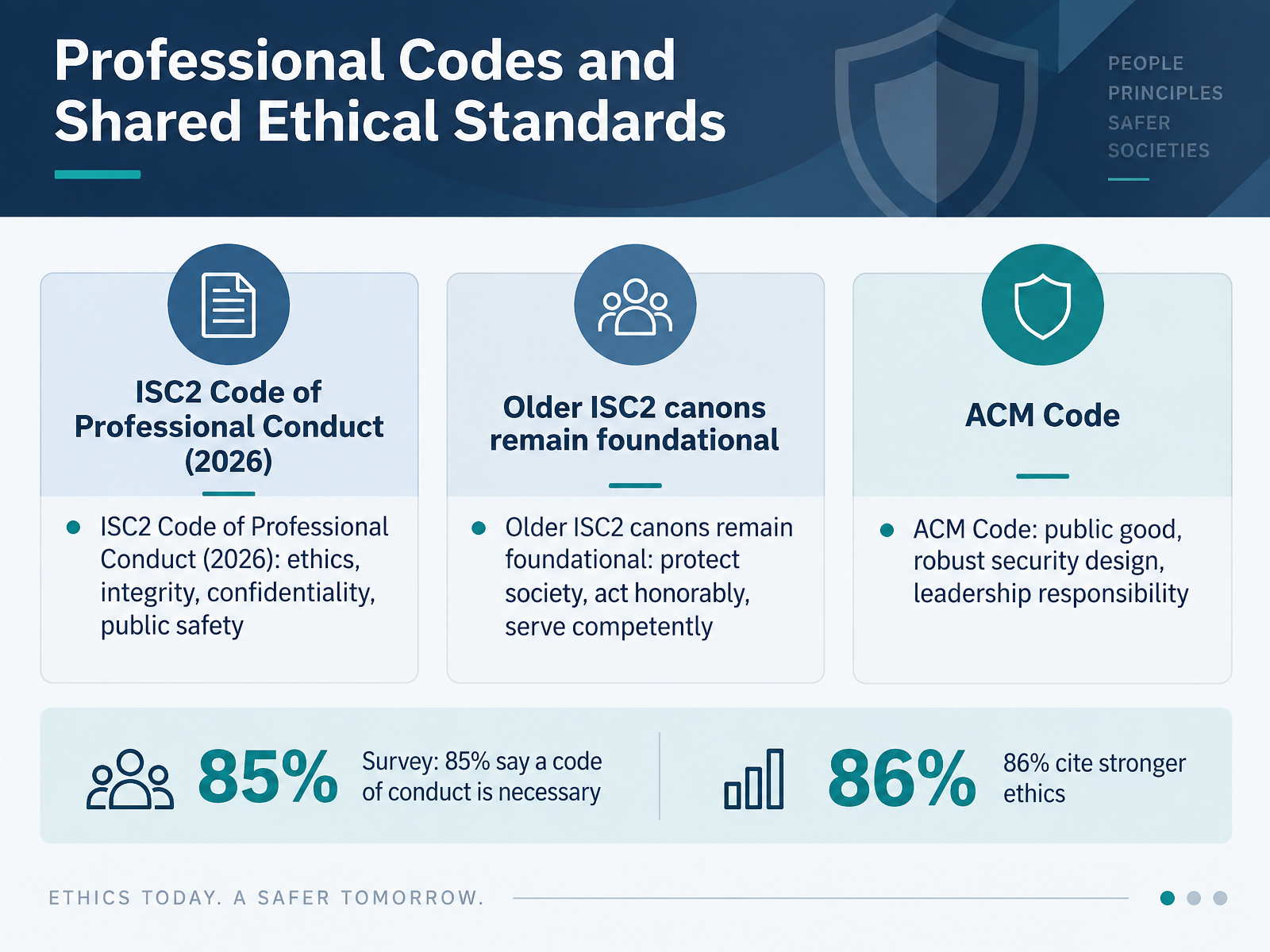
- 02Professional Codes and Shared Ethical StandardsLet's look at the professional codes and shared ethical standards that guide our work. The ISC2 Code of Professional Conduct, released in 2026, centers on ethics, integrity, confidentiality, and public safety. It builds on the older ISC2 canons, which still hold true today: protect society, act honorably, and serve competently. The ACM Code adds its own emphasis: support the public good, design systems that are robustly and usably secure, and take responsibility as a leader. Here is the key point. These standards matter most when you use them daily, not only during a formal investigation. A recent survey of nearly one thousand professionals found that eighty-five percent say a code of conduct is necessary for the field, and eighty-six percent say it fosters a stronger culture of ethics and accountability. So when you face a judgment call, pause and ask yourself: who is affected, what authority applies, and what could go wrong? Those three questions turn a code on paper into a practical tool. Next, we will examine the core ethical principles that guide defensive security.
 edge.sitecorecloud.ioisc2.orgisc2.org+22 min
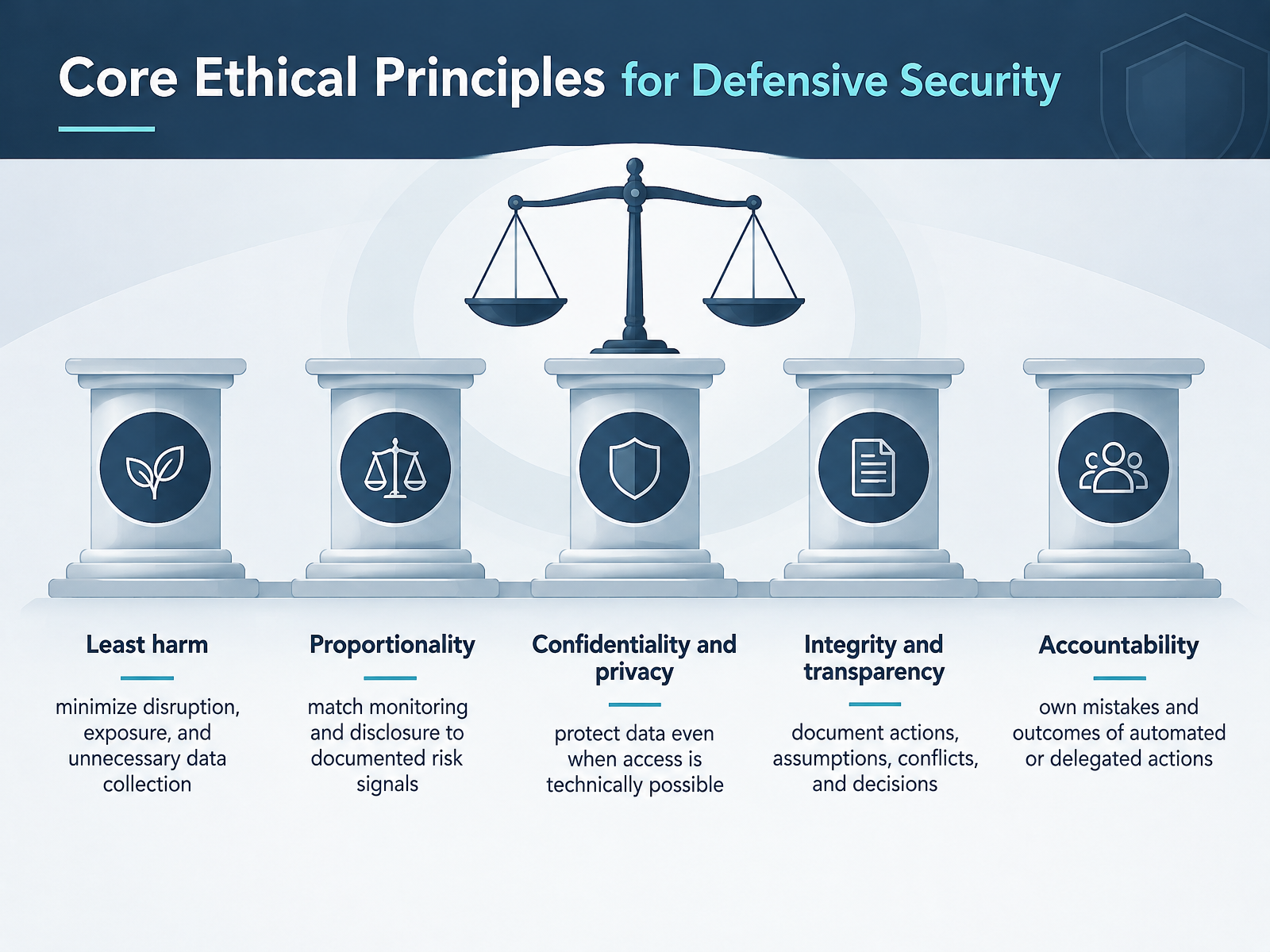
- 03Core Ethical Principles for Defensive SecurityLet's ground this in five principles you can actually apply during a shift. First, least harm. Ask who is affected, and whether you truly need that extra log or dataset. Second, proportionality. Match monitoring and disclosure to documented risk signals, not curiosity. Third, confidentiality and privacy. Protect data even when access is technically possible. Fourth, integrity and transparency. Document your actions, your assumptions, and any conflicts. Finally, accountability. Own mistakes, including outcomes from automated or delegated actions. Before you act, ask three practical questions. Who is affected? What authority applies? And what could go wrong? That pause is where good judgement lives. Next, let's look at legal and regulatory boundaries.
 edge.sitecorecloud.ioisc2.orgisc2.org+21 min
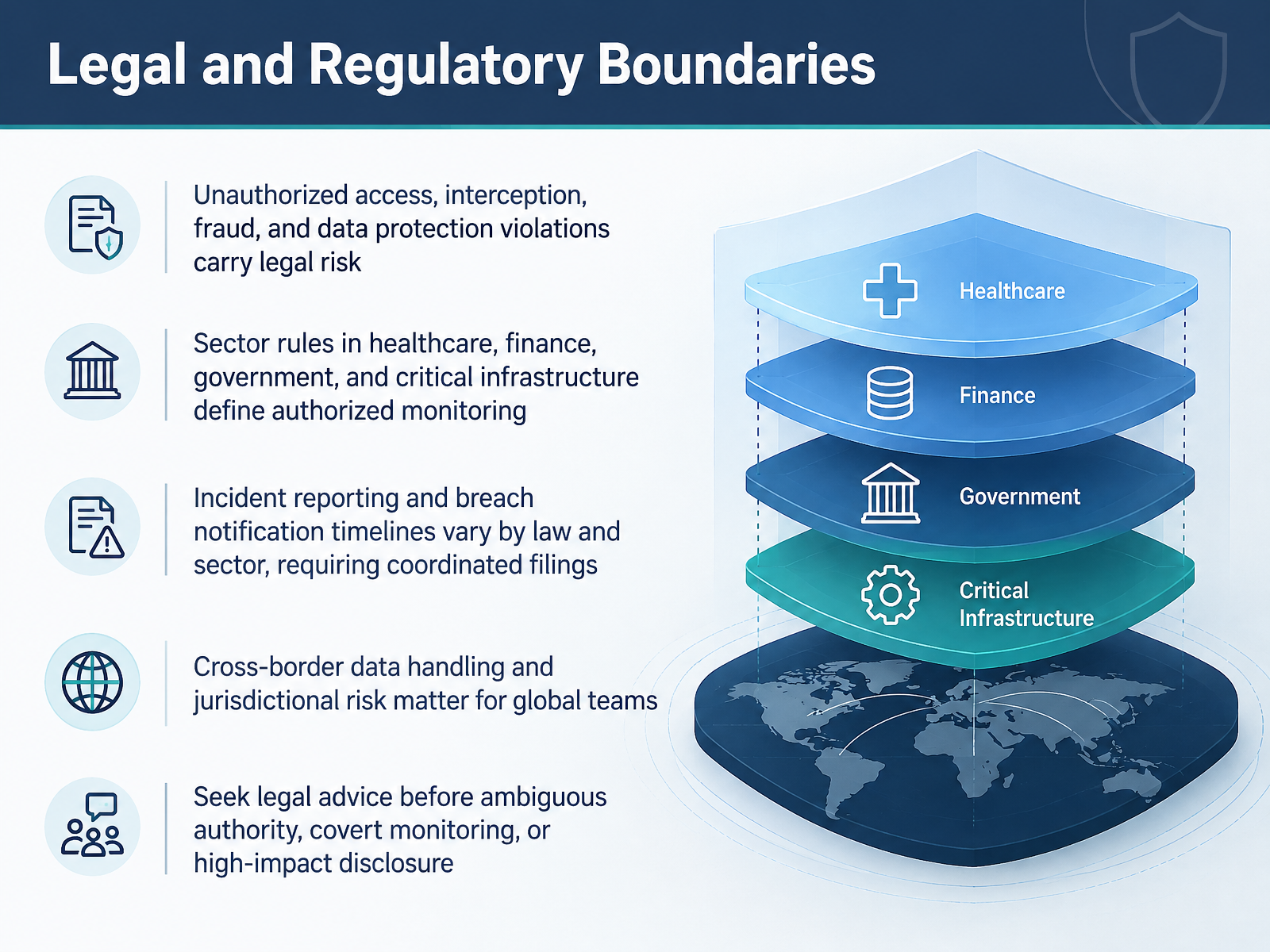
- 04Legal and Regulatory BoundariesNow let's look at the legal and regulatory boundaries around defensive security work. Unauthorized access, interception, fraud, and mishandling personal data can all carry legal risk, even when your intent is protective. Sector rules matter too. Healthcare, finance, government, and critical infrastructure each define what authorized monitoring looks like, and those definitions are not identical. Incident reporting adds another layer. Breach notification timelines vary by law and sector, so a single event may require several coordinated filings with different deadlines. For global teams, cross-border data handling and jurisdictional risk deserve early attention, because where data sits can change which rules apply. When authority is ambiguous, when monitoring turns covert, or when disclosure could have high impact, pause and ask yourself three questions. Who is affected? What authority actually applies? And what could go wrong? Then seek legal advice before you act, not after. That habit protects both the organization and the people it serves. Next, we turn to reporting, enforcement, and emerging legal pressure.
 reedsmith.comedpb.europa.euregdossier.eu+21 min
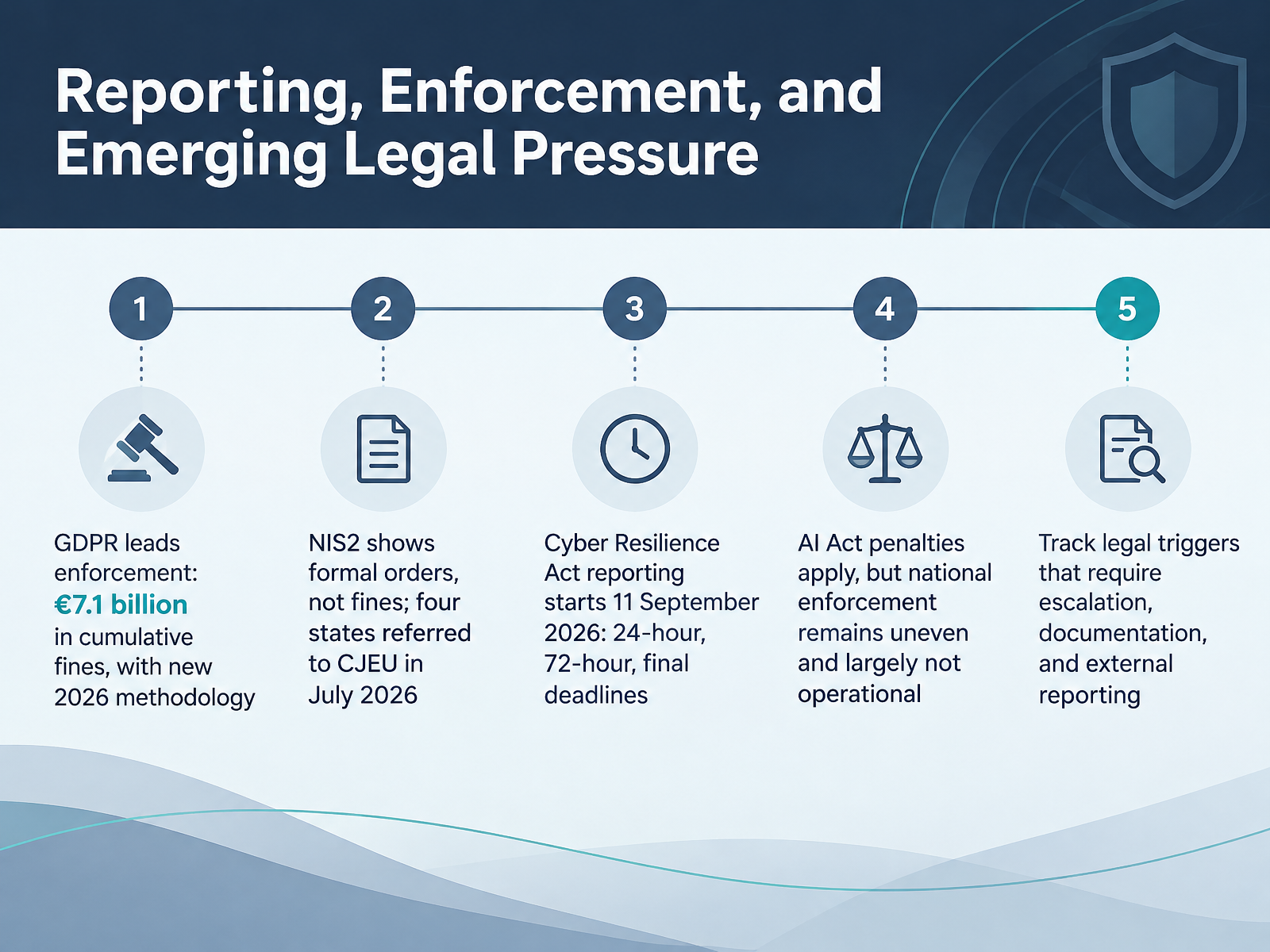
- 05Reporting, Enforcement, and Emerging Legal PressureLet's turn to reporting, enforcement, and the legal pressure building around them. Start with the General Data Protection Regulation, or G D P R. It remains the clear leader in enforcement, with around seven point one billion euros in cumulative fines, and a new 2026 methodology that pushes authorities to reason more explicitly about whether a fine is warranted. By contrast, NIS2 has produced no published corporate fines yet. Supervisors have issued formal orders instead, forty seven in Germany and twenty three in France, and four member states were referred to the Court of Justice in July 2026 for failing to transpose the directive. Then there is the Cyber Resilience Act. Its reporting obligations begin on the eleventh of September 2026. Manufacturers must notify an actively exploited vulnerability or severe incident within twenty four hours, follow up within seventy two hours, and submit a final report later. The AI Act's penalty chapter applies, but national enforcement is still uneven and largely not operational. So the practical lesson is to track legal triggers in your own work. Before an incident, ask yourself three questions. Which rules apply here, who must be notified, and what evidence will we need to show we acted responsibly? That groundwork is what makes escalation calm instead of chaotic. Next, we move into ethical decision making during incident response.
 reedsmith.comedpb.europa.euregdossier.eu+22 min
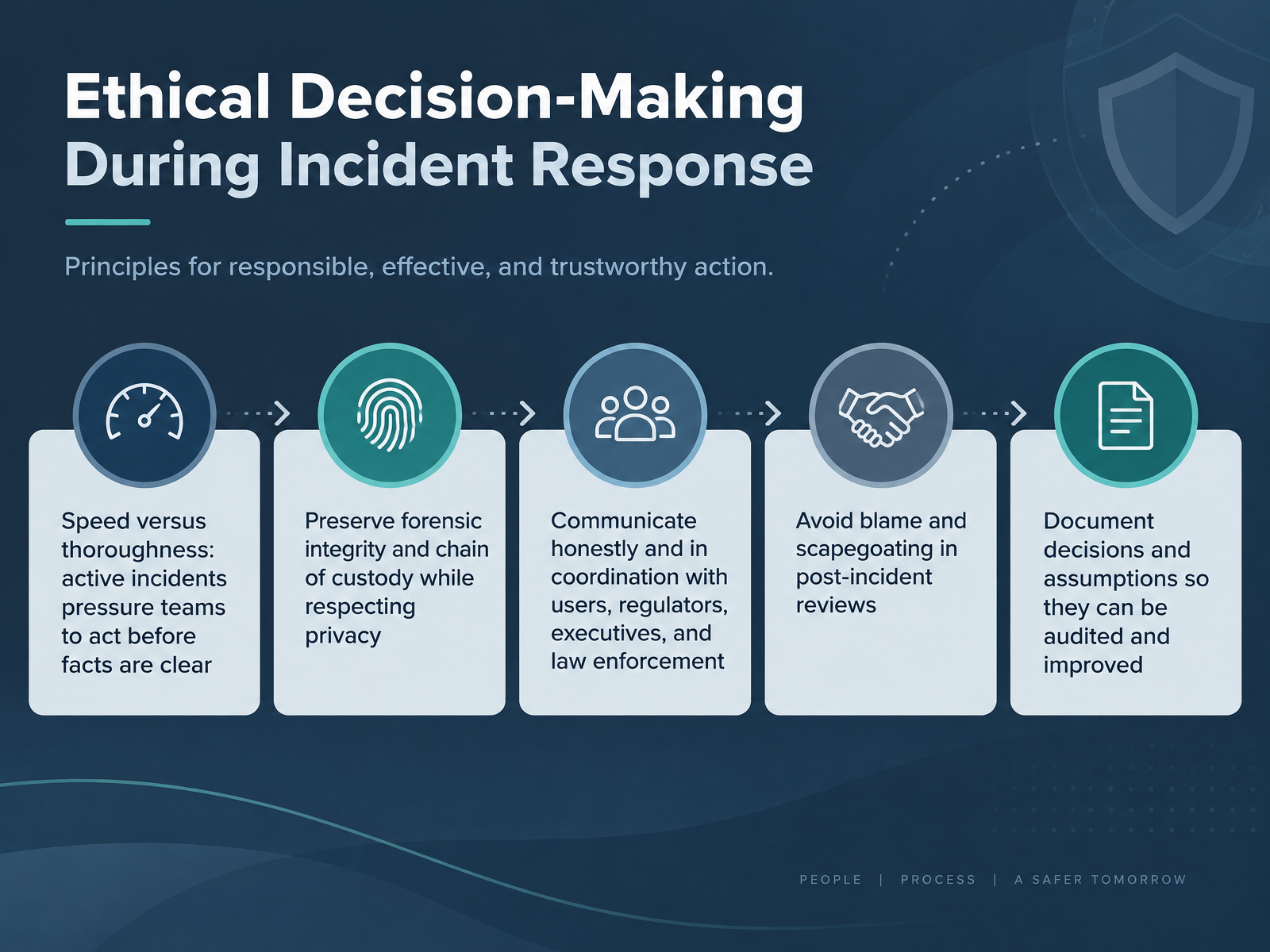
- 06Ethical Decision-Making During Incident ResponseLet's turn to ethical decision-making during incident response. When an incident is active, speed and thoroughness pull against each other. Teams feel pressure to act before the facts are clear. So pause and ask: what do we actually know, and what is still assumption? Then consider forensic integrity. Preserve the chain of custody and protect evidence, while still respecting the privacy of the people whose data sits in those logs. Those two duties are not in conflict. They simply require deliberate handling. Next, communicate honestly and in coordination. Users, regulators, executives, and law enforcement each need clear information, but they don't all need it at the same moment. Decide who speaks, to whom, and when. And resist blame. Post-incident reviews work best when people can describe what happened without fear. Finally, document your decisions and the assumptions behind them. That record becomes the evidence you can audit, explain, and improve. Speed matters, but defensible judgment matters more. Next, we'll look at privacy, monitoring, and surveillance boundaries.
 isc2.orgnfp77.chteiss.co.uk+22 min
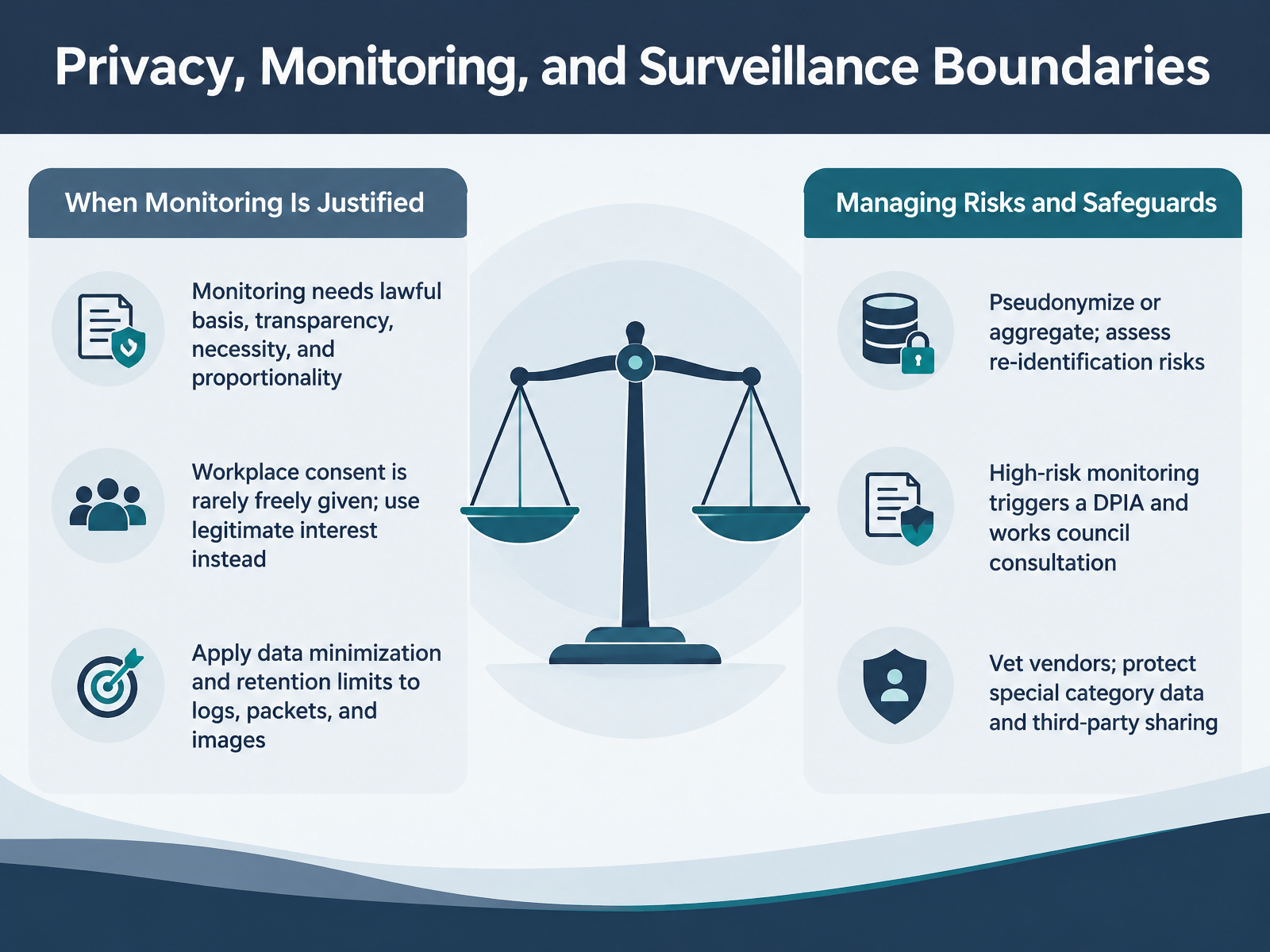
- 07Privacy, Monitoring, and Surveillance BoundariesLet's talk about privacy, monitoring, and surveillance boundaries. Security work depends on visibility, but visibility has limits. Any monitoring you run needs a lawful basis, and it needs to be transparent, necessary, and proportionate. So before you enable logging or packet capture, ask yourself: who is affected, what authority applies, and what could go wrong if this data is misused? Workplace consent is rarely freely given, because of the power imbalance between employer and employee. So lean on legitimate interest instead, and document your reasoning. Then apply data minimization and retention limits to logs, packets, and images. Keep only what you need, and delete it on schedule. Where you can, pseudonymize or aggregate, and assess re-identification risks honestly. High-risk monitoring should trigger a Data Protection Impact Assessment and, where applicable, works council consultation. Finally, vet your vendors carefully, and give special category data and third-party sharing the extra protection they require. The takeaway is simple: monitor with purpose, not with appetite. That mindset carries directly into our next topic, Vulnerability Disclosure and Coordinated Response.
 news.miami.eduhubsecure.aiinsiderisk.io+22 min
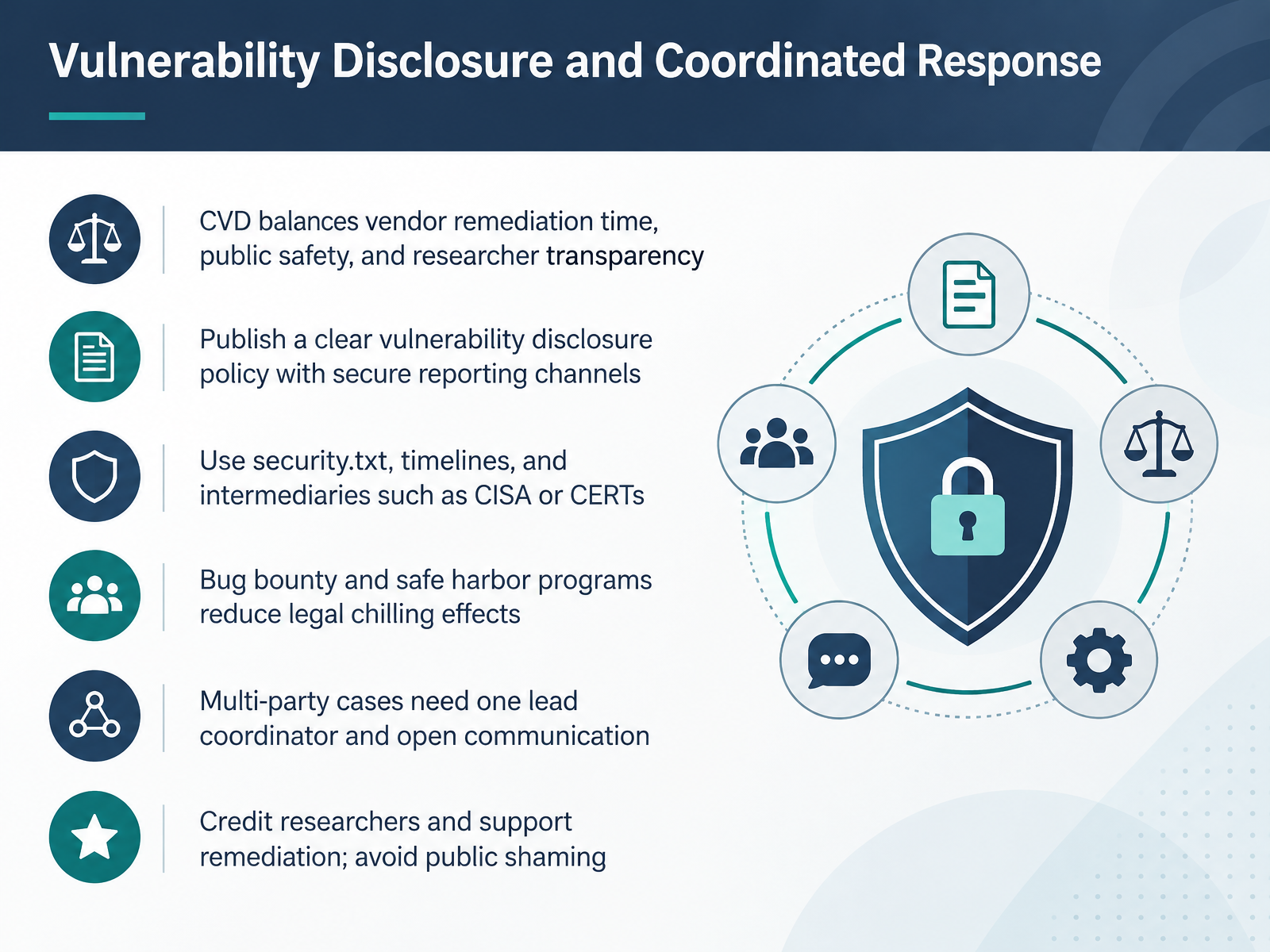
- 08Vulnerability Disclosure and Coordinated ResponseNext, let us look at vulnerability disclosure and coordinated response. Coordinated disclosure balances three things: giving vendors time to fix issues, protecting the public, and respecting the researcher who reported the problem. Start by publishing a clear disclosure policy with a secure reporting channel. You can use a security dot txt file, set clear timelines, or work through an intermediary such as CISA or a national CERT. Bug bounty and safe harbor programs also reduce the legal chilling effect that stops researchers from coming forward. When several parties are involved, choose one lead coordinator and keep communication open across the group. A few practical questions help here. Who is affected by this flaw? What authority or agreement applies? What could go wrong if we disclose too early, or wait too long? And finally, credit researchers, support remediation, and avoid public shaming. That keeps the relationship constructive and the process effective. This leads us into our next topic: AI, Automation, and Emerging Ethical Challenges.
 cisa.gov2 min
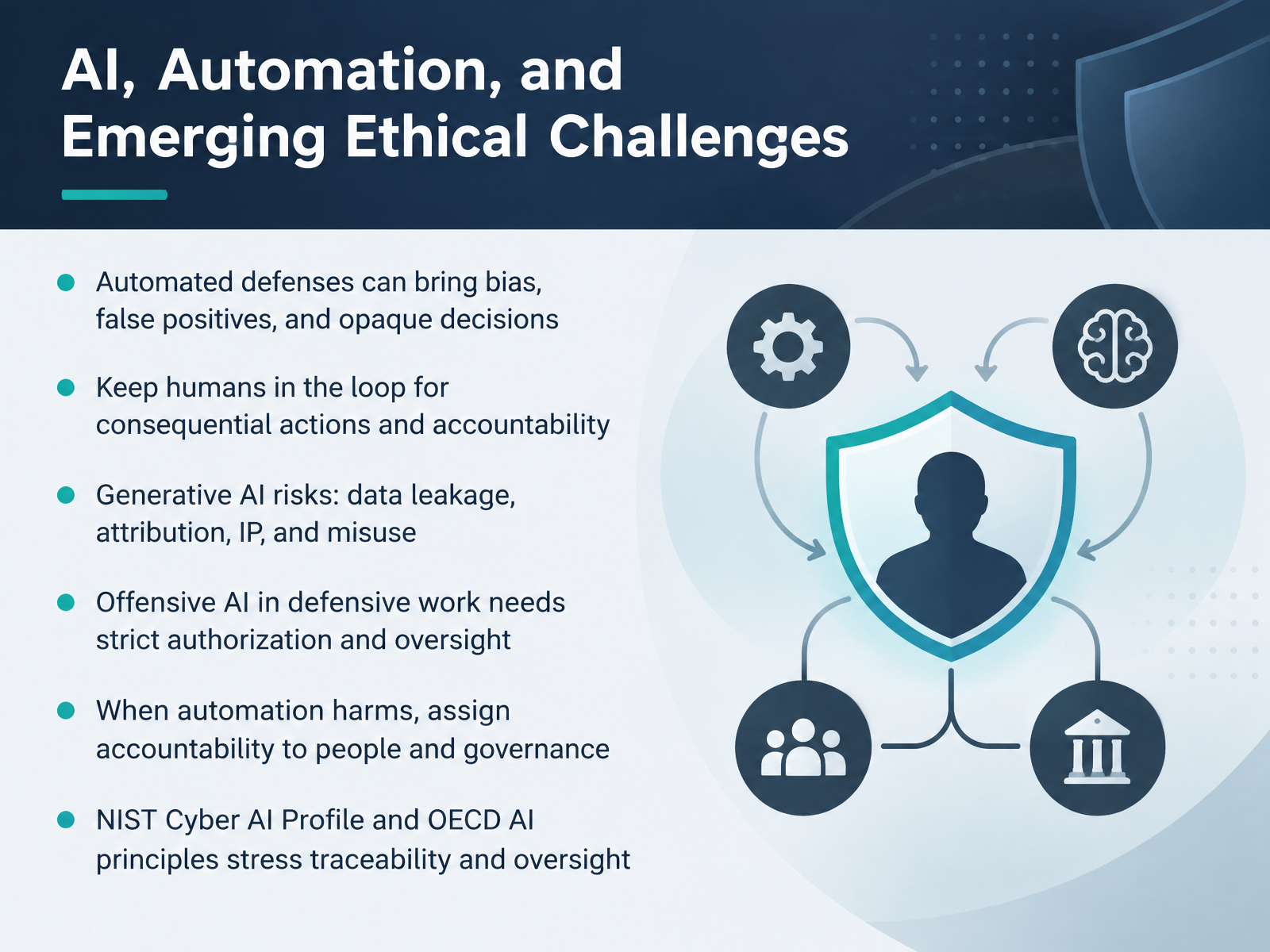
- 09AI, Automation, and Emerging Ethical ChallengesLet's turn to AI, automation, and the emerging ethical challenges they bring. Automated defenses are powerful, but they can also introduce bias, produce false positives, and make decisions that are hard to explain. So when an action is consequential, keep a human in the loop. Ask yourself, who reviews this, and who is accountable if it goes wrong? Generative AI adds its own risks, including data leakage, attribution questions, intellectual property concerns, and misuse. And using offensive AI in defensive work is sometimes necessary, but it demands strict authorization and oversight. When automation causes harm, accountability should land with people and governance, supported by traceability. That is why frameworks like the NIST Cyber AI Profile and the OECD AI principles stress oversight, traceability, and clear human responsibility. Next, we will look at organizational culture, leadership, and speaking up.
 2 min
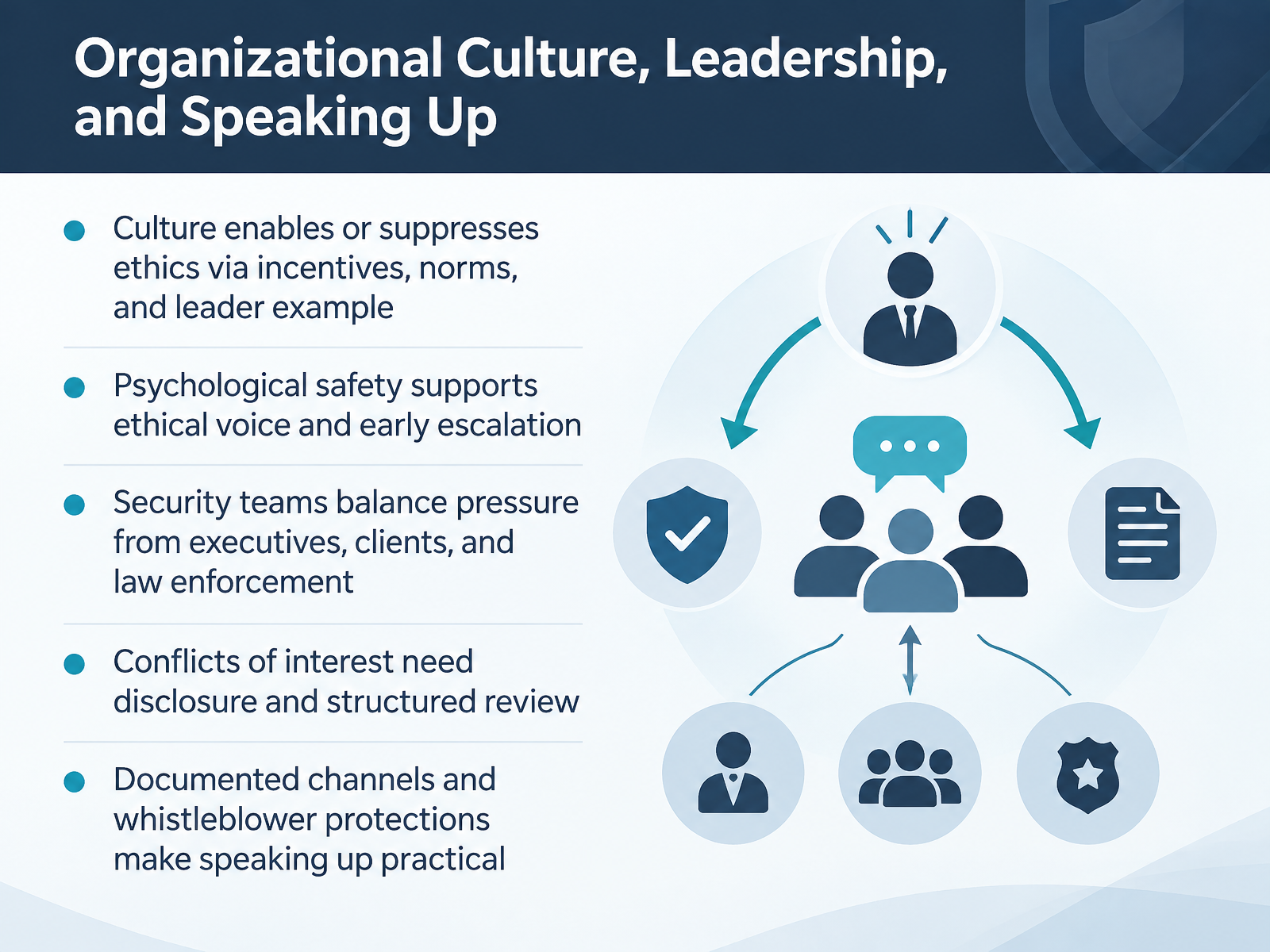
- 10Organizational Culture, Leadership, and Speaking UpLet's look at how organizational culture shapes ethical behavior. Culture enables or suppresses ethics through incentives, norms, and the example leaders set. When people see that raising a concern is safe, they speak up early. That's psychological safety, and it's often the difference between a small issue and a major incident. Security teams also juggle pressure from executives, clients, and law enforcement, and those pulls don't always align. Conflicts of interest need disclosure and a structured review, not a quiet workaround. So ask yourself: who is affected, what authority applies, and what could go wrong? Documented channels and whistleblower protections make speaking up practical, not risky. In short, ethical culture is built by leadership, protected by process, and sustained by people who feel safe to raise concerns. Next, we'll turn to daily habits and practical ethical controls.
 edge.sitecorecloud.ioisc2.orgisc2.org+21 min
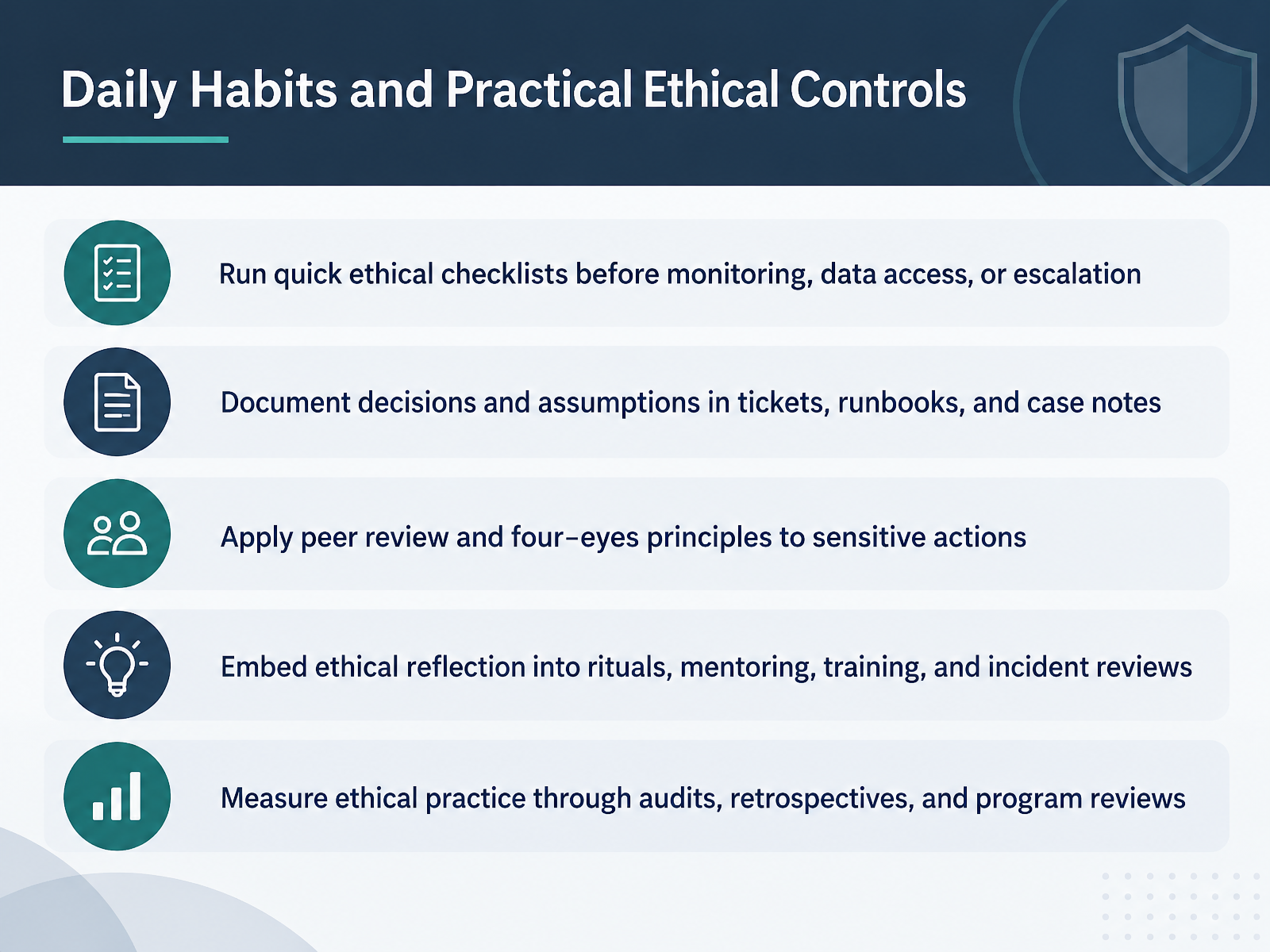
- 11Daily Habits and Practical Ethical ControlsNow let's turn ethics into daily habits and practical controls you can actually apply in your work. Start with a quick checklist before monitoring, data access, or escalation. Three questions help: who is affected, what authority do I have, and what could go wrong. Then document your decisions and assumptions in tickets, runbooks, and case notes. A short written rationale makes your reasoning visible and reviewable later. For sensitive actions, apply peer review and the four-eyes principle. Two sets of eyes catch both mistakes and ethical blind spots. Embed ethical reflection into your existing rituals, mentoring, training, and incident reviews, so it becomes part of how the team works rather than a separate task. Finally, measure ethical practice through audits, retrospectives, and program reviews. Look at whether checklists were used, decisions were documented, and reviews actually happened. The takeaway is simple: small, repeatable habits create a culture of accountability. Next, we'll apply these ideas in Scenario one: Insider Threat Investigation Without Overreach.
 isc2.orgnfp77.chteiss.co.uk+22 min
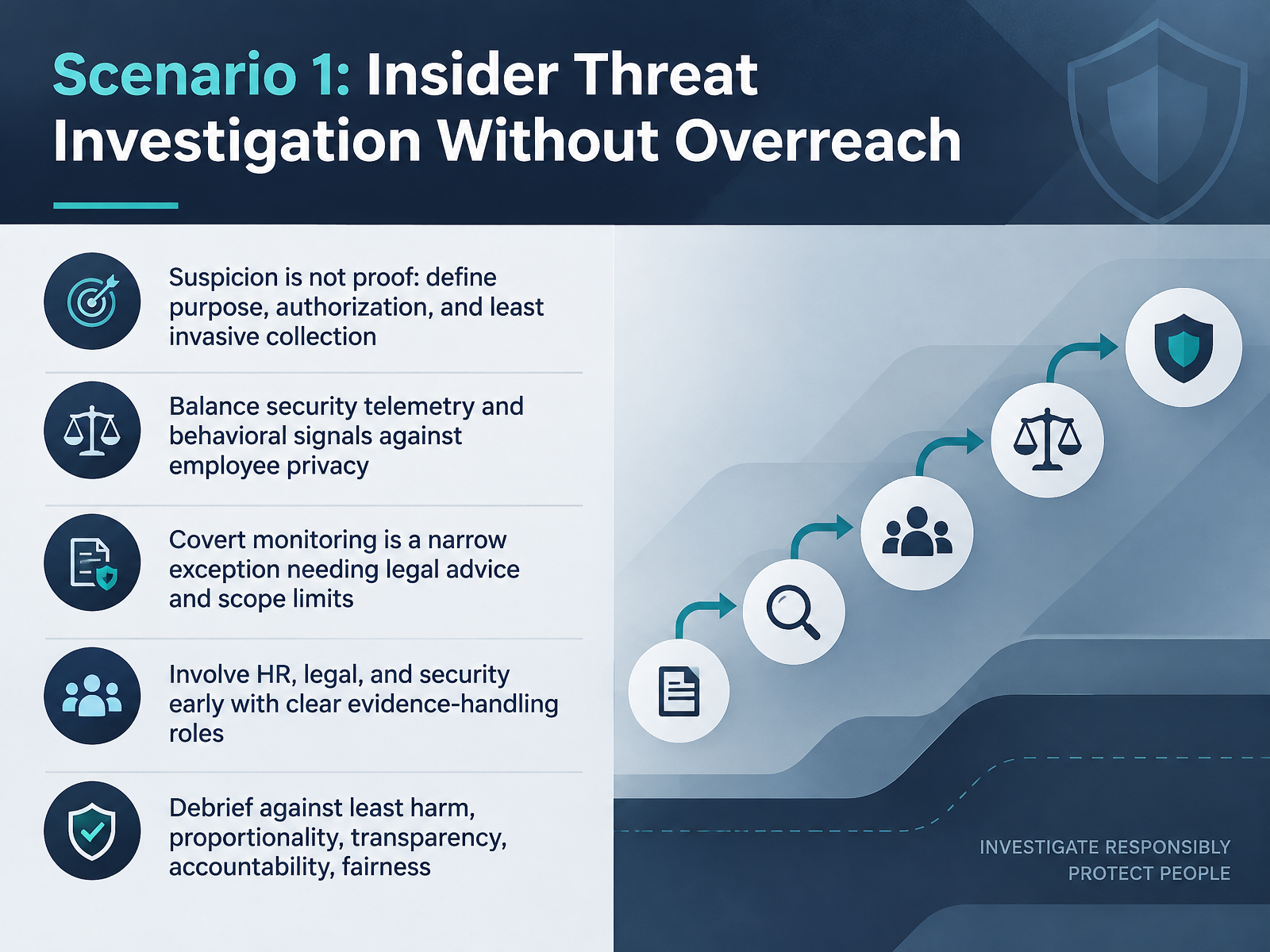
- 12Scenario 1: Insider Threat Investigation Without OverreachLet's work through a realistic scenario. You notice odd behavior from an employee. Maybe unusual file access, maybe activity at strange hours. Suspicion is not proof, so before you collect anything, define three things. What is the purpose of this inquiry? What authorization do you have? And what is the least invasive way to gather what you actually need? Balance your security telemetry against that person's privacy. Behavioral signals can be legitimate, but continuous content capture rarely justifies itself. Covert monitoring is a narrow exception. It needs legal advice, a defined scope, and a clear end point. Pull in HR, legal, and security early, and agree on who handles evidence and who does not. As you debrief, ask yourself: did we cause the least harm? Was our response proportionate? Were we transparent, accountable, and fair? Keep those questions close, because the next scenario tests them differently. Scenario 2: Vulnerability Report from an Unauthorized Researcher.
 news.miami.eduhubsecure.aiinsiderisk.io+22 min
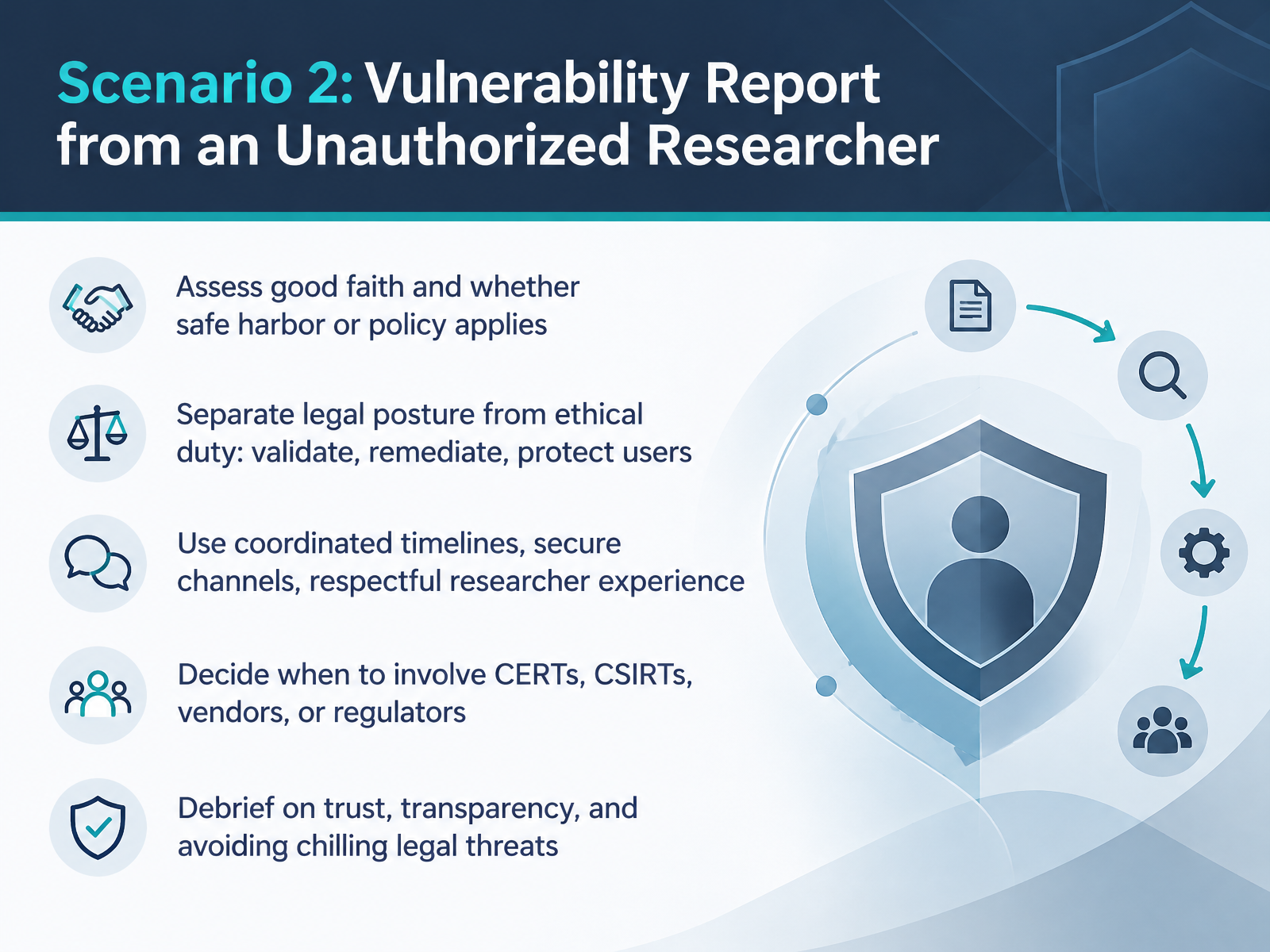
- 13Scenario 2: Vulnerability Report from an Unauthorized ResearcherLet's turn to a scenario many teams eventually face: a vulnerability report arrives from an unauthorized researcher. Someone tested your system, possibly outside the rules, and now they are sharing what they found.
Start by assessing good faith. Did they report privately, avoid exposing data, and give you a reasonable chance to fix the issue? Then check whether safe harbor or your disclosure policy applies, so you know where they stand.
Next, separate legal posture from ethical duty. Whatever the legal questions, you still have a duty to validate the finding, remediate it, and protect users. Use coordinated timelines and secure channels, and treat the researcher respectfully. A poor experience pushes people toward public disclosure or away from reporting at all.
Ask yourself: who is affected, what authority applies, and what could go wrong? Decide when to involve CERTs, CSIRTs, vendors, or regulators, especially in multi-party cases.
Afterward, debrief on trust, transparency, and avoiding legal threats that chill future research. The goal is to fix the issue and keep the reporting channel open.
Scenario 3: Breach Response with Conflicting Duties.
 cisa.govreedsmith.comedpb.europa.eu+22 min
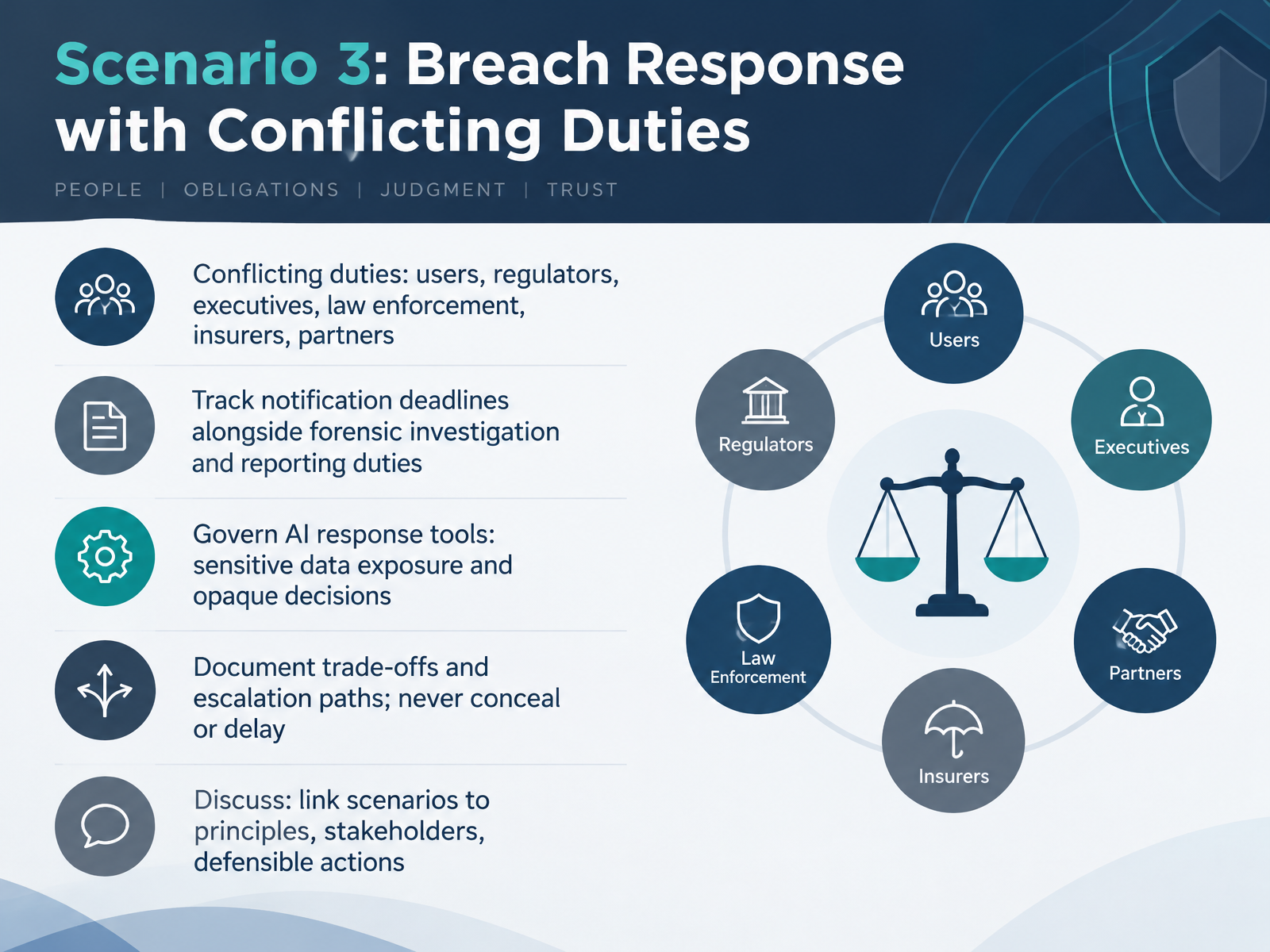
- 14Scenario 3: Breach Response with Conflicting DutiesLet's close with one more scenario, and it's the messiest one. A real breach rarely respects neat boundaries. Users, regulators, executives, law enforcement, insurers, and partners may all hold legitimate claims on you at the same time, and those claims can pull in different directions.
So how do you keep your footing? Track notification deadlines alongside your forensic investigation and any reporting duties. Those clocks run in parallel, not one after another. If you're using AI tools to triage or draft reports, govern them deliberately. Watch for sensitive data leaving your boundary, and be ready to explain how the tool reached its conclusions.
When duties conflict, the answer is almost never to conceal or delay. Document the trade-offs you weighed, and know your escalation path before you need it.
Take a moment on this question. Who is affected, what authority applies, and what could go wrong?
That's the through-line of this course. Link every scenario back to principles, stakeholders, and defensible actions, and you'll make decisions you can stand behind.
Thank you for working through this with me. Keep asking those questions and keep your practice grounded in responsibility. You're ready for it.
 reedsmith.comedpb.europa.euregdossier.eu+22 min
Take the deck with you
Download this course as a file — free, no sign-up needed.
- PDF handoutEvery slide page, ready to print or share.15 pages · 3.1 MBDownload
- Narrated PowerPointThe deck that presents itself — every slide carries the digital human's narration video.15 pages · 16.1 MBDownload
- PowerPoint slidesThe full deck as a .pptx — open it in PowerPoint, Keynote, or Google Slides.15 pages · 3.1 MBDownload
Free to use in your own training — please keep the PersonWise credit page at the end.
Have your own deck? Turn it into a course
Sources consulted
Web sources consulted while building this course.
- Code of Professional Conduct — edge.sitecorecloud.io
- ISC2 Launches Global Code of Professional Conduct for Cybersecurity — isc2.org
- ISC2 Code of Ethics—Guidance for Cybersecurity Professionals — isc2.org
- NEW! Code of Professional Conduct | ISC2 Chapters Community — isc2chapters.isc2.org
- Ethical Decision‑Making for Cybersecurity Professionals — isc2.org
- EU cybersecurity regulatory update for 2026 and beyond | ReedSmith — reedsmith.com
- EDPB-EDPS Joint Opinion [4/2026] — edpb.europa.eu
- EU Regulatory Enforcement Tracker 2026 | Fines & Status — regdossier.eu
- NIS2 Enforcement Tracker 2026: Fines, Audits, Status — legiscope.com
- New General Data Protection Regulation (GDPR) Fining Methodology Guidelines — Impact for Businesses | Publications | Insights | Faegre Drinker Biddle & Reath LLP — faegredrinker.com
- Guidelines — nfp77.ch
- teiss - Leadership & Management - An actionable code of ethics for cyber-security — teiss.co.uk
- EFROS Cybersecurity & AI Governance Toolkit (2026-Q2) — efros.com
- Cybersecurity — informatica.org
- Promoting Privacy in the Workplace: Strategies for ... — news.miami.edu
- Employee Monitoring and GDPR: What Employers Can and Cannot Do in 2026 | HubSecure — hubsecure.ai
- Privacy-Aware Insider Monitoring 2026 | Insider Risk Index — insiderisk.io
- GDPR-Compliant Employee Monitoring: 25-Point 2026 Checklist — gstride.ai
- Employee Monitoring Laws and Privacy Best Practices in 2026 | Remotly — remotly.tech
- Establishing a Coordinated Vulnerability Disclosure Program to Work With Security Researchers — cisa.gov