Begin
14 pages · ~28 min
Data Storytelling Strategic Communication Plan
This training helps professionals build a strategic data storytelling communication plan, turning goals into clear, actionable execution.
A digital instructor presents all 14 pages. Hold “Ask” at any point and ask out loud — the answer comes from this course. No sign-up needed.
What you’ll learn
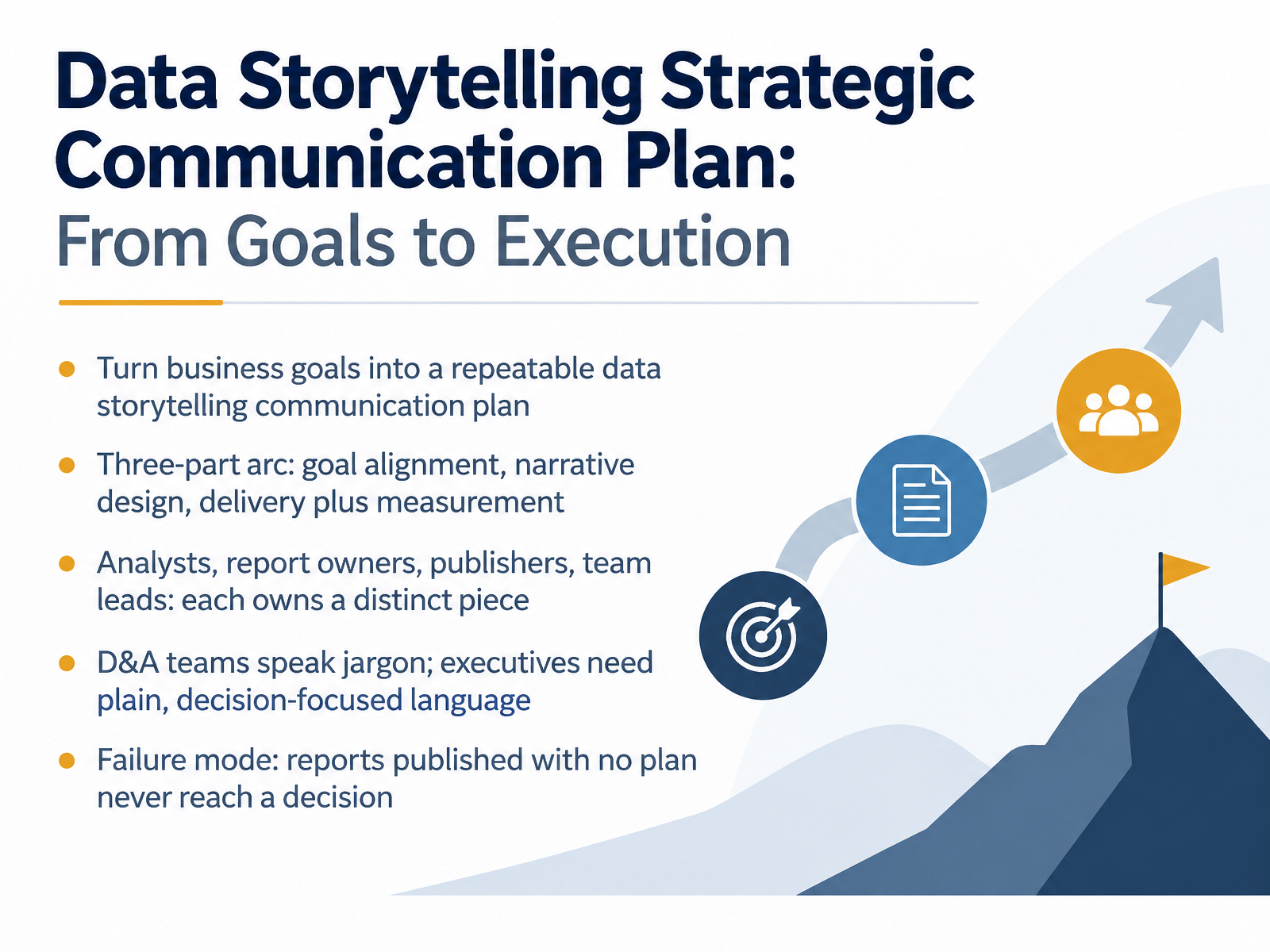
- 01Data Storytelling Strategic Communication Plan: From Goals to ExecutionWelcome. Let's start building something your team will actually reuse: a data storytelling communication plan that runs from goals to execution. Your aim today is simple. Turn business goals into a repeatable plan, built on a three-part arc: goal alignment, narrative design, then delivery and measurement. Each role owns a distinct piece. Analysts shape the insight. Report owners and publishers handle the narrative and release. Team leads secure the decision. A familiar friction point is language. Your data and analytics teams speak jargon, while executives need plain, decision-focused language. So the most common failure is this: reports get published with no plan behind them, and they never reach a decision. That is the gap we close today. Before we move on, write down one report you own and the single decision it should drive. Next, we look at why so many stories go untold. Background: Stories Nobody Told With Your Data.gartner.comscikiq.orgwebershandwick.com+22 min
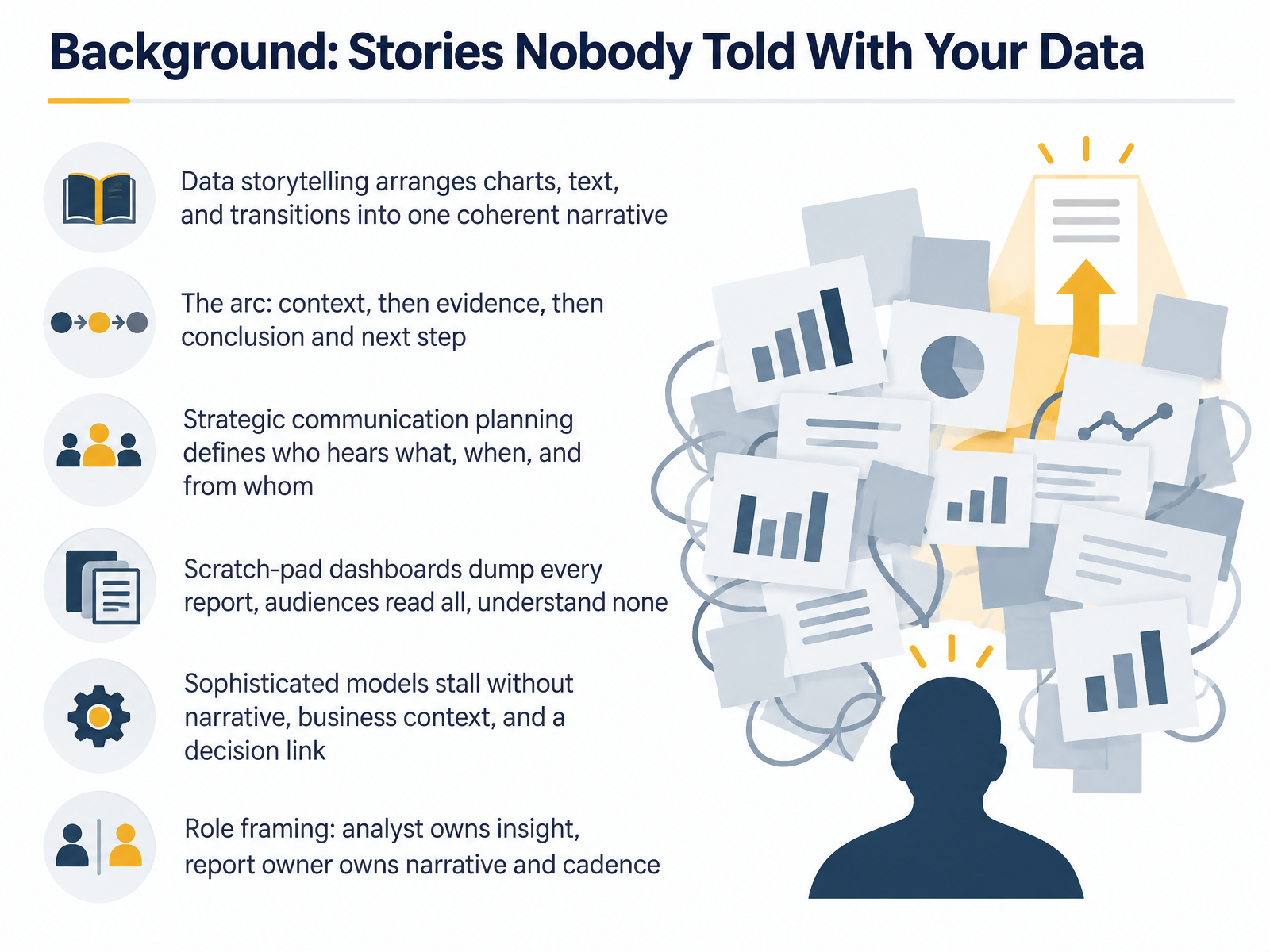
- 02Background: Stories Nobody Told With Your DataLet's start with why this problem keeps showing up. Data storytelling is the deliberate arrangement of charts, text, and transitions into one coherent narrative. The arc runs from context, through evidence, to a conclusion and a clear next step. Strategic communication planning then defines who hears what, when, and from whom. Skip that, and you get the scratch-pad dashboard, every report dumped in one place. Stakeholders read all of it and understand none of it. The same thing happens to sophisticated models: without narrative, business context, and a decision link, they stall. So frame roles early. Your analyst owns the insight. Your report owner owns the narrative and the cadence. Before your next report goes to review, write one sentence naming the decision it should support. That single sentence is your storytelling plan. The Improvement Ladder: From Outputs to Outcomes shows how to build on it.
 stonge.comdoi.orgdoi.org+22 min
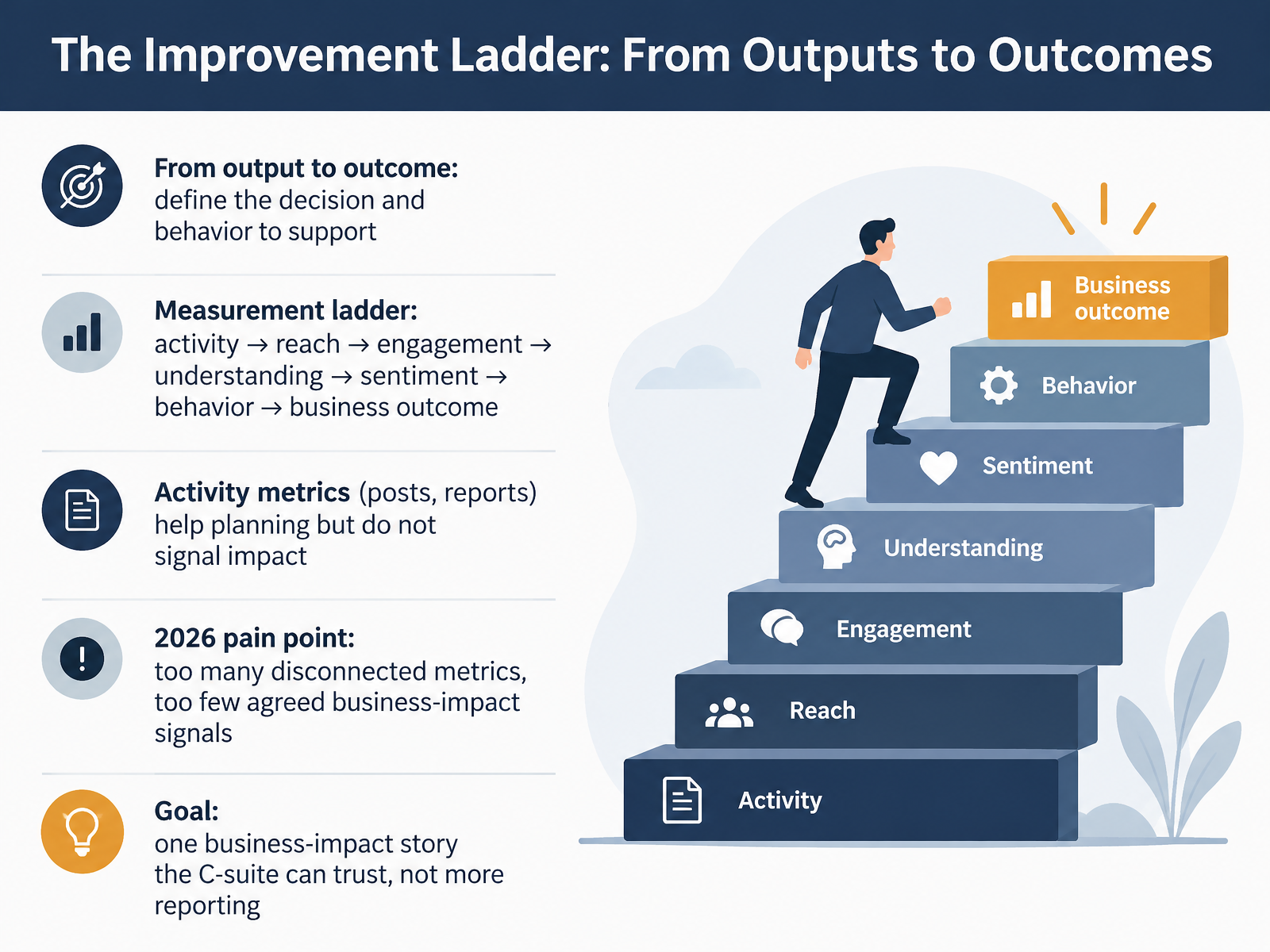
- 03The Improvement Ladder: From Outputs to OutcomesNow let's climb the improvement ladder, moving from outputs to outcomes. Start by defining the decision or behavior your communication should support. Then measure along the ladder: activity, reach, engagement, understanding, sentiment, behavior, and finally business outcome. Activity metrics like posts and reports help you plan capacity, but they never signal impact on their own. Here's the pain point many teams hit: too many disconnected metrics and too few agreed business-impact signals. So set one goal. Build a single business-impact story your executives can trust, not another reporting pack. Before your next review, pick one outcome, trace it back down the ladder, and retire one metric that proves nothing. That discipline becomes the foundation for the next step: start with the decision, not the data.
 changeengine.comworkvivo.comstaffbase.com+21 min
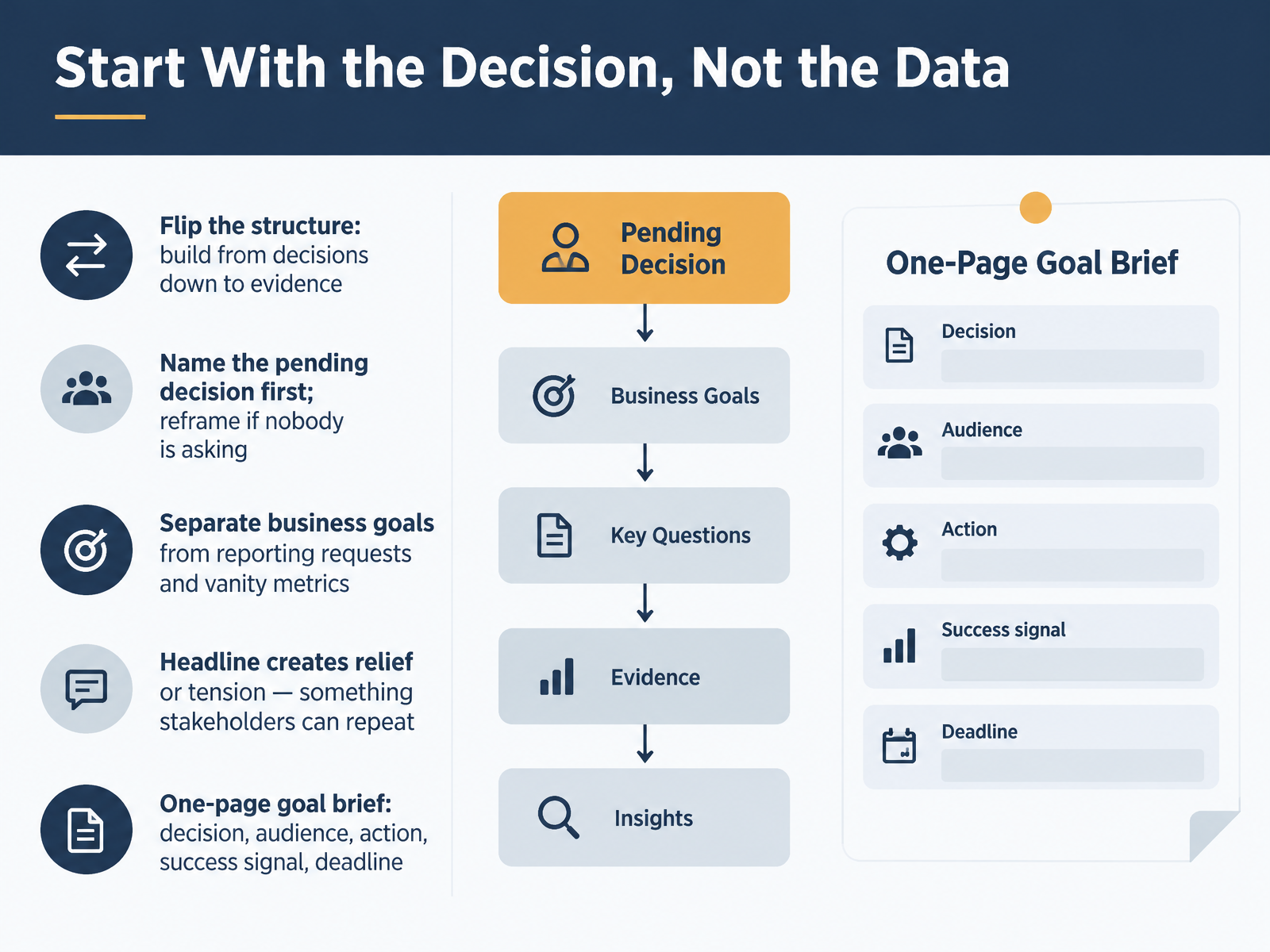
- 04Start With the Decision, Not the DataLet's flip the usual structure. Instead of building from data up to recommendations, you build from the decision down to the evidence. Start by naming the pending decision in plain language. If nobody is actively asking that question, either create urgency around it or reframe your work around what stakeholders are already asking. Then separate genuine business goals from reporting requests and vanity metrics. Your headline should create either relief or tension, something a stakeholder can repeat in their next planning meeting. If it does neither, it is a summary, not a headline. Finally, capture this on a one-page goal brief covering the decision, the audience, the action, the success signal, and the deadline. A useful test: if it does not fit on one page, the choices are not made yet. Next, we will look at who needs to hear it. Know Your Audience: Segmentation and Audience Maps.
 qualz.aidoi.orgnaccho.org+21 min
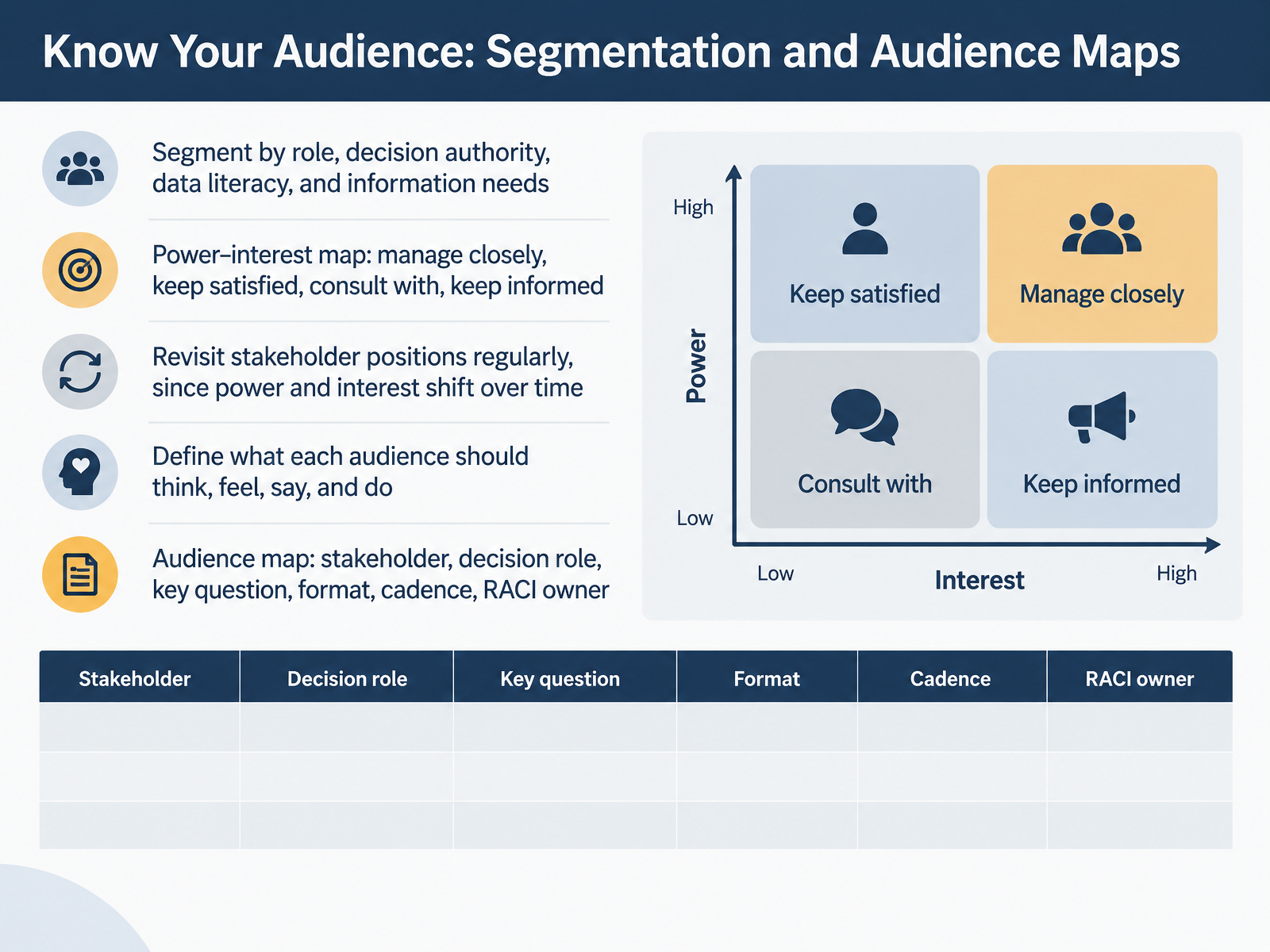
- 05Know Your Audience: Segmentation and Audience MapsSo now let's turn to your audience. Before you write a single line of a story, you need to know exactly who you're speaking to. Segment by role, decision authority, data literacy, and information needs. A finance director and an operations analyst may read the same report for very different reasons. Next, plot your stakeholders on a power and interest map. Manage closely the high-power, high-interest group. Keep satisfied the high-power, low-interest ones. Consult with the low-power, high-interest people. And keep informed the low-power, low-interest group. Revisit those positions regularly, because power and interest shift as projects move forward. Then define what each audience should think, feel, say, and do after they hear your story. Build a one-page audience map with six columns: stakeholder, decision role, key question, format, cadence, and RACI owner. That map resolves unclear ownership and review bottlenecks before they start. Your next step: draft that map for your current report and test it with one stakeholder this week. Next, we move into narrative architecture: from insight to story.
 gartner.comscikiq.orgwebershandwick.com+22 min
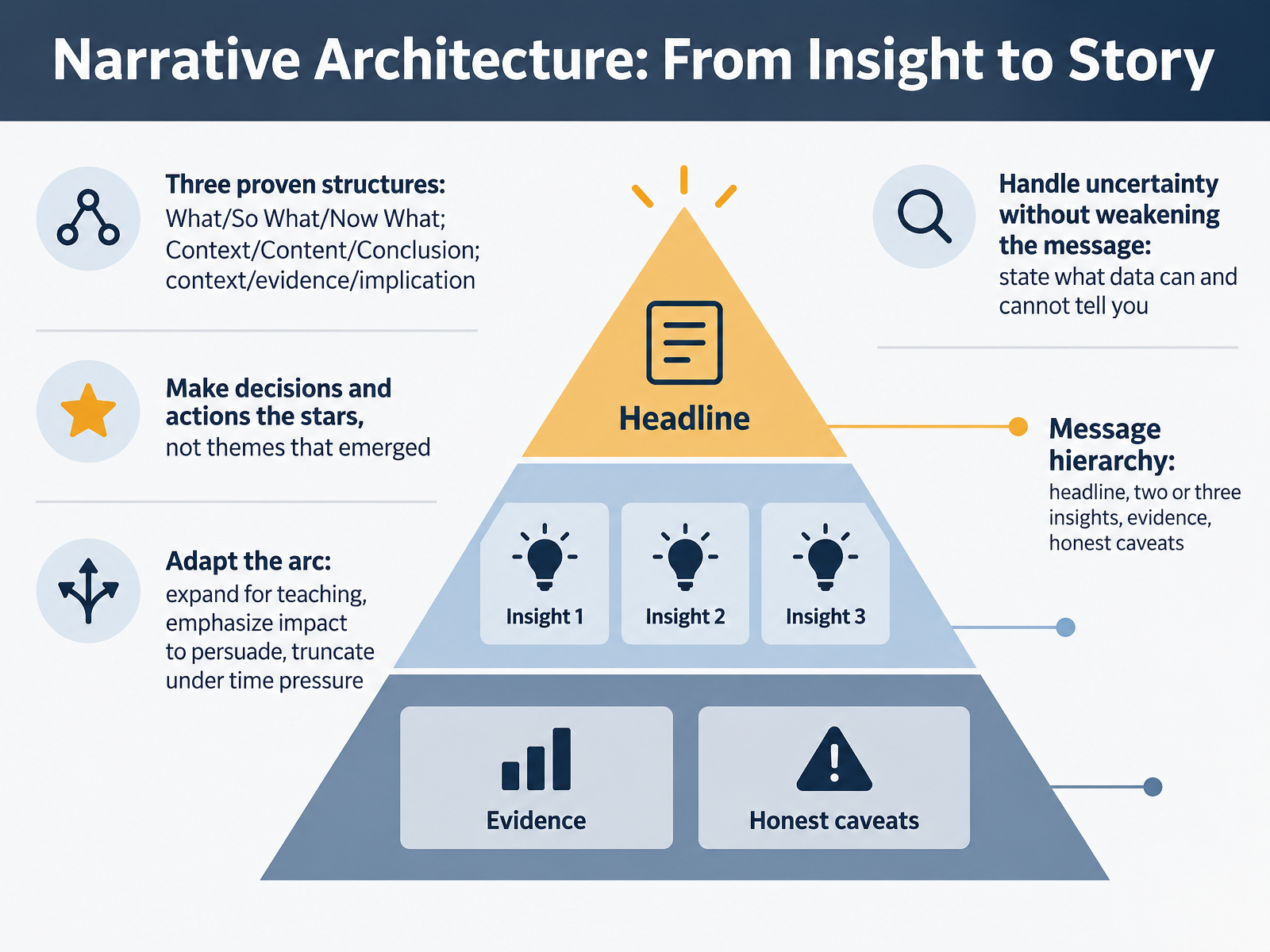
- 06Narrative Architecture: From Insight to StoryNow, let's look at how you actually structure the story once you know what it is. You have three reliable options: What, So What, Now What; Context, Content, Conclusion; and context, evidence, implication. Pick the one your audience already thinks in, then let decisions and actions be the stars, not the themes that emerged from your analysis. Build a message hierarchy: one headline, two or three insights, the evidence behind them, and honest caveats. Then adapt the arc to the room. Expand the process when you are teaching, lean hard on impact when you need to persuade, and truncate to the headline and next step when time pressure hits. When uncertainty shows up, do not soften the message. State plainly what the data can and cannot tell you, and name the decision it still supports. Before your next review, rewrite your opening slide as a decision headline, not a topic label. That one edit changes how the rest of the deck gets read. And that sets up our next topic: bad news, trade-offs, and the decision moment.
 stonge.comdoi.orgdoi.org+22 min
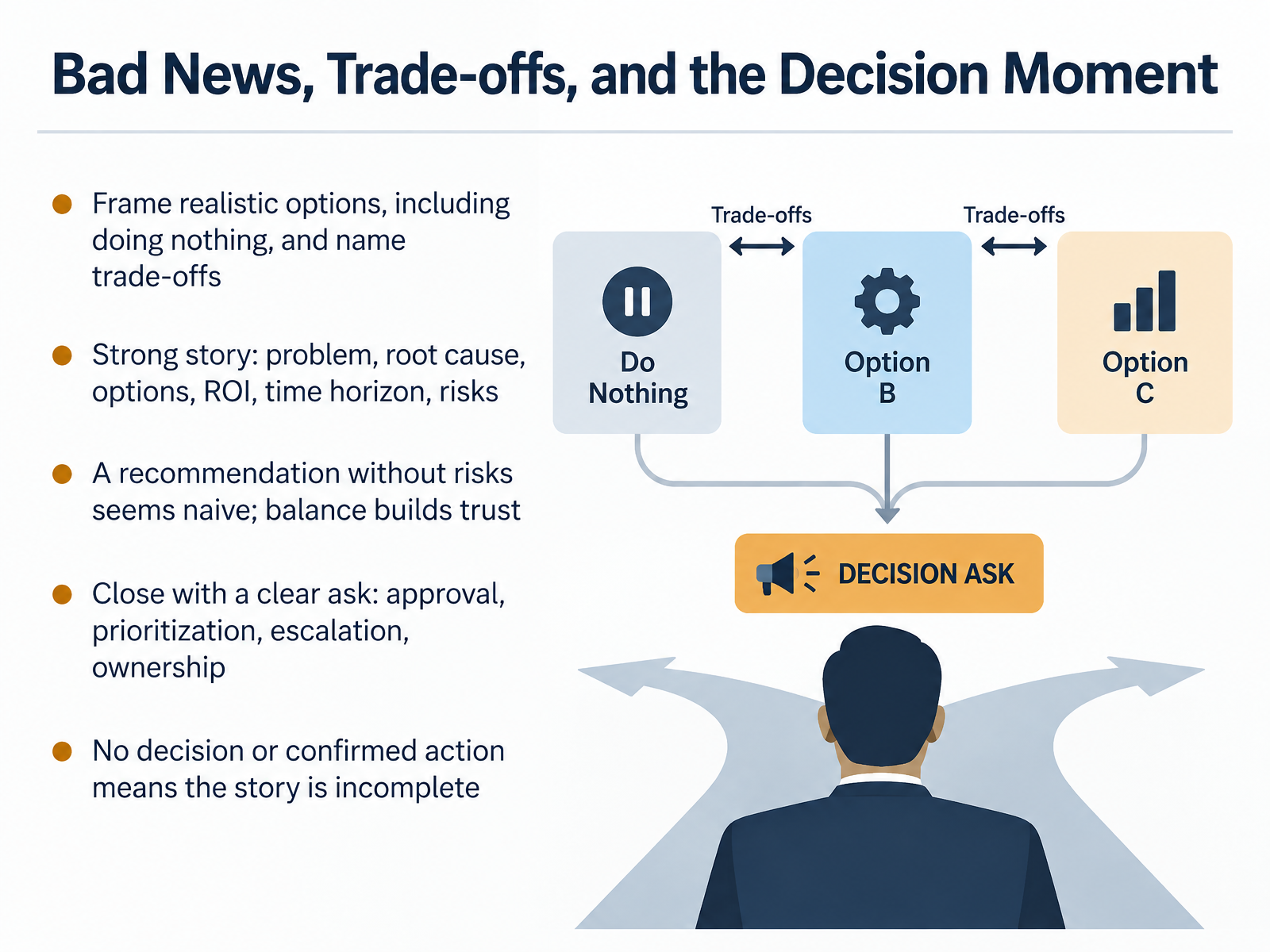
- 07Bad News, Trade-offs, and the Decision MomentNow let's talk about delivering bad news and framing the decision moment. Your job here is to frame realistic options, including doing nothing, and to name the trade-offs plainly. A strong story walks through the problem, the root cause, the options, the return on investment, the time horizon, and the risks. That last part matters. A recommendation without risks sounds naive, and a balanced view builds trust with your stakeholders. Then close with a clear ask. Do you need approval, prioritization, escalation, or confirmed ownership? If the meeting ends with no decision or confirmed action, your story is incomplete. So before your next review, draft your ask in one sentence and test whether your story earns it. Next, we look at the visual and verbal craft that carries this story.
 gartner.comstonge.comdoi.org+21 min
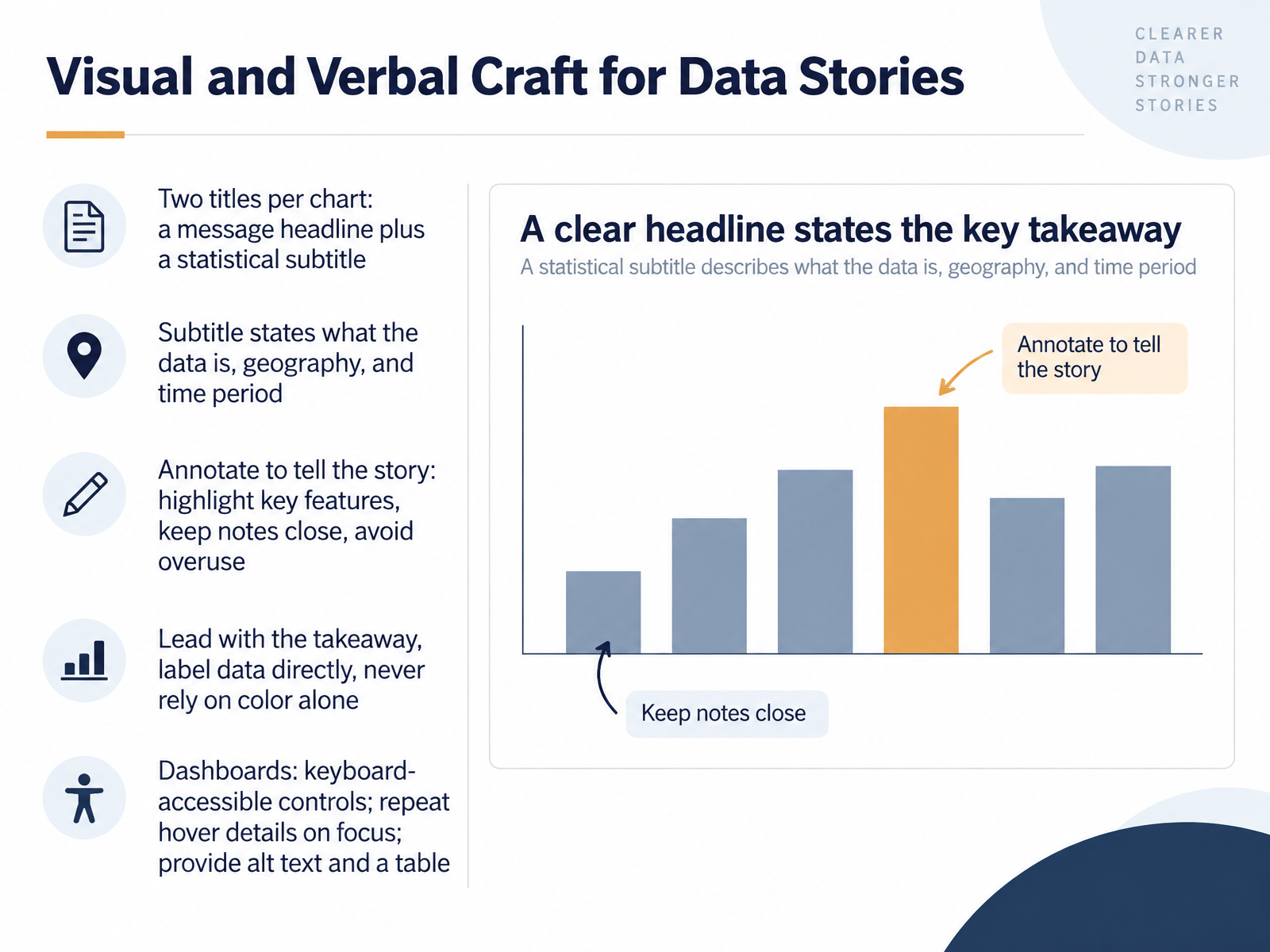
- 08Visual and Verbal Craft for Data StoriesLet's move into craft, both visual and verbal. Every chart you publish should carry two titles. A headline that states the message, like enrollment rose twelve percent, and a statistical subtitle naming the data, geography, and time period. That gives reviewers a fast read and gives screen reader users the figure's context. Then annotate to tell the story. Highlight the key feature, keep notes close to the data, and resist overusing them. Lead with the takeaway, label data directly, and never rely on color alone. For dashboards, make every control keyboard accessible, repeat hover details on focus, and provide alt text plus a table version. Pick one live dashboard this week and apply these checks before its next release. Next, we look at channel and format strategy, and how to match the decision.
 gartner.com1 min
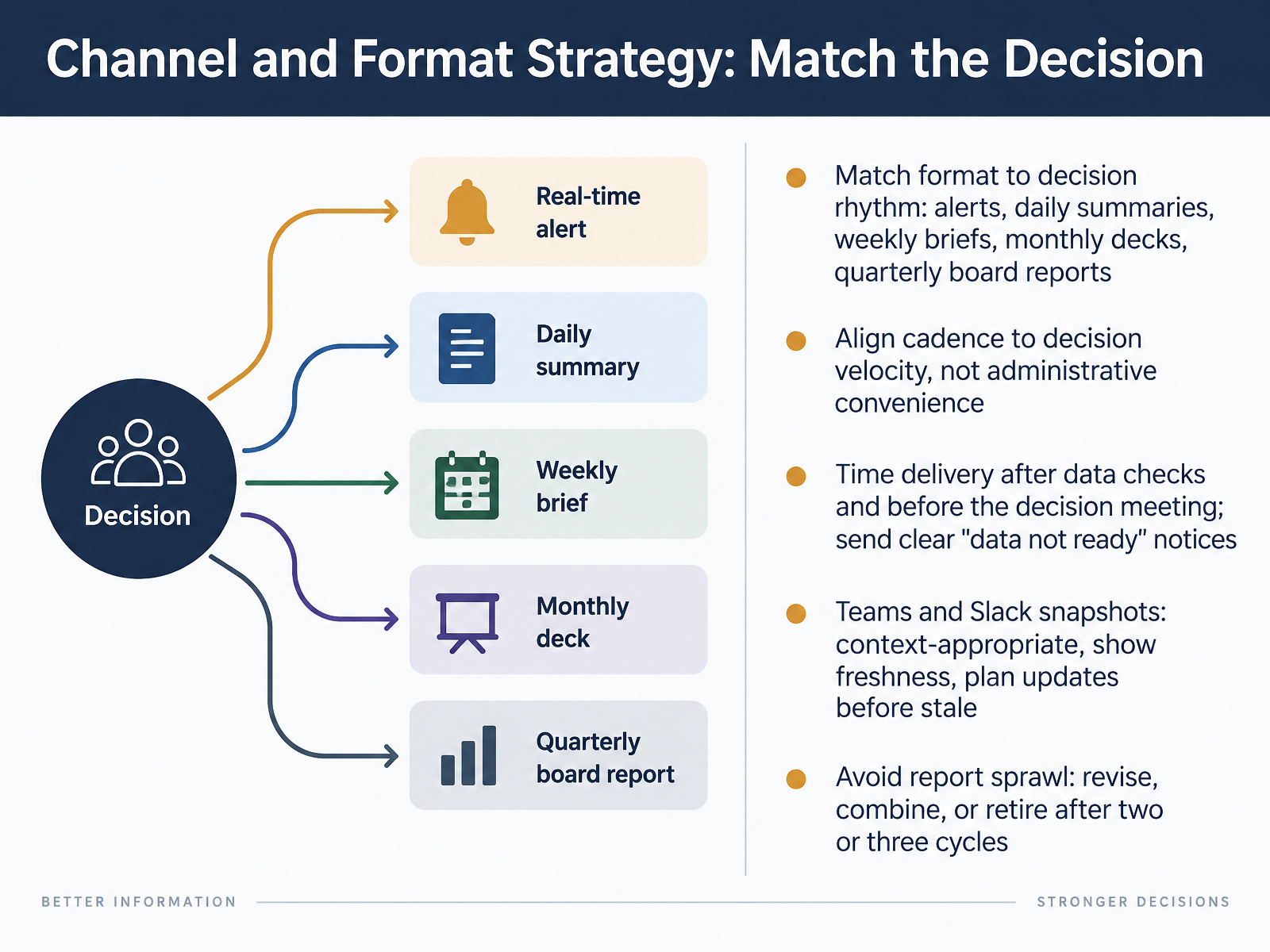
- 09Channel and Format Strategy: Match the DecisionNow let's match your channel and format to the decision. Alerts serve real-time operations, daily summaries cover tactical priorities, weekly briefs support course correction, monthly decks address strategy, and quarterly reports handle governance. Align cadence to decision velocity, not administrative convenience. A board pack built from real-time data is noise; a monthly report cannot fix a production line today. Time delivery after your data checks pass and before the decision meeting. If the data is not ready, send a clear data not ready notice instead of partial results. For Slack and Teams snapshots, keep them context-appropriate, show the freshness date, and schedule updates before they go stale. Finally, avoid report sprawl: after two or three cycles, revise, combine, or retire anything that serves no clear decision. Pick one recurring report this week and confirm it arrives before the decision it supports. Next, we move into publishing standards and the template kit.
 scikiq.org1 min
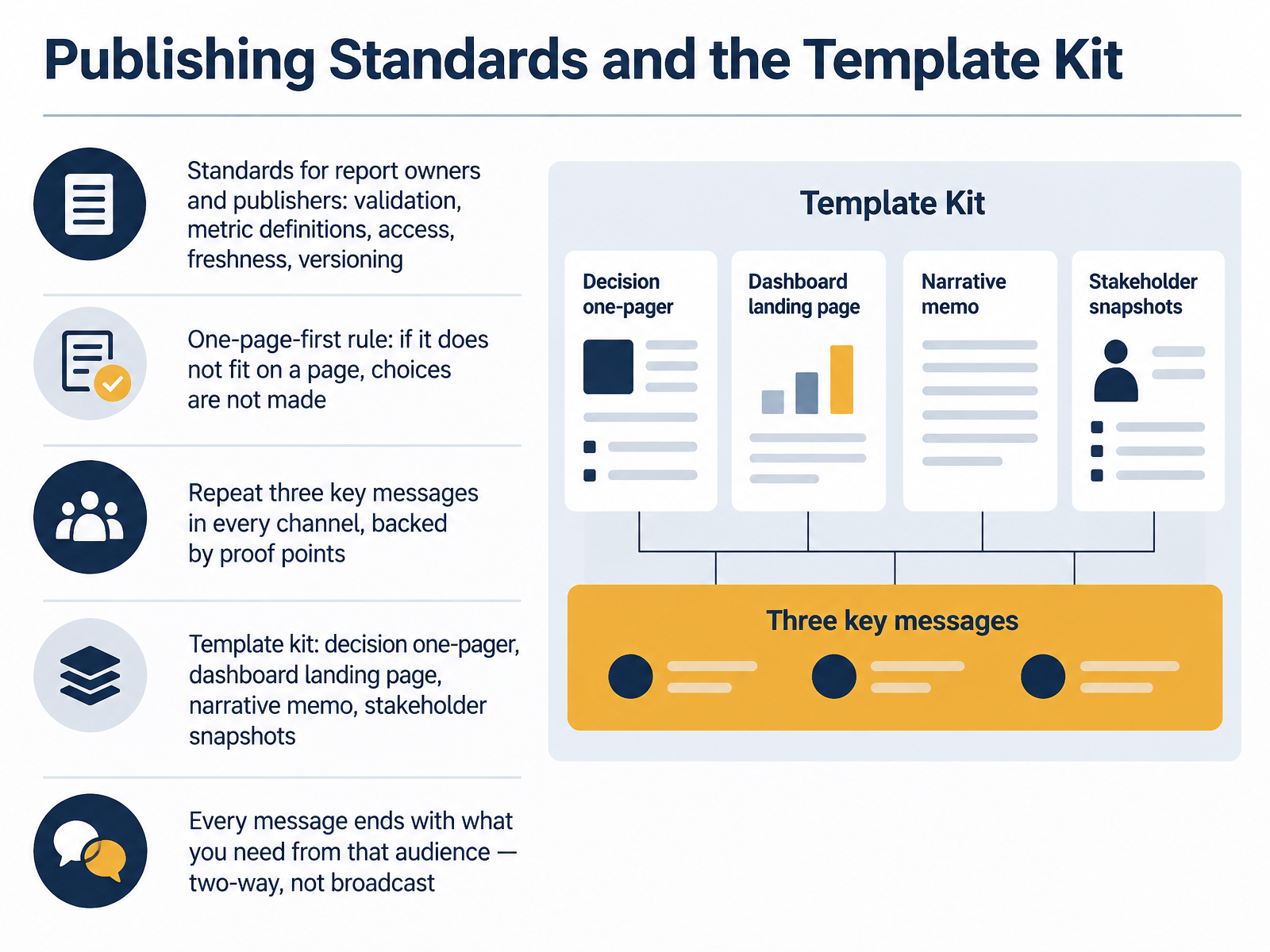
- 10Publishing Standards and the Template KitNow let's turn the plan into publishing standards your team can actually run. For report owners and publishers, standards cover five things: validation, metric definitions, access, freshness, and versioning. Apply the one-page-first rule. If it does not fit on a page, the choices are not made yet. Then repeat the same three key messages in every channel, backed by proof points, so your audience hears one consistent story. The template kit gives you four ready formats: a decision one-pager, a dashboard landing page, a narrative memo, and stakeholder snapshots. Pick the format that matches the decision, not the habit. And every message ends with what you need from that audience. That keeps communication two-way, not broadcast. Your next step: choose one template and one standard this week, and name its owner. That brings us to the execution plan, with roles, timeline, and readiness gates.
 gartner.comscikiq.orgwebershandwick.com+21 min
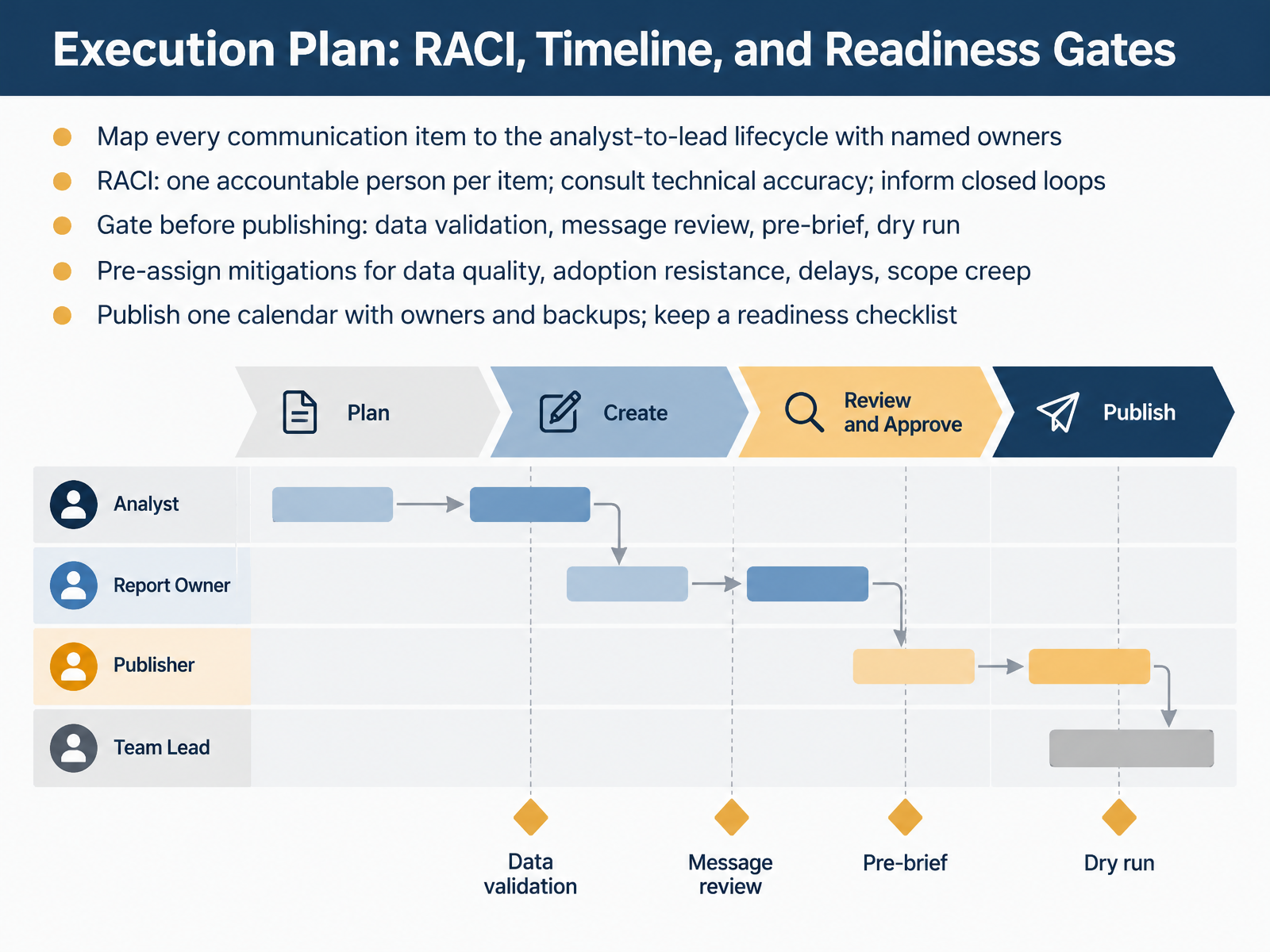
- 11Execution Plan: RACI, Timeline, and Readiness GatesLet's turn the plan into something your team can actually run. Start by mapping every communication item to the analyst-to-lead lifecycle, with a named owner for each one. Then apply R A C I discipline: exactly one accountable person per item, technical reviewers consulted for accuracy, and closed loops that inform the people affected. No owner means no follow-through. Before anything publishes, pass four readiness gates: data validation, message review, pre-brief, and a dry run. Also pre-assign mitigations for the risks you already expect, like data quality issues, adoption resistance, delays, and scope creep. Finally, publish one shared calendar with owners and backups, and keep a readiness checklist everyone can see. Pick one upcoming deliverable today and name its accountable owner and gate reviewer before your next standup. Next, we look at how to measure impact and close the feedback loop.
 scikiq.orggartner.comwebershandwick.com+21 min
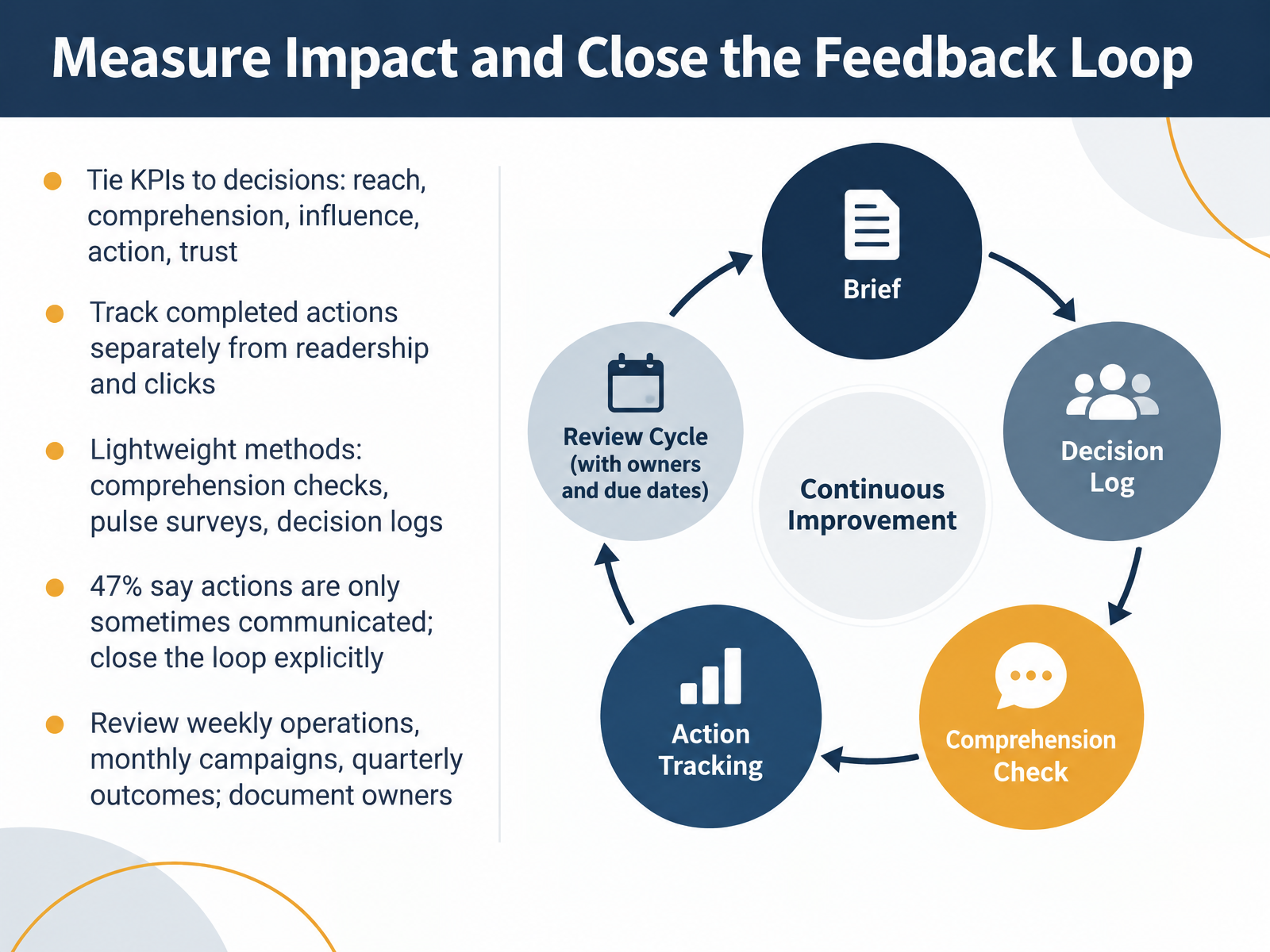
- 12Measure Impact and Close the Feedback LoopNow let's measure impact and close the feedback loop. Tie your KPIs to decisions, not vanity: reach, comprehension, influence, action, and trust. Track completed actions separately from readership and clicks. A policy acknowledged or a ticket deflected tells you more than an open rate. Keep methods lightweight: short comprehension checks, pulse surveys, and a simple decision log. Close the loop explicitly, because forty-seven percent say actions are only sometimes communicated. Review weekly operations, monthly campaigns, quarterly outcomes, and document owners for each. Pick one KPI and one action metric to report this month, then assign an owner and a due date. Next, we'll move into the Case Clinic: Auditing a Real Report Against the Plan.
 changeengine.comworkvivo.comstaffbase.com+22 min
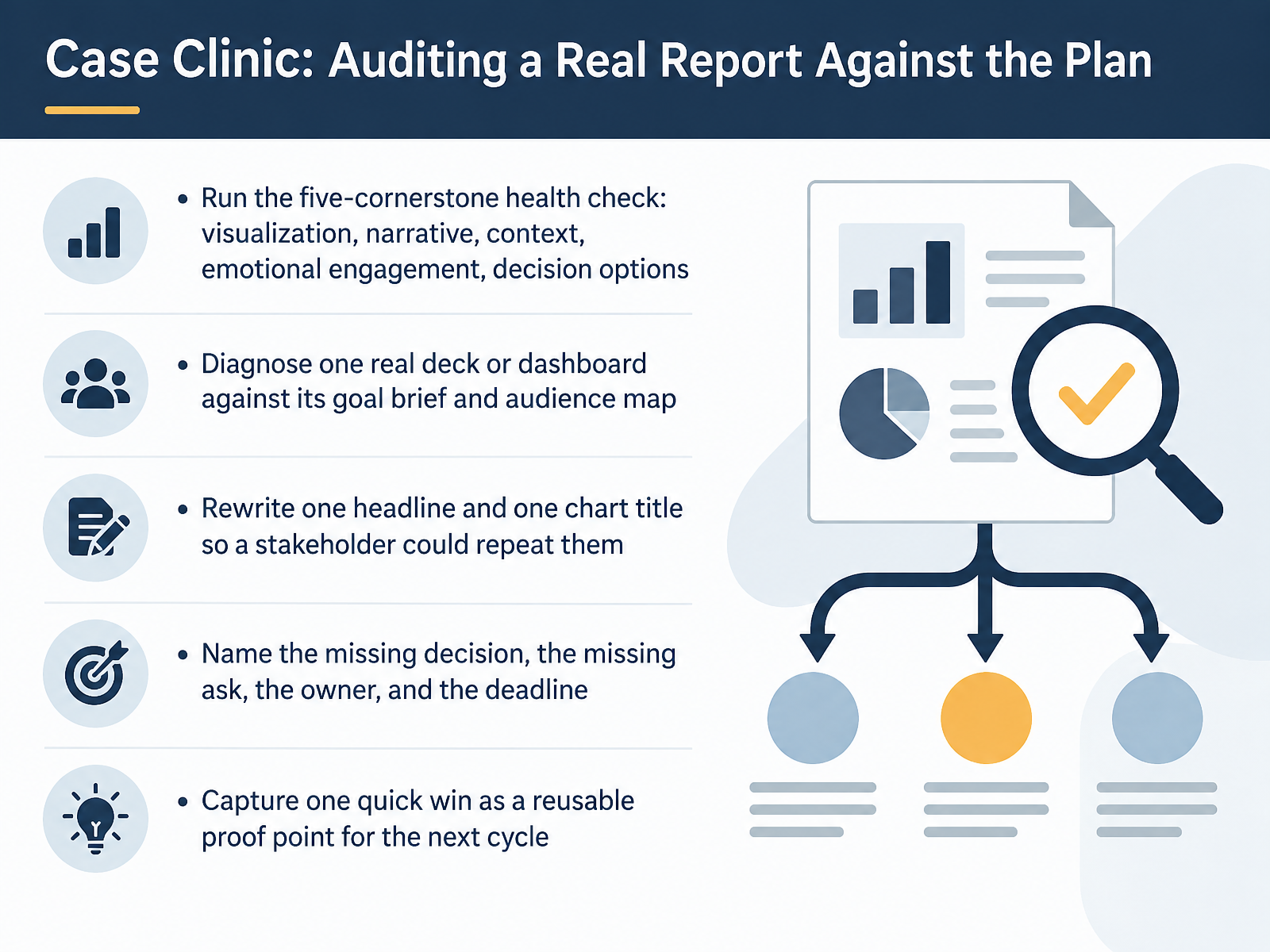
- 13Case Clinic: Auditing a Real Report Against the PlanNow let's put the plan under real pressure with a case clinic. Pick one live deck or dashboard, and audit it against its goal brief and audience map. Start with the five-cornerstone health check: visualization, narrative, context, emotional engagement, and decision options. Then rewrite one headline and one chart title so clearly that a stakeholder could repeat them in a hallway. For example, replace "Q3 revenue" with "Q3 revenue fell four percent because renewals slipped." Next, name four things out loud: the missing decision, the missing ask, the owner, and the deadline. Finally, capture one quick win as a reusable proof point for your next cycle. That proof point becomes evidence when you ask for time or support. Before we close, choose the report you will audit tomorrow, and bring it to the capstone. Capstone Workshop: Build Your One-Page Communication Plan.
 gartner.comqualz.aidoi.org+22 min
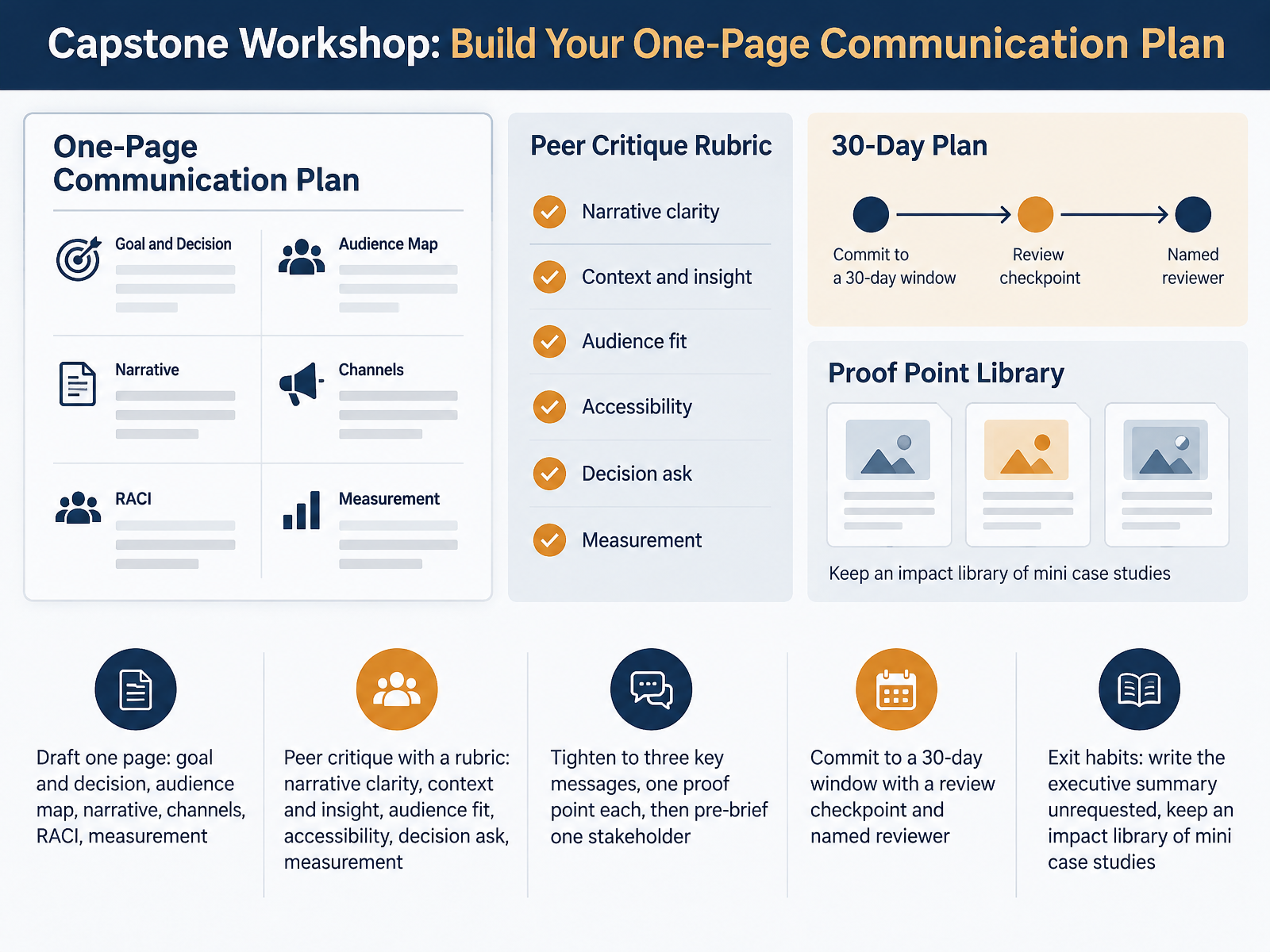
- 14Capstone Workshop: Build Your One-Page Communication PlanLet's put everything into practice. Your capstone is one page. A goal and the decision it supports, an audience map, your narrative, channels, a RACI naming who does the work and who owns the outcome, and how you will measure success. Pair up and critique with a rubric: narrative clarity, context and insight, audience fit, accessibility, the decision ask, and measurement. Then tighten to three key messages, one proof point each, and pre-brief one stakeholder before the review. Commit to a thirty-day window with a named reviewer and a checkpoint. Two habits to keep after today. Write the executive summary before anyone asks, and maintain an impact library of short case studies. That library turns every win into reusable evidence for your next decision ask. Take thirty minutes tomorrow to draft your page, and thank you for your focus and honesty all day. You leave with a plan and the skills to make it real. Keep going.
 scikiq.orgqualz.aidoi.org+21 min
Take the deck with you
Download this course as a file — free, no sign-up needed.
- PDF handoutEvery slide page, ready to print or share.15 pages · 3.1 MBDownload
- Narrated PowerPointThe deck that presents itself — every slide carries the digital human's narration video.15 pages · 12.7 MBDownload
- PowerPoint slidesThe full deck as a .pptx — open it in PowerPoint, Keynote, or Google Slides.15 pages · 3.0 MBDownload
Free to use in your own training — please keep the PersonWise credit page at the end.
Have your own deck? Turn it into a course
Sources consulted
Web sources consulted while building this course.
- Use Storytelling to Communicate the Business Value of Data and Analytics — gartner.com
- Strategy Communication Guide — scikiq.org
- PURPOSE-DRIVEN DATA — webershandwick.com
- Develop Data Storytelling as an Enterprise Capability for AI Decision Making — gartner.com
- The New Playbook for Impact Comms and Public Reporting - NationSwell — nationswell.com
- What’s the “So What?” - Effective Storytelling in Supply Chain Analytics - St. Onge — stonge.com
- A Design Space for Applying the Freytag's Pyramid Structure to Data Stories — doi.org
- Telling stories with data -- A systematic review — doi.org
- An Argument Structure for Data Stories — doi.org
- Harnessing the Power of “What, So What, Now What” in Data Storytelling – Investigations of a Dog — investigationsquality.com
- How to Measure the Impact of Your Internal Communications Strategy — changeengine.com
- Internal Communications Analytics: How to Measure What Matters — workvivo.com
- A guide to setting and measuring KPIs for internal comms | Staffbase — staffbase.com
- Global State of Internal Communications — 6282300.fs1.hubspotusercontent-na1.net
- IC Measurement Masterclass & Templates | Poppulo — poppulo.com
- How to Present User Research Findings That Actually Change Product Decisions | Qualz.ai Blog — qualz.ai
- Effective Communication Approaches for Decision Analytics — doi.org
- Data storytelling guidance — naccho.org
- p( Persuasion | data, analysis, storytelling ) — ssp3nc3r.github.io
- DataStory — turningdataintowisdom.com