Begin
14 pages · ~28 min
Integrating Responsible AI: Key Considerations
Learn how to integrate responsible AI by identifying key considerations and best practices. Ideal for professionals involved in AI development, deployment, or governance.
A digital instructor presents all 14 pages. Hold “Ask” at any point and ask out loud — the answer comes from this course. No sign-up needed.
What you’ll learn
- 01What to Consider When Integrating Responsible AIWelcome. This course is about what to consider when you integrate responsible AI into real work, not just into a principles document. Over the next slides, we will build a shared set of decision criteria for product, engineering, governance, education, and content teams, and we will treat you as informed peers working from the same questions. Here is the framing. Responsible AI integration is a cross-functional operating issue that touches design, data, deployment, monitoring, and content, so no single team can carry it alone. Our goal is practical. You will learn to classify risk, assign clear owners, build controls that fit your workflow, and prepare for regulation such as the EU AI Act. You will also move from principles to concrete checkpoints, templates, and action plans you can use in reviews and design sessions. Next, we will look at core principles and the integration gap.airc.nist.govairc.nist.govairc.nist.gov+22 min
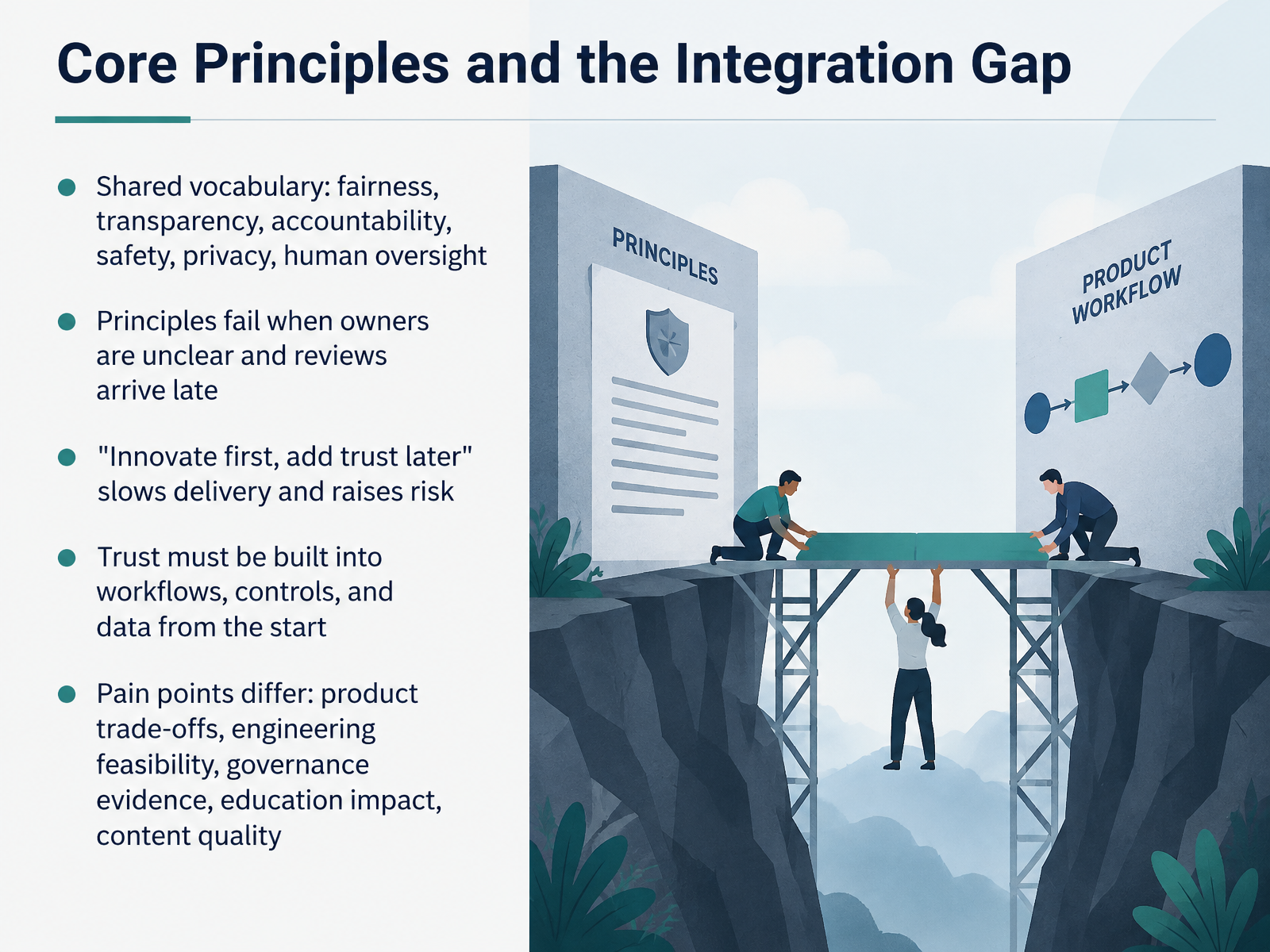
- 02Core Principles and the Integration GapLet's start with a shared vocabulary. When we say fairness, transparency, accountability, safety, privacy, and human oversight, we mean specific decisions you make in reviews, in design, and in content workflows. Here is the gap. These principles fail when owners are unclear and reviews arrive late. Innovate first, add trust later feels fast, but it slows delivery and raises risk. Trust has to be built into workflows, controls, and data from the start. And pain points differ. Product teams weigh trade-offs. Engineering tests feasibility. Governance needs evidence. Education teams consider learner impact. Content teams guard quality. So ask three questions at every checkpoint. Who owns this decision? What evidence do we need? And when will we review it? Next, let's look at the 2026 Regulatory and Standards Landscape.
 canada.caaisi.go.jpdoit.maryland.gov+21 min
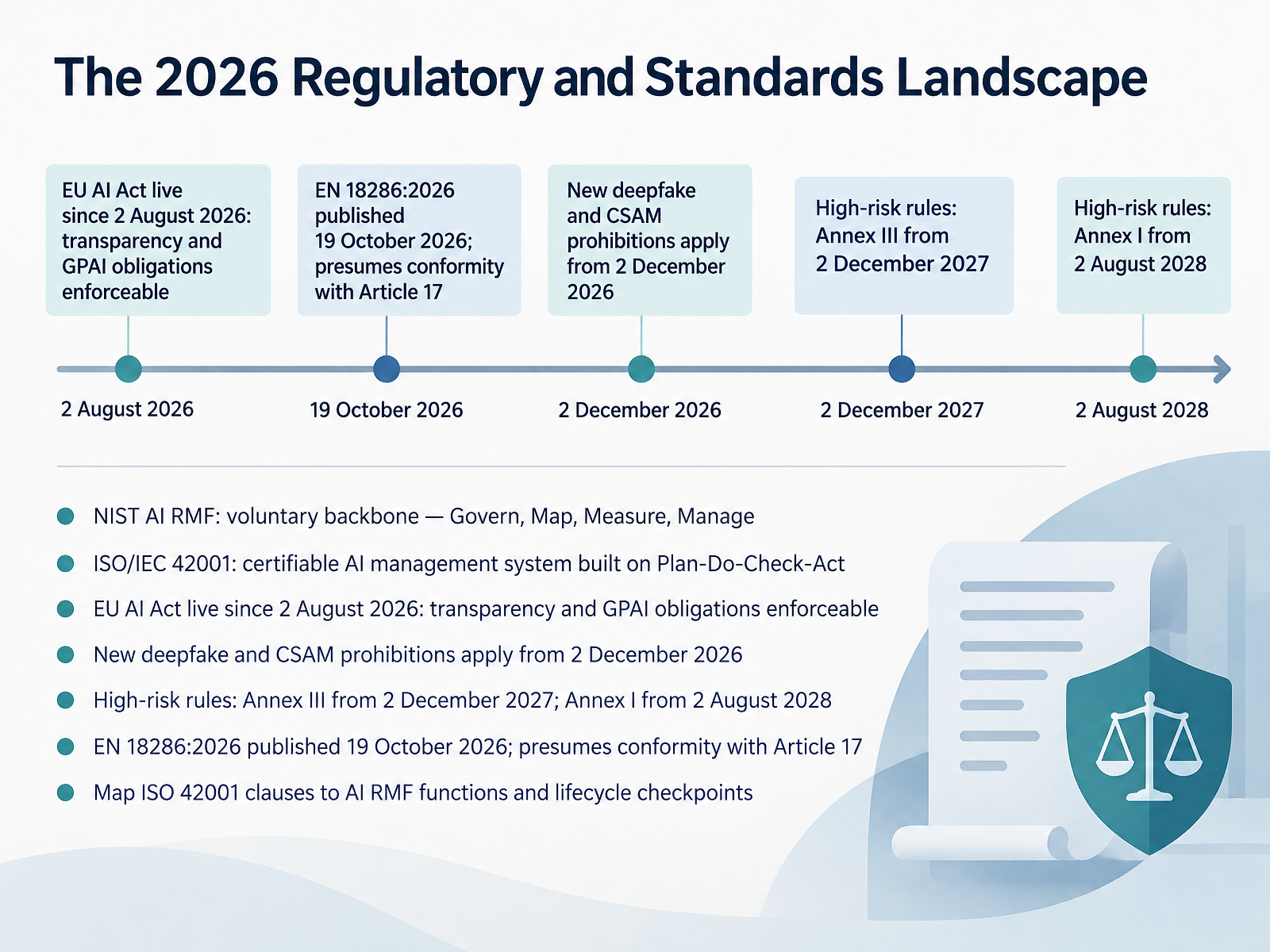
- 03The 2026 Regulatory and Standards LandscapeLet's look at the regulatory and standards landscape you'll be working within. Start with the NIST AI Risk Management Framework. It's a voluntary backbone, organized around four functions: Govern, Map, Measure, and Manage. Next, ISO/IEC 42001 is a certifiable AI management system standard, built on Plan, Do, Check, Act. Then there's the EU AI Act, live since the second of August, twenty twenty-six, with transparency and general-purpose AI obligations now enforceable. New prohibitions on deepfakes and child sexual abuse material apply from the second of December, twenty twenty-six. High-risk rules arrive later: Annex Three from the second of December, twenty twenty-seven, and Annex One from the second of August, twenty twenty-eight. Also published on the nineteenth of October, twenty twenty-six, is EN 18286, a harmonised standard that presumes conformity with Article Seventeen. Here's your practical takeaway. Map your ISO 42001 clauses to the AI RMF functions and to lifecycle checkpoints, so your reviews, design decisions, and content workflows all trace back to one structure. Turning Frameworks into One Operating Structure.
 ai-act-service-desk.ec.europa.euai-act-service-desk.ec.europa.euconsilium.europa.eu+22 min
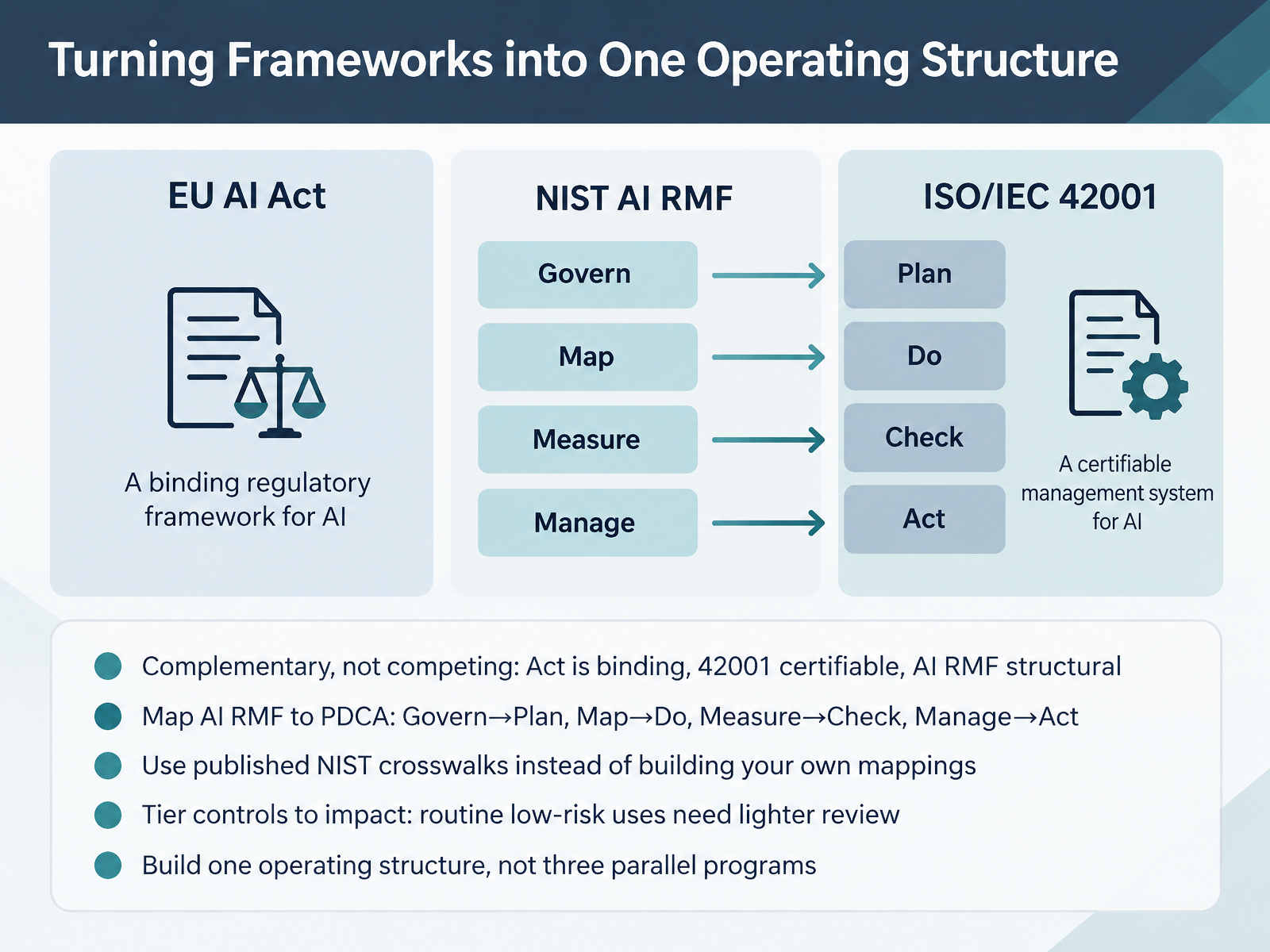
- 04Turning Frameworks into One Operating StructureNow let's look at how you turn these frameworks into one operating structure. They are complementary, not competing. The AI Act is binding law. ISO 42001 is a certifiable management system standard. The NIST AI Risk Management Framework, or AI RMF, gives you structural guidance. You can map the AI RMF functions onto the Plan, Do, Check, Act cycle. Govern aligns with Plan. Map aligns with Do. Measure aligns with Check. And Manage aligns with Act. Rather than building your own mappings, use the published NIST crosswalks to connect frameworks accurately. Then tier your controls to impact. A routine, low-risk use case needs lighter review than a customer-facing decision system. The goal is one operating structure, not three parallel programs. Ask who owns each review checkpoint, and how you will document the decision. Next, we will look at risk assessment and use-case classification.
 airc.nist.govairc.nist.govairc.nist.gov+21 min
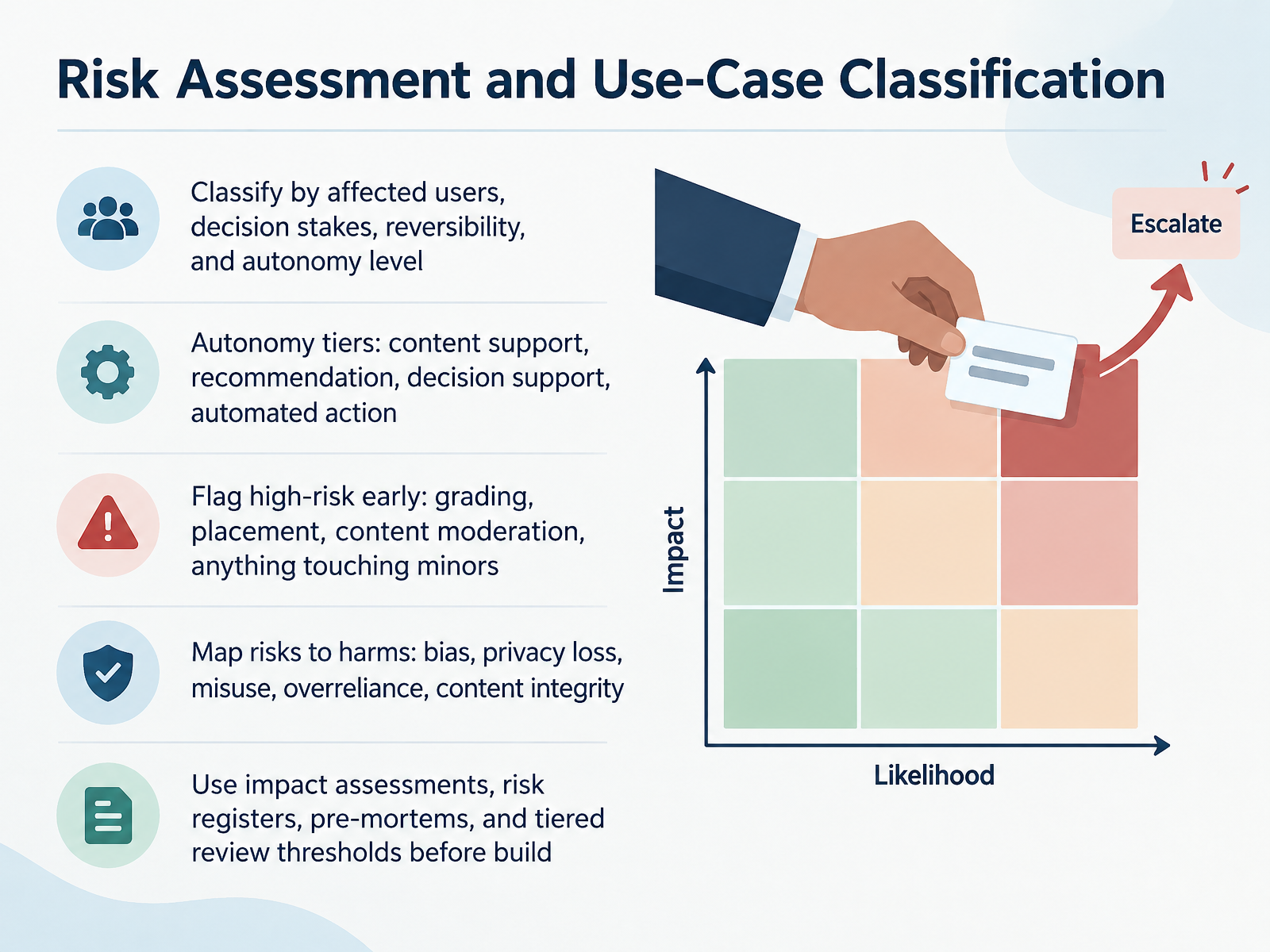
- 05Risk Assessment and Use-Case ClassificationNext, let's talk about risk assessment and use-case classification. This is where you decide, before build, how much scrutiny a use case deserves. Start with four questions. Who is affected? How high are the stakes? Can a bad outcome be reversed? And how much autonomy does the system have?
On autonomy, think in tiers. Content support drafts, recommendation suggests, decision support informs a human who decides, and automated action acts on its own. The higher the tier, the stronger the review.
Flag high-risk work early. Grading, placement, content moderation, and anything touching minors should trigger a formal review before design hardens.
Then map risks to harms: bias, privacy loss, misuse, overreliance, and content integrity. Use impact assessments to surface them, a risk register to track them, and a pre-mortem to imagine failure. Set tiered review thresholds so low-risk work moves quickly and high-risk work gets real oversight. The takeaway is simple: classify early, assign an owner, and agree the checkpoint. Next, we'll put this into practice in the workshop on scoring a use case.
 information-services.ed.ac.ukuwaterloo.caunesco.org+22 min
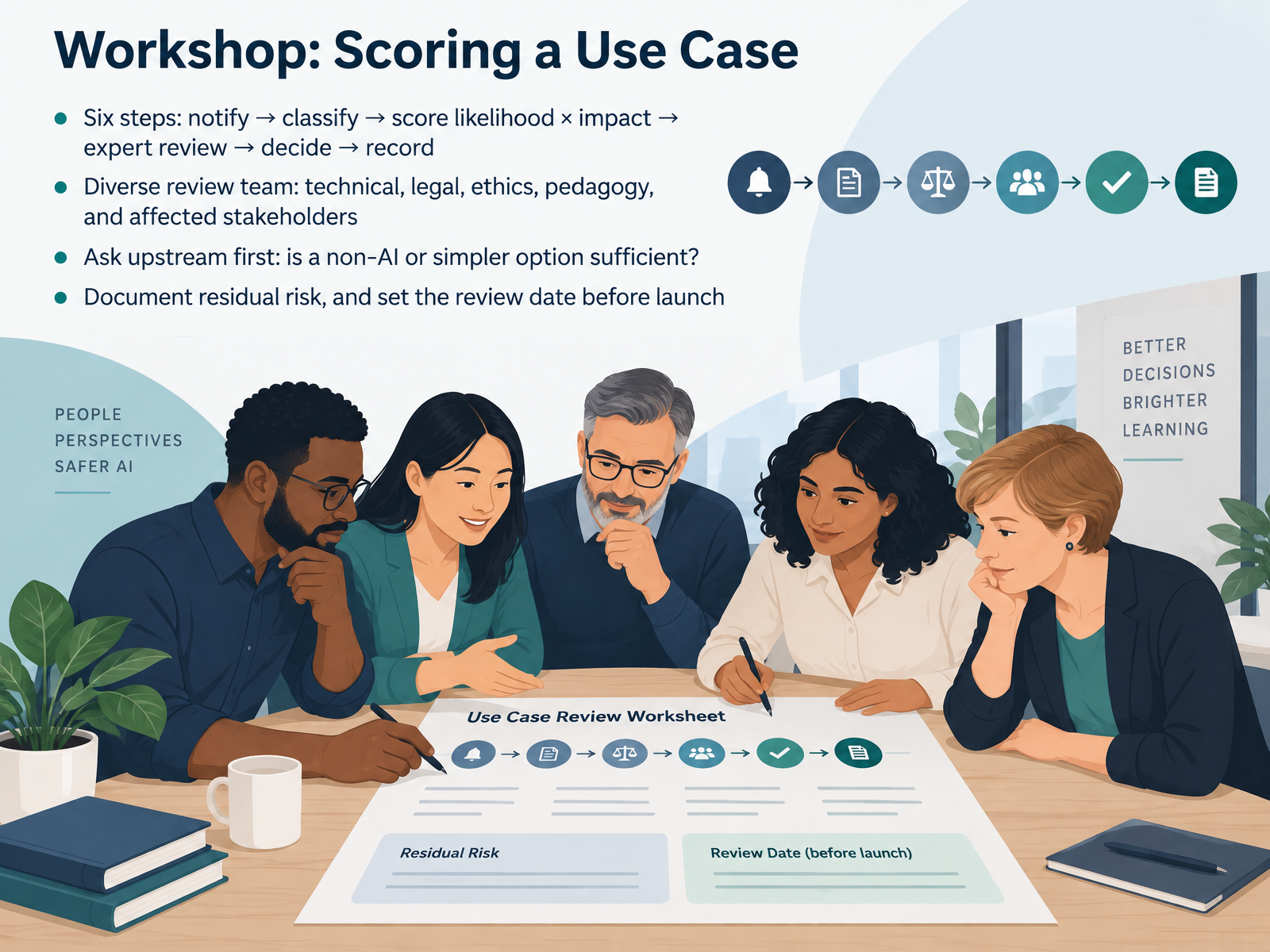
- 06Workshop: Scoring a Use CaseNow let's put this into practice with a scoring workshop. The process has six steps. You notify, then classify the use case, then score each risk as likelihood times impact. Likelihood is how probable the harm is. Impact is how severe it would be. Next comes expert review, then a decision, then a record of what you decided and why. Build the review team deliberately: technical, legal, ethics, pedagogy, and the people affected by the use case. Before you score anything, ask the upstream question. Is a non-AI option, or a simpler one, good enough? If it is, you may not need this review at all. Then document the residual risk, meaning what remains after controls, and set the review date before launch, not after. That date is the checkpoint that keeps the decision honest. Next, we turn to data, privacy, and content provenance.
 information-services.ed.ac.ukuwaterloo.caunesco.org+21 min
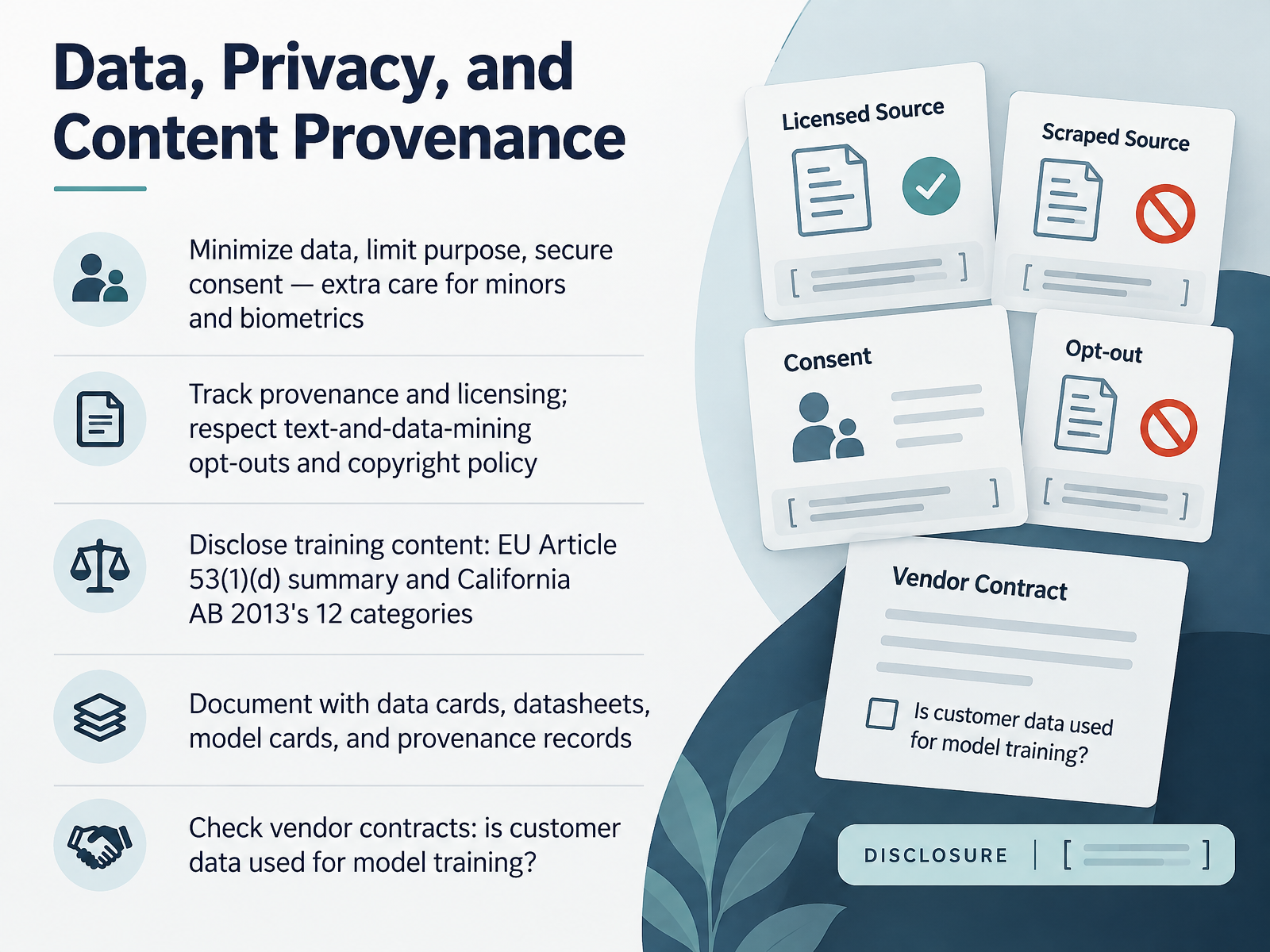
- 07Data, Privacy, and Content ProvenanceNow let's look at where data comes from, and how much you should be able to say about it. Start with minimization. Collect only what the task needs, limit use to the stated purpose, and secure valid consent. Treat minors and biometric data with extra care, because the harm from a mistake there is harder to undo.
Next, track provenance, meaning where each dataset came from and under what license. Respect text and data mining opt-outs, and follow your copyright policy. Be ready to disclose training content. Under EU Article fifty-three, providers publish a summary of training data, and California AB twenty-thirteen asks for twelve specific categories, such as dataset sources, whether data was purchased or licensed, and whether it contains personal information.
Document as you go with data cards, datasheets, model cards, and provenance records. And in vendor contracts, ask directly: is our customer data used for model training? Make that question a review checkpoint.
With the data picture in hand, let's turn to the people who watch over the system in Human Oversight and Accountability Design.
 ai-act-service-desk.ec.europa.euai-act-service-desk.ec.europa.euconsilium.europa.eu+22 min
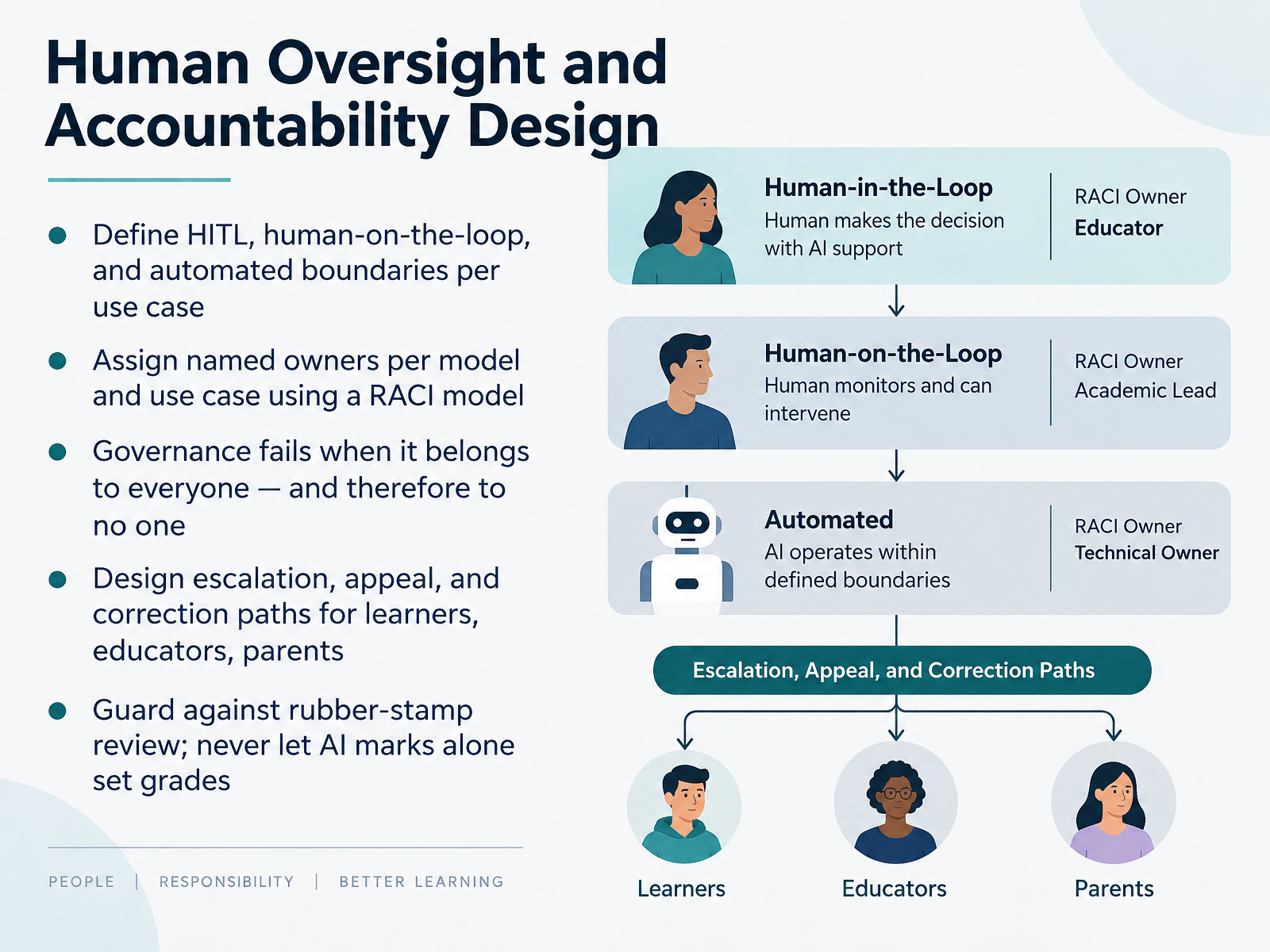
- 08Human Oversight and Accountability DesignLet's turn to human oversight and accountability design. Start by defining autonomy, per use case, before you build. Human-in-the-loop means a person reviews each consequential decision before it takes effect. Human-on-the-loop means people monitor and can intervene, but routine cases proceed. A fully automated boundary means no human check at that step, so write down why that is acceptable and what would trigger a review. Then assign accountability. Name an owner for each model and each use case, and use a RACI model, meaning responsible, accountable, consulted, and informed, to state who builds, who approves, who monitors, and who answers when it fails. Governance fails when it belongs to everyone, and therefore to no one. In education, design escalation, appeal, and correction paths for learners, educators, and parents, and staff them with named roles. Guard against rubber-stamp review. If reviewers approve nearly everything without a recorded reason, oversight is theater. Never let AI marks alone set grades. Next, we look at evaluation, testing, and red teaming.
 information-services.ed.ac.ukuwaterloo.caunesco.org+22 min
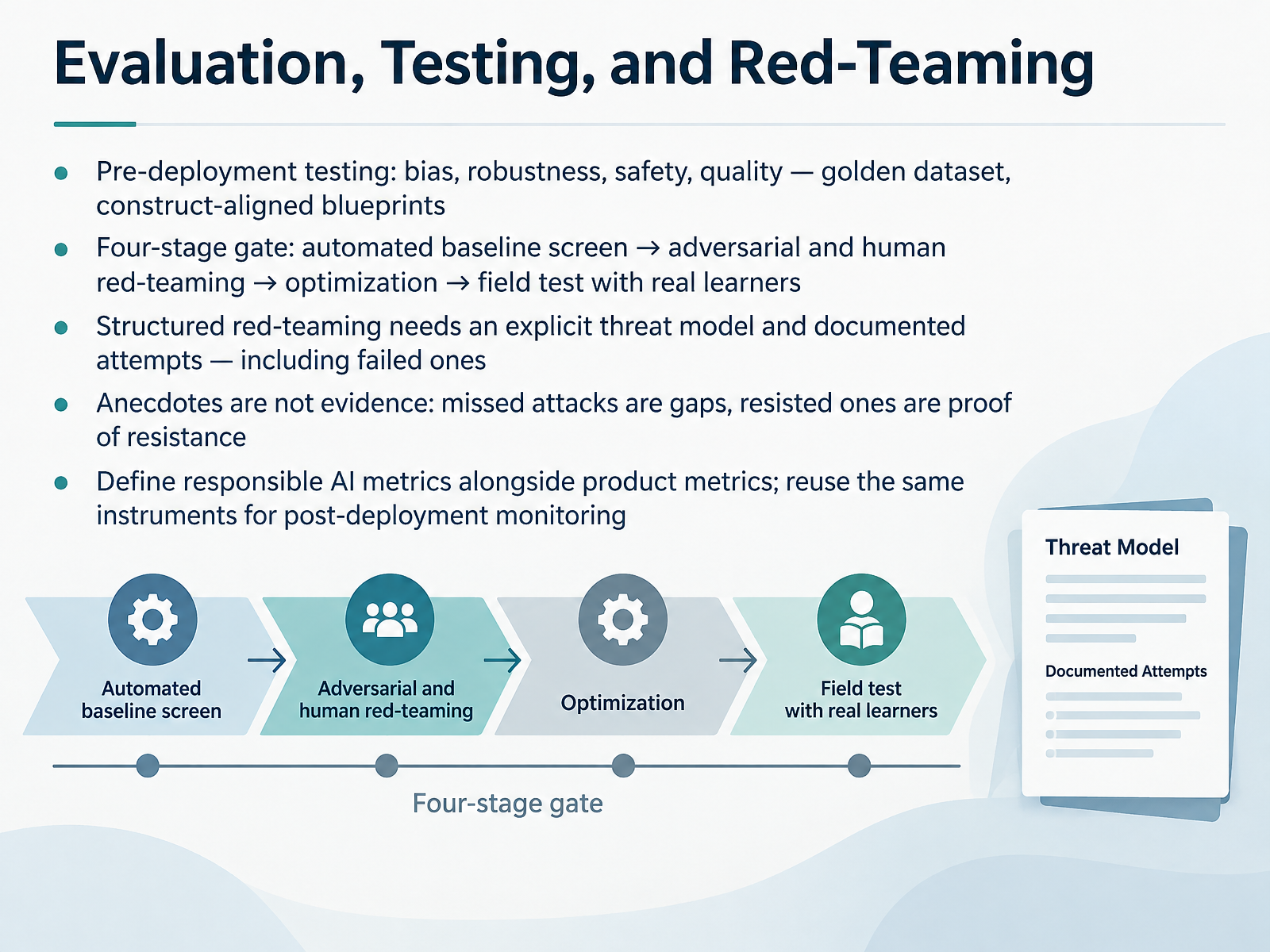
- 09Evaluation, Testing, and Red-TeamingNext, let's look at evaluation, testing, and red-teaming. Before deployment, test for bias, robustness, safety, and quality. Use a golden dataset, a fixed set of representative cases with expected outcomes, and construct-aligned blueprints that define what each test is meant to measure. Run a four-stage gate. Start with an automated baseline screen, then adversarial and human red-teaming, then optimization, then a field test with real learners. Red-teaming means deliberately attacking the system to make it fail. Structure it with an explicit threat model, which names the adversaries and harms in scope, and document every attempt, including failed ones. Anecdotes are not evidence. A missed attack is a gap; a resisted one is proof of resistance. Finally, define responsible AI metrics alongside product metrics, and reuse the same instruments for post-deployment monitoring. Your review checkpoint: ask who owns each gate and what evidence clears it. This leads us to transparency, content integrity, and user trust.
 information-services.ed.ac.ukuwaterloo.caunesco.org+22 min
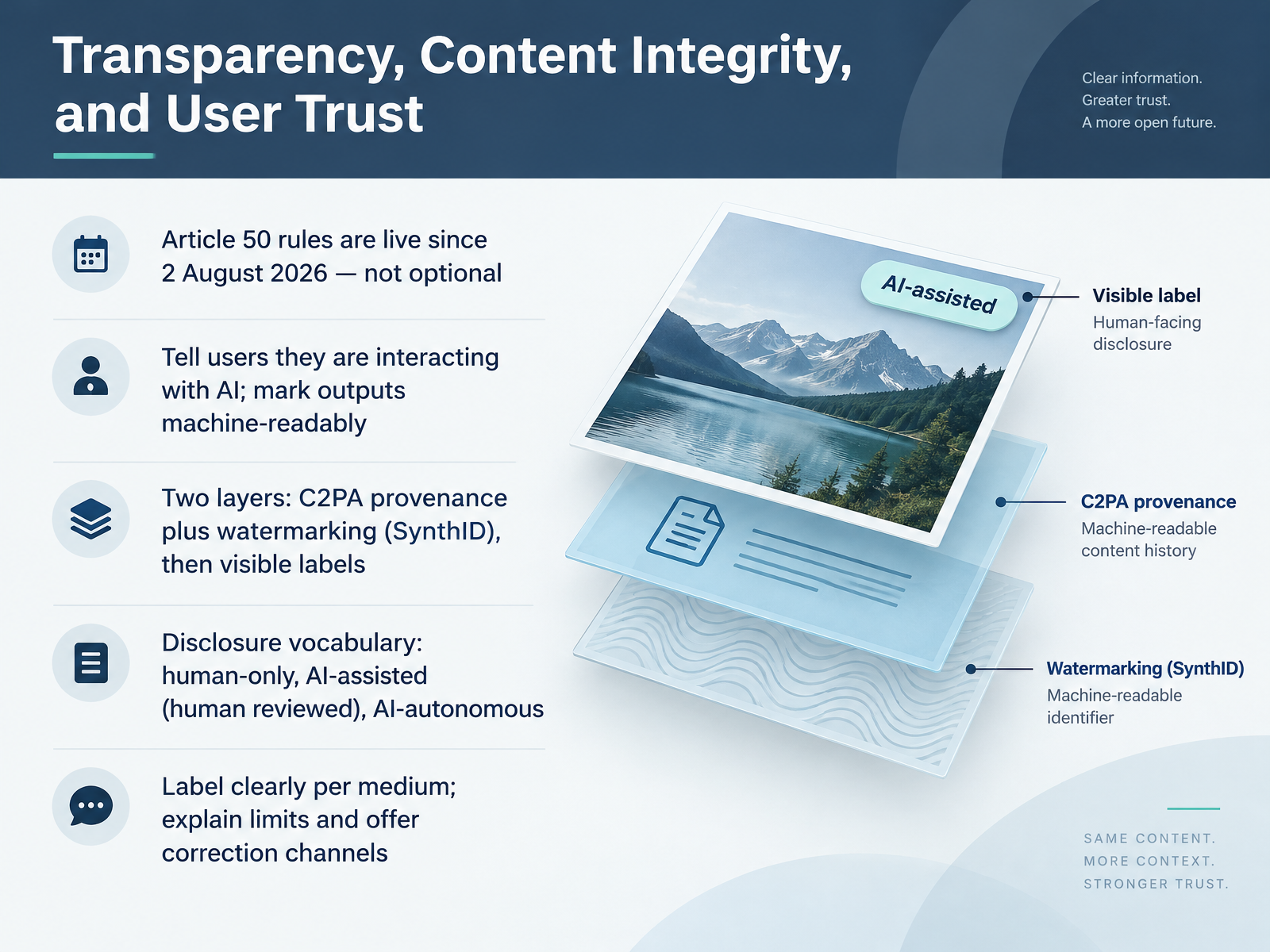
- 10Transparency, Content Integrity, and User TrustLet's look at transparency, content integrity, and user trust. Under Article 50 of the EU AI Act, transparency rules have applied since the second of August, twenty twenty-six. These are legal obligations, not optional guidance. So when someone interacts with a chatbot or an AI agent, tell them they are interacting with an AI system. And make AI-generated outputs detectable through machine-readable marks. In practice, that means two layers. First, provenance and watermarking. Use the C2PA standard, which embeds a verifiable record of how content was created, paired with watermarking such as SynthID, so an AI-origin signal survives even when metadata is stripped. Second, a visible label, placed clearly for the medium, at the start of a video, next to an image, or announced in audio. Agree on a shared disclosure vocabulary. Human-only means no AI was involved. AI-assisted means AI was involved and a human reviewed it before publication. AI-autonomous means AI-generated content was published without human review. Explain the limits of the label, and give users a route to flag errors or request a correction. Next, the Cross-Functional Integration Playbook.
 ai-act-service-desk.ec.europa.euai-act-service-desk.ec.europa.euconsilium.europa.eu+22 min
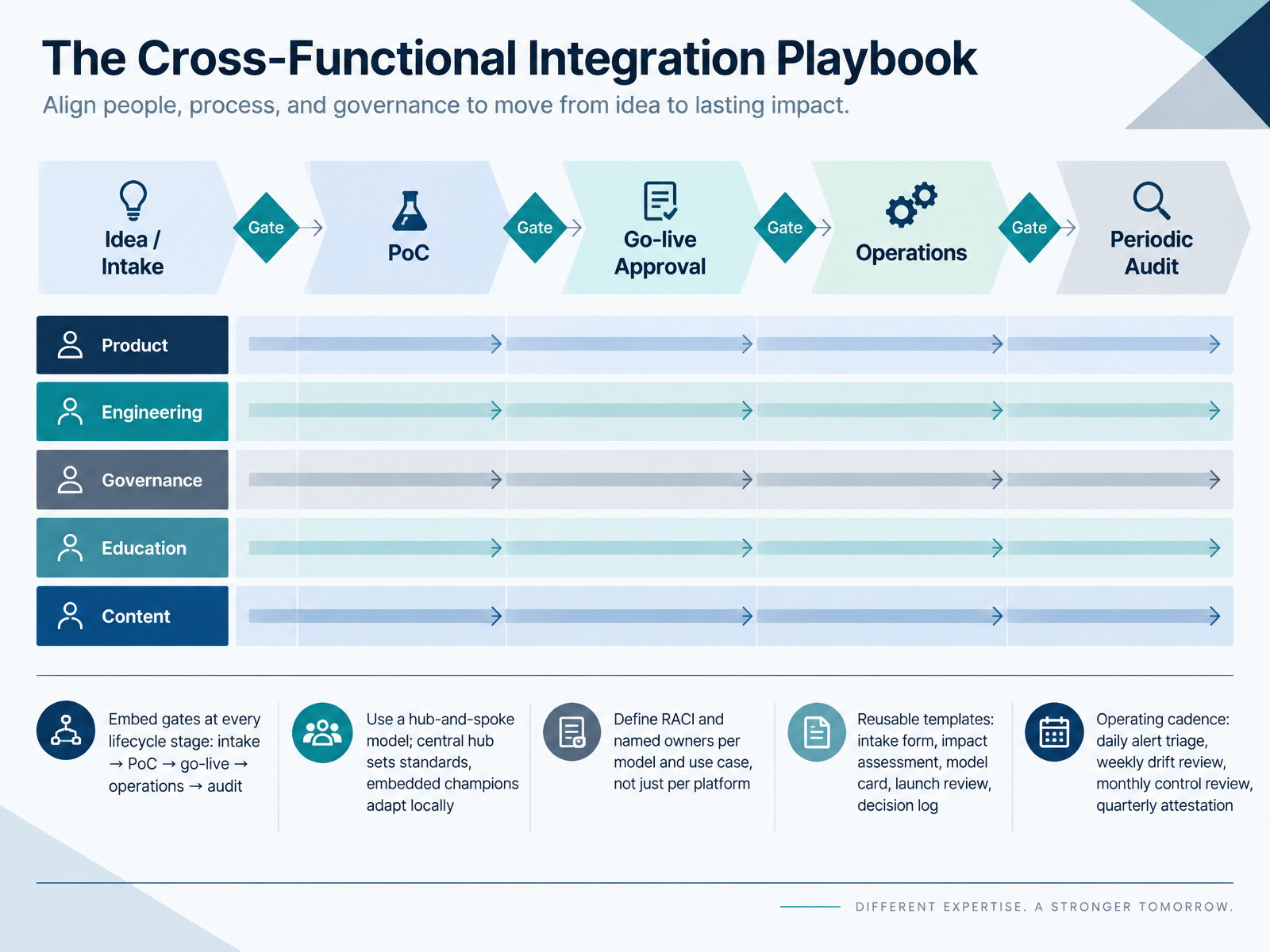
- 11The Cross-Functional Integration PlaybookLet us turn this into an operating playbook you can actually run. Start with gates, meaning defined checkpoints with clear approval criteria, at every lifecycle stage: intake, proof of concept, go-live, operations, and audit. Use a hub-and-spoke model. The central hub sets standards and handles risk review, while embedded champions adapt those standards to local needs. Define a RACI, which spells out who is responsible, accountable, consulted, and informed, for each model and use case, not just each platform. Reuse templates: an intake form, impact assessment, model card, launch review, and decision log. Then set a cadence: daily alert triage, weekly drift review, monthly control review, and quarterly attestation. Ask in your next review: which gate is weakest, and who owns it by name? That leads into measuring maturity and avoiding common failure modes.
 canada.caaisi.go.jpdoit.maryland.gov+21 min
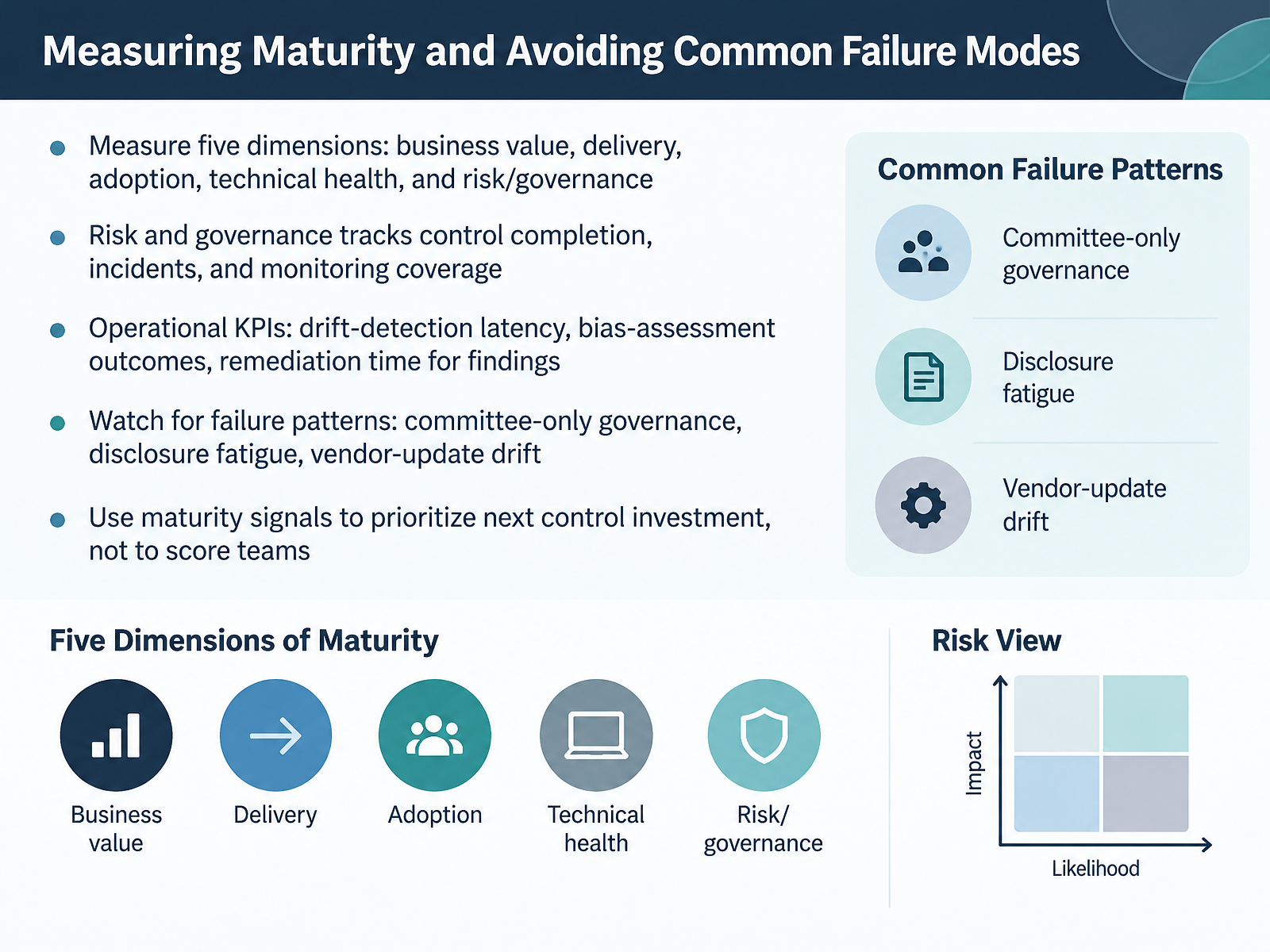
- 12Measuring Maturity and Avoiding Common Failure ModesLet's turn to measuring maturity, and to the failure patterns worth watching for. Measure five dimensions together: business value, delivery, adoption, technical health, and risk and governance. Keeping them side by side stops a fast launch from hiding weak controls. Within risk and governance, track control completion, incidents, and monitoring coverage. For operational signals, watch drift-detection latency, which is how quickly you notice a model's behavior shifting; bias-assessment outcomes; and remediation time for findings. Now the failure modes. Committee-only governance approves work but never inspects it. Disclosure fatigue means users stop reading notices, so the notice stops doing its job. Vendor-update drift means a supplier changes a model and your testing falls behind. Use maturity signals to prioritize your next control investment, not to score teams. Ask which dimension is weakest, and who owns closing it before the next review. That sets up our next section, Action Planning: Your First 90 Days.
 airc.nist.govairc.nist.govairc.nist.gov+22 min
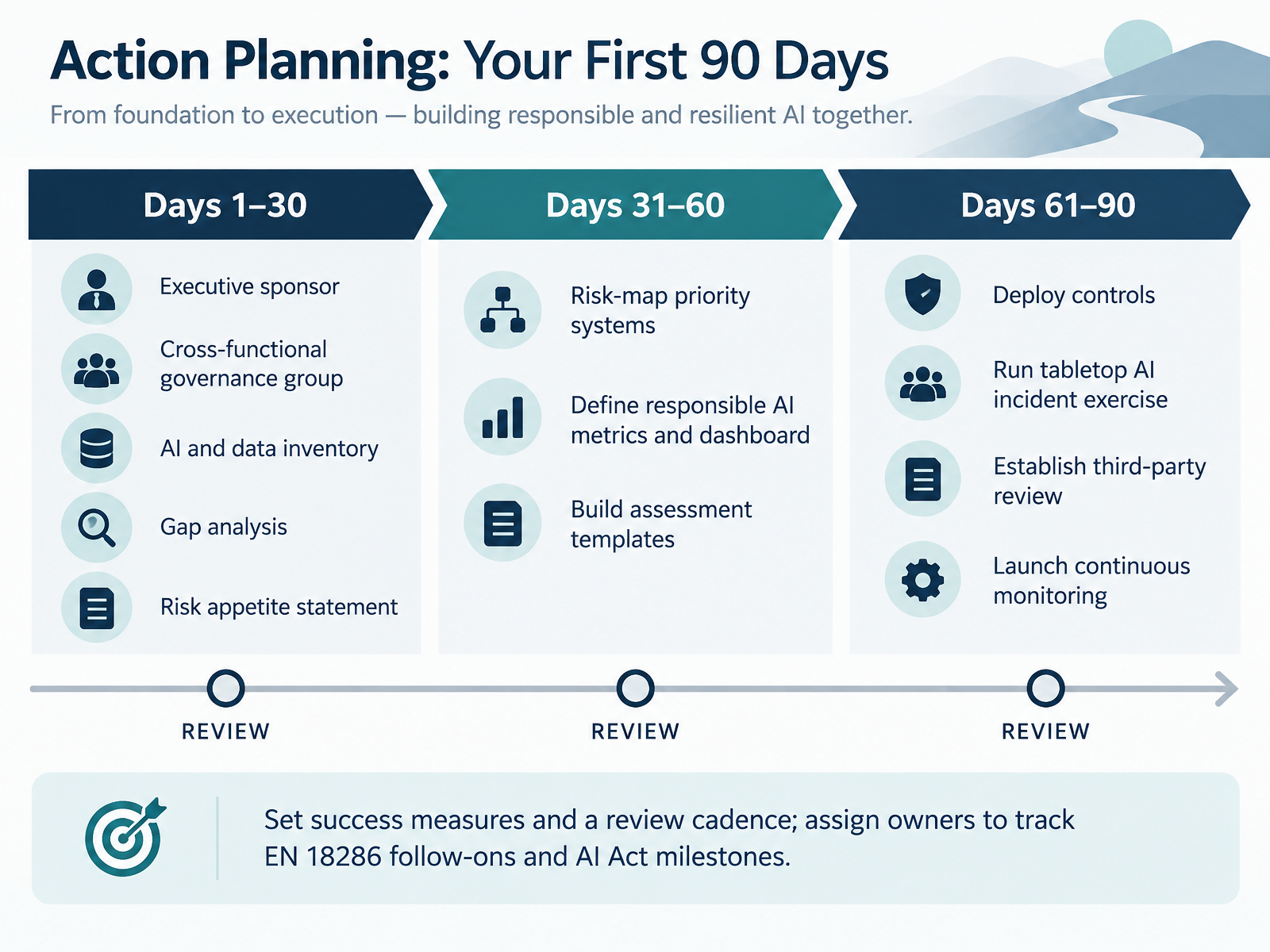
- 13Action Planning: Your First 90 DaysLet's turn this guidance into a plan for your first 90 days. In days one to thirty, name an executive sponsor. Stand up a cross-functional governance group that includes product, engineering, legal, security, and content owners. Build an inventory of AI systems and data, run a gap analysis, and write a risk appetite statement, meaning a clear position on how much AI risk you are willing to accept. In days thirty-one to sixty, map risks for your priority systems, define responsible AI metrics and a dashboard, and build assessment templates the teams can reuse. In days sixty-one to ninety, deploy controls, run a tabletop AI incident exercise, establish third-party review, and launch continuous monitoring. Set success measures and a review cadence, and assign owners to track EN 18286 follow-ons and AI Act milestones. Next, we'll pull the key takeaways and resources together.
 canada.caaisi.go.jpdoit.maryland.gov+22 min
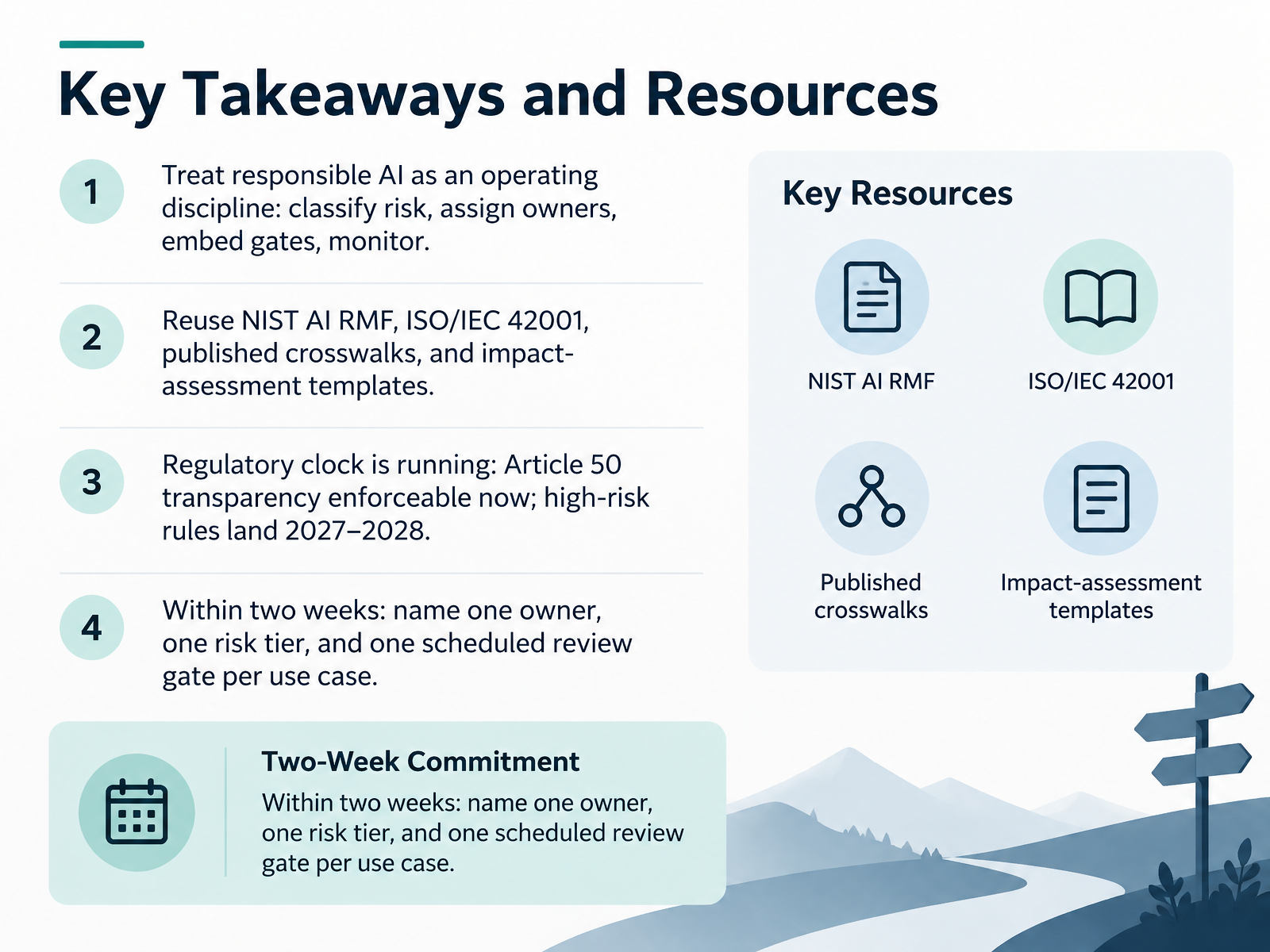
- 14Key Takeaways and ResourcesLet's bring this together. Treat responsible AI as an operating discipline, not a one-time campaign. Classify each use case by risk tier, assign a named owner, embed review gates at design and release, and monitor in production. You don't need to start from scratch. Reuse the NIST AI Risk Management Framework, ISO/IEC 42001, published crosswalks that map frameworks to each other, and impact-assessment templates. The regulatory clock is running. Article 50 transparency rules are enforceable now. High-risk obligations land in December 2027 for stand-alone systems and August 2028 for AI embedded in regulated products. So within the next two weeks, do one small thing per use case. Name one owner, assign one risk tier, and schedule one review gate. That single step turns guidance into practice. Thank you for your attention, and I hope you leave ready to put these habits to work.
 ai-act-service-desk.ec.europa.euai-act-service-desk.ec.europa.euconsilium.europa.eu+22 min
Take the deck with you
Download this course as a file — free, no sign-up needed.
- PDF handoutEvery slide page, ready to print or share.15 pages · 3.4 MBDownload
- Narrated PowerPointThe deck that presents itself — every slide carries the digital human's narration video.15 pages · 14.2 MBDownload
- PowerPoint slidesThe full deck as a .pptx — open it in PowerPoint, Keynote, or Google Slides.15 pages · 3.3 MBDownload
Free to use in your own training — please keep the PersonWise credit page at the end.
Have your own deck? Turn it into a course
Sources consulted
Web sources consulted while building this course.
- NIST AI RMF to ISO/IEC FDIS 42001 AI Management system Crosswalk — airc.nist.gov
- AI RMF PLAYBOOK — airc.nist.gov
- Crosswalk Documents - AIRC — airc.nist.gov
- AI Risk Management Framework | NIST — nist.gov
- Roadmap for the NIST Artificial Intelligence Risk Management Framework (AI RMF 1.0) | NIST — nist.gov
- Roadmap to Scale AI Projects in the Public Sector - Canada.ca — canada.ca
- Practical Manual for Establishing — aisi.go.jp
- The State of Maryland’s Responsible AI Policy Implementation Guidance - AI - Policies & Guidance - Department of Information Technology — doit.maryland.gov
- Enterprise AI Implementation Roadmap: From Strategy to Scale — sganalytics.com
- AI Implementation Strategy: A Practical Roadmap — microsoft.com
- Timeline for the Implementation of the EU AI Act | AI Act Service Desk — ai-act-service-desk.ec.europa.eu
- Frequently Asked Questions | AI Act Service Desk — ai-act-service-desk.ec.europa.eu
- Timeline - Artificial intelligence - Consilium — consilium.europa.eu
- Guidelines for providers of general-purpose AI models | Shaping Europe’s digital future — digital-strategy.ec.europa.eu
- Rules for trustworthy artificial intelligence in the EU | EUR-Lex — eur-lex.europa.eu
- Management of AI in EdTech Process | Learning Technology | Information Services — information-services.ed.ac.uk
- AI Human Rights Impact Assessment for Educators — uwaterloo.ca
- Ethical Impact Assessment — unesco.org
- Artificial intelligence impact assessment tool — digital.gov.au
- BAU Artificial Intelligence Risk Assessment Guide — ai.bau.edu.tr