Begin
14 pages · ~28 min
Ecological Succession and Ecosystem Recovery
This training explains ecological succession and how ecosystems recover and rebuild after disturbances, helping learners understand primary and secondary succession processes.
A digital instructor presents all 14 pages. Hold “Ask” at any point and ask out loud — the answer comes from this course. No sign-up needed.
What you’ll learn
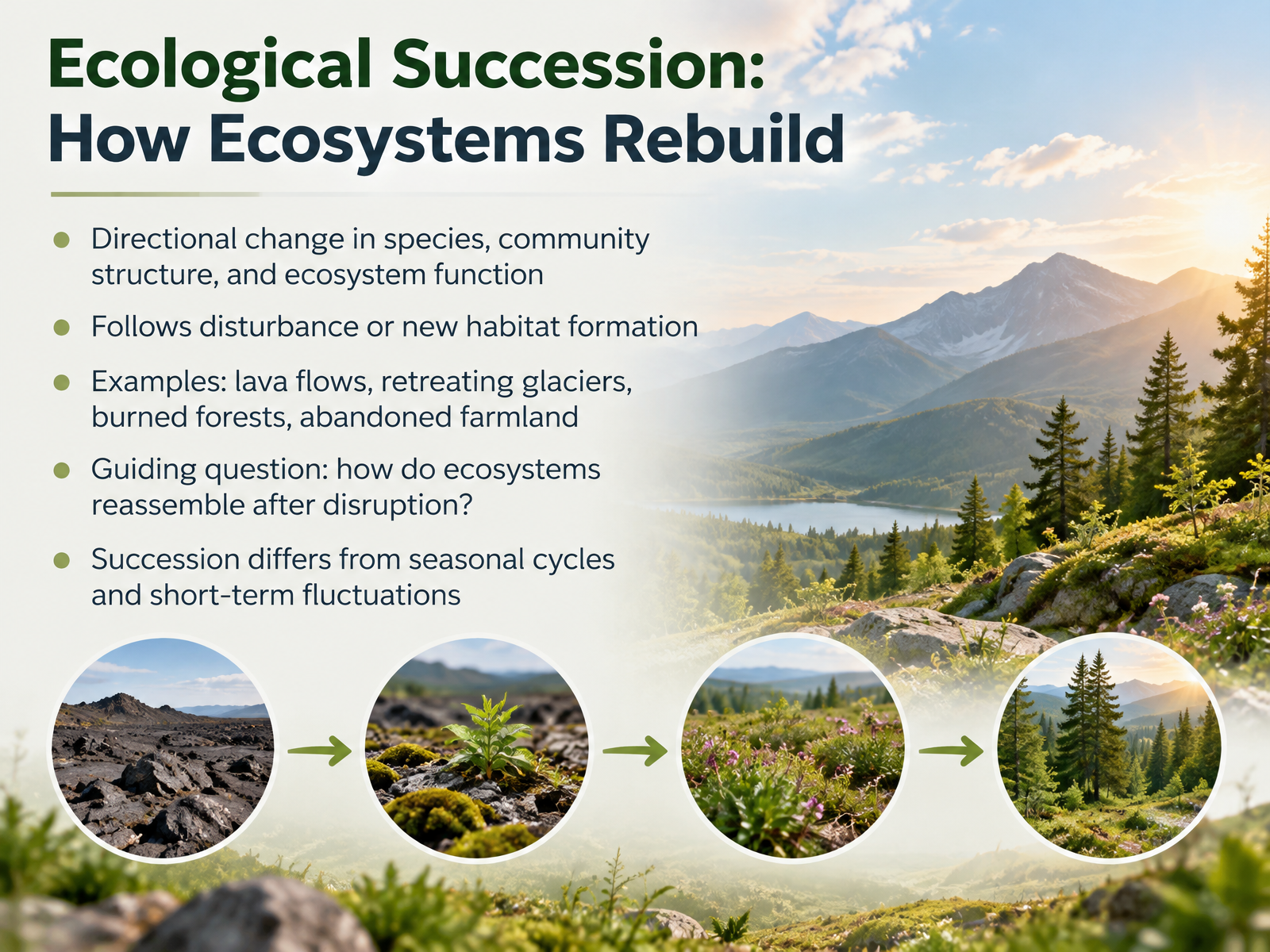
- 01Ecological Succession: How Ecosystems RebuildWelcome. Today we are exploring ecological succession, which is how ecosystems rebuild after disruption. This first slide sets the foundation. Succession is directional change over time. Species composition shifts. Community structure changes. Ecosystem functions, such as energy flow and nutrient cycling, also change. It usually follows a disturbance or the formation of new habitat. Consider a lava flow cooling into bare rock. A retreating glacier leaving exposed soil. A forest after a severe burn. Or farmland left unused. In each setting, the guiding question is the same. How do ecosystems reassemble after disruption? Notice that succession differs from seasonal cycles and short-term fluctuations. Seasons repeat. Weather varies week to week. Succession is a longer path of reassembly and change. Keep that contrast in mind. Next, we will examine why succession matters in the Anthropocene.1 min
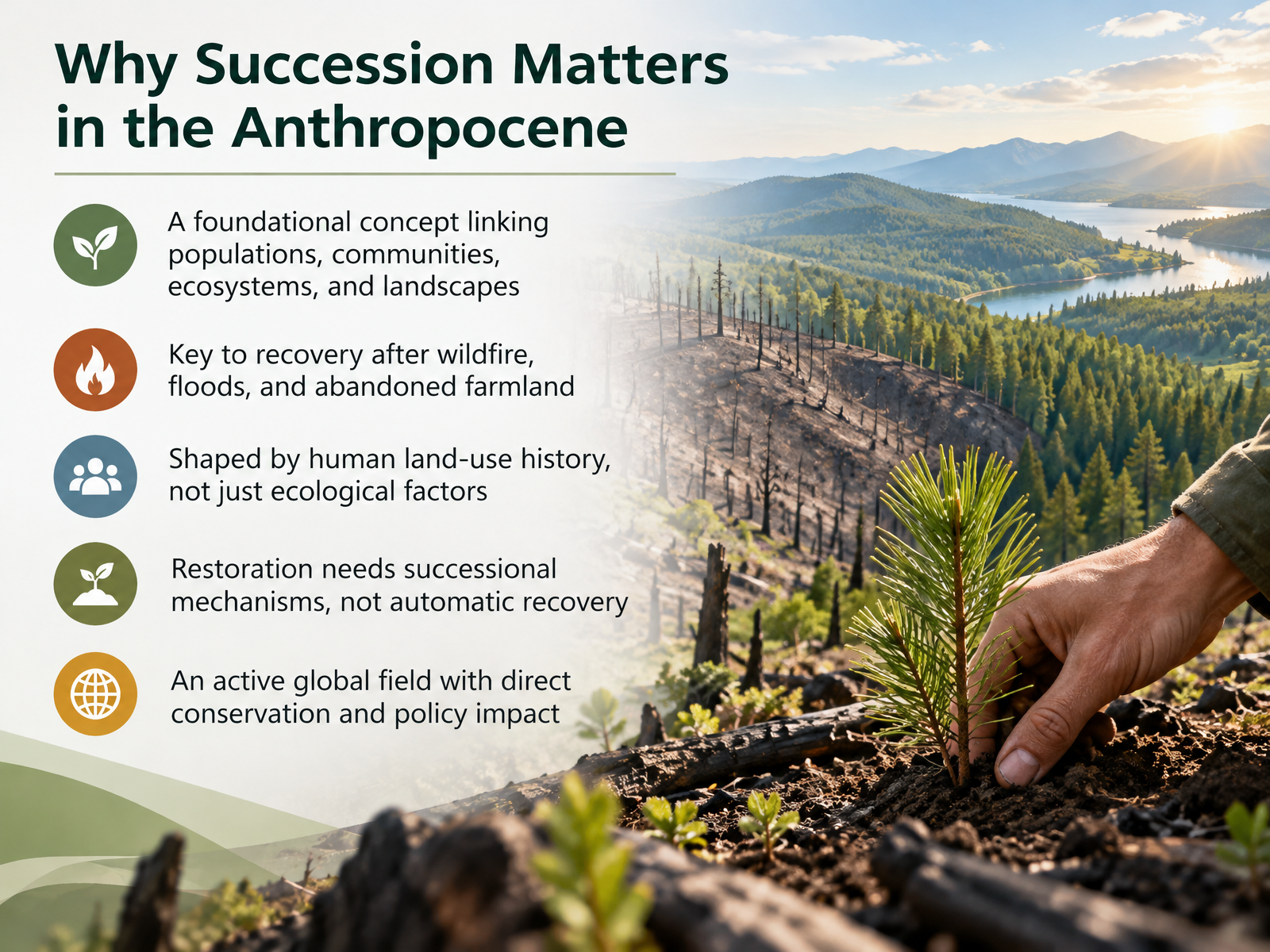
- 02Why Succession Matters in the AnthropoceneLet's build on that foundation by asking why succession matters right now. Ecologists often treat succession as a foundational concept, because it links four levels of organization: populations, communities, ecosystems, and landscapes. Think of a burned forest. First, individual plants and animals return. Then, species interact and form new communities. Over time, the whole ecosystem changes, and those changes spread across the surrounding landscape. Succession is also central to recovery after floods and on abandoned farmland. But here is the key shift. In the Anthropocene, human land-use history shapes succession just as much as climate or soil. Consider a former pasture. Whether it regrows into forest depends on past plowing, grazing, and nearby seed sources. Restoration, then, is not automatic recovery. It requires us to work with successional mechanisms, such as seed dispersal, soil development, and species interactions. This is an active global field with direct impact on conservation and policy. The takeaway is simple: succession helps us predict and guide how damaged lands recover. Next, we examine disturbance, severity, and biological legacy.
 2 min
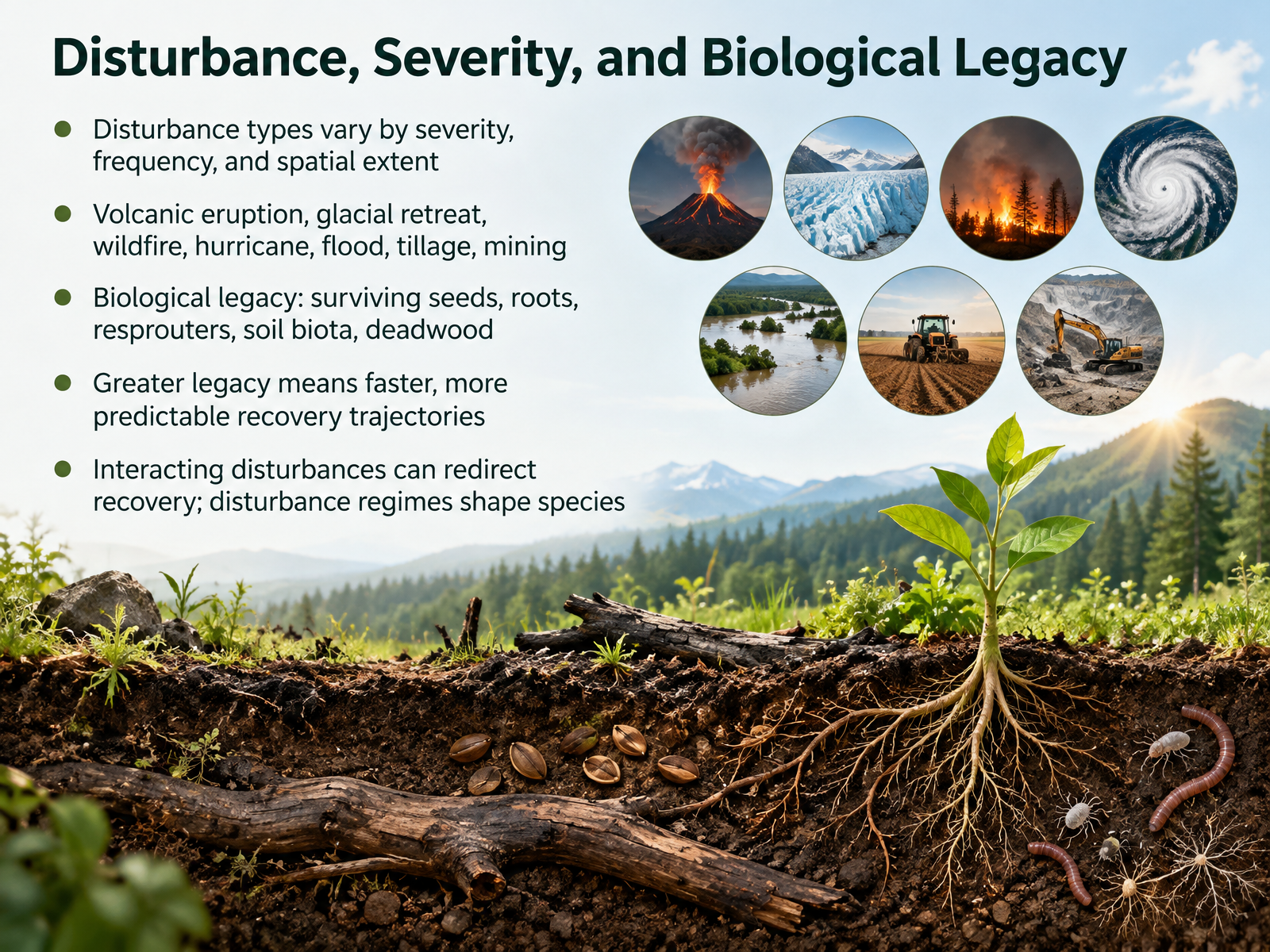
- 03Disturbance, Severity, and Biological LegacyNow let us look at what starts succession in the first place: disturbance. A disturbance is any event that disrupts an ecosystem and frees up resources. Disturbances differ in severity, frequency, and spatial extent. Consider a wildfire that scorches a few acres, then a volcano that buries an entire valley in ash. Same category of event, very different scale.
Other common disturbances include glacial retreat, hurricanes, floods, tillage, and mining. Each leaves behind a different starting point.
That starting point depends largely on biological legacy. Biological legacy means what survives the disturbance and remains available to the next generation: seeds, roots, resprouters, soil biota, and deadwood. Notice how a forest that burns lightly may keep its seed bank and soil life intact. A heavily mined site may keep almost nothing.
The takeaway is this. Greater biological legacy generally means faster and more predictable recovery. But disturbances interact. A flood after a fire, or repeated disturbances over time, can redirect recovery. Over many years, these patterns form a disturbance regime that shapes which species persist.
Next, we will see how these starting points produce two broad pathways: primary versus secondary succession, and why they are best understood as a continuum.
 2 min
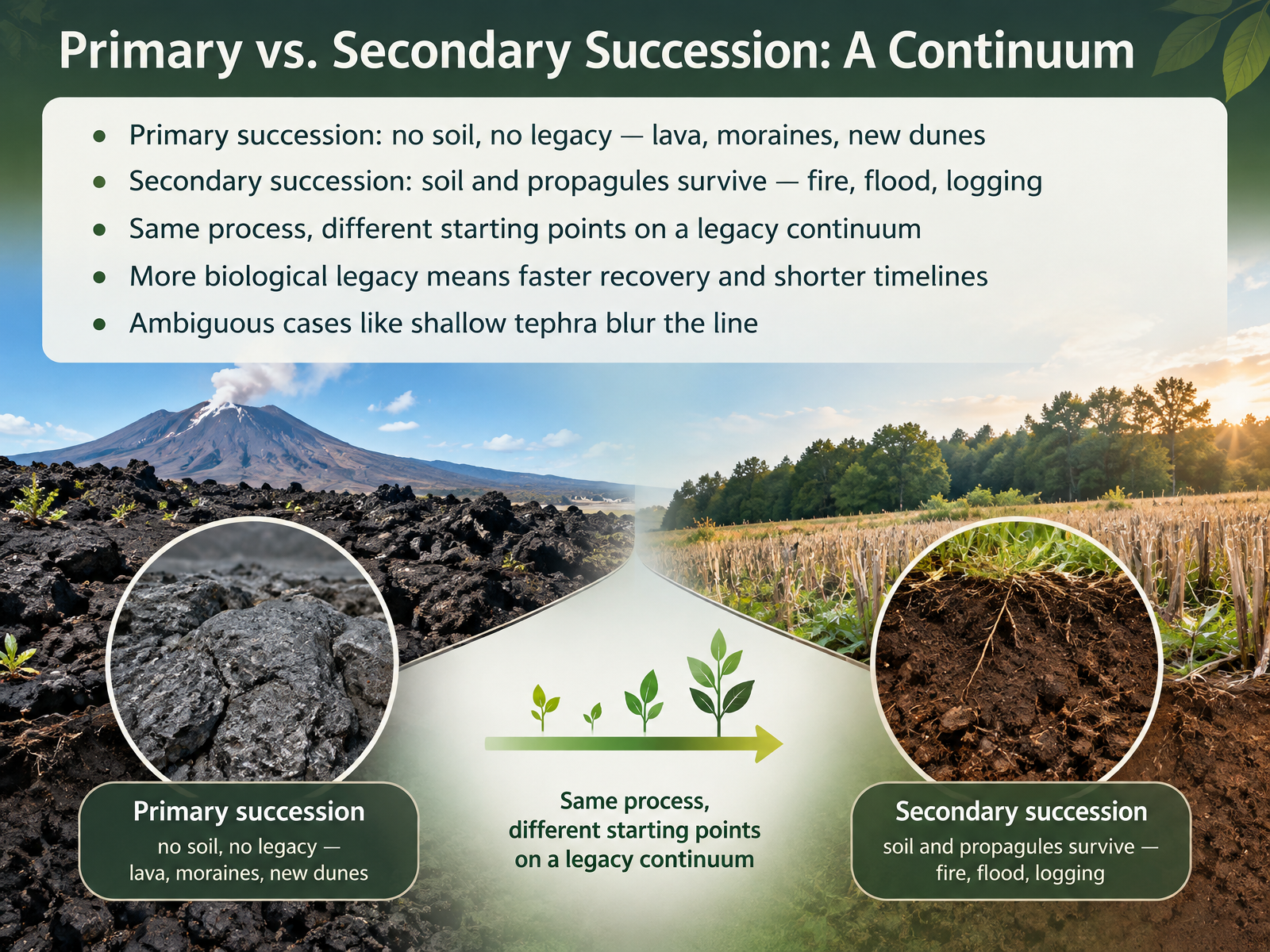
- 04Primary vs. Secondary Succession: A ContinuumNow let's compare the two main types of succession, and how they sit on one continuum. Primary succession begins where there is no soil and no biological legacy. Picture bare lava after a volcanic eruption, a rocky moraine left by a retreating glacier, or fresh dunes along a coast. Nothing living remains in place, so recovery starts from zero. Secondary succession begins where soil and propagules survive a disturbance. After a forest fire, a flood, or logging, the soil is still there, and seeds, roots, or spores may remain. Notice the key pattern. The process of succession is largely the same, but the starting point differs. More biological legacy means faster recovery and shorter timelines. Consider a logged forest, which can green up in decades, compared with bare lava, which may take centuries. Some cases, like a thin layer of volcanic tephra, blur the line between primary and secondary. Keep that continuum in mind. Next, we will look at pioneer species and early community assembly.
 2 min
- 05Pioneer Species and Early Community AssemblyNow let's look at who arrives first. Pioneer species are the earliest colonizers of harsh, bare ground. Think of lichens and mosses clinging to fresh lava, or fast-growing grasses taking hold on an abandoned field. These organisms share key traits. They disperse quickly, grow rapidly, and complete short life cycles. Notice how that strategy lets them establish before competitors arrive. As they live and die, weathering and organic matter slowly turn bare rock into developing soil. Then nitrogen-fixing species, such as alder and lupine, add fertility that supports later plants. Consider a glacial foreland, where new ground is exposed as ice retreats. You can literally watch this assembly unfold over decades. The takeaway is simple. Pioneers prepare the site, and their changes pave the way for the species that follow. Next, we examine the mechanisms of species replacement.
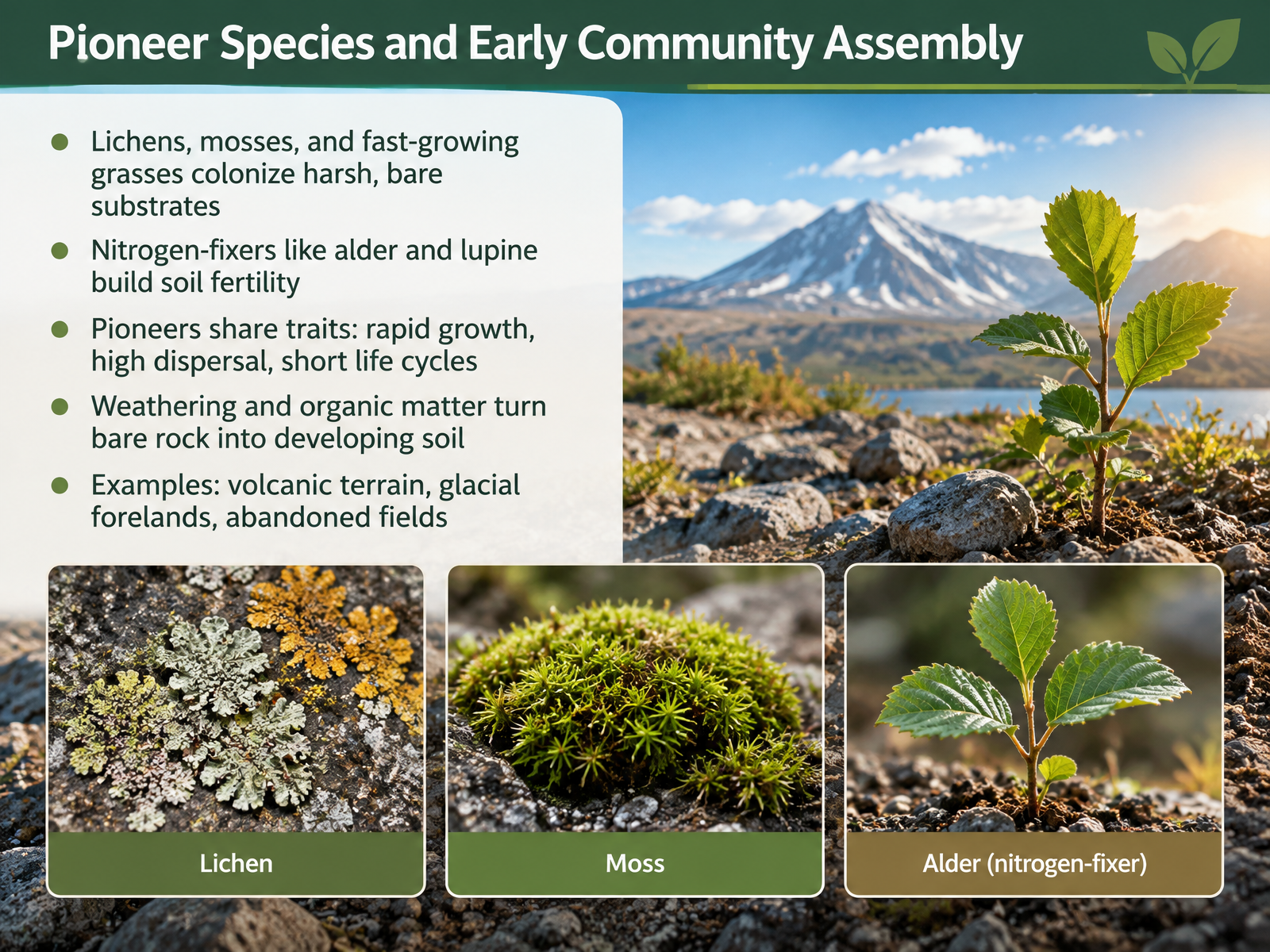 1 min
- 06Mechanisms of Species ReplacementLet's look at the mechanisms behind species replacement. Ecologists often describe three classic models: facilitation, tolerance, and inhibition. Think of them less as strict categories and more as points along a continuum. Consider a meadow recovering after a fire. Early plants may improve the soil for later species, that is facilitation. Or later species may simply tolerate existing conditions, or even inhibit newcomers by shading them out. Competition and life-history trade-offs then drive turnover. A fast-growing, short-lived plant may dominate early, then lose ground to slower, long-lived competitors. Arrival order also matters. Dispersal limitation and priority effects mean whoever gets there first can shape what follows. Ecosystem engineers, like beavers building a dam, and keystone species, like sea otters controlling urchins, can redirect entire successional pathways. Finally, plant-soil and plant-herbivore feedbacks can accelerate, slow, or divert succession. Notice how these mechanisms interact rather than act alone. Next, let's trace primary succession in detail, from bare rock to forest, to see these ideas in action.
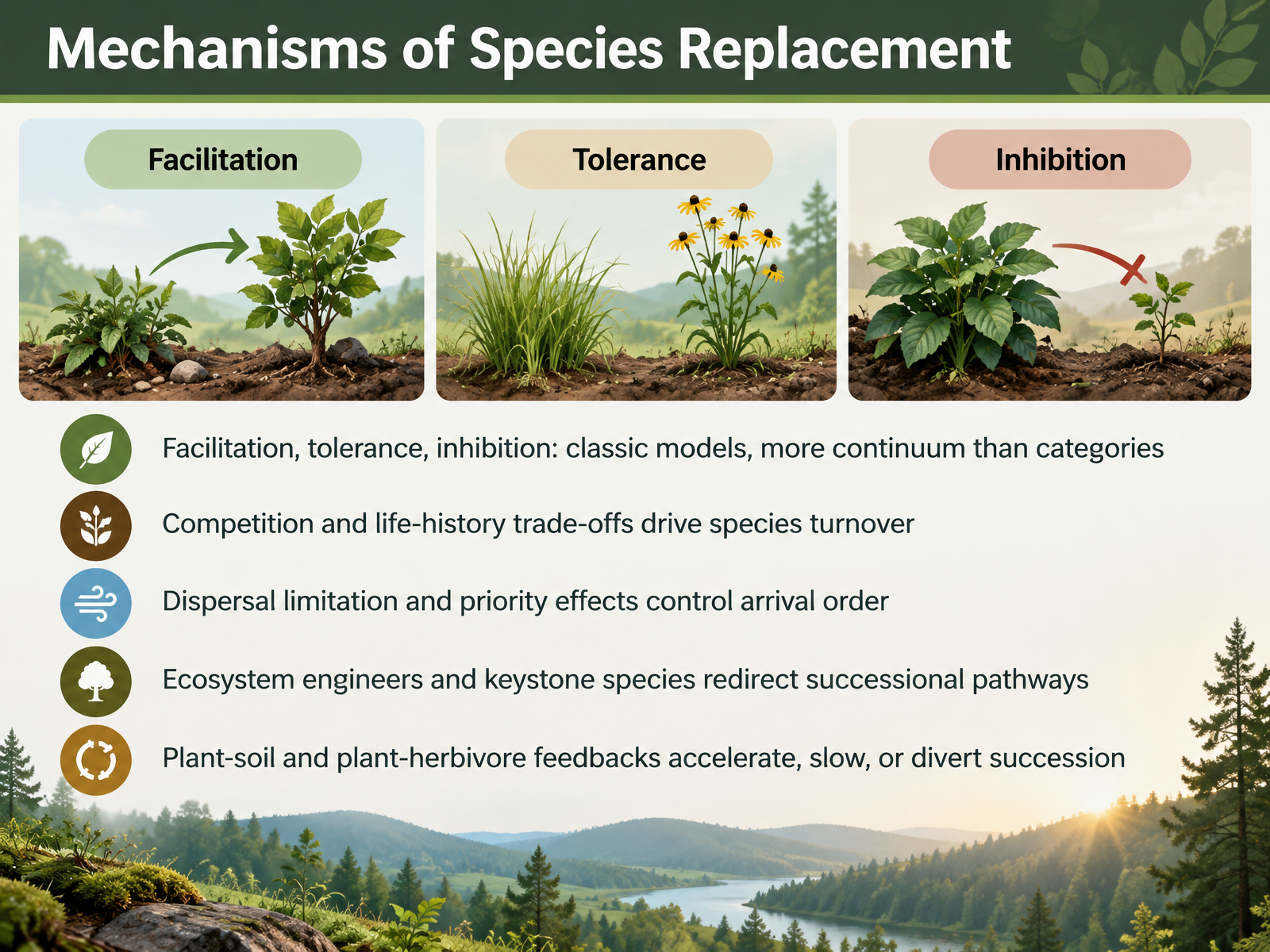 2 min
- 07From Bare Rock to Forest: Primary Succession in DetailLet's look closely at primary succession, where life begins on bare rock. In the pioneer stage, lichens and mosses attach to the rock surface. Lichens slowly break down minerals and create the first thin layer of soil. Next, grasses, herbs, and shrubs take root. Their roots and decaying leaves add organic matter, so the soil grows deeper and richer. Over time, pioneer trees establish, but they are eventually replaced by late-successional, shade-tolerant species that can grow in the dim light beneath them. Notice how soil depth, nitrogen, and water-holding capacity rise over centuries. Consider Mount St. Helens, Hawaii, and Glacier Bay, Alaska. At each site, the path differs. Early phases can persist for a very long time, and alternative pathways arise from site conditions and the order in which species arrive. The key takeaway is this: primary succession is slow, cumulative, and shaped by place. Next, we turn to secondary succession and human-influenced landscapes.
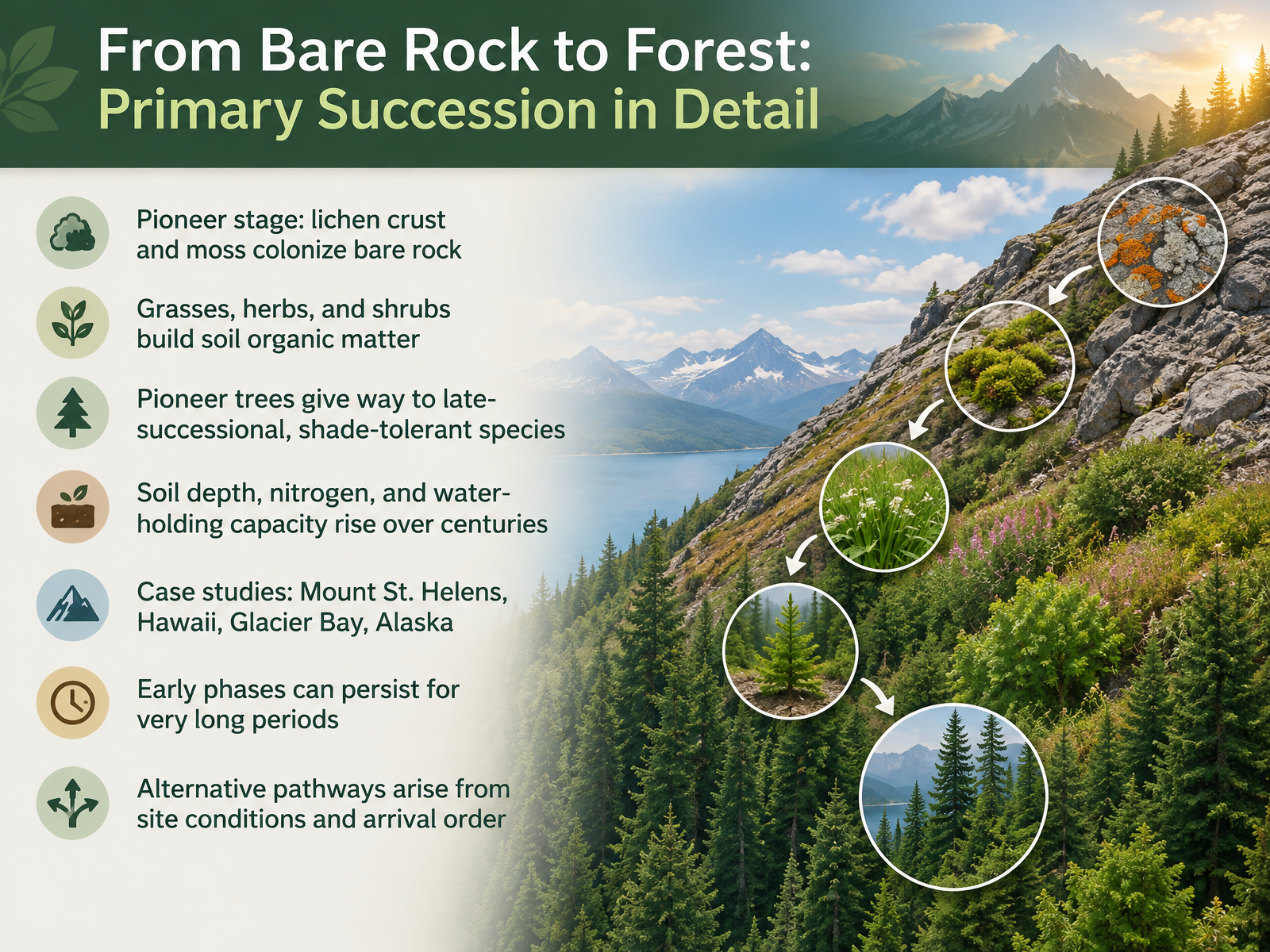 2 min
- 08Secondary Succession and Human-Influenced LandscapesNow let's turn to secondary succession and the landscapes people shape. Secondary succession is recovery that begins where soil still exists, after a disturbance removes much of the plant life but not the ground beneath it. Consider a forest after a severe fire. Within a year, grasses and fast-growing shrubs return. Because the soil and its seeds are already present, recovery can move faster than it would on bare rock. The same pattern appears after windthrow, flooding, or when a farm field is abandoned. Old-field succession is the classic teaching model. Yet notice how it varies by region. A field in the eastern United States may become pine, then hardwood. In a drier grassland, the path looks different. Logged forests, mined lands, urban brownfields, and managed restoration sites each follow their own routes. As recovery proceeds, biodiversity, carbon storage, and ecosystem services shift. Consider how a young thicket stores less carbon than a mature forest but supports different wildlife. Importantly, land-use intensity and socio-economic context shape both speed and direction. A site near a city may be replanted; a remote site may be left alone. So secondary succession is not one fixed script. It is a response to soil, climate, and human decisions. That tension between predictable patterns and varied outcomes leads us to trajectories, stability, and the question of climax.
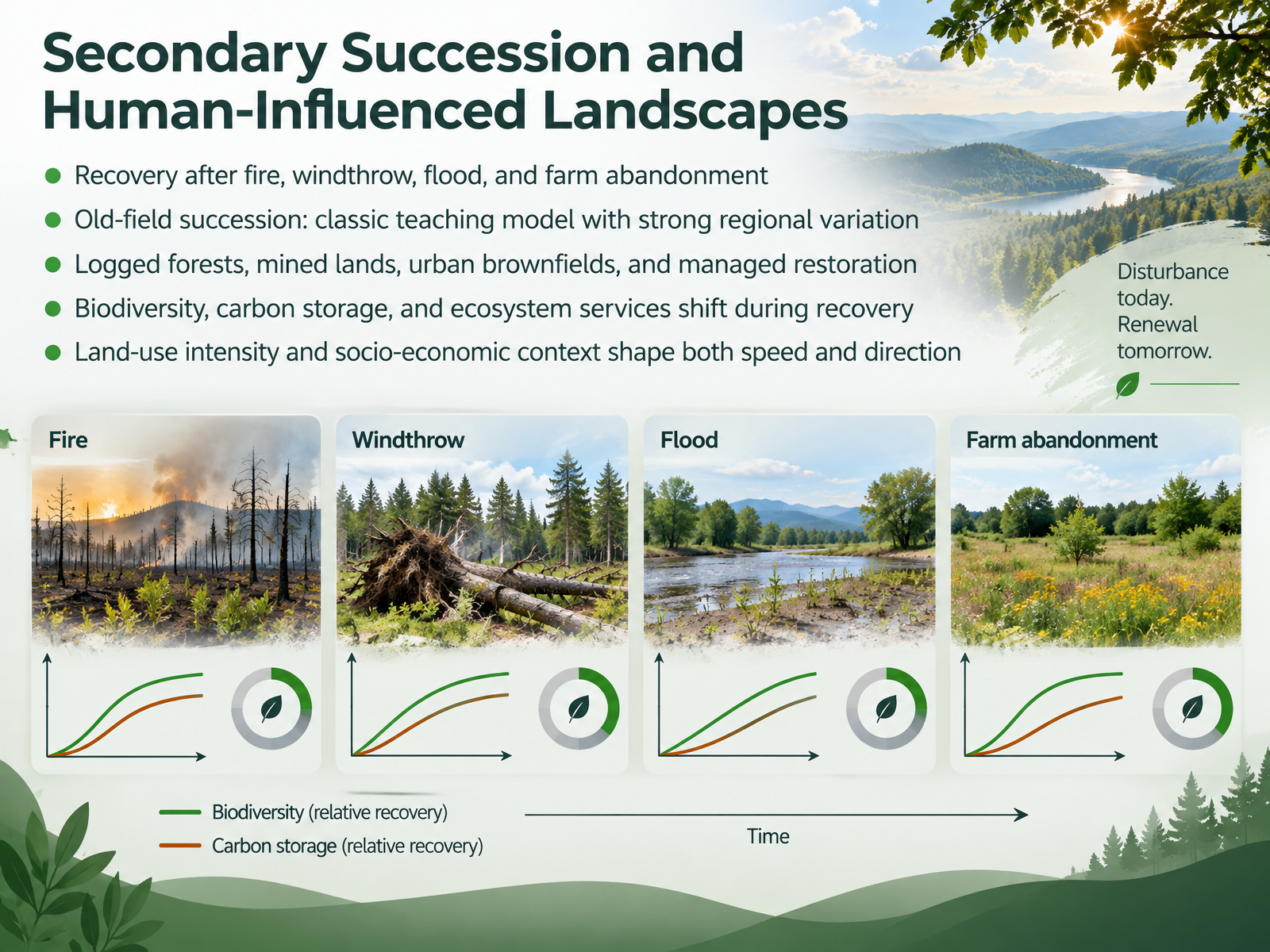 1 min
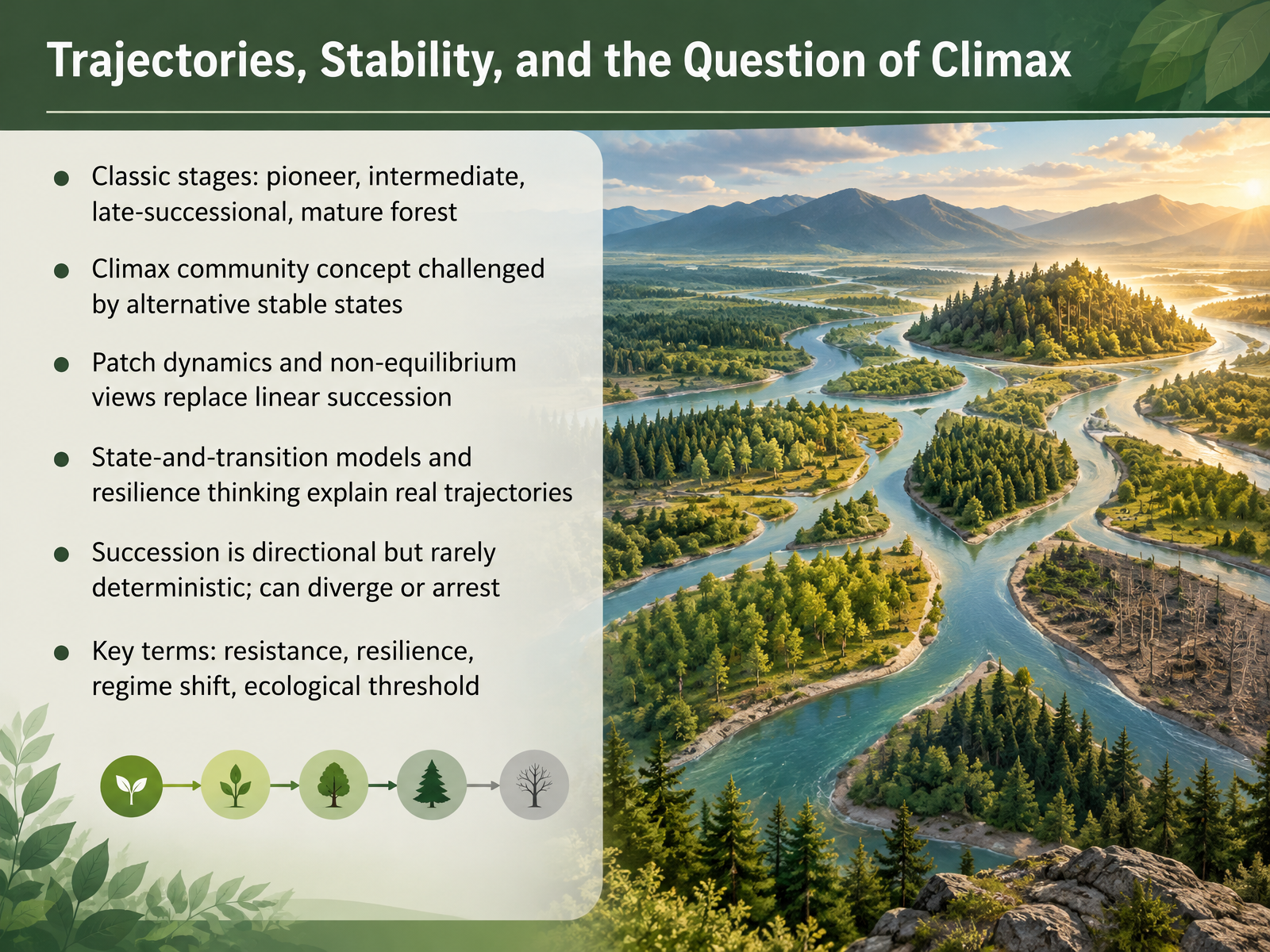
- 09Trajectories, Stability, and the Question of ClimaxLet's look at how succession is described over time, and why that description has changed. In the classic model, a community moves through stages: pioneer species first, then intermediate species, then late-successional species, and finally a mature forest. The old idea was a single climax community, a stable endpoint where change stops. Notice how that idea has been challenged. Ecologists now recognize alternative stable states, meaning different communities can persist in the same place under the same climate. Patch dynamics and non-equilibrium views replace the linear picture with a shifting mosaic of patches at different ages. State-and-transition models and resilience thinking help explain real trajectories. So succession is directional, but rarely deterministic. It can diverge, pause, or arrest. Consider a grassland that resists invasion by shrubs for years, then crosses a threshold and shifts to shrubland. Resistance is the ability to stay unchanged. Resilience is the ability to recover after disturbance. A regime shift is a large, persistent change, often triggered when an ecological threshold is crossed. Keep this takeaway: succession has direction, but not a guaranteed destination. Next, we move to Succession in Aquatic and Wetland Systems.
 2 min
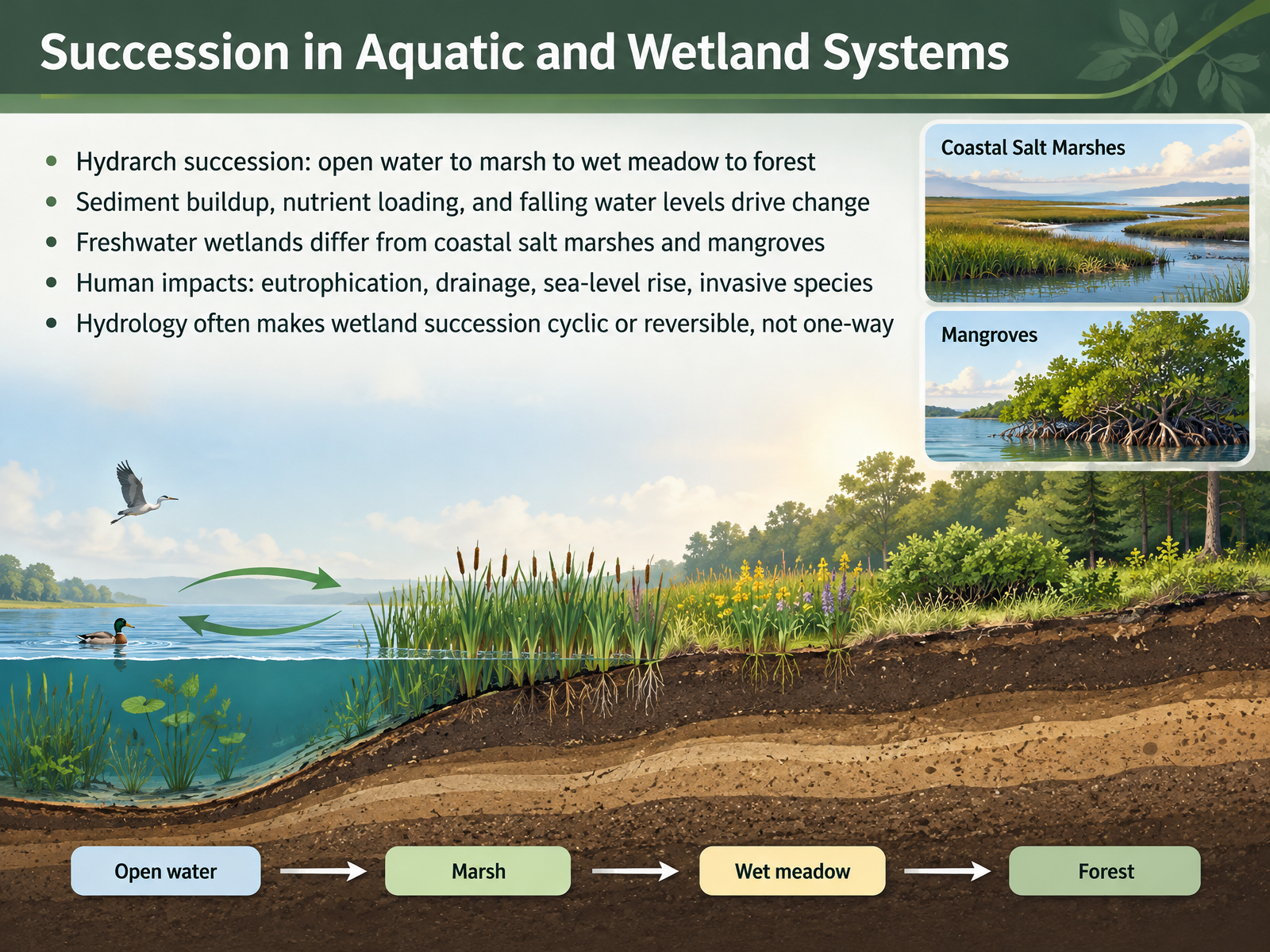
- 10Succession in Aquatic and Wetland SystemsNow let's turn to water, and how succession unfolds in aquatic and wetland systems. This process is called hydrarch succession. Picture a pond. Over time, it can shift from open water to marsh, then to wet meadow, and eventually to forest. What drives that change? Sediment builds up, nutrients accumulate, and water levels slowly fall. Consider a shallow lake filling with leaves and soil each year. Those small deposits make the water shallower, allowing rooted plants to move in. Freshwater wetlands are not all the same, though. They differ from coastal salt marshes and mangroves, which are shaped by tides and salt. Human activities also matter. Eutrophication adds excess nutrients, drainage removes water, sea-level rise pushes saltwater inland, and invasive species can crowd out native plants. Notice something important here. In wetlands, hydrology often makes succession cyclic or even reversible rather than one-way. A flood or drought can reset the system. So the key takeaway is this. Water shapes wetland succession, and human actions can speed it up, slow it down, or reverse it. Next, we'll explore the role of microbes and soils in succession.
 2 min
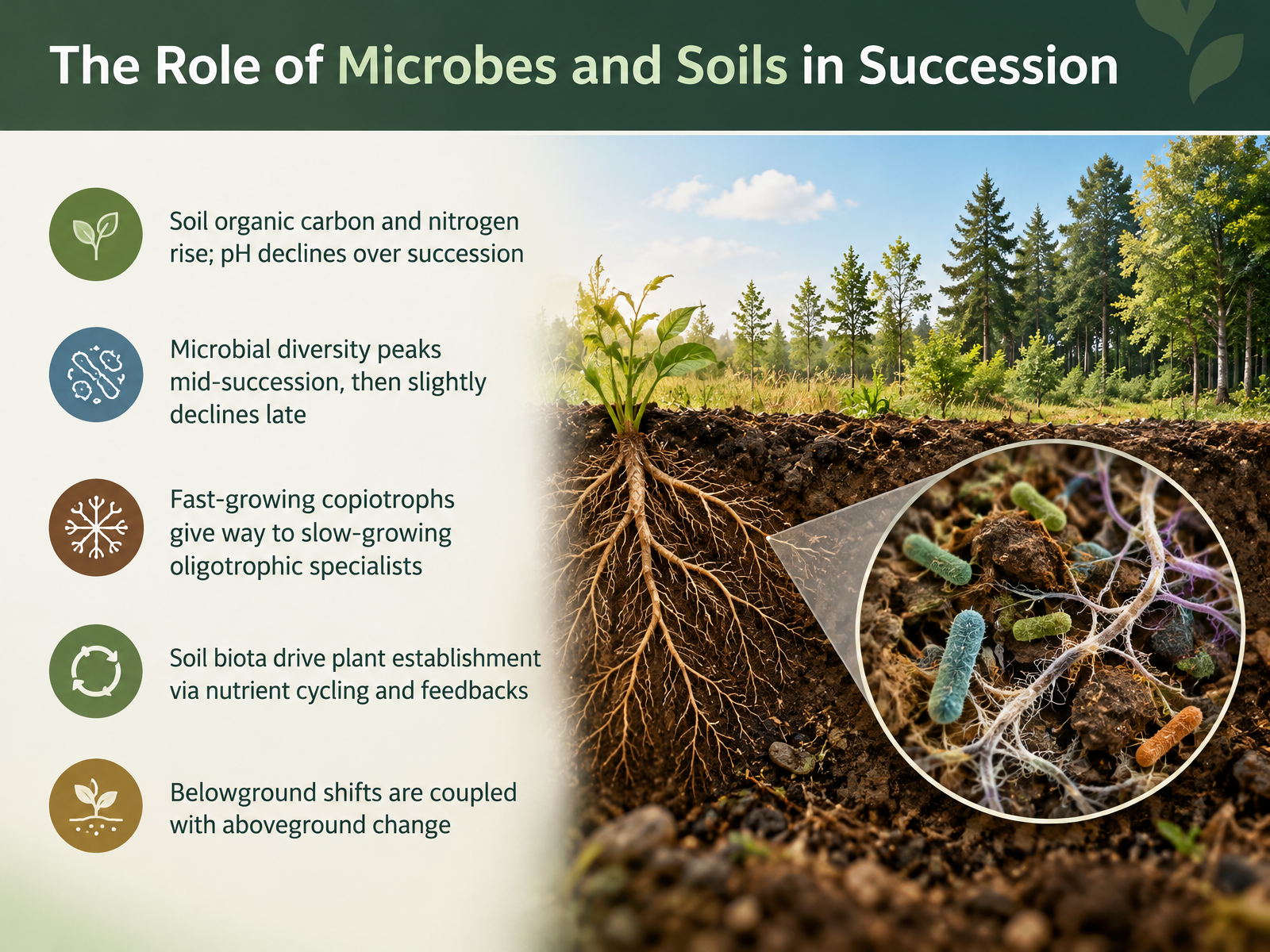
- 11The Role of Microbes and Soils in SuccessionNow let us look beneath the surface to see the role of microbes and soils in succession. As a community develops, soil chemistry changes. Organic carbon and nitrogen rise, while pH gradually declines. Picture a grassland turning into forest. Over decades, leaf litter and roots build richer, slightly more acidic soil. Microbial diversity often peaks in mid-succession, then dips slightly in late stages. Why? Early on, fast-growing copiotrophs thrive on simple, abundant nutrients. Later, slow-growing oligotrophic specialists take over, efficiently using scarce resources. These soil organisms drive plant establishment through nutrient cycling and feedbacks. For example, nitrogen-fixing bacteria enrich soil, helping shrubs and trees establish. Notice how belowground shifts are coupled with aboveground change. Consider what changes next as we measure and monitor succession.
 1 min
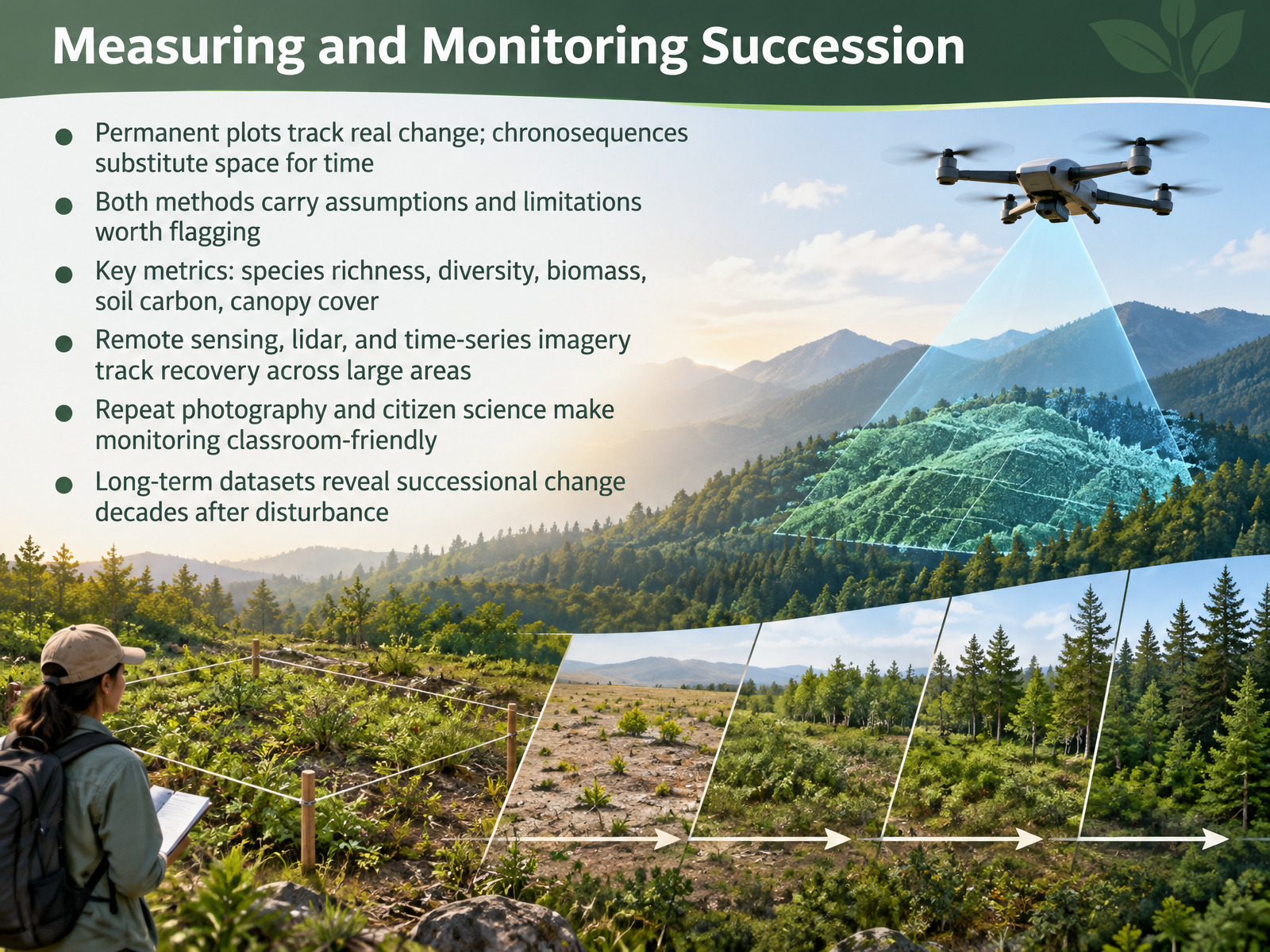
- 12Measuring and Monitoring SuccessionNow let's look at how researchers actually measure and monitor succession. Two main approaches are used. Permanent plots track real change over time by returning to the same marked location again and again. A chronosequence substitutes space for time, comparing several sites of different ages to infer a pattern. Both methods carry assumptions and limitations worth flagging. For example, a chronosequence assumes the sites started under similar conditions. Now consider what we measure. Key metrics include species richness, diversity, biomass, soil carbon, and canopy cover. On large landscapes, remote sensing, lidar, and time series imagery track recovery across wide areas. Repeat photography and citizen science make monitoring classroom friendly, because students can collect and compare images over a season. Notice how long term datasets reveal successional change decades after a disturbance, something a short study cannot show. So when you read a recovery claim, ask which method produced it and what it assumes. That habit turns monitoring data into evidence. Next, we move into teaching succession, including activities, assessment, and common misconceptions.
 2 min
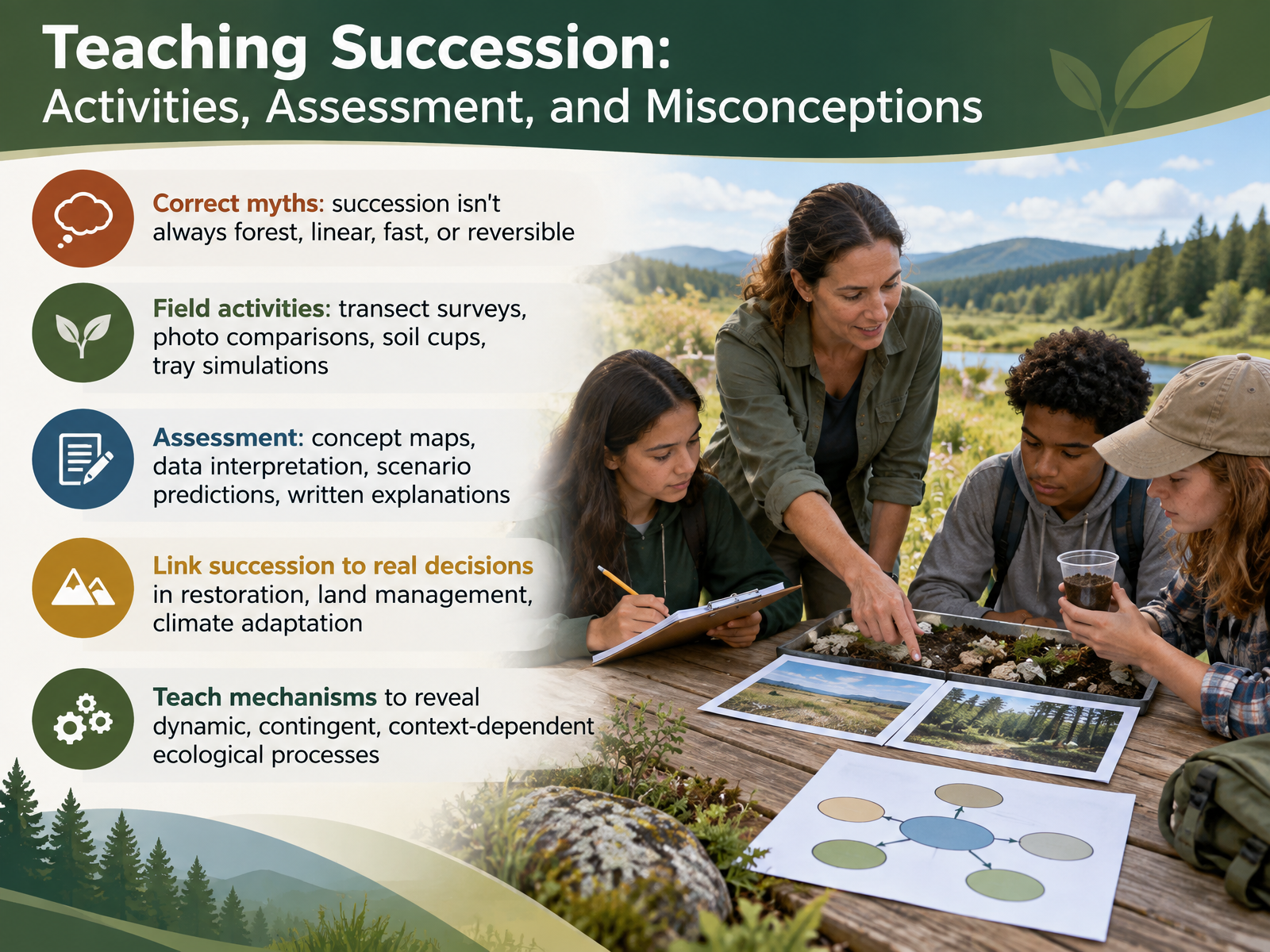
- 13Teaching Succession: Activities, Assessment, and MisconceptionsLet's turn to teaching succession in practice. A good place to start is correcting common myths. Succession is not always a forest, not always linear, not always fast, and not always reversible. Consider a coastal dune, for example. It can shift backward after a storm. So how do we help learners see those dynamics? Field activities work well, such as transect surveys, photo comparisons, soil cups, and tray simulations. For assessment, concept maps, data interpretation, scenario predictions, and written explanations all reveal student thinking. Notice how these tasks ask learners to reason, not just recall. Then link succession to real decisions in restoration, land management, and climate adaptation. Teach mechanisms rather than endpoints, so students see succession as dynamic, contingent, and context dependent. That prepares them for the next step: applying succession science to restoration, management, and future directions.
 2 min
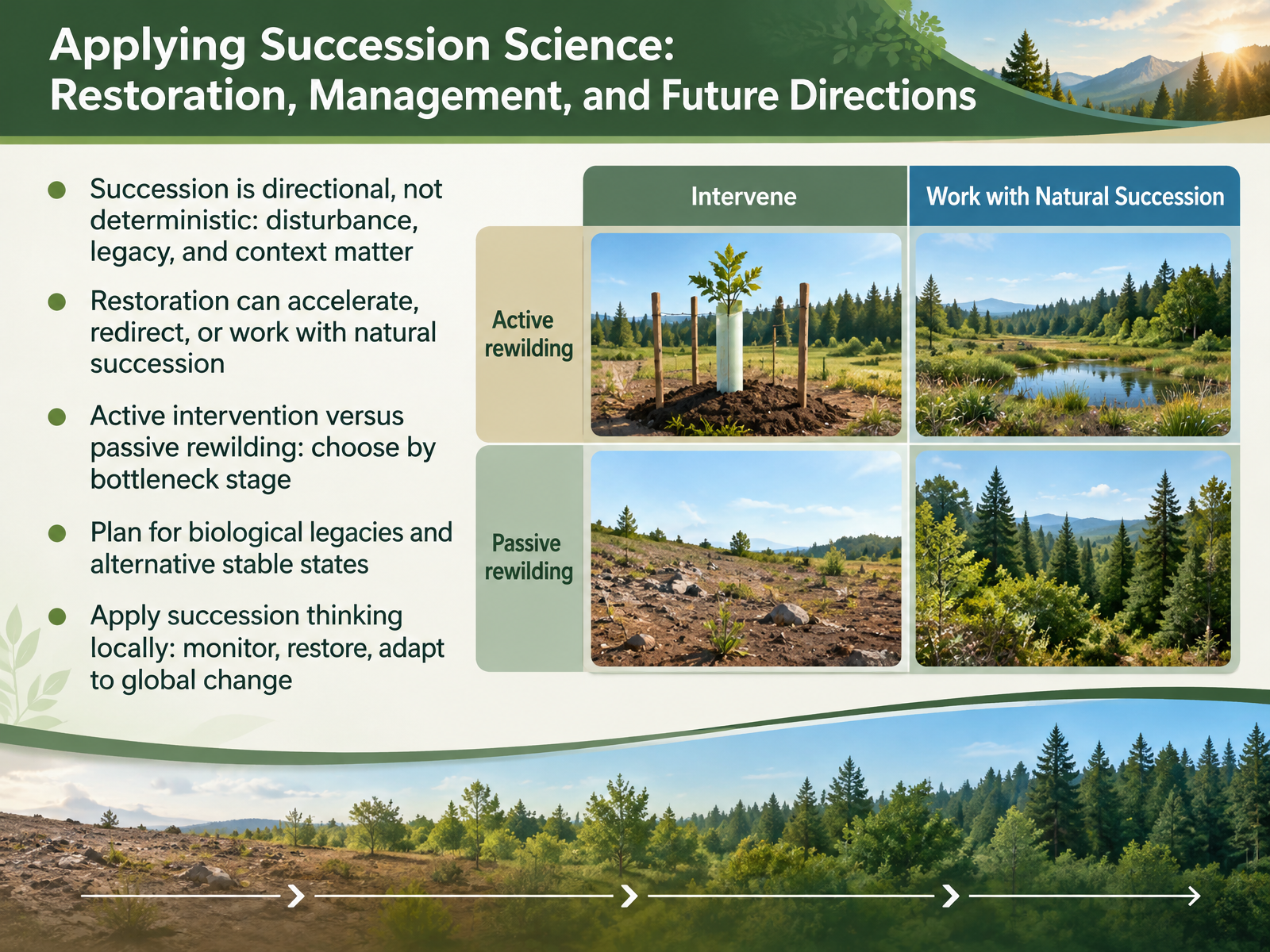
- 14Applying Succession Science: Restoration, Management, and Future DirectionsLet's close by applying what we've learned. Succession is directional, not deterministic. Disturbance, legacy, and local context all matter, so the future is shaped, not fixed. Restoration can take three paths. It can accelerate succession, redirect it, or simply work with it. For example, planting nitrogen fixing shrubs can speed soil recovery on degraded land. Active intervention versus passive rewilding is a choice guided by the bottleneck stage. If seeds can't reach a site, intervene. If the bottleneck is time, let natural processes work. Notice how that decision depends on what is limiting recovery right now. Plan for biological legacies and alternative stable states. Consider a forest that might remain a shrubland if grazing continues. Finally, apply succession thinking locally. Monitor, restore, and adapt as climate change shifts the rules. Thank you for learning with me. Keep observing, keep questioning, and keep restoring. You now have a practical framework for rebuilding ecosystems.
 2 min
Take the deck with you
Download this course as a file — free, no sign-up needed.
- PDF handoutEvery slide page, ready to print or share.15 pages · 5.7 MBDownload
- Narrated PowerPointThe deck that presents itself — every slide carries the digital human's narration video.15 pages · 17.7 MBDownload
- PowerPoint slidesThe full deck as a .pptx — open it in PowerPoint, Keynote, or Google Slides.15 pages · 5.7 MBDownload
Free to use in your own training — please keep the PersonWise credit page at the end.
Have your own deck? Turn it into a course