Introduction to Philosophy
Begin
14 pages · ~28 min
Introduction to Philosophy
This training introduces learners to the foundational tools of philosophy, focusing on how to identify, analyze, and evaluate arguments and reasoning.
What you’ll learn
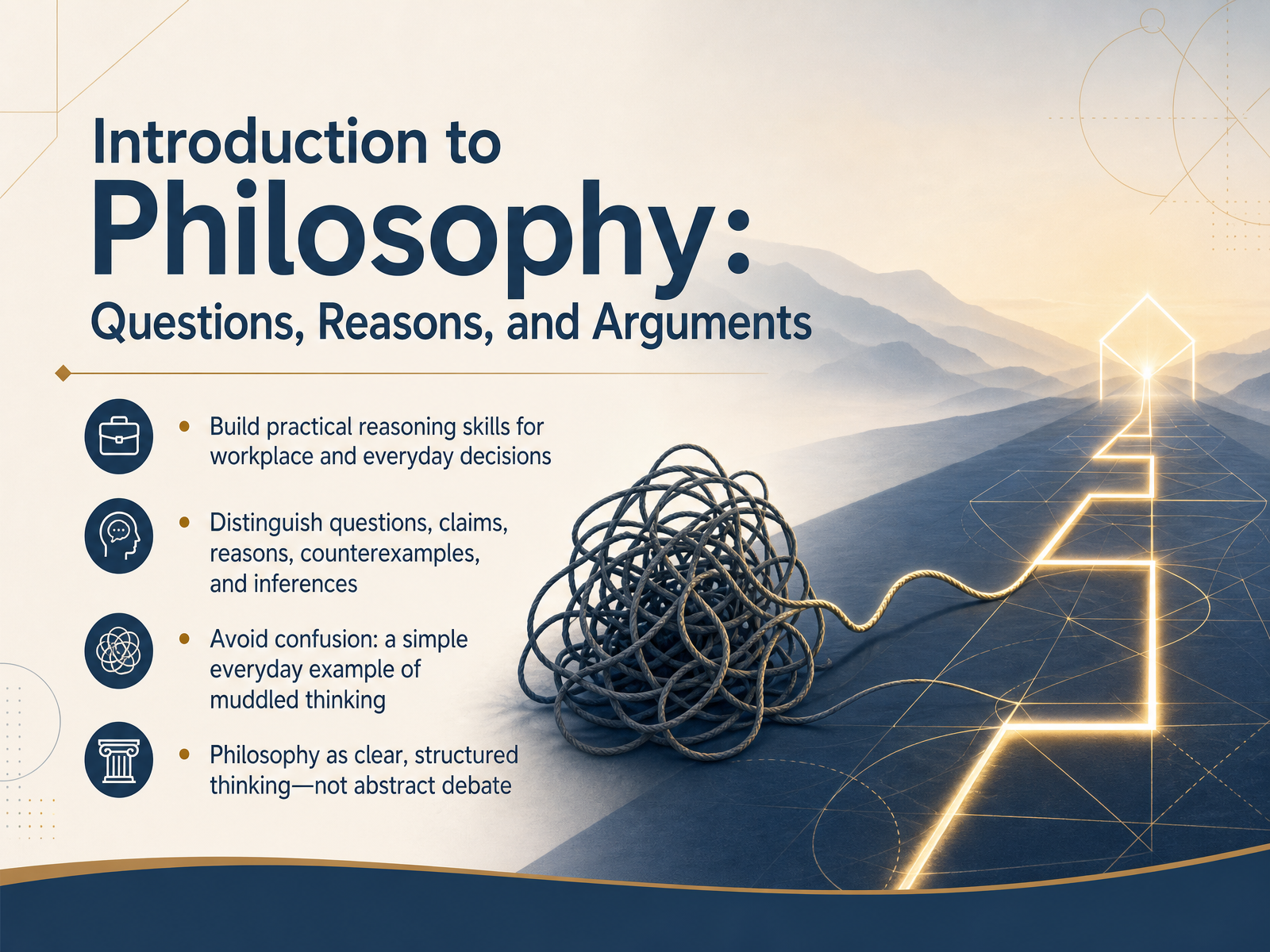
- 01Introduction to Philosophy: Questions, Reasons, and ArgumentsWelcome. Today we are going to build a practical toolkit for thinking more clearly. Our goal is not to win debates or to memorize big words—it is to learn how to examine ideas the way you would carefully unpack a puzzle. When you hear the word philosophy, you might picture abstract arguments in dusty books. What I want to show you instead is that philosophy is really just clear, structured thinking, a skill you already use when you decide which phone to buy or how to solve a disagreement at work. Over the next few minutes, we will look at a few simple building blocks: questions, claims, reasons, counterexamples, and inferences. We will start with a slightly muddled, everyday example so you can see how easily our thinking gets tangled, and then we will work through how to untangle it. By the end, you will be able to spot the difference between a claim and a reason, and you will have a simple method for asking sharper questions in any situation. Up next: we ask what really makes a good question.jps.bham.ac.ukdoi.orgacademia.edu+22 min
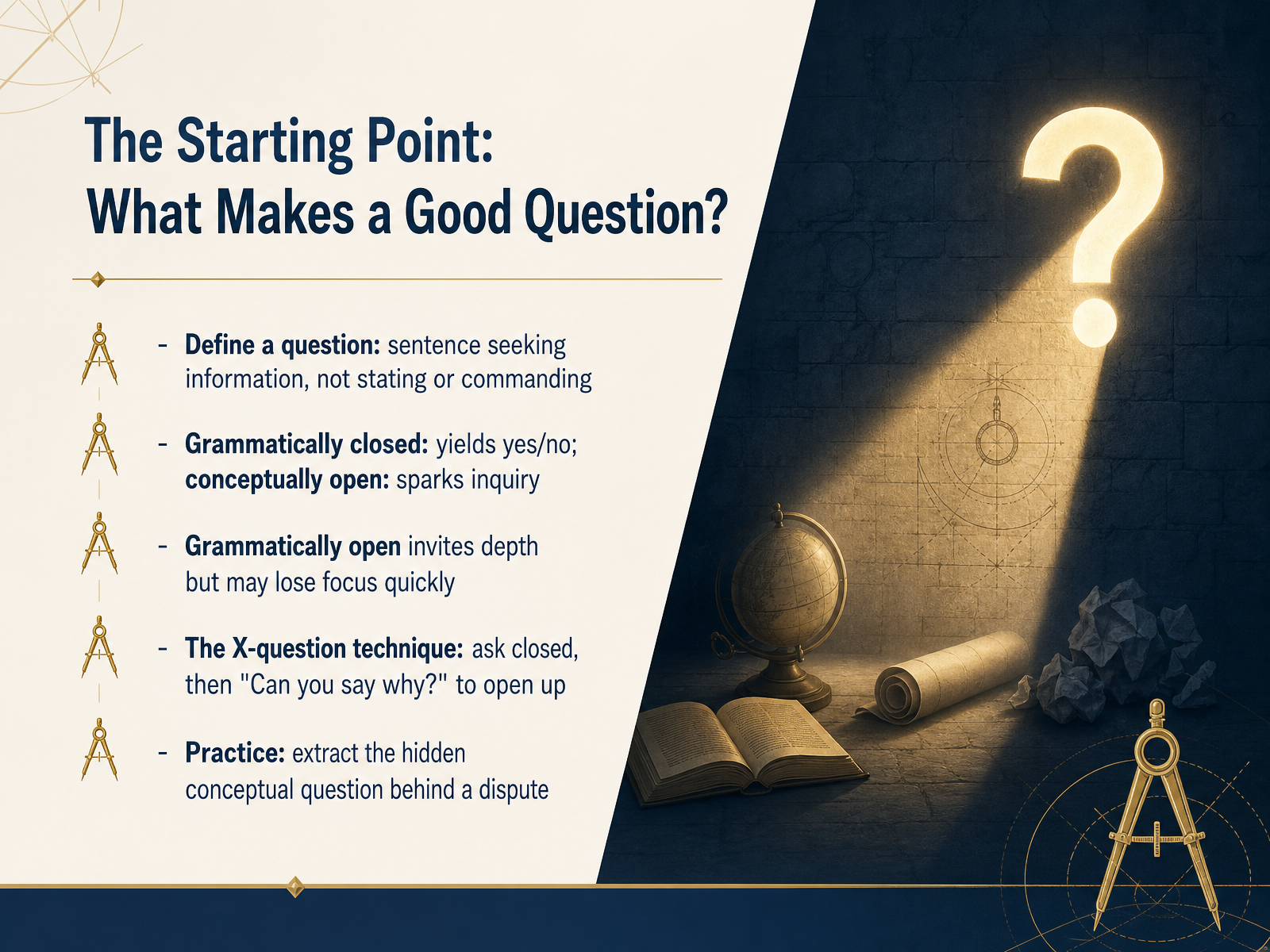
- 02The Starting Point: What Makes a Good Question?Let's start where every good inquiry starts, with a question. A question is simply a sentence that seeks information. It's not stating a fact, and it's not giving a command. For example, 'Is the door locked?' seeks a yes or no. We call that grammatically closed. But the question 'What is justice?' is grammatically open; it invites depth but can also lose focus very quickly. Here's a powerful technique to get the best of both worlds. It's called the X-question technique. You ask a focused, closed question, like 'Is the mind the same as the brain?' Then, you immediately open it up by asking, 'Can you say why?' This anchors the discussion and then invites the reasons. Think of a recent disagreement you witnessed. The hidden conceptual question beneath the argument is often more interesting than the fight itself. On our next slide, we'll begin unpacking those reasons by examining what a claim really is.
 jps.bham.ac.ukdoi.orgacademia.edu+21 min
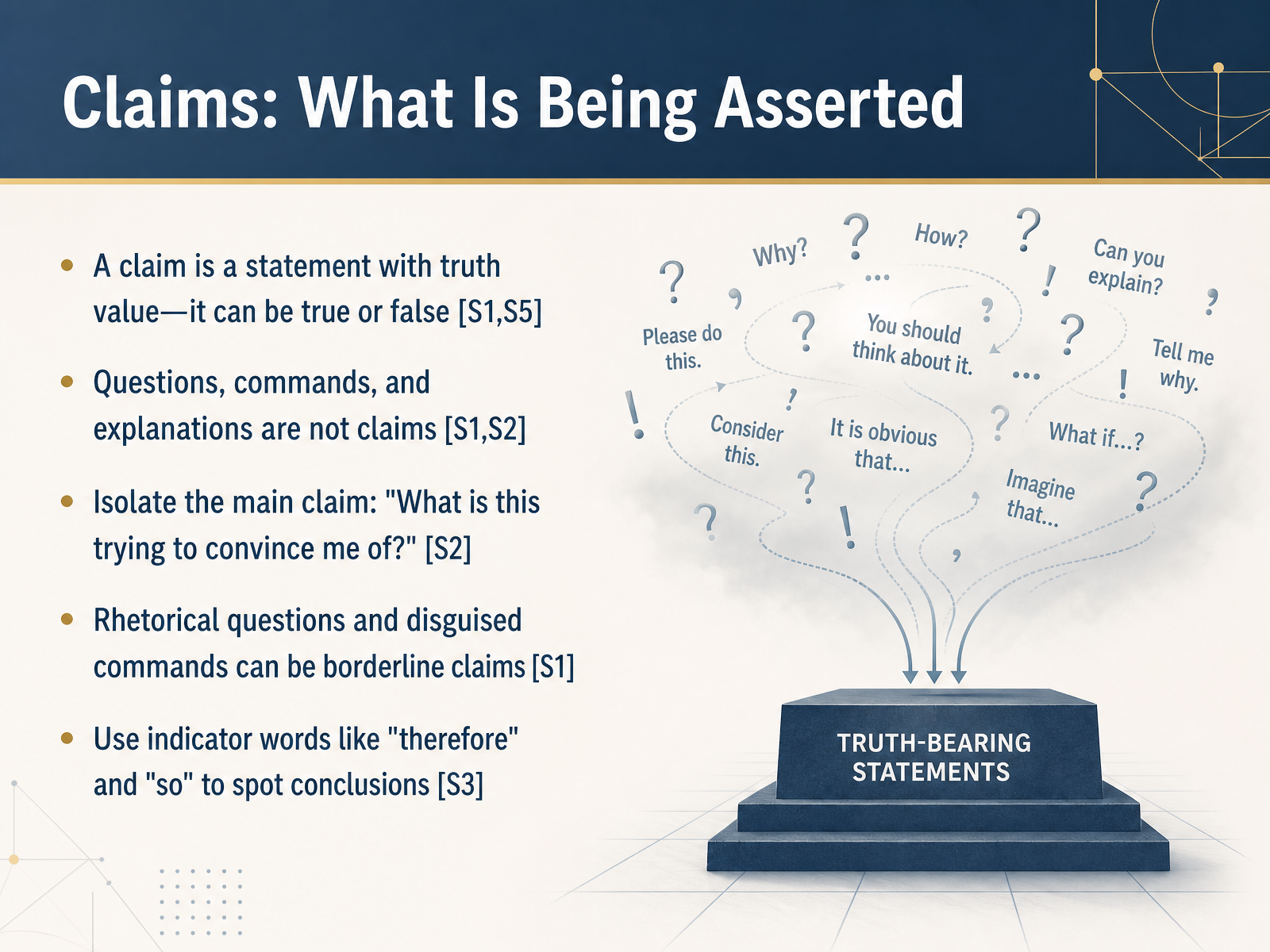
 - 03Claims: What Is Being AssertedNow let's talk about claims. When we argue, we are always putting forward a claim. Think of a claim as a statement that can be either true or false. For example, saying 'It is raining outside' is a claim, because we can check whether it is true. The key thing is that questions, commands, and explanations are not claims. Asking 'What time is it?' or saying 'Close the door' does not assert something true or false. Your main job in argument analysis is to isolate the main claim by asking yourself, what is this trying to convince me of? Look for indicator words like 'therefore' and 'so' to help you spot the conclusion. And keep in mind that rhetorical questions and disguised commands can sometimes act like borderline claims, but they still need careful attention. Once you have the claim pinned down, you are ready to ask the next natural question: what reasons support it? We will look at that next, when we explore reasons as the support structure.
 sfu.caiu.pressbooks.pubopen.muhlenberg.pub+21 min
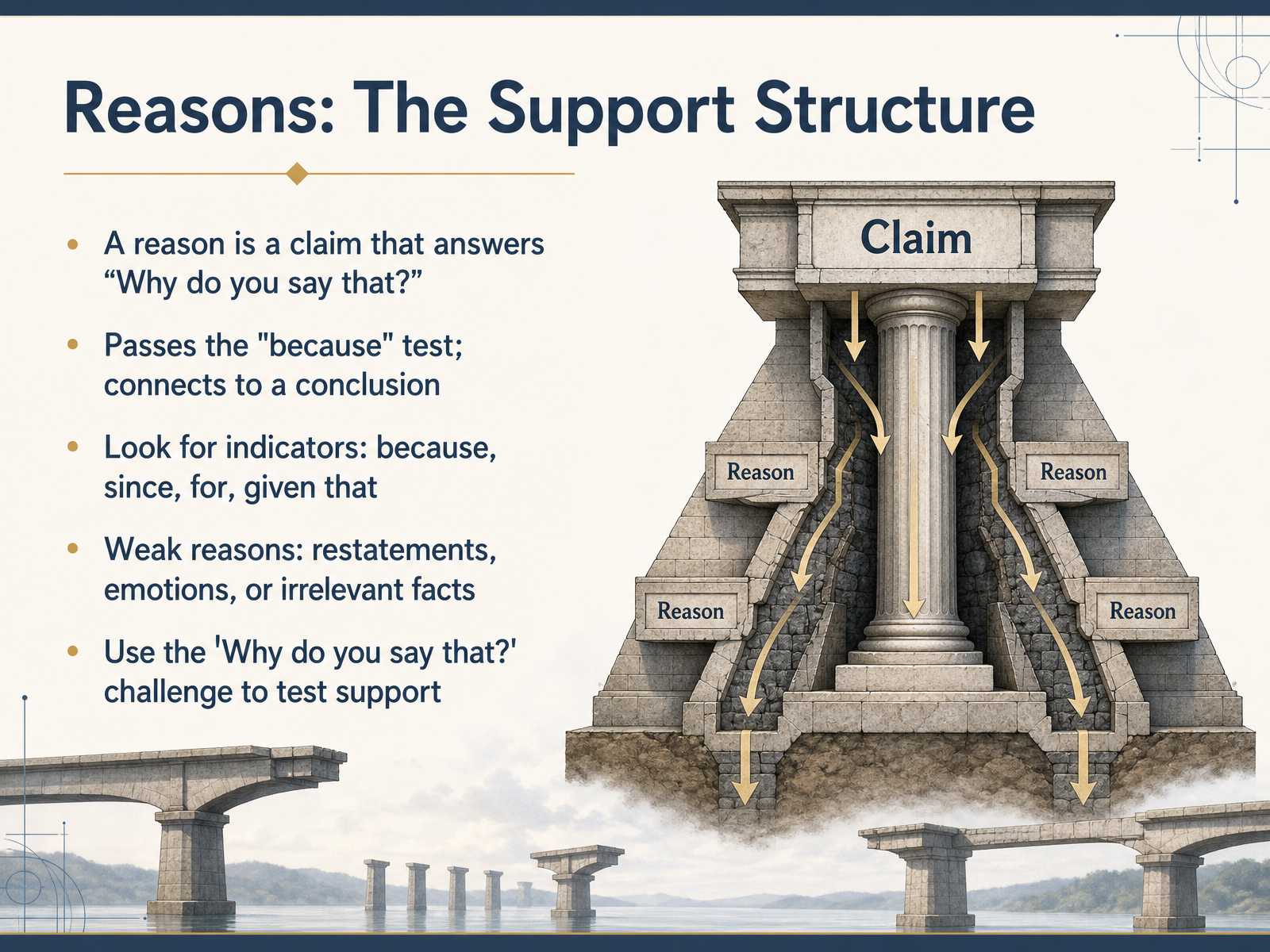
 - 04Reasons: The Support StructureNow that we’ve looked at claims and questions, let’s build the support structure. A reason is simply a claim that answers the question, “Why do you say that?”. Think of it like this: if your friend says, “This chair is broken,” you’d naturally ask, “Why do you say that?”. If they reply, “Because the leg wobbles when you sit down,” that’s a reason. A good reason passes the ‘because’ test—it connects directly to the claim it’s trying to support. In conversations and texts, you can spot reasons by listening for indicator words like because, since, for, or given that. But be careful: not everything that sounds like a reason actually provides support. Repeating the claim in different words is not a reason—saying “It’s broken because it’s damaged” just circles back. Strong emotions or totally irrelevant facts also fail as reasons. To test whether something is a real reason, just use the ‘Why do you say that?’ challenge. If the answer gives you a logical link between the claim and some evidence, you’ve found the support structure. Next, let’s practice separating questions, claims, and reasons together.
 sfu.caiu.pressbooks.pubopen.muhlenberg.pub+22 min
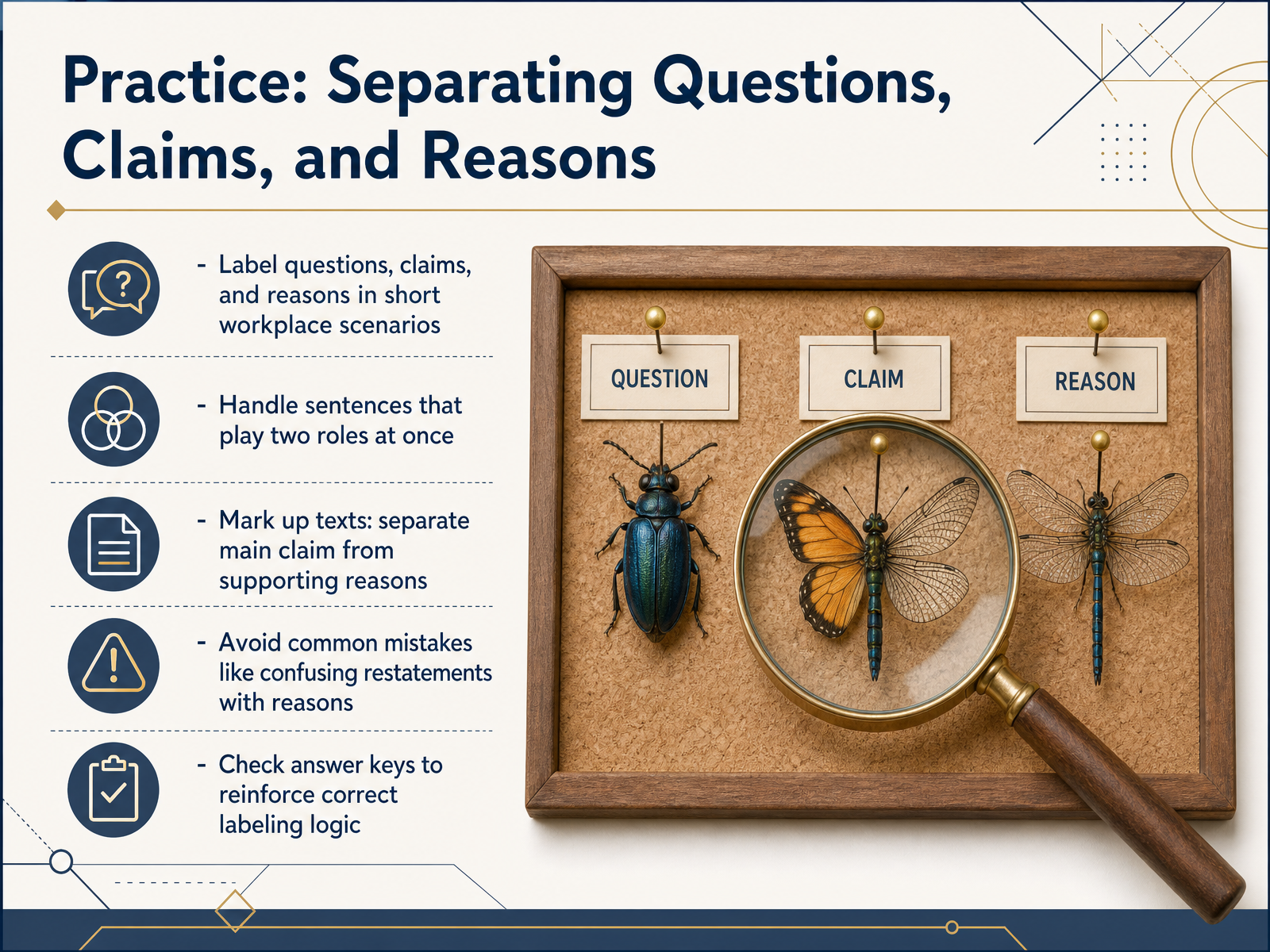
 - 05Practice: Separating Questions, Claims, and ReasonsNow we get to put these ideas to work. This practice session is about separating questions, claims, and reasons in real workplace scenarios. Think of it like sorting mail—each sentence has a different job. A question opens an inquiry, like asking, 'Should we extend the project deadline?' A claim makes an assertion that could be debated, such as, 'The current timeline is too tight.' A reason gives the because behind a claim: 'The client added three new features this week.' Sometimes a single sentence can play two roles at once, so stay alert for that. You will also mark up short texts, pulling the main claim apart from its supporting reasons. A common mistake is confusing a restatement with a real reason. Saying 'The timeline is too tight because we don't have enough time' just repeats the claim in different words—that is not a reason. After you complete each exercise, check the answer key carefully. It is not just about getting it right; it reinforces the logic of why each label fits. Let's move on to the next idea: counterexamples, which test a claim by finding exceptions.
 pz.harvard.eduscience.thinkport.orgscience.thinkport.org+22 min
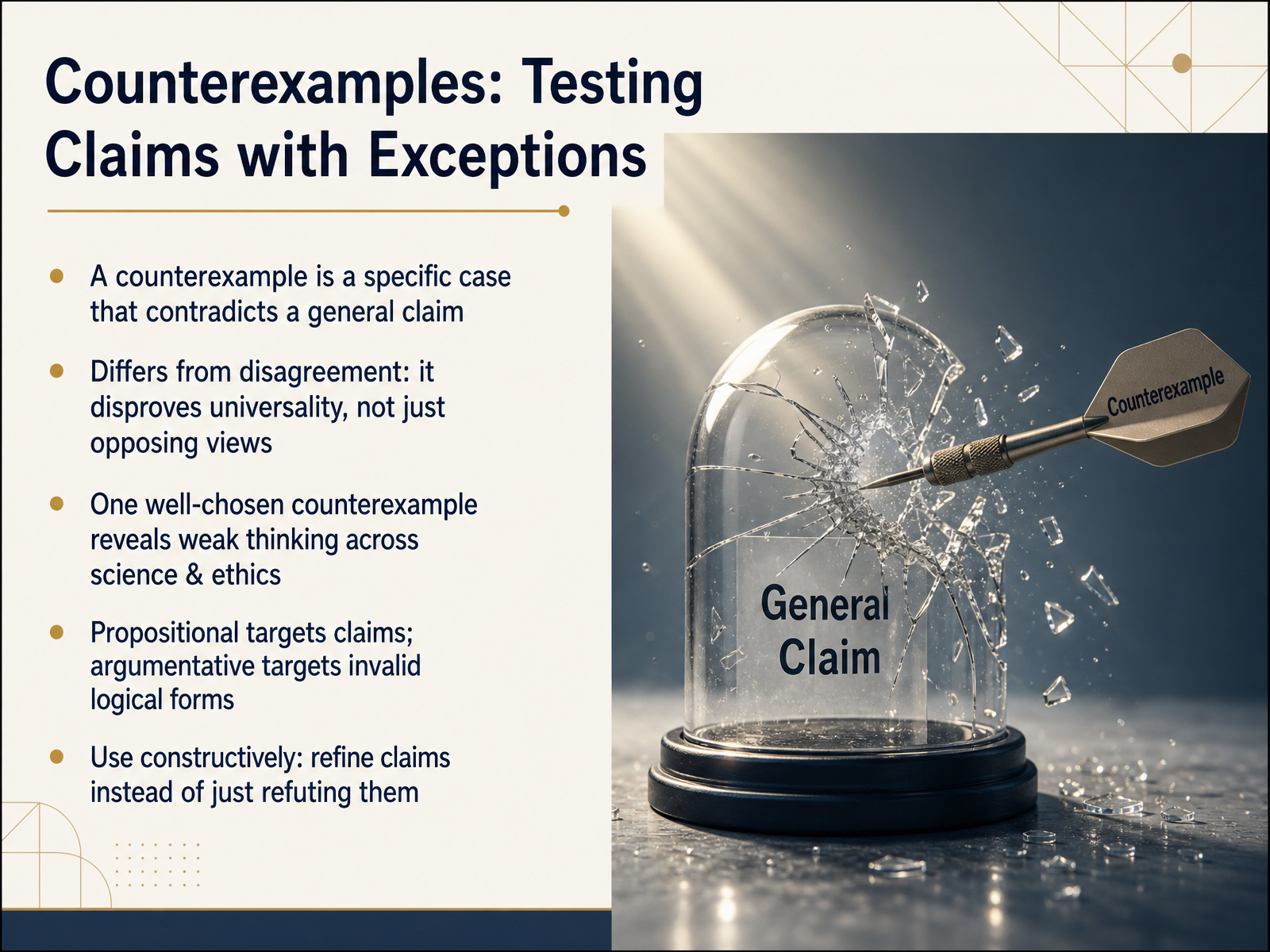
 - 06Counterexamples: Testing Claims with ExceptionsNow let's look at one of the most powerful tools in philosophy: the counterexample. A counterexample is simply a specific case that contradicts a general claim. Think of the statement, 'All birds can fly.' A penguin is a bird, but it cannot fly. That single penguin disproves the universal claim. Notice that a counterexample is different from just disagreeing. If I say 'I don't think all birds can fly,' that is an opinion. But pointing to a penguin is evidence that logically demolishes the claim. A single, well-chosen counterexample can reveal weak thinking, not just in science, but in everyday arguments too. For instance, if someone argues that people who commit crimes are bad, a counterexample might be a parent stealing bread to feed their family. That doesn't just oppose the view; it shows the generalization is too broad. The real art is using counterexamples constructively. Instead of just refuting someone, the goal is to help them refine their claim. Maybe it becomes, 'All birds can fly, except for flightless species.' This process strengthens ideas. Next, we'll explore how you can use counterexamples to strengthen your own arguments.
 en.wikipedia.orghuman.libretexts.orgguide.everydayphilosopher.org+22 min
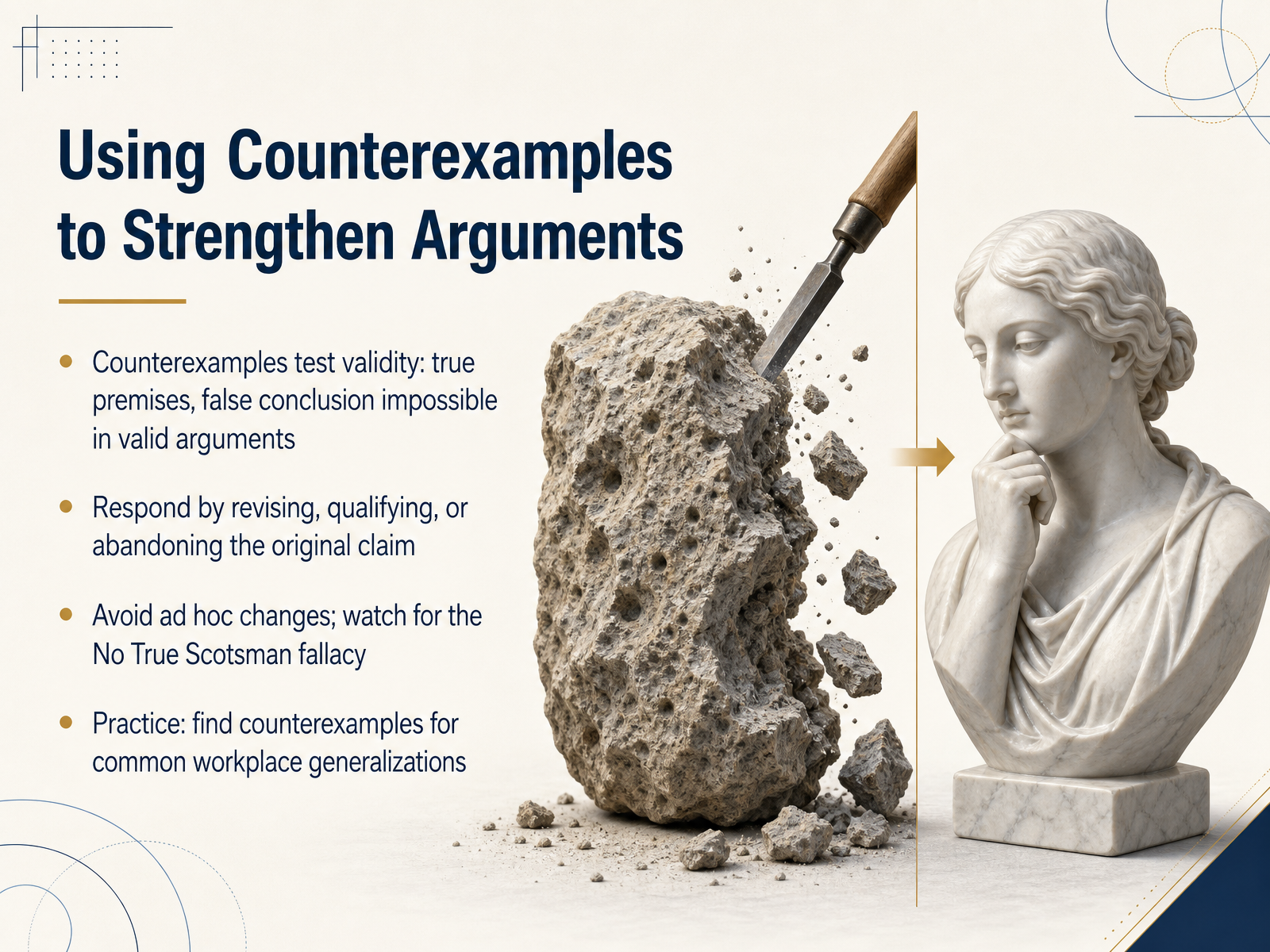
 - 07Using Counterexamples to Strengthen ArgumentsNow we turn to a tool that can seriously sharpen our reasoning: the counterexample. Think of a counterexample as a test for a claim. If someone says, "All swans are white," and you find a single black swan, that claim can't stand as it is. A counterexample is that specific instance that contradicts a general statement. In logical terms, a valid argument cannot have true premises and a false conclusion. So, if you can imagine a consistent scenario where the premises hold but the conclusion doesn't, you've found a counterexample, and you've shown the reasoning is flawed. When we face a counterexample, we have a few options. We can abandon our original claim, or we can revise and qualify it to handle the exception. But be careful here. When you change your claim, you must avoid what's called an 'ad hoc' fix, a revision made just to dodge the criticism with no good reason. This often shows up as the 'No True Scotsman' fallacy, where you simply redefine your terms to exclude the counterexample. Let's try a quick practice. Consider the workplace generalization, "Meetings are always a waste of time." Can you find a counterexample? Perhaps a brief meeting that solved a critical problem. That single case is enough to force a revision. Next, we will build on this by exploring how reasons lead to conclusions in the act of inference.
 en.wikipedia.orghuman.libretexts.orgguide.everydayphilosopher.org+22 min
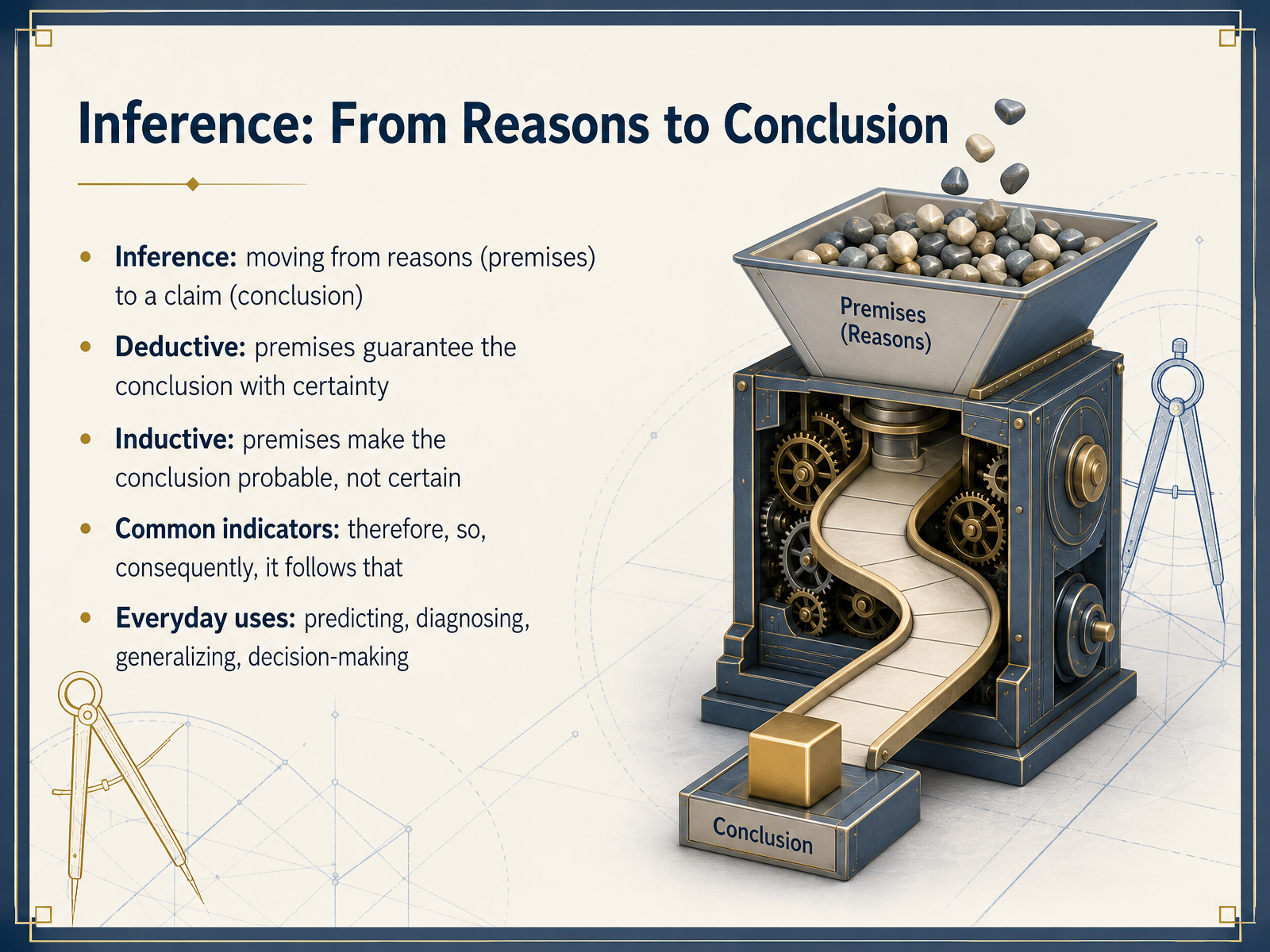
 - 08Inference: From Reasons to ConclusionSo far we have been talking about questions, claims, and reasons. Now let us see how those pieces move. An inference is the move itself—going from your reasons to your claim. Think of reasons as the premises, and the claim as the conclusion. The inference is the step that connects them. There are two main kinds of moves you can make. A deductive inference tries to guarantee the conclusion. If the premises are true, the conclusion must be true. For example: all smartphones have batteries; this object is a smartphone; therefore this object has a battery. There is no wiggle room. An inductive inference is different. It makes the conclusion probable, but not certain. Imagine your laptop will not turn on and you know the battery has not been charged all day. You infer the battery is dead. That is probably true, but it is still possible something else is wrong. You will often see words like 'therefore,' 'so,' 'consequently,' or 'it follows that' signalling an inference. And you use inference constantly: predicting tomorrow's weather, diagnosing why a friend is quiet, or deciding which route saves time. Each is a small reasoning step from what you know to what you conclude. Next, we will look more closely at those two types of moves in deductive and inductive arguments.
 2 min
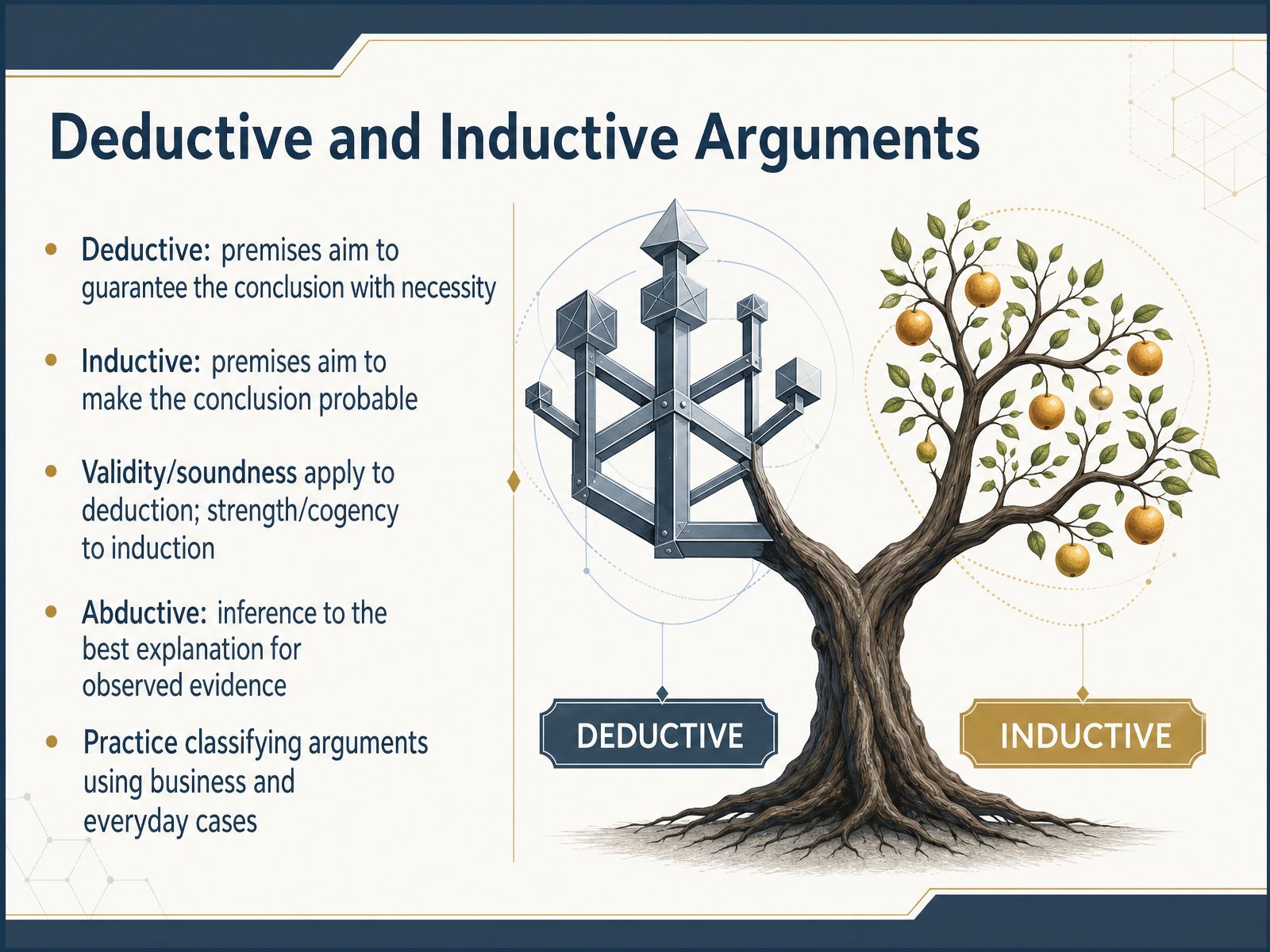
2 min - 09Deductive and Inductive ArgumentsSo far, we have talked about claims, reasons, and inferences. Now let us look at the three main families of inference: deductive, inductive, and abductive. Think of them as three different ways to connect evidence to a conclusion. A deductive argument tries to guarantee the conclusion with necessity. Like a math proof: if all humans are mortal, and Socrates is human, then Socrates must be mortal. Here we evaluate validity and soundness. An inductive argument only makes the conclusion probable. Like noticing your phone has taken photos every day, so it will probably take one tomorrow. We measure its strength and cogency, not certainty. A third type is abductive reasoning, or inference to the best explanation. If your kitchen floor is wet in the morning, you might conclude the ice maker leaked again, because that best explains the evidence. Let’s practice quickly. If a manager says, 'Our best team leads all came from public universities, so our next hire should come from one too,' is that deductive or inductive? Pause and decide. That is inductive, because the past pattern only makes the future prospect likely, not guaranteed. Now imagine a compliance officer says, 'Every contract over fifty thousand dollars needs legal review. This contract is sixty thousand, so it requires review.' That is deductive. The conclusion follows necessarily from the rule. Recognizing these patterns helps you choose the right evaluation lens every time. Next, we will uncover something even trickier: hidden assumptions buried inside everyday arguments.
 2 min
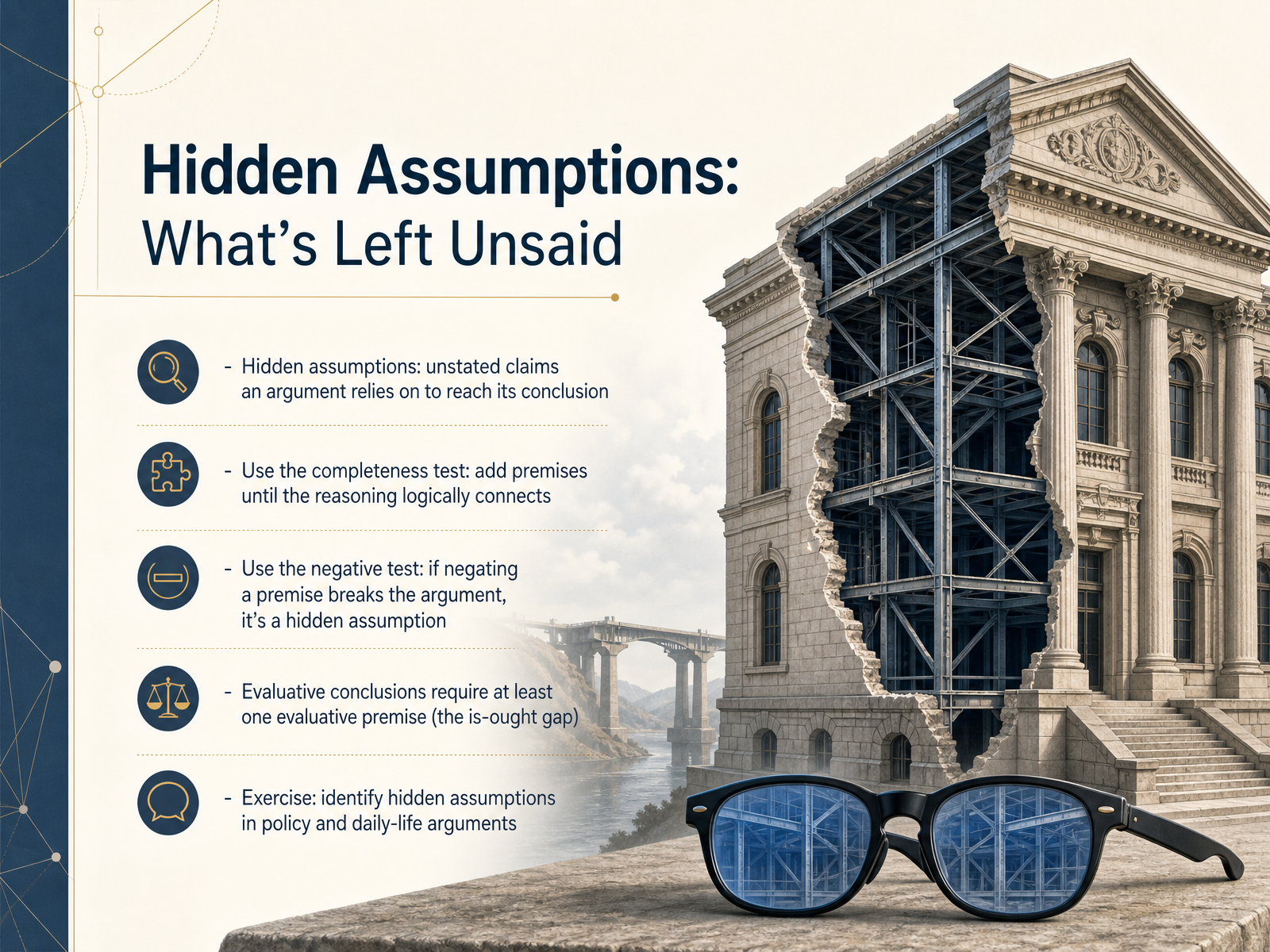
2 min - 10Hidden Assumptions: What's Left UnsaidNow we arrive at one of the most powerful tools in clear thinking: uncovering what’s left unsaid. These are hidden assumptions—unstated claims that an argument silently relies on to reach its conclusion. Think of them as invisible bridges. Without the bridge, the reason you’re given can’t actually carry you to the conclusion. For example, if someone says, ‘Cloning humans is wrong because it is unnatural,’ they’re silently assuming that anything unnatural is wrong. So how do we find these hidden bridges? We can use two simple tests. The first is the completeness test. You look at an argument and ask, ‘What extra thought would make this reasoning fully connect?’ Keep adding a reasonable premise until the logic flows. The second is the negative test. You take that new premise, flip it around, and ask, ‘If this flipped premise were true, would the argument collapse?’ If the answer is yes, you’ve found a hidden assumption. There is also a special rule to remember, often called the is-ought gap. If an argument ends with an evaluative conclusion—a claim about what we should do—it must contain at least one evaluative premise. You cannot jump from a pure fact, an ‘is,’ to a value judgment, an ‘ought,’ without a bridging value. Now, try this yourself. The next time you hear a policy debate or even a simple daily-life complaint, pause and ask: what must the speaker believe is true for their final point to make sense?
 2 min
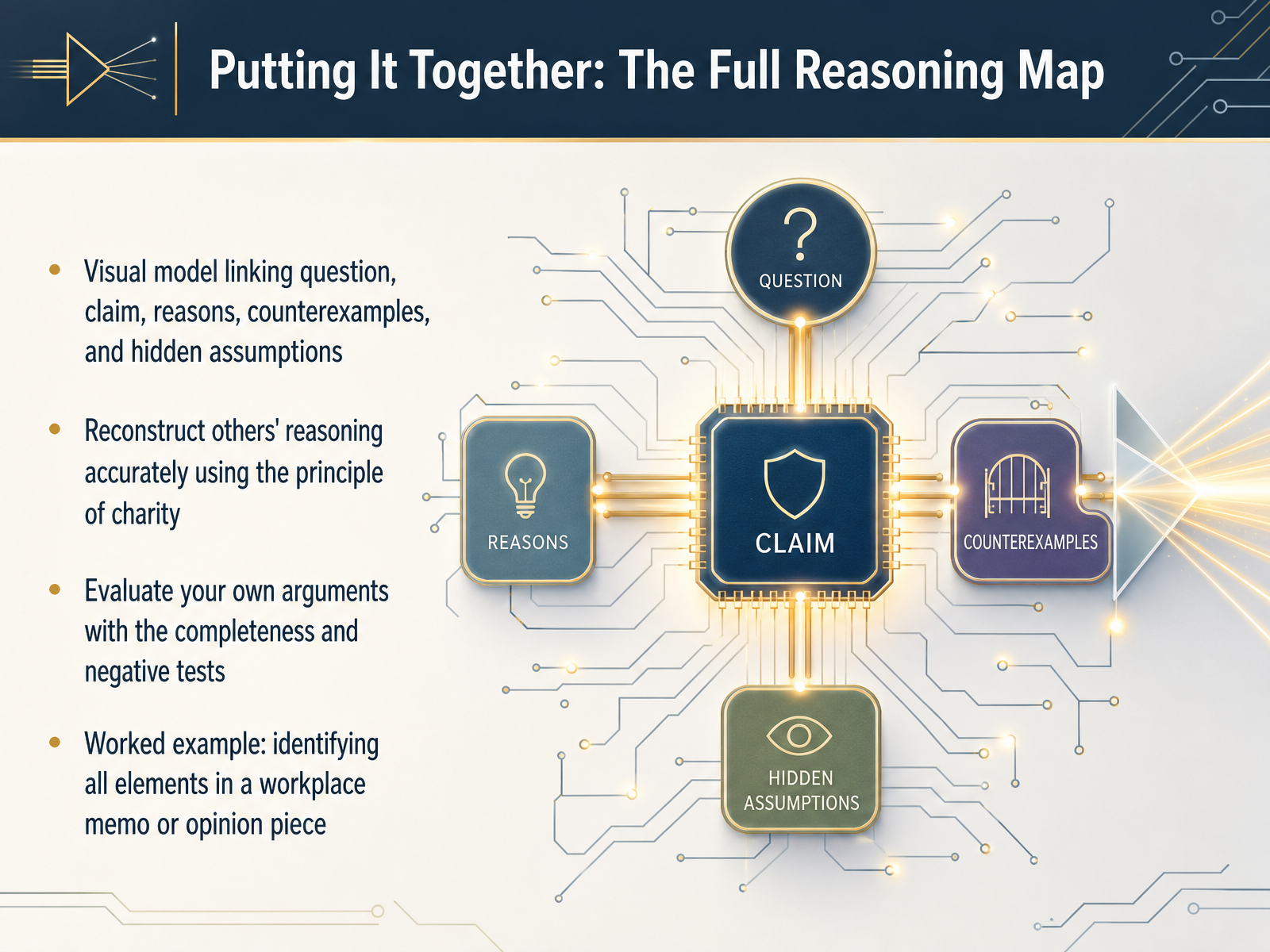
2 min - 11Putting It Together: The Full Reasoning MapNow, let's put all these pieces together into one complete reasoning map. Think of it like a detective's evidence board. You start with a central question, something you're curious or uncertain about. From there, you identify the main claim being made—the answer someone is proposing. That claim is supported by reasons, which are like the pillars holding it up. But here’s the clever part: you don't stop there. You actively search for hidden assumptions, those unspoken beliefs that must be true for the reasons to actually support the claim. Then, you test the whole structure by looking for counterexamples. Could the reasons be true, but the claim still be false? If so, you've found a weakness. When you're evaluating your own arguments, apply the completeness test by asking if anything is missing, and the negative test by imagining what would happen if an assumption were removed. All of this helps you reconstruct others' arguments fairly, using the principle of charity to make their reasoning as strong as possible. Let's look ahead now at common pitfalls and how to avoid them.
 sfu.caiu.pressbooks.pubopen.muhlenberg.pub+22 min
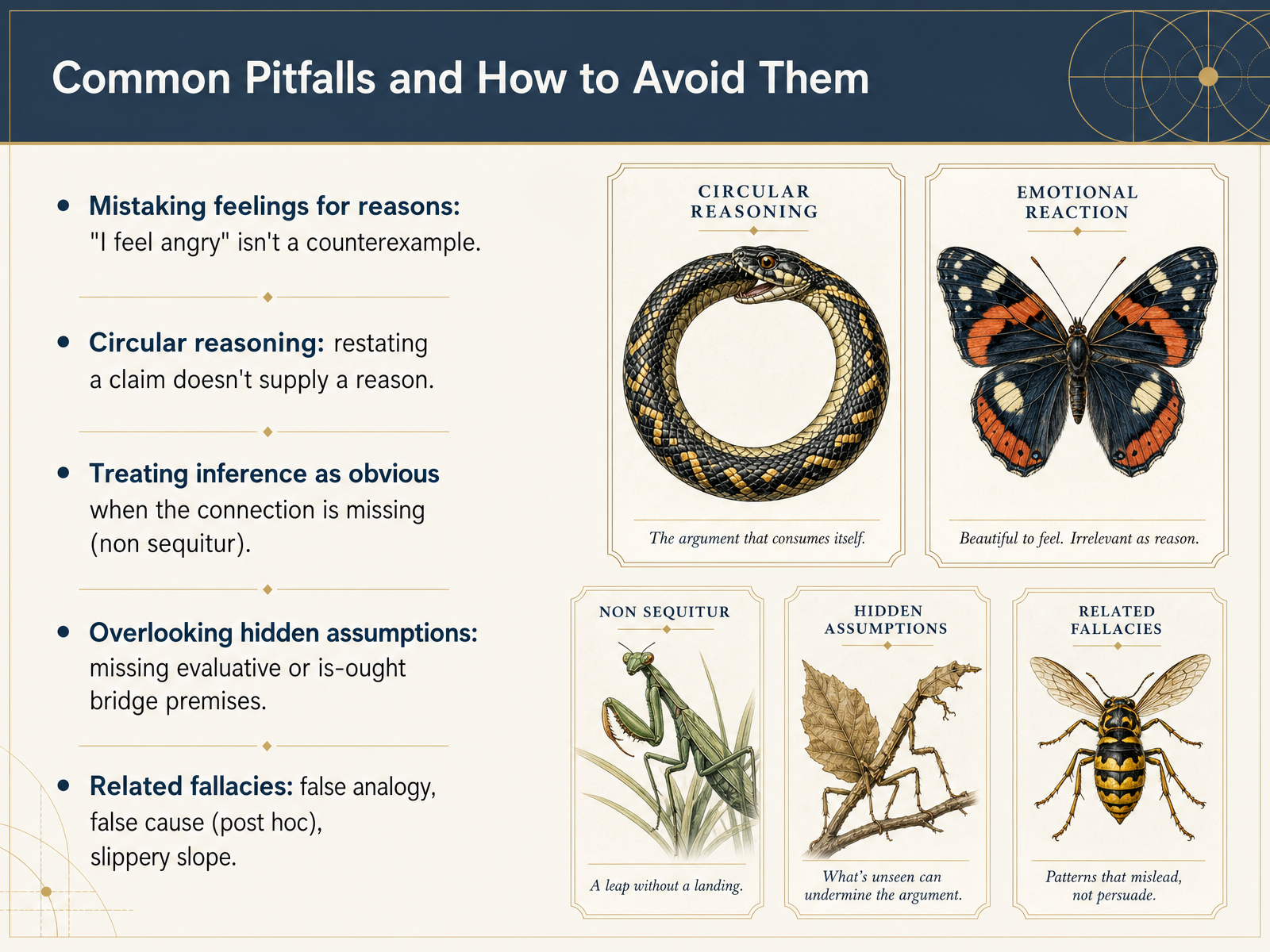
 - 12Common Pitfalls and How to Avoid ThemReasoning carefully also means knowing what to watch out for. Let's talk about the most common pitfalls, so you can spot them before they trip you up. First, mistaking feelings for reasons. Saying 'I feel angry' describes an emotion. It isn't a counterexample that disproves a claim. A counterexample needs to be a factual scenario, not just a personal reaction. Next, circular reasoning. This happens when you simply restate your claim as if it were a reason. Saying 'This rule is unfair because it's unjust' gets us nowhere. The word changed, but the meaning didn't. Another subtle error is the non sequitur, which is Latin for 'it does not follow.' You might hear, 'She's the fastest runner, so she'll be a great team captain.' The connection between speed and leadership is missing. We also need to be careful about hidden assumptions. Often, arguments make a leap from a fact, an 'is,' to a value judgment, an 'ought,' without providing the bridge. For example, 'Cloning is unnatural, therefore it is wrong.' This assumes that everything unnatural is wrong, which is a pretty shaky bridge when you think about sunglasses or surgery. Finally, keep an eye out for a few classic fallacies: comparing two things that aren't truly alike, assuming one event caused another just because it happened first, or predicting an extreme chain reaction from a tiny first step. Catching these patterns makes your own reasoning sharper. Now that you can spot these traps, let's apply the whole framework in real contexts on the next slide.
 2 min
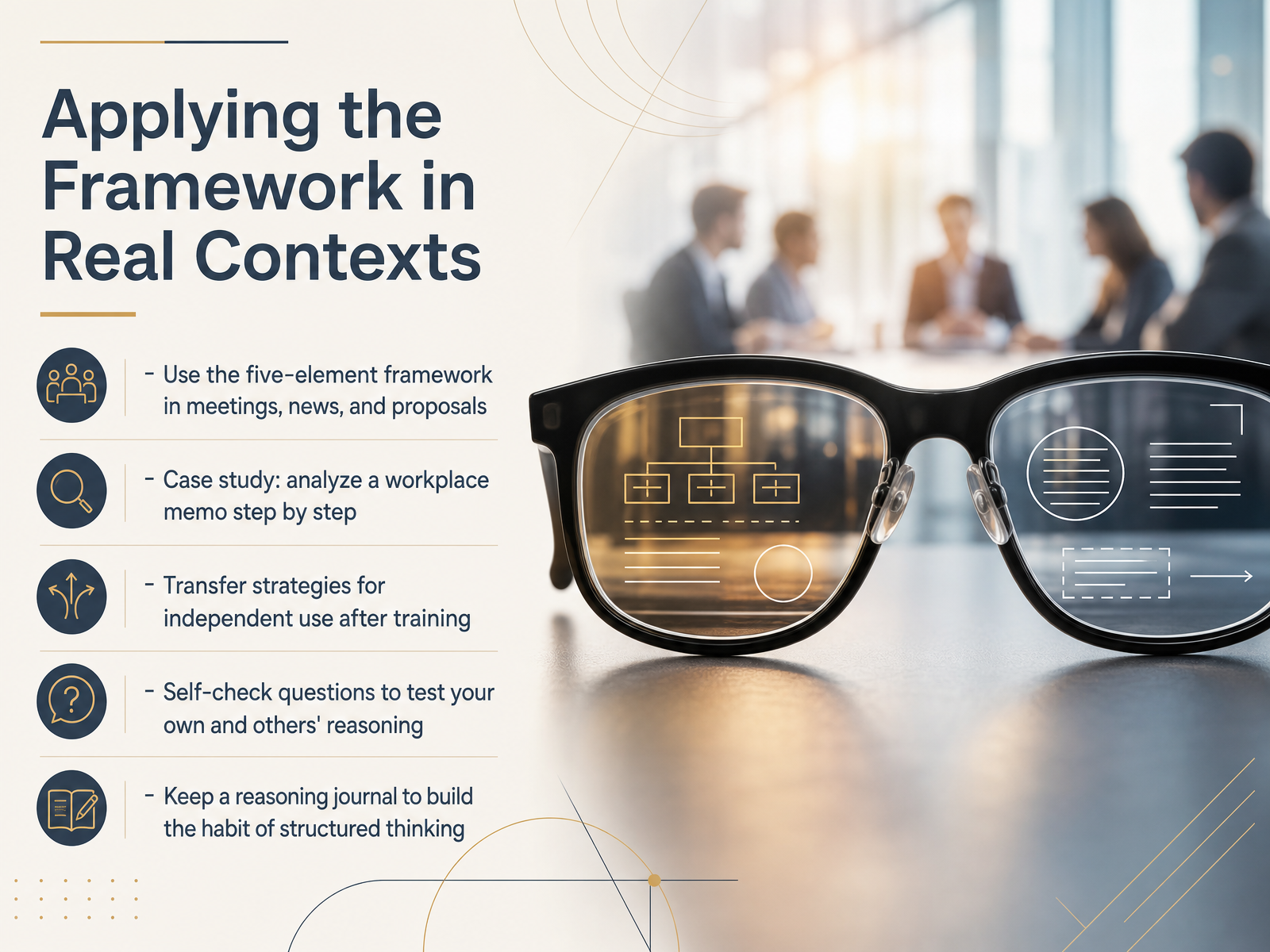
2 min - 13Applying the Framework in Real ContextsSo, how do we take this five-element framework and actually use it outside this course? Think of it as a portable toolkit. In your next meeting, when you hear a proposal, pause and silently ask: what is the main claim here? What reasons are given to support it? And what’s a counterexample that might shake things up? Let’s practice on a workplace memo. Maybe it claims that switching to a four-day work week will boost morale. The reason might be a cited survey. Your job is to spot any hidden assumptions. For example, does the survey sample match your company’s culture? To build the habit after today, try keeping a reasoning journal. Once a day, write down one argument you heard, break it into claim, reasons, and ask one self-check question, like, 'Is this an inference that must be true, or just probably true?' This active reflection turns a once-off lesson into a lasting skill.
 pz.harvard.eduscience.thinkport.orgscience.thinkport.org+22 min
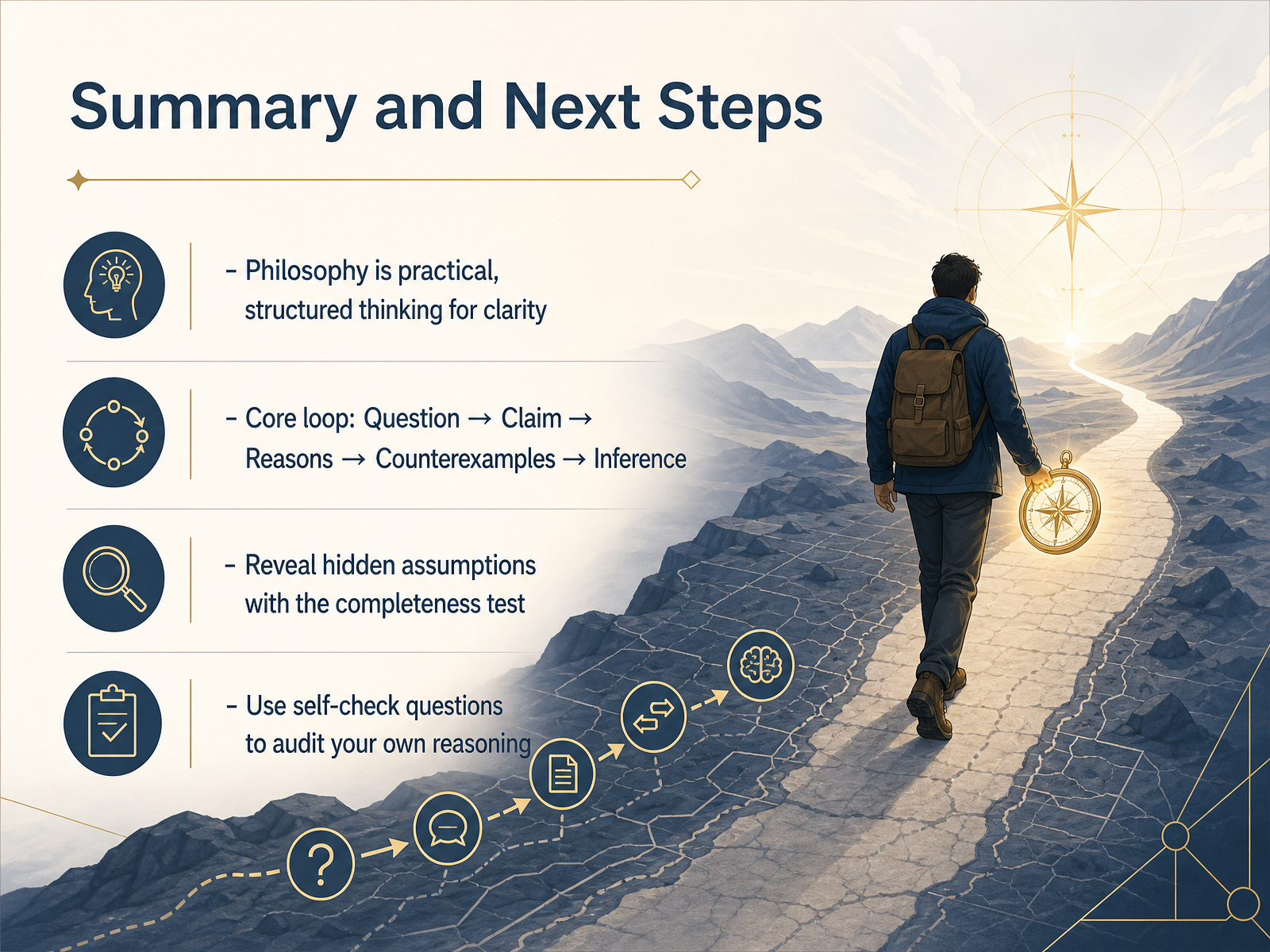
 - 14Summary and Next StepsWe've reached the end of this introduction, so let's put the pieces together. Philosophy isn't just about old books. It's a practical, structured way of thinking that brings clarity to messy problems. The core loop we've practiced is this. You start with a genuine question. From there, you form a claim, something you think is true. Then you support it with reasons that answer the question why. You stress-test those reasons by hunting for counterexamples, specific cases where your reasons hold but the claim falls apart. Based on this back-and-forth, you draw a conclusion, which is the inference. Along the way, we also learned to use the completeness test to reveal hidden assumptions. Think of it as asking yourself what else must be true for this to make sense. Finally, a practical habit for the future. Use self-check questions to audit your own reasoning. Ask yourself, is my claim clear? Are my reasons relevant? What would a good counterexample look like? Thank you for working through these ideas. The real skill is pausing to run this loop in everyday life. Keep questioning and keep reasoning clearly.
 sfu.caiu.pressbooks.pubopen.muhlenberg.pub+22 min
Take the deck with you
Download this course as a file — free, no sign-up needed.
- PDF handoutEvery slide page, ready to print or share.15 pages · 4.3 MBDownload
- Narrated PowerPointThe deck that presents itself — every slide carries the digital human's narration video.15 pages · 15.4 MBDownload
- PowerPoint slidesThe full deck as a .pptx — open it in PowerPoint, Keynote, or Google Slides.15 pages · 4.2 MBDownload
Free to use in your own training — please keep the PersonWise credit page at the end.
Have your own deck? Turn it into a course
Sources consulted
Web sources consulted while building this course.
- Two kinds of open and closed question — jps.bham.ac.uk
- Philosophy for Children and the Incidence of Teachers’ Questions on the Mobilization of Dialogical Critical Thinking in Pupils — doi.org
- (2017) Questioning the Question Or How To Cultivate Philosophical Questioning — academia.edu
- If it, anchor it, open it up: a closed, guided questioning technique — academia.edu
- https://www.philosophy-foundation.org/asset/download/643 — philosophy-foundation.org
- C H A P T E R 2 Claims, Issues, and Arguments — sfu.ca
- Arguments II: Argument Structure; Arguments vs. Explanations – Phil-P102 Critical Thinking and Applied Ethics — iu.pressbooks.pub
- Analysis, Standardization, and Diagramming – Arguments in Context — open.muhlenberg.pub
- Argument: Claims, Reasons, Evidence - Communication — comm.pitt.edu
- Chapter 2 Arguments | Pursuing Truth: A Guide to Critical Thinking — bookdown.org
- Claim, Support, Question — pz.harvard.edu
- Writing Explanation I: Claims, Evidence, Reasoning — science.thinkport.org
- Writing Explanation Part 1: Claims, Evidence and Reasoning | Try It — science.thinkport.org
- Practice Exercises: Chapter 1 – How to Think For Yourself: A Practical Guide to Critical Thinking — openwa.pressbooks.pub
- Developing Critical Reading Skills | Exercise 1: Identifying Claims and Arguments — highered.mheducation.com
- Counterexample — en.wikipedia.org
- 2.6: Method of Conterexample — human.libretexts.org
- Counterexample | The Everyday Philosopher's Guide — guide.everydayphilosopher.org
- Counterexample Definition for Intro to Philosophy | Fiveable — fiveable.me
- Counterexamples — skillfulreasoning.com