Begin
14 pages · ~28 min
Phrasal Verbs for Work and Projects
This training teaches professionals to use phrasal verbs for effective workplace and project communication.
A digital instructor presents all 14 pages. Hold “Ask” at any point and ask out loud — the answer comes from this course. No sign-up needed.
What you’ll learn
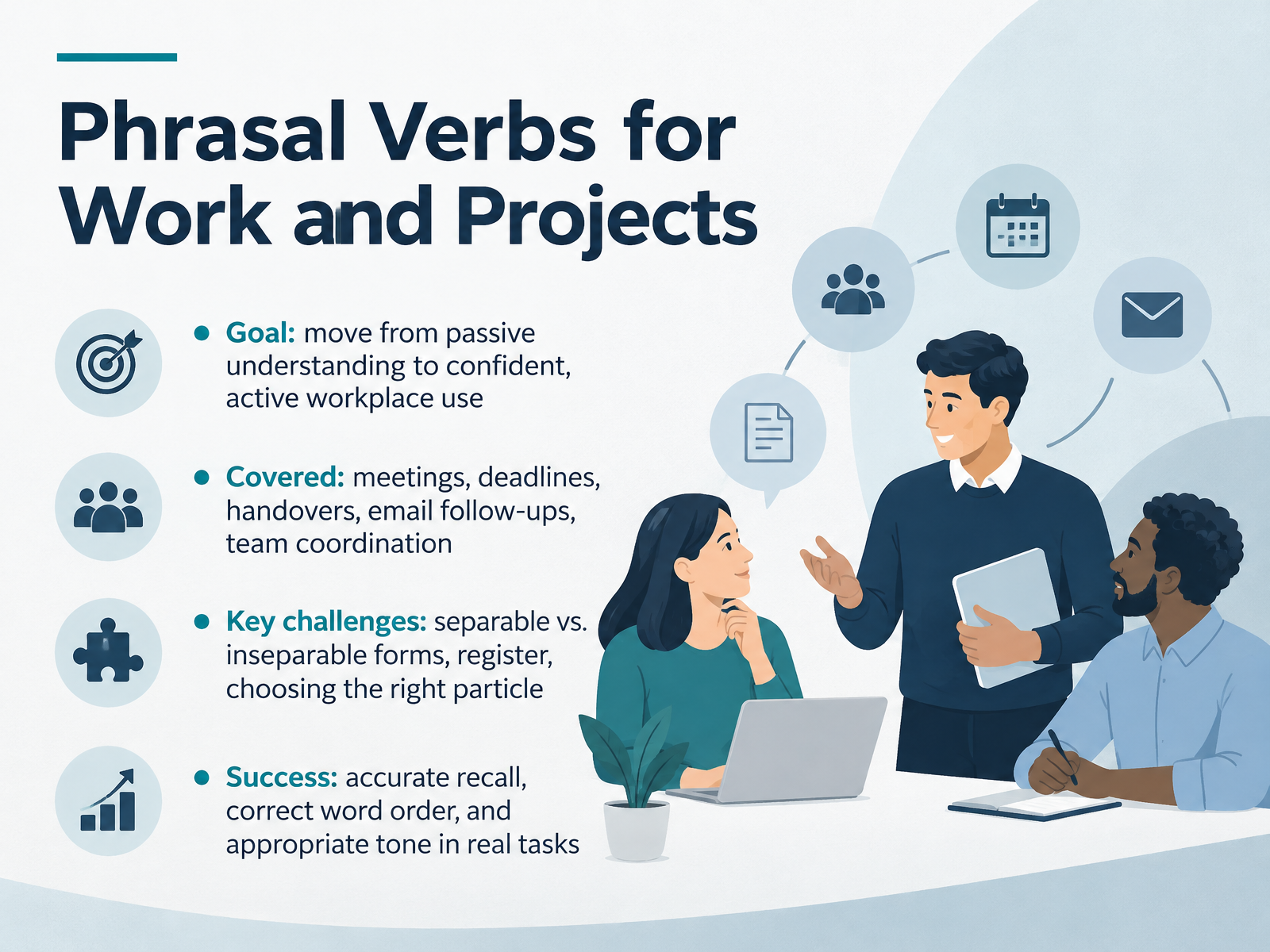
- 01Phrasal Verbs for Work and ProjectsWelcome. I'm glad you're here. This course is about phrasal verbs for work and projects. You already understand most of them, so we won't spend time on definitions. Our goal is different. We want you to move from passive understanding to confident, active use. In the slides ahead, we'll cover real situations: meetings, deadlines, handovers, email follow-ups, and team coordination. We'll also look at three common challenges. Separable and inseparable forms. Register, meaning whether a phrase sounds right in the room. And choosing the right particle. Here's how we'll measure success. Accurate recall, correct word order, and an appropriate tone in real tasks. Expect a few mistakes along the way. That's a normal part of practice, and it's how this vocabulary becomes yours. Let's begin by looking at why phrasal verbs matter at work.realbusinessenglish.comverbpal.comspeakconfidentenglish.com+21 min
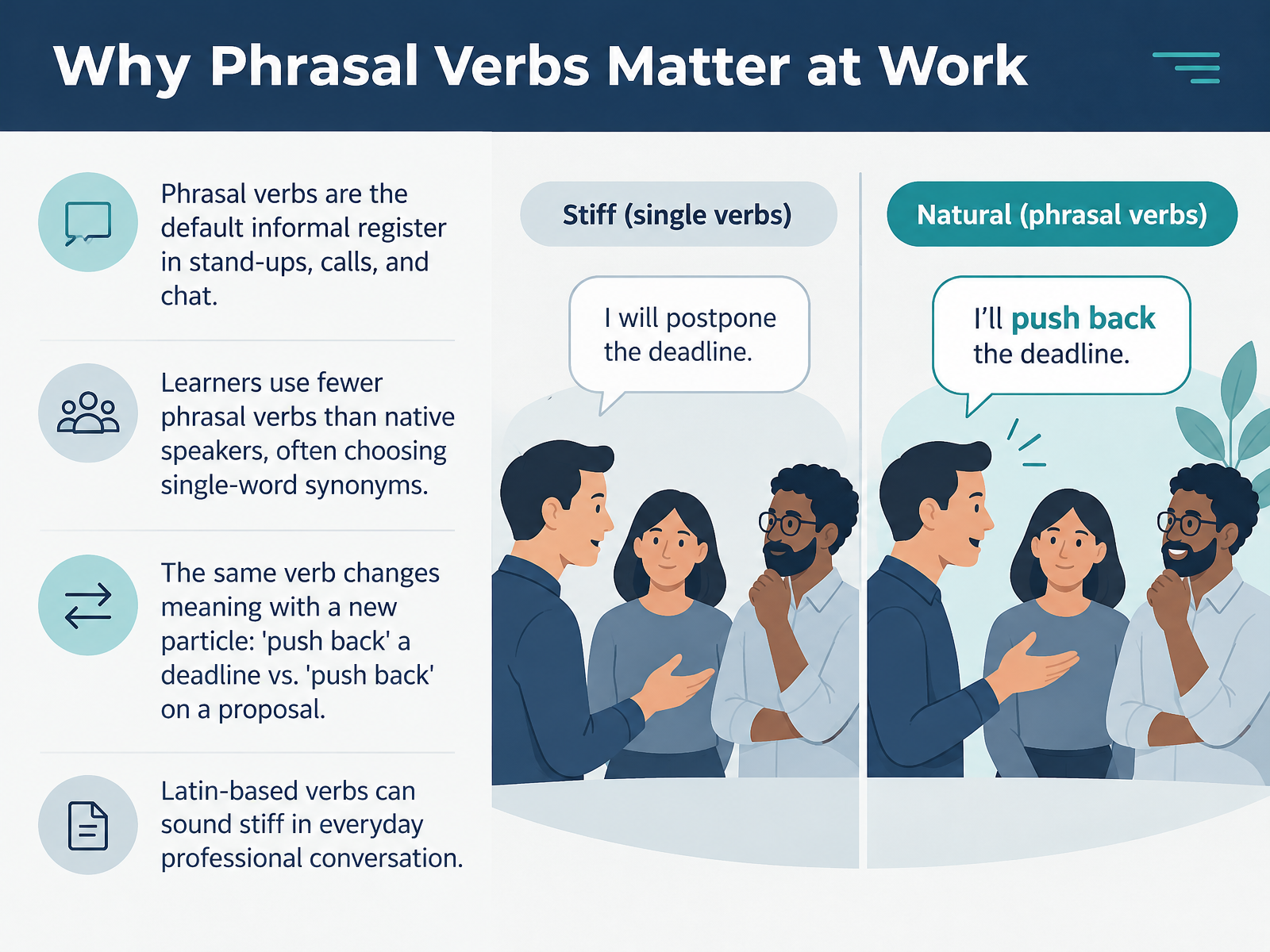
- 02Why Phrasal Verbs Matter at WorkLet's start with why this matters. In stand-ups, calls, and chat, phrasal verbs are the default informal register. They're what your colleagues actually reach for. If you only use single-word synonyms, your English can sound stiff, even when it's correct. Research on learner speech shows that non-native speakers use fewer phrasal verbs than native speakers, often choosing one formal word instead. So let's push your active use a little. Here's a good example of why the particle matters. 'We pushed back the deadline' means we moved it later. But 'we pushed back on the proposal' means we resisted it. Same verb, new particle, very different meaning. And one more thing. Latin-based verbs like 'postpone' or 'investigate' are fine in writing, but in everyday conversation they can sound formal and distant. Phrasal verbs keep you sounding natural and direct. Mistakes are part of practice, so don't wait for perfect. Now let's look at the set of phrasal verbs you'll use most: Your Core Starter Set.
 doi.orgdoi.orgsciencedirect.com+21 min
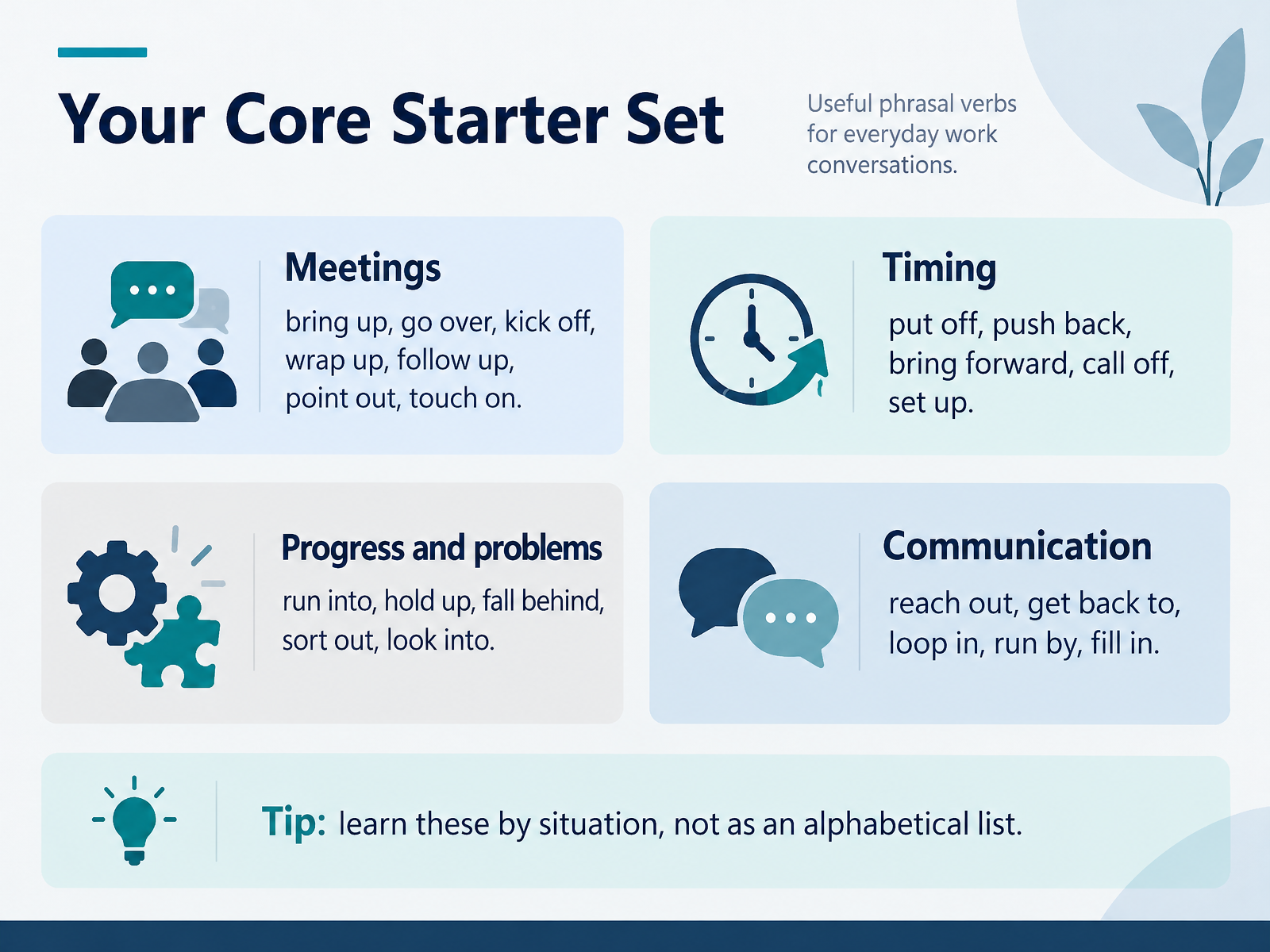
- 03Your Core Starter SetHere is your core starter set. These are the verbs you will hear most often, so treat them as your working vocabulary. In meetings, you might bring up a concern, go over the agenda, kick off the discussion, wrap up on time, and follow up by email. You can point out a risk, or touch on a topic briefly. For timing, notice how details change. You can put off a call, push back a deadline, bring a review forward, call something off, or set up a new meeting. When projects get difficult, say you ran into a problem, something is holding up the timeline, or you are falling behind. Then you will sort it out and look into the cause. For communication, reach out to a colleague, get back to them later, loop in a teammate, run an idea by your manager, or fill someone in on what they missed. So here is the tip. Learn these by situation, not as an alphabetical list. Choose one scenario, like a delayed project, and practise three verbs together. That is how they become active. Next, we look at word order in Separable versus Inseparable: Getting Word Order Right.
 realbusinessenglish.comverbpal.comspeakconfidentenglish.com+22 min
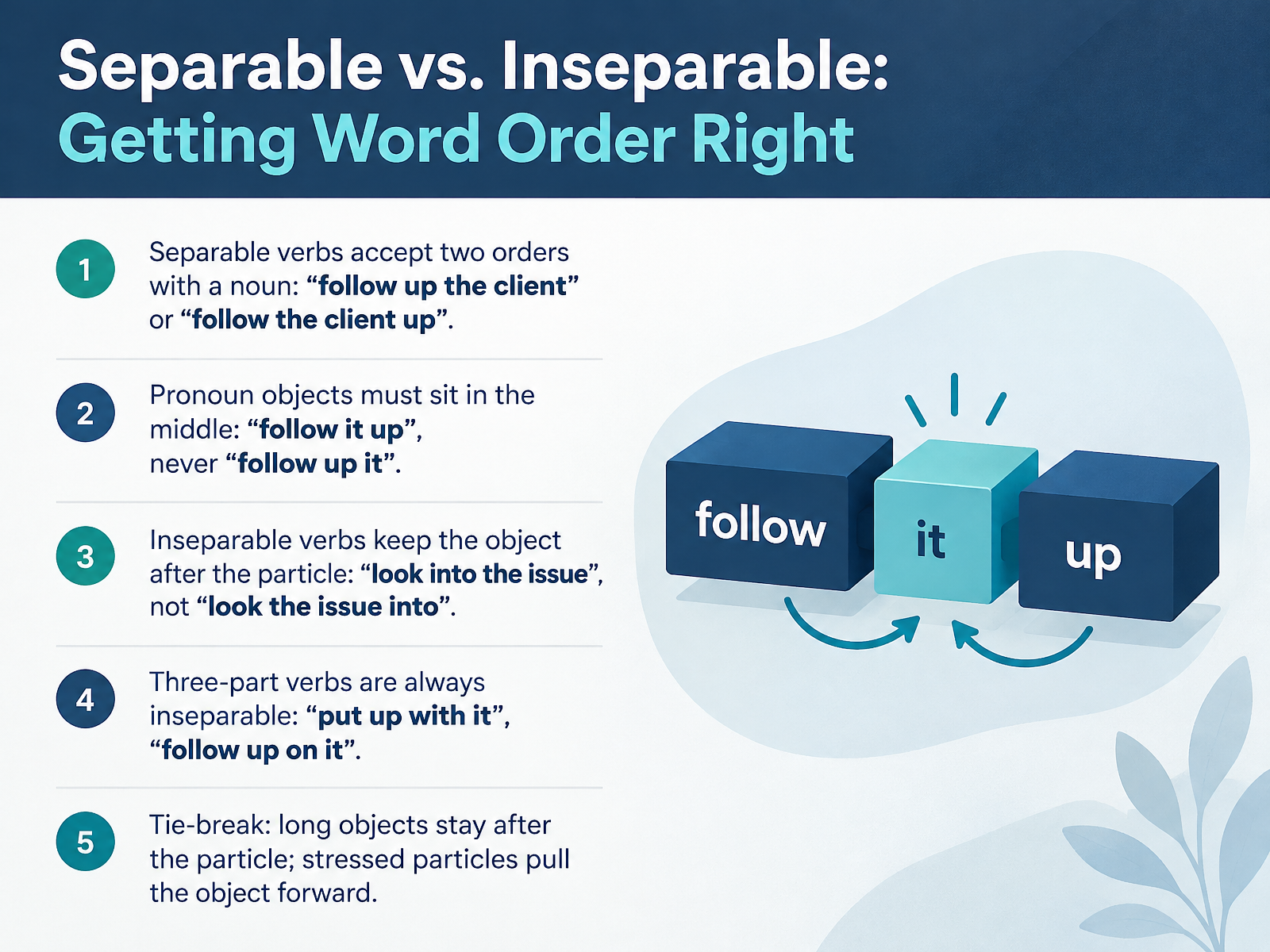
- 04Separable vs. Inseparable: Getting Word Order RightNow let's talk about word order. With separable verbs, you get two options with a noun. You can say, follow up the client. Or, follow the client up. Both work. But with a pronoun, there's only one correct order. The pronoun sits in the middle. Follow it up. Not follow up it. Now for inseparable verbs. Here the object always stays after the particle. So we say, look into the issue. Not, look the issue into. And three-part verbs are always inseparable. Put up with it. Follow up on it. So how do you decide? Keep long objects after the particle, and let a stressed particle pull the object forward. Next, let's look at a quick decision routine for word order.
 learnenglish.britishcouncil.orglearnenglish.britishcouncil.orgbbc.com+21 min
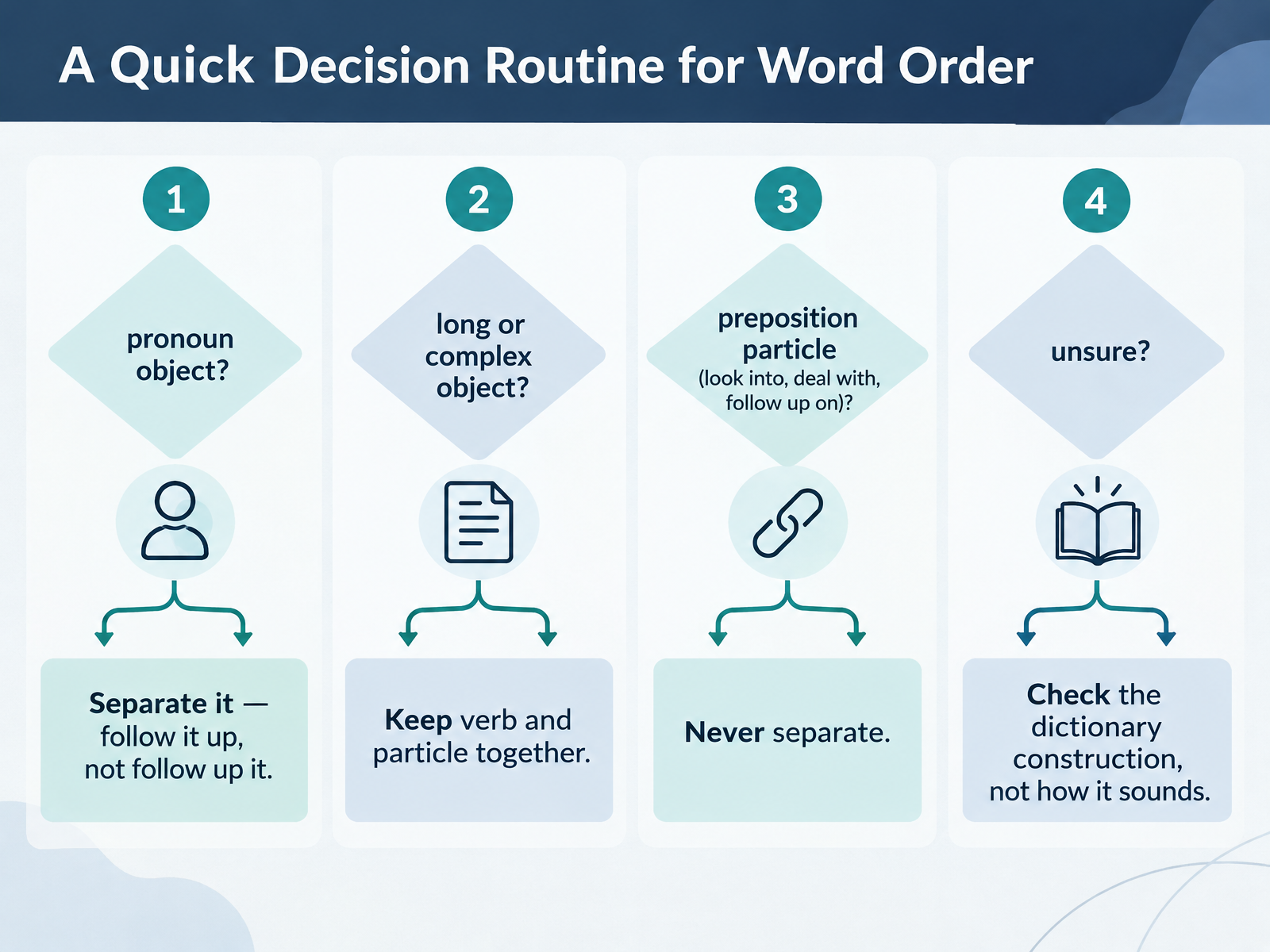
- 05A Quick Decision Routine for Word OrderLet's make word order practical with a quick decision routine you can run through in a few seconds. Step one. Is the object a pronoun? Then separate it. Say follow it up, not follow up it. Step two. Is the object long or complex? Keep the verb and particle together. Step three. Is the particle really a preposition, as in look into, deal with, or follow up on? Then never separate it. Step four. Still unsure? Check the dictionary construction, not how it sounds. Mistakes here are normal, so treat this as a routine to practise out loud. Try one now. Say follow it up, then follow up the client request. Next, we'll use these patterns in meetings and discussions.
 learnenglish.britishcouncil.orglearnenglish.britishcouncil.orgbbc.com+21 min
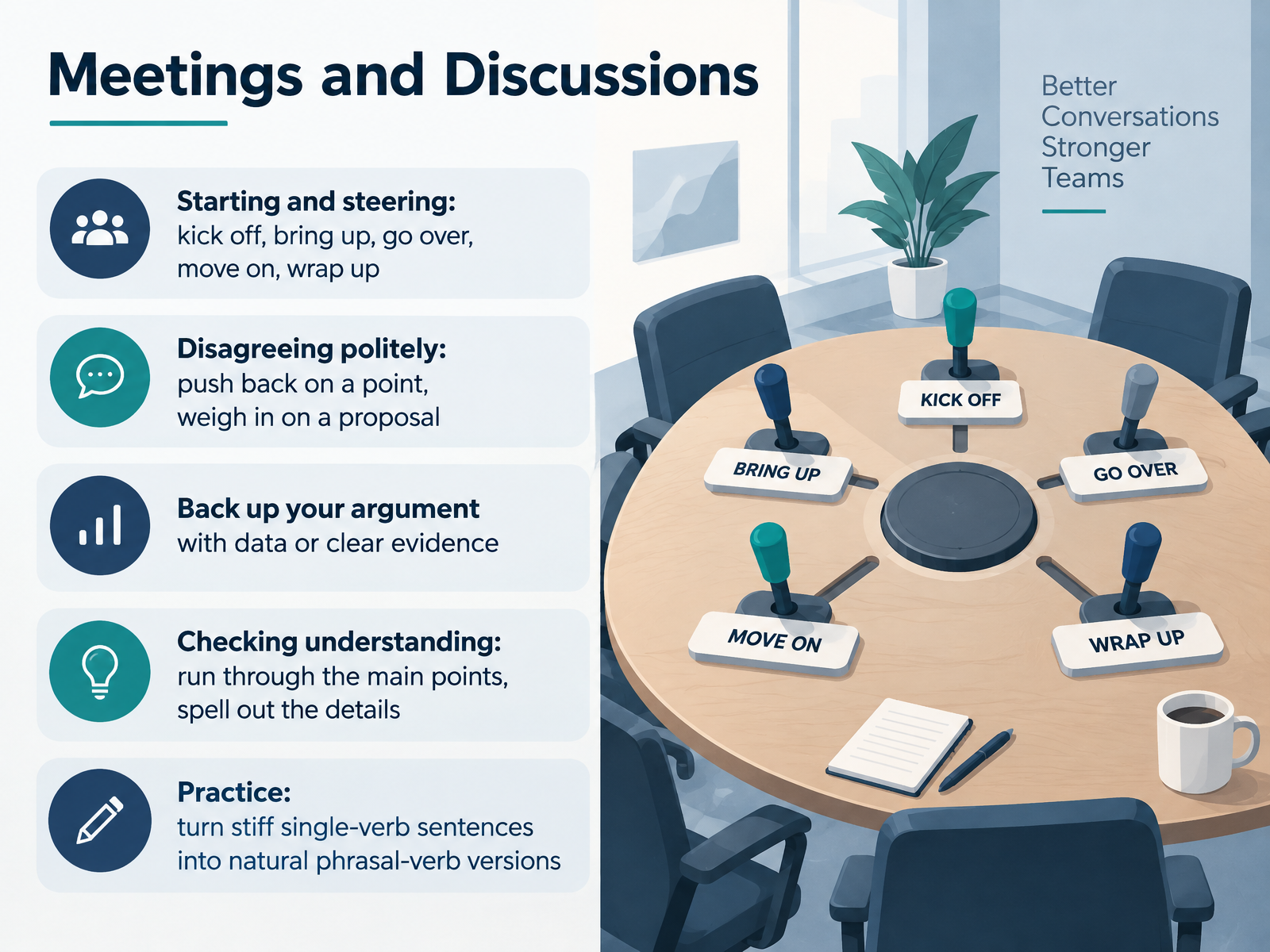
- 06Meetings and DiscussionsNow let's look at meetings and discussions. You already know these verbs, so today is about using them with confidence. First, steering a meeting. Kick off means start. "Let's kick off with the budget." Bring up means raise a topic. "I'd like to bring up the client feedback." Go over means review, and move on means continue to the next point. "Let's go over the numbers, then move on." And wrap up means finish. "Let's wrap up in five minutes." To disagree politely, push back on a point, or weigh in on a proposal. For example, "I'd like to push back on that timeline." "Can I weigh in on the proposal?" Always back up your argument with data. Now practice. Turn a stiff sentence into a natural one. Instead of "I want to mention a concern," say "I'd like to bring up a concern." Pause and try one yourself. Next, deadlines, tasks, and progress.
 realbusinessenglish.comverbpal.comspeakconfidentenglish.com+22 min
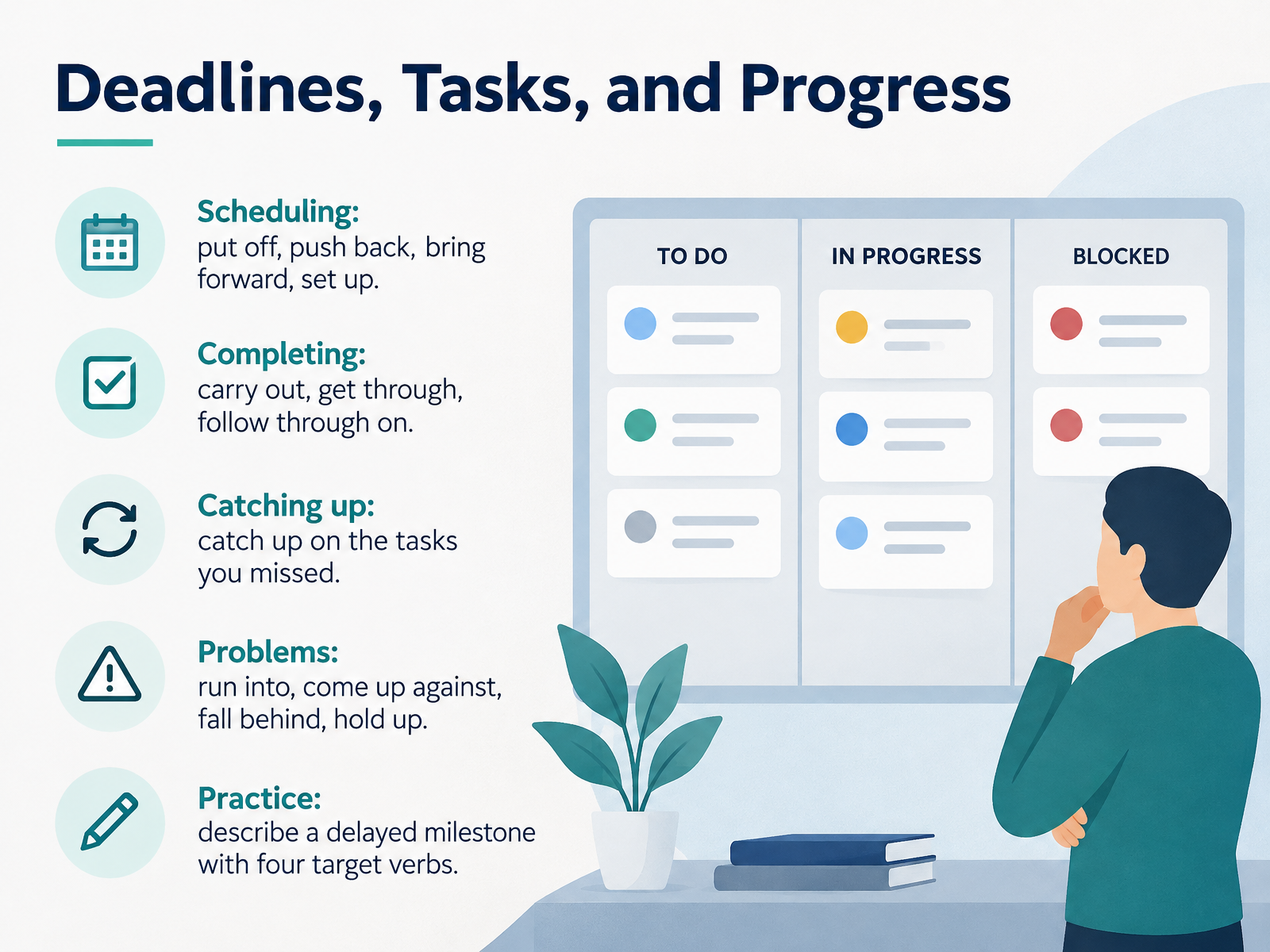
- 07Deadlines, Tasks, and ProgressLet's move on to deadlines, tasks, and progress. First, scheduling. If a meeting is delayed, we put it off or push it back. If it needs to happen sooner, we bring it forward. And when we arrange a new one, we set it up. For example: We pushed back the launch by two weeks because we ran into supplier issues.
Next, completing work. We carry out a task, get through a long to-do list, and follow through on our commitments. Good. Now, catching up. When you return from leave, you catch up on the tasks you missed.
For problems, you might run into an issue, come up against a constraint, fall behind schedule, or be held up by a missing approval. Notice the pattern. Run into and come up against introduce the problem. Fall behind and hold up describe the delay.
Now your turn. Think of a delayed milestone at work. In one or two sentences, describe it using four of these verbs. Say it out loud, or write it down if you prefer. Take a moment. Mistakes are fine here, they are part of practice.
Finally, when you talk about delays in writing, the same verbs work well in email and chat. Let's look at that next, in Email, Chat, and Handovers.
 realbusinessenglish.comverbpal.comspeakconfidentenglish.com+22 min
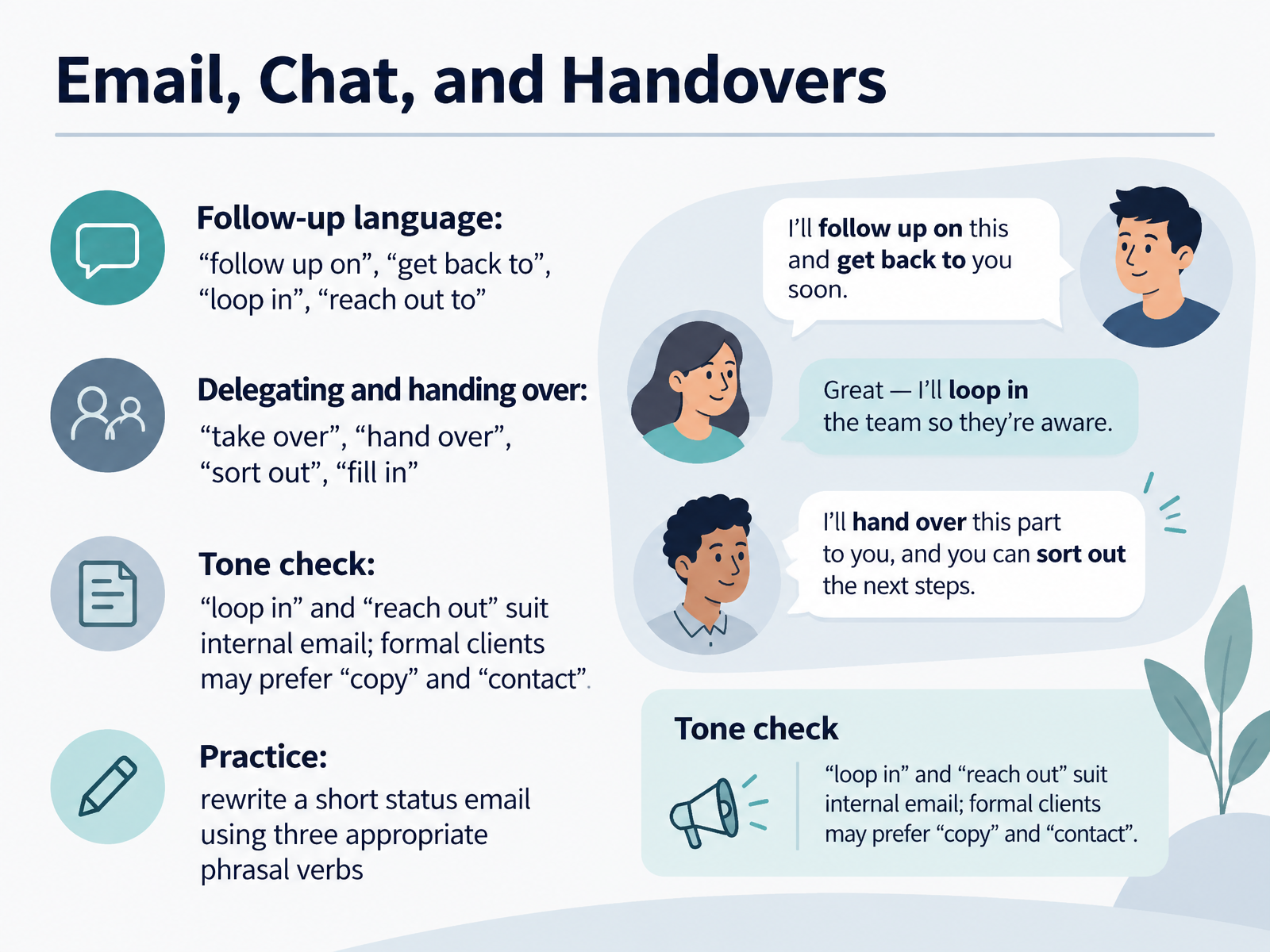
- 08Email, Chat, and HandoversNow let's look at email, chat, and handovers. Here are the follow-up phrases you'll use most. "I'll follow up on the invoice tomorrow." "I'll get back to you by Friday." "Let me loop in finance." "I'll reach out to the client." Try each one slowly. For handing work over, we have "take over," "hand over," "sort out," and "fill in." For example, "Sara will take over the report while I'm away, so hand over your notes by Thursday. Could you sort out the formatting, and fill me in on Monday?" One tone check. "Loop in" and "reach out" suit internal email. For formal clients, "copy" and "contact" often sound safer. Now a quick practice. Rewrite a short status email using three of these verbs. Pause and say one sentence aloud, or write it down, then move on. Next, we turn to problem-solving and teamwork.
 realbusinessenglish.comenglishwithbex.comenglishgrammar.org+21 min
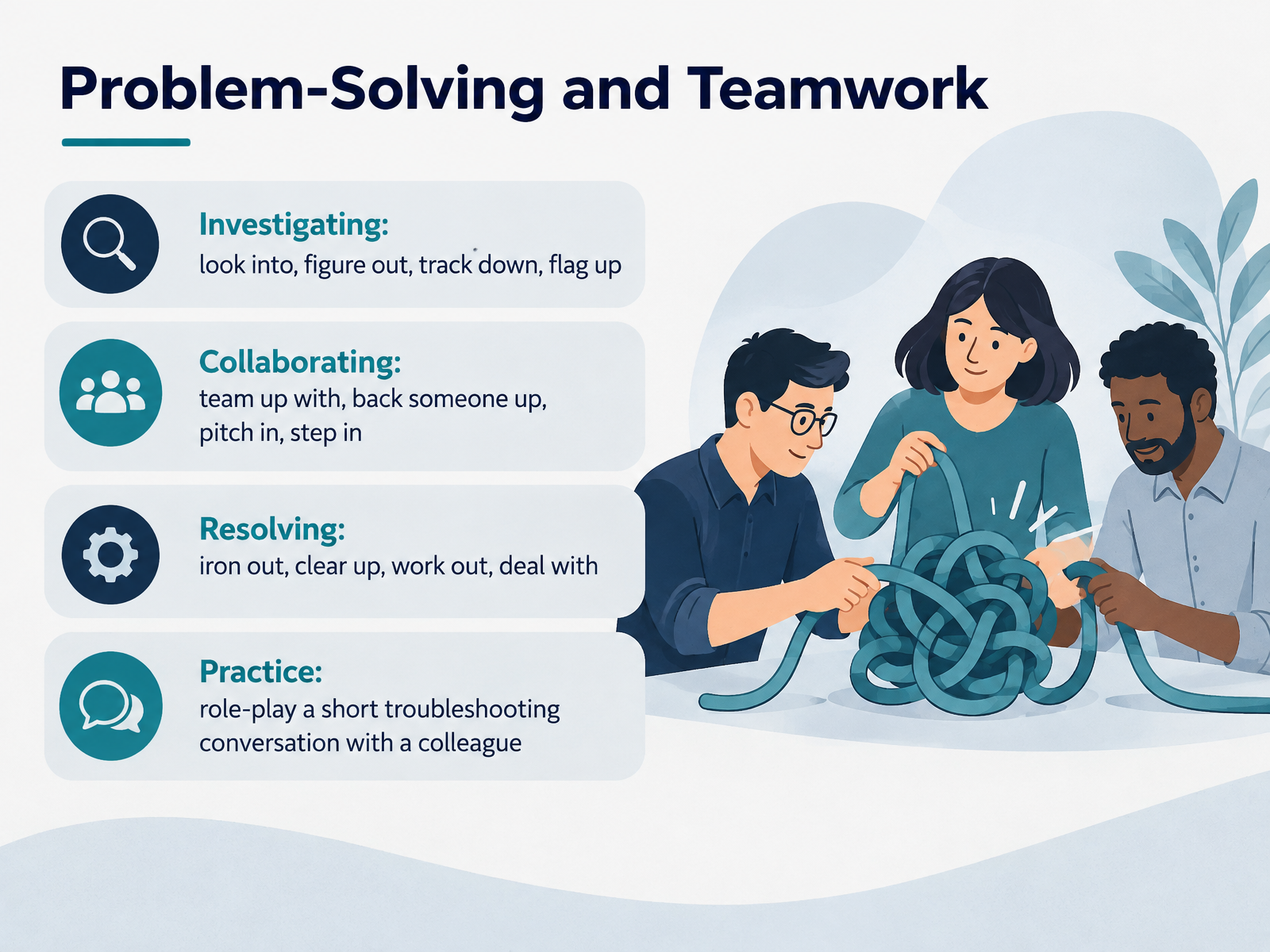
- 09Problem-Solving and TeamworkNow let's look at problem-solving and teamwork. When you're investigating an issue, you might say, I'll look into that and get back to you. Or, we need to figure out what went wrong. Then you track the cause down, and flag up any risks early. Here's the point: keep it short and direct, then pause so everyone stays with you. Good. Now for collaborating. You can team up with another department, back a colleague up in a meeting, pitch in when things get busy, or step in to calm a tense discussion. And when you're resolving, you iron out the details, clear up confusion, work out a solution, and deal with the problem calmly. Remember, a few small mistakes are normal here, so just keep using the verbs. Your practice task is to role-play a short troubleshooting conversation with a colleague. Use at least three of these phrasal verbs, and pause after each one. That sets us up nicely for our next slide, Common Mistakes and Quick Fixes.
 realbusinessenglish.comverbpal.comspeakconfidentenglish.com+21 min
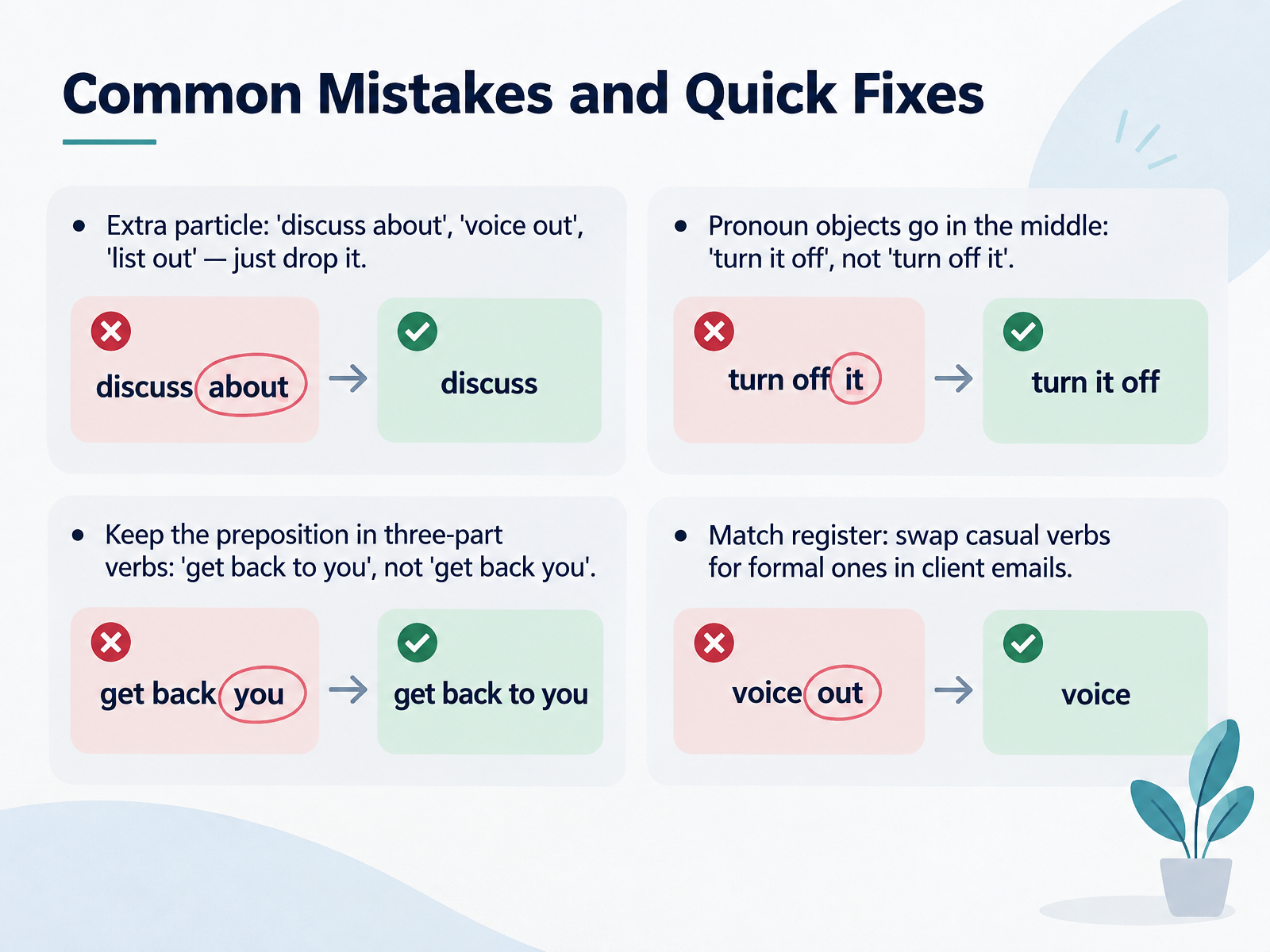
- 10Common Mistakes and Quick FixesNow let's look at a few common mistakes and quick fixes. These are small slips, and fixing them is simply part of practice. First, don't add an extra particle. Say discuss the budget, not discuss about the budget. Say voice a concern, not voice out a concern. Just drop the extra word. Second, with pronouns, put the object in the middle. Say turn it off, not turn off it. Say send it over, not send over it. Third, keep the preposition in three-part verbs. It is I'll get back to you, not I'll get back you. And follow up on the invoice, not follow up the invoice. Last, match the register. In a client email, swap reach out for contact, and send over for send. Pause here and say one corrected sentence aloud. Then we'll move to a quick check. Self-Check Before You Speak or Send.
 learnenglish.britishcouncil.orglearnenglish.britishcouncil.orgbbc.com+22 min
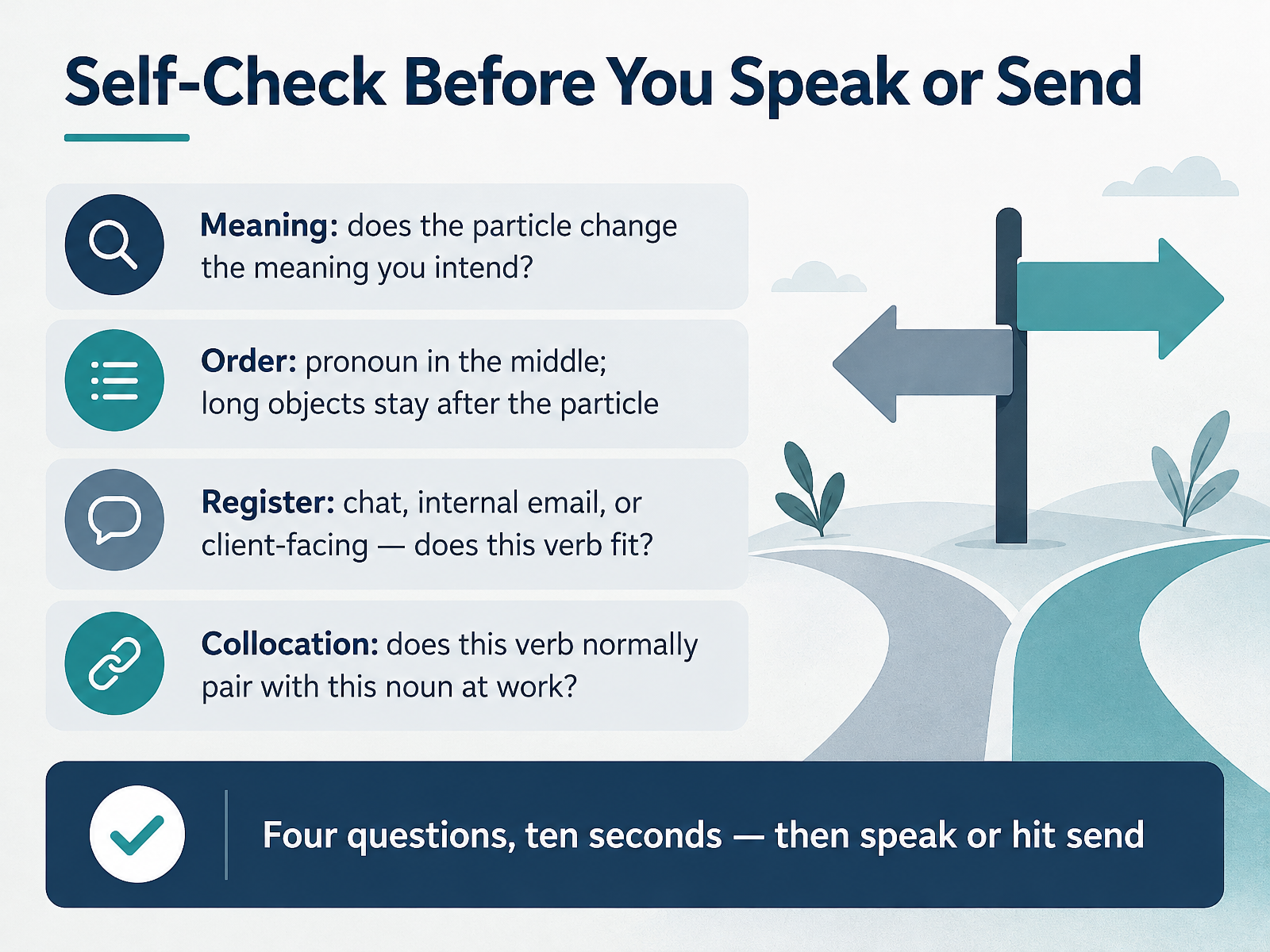
- 11Self-Check Before You Speak or SendNow let's make this practical. Before you speak or hit send, run four quick questions. First, meaning. Does the particle change the meaning you intend? Set up a meeting is not the same as set a meeting aside. Second, order. With a pronoun, put it in the middle. Turn it down, not turn down it. And if the object is long, keep it after the particle. Third, register. Chat, internal email, or client-facing? Reach out to a colleague sounds friendly. In a formal client email, contact may fit better. Fourth, collocation. Does this verb normally pair with this noun at work? We follow up on an action item and check in with a person. Four questions, about ten seconds. Then speak or hit send. You will still slip sometimes. That is normal. Pause here and write one phrasal verb you will check before sending today. Next, we move into the Practice Lab: Put Them to Work.
 learnenglish.britishcouncil.orglearnenglish.britishcouncil.orgbbc.com+22 min
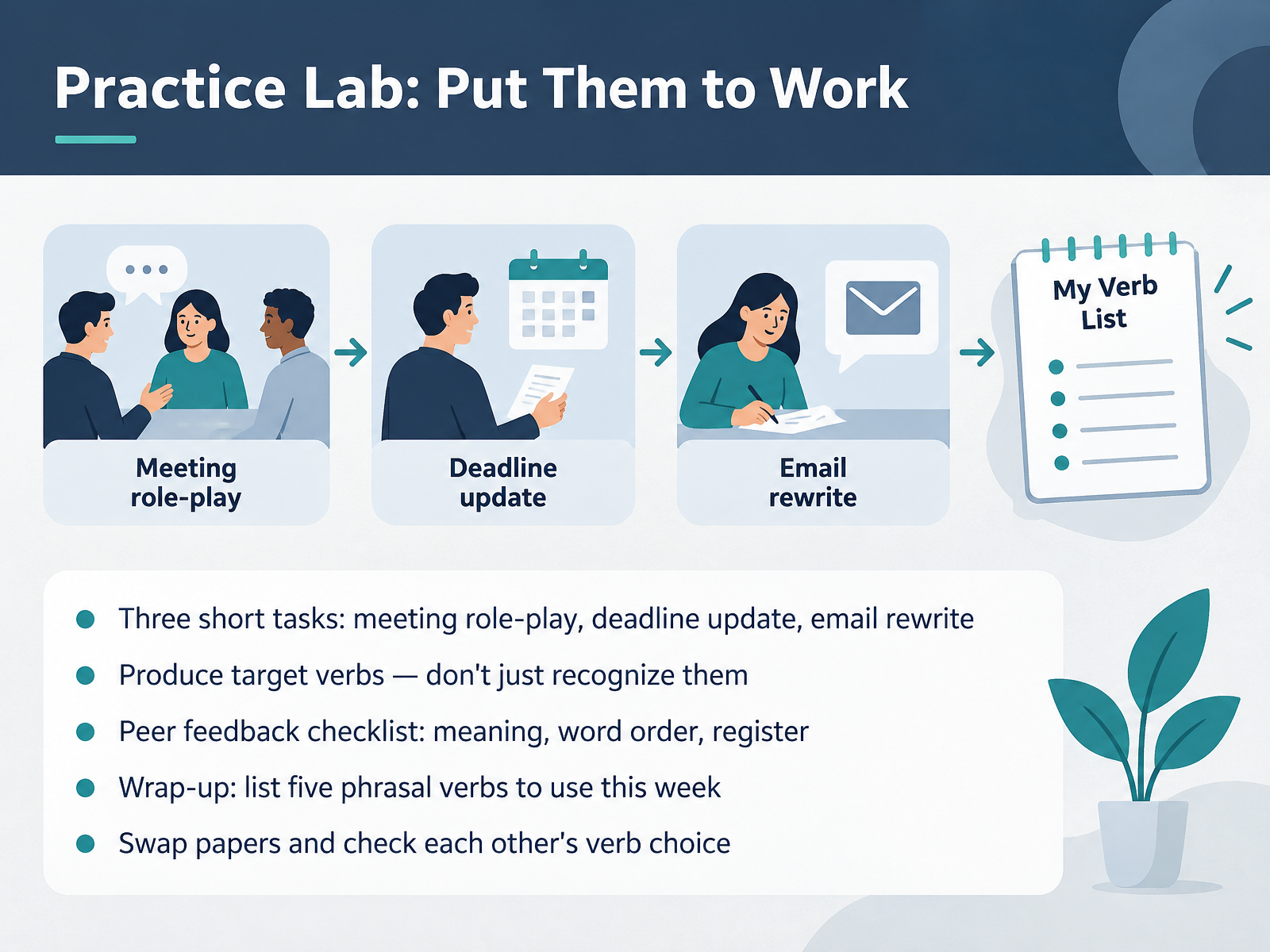
- 12Practice Lab: Put Them to WorkNow let's put these verbs to work. This is the practice lab, and the goal is simple. Produce the verbs, don't just recognize them. You have three short tasks. First, a meeting role-play. Bring up one concern, then wrap up the discussion. Second, a deadline update. Explain why a deadline was pushed back. Third, rewrite a short email using at least two phrasal verbs. After each task, swap papers with a partner. Check three things: meaning, word order, and register. Mistakes here are normal and useful, so treat them as practice, not a test. Before we finish, write down five phrasal verbs you will use this week. Keep them short and concrete. Next, let's turn this into an action plan.
 realbusinessenglish.comverbpal.comspeakconfidentenglish.com+21 min
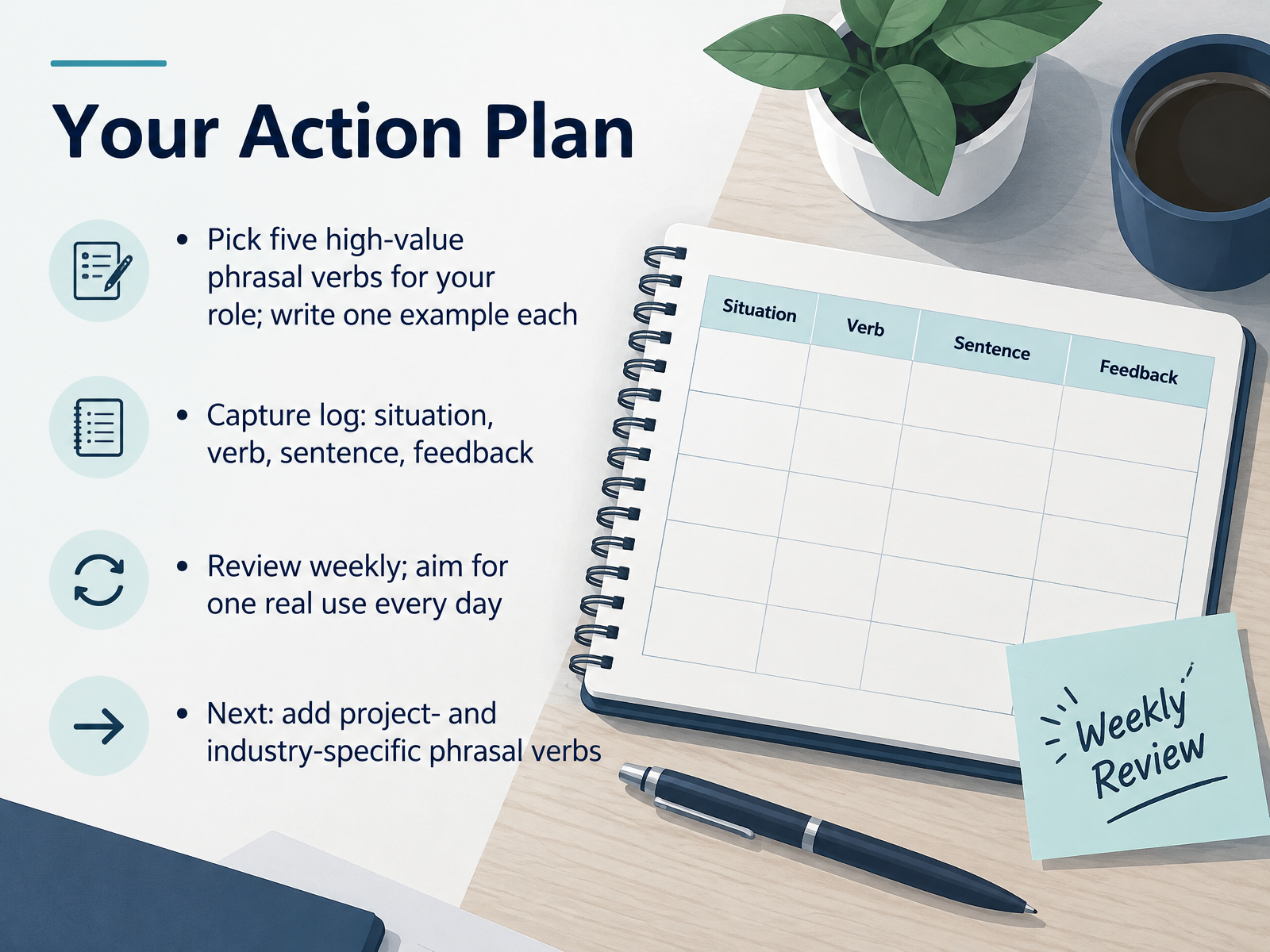
- 13Your Action PlanSo let's turn all of that into a simple action plan you can actually keep. First, pick five high-value phrasal verbs for your role. Not fifty. Five. Write one example for each, using your real work. Second, keep a capture log with four columns: the situation, the verb, your sentence, and any feedback you got. Third, review it weekly, and aim for one real use every day. One use in a meeting or an email counts. Mistakes are part of the practice, so log them and move on. Later, you can add project- and industry-specific phrasal verbs as your confidence grows. Now let's bring this together in Key Takeaways and Next Steps.
 doi.orgdoi.orgsciencedirect.com+21 min
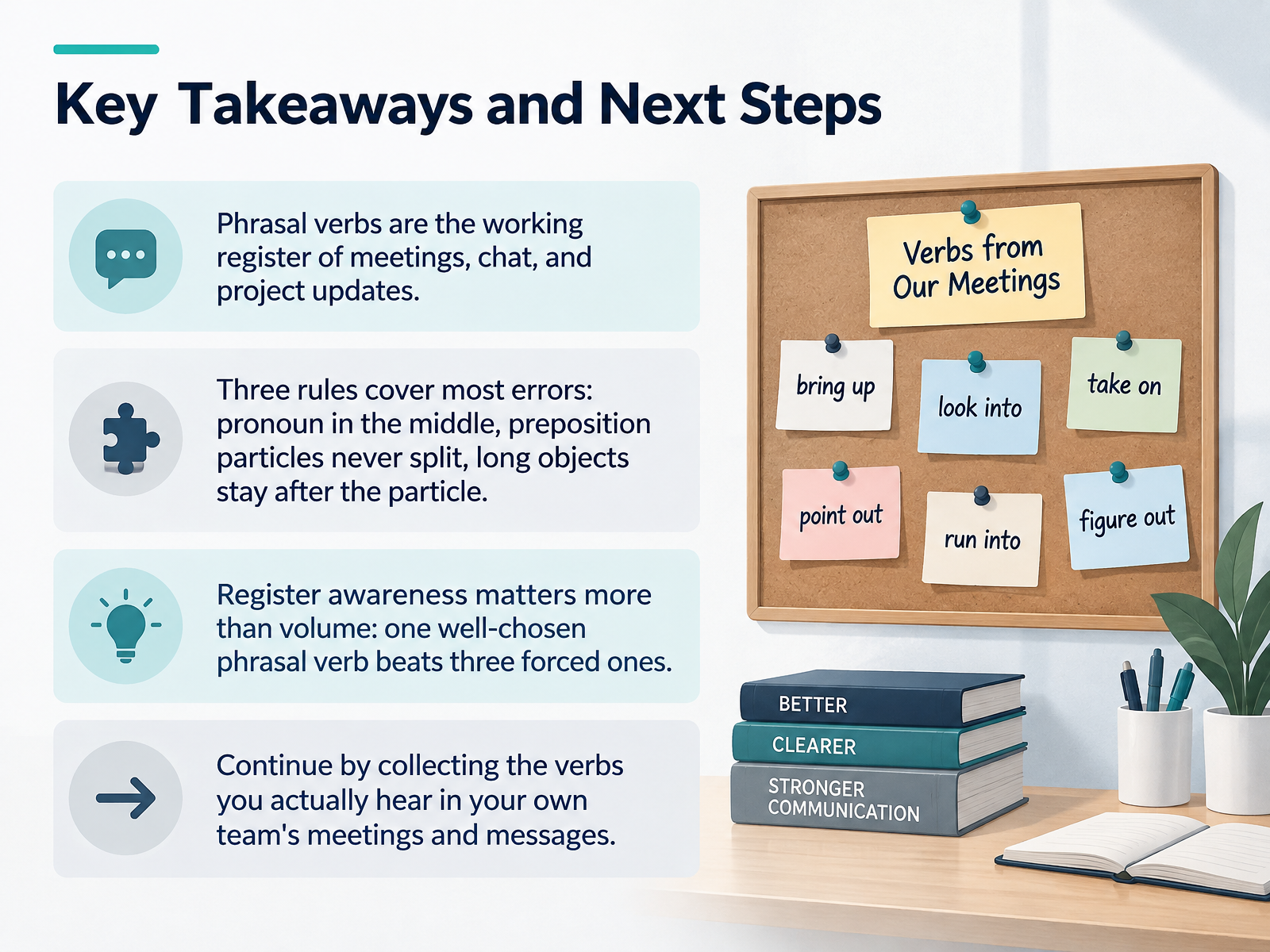
- 14Key Takeaways and Next StepsLet's bring this together with four takeaways. First, phrasal verbs are the working register of meetings, chat, and project updates. They are how your team actually talks, so you need them for active use. Second, three rules cover most errors. Pronouns go in the middle, as in turn it off, not turn off it. Preposition particles never split, so you come up with an idea, not come up an idea with. And long objects stay after the particle, as in sort out the problem in our scheduling system. Third, register matters more than volume. One well chosen phrasal verb beats three forced ones. Fourth, keep going by collecting the verbs you actually hear in your own team's meetings and messages, and note the sentence you heard them in. Thank you for working through this with you. You already have the knowledge. Now it's about confident, active use, one phrase at a time.
 doi.orgdoi.orgsciencedirect.com+21 min
Take the deck with you
Download this course as a file — free, no sign-up needed.
- PDF handoutEvery slide page, ready to print or share.15 pages · 3.2 MBDownload
- Narrated PowerPointThe deck that presents itself — every slide carries the digital human's narration video.15 pages · 12.7 MBDownload
- PowerPoint slidesThe full deck as a .pptx — open it in PowerPoint, Keynote, or Google Slides.15 pages · 3.1 MBDownload
Free to use in your own training — please keep the PersonWise credit page at the end.
Have your own deck? Turn it into a course
Sources consulted
Web sources consulted while building this course.
- 10 Must-Know Phrasal Verbs for Business Meetings (with Quiz!) — realbusinessenglish.com
- The 50 Most Common Phrasal Verbs for Business Meetings | VerbPal Blog — verbpal.com
- Sound Fluent & Professional: English Phrases for Meetings & Updates — speakconfidentenglish.com
- Essential Phrasal Verbs for Business English Meetings | Fluent Tips — englishinterconnect.com
- Business English Phrasal Verbs for Work: Show Up, Set Up, Kick Off, Push Back, Look Into, Turn In (with Quiz) — realbusinessenglish.com
- The most-common phrasal verbs with their key meanings for spoken and academic written English: A corpus analysis — doi.org
- The Most Frequently Used English Phrasal Verbs in American and British English: A Multicorpus Examination — doi.org
- Who's afraid of phrasal verbs? The use ... — sciencedirect.com
- Analyzing semantic/usage distributions of phrasal verbs across registers: a corpus-based study on PVs’ most frequent senses in academic and spoken English — ir.ua.edu
- The Assessment of the Importance of Phrasal Verbs in Contemporary Business English — hdl.handle.net
- Word order in phrasal verbs | LearnEnglish — learnenglish.britishcouncil.org
- Phrasal verbs | LearnEnglish — learnenglish.britishcouncil.org
- BBC Learning English - Course: intermediate / Unit 21 / Grammar Reference — bbc.com
- Separable and Inseparable Phrasal Verbs: Rules and Examples — studyphrasalverbs.com
- Business English Follow-Up Phrases: Email & Meetings (Quiz Inside) — realbusinessenglish.com
- 10 Easy Phrasal Verbs for Emails — englishwithbex.com
- 100 Phrasal Verbs for Office Emails — englishgrammar.org
- 120+ Professional Business Email Phrases — Ready to Use | Llexi — llexi.com
- 25 Business Email Idioms: Write Emails Like a Pro — seekidiom.com