The Science of Sound
Begin
16 pages · ~32 min
The Science of Sound
A foundational course exploring the physics of sound, designed to teach learners how sound waves are produced, travel, and are perceived.
What you’ll learn
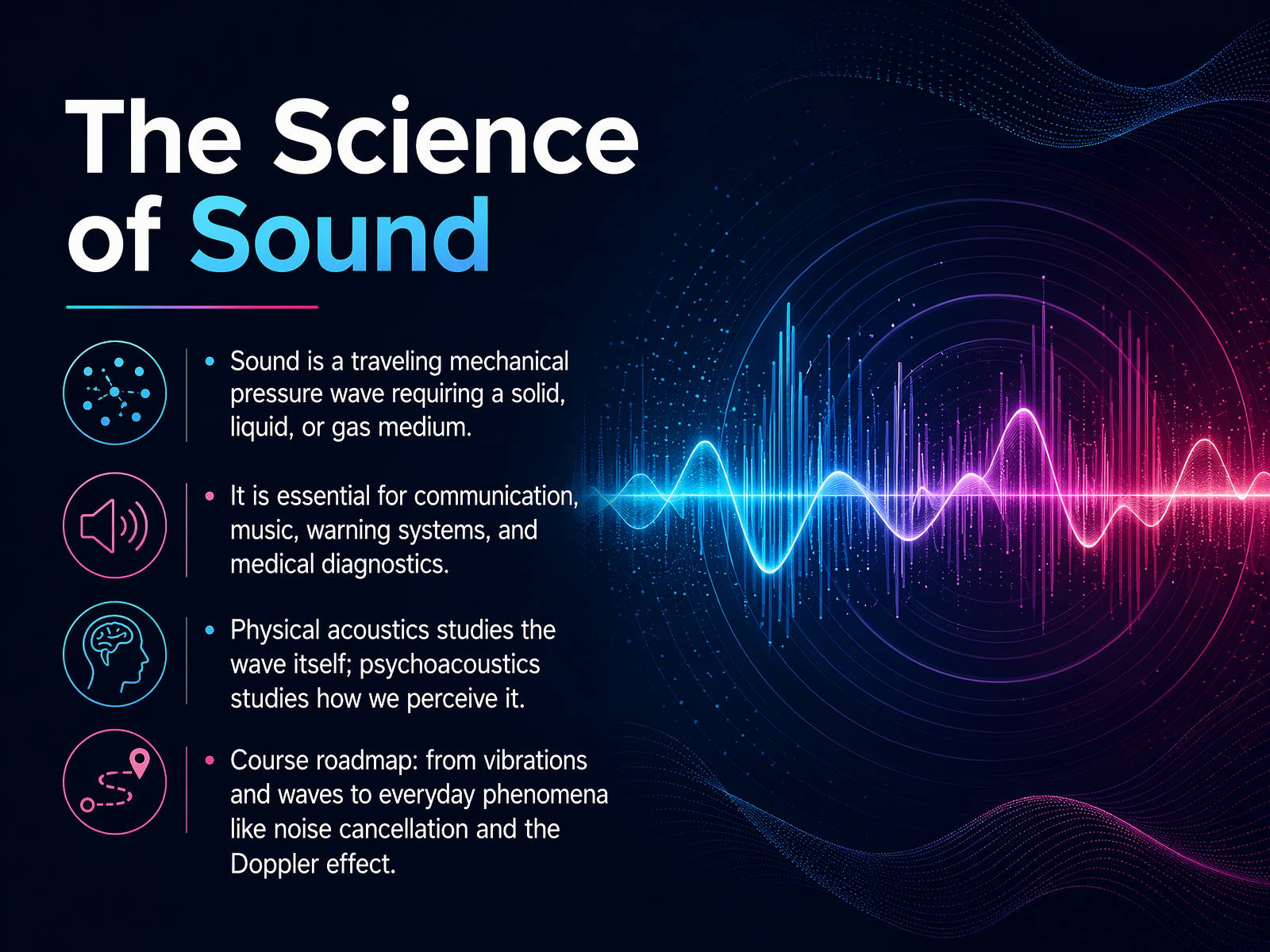
- 01The Science of SoundWelcome to The Science of Sound. My goal is to help you explore sound in a way that feels intuitive and observable. Let’s start with a simple idea: sound is a traveling mechanical pressure wave. That means it needs a medium to move through—a solid, a liquid, or a gas. Without a medium, there is no sound. Sound is essential for so much of life. It drives communication, music, warning systems, and even medical diagnostics. When we study sound, we actually look at it from two angles. Physical acoustics focuses on the wave itself—how it’s produced and how it travels. Psychoacoustics focuses on how we perceive that wave—what happens when the vibration reaches your ear and your brain makes sense of it. Over this course, we’ll build from the basics of vibrations and waves all the way to everyday phenomena like noise cancellation and the Doppler effect. You’ll start to notice sound in a whole new way. Up next, we begin at the source: Vibrations—The Source of Sound.en.wikipedia.orgvoicescience.orgicben.org+22 min
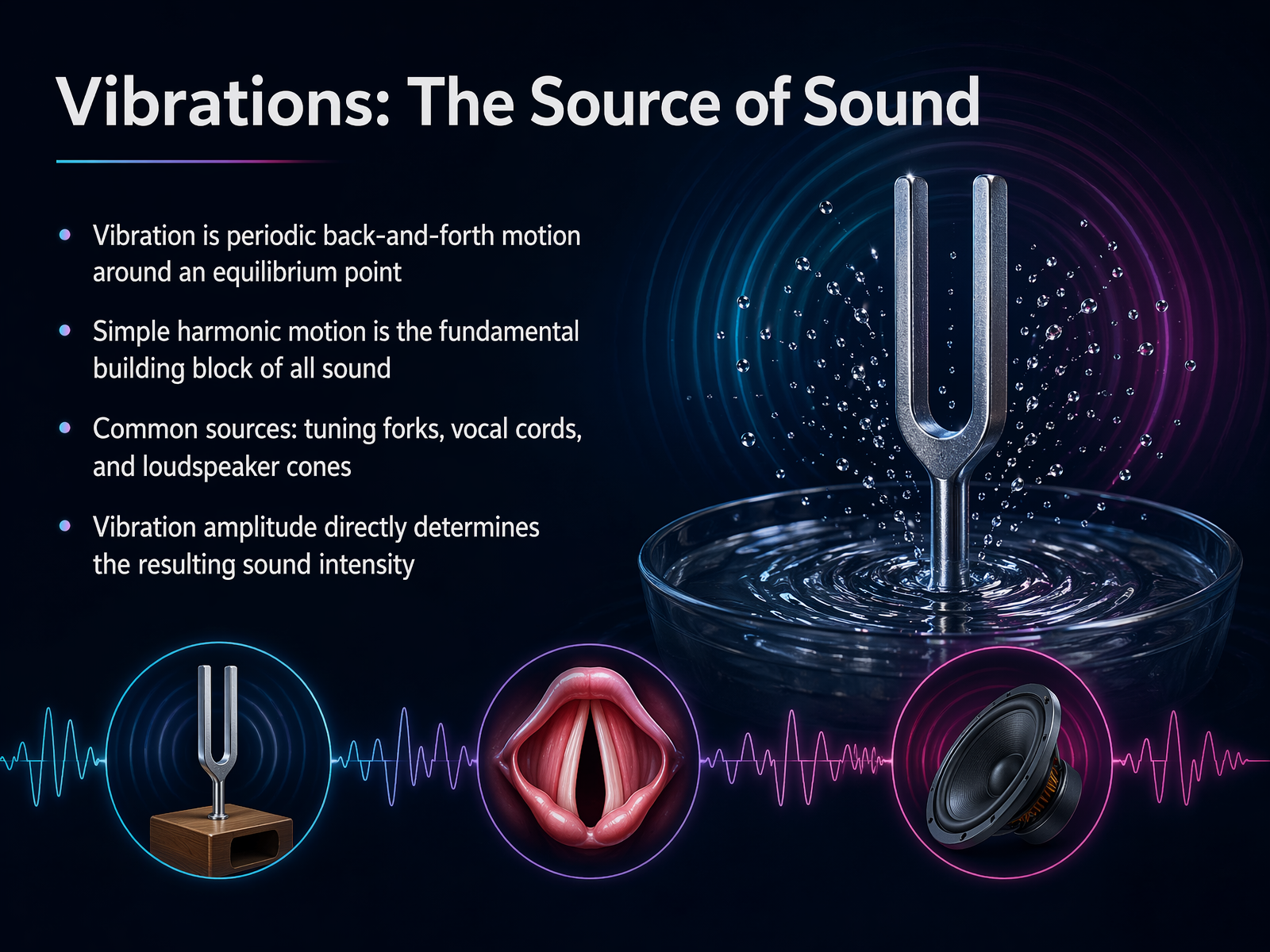
- 02Vibrations: The Source of SoundBuilding on that idea, let's look at where sound actually begins. It all starts with a vibration. Think of vibration as a steady, back-and-forth motion around a resting point. A perfect example is a guitar string. Pluck it, and it moves left and right, over and over, until it settles down. That simple, repeating swing is the heartbeat of every sound you hear. Physicists call the purest version of this ‘simple harmonic motion.’ It's the fundamental building block for all sound waves. Tuning forks, your own vocal cords, and even the cone of a loudspeaker all work this way. Now, a key point to remember: the size of that vibration, its amplitude, directly controls the loudness. A bigger back-and-forth motion creates a more intense sound. So, a gentle pluck makes a soft note, and a strong pluck makes a loud one. Now that we have a sound source, we need a way for that vibration to reach our ears. That leads us perfectly into our next topic: how sound travels through a medium.
 1 min
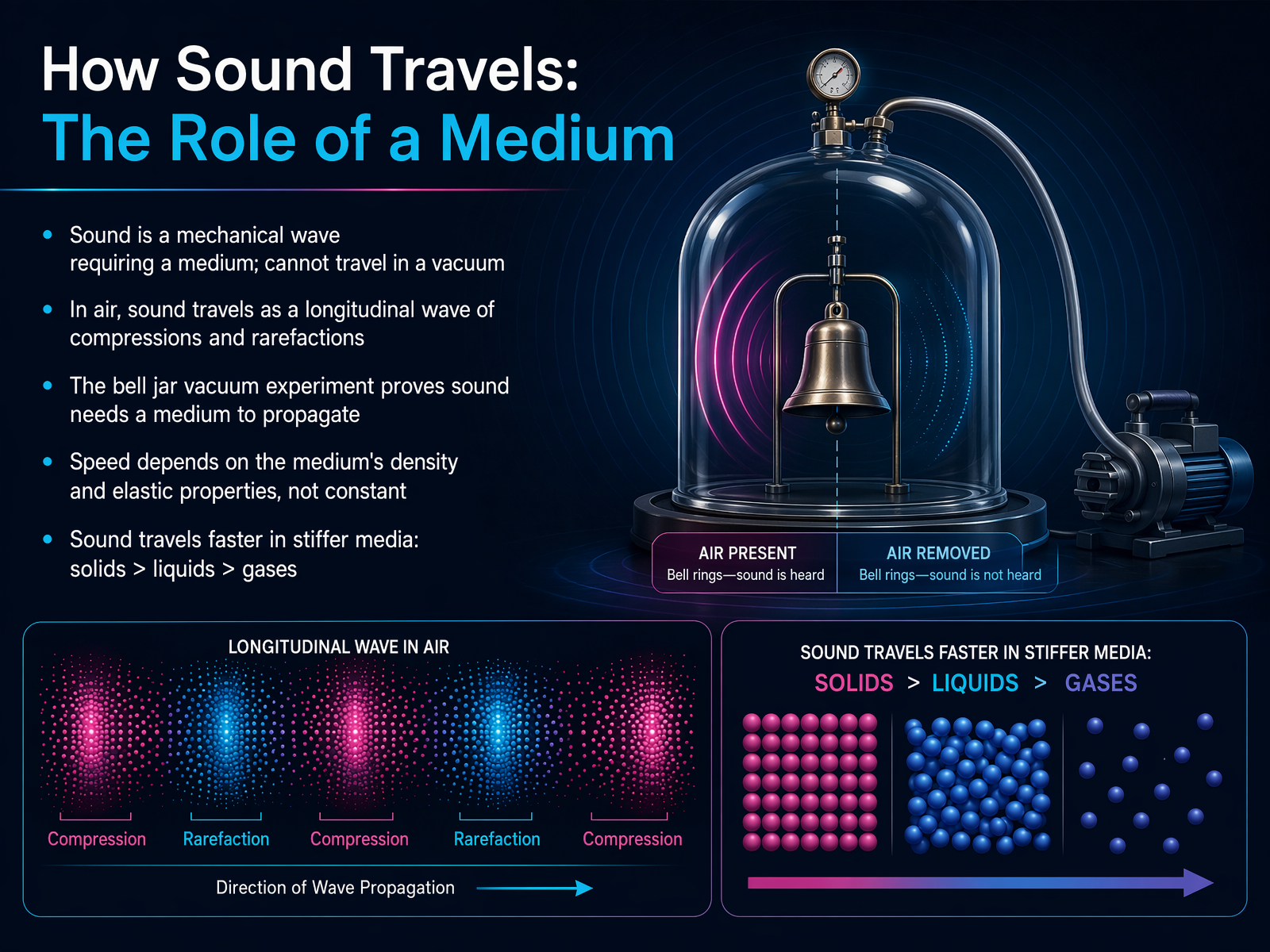
1 min - 03How Sound Travels: The Role of a MediumNow, let's look at how sound actually travels. Sound is a mechanical wave, which means it absolutely requires a medium to move. Unlike light, sound cannot travel through a vacuum—it needs particles to bump into each other. In air, sound moves as a longitudinal wave, creating a series of compressions and rarefactions. Think of it like a slinky: you push and pull one end, and those dense and spread-out zones travel along the coil. The classic proof of this is the bell jar experiment. If you place a ringing bell inside a jar and pump out the air, the sound fades to silence. The bell is still ringing, but the sound waves have no medium to carry them to your ears. The speed of sound is not constant; it depends on the medium's density and its elastic properties. A stiffer material transmits vibrations faster. This is why sound travels fastest in solids, slower in liquids, and slowest in gases. You can actually hear this difference yourself. The next time you're near a train track, safely put your ear to the rail. You'll hear the train much sooner through the steel than you will through the air. Let's dig deeper into those specific speeds in different materials next.
 engineeringtoolbox.comphys.libretexts.orghyperphysics.gsu.edu+22 min
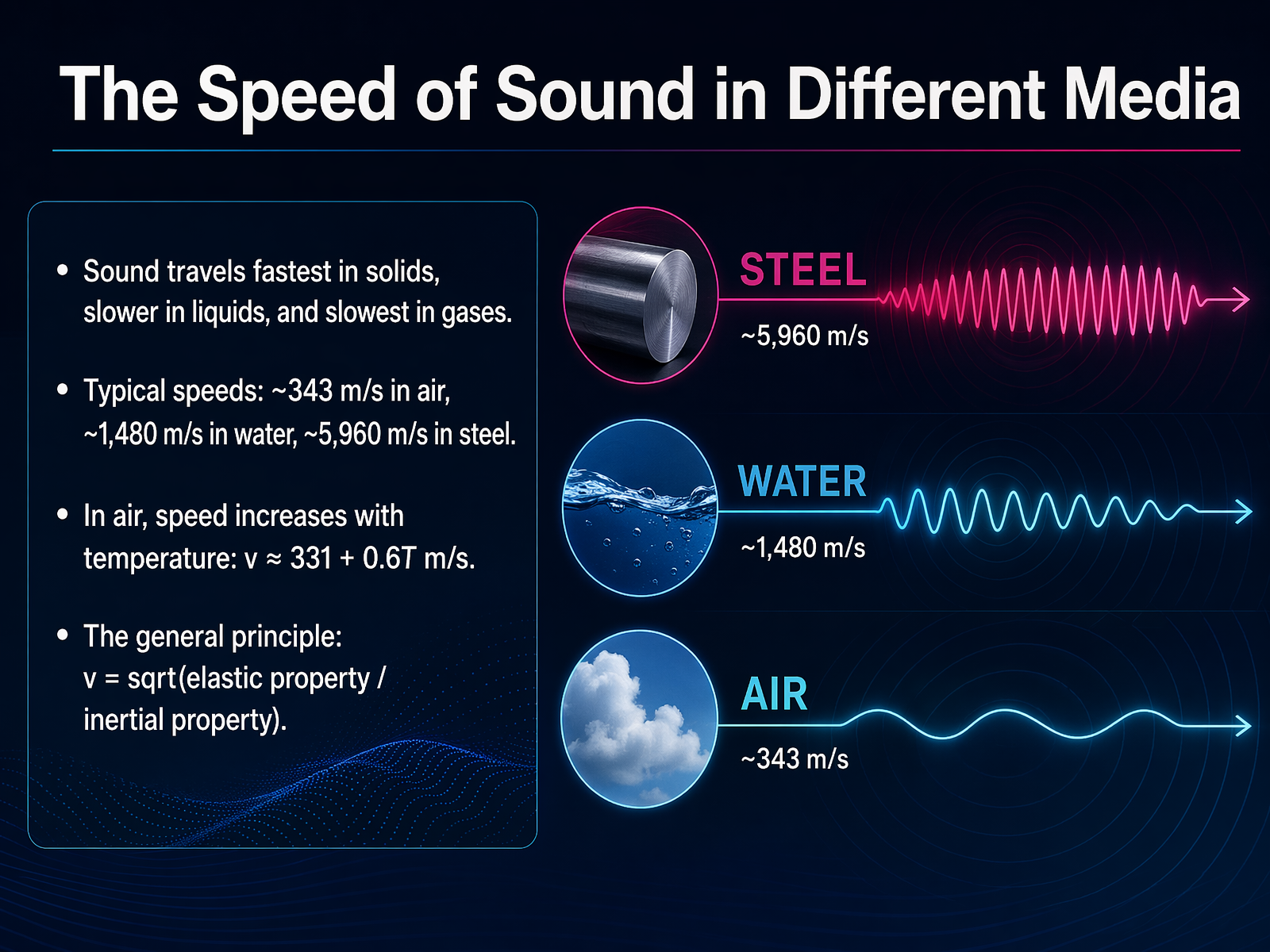
 - 04The Speed of Sound in Different MediaNow, let's explore how the medium itself changes the speed of sound. The key rule is simple: sound travels fastest in solids, slower in liquids, and slowest in gases. Think about a train approaching from far away. If you put your ear to the steel rail, you'll hear the rumble much sooner than through the air. That's because the vibrations jump from molecule to molecule much more quickly in a dense, rigid material. In typical air, sound moves at about three hundred forty-three meters per second. In water, it jumps to nearly one thousand four hundred eighty meters per second. In steel, it races along at about five thousand nine hundred sixty meters per second. That's over fifteen times faster than in air. We also see a temperature effect in air. The basic formula is: speed equals about three hundred thirty-one plus 0.6 times the temperature in Celsius. So on a hot day, sound travels a little faster. The general principle behind all this is that the speed equals the square root of an elastic property divided by an inertial property. In simple terms, stiffer materials push sound faster, while denser materials slow it down. But stiffness usually wins. That's why steel is so much faster than air. Next, we'll look at the wave properties that shape what we hear: frequency, wavelength, and amplitude.
 engineeringtoolbox.comphys.libretexts.orghyperphysics.gsu.edu+22 min
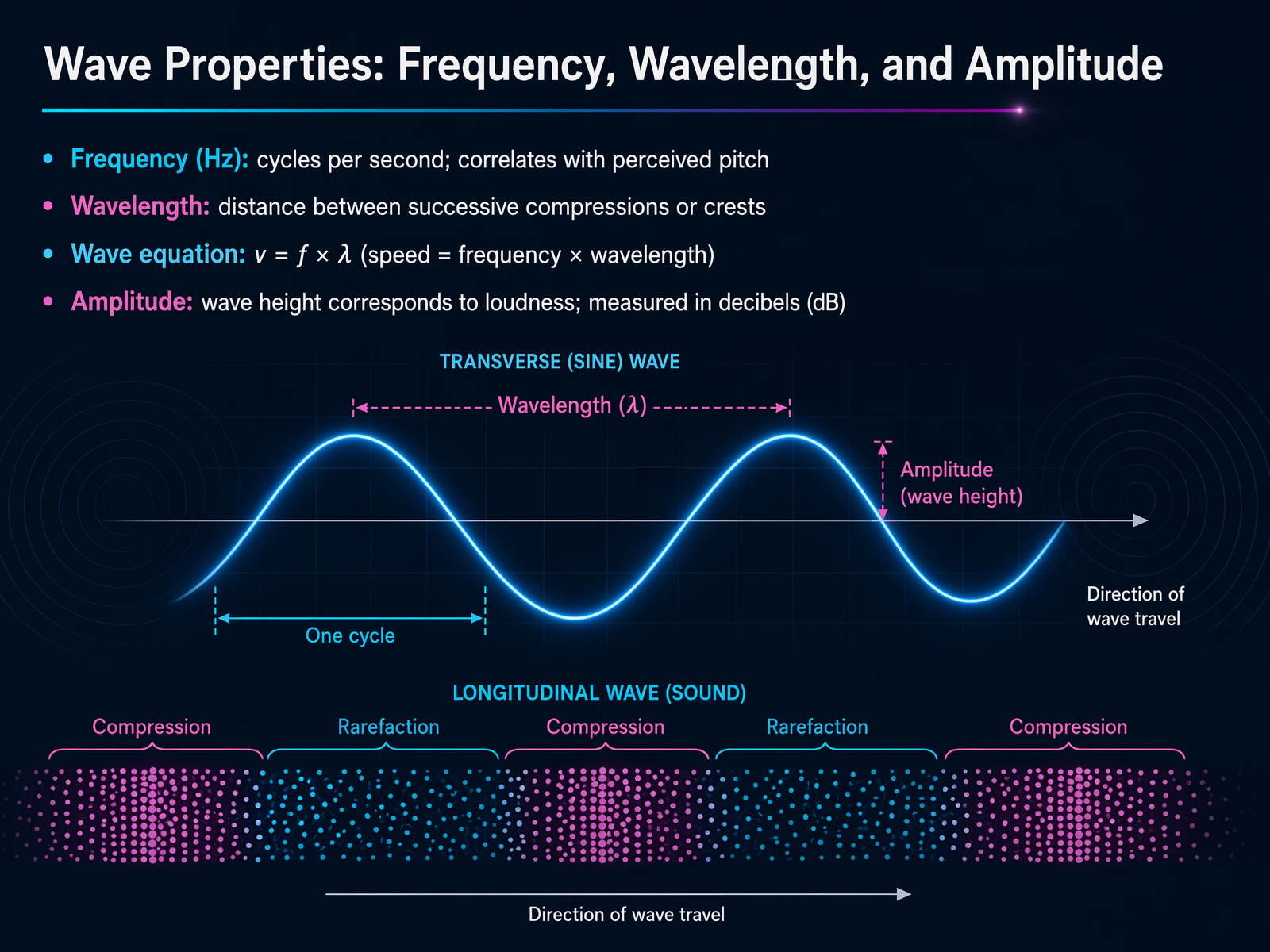
 - 05Wave Properties: Frequency, Wavelength, and AmplitudeNow, let's get to know three big ideas that describe any wave. First, frequency. Frequency is simply how many wave cycles pass a point in one second. We measure it in hertz. And here's the easy part to remember: frequency connects directly to what we hear as pitch. A high frequency, like a tight guitar string vibrating fast, gives us a high pitch. A low frequency, like a loose, thick string, gives us a low pitch. Next, wavelength. Wavelength is the distance from one peak of a wave to the next peak. So a high frequency wave has a short wavelength, and a low frequency wave has a long one. These two are linked by a simple equation: speed equals frequency times wavelength. For sound in air, that speed is roughly constant, so if frequency goes up, wavelength must get shorter. The last property is amplitude. Think of amplitude as the wave's height. A taller wave carries more energy, and our ears perceive that as loudness. We measure loudness in decibels. A gentle whisper has a small amplitude, while a roaring jet engine has a huge one. So, frequency is pitch, and amplitude is loudness. Now that we have these basics, let's explore the full range of frequencies, from the very lowest to the very highest.
 2 min
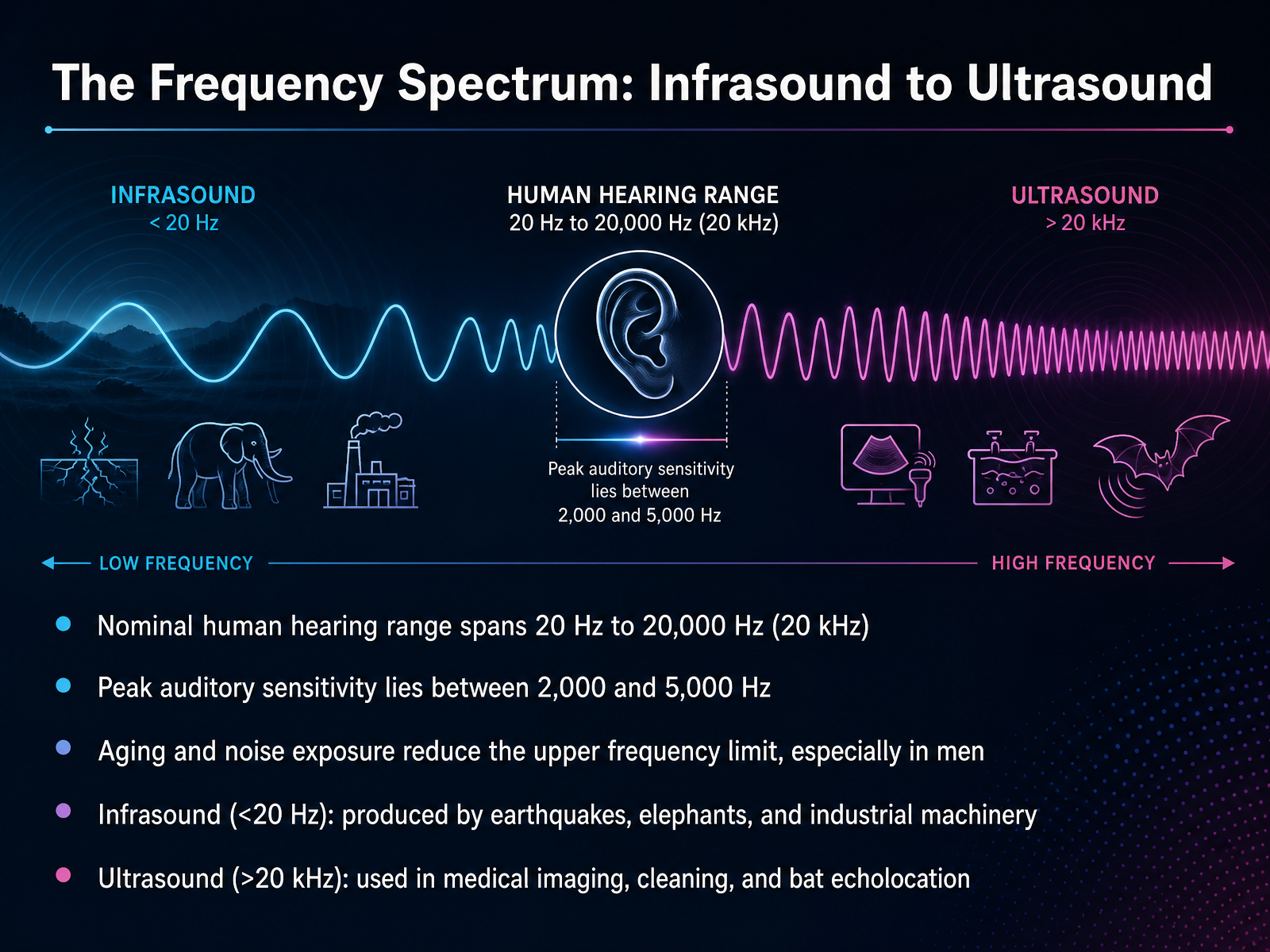
2 min - 06The Frequency Spectrum: Infrasound to UltrasoundNow let's explore the full frequency spectrum, from infrasound to ultrasound. The human ear is often described as hearing from twenty hertz to twenty thousand hertz, or twenty kilohertz. But our sensitivity isn't flat across that range. We actually hear best between two thousand and five thousand hertz, which is the frequency range of a baby's cry or a singer's bright, projecting tone. Over time, though, our upper limit naturally drops. Regular exposure to loud noise speeds this up, and men often lose high-frequency hearing earlier than women. Below twenty hertz, we enter the world of infrasound. You can't hear it as a tone, but you might feel it as a rumble. Earthquakes, elephants, and large industrial machines all produce infrasound. Above twenty kilohertz is ultrasound. Bats use it to echolocate in complete darkness, and doctors use it for medical imaging and even for cleaning delicate instruments. So the audible spectrum is just a slice of a much larger acoustic world. Next, we'll see what happens when sound waves meet boundaries, as we cover reflection, refraction, and diffraction.
 en.wikipedia.orgvoicescience.orgicben.org+22 min
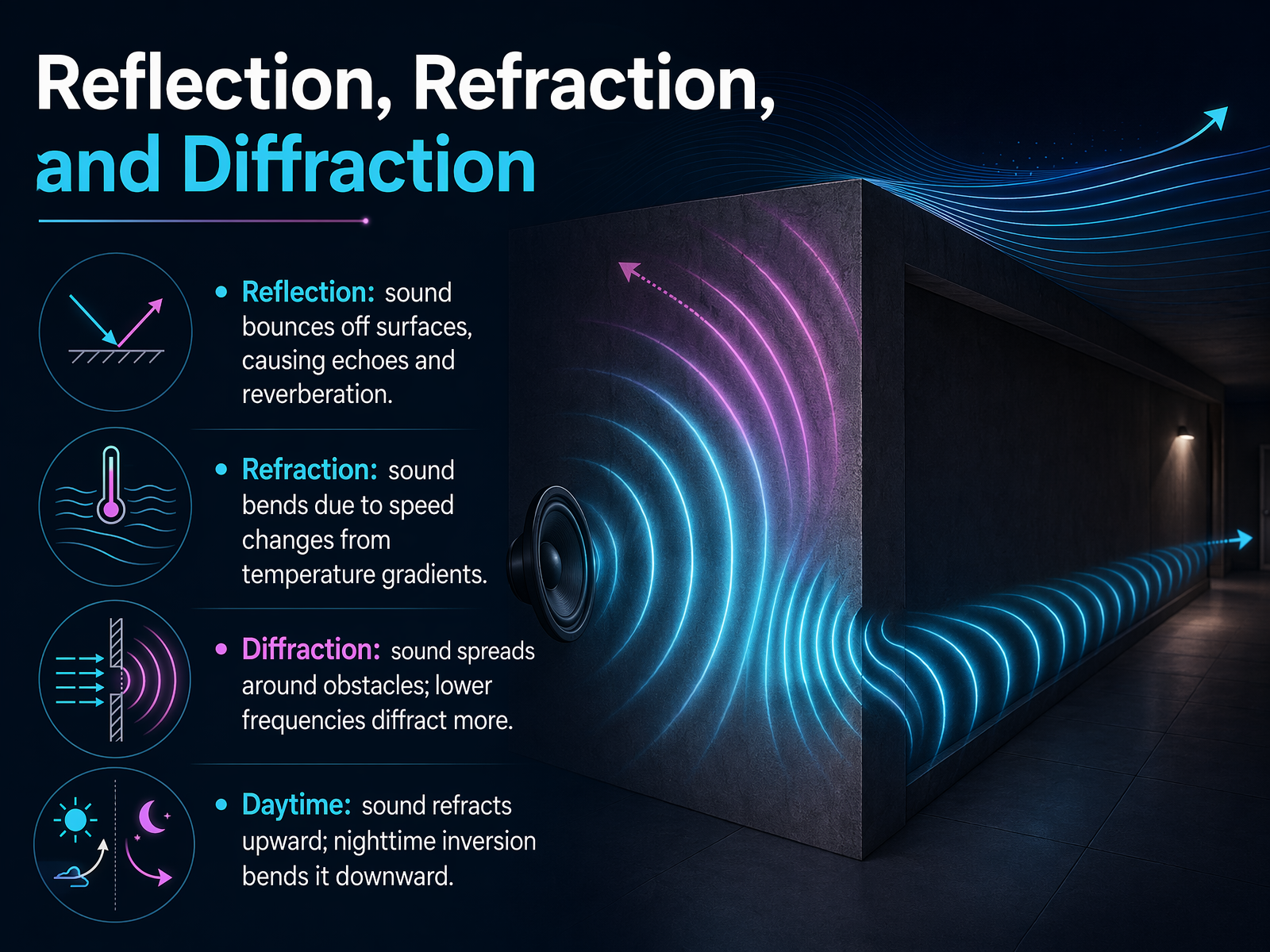
 - 07Reflection, Refraction, and DiffractionNow, let's look at what happens when sound meets a surface, a change in the air, or an obstacle. We call these behaviors reflection, refraction, and diffraction. Reflection is the simplest. It's just sound bouncing back. Think of shouting in a large empty hall. The sound waves hit the hard walls and bounce back to you, creating an echo. A shorter, more blended bounce is what we call reverberation. Refraction is a bit trickier. It's the bending of sound. This happens because sound speed changes with air temperature. Warmer air lets sound travel faster. So, during a sunny day, the air right next to the hot ground is warmer than the air above it. Sound traveling along the ground is faster at the bottom and slower on top, which bends the sound wave upward, away from the surface. This is why you might not hear a distant road very well on a hot afternoon. But at night, the ground cools down quickly. The air near the surface can become colder than the air above it. This is called a temperature inversion. It bends sound waves downward, back toward the ground, allowing sound to travel much farther. That's why distant trains or traffic sound louder at night. Finally, there's diffraction. This is the spreading of sound when it passes through an opening or around a corner. It's why you can hear someone talking in the next room even if you can't see them. And here's a key point: low-frequency sounds, with their long wavelengths, diffract much more easily than high-frequency sounds. That's why you might only hear the deep bass from a neighbor's music, while the high notes seem blocked. Next, we'll combine these ideas to see how they create resonance and standing waves.
 epod.usra.educomsol.combritannica.com+22 min
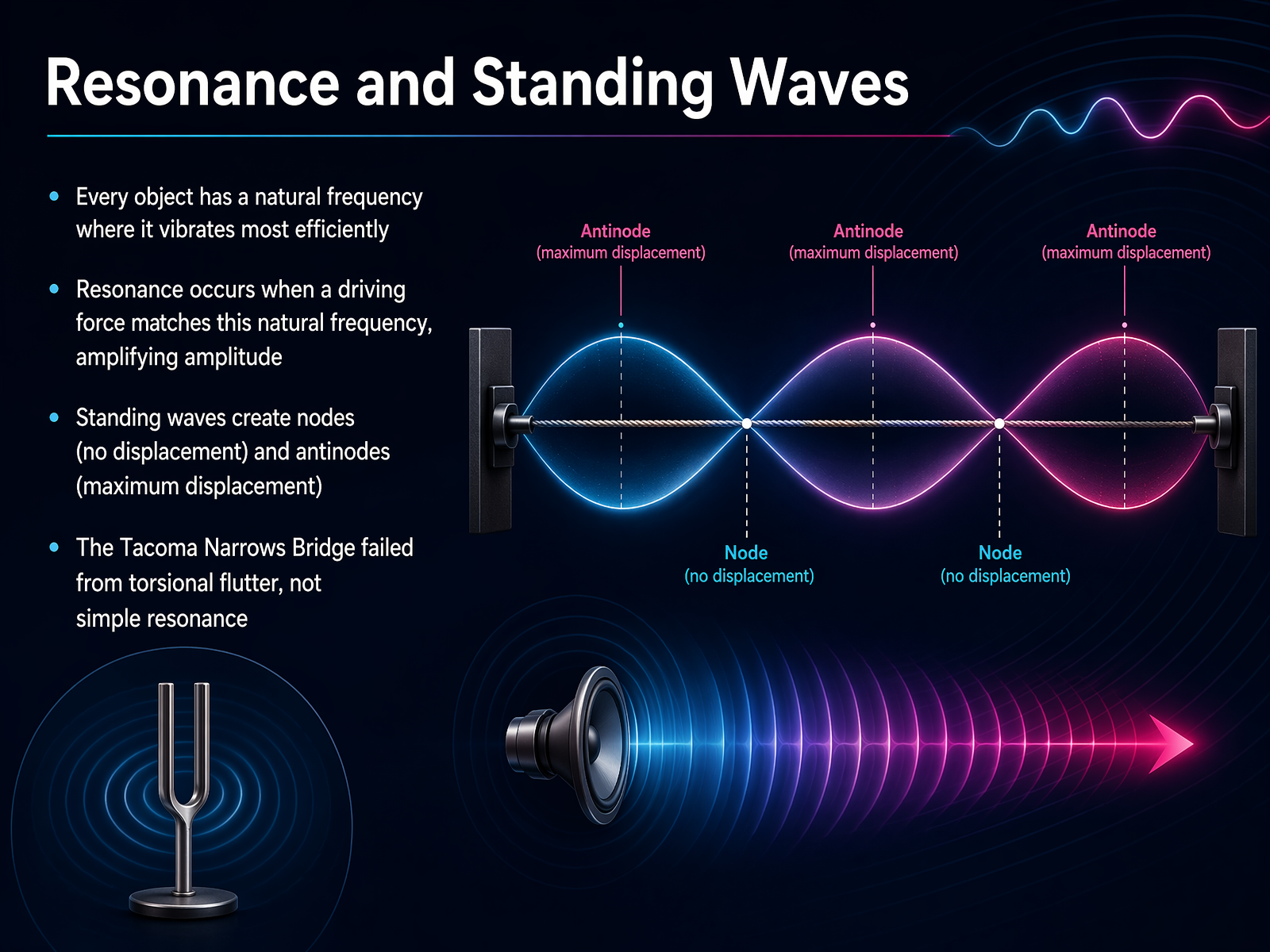
 - 08Resonance and Standing WavesLet’s explore resonance and standing waves. Every physical object has a natural frequency where it vibrates most efficiently—think of a guitar string that rings at a clear pitch, or a tuning fork that sings at its own steady tone. Resonance happens when a repeating driving force, like a push or a sound wave, matches that natural frequency. The timing adds energy cycle after cycle, and the amplitude grows dramatically. That’s how a singer’s voice can shatter a glass, or why a child on a swing goes higher when you push at just the right moment. Standing waves form when waves reflect back and forth within a medium, creating fixed patterns. You’ll see nodes, where there’s no displacement at all, and antinodes, where the motion peaks. A plucked guitar string is a perfect example: the ends stay still as nodes, and the middle jumps as the antinode. Now, a quick note on the famous Tacoma Narrows Bridge. Many textbooks once called it a resonance failure, but modern research points to a different mechanism called torsional flutter. The wind didn’t simply match the bridge’s natural frequency; instead, it created self-reinforcing twisting cycles that fed on the bridge’s own motion until it collapsed. Up next, we’ll look at how waves combine—moving into interference, both constructive and destructive.
 aps.orgphysicstoday.aip.orgpractical.engineering+22 min
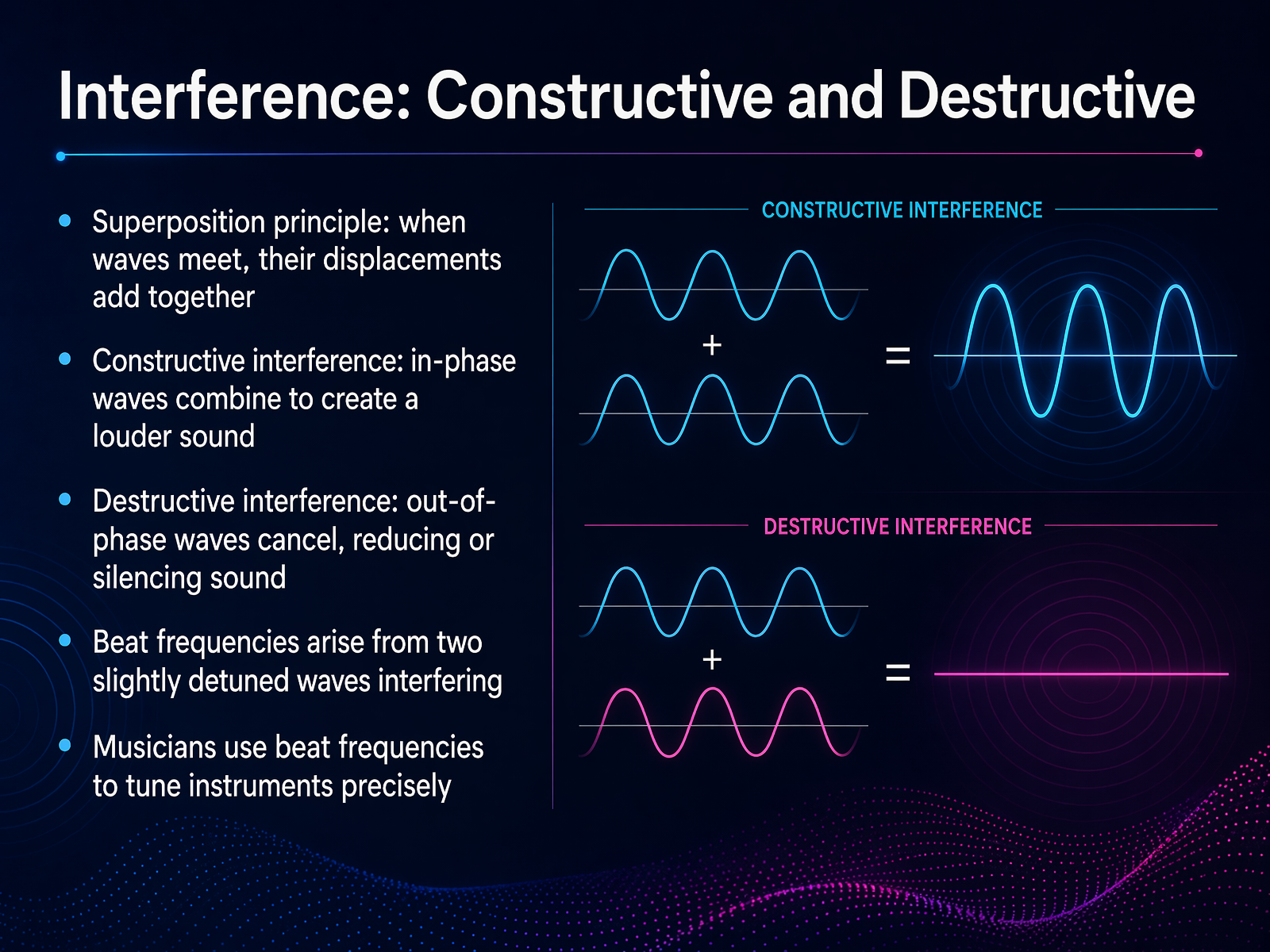
 - 09Interference: Constructive and DestructiveNow, let's explore what happens when sounds meet. This is called interference, and it follows a simple idea called the superposition principle. When two waves overlap, their displacements simply add together. That means sound can get louder, or it can get quieter, sometimes even disappearing completely. When waves arrive in phase, crest to crest and trough to trough, they add up. This is constructive interference, and it creates a louder sound. But when they arrive out of phase, the crest of one wave meets the trough of another. They cancel out. This is destructive interference, and it can reduce sound or even silence it. You can actually hear this effect in a phenomenon called beat frequencies. If two notes are slightly out of tune, their waves drift in and out of phase, creating a pulsing 'wah-wah-wah' sound. Musicians use this very principle. They listen for those beats to tune their instruments precisely, adjusting the string until the pulsing stops and the waves are perfectly in sync. Destructive interference is also the secret behind active noise-cancelling headphones. A tiny microphone listens to the noise around you, and the headphone creates a mirror-image wave, an anti-noise signal, that cancels the drone of an engine before it hits your ear. Next, we'll shift our focus to how motion changes the pitch of sound. Let's look at the Doppler effect and what happens when a source or an observer is moving.
 2 min
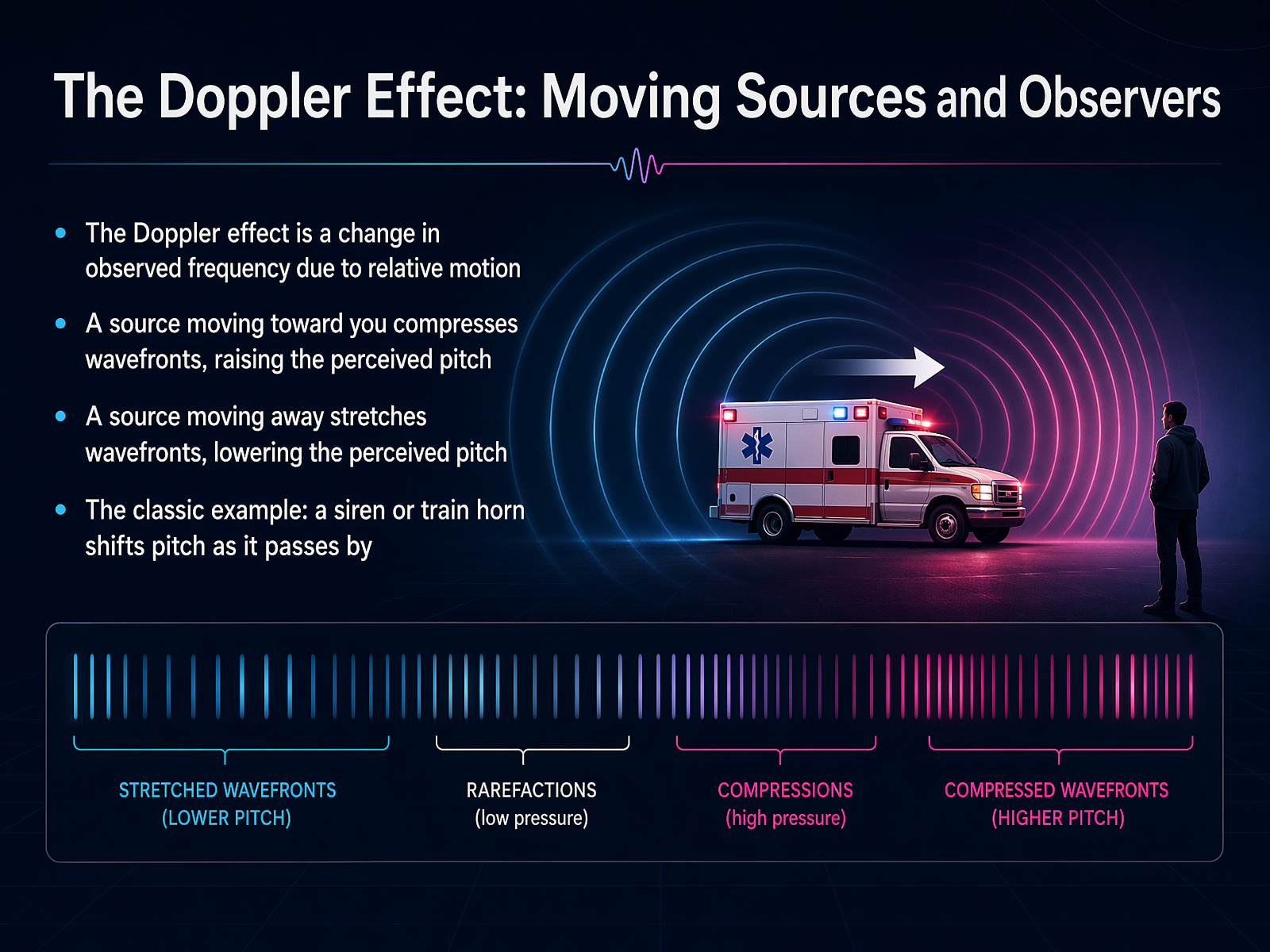
2 min - 10The Doppler Effect: Moving Sources and ObserversNow, let’s bring motion into the picture. That shift in pitch you hear when an ambulance races past—that’s the Doppler effect. It’s a change in the observed frequency caused by relative motion between you and the source. When a source moves toward you, it’s actually chasing its own sound waves. The wavefronts get squeezed together, so the wavelength gets shorter and the pitch rises. As soon as it passes and starts moving away, those wavefronts stretch out. The wavelength gets longer, and you hear a lower pitch. The siren itself isn’t changing its note at all. It’s the same steady tone the whole time, but your ears receive a different frequency depending on whether the source is approaching or receding. The classic example is exactly that—a train horn or a siren that sounds high on approach, then drops as it goes by. The faster the source moves, the more dramatic the shift. Up next, we’ll push this idea to the extreme and explore what happens when an object reaches the speed of sound itself: sonic booms and shock waves.
 1 min
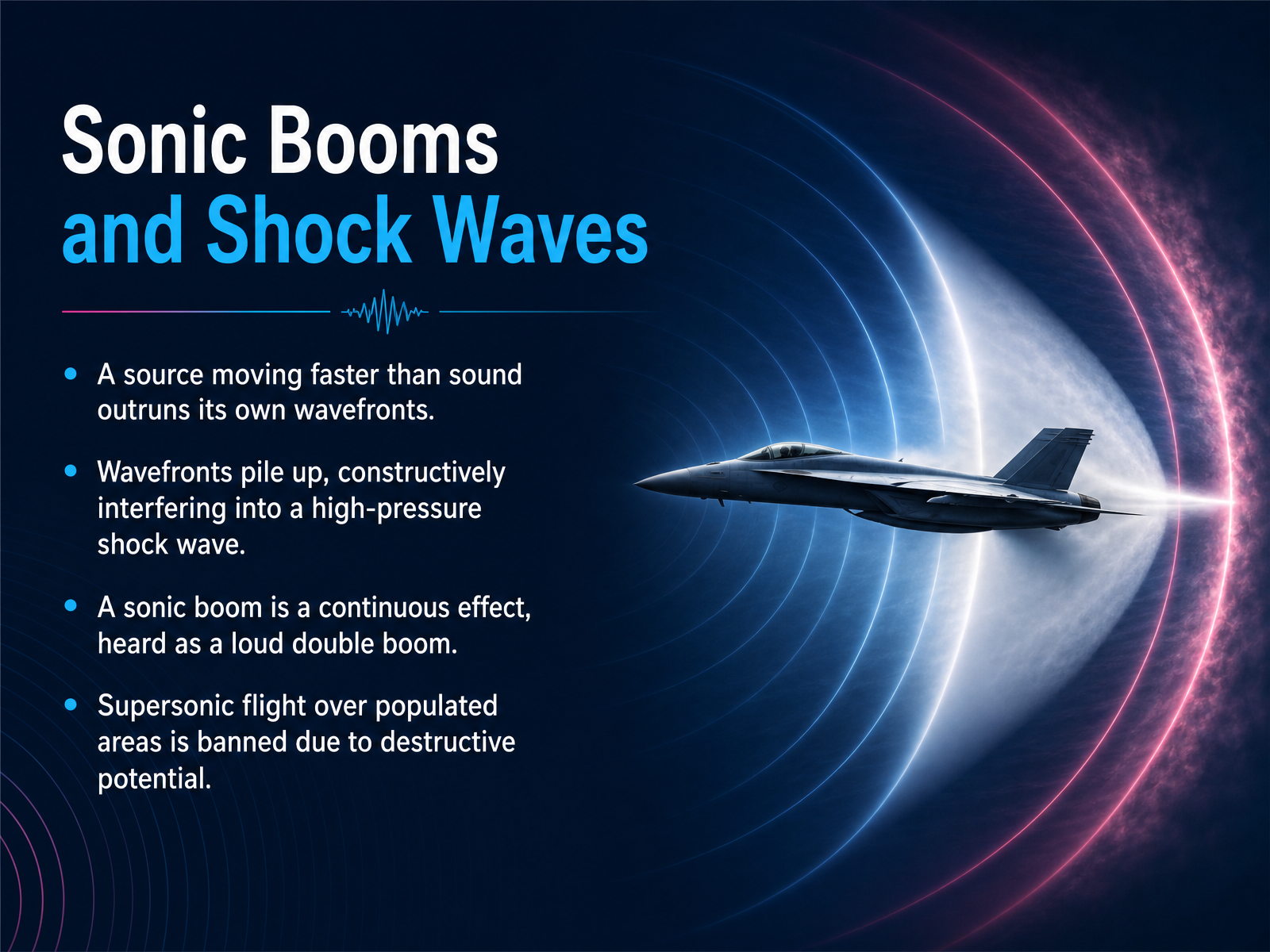
1 min - 11Sonic Booms and Shock WavesNow we push past the sound barrier itself. When a jet flies faster than the speed of sound, it outruns its own wavefronts. The sound waves can't get ahead of the plane. They pile up on top of each other, merging into a single, intense wall of high pressure. This is a shock wave. The sonic boom is not a one-time explosion at the moment the barrier is broken. It is a continuous effect. The shock wave travels with the aircraft, tracing a cone behind it. To a person on the ground, you hear this as a sudden, loud double boom, one from the nose and one from the tail. The pressure jump can be so powerful it can shatter windows. That destructive potential is why supersonic flight is banned over populated areas. It’s a dramatic example of constructive interference sculpting sound into something you can physically feel. Next, we’ll shift from a shock wave to a string wave, exploring the physics of music and timbre.
 1 min
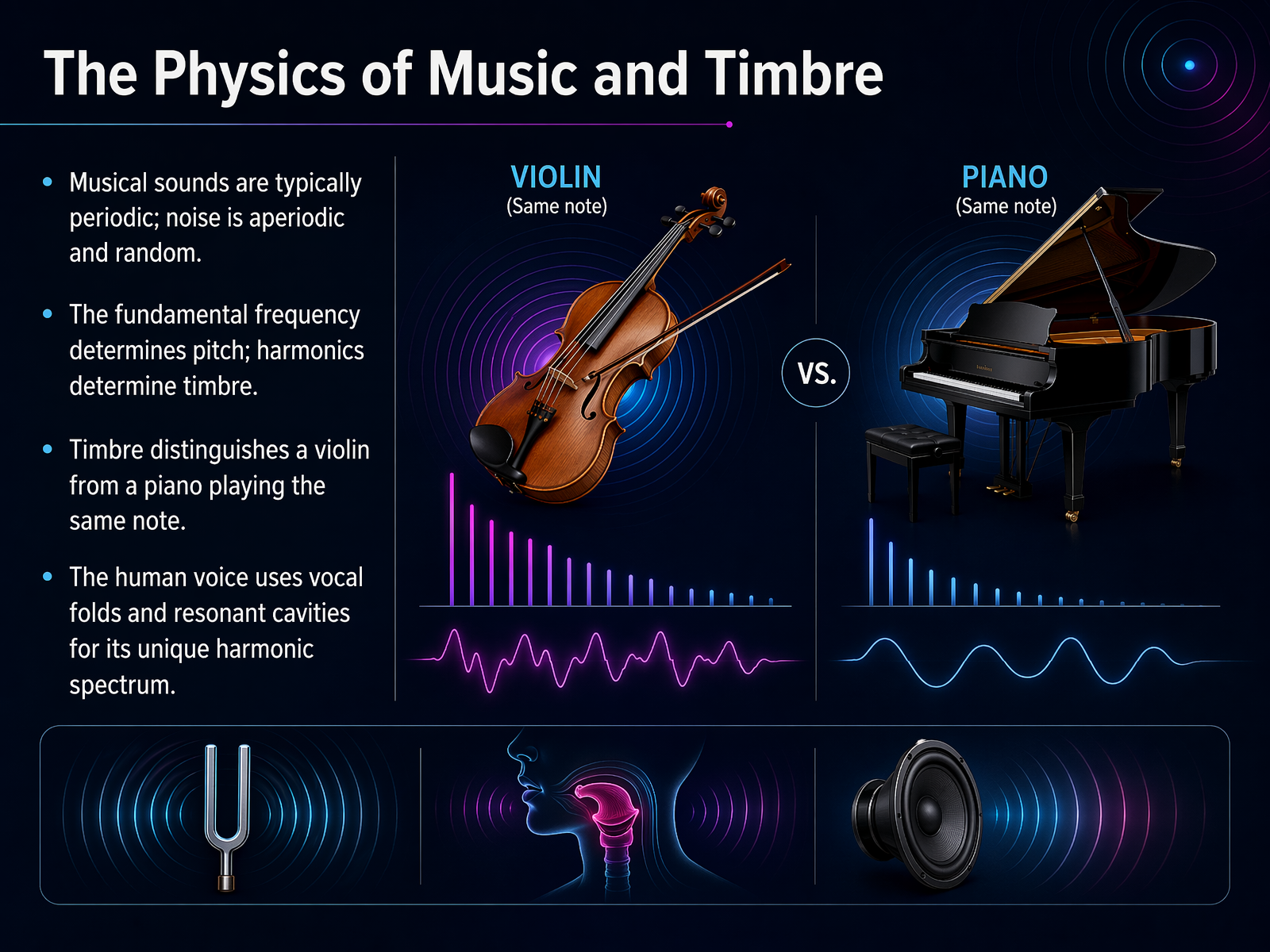
1 min - 12The Physics of Music and TimbreNow let's move from the basics of sound into the physics of music and what we call timbre. Think about the difference between a musical note and random noise. A musical sound is periodic, meaning its vibration pattern repeats cleanly over time. Noise, on the other hand, is aperiodic and random. When you strike a single note on a tuning fork, you get a clear, repeating wave. That's our starting point. The lowest frequency in that wave is the fundamental frequency, and it determines the pitch we hear. But the real magic of sound is in the harmonics. Harmonics are additional whole-number multiples of that fundamental frequency. They don't change the pitch, but they create the unique color, or timbre, of the sound. Timbre is why a violin and a piano playing the exact same note at the same loudness still sound completely different. The instruments are just mixing the harmonics in different amounts. The human voice works the same way. Our vocal folds create the fundamental frequency, but the shape of our throat, mouth, and nasal cavities acts as a resonant filter, boosting certain harmonics to create a unique spectrum. That's how you recognize a friend's voice instantly. So remember, pitch is the note, and timbre is the fingerprint. Coming up next, we'll explore how this applies directly to speech production and vocal acoustics.
 en.wikipedia.orgvoicescience.orgicben.org+22 min
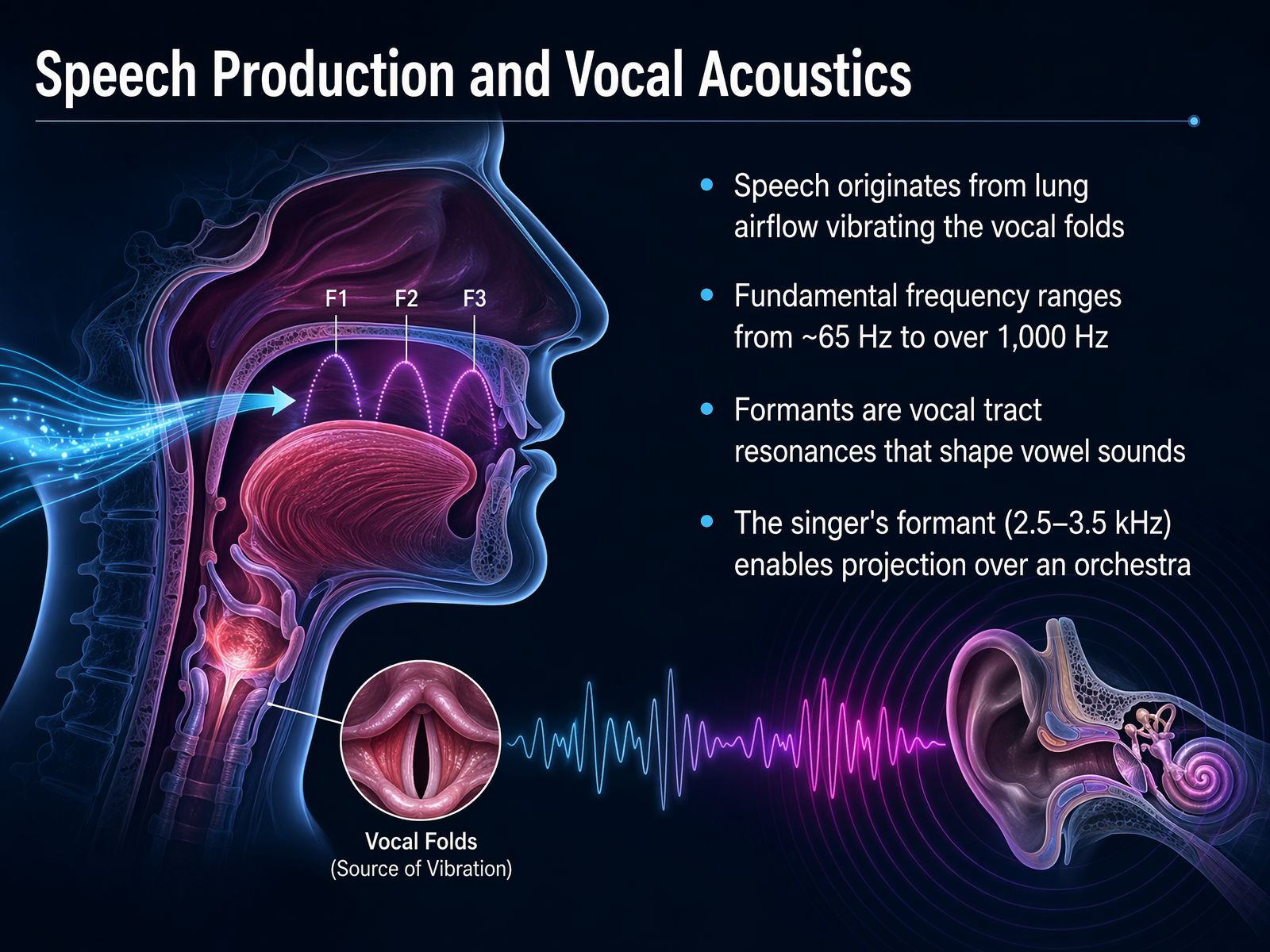
 - 13Speech Production and Vocal AcousticsNow let's turn our attention to the most personal sound source of all: the human voice. Speech production starts with airflow from the lungs. As that air passes through the vocal folds, it makes them vibrate, creating the initial sound. The rate of that vibration is called the fundamental frequency. For voices, it ranges from around 65 Hertz for a low bass note all the way up to over 1,000 Hertz for a high soprano. But raw vibration alone doesn't create recognizable vowels. The shape of your throat, mouth, and nasal passages filters the sound, emphasizing certain frequencies. These boosted resonance bands are called formants, and they're what let you distinguish an 'ah' from an 'ee.' There's a special formant for trained singers too. It's called the singer's formant, and it lives between about 2,500 and 3,500 Hertz. That energy boost sits right where the human ear is most sensitive, which is why a classical singer can project clearly over an entire orchestra. Up next, we'll explore the flip side of experiencing sound: Sound Level Safety and Hearing Protection.
 en.wikipedia.orgvoicescience.orgicben.org+22 min
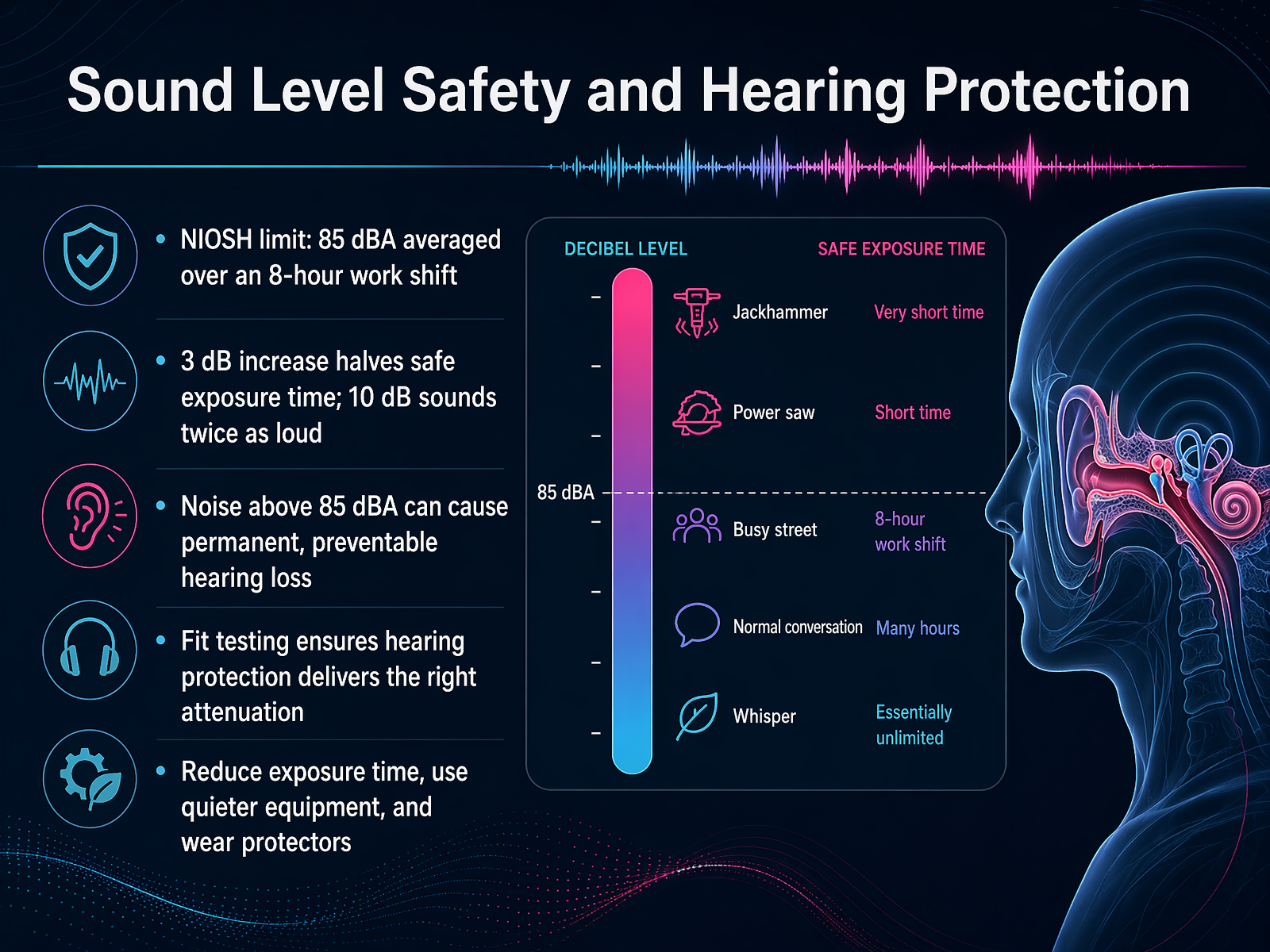
 - 14Sound Level Safety and Hearing ProtectionLet's talk about what happens when sound gets too loud, and how to protect the hearing we rely on every day. NIOSH, the National Institute for Occupational Safety and Health, sets a recommended exposure limit of 85 A-weighted decibels averaged over an eight-hour work shift. Think of it this way: a normal conversation is around 60 to 70 dBA. A lawnmower can easily reach 90. So that 85 dBA mark is a threshold where repeated exposure starts to become hazardous. Here's a critical rule to remember: the 3-decibel exchange rate. For every 3 decibel increase in noise level, the safe exposure time is cut in half. At 85 dBA, you can be safe for eight hours. At 88 dBA, it's only four hours. It's also helpful to know that an increase of 10 decibels is perceived by our ears as roughly twice as loud. Noise above 85 dBA can cause permanent hearing loss, but here's the good news—this damage is 100 percent preventable. The best approach is to reduce the noise at the source or use quieter equipment. When that's not possible, hearing protectors are essential. Fit testing is a key part of this. It measures your personal attenuation rating to make sure your earplugs or earmuffs are actually reducing the noise enough to keep you safe. A proper fit makes all the difference. Up next, we'll explore a different approach to safety: how noise-canceling headphones work.
 2 min
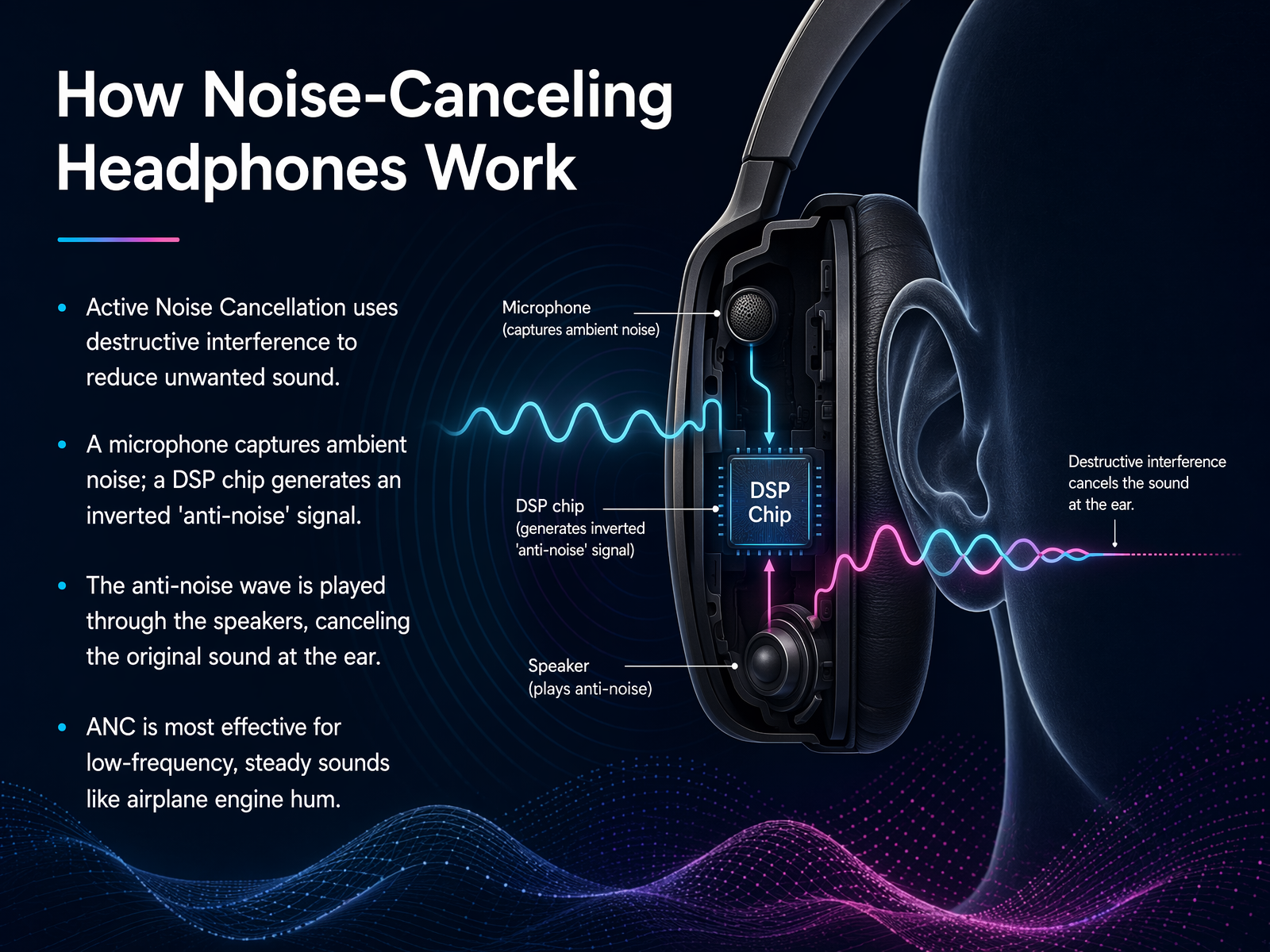
2 min - 15How Noise-Canceling Headphones WorkSo, how do noise-canceling headphones actually create that quiet bubble? It all comes down to something we've touched on before: destructive interference. Think of sound as a wave with peaks and valleys. Active Noise Cancellation works by creating a second wave that is the exact mirror image of the unwanted noise. When the peak of the noise wave meets the valley of this 'anti-noise' wave, they cancel each other out. The process is surprisingly fast. A tiny microphone on the outside of the earcup captures the ambient sound, like the steady hum of an airplane engine. That sound is sent to a digital signal processing chip, which instantly analyzes the wave and generates the inverted, out-of-phase signal. This anti-noise is then played through the headphone's speaker, right alongside your music. It reaches your ear at the same time as the original noise, and they effectively destroy each other, leaving you with near silence. This technology is brilliant, but it's not magic. It works best on low-frequency, steady sounds, exactly because those waves are predictable and don't change quickly. High-pitched, erratic sounds like a baby crying or a sudden dog bark are much harder to cancel in real time. Now that we've seen how we can manipulate waves to create silence, let's zoom out to the final topic: Putting It All Together: Sound Phenomena Explained.
 2 min
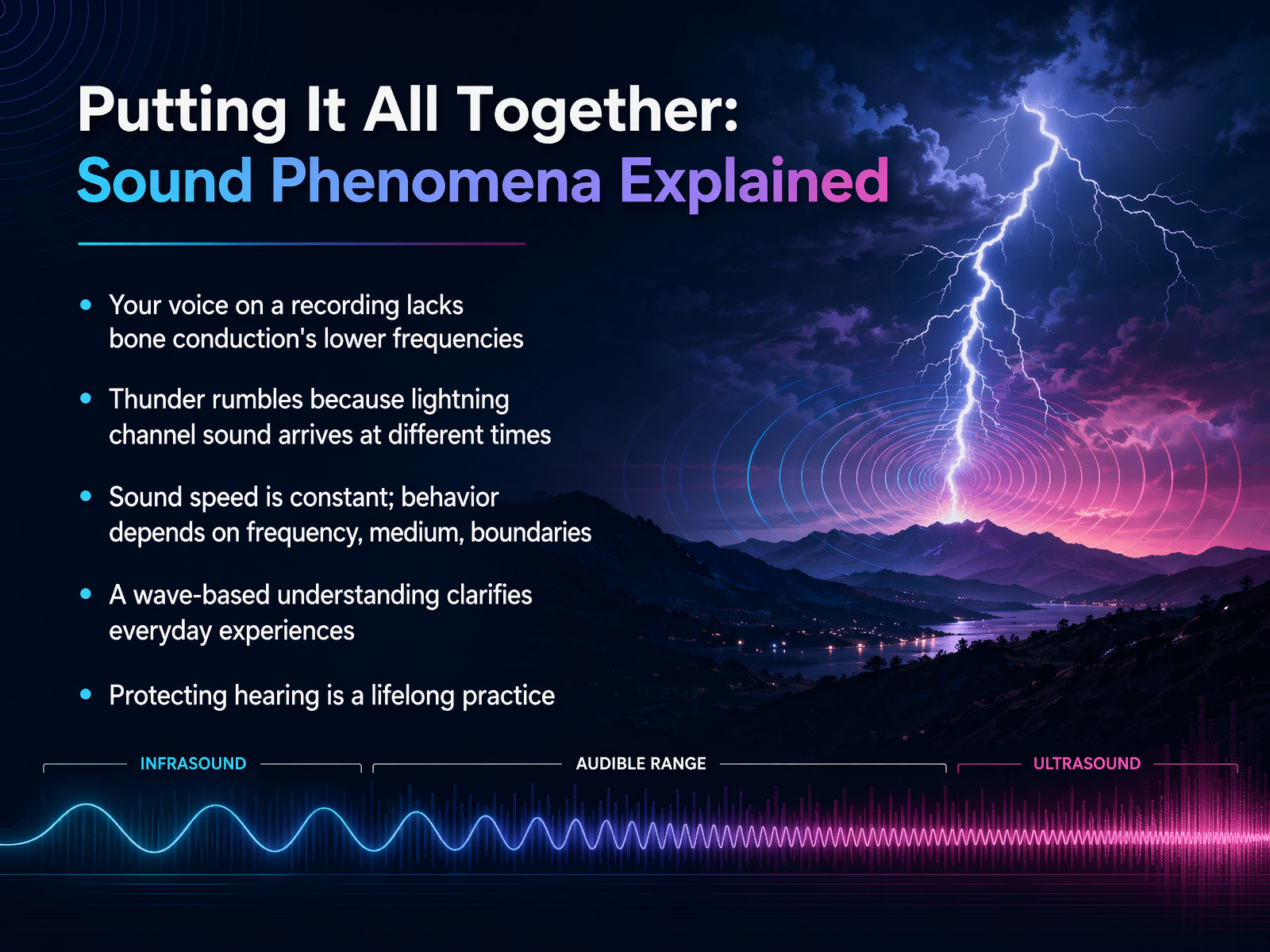
2 min - 16Putting It All Together: Sound Phenomena ExplainedThat brings us to the end of our journey through the science of sound. Think about what we've covered. Why does your voice on a recording sound different? It's because you're missing the lower frequencies that travel to your ears through bone conduction when you speak. And why does thunder rumble instead of just cracking once? The sound from different points along the lightning channel arrives at your ears at slightly different times. We've seen that sound speed stays constant in a given medium, but its behavior—like reflection and absorption—depends heavily on frequency and the boundaries it meets. A wave-based understanding really does clarify so many everyday experiences, from the music you love to the noise you try to avoid. As you go forward, remember that protecting your hearing is a lifelong practice. Thank you for learning with me, and keep listening to the wonderful world around you.
 1 min
1 min
Take the deck with you
Download this course as a file — free, no sign-up needed.
- PDF handoutEvery slide page, ready to print or share.17 pages · 4.4 MBDownload
- Narrated PowerPointThe deck that presents itself — every slide carries the digital human's narration video.17 pages · 35.0 MBDownload
- PowerPoint slidesThe full deck as a .pptx — open it in PowerPoint, Keynote, or Google Slides.17 pages · 4.3 MBDownload
Free to use in your own training — please keep the PersonWise credit page at the end.
Have your own deck? Turn it into a course
Sources consulted
Web sources consulted while building this course.
- Hearing range — en.wikipedia.org
- https://www.voicescience.org/lexicon/audible-range/ — voicescience.org
- Hearing beyond the limit: Measurement, perception and impact of infrasound and ultrasonic noise — icben.org
- Review What is infrasound? — sciencedirect.com
- Frontiers | Rediscovery of a seventh sense: humans produce, perceive, and process ultrasound — frontiersin.org
- Solids and Metals - Speed of Sound — engineeringtoolbox.com
- 17.3: Speed of Sound - Physics LibreTexts — phys.libretexts.org
- Speed of Sound — hyperphysics.gsu.edu
- https://stemcalculators.app/calculators/physics-oscillations-and-waves/sound-waves-and-acoustics/sound-wave-speed-in-media-calculator — stemcalculators.app
- Sound Speeds and Pipe Size Data — dam.bakerhughes.com
- Refraction of Sound Waves - EPOD - a service of USRA — epod.usra.edu
- Why Sounds Travel Farther at Night | COMSOL Blog — comsol.com
- Sound - Refraction, Frequency, Wavelength — britannica.com
- Refraction of Sound Waves — acs.psu.edu
- Sound speed gradient — en.wikipedia.org
- November 7, 1940: Collapse of the Tacoma Narrows Bridge | American Physical Society — aps.org
- The Tacoma Narrows Bridge collapse - Physics Today — physicstoday.aip.org
- Why the Tacoma Narrows Bridge Collapsed - Practical Engineering — practical.engineering
- Old and new explanations of the Tacoma Narrows Bridge collapse — gazzola.faculty.polimi.it
- Tacoma Narrows Bridge (1940) — en.wikipedia.org