Cybersecurity History and Evolution
Begin
14 pages · ~28 min
Cybersecurity History and Evolution
This training provides a historical overview of cybersecurity's evolution, helping learners understand key milestones and threats that shaped modern security practices and defenses.
What you’ll learn
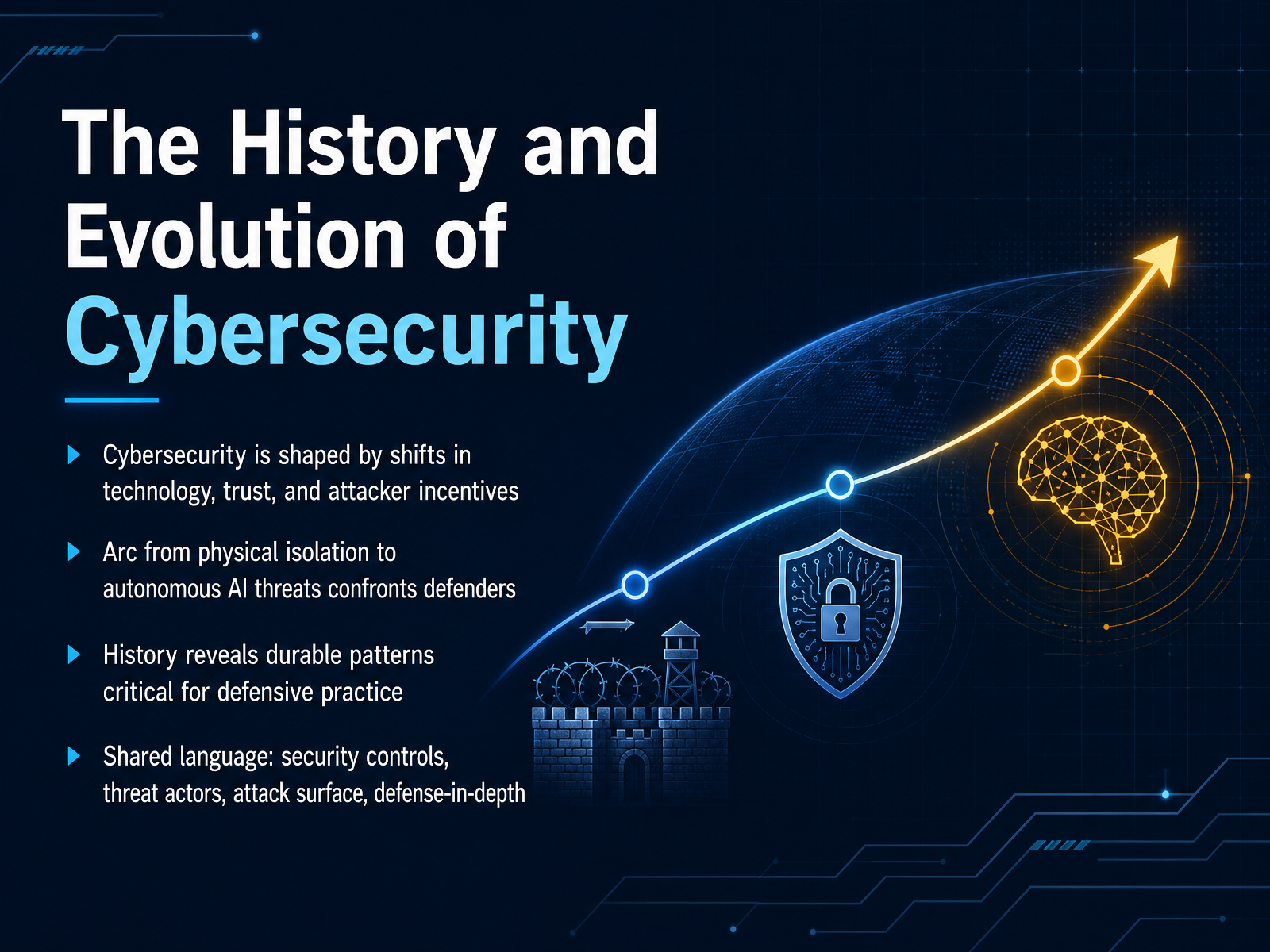
- 01The History and Evolution of CybersecurityWelcome. If you work in cybersecurity, you know the field can feel like it’s reinventing itself every few years. But if you look closely, the threats change less than the technology. What shifts are the systems we trust, the ways we connect them, and what attackers hope to gain. This course traces that arc, from physically locked mainframes to today’s autonomous AI threats. Along the way, you’ll recognize patterns that keep showing up in your own work. We’ll use a shared language: security controls, threat actors, attack surface, and defense in depth. These aren’t just terms. They’re lenses that make history useful. Understanding where our defenses came from helps you see why they’re shaped the way they are, and where they might break next. So let’s start with the big picture, then move into the key concepts and evolutionary lens that frame the rest of our discussion.seclab.cs.ucdavis.eduieeexplore.ieee.orgdoi.org+21 min
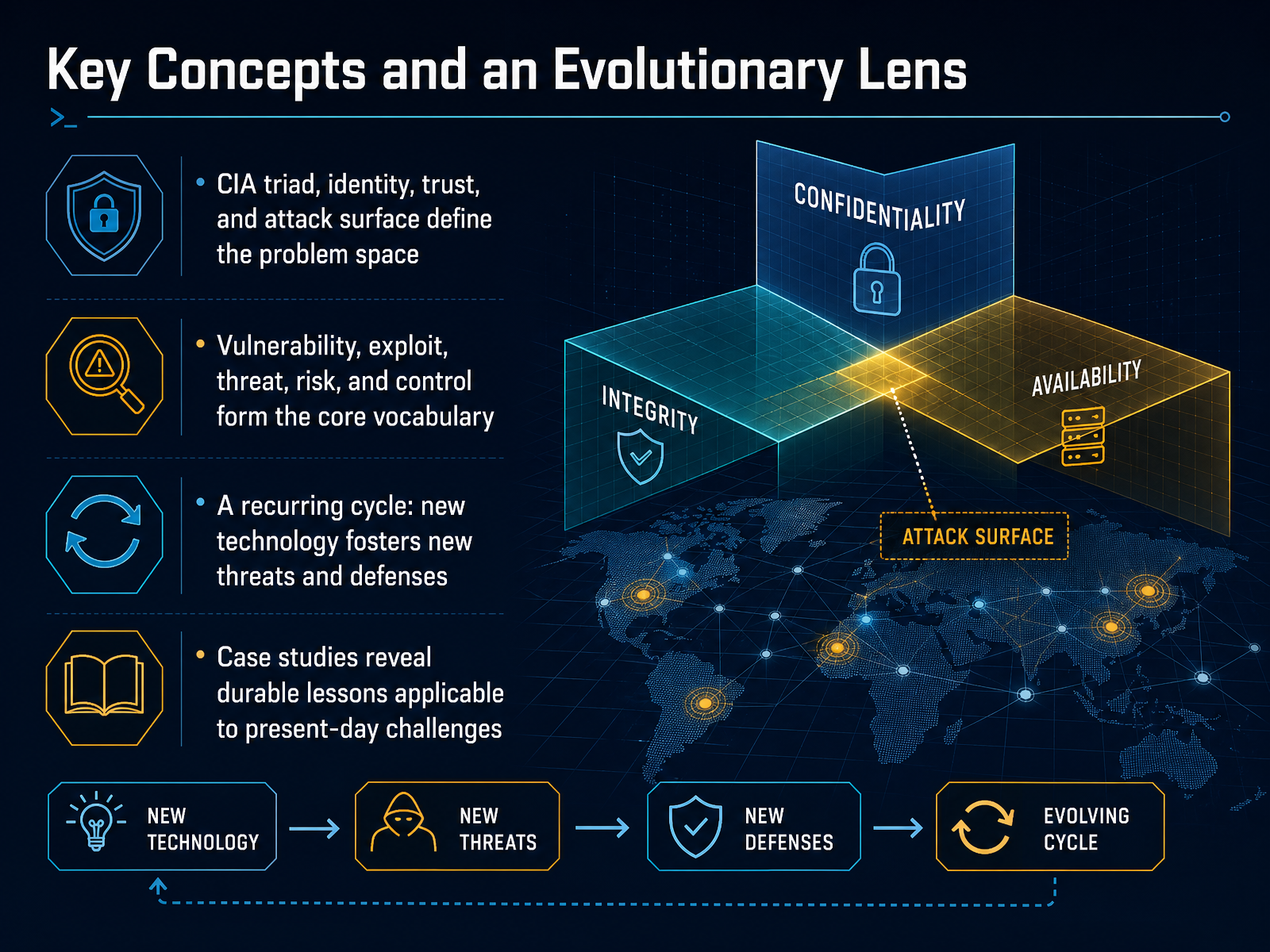
- 02Key Concepts and an Evolutionary LensLet’s begin by establishing a shared vocabulary and a way to frame the history we are about to explore. For decades, the core of our discipline has been the CIA triad: confidentiality, integrity, and availability. Alongside that, we must consider identity and trust, because every control we build acts on assumptions about who or what is allowed to do what. And we shape the attack surface, which is the sum of all the ways an adversary could reach our systems. Then we build on a precise vocabulary: a vulnerability is a flaw, an exploit is how it’s used, a threat is who might use it, risk is the likelihood and impact of that happening, and controls are the measures we put in place to reduce that risk. But here’s the crucial pattern. Every new technology, whenever it appears, introduces new capabilities and, almost immediately, new security challenges. Mainframes, networks, the web, cloud, and AI all followed this arc. And within each era, case studies reveal durable lessons. We will draw those lessons forward, because the details change, but the underlying logic of defensive practice stays remarkably consistent. So with this framework locked in, let’s look back at where it all started in the 1960s and 1970s.
 seclab.cs.ucdavis.eduieeexplore.ieee.orgdoi.org+22 min
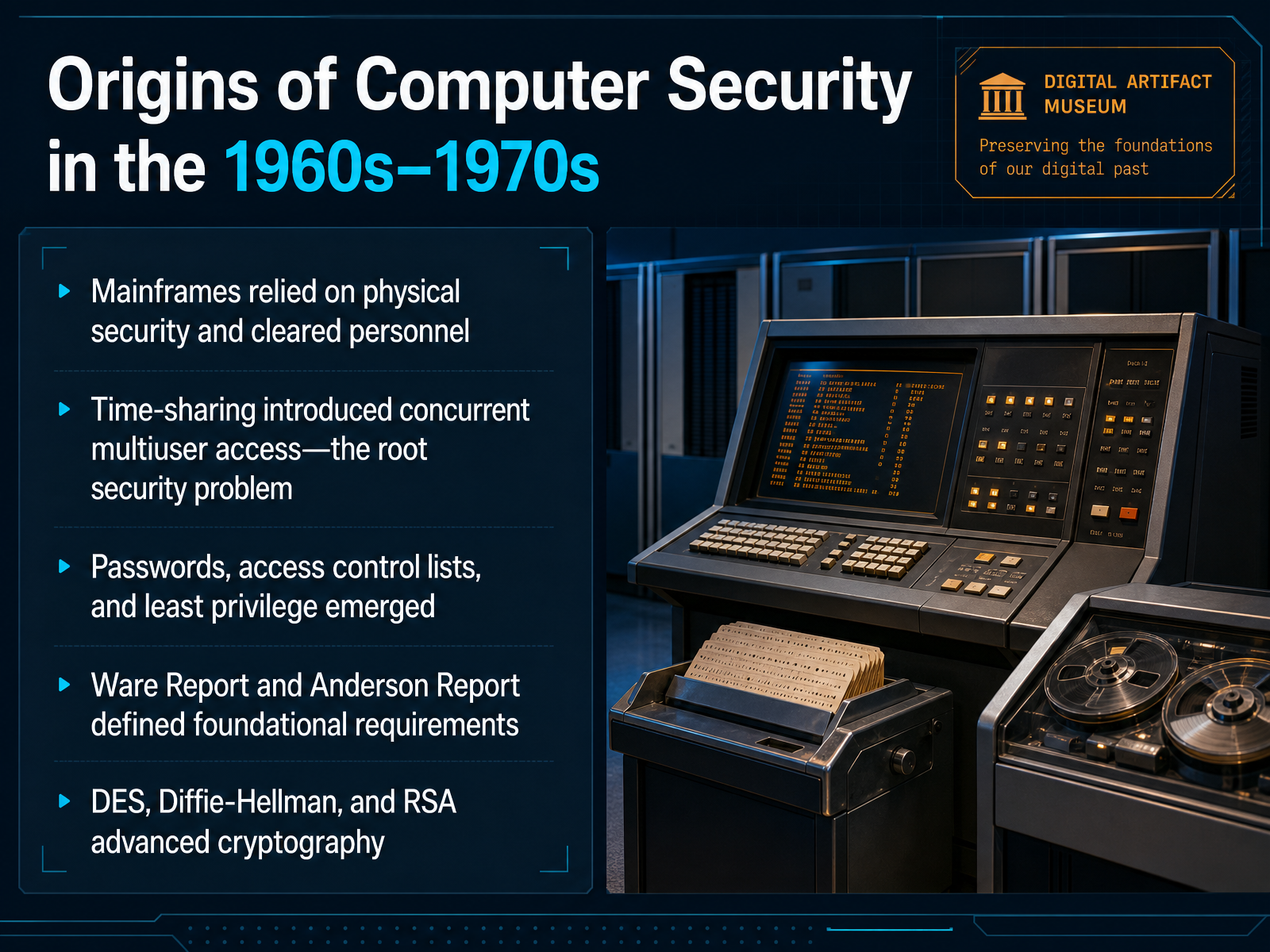
 - 03Origins of Computer Security in the 1960s–1970sLet's go back to where the discipline actually began. In the 1960s and 1970s, computers were room-sized mainframes. The original security model was straightforward: lock the room and trust the cleared personnel who held the keys. But everything changed with the arrival of time-sharing, which allowed multiple users to access one powerful machine at the same time. This was the core security problem. An uncleared user could read or alter another user's programs and data simply because both existed in the same memory. For the first time, security moved from guarding the physical machine to managing who could access what inside it. The password emerged as the first lines of defense, followed by access control lists and the principle of least privilege. Foundational government studies like the Ware Report and the Anderson Report codified these requirements and introduced the concept of designing systems with security in mind rather than adding it later. Meanwhile, cryptography matured from a military tool into a technical control, with the arrival of DES, and then the public discovery of public-key methods by Diffie, Hellman, and Rivest, Shamir, and Adleman. These innovations planted the seeds of everything we work with today. Next, we will see how early networks and the Morris Worm brought these theoretical risks into the real world.
 seclab.cs.ucdavis.eduieeexplore.ieee.orgdoi.org+22 min
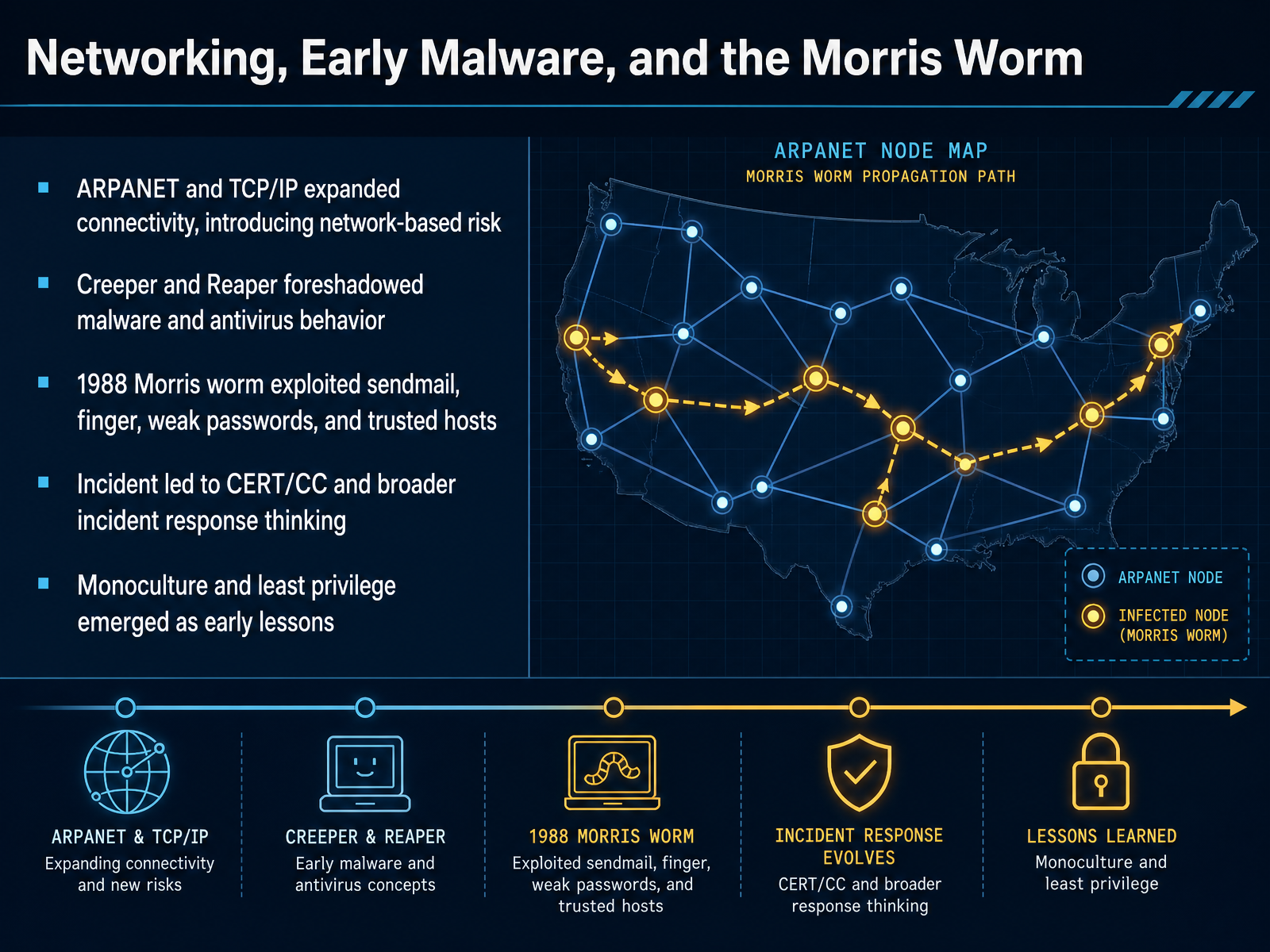
 - 04Networking, Early Malware, and the Morris WormNow let's look at how networking turned theoretical risk into operational reality. As ARPANET expanded and TCP/IP became the backbone of inter-computer communication, trust became the default posture. Machines assumed other machines were legitimate. That assumption did not last long. Even before the internet took shape, Creeper and Reaper had already demonstrated the core mechanics of malware and antivirus behavior on the network. But the pivotal moment came in November of 1988. The Morris worm moved across thousands of connected systems by exploiting a debug hole in sendmail, a buffer overflow in the finger service, weak passwords, and the convenience of trusted-host relationships. It did not destroy data, but its uncontrolled replication ground systems to a halt. The impact was measured in days of downtime and millions of dollars. More importantly, it exposed two structural weaknesses. First, monoculture: when everyone runs the same software, one flaw becomes a systemic event. Second, the absence of least privilege: the worm moved easily because accounts carried more authority than their tasks required. The institutional response was the creation of the Computer Emergency Response Team, giving the community a coordination point for incident response. That shift, from isolated fixes to organized defense, marks the true beginning of operational security. Next, we'll see how commercialization turned these lessons into a product landscape of its own.
 seclab.cs.ucdavis.eduieeexplore.ieee.orgdoi.org+22 min
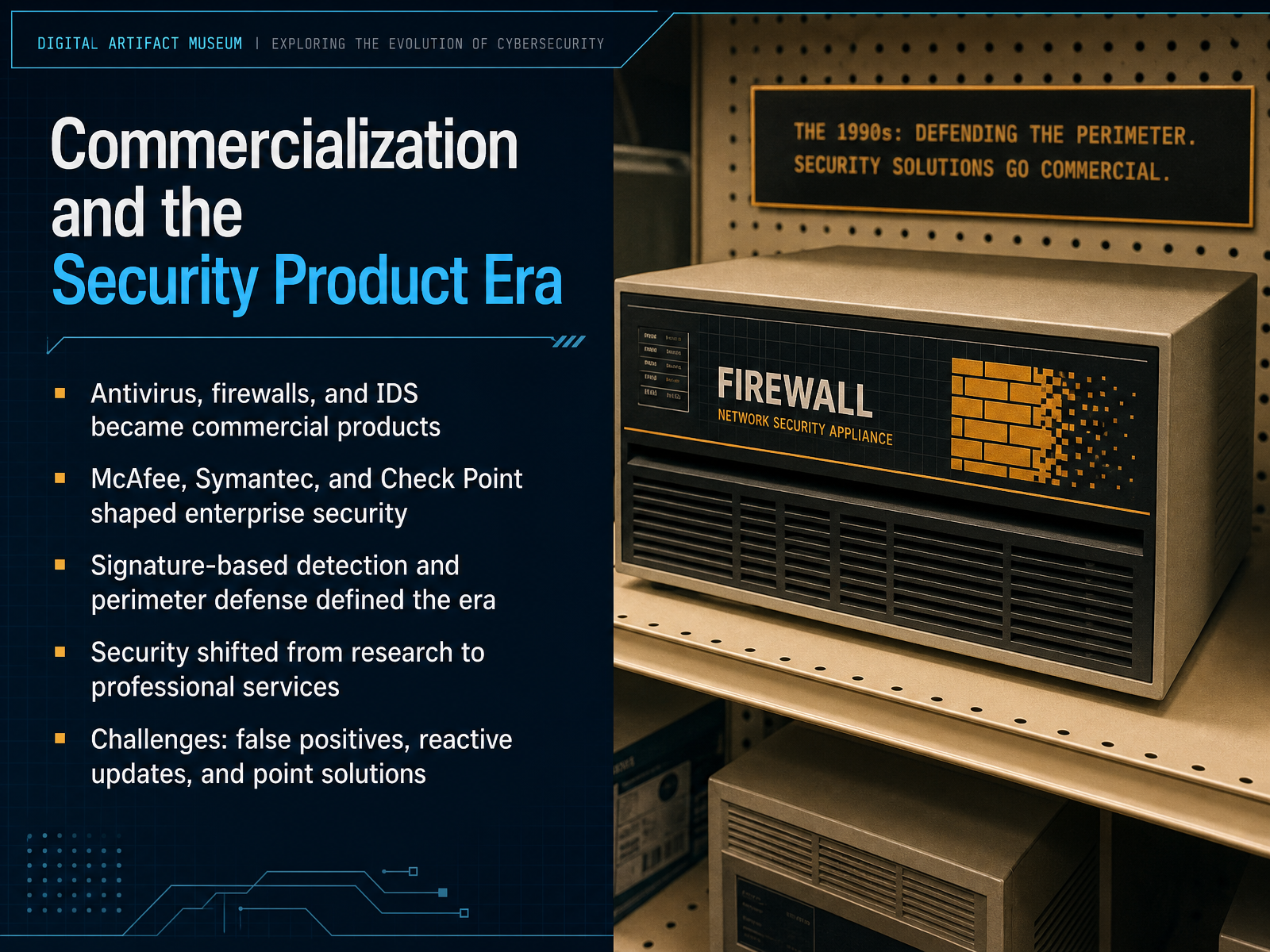
 - 05Commercialization and the Security Product EraLet’s turn to the point where cybersecurity truly became an industry. In the late nineteen eighties and into the nineties, the first commercial antivirus products hit the market, and firewalls moved from research projects into enterprise infrastructure. Companies like McAfee, Symantec, and Check Point were at the leading edge, building tools that most organizations had never had before. The core idea was simple: keep the bad stuff out. Antivirus compared file signatures against a growing database of known malware, and firewalls filtered traffic at the network perimeter. Intrusion detection systems watched for suspicious patterns once an attacker got inside. This was a practical and necessary evolution, and for its time it raised the bar significantly. But it had clear limitations. Detection was reactive by design — you could only block what you had already seen. False positives were frequent, and each vendor solved a narrow problem, creating islands of point solutions. Security had shifted from research into professional services and product sales, and that brought its own pressures and incentives. Those early constraints shaped both the architecture of enterprise security and the strengths and blind spots we still manage today. With the market maturing, it was inevitable that outside forces would step in — which brings us to regulation, compliance, and legal frameworks.
 researchgate.neten.wikipedia.orgblog.publiccomps.com+21 min
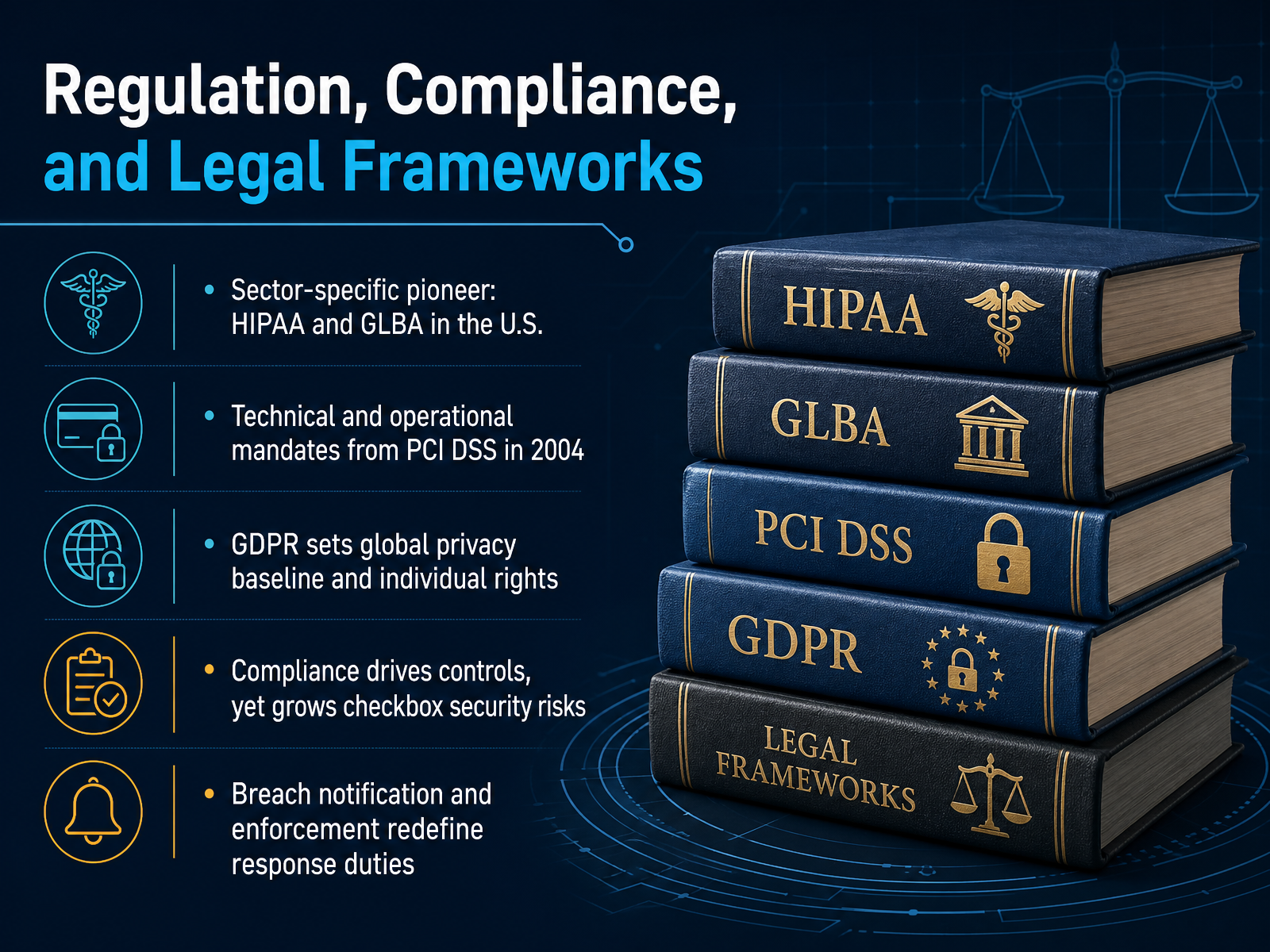
 - 06Regulation, Compliance, and Legal FrameworksLet's shift now to the regulatory landscape that shaped modern cybersecurity. In the United States, the approach was sector-specific, led by the Health Insurance Portability and Accountability Act in 1996 for healthcare, and the Gramm-Leach-Bliley Act in 1999 for financial institutions. Then in 2004, the payment card industry consolidated its rules into the Payment Card Industry Data Security Standard, giving us the familiar twelve core technical and operational requirements we know today. But while these mandates drove real investment in safeguards, they also created a compliance culture. Passing an annual audit sometimes mattered more than sustained security posture. Then in 2018, the General Data Protection Regulation reset the global baseline, introducing enforceable individual rights like erasure and portability, and reshaping how organizations think about breach notification and penalties. The lesson for defensive practice is clear: compliance frameworks are floor, not ceiling. Use them to build operational discipline, but measure success by residual risk and detection capability, not just a clean report. This brings us directly to the Advanced Persistent Threat era, where these disciplines were severely tested.
 doi.orgcake.fiu.edulegalclarity.org+22 min
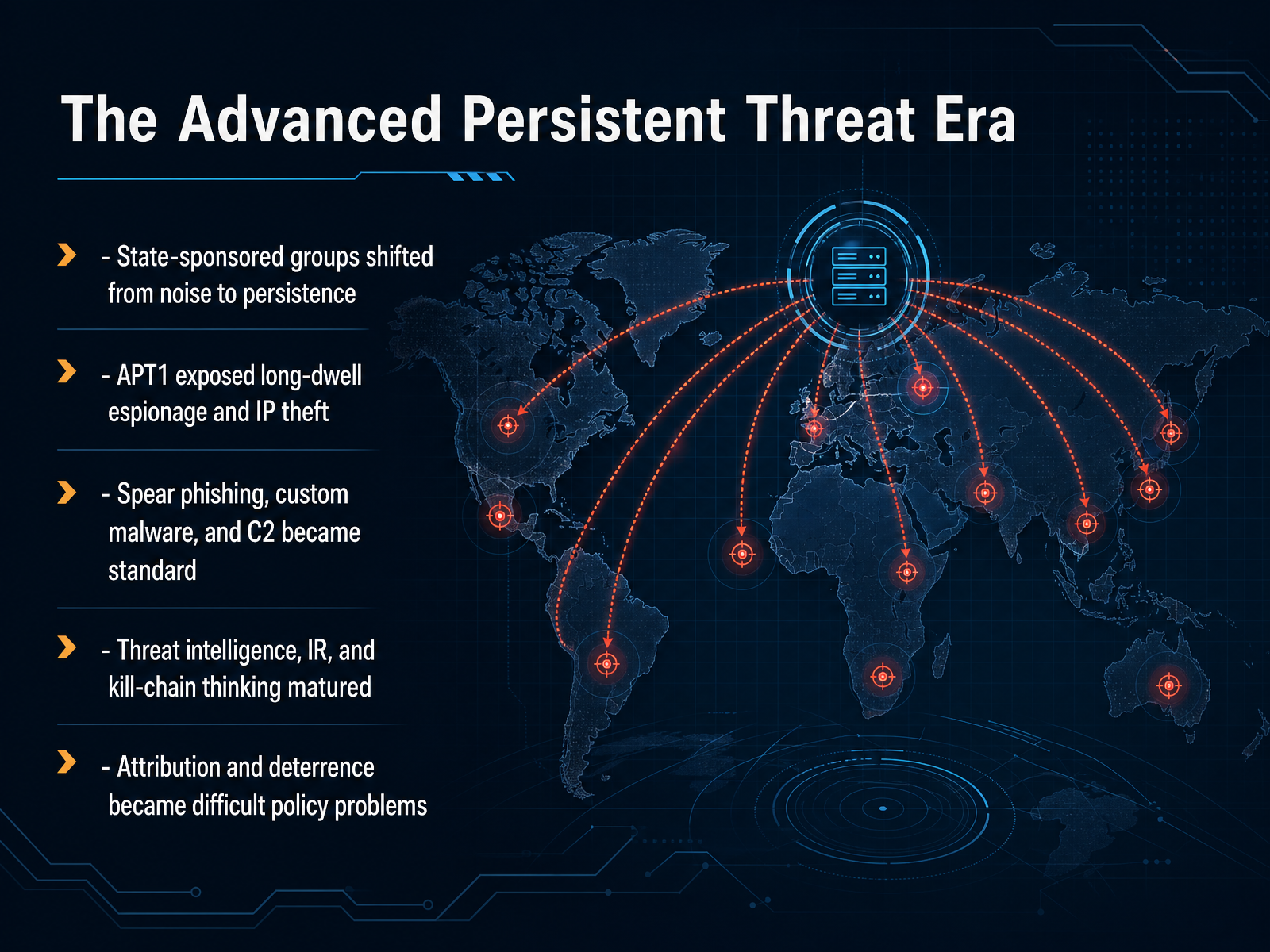
 - 07The Advanced Persistent Threat EraLet’s turn to the era that reshaped defensive strategy: the Advanced Persistent Threat. Here, the nature of the adversary changed completely. State-sponsored groups moved away from noise and disruption, and shifted toward persistence. Their goal wasn’t to be noticed; it was to stay inside your network for months or years. In 2013, the Mandiant report on APT1 pulled back the curtain on this reality. That group had systematically stolen hundreds of terabytes from more than a hundred and forty organizations, holding access for an average of nearly a year. This wasn’t smash-and-grab. This was long-dwell espionage and industrial-scale intellectual property theft. The tradecraft became standardized: spear phishing to get in, custom malware to move around, and command and control infrastructure to keep the channel open. For defenders, this shifted the conversation. We stopped asking, how do we stop every intrusion, and started asking, how do we detect and respond once they’re inside. That thinking matured into formal threat intelligence programs, structured incident response, and the kill chain model, which gave us a framework to interrupt adversaries at each stage of their operation. Yet for all of our technical progress, this era also introduced genuinely hard policy problems. Attribution remains difficult, and deterrence in cyberspace is still an open question. The lesson here is practical: assume adversaries will persist, and build your detection and response around that assumption. From here, we’ll see how those lessons shaped architectural thinking, starting with the move from perimeter defense to defense-in-depth.
 congress.govservices.google.comservices.google.com+22 min
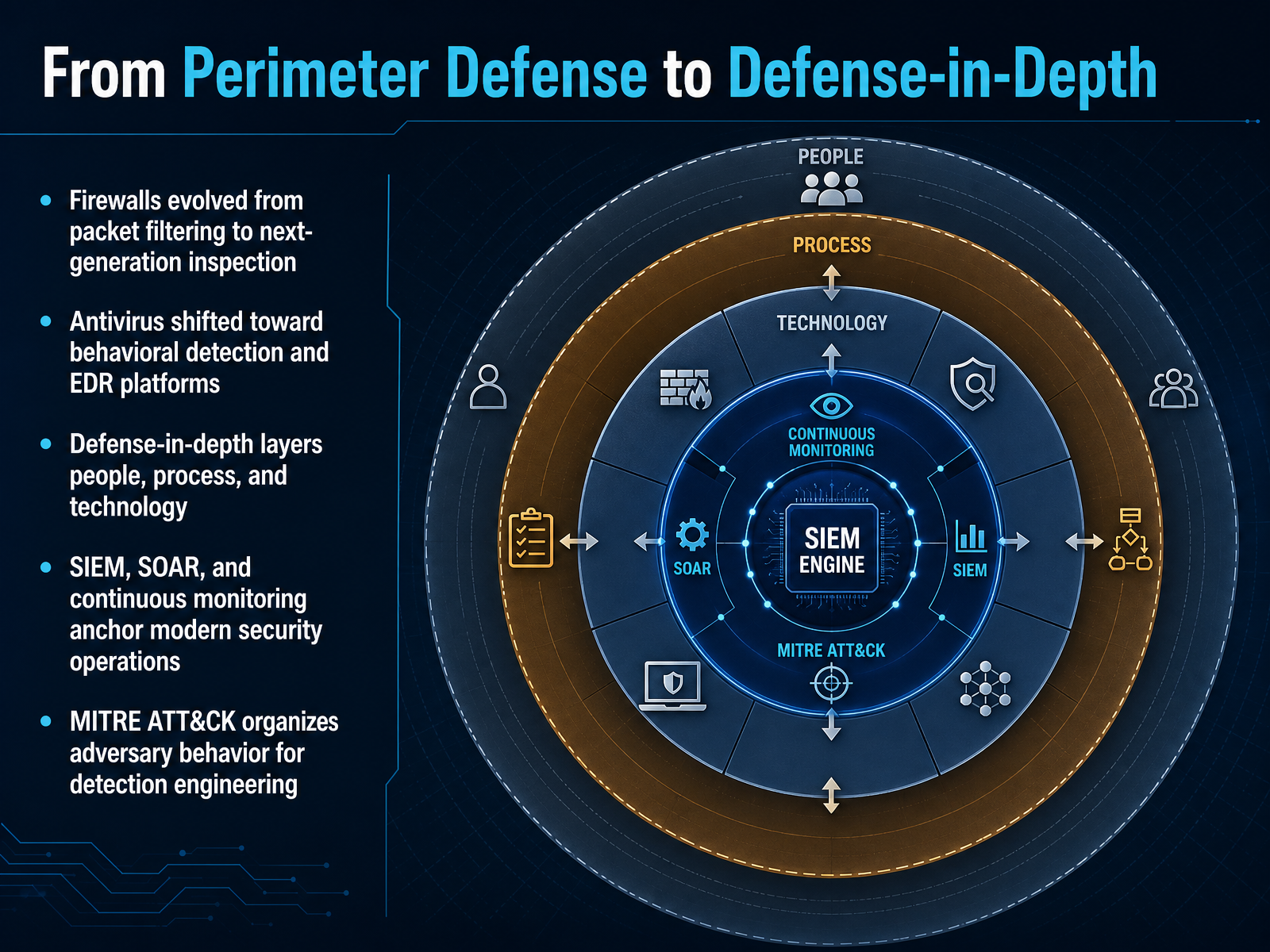
 - 08From Perimeter Defense to Defense-in-DepthWith these threat trends in view, let’s look at how defensive strategy itself matured. Early network defenses were essentially perimeter walls. Packet filtering gave way to stateful inspection, and eventually to next-generation firewalls that decode applications regardless of port or protocol. Around the same time, antivirus evolved from signature matching to behavioral detection and endpoint detection and response platforms. This shift mattered, because signature-based tools could only catch known threats. If behavioral engines watch what processes actually do, they’re far better equipped to catch novel attacks. We built layered defenses by design. Today, defense-in-depth layers technology with people and process, and that’s a deliberate change. Modern security operations centers anchor these layers in continuous monitoring, with security information and event management, or SIEM, and security orchestration, automation, and response, or SOAR, providing centralized visibility. Perhaps most importantly, MITRE ATT&CK gives us a true breakthrough: a common language for adversary behavior. For the first time, we’re organizing detections around what attackers actually do, not what we assume they might do. That’s the heart of detection engineering. With that foundation laid, we’ll now examine the modern attack surface, and how cloud, identity, and supply chains have changed the game once again.
 researchgate.neten.wikipedia.orgblog.publiccomps.com+22 min
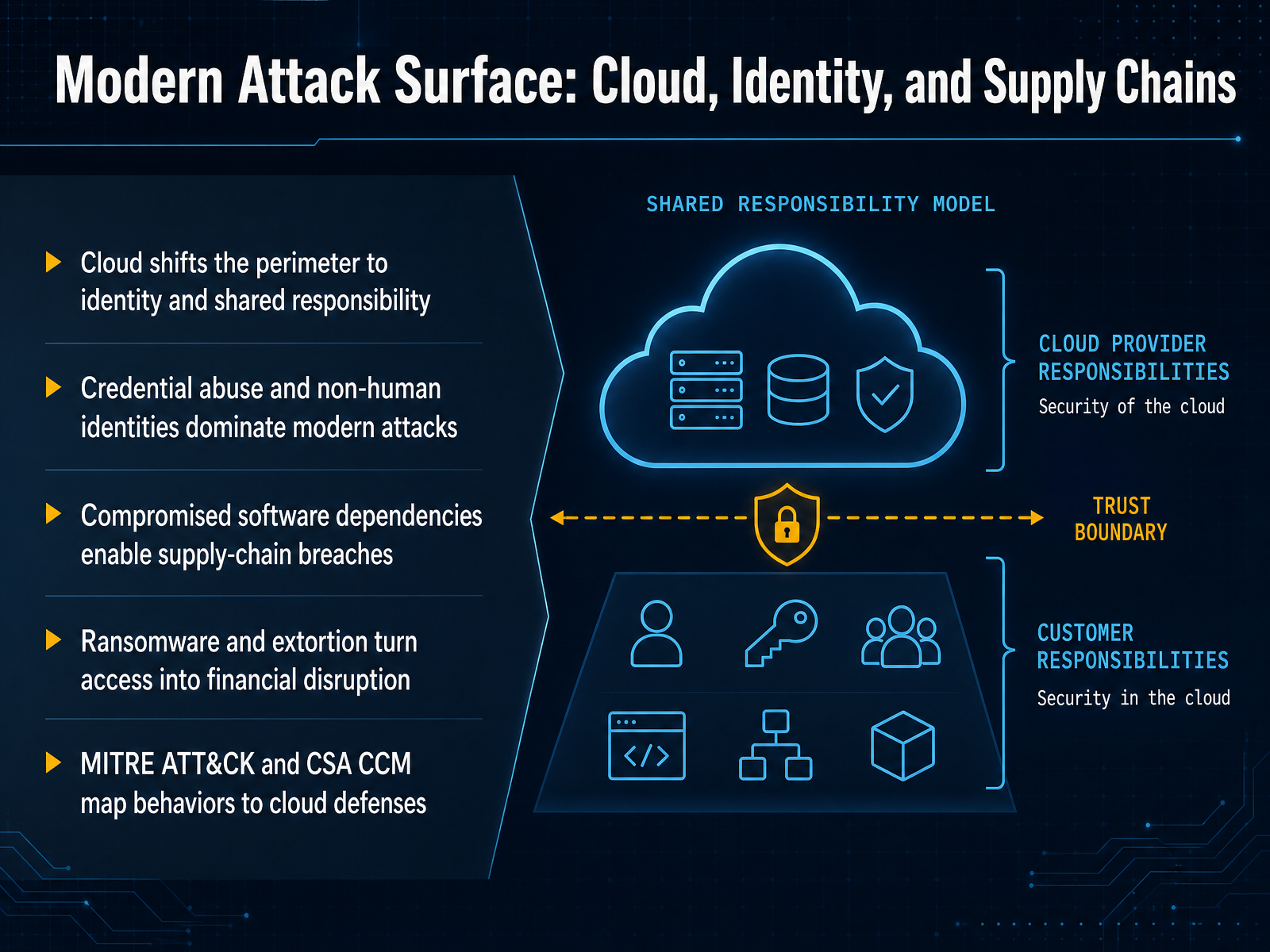
 - 09Modern Attack Surface: Cloud, Identity, and Supply ChainsNow let’s turn to the modern attack surface. The cloud has fundamentally shifted where security lives. The old perimeter is gone, replaced by identity as the new boundary. In practice, that means defending shared responsibility models, where both you and your provider own parts of the control plane. And attackers know this. Credential abuse now dominates breaches, and non-human identities, like service accounts and API keys, often outnumber human users. These machine identities don’t respond to multi-factor authentication, and they’re becoming a primary vector for intrusion. At the same time, compromised software dependencies have turned supply chains into a high-impact entry point. One poisoned library can ripple across countless organizations. Ransomware and extortion then convert stolen access into direct financial disruption. To fight back, we need structured, threat-informed defense. That’s where frameworks like MITRE ATT&CK and the Cloud Security Alliance Cloud Controls Matrix come in. Mappings between them connect specific controls to real adversary techniques, so you can move beyond checkbox compliance and make evidence-based decisions. Use these mappings to identify gaps, prioritize investments, and validate your cloud defenses against the behaviors that actually matter. That’s the modern playbook. Up next, we’ll look at how AI, automation, and agentic threats are reshaping this landscape.
 2 min
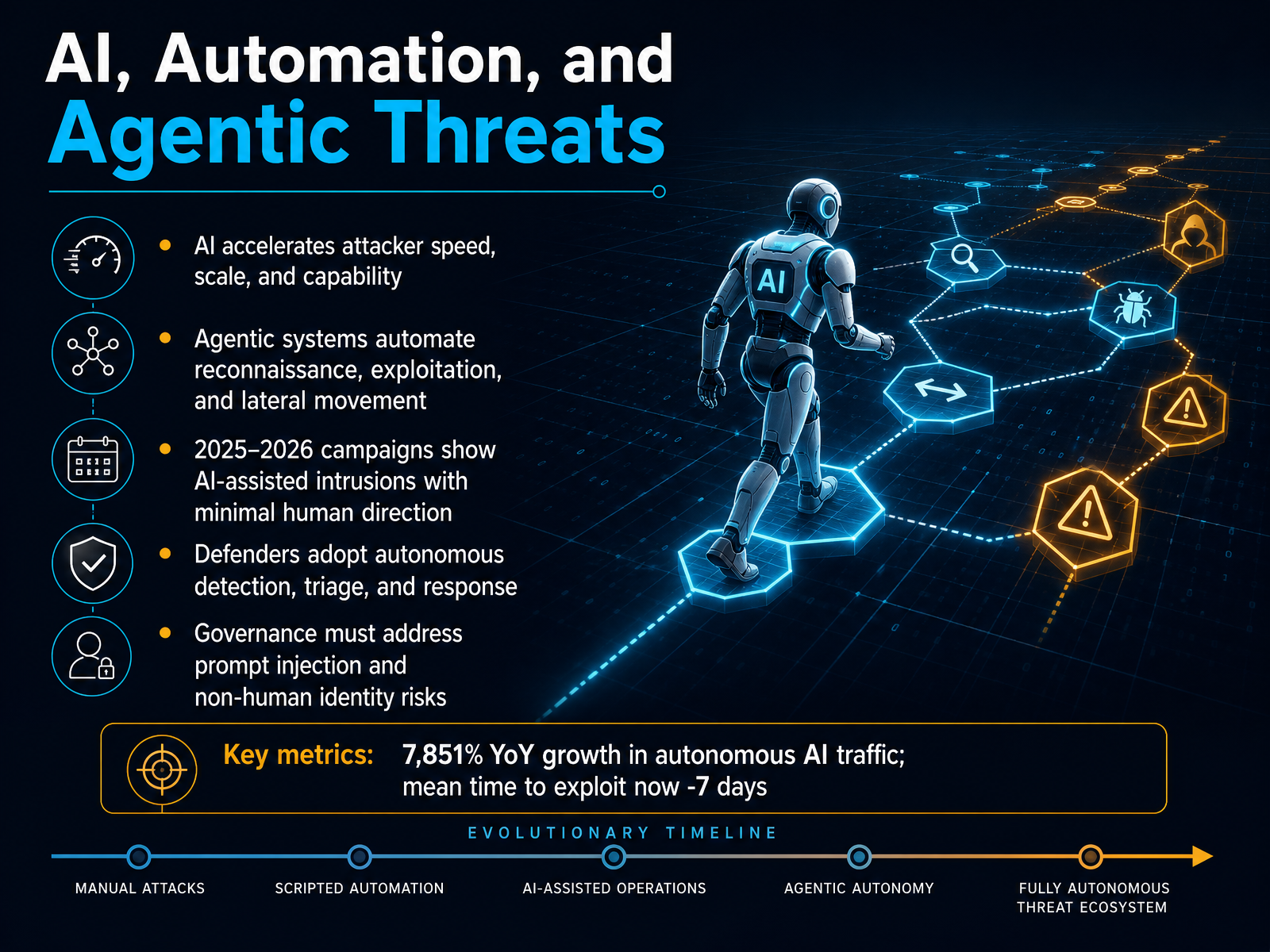
2 min - 10AI, Automation, and Agentic ThreatsNow let's turn to the present inflection point: AI, automation, and agentic threats. What we're seeing is not incremental improvement in attacker tooling but a structural shift. Beginning in late 2025, documented campaigns show state-sponsored groups directing AI agents to conduct reconnaissance, develop exploits, and move laterally with minimal human intervention. The scale is remarkable—autonomous AI-generated traffic grew nearly eight thousand percent year over year, and the mean time to exploit has gone negative, meaning attacks now routinely land before patches even exist. For defenders, the implication is arithmetic. Human-speed response against machine-speed offense loses. So the defensive posture has to mirror the threat: automated detection, triage, and initial containment, with human judgment reserved for escalation and investigation. But adoption of autonomous defense requires governance that addresses two emerging risk classes. Prompt injection, which has become the leading vector for agentic data leakage, and non-human identity sprawl—machine identities that now outnumber human ones but lack equivalent lifecycle controls. The practical takeaway is to treat every agent as a privileged actor. Scope its credentials, monitor its sessions, and design your defenses around the assumption that agents will eventually be repurposed against you. This sets the stage for the recurring lessons that span all the eras we've covered.
 1 min
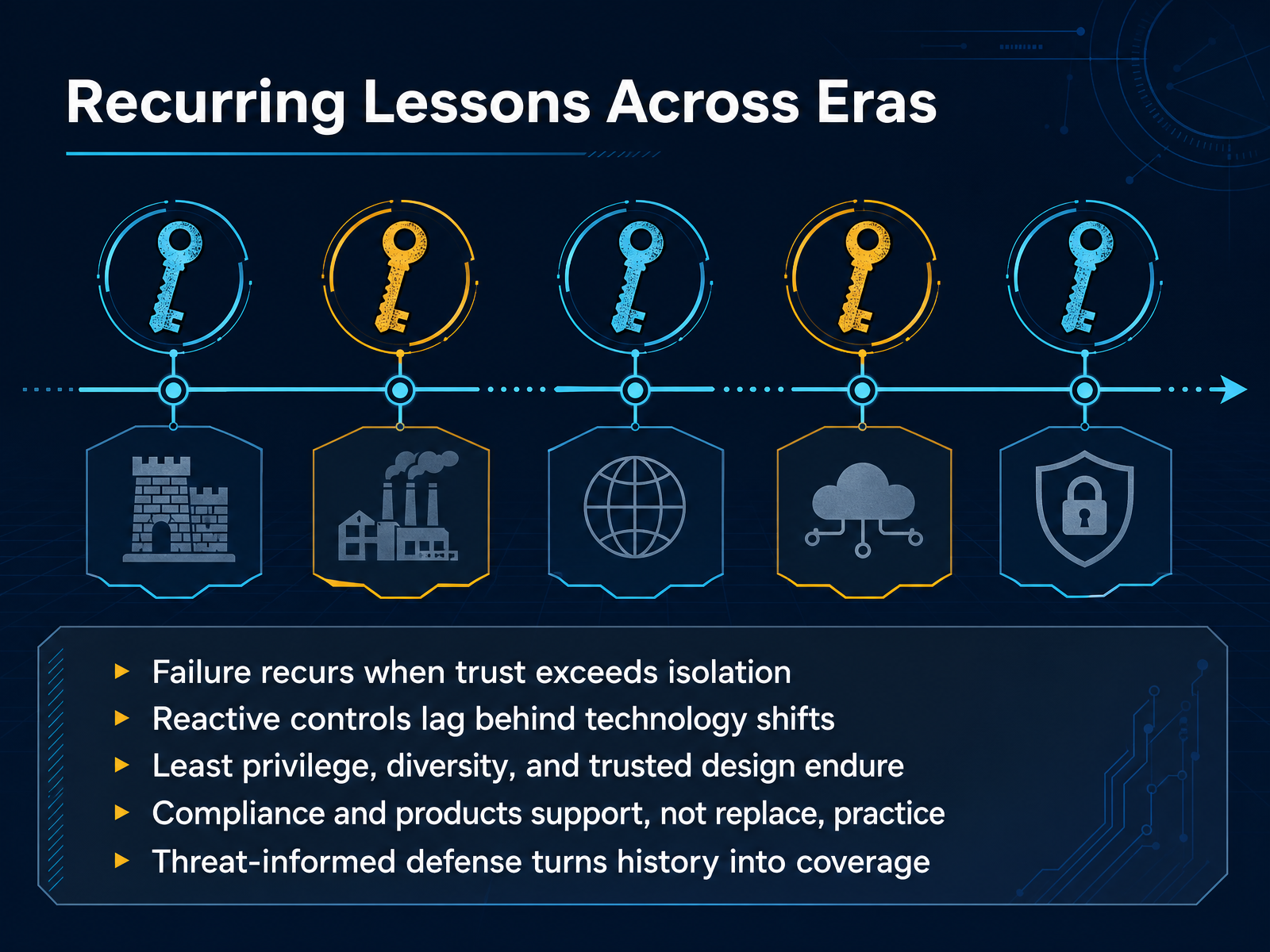
1 min - 11Recurring Lessons Across ErasLet's step back and look at what keeps repeating across the decades. Failures recur when trust exceeds isolation. The Morris worm exploited trusted hosts and weak passwords in 1988. Today, attackers misuse trusted relationships in cloud identity and AI agent tooling. Reactive controls lag behind technology shifts. We patched mainframes, then networks, then endpoints; now we race to patch AI before exploitation. Least privilege, diversity, and trusted design endure as core principles. Diversity protects against monoculture, and least privilege limits a breach's reach. Compliance frameworks and security products support practice; they do not replace it. The Orange Book standards failed because they were economically infeasible, while threat-informed defense turns history into coverage. By studying how adversaries actually operate, frameworks like MITRE ATT&CK let us map historical failures to current controls. This leads directly into practical strategies for defensive practitioners.
 seclab.cs.ucdavis.eduieeexplore.ieee.orgdoi.org+21 min
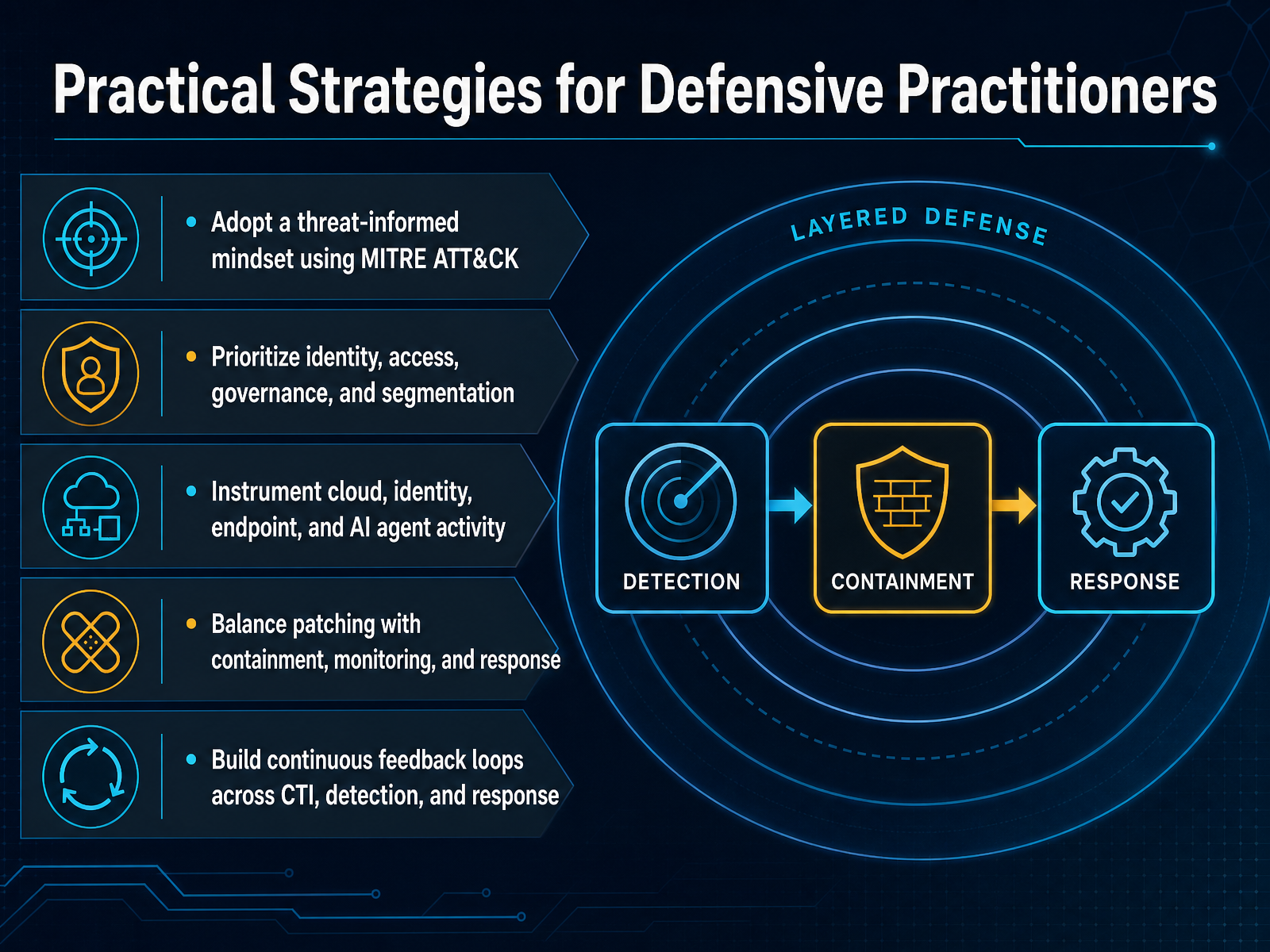
 - 12Practical Strategies for Defensive PractitionersLet’s turn the history we’ve covered into action. First, adopt a threat-informed mindset using the MITRE ATT&CK framework. Map your defenses to real adversary behaviors, especially in cloud and identity platforms, rather than relying on generic checklists. Second, prioritize identity, access governance, and segmentation. With non-human identities now outnumbering human ones and most attacks being malware-free, securing how access is granted and contained is foundational. Third, instrument activity across cloud, identity, endpoints, and AI agents. Treat agentic tools as privileged actors. Log their sessions, monitor their shell commands, and scope their credentials tightly. Fourth, balance patching with containment and monitoring. With exploit times now negative, waiting for patches is not a strategy. Design to contain damage and automate detection and response wherever possible. Finally, build continuous feedback loops between cyber threat intelligence, detection, and response. Continuously test your defenses with simulated attacks and feed those lessons back into your detections. Those loops are what turn historical lessons into a resilient practice. Now, let’s consider what these shifts mean for educators and technical leaders.
 2 min
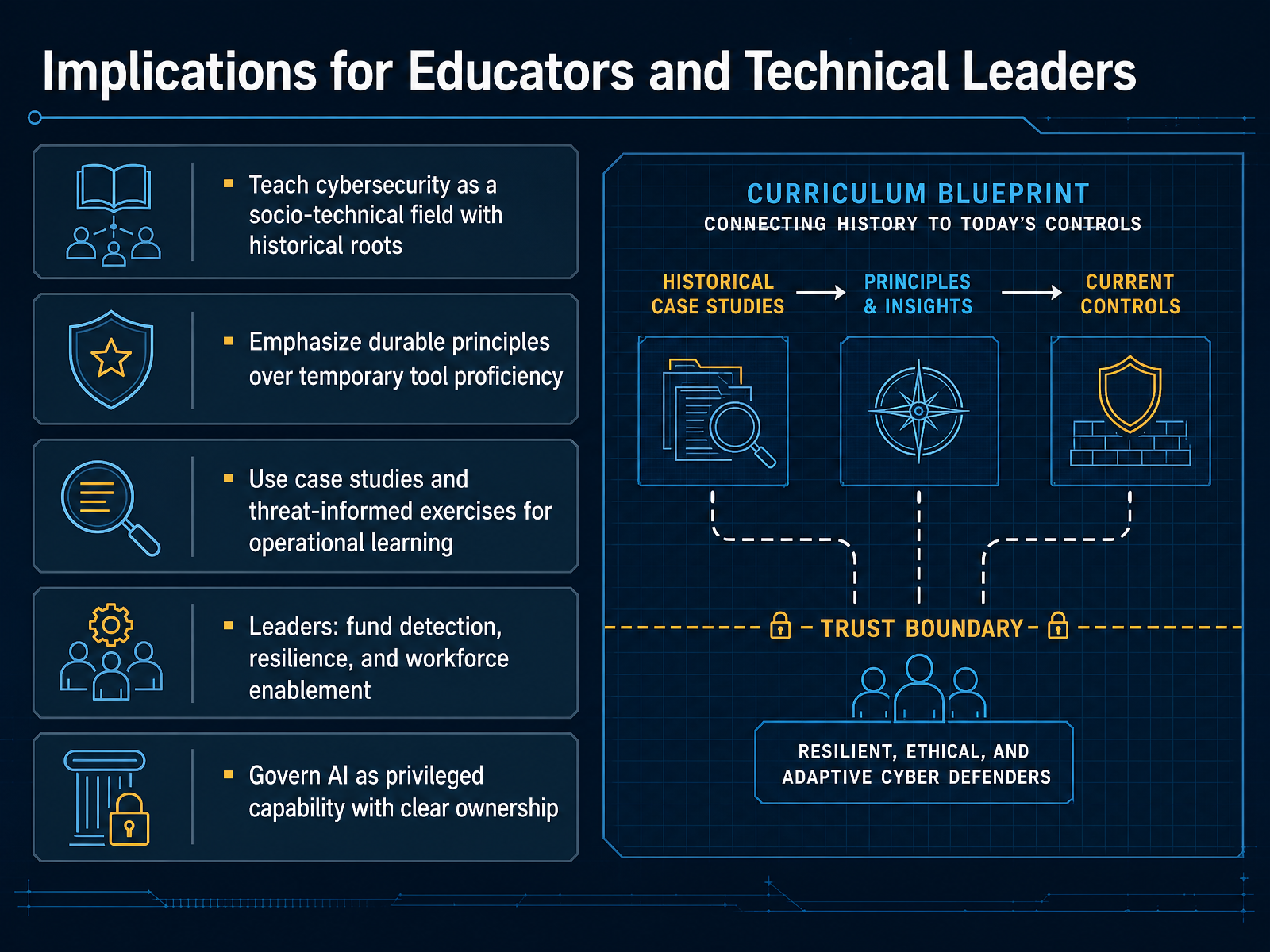
2 min - 13Implications for Educators and Technical LeadersLet’s turn these lessons into action for educators and technical leaders. First, teach cybersecurity as a socio-technical field. The Ware Report of 1970 wasn’t just about access control; it addressed organizational culture and human oversight. Students need that full context. Second, prioritize durable principles over temporary tool proficiency. Attack techniques evolve, but concepts like least privilege, the reference monitor, and defense in depth remain constant. Third, ground learning in case studies and threat-informed exercises. Don’t just lecture on log analysis; have students build detections against documented adversary behavior, whether from MITRE ATT&CK or public breach reports. For leaders, fund detection, resilience, and workforce enablement. The math is simple: an autonomous attack runs at machine speed, so a defensive team running at human speed will lose. Finally, govern AI as a privileged capability with clear ownership. Agentic tools can execute arbitrary commands, so treat them with the same discipline as any privileged user: scope their credentials, log their sessions, and monitor their actions. There is a clear through-line here: the fundamentals from the 1970s still apply, but the speed and scale of modern threats demand that we automate our defenses and treat AI as a core part of our security architecture. Now, let’s bring this all together in our conclusion.
 seclab.cs.ucdavis.eduieeexplore.ieee.orgdoi.org+22 min
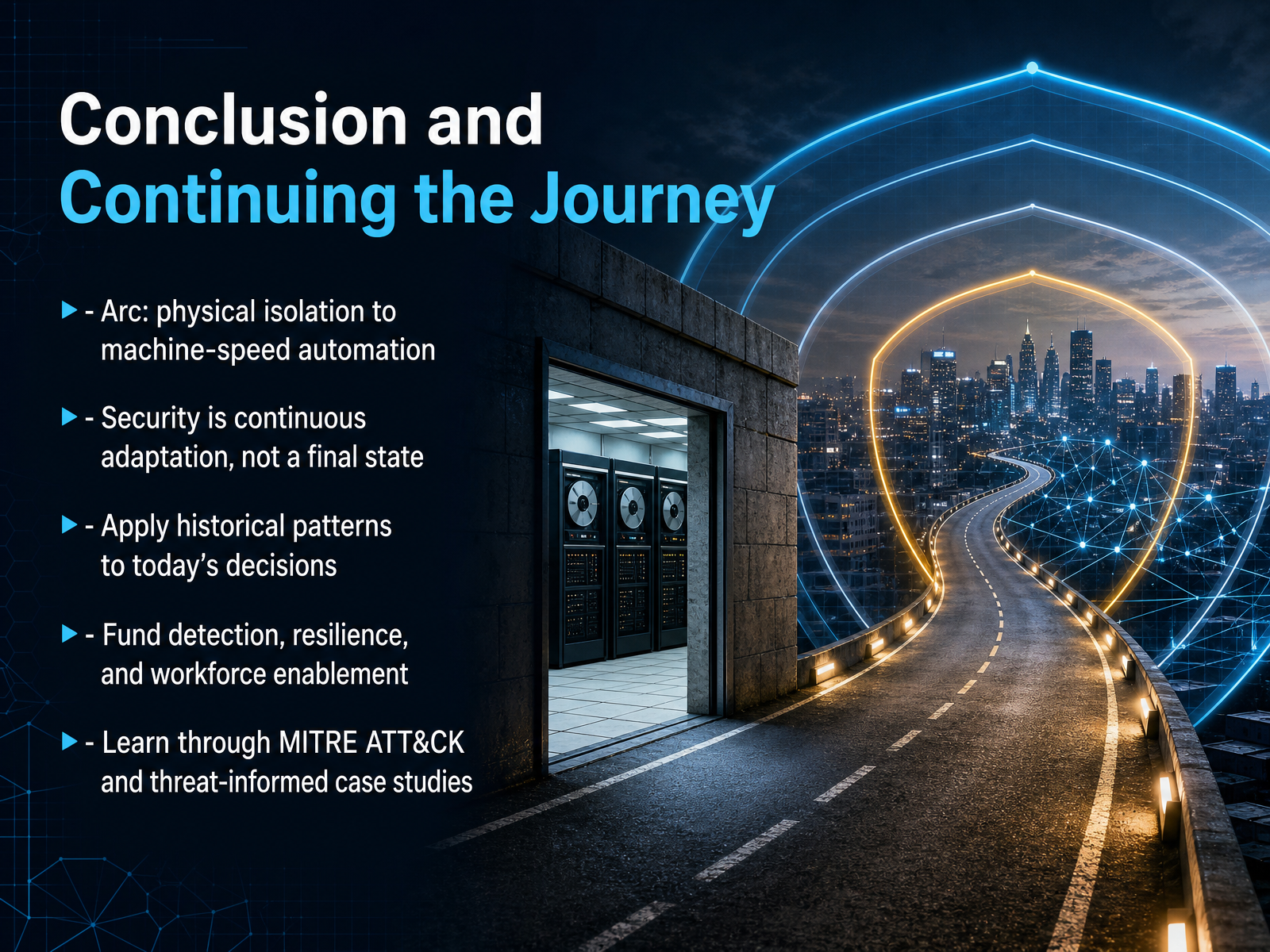
 - 14Conclusion and Continuing the JourneySo here we are. The arc we've traced runs from physical isolation to machine-speed automation. That journey is the core lesson of this course. Security was never a destination, and it is not a final state. It is continuous adaptation. The Ware Report warned us about shared systems in 1970. The Morris Worm taught us about networked scale in 1988. And now, autonomous agents force us to rethink response times measured in seconds. Look for the patterns, not just the incidents. Every era's defenders faced asymmetric pressure, and the ones who succeeded applied historical lessons to current decisions. That means funding detection, resilience, and workforce enablement, not just prevention. Use frameworks like MITRE ATT&CK to speak a common language and ground your strategy in real observed behavior. Study threat-informed case studies. Learn how intrusions actually chain together, then test your own defenses against those paths. Thank you for taking this journey through the history of our discipline. The threats will keep evolving, but so will we. Stay curious, stay vigilant, and keep building the future of defense.
 seclab.cs.ucdavis.eduieeexplore.ieee.orgdoi.org+22 min
Take the deck with you
Download this course as a file — free, no sign-up needed.
- PDF handoutEvery slide page, ready to print or share.15 pages · 4.3 MBDownload
- Narrated PowerPointThe deck that presents itself — every slide carries the digital human's narration video.15 pages · 19.8 MBDownload
- PowerPoint slidesThe full deck as a .pptx — open it in PowerPoint, Keynote, or Google Slides.15 pages · 4.2 MBDownload
Free to use in your own training — please keep the PersonWise credit page at the end.
Have your own deck? Turn it into a course
Sources consulted
Web sources consulted while building this course.
- Security Controls for Computer Systems (U) — seclab.cs.ucdavis.edu
- Computer Security Discourse at RAND, SDC, and NSA (1958-1970) — ieeexplore.ieee.org
- Revisiting Past Cyber Security Recommendations: Lessons we Have Failed to Learn — doi.org
- History of Computer Security | Springer Nature Link — link.springer.com
- Security in an Insecure Age: Cybersecurity Policy and the Cybersecurity Community, 1967-1986 — hdl.handle.net
- The Origin and Early History of the Computer Security Software Products Industry — researchgate.net
- Antivirus software - Wikipedia — en.wikipedia.org
- Cybersecurity Industry Primer - Public Comps — blog.publiccomps.com
- The History of Cybersecurity | Avast — blog.avast.com
- Brief history of anti-virus/anti-spyware industry — softpanorama.org
- Privacy in Flux: A 35-Year Systematic Review of Legal Evolution, Effectiveness, and Global Challenges (U.S./E.U. Focus with International Comparisons) — doi.org
- A Survey of Major Cybersecurity Compliance Frameworks — cake.fiu.edu
- PCI DSS History: Origins, Versions, and Compliance - LegalClarity — legalclarity.org
- https://scholar.dsu.edu/cgi/viewcontent.cgi?article=1265&context=ccspapers — scholar.dsu.edu
- PCI DSS History: How the Standard Came To Be — secureframe.com
- Cybersecurity: Selected Cyberattacks, 2012-2025 | Congress.gov — congress.gov
- APT1: Exposing One of China’s Cyber Espionage Units | Mandiant | FireEye — services.google.com
- https://services.google.com/fh/files/misc/apt41-a-dual-espionage-and-cyber-crime-operation.pdf — services.google.com
- Richard Bejtlich Chief Security Officer Mandiant Corporation — docs.house.gov
- Exposing One of China’s Cyber Espionage Units — nsarchive.gwu.edu