Thermal Energy Transfer
Begin
16 pages · ~32 min
Thermal Energy Transfer
This training explains how thermal energy moves, covering the fundamentals of heat and temperature for learners building foundational physics knowledge.
What you’ll learn
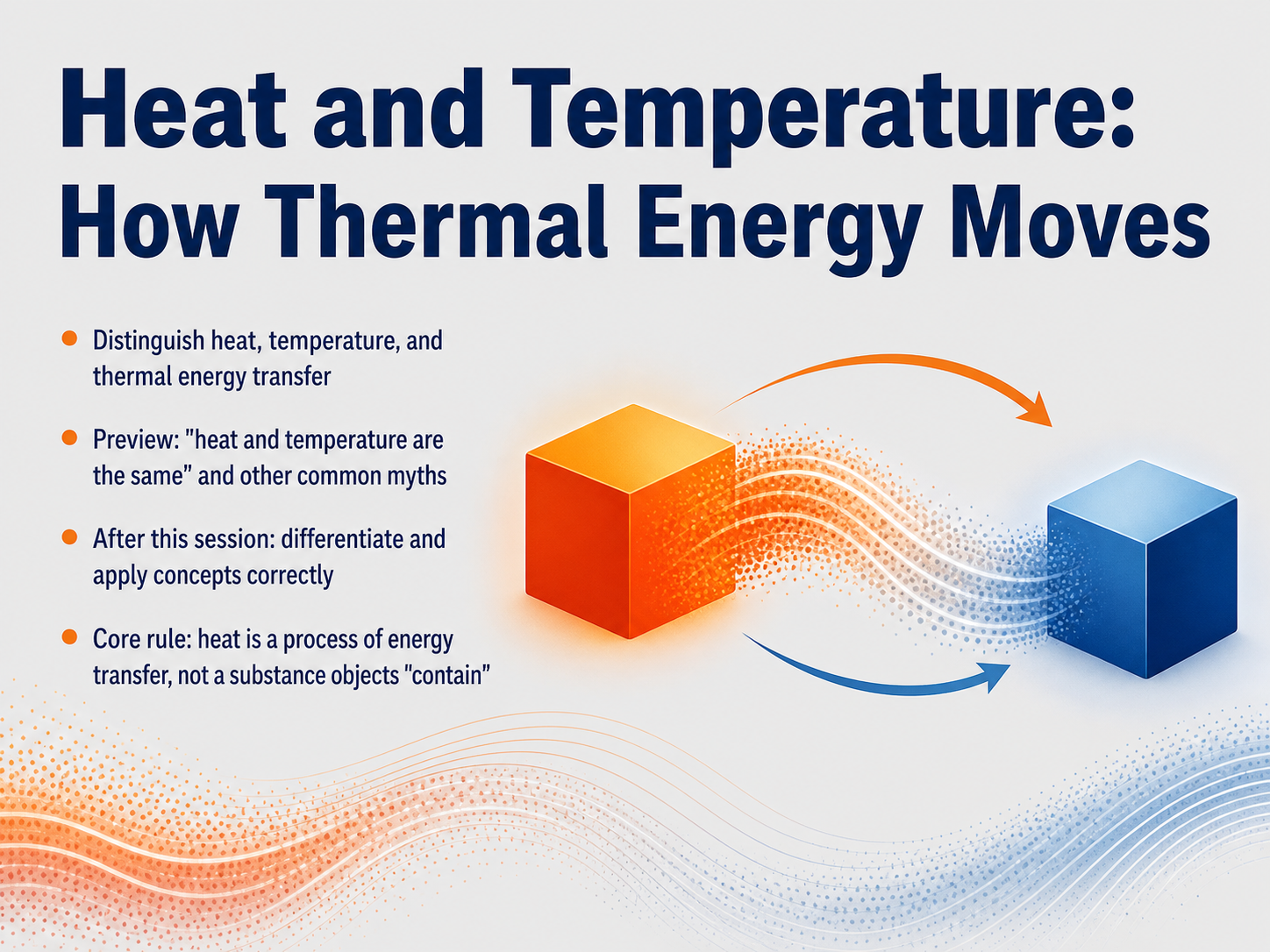
- 01Heat and Temperature: How Thermal Energy MovesWelcome. If you have ever said 'heat' and 'temperature' like they are the same word, you are in good company. A lot of people, including working scientists, learned these ideas from everyday language before they saw the physics behind them. In this session we will do something simple but powerful: we will separate those two words, and one more, thermal energy transfer, so you can use each one clearly. We will preview a few common myths, such as the idea that an object 'contains' heat. Then we will walk through what the terms really mean and how to apply them correctly. By the end, you will have a practical rule to hold onto: heat is a process of energy transfer, not a substance that lives inside something. Let us begin with why that distinction matters so much, and what it costs us when we mix them up.dergipark.org.tropen.edudoi.org+21 min
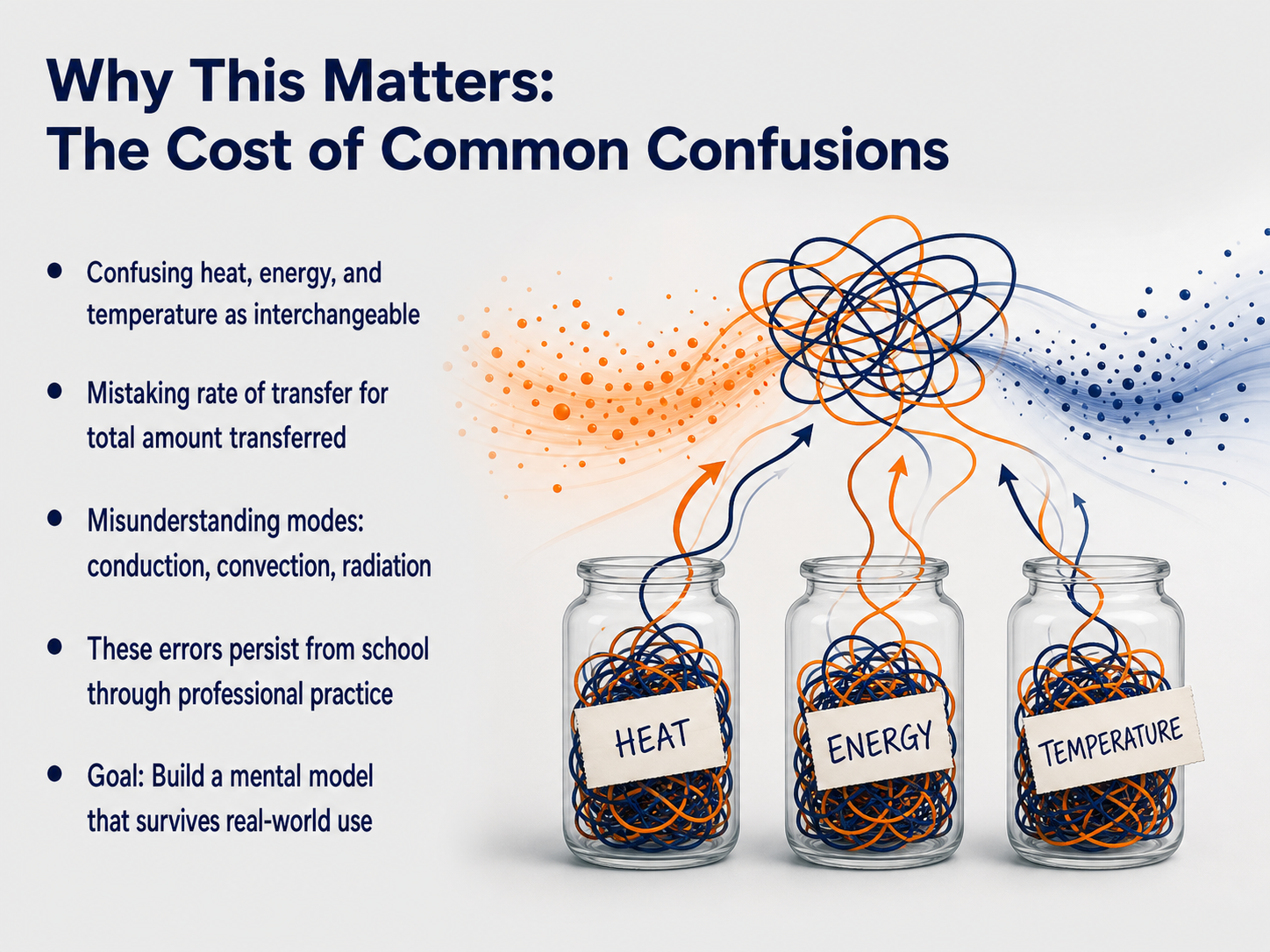
- 02Why This Matters: The Cost of Common ConfusionsNow, let's look at why untangling heat, temperature, and energy transfer really matters. These aren't just vocabulary mix-ups. They lead to persistent mistakes that follow learners from school right into professional practice. Think about the most common confusions. First, treating heat, energy, and temperature as interchangeable words. Second, mistaking how fast something transfers with how much total energy moves. A quick transfer does not always mean a large total amount. Third, misunderstanding the three modes of heat transfer: conduction, convection, and radiation. Research shows these errors are surprisingly stubborn. They survive traditional instruction because they're rooted in everyday language and intuition. Our goal is to build a clear, durable mental model you can rely on. A model that lets you distinguish the concepts, predict behavior correctly, and avoid costly design mistakes. By the end, you'll have a framework that works in real-world situations, not just on a quiz. Let's begin that foundation with our next slide: What Is Temperature?
 journals.flvc.orgeric.ed.govdoi.org+22 min
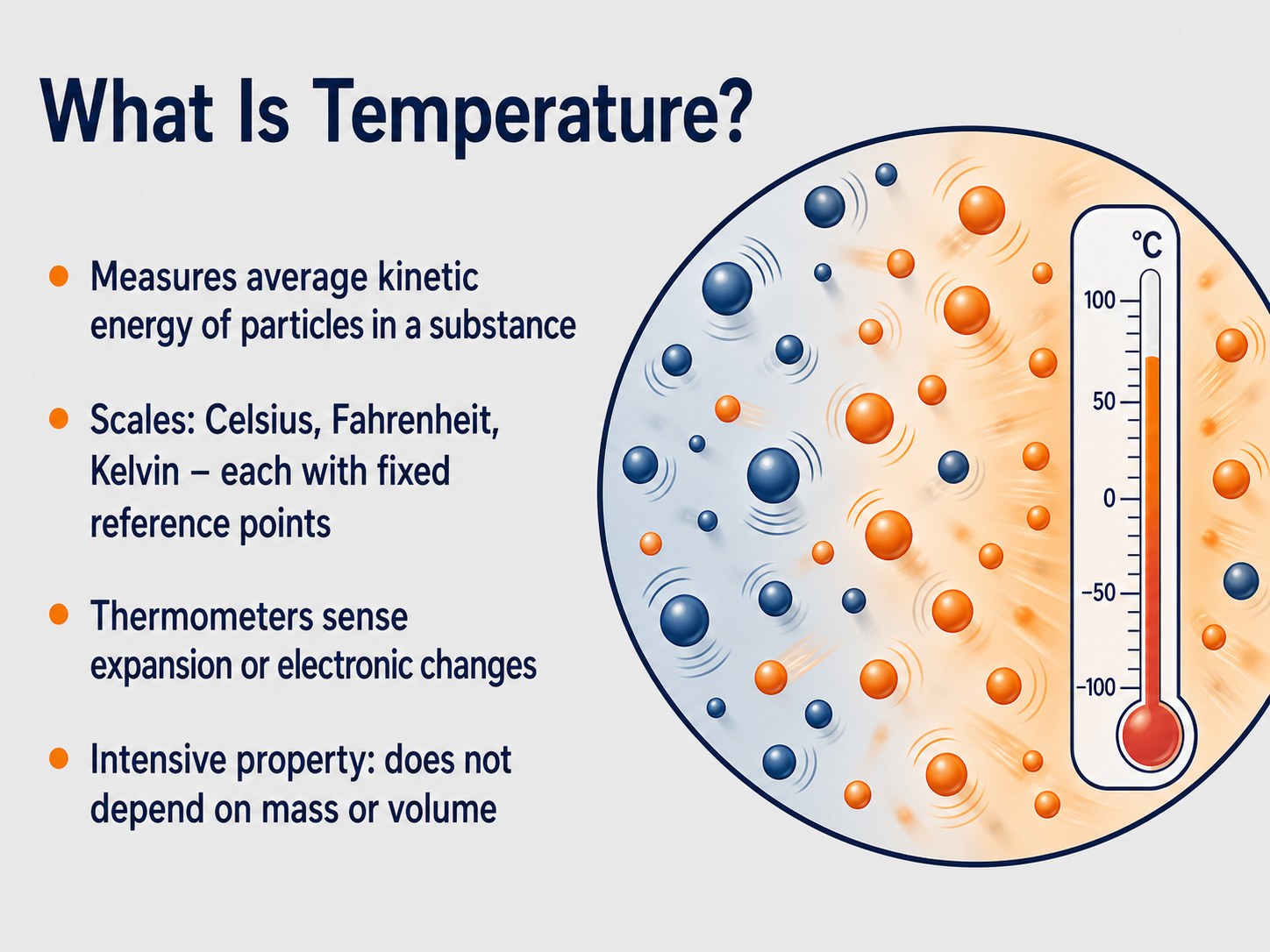
 - 03What Is Temperature?Now we turn to the concept of temperature. Temperature is a measure of the average kinetic energy of the particles in a substance. Think of it as the typical speed of the tiny, invisible particles that make up everything. A higher temperature means the particles are moving faster on average; a lower temperature means they are moving slower. We measure this using scales like Celsius, Fahrenheit, or Kelvin, each with fixed reference points, like the freezing and boiling points of water. A thermometer works by sensing how materials expand or change their electronic properties as the particle motion changes. Crucially, temperature is an intensive property. That means it does not depend on the mass or volume of the object. A small cup of tea and a large pot of tea can be at the exact same temperature, even though the pot contains much more thermal energy. In short, temperature tells us how vigorously the particles are moving, and it's independent of the total amount of the substance. Next, we will explore what heat is and how it differs from temperature.
 dergipark.org.tropen.edudoi.org+21 min
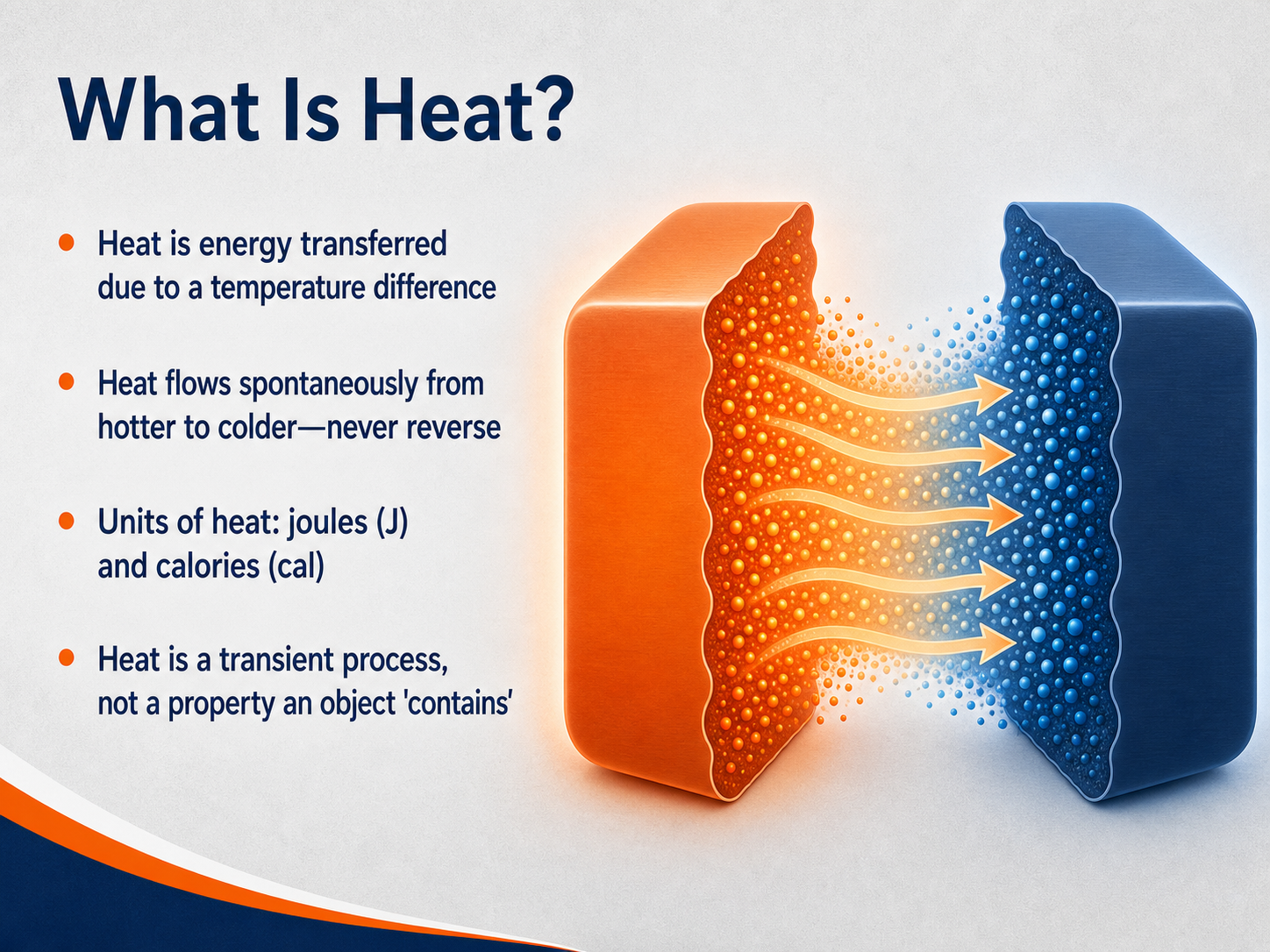
 - 04What Is Heat?Now let's focus on heat itself. Many people think of heat as something an object can hold, like a cup holding water. But in physics, heat is defined as energy that is transferred from one thing to another because of a temperature difference. Heat always flows spontaneously from the hotter object to the colder one, never in reverse. Think of a warm mug sitting on a cool counter. Energy moves from the mug to the counter, not the other way around. Heat is measured in joules or calories, but it is a transient process, not a static property. An object does not contain heat; it transfers it. So remember, heat is energy in transit, moving from hot to cold. Next, we will build on this by looking at thermal energy, the total internal energy of a substance.
 dergipark.org.tropen.edudoi.org+21 min
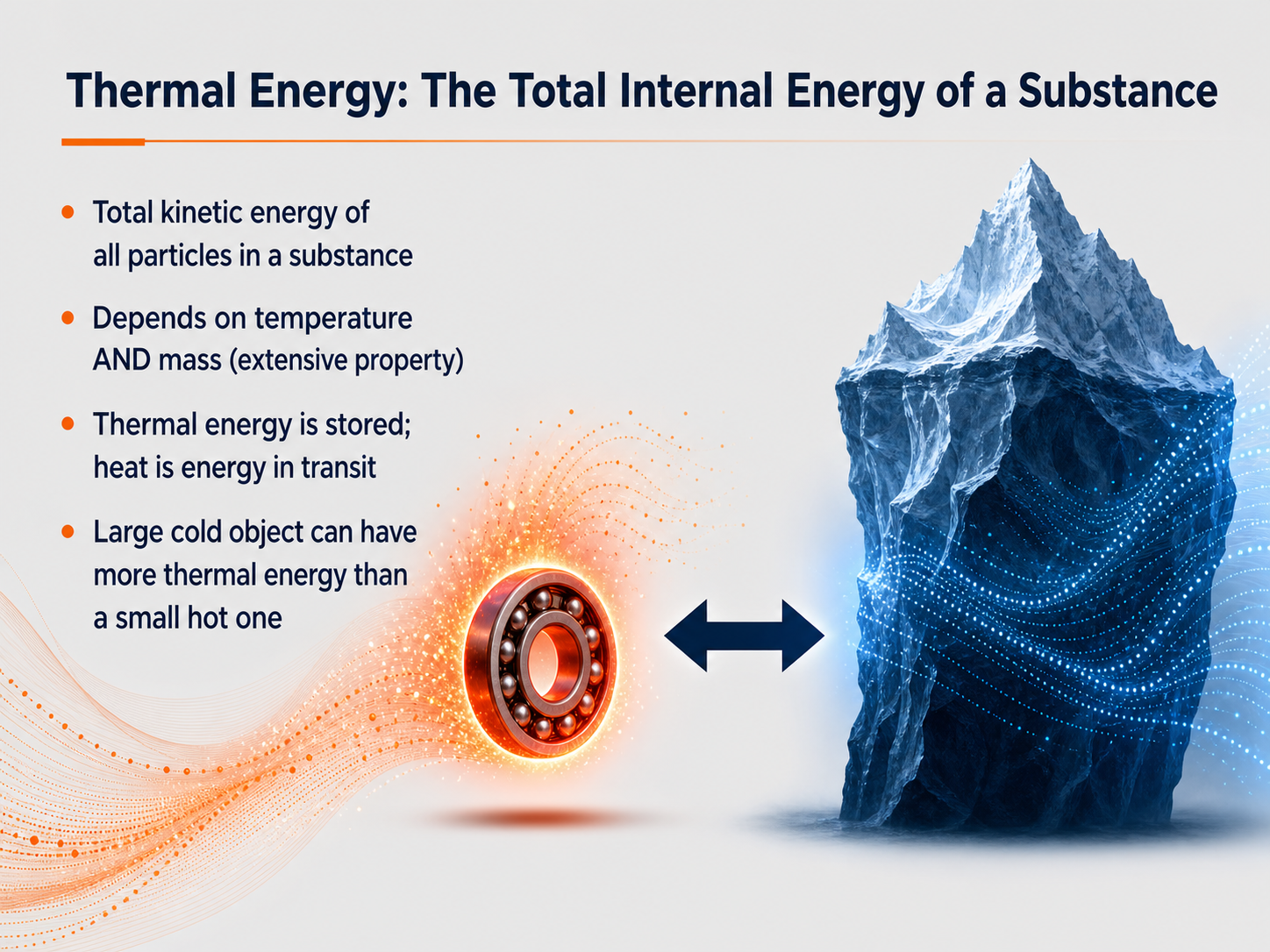
 - 05Thermal Energy: The Total Internal Energy of a SubstanceNow let's bring these ideas together and focus on thermal energy. Thermal energy is the total kinetic energy of all the particles inside a substance. It depends on two things: temperature and mass. Because it depends on the total amount of matter, scientists call it an extensive property. Think of it this way: thermal energy is stored energy. Heat, on the other hand, is energy in transit—it's moving from one place to another. Here's a surprising idea that often clears up confusion: a large cold object can hold more thermal energy than a small hot one. To see why, let's look at a classic comparison: the iceberg and the hot cup of coffee.
 chemnet.edu.auchegg.comdoi.org+21 min
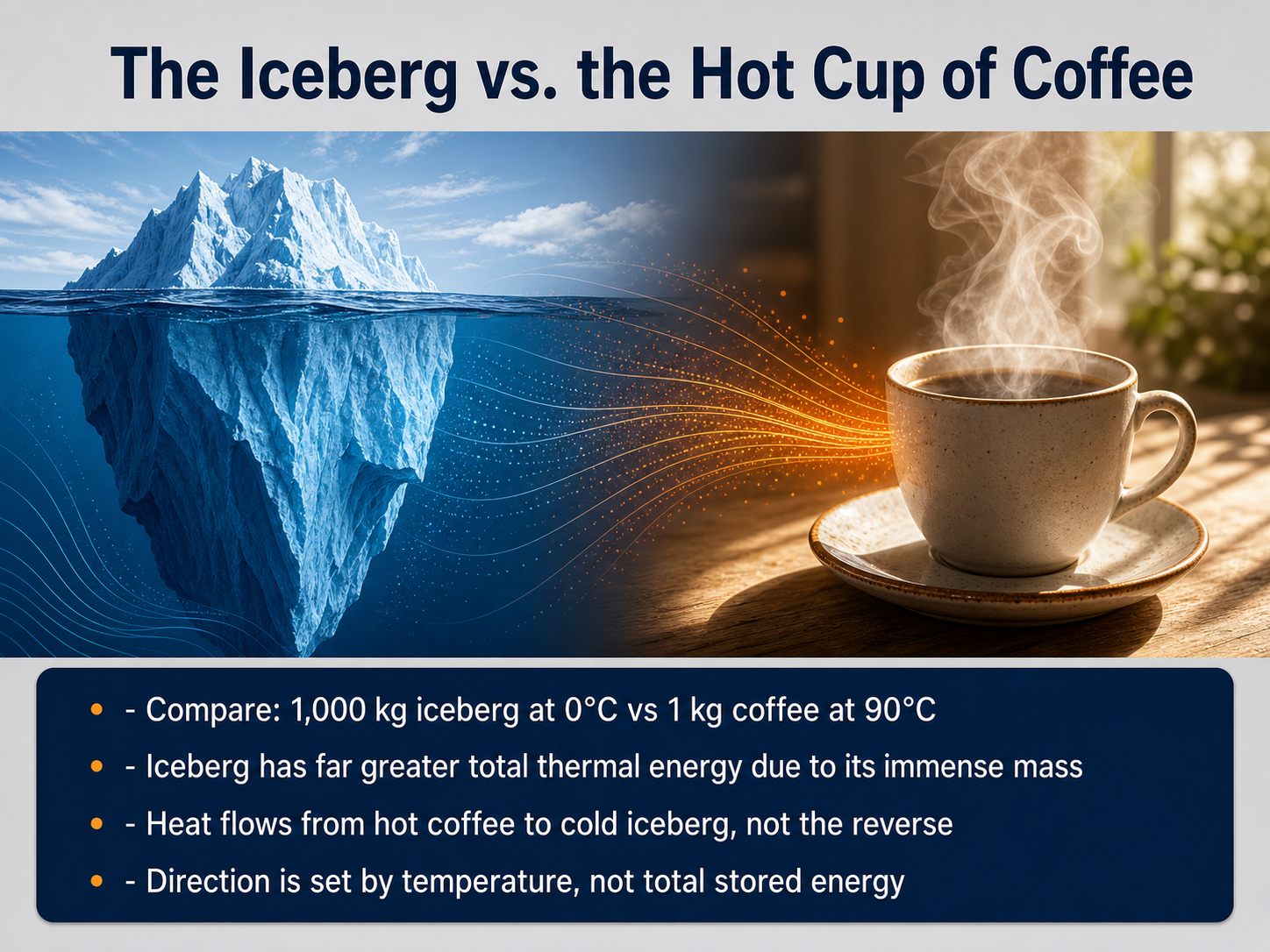
 - 06The Iceberg vs. the Hot Cup of CoffeeNow let’s use a surprising comparison to make this crystal clear. Picture an enormous iceberg, about one thousand kilograms, sitting at zero degrees Celsius. Next to it, imagine a single kilogram of hot coffee at ninety degrees Celsius. Which one holds more total thermal energy? If you guessed the iceberg, you’re right. Even though the coffee feels much hotter, the iceberg stores far more thermal energy simply because of its immense mass. Thermal energy is the total energy of all the particles in an object, and the iceberg has vastly more particles, even though each one is moving slower. Now here’s the key point: when the hot coffee meets the cold iceberg, thermal energy always moves from the coffee into the iceberg, never the other way around. That direction is set by temperature, not by total stored energy. Heat flows from the higher temperature to the lower temperature every time. So total energy doesn’t override temperature when deciding the direction of heat transfer. The coffee cools down, the iceberg warms ever so slightly. Coming up next, we’ll zoom in and see exactly how thermal energy moves through different materials, starting with conduction.
 chemnet.edu.auchegg.comdoi.org+22 min
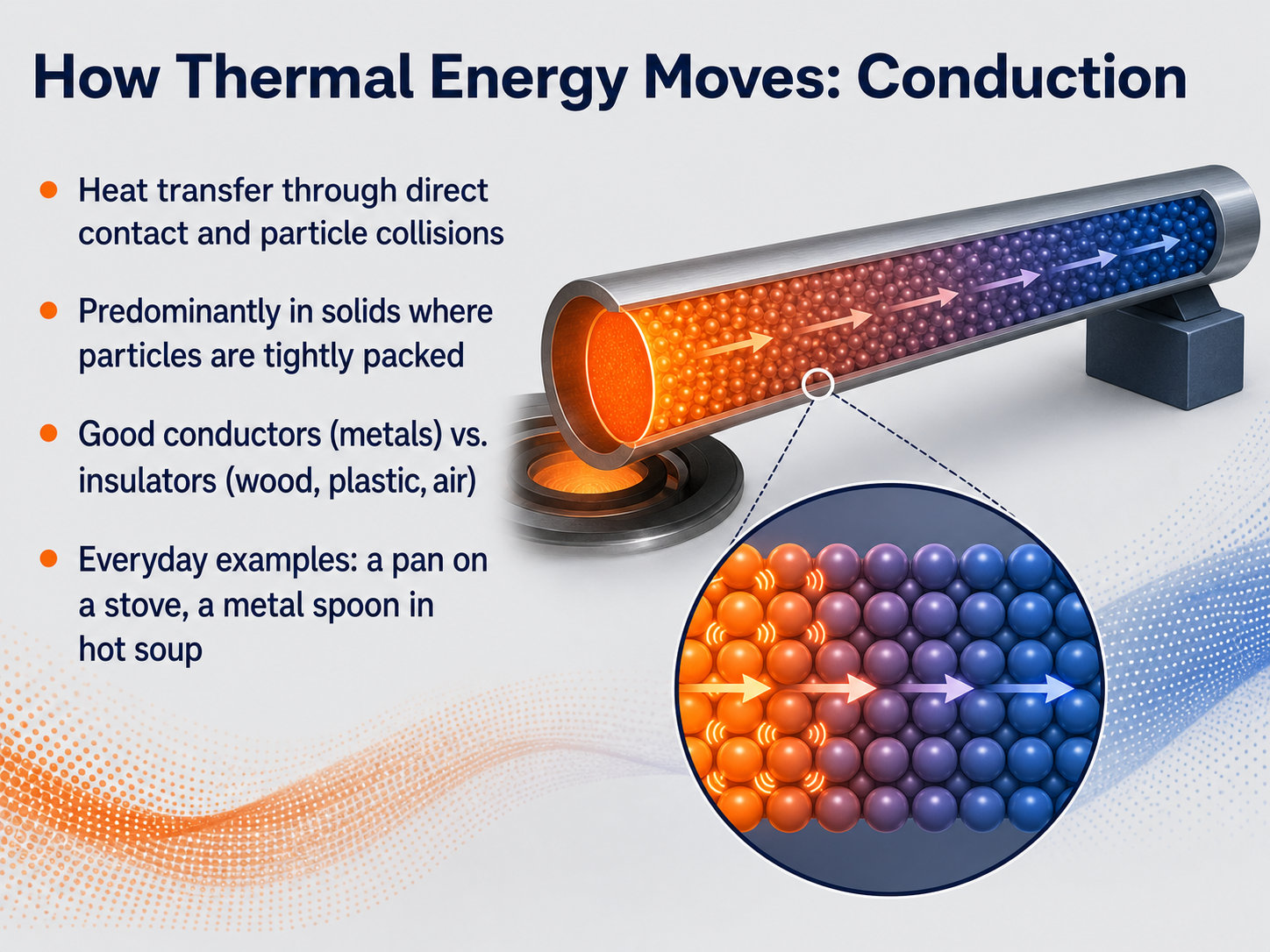
 - 07How Thermal Energy Moves: ConductionNow let's look at one way thermal energy actually moves. This is called conduction. Conduction is heat transfer through direct contact. When particles collide, faster-moving particles pass energy to slower ones. It happens mostly in solids, where particles are tightly packed and can bump into each other easily. Think of a metal spoon sitting in a hot bowl of soup. The handle soon gets warm, even though only the bowl end is in the liquid. Energy travels particle by particle up the spoon. That's conduction. Now, not all materials conduct heat equally well. Metals are good conductors. They transfer thermal energy quickly. That's why a pan on a stove heats up fast. Wood, plastic, and air are insulators. They slow down heat transfer. So a wooden spoon handle stays cooler much longer than a metal one. One common mix-up is believing that metal feels cold because it holds cold. In fact, metal just conducts heat away from your hand faster. It's not cold; it's a good conductor. So to recap: conduction is heat transfer by direct contact, mostly in solids. Good conductors like metals move energy quickly. Insulators like wood and plastic move it slowly. Let's carry that idea forward. Next, we'll explore how thermal energy moves in fluids through convection.
 dergipark.org.tropen.edudoi.org+21 min
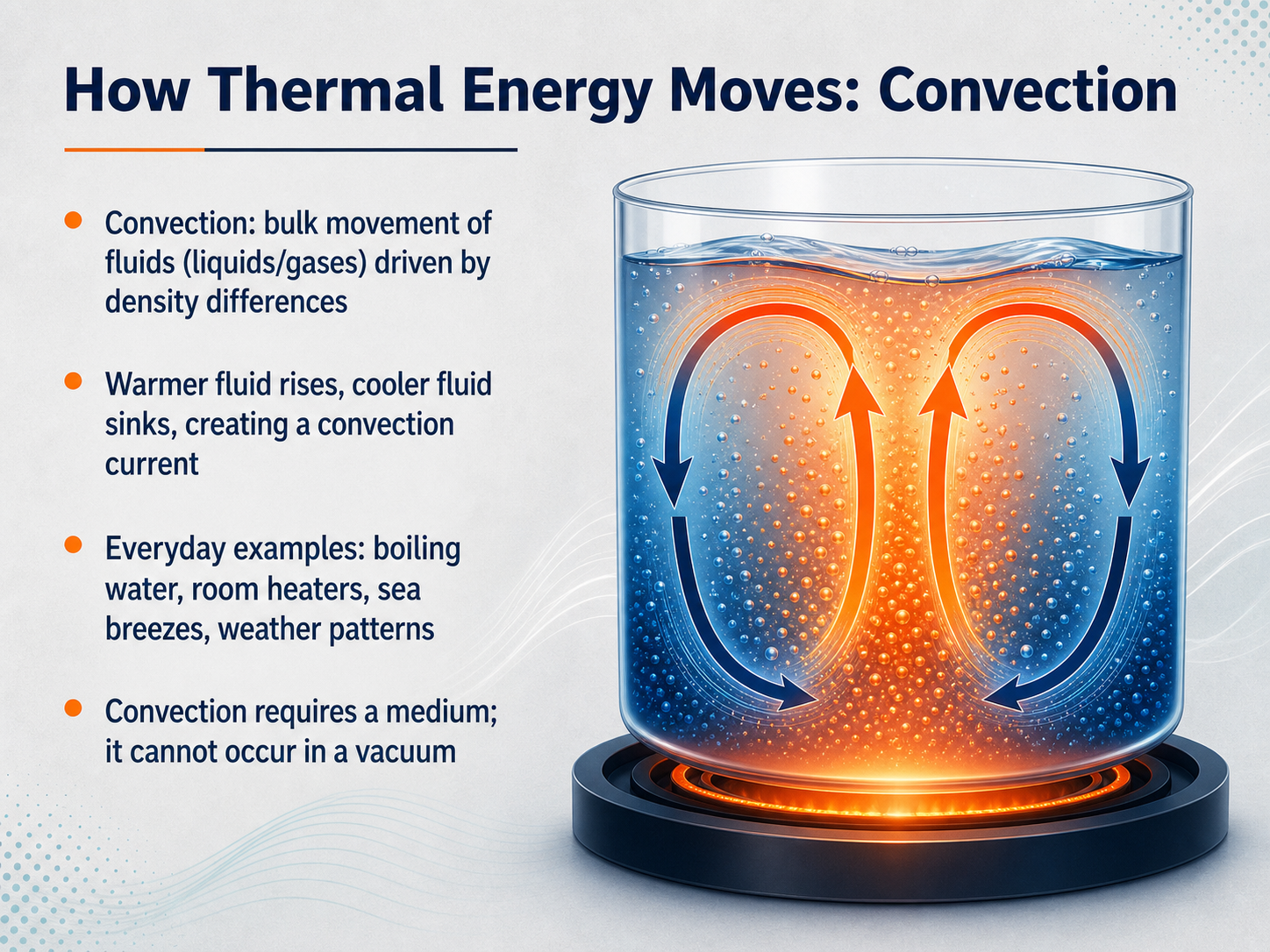
 - 08How Thermal Energy Moves: ConvectionNow let's talk about one of the main ways thermal energy moves: convection. Convection is the bulk movement of a fluid—that means a liquid or a gas—driven by differences in density. When a fluid is heated, it expands, becomes less dense, and rises. Cooler, denser fluid sinks to take its place. This creates a looping motion called a convection current. You can see this in a pot of boiling water: the hot water rises from the bottom, and the cooler water from the top sinks down. The same process happens with room heaters, where warm air rises, circulates, and gradually heats the whole room. Sea breezes and large-scale weather patterns also work this way. One important point: convection requires a medium—a liquid or a gas to move through. It cannot happen in a vacuum. So, when you see a fluid circulating and carrying energy with it, that's convection. Next, we'll look at how thermal energy moves when there is no medium at all: radiation.
 dergipark.org.tropen.edudoi.org+21 min
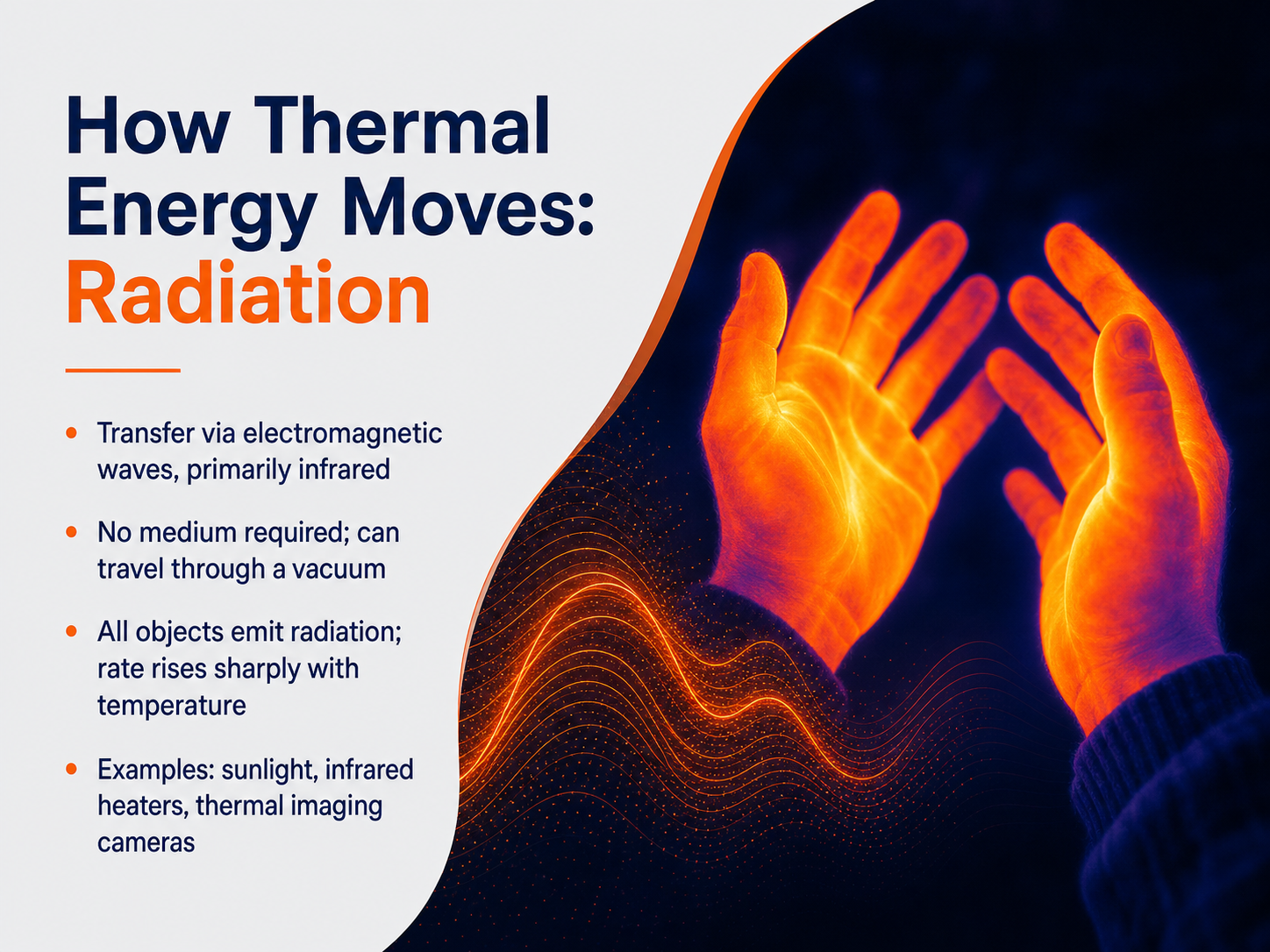
 - 09How Thermal Energy Moves: RadiationNow let's turn to a third way thermal energy moves: radiation. Radiation is the transfer of energy through electromagnetic waves, mostly in the infrared range we can't see. The key difference here is that radiation doesn't need any material to travel through. It can move right through empty space, which is how the sun's energy reaches us across the vacuum. Every object around you is constantly emitting radiation. The rate at which it radiates goes up sharply as temperature rises, so a hot stovetop radiates far more energy than a warm mug. You experience this with sunlight, with the heat you feel from an infrared heater, or the glow in a thermal imaging camera. So, to summarize: radiation is energy moving as waves, it doesn't need a medium, and all objects emit it, with hotter objects emitting much more. Next, we'll put all three modes of transfer side by side for a clear comparison.
 dergipark.org.tropen.edudoi.org+21 min
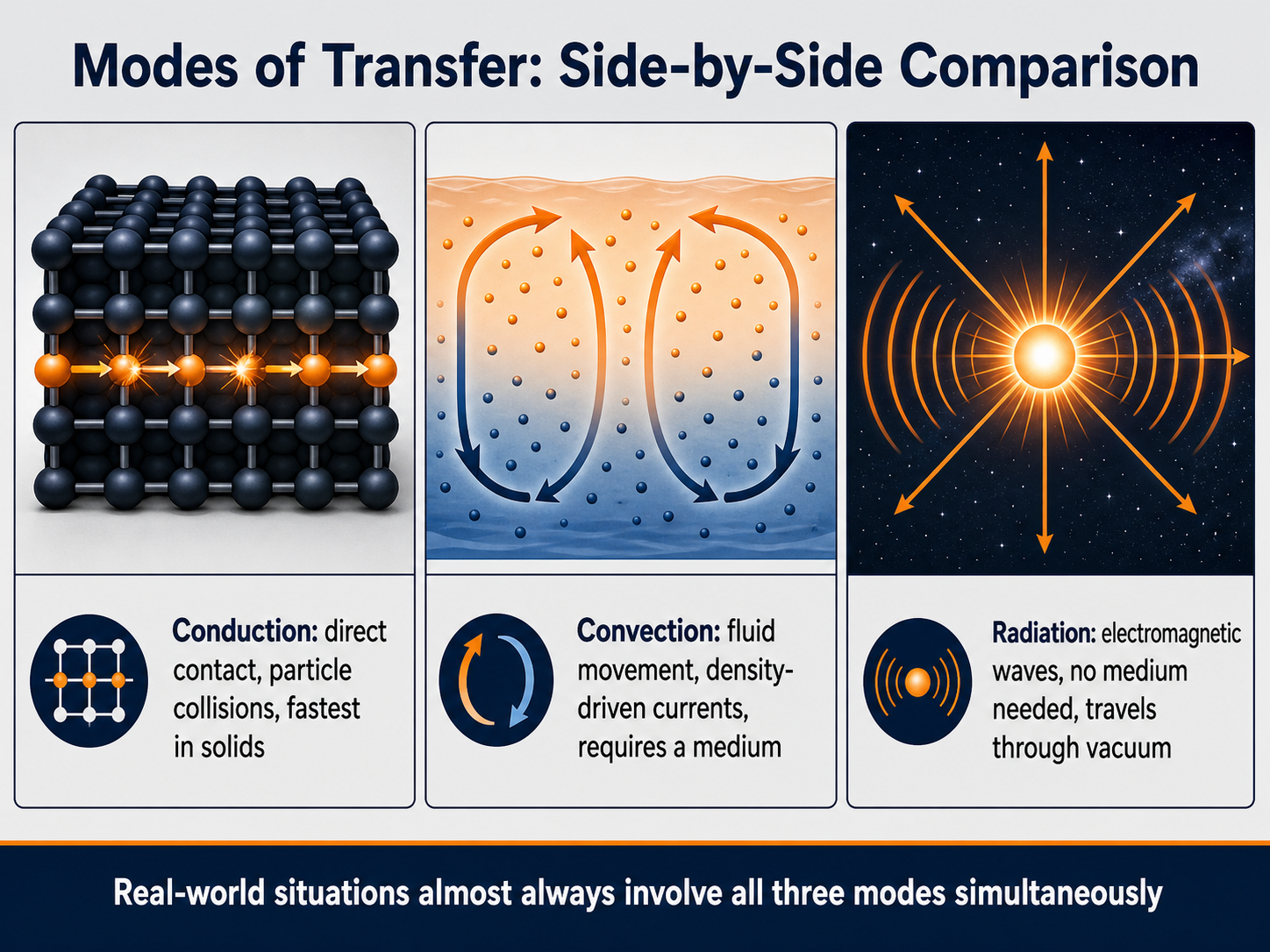
 - 10Modes of Transfer: Side-by-Side ComparisonNow let's put the three modes of heat transfer side by side. Conduction happens through direct contact. Think of a metal spoon in a hot pan. The faster particles collide with their neighbors, passing energy along. This works fastest in solids, where particles are packed tightly together. Convection is all about fluid movement. When a liquid or gas heats up, it expands, becomes less dense, and rises. Cooler, denser fluid sinks to take its place. This creates a continuous current. Convection requires a medium, like air or water, to carry the energy. Radiation is different. It transfers energy through electromagnetic waves, like the warmth you feel from the sun. No particles are needed. Radiation can travel through the vacuum of space. Now, here's a key point. In the real world, these three rarely work alone. A hot cup of coffee, for example, loses heat through conduction, convection, and radiation all at the same time. So, while we study them separately for clarity, remember that nature often combines them. Next, we'll see this combination in action with a real example: a cup of coffee cooling.
 dergipark.org.tropen.edudoi.org+22 min
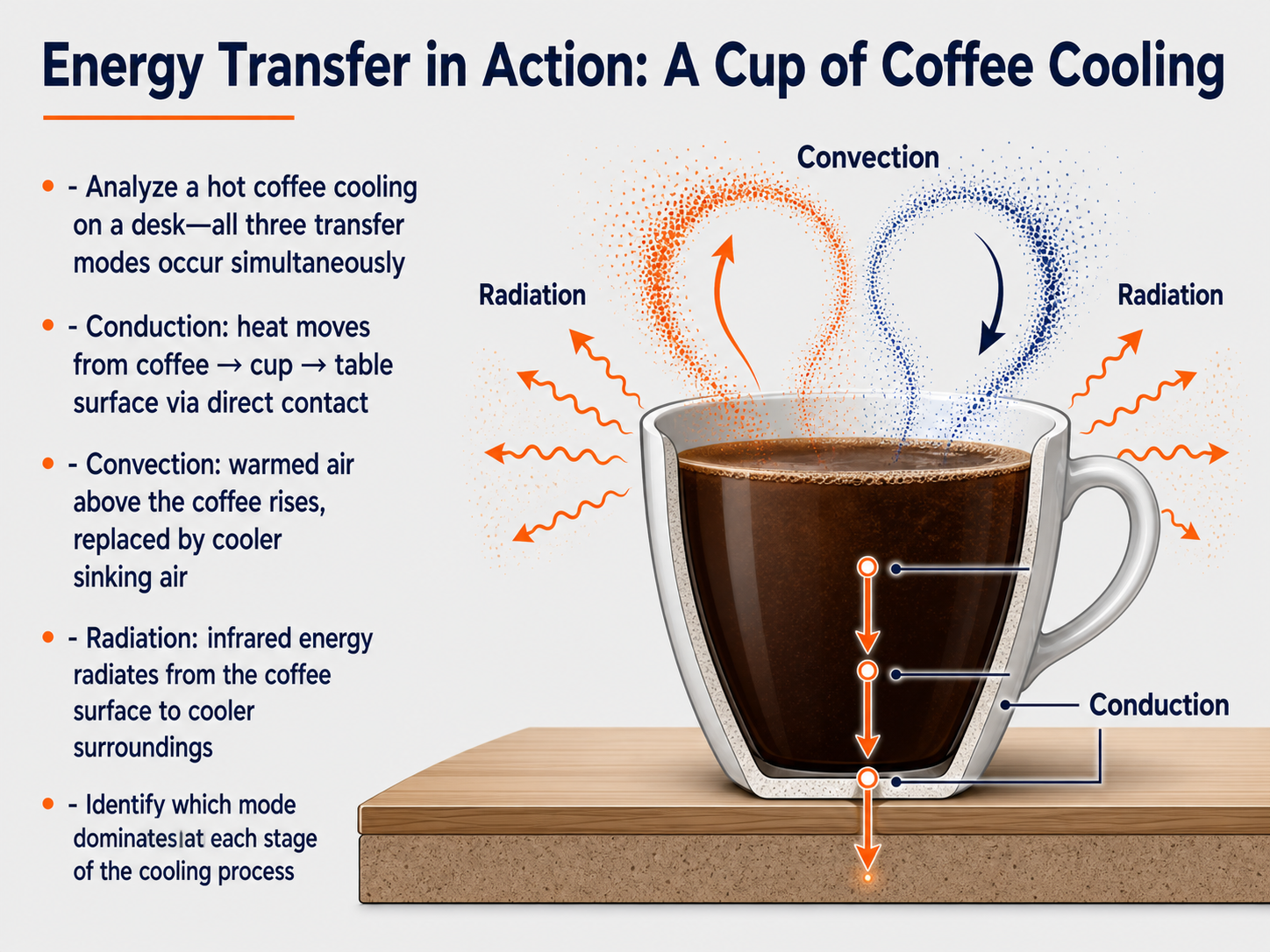
 - 11Energy Transfer in Action: A Cup of Coffee CoolingLet’s look at a familiar scene—a hot cup of coffee cooling on a desk. In this one moment, all three heat transfer modes are at work at the same time. First, conduction. Heat moves from the coffee into the cup, and then from the cup into the table surface through direct contact. Second, convection. The air just above the coffee warms up, becomes less dense, and rises, while cooler air sinks to take its place. That circulation speeds up cooling. Third, radiation. The coffee surface quietly sends out infrared energy to the cooler surroundings, even without touching them. The dominant mode shifts as the coffee cools. Early on, convection and radiation do most of the work. As the temperature gap narrows, conduction into the table becomes more noticeable. The key idea is that heat is energy transferring from warmer to cooler, and temperature only tells us which direction that energy will move—not how much energy is present. Next, we’ll see these same transfer modes in a different setting: a house losing heat in winter.
 dergipark.org.tropen.edudoi.org+22 min
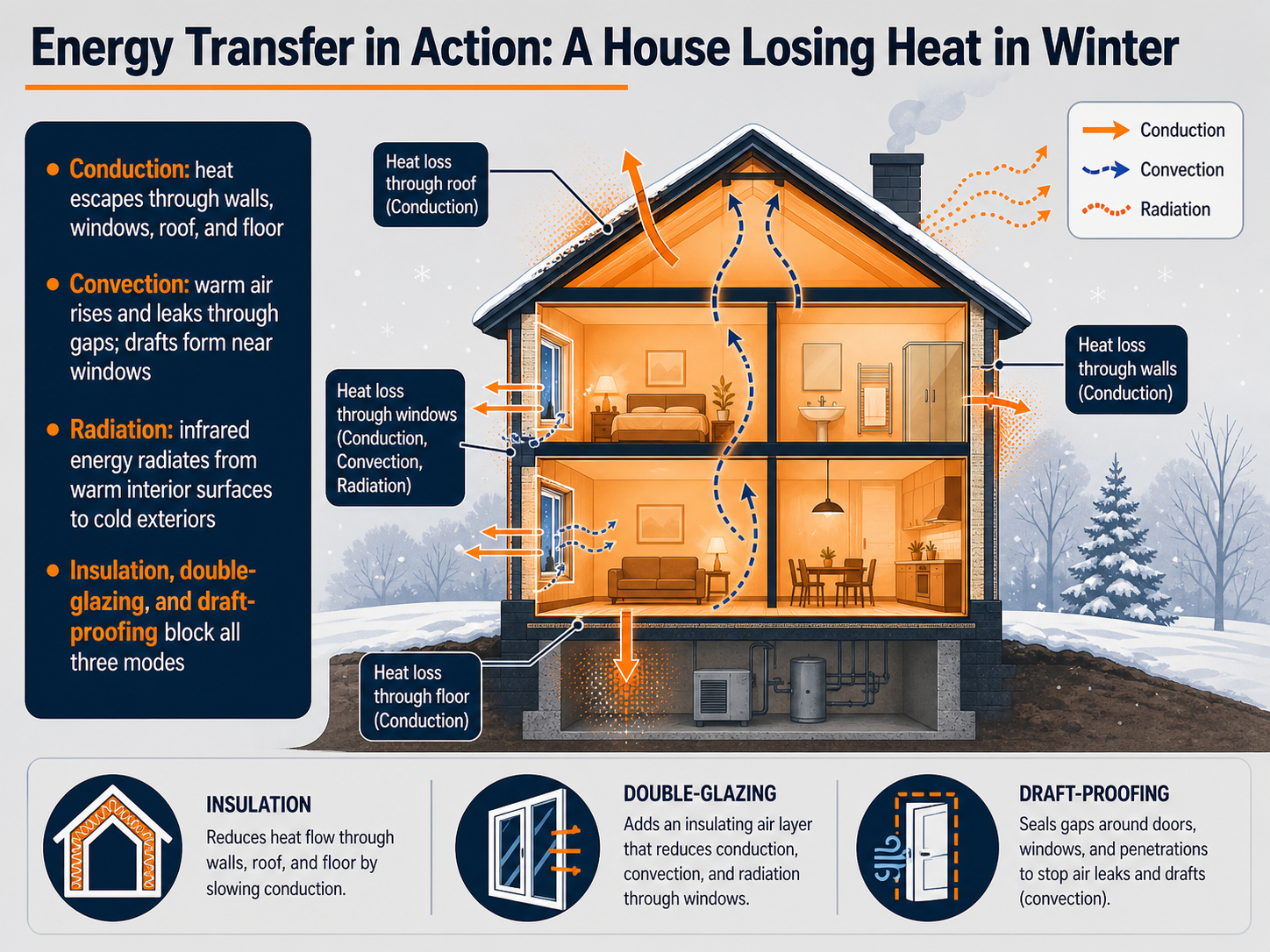
 - 12Energy Transfer in Action: A House Losing Heat in WinterNow let’s put energy transfer into a real scene, a house losing heat on a cold winter day. We’ll look at three ways thermal energy moves out. First, conduction. Heat escapes directly through the solid walls, windows, the roof, and the floor. Think of your hand touching a cold windowpane; the warmth moves right through the glass. Second, convection. Warm air inside rises and slips out through small gaps and cracks. That’s why you feel a chilly draft near a window, even when it’s closed. Third, radiation. Warm indoor surfaces, like your walls and furniture, send invisible infrared energy straight toward colder outdoor surfaces. The house is losing heat in all three ways at once. The good news is that insulation, double-glazed windows, and simple draft-proofing can block all three modes. They slow conduction, stop convection leaks, and reduce radiant heat loss. So a well-sealed home keeps the warmth where you want it. Up next, we’ll tackle a few stubborn myths and clear up what’s really going on in Mythbusting: Top Misconceptions and How to Fix Them.
 dergipark.org.tropen.edudoi.org+22 min
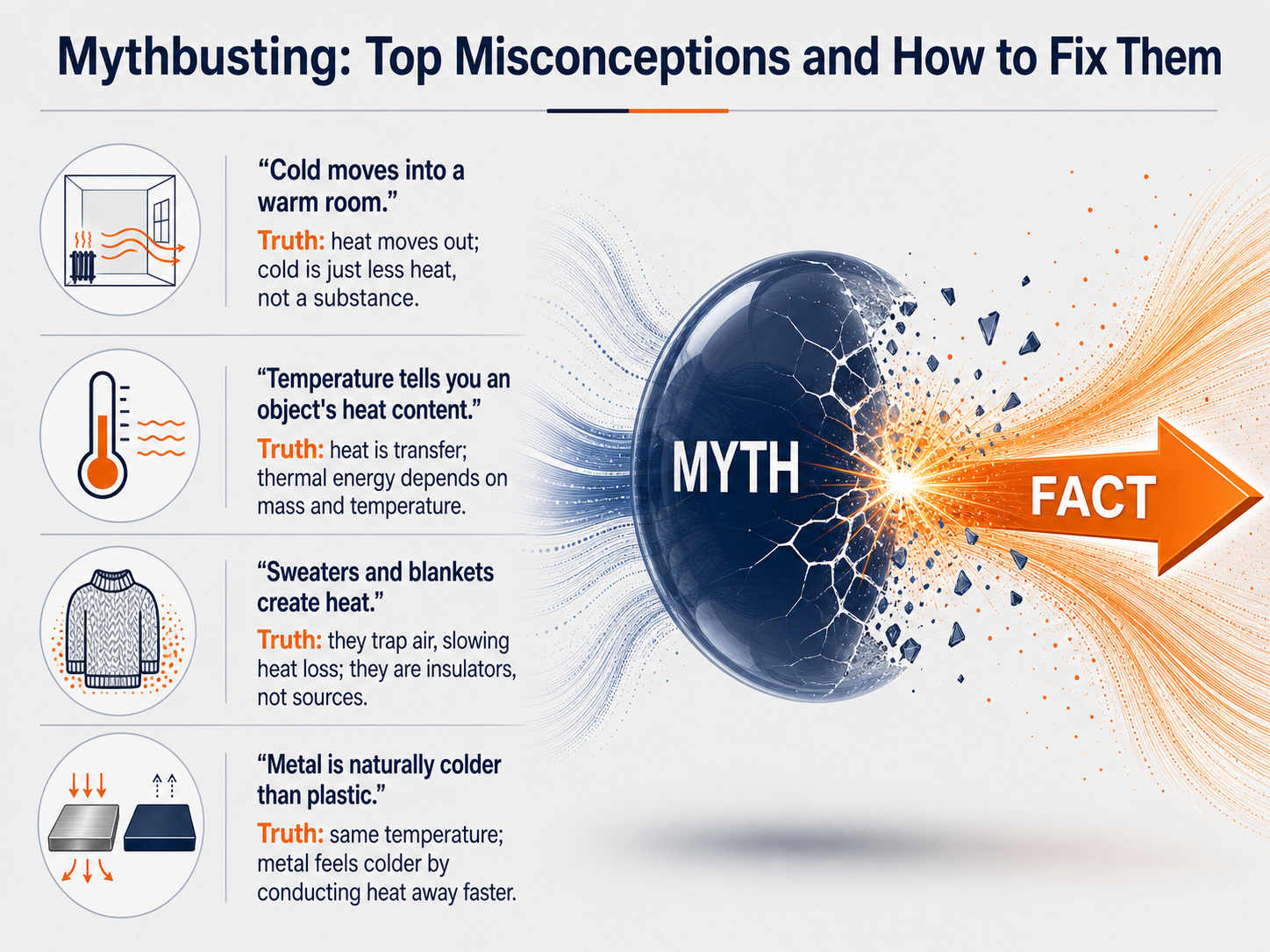
 - 13Mythbusting: Top Misconceptions and How to Fix ThemLet's tackle some of the most common myths head-on. First, the idea that "cold moves into a warm room." In truth, heat moves out. Cold is simply less heat, not a substance flowing in. Second, the belief that "temperature tells you an object's heat content." Here's the reality: heat is a transfer of energy. Thermal energy depends on both mass and temperature. A bathtub of lukewarm water holds far more thermal energy than a spark from a fire, even though the spark has a much higher temperature. Third, the myth that "sweaters and blankets create heat." They do not. They are insulators. They trap air and slow down heat loss from your body. Finally, "metal is naturally colder than plastic." They are actually the same temperature. Metal just feels colder because it conducts heat away from your skin faster. These corrections are the foundation for clearer thinking. Up next, we'll explore specific cognitive strategies to reframe your thinking.
 journals.flvc.orgeric.ed.govdoi.org+22 min
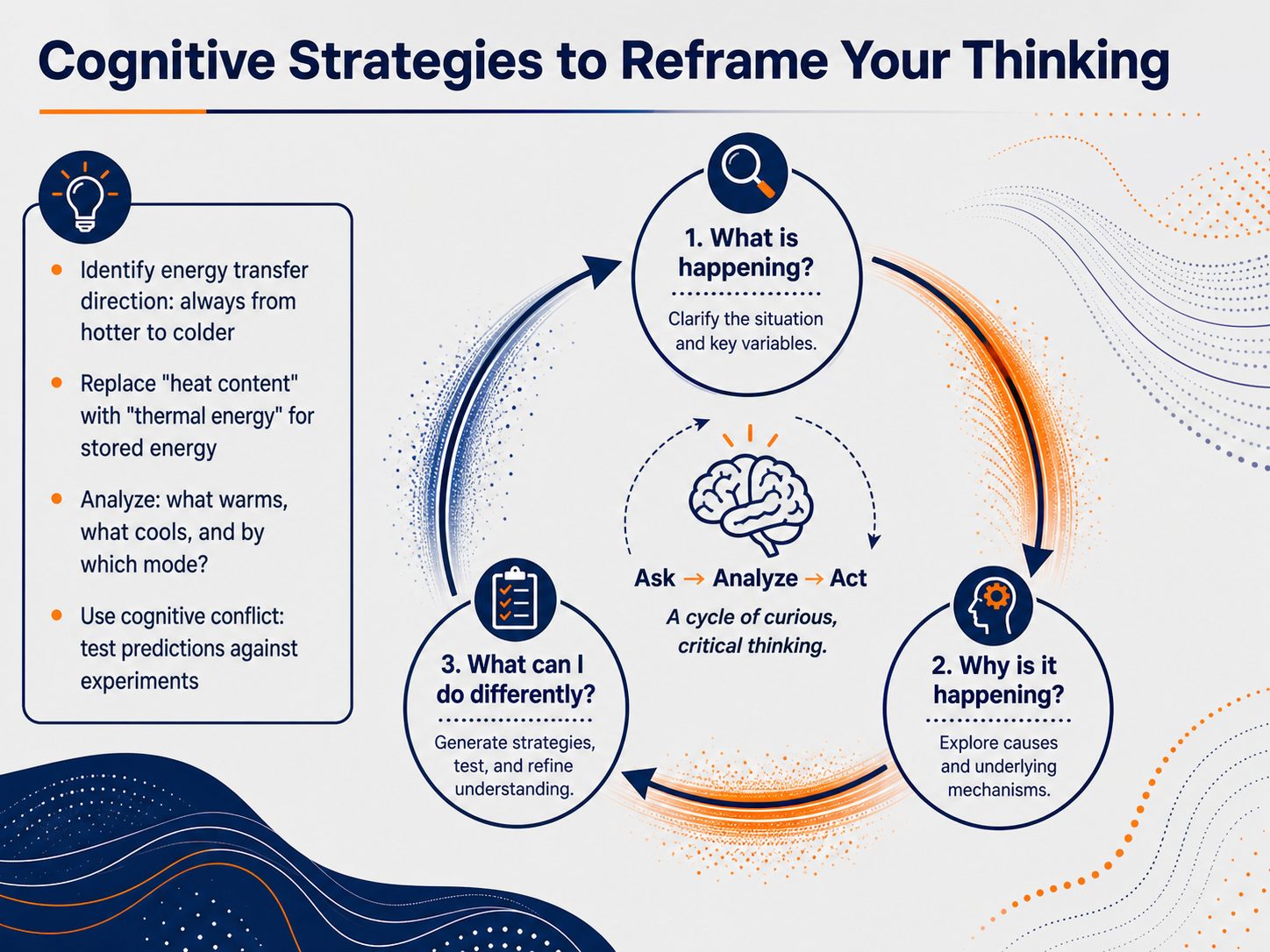
 - 14Cognitive Strategies to Reframe Your ThinkingLet's shift our focus to some practical cognitive strategies—ways to consciously reframe how you think about thermal energy. First, always identify the direction of energy transfer. Heat flows naturally from a hotter object to a colder one. When you spot that, you can predict what will warm up and what will cool down. Second, replace the phrase 'heat content' with 'thermal energy' when you're talking about stored energy. This small change keeps your language precise: heat is the transfer, thermal energy is what's stored. Third, when you analyze a situation, ask three questions: what warms, what cools, and by which mode? Is it conduction, convection, or radiation? Finally, use cognitive conflict. Make a prediction before you test it with an experiment. When your prediction doesn't match reality, that surprise is where deep learning happens. So, by identifying direction, refining your vocabulary, analyzing the mode, and testing your predictions, you actively build a more accurate mental model. Next, we'll move to 'Check Your Understanding: Self-Assessment' to see how these ideas feel in practice.
 journals.flvc.orgeric.ed.govdoi.org+22 min
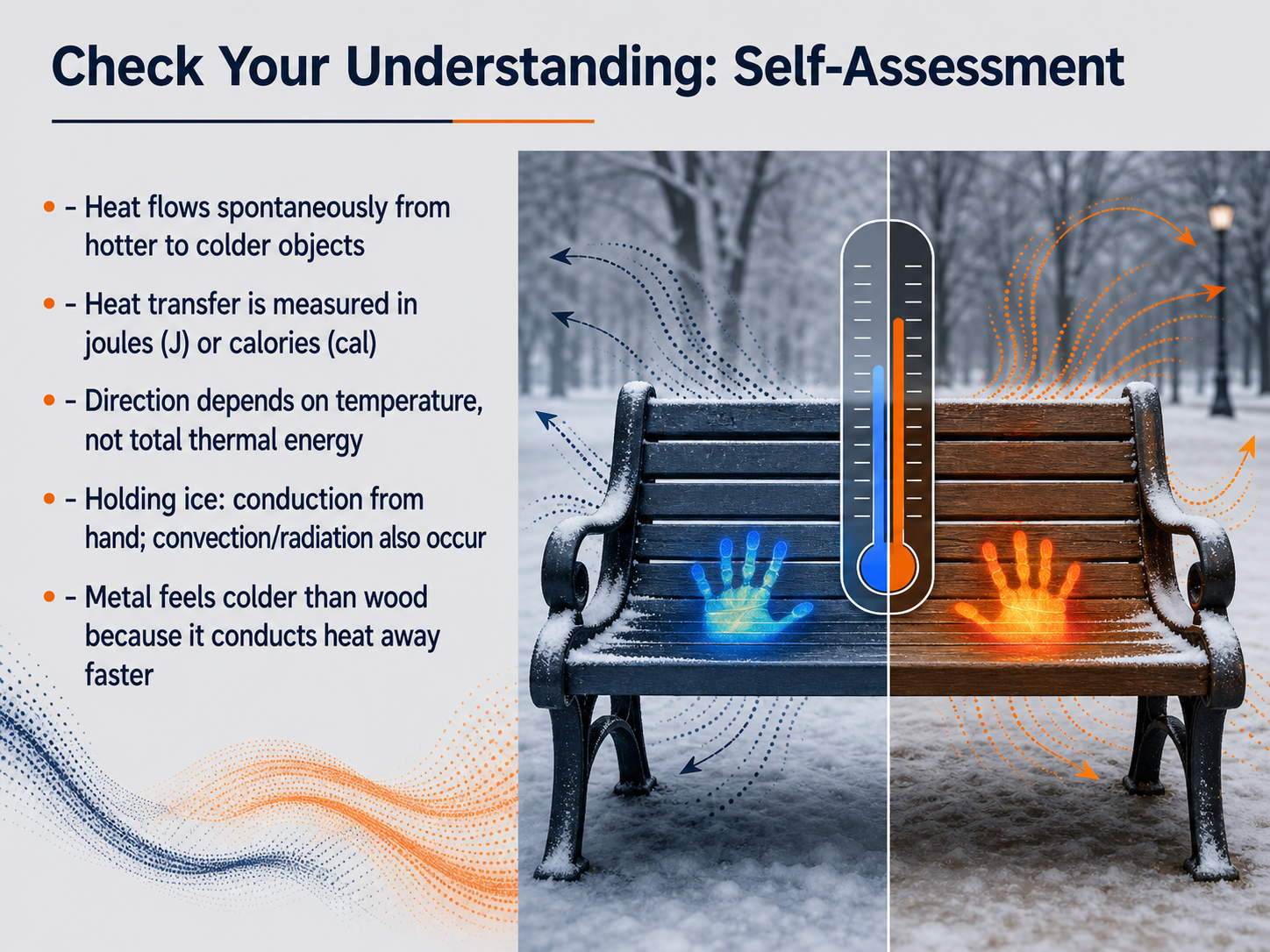
 - 15Check Your Understanding: Self-AssessmentLet's see how well you can apply these ideas. Heat always flows spontaneously from hotter objects to colder ones. That transfer is measured in joules or calories. The direction depends on temperature difference, not on total thermal energy. Remember, an iceberg can have more total thermal energy than a hot cup of coffee, but heat still moves from the coffee to the iceberg. When you hold ice, your hand loses heat by conduction, and convection and radiation also play a role. And metal feels colder than wood at the same temperature because it conducts heat away from your skin faster. Use these checkpoints to test your understanding before we move on to the recap and key takeaways.
 chemnet.edu.auchegg.comdoi.org+21 min
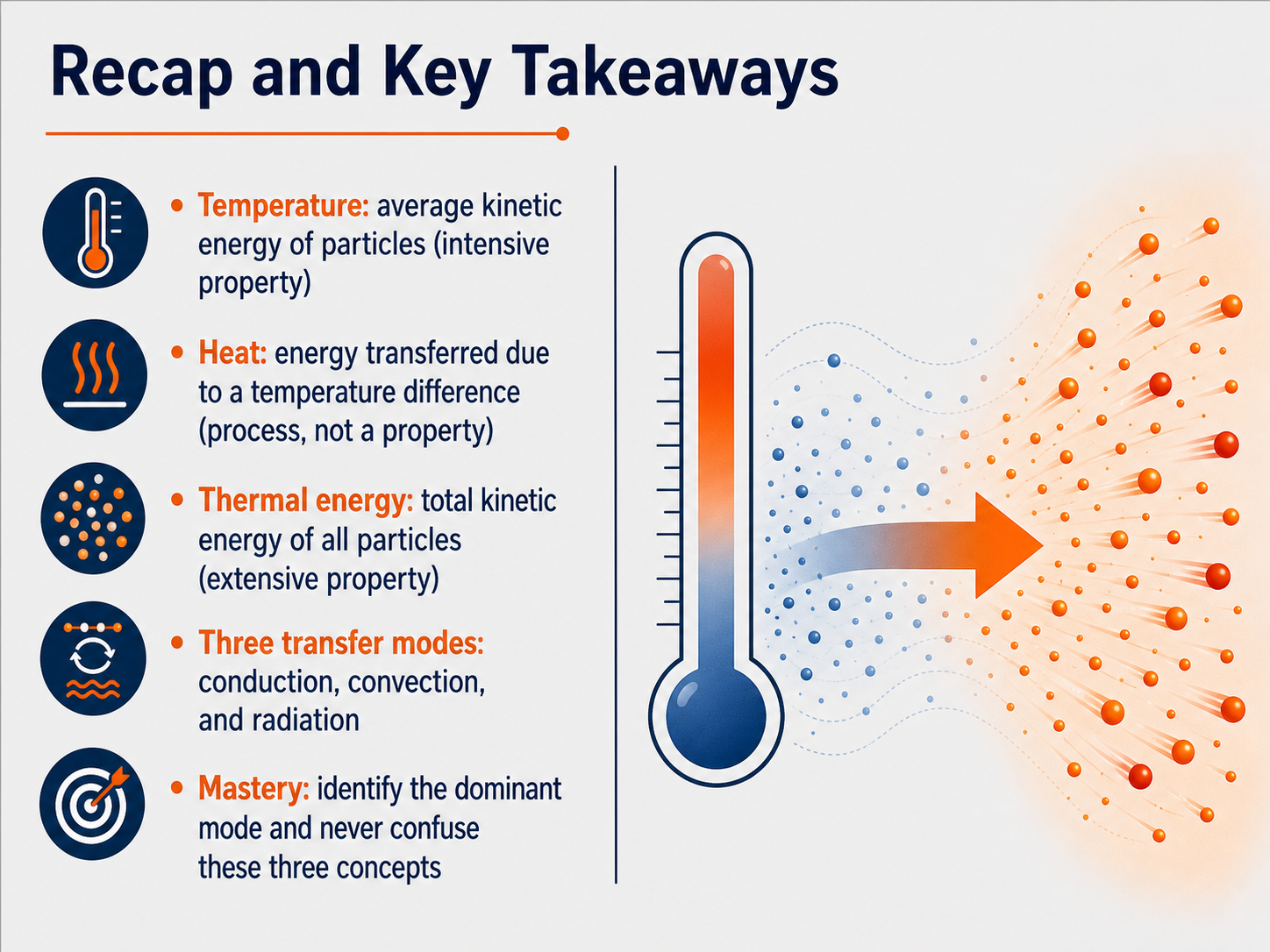
 - 16Recap and Key TakeawaysAnd here we are at the final slide. Let's take a moment to lock in the big ideas. First, temperature is the average kinetic energy of the particles in a substance. Think of it as a measure of intensity, and it doesn't depend on how much material you have. Second, heat is the energy transferred because of a temperature difference. It's a process, not a property an object keeps inside. Third, thermal energy is the total kinetic energy of all the particles, and that does depend on the amount of material. Heat can move in three ways: conduction through direct contact, convection through moving fluids, and radiation through empty space. The goal is simple. When you analyze a real-world situation, identify the dominant transfer mode and remember that temperature, heat, and thermal energy are three different things. Thank you for sticking with this. You've turned a common confusion into a clear distinction, and that's a skill that will serve you well. Keep practicing, and you'll see these patterns everywhere.
 dergipark.org.tropen.edudoi.org+22 min
Take the deck with you
Download this course as a file — free, no sign-up needed.
- PDF handoutEvery slide page, ready to print or share.17 pages · 5.0 MBDownload
- Narrated PowerPointThe deck that presents itself — every slide carries the digital human's narration video.17 pages · 16.4 MBDownload
- PowerPoint slidesThe full deck as a .pptx — open it in PowerPoint, Keynote, or Google Slides.17 pages · 5.0 MBDownload
Free to use in your own training — please keep the PersonWise credit page at the end.
Have your own deck? Turn it into a course
Sources consulted
Web sources consulted while building this course.
- A Review of Selected Literature on Students' Misconceptions of Heat and Temperature — dergipark.org.tr
- TI-AIE: Alternative conceptions: heat and temperature — open.edu
- Students’ Perceptions of the Heat and Temperature Concepts: A Comparative Study between Primary, Secondary, and University Levels — doi.org
- Misconceptions - heat and temperature — cyberphysics.co.uk
- Common Misconceptions about Heat and Insulation — beyondpenguins.ehe.osu.edu
- Repairing Student Misconceptions in Heat Transfer Using Inquiry-Based Activities — journals.flvc.org
- Repairing Student Misconceptions in Heat Transfer Using Inquiry-Based ... — eric.ed.gov
- Using inquiry-based activities to repair student misconceptions related to Heat, energy and temperature — doi.org
- The Use of Inquiry-Based Activities to Repair Student Misconceptions Related to Heat, Energy and Temperature — doi.org
- Addressing Misconceptions about Heat Transfer in Undergraduate ... — digitalcommons.lib.uconn.edu
- Coffee/Iceberg Analogy | Chemistry Discipline Network — chemnet.edu.au
- Solved Compared to a giant iceberg, a hot cup of coffee has | Chegg.com — chegg.com
- The q/T Paradox: Which "Contains More Heat", a Cup of Coffee at 95 °C or a Liter of Icewater? — doi.org
- Explain how a frozen iceberg has more thermal energy ... — brainly.com
- [FREE] Which has the greater amount of thermal energy ... — brainly.com