Begin
14 pages · ~28 min
Customer Education Maturity Models
This training explains customer education maturity models to help teams assess their current stage and plan improvements toward more advanced practices.
A digital instructor presents all 14 pages. Hold “Ask” at any point and ask out loud — the answer comes from this course. No sign-up needed.
What you’ll learn
- 01Customer Education Maturity Models ExplainedWelcome. I'm glad you're here, because this is a conversation for people who already do this work and want to do it more deliberately. You live in customer education and enablement every day, and you know the shift underway. Education is moving out of the documentation folder and into the growth conversation, as a lever for adoption, retention, and expansion. So here's our goal. We'll treat a maturity model as what it really is, a developmental framework for building capability, not a compliance checklist you score once and file away. Over the next several slides, we'll cover the foundations, the twenty twenty-six landscape, the anatomy of a model, how to assess where you are, how to build a roadmap, and the operating model that sustains it. The outcomes are written for education leads, enablement teams, customer success leaders, and learning and development practitioners. Use this deck to diagnose your own program, then leave with a thirty, ninety, and one hundred eighty day action plan. Next, let's look at why customer education needs a maturity lens.insights.sei.cmu.edundia.dtic.milen.wikipedia.org+21 min
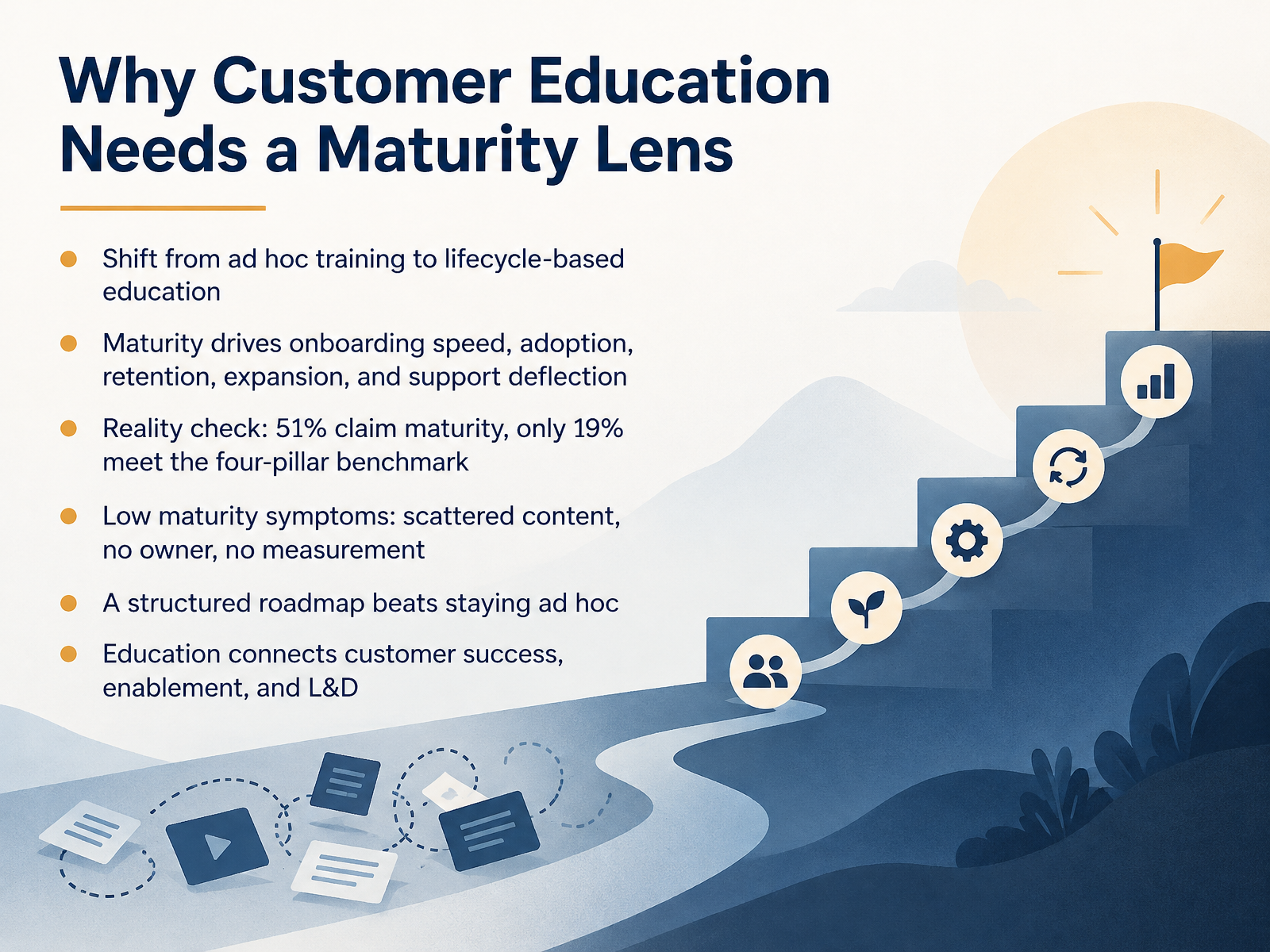
- 02Why Customer Education Needs a Maturity LensSo let's talk about why customer education needs a maturity lens. The shift that matters is moving from ad hoc training, built request by request, to education organized around the customer lifecycle. Maturity is what drives onboarding speed, adoption, retention, expansion, and support deflection. And here's a reality check you'll recognize: fifty-one percent of programs describe themselves as mature, but only nineteen percent meet the four-pillar benchmark. In practice, low maturity looks like scattered content, no clear owner, and no measurement. A structured roadmap beats staying ad hoc, and education connects customer success, enablement, and learning and development around one shared journey. Next, let's look at The 2026 Landscape: What the Data Says.
 absorbai.comthinkific.comabsorbai.com+21 min
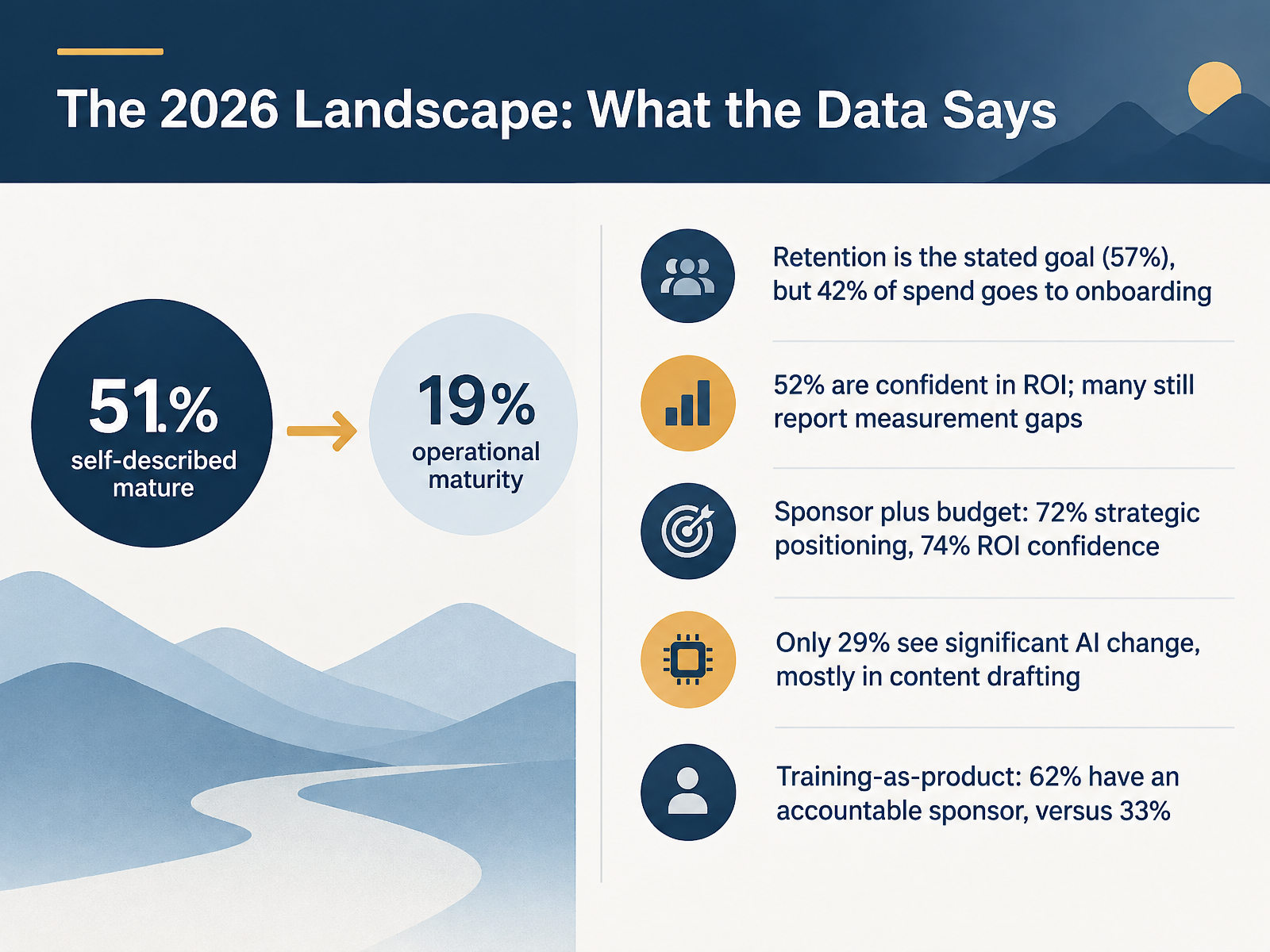
- 03The 2026 Landscape: What the Data SaysLet's look at the 2026 data and what it actually tells us. Retention is the stated goal for fifty-seven percent of programs. Yet forty-two percent of spend still goes to onboarding, well before the renewal moments where churn risk really sits. On measurement, fifty-two percent are confident in return on investment, but many of that same group still report fundamental gaps in their analytics. The clearest signal is sponsorship and budget. The eighteen percent with both report seventy-two percent strategic positioning and seventy-four percent ROI confidence. Now look at AI. Only twenty-nine percent report significant change, and it's mostly content drafting, not personalization or measurement. And for training-as-product teams, sixty-two percent have an accountable sponsor, versus thirty-three percent elsewhere. So the pattern is consistent: structure first, then confidence follows. Next, we'll look at Core Concepts and Vocabulary.
 absorbai.comthinkific.comabsorbai.com+21 min
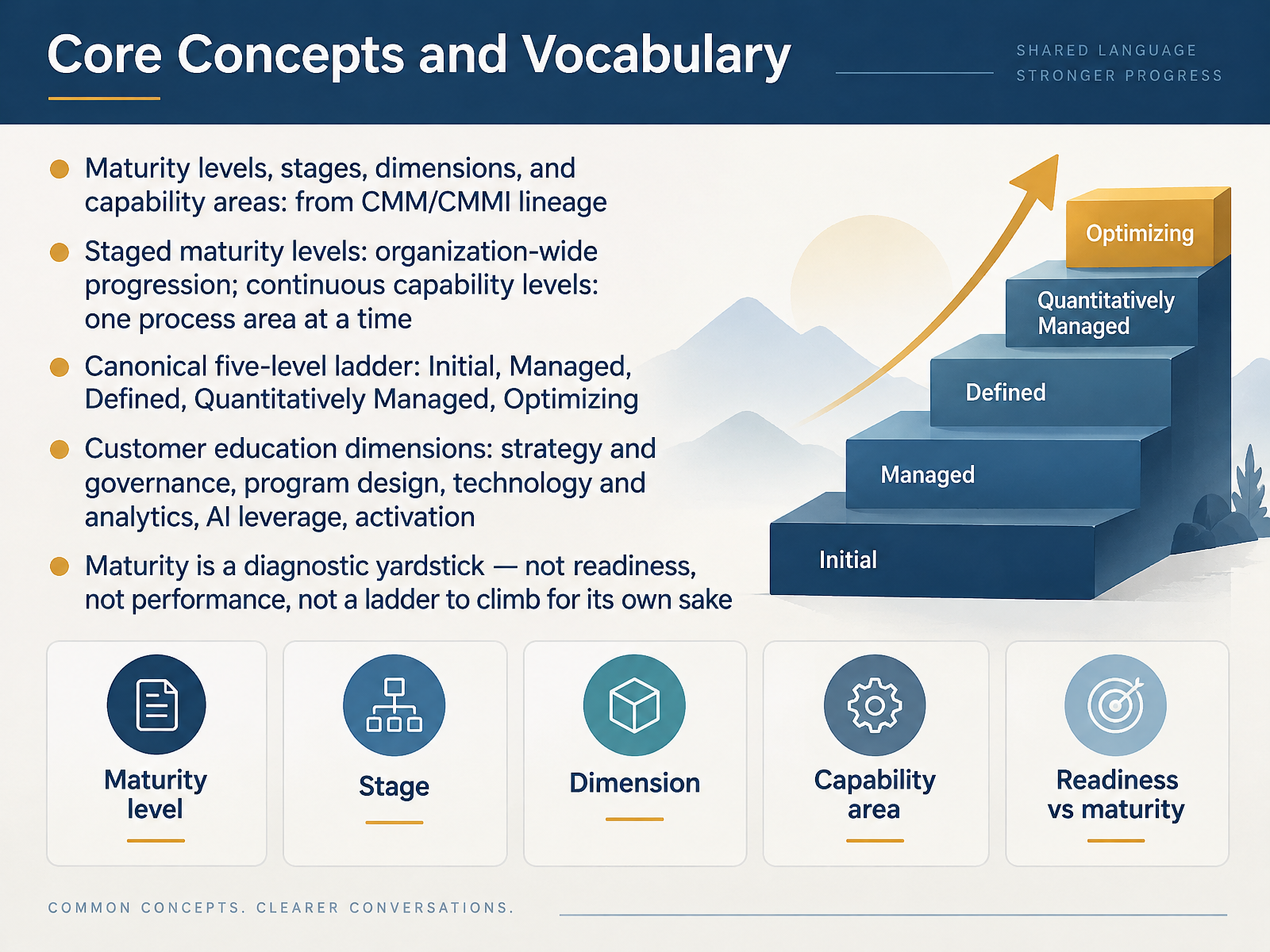
- 04Core Concepts and VocabularyBefore we look at specific models, let's align on vocabulary. Most of this language comes from the C M M and C M M I lineage, and a few of those terms get used loosely, so precision helps. First, two different lenses. Staged maturity levels describe organization-wide progression. Continuous capability levels assess one process area at a time. The canonical five-level ladder runs Initial, Managed, Defined, Quantitatively Managed, and Optimizing. In customer education, those levels play out across dimensions such as strategy and governance, program design, technology and analytics, A I leverage, and activation. Here's the discipline that matters. Treat maturity as a diagnostic yardstick. It is not readiness. It is not performance. And it is not a ladder to climb for its own sake. Use it to find the constraint worth fixing next. Next, we'll survey the major maturity models.
 insights.sei.cmu.edundia.dtic.milen.wikipedia.org+21 min
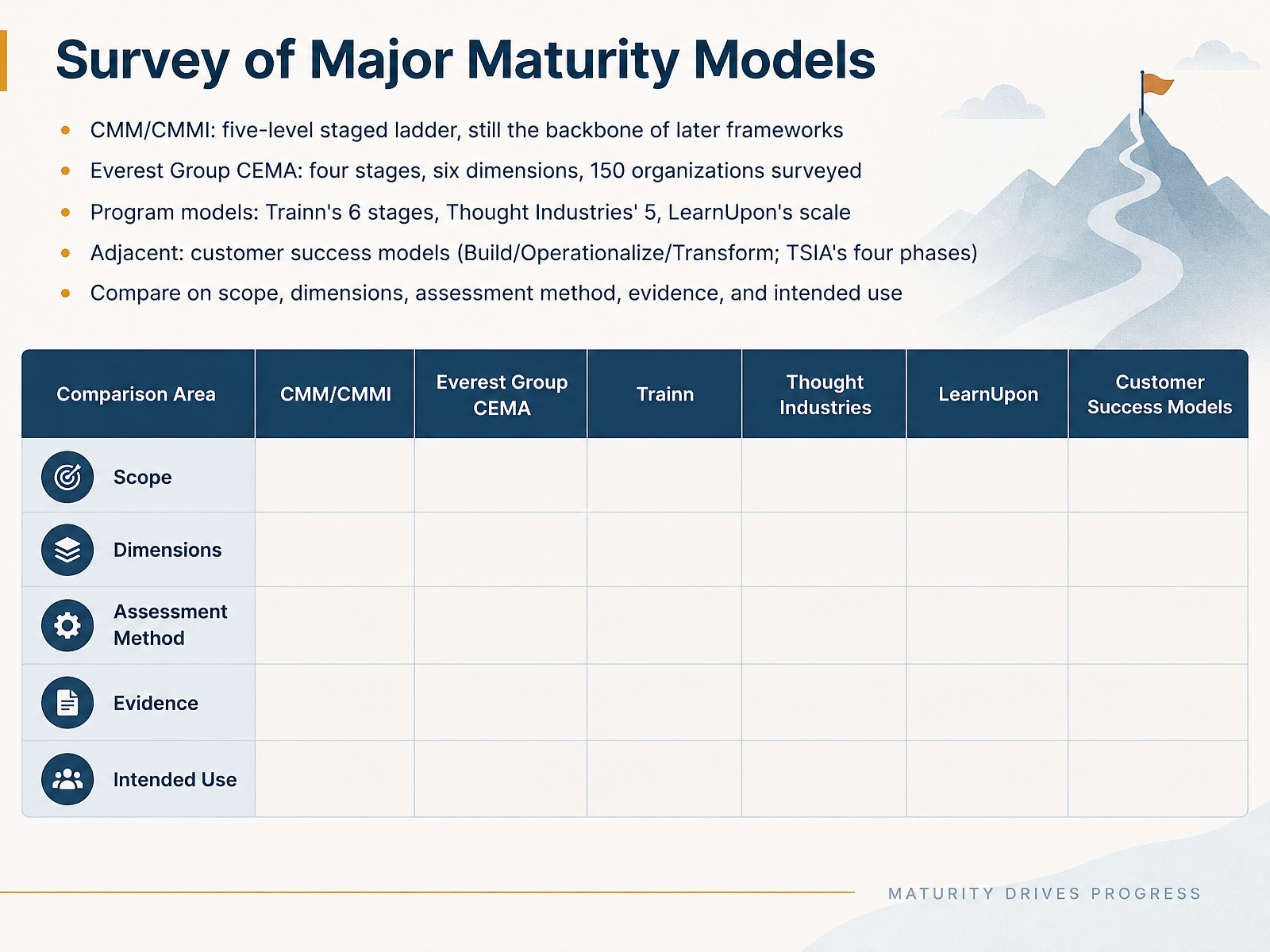
- 05Survey of Major Maturity ModelsLet's survey the landscape. C M M and C M M I gave us the five-level staged ladder, and it still sits underneath most later frameworks. Everest Group's C E M A refines that for customer education specifically, with four stages and six dimensions, grounded in a survey of one hundred fifty organizations. Then there are program models. Trainn's has six stages, Thought Industries' has five, and LearnUpon frames maturity as scale. Adjacent to all of these, customer success models like Build, Operationalize, Transform and TSIA's four phases cover the broader post-sale function. Notice how differently they are built. When you compare them, look at scope, dimensions, assessment method, evidence behind the model, and intended use. Those five criteria tell you whether a model can actually be applied in your team. Next, we'll break down the anatomy of a maturity model.
 everestgrp.combusiness.adobe.comtrainn.co+21 min
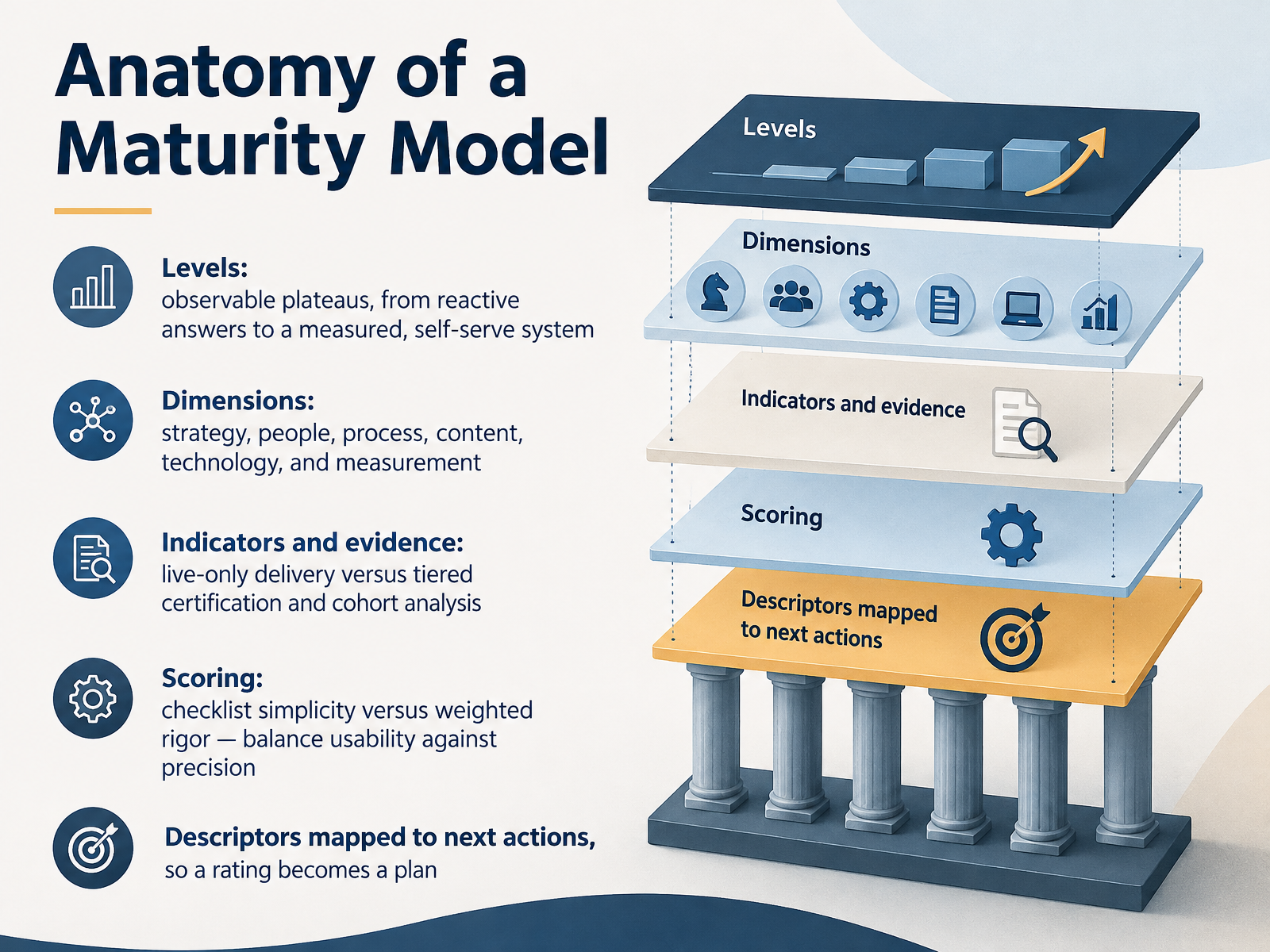
- 06Anatomy of a Maturity ModelLet's break down what a maturity model is actually made of. Four components. First, levels. Think of these as observable plateaus, from teams answering questions reactively one at a time, up to a measured, self-serve learning system. Each level should describe behavior you can see, not aspiration. Second, dimensions. The usual set is strategy, people, process, content, technology, and measurement. Score each one separately, because programs rarely mature evenly. Third, indicators and evidence. For example, live-only delivery versus tiered certification and cohort analysis. Evidence keeps the rating honest. Fourth, scoring. A simple checklist is easy to use but blunt. Weighted scoring is rigorous but heavy. Balance usability against precision, and match the method to how the results will be used. One more thing that matters. Map your descriptors to next actions, so a rating becomes a plan rather than a label. With that structure in mind, let's look at assessing your current maturity.
 insights.sei.cmu.edundia.dtic.milen.wikipedia.org+21 min
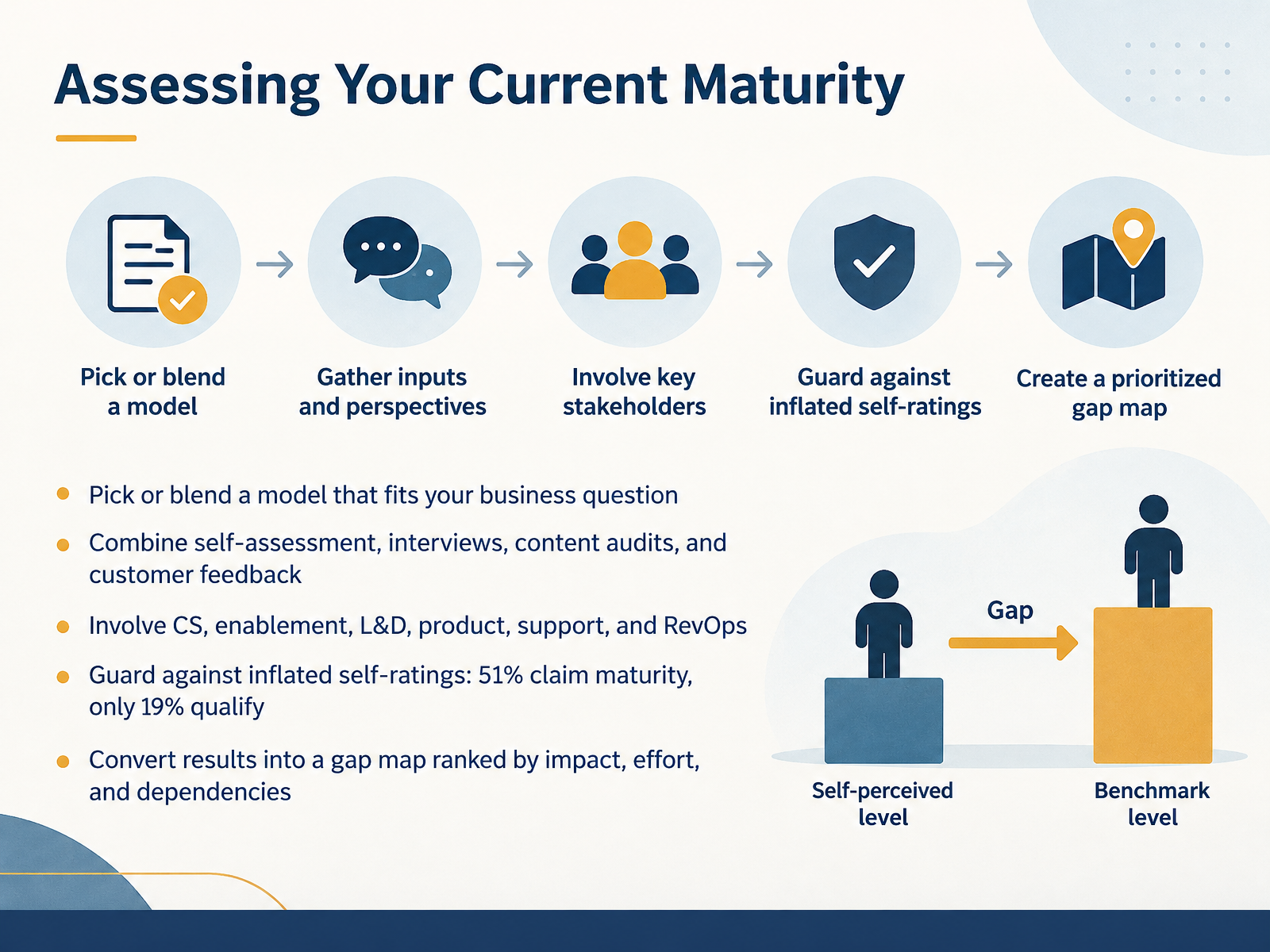
- 07Assessing Your Current MaturitySo how do you assess where you actually stand? Start by picking or blending a model that fits your business question. No single framework is sacred, so use the one that maps to what you need to prove. Then triangulate. Combine self-assessment, interviews, content audits, and customer feedback. Bring in CS, enablement, L and D, product, support, and RevOps, because each group sees a different part of the picture. One caution worth repeating. Guard against inflated self-ratings. In a recent benchmark study, fifty-one percent described their programs as mature, but only nineteen percent actually met the operational criteria. Nearly half of the self-described mature programs had one or no maturity pillars in place. So verify claims against evidence. Finally, convert results into a gap map ranked by impact, effort, and dependencies. From assessment to roadmap, that is where we go next.
 absorbai.comthinkific.comabsorbai.com+21 min
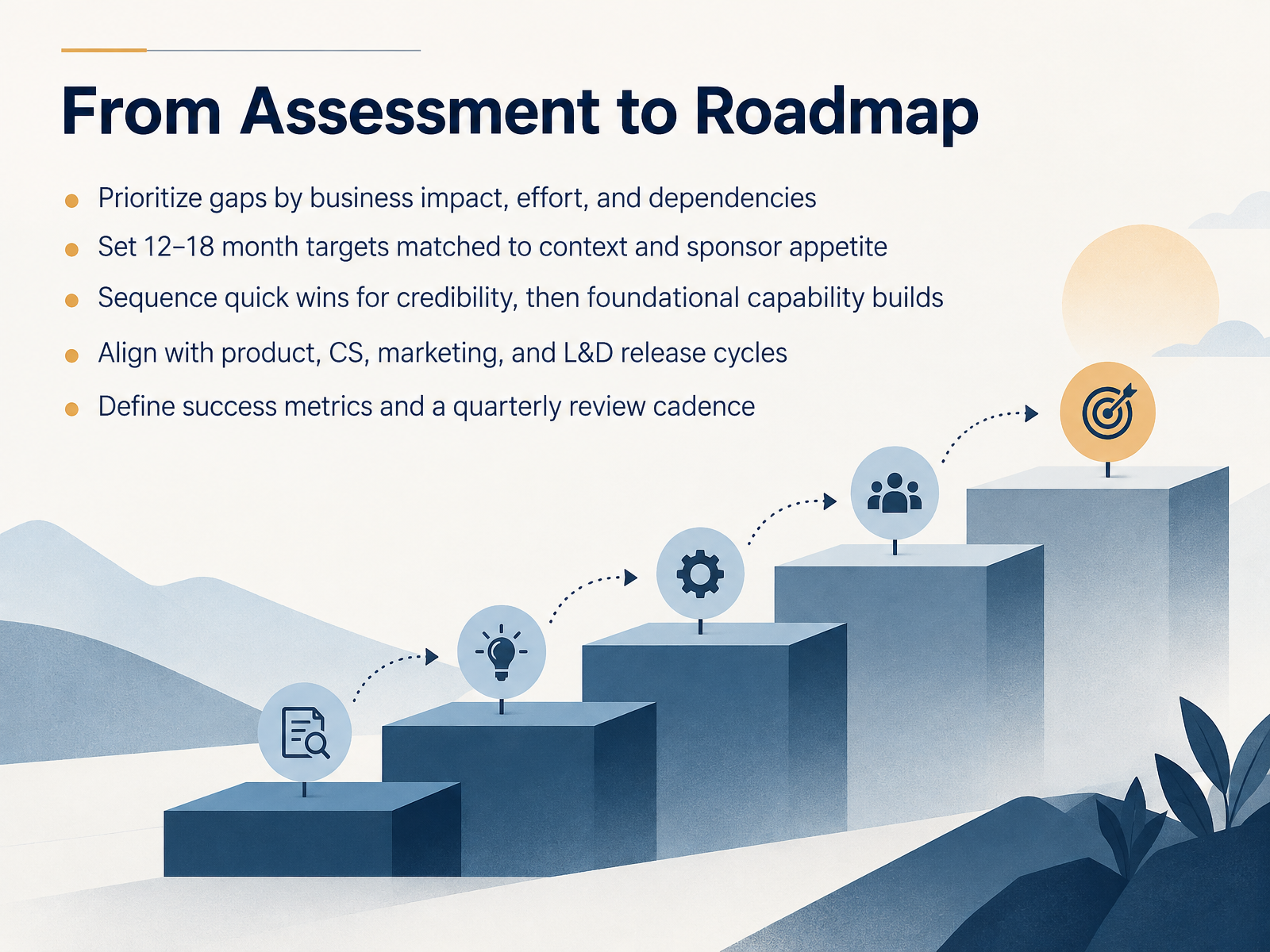
- 08From Assessment to RoadmapLet's talk about turning your assessment into a roadmap you can actually defend. Prioritize gaps by business impact, effort, and dependencies. Don't chase everything at once. Set targets for the next twelve to eighteen months, matched to your context and your sponsor's appetite for risk and investment. Sequence the work deliberately. Land quick wins first to build credibility, then invest in foundational capability builds. And align your roadmap with product, customer success, marketing, and learning and development release cycles, so education moves with the business instead of lagging behind it. Finally, define your success metrics and hold a quarterly review cadence. That rhythm keeps the roadmap honest and keeps your stakeholders engaged. Next, we'll look at the operating model and capabilities by maturity stage.
 action.deloitte.comeverestgrp.comabsorbai.com+21 min
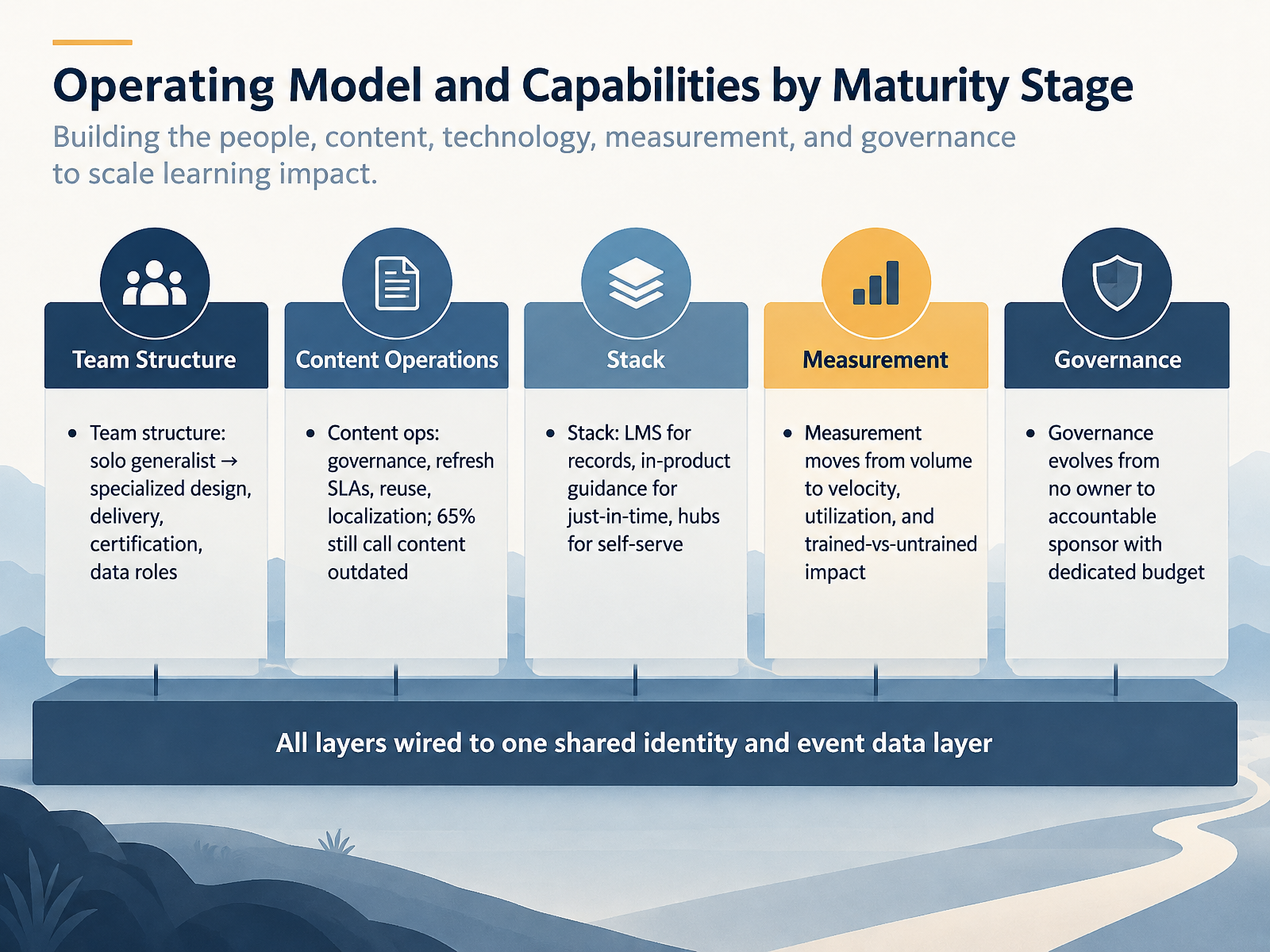
- 09Operating Model and Capabilities by Maturity StageLet's look at how the operating model and capabilities change as you move up the maturity curve. On team structure, most programs start with one generalist doing everything. Mature teams split that into specialized roles: design, delivery, certification, and data. Content operations follow the same pattern. You move from ad hoc publishing to governance, refresh service levels, reuse, and localization. And that matters, because sixty-five percent of programs still describe their content as periodically updated or outdated. The stack matures too. An LMS holds the record of learning, in-product guidance delivers help at the moment of friction, and knowledge hubs carry self-serve answers. The real milestone is wiring all of those layers to one shared identity and event data layer, so you can see what a customer actually did. Measurement then shifts from volume, like courses published, to velocity, utilization, and trained versus untrained impact. Governance evolves from no owner to an accountable sponsor with dedicated budget. That is the structure that makes the rest sustainable. Next, we'll connect education to revenue with measurement maturity.
 martech.zonecedma.orgappcues.com+22 min
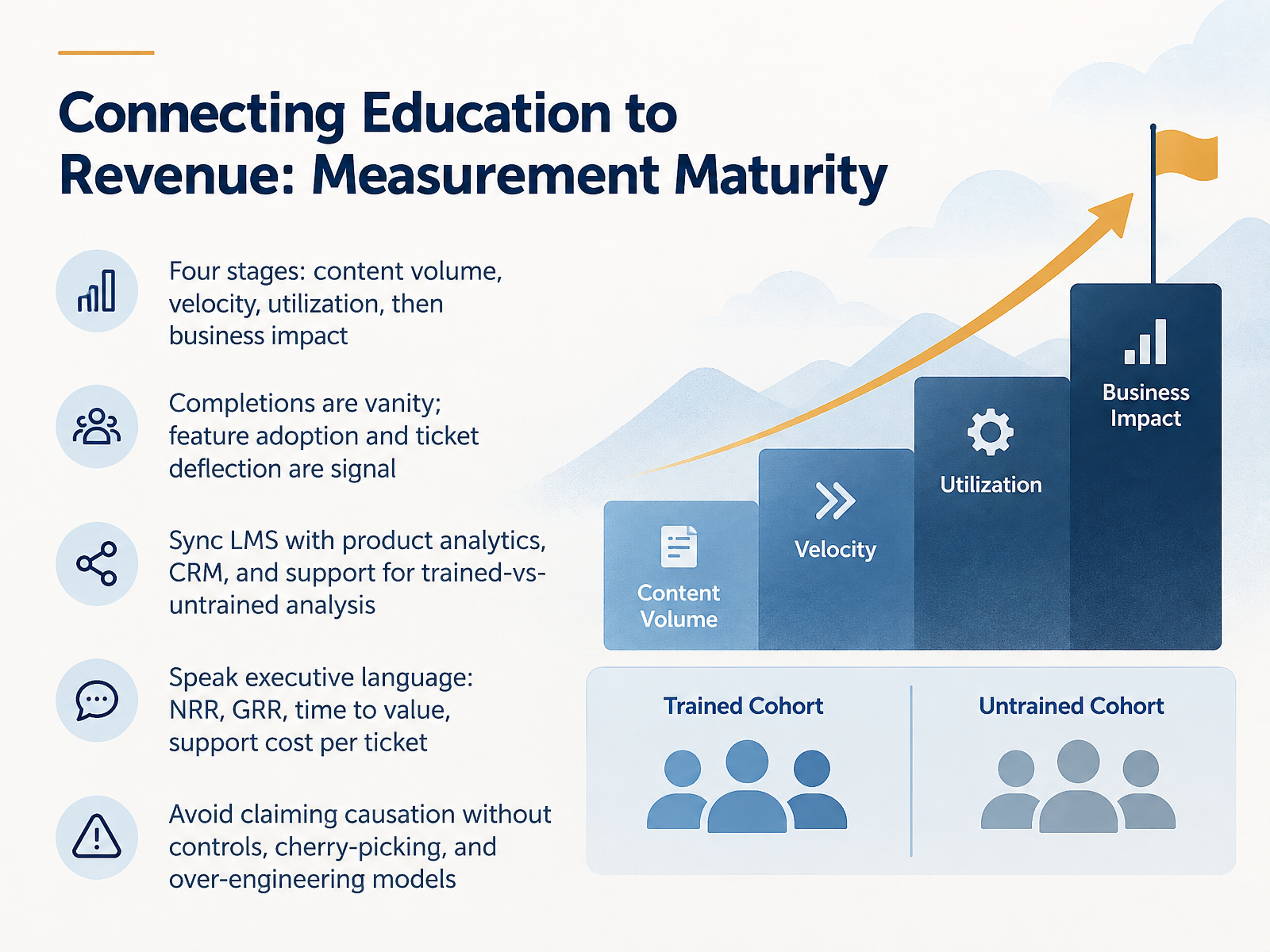
- 10Connecting Education to Revenue: Measurement MaturitySo let's talk about measurement maturity. Most programs move through four stages: content volume, then velocity, then utilization, and finally business impact. Completions are vanity. Feature adoption and ticket deflection are the real signal. To get there, sync your LMS with product analytics, your CRM, and support data so you can run trained versus untrained cohort analysis. Then speak the language your executives already trust: net revenue retention, gross revenue retention, time to value, and support cost per ticket. One word of caution. Avoid claiming causation without controls, resist cherry-picking success stories, and don't over-engineer models when strong correlation and a clear playbook are enough to make a smart decision. That discipline is what makes the numbers credible. Which brings us to the next layer of maturity: The AI Dimension of Maturity.
 action.deloitte.comeverestgrp.comabsorbai.com+22 min
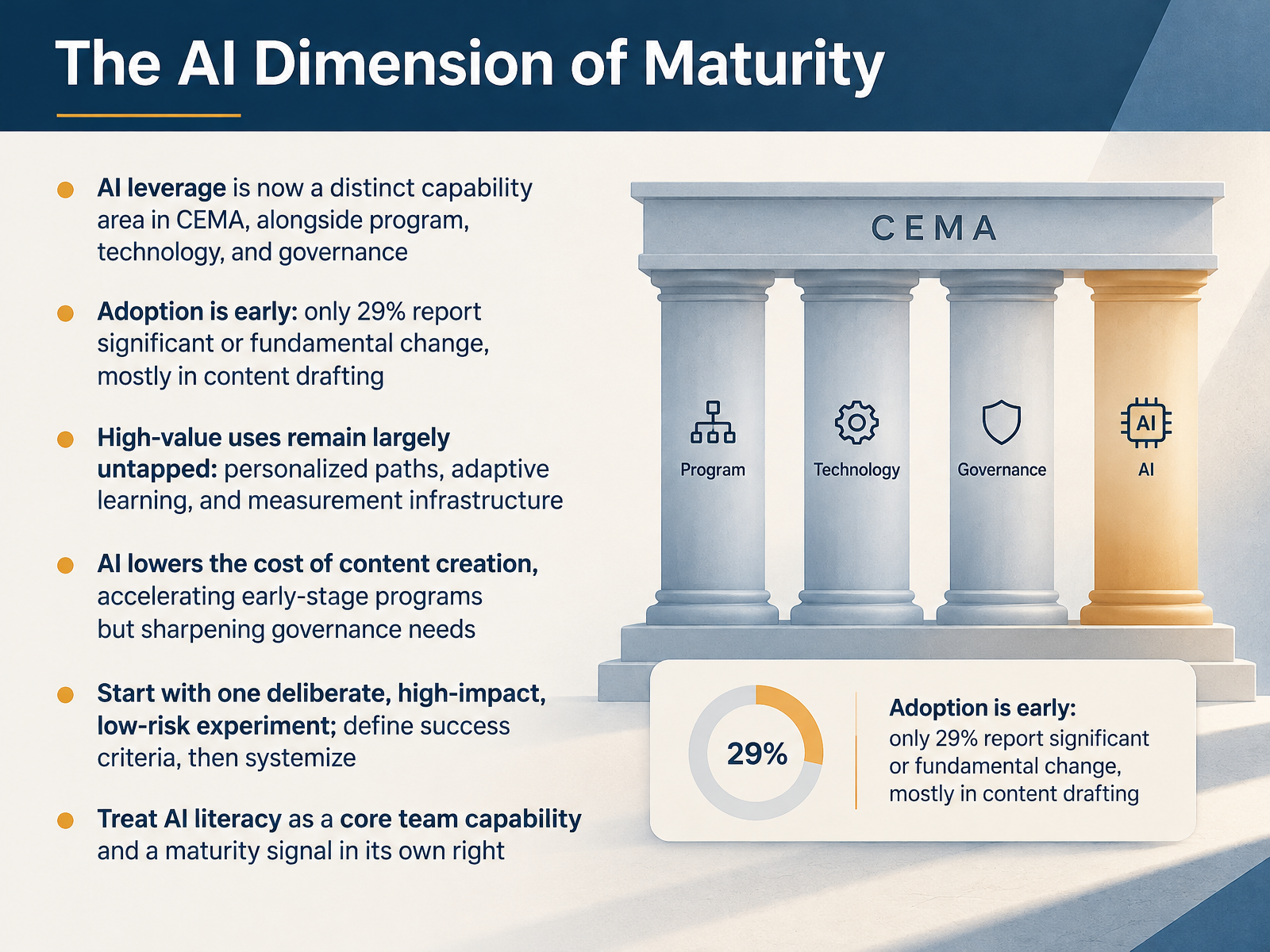
- 11The AI Dimension of MaturityNow let's look at the AI dimension of maturity. In the C E M A framework, AI leverage is now a distinct capability area, standing alongside program design, technology, and governance. It's no longer a side experiment. It's part of how maturity is judged.
That said, adoption is still early. Only twenty-nine percent of programs report significant or fundamental change from AI so far, and most of that sits in content drafting. The high-value uses remain largely untapped, things like personalized learning paths, adaptive learning, and measurement infrastructure. AI lowers the cost of content creation, which accelerates early-stage programs but also sharpens your governance needs.
So the practical move is this. Start with one deliberate, high-impact, low-risk experiment. Define your success criteria up front, measure it, then systemize what works. And treat AI literacy as a core team capability, because it is a maturity signal in its own right.
That leads us naturally into the next slide: Common Pitfalls and Critical Success Factors.
 everestgrp.comtrainn.cobusiness.adobe.com+22 min
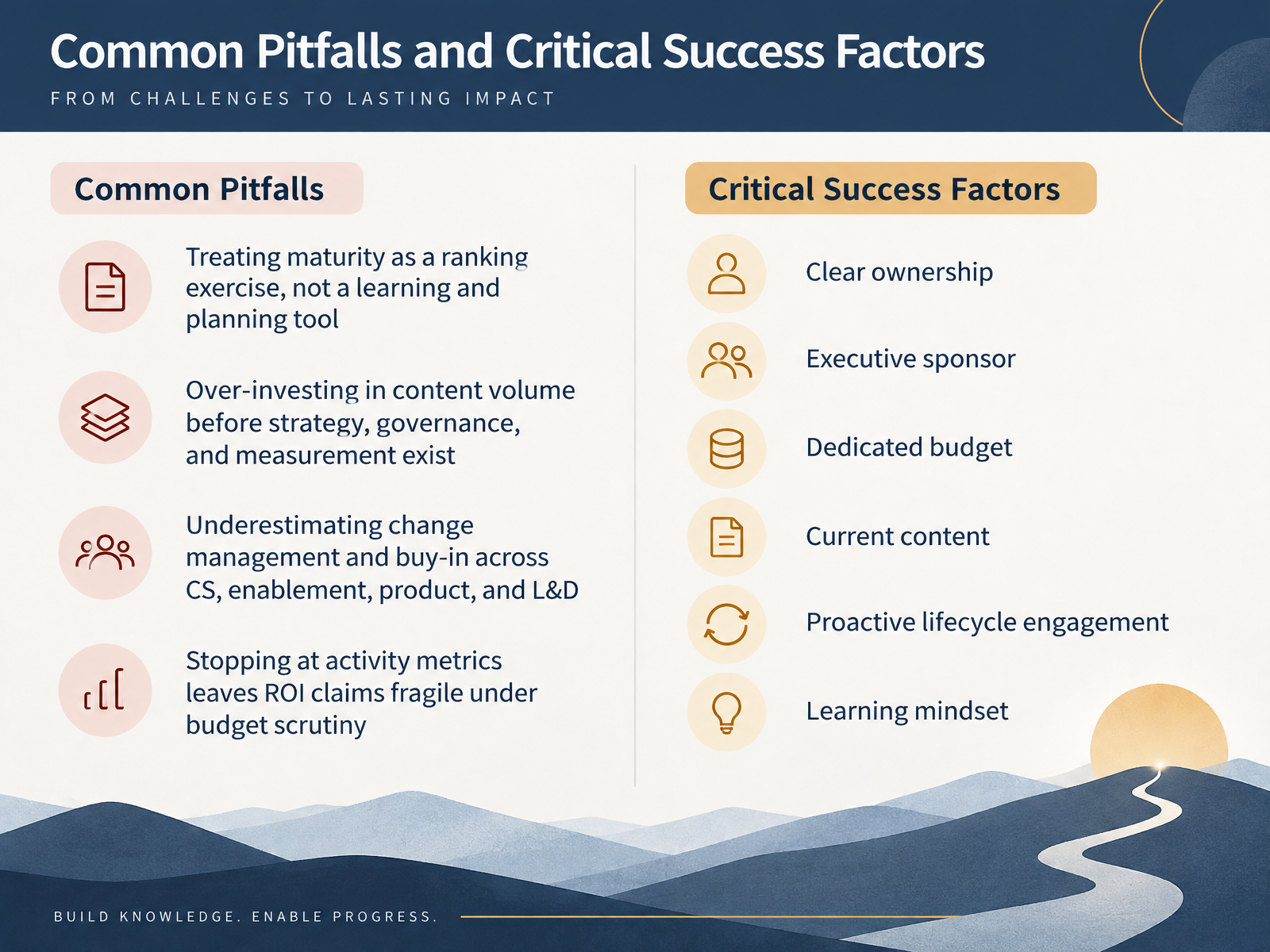
- 12Common Pitfalls and Critical Success FactorsNow let's name the pitfalls, because most of you have probably seen at least one of them up close. The first is treating maturity as a ranking exercise instead of a learning and planning tool. If your team treats the model as a scorecard, you lose the value of using it to spot the next capability to build. Second, over-investing in content volume before strategy, governance, and measurement exist. A large library with no owner and no outcome link is expensive shelf space. Third, underestimating change management and buy-in across Customer Success, enablement, product, and Learning and Development. Education only works when those teams reinforce it. And fourth, stopping at activity metrics, such as completions and logins. That leaves your return on investment claims fragile the moment budgets get scrutinized. So what separates programs that succeed? Clear ownership, an executive sponsor who is accountable, a dedicated budget, content that stays current, proactive engagement across the customer lifecycle, and a learning mindset. Pick one of those to strengthen this quarter. Next, we look at turning those factors into a repeatable practice in Building a Continuous Improvement System.
 absorbai.comthinkific.comabsorbai.com+22 min
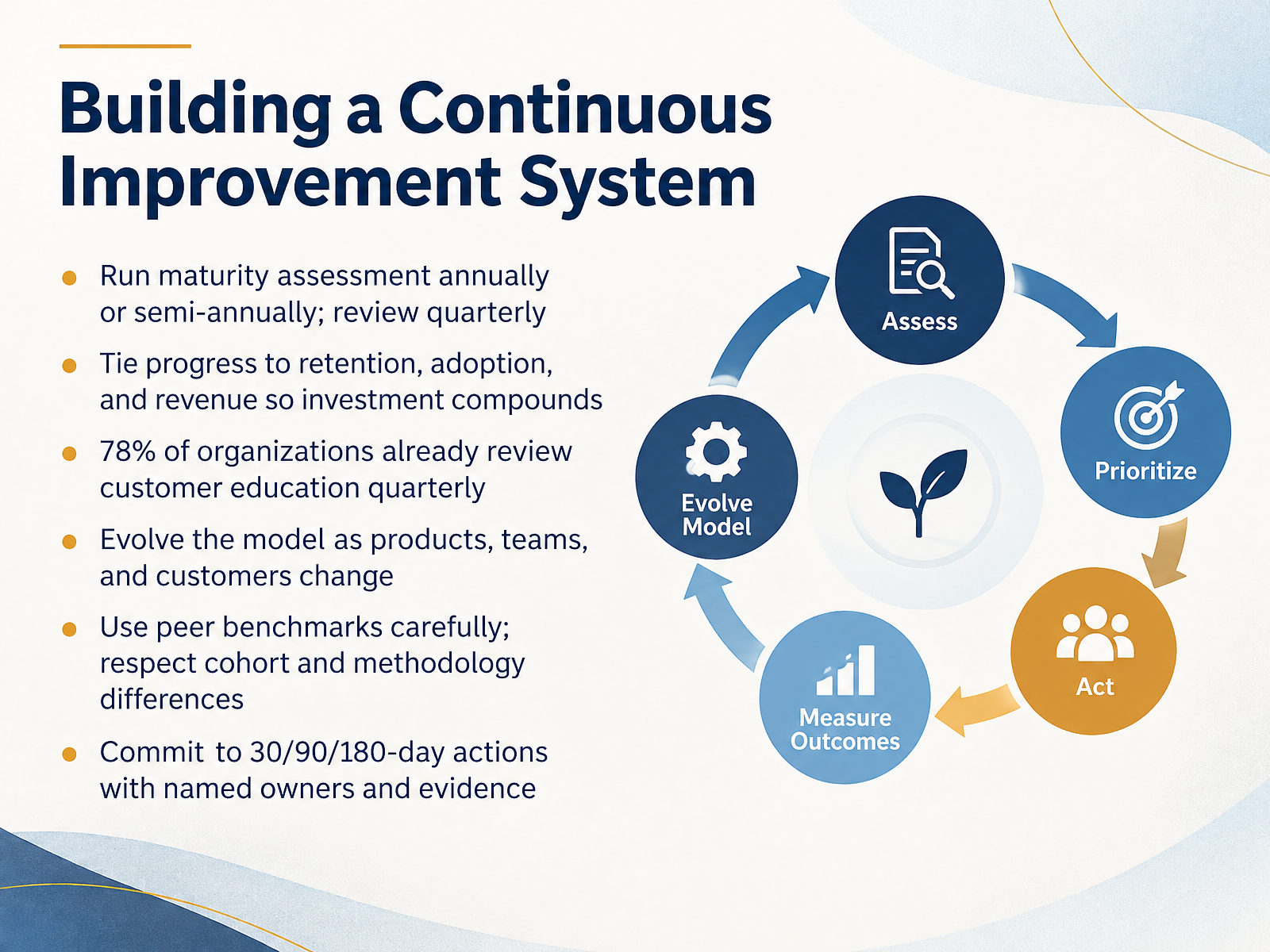
- 13Building a Continuous Improvement SystemLet's talk about turning maturity assessment into a continuous improvement system, not a one-time exercise. Run the assessment annually or semi-annually, and review progress quarterly. That cadence is already the norm, since seventy-eight percent of organizations review customer education at least quarterly. Tie every improvement to retention, adoption, and revenue, so each cycle compounds the investment instead of resetting it. Then let the model evolve as your products, teams, and customers change. A word of caution on peer benchmarks: use them carefully, and respect differences in cohort and methodology before you compare. Finally, commit to thirty, ninety, and one hundred eighty day actions, each with a named owner and evidence you'll bring to the next review. Now let's put this into practice with the workshop: your thirty, ninety, and one hundred eighty day action plan.
 action.deloitte.comeverestgrp.comabsorbai.com+21 min
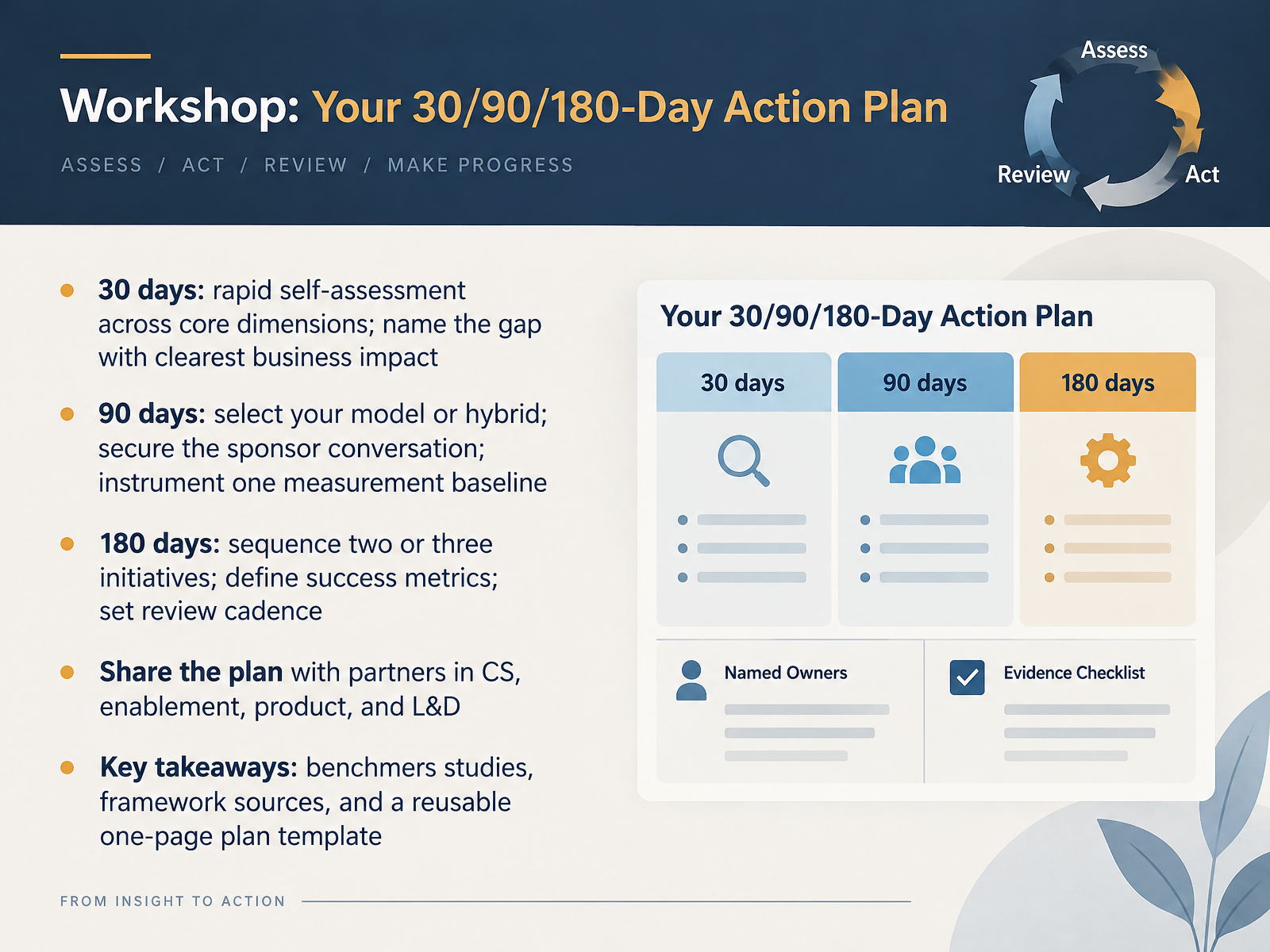
- 14Workshop: Your 30/90/180-Day Action PlanLet's bring this all together into a plan you can actually run. In the first thirty days, do a rapid self-assessment across the core dimensions, and name the one gap with the clearest business impact. In the next sixty, choose your model or a hybrid of a couple, secure that sponsor conversation, and instrument one measurement baseline. By one hundred eighty days, sequence two or three initiatives, define success metrics, and set a review cadence. Then share the plan with your partners in Customer Success, enablement, product, and Learning and Development. It matters, because only nineteen percent of programs meet the maturity benchmark, and sponsorship plus budget is what separates them. So use benchmark studies and framework sources, and put it all on a reusable one-page plan. Thank you for working through this with me. You now have a way to benchmark honestly and move deliberately, so pick your gap, start small, and build from there. Good luck.
 absorbai.comthinkific.comabsorbai.com+21 min
Take the deck with you
Download this course as a file — free, no sign-up needed.
- PDF handoutEvery slide page, ready to print or share.15 pages · 3.6 MBDownload
- Narrated PowerPointThe deck that presents itself — every slide carries the digital human's narration video.15 pages · 13.9 MBDownload
- PowerPoint slidesThe full deck as a .pptx — open it in PowerPoint, Keynote, or Google Slides.15 pages · 3.6 MBDownload
Free to use in your own training — please keep the PersonWise credit page at the end.
Have your own deck? Turn it into a course
Sources consulted
Web sources consulted while building this course.
- Capability Maturity Model for Software (Version 1.1) — insights.sei.cmu.edu
- Understanding Model Representations and Levels: What Do They Mean? — ndia.dtic.mil
- Capability Maturity Model — en.wikipedia.org
- Key Practices of the Capability Maturity Model Version 1.1 | CMU Software Engineering Institute — sei.cmu.edu
- The Capability Maturity Model for Software — doi.org
- The state of customer education in 2026 — absorbai.com
- From Learning To Revenue — thinkific.com
- New Absorb Software and Lighthouse Research & Advisory Study Reveals How the Highest-Performing Customer Education Programs Turn Learning into Measurable Growth | Absorb LMS Software — absorbai.com
- Maximizing Revenue & Organizational Value — go.cloudshare.com
- Customer Education: Benchmarks and ROI Report — thinkific.com
- Customer Education Maturity Assessment (CEMA) - Everest Group Research Portal — everestgrp.com
- What is customer education maturity in the age of AI? — business.adobe.com
- Customer Education Maturity Model: 6 Stages (2026) | Trainn — trainn.co
- The Customer Success Maturity Model — 6023880.fs1.hubspotusercontent-na1.net
- The Customer Success Maturity Model in 4 Phases — tsia.com
- The future of customer and partner education — action.deloitte.com
- Customer Education as Revenue Infrastructure | ThinkThru — thinkthru.co
- Building A Modern Customer Education Technology Stack | Martech Zone — martech.zone
- The Blueprint for a Customer Education Ecosystem: Scaling Impact Without Losing the Human Touch - Customer Education Management Association — cedma.org
- Best customer training software: 7 tools for every approach — appcues.com